PART 2: HOA Karen Kept Stealing My Firewood—Then One Stolen Log Ended Her HOA Reign
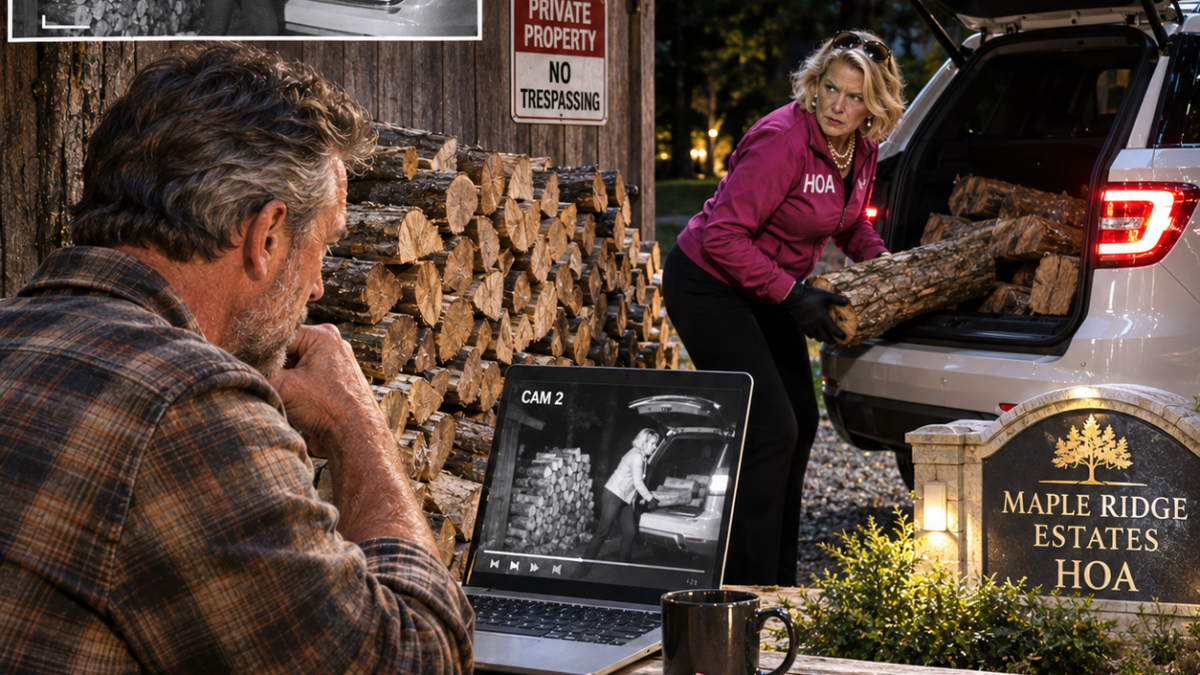
The first time I realized somebody was stealing my firewood, I thought it was a bored teenager; the night my security camera showed the HOA president loading my oak into her SUV at 1:21 in the morning, I stopped laughing.
What made it worse was that Karen Whitmore had spent the previous month fining me for keeping that exact same woodpile behind my shed, calling it an eyesore, a pest hazard, and a threat to the “visual harmony” of Maple Ridge Estates.
I could have marched to her door with the footage that morning, but when another HOA citation arrived before breakfast, I realized catching Karen wasn’t enough—I needed to know how far she was willing to go once she thought nobody could stop her.
My name is Tom Thompson, and before Karen moved into Maple Ridge, I had spent eight quiet years believing an HOA could be irritating without becoming personal.
I moved there after my wife, Elaine, died.
That first year after losing her, silence followed me everywhere. Our old house felt too large, every room holding some little reminder of her—a coffee mug she always used, the chair she read in, a jacket still hanging behind a closet door because I couldn’t make myself donate it.
Maple Ridge seemed like a place where I could start over without pretending I had forgotten anything.
I worked from home as a freelance mechanical engineer, mostly designing equipment upgrades for factories. My backyard became half sanctuary, half workshop: a tool shed, two workbenches, a smoker, an old stone fire pit, and a neatly stacked woodpile I cut every fall.
Splitting oak had become one of those repetitive jobs that quieted my head.
Karen hated it immediately.
She moved two houses down, and within weeks somehow became HOA president.
Her first visit came on a Tuesday morning.
She stood on my porch wearing a fitted navy jacket, pearl earrings, and the expression of someone delivering a court order.
“Mr. Thompson?”
“Yes?”
She handed me a printed notice.
“Your outdoor wood storage violates community aesthetic standards.”
I looked past her toward my backyard.
“My woodpile?”
“It is visible from certain angles.”
“From whose angles?”
She didn’t appreciate that.
“It disrupts neighborhood symmetry.”
I almost smiled.
“Karen, it’s firewood.”
“Which does not exempt it from the covenants.”
I read the paper again.
“You’re giving me ten days to remove it?”
“Relocate it.”
“It’s behind my shed.”
“Not adequately.”
She turned before I could answer.
I didn’t move the woodpile.
I stacked it more tightly, repaired one loose section of fence, and assumed that would be enough.
A week later, approximately twenty pieces of seasoned oak disappeared.
I blamed my memory.
Two nights later, another dozen were gone.
Then more.
The logs were worth money, sure, but that wasn’t what bothered me.
Someone was entering my fenced yard after dark.
So I began marking the ends with tiny cuts only I would recognize.
The next morning, four marked logs were missing.
Near the side gate, the damp grass showed narrow heel prints.
I stood there longer than I want to admit.
There were not many people in Maple Ridge wandering through backyards in heeled boots after midnight.
That afternoon another HOA letter arrived.
**CONTINUING FIREWOOD VIOLATION.**
Signed:
**Karen Whitmore, President.**
I was staring at the signature when something made me drive past her house.
Through the large front window, beside her fireplace, I saw a steel log rack.
On it sat fresh-cut oak.
One piece had two shallow diagonal marks near the end.
My marks.
My hand tightened around the steering wheel.
Karen was stealing the same firewood she was threatening to fine me for keeping.
I could have confronted her right there.
Instead, I went home and installed two security cameras.
For two nights, nothing happened.
Then my phone buzzed at 1:21 a.m.
Motion detected.
I opened the live feed.
Karen walked through my side gate wearing a beige coat, scarf, gloves, and the same heeled boots whose prints I’d found in the grass.
She didn’t hesitate.
She went directly to the pile.
Picked up my logs.
Carried them to her SUV.
Then, while stacking the last few pieces inside, she whispered something the camera microphone barely caught.
“He won’t miss it.”
She paused.
Then added:
“It’s for the community anyway.”
I replayed those words three times.
The next morning, before I had even finished my coffee, another envelope appeared in my mailbox.
Inside was a $250 fine for failing to remove my “hazardous wood storage.”
I set the citation beside my laptop.
On the screen, frozen in crystal-clear night vision, was Karen carrying the very property she had just fined me for owning.
And for the first time since Elaine died, anger pushed every other thought completely out of my head.
PART 2
I sat at my kitchen table for nearly an hour without touching my coffee.
On the laptop screen, Karen’s face was turned slightly toward the camera.
She had no idea it was there.
No hesitation.
No nervous glance toward the house.
She carried herself like somebody performing a duty she genuinely believed she had the right to perform.
That disturbed me almost more than the theft itself.
I clicked backward.
1:21:13 a.m.
Gate opened.
1:21:26.
Karen entered.
1:22:04.
First log removed.
1:24:31.
SUV hatch opened.
1:26:17.
She said:
“He won’t miss it.”
Then:
“It’s for the community anyway.”
I exported the recording.
Saved it to my computer.
Saved another copy to a portable drive.
Uploaded one to cloud storage.
Then emailed a copy to myself.
Thirty years of engineering taught me something simple.
Never rely on one point of failure.
I printed the HOA fine.
Placed it beside a photograph of the marked firewood visible through Karen’s window.
Then I opened a new folder.
On the front I wrote:
**WHITMORE**
For half a second, I almost added:
**THEFT.**
I didn’t.
Not yet.
Facts first.
Conclusions later.
Elaine used to tease me about that.
“You can turn ordering dinner into a root-cause analysis.”
I could hear her voice so clearly that morning I nearly looked toward the hallway.
That still happened sometimes.
Grief doesn’t disappear.
It just becomes less surprised to find you.
I closed the folder.
Then the phone rang.
Karen.
I let it ring twice before answering.
“Tom.”
Her tone was brisk.
Professional.
As if she had not been walking through my backyard six hours earlier.
“Morning.”
“You received the violation notice?”
“I did.”
“Good.”
She sounded pleased.
“The board has been very patient.”
“The board?”
“Yes.”
“With my firewood?”
“With your refusal to comply.”
I looked at the frozen video frame.
Karen carrying two oak logs against her chest.
“Interesting.”
“What is?”
“Nothing.”
She continued.
“You now have seventy-two hours to remove the remaining pile.”
“Remaining?”
A pause.
Tiny.
But there.
“Yes.”
“You make it sound like you know how much is left.”
Silence.
Then:
“It’s visible from the community walkway.”
“There isn’t a community walkway behind my fence.”
“You’re being argumentative.”
“No.”
I leaned back.
“I’m being specific.”
Her voice cooled.
“Tom, you’ve been here long enough to understand that individual preferences sometimes have to give way to neighborhood standards.”
“Does that apply to everybody?”
“Of course.”
“Even the HOA president?”
Long pause.
“What exactly are you implying?”
“Nothing.”
I smiled despite myself.
“Yet.”
She inhaled sharply.
“I expect compliance.”
Then hung up.
I stared at the phone.
That word.
Compliance.
Karen used it constantly.
She didn’t want cooperation.
Cooperation requires consent.
She wanted compliance.
—
The next HOA meeting was scheduled for that afternoon.
Normally I avoided those meetings.
There are only so many forty-minute debates about mailbox paint a man should survive voluntarily.
That day, I arrived ten minutes early.
The clubhouse was beige inside and out.
Rows of folding chairs.
Coffee nobody wanted.
A table at the front.
Mrs. Beasley, the treasurer, sat beside a stack of financial reports.
Vice President Harold Wilson sat at the other end.
Wilson was a retired attorney in his late sixties.
Quiet.
Careful.
The kind of man who listened long enough to make loud people nervous.
He nodded when I entered.
“Tom.”
“Harold.”
Karen arrived seven minutes late.
Of course.
Coffee cup in one hand.
Clipboard in the other.
The mug said:
**BOSS LADY**
Subtle.
She sat.
Tapped the table.
“Let’s begin.”
Landscaping budget.
Parking complaint.
Someone’s fence.
Then:
“Next item.”
She looked directly at me.
“Mr. Thompson’s continued refusal to resolve his outdoor-firewood violation.”
Every head turned.
I crossed my arms.
Karen continued.
“Despite multiple warnings, excessive combustible material remains visible and represents both a pest risk and a potential fire hazard.”
A man behind me muttered:
“It’s wood, Karen.”
Several people laughed quietly.
She ignored them.
“The president’s office recommends an immediate two-hundred-fifty-dollar fine and mandatory removal within seventy-two hours.”
I raised my hand.
Karen gave me an indulgent smile.
“Mr. Thompson.”
“Just one question.”
“Briefly.”
“You said you’ve documented the pile recently.”
“Yes.”
“How recently?”
“Within the last forty-eight hours.”
I nodded.
“Interesting.”
Karen’s smile tightened.
“Why?”
“Because quite a bit of it disappeared during those forty-eight hours.”
She blinked.
“Maybe you miscounted.”
“I don’t misplace seasoned oak.”
A few people turned toward one another.
I continued.
“So after the second theft, I installed cameras.”
Karen stopped moving.
Completely.
I watched her fingers tighten around the pen.
“And?”
“And one of them recorded the person taking the wood.”
Mrs. Beasley looked up.
Wilson leaned forward.
Karen laughed too quickly.
“I don’t see what that has to do with HOA enforcement.”
“It doesn’t.”
I took out my phone.
“It has to do with theft.”
Her face changed.
“Tom.”
“Yes?”
“Be very careful about accusing people.”
“I agree.”
“So let’s not accuse anybody.”
I unlocked the phone.
“Let’s watch.”
She stood.
“That’s unnecessary.”
“Why?”
“This meeting concerns your violation.”
“Which involves firewood.”
“We don’t have time.”
Wilson spoke for the first time.
“We have time.”
Karen turned.
“Harold.”
“If someone’s entering homeowners’ yards at night, that’s relevant.”
She looked at Mrs. Beasley.
Mrs. Beasley avoided eye contact.
I opened the clip.
Didn’t even play it yet.
Karen saw the thumbnail.
Her.
Beige coat.
My gate.
She stared.
Then said:
“You can’t record people without permission.”
I almost laughed.
“The camera is on my property.”
“Invasion of privacy.”
“Inside my fenced yard?”
“You deliberately targeted me.”
“I installed it because somebody was stealing my wood.”
A neighbor whispered:
“Play it.”
Then another:
“Yeah.”
Karen looked around.
“You are all participating in harassment.”
Wilson’s voice remained calm.
“Karen, sit down.”
She didn’t.
I pressed play.
The room watched.
Gate.
Flashlight.
Heeled boots.
Karen.
First log.
Second.
Third.
SUV.
Then the audio.
“He won’t miss it.”
Silence.
Then:
“It’s for the community anyway.”
The video ended.
Nobody spoke for several seconds.
Mrs. Beasley slowly removed her glasses.
“Karen?”
Karen’s face had gone red.
“That recording has been manipulated.”
I almost admired the speed.
“Really?”
“Yes.”
“You think I fabricated you, your SUV, your clothes, and your voice?”
“Technology can fake anything now.”
A teenager sitting beside his father whispered:
“That’s definitely her car.”
His father elbowed him.
Karen pointed at me.
“This is exactly the kind of hostility I’ve been warning everyone about.”
I stared.
“You entered my yard.”
“Your gate wasn’t secured.”
“That doesn’t make it public.”
“I was removing a community hazard.”
“You put the community hazard in your fireplace.”
Her face went still.
There it was.
I hadn’t directly said I’d seen the logs at her house before.
She realized it too late.
Someone laughed.
Then several others.
Karen grabbed her clipboard.
“This meeting is adjourned.”
Wilson said:
“No.”
She stopped.
“What?”
“We haven’t voted.”
“I am postponing the item.”
“Fine.”
Wilson looked at me.
“The firewood fine is suspended pending board review.”
Karen spun.
“You can’t do that.”
“I just did.”
“I’m president.”
“You’re one member of a board.”
Silence again.
Different this time.
Karen stared at him.
Then at me.
“You’ll regret this.”
She walked out.
The door slammed.
Nobody followed.
—
Doug Miller caught me in the parking lot afterward.
Different Miller than some others in the neighborhood; Maple Ridge had enough Millers to start its own census category.
He shook his head.
“That woman really stole your wood.”
“Apparently.”
“And fined you for having it.”
“Apparently.”
Doug laughed.
“I thought my ex-wife was complicated.”
Mrs. Beasley came out next.
She looked embarrassed.
“Tom.”
“Yes?”
“I’m sorry.”
“You didn’t steal anything.”
“No.”
She lowered her voice.
“But I voted for several of those fines.”
“Did you know what she was doing?”
“Not exactly.”
“Then why vote?”
That landed harder than I intended.
She looked down.
“Because arguing with Karen takes hours.”
That answer stayed with me.
Not fear exactly.
Exhaustion.
“She wears people down,” Mrs. Beasley said. “Every issue becomes a battle. Eventually everybody says yes because we want to go home.”
I understood immediately.
Karen’s power wasn’t authority.
It was endurance.
She could make resistance cost more time and emotional energy than surrender.
“You can change that.”
Mrs. Beasley looked toward the clubhouse.
“Maybe.”
“Not maybe.”
She looked at me.
“Are you filing a police report?”
“I haven’t decided.”
“You should.”
“Maybe.”
Now she smiled.
“Not maybe?”
“Fair.”
—
For three days, Maple Ridge was quiet.
No Karen at my door.
No violation notices.
No camera patrol.
My firewood remained untouched.
Then another envelope arrived.
**NOTICE OF VIOLATION**
**UNAPPROVED EXTERIOR SECURITY EQUIPMENT**
Apparently my cameras were now the problem.
I read it twice.
Then called Wilson.
“Did the board approve this?”
Silence.
“Harold?”
“No.”
“Was there a vote?”
“No.”
“Then who issued it?”
“You know who.”
“Karen?”
“Yes.”
“Still?”
A sigh.
“She says existing presidential authority allows emergency safety enforcement.”
“Does it?”
“No.”
“Then why is she doing it?”
Another silence.
“Because nobody has stopped her.”
That answer was painfully familiar.
I hung up.
Walked into my workshop.
And for the first time, anger got ahead of judgment.
On one shelf were old demonstration materials from years of mechanical-design projects.
Scrap sections.
Prototype parts.
Some hollow wood pieces I’d once used in a vibration experiment.
I stared at them.
Then at a cabinet where I kept supplies from past holiday projects.
An ugly idea formed.
Make a few logs look real.
Make them produce a dramatic surprise when Karen burned them.
Something loud enough to scare her.
My engineer’s brain immediately began solving problems my adult brain should not have been posing.
I pulled out a sketchpad.
Wrote:
**FIREWOOD PROJECT**
Then stopped.
I stared at those words.
Elaine’s photograph sat above the workbench.
She was laughing in it.
Hair pulled back.
One hand resting on my shoulder.
I could almost hear her.
**Thomas, what exactly are you doing?**
I put the pencil down.
The answer was:
Something stupid.
Maybe dangerous.
Definitely something Karen could use to turn herself into the victim.
I had spent days proving she was wrong.
One reckless stunt and I could hand her everything she needed.
I tore the page out.
Shredded it.
Then stood in the workshop until my pulse slowed.
Revenge had started to feel attractive because I was angry.
That wasn’t the same as it being smart.
I called Officer Ramirez at the non-emergency number.
We had spoken before at neighborhood safety events.
He answered after a transfer.
“Ramirez.”
“Officer, it’s Tom Thompson.”
“Maple Ridge?”
“Yes.”
“Firewood guy?”
Apparently fame travels.
“Yes.”
“What happened?”
“I have video of the HOA president entering my property at night and removing firewood.”
“Multiple times?”
“At least once clearly. Strong indications before that.”
“Want to report it?”
“Yes.”
That was the moment the strategy changed.
Not trap her with something explosive.
Trap her with evidence.
Much harder for Karen to turn against me.
—
Ramirez came by that afternoon.
Watched the footage.
Asked for the original file.
I gave him a copy.
He walked the property line.
Photographed the gate.
The pile.
Asked about the logs.
“Value?”
“Maybe a few hundred dollars total over the season.”
“Not huge.”
“No.”
“But trespass matters.”
“Yes.”
“Have you told her not to enter?”
“Repeatedly.”
He wrote.
“Any written proof?”
I showed him the HOA emails.
Then Karen’s camera violation.
He frowned.
“She fined you for cameras after the cameras recorded her?”
“Yes.”
He shook his head.
“People are fascinating.”
I leaned against the fence.
“What happens?”
“Could pursue theft and trespass depending on circumstances and what you want.”
“I want it stopped.”
“Then start with formal notice.”
“Through you?”
“Through attorney if you want stronger paper.”
I thought.
“And if she comes back?”
“Call.”
“That’s it?”
“That’s usually how the law works.”
“Less satisfying than movies.”
“Much safer.”
I smiled.
“Fair.”
Before leaving, Ramirez turned.
“One more thing.”
“Yeah?”
“Don’t do anything cute.”
I froze.
“What?”
“You’re an engineer.”
“How do you know?”
“Doug talks.”
Of course Doug talks.
Ramirez pointed toward the workshop.
“I’ve seen neighborhood feuds turn into booby traps.”
“I wasn’t—”
He raised an eyebrow.
I stopped.
“Okay.”
“Don’t.”
“I won’t.”
He nodded.
“Good.”
That five-second conversation probably saved me from making the dumbest decision of my life.
—
Sarah—no, my lawyer in this case was Natalie Pierce.
She specialized in property disputes and civil harassment.
When I showed her the footage, she watched twice.
Then asked:
“Why haven’t you filed sooner?”
“Because I hoped the HOA would handle it.”
She looked at the camera citation.
“This HOA?”
“Point taken.”
We sent Karen formal written notice.
No entry onto my property.
No removal of personal property.
No direct contact except through proper HOA procedure.
Then something interesting happened.
Nothing.
For five nights.
No theft.
No notes.
No Karen.
I started wondering if legal paper had finally done what common sense couldn’t.
Then my camera pinged.
1:08 a.m.
Karen.
Different coat.
Different shoes.
Same flashlight.
I watched live.
She stopped at the gate.
Read the new **NO TRESPASSING** sign.
Looked toward my house.
Then opened the gate.
My hand tightened around the phone.
She went to the woodpile.
This time, I had prepared something completely different.
Three logs had harmless tracking tags concealed in natural cracks, the kind used to keep track of equipment and property.
No chemicals.
No explosives.
Nothing that could hurt anyone.
Just location data.
If she took them, she would prove exactly where the stolen property went.
Karen lifted the first tagged log.
Then another.
Then the third.
Loaded all three into her SUV.
I called Ramirez.
“She’s back.”
“You watching?”
“Yes.”
“Stay inside.”
“I am.”
“Do not confront.”
“Understood.”
Patrol officers arrived several minutes after Karen left.
I showed them the video.
Then the tracker location.
All three tags had stopped two houses away.
Karen’s address.
One officer stared at the screen.
“That accurate?”
“Within a limited radius, yes.”
“You’re certain those logs are yours?”
“Marked, photographed, tagged, and recorded leaving my yard.”
He looked at his partner.
“That is unusually organized.”
“Engineer.”
“Of course.”
—
Nobody kicked in Karen’s door.
Real policing is not television.
Ramirez documented the theft.
Officers contacted Karen the next morning.
She denied taking anything.
Then admitted she had “removed hazardous materials.”
Then claimed HOA authority.
Then said the firewood had been abandoned.
Then argued the wood was technically community property because it violated neighborhood standards.
I learned all of this later through the incident record and the board hearing.
What mattered immediately was that the logs were recovered.
Still stacked beside her fireplace.
Tags intact.
My marks visible.
Karen received a formal citation related to trespass and theft allegations, with the matter routed through the appropriate local process.
She was furious.
At me.
Not herself.
That part was almost impressive.
She called from a blocked number.
“Tom.”
“Natalie told you not to contact me directly.”
“You had police come to my house.”
“You stole from mine.”
“I was enforcing a safety rule.”
“Then why did you put the wood beside your fireplace?”
Silence.
“You tracked me.”
“I tracked my property.”
“That is illegal surveillance.”
“Call your lawyer.”
“You think you’re clever.”
“No.”
I looked out at my woodpile.
“I think I’m tired.”
Her voice became quieter.
“You’ve turned everybody against me.”
“I haven’t.”
“Yes, you have.”
“Karen, you walked into my yard after being told not to.”
“That wood was a violation.”
“You stole it.”
“It needed removal.”
“You burned the earlier pieces.”
“That is not relevant.”
“It is extremely relevant.”
She breathed hard.
Then:
“You’re going to regret embarrassing me.”
There it was again.
Not:
I made a mistake.
Not:
I shouldn’t have entered your yard.
Embarrassing me.
Her real injury was never the firewood.
It was public loss of control.
—
The HOA called an emergency meeting.
This time, Wilson—not Karen—issued the notice.
Subject:
**BOARD CONDUCT AND PRESIDENTIAL AUTHORITY**
The clubhouse was packed.
People who never attended showed up.
Doug sat near the back with coffee.
Mrs. Beasley sat at the board table.
Karen sat in the president’s chair.
Still.
Technically.
For now.
She wore a gray suit.
No pearls.
Her face looked tired.
Wilson called the meeting to order.
“Tonight we are addressing several matters involving the board president and a homeowner.”
Karen interrupted.
“Let’s call it what it is.”
Wilson looked at her.
“What?”
“An attack.”
“No.”
She pointed at me.
“He has been undermining this association for weeks.”
Murmurs.
Wilson said:
“You will have time.”
“I have time now.”
“Karen.”
She stared at him.
Then leaned back.
Wilson nodded to me.
“Tom.”
I stood.
No speech.
I had promised Natalie.
Facts.
“About six weeks ago, firewood began disappearing from my property.”
I showed photographs.
“After repeated thefts, I installed cameras.”
Video.
Karen entering.
Removing logs.
SUV.
Audio.
The room watched.
Nobody laughed this time.
This had gone beyond comedy.
Then I showed the first fine.
Karen accusing me of improper wood storage.
Then a photograph of my marked logs visible in her fireplace rack.
Mrs. Beasley looked down.
Then the second citation.
Security cameras.
Issued after the cameras recorded Karen.
Wilson asked:
“Was this board-approved?”
Mrs. Beasley answered:
“No.”
Karen snapped:
“Emergency authority.”
Wilson looked at the bylaws.
“There is no provision authorizing unilateral fines of this type without review.”
“That’s your interpretation.”
“I practiced law for thirty-eight years.”
Karen folded her arms.
“HOA law isn’t your specialty.”
Someone laughed.
Wilson didn’t.
Then came the second theft.
Formal no-trespass notice.
Camera footage.
Karen entering again.
Tracking records.
Police incident report.
Recovery record.
The room went still.
Karen stood.
“This is a setup.”
I looked at her.
“How?”
“He put tracking devices in wood because he wanted me arrested.”
“No.”
“You knew I would take it.”
I paused.
That was actually important.
“I suspected you might steal again.”
“Exactly!”
A few people murmured.
I continued.
“So I marked my own property in a way that would show where it went.”
“You baited me.”
I shook my head.
“Karen, there is no legal theory where leaving my possessions in my yard forces you to steal them.”
Wilson said:
“Correct.”
Her face hardened.
“This entire board has lost perspective.”
Mrs. Beasley finally spoke.
“No.”
Karen turned.
Beasley looked terrified.
But she kept going.
“We lost perspective before.”
Karen stared.
“What?”
“We kept voting yes because we were tired of fighting with you.”
The room became silent.
Beasley’s hand shook on the table.
“You made every disagreement feel like disloyalty.”
“That’s absurd.”
“You fined me for wind chimes.”
“Those were clearly outside the approved tone range.”
Someone burst out laughing.
Beasley didn’t.
“My husband was in chemotherapy.”
Karen stopped.
“I missed two meetings because I was driving him to treatment.”
Her voice cracked.
“You sent me a warning for failure to perform board duties.”
Karen’s expression shifted.
“I didn’t know—”
“Yes, you did.”
Beasley wiped her eyes.
“I told you.”
That changed the room.
The conflict was no longer Tom versus Karen.
It was everybody remembering their own version.
A man stood.
“You threatened me over my son’s basketball hoop.”
A woman:
“You sent four notices while my mother was dying.”
Another:
“You measured my grass after I asked you to stay off my property.”
Doug raised his coffee.
“You told me my truck was aesthetically depressing.”
People laughed.
Karen looked around.
Her anger turned to panic.
“This is a mob.”
Wilson said:
“No.”
“Then stop them.”
“They are members.”
“They’re attacking me.”
“They’re speaking.”
“I have protected this neighborhood for years.”
A woman near the aisle said:
“From what?”
Karen turned toward her.
“Decline.”
“What decline?”
“Standards matter.”
The woman shook her head.
“Respect matters too.”
Applause.
Karen slammed one hand on the table.
“Enough!”
The room quieted.
Not because she still had power.
Habit.
That realization flashed across her face.
Wilson opened the bylaws.
“Under Article Seven, the board may call a removal vote when an officer acts against association interests or abuses delegated authority.”
Karen stood.
“You wouldn’t.”
Wilson looked at Mrs. Beasley.
She raised her hand.
“Motion to remove Karen Whitmore as president.”
Someone gasped.
Wilson asked:
“Second?”
One of the newer board members raised his hand.
“Second.”
Karen stared at him.
“You’ve been on this board four months.”
“Yes.”
“I nominated you.”
“I know.”
“And this is how you repay me?”
He swallowed.
“This isn’t about repayment.”
Wilson called the vote.
One hand.
Then another.
Then another.
Mrs. Beasley.
New members.
Wilson.
Unanimous among eligible voting board members.
Karen looked toward the audience.
Dozens of homeowners raised their hands too, symbolic but unmistakable.
Her face changed.
Not fury.
Shock.
For perhaps the first time, she understood that nobody was afraid of disappointing her anymore.
Wilson said:
“Motion carries.”
Karen whispered:
“You’re removing me.”
“Yes.”
“I built this board.”
Beasley shook her head.
“No.”
“You controlled it.”
Karen grabbed her purse.
“You’ll regret this.”
Nobody answered.
She walked toward the door.
Stopped.
Looked at me.
I expected another threat.
Instead:
“This was all over some firewood.”
I looked at her.
“No.”
Her eyes narrowed.
“It stopped being about firewood the first night you decided my property belonged to you.”
The door closed behind her.
For a moment, nobody moved.
Then applause began.
Not wild.
Not cruel.
Relieved.
That was different.
—
The board canceled my fines.
All of them.
They reviewed Karen’s past unilateral citations.
Found dozens lacking proper votes or authority.
Some residents received refunds or credits.
New policies followed.
No single board member could issue fines without review.
Property entry required permission except for narrowly defined emergencies and lawful common-area responsibilities.
Violation notices had to cite the actual covenant.
Appeals were documented.
Board meetings recorded.
Financial reports published.
Wilson became interim president.
His first email was five sentences long.
Karen’s average had been five pages.
Progress.
—
Karen did not disappear immediately.
That would have been too easy.
Three days after her removal, handwritten flyers appeared.
**UNSAFE HOA LEADERSHIP**
**COMMUNITY TAKEN OVER BY MOB**
**THOMPSON USES POLICE TO INTIMIDATE WOMEN**
I gave one to Natalie.
She read.
“This one may cross lines.”
“What do we do?”
“Nothing impulsive.”
My new life motto.
The HOA sent Karen a cease-and-desist letter for falsely representing herself as president.
She ignored it.
Then created a social-media page:
**KAREN FOR COMMUNITY SAFETY**
Two people followed.
One was apparently her cousin in Arizona.
Doug joined temporarily because he wanted screenshots.
I told him that was unhealthy.
He said:
“Research.”
Karen filed a complaint with the county accusing the HOA board of discrimination and conspiracy.
The board responded.
Documents.
Minutes.
Vote.
Police report.
Done.
She put signs in her yard.
**FRAUDULENT ELECTION**
**DANGEROUS NEIGHBORHOOD**
**FIREWOOD SABOTEUR LIVES HERE**
One arrow pointed vaguely toward my house.
Wilson came over.
“Want us to address it?”
I looked at the sign.
“Is it on her property?”
“Yes.”
“Let her embarrass herself.”
He smiled.
“Growth.”
—
Theft proceedings moved quietly.
I chose not to pursue the harshest outcome available.
That surprised some people.
Especially Doug.
“She stole repeatedly.”
“I know.”
“Entered your yard after notice.”
“I know.”
“Why go easy?”
I looked toward Karen’s house.
“Because I want her stopped, not destroyed.”
Doug lowered his coffee.
“She wouldn’t do that for you.”
“That’s not a reason to become her.”
He considered.
“Elaine would’ve said that.”
That hit me.
I looked at him.
“You knew Elaine five minutes.”
“She was memorable.”
He wasn’t wrong.
The final resolution involved restitution for the firewood, formal acknowledgment of the trespass-related conduct, and conditions requiring no entry onto my property.
The exact legal mechanics were far less dramatic than neighborhood gossip made them sound.
Good.
Real consequences don’t need fireworks.
—
Then Karen’s water heater burst.
I did not cause it.
I feel obligated to make that extremely clear.
It flooded part of her basement.
She called the HOA maintenance line.
Under the old system, Karen had routinely ordered HOA contractors to assist individual favored homeowners with private-property issues.
The new board had ended that practice.
She was told:
“Private residence maintenance is homeowner responsibility.”
I happened to be outside when the plumber arrived.
Through the open garage, I could hear Karen.
“This community has always provided emergency assistance!”
The plumber said:
“Ma’am, I’m just here for the water heater.”
“You people are unbelievable!”
I walked inside my house.
Closed the door.
Then laughed into a dish towel for probably thirty seconds.
I am not perfect.
—
By late summer, the **FOR SALE** sign appeared.
Nobody knew whether Karen had planned to move earlier or whether losing the HOA presidency made staying unbearable.
Probably both.
The moving truck arrived on a Wednesday.
Suddenly half the neighborhood needed to check mail.
Walk dogs.
Water plants.
Mr. Jenkins actually brought a lawn chair outside.
“Subtle,” I told him.
“Bad knees.”
“Sure.”
Karen supervised movers.
Boxes.
Furniture.
That steel log rack.
I saw it disappear into the truck.
Something strange moved through me.
I had spent months waiting for her to leave me alone.
Now that she was leaving, I didn’t feel victorious.
Mostly tired.
Karen noticed the neighbors watching.
“You’re all vultures.”
Nobody answered.
She turned toward me.
“You enjoying this?”
I considered lying.
“Not as much as you think.”
That stopped her.
“What?”
“I wanted you to stop stealing from me.”
“You destroyed my reputation.”
“No.”
Her face tightened.
“I exposed what you did.”
“Same thing.”
“No.”
I shook my head.
“That’s the part you still don’t understand.”
She stared.
Then got into her SUV.
Before driving away, she lowered the window.
“You haven’t seen the last of me.”
I leaned against my porch railing.
“If I do, the cameras are staying up.”
She drove off.
For several seconds, nobody spoke.
Then Mr. Jenkins clapped once.
Someone else joined.
Soon half the street was applauding.
I raised both hands.
“Okay.”
The clapping faded.
“Let’s not make this weird.”
Doug said:
“Too late.”
—
Maple Ridge became boring.
Beautifully boring.
No grass rulers.
No mailbox lectures.
No threatening letters.
People still followed rules.
Reasonable ones.
Parking.
Common areas.
Noise.
Maintenance.
But the board remembered that rules were tools, not weapons.
Wilson sometimes disagreed with residents.
That’s normal.
The difference was he explained why.
If somebody appealed, he listened.
If the board was wrong, it corrected itself.
That shouldn’t feel revolutionary.
After Karen, it did.
The first summer barbecue under the new board was held near the clubhouse.
Ironically, Karen had previously opposed outdoor grilling because smoke might reduce “visual-air quality.”
Wilson made me grill master.
“Absolutely not.”
“You work with firewood.”
“Bad association.”
Everybody laughed.
Mrs. Beasley approached while I flipped burgers.
Lemonade in hand.
“You know I was scared of her.”
“I know.”
“No.”
She looked down.
“I mean really scared.”
I stopped.
“She never threatened violence.”
“No.”
“She threatened belonging.”
I waited.
“If you disagreed, suddenly your friends stopped getting committee positions.”
“Your violations increased.”
“People avoided you.”
“She made you feel like the neighborhood itself was rejecting you.”
I nodded.
“That can be powerful.”
Beasley looked around.
Families.
Kids.
Wilson arguing peacefully with somebody about parking.
“She was good at making herself seem like the community.”
“Yeah.”
“And when she lost the presidency…”
Beasley smiled faintly.
“We discovered the community was still here.”
That was probably the smartest thing anyone said about Karen.
—
The old woodpile stayed.
I moved it six inches.
Not because Karen had been right.
Because one corner genuinely did collect moisture.
Doug noticed.
“You complied.”
“No.”
“You relocated the wood.”
“For airflow.”
“Karen wins from beyond the horizon.”
I pointed a splitting maul at him.
“Leave.”
He laughed.
I also built a better covered rack.
Neighbors began asking for firewood.
I gave some away.
That’s the irony.
I had never minded sharing.
Karen could have knocked on my door.
“Tom, can I buy or borrow some oak?”
I probably would’ve given her a stack.
Instead, she decided taking it was justified because she wanted it and because she’d invented a rule saying I shouldn’t have it.
That was what bothered me most.
Not the dollar value.
The assumption.
That her authority erased my consent.
—
The new owners of Karen’s house arrived that autumn.
Elliot and Margaret Hayes.
Retired teacher and accountant.
Sweet people.
They invited the block for brunch before they’d finished unpacking.
I brought a small basket of firewood.
Real firewood.
Elliot looked at it.
Then at me.
“You’re him.”
“Depends what you’ve heard.”
“The firewood guy.”
I sighed.
“Of course.”
He laughed.
“Our realtor told us there was some neighborhood history.”
“That is one phrase for it.”
“Is the fireplace safe?”
“Yes.”
“Firewood?”
“As long as you don’t steal it.”
He stared.
Then burst out laughing.
“Fair enough.”
Margaret came over.
“We were told someone used to run the HOA from this house.”
“Someone tried.”
She looked toward the clubhouse.
“We don’t want board positions.”
“Already like you.”
The Hayes eventually became two of my closest neighbors.
No drama.
No clipboard.
No theft.
Elliot occasionally bought oak from me.
He paid.
Revolutionary concept.
—
Almost a year after Karen left, she returned.
I was in my workshop sanding a metal bracket when a familiar voice came from the gate.
“Still playing with fire?”
My hand stopped.
I turned.
Karen.
Sunglasses.
Dark scarf.
Hair shorter.
No clipboard.
For half a second, every old instinct returned.
Anger.
Suspicion.
Then I saw her differently.
She looked tired.
Not defeated.
Just smaller somehow.
“What are you doing here?”
“The Hayeses said I could retrieve a box from their shed.”
I stepped toward the gate.
“They know you’re here?”
“Yes.”
I called Elliot anyway.
He confirmed.
“All right.”
Karen looked offended.
“You still don’t trust me.”
“No.”
At least we were being honest.
I walked with her.
She glanced toward the new firewood rack.
“You rebuilt it.”
“Yes.”
“Looks better.”
I almost laughed.
“Careful.”
“What?”
“That sounded like a compliment.”
She ignored me.
At the Hayes shed, she found a dusty box labeled:
**HOLIDAY DECORATIONS**
She picked it up.
Then looked around the yard.
“You’ve changed things.”
“Neighborhood changed itself.”
“You think it’s better without me.”
“Yes.”
Her jaw tightened.
I expected a fight.
Instead she nodded.
“I thought so.”
We walked toward the gate.
Then she stopped.
“Do you know what people call me online?”
I said nothing.
“HOA Karen.”
“I’ve heard.”
“There are memes.”
“The internet is efficient.”
She gave me a tired look.
“You made me a joke.”
“No.”
I kept my voice quiet.
“You were stealing from me before I showed anyone the video.”
“You could’ve handled it privately.”
“I tried.”
“You could’ve come to me.”
“You were the person taking it.”
She looked away.
“I told myself I was removing a violation.”
“Then why burn it in your fireplace?”
Silence.
“Karen.”
She looked at me.
“You wanted free wood.”
Her face tightened.
“Yes.”
There it was.
Small.
Embarrassing.
Human.
“I was angry.”
“At me?”
“At everyone.”
I didn’t expect that.
She leaned against the gate.
“When I became president, people listened.”
“Then?”
“They complained constantly.”
“About?”
“Everything.”
“Trees.”
“Noise.”
“Dogs.”
“Fences.”
“Everyone wanted me to fix something.”
“Then when I did, somebody else got angry.”
She looked toward the clubhouse.
“Eventually I stopped asking.”
I understood.
“You started deciding.”
“Yes.”
“And that felt easier.”
“At first.”
“Then somebody telling you no felt personal.”
Karen looked at me.
“Yes.”
That was the first honest conversation we’d ever had.
She continued.
“When you ignored the wood notice, I thought you were challenging me.”
“I was storing firewood.”
“I know that now.”
“And stealing it?”
Her face flushed.
“I convinced myself that if the board wanted it removed, it didn’t matter who removed it.”
“Then why take it home?”
She almost smiled.
“Because oak is expensive.”
I laughed despite myself.
She did too.
Briefly.
Then the smile disappeared.
“I was wrong.”
I waited.
No qualification.
No “but.”
No excuse.
Just:
“I was wrong.”
That mattered more than I expected.
“Yeah.”
She nodded.
“You made me pay for it.”
“You made yourself pay.”
“I know.”
She looked toward the street.
“I don’t expect forgiveness.”
“Good.”
She glanced at me.
“That was rude.”
“Still me.”
A faint smile.
Then she lifted the box.
“Take care, Tom.”
“You too.”
She walked away.
No threat.
No accusation.
No dramatic exit.
For the first time, Karen left Maple Ridge quietly.
—
That evening, I sat near the fire pit.
Real oak crackled.
Wilson.
Doug.
Beasley.
The Millers.
The Hayeses.
Several families.
What had once been my private retreat had become an informal neighborhood gathering place.
Not because an HOA required it.
Because people wanted to be there.
Wilson raised his glass.
“To peace.”
Doug said:
“And surveillance cameras.”
Laughter.
Mrs. Beasley added:
“And receipts.”
More laughter.
Somebody shouted:
“To Tom and the Great Firewood War.”
I groaned.
“Please don’t call it that.”
Too late.
Wilson looked toward me.
“You know, people still tell the story wrong.”
“How?”
“They say you set some crazy trap.”
My expression changed.
For a moment, I remembered the workshop.
The sketchpad.
That dark, stupid idea I’d almost followed because I wanted Karen frightened.
I looked into the flames.
“Good thing stories aren’t always accurate.”
Doug noticed my tone.
“What?”
I shook my head.
“Nothing.”
But it wasn’t nothing.
I had come closer than anyone knew to crossing my own line.
That part stayed with me.
Karen had allowed anger and entitlement to justify bad choices.
For a few hours in my workshop, I had nearly done the same.
Different motive.
Same danger.
The thing that separated justice from revenge wasn’t who felt more righteous.
It was where you stopped.
I was grateful I had.
—
Later that year, I took down the folder labeled **WHITMORE**.
Camera stills.
HOA fines.
Police documents.
Board minutes.
Restitution paperwork.
I considered throwing it away.
Then found the first woodpile citation.
**COMMUNITY AESTHETIC VIOLATION.**
I laughed.
Elaine would have loved the absurdity.
I sat at the kitchen table.
Her old mug remained in the cabinet.
I still used it sometimes.
Grief had changed over the years.
At first, memories of her felt like touching a bruise.
Now they felt warmer.
I imagined telling her the entire story.
She would’ve listened.
Then asked:
“So you almost did something stupid?”
“Yes.”
“And then?”
“I called the police.”
She would’ve smiled.
“Look at you growing up.”
I laughed alone in the kitchen.
That felt good instead of sad.
Progress.
I put most of the Karen paperwork into long-term storage.
Kept the first citation.
Kept one still from the security camera.
Not because I wanted to remember her humiliation.
Because I wanted to remember the moment I stopped doubting myself.
—
Maple Ridge’s annual barbecue became tradition.
I grilled.
Again.
Apparently nobody learned.
Children roasted marshmallows at my backyard fire pit afterward.
One kid asked:
“Mr. Thompson, is this the firewood that blew up?”
His mother nearly dropped her drink.
“Evan!”
I laughed.
“No.”
“So none blew up?”
“Neighborhood stories get exaggerated.”
Doug coughed suspiciously.
The child looked disappointed.
“What actually happened?”
“A lady stole something.”
“And?”
“She got caught.”
“That’s it?”
“Pretty much.”
“That’s boring.”
“Real life often is.”
He ran off.
Wilson looked at me.
“You’re cleaning up your legend.”
“Trying.”
“Why?”
I watched the children near the fire.
“Because I don’t want them thinking the clever part was hurting somebody.”
Wilson nodded.
“The clever part was the evidence.”
“Exactly.”
He raised his beer.
“To boring justice.”
I clinked mine against it.
“Best kind.”
—
Years passed.
The woodpile became smaller as I got older.
My shoulders no longer loved splitting oak as much as my younger self did.
Elliot helped.
Sometimes neighborhood teenagers.
I paid them.
Karen would’ve objected to informal labor.
Another reason to enjoy it.
Doug’s coffee eventually became half-decaf.
He denied this publicly.
Mrs. Beasley stepped away from the board.
Wilson served two terms and refused a third.
Healthy.
A younger board took over.
Transparent elections.
Normal disputes.
A pool renovation.
Parking.
Storm damage.
Nothing apocalyptic.
The greatest sign of success was that most people stopped talking about Karen.
New families moved in who had never met her.
They knew Maple Ridge as friendly.
A little fussy, maybe.
But normal.
That was the ending she never understood.
Communities don’t need permanent heroes any more than they need permanent dictators.
They need systems that survive both.
—
One winter morning, I woke before sunrise.
Snow covered the yard.
The woodpile had a white cap.
I made coffee.
Walked outside.
For years, that side gate had triggered a tiny reaction in me.
Even after Karen left.
My eyes would move toward it automatically.
Is it closed?
Anyone there?
That morning, I realized I hadn’t checked it in weeks.
The fear had gone.
Not dramatically.
Quietly.
That’s how peace returns.
You stop noticing the place where it used to hurt.
I walked to the woodpile.
Picked up a split piece of oak.
Heavy.
Solid.
Normal.
Turned it over in my hand.
Then placed it beside the fire pit.
No tracking tag.
No camera evidence needed.
No serial mark.
Just wood.
That ordinary object had once become the center of a neighborhood war.
Now it was fuel again.
Nothing more.
Exactly what it should have been.
—
A few months later, Officer Ramirez retired.
Maple Ridge invited him to the barbecue.
I handed him a burger.
He looked toward the fire pit.
“Behaving yourself?”
“Mostly.”
“No science experiments?”
“Never happened.”
He raised an eyebrow.
“Mm-hmm.”
I laughed.
Then grew serious.
“You know something?”
“What?”
“You stopped me from doing something stupid.”
“When?”
“That day you told me not to get cute.”
He remembered.
“I had a feeling.”
“Was I that obvious?”
“You’re an angry mechanical engineer with a workshop.”
“Fair.”
Ramirez took a drink.
“I’ve seen it before.”
“What?”
“Decent people get pushed long enough and start thinking a bad idea becomes good because the other person deserves it.”
That landed.
He continued.
“That’s when cases turn.”
“Victim becomes defendant.”
“Sometimes.”
I looked toward the neighbors.
“Glad I listened.”
“So am I.”
He smiled.
“Tracking tags were smarter.”
“Much.”
“Less paperwork for me.”
“That’s what mattered.”
“Absolutely.”
—
Elaine had once told me something after a terrible argument we had early in our marriage.
I barely remembered what the argument was about.
Probably money.
Maybe work.
I had said something sharp.
She had gone silent.
Later she told me:
“Winning the argument isn’t worth becoming someone I don’t recognize.”
I didn’t understand it then.
I did now.
Karen’s theft gave me every excuse to be angry.
Her fines.
Her lies.
Her retaliation.
Her trespass.
But anger is not a permission slip.
I won because I stopped before I became reckless.
Because the cameras told the truth.
Because the tracking tags told the truth.
Because witnesses spoke.
Because Beasley finally raised her hand.
Because Wilson opened the bylaws.
Because Ramirez did his job.
No explosion required.
No one hurt.
No house damaged.
Just consequences.
That was better.
Much better.
—
On the tenth anniversary of moving to Maple Ridge, I replaced the original wood rack.
The old boards had rotted.
Elliot helped me build a new one.
We worked Saturday morning.
He held a level.
“Good?”
I checked.
“Quarter inch low.”
“You’re insufferable.”
“Engineer.”
“Retired engineer.”
“Standards don’t retire.”
He laughed.
When we finished, Margaret brought lemonade.
Doug appeared with coffee.
Wilson wandered over.
Within an hour, five people were sitting in my backyard.
Nobody had planned it.
That was how Maple Ridge worked now.
Elliot looked at the rack.
“You know, I heard the old president used to complain about this.”
“She did.”
“Looks fine to me.”
“It always did.”
He nodded.
“Funny what people choose to fight about.”
I looked around.
“Usually the object isn’t the real issue.”
“What was hers?”
“Control.”
“And yours?”
I thought.
“Respect.”
Doug said:
“Firewood.”
Everyone laughed.
Maybe all three.
—
The last time I heard from Karen came through a Christmas card.
No return address I recognized.
Inside:
**Tom,**
**I hope Maple Ridge is well.**
**I live somewhere without an HOA now. You may appreciate the irony.**
**I still think you could have been less stubborn.**
**But I also know I had no right to enter your property or take your things.**
**For what it’s worth, I’m sorry.**
**Karen**
I read it twice.
Then laughed at:
**I still think you could have been less stubborn.**
Of course.
Karen would apologize with a footnote.
Still, it was an apology.
I put the card on the table.
Thought about replying.
Eventually wrote:
**Karen,**
**Thank you. I hope you’re doing well.**
**Tom**
That was all.
No lecture.
No joke.
No firewood reference.
Closure does not always need a final punch line.
—
That evening, snow began falling.
I built a small fire.
Sat beside it with Elaine’s old mug filled with coffee.
Real logs.
The flames moved slowly through the oak.
No drama.
No trap.
No surprise.
Across the street, Christmas lights blinked on.
Blue.
Red.
Green.
Far more than Karen’s old rules would have allowed.
Nobody measured them.
Nobody counted.
Nobody cared.
A child laughed somewhere down the block.
Doug’s porch light came on.
The Hayeses’ chimney gave off a thin ribbon of ordinary smoke.
I thought about the night Karen first walked through my gate.
She had believed she could take because she had decided I shouldn’t own what she wanted.
That was the entire conflict in one sentence.
My firewood.
My yard.
Her rule.
Her entitlement.
But the thing I remembered most wasn’t seeing her caught on video.
It wasn’t the police report.
It wasn’t the emergency vote.
It wasn’t watching the moving truck leave.
It was the moment in my workshop when I stared at a bad idea and chose not to become part of the danger myself.
That’s where the story could have gone wrong.
Instead, I turned off the light.
Made a phone call.
Saved the evidence.
And let Karen’s own choices do the rest.
The fire popped softly.
I smiled.
Then added another plain piece of oak.
Solid.
Unremarkable.
Mine.
[END OF STORY]




