We Lost Our Pit Bull Eighty Kilometers From Home, and Every Night My Daughter Asked Me the One Question I Couldn’t Answer
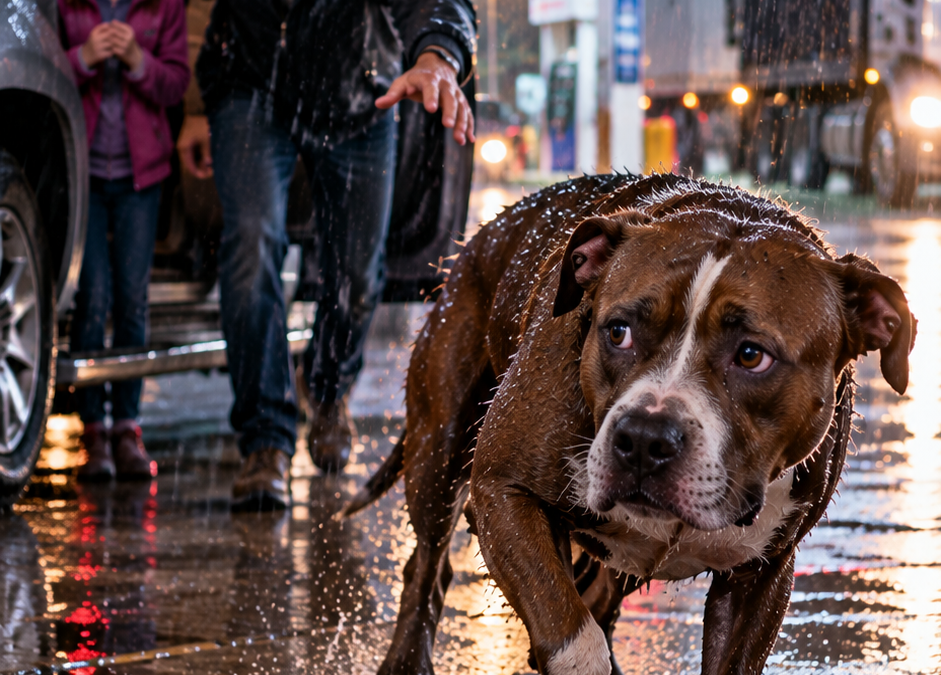
We Lost Our Pit Bull Eighty Kilometers From Home, and Every Night My Daughter Asked Me the One Question I Couldn’t Answer
The question my daughter asked me every night was the one I had no answer for.
“Dad, do you think Jack is trying to find us?”
For the first week, I said yes without hesitation.
For the second, I said maybe.
By the third, I learned how to look away before answering.
I had always believed a father was supposed to know what to say when his child was scared.
That belief disappeared on a rainy night beside a gas station almost fifty miles from the house we were moving into.
That was the night we lost Jack.
And for nearly a month afterward, I woke every morning with the same thought.
I was the one who left him behind.
My name is Daniel Thompson.
At the time, my wife, Rachel, our two children, Sophie and Ben, and I were in the middle of the worst move of our lives.
Not because we hated the new town.
We barely knew it.
Not because the house was bad.
It was smaller than the old one, but clean, bright, and only a few blocks from a park.
The problem was everything surrounding the move.
I had accepted a new job after the company I’d worked for almost fifteen years downsized.
Rachel’s mother had become ill, which meant we needed to live closer to her.
Sophie was changing schools.
Ben had just started complaining that every decision adults made ruined his life.
And the entire house was packed into boxes labeled with increasingly desperate handwriting.
KITCHEN
BOOKS
WINTER CLOTHES
IMPORTANT
VERY IMPORTANT
I DON’T KNOW
Moving does something ugly to people.
You discover how much you own, how little you know where any of it belongs, and how quickly patience disappears when three people are asking where the tape is.
Through all of it, Jack stayed Jack.
He was a pit bull, compact and muscular, with a dark coat and a white patch on his chest.
People who did not know him sometimes crossed the street when they saw us coming.
People who knew him laughed at that.
Jack was less interested in intimidating strangers than in stealing socks and sitting on anyone who made the mistake of using the couch.
He belonged most completely to Sophie.
We adopted him when she was seven.
She had been afraid of dogs until she met him.
Jack had been sitting in the shelter kennel with his head lowered while every other dog barked.
Sophie crouched outside the gate.
He looked at her.
She looked at him.
Then he stood, walked forward, and pressed his nose through the bars.
That was it.
I had wanted to “look around.”
Sophie had already chosen.
For six years, the two of them were almost inseparable.
When she did homework, Jack slept under the table.
When she cried, he found her.
When she got sick, he lay outside her bedroom.
When she went to school, he waited near the front window at roughly the time the bus returned.
He knew her routines better than I did.
Which is why what happened at that gas station still feels impossible to explain.
We had been driving for hours.
Rain started shortly after sunset.
Not a gentle rain.
The kind that turns headlights into smeared lines and makes every passing truck throw a wall of water across your windshield.
Our moving truck was ahead.
Rachel drove the family SUV behind me.
Jack rode in a large travel crate in the back.
We stopped for fuel because Ben needed a restroom, Rachel needed coffee, and I was beginning to feel the road blurring in front of me.
I remember checking Jack.
He seemed restless.
Probably because we’d been driving too long.
“Almost there, buddy.”
His ears lifted.
I opened the crate to clip his leash on.
That is the part I replay.
The door opened.
I reached for the leash.
Someone called my name.
Maybe Rachel.
Maybe Ben.
I turned.
For one second.
Maybe two.
When I turned back, Jack jumped down.
I wasn’t immediately worried.
“Jack.”
He stood beside the vehicle.
Rain pouring over him.
Tail moving.
He thought we were stopping for a walk.
“Come here.”
Then a truck pulled into the next pump.
Air brakes hissed.
Jack startled.
He backed away.
“Jack.”
I moved toward him.
Another vehicle passed.
Headlights.
Noise.
Rain.
He ran around the side of the station.
“Jack!”
I went after him.
I expected him to stop.
He always stopped when I called.
Always.
But the station backed into an area of brush and dark trees.
By the time I rounded the building, I saw only shadows.
“Jack!”
Nothing.
I ran farther.
“Jack!”
Rain swallowed my voice.
That was when fear began.
Rachel came around the corner.
“What happened?”
“He ran.”
“What do you mean he ran?”
“He got out.”
Her face changed instantly.
“Sophie knows?”
“No.”
Too late.
Our daughter came running through the rain.
“Where’s Jack?”
I turned toward her.
She saw my face.
“No.”
“Sophie—”
“No.”
She ran past me.
“Jack!”
I caught up.
“Stay close.”
“JACK!”
Her voice broke.
Rachel grabbed her.
“Sweetheart, we’re going to find him.”
That became our sentence for the night.
We’re going to find him.
Again.
Again.
Again.
For nearly four hours.
I searched under parked vehicles.
Behind dumpsters.
Inside the station’s rear storage areas after the employee unlocked them.
Along the edge of the woods.
Near the road.
Behind an abandoned shed.
I walked the drainage ditch with my phone flashlight.
I crossed the parking lot so many times that the attendant stopped asking whether I’d checked somewhere.
He simply pointed whenever he thought of another place.
“Try behind the maintenance building.”
I did.
Nothing.
I shouted until my throat hurt.
“Jack!”
Rain soaked through my coat.
My shoes filled with water.
Mud covered my jeans.
Cars came and went.
Strangers looked at me.
A few helped.
One truck driver walked the tree line with a flashlight.
A woman parked near the entrance waited almost twenty minutes, calling softly:
“Come here, puppy.”
No Jack.
Around midnight, Sophie refused to stay in the car.
“I can help.”
“You’re freezing.”
“I don’t care.”
“I care.”
“You lost him!”
The words hit exactly where they were supposed to.
Rachel said:
“Sophie.”
But I stopped her.
“No.”
I looked at my daughter.
Her face was soaked with rain and tears.
“She is right.”
Sophie started crying harder.
“I didn’t mean—”
“I know.”
I crouched.
“I should have secured the leash before opening the crate.”
“That was my job.”
She shook her head violently.
“He’s scared.”
“I know.”
“He doesn’t know where we are.”
“I know.”
“What if he thinks we left him?”
That question followed me for weeks.
I pulled her into my arms.
“We are not leaving him.”
But eventually, we did.
Not willingly.
Not emotionally.
Physically.
There is a difference, though it did not feel like one.
By almost four in the morning, the children were exhausted.
Rachel was shivering.
I had walked every accessible area around the station.
The employee promised to call immediately if Jack returned.
I wrote my number on three separate pieces of paper.
Taped one near the register.
One in the employee office.
Gave one directly to the night manager.
“This dog.”
I showed him the photo on my phone.
“Dark coat.”
“White chest.”
“Pit bull.”
“Friendly.”
“His name is Jack.”
The manager nodded.
“I’ve got it.”
“Please call me.”
“We will.”
“Any hour.”
“I understand.”
I looked toward the road.
I could not accept what we were about to do.
Our new home was nearly eighty kilometers away.
Jack had never been there.
He had never traveled that route except inside a vehicle.
He knew nothing.
No familiar sidewalks.
No smell of our old yard.
No local park.
No school bus.
Nothing.
Rachel stood beside me.
“We have to go.”
I looked at her.
“No.”
“Daniel.”
“No.”
“Our kids are asleep in the car.”
“My mother has an appointment tomorrow.”
“You start work Monday.”
“We cannot stay indefinitely.”
“I know.”
But knowing did not help.
She touched my arm.
“Jack may come back here.”
“We gave them our number.”
“We’ll call first thing.”
I looked at the dark trees again.
Rain fell softer now.
“Five more minutes.”
Rachel didn’t argue.
I walked to the edge of the parking lot one last time.
“Jack!”
Nothing.
I waited.
“Come on, boy!”
Silence.
Then only highway noise.
When I finally got into the driver’s seat, Sophie was awake.
Her eyes were swollen.
“Did you find him?”
I could not lie.
“No.”
She turned toward the window.
I put the vehicle in gear.
That may have been the hardest thing I had ever done.
Driving away.
I kept looking in the mirrors as though Jack might suddenly appear behind us.
He didn’t.
We reached the new house shortly after sunrise.
Nobody cared about unpacking.
Boxes sat everywhere.
Sophie went directly to her room.
Rachel stood in the kitchen.
I remained by the front door.
The house smelled wrong.
Fresh paint.
Cardboard.
Someone else’s cleaning products.
Jack’s bed was still packed in the moving truck.
I couldn’t bring myself to unload it.
At nine in the morning, I called the gas station.
“Any sign?”
“No, sir.”
At noon, I called again.
Nothing.
At six.
Nothing.
Before bed.
Nothing.
The next morning.
Nothing.
For seven days, one of us called every day.
Sometimes twice.
The answer never changed.
“No.”
“No dog.”
“Sorry.”
“No.”
We printed missing-dog notices.
Used the clearest photo we had.
LOST PIT BULL — JACK
FRIENDLY
FAMILY PET
MISSING NEAR HIGHWAY GAS STATION
I drove back twice during the first week.
I searched again.
Walked the woods.
Talked to businesses.
Handed out flyers.
Checked shelters.
Animal control.
Veterinary clinics.
Nothing.
Every failed search made the distance between the gas station and our new house feel larger.
Nearly fifty miles.
An impossible distance for a dog with no map.
At home, Sophie kept Jack’s old collar beside her bed.
We had another one he wore during travel, which had disappeared with him.
The spare stayed in her hand some nights.
Rachel found her sleeping with it.
My wife told me quietly in the hallway:
“She is blaming you.”
“I know.”
“She also blames herself.”
“For what?”
“She says she should have held the leash.”
My chest tightened.
“She is thirteen.”
“I know.”
“She should not carry that.”
“Neither should you.”
I looked at Rachel.
She knew I was carrying it anyway.
The second week hurt differently.
The first week had urgency.
Phone calls.
Flyers.
Driving.
Searching.
Hope turned into action.
The second week became waiting.
That is worse.
There was nothing left to do that we had not already done.
People shared the post online.
Strangers commented.
Praying he comes home.
Check shelters daily.
Pit bulls can travel far.
Don’t give up.
I appreciated every message.
I hated all of them.
Hope from strangers felt easier than hope inside our house.
Sophie asked questions I couldn’t answer.
“Do you think somebody took him?”
“Maybe someone found him.”
“Would they keep him?”
“I don’t know.”
“What if he’s hungry?”
“Dogs can find food.”
“Is he cold?”
“He’s tough.”
“Dad.”
“What?”
“Does he think we left him?”
Every time.
That question.
I finally said:
“No.”
She looked at me.
“How do you know?”
I didn’t.
I answered anyway.
“Because Jack knows us.”
That was all I had.
Jack knows us.
By the end of the second week, Rachel began trying to prepare Sophie for the possibility we might never see him again.
I hated her for it.
Not truly.
Grief looks for targets.
One evening, I overheard them in Sophie’s room.
My daughter was crying.
“Mom, did Jack forget where home is?”
Rachel sat beside her.
“No.”
“He doesn’t know this house.”
“I know.”
“So how can he come home?”
Rachel hesitated.
“Sometimes dogs get lost.”
Her voice was soft.
“And sometimes they don’t find their way back.”
“No.”
“Sophie.”
“No.”
“I don’t want you to stop hoping.”
“You’re telling me to.”
“I’m trying to protect you.”
“I don’t want to be protected.”
Rachel had no answer.
Neither did I.
I stood outside the room feeling useless.
What none of us understood then was that Jack had not stopped searching.
We could never know every exact mile he traveled or every moment of those weeks.
No one followed him with a camera.
But the path he must have taken and the condition in which he eventually reached us told its own story.
And for the rest of my life, I have pictured it.
That first night after we left, I imagine Jack returned to the gas station.
Maybe ten minutes after our taillights disappeared.
Maybe an hour.
He would have found our smell everywhere.
Near the pumps.
Beside the vehicle space.
Along the grass where Sophie had stood calling him.
But the cars were gone.
The family was gone.
Jack had never understood moving.
To him, home was not real estate.
It was us.
The first days, according to the station employees, a dog matching Jack’s description was seen several times around the area.
That detail reached us later.
A trucker gave him bread.
Someone left water in an old bowl.
He stayed near the station.
Waiting perhaps.
Searching perhaps.
Trying to understand where we had gone.
If the source story is right about that third morning, then something finally pulled him away.
A scent.
A trace carried over distance.
Maybe Sophie.
Maybe coffee.
Maybe something from our belongings that had traveled the road before us.
I will never pretend I understand what a dog’s nose can do across fifty miles.
I only know Jack began moving.
And he kept moving.
That was the part the condition of his body told us later.
He did not simply wander three streets and get picked up.
He traveled.
Roads.
Fields.
Small towns.
Rail lines.
Bridges.
Places he had never seen.
Imagine doing that without a map.
Without knowing the name of your destination.
Only knowing what home smelled like.
One morning, somewhere along that journey, Jack crossed railroad tracks.
I picture him hesitating as metal vibrated beneath his paws.
Head lifted.
Then moving forward.
Another day, a bridge.
Below it, a swollen river from spring rain.
Traffic roaring nearby.
He kept going.
Farm dogs barked from fields.
Strangers watched him pass.
Maybe some tried to call him.
Maybe someone offered food.
He might have eaten enough to survive.
When he finally reached us, he’d lost nearly a third of his body weight.
That meant whatever food he found, it wasn’t much.
His paw pads were scraped raw in places.
There were scratches on his legs.
A cut along one ear.
He paid for every mile.
Still, he kept going.
One night, according to a man who later contacted us after seeing the online post, a dark pit bull had been spotted near a rural road almost ten days after Jack disappeared.
The man tried to help.
Opened his car door.
Called.
Jack ran.
At the time, I wished Jack had trusted him.
Later, I understood.
Jack wasn’t looking for rescue.
He was looking for us.
That difference mattered.
By the third week, our house began learning life without him.
I hated that.
His bowl remained packed.
His old bed still sat in the garage.
Sophie refused to let us donate anything.
“I’m not.”
I told her.
“You were going to.”
“No.”
“You looked at the bed.”
“I was moving a box.”
She narrowed her eyes.
“You better not.”
“I won’t.”
She still checked the missing-dog posts.
Every morning before school.
Every afternoon after.
Nothing.
Then one night, she didn’t ask about Jack.
That frightened me more than the questions.
At dinner, she ate quietly.
Went upstairs.
I looked at Rachel.
“She didn’t ask.”
Rachel knew what I meant.
“She is tired.”
“No.”
“She is letting go.”
“Daniel.”
“I don’t want her to.”
Rachel put down her fork.
“You think I do?”
I stared at her.
“Then why do you keep preparing her?”
“Because I am her mother.”
“And?”
“And I cannot let her break herself waiting forever.”
I leaned back.
“So what do we do?”
“I don’t know.”
That was the first time Rachel said it.
Not pretending.
Not protecting me.
“I don’t know.”
We sat in silence.
Then Ben, who had been unusually quiet through all of it, said:
“I still think Jack’s coming.”
Rachel looked at him.
“Why?”
Ben shrugged.
“He likes Sophie more than us.”
Despite everything, I laughed.
Sophie shouted from upstairs:
“I heard that!”
Ben yelled:
“It’s true!”
A door slammed.
For three seconds, our house sounded normal.
Then it didn’t.
Almost a month passed.
I started work.
Rachel settled into caring for her mother and managing the move.
Sophie attended the new school.
Ben found a kid down the street who liked the same games.
Boxes disappeared.
Pictures went onto walls.
The house slowly became ours.
Except for one absence.
Jack.
The morning he returned began like any other.
I was already at work.
Rachel was home.
She had tea in one hand and a list of errands in the other.
Sophie was in her room.
Ben was watching something upstairs.
The door made a faint scratching sound.
Rachel told me later she almost ignored it.
She thought it was a branch.
Then:
Scratch.
Scratch.
Not knocking.
Not barking.
She walked toward the door.
When she opened it, she looked down.
The cup left her hand.
It struck the floor and broke.
Jack sat on the porch.
For a second, she did not recognize him.
That hurts me to say.
But he had changed.
Thinner.
Much thinner.
Ribs visible.
Mud dried into his coat.
Paws battered.
Head hanging from exhaustion.
But his eyes—
Jack’s eyes were still Jack.
Rachel covered her mouth.
“Oh my God.”
His tail moved.
Weakly.
Once.
Twice.
“Jack?”
The tail moved again.
Rachel dropped to her knees.
“Jack!”
She wrapped both arms around his neck.
His body trembled against her.
Not fear.
Exhaustion.
Relief.
He licked her cheek.
Barely enough energy.
Then leaned into her.
Rachel screamed toward the stairs.
“SOPHIE!”
My daughter came running.
“What?”
Then she reached the entryway.
Stopped.
Years later, Sophie still describes that moment as the second when the entire world went silent.
Jack looked at her.
She looked at him.
Neither moved at first.
Then Sophie made a sound.
Not quite a word.
Not quite crying.
She ran.
Dropped onto the floor.
Wrapped herself around him.
Jack’s tail began moving harder.
His body tried to stand.
Couldn’t.
So he crawled closer.
Sophie buried her face into his neck.
“I knew it.”
She cried.
“I knew it.”
Over and over.
“I knew you’d come back.”
Jack licked her face.
Rachel called me.
I was in a meeting.
My phone vibrated.
I ignored it.
Then again.
And again.
I saw her name.
Something in me tightened.
I excused myself.
“What’s wrong?”
All I heard was crying.
“Rachel?”
“Daniel.”
“What happened?”
She couldn’t speak.
My heart dropped.
“Rachel, talk to me.”
Then Sophie’s voice in the background.
“Dad!”
Crying.
Loud.
“Dad, he’s home!”
I froze.
“What?”
“Jack!”
I gripped the phone.
“Stop.”
I thought I had misheard.
“Say that again.”
“Jack is here!”
My knees went weak.
I sat in the nearest chair.
“No.”
Rachel laughed and cried at the same time.
“Yes.”
“He’s here.”
“At the house?”
“Yes.”
“That doesn’t make sense.”
“I know.”
“He doesn’t know where we live.”
“I know.”
“Rachel—”
“I opened the door.”
Her voice broke.
“He was sitting there.”
I left work.
I don’t remember the drive home clearly.
I remember one red light that seemed endless.
I remember telling another driver something impolite when he moved too slowly.
I remember my hands shaking.
When I turned onto our street, I saw the front door open.
Sophie sat on the porch.
Jack lay beside her.
I stopped the car in the middle of the driveway.
Did not even close the door.
“Jack.”
His head lifted.
I walked toward him.
Then stopped.
Guilt hit so hard I couldn’t move.
The last time I had seen that dog, I had been shouting his name beside a gas station.
Then I drove away.
“Hey, buddy.”
My voice failed.
Jack tried to stand.
His back legs shook.
He managed.
Then walked toward me.
Slow.
One step.
Another.
I dropped to my knees.
He pressed his head into my chest.
That destroyed me.
“I am sorry.”
I held him.
“I am so sorry.”
Jack licked my chin.
No accusation.
No hesitation.
No demand for an explanation.
I cried into his fur.
Sophie cried beside us.
Rachel joined.
Ben stood in the doorway pretending he wasn’t crying until Jack moved toward him too.
Four people on a porch surrounding one exhausted dog who had somehow crossed nearly eighty kilometers to find a house he’d never seen.
That afternoon, the veterinarian examined him.
Dehydrated.
Severely underweight.
Paw pads damaged.
Minor cuts.
Exhaustion.
But alive.
No broken bones.
No infection that could not be treated.
No major internal injury.
The veterinarian looked at us.
“How long has he been missing?”
“Almost a month.”
“And where?”
I told him.
He stared.
“That far?”
“Yes.”
“How did he get here?”
“If you can answer that, I’d like to know.”
He shook his head.
“Dogs are remarkable.”
That was all he could give me.
Remarkable.
We bathed Jack at home after the vet cleared him.
The water turned brown.
Sophie sat beside the tub.
Every time Jack looked away, she touched him.
Not compulsively.
Reassurance.
He was real.
Still there.
He ate slowly.
We were warned not to let him gorge himself after prolonged hunger.
That offended Jack.
He looked at the small portion as though we had betrayed him.
Sophie laughed.
First genuine laugh about him in weeks.
“You traveled fifty miles and you’re still greedy.”
Tail.
That night, Jack slept at Sophie’s feet.
Not in his old bed.
She refused.
“He’s sleeping with me.”
Normally, Rachel might have objected.
Not that night.
We all gathered in the living room first.
Jack lay wrapped in a blanket.
Clean now.
Fed.
His head on Sophie’s foot.
I sat beside Rachel.
My hand rested on her shoulder.
For a while, we only watched him breathe.
Then I said:
“Nearly eighty kilometers.”
Rachel shook her head.
“How?”
“No idea.”
Sophie stroked his ear.
“He followed us.”
“But how?”
Rachel looked at Jack.
Then at me.
“With his heart.”
I would have mocked that sentence under normal circumstances.
Too sentimental.
Too easy.
But sitting there looking at him, I had no better explanation.
Maybe scent.
Instinct.
Magnetic fields.
Memory.
Luck.
A combination of everything.
But what brought him home was not information alone.
Information doesn’t explain persistence.
Jack had to keep choosing forward.
When his paws hurt.
When he was hungry.
When strangers frightened him.
When he reached intersections with no road sign he could read.
Something in him kept saying:
Not here.
Keep going.
Home is somewhere ahead.
That night, after everyone went to bed, I sat alone beside Jack.
He had fallen asleep in the living room before Sophie carried him upstairs.
I put my hand on his back.
He opened one eye.
“Did you think we left you?”
His eye closed.
I swallowed.
“I didn’t.”
My voice broke.
“I need you to know that.”
Of course he could not understand every word.
Maybe none.
I kept talking.
“I searched.”
“I came back.”
“I called.”
“I should’ve stayed longer.”
I rubbed his shoulder.
“But I didn’t stop looking for you.”
Jack sighed.
I laughed through tears.
“That is very forgiving.”
He rested his head against my leg.
Dogs do not seem interested in the kind of punishment humans assign themselves.
They live closer to the present.
You are here.
I am here.
That was enough for him.
It took me longer.
The next morning, a neighbor saw Jack on the porch.
He had insisted on going outside with Sophie.
Not far.
Just the front step.
Sunlight warmed his coat.
He lay with his head between his paws, watching the street as though he had lived there forever.
The neighbor stopped.
“Is that the dog?”
Sophie smiled.
“That’s Jack.”
“The one who was lost?”
“He wasn’t lost.”
She corrected him.
“He was coming home.”
I heard that from inside.
I stepped onto the porch.
Jack’s tail moved.
By then, we had already bought him a new collar.
His old travel collar was gone somewhere along those miles.
Sophie chose the replacement.
Dark blue.
Sturdy.
She also insisted on a new identification tag.
On one side:
JACK THOMPSON
Our phone number.
On the other, Sophie’s idea.
Four words:
I KNOW THE WAY HOME
I thought it was corny.
I paid for it anyway.
The tag caught the morning sunlight.
Jack lifted his head.
For weeks after he returned, people asked how he did it.
I never had a satisfying answer.
Some wanted science.
Some wanted something almost supernatural.
“How could a dog smell them from eighty kilometers?”
“Maybe he didn’t smell them the entire way.”
“How did he choose the correct roads?”
“I don’t know.”
“Was he trained?”
“No.”
“Had he been to the new house before?”
“Never.”
“Then how?”
I don’t know.
I became comfortable saying it.
Not knowing doesn’t make what happened less real.
We know where Jack disappeared.
We know where he arrived.
We know how long he was gone.
We know what condition his body was in.
The space between those points belonged to him.
Roads we never saw.
Nights we weren’t there.
Choices he made without us.
That journey was Jack’s.
What mattered to me was the fact he made it.
Sophie changed after that.
Before Jack disappeared, she loved him the uncomplicated way children love animals.
Afterward, there was gratitude mixed into it.
Awareness.
She became more careful.
Doors checked twice.
Leashes clipped before gates opened.
She placed her phone number on his collar and checked the tag constantly.
Once I saw her sitting beside him.
She whispered:
“I didn’t forget you either.”
Jack put one paw across her leg.
Maybe coincidence.
Maybe not.
I walked away before she saw me.
Rachel changed too.
She had been the first to begin accepting that Jack might be gone.
That fact made her feel guilty after his return.
One evening, she said:
“I gave up on him.”
“No.”
“I did.”
“You were trying to help Sophie.”
“I told her dogs get lost.”
“Dogs do.”
“But Jack didn’t.”
I looked at her.
“Rachel.”
She looked down.
“Hope isn’t an obligation.”
“What?”
“You don’t owe anybody perfect hope.”
She stared at me.
“You spent a month blaming yourself.”
“Still do sometimes.”
“Then don’t lecture me.”
“Fair.”
We laughed.
Then she said:
“He kept going even when we stopped believing.”
That was true.
And uncomfortable.
Maybe that is why Jack’s journey affected us so deeply.
He had not known we were losing hope.
He did not know that after two weeks we had begun using words like maybe and probably.
He did not know that I had stopped calling the gas station every day.
He did not know Rachel had tried to prepare Sophie.
He simply kept moving.
His faith was not in our faith.
It was in us.
That humbles me.
I think often about Jack’s first days alone.
He had spent his life relying on us.
Food arrived because we filled the bowl.
Doors opened because we opened them.
Cars went where we drove.
Then suddenly, none of that.
Rain.
Noise.
A place he didn’t know.
No family.
Yet somewhere in that confusion, he shifted from waiting to searching.
That transition fascinates me.
There must have been a moment.
Maybe the third morning.
Jack stood at the edge of the station.
Turned his head into the wind.
Caught something.
Or maybe he simply decided waiting was no longer enough.
Then he walked.
That first step may have mattered more than every mile after it.
Because starting requires a kind of certainty you don’t always possess.
Humans like maps before we move.
We want addresses.
Schedules.
Directions.
Proof.
Jack had none.
He had scent.
Memory.
Attachment.
And apparently that was enough.
I learned something from him that month.
Home is more complicated than an address.
We had assumed Jack could never find the new house because he had never seen it.
But he wasn’t searching for architecture.
He wasn’t looking for yellow siding or the right mailbox.
He was looking for us.
Our smells had moved.
Our clothes.
Furniture.
Blankets.
Shoes.
Coffee.
Soap.
Sophie’s shampoo.
All the ordinary traces of family had been carried into a new place.
Maybe the house was new to Jack.
We weren’t.
He found the familiar inside the unfamiliar.
Maybe that’s what home really is.
Not where you have been before.
Where the people you love are waiting.
For several weeks, Jack tired easily.
Short walks.
Extra food carefully increased.
Paw treatment.
Rest.
The park was only three blocks away, but we waited until the veterinarian cleared him.
The first morning we took him, Sophie held the leash.
Jack walked slowly.
He sniffed everything.
Every tree.
Every bench.
Every mailbox.
I watched him mapping the neighborhood.
Learning.
Claiming.
At one point, Sophie stopped.
Jack looked up.
“What?”
I asked.
She wiped her face.
“He finally gets to know where he came.”
I knew what she meant.
The last time, he had reached our door as an exhausted stranger.
Now he could learn the route as a dog who belonged.
We walked home together.
Jack led the last half block.
Straight to the yellow house.
Tail high.
At the door, he looked back at us.
As if asking why we were so slow.
Sophie laughed.
“Show-off.”
The new collar tag clicked against the buckle.
I KNOW THE WAY HOME.
Yes.
He did.
One afternoon, I called the gas station one final time.
The same manager answered.
I recognized his voice.
“This is Daniel Thompson.”
Pause.
“The dog?”
“Yes.”
His tone changed instantly.
“You found him?”
“He found us.”
“What?”
“He came to our house.”
Silence.
“How far is that?”
“About eighty kilometers.”
The manager said something I won’t repeat.
Then:
“You’re serious?”
“Completely.”
He laughed.
Then stopped.
“Man.”
“I wish I could’ve seen that.”
“Me too.”
I thanked him.
For helping search.
For keeping my number.
For feeding Jack if he was one of the people who had.
The manager said:
“A couple drivers saw him the first days.”
“He wouldn’t stay close to anybody.”
“That sounds like him.”
“Guess he had somewhere to be.”
“Yes.”
He did.
After the call, I stood in our kitchen.
Jack slept in a patch of sun.
Rachel made coffee.
Sophie complained upstairs about homework.
Ben yelled that the internet was slow.
Normal life.
I thought of that first terrible morning in the same kitchen.
Boxes everywhere.
No Jack.
Nothing felt like home.
Now nothing had changed about the walls.
The difference lay sleeping by the window.
That is why the final line people use when telling Jack’s story is the one I believe most.
Home is not necessarily where you started.
It is where you are loved.
Jack had left one physical home behind with us.
Then lost us during the transition.
So he followed family instead of geography.
I have no idea whether dogs think about love the way humans do.
Probably not.
They don’t need our language for it.
Jack knew Sophie belonged to him.
He knew our voices.
Our scent.
Our routines.
He knew there was a place in the world where someone would say his name like it mattered.
So he kept moving until he found it.
Months later, Sophie asked me:
“Dad?”
We were sitting on the porch.
Jack between us.
“What?”
“If it happened again, do you think he’d find us?”
I looked at her.
“It’s not happening again.”
“I know.”
“But do you think he could?”
I stared at Jack.
He was watching a squirrel.
Completely uninterested in the philosophical importance of the question.
“I think he would try.”
Sophie smiled.
“That’s not what I asked.”
“It is the better answer.”
“Why?”
“Because nobody can promise the result.”
I rubbed Jack’s head.
“But you can know who refuses to give up.”
She thought about that.
Then rested her head on my shoulder.
Jack moved closer.
For a while, the three of us watched the street.
The yellow house behind us was still not the house where Jack had grown up.
Maybe that had stopped mattering.
It was the place with his bowl.
His blanket.
His family.
Sophie.
It was home.
And the dog we thought we’d lost forever had taught us something none of us had understood when we drove away from that gas station in the rain.
You can move a house.
You can change a town.
You can cross miles of road.
You can lose sight of someone you love.
But sometimes the bond remains stronger than the distance.
Jack did not return because he knew an address.
He returned because somewhere ahead of him were the people he had decided belonged to him.
The next morning, I found him on the porch again.
Sunlight across his back.
Head resting between his paws.
New collar around his neck.
The tag glinted when he moved.
I KNOW THE WAY HOME.
I sat beside him.
Jack leaned against my leg.
“You do, don’t you?”
His tail tapped the porch once.
I looked toward the street he had somehow found after nearly a month of searching.
Then down at him.
For weeks, I had wondered whether Jack believed we had abandoned him.
I finally realized the answer had been sitting in front of us all along.
If he had believed that, he might have stopped.
Instead, he crossed nearly eighty kilometers.
He came to a door he had never seen.
And scratched until someone he loved opened it.
Jack never forgot us.
And from the moment that door opened, none of us would ever again mistake distance for the end of love.
𝗧𝗛𝗘 𝗘𝗡𝗗
We Lost Our Pit Bull Eighty Kilometers From Home, and Every Night My Daughter Asked Me the One Question I Couldn’t Answer
The question my daughter asked me every night was the one I had no answer for.
“Dad, do you think Jack is trying to find us?”
For the first week, I said yes without hesitation.
For the second, I said maybe.
By the third, I learned how to look away before answering.
I had always believed a father was supposed to know what to say when his child was scared.
That belief disappeared on a rainy night beside a gas station almost fifty miles from the house we were moving into.
That was the night we lost Jack.
And for nearly a month afterward, I woke every morning with the same thought.
I was the one who left him behind.
My name is Daniel Thompson.
At the time, my wife, Rachel, our two children, Sophie and Ben, and I were in the middle of the worst move of our lives.
Not because we hated the new town.
We barely knew it.
Not because the house was bad.
It was smaller than the old one, but clean, bright, and only a few blocks from a park.
The problem was everything surrounding the move.
I had accepted a new job after the company I’d worked for almost fifteen years downsized.
Rachel’s mother had become ill, which meant we needed to live closer to her.
Sophie was changing schools.
Ben had just started complaining that every decision adults made ruined his life.
And the entire house was packed into boxes labeled with increasingly desperate handwriting.
KITCHEN
BOOKS
WINTER CLOTHES
IMPORTANT
VERY IMPORTANT
I DON’T KNOW
Moving does something ugly to people.
You discover how much you own, how little you know where any of it belongs, and how quickly patience disappears when three people are asking where the tape is.
Through all of it, Jack stayed Jack.
He was a pit bull, compact and muscular, with a dark coat and a white patch on his chest.
People who did not know him sometimes crossed the street when they saw us coming.
People who knew him laughed at that.
Jack was less interested in intimidating strangers than in stealing socks and sitting on anyone who made the mistake of using the couch.
He belonged most completely to Sophie.
We adopted him when she was seven.
She had been afraid of dogs until she met him.
Jack had been sitting in the shelter kennel with his head lowered while every other dog barked.
Sophie crouched outside the gate.
He looked at her.
She looked at him.
Then he stood, walked forward, and pressed his nose through the bars.
That was it.
I had wanted to “look around.”
Sophie had already chosen.
For six years, the two of them were almost inseparable.
When she did homework, Jack slept under the table.
When she cried, he found her.
When she got sick, he lay outside her bedroom.
When she went to school, he waited near the front window at roughly the time the bus returned.
He knew her routines better than I did.
Which is why what happened at that gas station still feels impossible to explain.
We had been driving for hours.
Rain started shortly after sunset.
Not a gentle rain.
The kind that turns headlights into smeared lines and makes every passing truck throw a wall of water across your windshield.
Our moving truck was ahead.
Rachel drove the family SUV behind me.
Jack rode in a large travel crate in the back.
We stopped for fuel because Ben needed a restroom, Rachel needed coffee, and I was beginning to feel the road blurring in front of me.
I remember checking Jack.
He seemed restless.
Probably because we’d been driving too long.
“Almost there, buddy.”
His ears lifted.
I opened the crate to clip his leash on.
That is the part I replay.
The door opened.
I reached for the leash.
Someone called my name.
Maybe Rachel.
Maybe Ben.
I turned.
For one second.
Maybe two.
When I turned back, Jack jumped down.
I wasn’t immediately worried.
“Jack.”
He stood beside the vehicle.
Rain pouring over him.
Tail moving.
He thought we were stopping for a walk.
“Come here.”
Then a truck pulled into the next pump.
Air brakes hissed.
Jack startled.
He backed away.
“Jack.”
I moved toward him.
Another vehicle passed.
Headlights.
Noise.
Rain.
He ran around the side of the station.
“Jack!”
I went after him.
I expected him to stop.
He always stopped when I called.
Always.
But the station backed into an area of brush and dark trees.
By the time I rounded the building, I saw only shadows.
“Jack!”
Nothing.
I ran farther.
“Jack!”
Rain swallowed my voice.
That was when fear began.
Rachel came around the corner.
“What happened?”
“He ran.”
“What do you mean he ran?”
“He got out.”
Her face changed instantly.
“Sophie knows?”
“No.”
Too late.
Our daughter came running through the rain.
“Where’s Jack?”
I turned toward her.
She saw my face.
“No.”
“Sophie—”
“No.”
She ran past me.
“Jack!”
I caught up.
“Stay close.”
“JACK!”
Her voice broke.
Rachel grabbed her.
“Sweetheart, we’re going to find him.”
That became our sentence for the night.
We’re going to find him.
Again.
Again.
Again.
For nearly four hours.
I searched under parked vehicles.
Behind dumpsters.
Inside the station’s rear storage areas after the employee unlocked them.
Along the edge of the woods.
Near the road.
Behind an abandoned shed.
I walked the drainage ditch with my phone flashlight.
I crossed the parking lot so many times that the attendant stopped asking whether I’d checked somewhere.
He simply pointed whenever he thought of another place.
“Try behind the maintenance building.”
I did.
Nothing.
I shouted until my throat hurt.
“Jack!”
Rain soaked through my coat.
My shoes filled with water.
Mud covered my jeans.
Cars came and went.
Strangers looked at me.
A few helped.
One truck driver walked the tree line with a flashlight.
A woman parked near the entrance waited almost twenty minutes, calling softly:
“Come here, puppy.”
No Jack.
Around midnight, Sophie refused to stay in the car.
“I can help.”
“You’re freezing.”
“I don’t care.”
“I care.”
“You lost him!”
The words hit exactly where they were supposed to.
Rachel said:
“Sophie.”
But I stopped her.
“No.”
I looked at my daughter.
Her face was soaked with rain and tears.
“She is right.”
Sophie started crying harder.
“I didn’t mean—”
“I know.”
I crouched.
“I should have secured the leash before opening the crate.”
“That was my job.”
She shook her head violently.
“He’s scared.”
“I know.”
“He doesn’t know where we are.”
“I know.”
“What if he thinks we left him?”
That question followed me for weeks.
I pulled her into my arms.
“We are not leaving him.”
But eventually, we did.
Not willingly.
Not emotionally.
Physically.
There is a difference, though it did not feel like one.
By almost four in the morning, the children were exhausted.
Rachel was shivering.
I had walked every accessible area around the station.
The employee promised to call immediately if Jack returned.
I wrote my number on three separate pieces of paper.
Taped one near the register.
One in the employee office.
Gave one directly to the night manager.
“This dog.”
I showed him the photo on my phone.
“Dark coat.”
“White chest.”
“Pit bull.”
“Friendly.”
“His name is Jack.”
The manager nodded.
“I’ve got it.”
“Please call me.”
“We will.”
“Any hour.”
“I understand.”
I looked toward the road.
I could not accept what we were about to do.
Our new home was nearly eighty kilometers away.
Jack had never been there.
He had never traveled that route except inside a vehicle.
He knew nothing.
No familiar sidewalks.
No smell of our old yard.
No local park.
No school bus.
Nothing.
Rachel stood beside me.
“We have to go.”
I looked at her.
“No.”
“Daniel.”
“No.”
“Our kids are asleep in the car.”
“My mother has an appointment tomorrow.”
“You start work Monday.”
“We cannot stay indefinitely.”
“I know.”
But knowing did not help.
She touched my arm.
“Jack may come back here.”
“We gave them our number.”
“We’ll call first thing.”
I looked at the dark trees again.
Rain fell softer now.
“Five more minutes.”
Rachel didn’t argue.
I walked to the edge of the parking lot one last time.
“Jack!”
Nothing.
I waited.
“Come on, boy!”
Silence.
Then only highway noise.
When I finally got into the driver’s seat, Sophie was awake.
Her eyes were swollen.
“Did you find him?”
I could not lie.
“No.”
She turned toward the window.
I put the vehicle in gear.
That may have been the hardest thing I had ever done.
Driving away.
I kept looking in the mirrors as though Jack might suddenly appear behind us.
He didn’t.
We reached the new house shortly after sunrise.
Nobody cared about unpacking.
Boxes sat everywhere.
Sophie went directly to her room.
Rachel stood in the kitchen.
I remained by the front door.
The house smelled wrong.
Fresh paint.
Cardboard.
Someone else’s cleaning products.
Jack’s bed was still packed in the moving truck.
I couldn’t bring myself to unload it.
At nine in the morning, I called the gas station.
“Any sign?”
“No, sir.”
At noon, I called again.
Nothing.
At six.
Nothing.
Before bed.
Nothing.
The next morning.
Nothing.
For seven days, one of us called every day.
Sometimes twice.
The answer never changed.
“No.”
“No dog.”
“Sorry.”
“No.”
We printed missing-dog notices.
Used the clearest photo we had.
LOST PIT BULL — JACK
FRIENDLY
FAMILY PET
MISSING NEAR HIGHWAY GAS STATION
I drove back twice during the first week.
I searched again.
Walked the woods.
Talked to businesses.
Handed out flyers.
Checked shelters.
Animal control.
Veterinary clinics.
Nothing.
Every failed search made the distance between the gas station and our new house feel larger.
Nearly fifty miles.
An impossible distance for a dog with no map.
At home, Sophie kept Jack’s old collar beside her bed.
We had another one he wore during travel, which had disappeared with him.
The spare stayed in her hand some nights.
Rachel found her sleeping with it.
My wife told me quietly in the hallway:
“She is blaming you.”
“I know.”
“She also blames herself.”
“For what?”
“She says she should have held the leash.”
My chest tightened.
“She is thirteen.”
“I know.”
“She should not carry that.”
“Neither should you.”
I looked at Rachel.
She knew I was carrying it anyway.
The second week hurt differently.
The first week had urgency.
Phone calls.
Flyers.
Driving.
Searching.
Hope turned into action.
The second week became waiting.
That is worse.
There was nothing left to do that we had not already done.
People shared the post online.
Strangers commented.
Praying he comes home.
Check shelters daily.
Pit bulls can travel far.
Don’t give up.
I appreciated every message.
I hated all of them.
Hope from strangers felt easier than hope inside our house.
Sophie asked questions I couldn’t answer.
“Do you think somebody took him?”
“Maybe someone found him.”
“Would they keep him?”
“I don’t know.”
“What if he’s hungry?”
“Dogs can find food.”
“Is he cold?”
“He’s tough.”
“Dad.”
“What?”
“Does he think we left him?”
Every time.
That question.
I finally said:
“No.”
She looked at me.
“How do you know?”
I didn’t.
I answered anyway.
“Because Jack knows us.”
That was all I had.
Jack knows us.
By the end of the second week, Rachel began trying to prepare Sophie for the possibility we might never see him again.
I hated her for it.
Not truly.
Grief looks for targets.
One evening, I overheard them in Sophie’s room.
My daughter was crying.
“Mom, did Jack forget where home is?”
Rachel sat beside her.
“No.”
“He doesn’t know this house.”
“I know.”
“So how can he come home?”
Rachel hesitated.
“Sometimes dogs get lost.”
Her voice was soft.
“And sometimes they don’t find their way back.”
“No.”
“Sophie.”
“No.”
“I don’t want you to stop hoping.”
“You’re telling me to.”
“I’m trying to protect you.”
“I don’t want to be protected.”
Rachel had no answer.
Neither did I.
I stood outside the room feeling useless.
What none of us understood then was that Jack had not stopped searching.
We could never know every exact mile he traveled or every moment of those weeks.
No one followed him with a camera.
But the path he must have taken and the condition in which he eventually reached us told its own story.
And for the rest of my life, I have pictured it.
That first night after we left, I imagine Jack returned to the gas station.
Maybe ten minutes after our taillights disappeared.
Maybe an hour.
He would have found our smell everywhere.
Near the pumps.
Beside the vehicle space.
Along the grass where Sophie had stood calling him.
But the cars were gone.
The family was gone.
Jack had never understood moving.
To him, home was not real estate.
It was us.
The first days, according to the station employees, a dog matching Jack’s description was seen several times around the area.
That detail reached us later.
A trucker gave him bread.
Someone left water in an old bowl.
He stayed near the station.
Waiting perhaps.
Searching perhaps.
Trying to understand where we had gone.
If the source story is right about that third morning, then something finally pulled him away.
A scent.
A trace carried over distance.
Maybe Sophie.
Maybe coffee.
Maybe something from our belongings that had traveled the road before us.
I will never pretend I understand what a dog’s nose can do across fifty miles.
I only know Jack began moving.
And he kept moving.
That was the part the condition of his body told us later.
He did not simply wander three streets and get picked up.
He traveled.
Roads.
Fields.
Small towns.
Rail lines.
Bridges.
Places he had never seen.
Imagine doing that without a map.
Without knowing the name of your destination.
Only knowing what home smelled like.
One morning, somewhere along that journey, Jack crossed railroad tracks.
I picture him hesitating as metal vibrated beneath his paws.
Head lifted.
Then moving forward.
Another day, a bridge.
Below it, a swollen river from spring rain.
Traffic roaring nearby.
He kept going.
Farm dogs barked from fields.
Strangers watched him pass.
Maybe some tried to call him.
Maybe someone offered food.
He might have eaten enough to survive.
When he finally reached us, he’d lost nearly a third of his body weight.
That meant whatever food he found, it wasn’t much.
His paw pads were scraped raw in places.
There were scratches on his legs.
A cut along one ear.
He paid for every mile.
Still, he kept going.
One night, according to a man who later contacted us after seeing the online post, a dark pit bull had been spotted near a rural road almost ten days after Jack disappeared.
The man tried to help.
Opened his car door.
Called.
Jack ran.
At the time, I wished Jack had trusted him.
Later, I understood.
Jack wasn’t looking for rescue.
He was looking for us.
That difference mattered.
By the third week, our house began learning life without him.
I hated that.
His bowl remained packed.
His old bed still sat in the garage.
Sophie refused to let us donate anything.
“I’m not.”
I told her.
“You were going to.”
“No.”
“You looked at the bed.”
“I was moving a box.”
She narrowed her eyes.
“You better not.”
“I won’t.”
She still checked the missing-dog posts.
Every morning before school.
Every afternoon after.
Nothing.
Then one night, she didn’t ask about Jack.
That frightened me more than the questions.
At dinner, she ate quietly.
Went upstairs.
I looked at Rachel.
“She didn’t ask.”
Rachel knew what I meant.
“She is tired.”
“No.”
“She is letting go.”
“Daniel.”
“I don’t want her to.”
Rachel put down her fork.
“You think I do?”
I stared at her.
“Then why do you keep preparing her?”
“Because I am her mother.”
“And?”
“And I cannot let her break herself waiting forever.”
I leaned back.
“So what do we do?”
“I don’t know.”
That was the first time Rachel said it.
Not pretending.
Not protecting me.
“I don’t know.”
We sat in silence.
Then Ben, who had been unusually quiet through all of it, said:
“I still think Jack’s coming.”
Rachel looked at him.
“Why?”
Ben shrugged.
“He likes Sophie more than us.”
Despite everything, I laughed.
Sophie shouted from upstairs:
“I heard that!”
Ben yelled:
“It’s true!”
A door slammed.
For three seconds, our house sounded normal.
Then it didn’t.
Almost a month passed.
I started work.
Rachel settled into caring for her mother and managing the move.
Sophie attended the new school.
Ben found a kid down the street who liked the same games.
Boxes disappeared.
Pictures went onto walls.
The house slowly became ours.
Except for one absence.
Jack.
The morning he returned began like any other.
I was already at work.
Rachel was home.
She had tea in one hand and a list of errands in the other.
Sophie was in her room.
Ben was watching something upstairs.
The door made a faint scratching sound.
Rachel told me later she almost ignored it.
She thought it was a branch.
Then:
Scratch.
Scratch.
Not knocking.
Not barking.
She walked toward the door.
When she opened it, she looked down.
The cup left her hand.
It struck the floor and broke.
Jack sat on the porch.
For a second, she did not recognize him.
That hurts me to say.
But he had changed.
Thinner.
Much thinner.
Ribs visible.
Mud dried into his coat.
Paws battered.
Head hanging from exhaustion.
But his eyes—
Jack’s eyes were still Jack.
Rachel covered her mouth.
“Oh my God.”
His tail moved.
Weakly.
Once.
Twice.
“Jack?”
The tail moved again.
Rachel dropped to her knees.
“Jack!”
She wrapped both arms around his neck.
His body trembled against her.
Not fear.
Exhaustion.
Relief.
He licked her cheek.
Barely enough energy.
Then leaned into her.
Rachel screamed toward the stairs.
“SOPHIE!”
My daughter came running.
“What?”
Then she reached the entryway.
Stopped.
Years later, Sophie still describes that moment as the second when the entire world went silent.
Jack looked at her.
She looked at him.
Neither moved at first.
Then Sophie made a sound.
Not quite a word.
Not quite crying.
She ran.
Dropped onto the floor.
Wrapped herself around him.
Jack’s tail began moving harder.
His body tried to stand.
Couldn’t.
So he crawled closer.
Sophie buried her face into his neck.
“I knew it.”
She cried.
“I knew it.”
Over and over.
“I knew you’d come back.”
Jack licked her face.
Rachel called me.
I was in a meeting.
My phone vibrated.
I ignored it.
Then again.
And again.
I saw her name.
Something in me tightened.
I excused myself.
“What’s wrong?”
All I heard was crying.
“Rachel?”
“Daniel.”
“What happened?”
She couldn’t speak.
My heart dropped.
“Rachel, talk to me.”
Then Sophie’s voice in the background.
“Dad!”
Crying.
Loud.
“Dad, he’s home!”
I froze.
“What?”
“Jack!”
I gripped the phone.
“Stop.”
I thought I had misheard.
“Say that again.”
“Jack is here!”
My knees went weak.
I sat in the nearest chair.
“No.”
Rachel laughed and cried at the same time.
“Yes.”
“He’s here.”
“At the house?”
“Yes.”
“That doesn’t make sense.”
“I know.”
“He doesn’t know where we live.”
“I know.”
“Rachel—”
“I opened the door.”
Her voice broke.
“He was sitting there.”
I left work.
I don’t remember the drive home clearly.
I remember one red light that seemed endless.
I remember telling another driver something impolite when he moved too slowly.
I remember my hands shaking.
When I turned onto our street, I saw the front door open.
Sophie sat on the porch.
Jack lay beside her.
I stopped the car in the middle of the driveway.
Did not even close the door.
“Jack.”
His head lifted.
I walked toward him.
Then stopped.
Guilt hit so hard I couldn’t move.
The last time I had seen that dog, I had been shouting his name beside a gas station.
Then I drove away.
“Hey, buddy.”
My voice failed.
Jack tried to stand.
His back legs shook.
He managed.
Then walked toward me.
Slow.
One step.
Another.
I dropped to my knees.
He pressed his head into my chest.
That destroyed me.
“I am sorry.”
I held him.
“I am so sorry.”
Jack licked my chin.
No accusation.
No hesitation.
No demand for an explanation.
I cried into his fur.
Sophie cried beside us.
Rachel joined.
Ben stood in the doorway pretending he wasn’t crying until Jack moved toward him too.
Four people on a porch surrounding one exhausted dog who had somehow crossed nearly eighty kilometers to find a house he’d never seen.
That afternoon, the veterinarian examined him.
Dehydrated.
Severely underweight.
Paw pads damaged.
Minor cuts.
Exhaustion.
But alive.
No broken bones.
No infection that could not be treated.
No major internal injury.
The veterinarian looked at us.
“How long has he been missing?”
“Almost a month.”
“And where?”
I told him.
He stared.
“That far?”
“Yes.”
“How did he get here?”
“If you can answer that, I’d like to know.”
He shook his head.
“Dogs are remarkable.”
That was all he could give me.
Remarkable.
We bathed Jack at home after the vet cleared him.
The water turned brown.
Sophie sat beside the tub.
Every time Jack looked away, she touched him.
Not compulsively.
Reassurance.
He was real.
Still there.
He ate slowly.
We were warned not to let him gorge himself after prolonged hunger.
That offended Jack.
He looked at the small portion as though we had betrayed him.
Sophie laughed.
First genuine laugh about him in weeks.
“You traveled fifty miles and you’re still greedy.”
Tail.
That night, Jack slept at Sophie’s feet.
Not in his old bed.
She refused.
“He’s sleeping with me.”
Normally, Rachel might have objected.
Not that night.
We all gathered in the living room first.
Jack lay wrapped in a blanket.
Clean now.
Fed.
His head on Sophie’s foot.
I sat beside Rachel.
My hand rested on her shoulder.
For a while, we only watched him breathe.
Then I said:
“Nearly eighty kilometers.”
Rachel shook her head.
“How?”
“No idea.”
Sophie stroked his ear.
“He followed us.”
“But how?”
Rachel looked at Jack.
Then at me.
“With his heart.”
I would have mocked that sentence under normal circumstances.
Too sentimental.
Too easy.
But sitting there looking at him, I had no better explanation.
Maybe scent.
Instinct.
Magnetic fields.
Memory.
Luck.
A combination of everything.
But what brought him home was not information alone.
Information doesn’t explain persistence.
Jack had to keep choosing forward.
When his paws hurt.
When he was hungry.
When strangers frightened him.
When he reached intersections with no road sign he could read.
Something in him kept saying:
Not here.
Keep going.
Home is somewhere ahead.
That night, after everyone went to bed, I sat alone beside Jack.
He had fallen asleep in the living room before Sophie carried him upstairs.
I put my hand on his back.
He opened one eye.
“Did you think we left you?”
His eye closed.
I swallowed.
“I didn’t.”
My voice broke.
“I need you to know that.”
Of course he could not understand every word.
Maybe none.
I kept talking.
“I searched.”
“I came back.”
“I called.”
“I should’ve stayed longer.”
I rubbed his shoulder.
“But I didn’t stop looking for you.”
Jack sighed.
I laughed through tears.
“That is very forgiving.”
He rested his head against my leg.
Dogs do not seem interested in the kind of punishment humans assign themselves.
They live closer to the present.
You are here.
I am here.
That was enough for him.
It took me longer.
The next morning, a neighbor saw Jack on the porch.
He had insisted on going outside with Sophie.
Not far.
Just the front step.
Sunlight warmed his coat.
He lay with his head between his paws, watching the street as though he had lived there forever.
The neighbor stopped.
“Is that the dog?”
Sophie smiled.
“That’s Jack.”
“The one who was lost?”
“He wasn’t lost.”
She corrected him.
“He was coming home.”
I heard that from inside.
I stepped onto the porch.
Jack’s tail moved.
By then, we had already bought him a new collar.
His old travel collar was gone somewhere along those miles.
Sophie chose the replacement.
Dark blue.
Sturdy.
She also insisted on a new identification tag.
On one side:
JACK THOMPSON
Our phone number.
On the other, Sophie’s idea.
Four words:
I KNOW THE WAY HOME
I thought it was corny.
I paid for it anyway.
The tag caught the morning sunlight.
Jack lifted his head.
For weeks after he returned, people asked how he did it.
I never had a satisfying answer.
Some wanted science.
Some wanted something almost supernatural.
“How could a dog smell them from eighty kilometers?”
“Maybe he didn’t smell them the entire way.”
“How did he choose the correct roads?”
“I don’t know.”
“Was he trained?”
“No.”
“Had he been to the new house before?”
“Never.”
“Then how?”
I don’t know.
I became comfortable saying it.
Not knowing doesn’t make what happened less real.
We know where Jack disappeared.
We know where he arrived.
We know how long he was gone.
We know what condition his body was in.
The space between those points belonged to him.
Roads we never saw.
Nights we weren’t there.
Choices he made without us.
That journey was Jack’s.
What mattered to me was the fact he made it.
Sophie changed after that.
Before Jack disappeared, she loved him the uncomplicated way children love animals.
Afterward, there was gratitude mixed into it.
Awareness.
She became more careful.
Doors checked twice.
Leashes clipped before gates opened.
She placed her phone number on his collar and checked the tag constantly.
Once I saw her sitting beside him.
She whispered:
“I didn’t forget you either.”
Jack put one paw across her leg.
Maybe coincidence.
Maybe not.
I walked away before she saw me.
Rachel changed too.
She had been the first to begin accepting that Jack might be gone.
That fact made her feel guilty after his return.
One evening, she said:
“I gave up on him.”
“No.”
“I did.”
“You were trying to help Sophie.”
“I told her dogs get lost.”
“Dogs do.”
“But Jack didn’t.”
I looked at her.
“Rachel.”
She looked down.
“Hope isn’t an obligation.”
“What?”
“You don’t owe anybody perfect hope.”
She stared at me.
“You spent a month blaming yourself.”
“Still do sometimes.”
“Then don’t lecture me.”
“Fair.”
We laughed.
Then she said:
“He kept going even when we stopped believing.”
That was true.
And uncomfortable.
Maybe that is why Jack’s journey affected us so deeply.
He had not known we were losing hope.
He did not know that after two weeks we had begun using words like maybe and probably.
He did not know that I had stopped calling the gas station every day.
He did not know Rachel had tried to prepare Sophie.
He simply kept moving.
His faith was not in our faith.
It was in us.
That humbles me.
I think often about Jack’s first days alone.
He had spent his life relying on us.
Food arrived because we filled the bowl.
Doors opened because we opened them.
Cars went where we drove.
Then suddenly, none of that.
Rain.
Noise.
A place he didn’t know.
No family.
Yet somewhere in that confusion, he shifted from waiting to searching.
That transition fascinates me.
There must have been a moment.
Maybe the third morning.
Jack stood at the edge of the station.
Turned his head into the wind.
Caught something.
Or maybe he simply decided waiting was no longer enough.
Then he walked.
That first step may have mattered more than every mile after it.
Because starting requires a kind of certainty you don’t always possess.
Humans like maps before we move.
We want addresses.
Schedules.
Directions.
Proof.
Jack had none.
He had scent.
Memory.
Attachment.
And apparently that was enough.
I learned something from him that month.
Home is more complicated than an address.
We had assumed Jack could never find the new house because he had never seen it.
But he wasn’t searching for architecture.
He wasn’t looking for yellow siding or the right mailbox.
He was looking for us.
Our smells had moved.
Our clothes.
Furniture.
Blankets.
Shoes.
Coffee.
Soap.
Sophie’s shampoo.
All the ordinary traces of family had been carried into a new place.
Maybe the house was new to Jack.
We weren’t.
He found the familiar inside the unfamiliar.
Maybe that’s what home really is.
Not where you have been before.
Where the people you love are waiting.
For several weeks, Jack tired easily.
Short walks.
Extra food carefully increased.
Paw treatment.
Rest.
The park was only three blocks away, but we waited until the veterinarian cleared him.
The first morning we took him, Sophie held the leash.
Jack walked slowly.
He sniffed everything.
Every tree.
Every bench.
Every mailbox.
I watched him mapping the neighborhood.
Learning.
Claiming.
At one point, Sophie stopped.
Jack looked up.
“What?”
I asked.
She wiped her face.
“He finally gets to know where he came.”
I knew what she meant.
The last time, he had reached our door as an exhausted stranger.
Now he could learn the route as a dog who belonged.
We walked home together.
Jack led the last half block.
Straight to the yellow house.
Tail high.
At the door, he looked back at us.
As if asking why we were so slow.
Sophie laughed.
“Show-off.”
The new collar tag clicked against the buckle.
I KNOW THE WAY HOME.
Yes.
He did.
One afternoon, I called the gas station one final time.
The same manager answered.
I recognized his voice.
“This is Daniel Thompson.”
Pause.
“The dog?”
“Yes.”
His tone changed instantly.
“You found him?”
“He found us.”
“What?”
“He came to our house.”
Silence.
“How far is that?”
“About eighty kilometers.”
The manager said something I won’t repeat.
Then:
“You’re serious?”
“Completely.”
He laughed.
Then stopped.
“Man.”
“I wish I could’ve seen that.”
“Me too.”
I thanked him.
For helping search.
For keeping my number.
For feeding Jack if he was one of the people who had.
The manager said:
“A couple drivers saw him the first days.”
“He wouldn’t stay close to anybody.”
“That sounds like him.”
“Guess he had somewhere to be.”
“Yes.”
He did.
After the call, I stood in our kitchen.
Jack slept in a patch of sun.
Rachel made coffee.
Sophie complained upstairs about homework.
Ben yelled that the internet was slow.
Normal life.
I thought of that first terrible morning in the same kitchen.
Boxes everywhere.
No Jack.
Nothing felt like home.
Now nothing had changed about the walls.
The difference lay sleeping by the window.
That is why the final line people use when telling Jack’s story is the one I believe most.
Home is not necessarily where you started.
It is where you are loved.
Jack had left one physical home behind with us.
Then lost us during the transition.
So he followed family instead of geography.
I have no idea whether dogs think about love the way humans do.
Probably not.
They don’t need our language for it.
Jack knew Sophie belonged to him.
He knew our voices.
Our scent.
Our routines.
He knew there was a place in the world where someone would say his name like it mattered.
So he kept moving until he found it.
Months later, Sophie asked me:
“Dad?”
We were sitting on the porch.
Jack between us.
“What?”
“If it happened again, do you think he’d find us?”
I looked at her.
“It’s not happening again.”
“I know.”
“But do you think he could?”
I stared at Jack.
He was watching a squirrel.
Completely uninterested in the philosophical importance of the question.
“I think he would try.”
Sophie smiled.
“That’s not what I asked.”
“It is the better answer.”
“Why?”
“Because nobody can promise the result.”
I rubbed Jack’s head.
“But you can know who refuses to give up.”
She thought about that.
Then rested her head on my shoulder.
Jack moved closer.
For a while, the three of us watched the street.
The yellow house behind us was still not the house where Jack had grown up.
Maybe that had stopped mattering.
It was the place with his bowl.
His blanket.
His family.
Sophie.
It was home.
And the dog we thought we’d lost forever had taught us something none of us had understood when we drove away from that gas station in the rain.
You can move a house.
You can change a town.
You can cross miles of road.
You can lose sight of someone you love.
But sometimes the bond remains stronger than the distance.
Jack did not return because he knew an address.
He returned because somewhere ahead of him were the people he had decided belonged to him.
The next morning, I found him on the porch again.
Sunlight across his back.
Head resting between his paws.
New collar around his neck.
The tag glinted when he moved.
I KNOW THE WAY HOME.
I sat beside him.
Jack leaned against my leg.
“You do, don’t you?”
His tail tapped the porch once.
I looked toward the street he had somehow found after nearly a month of searching.
Then down at him.
For weeks, I had wondered whether Jack believed we had abandoned him.
I finally realized the answer had been sitting in front of us all along.
If he had believed that, he might have stopped.
Instead, he crossed nearly eighty kilometers.
He came to a door he had never seen.
And scratched until someone he loved opened it.
Jack never forgot us.
And from the moment that door opened, none of us would ever again mistake distance for the end of love.




