The Moment Rex Refused to Let Us Stay Inside, I Knew He Was Afraid of Something I Couldn’t Hear
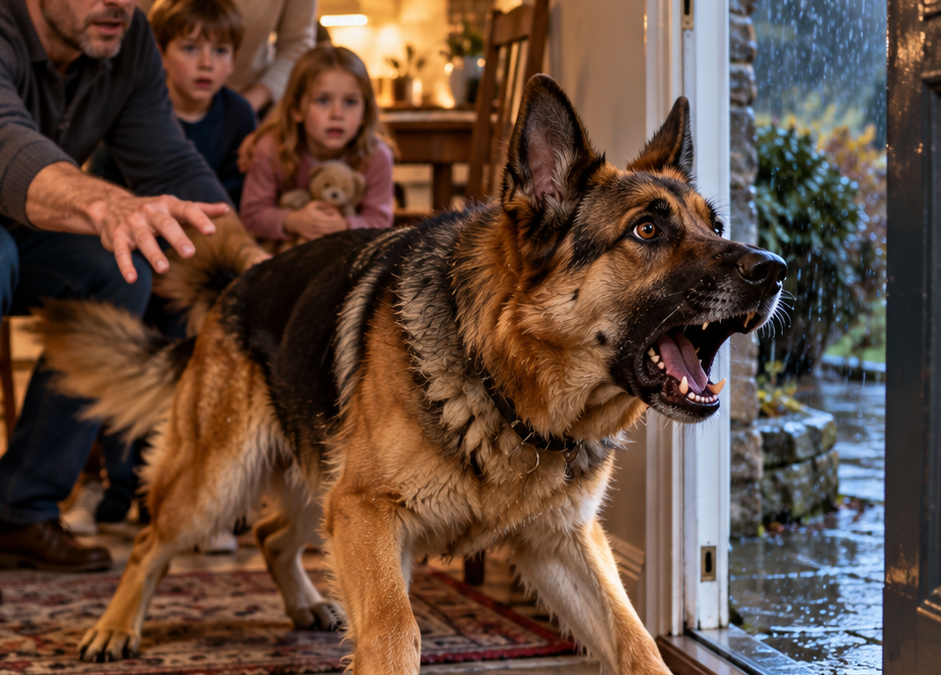
The Moment Rex Refused to Let Us Stay Inside, I Knew He Was Afraid of Something I Couldn’t Hear
The first warning was not a crack in the wall.
It was Rex.
At the time, I did not understand that.
I only knew that our nine-year-old German Shepherd, a dog who had slept through thunderstorms, ignored tractors, and once refused to move when a fox crossed the garden, suddenly became terrified of our house.
It started just after four in the afternoon.
The sky over Little Barrington had turned the flat gray color we knew so well in the northern Cotswolds, and a fine cold drizzle had begun tapping against the kitchen windows.
My wife, Rachel, was standing at the stove.
Our son, Sam, was at the table pretending to do homework.
Ellie, our seven-year-old daughter, was on the floor with colored pencils scattered around her.
And Rex was pacing.
That alone was unusual.
Rex did not pace.
He had routines.
At that hour, he usually lay near the back door, one eye half open, waiting for the possibility of food.
Instead, he walked from the kitchen to the hallway.
Back again.
Stopped.
Lifted his head.
Listened.
Then started over.
His claws clicked against the old stone floor.
Click.
Click.
Click.
Click.
Rachel finally looked down.
“What’s wrong with him?”
“I don’t know.”
Rex reached the hallway.
Stopped beneath the wooden beam that crossed the ceiling.
His ears went forward.
Then he backed away.
Not slowly.
Suddenly.
His nails scraped the floor.
“Rex?”
I stepped toward him.
He looked at me.
I had known that dog for almost nine years.
I knew when he wanted food.
When he needed to go outside.
When he had heard an animal in the field.
When he was bored.
When he was pretending not to understand the word bath.
This was none of those things.
His eyes were wide.
Alert.
Afraid.
“Come here.”
He didn’t.
He turned toward the front door.
Barked once.
Sharp.
Then looked back at us.
“What is it?” Sam asked.
“Probably heard something.”
“There’s nothing outside.”
“Dogs hear more than we do.”
That answer was easy.
Comforting.
Wrong.
Rex barked again.
Then he went to Ellie.
He pushed his nose hard against her shoulder.
She laughed.
“Rex, stop.”
He pushed again.
Harder.
“Dad.”
“I see.”
He moved to Sam.
Did the same thing.
Then Rachel.
He nudged her leg, turned toward the door, and barked.
Rachel lowered the spoon in her hand.
“Daniel.”
“I know.”
“What is he doing?”
“I don’t know.”
Rex ran to me.
Grabbed the cuff of my trouser leg between his teeth.
Not biting.
Pulling.
“Hey.”
He pulled again.
Toward the front door.
Something cold moved through me.
“Everyone outside.”
Rachel stared.
“What?”
“Just for a minute.”
“It’s raining.”
“Rachel.”
She heard the change in my voice.
I looked at Sam.
“Shoes.”
“What’s happening?”
“I don’t know.”
That was the truth.
I had no explanation.
Only a dog I trusted more than I trusted my own instincts.
The house was old.
Very old.
Stone walls.
Heavy timber.
Iron reinforcement added decades later.
My grandfather used to say the place had been standing before anyone in our family deserved it.
It had survived winter storms.
Floods.
High winds.
One chimney fire.
Two renovations.
And a century’s worth of people assuming it would remain where it was forever.
There had been small cracks in the west wall for years.
Nothing dramatic.
We had patched them.
A builder inspected the house the previous spring and said the foundation had shifted slightly but was stable.
Stable.
I had believed that word.
Rex did not care what the builder had said.
He barked again.
Then ran to the door and scratched it.
“Dad, he’s freaking out,” Sam said.
“I can see that.”
I opened the front door.
Cold rain blew inside.
Rex shot out.
Then immediately turned around.
He did not run into the yard.
He stood outside and barked at us.
“Come on,” I told everyone.
Rachel grabbed Ellie’s coat.
Sam followed.
We stepped into the yard.
Rex moved behind Ellie and pushed her farther from the house.
She stumbled.
“Rex!”
“Let him.”
“What’s wrong with him?”
“I don’t know.”
We crossed half the garden.
That was when I heard it.
Low.
Deep.
Not loud.
A groan.
Not from outside.
From the house.
I turned.
The old stone wall near the kitchen shifted.
At first, I thought my eyes were lying.
Then a crack widened near the upper window.
“Move!”
I grabbed Ellie.
Rachel pulled Sam.
“Run!”
We sprinted toward the gate.
Behind us came a sound I will hear until I die.
Wood splitting.
Metal twisting.
Stone breaking under weight.
The left side of the house dropped inward.
A section of roof folded.
The upstairs windows vanished behind gray dust.
Rachel screamed.
Sam yelled.
I shoved Ellie toward the fence.
Then looked back.
Rex was not with us.
“Rex!”
He was halfway across the yard.
Facing the house.
“No!”
He ran toward it.
I ran after him.
“REX!”
He stopped at the broken doorway.
Looked back once.
That image is burned into me.
Rain on his coat.
Ears forward.
Dust moving around him.
For one second, our eyes met.
Then he disappeared inside.
“REX!”
I reached the door.
A second collapse struck.
Someone grabbed the back of my coat and threw me away from the wall.
Stone hit the ground where I had been standing.
I landed hard on my shoulder.
For several seconds, I could not hear anything except ringing.
Then a voice.
“Daniel!”
Harold Bennett.
Our neighbor.
He lived across the field.
Seventy-two years old.
Farmer his entire life.
Strong in the stubborn way old men become when nobody ever convinces them they are old.
He had apparently heard Rex barking from his property.
Later, Harold told me the bark was what made him come outside.
“It wasn’t normal,” he said.
“It sounded like he was trying to wake the whole valley.”
He had seen us running from the house.
Then seen Rex go back in.
Now he stood over me, rain dripping from his cap.
“Don’t move.”
“Rex is inside.”
“I know.”
I tried to stand.
Harold held my shoulder.
“Daniel.”
“Get off me.”
“Another section can come down.”
“My dog is in there.”
“I know.”
I shoved him away.
“Then help me.”
That was the moment everything else disappeared.
The house.
Money.
Furniture.
Photographs.
Documents.
The fact that nearly our entire life was under stone and timber.
None of it mattered.
Rex had gotten us out.
Then gone back.
Why?
I still do not know.
Maybe he heard something inside.
Maybe instinct sent him toward a familiar room.
Maybe he believed one of us was missing.
Maybe he was confused by the collapse.
People later tried to turn it into a perfect act of heroism.
I never needed perfection.
I knew only what happened.
Rex forced us out.
Then he went back in.
And the house fell on him.
I reached the rubble.
The front half of the building was still standing.
The western side had collapsed almost completely.
Roof slate.
Stone.
Broken windows.
Heavy timbers.
Furniture mixed into everything.
Dust turned to gray mud beneath the rain.
I started pulling pieces away with my hands.
“Rex!”
Nothing.
“REX!”
Harold came beside me.
“Listen.”
We stopped.
Rain.
Settling stone.
A soft metallic creak from somewhere inside.
No bark.
Nothing.
My stomach turned.
I grabbed another board.
“Daniel, the village men are coming.”
“Good.”
“Wait for them.”
“No.”
“You’ll bring the rest down.”
“I’m not waiting.”
My hands were already bleeding.
I barely noticed.
I pulled broken wood.
Small stones.
A shattered window frame.
Anything I could move.
Behind me, Rachel called.
“Daniel.”
I turned.
She stood near Harold’s fence with the children.
Dust covered her hair.
Ellie was crying silently.
Sam was trying not to.
Rachel’s face was white.
“Don’t go inside.”
“I’m not.”
That was technically true.
Not yet.
Ellie looked at me.
“Dad?”
I tried to make my face calm.
“What, sweetheart?”
“Is he in there?”
I could not answer immediately.
Her lower lip trembled.
“Rex.”
“Yes.”
“He’s inside?”
“Yes.”
“Is he hurt?”
“I don’t know.”
“You’re going to get him?”
The question cut through me.
I looked toward the rubble.
Then back at her.
“Yes.”
I said it before I knew whether I could keep it.
“I’m going to get him.”
Rachel closed her eyes.
Maybe she heard the promise inside that answer.
Maybe she knew promises were dangerous.
I did too.
But Ellie needed one.
So did I.
Harold put a hand on my shoulder.
“I saw him.”
I looked at him.
“What?”
“Before it fell.”
“Where?”
“He ran through the front.”
“I know.”
“No.”
Harold pointed.
“He turned left.”
“Toward the sitting room?”
“Yes.”
My heart raced.
“Are you sure?”
“Yes.”
“Why?”
“I don’t know.”
I did not care why.
Direction was enough.
I moved toward that side.
The sitting room had been near the western wall.
That part of the house was now a mountain of stone.
I started digging.
Twenty minutes later, the first neighbors arrived.
Then more.
Men from the village.
Women bringing blankets.
Ropes.
Tools.
Someone brought lanterns even though it was not yet dark.
Thomas Wood arrived carrying two hydraulic jacks in the back of his truck.
Thomas was the village carpenter.
He knew old houses.
More importantly, he knew when frightened people were about to make dangerous decisions.
He walked around the rubble once.
Then grabbed my arm.
“Stop.”
I pulled away.
“I can’t.”
“You have to.”
“Rex is in there.”
“I know.”
“He could be dying.”
“And if you move the wrong stone, you could kill him.”
That stopped me.
Thomas pointed toward the upper section.
“See that?”
A large iron beam had fallen diagonally.
One end rested on broken masonry.
The other disappeared into the collapsed room.
“That beam shifts, this side goes.”
I looked.
“Then we move it.”
“No.”
“Why?”
“Because it weighs more than all of us.”
My hands curled.
Thomas stepped closer.
“Daniel, listen to me.”
I hated calm people in that moment.
“You want the dog out?”
“Yes.”
“Then let us do this properly.”
Every second felt like betrayal.
But I nodded.
Thomas organized us.
Two men brought wooden supports from his truck.
Another fetched a pry bar.
We cleared only light debris at first.
Slowly.
Carefully.
Every movement followed by silence.
Listen.
Nothing.
Move another piece.
Listen.
Nothing.
I called Rex’s name every few minutes.
No answer.
Half an hour passed.
Then forty minutes.
Rachel brought me a coat.
I refused.
“You’re shaking.”
“I’m fine.”
“You’re bleeding.”
I looked at my hands.
Skin torn across my knuckles.
Blood mixed with gray dust.
“I don’t care.”
She grabbed my wrists.
“Daniel.”
I looked at her.
Her eyes were wet.
“You almost died.”
“I know.”
“The children almost died.”
“I know.”
“Rex got us out.”
“I know.”
She lowered her voice.
“And now you’re going to get yourself killed trying to repay him?”
The words hurt because they were true enough to frighten me.
“What do you want me to do?”
“I want you alive.”
“And him?”
Rachel looked toward the rubble.
Her face broke.
“I want him alive too.”
Then she whispered, “But I can’t lose both.”
I pressed my forehead against hers.
For three seconds.
Maybe four.
Then Thomas called.
“Daniel.”
I turned.
“We found something.”
Hope is a dangerous thing when you have spent an hour preparing yourself for silence.
I ran.
Thomas crouched near a narrow gap between two heavy blocks of stone.
A broken cabinet had fallen at an angle beneath them.
“There’s air.”
“What?”
He held a small scrap of tissue near the opening.
It moved slightly.
“Draft.”
My knees hit the mud.
I lowered my face toward the gap.
Darkness.
Dust.
Nothing visible beyond a foot or two.
“Rex.”
Silence.
I swallowed.
“Rex, buddy.”
Nothing.
“It’s me.”
My voice broke.
“I’m here.”
Everyone around us became still.
No tools.
No talking.
Only rain.
I put my ear near the opening.
“Rex?”
Five seconds.
Ten.
Then—
A sound.
Low.
Short.
A bark.
Barely a bark.
Almost a breath shaped like one.
I froze.
“Again.”
Nothing.
Then scratching.
Weak.
Stone against claw.
“He’s alive.”
The words came out as a whisper.
I turned toward Thomas.
“He’s alive.”
Harold looked away.
I saw him wipe his face with the back of one hand.
Ellie screamed from the fence.
“REX!”
Another weak sound came from inside.
I laughed.
Cried.
I don’t know.
Something left my chest all at once.
“He heard her.”
Thomas immediately raised one hand.
“Everybody calm down.”
No one wanted calm.
We wanted to tear the house apart.
But now the danger was worse.
Before, we feared Rex might already be dead.
Now we knew one wrong movement could make that true.
Thomas pushed a flashlight into the opening.
At first the beam hit dust.
Broken timber.
A section of wall.
Then fur.
My heart stopped.
“Move it left.”
Thomas did.
There.
Rex.
He was lying inside a small cavity formed by pure accident.
A wardrobe had fallen sideways.
A table had broken beneath it.
A slab of wall rested at an angle over the wreckage, creating a pocket just large enough for him.
Had any one of those pieces landed differently, there would have been no space.
Rex’s body was covered in dust.
His muzzle gray.
Fur torn along his shoulder.
Right rear leg trapped awkwardly.
One eye barely open.
His chest rose.
Slow.
Painful.
But it rose.
“Rex.”
His ear moved.
I pressed closer.
“Hey.”
His eye opened a little more.
He knew my voice.
“Good boy.”
I could not stop crying now.
“Good boy.”
Thomas widened the opening only enough for me to push my arm through.
“Nothing more.”
“I can reach him.”
“Only your arm.”
I lay flat in the mud.
Reached into the darkness.
My fingers touched fur.
Rex moved his head weakly toward me.
“There you are.”
I felt his ear.
Then forehead.
Dust.
Warmth.
Life.
He tried to lick my fingers.
His tongue barely touched them.
It lasted maybe two seconds.
For me, time stopped.
I had touched him.
After an hour of hearing nothing, there was my dog.
Still there.
“I’m not leaving.”
I whispered it into the gap.
“Do you hear me?”
His nose pressed weakly against my hand.
“We’re getting you out.”
Thomas touched my shoulder.
“We need you back.”
“No.”
“Daniel.”
“Two more seconds.”
“Now.”
I pulled my arm out.
It felt like abandoning him.
Thomas saw it in my face.
“He needs you to let us work.”
I stood.
“Tell me what to do.”
The next hour was the longest of my life.
Thomas placed support after support.
Heavy wooden braces.
Hydraulic jacks.
Ropes around unstable sections.
He moved inches at a time.
“Pressure.”
A jack rose.
“Stop.”
Someone inserted timber.
“Release slightly.”
Stone settled.
We all froze.
Listen.
Rex scratched once.
Still alive.
Again.
Lift.
Brace.
Clear.
Every sound from the house made my heart stop.
Sam eventually came closer.
Rachel tried to stop him.
“Mom, I just want to see.”
“Stay behind Harold.”
He did.
He stood twenty feet away.
Fists closed.
At twelve, he was old enough to understand what might happen and young enough to believe I could prevent it.
That was almost harder than Ellie’s crying.
“Dad?”
I looked.
“You heard him?”
“Yes.”
“He’s alive?”
“Yes.”
“Then get him.”
“I’m trying.”
Sam nodded.
He never asked again.
Darkness began arriving.
People set lanterns around the site.
Rain softened.
Cold got worse.
Nobody left.
Not one neighbor.
Mrs. Wood brought tea.
No one drank much.
Harold worked beside men half his age.
Rachel wrapped Ellie in two blankets.
Then finally Thomas looked at me.
“We have enough room.”
I stared.
“For what?”
“One person.”
“I’m going.”
He did not argue.
Maybe he knew there was no point.
He grabbed my coat.
“Listen carefully.”
I nodded.
“You crawl only where I tell you.”
“Yes.”
“Do not touch the beam.”
“Yes.”
“Do not move the cabinet.”
“Yes.”
“If I tell you out, you come out.”
I hesitated.
Thomas tightened his grip.
“Daniel.”
“Yes.”
He studied my face.
“You don’t save him by becoming another body we have to dig out.”
“I understand.”
I got down.
The opening was barely large enough.
Stone pressed against my shoulder.
Dust filled my mouth.
Someone held the flashlight behind me.
I crawled.
Slowly.
One elbow.
Then the other.
A broken piece of wood caught my jacket.
I freed it.
The space narrowed.
Then opened slightly.
Rex was three feet ahead.
“Hey, buddy.”
His eye opened.
His tail moved.
Once.
A weak scrape against debris.
I nearly lost control.
“Don’t.”
I laughed through tears.
“You don’t have to do anything.”
I reached him.
His body was partially trapped beneath a broken section of plaster and wood.
Not heavy.
I moved it carefully.
His rear leg became visible.
I knew immediately it was broken.
Wrong angle.
Swollen.
Rex whimpered.
“Sorry.”
I put my hand against his neck.
“I’m sorry.”
He licked my wrist.
Even then.
Even broken beneath a house, he was trying to comfort me.
I stayed still for a moment.
My forehead against his.
“You idiot.”
My voice shook.
“Why did you go back?”
Rex breathed.
“You got us out.”
I swallowed.
“You got everyone out.”
His eyes closed.
“And then you went back.”
No answer.
Of course.
Maybe there never would be.
I slid one arm beneath his chest.
The other under his hips without bending the injured leg.
Thomas called from outside.
“You have him?”
“Yes.”
“Can he move?”
“No.”
“Blanket coming in.”
Someone pushed a folded blanket through the gap.
I maneuvered it beneath Rex as carefully as possible.
He made one low sound.
“Almost.”
I wrapped him.
Then whispered, “Now, my friend.”
I put my face near his ear.
“We go out together.”
Moving him took forever.
I crawled backward.
One foot.
Pause.
Check beam.
Another foot.
Rex’s weight dragged against my arms.
Nine years old.
Large Shepherd.
He had always looked powerful.
Now he felt terrifyingly fragile.
“Easy.”
Someone grabbed the edge of the blanket.
“Not yet.”
I kept one hand under Rex.
Then another pair of hands reached us.
Thomas.
“Give me the shoulders.”
“No, I have him.”
“Daniel.”
I knew.
I let him help.
Together, inch by inch, we moved Rex through the opening.
Then the night air hit my face.
Hands everywhere.
Supporting.
Lifting.
Moving us away from the wreckage.
When Rex finally emerged fully into the lantern light, everyone went silent.
No cheering.
No celebration.
Not at first.
Because seeing him hurt made the cost real.
His coat was soaked.
Dust had turned to mud across his back.
Cuts showed beneath torn fur.
His rear leg hung badly.
His breathing was shallow.
But he was alive.
Rachel covered her mouth.
Sam looked away.
Ellie did not.
She came toward us.
Rachel caught her.
“Slow.”
Ellie approached.
I was kneeling with Rex on the blanket.
His head in my lap.
She crouched.
“Rex?”
His eyes opened.
Tail moved.
Once.
Ellie began crying again.
She wiped his dusty muzzle with the sleeve of her sweater.
“You’re going to get better.”
Her voice broke.
“You have to.”
Rex licked the fabric weakly.
Thomas turned away.
The biggest man there.
Hands like shovels.
Could lift a timber beam with another man.
He stood facing the darkness because he did not want us to see him cry.
Harold did not bother hiding his tears anymore.
He put a hand on my back.
“Good dog.”
That was all he said.
Good dog.
Sometimes two words can hold everything.
We got Rex into Harold’s truck because it had the easiest access.
The village veterinarian, Dr. James Parker, had already been called.
His clinic was small.
Mostly livestock and household animals.
He met us there.
“What happened?”
“House collapse.”
James looked at Rex.
Then me.
“He was under it?”
“About three hours.”
James’ face hardened into professional focus.
“Table.”
We carried Rex inside.
I tried staying beside him.
James stopped me.
“Let me work.”
“I’m staying.”
“You can stay against the wall.”
“Fine.”
Rachel arrived with the children a few minutes later.
Harold brought them.
James examined Rex.
Palpated his abdomen.
Checked gums.
Breathing.
Pupils.
Leg.
Rex growled once when James touched the break.
I almost smiled.
“What?”
Rachel whispered.
“He growled.”
“So?”
“He has enough energy to complain.”
She understood.
A few minutes later, James looked at us.
“Right rear leg is definitely fractured.”
“How bad?”
“Likely two breaks.”
Ellie made a sound.
Rachel pulled her closer.
“Ribs?”
James listened.
“Possibly.”
“Internal bleeding?”
“I don’t know yet.”
My stomach turned.
“We need imaging.”
“How long?”
“As long as it takes.”
Again.
Waiting.
We had already waited under rain beside a collapsed house.
Now another room.
Different silence.
Sam sat beside me.
His knees touching mine.
“Dad?”
“Yes.”
“Did he know?”
“What?”
“The house.”
I looked at him.
“Did Rex know it was going to fall?”
I exhaled.
“I don’t know.”
“He made us leave.”
“Yes.”
“So he knew.”
“Maybe he heard something.”
“What?”
“Stone shifting. Wood. Something we couldn’t hear.”
Sam nodded slowly.
“Then he saved us.”
“Yes.”
There was no reason to soften that.
Rex saved us.
We would have been in the kitchen when that wall came down.
Rachel would have been near the stove.
Ellie on the floor.
Sam at the table.
Me near the hallway.
I had replayed it already.
Too many times.
If Rex had not forced us outside, our family would have been inside a room that no longer existed.
James came back nearly an hour later.
I stood immediately.
“Well?”
“Three cracked ribs.”
Rachel closed her eyes.
“Broken leg in two places.”
“Anything internal?”
James paused.
“His organs look remarkably good.”
I stared.
“No major internal bleeding.”
I felt my knees weaken.
“He’s going to live?”
“I think he has a very good chance.”
Ellie started crying loudly this time.
Rachel hugged her.
I grabbed the edge of a chair.
James continued.
“He’s dehydrated, in shock, bruised everywhere, and he’s going to hurt for a while.”
“But?”
“But he’s alive.”
I laughed once.
“Yeah.”
James looked through the glass toward Rex.
“For a nine-year-old German Shepherd, he’s incredibly tough.”
I wiped my face.
“We always knew.”
That was the first time I smiled that day.
Rex stayed at the clinic overnight.
I did not want to leave.
James practically forced me.
“You have two children who nearly lost their home.”
I looked at him.
“They need you tonight.”
That got through.
Our house was uninhabitable.
Part of it still stood, but inspectors later said the structure was unsafe.
We spent the first night at Harold’s.
None of us slept.
Ellie came into the room where Rachel and I were lying.
“Can Rex sleep here when he comes back?”
“Yes.”
“No matter what?”
“Yes.”
“Even if he’s dirty?”
Rachel almost laughed.
“Especially if he’s dirty.”
Ellie climbed between us.
For a while we listened to rain.
Then she whispered, “Why did he go back?”
I stared into darkness.
“I don’t know.”
“Was he looking for us?”
“Maybe.”
“But we were outside.”
“I know.”
“Did he forget?”
“Maybe.”
She was quiet.
Then: “Maybe he thought someone else was inside.”
That possibility hurt.
Rex had spent his whole life watching us.
Counting us in whatever way dogs count family.
Maybe in chaos, he thought one of us remained.
Maybe he went back because Shepherds are wired to gather what belongs to them.
Maybe the house itself felt like part of his herd.
There was no answer.
Ellie did not need one.
Eventually she fell asleep.
I did not.
Every time I closed my eyes, I saw Rex disappear through the doorway.
Then the wall collapse.
At six in the morning, I drove to the clinic.
James was already there.
“So much for rest.”
“How is he?”
“Awake.”
My chest loosened.
“Can I see him?”
James opened the door.
Rex lay on a padded mat.
Leg stabilized.
Bandages along his shoulder.
His eyes opened when I entered.
Tail moved.
Weak.
But real.
I sat on the floor.
“Hey.”
His head lifted slightly.
“Don’t.”
I put one hand beside his face.
He rested against it.
“You scared me.”
Rex closed his eyes.
“You hear me?”
I stroked his ear.
“You’re not allowed to be the hero twice in one day.”
His breathing remained slow.
I stayed there almost an hour.
Over the next week, our life became two disasters happening at once.
The house.
And Rex.
Insurance.
Inspectors.
Temporary housing.
Builders.
What could be salvaged.
What was destroyed.
Clothes.
Documents.
Furniture.
Family photographs.
Every item came with a question.
Can we save this?
Is this safe?
Is it worth anything?
Meanwhile, Rex needed medication.
Bandage changes.
Follow-up imaging.
Rest.
The leg was cast.
James warned us recovery would be harder because of his age.
Ellie rejected that.
“He’s not old.”
“He’s nine.”
“That’s not old.”
“In dog years—”
“Don’t.”
James smiled.
“Yes, ma’am.”
We moved temporarily into an old converted barn on Harold’s property.
Calling it a barn made it sound worse than it was.
It had heat.
Electricity.
A bathroom.
Two makeshift bedrooms.
Enough.
Harold refused rent.
I argued.
He ignored me.
“Your dog saved those children.”
“That doesn’t mean you house us for free.”
“Yes, it does.”
“That makes no sense.”
“I’m old. I don’t need sense.”
That ended it.
Rex came home four days later.
Getting him from the truck became a family operation.
Sam held the door.
Rachel carried medication.
Ellie carried Rex’s blanket.
I supported Rex with a sling beneath his abdomen.
The moment his paws touched the barn floor, he looked around.
Uncertain.
The place did not smell like home.
That worried me.
Then Ellie put down his old blanket.
One of the few things pulled intact from the wreckage.
Rex sniffed it.
Lay down.
Home enough.
For the first two weeks, he barely moved.
That was hard.
Rex had always followed everything.
Kitchen.
Garden.
Children.
Me.
Now he watched.
Sam did homework beside him.
Ellie drew pictures on the floor.
Rachel drank tea near the stove.
I handled phone calls about construction.
Rex lay in the middle of all of it.
Still watching.
Still keeping count.
Some nights, he woke suddenly.
Panting.
I would sit beside him.
“Easy.”
His eyes searched the room.
Everyone there.
“You got us out.”
I whispered it often.
“I know.”
I had begun feeling guilty.
Not rational guilt.
The useless kind.
Why did he go back?
Could I have stopped him?
Could I have caught him before he entered?
Should I have noticed structural problems earlier?
Did the crack in the wall mean more than I believed?
I asked the surveyor.
He explained that prolonged dampness, old structural movement, and failure around one reinforced section likely contributed.
Technical words.
None changed what happened.
The house failed.
Rex noticed first.
I didn’t.
One night Rachel found me sitting beside him after everyone slept.
“You’re doing it again.”
“What?”
“Blaming yourself.”
“I’m not.”
“You are.”
I looked at Rex.
“If I had listened to that crack last month—”
“You had it checked.”
“Months ago.”
“The report said stable.”
“Reports can be wrong.”
“So can people.”
I rubbed my face.
“He went back because I didn’t stop him.”
Rachel sat beside me.
“You had seconds.”
“I should have—”
“Daniel.”
I looked at her.
“He saved us.”
“I know.”
“And we saved him.”
“Barely.”
“Still counts.”
Rex opened one eye.
Rachel touched his head.
“You don’t have to turn love into debt.”
That sentence stayed with me.
I had been treating Rex’s rescue like repayment.
He did this for us.
Therefore I must do everything perfectly afterward.
But love between people and animals is not accounting.
No one balances the ledger.
Rex did not save us because he expected three hours of digging in return.
We did not dig because we owed him.
We dug because he was ours.
That was enough.
Five weeks after the collapse, James removed the cast.
Rex stood on three legs at first.
Looked offended by the missing weight.
James laughed.
“Give him time.”
“How long?”
“Several weeks before I want him doing anything stupid.”
I looked at Rex.
“You hear that?”
Rex ignored me.
James pointed.
“I mean it. Short walks. Controlled. No running.”
Ellie said, “He doesn’t run now.”
Rex chose that moment to lunge toward a treat on the floor.
James caught him.
“Exhibit A.”
His limp remained.
But each day improved.
First the length of the barn.
Then the yard.
Then to Harold’s fence.
The rebuilding had started by then.
We decided not to recreate the old stone house.
I could not.
Rachel could not either.
Too many memories now belonged to the collapse.
Instead, we planned a timber-framed home on the same property.
Lighter structure.
Modern reinforcement.
Wide windows.
A large front porch.
Ellie demanded “a proper place for Rex.”
“What does that mean?” the architect asked.
“A place where he can lie and watch everyone.”
The architect looked at me.
“She’s serious.”
“So am I.”
The design included a wide section beside the main doorway.
Rex’s place.
Every morning, from Harold’s barn, Rex walked outside and looked toward the construction.
He seemed fascinated.
Or maybe that was my projection.
Men moved timber.
Machines arrived.
Foundations poured.
Walls rose.
Rex sat and watched.
Harold came over most mornings.
“He’s supervising.”
“He’s useless.”
Rex looked at me.
Harold laughed.
“He disagrees.”
By the sixth week, Rex could put weight on the injured leg.
By the eighth, he walked without the sling.
Still limping.
But stubbornly independent.
Sam stopped hovering.
Ellie never did.
She brought Rex water as if he had forgotten how to drink without assistance.
She tucked blankets over him.
Once I found her reading to him.
“What are you doing?”
“He gets bored.”
“He’s asleep.”
“He can still hear.”
The book was about horses.
Rex looked deeply uninterested.
I left them alone.
That autumn became winter.
The old house disappeared piece by piece.
Salvage crews removed stone that could be reused.
We kept several beams that were safe.
One became the mantel in the new house.
Rachel wanted that.
“So it’s still ours.”
I understood.
We did not want the old house erased.
Only transformed.
One clear cold afternoon, several weeks after Rex’s cast came off, we gathered outside the barn around a fire pit.
Harold had built it from old stone.
Rachel sat on a wooden bench holding tea.
Sam was throwing a ball carefully for Rex.
Not far.
Ellie kept yelling instructions.
“Not too hard!”
“I’m not.”
“He’s still healing.”
“I know.”
“You threw it too far.”
“It went four feet.”
“Too far.”
Rex ignored both of them and carried the ball back.
Slowly.
Proudly.
I watched him.
Gray beginning around his muzzle.
One ear slightly scarred from the collapse.
A small patch of fur still shorter on his shoulder.
He looked older than he had two months earlier.
So did all of us.
Disasters age families strangely.
Children remain children, but something changes in the way they understand safety.
Adults become grateful for things they once considered ordinary.
Walls.
Dinner.
Shoes by the door.
A dog asleep nearby.
I stood.
Rex looked toward me.
I walked over.
Knelt.
Wrapped my arms around his neck.
He tolerated hugs rather than enjoyed them.
Always had.
That day, he stayed still.
I pressed my forehead against his fur.
“You taught us something.”
Rachel watched.
Sam stopped throwing the ball.
Ellie sat beside Rex.
“What?” she asked.
I looked at them.
Then at the dog.
“That the loudest kind of love isn’t always the strongest.”
Sam frowned.
“What does that mean?”
I smiled.
“Rex couldn’t tell us the house was dangerous.”
“But he barked.”
“Yes.”
“He pushed us.”
“Yes.”
“So that was loud.”
“Fair point.”
Rachel laughed.
I tried again.
“He didn’t explain.”
I stroked Rex’s neck.
“He just acted.”
Ellie nodded seriously.
“He saved us.”
“Yes.”
Then I looked toward the new house frame.
“And when he was trapped, we didn’t know if he was alive.”
Sam looked down.
“We kept digging.”
“Yes.”
I swallowed.
“We kept searching.”
Rex leaned against me.
“Sometimes love means you don’t stop just because everything looks hopeless.”
No one spoke.
I had meant the words for the children.
Maybe also for myself.
Rex turned his head.
Licked my nose.
Long.
Slow.
Disgusting.
Nobody laughed.
Not immediately.
We all smiled.
Even Harold, watching from behind his fence, shook his head.
“Damn dog.”
His voice carried across the field.
Rex’s tail moved.
Months later, the new house was finished.
The first night inside felt strange.
New timber smell.
Fresh paint.
Clean floors.
No scratches.
No history.
Rachel stood in the kitchen and whispered, “Doesn’t feel like ours.”
“It will.”
Sam went upstairs.
Ellie immediately arranged Rex’s blankets near the entrance.
Rex walked through each room.
Slow.
Sniffing.
Checking.
Then returned to the front door.
Lay down.
Head on paws.
Rachel looked at me.
“There.”
“What?”
“Now it’s ours.”
She was right.
The house became home at the exact moment Rex settled into it.
We mounted one piece from the old house above the fireplace.
A length of timber recovered from the safe eastern section.
Burned slightly dark by age.
Not damaged by the collapse.
Under it, we placed a family photograph.
Taken before that day.
Rex younger.
Children smaller.
Stone house behind us.
I thought looking at it would hurt.
Sometimes it did.
Mostly, it reminded me that survival does not require pretending nothing was lost.
We lost the old house.
We lost possessions.
Photographs.
Furniture.
Pieces of family history.
Rex lost some of the strength in his back leg.
But we were there.
All of us.
That sentence became enough.
Ellie turned eight not long after we moved in.
Her friends from the village came for cake.
At some point I heard her telling the story.
Children tell stories differently from adults.
Adults qualify.
Explain.
Correct.
Children find the center.
“Rex knew the house was going to fall.”
One girl gasped.
“How?”
“He’s a dog.”
Apparently that was explanation enough.
“He pushed us outside.”
“Really?”
“Yes.”
“Then what?”
“He went back.”
“Why?”
Ellie paused.
“I think he thought somebody was still inside.”
My chest tightened from across the room.
The girl asked, “Then the house fell on him?”
“Yes.”
“Did he die?”
“No.”
Ellie looked offended.
“Dad found him.”
I almost corrected that.
Dad and Thomas and Harold and half the village.
But I didn’t.
“And then?”
“We pulled him out.”
“Was he hurt?”
“Very.”
Ellie put both arms around Rex.
He tolerated it.
“But he’s okay now.”
The girl touched his ear.
“Hero dog.”
Ellie’s face became serious.
“Sometimes people think we save dogs.”
She had clearly rehearsed this thought.
“But mostly they save us.”
The other children nodded as if she had delivered proven science.
I went outside before she could see my face.
The next day I made a sign.
It was small.
Wood.
Nothing fancy.
I carved the letters myself.
Rachel watched from the kitchen table.
“What are you making?”
“Nothing.”
“That is obviously something.”
“Go away.”
“Very mature.”
When I finished, I took the sign outside and mounted it near the entrance.
HERE LIVES THE HERO WHO SAVED OUR WHOLE WORLD.
Rachel stood behind me.
“Subtle.”
“I wasn’t aiming for subtle.”
Sam read it.
“Embarrassing.”
“You’re twelve. Everything is embarrassing.”
Ellie loved it.
Harold came across the field.
Read it.
Nodded.
“Accurate.”
Rex walked past without looking.
That seemed right.
Heroes rarely care about signs.
People from the village began slowing when they passed.
Some already knew the story.
Most did.
Little places carry stories quickly.
Someone brought Rex a large bag of treats.
Thomas built a raised feeding stand because bending had become harder on his hip.
Mrs. Wood knitted him a blanket he refused to use for two months and then suddenly adopted.
James Parker checked his leg every few months.
“He’s slowing down.”
James told me one spring.
“I know.”
“Normal.”
“I know.”
“He’s doing well.”
I nodded.
Rex was ten by then.
His face whitening.
Hearing slightly worse.
But he still woke when one of the children came home.
Still positioned himself where he could see the door.
Still disliked being excluded from anything.
One night a storm rolled through.
Heavy rain.
Wind.
The new house creaked once.
Only normal movement.
I knew that.
But my body reacted before my mind did.
I sat upright in bed.
Rachel woke.
“What?”
“Nothing.”
She listened.
Rain.
I looked toward the bedroom door.
Rex was asleep outside it.
Completely relaxed.
I stared at him.
Rachel followed my gaze.
“He’s not worried.”
I exhaled.
“No.”
“Then sleep.”
It sounds foolish.
But after the collapse, I trusted Rex’s calm more than engineering.
If Rex slept, part of me believed the house could not fall.
That is what trauma does.
It makes irrational bargains with safety.
Rex never seemed haunted in the way we were.
At least not visibly.
He did not avoid the property.
Did not panic at construction sounds.
Did not run from the new house.
Dogs may remember differently.
Or perhaps his world had always been simpler.
Family here.
Therefore home here.
One evening I sat with Harold at his fence.
We watched Rex asleep near the front door.
“You know,” Harold said, “I still see it.”
“What?”
“Him running back.”
I looked at him.
“Me too.”
“I yelled.”
“I know.”
“He looked at me.”
Harold swallowed.
“Just once.”
“Yes.”
“Sometimes I think if I’d moved faster—”
“No.”
He looked at me.
“No?”
“You’re not doing that.”
“What?”
“What Rachel stopped me doing.”
“Which is?”
“Turning it into your fault.”
Harold rubbed his chin.
“I could’ve grabbed him.”
“Maybe.”
“That isn’t helpful.”
“It’s true.”
I leaned against the fence.
“I could’ve too.”
Harold said nothing.
“We had seconds.”
“Yes.”
“The house fell.”
“Yes.”
“And then we got him back.”
Harold looked toward Rex.
“Damn lucky.”
“Yes.”
“Very damn lucky.”
I smiled.
“That should be on the sign.”
He laughed.
For a long time, I thought the lesson of that day was courage.
Rex was courageous.
The neighbors were courageous.
Thomas crawled beneath unstable beams.
James treated an animal that looked as if he should have been worse than he was.
Rachel held our children together while watching me risk myself in the rubble.
But courage was only part of it.
The larger lesson was attention.
Rex paid attention.
He noticed something we did not.
Then we paid attention to him.
That saved us.
Later, beneath the debris, we paid attention to a weak bark.
That saved him.
So much of survival comes down to listening when something small is trying to tell you what matters.
A dog pacing.
A crack widening.
A faint scratch beneath stone.
A child asking, “Is he inside?”
Life rarely announces every danger clearly.
Sometimes the warning has four legs and cannot explain itself.
Years passed.
Rex grew older.
The limp never vanished completely.
Cold weather made it worse.
On winter mornings, he stood slowly.
Stretch.
Pause.
Then walk.
I learned not to rush him.
Ellie, older now, still told visitors his story.
Sam pretended he was tired of hearing it.
He wasn’t.
I caught him once explaining the rescue to a friend outside.
“Dad crawled in.”
“Wasn’t that dangerous?”
“Yeah.”
“And Rex?”
“He was crushed.”
“Was he conscious?”
“Barely.”
Sam’s voice changed.
“Dad said Rex licked his hand.”
I stopped listening.
Some moments belong differently to each person.
For Sam, that detail mattered.
For Ellie, it was Rex pushing her toward the door.
For Rachel, it was seeing the wall fall after we reached the yard.
For Harold, Rex’s last look before entering.
For Thomas, the weak bark beneath stone.
For me, it was touch.
My hand through a dark opening.
Fur beneath my fingers.
A tongue against my skin.
Proof that something I loved was still alive in a place that looked completely lifeless.
Even years later, whenever I see rubble after a storm on television, I think about that.
You cannot always tell from the outside.
Sometimes life remains in impossible pockets.
Waiting.
Breathing.
Too weak to make much noise.
You have to listen.
You have to look.
You have to be careful enough not to destroy what you are trying to reach.
And sometimes you have to keep digging long after fear tells you there is no point.
I do not romanticize what happened.
I would trade every lesson to spare Rex the pain.
Heroism is beautiful only from a safe distance.
Up close, it is blood.
Broken bone.
Fear.
Children crying.
A family standing in rain while their home becomes rubble.
If I could change that afternoon, I would.
I would hear whatever Rex heard earlier.
I would get everyone outside sooner.
I would close the door before he could go back.
Rex would never have been trapped.
No sign.
No village story.
No heroic legend.
Just an ordinary dog growing old beside an ordinary family.
I would choose that.
Every time.
But life does not ask what version we prefer after the fact.
We get what happened.
Then we decide what to do with it.
We rebuilt.
Rex healed.
We stayed.
That is the story.
One summer evening, long after the new house had stopped smelling new, I sat on the front step with Rex.
The children were inside.
Rachel was reading.
Sunlight stretched across the fields.
Rex lowered himself slowly beside me.
The gray around his muzzle had spread almost completely.
I touched the old scar near his shoulder.
“You remember?”
He looked at me.
“No?”
Tail movement.
“Probably healthier.”
I rested my arm across his back.
The sign hung above us.
HERE LIVES THE HERO WHO SAVED OUR WHOLE WORLD.
Rex looked toward the fields.
Calm.
No danger.
No urgency.
Just evening.
I sometimes wondered whether he understood anything about what he had done.
Probably not in the way we did.
He did not know the village called him a hero.
He did not understand that strangers slowed near our house because of him.
He did not know children repeated his story.
He knew only his family had been inside.
Then outside.
Then he had gone back.
Pain.
Darkness.
My voice.
Hands pulling him free.
Home again.
Maybe that was enough.
It was enough for me.
People like to say dogs love unconditionally.
I am not sure that phrase gives them enough credit.
Unconditional makes it sound effortless.
Rex’s love was not passive.
It watched.
Warned.
Pushed.
Ran.
Returned.
Endured.
And then, after all of that, trusted us to carry him out.
That kind of love had action inside it.
One evening Ellie came outside and sat on the other side of him.
She was older now.
Longer legs.
Less of the child I had carried away from the collapsing wall.
She placed her hand on Rex’s back.
“Dad?”
“Yeah?”
“Do you think he knew?”
“The house?”
She nodded.
“I think he knew something was wrong.”
“Could he hear it?”
“Maybe.”
“Smell it?”
“Maybe.”
“How?”
“I don’t know.”
She seemed dissatisfied.
Then she smiled.
“He was smarter than us.”
“That’s not a high bar.”
She laughed.
Rex opened one eye.
Ellie rested her head against him.
“Sometimes I still dream about it.”
My chest tightened.
“What happens?”
“The house falls.”
I waited.
“But in the dream, Rex doesn’t go back.”
“That’s good.”
“No.”
She frowned.
“Then I wake up before I know if everyone got out.”
I understood.
I put my arm around her.
“Everyone got out.”
“I know.”
“And Rex came out too.”
“I know.”
“Dreams don’t change that.”
She nodded.
We sat until sunset.
Rex between us.
Warm.
Breathing.
That was how healing happened in our family.
Not once.
Repeatedly.
Someone remembered.
Someone reminded.
We were there.
Rex was there.
The house was different.
We were different.
Still there.
When Rex turned eleven, we celebrated with steak.
Rachel said that was ridiculous.
Then cooked extra.
Harold came.
Thomas brought a biscuit.
James Parker stopped by after work.
Someone put a paper crown on Rex.
He tolerated it for six seconds.
Ellie took a photograph before he shook it off.
That photograph later sat on our mantel beside the older family picture from before the collapse.
Two lives.
Before.
After.
Both real.
Neither erased the other.
As Rex aged, I found myself thinking more about the day we would lose him.
I hated that.
But anyone who loves an older dog knows the thought.
It arrives quietly.
You notice how long it takes him to stand.
How deeply he sleeps.
How white his face has become.
And suddenly time becomes visible.
I tried not to count.
Instead, I paid attention.
Morning light on his coat.
The sound of his paws.
His breathing near the door.
The way he still watched Ellie leave for school.
The way Sam, now taller than me, bent to touch his head every time he passed.
The way Rachel stepped around him in the kitchen without complaint even though he always chose the worst possible place to lie.
Ordinary things.
The same kind we had once taken for granted.
That was Rex’s final lesson long before he was gone.
Ordinary is not small.
A quiet evening is not nothing.
A house standing is not nothing.
A dog sleeping by the door is not nothing.
Safety is not boring after you have heard stone collapse behind your children.
One autumn afternoon, rain began.
Fine.
Cold.
Almost identical to the day the old house fell.
Rex was lying on the porch.
I stood near him.
For a moment, memory overlaid the present.
Old stone.
Crack.
Barking.
Running.
Dust.
Then Rex sighed.
A tired old dog’s sigh.
I looked at the new house.
Solid timber.
Warm light in the windows.
Rachel inside.
Ellie laughing somewhere upstairs.
Sam home from school.
Everything Rex had once pushed out of danger was now behind those walls.
I sat beside him.
“You did okay.”
His ear moved.
“Better than okay.”
I touched his neck.
“You saved all of it.”
Rex looked toward me.
Then slowly licked my hand.
No drama.
That was his way.
That night, as always, he slept near the door.
Not guarding against disaster.
At least I don’t think so.
Just where he liked to be.
And I understood something that took me years.
We put the sign outside saying a hero lived there.
But Rex never lived as though he was a hero.
He lived as a dog.
He wanted food.
Warmth.
Walks.
Children.
Us.
Maybe heroism is often like that.
Not a person or animal deciding to become extraordinary.
Just love acting before fear has time to negotiate.
That afternoon, Rex heard something.
Felt something.
Knew something.
Whatever it was, he did not stand and analyze the risk.
He pushed us toward the door.
We followed.
That saved our lives.
Then he went back.
That nearly cost him his.
And when he was buried beneath wood, stone, and iron, the people around us did the same thing Rex had done.
They acted.
Harold came.
Thomas came.
Neighbors came.
Nobody stood at a safe distance and said it was hopeless.
They listened.
Dug.
Braced.
Waited.
Then heard one weak bark.
Love moved in both directions that day.
Rex saved his family.
A village saved Rex.
That is the version I tell now.
Not because it is neat.
Because it is true.
A dog cannot rebuild a house.
A man cannot undo collapse.
A child cannot prevent fear.
But everyone can do the next thing.
Push someone toward safety.
Lift one stone.
Hold one beam.
Call one name.
Listen for one answer.
Keep going.
Years later, people still ask me about the sign.
Some smile.
Some think it is sentimental.
I don’t care.
It remains above the entrance.
HERE LIVES THE HERO WHO SAVED OUR WHOLE WORLD.
The words have weathered.
The wood darkened.
Rain softened the edges.
I have repainted the letters twice.
I probably will again.
Because they are true.
Our whole world was not the old stone house.
I misunderstood that before.
Our whole world was Rachel.
Sam.
Ellie.
Rex.
The people standing together in the rain.
The neighbors who came running with ropes and crowbars.
Thomas beneath the beam.
Harold with mud on his knees.
James waiting at the clinic.
The life inside the walls.
Not the walls themselves.
Rex knew that before I did.
Maybe that is why the house was easier to rebuild than I expected.
Stone can be replaced.
Timber can be cut again.
Furniture bought.
Walls painted.
A family cannot be reconstructed so easily.
Neither can a dog.
So when people slow near the house and point at the sign, I let them.
Sometimes Rex raised his head.
Sometimes he slept through it.
The legend belonged to them.
The dog belonged to us.
And every evening, when the sun dropped behind the Cotswold hills and the sky turned gold, then purple, Rex took his place on the porch.
His head rested on his front paws.
Eyes toward the fields.
The white around his muzzle brighter in the last light.
He no longer paced.
No longer barked at the walls.
No longer tried to push anyone toward the road.
There was nothing to warn us about.
Only home.
Only evening.
Only the family he had once forced into the rain because something inside him understood danger before any of us did.
Sometimes I sat beside him.
Sometimes Ellie did.
Sometimes no one.
Rex never needed an audience.
He had already done the hardest thing of his life.
And I think, in whatever way dogs understand such things, he knew one simple fact.
Everyone was where they were supposed to be.
Safe.
Together.
Home.




