𝗙𝗨𝗟𝗟 𝗦𝗧𝗢𝗥𝗬 The Man Outside Our Shelter Refused the Warm Room Until I Told Him His Dog Could Stay Beside Him
𝗣𝗔𝗥𝗧 𝟮
He avoided the question.
“Let’s get Buddy settled.”
He followed me into the kennel wing.
Buddy stayed so close to his legs that Sam nearly tripped twice.
The shelter was quieter at that hour, but not silent.
Dogs shifted behind gates.
A terrier barked from the far row.
A metal bowl scraped concrete.
Every sound made Buddy look up.
We reached the open kennel.
I placed a fresh blanket inside.
Food.
Water.
Buddy stopped at the gate.
Sam crouched.
“Go ahead.”
Buddy looked at him.
“You’re okay.”
Nothing.
Sam stepped inside.
Buddy followed immediately.
I watched him sit on the floor.
Buddy pushed against his chest.
Sam wrapped both arms around the dog.
For perhaps thirty seconds, neither moved.
Then Sam whispered, “You stay warm.”
Buddy licked his chin.
“I’ll be close.”
Sam stood.
Buddy stood.
Sam stepped toward the gate.
Buddy followed.
I closed it gently.
The latch clicked.
Buddy barked.
Not loudly.
A short, broken sound.
Sam froze.
Buddy barked again.
Then placed both front paws against the bars.
“I’m here.”
Sam crouched outside.
Buddy pushed his nose through the gap.
Sam put two fingers through.
“There.”
The dog stopped barking.
I walked several steps away to give them space.
Ten minutes passed.
Then fifteen.
Sam finally stood.
Buddy remained at the gate.
“Good boy.”
Buddy whined.
“I’ll see you in the morning.”
Sam turned away.
Buddy barked once.
Sam stopped.
He did not look back immediately.
When he finally did, his eyes were wet.
I pretended not to notice.
We returned to the lobby.
I expected him to ask to sit there a while.
Instead, he headed toward the door.
“Sam.”
He stopped.
“Where are you going?”
“Outside.”
“It’s almost eight.”
“I know.”
“Where outside?”
“There are some places near the river.”
“What kind of places?”
“Underpasses.”
I stared.
“Tonight?”
He shrugged.
“The wind isn’t as bad underneath.”
I looked at his jacket.
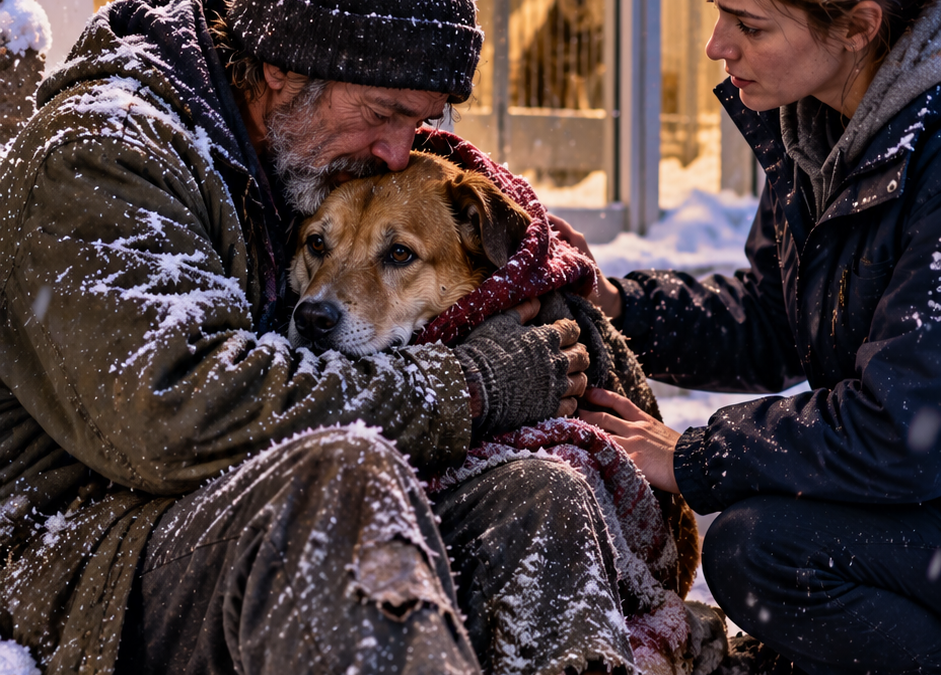
“You gave Buddy your coat.”
“He needed it more.”
“So do you.”
“I have layers.”
I looked at the thin jacket.
“That is not layers.”
He almost smiled.
“You’d be surprised.”
“Sam, it’s twenty-three below.”
“I know.”
“They’re warning people not to stay outside more than a few minutes.”
“I know.”
“You could die.”
He looked toward the kennel wing.
“Buddy won’t.”
That sentence stayed with me.
I had heard people say they loved animals.
I had heard it hundreds of times.
I had seen people spend thousands on surgery.
Sleep in veterinary waiting rooms.
Cancel vacations.
Drive across states.
But something about the way Sam said Buddy won’t was different.
He was not trying to impress me.
He had already made the calculation.
There was one warm coat.
One dog.
One man.
Buddy got the coat.
End of decision.
“Wait here.”
“I don’t need—”
“Wait.”
I went into the staff room and poured coffee.
It had been sitting in the pot too long.
I added hot water.
Then found a cup of soup in the refrigerator.
When I returned, Sam had moved outside.
He was sitting on the steps.
I opened the door.
Cold hit my face immediately.
“You couldn’t wait inside?”
“I didn’t want to cause trouble.”
“You’re causing me more trouble out here.”
He looked surprised.
I handed him the coffee.
“Take it.”
His hands closed around the mug.
That was when I saw his fingers properly.
Blue along the tips.
Purple near two nails.
I felt a spike of fear.
“Sam.”
“What?”
“Your hands.”
He looked down.
“They’re fine.”
“They are not fine.”
“They’ll come back.”
“What does that mean?”
“The color.”
“You’ve had frostbite?”
“Before.”
“Where?”
“Feet mostly.”
I looked at his boots.
One sole had nearly separated.
His socks were wet.
“When?”
“Couple years ago.”
“Did you lose anything?”
“No.”
“Were you treated?”
“Eventually.”
The casual way he said it made me angry.
Not at him.
At whatever circumstances had taught him that frostbite belonged in the same category as rain.
Something unpleasant.
Something to manage.
Not an emergency.
I sat beside him.
The concrete cold came straight through my pants.
Inside, Buddy barked.
One quiet sound.
Sam raised his hand toward the building.
“I’m here.”
The barking stopped.
“You think he can see you?”
“No.”
“Then why do that?”
Sam stared at the door.
“He knows.”
“How?”
“He always knows when I’m close.”
I drank nothing.
My coffee sat inside.
We listened to the wind.
After a minute, I asked, “Why aren’t you going to a human shelter?”
“Full.”
“All of them?”
“The ones that take walk-ins.”
“What about the emergency warming center?”
“Won’t take Buddy.”
“He’s here.”
Sam looked at me.
“I know.”
“So go.”
His expression closed.
“No.”
“Why?”
“I told him I’d stay.”
“He is safe.”
“I know.”
“He has food.”
“I know.”
“A blanket.”
“I know.”
“Then why sit out here and freeze?”
He stared at the coffee.
Finally, he said, “When you’ve been left enough times, words matter.”
I stopped.
Sam continued quietly.
“I told him I’d stay close.”
“That doesn’t mean sitting ten feet from the door.”
“To him, maybe it does.”
“Sam.”
He looked at me.
“He’s stayed with me when he had every reason not to.”
There was no answer to that.
Buddy barked again.
Sam raised his hand.
“I’m here.”
I stood.
“Come inside.”
“No.”
“Why?”
“You already did what I asked.”
“That’s irrelevant.”
“It’s enough.”
“Sam—”
“You took Buddy.”
He looked at me with a kind of exhausted dignity I still remember.
“I don’t want anything else.”
“You need something else.”
“I need him safe.”
“He is safe.”
“Then I’m okay.”
“No. You are not.”
His eyes dropped toward his boots.
I followed his gaze.
“Can you feel your feet?”
He did not answer.
“Sam.”
“Some.”
“That is not good.”
“I’ve had worse.”
“You keep saying things that make this less reassuring.”
He smiled.
Very slightly.
Then his face tightened when another gust hit us.
That decided it.
“I’ll be back.”
He looked tired.
“Julie, don’t.”
I had never told him my name.
He must have read my badge.
“Don’t what?”
“Get yourself in trouble.”
“I am remarkably capable of doing that without help.”
That almost made him laugh.
I went inside and called my manager.
Karen answered after four rings.
“If this is about the boiler again—”
“It’s not.”
“What happened?”
“I need permission to do something you’re not going to like.”
“That’s never how good conversations start.”
I explained.
Sam.
Buddy.
The coat.
The shelters being full.
His hands.
The temperature.
Karen did not interrupt.
When I finished, there was silence.
Then she said, “Julie.”
“I know.”
“We’re an animal shelter.”
“I know.”
“We’re not licensed to house people.”
“I know.”
“There are liability issues.”
“I know.”
“Insurance.”
“I know.”
“If he gets hurt—”
“He’s going to get hurt outside.”
“That isn’t legally the same thing.”
“I know.”
Karen sighed.
“What exactly do you want?”
“The storage room.”
Another silence.
“Our storage room?”
“It has heat.”
“It has dog food.”
“I’ll move some.”
“It has old crates.”
“They’re empty.”
“You want a homeless man sleeping inside a room full of shelter supplies.”
“With his dog.”
“That does not improve the legal situation.”
“Probably not.”
“Julie.”
“He gave his only real coat to Buddy.”
Karen said nothing.
I looked through the front window.
Sam sat bent over the mug.
“He is outside in a thin jacket because he decided the dog needed warmth more than he did.”
“That was his choice.”
“I know.”
“Maybe not a safe choice.”
“No.”
“Then why are you using it as an argument?”
“Because it tells me something.”
“What?”
I thought about it.
“That he isn’t asking us to save him.”
Karen was silent.
“He only asked us to save Buddy.”
More silence.
I continued.
“If I lock the door tonight and leave him on those steps, I’m going to see it every time I close this shelter.”
Karen exhaled slowly.
“You’re going to do it anyway.”
“Probably.”
“So why call?”
“Because I prefer insubordination with documentation.”
That finally got a laugh.
“Fine.”
“Fine?”
“Do what you think you have to do.”
“Is that approval?”
“No.”
“Will you deny knowing?”
“Absolutely.”
“So officially—”
“I have no idea what you’re talking about.”
The line disconnected.
I took that as permission.
When I went back outside, the coffee mug was empty.
Sam had placed it upside down beside him so snow would not blow into it.
I still remember that detail.
A man with almost nothing, freezing on our steps, and he was thinking about returning a cup clean.
“We have a room.”
He looked up.
“What?”
“Small room.”
“No.”
“You haven’t heard the rest.”
“I don’t need a room.”
“Buddy can stay with you.”
Sam stopped.
The wind moved loose snow across the steps.
“What?”
“You and Buddy. Same room.”
His expression changed so quickly it hurt to watch.
Hope.
Then suspicion.
Then restraint.
“How much?”
“Nothing.”
“I don’t have money.”
“I know.”
“I can work it off.”
“No.”
“I don’t want charity.”
“This is not a transaction.”
“Everything is a transaction.”
“That sounds exhausting.”
“It keeps you from owing people.”
I crouched so we were closer to eye level.
“You don’t owe me.”
Sam looked away.
“People say that.”
“I’m saying it now.”
“What room?”
“Storage.”
“You keep people in storage?”
“Only very difficult ones.”
That got the smallest smile.
“It has a radiator.”
“Buddy stays?”
“Yes.”
“All night?”
“Yes.”
“Door open?”
“If you want.”
He stared at me for several seconds.
I saw something I had seen many times with frightened dogs.
The desire to move toward safety fighting with the fear that safety might be temporary.
“Why?”
he asked.
“Why what?”
“Why are you doing this?”
I thought about the answer.
“Because you’re freezing.”
“That’s not your problem.”
“Tonight it is.”
He lowered his head.
For a second, I thought he might refuse.
Then Buddy barked inside.
Sam looked toward the sound.
“Okay.”
The word was barely audible.
I helped him stand.
His knees almost gave way.
That frightened me more than the blue fingers.
We went inside.
The warmth made him shake harder.
“Is that normal?” he asked.
“It can happen.”
“You a doctor too?”
“No.”
“Good.”
“Why good?”
“Would make me suspicious.”
We collected Buddy.
The moment the kennel door opened, the dog pushed past me and nearly climbed Sam’s body.
Buddy whined.
Licked his hands.
His face.
His chin.
Sam dropped to the floor.
“Hey.”
Buddy’s whole body shook.
“I told you.”
The dog pressed into him.
“I came back.”
Sam buried his face in Buddy’s neck.
I turned away.
Not because I was embarrassed.
Because suddenly I understood that Buddy had not been waiting for a warm kennel.
He had been waiting for Sam.
We walked to the storage room.
It was not much.
A narrow space behind the laundry area.
Folded kennels leaned against one wall.
Old bags of food sat on shelves.
There were towels, cleaning supplies, donated blankets, and one radiator that rattled every few minutes like an old washing machine.
But it was warm.
I had never appreciated that room until that night.
I spread blankets on the floor.
Found two old cushions.
Buddy entered immediately.
He sniffed.
Walked toward the radiator.
Turned twice.
Lay down.
Then released a sigh so deep that his chest seemed to collapse.
Sam stopped at the doorway.
“You coming in?”
He did not move.
“Sam?”
“It’s okay.”
“What is?”
“I can sleep by the door.”
“Why?”
He looked around.
His eyes moved over the closed walls.
The stacked crates.
The single doorway.
“I don’t like being locked in.”
“No one is locking you in.”
“I know.”
But his body did not.
I understood that.
“Leave the door open.”
He looked at me.
“Really?”
“Really.”
He stepped inside.
Slowly.
Buddy lifted his head.
The moment Sam sat near the radiator, Buddy stood and moved beside him.
Sam touched the dog’s head.
“Good job, old man.”
Buddy closed his eyes.
“You did good.”
I brought soup.
Crackers.
Water.
More coffee.
Food for Buddy.
Sam objected.
“This is too much.”
“It’s soup.”
“You already—”
“Sam.”
He stopped.
“Eat.”
He did.
I left them around ten.
I did not go home.
I told myself it was because I wanted to make sure the furnace behaved.
That was partly true.
Mostly, I could not bring myself to leave.
I slept on the staff-room couch.
At two in the morning, I walked quietly toward the storage room.
The door remained open.
Buddy was asleep against Sam’s chest.
Sam lay partly on his side with one arm around the dog.
His green jacket was folded beneath Buddy’s head like a pillow.
For once, neither was shivering.
I stood there perhaps five seconds.
Then left.
I cried in my office afterward.
Not loudly.
I did not even fully understand why.
Maybe because the world contains enormous amounts of kindness nobody records.
No press release.
No photograph.
No applause.
A man gives his coat to a dog.
A dog sleeps against a man to keep him warm.
They keep each other alive.
Nobody sees.
Nobody knows.
Until sometimes, by accident, someone does.
I fell asleep sometime before four.
At six, I woke.
The first thing I did was check the storage room.
Empty.
The blankets were folded.
Soup container rinsed.
Water bottle placed beside the sink.
Buddy’s bowl cleaned.
Sam’s gone.
“Sam?”
Nothing.
I walked through the shelter.
Bathroom.
Lobby.
Parking lot.
Then I saw the note.
Folded paper on the radiator.
Blue pen.
The handwriting shaky.
Thank you.
Buddy says it was the warmest night of his life.
Don’t worry about me.
We’ll come back when we can.
Sam.
I read it twice.
Then ran outside.
Fresh snow covered most of the parking lot.
Their tracks were easy to see.
Boots.
Paws.
Side by side.
Heading toward the river.
I stood there staring until cold reached through my coat.
“Damn you.”
I was angry.
Not because he left.
Because of that sentence.
Don’t worry about me.
As if worry were something another person could decline.
For three days, I heard nothing.
I called outreach organizations.
Asked whether anyone knew a man named Sam traveling with a brown dog called Buddy.
Some people vaguely recognized them.
No fixed location.
No contact number.
No reliable place to find them.
Night temperatures remained dangerous.
I kept Sam’s note inside my desk drawer.
On the third morning, the front bell rang.
I looked up.
Sam stood outside.
Buddy beside him.
I ran to the door.
“What happened to you?”
Sam blinked.
“Good morning.”
“You disappeared.”
“I left a note.”
“I know.”
“Then technically—”
“No.”
He stopped.
I crossed my arms.
“Do you know how cold it has been?”
“Yes.”
“Where did you sleep?”
“Places.”
“I hate that answer.”
“I know.”
Buddy wagged.
At least someone seemed happy to see me.
Sam looked thinner than three days earlier.
Cheeks more hollow.
Same green jacket.
Buddy wore the heavy coat again.
Of course he did.
I sighed.
“What do you need?”
Sam straightened.
“Work.”
I stared.
“What?”
“I want to work here.”
“At the shelter?”
“Yes.”
“Sam—”
“I can clean.”
“That isn’t—”
“Feed animals.”
“We have—”
“Walk dogs. Laundry. Whatever.”
He spoke quickly now.
“I don’t want money.”
“That makes it illegal in a different direction.”
“I want a place to sleep.”
“With Buddy.”
“Yes.”
“You want to work in exchange for the storage room.”
“I want to work.”
“Sam, we cannot pay an employee only with a floor and soup.”
“I didn’t ask for employee.”
“Then what are you asking for?”
“A chance.”
He stopped.
That word changed everything.
Not rescue.
Not charity.
A chance.
“I can work,” he said again.
“I believe you.”
“Then let me.”
I looked at Buddy.
The dog sat beside him.
Patient.
“I need to call Karen.”
Sam nodded.
This time Karen answered immediately.
“He’s back,” I said.
“The man?”
“Sam.”
“And Buddy?”
“Obviously.”
“What now?”
“He wants a job.”
Silence.
Then a sigh.
“Of course he does.”
“He says he’ll clean cages, feed animals, walk dogs.”
“Does he have identification?”
“Probably complicated.”
“Address?”
“Definitely complicated.”
“Employment history?”
“Unknown.”
“Julie.”
“I know.”
“What do you want?”
“Let him volunteer for a week while we figure out the rest.”
“Where is he sleeping?”
I looked at Sam.
He pretended not to listen.
“Storage room?”
“You’re enjoying destroying my blood pressure.”
“No.”
“You owe me coffee.”
“I can do that.”
Karen sighed.
“One week.”
“That’s a yes?”
“That’s one week.”
I hung up.
Sam looked at me.
“One week.”
His face changed.
“I can start now.”
“You can start after breakfast.”
“I’m not hungry.”
“Sam.”
He stopped.
I pointed toward Buddy.
“What time did he eat?”
“This morning.”
“What about you?”
Silence.
“Exactly.”
I handed him a sandwich.
“You feed yourself too.”
He took it reluctantly.
The first day told me more about Sam than any interview could have.
He worked carefully.
Not frantically.
Not trying to impress anyone.
He simply paid attention.
A lot of shelter work is unpleasant.
Concrete.
Urine.
Hair.
Laundry.
Barking.
Heavy bags.
Scrubbing the same surfaces every day because tomorrow they will be dirty again.
Sam never complained.
But that was not what impressed me.
What impressed me was how he watched the animals.
Kennel 12 held a large shepherd mix named Duke.
Duke disliked men.
We did not know why.
He barked aggressively when unfamiliar male volunteers approached.
Most avoided him.
Sam stopped outside the kennel.
Duke barked.
Sam sat down.
No command.
No eye contact.
Just sat.
After several minutes, Duke stopped barking.
Sam remained.
Ten minutes later, Duke approached the bars.
Sniffed.
Sam did not move.
The dog sniffed again.
Sam slowly placed one hand on the floor outside the kennel.
Duke touched it with his nose.
I watched from a distance.
Later, I asked, “How did you know what to do?”
Sam shrugged.
“He was scared.”
“Most people try to show him they’re friendly.”
“That’s the problem.”
“What do you mean?”
“Everyone wants to prove they’re nice.”
He picked up a mop.
“Sometimes being nice means leaving somebody alone until they’re ready.”
I thought about Sam standing outside the storage room the first night.
Maybe he knew something about frightened animals because he understood frightened people.
The week passed quickly.
Sam arrived early every morning.
Buddy followed.
He learned names.
Medication.
Food portions.
Behavior notes.
By day five, he knew which dogs needed slow introductions.
Which one hated mops.
Which puppy would steal towels.
Which senior dog needed encouragement to eat.
One afternoon, I almost gave a beagle the wrong-sized food scoop.
Sam said, “That’s Charlie’s scoop.”
I looked.
He was right.
“You have been here five days.”
“Fast learner.”
“Dangerously confident.”
“Also true.”
Buddy became the unofficial shadow of the shelter.
He sat wherever Sam worked.
Never interfered.
If Sam cleaned Kennel 4, Buddy waited outside.
If Sam hauled food bags, Buddy walked beside him.
If Sam took a dog outside, Buddy stayed with me until he returned.
They seemed connected by an invisible line.
The one-week trial became two.
Two became a month.
Karen worked with a local outreach coordinator to help Sam replace his identification.
That process opened my eyes to how difficult ordinary life becomes once you lose the documents that prove you exist in official ways.
No ID meant trouble getting work.
No job meant difficulty getting housing.
No address complicated replacing documents.
Every requirement seemed to depend on another requirement Sam did not have.
He became frustrated.
“I don’t need people doing everything for me.”
“I know.”
“You keep calling places.”
“Because they know which forms.”
“I can fill out forms.”
“You filled the wrong one yesterday.”
“That form was stupid.”
“It was extremely stupid.”
That stopped his argument.
I learned not to take over.
Sam’s dignity mattered.
There is a difference between helping someone stand and trying to carry them everywhere.
He needed the first.
Not the second.
After several weeks, paperwork came together.
The shelter hired him officially.
Part-time first.
Then more hours.
The day Karen handed him his first paycheck, Sam stared at it.
“It’s wrong.”
Karen frowned.
“What?”
“Too much.”
She checked.
“It’s correct.”
“No.”
“You worked overtime.”
“I didn’t ask for overtime.”
“That is not how overtime works.”
Sam looked uncomfortable.
Karen said, “Take the check.”
He did.
Later I found him sitting in the storage room.
Buddy beside him.
The envelope unopened.
“You okay?”
He nodded.
“You look like you’re holding a court summons.”
“I haven’t had a paycheck in years.”
I sat.
“That doesn’t make it dangerous.”
Sam smiled faintly.
“It feels strange.”
“What are you going to do with it?”
He looked at Buddy.
“Food.”
“Shelter provides Buddy’s food.”
“Not his favorite.”
“Obviously priorities.”
“Then boots.”
I looked at the pair on his feet.
“Yes. Boots.”
“And maybe a phone.”
“That seems useful.”
He nodded.
Then became quiet.
“What?”
he asked after a moment.
“Nothing.”
“You’re staring.”
“I’m just thinking.”
“Dangerous habit.”
I smiled.
“I remember your hands that first night.”
Sam looked at them.
The blue was gone.
Skin pink.
Cracked.
Warm.
“Me too.”
Three months after Sam returned, he had become one of the shelter’s most reliable employees.
He knew every dog.
Not just names.
Personalities.
Rosie hated thunderstorms.
Baxter preferred his food bowl away from the gate.
Marvin, an old hound, ate better when someone spoke to him.
Cleo needed her medication hidden in cheese or she would spit it out with remarkable precision.
Sam knew all of it.
One afternoon, I found him inside Marvin’s kennel reading the sports section aloud.
Marvin was eating.
“What are you doing?”
“Baseball.”
“You don’t like baseball.”
“Marvin does.”
I looked at the dog.
“He told you?”
“He eats when someone talks.”
Marvin continued chewing.
I laughed.
Buddy slept outside the gate.
That was when I realized Sam no longer looked like someone temporarily staying at the shelter.
He looked like he belonged to the place.
Not because he needed it.
Because it needed him.
One evening after closing, Sam and I sat in the break room with coffee.
Buddy was beneath the table.
Outside, winter had softened.
Snow still covered the parking lot, but sunlight lasted longer.
I asked the question I had been wondering for months.
“How did you and Buddy meet?”
Sam looked down.
Buddy opened his eyes.
For a few seconds, they simply looked at each other.
Sam smiled.
“He found me.”
“Of course he did.”
“Three years ago.”
He took a drink.
“I was sleeping under a bridge.”
“In winter?”
“Yes.”
“How cold?”
“Around thirty below that night.”
I stopped holding the mug halfway to my mouth.
“Thirty below?”
“That’s what the news said next morning.”
“What happened?”
“I had a sleeping bag.”
He paused.
“Bad one.”
“I believe you.”
“I’d gotten wet earlier.”
My stomach tightened.
Sam continued.
“Sometime during the night, I woke up because something was pushing against my back.”
“Buddy?”
“I thought it was a rat.”
I laughed.
Buddy lifted his head.
Sam pointed down.
“He was skinnier.”
“Still a very large rat.”
“Fair.”
Sam smiled.
“I pushed him away.”
“You pushed Buddy away?”
“Twice.”
Buddy stared at him.
“Don’t look at me like that.”
The dog’s tail moved.
“He crawled back.”
Sam’s expression changed.
“Third time, I gave up.”
Buddy had climbed inside the sleeping bag and curled directly against Sam’s chest.
“He was freezing too?”
“Probably.”
“Did he have a collar?”
“No.”
“Tags?”
“No.”
“What did you do in the morning?”
Sam looked into his coffee.
“Woke up.”
Something about the way he said it made me put my cup down.
“You think you wouldn’t have?”
He did not answer immediately.
“No.”
The room went quiet.
“The temperature dropped harder than I expected. My clothes were damp. I was tired.”
He placed one hand on Buddy’s back.
“He was warm.”
I stared at the dog.
“You really think he kept you alive?”
“Yes.”
No hesitation.
The dog who had needed Sam’s coat the night they entered our shelter had once given Sam his own body heat under a bridge.
They had been saving each other for years.
“What happened after that?”
“I shared breakfast.”
“With him?”
“Half.”
“What was it?”
“Something terrible from a gas station.”
“Buddy approved?”
“He eats things off sidewalks.”
“Fair.”
Sam scratched behind Buddy’s ear.
“I tried finding an owner.”
“No one?”
“No chip.”
“Shelters?”
“Checked.”
“Then?”
“He followed me.”
“For three years.”
“Pretty much.”
I looked at Buddy.
“Excellent judgment.”
Sam smiled.
“Debatable.”
I hesitated.
“How long had you been homeless by then?”
His expression changed.
The question suddenly felt too personal.
“You don’t have to—”
“Two years.”
I waited.
Sam stared at the table.
“I worked construction.”
“What happened?”
“Back injury.”
The story came slowly.
Not as one dramatic collapse.
That mattered.
Sam hurt his back on a job.
Could not work for several months.
Workers’ compensation helped, then became complicated.
Savings disappeared.
Rent fell behind.
A relationship ended.
He stayed with friends.
One friend moved.
Another had children.
Temporary couches became shelters.
Shelters became streets.
“You had family?”
“A sister.”
“Where?”
“Arizona.”
“Does she know?”
Sam looked away.
“No.”
“Why?”
“Pride.”
At least he was honest.
“Does she think you’re okay?”
“Probably thinks I’m dead.”
My chest tightened.
“Sam.”
“Don’t.”
I stopped.
After a while, he continued.
“When you’re outside long enough, people stop looking at you.”
“What do you mean?”
“You become part of the sidewalk.”
I said nothing.
“They see a coat. A backpack. Maybe a sign.”
His voice remained calm.
“Not a person.”
Buddy lifted his head.
Sam touched him.
“But he did.”
“Buddy?”
“Yes.”
Sam smiled faintly.
“He didn’t care where I slept.”
Of course not.
“He didn’t care whether I smelled bad.”
“Probably smelled worse.”
Sam laughed.
“He didn’t care if I had money.”
“No.”
“Didn’t ask what happened.”
His hand rested on Buddy’s chest.
“He just decided I was his person.”
My throat tightened.
Sam looked at me.
“When you’ve had people look through you for long enough, that matters.”
I understood.
Not completely.
I had never lived what Sam had.
But enough.
“He made you feel human.”
Sam nodded.
“That’s exactly it.”
Buddy placed his chin on Sam’s boot.
Sam continued.
“People think the worst part of homelessness is cold.”
“Isn’t it?”
“Cold is bad.”
He looked toward the dark window.
“Hunger too.”
“What’s worse?”
He thought for a moment.
“Feeling like no one would notice if you disappeared.”
I had no answer.
Buddy shifted.
Sam looked down.
“He would.”
That was the point.
When nobody else was waiting for Sam, Buddy was.
If Sam failed to wake beneath a bridge, Buddy would know.
If he left, Buddy followed.
If he came back, Buddy celebrated.
To most people, Sam had become anonymous.
To one dog, he was irreplaceable.
That had kept something alive in him long before we met.
Maybe more than body heat.
A reason to get through another night.
I reached across the table and squeezed Sam’s hand.
Months earlier, those fingers had been blue.
That evening they were warm.
He looked surprised.
Then smiled.
Spring came.
With it, another problem.
The storage room had never been intended as permanent housing.
Everyone knew it.
Sam knew it too.
He had saved money.
Not much.
Enough for deposits if we could find somewhere affordable and willing to accept Buddy.
The dog became the obstacle again.
“No pets.”
Again.
“Breed restrictions.”
Buddy was a mixed breed and still somehow got rejected.
“Pet deposit.”
Too high.
“No dogs over thirty pounds.”
Buddy weighed forty-six.
Each rejection frustrated Sam more.
“I’m not leaving him.”
“No one is asking you to.”
“They will.”
“No.”
“You don’t know.”
I did know one thing.
Whatever happened, Buddy would remain with Sam.
That was not negotiable.
Eventually, Karen found a small apartment across town through a landlord who had once adopted a senior dog from our shelter.
One bedroom.
Second floor, but manageable.
Tiny kitchen.
A window facing the river.
Old carpet.
Good heat.
Dog allowed.
I went with Sam to see it.
The landlord opened the door.
Buddy entered first.
Sniffed everything.
Sam remained in the hallway.
Again.
That hesitation.
I noticed.
“You coming?”
Sam stared into the apartment.
“Yeah.”
He did not move.
I remembered the storage room.
Warmth could be frightening when you had learned it was temporary.
“You don’t have to decide now.”
“Yes, I do.”
He stepped inside.
Buddy explored the bedroom.
Kitchen.
Window.
Then came back and sat at Sam’s feet.
The landlord said, “Looks like he approves.”
Sam laughed.
“His standards have improved.”
There was a radiator beneath the window.
Newer than ours.
Quiet.
Sam touched it.
Warm.
He looked at me.
“You okay?”
He nodded.
His eyes did not.
Rent was manageable on his shelter salary with assistance from a local housing program.
Deposit became possible through community funds.
Sam tried refusing that too.
We argued.
Eventually he accepted on the condition that he would repay what he could.
“You know that isn’t required.”
“I know.”
“So why?”
“Because I want someone else to use it after me.”
I stopped arguing.
Moving day came in late spring.
Sam had very little.
A few clothes.
New boots.
Phone.
Books people had given him.
Buddy’s bed.
Two bowls.
The old heavy coat.
He still had it.
The coat he gave Buddy that first night.
“You kept that thing?”
“Of course.”
“It has holes everywhere.”
“It works.”
“Barely.”
“Buddy likes it.”
Buddy was already lying on it.
I laughed.
“Fine.”
We carried everything upstairs.
When the last bag was inside, Sam stood in the middle of the room.
Buddy walked toward the window.
Sunlight covered part of the carpet.
He lay down.
Sam stared.
“What?”
I asked.
“Nothing.”
“You’re doing that thing again.”
“What thing?”
“Pretending you’re fine while obviously having an emotion.”
Sam smiled.
“Learned from Buddy.”
“He has more emotional honesty.”
“True.”
I moved toward the door.
Sam suddenly said, “Julie.”
I turned.
“Thank you.”
“You did most of this.”
“No.”
“Yes.”
He looked around.
“I wouldn’t be here if you had closed the door.”
I thought about that first night.
My keys in my hand.
Sam on the steps.
Buddy barking inside.
“I almost did.”
“But you didn’t.”
That mattered.
Not heroism.
Not destiny.
A choice.
One door left open.
Sam continued working at the shelter.
Full-time eventually.
He became my right hand.
Maybe more accurately, the person who noticed things before I did.
He trained new volunteers.
He became particularly good with frightened dogs and people who had recently lost pets.
Something about him made people talk.
Perhaps because he never rushed to fill silence.
Buddy changed too.
At the shelter, he became calm around almost everyone.
Children especially.
One afternoon, a little boy visiting with a school group sat alone near the lobby.
Buddy approached.
The boy had autism, his teacher explained, and loud kennel noise had overwhelmed him.
Buddy lay beside the child.
No command.
No training.
Just stayed.
The boy put one hand on Buddy’s back.
His breathing slowed.
I watched from behind the desk.
Sam saw it too.
“That dog.”
He shook his head.
“What?”
“Still working.”
“Unlike his owner?”
“Exactly.”
We began formal therapy-dog training.
Buddy passed.
Not perfectly.
He got distracted by sandwiches.
But he passed.
Soon he visited schools.
Hospitals.
A retirement home.
The first time we took him to a nursing facility, Buddy walked directly to an older man sitting alone near a window.
The man had barely spoken all morning, staff said.
Buddy placed his head on the man’s knee.
The man began stroking him.
After several minutes he whispered, “I had a dog.”
Sam stood nearby.
“So did I,” the man continued.
“What was his name?” Sam asked.
The old man talked for twenty minutes.
Buddy listened.
That became his gift.
Presence.
No judgment.
No hurry.
Exactly what he had given Sam under the bridge.
Exactly what Sam had learned to give the shelter dogs.
People sometimes asked about Sam.
They noticed his history because he did not hide it.
Some reacted awkwardly.
One visitor once said, “You don’t look homeless.”
Sam smiled.
“I’m not anymore.”
The woman flushed.
“I meant—”
“I know.”
Later I asked if comments like that bothered him.
“Used to.”
“And now?”
He shrugged.
“People think homelessness is a type of person.”
“It isn’t.”
“No.”
“What is it?”
“A situation.”
That answer should be printed everywhere.
Not identity.
Situation.
Sam had been injured.
Lost income.
Lost housing.
Lost stability.
Then the systems for climbing back up required exactly the things he no longer had.
A dog did not fix that.
I did not fix that.
The shelter did not fix that.
But Buddy gave Sam a reason to remain connected.
And one cold night gave him an opening.
Everything after required work.
His work.
Paperwork.
Jobs.
Savings.
Rent.
Consistency.
Showing up.
Healing was not one dramatic rescue.
It was hundreds of ordinary mornings.
That was perhaps the most important part of the story.
Years have passed now.
Sam’s apartment is still small.
He has upgraded the furniture.
The old coat remains.
Buddy sleeps on it near the window.
Sam tried buying him an expensive orthopedic bed.
Buddy preferred the coat.
“Of course,” I said.
“I spent ninety dollars.”
“That was your mistake.”
Buddy is older.
His muzzle almost completely gray.
He walks slower.
Therapy visits are shorter.
Sam watches him closely.
Maybe too closely.
I understand.
Their lives are tangled in a way few relationships are.
Buddy once kept Sam alive beneath a bridge.
Sam later gave him his coat.
Buddy brought him to our shelter.
Sam’s love for Buddy made me leave a door open.
That door led to work.
Work led to paperwork.
Paperwork led to housing.
Housing gave them both stability.
It would be easy to turn that into something sentimental.
Buddy saved Sam.
Sam saved Buddy.
Love solved everything.
That would not be true.
Love did not create affordable housing.
Love did not replace identification.
Love did not heal Sam’s back.
Love did not remove every winter night he spent outside.
What love did was give him a reason to keep participating in his own future.
A witness.
Someone waiting.
Sometimes that is enough to keep a person moving until practical help becomes possible.
One January, years after that first night, the temperature dropped sharply again.
Not twenty-three below.
Cold enough.
Sam stayed late at the shelter.
We finished the last kennel check together.
Buddy was sleeping in my office because his hips were bothering him.
I locked the front door.
Then looked at the steps.
The same steps.
Sam followed my gaze.
“You remember?”
“Yes.”
“You almost left me out there.”
“I did not.”
“You thought about it.”
“I was closing.”
He smiled.
“I’m kidding.”
“I know.”
We stood quietly.
Snow began falling.
“I was scared that night,” Sam said.
That admission surprised me.
“You didn’t look scared.”
“I was.”
“Of freezing?”
“Partly.”
“What else?”
He looked toward the office where Buddy slept.
“That you’d ask me to give him up.”
I stared.
“Why did you think that?”
“Everyone did.”
“What do you mean?”
“Shelters. Outreach. People offering a room.”
He shrugged.
“The solution was always the same.”
Get rid of the dog.
“I couldn’t.”
“I know.”
“I would have stayed outside forever before I did that.”
I believed him.
“Was that wise?”
“No.”
He smiled.
“But he’d done the same for me.”
Not literally, perhaps.
But emotionally, yes.
Neither had treated the other as disposable.
That was the agreement between them.
I unlocked the office.
Buddy lifted his head.
The moment he saw Sam, his tail moved.
Slow now.
Still there.
Sam crouched.
“Ready?”
Buddy stood carefully.
Sam helped him into his coat.
Not the old human coat anymore.
A proper dog coat.
Warm.
Fitted.
Buddy looked slightly offended.
“You look handsome.”
Buddy stared.
I laughed.
“He disagrees.”
They walked toward the door.
Before leaving, Sam turned.
“You know what I remember most?”
“What?”
“The radiator.”
I laughed.
“That horrible thing?”
“Sounded like it was dying.”
“It probably was.”
“Best sound I ever heard.”
That stopped me.
For me, it had been an annoying old radiator.
For Sam, it had been proof that, for one night, winter could not reach him.
Perspective.
He pushed the door open.
Buddy stepped outside.
Sam followed.
I watched them cross the parking lot toward Sam’s car.
His car.
Not borrowed.
Not ours.
An old used sedan he had bought after saving for nearly a year.
Buddy climbed carefully into the back seat.
Sam drove away.
I locked the door.
That night I thought about all the times people had come through our shelter asking what animal rescue meant.
They imagined dramatic things.
Dogs pulled from fires.
Animals taken from abusive homes.
Emergency surgeries.
Those happen.
But rescue is often quieter.
A bowl.
A blanket.
A room.
A form filled out correctly.
A job interview.
Someone remembering a name.
Someone noticing that a pair of hands are turning blue.
Someone refusing to accept “I’m fine” when obviously nobody is fine.
And sometimes rescue moves both directions.
Buddy needed shelter from cold.
Sam needed proof that he still mattered.
I needed to be reminded that policies exist for reasons but human judgment exists for reasons too.
Karen needed to learn that bending one rule did not destroy the organization.
The shelter dogs gained one of the best caretakers they ever had.
A door opened and the consequences kept moving outward.
One afternoon, a group of middle-school students visited for Buddy’s therapy program.
Sam told them a shortened version of the story.
Not everything.
Just enough.
He explained that Buddy had once lived on the streets with him.
A boy raised his hand.
“Why didn’t you just go home?”
The room became very quiet.
Adults sometimes get angry when children ask questions like that.
Sam didn’t.
“I didn’t have one.”
The boy frowned.
“How do you not have a home?”
Sam thought.
“Sometimes several bad things happen close together.”
The children listened.
“And sometimes getting back is harder than falling.”
Another student asked, “Was Buddy homeless too?”
Sam smiled.
“Yes.”
“Was he sad?”
“I don’t know.”
“Did he know?”
“Know what?”
“That he was homeless.”
Sam looked at Buddy.
The dog was lying beside him.
“I don’t think Buddy cared about addresses.”
The boy considered.
“So what did he care about?”
Sam rested a hand on Buddy’s neck.
“Knowing where I was.”
The answer stayed with the room.
Afterward, one teacher approached me.
“He’s good with them.”
“Sam?”
“Yes.”
“So is Buddy.”
“They make a pretty effective team.”
She smiled.
“I think those kids will remember that.”
So did I.
Home is an ordinary word until you lose one.
Most people define it by structure.
Walls.
Roof.
Address.
Keys.
Sam had spent years without those things.
But Buddy had given him something that looked like the emotional center of home.
Recognition.
You are my person.
I notice when you leave.
I wait for you.
I am relieved when you come back.
That does not replace housing.
It should never have to.
But maybe it explains why Sam protected Buddy so fiercely.
Buddy was the last place where Sam was not anonymous.
The last place where he was needed.
One evening, years after they left our storage room, I visited their apartment.
Buddy was older and had begun struggling with stairs.
Sam had built a small wooden ramp over the few steps at the entrance.
Inside, the apartment was warm.
Photographs on the walls.
Most of Buddy.
Some shelter staff.
One picture of Sam and me standing outside the shelter after a charity event.
I hated the picture.
Sam loved it because I was mid-sneeze.
He made coffee.
We sat near the window.
The river was visible in the distance.
Buddy lay between us.
“Do you ever miss the storage room?” I asked.
Sam stared at me.
“No.”
I laughed.
“Not even the radiator?”
“Absolutely not.”
“You said it was the best sound you ever heard.”
“It was.”
“Contradiction.”
“No.”
He looked around his apartment.
“It was the best sound because I knew it was temporary.”
I had never thought of that.
Buddy lifted his head.
Sam touched him.
“This is better.”
“Yes.”
“Much better.”
We drank coffee.
After a while, Sam said, “I finally called my sister.”
I nearly dropped the mug.
“When?”
“Last week.”
“What did she say?”
“Cried.”
“And?”
“Yelled.”
“Reasonable.”
“Then cried again.”
“Also reasonable.”
He smiled.
“She thought I was dead.”
My chest hurt.
“Are you going to see her?”
“Spring.”
“That’s good.”
“Yeah.”
Buddy shifted.
Sam’s hand remained on him.
Life had not been restored to what it had been before homelessness.
That was not possible.
But new connections had formed.
Old ones reopened.
Sam’s world grew again.
That is different from going backward.
Healing often is.
People at the shelter still ask about the story.
New staff hear pieces.
Someone points toward the storage room.
“Is that where Sam slept?”
“One winter.”
“Really?”
“Yes.”
“Was Buddy there?”
“Always.”
The old radiator was replaced eventually.
I was almost sad when maintenance removed it.
Almost.
It truly was terrible.
I kept Sam’s original note.
Still have it.
Folded in a drawer.
The ink has faded slightly.
Buddy says it was the warmest night of his life.
Don’t worry about me.
We’ll come back when we can.
Sam.
I sometimes read it when shelter work feels impossible.
When we cannot save every animal.
When someone abandons a dog for a reason that makes me angry.
When funding is short.
When the waiting list grows.
Not because Sam’s story proves kindness solves every problem.
It doesn’t.
It reminds me that one action can matter without solving everything.
We gave one night.
Sam did the rest with the opportunities that followed.
Years later, Buddy became too old for regular therapy visits.
His hearing declined.
His hips stiffened.
But he still came to the shelter sometimes.
The dogs reacted differently to him.
Some sniffed.
Some ignored.
Nervous dogs often seemed comfortable around him.
Sam joked that Buddy had become an old counselor who no longer wanted to work.
One winter afternoon, I sat on the floor beside him.
“Remember this place?”
Buddy looked at me.
His cloudy eyes made me wonder how much he saw.
“You spent one night here.”
Tail tap.
“Changed everything.”
Another tap.
Sam entered carrying coffee.
“You talking to my dog?”
“He understands me better than you do.”
“Low standard.”
He handed me a cup.
Buddy rested his head in my lap.
For a long time, nobody spoke.
That silence did not feel empty.
Sam once told me Buddy made him feel human when everyone else saw a problem.
Maybe that was Buddy’s greatest gift.
Not rescuing him under a bridge.
Not keeping him physically warm.
Seeing him.
Animals do that naturally in ways humans sometimes forget.
They do not see bank statements.
Housing status.
Job titles.
Failed relationships.
Addresses.
They recognize voice.
Scent.
Hands.
Routine.
Presence.
Sam was never homeless to Buddy.
He was simply Sam.
The person who shared food.
The person whose footsteps meant safety.
The person Buddy looked for when he woke.
Years later, Sam became that kind of presence for shelter animals too.
The man once overlooked by society became very good at noticing creatures other people overlooked.
Older dogs.
Fearful dogs.
Quiet dogs.
Animals labeled difficult.
Sam never rushed them.
He knew what it was to have strangers make conclusions from a distance.
One dog named Frankie stayed almost nine months because he hid whenever visitors approached.
Sam spent weeks sitting outside the kennel.
Eventually Frankie trusted him.
Then another volunteer.
Then a family.
The day Frankie was adopted, I said, “You know you did that.”
Sam shook his head.
“No.”
“You did.”
“I waited.”
“That counts.”
He considered.
“Maybe.”
Buddy sat nearby.
I looked at both of them.
“Seems to be a theme with you.”
Waiting.
Staying.
Not leaving because progress was slow.
That may have been what Buddy taught him first.
That may have been what Sam later taught me.
There are moments when a person’s life changes with great noise.
Accidents.
Births.
Deaths.
Weddings.
Then there are quiet moments.
A man walks into an animal shelter carrying a dog inside his coat.
A worker notices his fingers are blue.
A manager says, “I didn’t hear anything.”
A storage room door stays open.
One night becomes a week.
One week becomes work.
Work becomes stability.
Stability becomes an apartment.
An apartment becomes a life.
None of those things were guaranteed.
That is what makes the story matter to me.
It was not fate.
It was a chain of choices.
Sam chose Buddy under that bridge.
Buddy chose to stay.
Sam chose to give Buddy the warm coat.
I chose not to close the shelter.
Karen chose not to stop me.
Sam chose to return three days later.
He chose work.
Paperwork.
Patience.
Savings.
Showing up every morning.
Again.
Again.
Again.
That is how lives often change.
Not one miracle.
Many small decisions that continue in the same direction.
Today, Sam is still one of my closest friends.
He still works with animals.
Buddy is old now.
Very old.
He spends more time sleeping than walking.
Sam complains that Buddy snores.
I remind him that Buddy listened to him snore under bridges for years.
“Fair,” he says.
Their apartment is still warm.
That detail matters to me more than I can explain.
Every winter, when temperatures drop, I think about the first night.
The green jacket.
The destroyed boots.
The blue fingers wrapped around the coffee cup.
Buddy barking softly from inside.
And Sam raising one hand toward the window.
I’m here.
That was the promise beneath everything.
I’m here.
Buddy had told Sam the same thing for three years without words.
Under the bridge.
On sidewalks.
Outside shelters.
In the storage room.
Through every uncertain night.
I’m here.
Eventually, Sam learned to believe other people might say it too.
And mean it.
Sometimes visitors still ask why Sam and Buddy are so close.
I tell them only part of the story.
Because some of it belongs to them.
But when people ask what I learned, my answer has changed over the years.
I used to say that home is where someone waits for you.
I still believe that.
But now I think there is another part.
Home should also be a place where neither love nor survival requires someone to freeze outside.
Sam and Buddy taught me both truths.
Love can exist without a roof.
But people and animals still deserve roofs.
Warm rooms.
Food.
Safety.
Dignity.
We should not romanticize the cold just because someone survived it beautifully.
There was nothing beautiful about Sam nearly losing his feet.
Nothing beautiful about shelters being full.
Nothing beautiful about a man believing he had to choose between warmth and the dog who had once saved his life.
The beautiful part was what they refused to surrender inside those circumstances.
Each other.
And the moment someone finally made room for both of them, they did not waste it.
That is the ending I care about.
Not Sam sleeping under a bridge.
Not Buddy shivering inside a borrowed coat.
Not me crying at my desk.
The ending is Sam opening the door of a warm apartment after work.
Buddy walking slowly inside.
A bowl in the kitchen.
A bed beside the radiator.
Keys on the table.
Tomorrow’s shift written on the calendar.
A life ordinary enough that nobody would stop to photograph it.
That is the miracle.
Ordinary life.
Warmth that does not have to be earned through suffering.
A place to return to.
Someone waiting.
One evening last winter, Sam sent me a photograph.
Buddy was asleep near the window.
Snow covered the city outside.
The old heavy coat from that first night was beneath him.
The caption said:
Still the warmest place he knows.
I stared at the picture for a long time.
Then wrote back:
Tell him I said he earned it.
Sam replied:
He says I did too.
I cried.
After all these years, apparently they can still do that to me.
I keep thinking about how close I came to turning the key in the front door that night.
If I had left on time, someone else might have helped Sam.
Maybe.
Or perhaps he would have gone to the river.
Perhaps his feet would have frozen again.
Perhaps nothing dramatic would have happened.
We never know the lives created by decisions we did or did not make.
I only know the life that followed this one.
Sam works.
Buddy sleeps somewhere warm.
A dog once considered a burden became a therapy dog.
A man strangers had stopped seeing became the person frightened animals trust most.
And the storage room returned to being a storage room.
Sometimes that is what a good ending looks like.
The emergency becomes ordinary.
The temporary becomes unnecessary.
The person who once needed the door opened now holds it for someone else.
When I close the shelter at night, I still check the steps.
Every time.
I doubt I will ever stop.
Most nights, nobody is there.
Just snow.
Rain.
Dry pavement.
Whatever the season brings.
Then I turn the key.
But sometimes, before I leave, I think I can still hear Buddy’s quiet bark from that first January night.
Not panic.
Not demand.
Just a reminder traveling through walls.
I’m here.
Don’t leave me.
And outside, in my memory, Sam lifts one blue hand toward the window.
I’m here too.
Maybe that was all they had for a long time.
One another.
Maybe that is why they survived.
But survival should not have to be the end of the story.
For Sam and Buddy, it wasn’t.
One warm night became another.
Then another.
Until warmth stopped being a gift and became simply where they lived.
And whenever I see Sam unlock his own front door with Buddy beside him, I remember the man on our shelter steps who insisted he needed nothing for himself.
He was wrong.
He needed warmth.
Food.
Work.
Dignity.
Opportunity.
A place where Buddy could stay.
And, most of all, a chance to believe that he was still worth opening a door for.
That first night, I thought I was making room for two freezing strangers.
I understand it differently now.
I was only opening a door.
Sam and Buddy were the ones brave enough to walk through it.
And neither of them ever had to sleep outside that door again.




