The Labrador Everyone Called Unadoptable Went Silent Whenever the Eleven-Year-Old Girl Sat Outside His Kennel
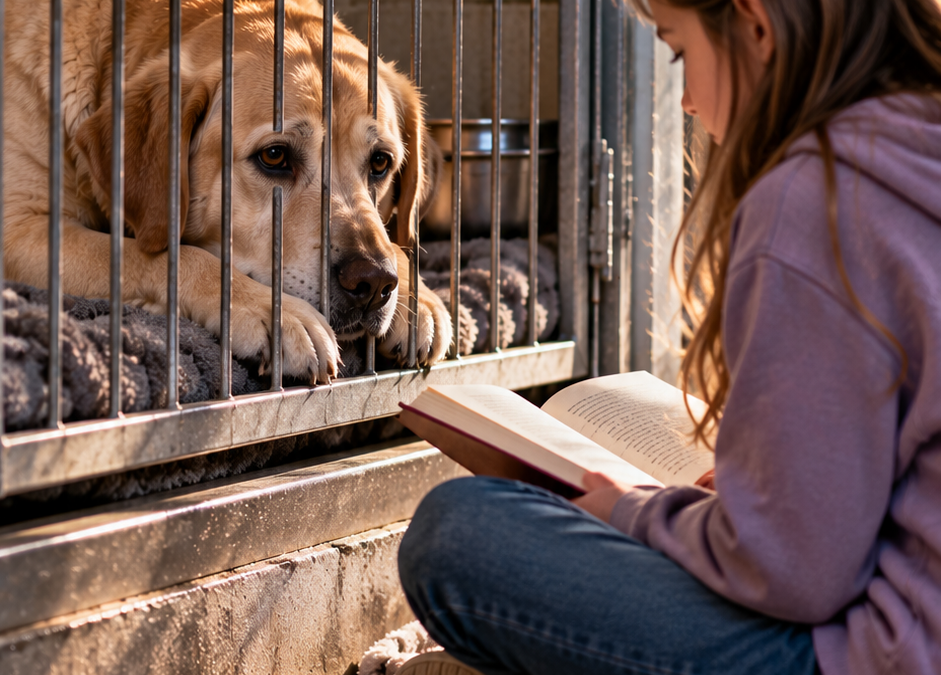
The Labrador Everyone Called Unadoptable Went Silent Whenever the Eleven-Year-Old Girl Sat Outside His Kennel
By the time I met Ben, eight different homes had already decided they could not live with him.
By the time Emily sat down outside his kennel, most of us at the shelter had stopped asking whether Ben would ever change.
What none of us understood was why the most chaotic dog I had ever known became completely still whenever that eleven-year-old girl began to read.
My name is Margaret.
I had worked with shelter dogs long enough to stop believing in easy labels.
Friendly.
Aggressive.
Easy.
Difficult.
Safe.
Dangerous.
Adoptable.
Unadoptable.
Those words are convenient because human beings like things that fit into boxes.
Dogs rarely do.
Ben certainly didn’t.
He was a Labrador, large and powerful, with the kind of body that should have made him look cheerful even when he wasn’t.
People expect Labradors to be simple.
Tail wagging.
Ball chasing.
Food loving.
Family friendly.
Ben had none of the qualities people expected when they heard the word Labrador.
He barked at strangers.
Pulled violently on the leash.
Chewed through anything within reach.
Scratched doors.
Tore paint from walls.
Threw himself against kennel bars.
Panicked when confined.
Panicked when left alone.
Panicked when too many people surrounded him.
And if he became frightened enough, all that fear came out looking like rage.
That was the problem.
People rarely see fear once it starts making noise.
They see teeth.
Broken furniture.
A leash pulled from someone’s hand.
A dog who cannot settle.
A dog who destroys.
A dog who has already been returned once.
Then twice.
Then four times.
Then eight.
By the eighth return, even people who wanted to give him the benefit of the doubt had stopped using hopeful language.
Ben had become a file.
A warning.
A problem everyone discussed quietly.
I hated that.
I also understood it.
Love does not erase risk.
Good intentions do not make an unstable dog easy to manage.
And a shelter cannot pretend behavior doesn’t exist simply because we feel sorry for the animal displaying it.
Mr. Thompson understood that better than almost anyone.
He was one of those men who seemed to carry rules inside his bones.
Straight posture.
Careful speech.
Everything written down.
Everything documented.
Everything assessed.
He did not dislike Ben.
That would have been easier.
He was simply unconvinced that affection was enough.
Especially where Emily was concerned.
Emily was eleven.
Small for her age.
Quiet.
She had learned the kind of silence children learn when adults have made too many decisions around them.
She did not demand attention.
She did not throw herself dramatically at people.
She watched first.
That was one of the first things I noticed about her.
She watched doors.
She watched voices.
She watched hands.
She watched the distance between herself and anyone standing too close.
And somehow, from the first day she saw Ben, she watched him differently.
The first time she asked if she could walk him, Mr. Thompson said no.
Not harshly.
Just immediately.
“Absolutely not.”
Emily looked through the kennel bars.
Ben was pacing.
Three steps one way.
Turn.
Three steps back.
His nails clicked on concrete.
He hit the side wall with one shoulder because he had turned too fast.
Then continued.
Emily asked, “Why?”
Mr. Thompson folded his arms.
“Because he’s too strong.”
“I can hold a leash.”
“That’s not the issue.”
“Then what is?”
“He has a history.”
Emily turned.
“So do I.”
The entire hallway seemed to become quieter.
Mr. Thompson’s expression changed for half a second.
Then he recovered.
“Emily.”
“I’m just saying.”
“I know what you’re saying.”
“Do you?”
He didn’t answer immediately.
Neither did I.
Ben kept pacing.
Back.
Turn.
Back.
Turn.
Mr. Thompson finally said, “You are not taking him outside.”
Emily looked disappointed.
But not surprised.
She had the face of someone who had heard no often enough to know it could mean many things.
No, because you’re too young.
No, because it’s dangerous.
No, because someone else has already decided what you can handle.
No, because adults are afraid.
She nodded.
“Okay.”
Then she sat down outside Ben’s kennel.
Mr. Thompson frowned.
“What are you doing?”
“Not walking him.”
That almost made me laugh.
He looked at me.
I kept my face neutral.
“Emily.”
She pulled a book from her bag.
“If I can’t walk him, can I sit here?”
Mr. Thompson looked toward Ben.
The dog had stopped pacing.
Not completely.
But he had slowed.
“What are you going to do?”
“Read.”
“To the dog?”
Emily opened the book.
“He’s here.”
Mr. Thompson rubbed the bridge of his nose.
“I suppose.”
That was how it began.
One week.
Seven days.
Every day, Emily came to the shelter.
Every day, she asked some version of the same question.
“Can I take Ben outside?”
Every day, Mr. Thompson said no.
And every day, Emily sat outside his kennel with the same book.
The Little Prince.
The first afternoon, Ben ignored her.
He paced.
Barked twice at a volunteer.
Grabbed the edge of his bedding and shook it violently.
Emily kept reading.
Her voice was soft.
Not babyish.
She never used that exaggerated tone some people use with shelter animals.
She simply read.
At one point, Ben stopped near the bars.
He looked at her.
Emily didn’t look back.
She continued.
A few seconds later, Ben resumed pacing.
On the second day, he barked less.
On the third, he lay down for almost ten minutes.
On the fourth, one of our volunteers came to me.
“Margaret.”
“What?”
“Come look.”
We stood at the end of the hallway.
Emily sat cross-legged with the book open.
Ben lay on the other side of the bars.
Head on his paws.
Eyes half closed.
Every time Emily’s voice changed slightly, one of his ears moved.
I watched for several minutes.
“Has he chewed the bars today?”
“No.”
“Wall?”
“No.”
“Bedding?”
“Still intact.”
I looked at Emily.
She turned a page.
Ben exhaled.
It was the longest, calmest breath I had ever heard from him.
By the fifth day, everyone noticed.
Ben stopped throwing himself at the kennel door when Emily arrived.
Instead, he waited.
That word matters.
Waited.
Ben had never been good at waiting.
A delayed meal could make him frantic.
Another dog walking past could send him into barking.
If someone approached and then walked away, Ben behaved as though abandonment were happening all over again.
But with Emily, he waited.
Sometimes she came five minutes later than usual.
Ben would stand at the front of the kennel.
No barking.
Just watching the hallway.
Then the sound of her footsteps.
His ears rose.
Emily appeared.
Ben’s tail hit the floor once.
Not wildly.
Once.
As though he didn’t quite trust happiness enough to spend all of it.
She would sit.
Take out her book.
“Hi, Ben.”
He would lie down.
The Little Prince opened.
And the shelter changed.
Not entirely.
Dogs still barked.
Phones rang.
Bowls clattered.
Volunteers talked.
But in that small space between one kennel and one child, something became quiet.
I had seen hundreds of people try to win dogs over.
Treats.
Toys.
Baby voices.
Fast affection.
“Come on, buddy.”
“It’s okay.”
“See? I’m nice.”
Emily didn’t try to convince Ben of anything.
She simply returned.
That was all.
Return.
Sit.
Read.
Leave.
Return again.
I began to think Ben understood repetition better than reassurance.
Words are easy.
People had probably told him he was safe before.
People had certainly told him he was home.
Eight times.
Then eight homes had sent him back.
How much did words mean after that?
Perhaps none.
But a person who came back every day?
That was evidence.
At the end of the first week, I made a decision I had not planned.
Emily sat outside the kennel.
Mr. Thompson was elsewhere in the building.
I stood nearby.
Ben lay with his body parallel to the gate.
Emily was reading.
I put my hand on the latch.
One of the volunteers looked at me.
“Margaret?”
“I know.”
“Are you sure?”
“No.”
That was the truth.
I opened the kennel door.
Emily stopped reading.
“Keep going.”
She looked at me.
“Keep reading.”
Her eyes widened.
Then she lowered them to the page.
Her voice returned.
Ben lifted his head.
The kennel door stood open.
For a dog famous for bolting, it should have been an invitation.
He could have exploded into the hallway.
He could have run.
Could have jumped on Emily.
Could have turned the quiet moment into proof everyone else had been right.
Instead, Ben stood.
Slowly.
No frantic energy.
No nails scraping.
No barking.
He stepped through the doorway.
Emily’s voice trembled for one sentence.
Then steadied.
Ben approached.
I held my breath.
He stopped beside her.
Emily didn’t reach for him.
She continued reading.
Ben sat.
His shoulder touched hers.
Then, with a movement so gentle I almost thought I had imagined it, he lowered his head onto Emily’s shoulder.
The book fell silent.
Emily froze.
“Keep breathing,” I whispered.
She did.
Ben closed his eyes.
I had seen that dog destroy bedding.
Pull hard enough to make grown adults stumble.
Bark until his voice became hoarse.
I had seen him returned after families swore they had tried everything.
But in that moment he looked tired.
That is the word that finally made sense.
Not bad.
Not wild.
Tired.
Tired of leaving.
Tired of arriving.
Tired of people looking at him as if they were waiting for the next disaster.
Emily turned her face slightly.
Ben’s head remained against her.
“Hi.”
His tail moved.
Once.
Emily’s eyes filled.
I felt my own do the same.
One volunteer covered her mouth.
Another quietly left because she was crying too hard.
For the first time in all the years Ben had been alive, as far as any of us knew, he was not trying to escape anything.
He wasn’t destroying.
Wasn’t defending.
Wasn’t running.
He was resting against someone.
Trust.
Maybe that was the word.
Or hope.
Sometimes those two things look almost identical when they first return.
Mr. Thompson was not impressed by our emotion.
When he found out I had opened the kennel, his face hardened.
“You did what?”
“He was calm.”
“Margaret.”
“Emily was sitting there.”
“I know where she was.”
“Nothing happened.”
“That is not the same as nothing could have happened.”
I understood his point.
That made arguing with him harder.
“You’re right.”
He looked surprised.
“But you should have seen them.”
“I don’t make decisions based on moving moments.”
“No.”
“Especially not with a child involved.”
“I know.”
“Ben has a documented pattern.”
“Eight returns.”
“Yes.”
I leaned against the desk.
“What if the pattern means something?”
“It means eight families couldn’t manage him.”
“Maybe.”
“What else would it mean?”
“That eight times, something went wrong before anyone understood what he needed.”
Mr. Thompson stared at me.
“You are speculating.”
“Of course I am.”
“That’s exactly the problem.”
“Then keep watching.”
He frowned.
“What?”
“Don’t approve anything.”
I pointed toward the kennel wing.
“Don’t change the rules. Just watch.”
“I have been watching.”
“No.”
I shook my head.
“You’ve been reading reports.”
His eyes narrowed.
“Watch the dog.”
For the next two weeks, that was exactly what happened.
No official decision.
No dramatic change.
Emily continued visiting.
Ben continued changing in ways small enough that only people who knew him well would notice.
His body softened when she entered.
He stopped barking when she walked away.
That surprised me most.
Separation had always been one of his triggers.
But now Emily would close the book and say:
“I’ll come back tomorrow.”
And Ben would watch her leave.
He didn’t attack the bars.
Didn’t destroy the blanket.
He simply watched.
Maybe he believed her.
I don’t know whether dogs understand tomorrow.
But Ben understood that Emily’s leaving had started to contain a return.
That changed everything.
Then October weather shifted.
Leaves turned yellow.
Rain came more often.
The sky stayed gray for days at a time.
By the third week of Emily’s visits, I had begun allowing her to sit just inside the kennel with me nearby.
Mr. Thompson still refused to let her walk Ben.
Emily still asked.
He still said no.
She still answered:
“Okay.”
And returned the next day.
Then came the storm.
It began suddenly.
One minute the afternoon was dark and wet.
The next, rain hammered the shelter roof.
Emily was sitting near Ben’s kennel.
Her book was open.
I was in the small office sorting paperwork when the first thunder hit.
The sound shook the windows.
Several dogs erupted.
Barking.
Howling.
One dog knocked over a water bowl.
Another pressed itself into the rear corner of its kennel.
Then I heard something else.
A child crying.
I stepped into the hallway.
Emily had pulled her knees against her chest.
Her book lay on the floor.
Her face was pale.
Another thunderclap.
Emily flinched so violently her entire body folded inward.
“Emily?”
She shook her head.
“I’m okay.”
She wasn’t.
I moved closer.
“Come to the office.”
“No.”
“We’ll go somewhere quieter.”
Another boom rolled overhead.
Emily covered her ears.
Tears spilled down her face.
“I can’t.”
Ben stood inside his kennel.
He had always disliked loud noises himself.
During previous storms, he paced.
Barked.
Sometimes scratched walls.
But this time, he wasn’t looking at the windows.
He was looking at Emily.
“Emily.”
I crouched.
“Look at me.”
She couldn’t.
Her breathing had become shallow.
Fast.
Then she said something between sobs.
“I hate thunder.”
“I know.”
“No.”
Her voice cracked.
“You don’t.”
Another strike.
She squeezed her eyes shut.
I learned the reason in broken pieces.
When she was younger, she had once been locked in a dark basement during a storm.
I did not ask for details.
Didn’t need them.
The important part was what her body remembered.
Darkness.
Thunder.
Being trapped.
Being alone.
That is the thing about fear.
The present can be safe while the body is still somewhere else.
Emily wasn’t an eleven-year-old sitting in a shelter hallway anymore.
Some part of her had returned to that dark room.
Another thunderclap exploded.
Ben barked.
I spun toward him.
But it wasn’t his panic bark.
One short bark.
Then another.
Loud.
Directed at us.
Then he began scratching the kennel door.
“Ben.”
He scratched harder.
Not at the wall.
Not randomly.
At the latch.
“Ben.”
He barked.
Emily cried harder.
I understood.
“You want out.”
The dog struck the door again.
I hesitated.
Every warning Mr. Thompson had ever given me passed through my mind.
Child.
Frightened.
Unpredictable situation.
Large dog.
History.
Another thunderclap.
Emily screamed.
Ben threw both front paws against the gate.
I opened it.
He launched into the hallway.
My heart stopped.
“Ben!”
He ran directly to Emily.
Then dropped.
Not on her.
Against her.
His entire body pressed along her side.
He lowered his head.
Emily looked up.
Ben licked one tear from her cheek.
Then another.
Slow.
Careful.
The same dog who could barely control himself around loud sounds was ignoring the storm.
Emily’s hands came away from her ears.
She stared at him.
Another thunderclap.
Ben flinched.
I saw it.
He was afraid too.
That made what happened next more extraordinary.
Instead of running, he pushed closer.
Emily grabbed his neck.
Not gently.
She clung to him.
Ben remained still.
“You understand.”
Her words were almost impossible to hear.
“You understand, don’t you?”
Ben licked her face.
Emily buried herself against him.
“Don’t leave.”
He didn’t.
I stood several feet away.
Then noticed someone at the end of the hallway.
Mr. Thompson.
He had come to the shelter unexpectedly that afternoon.
I had forgotten he was even in the building.
He had seen everything.
Ben’s panic at Emily’s crying.
The scratching.
The moment the door opened.
The way he ran.
The way he transformed from the dog everyone feared into a wall of warmth around a frightened child.
Mr. Thompson’s face had changed.
He watched Emily whisper into Ben’s fur.
Watched Ben lie through thunder that frightened him because she was more afraid than he was.
I approached quietly.
He lifted one hand.
Not to stop me.
To ask for silence.
Another thunderclap.
Emily tightened her arms around Ben.
Ben stayed.
Mr. Thompson looked away.
Quickly.
Then wiped one eye.
If I had told anyone afterward, he probably would have denied it.
I saw him.
That storm became the moment none of us could dismiss.
Not because it proved Ben was magically safe.
It didn’t erase history.
It didn’t erase eight failed placements.
It didn’t mean rules no longer mattered.
What it showed was something more specific.
Ben was capable of choosing connection over fear.
Even under stress.
And Emily was capable of reaching something inside him that no one else had.
The same might have been true in reverse.
Adults had spent years trying to reassure Emily.
Explain.
Assess.
Protect.
Manage.
That afternoon Ben did none of those things.
He simply refused to let her be afraid alone.
A week later, child protective services called an extraordinary meeting.
Four hours.
Four long hours in a room where almost everyone had paperwork.
Reports on Ben.
Reports concerning Emily.
Behavioral notes.
Risk evaluations.
Statements.
Conditions.
Questions.
I attended because I knew Ben.
Mr. Thompson was there.
Several officials.
Sarah too.
At first, the discussion went exactly the way I expected.
“This is one incident.”
“We cannot build a permanent placement around an emotional event.”
“The dog has a significant history of destructive behavior.”
“There is a child involved.”
“What happens if he regresses?”
“Who assumes liability?”
“What safeguards exist?”
Every question was valid.
That is what made the meeting difficult.
Love does not eliminate responsibility.
I kept returning to the same point.
“Watch the pattern since Emily arrived.”
Someone answered:
“Three weeks does not erase eight failed homes.”
“No.”
I said.
“But eight failed homes do not erase three weeks either.”
Mr. Thompson said nothing for almost the first hour.
That worried me.
He had been Ben’s strongest opponent.
Or perhaps not opponent.
Guardian of the rules.
There is a difference.
One official said:
“We cannot guarantee this behavior won’t return.”
Another responded:
“We can’t guarantee any dog’s behavior indefinitely.”
The first shook his head.
“This is not any dog.”
“No.”
I said.
“It’s Ben.”
Silence.
I explained what we’d seen.
No more chewing bars when Emily read.
Reduced pacing.
Reduced destruction.
Ability to settle near her.
No frantic reaction when she left.
Voluntary calm contact.
Then the storm.
One official leaned back.
“You are emotionally invested.”
“Of course.”
“That can affect judgment.”
“So can a file containing only failures.”
The room became tense.
Mr. Thompson finally looked at me.
For a moment I thought I had gone too far.
Then he stood.
That surprised everyone.
He put both hands on the table.
“I’ve been the one saying no.”
No one interrupted.
“I said no to the walks.”
He glanced at Emily’s file.
“I said no because I believed affection was being mistaken for safety.”
He paused.
“I still believe safety matters more than sentiment.”
My stomach tightened.
Then he continued.
“But I saw what happened during the storm.”
The room went completely still.
“I watched that dog.”
His voice changed.
Not softer.
More personal.
“I watched him respond to her fear.”
He swallowed.
“And I watched her respond to him.”
Someone asked, “Mr. Thompson, are you recommending approval?”
He did not answer immediately.
Instead he said:
“That dog did something for Emily that we have not managed to do in years.”
A woman beside him frowned.
“What?”
“He made her feel she was not alone.”
No one moved.
Mr. Thompson looked down.
“I don’t think we should pretend that means nothing because it isn’t easy to write into a policy.”
That was the turning point.
Not a dramatic vote.
Not everyone suddenly abandoning caution.
The conditions became stricter, not looser.
There would be oversight.
Veterinary care.
Behavior monitoring.
Clear responsibilities.
The home environment had to be appropriate.
Adults would remain involved.
No one said:
Love solves everything.
Thank God.
Love is important.
Structure is important too.
By the end of four hours, the decision was unanimous.
Ben could become Emily’s dog.
Under special conditions.
When I told Emily, she stared at me.
“What?”
“He’s coming with you.”
She didn’t move.
I smiled.
“Ben.”
Still nothing.
“He’s yours.”
Her lower lip trembled.
“No.”
“Yes.”
“They changed their minds?”
“Yes.”
“Mr. Thompson too?”
“Especially Mr. Thompson.”
That made her cry.
Ben sat beside her.
She put both arms around him.
“We’re leaving.”
Tail.
“We’re going home.”
His tail moved harder.
Then she pulled back.
Her face changed.
A frightened question.
“What if he thinks we’re coming back?”
I knew what she meant.
Eight returns.
Eight departures that looked like beginnings.
Eight homes that became temporary.
Ben had learned that leaving a shelter did not always mean staying gone.
“He might.”
I said.
Emily looked down at him.
“How do I explain it?”
“You don’t.”
“Then how will he know?”
“You show him.”
“How?”
“Tomorrow.”
I touched her shoulder.
“Then the next day.”
“And the next?”
“Exactly.”
That was the language Ben trusted.
Repetition.
They moved into a small house on Hazelgrove Road outside Manchester.
Number 14.
A modest place.
Small garden.
Nothing grand.
But when I visited, it felt different from the shelter for one obvious reason.
No kennel bars.
Ben stepped through the doorway cautiously.
Emily stood beside him.
Sarah had prepared everything.
Food.
Water.
A bed.
Lead.
Blanket.
And rules.
One of those rules was extremely clear.
“No dogs on the bed.”
Emily nodded solemnly.
Ben looked unconcerned.
I suspected trouble immediately.
The first afternoon, Ben explored every room.
Slow.
No frantic pacing.
He sniffed corners.
Doorways.
Furniture.
The garden.
Then returned to Emily.
Wherever she stood, he checked.
She disappeared upstairs.
Ben waited beneath the stairs.
She returned.
He relaxed.
That evening, when I left, Emily followed me to the door.
“Margaret?”
“Yeah?”
“What if tomorrow he starts being bad again?”
I looked at Ben.
“What does bad mean?”
“You know.”
“Breaking things?”
“Barking.”
“Running.”
“Anything.”
I crouched so we were closer to eye level.
“Then you deal with tomorrow tomorrow.”
She looked uncertain.
“Nobody becomes perfect because they found a home.”
“Ben?”
“Ben.”
I paused.
“You too.”
Her eyes narrowed.
“What do you mean?”
“You don’t have to become perfect to stay either.”
She looked at me for a long time.
Then nodded.
That first night, Emily couldn’t sleep.
She told me later.
She sat upright in bed.
The wind moved outside.
Every sound in the house seemed unfamiliar.
The old fear returned.
Not the storm this time.
Something else.
The belief that morning would erase everything.
That she would wake and the house would no longer be hers.
That someone would change a decision.
That Ben would be taken back.
That permanence was only something adults said before plans changed.
She sat there listening.
Then she heard paws in the hallway.
Click.
Pause.
Click.
Ben pushed the bedroom door.
Somehow, he had learned to press the handle with his paw.
Sarah had been very clear.
No dogs on beds.
Ben had survived eight returns.
Apparently household policy did not frighten him.
He jumped up.
Emily whispered:
“You’re not allowed.”
Ben circled once.
Lay beside her.
Head on the pillow.
Emily tried pushing him gently.
“You have your own bed.”
Ben closed his eyes.
“Sarah said no.”
Nothing.
Then his breathing settled.
Warm against Emily’s cheek.
She listened.
In.
Out.
In.
Out.
The rhythm of a body that wasn’t leaving.
Her shoulders relaxed.
Her jaw unclenched.
At some point, she put one hand on Ben’s chest.
Heart.
Steady.
She slept.
No nightmare.
For the first time in years.
The next morning, Sarah found them.
Emily asleep.
Ben beside her.
Two heads near the same pillow.
She stood in the doorway.
The rule was still technically the rule.
Then Ben opened one eye.
Sarah sighed.
“One night.”
It was not one night.
Of course it wasn’t.
Rules sometimes evolve after losing battles repeatedly.
Days became weeks.
Weeks became months.
I waited for problems.
We all did.
Not because we wanted them.
Because Ben’s history had taught us to expect them.
I called often.
“How was today?”
“Fine.”
“Any chewing?”
“No.”
“Barking?”
“He barked at the mail.”
“Normal.”
“Anything destroyed?”
“One sock.”
“One?”
“Emily says it was already ugly.”
That sounded suspicious.
But compared with his old behavior, Ben seemed transformed.
Not into another dog.
That is what I eventually understood.
People kept saying:
“He’s completely different.”
I said it too at first.
Then Emily corrected me.
“No.”
I looked at her.
“No?”
“He’s Ben.”
She scratched behind his ears.
“He was always Ben.”
She was right.
The frantic behavior had not been his entire personality.
It had been the part of him that appeared when fear controlled everything else.
In the right environment, with consistency, structure, and a person he trusted, other parts finally had room.
Gentleness.
Patience.
Humor.
Loyalty.
One of the first neighborhood routines they developed involved school.
Every morning, Ben walked with Emily.
Every afternoon, he waited.
There was an old chestnut tree near the corner.
Ben learned that Emily disappeared in one direction and returned from it later.
So he waited beneath the tree with whoever was responsible for him that day.
When Emily appeared, his whole body changed.
Not wild.
Not out of control.
Joyful.
Tail.
Ears.
Head high.
Emily would call:
“Ben!”
And he would move toward her.
People in the neighborhood learned them quickly.
At first, some knew his history.
“Isn’t that the dog that was returned all those times?”
“Eight times.”
“Wasn’t he dangerous?”
I hated that word.
Emily hated it more.
“He was scared.”
She would say.
Simple.
No argument.
He was scared.
Some people remained cautious.
Fair.
Then they watched him.
Days.
Weeks.
Months.
Ben did not chew their fences.
Did not lunge at passersby.
Did not try to escape.
He became the large quiet Labrador under the chestnut tree.
Children learned his name.
Neighbors scratched his head.
People who had heard the word unadoptable eventually forgot it.
I visited whenever I could.
Every time, I stood at the garden gate for a few seconds because I still could not reconcile the dog in front of me with the shelter dog I had known.
Ben would approach.
Tail moving.
No frantic energy.
“Who are you?”
I asked once.
Emily laughed.
“It’s him.”
“I think somebody replaced him.”
“No.”
She hugged Ben’s neck.
“He just doesn’t need to be scared here.”
There it was again.
An eleven-year-old understood something the rest of us had taken years to see.
Behavior is communication.
Not an excuse.
Not magic.
Communication.
Ben had been shouting fear in the only ways he knew.
Destroy.
Run.
Bark.
Pull.
Fight confinement.
Every return confirmed the lesson.
Homes disappear.
People leave.
Doors close.
Do something before it happens again.
Then Emily arrived.
She had her own fear of being left.
Perhaps that was why she never demanded that Ben stop being afraid before she cared about him.
They recognized something.
I don’t know a better word.
Recognition.
There was one storm several months after the move.
Emily told me about it the next day.
Thunder began after dark.
Her body reacted immediately.
Hands cold.
Heart racing.
That old basement memory rising.
Ben heard the first thunderclap.
He stood.
Emily expected him to panic.
Instead, he came to her.
Same as the shelter.
Lay against her.
This time she whispered:
“We’re both home.”
Ben put his head in her lap.
The storm continued.
Neither was fearless.
That is important.
People later told the story as if Ben had cured Emily’s fear of thunder.
He didn’t.
And Emily didn’t cure Ben’s fear of loud noises.
They were afraid together.
That was different.
Sometimes courage is not becoming unafraid.
Sometimes it’s having company while fear passes through.
Years moved.
Ben became part of the neighborhood.
Part of Emily’s routines.
Part of every important day.
Birthdays.
School mornings.
Rainy afternoons.
Quiet nights.
The golden field she once dreamed about after their first night in the new house became a private joke between us.
Whenever the weather was perfect, Emily would say:
“Ben weather.”
“What does that mean?”
“Golden field weather.”
I knew.
As Emily grew, something else changed.
She became interested in animals other people gave up on.
Not only cute ones.
Not only easy ones.
The frightened ones.
The ones who hid.
The ones who barked.
The ones whose kennel cards carried warnings.
Whenever she visited the shelter, she stopped longest near those cages.
One afternoon, years later, she stood beside me watching a dog pace.
“Everyone likes the puppies.”
“Usually.”
“This one hasn’t had visitors.”
“Not many.”
She looked at me.
“Why?”
“He’s difficult.”
She smiled faintly.
“So was Ben.”
I laughed.
“You’re going to make my job complicated forever, aren’t you?”
“Probably.”
Her path eventually became obvious.
Veterinary medicine.
When she first told me, I wasn’t surprised.
“I want to help animals people stop believing in.”
“That’s a large category.”
“Good.”
She had grown taller.
More confident.
But whenever she said something with complete certainty, I still saw the eleven-year-old sitting on concrete reading The Little Prince through kennel bars.
Eight years passed.
Eight years.
It is strange how enormous that number sounded when used to describe Ben’s failed adoptions.
Eight returns.
Then suddenly eight years in one home passed like a breath.
When I visited them again, Emily was nineteen.
No longer the small girl with the book.
A young woman.
She sat in the garden.
Ben’s head rested on her lap.
Age had found him.
His muzzle was white.
The dark shine of youth had softened.
His movements were slower.
When he stood, he took a moment before the back legs fully cooperated.
But the eyes were the same.
Warm.
Watchful.
Still most alive when Emily was near.
I stopped at the gate.
For a second, memory replaced the garden.
Kennel corridor.
Metal bars.
A dog chewing paint.
A little girl sitting outside with a book.
Then Emily called:
“Margaret!”
Ben’s head lifted.
Tail.
Slow now.
But there.
I walked in.
“Look at you.”
Emily smiled.
“Me or him?”
“Both.”
I crouched beside Ben.
“Do you remember me?”
He licked my wrist.
“I’ll take that as yes.”
Emily scratched his ear.
“He sleeps most afternoons now.”
“He earned it.”
“His hips are getting worse.”
“I can see.”
Her voice carried worry.
Not panic.
She had learned something about loving an aging dog.
You cannot protect yourself by pretending time is not passing.
You notice.
Adjust.
Stay.
“What does the vet say?”
“Manageable.”
She smiled.
“Technically, I’m getting irritating because I ask too many questions.”
“Good practice.”
That was when she told me.
“Three years.”
“What?”
“I graduate in three years.”
I stared at her.
“Veterinary school.”
Pride entered her voice.
“I know what kind of work I want to do.”
“I can guess.”
She looked at Ben.
“The ones no one wants.”
My eyes burned.
“Emily.”
“I’m serious.”
“I know.”
“My first patient…”
She laughed.
“Okay, maybe not literally my first patient.”
“Thank you.”
“But I want the dog everyone says is hopeless.”
I sat beside her.
“Why?”
She looked at me as if the answer were obvious.
Then she stroked Ben’s white muzzle.
“Because somebody has to look twice.”
I couldn’t speak for a moment.
She continued.
“People looked at Ben and saw what he broke.”
Her fingers moved behind his ear.
“They saw barking.”
“Running.”
“Eight returns.”
She looked at me.
“I saw that too.”
That mattered.
She wasn’t pretending.
“But I also thought maybe nobody was asking why.”
I nodded.
Emily looked down.
“Sometimes people do that with kids too.”
There it was.
Quiet.
No dramatic confession.
No anger.
Just recognition.
“They see the part that doesn’t work.”
Her voice lowered.
“The part that’s angry.”
“The part that’s scared.”
“The part that makes trouble.”
She rubbed Ben’s head.
“And they decide that’s the whole person.”
I looked away because tears had already started.
Emily smiled sadly.
“Maybe that’s why I liked him.”
“Because you thought you were the same?”
“Not the same.”
She was careful.
“But maybe we both knew what it was like when people expected the worst before we did anything.”
Ben breathed deeply.
Emily continued.
“He wasn’t bad.”
Her eyes met mine.
“He was afraid.”
“And you?”
She smiled.
“So was I.”
I put my hand over hers.
“You were eleven.”
“I know.”
“He was the dog.”
“I know.”
“You didn’t save each other because that was your job.”
“I know.”
She smiled again.
“But we found each other.”
That I could accept.
Yes.
They had found each other.
Not repaired.
Not erased.
Found.
There is a difference.
The sun lowered across the garden.
Manchester sky turned pink and gold.
Ben shifted.
Emily helped him stand.
He walked toward the window beneath her bedroom.
His favorite place.
Apparently it had been for years.
A small plaque hung above it.
Emily had painted it herself.
It read:
HERE LIVES THE MOST FAITHFUL DOG THERE EVER WAS.
I laughed when I saw it.
“Subtle.”
Emily grinned.
“It’s true.”
Ben circled slowly.
Lowered himself.
His head rested on his front paws.
Within minutes, he slept.
Peacefully.
No pacing.
No bars.
No need to run.
I stood watching.
Eight homes had sent him back.
Eight different times, his life had changed direction.
Every return added another line to the story people told about him.
Too much.
Unmanageable.
Impossible.
Unadoptable.
Then an eleven-year-old girl sat down.
That was all.
She did not fix him in one afternoon.
She didn’t prove everyone wrong by loving him harder.
That is not how difficult dogs work.
Instead she offered something Ben had rarely received long enough to trust.
Consistency.
She showed up.
Again.
Again.
Again.
Read the same book.
Used the same voice.
Sat in the same place.
Left.
Returned.
For a dog whose life had taught him departures were permanent, Emily made returning predictable.
And in return, when the storm pulled her back into the most frightening memory she carried, Ben offered the same thing.
Presence.
Not explanation.
Not correction.
Not an order to stop being afraid.
He lay beside her.
He stayed.
Maybe that was the foundation of everything afterward.
Not rescue.
Mutual permission.
You can be frightened here.
You can have a bad history here.
You can need help here.
You can still stay.
I thought about Mr. Thompson.
The man who said no every day.
For years, I had remembered him as an obstacle in the story.
Eventually, I understood him differently too.
He had been afraid.
Not of Ben for himself.
Afraid of making the wrong decision for Emily.
Rules gave him a way to manage uncertainty.
Then the storm showed him something no report could show completely.
Ben’s gentleness under pressure.
Emily’s trust.
He still did not throw the rules away.
Good.
He changed his judgment when the evidence changed.
That matters.
A week after the meeting, when Ben officially left the shelter, Mr. Thompson came to say goodbye.
Emily held the leash.
Ben stood close.
Mr. Thompson bent down.
For a moment, he didn’t touch the dog.
Then he held out one hand.
Ben sniffed.
Mr. Thompson stroked his head.
“Behave yourself.”
Emily frowned.
“He does.”
Mr. Thompson looked at her.
“I know.”
That may have been the closest he came to an apology.
It was enough.
Years later, he once asked me about them.
“Still together?”
“Of course.”
“Dog okay?”
“Old.”
“And Emily?”
“Becoming a veterinarian.”
He stared.
“Seriously?”
“Seriously.”
His expression softened.
“Good.”
Then he said:
“I think about that storm sometimes.”
“So do I.”
“I almost stopped you opening the kennel.”
I looked at him.
“But you didn’t.”
“No.”
“Why?”
He thought.
“Because the dog wasn’t looking at me.”
“What?”
“He wasn’t trying to get out.”
Mr. Thompson spoke slowly.
“He was trying to get to her.”
I had never thought about it that way.
He had seen it before I did.
Not escape.
Destination.
Ben finally had one.
Emily.
Eight years after the adoption, I sometimes went back through our old files.
Shelter work produces too much paper.
Intake forms.
Behavior notes.
Adoption applications.
Return documents.
Ben’s file was unusually thick.
Eight returns create paperwork.
The early notes were painful.
Destroyed door.
Severe separation distress.
Excessive barking.
Escape attempt.
Unsafe pulling.
Unable to settle.
Returned.
Returned.
Returned.
Returned.
If you read only the file, you could understand why people gave up.
If you read only the ending, you might unfairly judge everyone who came before Emily.
I try not to.
Maybe those homes weren’t right.
Maybe they lacked resources.
Maybe they were frightened.
Maybe Ben frightened them.
Maybe his behavior was genuinely beyond what they could safely manage.
Love does not require us to pretend limits do not exist.
The lesson was not that eight families were cruel.
The lesson was that a failed placement does not always tell you the animal itself is a failure.
Sometimes fit matters.
Timing.
Environment.
Skill.
Expectations.
Trust.
Ben wasn’t a dog for everyone.
He didn’t need everyone.
He needed one place where what frightened him could be understood without becoming the only thing anyone saw.
Emily needed something similar.
That is where their story met.
When I visited again as Ben grew older, Emily had begun preparing herself for the truth she did not want.
His life would be shorter than hers.
Every person who loves an animal knows that from the beginning.
We ignore it because otherwise we might never begin.
One afternoon, she asked:
“How do you know when you’ve done enough?”
“For what?”
“For them.”
Ben slept nearby.
I knew what she meant.
“You don’t.”
“That’s not helpful.”
“I know.”
She looked down.
“I feel like after everything he went through, he deserves more years.”
“He probably does.”
“That’s not fair.”
“No.”
I sat beside her.
“Fairness isn’t something dogs get promised.”
Emily’s eyes filled.
“Then what do they get?”
I looked at Ben.
“This.”
She followed my gaze.
Garden.
Sun.
His bed.
Emily.
Home.
“They get now.”
I said.
She was quiet.
Then nodded.
“Now.”
That had always been Ben’s problem before.
His now had never felt secure.
With Emily, it did.
Years.
Thousands of ordinary days.
Breakfast.
School.
Walks.
Thunderstorms survived together.
Nights on forbidden beds.
Waiting beneath the chestnut tree.
Aging.
The things that make a home are rarely spectacular.
That is why people underestimate them.
The plaque above the window remained.
HERE LIVES THE MOST FAITHFUL DOG THERE EVER WAS.
Maybe technically there had been more faithful dogs.
I wasn’t going to argue.
Ben had earned exaggeration.
Sometimes visitors asked Emily why she didn’t write:
HERE LIVES THE DOG WHO WAS RETURNED EIGHT TIMES.
She hated that idea.
“That’s something that happened to him.”
She told me.
“It’s not who he is.”
I wrote that down in my mind.
Something that happened to him.
Not who he is.
Children understand truths adults complicate.
A frightened dog can behave terribly.
A frightened child can too.
An adult can make mistakes out of fear.
None of those moments have to become a complete identity.
Ben’s story could have ended at return number eight.
Emily’s life could have been defined by adults who saw only the parts of her that needed management.
Instead, they met.
A dog behind bars.
A child outside.
A book between them.
The Little Prince.
A quiet voice.
One week.
Then an open kennel door.
One head on one shoulder.
The beginning was that small.
People imagine transformation should look larger.
It often doesn’t.
I have worked in shelters long enough to know not every story ends this way.
Some dogs remain difficult.
Some placements fail despite tremendous effort.
Some histories cannot be loved away.
Some risks require boundaries that break our hearts.
I do not tell Ben’s story because I think every dog should be placed with every child if only they care enough.
That would be irresponsible.
I tell it because judgment should remain curious.
Because behavior deserves context.
Because evidence can change.
Because sometimes beneath chaos there is fear.
And because occasionally two beings recognize something in each other before the professionals in the room understand what they are seeing.
Emily never saw Ben as a project.
That may have been why he trusted her.
Ben never saw Emily as a case.
That may have been why she trusted him.
They did not know each other’s files.
Thank God.
Ben did not know why Emily feared thunder.
He only heard her cry.
Emily did not need every detail of Ben’s eight returns.
She only knew he was still there.
Sometimes not knowing the file allows you to see the living thing in front of you.
That does not mean records are useless.
It means they are incomplete.
A file records incidents.
It does not always record possibility.
The last time I visited Ben when he was very old, Emily sat beneath the window with him.
She had a veterinary textbook beside her.
Not The Little Prince anymore.
“Studying?”
“Trying.”
Ben’s head lay across the book.
“Helpful.”
“He disagrees with the chapter.”
“What chapter?”
“Behavior.”
I laughed.
“Of course.”
Emily looked down at him.
“He’d be a terrible textbook.”
“Why?”
“Too many exceptions.”
Maybe.
Or perhaps he was exactly what a good textbook should teach.
Look again.
Ask why.
Respect risk.
Notice fear.
Don’t confuse a behavior with an identity.
Trust slowly.
Be consistent.
And when evidence changes, be brave enough to change your mind.
Ben opened his eyes.
He looked at me.
Still warm.
Still himself.
“Hey, trouble.”
His tail moved against the floor.
Emily smiled.
“He knows you.”
“I hope so.”
“He does.”
She scratched behind his ears.
“He remembers everyone who stayed.”
That sentence almost broke me.
Everyone who stayed.
Not everyone who loved him.
Not everyone who tried.
Stayed.
For Ben, perhaps those were the same thing.
I thought of eight homes.
Then the shelter.
Then Emily’s daily visits.
Her book.
The storm.
The meeting.
The house.
Eight years.
The arithmetic no longer felt tragic.
Eight returns.
Then eight years of home.
Not a balance.
You cannot cancel pain with later happiness as though life were a ledger.
But later love can change what the whole story means.
Ben was not the Labrador who failed eight homes.
He was the Labrador who eventually found the place where he could stop preparing to lose everything.
Emily was not simply the little girl adults had struggled to place or understand.
She became the young woman who wanted to spend her life helping animals no one else understood.
They changed each other’s direction.
Quietly.
No miracle.
No magic.
Just a relationship that lasted long enough for fear to stop making every decision.
One evening, I left their house as sunset colored the sky pink and gold.
Emily remained in the garden.
Ben lay beneath her window.
I stopped at the gate and looked back.
She had one hand on his side.
His eyes were closed.
No bars.
No pacing.
No noise.
Just rest.
I remembered the first week.
Emily reading while Ben listened through metal.
People walking past and whispering:
That’s the one who was returned eight times.
Be careful.
He destroys everything.
He’s impossible.
Now the impossible dog was sleeping in a garden beneath a hand that had known him for most of her childhood.
Maybe he had never needed someone fearless.
Emily had never been fearless.
Neither had Ben.
Maybe that was the point.
She knew what fear looked like from the inside.
So when his fear came out loud and destructive, she didn’t automatically mistake it for the whole truth.
And when her fear returned with thunder, Ben didn’t try to make it disappear.
He stayed beside her until it passed.
Two frightened hearts.
Neither one asking the other to be less damaged before being allowed close.
That is how I remember them.
Years later, people still occasionally ask me about the “unadoptable Labrador.”
I always correct them.
“Ben.”
They say:
“Yes, Ben. The one nobody could handle.”
I shake my head.
“No.”
Because after everything I watched, I no longer believe that is the right description.
Ben was not a dog who needed nobody.
He was a dog who had learned not to trust that anyone would remain.
Emily did not tame him.
She did something slower.
She returned.
Again.
Again.
Again.
Until leaving stopped meaning forever.
And Ben gave her the same promise in the only way a dog knows how.
During thunder.
During dark nights.
At the school corner.
Beside her bed.
Under her window.
He stayed.
In the end, I think that was what both of them had been looking for long before they knew each other existed.
Not perfection.
Not rescue.
Not someone who could erase the past.
A home where fear could enter the room without causing love to leave.
A home where mistakes did not automatically become abandonment.
A home where neither one had to prove they were easy in order to be allowed to stay.
Ben had been returned eight times.
Emily had spent too much of her young life knowing what it felt like when adults made decisions about where she belonged.
Then, in a shelter hallway, she sat down with a book.
The dog stopped pacing.
She came back the next day.
And the next.
Eventually, a kennel door opened.
Ben walked out.
He placed his head on her shoulder.
And from that moment forward, they began learning the same lesson together.
You are afraid.
I am still here.
You are difficult today.
I am still here.
The storm is loud.
I am still here.
Morning came.
They were still there.
Years came.
Still there.
And when Ben finally grew old enough that his muzzle turned white and his steps became slow, he could fall asleep beneath Emily’s window without listening for the sound of another door closing behind him.
He already knew where he belonged.
So did she.
𝗧𝗛𝗘 𝗘𝗡𝗗
The Labrador Everyone Called Unadoptable Went Silent Whenever the Eleven-Year-Old Girl Sat Outside His Kennel
By the time I met Ben, eight different homes had already decided they could not live with him.
By the time Emily sat down outside his kennel, most of us at the shelter had stopped asking whether Ben would ever change.
What none of us understood was why the most chaotic dog I had ever known became completely still whenever that eleven-year-old girl began to read.
My name is Margaret.
I had worked with shelter dogs long enough to stop believing in easy labels.
Friendly.
Aggressive.
Easy.
Difficult.
Safe.
Dangerous.
Adoptable.
Unadoptable.
Those words are convenient because human beings like things that fit into boxes.
Dogs rarely do.
Ben certainly didn’t.
He was a Labrador, large and powerful, with the kind of body that should have made him look cheerful even when he wasn’t.
People expect Labradors to be simple.
Tail wagging.
Ball chasing.
Food loving.
Family friendly.
Ben had none of the qualities people expected when they heard the word Labrador.
He barked at strangers.
Pulled violently on the leash.
Chewed through anything within reach.
Scratched doors.
Tore paint from walls.
Threw himself against kennel bars.
Panicked when confined.
Panicked when left alone.
Panicked when too many people surrounded him.
And if he became frightened enough, all that fear came out looking like rage.
That was the problem.
People rarely see fear once it starts making noise.
They see teeth.
Broken furniture.
A leash pulled from someone’s hand.
A dog who cannot settle.
A dog who destroys.
A dog who has already been returned once.
Then twice.
Then four times.
Then eight.
By the eighth return, even people who wanted to give him the benefit of the doubt had stopped using hopeful language.
Ben had become a file.
A warning.
A problem everyone discussed quietly.
I hated that.
I also understood it.
Love does not erase risk.
Good intentions do not make an unstable dog easy to manage.
And a shelter cannot pretend behavior doesn’t exist simply because we feel sorry for the animal displaying it.
Mr. Thompson understood that better than almost anyone.
He was one of those men who seemed to carry rules inside his bones.
Straight posture.
Careful speech.
Everything written down.
Everything documented.
Everything assessed.
He did not dislike Ben.
That would have been easier.
He was simply unconvinced that affection was enough.
Especially where Emily was concerned.
Emily was eleven.
Small for her age.
Quiet.
She had learned the kind of silence children learn when adults have made too many decisions around them.
She did not demand attention.
She did not throw herself dramatically at people.
She watched first.
That was one of the first things I noticed about her.
She watched doors.
She watched voices.
She watched hands.
She watched the distance between herself and anyone standing too close.
And somehow, from the first day she saw Ben, she watched him differently.
The first time she asked if she could walk him, Mr. Thompson said no.
Not harshly.
Just immediately.
“Absolutely not.”
Emily looked through the kennel bars.
Ben was pacing.
Three steps one way.
Turn.
Three steps back.
His nails clicked on concrete.
He hit the side wall with one shoulder because he had turned too fast.
Then continued.
Emily asked, “Why?”
Mr. Thompson folded his arms.
“Because he’s too strong.”
“I can hold a leash.”
“That’s not the issue.”
“Then what is?”
“He has a history.”
Emily turned.
“So do I.”
The entire hallway seemed to become quieter.
Mr. Thompson’s expression changed for half a second.
Then he recovered.
“Emily.”
“I’m just saying.”
“I know what you’re saying.”
“Do you?”
He didn’t answer immediately.
Neither did I.
Ben kept pacing.
Back.
Turn.
Back.
Turn.
Mr. Thompson finally said, “You are not taking him outside.”
Emily looked disappointed.
But not surprised.
She had the face of someone who had heard no often enough to know it could mean many things.
No, because you’re too young.
No, because it’s dangerous.
No, because someone else has already decided what you can handle.
No, because adults are afraid.
She nodded.
“Okay.”
Then she sat down outside Ben’s kennel.
Mr. Thompson frowned.
“What are you doing?”
“Not walking him.”
That almost made me laugh.
He looked at me.
I kept my face neutral.
“Emily.”
She pulled a book from her bag.
“If I can’t walk him, can I sit here?”
Mr. Thompson looked toward Ben.
The dog had stopped pacing.
Not completely.
But he had slowed.
“What are you going to do?”
“Read.”
“To the dog?”
Emily opened the book.
“He’s here.”
Mr. Thompson rubbed the bridge of his nose.
“I suppose.”
That was how it began.
One week.
Seven days.
Every day, Emily came to the shelter.
Every day, she asked some version of the same question.
“Can I take Ben outside?”
Every day, Mr. Thompson said no.
And every day, Emily sat outside his kennel with the same book.
The Little Prince.
The first afternoon, Ben ignored her.
He paced.
Barked twice at a volunteer.
Grabbed the edge of his bedding and shook it violently.
Emily kept reading.
Her voice was soft.
Not babyish.
She never used that exaggerated tone some people use with shelter animals.
She simply read.
At one point, Ben stopped near the bars.
He looked at her.
Emily didn’t look back.
She continued.
A few seconds later, Ben resumed pacing.
On the second day, he barked less.
On the third, he lay down for almost ten minutes.
On the fourth, one of our volunteers came to me.
“Margaret.”
“What?”
“Come look.”
We stood at the end of the hallway.
Emily sat cross-legged with the book open.
Ben lay on the other side of the bars.
Head on his paws.
Eyes half closed.
Every time Emily’s voice changed slightly, one of his ears moved.
I watched for several minutes.
“Has he chewed the bars today?”
“No.”
“Wall?”
“No.”
“Bedding?”
“Still intact.”
I looked at Emily.
She turned a page.
Ben exhaled.
It was the longest, calmest breath I had ever heard from him.
By the fifth day, everyone noticed.
Ben stopped throwing himself at the kennel door when Emily arrived.
Instead, he waited.
That word matters.
Waited.
Ben had never been good at waiting.
A delayed meal could make him frantic.
Another dog walking past could send him into barking.
If someone approached and then walked away, Ben behaved as though abandonment were happening all over again.
But with Emily, he waited.
Sometimes she came five minutes later than usual.
Ben would stand at the front of the kennel.
No barking.
Just watching the hallway.
Then the sound of her footsteps.
His ears rose.
Emily appeared.
Ben’s tail hit the floor once.
Not wildly.
Once.
As though he didn’t quite trust happiness enough to spend all of it.
She would sit.
Take out her book.
“Hi, Ben.”
He would lie down.
The Little Prince opened.
And the shelter changed.
Not entirely.
Dogs still barked.
Phones rang.
Bowls clattered.
Volunteers talked.
But in that small space between one kennel and one child, something became quiet.
I had seen hundreds of people try to win dogs over.
Treats.
Toys.
Baby voices.
Fast affection.
“Come on, buddy.”
“It’s okay.”
“See? I’m nice.”
Emily didn’t try to convince Ben of anything.
She simply returned.
That was all.
Return.
Sit.
Read.
Leave.
Return again.
I began to think Ben understood repetition better than reassurance.
Words are easy.
People had probably told him he was safe before.
People had certainly told him he was home.
Eight times.
Then eight homes had sent him back.
How much did words mean after that?
Perhaps none.
But a person who came back every day?
That was evidence.
At the end of the first week, I made a decision I had not planned.
Emily sat outside the kennel.
Mr. Thompson was elsewhere in the building.
I stood nearby.
Ben lay with his body parallel to the gate.
Emily was reading.
I put my hand on the latch.
One of the volunteers looked at me.
“Margaret?”
“I know.”
“Are you sure?”
“No.”
That was the truth.
I opened the kennel door.
Emily stopped reading.
“Keep going.”
She looked at me.
“Keep reading.”
Her eyes widened.
Then she lowered them to the page.
Her voice returned.
Ben lifted his head.
The kennel door stood open.
For a dog famous for bolting, it should have been an invitation.
He could have exploded into the hallway.
He could have run.
Could have jumped on Emily.
Could have turned the quiet moment into proof everyone else had been right.
Instead, Ben stood.
Slowly.
No frantic energy.
No nails scraping.
No barking.
He stepped through the doorway.
Emily’s voice trembled for one sentence.
Then steadied.
Ben approached.
I held my breath.
He stopped beside her.
Emily didn’t reach for him.
She continued reading.
Ben sat.
His shoulder touched hers.
Then, with a movement so gentle I almost thought I had imagined it, he lowered his head onto Emily’s shoulder.
The book fell silent.
Emily froze.
“Keep breathing,” I whispered.
She did.
Ben closed his eyes.
I had seen that dog destroy bedding.
Pull hard enough to make grown adults stumble.
Bark until his voice became hoarse.
I had seen him returned after families swore they had tried everything.
But in that moment he looked tired.
That is the word that finally made sense.
Not bad.
Not wild.
Tired.
Tired of leaving.
Tired of arriving.
Tired of people looking at him as if they were waiting for the next disaster.
Emily turned her face slightly.
Ben’s head remained against her.
“Hi.”
His tail moved.
Once.
Emily’s eyes filled.
I felt my own do the same.
One volunteer covered her mouth.
Another quietly left because she was crying too hard.
For the first time in all the years Ben had been alive, as far as any of us knew, he was not trying to escape anything.
He wasn’t destroying.
Wasn’t defending.
Wasn’t running.
He was resting against someone.
Trust.
Maybe that was the word.
Or hope.
Sometimes those two things look almost identical when they first return.
Mr. Thompson was not impressed by our emotion.
When he found out I had opened the kennel, his face hardened.
“You did what?”
“He was calm.”
“Margaret.”
“Emily was sitting there.”
“I know where she was.”
“Nothing happened.”
“That is not the same as nothing could have happened.”
I understood his point.
That made arguing with him harder.
“You’re right.”
He looked surprised.
“But you should have seen them.”
“I don’t make decisions based on moving moments.”
“No.”
“Especially not with a child involved.”
“I know.”
“Ben has a documented pattern.”
“Eight returns.”
“Yes.”
I leaned against the desk.
“What if the pattern means something?”
“It means eight families couldn’t manage him.”
“Maybe.”
“What else would it mean?”
“That eight times, something went wrong before anyone understood what he needed.”
Mr. Thompson stared at me.
“You are speculating.”
“Of course I am.”
“That’s exactly the problem.”
“Then keep watching.”
He frowned.
“What?”
“Don’t approve anything.”
I pointed toward the kennel wing.
“Don’t change the rules. Just watch.”
“I have been watching.”
“No.”
I shook my head.
“You’ve been reading reports.”
His eyes narrowed.
“Watch the dog.”
For the next two weeks, that was exactly what happened.
No official decision.
No dramatic change.
Emily continued visiting.
Ben continued changing in ways small enough that only people who knew him well would notice.
His body softened when she entered.
He stopped barking when she walked away.
That surprised me most.
Separation had always been one of his triggers.
But now Emily would close the book and say:
“I’ll come back tomorrow.”
And Ben would watch her leave.
He didn’t attack the bars.
Didn’t destroy the blanket.
He simply watched.
Maybe he believed her.
I don’t know whether dogs understand tomorrow.
But Ben understood that Emily’s leaving had started to contain a return.
That changed everything.
Then October weather shifted.
Leaves turned yellow.
Rain came more often.
The sky stayed gray for days at a time.
By the third week of Emily’s visits, I had begun allowing her to sit just inside the kennel with me nearby.
Mr. Thompson still refused to let her walk Ben.
Emily still asked.
He still said no.
She still answered:
“Okay.”
And returned the next day.
Then came the storm.
It began suddenly.
One minute the afternoon was dark and wet.
The next, rain hammered the shelter roof.
Emily was sitting near Ben’s kennel.
Her book was open.
I was in the small office sorting paperwork when the first thunder hit.
The sound shook the windows.
Several dogs erupted.
Barking.
Howling.
One dog knocked over a water bowl.
Another pressed itself into the rear corner of its kennel.
Then I heard something else.
A child crying.
I stepped into the hallway.
Emily had pulled her knees against her chest.
Her book lay on the floor.
Her face was pale.
Another thunderclap.
Emily flinched so violently her entire body folded inward.
“Emily?”
She shook her head.
“I’m okay.”
She wasn’t.
I moved closer.
“Come to the office.”
“No.”
“We’ll go somewhere quieter.”
Another boom rolled overhead.
Emily covered her ears.
Tears spilled down her face.
“I can’t.”
Ben stood inside his kennel.
He had always disliked loud noises himself.
During previous storms, he paced.
Barked.
Sometimes scratched walls.
But this time, he wasn’t looking at the windows.
He was looking at Emily.
“Emily.”
I crouched.
“Look at me.”
She couldn’t.
Her breathing had become shallow.
Fast.
Then she said something between sobs.
“I hate thunder.”
“I know.”
“No.”
Her voice cracked.
“You don’t.”
Another strike.
She squeezed her eyes shut.
I learned the reason in broken pieces.
When she was younger, she had once been locked in a dark basement during a storm.
I did not ask for details.
Didn’t need them.
The important part was what her body remembered.
Darkness.
Thunder.
Being trapped.
Being alone.
That is the thing about fear.
The present can be safe while the body is still somewhere else.
Emily wasn’t an eleven-year-old sitting in a shelter hallway anymore.
Some part of her had returned to that dark room.
Another thunderclap exploded.
Ben barked.
I spun toward him.
But it wasn’t his panic bark.
One short bark.
Then another.
Loud.
Directed at us.
Then he began scratching the kennel door.
“Ben.”
He scratched harder.
Not at the wall.
Not randomly.
At the latch.
“Ben.”
He barked.
Emily cried harder.
I understood.
“You want out.”
The dog struck the door again.
I hesitated.
Every warning Mr. Thompson had ever given me passed through my mind.
Child.
Frightened.
Unpredictable situation.
Large dog.
History.
Another thunderclap.
Emily screamed.
Ben threw both front paws against the gate.
I opened it.
He launched into the hallway.
My heart stopped.
“Ben!”
He ran directly to Emily.
Then dropped.
Not on her.
Against her.
His entire body pressed along her side.
He lowered his head.
Emily looked up.
Ben licked one tear from her cheek.
Then another.
Slow.
Careful.
The same dog who could barely control himself around loud sounds was ignoring the storm.
Emily’s hands came away from her ears.
She stared at him.
Another thunderclap.
Ben flinched.
I saw it.
He was afraid too.
That made what happened next more extraordinary.
Instead of running, he pushed closer.
Emily grabbed his neck.
Not gently.
She clung to him.
Ben remained still.
“You understand.”
Her words were almost impossible to hear.
“You understand, don’t you?”
Ben licked her face.
Emily buried herself against him.
“Don’t leave.”
He didn’t.
I stood several feet away.
Then noticed someone at the end of the hallway.
Mr. Thompson.
He had come to the shelter unexpectedly that afternoon.
I had forgotten he was even in the building.
He had seen everything.
Ben’s panic at Emily’s crying.
The scratching.
The moment the door opened.
The way he ran.
The way he transformed from the dog everyone feared into a wall of warmth around a frightened child.
Mr. Thompson’s face had changed.
He watched Emily whisper into Ben’s fur.
Watched Ben lie through thunder that frightened him because she was more afraid than he was.
I approached quietly.
He lifted one hand.
Not to stop me.
To ask for silence.
Another thunderclap.
Emily tightened her arms around Ben.
Ben stayed.
Mr. Thompson looked away.
Quickly.
Then wiped one eye.
If I had told anyone afterward, he probably would have denied it.
I saw him.
That storm became the moment none of us could dismiss.
Not because it proved Ben was magically safe.
It didn’t erase history.
It didn’t erase eight failed placements.
It didn’t mean rules no longer mattered.
What it showed was something more specific.
Ben was capable of choosing connection over fear.
Even under stress.
And Emily was capable of reaching something inside him that no one else had.
The same might have been true in reverse.
Adults had spent years trying to reassure Emily.
Explain.
Assess.
Protect.
Manage.
That afternoon Ben did none of those things.
He simply refused to let her be afraid alone.
A week later, child protective services called an extraordinary meeting.
Four hours.
Four long hours in a room where almost everyone had paperwork.
Reports on Ben.
Reports concerning Emily.
Behavioral notes.
Risk evaluations.
Statements.
Conditions.
Questions.
I attended because I knew Ben.
Mr. Thompson was there.
Several officials.
Sarah too.
At first, the discussion went exactly the way I expected.
“This is one incident.”
“We cannot build a permanent placement around an emotional event.”
“The dog has a significant history of destructive behavior.”
“There is a child involved.”
“What happens if he regresses?”
“Who assumes liability?”
“What safeguards exist?”
Every question was valid.
That is what made the meeting difficult.
Love does not eliminate responsibility.
I kept returning to the same point.
“Watch the pattern since Emily arrived.”
Someone answered:
“Three weeks does not erase eight failed homes.”
“No.”
I said.
“But eight failed homes do not erase three weeks either.”
Mr. Thompson said nothing for almost the first hour.
That worried me.
He had been Ben’s strongest opponent.
Or perhaps not opponent.
Guardian of the rules.
There is a difference.
One official said:
“We cannot guarantee this behavior won’t return.”
Another responded:
“We can’t guarantee any dog’s behavior indefinitely.”
The first shook his head.
“This is not any dog.”
“No.”
I said.
“It’s Ben.”
Silence.
I explained what we’d seen.
No more chewing bars when Emily read.
Reduced pacing.
Reduced destruction.
Ability to settle near her.
No frantic reaction when she left.
Voluntary calm contact.
Then the storm.
One official leaned back.
“You are emotionally invested.”
“Of course.”
“That can affect judgment.”
“So can a file containing only failures.”
The room became tense.
Mr. Thompson finally looked at me.
For a moment I thought I had gone too far.
Then he stood.
That surprised everyone.
He put both hands on the table.
“I’ve been the one saying no.”
No one interrupted.
“I said no to the walks.”
He glanced at Emily’s file.
“I said no because I believed affection was being mistaken for safety.”
He paused.
“I still believe safety matters more than sentiment.”
My stomach tightened.
Then he continued.
“But I saw what happened during the storm.”
The room went completely still.
“I watched that dog.”
His voice changed.
Not softer.
More personal.
“I watched him respond to her fear.”
He swallowed.
“And I watched her respond to him.”
Someone asked, “Mr. Thompson, are you recommending approval?”
He did not answer immediately.
Instead he said:
“That dog did something for Emily that we have not managed to do in years.”
A woman beside him frowned.
“What?”
“He made her feel she was not alone.”
No one moved.
Mr. Thompson looked down.
“I don’t think we should pretend that means nothing because it isn’t easy to write into a policy.”
That was the turning point.
Not a dramatic vote.
Not everyone suddenly abandoning caution.
The conditions became stricter, not looser.
There would be oversight.
Veterinary care.
Behavior monitoring.
Clear responsibilities.
The home environment had to be appropriate.
Adults would remain involved.
No one said:
Love solves everything.
Thank God.
Love is important.
Structure is important too.
By the end of four hours, the decision was unanimous.
Ben could become Emily’s dog.
Under special conditions.
When I told Emily, she stared at me.
“What?”
“He’s coming with you.”
She didn’t move.
I smiled.
“Ben.”
Still nothing.
“He’s yours.”
Her lower lip trembled.
“No.”
“Yes.”
“They changed their minds?”
“Yes.”
“Mr. Thompson too?”
“Especially Mr. Thompson.”
That made her cry.
Ben sat beside her.
She put both arms around him.
“We’re leaving.”
Tail.
“We’re going home.”
His tail moved harder.
Then she pulled back.
Her face changed.
A frightened question.
“What if he thinks we’re coming back?”
I knew what she meant.
Eight returns.
Eight departures that looked like beginnings.
Eight homes that became temporary.
Ben had learned that leaving a shelter did not always mean staying gone.
“He might.”
I said.
Emily looked down at him.
“How do I explain it?”
“You don’t.”
“Then how will he know?”
“You show him.”
“How?”
“Tomorrow.”
I touched her shoulder.
“Then the next day.”
“And the next?”
“Exactly.”
That was the language Ben trusted.
Repetition.
They moved into a small house on Hazelgrove Road outside Manchester.
Number 14.
A modest place.
Small garden.
Nothing grand.
But when I visited, it felt different from the shelter for one obvious reason.
No kennel bars.
Ben stepped through the doorway cautiously.
Emily stood beside him.
Sarah had prepared everything.
Food.
Water.
A bed.
Lead.
Blanket.
And rules.
One of those rules was extremely clear.
“No dogs on the bed.”
Emily nodded solemnly.
Ben looked unconcerned.
I suspected trouble immediately.
The first afternoon, Ben explored every room.
Slow.
No frantic pacing.
He sniffed corners.
Doorways.
Furniture.
The garden.
Then returned to Emily.
Wherever she stood, he checked.
She disappeared upstairs.
Ben waited beneath the stairs.
She returned.
He relaxed.
That evening, when I left, Emily followed me to the door.
“Margaret?”
“Yeah?”
“What if tomorrow he starts being bad again?”
I looked at Ben.
“What does bad mean?”
“You know.”
“Breaking things?”
“Barking.”
“Running.”
“Anything.”
I crouched so we were closer to eye level.
“Then you deal with tomorrow tomorrow.”
She looked uncertain.
“Nobody becomes perfect because they found a home.”
“Ben?”
“Ben.”
I paused.
“You too.”
Her eyes narrowed.
“What do you mean?”
“You don’t have to become perfect to stay either.”
She looked at me for a long time.
Then nodded.
That first night, Emily couldn’t sleep.
She told me later.
She sat upright in bed.
The wind moved outside.
Every sound in the house seemed unfamiliar.
The old fear returned.
Not the storm this time.
Something else.
The belief that morning would erase everything.
That she would wake and the house would no longer be hers.
That someone would change a decision.
That Ben would be taken back.
That permanence was only something adults said before plans changed.
She sat there listening.
Then she heard paws in the hallway.
Click.
Pause.
Click.
Ben pushed the bedroom door.
Somehow, he had learned to press the handle with his paw.
Sarah had been very clear.
No dogs on beds.
Ben had survived eight returns.
Apparently household policy did not frighten him.
He jumped up.
Emily whispered:
“You’re not allowed.”
Ben circled once.
Lay beside her.
Head on the pillow.
Emily tried pushing him gently.
“You have your own bed.”
Ben closed his eyes.
“Sarah said no.”
Nothing.
Then his breathing settled.
Warm against Emily’s cheek.
She listened.
In.
Out.
In.
Out.
The rhythm of a body that wasn’t leaving.
Her shoulders relaxed.
Her jaw unclenched.
At some point, she put one hand on Ben’s chest.
Heart.
Steady.
She slept.
No nightmare.
For the first time in years.
The next morning, Sarah found them.
Emily asleep.
Ben beside her.
Two heads near the same pillow.
She stood in the doorway.
The rule was still technically the rule.
Then Ben opened one eye.
Sarah sighed.
“One night.”
It was not one night.
Of course it wasn’t.
Rules sometimes evolve after losing battles repeatedly.
Days became weeks.
Weeks became months.
I waited for problems.
We all did.
Not because we wanted them.
Because Ben’s history had taught us to expect them.
I called often.
“How was today?”
“Fine.”
“Any chewing?”
“No.”
“Barking?”
“He barked at the mail.”
“Normal.”
“Anything destroyed?”
“One sock.”
“One?”
“Emily says it was already ugly.”
That sounded suspicious.
But compared with his old behavior, Ben seemed transformed.
Not into another dog.
That is what I eventually understood.
People kept saying:
“He’s completely different.”
I said it too at first.
Then Emily corrected me.
“No.”
I looked at her.
“No?”
“He’s Ben.”
She scratched behind his ears.
“He was always Ben.”
She was right.
The frantic behavior had not been his entire personality.
It had been the part of him that appeared when fear controlled everything else.
In the right environment, with consistency, structure, and a person he trusted, other parts finally had room.
Gentleness.
Patience.
Humor.
Loyalty.
One of the first neighborhood routines they developed involved school.
Every morning, Ben walked with Emily.
Every afternoon, he waited.
There was an old chestnut tree near the corner.
Ben learned that Emily disappeared in one direction and returned from it later.
So he waited beneath the tree with whoever was responsible for him that day.
When Emily appeared, his whole body changed.
Not wild.
Not out of control.
Joyful.
Tail.
Ears.
Head high.
Emily would call:
“Ben!”
And he would move toward her.
People in the neighborhood learned them quickly.
At first, some knew his history.
“Isn’t that the dog that was returned all those times?”
“Eight times.”
“Wasn’t he dangerous?”
I hated that word.
Emily hated it more.
“He was scared.”
She would say.
Simple.
No argument.
He was scared.
Some people remained cautious.
Fair.
Then they watched him.
Days.
Weeks.
Months.
Ben did not chew their fences.
Did not lunge at passersby.
Did not try to escape.
He became the large quiet Labrador under the chestnut tree.
Children learned his name.
Neighbors scratched his head.
People who had heard the word unadoptable eventually forgot it.
I visited whenever I could.
Every time, I stood at the garden gate for a few seconds because I still could not reconcile the dog in front of me with the shelter dog I had known.
Ben would approach.
Tail moving.
No frantic energy.
“Who are you?”
I asked once.
Emily laughed.
“It’s him.”
“I think somebody replaced him.”
“No.”
She hugged Ben’s neck.
“He just doesn’t need to be scared here.”
There it was again.
An eleven-year-old understood something the rest of us had taken years to see.
Behavior is communication.
Not an excuse.
Not magic.
Communication.
Ben had been shouting fear in the only ways he knew.
Destroy.
Run.
Bark.
Pull.
Fight confinement.
Every return confirmed the lesson.
Homes disappear.
People leave.
Doors close.
Do something before it happens again.
Then Emily arrived.
She had her own fear of being left.
Perhaps that was why she never demanded that Ben stop being afraid before she cared about him.
They recognized something.
I don’t know a better word.
Recognition.
There was one storm several months after the move.
Emily told me about it the next day.
Thunder began after dark.
Her body reacted immediately.
Hands cold.
Heart racing.
That old basement memory rising.
Ben heard the first thunderclap.
He stood.
Emily expected him to panic.
Instead, he came to her.
Same as the shelter.
Lay against her.
This time she whispered:
“We’re both home.”
Ben put his head in her lap.
The storm continued.
Neither was fearless.
That is important.
People later told the story as if Ben had cured Emily’s fear of thunder.
He didn’t.
And Emily didn’t cure Ben’s fear of loud noises.
They were afraid together.
That was different.
Sometimes courage is not becoming unafraid.
Sometimes it’s having company while fear passes through.
Years moved.
Ben became part of the neighborhood.
Part of Emily’s routines.
Part of every important day.
Birthdays.
School mornings.
Rainy afternoons.
Quiet nights.
The golden field she once dreamed about after their first night in the new house became a private joke between us.
Whenever the weather was perfect, Emily would say:
“Ben weather.”
“What does that mean?”
“Golden field weather.”
I knew.
As Emily grew, something else changed.
She became interested in animals other people gave up on.
Not only cute ones.
Not only easy ones.
The frightened ones.
The ones who hid.
The ones who barked.
The ones whose kennel cards carried warnings.
Whenever she visited the shelter, she stopped longest near those cages.
One afternoon, years later, she stood beside me watching a dog pace.
“Everyone likes the puppies.”
“Usually.”
“This one hasn’t had visitors.”
“Not many.”
She looked at me.
“Why?”
“He’s difficult.”
She smiled faintly.
“So was Ben.”
I laughed.
“You’re going to make my job complicated forever, aren’t you?”
“Probably.”
Her path eventually became obvious.
Veterinary medicine.
When she first told me, I wasn’t surprised.
“I want to help animals people stop believing in.”
“That’s a large category.”
“Good.”
She had grown taller.
More confident.
But whenever she said something with complete certainty, I still saw the eleven-year-old sitting on concrete reading The Little Prince through kennel bars.
Eight years passed.
Eight years.
It is strange how enormous that number sounded when used to describe Ben’s failed adoptions.
Eight returns.
Then suddenly eight years in one home passed like a breath.
When I visited them again, Emily was nineteen.
No longer the small girl with the book.
A young woman.
She sat in the garden.
Ben’s head rested on her lap.
Age had found him.
His muzzle was white.
The dark shine of youth had softened.
His movements were slower.
When he stood, he took a moment before the back legs fully cooperated.
But the eyes were the same.
Warm.
Watchful.
Still most alive when Emily was near.
I stopped at the gate.
For a second, memory replaced the garden.
Kennel corridor.
Metal bars.
A dog chewing paint.
A little girl sitting outside with a book.
Then Emily called:
“Margaret!”
Ben’s head lifted.
Tail.
Slow now.
But there.
I walked in.
“Look at you.”
Emily smiled.
“Me or him?”
“Both.”
I crouched beside Ben.
“Do you remember me?”
He licked my wrist.
“I’ll take that as yes.”
Emily scratched his ear.
“He sleeps most afternoons now.”
“He earned it.”
“His hips are getting worse.”
“I can see.”
Her voice carried worry.
Not panic.
She had learned something about loving an aging dog.
You cannot protect yourself by pretending time is not passing.
You notice.
Adjust.
Stay.
“What does the vet say?”
“Manageable.”
She smiled.
“Technically, I’m getting irritating because I ask too many questions.”
“Good practice.”
That was when she told me.
“Three years.”
“What?”
“I graduate in three years.”
I stared at her.
“Veterinary school.”
Pride entered her voice.
“I know what kind of work I want to do.”
“I can guess.”
She looked at Ben.
“The ones no one wants.”
My eyes burned.
“Emily.”
“I’m serious.”
“I know.”
“My first patient…”
She laughed.
“Okay, maybe not literally my first patient.”
“Thank you.”
“But I want the dog everyone says is hopeless.”
I sat beside her.
“Why?”
She looked at me as if the answer were obvious.
Then she stroked Ben’s white muzzle.
“Because somebody has to look twice.”
I couldn’t speak for a moment.
She continued.
“People looked at Ben and saw what he broke.”
Her fingers moved behind his ear.
“They saw barking.”
“Running.”
“Eight returns.”
She looked at me.
“I saw that too.”
That mattered.
She wasn’t pretending.
“But I also thought maybe nobody was asking why.”
I nodded.
Emily looked down.
“Sometimes people do that with kids too.”
There it was.
Quiet.
No dramatic confession.
No anger.
Just recognition.
“They see the part that doesn’t work.”
Her voice lowered.
“The part that’s angry.”
“The part that’s scared.”
“The part that makes trouble.”
She rubbed Ben’s head.
“And they decide that’s the whole person.”
I looked away because tears had already started.
Emily smiled sadly.
“Maybe that’s why I liked him.”
“Because you thought you were the same?”
“Not the same.”
She was careful.
“But maybe we both knew what it was like when people expected the worst before we did anything.”
Ben breathed deeply.
Emily continued.
“He wasn’t bad.”
Her eyes met mine.
“He was afraid.”
“And you?”
She smiled.
“So was I.”
I put my hand over hers.
“You were eleven.”
“I know.”
“He was the dog.”
“I know.”
“You didn’t save each other because that was your job.”
“I know.”
She smiled again.
“But we found each other.”
That I could accept.
Yes.
They had found each other.
Not repaired.
Not erased.
Found.
There is a difference.
The sun lowered across the garden.
Manchester sky turned pink and gold.
Ben shifted.
Emily helped him stand.
He walked toward the window beneath her bedroom.
His favorite place.
Apparently it had been for years.
A small plaque hung above it.
Emily had painted it herself.
It read:
HERE LIVES THE MOST FAITHFUL DOG THERE EVER WAS.
I laughed when I saw it.
“Subtle.”
Emily grinned.
“It’s true.”
Ben circled slowly.
Lowered himself.
His head rested on his front paws.
Within minutes, he slept.
Peacefully.
No pacing.
No bars.
No need to run.
I stood watching.
Eight homes had sent him back.
Eight different times, his life had changed direction.
Every return added another line to the story people told about him.
Too much.
Unmanageable.
Impossible.
Unadoptable.
Then an eleven-year-old girl sat down.
That was all.
She did not fix him in one afternoon.
She didn’t prove everyone wrong by loving him harder.
That is not how difficult dogs work.
Instead she offered something Ben had rarely received long enough to trust.
Consistency.
She showed up.
Again.
Again.
Again.
Read the same book.
Used the same voice.
Sat in the same place.
Left.
Returned.
For a dog whose life had taught him departures were permanent, Emily made returning predictable.
And in return, when the storm pulled her back into the most frightening memory she carried, Ben offered the same thing.
Presence.
Not explanation.
Not correction.
Not an order to stop being afraid.
He lay beside her.
He stayed.
Maybe that was the foundation of everything afterward.
Not rescue.
Mutual permission.
You can be frightened here.
You can have a bad history here.
You can need help here.
You can still stay.
I thought about Mr. Thompson.
The man who said no every day.
For years, I had remembered him as an obstacle in the story.
Eventually, I understood him differently too.
He had been afraid.
Not of Ben for himself.
Afraid of making the wrong decision for Emily.
Rules gave him a way to manage uncertainty.
Then the storm showed him something no report could show completely.
Ben’s gentleness under pressure.
Emily’s trust.
He still did not throw the rules away.
Good.
He changed his judgment when the evidence changed.
That matters.
A week after the meeting, when Ben officially left the shelter, Mr. Thompson came to say goodbye.
Emily held the leash.
Ben stood close.
Mr. Thompson bent down.
For a moment, he didn’t touch the dog.
Then he held out one hand.
Ben sniffed.
Mr. Thompson stroked his head.
“Behave yourself.”
Emily frowned.
“He does.”
Mr. Thompson looked at her.
“I know.”
That may have been the closest he came to an apology.
It was enough.
Years later, he once asked me about them.
“Still together?”
“Of course.”
“Dog okay?”
“Old.”
“And Emily?”
“Becoming a veterinarian.”
He stared.
“Seriously?”
“Seriously.”
His expression softened.
“Good.”
Then he said:
“I think about that storm sometimes.”
“So do I.”
“I almost stopped you opening the kennel.”
I looked at him.
“But you didn’t.”
“No.”
“Why?”
He thought.
“Because the dog wasn’t looking at me.”
“What?”
“He wasn’t trying to get out.”
Mr. Thompson spoke slowly.
“He was trying to get to her.”
I had never thought about it that way.
He had seen it before I did.
Not escape.
Destination.
Ben finally had one.
Emily.
Eight years after the adoption, I sometimes went back through our old files.
Shelter work produces too much paper.
Intake forms.
Behavior notes.
Adoption applications.
Return documents.
Ben’s file was unusually thick.
Eight returns create paperwork.
The early notes were painful.
Destroyed door.
Severe separation distress.
Excessive barking.
Escape attempt.
Unsafe pulling.
Unable to settle.
Returned.
Returned.
Returned.
Returned.
If you read only the file, you could understand why people gave up.
If you read only the ending, you might unfairly judge everyone who came before Emily.
I try not to.
Maybe those homes weren’t right.
Maybe they lacked resources.
Maybe they were frightened.
Maybe Ben frightened them.
Maybe his behavior was genuinely beyond what they could safely manage.
Love does not require us to pretend limits do not exist.
The lesson was not that eight families were cruel.
The lesson was that a failed placement does not always tell you the animal itself is a failure.
Sometimes fit matters.
Timing.
Environment.
Skill.
Expectations.
Trust.
Ben wasn’t a dog for everyone.
He didn’t need everyone.
He needed one place where what frightened him could be understood without becoming the only thing anyone saw.
Emily needed something similar.
That is where their story met.
When I visited again as Ben grew older, Emily had begun preparing herself for the truth she did not want.
His life would be shorter than hers.
Every person who loves an animal knows that from the beginning.
We ignore it because otherwise we might never begin.
One afternoon, she asked:
“How do you know when you’ve done enough?”
“For what?”
“For them.”
Ben slept nearby.
I knew what she meant.
“You don’t.”
“That’s not helpful.”
“I know.”
She looked down.
“I feel like after everything he went through, he deserves more years.”
“He probably does.”
“That’s not fair.”
“No.”
I sat beside her.
“Fairness isn’t something dogs get promised.”
Emily’s eyes filled.
“Then what do they get?”
I looked at Ben.
“This.”
She followed my gaze.
Garden.
Sun.
His bed.
Emily.
Home.
“They get now.”
I said.
She was quiet.
Then nodded.
“Now.”
That had always been Ben’s problem before.
His now had never felt secure.
With Emily, it did.
Years.
Thousands of ordinary days.
Breakfast.
School.
Walks.
Thunderstorms survived together.
Nights on forbidden beds.
Waiting beneath the chestnut tree.
Aging.
The things that make a home are rarely spectacular.
That is why people underestimate them.
The plaque above the window remained.
HERE LIVES THE MOST FAITHFUL DOG THERE EVER WAS.
Maybe technically there had been more faithful dogs.
I wasn’t going to argue.
Ben had earned exaggeration.
Sometimes visitors asked Emily why she didn’t write:
HERE LIVES THE DOG WHO WAS RETURNED EIGHT TIMES.
She hated that idea.
“That’s something that happened to him.”
She told me.
“It’s not who he is.”
I wrote that down in my mind.
Something that happened to him.
Not who he is.
Children understand truths adults complicate.
A frightened dog can behave terribly.
A frightened child can too.
An adult can make mistakes out of fear.
None of those moments have to become a complete identity.
Ben’s story could have ended at return number eight.
Emily’s life could have been defined by adults who saw only the parts of her that needed management.
Instead, they met.
A dog behind bars.
A child outside.
A book between them.
The Little Prince.
A quiet voice.
One week.
Then an open kennel door.
One head on one shoulder.
The beginning was that small.
People imagine transformation should look larger.
It often doesn’t.
I have worked in shelters long enough to know not every story ends this way.
Some dogs remain difficult.
Some placements fail despite tremendous effort.
Some histories cannot be loved away.
Some risks require boundaries that break our hearts.
I do not tell Ben’s story because I think every dog should be placed with every child if only they care enough.
That would be irresponsible.
I tell it because judgment should remain curious.
Because behavior deserves context.
Because evidence can change.
Because sometimes beneath chaos there is fear.
And because occasionally two beings recognize something in each other before the professionals in the room understand what they are seeing.
Emily never saw Ben as a project.
That may have been why he trusted her.
Ben never saw Emily as a case.
That may have been why she trusted him.
They did not know each other’s files.
Thank God.
Ben did not know why Emily feared thunder.
He only heard her cry.
Emily did not need every detail of Ben’s eight returns.
She only knew he was still there.
Sometimes not knowing the file allows you to see the living thing in front of you.
That does not mean records are useless.
It means they are incomplete.
A file records incidents.
It does not always record possibility.
The last time I visited Ben when he was very old, Emily sat beneath the window with him.
She had a veterinary textbook beside her.
Not The Little Prince anymore.
“Studying?”
“Trying.”
Ben’s head lay across the book.
“Helpful.”
“He disagrees with the chapter.”
“What chapter?”
“Behavior.”
I laughed.
“Of course.”
Emily looked down at him.
“He’d be a terrible textbook.”
“Why?”
“Too many exceptions.”
Maybe.
Or perhaps he was exactly what a good textbook should teach.
Look again.
Ask why.
Respect risk.
Notice fear.
Don’t confuse a behavior with an identity.
Trust slowly.
Be consistent.
And when evidence changes, be brave enough to change your mind.
Ben opened his eyes.
He looked at me.
Still warm.
Still himself.
“Hey, trouble.”
His tail moved against the floor.
Emily smiled.
“He knows you.”
“I hope so.”
“He does.”
She scratched behind his ears.
“He remembers everyone who stayed.”
That sentence almost broke me.
Everyone who stayed.
Not everyone who loved him.
Not everyone who tried.
Stayed.
For Ben, perhaps those were the same thing.
I thought of eight homes.
Then the shelter.
Then Emily’s daily visits.
Her book.
The storm.
The meeting.
The house.
Eight years.
The arithmetic no longer felt tragic.
Eight returns.
Then eight years of home.
Not a balance.
You cannot cancel pain with later happiness as though life were a ledger.
But later love can change what the whole story means.
Ben was not the Labrador who failed eight homes.
He was the Labrador who eventually found the place where he could stop preparing to lose everything.
Emily was not simply the little girl adults had struggled to place or understand.
She became the young woman who wanted to spend her life helping animals no one else understood.
They changed each other’s direction.
Quietly.
No miracle.
No magic.
Just a relationship that lasted long enough for fear to stop making every decision.
One evening, I left their house as sunset colored the sky pink and gold.
Emily remained in the garden.
Ben lay beneath her window.
I stopped at the gate and looked back.
She had one hand on his side.
His eyes were closed.
No bars.
No pacing.
No noise.
Just rest.
I remembered the first week.
Emily reading while Ben listened through metal.
People walking past and whispering:
That’s the one who was returned eight times.
Be careful.
He destroys everything.
He’s impossible.
Now the impossible dog was sleeping in a garden beneath a hand that had known him for most of her childhood.
Maybe he had never needed someone fearless.
Emily had never been fearless.
Neither had Ben.
Maybe that was the point.
She knew what fear looked like from the inside.
So when his fear came out loud and destructive, she didn’t automatically mistake it for the whole truth.
And when her fear returned with thunder, Ben didn’t try to make it disappear.
He stayed beside her until it passed.
Two frightened hearts.
Neither one asking the other to be less damaged before being allowed close.
That is how I remember them.
Years later, people still occasionally ask me about the “unadoptable Labrador.”
I always correct them.
“Ben.”
They say:
“Yes, Ben. The one nobody could handle.”
I shake my head.
“No.”
Because after everything I watched, I no longer believe that is the right description.
Ben was not a dog who needed nobody.
He was a dog who had learned not to trust that anyone would remain.
Emily did not tame him.
She did something slower.
She returned.
Again.
Again.
Again.
Until leaving stopped meaning forever.
And Ben gave her the same promise in the only way a dog knows how.
During thunder.
During dark nights.
At the school corner.
Beside her bed.
Under her window.
He stayed.
In the end, I think that was what both of them had been looking for long before they knew each other existed.
Not perfection.
Not rescue.
Not someone who could erase the past.
A home where fear could enter the room without causing love to leave.
A home where mistakes did not automatically become abandonment.
A home where neither one had to prove they were easy in order to be allowed to stay.
Ben had been returned eight times.
Emily had spent too much of her young life knowing what it felt like when adults made decisions about where she belonged.
Then, in a shelter hallway, she sat down with a book.
The dog stopped pacing.
She came back the next day.
And the next.
Eventually, a kennel door opened.
Ben walked out.
He placed his head on her shoulder.
And from that moment forward, they began learning the same lesson together.
You are afraid.
I am still here.
You are difficult today.
I am still here.
The storm is loud.
I am still here.
Morning came.
They were still there.
Years came.
Still there.
And when Ben finally grew old enough that his muzzle turned white and his steps became slow, he could fall asleep beneath Emily’s window without listening for the sound of another door closing behind him.
He already knew where he belonged.
So did she.




