𝗙𝗨𝗟𝗟 𝗦𝗧𝗢𝗥𝗬 No One Wanted the Nearly Blind Old Dog, but Every Frightened Puppy in the Shelter Knew Exactly Where to Find Him
𝗣𝗔𝗥𝗧 𝟮
After that, Patsy stopped being taken home.
Not because the shelter stopped trying.
His photograph remained online.
His kennel card stayed up.
AGE: 11.
MALE.
CALM.
GOOD WITH OTHER DOGS.
VISION IMPAIRED.
Every few months someone would ask.
Usually the conversation ended the same way.
“How impaired?”
“Almost blind.”
“How old?”
“Eleven.”
Then a pause.
Then:
“Can we see the younger dogs?”
I saw it happen myself.
A family came in one Saturday.
Mother.
Father.
A little boy around eight.
The boy stopped at Patsy’s kennel.
“He’s pretty.”
Patsy stood because he heard them.
He moved toward the gate.
Not excited.
Just attentive.
The mother read the card.
“Oh.”
“What?” the father asked.
“He’s almost blind.”
The father’s eyes moved to the age.
“Eleven.”
He lowered his voice, but not enough.
“He probably doesn’t have much time.”
The boy reached toward the kennel.
“I like him.”
The father gently redirected his hand.
“Let’s look around first.”
They walked three kennels farther.
A young golden retriever jumped against the gate.
Tail exploding with excitement.
The boy laughed.
Within twenty minutes, they were filling out an application.
Patsy lay back down.
I stood near the supply closet watching.
I wanted to say something.
I didn’t know what.
Ruth appeared beside me.
“Don’t.”
“I didn’t say anything.”
“You were about to.”
I looked at her.
“Doesn’t that make you angry?”
“Every day.”
“Then how do you do this for twenty-three years?”
She watched Patsy.
“You learn the difference between anger that’s useful and anger that only burns you.”
I wasn’t there yet.
Maybe I’m still not.
Once, the shelter director suggested transferring Patsy somewhere else.
A senior-dog sanctuary.
Another shelter with more visibility.
Better adoption traffic.
On paper, it made sense.
Ruth refused.
I wasn’t working there then, but she told me the story.
“He has been moved enough.”
The director argued another facility might find him a home.
Ruth said, “Or he might think he’s been abandoned for the seventh time.”
They didn’t move him.
“This place became his home,” she told me.
I found that unbearably sad.
Ruth didn’t.
“Home doesn’t always look the way you think it should.”
At the time, I didn’t understand that either.
Patsy knew the shelter more intimately than most employees.
He knew feeding times.
He knew when the kitchen door opened.
He knew which kennels usually held puppies.
He knew when a terrified new dog had arrived by the sounds it made.
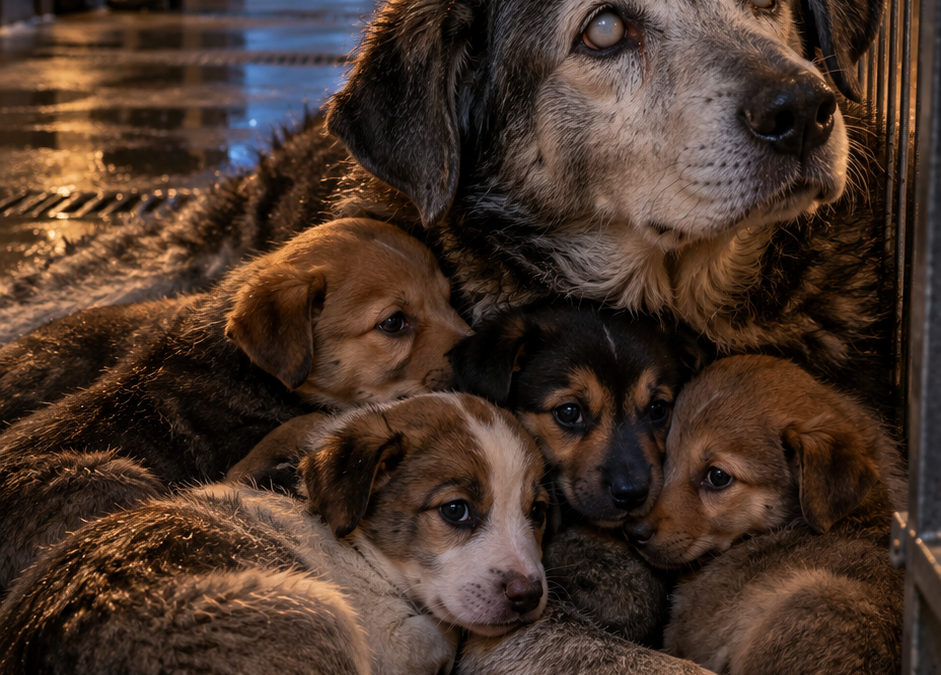
And over five years, according to Ruth’s records and memory, Patsy had comforted more than four hundred puppies.
Four hundred.
I thought she was exaggerating.
She wasn’t.
Some arrived without mothers.
Some had been abandoned.
Some seized from terrible homes.
Some transported from overcrowded facilities.
Some arrived cold.
Some injured.
Some simply terrified by the smells and sounds of a shelter.
Puppies cry at night.
That was one of the first things I learned.
Not all of them.
But enough.
The building sounds different after midnight.
During the day, noise overlaps.
Staff talking.
Phones ringing.
Doors.
Bowls.
Dogs barking.
Visitors.
Vehicles.
At night, each sound becomes separate.
A paw scratching metal.
A collar shaking.
A dog turning in bedding.
A puppy crying from three rooms away.
Ruth told me Patsy could never ignore that last sound.
“He starts barking.”
“Why?”
“To get us.”
“That’s it?”
“No.”
She smiled.
“That’s only the first step.”
If someone opened his kennel, Patsy would walk to the crying puppy.
If allowed inside, he would lie beside it.
He did not play.
He did not overwhelm frightened puppies.
He simply stayed.
Sometimes he licked them.
Sometimes he rested his head against them.
Sometimes he positioned his body between the puppy and the kennel door.
Eventually, most stopped crying.
“How did he learn that?” I asked.
Ruth shook her head.
“Nobody taught him.”
“Maybe he had puppies around before he came here.”
“Maybe.”
“Or lived with other dogs.”
“Maybe.”
“Or—”
“Denny.”
“What?”
“Not everything needs solving.”
I hated when she said things like that.
I was twenty-four.
At twenty-four, you still believe understanding the cause gives you control over the result.
That night changed me.
It was February.
One of those Montana nights where the cold seemed less like weather and more like a physical object pressing against the building.
Snow had been falling since evening.
Not a storm exactly.
Soft flakes.
Steady.
Enough to erase tire tracks and round off the edges of everything outside.
The Bridge of Hope had an aging heating system that worked hard and lost anyway.
Inside, the temperature stayed around fifty degrees.
Warm enough to be safe.
Not warm enough to forget winter.
Ruth left around eleven.
Before leaving, she pointed at me.
“Call if you need anything.”
“I won’t.”
“That’s what people say before needing something.”
“I’ll be fine.”
She looked toward the kennels.
“Check Patsy’s water before one.”
“Already did.”
“Blanket?”
“Clean.”
“Puppy room?”
“Everyone settled.”
Ruth pulled on her coat.
“Then don’t fall asleep.”
“I don’t sleep at work.”
She stared.
“You’re new.”
Then she left.
I sat in the small night office near the front.
There was an old computer.
A desk.
A chair that leaned slightly to the right.
A security monitor showing grainy black-and-white views of hallways.
Someone had left headphones in a drawer.
Ruth had mentioned them during training.
“You’ll understand eventually.”
“Why?”
“For the barking.”
I hadn’t used them.
I wanted to prove I could handle shelter noise.
Around one-thirty, things became quiet.
Not silent.
A shelter is never silent.
But settled.
Dogs sleeping.
Heating system rattling.
Snow against the windows.
I completed paperwork.
Checked medications.
Walked through the kennels once.
Patsy was asleep.
His silver body curled on a blanket.
I stopped.
He lifted his head.
“It’s just me.”
His tail tapped once.
“Go back to sleep.”
He did.
At two in the morning, headlights crossed the rear security camera.
I frowned.
Nobody was scheduled.
Then I heard a vehicle pull in.
I went outside.
Cold hit instantly.
A police car sat near the rear entrance.
An officer stepped out.
“Bridge of Hope?”
“Yeah.”
He opened the rear door.
“What happened?”
He didn’t answer immediately.
He reached into the back seat.
Then I saw the box.
Wet cardboard.
Partially collapsed.
Inside was the smallest black puppy I had ever seen.
Maybe eight weeks old.
Maybe less.
His fur was soaked.
He was curled into the farthest corner as if trying to disappear through cardboard.
His eyes were huge.
“What happened?”
The officer shook his head.
“Someone dumped him beside Route 6.”
“In this weather?”
“Box was near a drainage ditch.”
He looked at the puppy.
“Rain got it earlier, then the temperature dropped.”
The puppy trembled violently.
“I don’t know if he’ll make it.”
“Bring him in.”
I took the box.
It weighed almost nothing.
Inside, the puppy stared at me.
No barking.
No growling.
Just fear.
“We tried contacting animal control,” the officer said.
“They sent you here?”
“You’re the only place answering.”
“Okay.”
“I couldn’t leave him.”
“You did the right thing.”
He looked relieved to hear it.
Sometimes people need permission to believe that.
I carried the puppy inside.
The warmest available kennel was at the far end of the corridor, near a heating pipe running through the wall.
I put down a thick blanket.
Fresh water.
A small amount of food.
The puppy wouldn’t move from the back corner.
“Hey.”
He trembled.
“It’s okay.”
Stupid words.
He had no reason to believe me.
I sat outside his kennel for several minutes.
“You’ll warm up.”
He began crying.
A tiny sound.
Sharp.
Repeated.
I tried reaching slowly through the bars.
He backed away immediately.
“Okay.”
I withdrew my hand.
“It’s fine.”
The crying continued.
I checked the temperature.
Checked his breathing as best I could without stressing him.
I considered calling Ruth.
Then decided against it.
The puppy was stable.
Cold and frightened, but stable.
Ruth had told me something during my first night.
“You learn not to listen to every cry.”
I had thought that sounded cruel.
She explained.
“If every sound goes through your chest, you won’t last six months.”
Now I understood.
There were forty-three dogs in the building that night.
Every one had a story.
Every one could break your heart if you gave the story enough room.
You had to function.
So I returned to the office.
The puppy cried.
I heard him all the way down the hall.
I closed the office door halfway.
Still heard him.
I opened paperwork.
Tried concentrating.
The crying continued.
Then another sound began.
Bark.
Pause.
Bark.
Pause.
Bark.
I looked toward the hallway.
Patsy.
I knew his voice.
Everyone did.
Short barks.
Rhythmic.
Persistent.
“What are you doing?”
Obviously he couldn’t hear me from the office.
The puppy stopped crying for a moment.
Patsy stopped barking.
Silence.
Then the puppy cried again.
Bark.
Pause.
Bark.
Pause.
I stared at the security monitor.
Patsy’s kennel wasn’t visible from that camera angle.
I went back to the paperwork.
Ten minutes.
The pattern continued.
Puppy cries.
Patsy barks.
Pause.
Puppy cries.
Patsy barks.
Twenty minutes.
Thirty.
Forty.
I rubbed my face.
“Patsy.”
The barking continued.
I finally stood.
Three in the morning.
I walked down the corridor.
Patsy was standing at his gate.
His front paws pressed against the metal.
Head tilted.
Listening.
“You’re doing this again, huh?”
Bark.
“I know.”
Bark.
“Patsy.”
He didn’t stop.
I looked toward the puppy’s kennel.
Another cry.
Patsy’s ears rose.
He barked immediately.
I remembered Ruth.
He takes care of them.
I sighed.
“Fine.”
Patsy stopped barking.
Not because he understood the word fine.
Because he heard the latch.
I opened his gate.
He stepped into the corridor.
Slowly.
His eyesight was so poor that I instinctively moved to guide him.
He didn’t need me.
He knew exactly where he was going.
One paw forward.
Pause.
Another.
He stayed near the wall.
At the first junction, he turned right.
I followed.
“You can’t see anything, can you?”
His ears moved.
He continued.
He had mapped the entire building inside himself.
Every doorway.
Every corner.
Every kennel.
Halfway down the corridor, the puppy cried.
Patsy’s pace changed.
Not faster exactly.
More certain.
He reached the kennel.
His nose touched the metal bars.
The puppy stopped crying.
Immediately.
That was the first moment I realized Ruth had not been exaggerating.
Patsy stood there.
The puppy moved cautiously toward the gate.
Not all the way.
Enough to smell him.
Patsy remained motionless.
No bark.
No excitement.
Nothing that could frighten him.
I crouched beside Patsy.
“Want in?”
His tail moved once.
I opened the puppy’s kennel.
Patsy walked inside.
For the first five minutes, he did nothing.
Literally nothing.
He stood.
The puppy remained in the back corner.
Patsy waited.
The puppy sniffed.
One step.
Patsy didn’t move.
Another.
Nothing.
The puppy reached him.
Sniffed one leg.
Then the other.
Patsy slowly lowered himself to the blanket.
His joints made the movement awkward.
I could hear his nails scrape lightly against the floor.
The puppy flinched.
Patsy froze halfway down.
Waited.
Then continued.
He lay on his side.
The puppy trembled.
Patsy turned his head toward the sound.
He extended his nose.
One gentle lick.
Across the puppy’s forehead.
The puppy froze.
Another lick.
Slow.
Careful.
The crying stopped.
I sat outside the kennel.
The puppy moved closer.
Pressed against Patsy’s chest.
Then closer still.
He buried his nose in the thick fur near Patsy’s belly.
Patsy rested his head over the puppy’s back.
And closed his eyes.
That was it.
No miracle music.
No sudden transformation.
An old almost-blind dog lay down beside a frightened puppy.
But watching it, I understood something I had not understood when Ruth explained it.
The puppy did not need another human standing over him.
He had been handled.
Transported.
Found.
Moved.
Examined.
Placed somewhere unfamiliar.
Everything in his world had changed.
Patsy asked nothing from him.
He was simply warm.
Still.
Present.
Within minutes, the puppy slept.
Deeply.
His body stopped trembling.
I sat on the floor longer than I meant to.
Patsy opened one cloudy eye.
Or seemed to.
“You’ve done this four hundred times?”
His tail barely moved.
“Nobody wants you, but you’re raising half the shelter.”
Patsy breathed slowly.
I felt ashamed as soon as I said nobody wants you.
Maybe because it wasn’t entirely true.
Ruth wanted him.
The staff loved him.
The puppies needed him.
Still, none of us had taken him home.
There was a difference between being loved somewhere and being chosen.
I wondered whether Patsy knew.
Whether dogs understand rejection in accumulated numbers.
One family.
Two.
Six.
Whether he remembered each house.
Each return trip.
The shelter door opening again.
The same smells rushing back.
Had he ever stopped expecting another chance?
Or had he simply stopped needing one?
I didn’t know.
Around three-thirty, I returned to the office.
I left Patsy’s kennel empty.
Let him stay with the puppy.
The building became quiet.
The kind of quiet Ruth probably meant when she said Patsy could enter their nights.
I worked.
Checked once around four.
They were still sleeping together.
The puppy’s body tucked against Patsy’s side.
Around five-thirty, dawn began turning the windows gray.
Snow still fell.
I made coffee.
Completed the intake paperwork for the puppy.
Under NAME, I wrote:
UNKNOWN.
AGE:
APPROX. 8 WEEKS.
FOUND:
ROADSIDE IN CARDBOARD BOX.
CONDITION:
COLD, WET, FEARFUL.
At six, I walked the kennel corridor again.
Dogs began waking.
Collars jingled.
Some barked.
The shelter shifted from night to morning.
I reached the puppy’s kennel.
He was awake.
Sitting beside Patsy.
Something in his face looked different.
The terror wasn’t gone.
But curiosity had returned.
He watched me.
His head tilted.
“Morning.”
The puppy did not retreat.
That felt like progress.
Patsy remained lying beside him.
“Hey, old man.”
Nothing.
I smiled.
“Long night?”
Nothing.
“Patsy.”
I opened the kennel.
The puppy stood.
Patsy did not.
I crouched.
“Patsy.”
No ear movement.
No head turn.
Nothing.
A cold feeling moved through me.
I reached toward his side.
Stopped.
For one second, I already knew.
I just didn’t want my hand to confirm it.
“Patsy?”
I touched his ribs.
Warm.
Still warm.
But still.
Completely still.
No rise.
No fall.
I placed my hand more firmly against him.
Nothing.
I moved toward his nose.
No breath.
“No.”
I don’t know why I said it.
Not loudly.
Just no.
As if I had authority.
“Patsy.”
I shook him gently.
Nothing.
“Patsy.”
The puppy moved closer to him.
I put my hand against Patsy’s chest.
No heartbeat.
My training wasn’t extensive, but I didn’t need training for that.
He was gone.
I sat down on the kennel floor.
The puppy looked at me.
Then at Patsy.
He pushed his nose beneath the old dog’s chin.
Patsy did not respond.
The puppy whined.
A very small sound.
I covered my face.
I’d known Patsy thirteen days.
Thirteen.
And I cried like I had lost a dog I’d owned my whole life.
Maybe I was crying because of what I’d witnessed.
Maybe because he had spent his last night doing exactly what everyone said he always did.
Maybe because nobody had chosen him in five years and yet his final act was making sure a puppy did not feel alone.
I don’t know.
The puppy climbed partly over Patsy’s front leg.
I touched Patsy’s silver head.
His mouth was slightly open.
The tip of his tongue visible.
Ruth had told me that was how he looked when relaxed.
Happy, she called it.
I hated that word then.
Happy.
What right did we have to call his life happy?
Six returns.
Five years in a kennel.
Almost blind.
Arthritis.
Hundreds of nights listening to other dogs leave.
I sat beside him until I heard the front door open.
Ruth usually arrived around seven.
That morning she came early because of the snow.
I heard her boots.
Then her voice.
“Denny?”
I couldn’t answer.
She walked toward the kennel.
Stopped.
Her eyes went to me.
Then Patsy.
Then the puppy.
She understood immediately.
“Oh.”
That was all.
Just oh.
Ruth entered.
She knelt beside Patsy.
Put one hand on his face.
For a moment, the woman who had worked around death for twenty-three years looked very old.
“He went in his sleep?”
“I think so.”
“Was he alone?”
I looked at the puppy.
“No.”
Ruth closed her eyes.
“Good.”
I became angry.
I don’t know why that word triggered it.
“Good?”
She looked at me.
“He died in a kennel.”
“Denny—”
“He lived in a kennel.”
“He was loved here.”
“That’s not the same.”
“No.”
“He got returned six times.”
“I know.”
“He was almost blind and nobody wanted him.”
Ruth said nothing.
“And now we’re supposed to say he had a good life because he died next to a puppy?”
My voice had risen.
The puppy backed away.
I immediately lowered it.
Ruth stayed calm.
“No.”
I stared.
“No what?”
“We don’t have to lie about what he didn’t have.”
That stopped me.
She stroked Patsy’s head.
“He should have had a family.”
Her voice cracked.
“He should have had a couch.”
“A yard.”
“Somebody who thought eleven years wasn’t too old.”
Tears filled her eyes.
“He should have had all of that.”
I looked down.
Ruth continued.
“But that doesn’t mean the life he actually had meant nothing.”
The puppy moved toward Patsy again.
Ruth watched.
“Patsy couldn’t choose the six people who brought him back.”
She swallowed.
“He couldn’t make somebody adopt him.”
“He couldn’t make his eyes work.”
“He couldn’t make himself young.”
Her hand rested on his shoulder.
“But he could decide what to do with the life that remained.”
I wiped my face.
“And he did.”
I wanted to argue.
Couldn’t.
Ruth stood.
“We should move him.”
I nodded.
Together, we lifted Patsy.
He was heavier than I expected.
Dead weight.
I hate that phrase now.
There is nothing empty about holding the body of something that has mattered.
The puppy cried when we carried Patsy away.
That sound nearly destroyed me.
I turned.
The little black puppy stood at the bars.
Watching.
“We’ll come back.”
He didn’t understand.
Ruth and I carried Patsy into the courtyard.
Snow was still falling.
We placed him on the ground beneath the covered section near the back wall.
I brought a blanket.
Covered him carefully.
His face remained visible.
Silver muzzle.
Clouded eyes closed.
That slight opening of his mouth.
Ruth stood beside me.
Neither of us spoke.
Finally, she leaned against me and put one arm around my shoulders.
I was taller than she was.
In that moment, I felt about twelve.
“He had a purpose,” she whispered.
I looked at Patsy.
I was still angry.
“He deserved more than a purpose.”
“Yes.”
The answer came immediately.
No argument.
No inspirational correction.
“Yes, he did.”
We stood there while snow gathered on the courtyard.
Inside, the puppy began crying again.
This time, Patsy did not bark.
That silence was unbearable.
Ruth heard it too.
Her face changed.
“We should go in.”
I didn’t move.
“Denny.”
“One minute.”
She left me there.
I knelt beside Patsy.
“I didn’t know you.”
My voice sounded ridiculous.
“I mean, not really.”
Snow landed on the blanket.
“You probably didn’t know me either.”
I touched his head.
“But I saw you.”
That felt important.
“I saw what you did.”
My throat tightened.
“And I won’t forget.”
I covered his face gently.
Then went inside.
The puppy was still crying.
I opened his kennel.
He retreated.
I sat on the floor.
“I know.”
The puppy trembled.
“I know.”
I wanted to comfort him like Patsy had.
I couldn’t.
Not the same way.
I didn’t have that gift.
So I sat.
Eventually, the puppy came close enough to sniff my shoe.
That was all.
I stayed anyway.
Word spread through the shelter by midmorning.
People arrived for work.
Stopped.
Asked the same question.
“What happened?”
Ruth answered until she couldn’t.
Then I answered.
“He stayed with the new puppy.”
“All night?”
“Yeah.”
“And then?”
“He didn’t wake up.”
Margot from the kitchen cried openly.
The shelter director locked himself in his office for twenty minutes.
One volunteer brought Patsy’s old blanket out of storage.
Another printed photographs.
Somebody found the intake picture from five years earlier.
Young Patsy.
Clear eyes.
Dark coat.
Standing straight.
They placed it beside a photograph taken only weeks earlier.
Same dog.
Different life.
Visitors were told gently that day.
A few who knew Patsy left flowers.
Someone brought a tennis ball even though Patsy had not chased one in years.
That touched me more than it should have.
The puppy survived.
For the first few days, he cried often.
He ate.
He warmed.
His fear slowly loosened.
Ruth named him Finn.
“Why Finn?”
“Because I had to write something on his card.”
No grand meaning.
I liked that.
Finn began approaching people.
Not immediately.
But enough.
The first person he trusted was Ruth.
Then me.
One afternoon, he fell asleep against my shoe.
I looked down and thought of Patsy.
The warmth had been passed.
That’s how I began thinking about it.
Passed.
Not replaced.
Not repaid.
Passed.
Patsy had received too little kindness from too many people.
But somehow, instead of hoarding whatever gentleness remained inside him, he kept giving it away.
That made me uncomfortable.
Because humans like fairness.
We want kindness rewarded.
We want the good dog adopted.
We want the abandoned animal to get the perfect home.
We want suffering to lead cleanly toward compensation.
Patsy’s story didn’t do that.
He was returned six times.
Nobody took him home permanently.
He grew old in a shelter.
He nearly lost his sight.
He died there.
Those facts remain true.
But another set of facts remains true too.
More than four hundred puppies slept better because Patsy existed.
Some of them had been beaten.
Some abandoned.
Some separated from mothers too young.
Some arrived trembling so hard their bowls rattled when they touched them.
Patsy lay beside them.
Again.
Again.
Again.
They eventually left.
That was the cruelest and most beautiful part.
Patsy comforted them until they were ready to go somewhere he never got to go.
Home.
One puppy after another.
Families came.
Leashes clipped.
Doors opened.
Cars drove away.
Patsy stayed.
I began looking through old shelter files.
Not official research.
Just curiosity.
Ruth remembered many of the dogs Patsy had helped.
A shepherd mix named Lulu who arrived at ten weeks after being found beneath an abandoned porch.
Patsy spent three nights beside her.
She was adopted by a teacher.
A litter of five terrier puppies rescued from a freezing shed.
Patsy moved between them every night for a week.
All five adopted.
A little brown puppy named Harvey who screamed whenever lights went out.
Patsy slept beside him until the screaming stopped.
Harvey went home with a retired firefighter.
Hundreds.
I wondered how many families had no idea their happy adult dog had once slept against an almost-blind old shelter dog in Montana.
Probably most.
Maybe all.
There was something beautiful about that anonymity.
Patsy didn’t need them to remember him.
He needed them to survive the night.
After his death, the shelter changed.
Not dramatically at first.
People just behaved differently.
Staff lingered longer near older dogs.
Visitors were encouraged to meet senior animals instead of walking past automatically.
Ruth became even more stubborn about explaining that blindness did not mean helplessness.
Neither did age.
The director started highlighting long-term residents in adoption posts.
But the thing everyone remembered most was the puppies.
Someone suggested placing Patsy’s photograph in the puppy room.
Ruth shook her head.
“Too easy.”
“What do you mean?”
“People stop seeing photographs.”
She was right.
Anything hanging on a wall eventually becomes wall.
So they came up with something else.
A small gray stone.
Nothing fancy.
Smooth.
Round.
Montana river stone.
One was placed in the kennel of every new puppy.
At first, I thought it was silly.
Then Ruth explained.
“People ask what it is.”
“And?”
“Then we tell them.”
That became the rule.
Every new puppy received a gray stone.
Not inside where they could chew it dangerously.
Placed outside the kennel, near the information card.
When adopters asked, someone told Patsy’s story.
Not exaggerated.
Not softened.
“He lived here five years.”
“He was almost blind.”
“He had been returned six times.”
“He comforted more than four hundred puppies.”
“He died sleeping beside one.”
People cried.
Almost everyone asked the same question.
“How could nobody want him?”
I never found a satisfying answer.
Sometimes people want easy.
Young.
Healthy.
Instant affection.
Predictable years ahead.
Patsy was none of those things.
He required patience.
He carried history.
He was old enough that loving him meant accepting the possibility of losing him soon.
Many people aren’t prepared for that.
I understand it.
I don’t like it.
But I understand.
Months after Patsy died, a family adopted Finn.
The same puppy from that final night.
By then, Finn had transformed.
Still cautious.
But playful.
Healthy.
His black coat shone.
He loved squeaky toys and hated metal bowls.
He had a habit of sleeping pressed against another dog whenever possible.
I wondered where he’d learned that.
The adopting family had two children and an older Labrador.
Before they left, the mother noticed the gray stone beside Finn’s kennel.
“What’s this?”
I looked at Ruth.
She nodded toward me.
My story now.
I picked up the stone.
“There was an old dog here named Patsy.”
The children listened.
I told them.
Not everything.
Enough.
When I reached the final night, the mother covered her mouth.
The older child asked, “So Patsy saved Finn?”
I thought about the word saved.
“He helped him.”
“Where is Patsy now?”
I looked at Finn.
“Gone.”
The child’s face fell.
“Did he have a family?”
That question hurt every time.
“The shelter was his family.”
It sounded inadequate.
The child seemed to know that.
“But nobody adopted him?”
“No.”
“Why?”
“I don’t know.”
The boy looked toward the older dogs.
Then back at Finn.
“That’s sad.”
“Yeah.”
I wasn’t going to lie.
“It is.”
Finn’s new mother crouched beside him.
“Did he die alone?”
“No.”
That answer mattered.
“No.”
I smiled slightly.
“He was exactly where he wanted to be.”
Finn went home that afternoon.
I watched through the front window as the family’s car left.
Ruth stood beside me.
“You okay?”
“Yeah.”
“Liar.”
I laughed.
“He doesn’t know.”
“Know what?”
“What Patsy did.”
Ruth looked at me.
“He doesn’t need to.”
That was true.
Finn’s ignorance was the reward.
He didn’t need to remember the box.
The cold road.
The terror.
The shelter.
Or the warm old dog who stopped him from trembling for one night.
He could simply go live.
That was enough.
I continued working nights.
Eventually, I learned why the headphones were there.
I even used them sometimes.
Not to ignore animals.
To survive enough to help them.
Ruth was right about that too.
But after Patsy, I never ignored a puppy crying without checking.
Sometimes it needed nothing.
Sometimes food.
Sometimes warmth.
Sometimes just time.
And sometimes, especially with frightened dogs, I found myself sitting outside the kennel in silence.
Not reaching.
Not talking.
Just staying.
I wasn’t Patsy.
But I had watched him.
You learn from what you witness.
Years passed.
Ruth eventually retired.
The Bridge of Hope replaced its heating system.
The kennel floors were renovated.
The night office got a new chair.
Patsy’s old kennel housed dozens of different dogs over time.
For a while, I hated seeing another animal there.
Then I realized that was foolish.
A kennel is supposed to be temporary.
Letting another dog leave from Patsy’s old space felt more appropriate than turning it into a monument.
We kept only a small plaque near the hallway entrance.
PATSY
HE STAYED.
That was all.
I liked it because it didn’t pretend he had a perfect life.
It didn’t call him a hero.
Didn’t turn pain into something pretty.
He stayed.
For frightened puppies.
For the staff.
For five years.
Until he couldn’t.
Sometimes people who had adopted puppies years earlier returned to visit.
They’d hear the story and suddenly realize their dog might have known Patsy.
A woman once came in carrying photographs of a large white dog.
“This is Molly.”
Ruth recognized the name immediately.
“Molly was terrified of men.”
“Not anymore.”
The woman smiled.
“She sleeps beside my husband every night.”
Ruth asked when she’d been adopted.
They checked records.
Molly had overlapped with Patsy.
Ruth remembered.
“He slept beside her for four nights.”
The woman’s eyes filled.
“She does that with our foster puppies.”
I felt something move through me.
There it was.
The thing Ruth had told me couldn’t die.
Behavior passing forward.
Comfort taught through comfort.
Maybe Molly learned it from Patsy.
Maybe not.
There was no way to prove it.
I didn’t need proof.
I liked believing some kindness survives because someone who received it repeats it without knowing where it began.
That felt like Patsy.
Years later, I still remember his final morning more clearly than almost anything from my twenties.
The snow.
The gray light.
Finn sitting beside him.
My hand touching warm fur and finding no breath.
For a long time, I thought the tragedy of Patsy’s life was that nobody adopted him.
Part of me still thinks that.
Someone should have.
Somewhere, there should have been a person willing to take an almost-blind eleven-year-old dog home.
Someone should have given him a couch.
A yard.
A bedroom floor.
A final Christmas in a house.
He deserved that.
I refuse to rewrite his story into a lesson suggesting neglected animals somehow don’t need those things because they can find purpose in suffering.
They do.
Patsy deserved better.
But deserving better and having a meaningful life are not opposites.
That took me years to understand.
The world failed Patsy in certain ways.
Six returns were failures.
Five years without a permanent family was a failure.
People walking past because his age made them afraid of grief was understandable, perhaps, but still sad.
Yet Patsy did not become only the sum of what people failed to give him.
He became something else too.
A steady body beside frightened puppies.
A bark in the night saying someone needs help.
A map of shelter hallways carried inside an almost-blind dog’s memory.
Warmth.
Patience.
Presence.
Maybe that’s why Ruth had said the Bridge of Hope was his home.
Not because a kennel was good enough.
But because home can also be the place where your existence matters to others.
Patsy mattered there.
Deeply.
One winter night, long after his death, a puppy came in shaking after being abandoned outside a grocery store.
He cried for hours.
Nothing helped.
Eventually, I opened his kennel and sat on the floor beside him.
He stayed in the corner.
I remembered Patsy.
Don’t force.
Don’t ask.
Stay.
So I did.
Twenty minutes.
Forty.
An hour.
The puppy eventually moved closer.
Not all the way.
Enough.
I almost heard Ruth’s voice.
Patsy could enter their nights.
I finally understood what she meant.
Daytime is easier.
Daylight creates activity.
Humans arrive.
Bowls fill.
Doors open.
At night, frightened animals meet their memories.
Abandonment feels larger in the dark.
Patsy had been there for that part.
The part nobody sees in adoption photographs.
Maybe that was why four hundred puppies mattered so much.
He did not save them in a dramatic sense.
He didn’t pull them from fires.
Didn’t find them on roads.
Didn’t perform medical miracles.
He did something quieter.
He made one terrible night less terrible.
Sometimes that is enough to alter what comes next.
People underestimate small forms of rescue.
We like visible heroism.
Big moments.
But a life can change because somebody stayed beside you when you were afraid.
No headlines.
No applause.
Just warmth.
I think of Patsy whenever someone tells me an old dog “doesn’t have much time.”
People say that as though the value of love depends on length.
Five years.
Five months.
Five weeks.
Who decides what is worth giving?
If someone had adopted Patsy during his final year, would the grief have come quickly?
Yes.
Would that have made the year worthless?
No.
If anything, knowing time is short can make gentleness more urgent.
I learned that too late for Patsy.
But not too late for every dog who came after.
The Bridge of Hope began seeing more senior adoptions over the years.
Not because of Patsy alone.
Many people worked hard.
But his story became part of how we explained them.
“This dog may be old.”
“Yes.”
“You may not have ten years.”
“No.”
“But you could give him one year that feels different from everything before it.”
Sometimes that worked.
Sometimes people still chose the puppy.
That’s okay.
Puppies need homes too.
Patsy taught me not to turn compassion into competition.
The point is not choosing the saddest animal.
The point is seeing clearly.
Age.
Disability.
Fear.
None of those erase a life.
The gray stones remain at the shelter.
Last time I visited, one sat beside a kennel holding three rescued puppies.
A young volunteer was explaining it to a family.
“There was an old dog named Patsy…”
I stood far enough away that they didn’t notice me.
The volunteer had never met him.
That affected me more than I expected.
She knew the story.
Not because I had told her.
Because somebody told somebody who told somebody.
The family listened.
One little girl crouched near the kennel.
“Was Patsy nice?”
The volunteer smiled.
“Very.”
“Was he scared because he couldn’t see?”
“I don’t know.”
“Did he have friends?”
The volunteer looked toward the puppies.
“A lot.”
The girl thought.
“More than four hundred?”
The volunteer laughed.
“Probably.”
I walked outside before anyone saw me crying.
The Montana air was cold.
Not like that night.
But enough to bring it back.
For years, I carried guilt.
I met Patsy thirteen days before he died.
Why didn’t I take him home?
The question is irrational.
I was new.
Young.
Living in a small apartment that didn’t allow pets.
I barely knew him.
Still, guilt doesn’t care about logistics.
I imagined another ending.
I quit.
Find a new apartment.
Adopt Patsy.
Give him a home for whatever time remained.
That didn’t happen.
You can torture yourself forever with the life you did not create.
Eventually, Ruth helped me stop.
We were having coffee after she retired.
I said, “I wish somebody had taken him.”
“So do I.”
“I wish I had.”
She looked at me for a long time.
“Denny, don’t turn loving him into punishing yourself.”
I said nothing.
“You gave him his last night.”
“No.”
“Yes.”
“Patsy gave the puppy his last night.”
“And who opened the kennel?”
I looked down.
“If you’d put on the headphones and ignored him, what happens?”
“I don’t know.”
“Exactly.”
She reached across the table.
“You listened.”
That sentence stayed.
I listened.
Not enough to save Patsy.
That wasn’t mine to do.
Enough to let him be where he wanted to be.
With the puppy.
Maybe that mattered.
I hope it did.
Sometimes I imagine his last moments.
Not because I enjoy it.
Because I was not there for the exact breath when he left.
I picture darkness.
Shelter quiet.
Snow outside.
Finn asleep against him.
Patsy’s head resting on that small black back.
Maybe his breathing slowed.
Maybe he felt tired.
Maybe he knew.
Maybe he didn’t.
I hope there was no fear.
His face in the morning didn’t look frightened.
That’s all I know.
He looked peaceful.
And if dogs understand anything like satisfaction, perhaps he had it.
The puppy wasn’t crying.
That was what he had wanted.
Silence.
Warmth.
Someone beside him.
Patsy had spent years giving that to others.
On his final night, perhaps the puppy gave it back.
That thought helps.
People sometimes describe Patsy’s story by saying nobody wanted him.
I understand why.
It’s powerful.
But after years of thinking about him, I don’t think it’s completely accurate.
Six families failed to keep him.
Many adopters passed.
Yes.
But Ruth wanted him.
Margot wanted him.
Volunteers loved him.
Four hundred puppies sought his body when they were afraid.
Finn chose his warmth on the last night of his life.
Maybe adoption is not the only measure of being wanted.
Again, that doesn’t excuse the home he never had.
It simply makes his life larger than the absence.
Patsy was wanted.
Just not in the simple way his kennel card had been waiting for.
He belonged to a strange family.
A revolving family.
Staff who came and went.
Dogs who stayed a week.
Puppies who slept against him and disappeared into new homes.
He belonged to all of them briefly.
Maybe that is why he never stopped responding when one cried.
He knew departures better than almost anyone.
Maybe he understood that fear.
Or maybe I’m giving him a story he never needed.
Perhaps he simply heard crying and went.
Sometimes compassion is that uncomplicated.
You hear suffering.
You move toward it.
One night years later, I found an old photograph of Patsy on my phone.
It had been taken during my first week.
He was standing outside in snow.
Silver coat against white ground.
Head tilted toward the camera even though he couldn’t really see it.
I zoomed in.
His face was calm.
For the first time, I noticed Finn’s gray stone sitting on my desk nearby.
I picked it up.
The shelter had given me one after Patsy died.
I kept it through three apartments and two jobs.
Just a stone.
People often need objects because memory has no weight.
I turned it in my hand.
Cold.
Smooth.
Ordinary.
Patsy had been ordinary too.
That’s important.
He wasn’t supernatural.
He didn’t understand human ideas about sacrifice.
He wasn’t a saint.
He was a dog.
An old dog.
Nearly blind.
Arthritic.
Sometimes stubborn.
He stole food if someone left it low enough.
Ruth said he once urinated on the director’s shoe.
He hated having his nails trimmed.
He could snore loudly enough to wake neighboring kennels.
All of that makes what he did more meaningful, not less.
Kindness doesn’t require perfection.
It doesn’t require being extraordinary all the time.
Patsy simply had one thing he consistently did well.
He noticed fear.
And he stayed near it.
I think humans could learn from that.
Not fix everything.
Not make speeches.
Not demand that pain disappear.
Sometimes just notice.
Then stay.
I am older now than Ruth was when I first met her.
That fact shocks me.
I have worked with animals most of my adult life.
I have seen hundreds leave shelters.
Hundreds arrive.
I have seen miraculous recoveries.
Terrible losses.
People surrender pets while crying.
People adopt senior dogs knowing exactly what they are choosing.
Children whisper goodbye through kennel bars.
Old dogs discover beds.
Frightened puppies learn to play.
But when someone asks which animal I remember most, I always answer Patsy.
The old silver dog who didn’t come running when I entered his kennel.
The one who simply stood.
Turned toward my footsteps.
Waited.
Ready.
Show me where I need to go.
That was his language.
That was his life.
Not:
Take me.
Choose me.
Love me.
Though he deserved all three.
Instead:
Where am I needed?
And somehow he kept answering that question until the last night.
Finn lived a good life.
I know because his family stayed in contact with the shelter.
He grew into a large black dog with a white patch under his chin.
He adored their older Labrador.
When that dog became sick years later, Finn slept beside him every night.
I found out from a Christmas card.
The family wrote:
He won’t leave Charlie’s side.
I sat with that sentence for a long time.
Maybe Finn learned nothing from Patsy.
Maybe dogs simply do these things.
But I like the possibility.
One old dog lies beside one frightened puppy.
That puppy grows.
Years later, he lies beside another old dog.
Warmth moving forward.
No one owns it.
No one gets credit.
It simply continues.
That’s the version of legacy I believe now.
Not statues.
Not names.
Behavior.
What somebody did for you becoming what you later know how to do for someone else.
Patsy comforted four hundred puppies.
How many of them comforted someone afterward?
A child.
Another dog.
An elderly owner.
A frightened foster animal.
We’ll never know.
That’s beautiful to me.
There is a line in the shelter now beneath Patsy’s small plaque.
Ruth added it before retiring.
KINDNESS STAYS LONGER THAN WE DO.
I used to think it was sentimental.
Now I think it’s accurate.
Patsy has been gone many years.
The dogs he knew are mostly gone too.
The staff changed.
The building changed.
But a puppy still receives a gray stone.
A volunteer still explains why.
A family still pauses.
Someone still asks:
“How could nobody want him?”
And someone still tells them:
“We don’t know.”
Then perhaps that person looks differently at an older dog.
Or a blind dog.
Or an animal that doesn’t immediately jump with excitement.
Maybe they stop at a kennel they would have passed.
Maybe not.
But possibility remains.
That’s enough.
On the morning Patsy died, I thought his life had ended in the same place where he’d been forgotten.
I no longer see it that way.
Yes, he died inside the shelter.
Yes, he never received the home I wish he had.
Those truths deserve to remain uncomfortable.
But he did not die forgotten.
I remember him.
Ruth remembered.
The shelter remembers.
Finn carried something forward.
Four hundred puppies once slept because he stayed near them.
That is not nothing.
It is enormous.
Maybe Patsy never found the home people imagined for him.
But for hundreds of terrified little animals on the worst nights of their young lives, Patsy was home.
Not a building.
Not a family name.
Not an address.
Warm fur.
A steady heartbeat.
A head resting gently across their backs.
A presence saying without words:
The dark is still here.
The shelter is still strange.
You are still afraid.
But you are not alone.
Stay close.
Sleep.
I am here.
That was Patsy’s gift.
And on his final night, with snow falling outside and a tiny abandoned puppy curled against his chest, that was what he gave one last time.
When morning came, Patsy was gone.
The puppy was no longer trembling.
Sometimes I think that says everything there is to say.
An old dog whom people had returned six times used his last night making sure one more frightened creature felt safe enough to sleep.
He had spent his life waiting to be chosen.
Yet when the moment came, he chose someone else.
And maybe that is why, even after all these years, whenever I hear a puppy crying in the dark, I still think I can hear Patsy somewhere beyond the kennel doors.
One short bark.
A pause.
Another.
Not asking for anything.
Just saying what he had always said best:
I’m here.
You hear me?
I’m still here.




