My Golden Retriever Broke the One Rule He Had Obeyed for Eleven Years
My Golden Retriever Broke the One Rule He Had Obeyed for Eleven Years
For eleven years, Charlie knew exactly where he was supposed to sit whenever we got into the car.
That Friday afternoon, something happened that made him ignore the rule for the first time in his life.
By the time anyone understood why an old golden retriever was frantically climbing into the front seat, I could no longer tell them myself.
My name is George Harrison.
I’m eighty-two years old, a retired architect, and for most of my life I have believed that routines are one of the quiet ways we hold the world together.
Buildings need structure.
So do people.
Mine had become simple after retirement.
Every Friday morning at ten, I made tea in the same ceramic mug my wife had given me more than forty years earlier.
Blue glaze.
A little crack near the handle.
The words World’s Most Difficult Architect printed on one side.
My wife, Margaret, had thought that was hilarious.
I had pretended to be offended.
I still used the mug long after she was gone.
At eleven, I read the local newspaper.
Not online.
Actual paper.
I liked the sound of the pages.
At noon, I usually ate something light.
Then, at exactly two in the afternoon, I reached for my keys.
That was Charlie’s favorite part.
The keys could be ten feet away and he would hear them.
His head would rise immediately.
His ears would come forward.
His tail would begin hitting the floor.
“Don’t start.”
More tail.
“We go every Friday. This is not a surprise.”
Charlie would stand anyway.
He was eleven years old then.
Old for a golden retriever.
His muzzle had turned almost completely white.
His hips were stiffer than they once had been.
He no longer charged through the house with a tennis ball the way he did at three.
But the moment I picked up my keys, he looked young again.
Friday meant Mount Trashmore Park.
We lived on Bay Shore Drive in Virginia Beach, and the drive wasn’t long.
We had made it so many times that I suspected Charlie could have navigated it better than some people I knew.
Our routine was always the same.
He sat in the back seat.
Always.
I’d trained him that way from the beginning.
“Back seat is safer, Charlie.”
He learned.
Golden retrievers are very good at learning rules when they believe those rules matter to you.
For eleven years, he never tried to climb forward while the car was moving.
Not once.
That Friday began like every other.
Tea at ten.
Newspaper at eleven.
At around one, my older son, Thomas, called from Atlanta.
“Dad.”
“Thomas.”
“Why do you always answer like I’m calling to discuss a contract?”
“Because you usually want something.”
He laughed.
“I have news.”
“You’re finally learning to cook?”
“No.”
“Then I’m not interested.”
“I’m coming for Christmas.”
That stopped me.
“What?”
“Me. Rachel. The kids. We’re coming up.”
“All of you?”
“Unless you’ve changed the locks.”
I smiled.
“How long?”
“Five days.”
“Five?”
“Try to contain your excitement.”
I looked toward the framed photograph of Margaret on the shelf.
Christmas had become quieter after she died.
Too quiet sometimes.
“Your mother would have liked that.”
Thomas didn’t answer for a moment.
Then he said,
“Yeah.”
We stayed on the phone longer than usual.
He told me about work.
The grandchildren.
Travel plans.
Before hanging up, he said,
“Dad?”
“Yes?”
“How are you doing?”
“Fine.”
“Really?”
“I’m eighty-two, not eighty-seven. Stop checking on me.”
He sighed.
“You know that’s not how aging works.”
“I was an architect. I understand structural deterioration.”
“That’s reassuring.”
“Goodbye, Thomas.”
“Love you.”
I paused.
“Love you too.”
After the call, I remained in my chair for several minutes.
I thought about Christmas.
About grandchildren in the house.
About the noise Charlie would make every time someone dropped food.
About Margaret complaining that everyone had left shoes in the hallway.
Old habits of imagination.
At two o’clock, Charlie and I left.
October had been mild.
That afternoon was cooler than expected, but the sun was out.
Leaves spun lazily from the trees.
Charlie climbed into the back seat.
I pointed at him.
“Stay.”
He gave me the look he always gave when I issued a command he had obeyed ten thousand times.
“Humor me.”
He settled.
I started the car.
For the first several minutes, everything felt normal.
We moved slowly through the neighborhood.
Bay Shore Drive is quiet in the early afternoon.
Large lots.
Mature trees.
Few pedestrians.
I wasn’t driving fast.
Maybe twenty miles per hour.
I was thinking about Thomas.
About whether I had enough guest bedding.
Whether the railing on the back steps needed fixing before the children came.
Whether Charlie would tolerate the youngest grandson trying to hug him every thirty seconds.
Then my right hand went numb.
Not painful.
That would have been easier.
Pain announces itself.
Numbness was quieter.
At first, I thought I’d been gripping the steering wheel strangely.
I flexed my fingers.
Nothing.
I tried again.
Still nothing.
“What the…”
The words didn’t come out correctly.
That was when fear hit.
I tried to say Charlie’s name.
What came out was a sound.
Not a word.
My tongue felt wrong.
My face felt heavy.
The edges of my vision darkened.
I knew enough to understand what might be happening.
Stroke.
The thought appeared clearly.
My body did not cooperate with it.
I tried to move my right foot.
It slipped from the pedal.
The car began drifting.
Slowly.
Too slowly to feel violent.
That made the moment worse.
I could see what was happening.
Couldn’t correct it.
The right front tire touched the curb.
The steering wheel shifted.
The car rolled toward a large oak tree.
I tried to reach the horn.
My right hand hung uselessly.
My left arm felt impossibly far away from everything I needed.
“Charlie.”
Again, only broken sound.
The car struck the tree.
Not hard.
The impact pushed me sideways.
My head dropped toward my shoulder.
The world went dark around the edges.
I remember thinking one thing before I lost awareness.
Charlie is in the back.
He had been sleeping.
Later, I pieced together what happened from Emily, the paramedics, and the marks Charlie left on the center console.
The car stopped moving normally.
Charlie woke.
He barked once.
Then again.
I didn’t respond.
That alone must have frightened him.
For eleven years, he knew my patterns better than most people did.
He knew the sound of my breathing at night.
He knew which drawer held his treats.
He knew that if I picked up my blue jacket, we were going outside.
He knew my footsteps.
My cough.
The difference between me sitting quietly and me being wrong.
And something was wrong.
Charlie stood in the back seat.
I was slumped sideways.
He barked again.
Nothing.
Then he broke the rule.
The rule I had taught him his whole life.
Stay in the back.
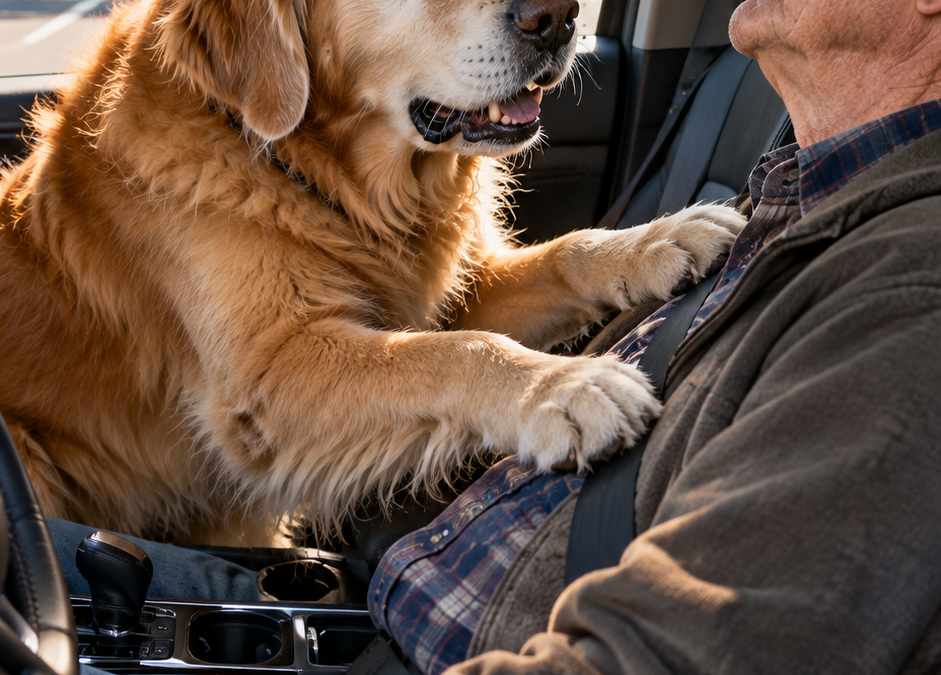
Charlie climbed over the center console.
That couldn’t have been easy.
He was an elderly seventy-pound golden retriever with stiff hips.
But somehow he got his front paws forward.
One paw landed between my legs.
The other against the steering wheel.
Then it pressed the horn.
One short blast.
No response.
He pressed again.
And again.
Bay Shore Drive remained quiet.
He didn’t stop.
Twenty-eight times in two minutes.
That’s what a neighbor’s security camera later helped establish.
Twenty-eight separate blasts.
Some brief.
Some longer.
Uneven.
Desperate.
Not a pattern anyone had taught him.
Just persistence.
The street was so quiet that under ordinary circumstances someone might have complained about the noise.
But that afternoon, most people were inside.
My nearest neighbor, Margaret Sullivan, was eighty-seven and usually napped at that hour.
A landscaping crew that normally worked two houses away had finished early.
Nobody came.
Charlie kept pressing.
Eventually he grew tired.
But he didn’t return to the back seat.
He stayed beside me.
Barked.
Pressed the horn.
Waited.
Tried again.
Several minutes passed.
Then Emily Parker drove onto Bay Shore Drive.
I didn’t know Emily well.
I’d seen her around the neighborhood.
Young woman.
Maybe mid-thirties.
She lived a few streets away with her husband and son.
That afternoon she was home earlier than usual because the school had called to say her child wasn’t feeling well.
She told me later that she’d heard a horn from a distance.
At first, she assumed someone was being impatient.
Then it happened again.
Again.
Again.
“At some point,” she told me, “it stopped sounding like anger.”
“What did it sound like?”
“Wrong.”
She slowed.
Then saw my blue sedan partly against the oak tree.
The engine was still running.
One wheel turned slowly against the curb.
And through the windshield she saw Charlie.
An old golden retriever halfway into the driver’s area, one paw on the steering wheel.
He hit the horn while she watched.
Emily stopped immediately.
She ran toward us.
Charlie barked.
“Hey! It’s okay!”
He didn’t know her.
He stood over me.
Protective.
Confused.
Emily later told me she was afraid he might bite.
“I almost stayed back.”
“Why didn’t you?”
“Because he hit the horn again.”
She approached more slowly.
“Good boy.”
Charlie stared at her.
“I need to help him.”
Something about her tone must have worked.
He moved just enough.
Emily opened the driver’s door.
I was pale.
Eyes partly open.
Unable to speak.
“Sir?”
I could hear her.
I remember pieces.
A woman’s voice.
Cold air.
Charlie panting.
“Sir, can you hear me?”
I tried to answer.
Nothing.
“Can you squeeze my hand?”
My left fingers moved.
Emily saw it.
“Okay. Good.”
She took out her phone.
Called 911.
She kept talking to me.
I don’t remember everything she said.
Something about the ambulance coming.
Something about staying awake.
Something about my dog.
“Your dog did good.”
I remember that.
Very clearly.
Your dog did good.
Charlie stood pressed against my leg.
Emily tried once to move him.
He resisted.
Not aggressively.
He simply would not leave me.
When the paramedics arrived, they assessed me immediately.
One of them asked when I’d last been known well.
Emily didn’t know.
That became a problem.
In stroke treatment, time matters enormously.
Then she noticed my phone.
The last call from Thomas gave them a reference point.
They began working.
Blood pressure.
Neurological checks.
Questions I couldn’t answer properly.
“George, can you smile for me?”
I tried.
One side failed.
“Raise both arms.”
My right arm barely moved.
“Do you know where you are?”
I understood.
Couldn’t form the words.
I had spent eighty-two years using language without appreciating what a miracle it was.
Then suddenly the words were trapped inside my own head.
The paramedics prepared to move me.
Charlie tried to follow.
“Dog has to stay.”
One paramedic reached for him.
Charlie planted himself.
Emily said,
“He called you.”
The paramedic looked at her.
“What?”
“The dog. He was hitting the horn.”
The man looked at Charlie.
Then at me.
“Seriously?”
“That’s why I stopped.”
Charlie whined.
The paramedic shook his head.
“Fine. If he’s calm, bring him.”
Charlie climbed into the ambulance.
For the first time in eleven years, nobody told him to stay in the back.
I remember almost nothing about the ride.
Lights through closed eyelids.
Voices.
A mask.
The rhythmic vibration of the road.
But I remember fur against my left hand.
Charlie.
He was there.
The doctors at Sentara Virginia Beach moved fast.
Scans.
Medication.
More people asking me questions.
My mind knew answers my mouth couldn’t produce.
Then even those memories blurred.
Three hours later, I opened my eyes in a hospital room.
The light was dim.
For a moment, I couldn’t remember where I was.
Then I saw Charlie.
He was curled awkwardly on a narrow chair beside the bed.
Far too large for it.
His head rested near my arm.
One paw lay across my left hand.
I moved my fingers.
Barely.
Charlie woke.
His eyes found mine.
His tail moved once against the chair.
Thump.
I tried to speak.
“Ch…”
That was all.
But his tail moved again.
A nurse entered.
She stopped when she saw me awake.
“Mr. Harrison?”
I looked at her.
“Don’t try to talk yet.”
Charlie stood.
The nurse smiled.
“Your friend hasn’t left.”
I looked at him.
His chin was gray.
Eyes tired.
He looked every bit of eleven years old.
“Apparently he’s very stubborn.”
I wanted to say:
You have no idea.
A doctor came later.
He explained that I’d had an ischemic stroke.
A blockage had interrupted blood flow to part of my brain.
Because help reached me quickly enough, they had been able to intervene before the damage became as severe as it might have been.
I listened.
Some words I understood immediately.
Others seemed to arrive through water.
“Will I walk?”
My speech was terrible.
The doctor understood.
“That’s our expectation.”
“Talk?”
“Yes.”
“Hand?”
“With therapy, we’re hopeful you’ll regain substantial function.”
I looked toward Charlie.
The doctor followed my eyes.
“They tell me he’s the reason someone stopped.”
I tried to smile.
Only part of my face cooperated.
“Good dog.”
The doctor laughed softly.
“Very.”
Thomas arrived from Atlanta the following morning.
He walked into the room looking as though he’d aged ten years overnight.
“Dad.”
I lifted my left hand.
He took it.
For several seconds, neither of us spoke.
Then he looked at Charlie.
The dog was asleep beside the bed.
“Is that true?”
I raised an eyebrow.
“The horn?”
I nodded.
Thomas stared at him.
“Twenty-eight times?”
Another nod.
He swallowed.
Then crouched.
Charlie opened his eyes.
Thomas put both hands around his face.
“You crazy old dog.”
Charlie’s tail moved.
Thomas laughed and wiped his eyes.
“You saved him.”
I wanted to say that Thomas was going to spoil him forever now.
Couldn’t.
So I pointed at Charlie.
Then mimed eating.
Thomas understood.
“Treats?”
I nodded.
“How many?”
I held up both hands as best I could.
Thomas laughed.
“All of them?”
I nodded.
Rehabilitation humbled me.
Architects spend their lives thinking about structure and control.
I had designed buildings that could handle hurricane-force winds.
I understood load paths, structural redundancy, stress distribution.
Then a stroke made lifting a plastic cup with my right hand feel like advanced engineering.
My therapist would place an object in front of me.
“Pick it up.”
I’d concentrate until sweat formed on my forehead.
My fingers moved an inch.
Then stopped.
Again.
Again.
Again.
Some days I wanted to throw the cup.
Unfortunately, throwing required grip strength.
Charlie came whenever they allowed him.
He would lie beside the therapy room.
Watch.
If I became frustrated, he’d lift his head.
“Don’t start,” I’d say.
Speech returned gradually.
At first, individual words.
Then short sentences.
My right leg improved faster than my hand.
Walking with assistance.
Then a cane.
Then several steps independently.
One afternoon, my physical therapist said,
“You’re stubborn.”
I pointed toward Charlie.
“His fault.”
She laughed.
“Learned from him?”
“No.”
I paused carefully.
“He learned… from me.”
Speaking was exhausting.
But every clear sentence felt like recovering a room inside my own house.
Emily visited too.
The first time, I knew her face before I remembered her name.
She stood near the door holding flowers.
“Hi, Mr. Harrison.”
“George.”
“George.”
Charlie recognized her immediately.
He went straight to her.
She crouched.
“Hey, hero.”
His tail went wild.
“You remember me?”
Of course he did.
I watched them.
Then said slowly,
“You stopped.”
Emily looked at me.
“Because of him.”
“I know.”
“No.”
I searched for words.
“You… could have kept driving.”
Her expression softened.
“I couldn’t after I saw the car.”
“Thank you.”
She shook her head.
“Thank Charlie.”
I looked at him.
“I do.”
Two months after the stroke, I went home.
December.
Cold morning.
Bare trees.
The house looked exactly the same.
That surprised me.
Part of me expected the world to reflect what had happened.
But the ceramic mug was still in the cabinet.
My newspaper subscription had continued.
The chair was where I’d left it.
The indentation from Charlie’s bed remained beside the sofa.
Thomas stayed with me the first week.
He wanted to stay longer.
I refused.
“You have a family.”
“So do you.”
He pointed at Charlie.
“He’s not a licensed medical professional.”
Charlie looked offended.
“He’s more qualified than some people I’ve met.”
Thomas didn’t laugh.
“Dad, seriously.”
I reached for his arm.
My right hand still lacked strength, but it worked enough.
“I’ll call.”
“Every day.”
“That’s excessive.”
“Every day.”
“Fine.”
He left after extracting three separate promises from me.
Charlie and I returned to our routine.
Modified.
Slower.
More careful.
Then one morning, I picked up the car keys.
Charlie stood.
He went automatically toward the back door.
I stopped.
“Wait.”
He looked at me.
I opened the passenger-side front door.
Charlie hesitated.
Eleven years of training.
“You heard me.”
He stared.
“Front.”
He looked toward the back seat.
Then at me.
I smiled.
“You earned it.”
Charlie climbed slowly into the passenger seat.
He turned once.
Settled.
Placed one paw on my knee.
I sat behind the wheel.
For a moment, my right hand rested there.
My fingers still weren’t perfect.
Neither was my speech.
Neither was my balance.
I was alive.
That seemed like enough.
“We’re not going fast.”
Charlie looked forward.
“And if I feel anything strange, we stop.”
His ears moved.
“You’re in charge of emergency communications.”
Tail.
I started the engine.
We drove to Mount Trashmore Park.
The trees were mostly bare now.
October’s orange and red leaves were gone.
December sunlight made everything look sharper.
Cleaner.
Charlie climbed out carefully.
So did I.
I used a cane.
He had arthritis.
We made quite a team.
Our old walking route had once taken forty minutes.
That day, we barely made half of it.
I didn’t care.
Charlie walked beside me.
Not ahead.
Not behind.
Beside me.
We stopped beneath one of the trees.
I sat on a bench.
Charlie lowered himself near my feet.
For several minutes, I said nothing.
Then I looked at him.
“You know what you did?”
His eyes stayed on me.
“You broke the rules.”
Tail movement.
“Very serious.”
Another movement.
“Eleven years of excellent behavior ruined in two minutes.”
His head tilted.
I laughed.
The sound still wasn’t quite the same as before.
That didn’t matter.
I put my hand on his head.
My right hand.
It trembled.
But it worked.
Charlie closed his eyes.
I thought about the twenty-eight horn blasts.
What must have happened inside his mind when I stopped answering.
People like to say dogs don’t understand emergencies.
Maybe not in the human sense.
Charlie didn’t know the word stroke.
Didn’t know what an ambulance was.
Didn’t understand cerebral blood flow or treatment windows.
He understood George.
And George was wrong.
That was enough.
For years, I had thought obedience was one of Charlie’s finest qualities.
Sit.
Stay.
Back seat.
Wait.
Come.
He followed rules because he trusted me.
Then the day came when following my rule would’ve been the wrong thing to do.
So he broke it.
I think about that often.
Sometimes love is obedience.
Sometimes love is knowing when obedience no longer matters.
That afternoon beneath the bare trees, Charlie rested his chin on my knee.
I looked across the park.
Children ran near the playground.
A couple walked past holding hands.
Someone threw a tennis ball for a younger golden retriever.
Charlie watched.
“You want to try?”
His ears rose.
“Absolutely not.”
Tail.
“You’re eleven.”
He stood.
I sighed.
I picked up a small stick instead.
Threw it maybe ten feet.
Charlie walked after it.
Not ran.
Walked.
He reached it.
Sniffed it.
Then left it on the ground.
I laughed.
“Good decision.”
He returned.
We sat until the afternoon cooled.
Then I drove us home.
Charlie stayed in the front seat.
From that day forward, he always did.
The rule was gone.
Some rules deserve to disappear.
Christmas came.
Thomas arrived with Rachel and the children.
The house became loud again.
Exactly as I had imagined before the stroke.
My youngest grandson climbed beside Charlie on the rug.
“Grandpa says you saved him.”
Charlie rolled onto one hip.
“He did,” I said.
“How?”
“He called for help.”
The boy frowned.
“Dogs can’t use phones.”
“No.”
“Then how?”
I looked at Charlie.
“He found another way.”
My grandson thought about that.
Then hugged him.
Charlie endured it with the patience of an old saint.
At dinner, Thomas raised a glass.
“To Charlie.”
I groaned.
“Don’t make him arrogant.”
Rachel smiled.
“Too late.”
Everyone raised glasses.
Even me.
Charlie lay beneath the table waiting for someone to drop food.
A hero has priorities.
Months passed.
My recovery continued.
My hand never returned completely to what it had been.
Neither did my speech when I was exhausted.
But I walked.
Talked.
Drove.
Lived.
Charlie grew older.
His pace slowed more quickly than mine.
That felt unfair.
I had needed him to save my life.
Now his body was asking me to repay the favor in smaller ways.
Shorter walks.
Medication.
A ramp beside the back steps.
Help into the car.
Front seat, always.
Every Friday, we still went to Mount Trashmore.
Two o’clock became two-fifteen sometimes.
Then two-thirty.
Architecture had taught me that structures survive not because nothing ever changes, but because good structures adapt to loads.
Maybe routines work the same way.
The ritual changed.
The meaning didn’t.
Tea.
Newspaper.
Keys.
Charlie.
Park.
One Friday, I sat on our usual bench and rubbed the white fur around his ears.
“You know, people still ask about the horn.”
He looked at me.
“Twenty-eight times.”
No response.
“Couldn’t make it thirty?”
His tail hit my shoe once.
“Lazy.”
He rested his head against my leg.
I looked at the hand stroking him.
The hand that had hung uselessly beside me in the car.
Movement had returned.
Not perfect.
Enough.
My whole life, I designed buildings around the possibility of failure.
We add backups.
Multiple supports.
Redundant systems.
Because one connection can fail.
One beam.
One cable.
One electrical system.
You never want everything depending on a single point.
I thought I understood redundancy.
Then, at eighty-two years old, I discovered mine had golden fur.
When my hand failed, Charlie became my hand.
When my voice failed, Charlie became my voice.
When I couldn’t ask the world for help, he made enough noise that eventually the world answered.
Twenty-eight times.
People call him heroic.
Maybe he was.
But if you had asked Charlie what he’d done, I don’t think he would have understood the question.
He wasn’t trying to become a hero.
He wasn’t saving “an eighty-two-year-old retired architect.”
He was trying to wake George.
His person.
The man who filled his food bowl.
Opened the back door.
Took him to the park.
Talked to him when the house became too quiet after Margaret died.
That was all.
And perhaps that’s what makes what he did matter so much to me.
There was no reward in his mind.
No recognition.
No choice between courage and cowardice.
Just one fact:
I needed him.
So he refused to stop.
Even now, whenever I hear a car horn repeat too many times, my chest tightens.
Then I look at Charlie.
If he’s beside me, I put my hand on him.
“You caused that.”
He doesn’t care.
Of course he doesn’t.
Dogs are wonderfully uninterested in their own legends.
That might be another thing we could learn from them.
I used to believe the safest place for Charlie was always the back seat.
For eleven years, that was true.
Until the day it wasn’t.
And on the worst afternoon of my life, an old dog decided that one rule mattered less than the person who had taught it to him.
He climbed forward.
Put one paw on the center of my steering wheel.
And kept calling for help until somebody finally listened.
I am still here because he did.
𝗧𝗛𝗘 𝗘𝗡𝗗
My Golden Retriever Broke the One Rule He Had Obeyed for Eleven Years
For eleven years, Charlie knew exactly where he was supposed to sit whenever we got into the car.
That Friday afternoon, something happened that made him ignore the rule for the first time in his life.
By the time anyone understood why an old golden retriever was frantically climbing into the front seat, I could no longer tell them myself.
My name is George Harrison.
I’m eighty-two years old, a retired architect, and for most of my life I have believed that routines are one of the quiet ways we hold the world together.
Buildings need structure.
So do people.
Mine had become simple after retirement.
Every Friday morning at ten, I made tea in the same ceramic mug my wife had given me more than forty years earlier.
Blue glaze.
A little crack near the handle.
The words World’s Most Difficult Architect printed on one side.
My wife, Margaret, had thought that was hilarious.
I had pretended to be offended.
I still used the mug long after she was gone.
At eleven, I read the local newspaper.
Not online.
Actual paper.
I liked the sound of the pages.
At noon, I usually ate something light.
Then, at exactly two in the afternoon, I reached for my keys.
That was Charlie’s favorite part.
The keys could be ten feet away and he would hear them.
His head would rise immediately.
His ears would come forward.
His tail would begin hitting the floor.
“Don’t start.”
More tail.
“We go every Friday. This is not a surprise.”
Charlie would stand anyway.
He was eleven years old then.
Old for a golden retriever.
His muzzle had turned almost completely white.
His hips were stiffer than they once had been.
He no longer charged through the house with a tennis ball the way he did at three.
But the moment I picked up my keys, he looked young again.
Friday meant Mount Trashmore Park.
We lived on Bay Shore Drive in Virginia Beach, and the drive wasn’t long.
We had made it so many times that I suspected Charlie could have navigated it better than some people I knew.
Our routine was always the same.
He sat in the back seat.
Always.
I’d trained him that way from the beginning.
“Back seat is safer, Charlie.”
He learned.
Golden retrievers are very good at learning rules when they believe those rules matter to you.
For eleven years, he never tried to climb forward while the car was moving.
Not once.
That Friday began like every other.
Tea at ten.
Newspaper at eleven.
At around one, my older son, Thomas, called from Atlanta.
“Dad.”
“Thomas.”
“Why do you always answer like I’m calling to discuss a contract?”
“Because you usually want something.”
He laughed.
“I have news.”
“You’re finally learning to cook?”
“No.”
“Then I’m not interested.”
“I’m coming for Christmas.”
That stopped me.
“What?”
“Me. Rachel. The kids. We’re coming up.”
“All of you?”
“Unless you’ve changed the locks.”
I smiled.
“How long?”
“Five days.”
“Five?”
“Try to contain your excitement.”
I looked toward the framed photograph of Margaret on the shelf.
Christmas had become quieter after she died.
Too quiet sometimes.
“Your mother would have liked that.”
Thomas didn’t answer for a moment.
Then he said,
“Yeah.”
We stayed on the phone longer than usual.
He told me about work.
The grandchildren.
Travel plans.
Before hanging up, he said,
“Dad?”
“Yes?”
“How are you doing?”
“Fine.”
“Really?”
“I’m eighty-two, not eighty-seven. Stop checking on me.”
He sighed.
“You know that’s not how aging works.”
“I was an architect. I understand structural deterioration.”
“That’s reassuring.”
“Goodbye, Thomas.”
“Love you.”
I paused.
“Love you too.”
After the call, I remained in my chair for several minutes.
I thought about Christmas.
About grandchildren in the house.
About the noise Charlie would make every time someone dropped food.
About Margaret complaining that everyone had left shoes in the hallway.
Old habits of imagination.
At two o’clock, Charlie and I left.
October had been mild.
That afternoon was cooler than expected, but the sun was out.
Leaves spun lazily from the trees.
Charlie climbed into the back seat.
I pointed at him.
“Stay.”
He gave me the look he always gave when I issued a command he had obeyed ten thousand times.
“Humor me.”
He settled.
I started the car.
For the first several minutes, everything felt normal.
We moved slowly through the neighborhood.
Bay Shore Drive is quiet in the early afternoon.
Large lots.
Mature trees.
Few pedestrians.
I wasn’t driving fast.
Maybe twenty miles per hour.
I was thinking about Thomas.
About whether I had enough guest bedding.
Whether the railing on the back steps needed fixing before the children came.
Whether Charlie would tolerate the youngest grandson trying to hug him every thirty seconds.
Then my right hand went numb.
Not painful.
That would have been easier.
Pain announces itself.
Numbness was quieter.
At first, I thought I’d been gripping the steering wheel strangely.
I flexed my fingers.
Nothing.
I tried again.
Still nothing.
“What the…”
The words didn’t come out correctly.
That was when fear hit.
I tried to say Charlie’s name.
What came out was a sound.
Not a word.
My tongue felt wrong.
My face felt heavy.
The edges of my vision darkened.
I knew enough to understand what might be happening.
Stroke.
The thought appeared clearly.
My body did not cooperate with it.
I tried to move my right foot.
It slipped from the pedal.
The car began drifting.
Slowly.
Too slowly to feel violent.
That made the moment worse.
I could see what was happening.
Couldn’t correct it.
The right front tire touched the curb.
The steering wheel shifted.
The car rolled toward a large oak tree.
I tried to reach the horn.
My right hand hung uselessly.
My left arm felt impossibly far away from everything I needed.
“Charlie.”
Again, only broken sound.
The car struck the tree.
Not hard.
The impact pushed me sideways.
My head dropped toward my shoulder.
The world went dark around the edges.
I remember thinking one thing before I lost awareness.
Charlie is in the back.
He had been sleeping.
Later, I pieced together what happened from Emily, the paramedics, and the marks Charlie left on the center console.
The car stopped moving normally.
Charlie woke.
He barked once.
Then again.
I didn’t respond.
That alone must have frightened him.
For eleven years, he knew my patterns better than most people did.
He knew the sound of my breathing at night.
He knew which drawer held his treats.
He knew that if I picked up my blue jacket, we were going outside.
He knew my footsteps.
My cough.
The difference between me sitting quietly and me being wrong.
And something was wrong.
Charlie stood in the back seat.
I was slumped sideways.
He barked again.
Nothing.
Then he broke the rule.
The rule I had taught him his whole life.
Stay in the back.
Charlie climbed over the center console.
That couldn’t have been easy.
He was an elderly seventy-pound golden retriever with stiff hips.
But somehow he got his front paws forward.
One paw landed between my legs.
The other against the steering wheel.
Then it pressed the horn.
One short blast.
No response.
He pressed again.
And again.
Bay Shore Drive remained quiet.
He didn’t stop.
Twenty-eight times in two minutes.
That’s what a neighbor’s security camera later helped establish.
Twenty-eight separate blasts.
Some brief.
Some longer.
Uneven.
Desperate.
Not a pattern anyone had taught him.
Just persistence.
The street was so quiet that under ordinary circumstances someone might have complained about the noise.
But that afternoon, most people were inside.
My nearest neighbor, Margaret Sullivan, was eighty-seven and usually napped at that hour.
A landscaping crew that normally worked two houses away had finished early.
Nobody came.
Charlie kept pressing.
Eventually he grew tired.
But he didn’t return to the back seat.
He stayed beside me.
Barked.
Pressed the horn.
Waited.
Tried again.
Several minutes passed.
Then Emily Parker drove onto Bay Shore Drive.
I didn’t know Emily well.
I’d seen her around the neighborhood.
Young woman.
Maybe mid-thirties.
She lived a few streets away with her husband and son.
That afternoon she was home earlier than usual because the school had called to say her child wasn’t feeling well.
She told me later that she’d heard a horn from a distance.
At first, she assumed someone was being impatient.
Then it happened again.
Again.
Again.
“At some point,” she told me, “it stopped sounding like anger.”
“What did it sound like?”
“Wrong.”
She slowed.
Then saw my blue sedan partly against the oak tree.
The engine was still running.
One wheel turned slowly against the curb.
And through the windshield she saw Charlie.
An old golden retriever halfway into the driver’s area, one paw on the steering wheel.
He hit the horn while she watched.
Emily stopped immediately.
She ran toward us.
Charlie barked.
“Hey! It’s okay!”
He didn’t know her.
He stood over me.
Protective.
Confused.
Emily later told me she was afraid he might bite.
“I almost stayed back.”
“Why didn’t you?”
“Because he hit the horn again.”
She approached more slowly.
“Good boy.”
Charlie stared at her.
“I need to help him.”
Something about her tone must have worked.
He moved just enough.
Emily opened the driver’s door.
I was pale.
Eyes partly open.
Unable to speak.
“Sir?”
I could hear her.
I remember pieces.
A woman’s voice.
Cold air.
Charlie panting.
“Sir, can you hear me?”
I tried to answer.
Nothing.
“Can you squeeze my hand?”
My left fingers moved.
Emily saw it.
“Okay. Good.”
She took out her phone.
Called 911.
She kept talking to me.
I don’t remember everything she said.
Something about the ambulance coming.
Something about staying awake.
Something about my dog.
“Your dog did good.”
I remember that.
Very clearly.
Your dog did good.
Charlie stood pressed against my leg.
Emily tried once to move him.
He resisted.
Not aggressively.
He simply would not leave me.
When the paramedics arrived, they assessed me immediately.
One of them asked when I’d last been known well.
Emily didn’t know.
That became a problem.
In stroke treatment, time matters enormously.
Then she noticed my phone.
The last call from Thomas gave them a reference point.
They began working.
Blood pressure.
Neurological checks.
Questions I couldn’t answer properly.
“George, can you smile for me?”
I tried.
One side failed.
“Raise both arms.”
My right arm barely moved.
“Do you know where you are?”
I understood.
Couldn’t form the words.
I had spent eighty-two years using language without appreciating what a miracle it was.
Then suddenly the words were trapped inside my own head.
The paramedics prepared to move me.
Charlie tried to follow.
“Dog has to stay.”
One paramedic reached for him.
Charlie planted himself.
Emily said,
“He called you.”
The paramedic looked at her.
“What?”
“The dog. He was hitting the horn.”
The man looked at Charlie.
Then at me.
“Seriously?”
“That’s why I stopped.”
Charlie whined.
The paramedic shook his head.
“Fine. If he’s calm, bring him.”
Charlie climbed into the ambulance.
For the first time in eleven years, nobody told him to stay in the back.
I remember almost nothing about the ride.
Lights through closed eyelids.
Voices.
A mask.
The rhythmic vibration of the road.
But I remember fur against my left hand.
Charlie.
He was there.
The doctors at Sentara Virginia Beach moved fast.
Scans.
Medication.
More people asking me questions.
My mind knew answers my mouth couldn’t produce.
Then even those memories blurred.
Three hours later, I opened my eyes in a hospital room.
The light was dim.
For a moment, I couldn’t remember where I was.
Then I saw Charlie.
He was curled awkwardly on a narrow chair beside the bed.
Far too large for it.
His head rested near my arm.
One paw lay across my left hand.
I moved my fingers.
Barely.
Charlie woke.
His eyes found mine.
His tail moved once against the chair.
Thump.
I tried to speak.
“Ch…”
That was all.
But his tail moved again.
A nurse entered.
She stopped when she saw me awake.
“Mr. Harrison?”
I looked at her.
“Don’t try to talk yet.”
Charlie stood.
The nurse smiled.
“Your friend hasn’t left.”
I looked at him.
His chin was gray.
Eyes tired.
He looked every bit of eleven years old.
“Apparently he’s very stubborn.”
I wanted to say:
You have no idea.
A doctor came later.
He explained that I’d had an ischemic stroke.
A blockage had interrupted blood flow to part of my brain.
Because help reached me quickly enough, they had been able to intervene before the damage became as severe as it might have been.
I listened.
Some words I understood immediately.
Others seemed to arrive through water.
“Will I walk?”
My speech was terrible.
The doctor understood.
“That’s our expectation.”
“Talk?”
“Yes.”
“Hand?”
“With therapy, we’re hopeful you’ll regain substantial function.”
I looked toward Charlie.
The doctor followed my eyes.
“They tell me he’s the reason someone stopped.”
I tried to smile.
Only part of my face cooperated.
“Good dog.”
The doctor laughed softly.
“Very.”
Thomas arrived from Atlanta the following morning.
He walked into the room looking as though he’d aged ten years overnight.
“Dad.”
I lifted my left hand.
He took it.
For several seconds, neither of us spoke.
Then he looked at Charlie.
The dog was asleep beside the bed.
“Is that true?”
I raised an eyebrow.
“The horn?”
I nodded.
Thomas stared at him.
“Twenty-eight times?”
Another nod.
He swallowed.
Then crouched.
Charlie opened his eyes.
Thomas put both hands around his face.
“You crazy old dog.”
Charlie’s tail moved.
Thomas laughed and wiped his eyes.
“You saved him.”
I wanted to say that Thomas was going to spoil him forever now.
Couldn’t.
So I pointed at Charlie.
Then mimed eating.
Thomas understood.
“Treats?”
I nodded.
“How many?”
I held up both hands as best I could.
Thomas laughed.
“All of them?”
I nodded.
Rehabilitation humbled me.
Architects spend their lives thinking about structure and control.
I had designed buildings that could handle hurricane-force winds.
I understood load paths, structural redundancy, stress distribution.
Then a stroke made lifting a plastic cup with my right hand feel like advanced engineering.
My therapist would place an object in front of me.
“Pick it up.”
I’d concentrate until sweat formed on my forehead.
My fingers moved an inch.
Then stopped.
Again.
Again.
Again.
Some days I wanted to throw the cup.
Unfortunately, throwing required grip strength.
Charlie came whenever they allowed him.
He would lie beside the therapy room.
Watch.
If I became frustrated, he’d lift his head.
“Don’t start,” I’d say.
Speech returned gradually.
At first, individual words.
Then short sentences.
My right leg improved faster than my hand.
Walking with assistance.
Then a cane.
Then several steps independently.
One afternoon, my physical therapist said,
“You’re stubborn.”
I pointed toward Charlie.
“His fault.”
She laughed.
“Learned from him?”
“No.”
I paused carefully.
“He learned… from me.”
Speaking was exhausting.
But every clear sentence felt like recovering a room inside my own house.
Emily visited too.
The first time, I knew her face before I remembered her name.
She stood near the door holding flowers.
“Hi, Mr. Harrison.”
“George.”
“George.”
Charlie recognized her immediately.
He went straight to her.
She crouched.
“Hey, hero.”
His tail went wild.
“You remember me?”
Of course he did.
I watched them.
Then said slowly,
“You stopped.”
Emily looked at me.
“Because of him.”
“I know.”
“No.”
I searched for words.
“You… could have kept driving.”
Her expression softened.
“I couldn’t after I saw the car.”
“Thank you.”
She shook her head.
“Thank Charlie.”
I looked at him.
“I do.”
Two months after the stroke, I went home.
December.
Cold morning.
Bare trees.
The house looked exactly the same.
That surprised me.
Part of me expected the world to reflect what had happened.
But the ceramic mug was still in the cabinet.
My newspaper subscription had continued.
The chair was where I’d left it.
The indentation from Charlie’s bed remained beside the sofa.
Thomas stayed with me the first week.
He wanted to stay longer.
I refused.
“You have a family.”
“So do you.”
He pointed at Charlie.
“He’s not a licensed medical professional.”
Charlie looked offended.
“He’s more qualified than some people I’ve met.”
Thomas didn’t laugh.
“Dad, seriously.”
I reached for his arm.
My right hand still lacked strength, but it worked enough.
“I’ll call.”
“Every day.”
“That’s excessive.”
“Every day.”
“Fine.”
He left after extracting three separate promises from me.
Charlie and I returned to our routine.
Modified.
Slower.
More careful.
Then one morning, I picked up the car keys.
Charlie stood.
He went automatically toward the back door.
I stopped.
“Wait.”
He looked at me.
I opened the passenger-side front door.
Charlie hesitated.
Eleven years of training.
“You heard me.”
He stared.
“Front.”
He looked toward the back seat.
Then at me.
I smiled.
“You earned it.”
Charlie climbed slowly into the passenger seat.
He turned once.
Settled.
Placed one paw on my knee.
I sat behind the wheel.
For a moment, my right hand rested there.
My fingers still weren’t perfect.
Neither was my speech.
Neither was my balance.
I was alive.
That seemed like enough.
“We’re not going fast.”
Charlie looked forward.
“And if I feel anything strange, we stop.”
His ears moved.
“You’re in charge of emergency communications.”
Tail.
I started the engine.
We drove to Mount Trashmore Park.
The trees were mostly bare now.
October’s orange and red leaves were gone.
December sunlight made everything look sharper.
Cleaner.
Charlie climbed out carefully.
So did I.
I used a cane.
He had arthritis.
We made quite a team.
Our old walking route had once taken forty minutes.
That day, we barely made half of it.
I didn’t care.
Charlie walked beside me.
Not ahead.
Not behind.
Beside me.
We stopped beneath one of the trees.
I sat on a bench.
Charlie lowered himself near my feet.
For several minutes, I said nothing.
Then I looked at him.
“You know what you did?”
His eyes stayed on me.
“You broke the rules.”
Tail movement.
“Very serious.”
Another movement.
“Eleven years of excellent behavior ruined in two minutes.”
His head tilted.
I laughed.
The sound still wasn’t quite the same as before.
That didn’t matter.
I put my hand on his head.
My right hand.
It trembled.
But it worked.
Charlie closed his eyes.
I thought about the twenty-eight horn blasts.
What must have happened inside his mind when I stopped answering.
People like to say dogs don’t understand emergencies.
Maybe not in the human sense.
Charlie didn’t know the word stroke.
Didn’t know what an ambulance was.
Didn’t understand cerebral blood flow or treatment windows.
He understood George.
And George was wrong.
That was enough.
For years, I had thought obedience was one of Charlie’s finest qualities.
Sit.
Stay.
Back seat.
Wait.
Come.
He followed rules because he trusted me.
Then the day came when following my rule would’ve been the wrong thing to do.
So he broke it.
I think about that often.
Sometimes love is obedience.
Sometimes love is knowing when obedience no longer matters.
That afternoon beneath the bare trees, Charlie rested his chin on my knee.
I looked across the park.
Children ran near the playground.
A couple walked past holding hands.
Someone threw a tennis ball for a younger golden retriever.
Charlie watched.
“You want to try?”
His ears rose.
“Absolutely not.”
Tail.
“You’re eleven.”
He stood.
I sighed.
I picked up a small stick instead.
Threw it maybe ten feet.
Charlie walked after it.
Not ran.
Walked.
He reached it.
Sniffed it.
Then left it on the ground.
I laughed.
“Good decision.”
He returned.
We sat until the afternoon cooled.
Then I drove us home.
Charlie stayed in the front seat.
From that day forward, he always did.
The rule was gone.
Some rules deserve to disappear.
Christmas came.
Thomas arrived with Rachel and the children.
The house became loud again.
Exactly as I had imagined before the stroke.
My youngest grandson climbed beside Charlie on the rug.
“Grandpa says you saved him.”
Charlie rolled onto one hip.
“He did,” I said.
“How?”
“He called for help.”
The boy frowned.
“Dogs can’t use phones.”
“No.”
“Then how?”
I looked at Charlie.
“He found another way.”
My grandson thought about that.
Then hugged him.
Charlie endured it with the patience of an old saint.
At dinner, Thomas raised a glass.
“To Charlie.”
I groaned.
“Don’t make him arrogant.”
Rachel smiled.
“Too late.”
Everyone raised glasses.
Even me.
Charlie lay beneath the table waiting for someone to drop food.
A hero has priorities.
Months passed.
My recovery continued.
My hand never returned completely to what it had been.
Neither did my speech when I was exhausted.
But I walked.
Talked.
Drove.
Lived.
Charlie grew older.
His pace slowed more quickly than mine.
That felt unfair.
I had needed him to save my life.
Now his body was asking me to repay the favor in smaller ways.
Shorter walks.
Medication.
A ramp beside the back steps.
Help into the car.
Front seat, always.
Every Friday, we still went to Mount Trashmore.
Two o’clock became two-fifteen sometimes.
Then two-thirty.
Architecture had taught me that structures survive not because nothing ever changes, but because good structures adapt to loads.
Maybe routines work the same way.
The ritual changed.
The meaning didn’t.
Tea.
Newspaper.
Keys.
Charlie.
Park.
One Friday, I sat on our usual bench and rubbed the white fur around his ears.
“You know, people still ask about the horn.”
He looked at me.
“Twenty-eight times.”
No response.
“Couldn’t make it thirty?”
His tail hit my shoe once.
“Lazy.”
He rested his head against my leg.
I looked at the hand stroking him.
The hand that had hung uselessly beside me in the car.
Movement had returned.
Not perfect.
Enough.
My whole life, I designed buildings around the possibility of failure.
We add backups.
Multiple supports.
Redundant systems.
Because one connection can fail.
One beam.
One cable.
One electrical system.
You never want everything depending on a single point.
I thought I understood redundancy.
Then, at eighty-two years old, I discovered mine had golden fur.
When my hand failed, Charlie became my hand.
When my voice failed, Charlie became my voice.
When I couldn’t ask the world for help, he made enough noise that eventually the world answered.
Twenty-eight times.
People call him heroic.
Maybe he was.
But if you had asked Charlie what he’d done, I don’t think he would have understood the question.
He wasn’t trying to become a hero.
He wasn’t saving “an eighty-two-year-old retired architect.”
He was trying to wake George.
His person.
The man who filled his food bowl.
Opened the back door.
Took him to the park.
Talked to him when the house became too quiet after Margaret died.
That was all.
And perhaps that’s what makes what he did matter so much to me.
There was no reward in his mind.
No recognition.
No choice between courage and cowardice.
Just one fact:
I needed him.
So he refused to stop.
Even now, whenever I hear a car horn repeat too many times, my chest tightens.
Then I look at Charlie.
If he’s beside me, I put my hand on him.
“You caused that.”
He doesn’t care.
Of course he doesn’t.
Dogs are wonderfully uninterested in their own legends.
That might be another thing we could learn from them.
I used to believe the safest place for Charlie was always the back seat.
For eleven years, that was true.
Until the day it wasn’t.
And on the worst afternoon of my life, an old dog decided that one rule mattered less than the person who had taught it to him.
He climbed forward.
Put one paw on the center of my steering wheel.
And kept calling for help until somebody finally listened.
I am still here because he did.




