𝗙𝗨𝗟𝗟 𝗦𝗧𝗢𝗥𝗬 For Twenty-Six Nights, the Limping Dog Stared Through My Store Window at Something I Couldn’t See
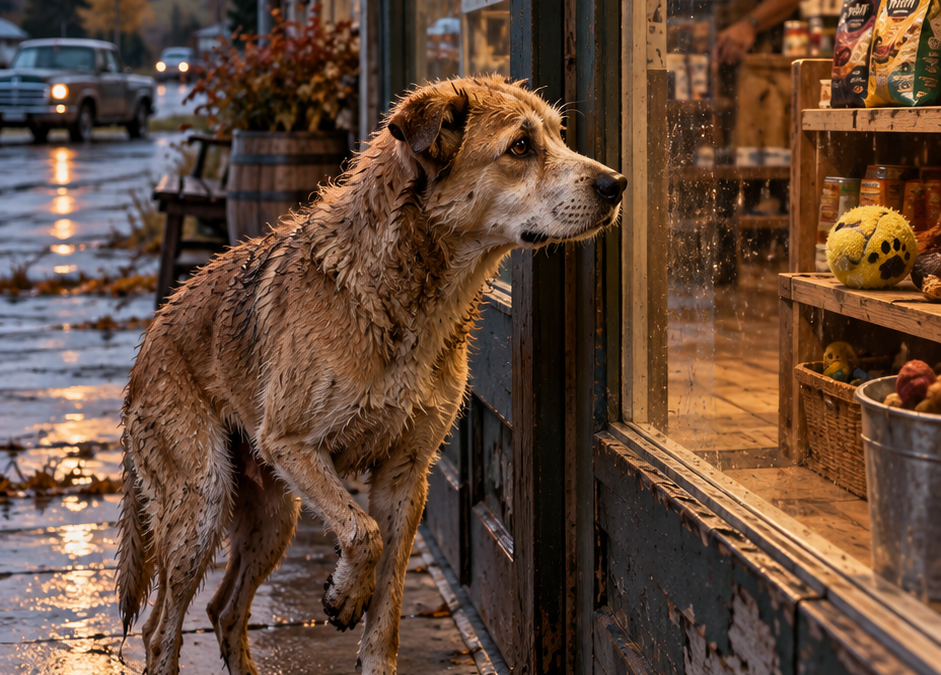
𝗣𝗔𝗥𝗧 𝟮
That encouraged me.
I tore a corner from a loaf I had damaged while unloading.
I tossed it gently onto the pavement.
The dog looked at the bread.
Then at me.
“Go ahead.”
Nothing.
He did not even sniff it.
I tossed another piece slightly closer.
Still nothing.
Instead, his gaze shifted past me.
Into the store.
I stepped sideways.
His head moved with me.
He was looking around my body.
“What are you looking at?”
He stared.
I turned.
Aisles.
Shelves.
Lights.
Nothing unusual.
When I looked back, the dog was already walking away.
The bread remained untouched.
The third day, he came again.
This time I put out a piece of deli meat.
If bread didn’t work, turkey usually did.
He ignored that too.
That bothered me.
A hungry stray refusing turkey usually means one of two things.
Fear.
Or purpose.
He did not seem afraid.
He would look at me directly.
Never flatten his ears.
Never tuck his tail.
Never growl.
He simply did not care about food.
He cared about the inside of the store.
I started calling him Old Man in my head.
I had no idea whether he was male.
No idea how old he was.
But the limp and the expression gave him the look of someone who had already lived through more than he wanted to discuss.
“Back again, Old Man?”
He would stare through the window.
Then leave.
After a week, customers began noticing.
Mrs. Keller, who bought the same coffee and oatmeal every Tuesday, stood at the register watching him.
“That yours?”
“No.”
“Looks like it wants to be.”
“He doesn’t.”
“You feed him?”
“He refuses.”
She frowned.
“Maybe he’s sick.”
“Maybe.”
“Call somebody.”
“I will.”
I contacted a local rescue group.
They came one afternoon.
The dog did not.
They left a humane trap behind.
I put food inside.
Chicken.
The kind I knew a hungry animal would smell from yards away.
Nothing.
The dog returned the next afternoon.
Walked around the trap without looking at it.
Stood at the door.
Looked inside.
Then left.
“You’re making me look stupid,” I said.
His tail moved once.
Maybe coincidence.
By the second week, the ritual had become part of my day.
Three thirty.
Sometimes four.
Depending on weather.
The dog appeared somewhere along Silver Creek Road.
Limping.
Slow.
Always alone.
He approached the storefront.
Stopped.
Watched.
Then disappeared before evening.
I tried walking toward him once.
He let me get within ten feet.
Then moved away.
Not running.
Just maintaining distance.
“Fine.”
I stopped.
“You don’t trust me.”
He stared.
“That’s mutual.”
The truth was I was becoming curious.
I asked customers.
“Recognize that dog?”
Most did not.
A few thought they might have seen him near farms farther down the road.
Nobody knew an owner.
No one knew a name.
One man said, “Probably dumped.”
I hated that possibility.
People do it.
Drive far enough outside town.
Open the door.
Leave.
I had seen animals wandering rural roads before.
But something about this dog felt different.
He wasn’t searching for food.
He wasn’t begging for shelter.
He was returning to one exact place.
My store.
One night, almost two weeks after I first saw him, I was already home when I thought about the security cameras.
I had installed them after somebody broke the side window the previous winter.
Four cameras.
Parking lot.
Front entrance.
Register.
Back aisle.
Most nights I never checked them.
That evening I was in bed around eleven when the dog came into my mind for no reason.
I picked up my phone.
Opened the camera app.
At first, nothing.
Parking lot empty.
Store dark.
A weak streetlamp painted half the front sidewalk orange.
Then a shape appeared.
The dog.
I sat up.
He came from the direction of the road.
Slowly.
Limping worse than during the day.
He crossed the parking lot.
But instead of stopping by the door, he went to the large front window.
He stood there.
Then rose onto his hind legs.
His front paws pressed against the glass.
I stared at the screen.
“What the hell?”
He looked inside.
Not around.
Inside.
For a long time.
One minute.
Two.
Three.
His face moved slightly, as though scanning the dark shelves.
At five minutes, he lowered himself.
Stood still.
Then walked away.
I replayed the recording.
Again.
Same thing.
Something about it bothered me.
Not fear.
Not yet.
It was the precision.
He had clearly come there to look.
The next night, I checked again.
11:04 p.m.
There he was.
Front window.
Paws up.
Staring.
Third night.
Same.
Fourth.
Same.
Every night, after the store was empty.
That detail unsettled me most.
During the day, he came.
Watched.
Left.
At night, he approached the glass.
Pressed himself against it.
Studied the darkness.
Why only when nobody was inside?
I tested it.
One Thursday, I stayed late.
The store closed at nine.
I turned off the main lights but remained in the back office with the door nearly shut.
Eleven came.
No dog.
Eleven thirty.
Nothing.
Midnight.
Nothing.
I went home.
At 12:46, the camera sent a motion alert.
The dog had arrived.
I stared at my phone.
“He knew.”
That was irrational.
Dogs hear.
Smell.
Notice cars.
Maybe he had seen my truck outside.
So the next night I parked behind the building where it could not be seen.
Stayed silent.
Lights off.
No dog.
I left at 11:30.
11:58.
Motion alert.
He arrived.
Now I was bothered.
Not because I thought he had supernatural abilities.
Because whatever he was doing, he needed the place empty.
He wasn’t coming to me.
He wasn’t even coming to the store as a building.
He was coming to something that remained after everyone left.
I started counting.
Night nineteen.
Night twenty.
Twenty-one.
Twenty-two.
Every night.
Same ritual.
At some point, I stopped thinking of him as a stray.
Stray implied wandering.
This dog was not wandering.
He was commuting.
He had a destination.
On night twenty-six, I sat at home watching him through the camera.
He stood against the glass.
Rain had started.
Water ran along his back.
He did not move.
He stayed longer than usual.
Nearly seven minutes.
Then lowered himself.
For a second, he sat directly in front of the window.
Head bowed.
Rain falling.
I watched him from my warm bedroom.
Something inside me changed.
“This is ridiculous.”
I got dressed.
By the time I drove back, he was gone.
The next morning, I walked through the store trying to see what he saw.
I stood outside the front window.
Pressed my palms against the glass.
Looked in.
Candy rack.
Checkout counter.
Aisles.
Tools.
Pet food.
Back shelf.
I shifted left.
Then right.
Still nothing.
I went inside.
Walked aisle by aisle.
“What are you looking for?”
My voice echoed.
At the far back, I stopped beside the pet shelf.
That was when I saw the yellow plush ball.
Dusty.
Faded.
Sitting between two packages of old chew toys.
I picked it up.
Squeezed.
A weak squeak came from inside.
I frowned.
I had seen it before.
Earl left it when he sold the store.
I never priced it.
Never inventoried it.
It had simply remained.
For years.
I almost threw it away several times.
Never did.
Keep everything unless you’re sure nobody wants it.
I put it back.
I did not yet connect it to the dog.
That happened the following night.
Night twenty-seven.
I decided I was done watching through cameras.
At nine, I locked the front door as usual.
But I stayed inside.
This time, I moved my truck two buildings down and walked back.
I sat behind the counter.
No lights.
No movement.
No radio.
I waited.
Ten o’clock.
Nothing.
Ten thirty.
Nothing.
At eleven, I began thinking he would somehow know again.
Then movement appeared outside.
The dog.
My pulse jumped.
He limped toward the window.
Slowly.
Carefully.
He rose on his hind legs.
Placed his paws on the glass.
His face appeared inches from mine, separated by the window and darkness.
I stayed still.
He did not run.
He looked inside.
Then our eyes met.
I have struggled to explain that look.
There was no fear.
No aggression.
Not even surprise.
It felt like a question.
Not directed toward me exactly.
But through me.
As if he had been asking the same question every night and had finally found someone willing to listen.
Do you know where he is?
I know how absurd that sounds.
Dogs do not ask questions in sentences.
But emotion does not always need language.
Something in that animal’s face carried expectation so clearly that my knees weakened.
I crouched.
Not to attract him.
Because standing suddenly felt difficult.
The dog lowered himself from the glass.
He stayed outside.
I unlocked the door.
Opened it.
Cold air entered.
The dog did not.
He stared at the threshold.
“Come on.”
Nothing.
“I’ve been trying to feed you for a month.”
His ear moved.
“You owe me an explanation.”
Still nothing.
I sat on the floor.
Back against the counter.
Waited.
One minute.
Two.
The dog stepped closer.
Then stopped.
I did not reach.
Five minutes.
He entered the doorway enough to sniff the air.
Then backed out.
“It’s okay.”
He looked at me.
“I’m not going to hurt you.”
He entered again.
This time one paw crossed the threshold.
Then the other.
His limp became obvious under the interior light from the back hallway.
Left rear leg.
Old injury, perhaps.
He moved toward me.
Slowly.
Stopped.
Sniffed my hand.
His nose was cool.
His coat smelled like wet earth.
I let him decide.
Finally, he sat directly in front of me.
Head slightly tilted.
Then turned toward the dark store.
His eyes fixed on the back.
I followed his gaze.
“What?”
He stood.
Walked past me.
Not toward food.
Not toward the dog kibble stacked halfway down the aisle.
He ignored everything.
He went straight toward the back shelf.
I followed.
The dog stopped.
Looked upward.
Third row.
I stared.
The yellow ball.
“No way.”
I reached for it.
The dog became completely still.
I took it down.
Held it.
“This?”
His eyes locked on the toy.
Then on me.
Then the sound came.
One low, broken bark.
Not loud.
It cracked halfway through.
Almost a sob.
I froze.
The dog made the sound again.
Softer.
My chest tightened.
“Hey.”
I crouched.
Placed the yellow ball on the floor.
The dog approached.
Stopped inches away.
Sniffed it.
Backed away.
Came forward again.
Touched it with one paw.
Very gently.
Then lowered his head.
Picked it up.
He did not chew.
Did not shake it.
Did not play.
He simply held it.
Eyes closed.
Standing completely still.
I had never seen anything like it.
The toy hung from his mouth.
His breathing changed.
Slow.
Deep.
For a moment, the entire store felt like a church.
I was afraid to move.
Minutes may have passed.
Maybe only one.
Then headlights swept across the front windows.
A vehicle turned into the lot.
The dog startled.
Dropped the ball.
His body went rigid.
“Easy.”
He turned.
Ran.
“Wait!”
I followed.
By the time I reached the door, he was already across the parking lot.
His limp disappeared beneath adrenaline.
He vanished into the fog along the road.
I stood outside holding the yellow ball.
The vehicle belonged to a truck driver who had stopped at the soda machine outside.
He looked at me.
“You open?”
“No.”
“Then why are you standing there holding a dog toy?”
“Long story.”
He shrugged and returned to his truck.
I went inside.
Locked the door.
Set the ball on the counter.
For the first time, I knew the dog had not been waiting for food.
He had been looking for memory.
The toy mattered.
But not by itself.
Dogs do not mourn objects.
Not exactly.
They mourn what objects mean.
Scent.
Routine.
A person.
A place.
Somewhere in that yellow ball was someone the dog expected to find.
The next morning, I closed the store.
I had never done that on a weekday unless sick.
I printed a still image from the security camera.
The dog’s face was grainy but recognizable.
I made flyers.
DO YOU RECOGNIZE THIS DOG?
SAND-COLORED MIX.
LIMP ON LEFT REAR LEG.
NO COLLAR.
I included my number.
I drove Silver Creek Road.
Gas station.
Feed store.
Church bulletin board.
Farm supply store.
Mailbox cluster.
Local diner.
I spoke with everyone.
“Seen him?”
“Maybe.”
“Not sure.”
“Looks familiar.”
Nothing solid.
I drove farther down Silver Creek Road than I usually did.
Passed old farms.
Empty houses.
One property caught my eye.
Small house.
Brown siding.
Overgrown grass.
Curtains closed.
Mailbox leaning.
I had driven past it almost every day.
Never thought about it.
Something made me stop.
No car.
No movement.
I knocked anyway.
Nothing.
I left a flyer under the door.
Two days passed.
No dog returned to the store.
That worried me.
Maybe I had frightened him.
Maybe taking the toy had broken the ritual.
I placed the ball back on the shelf where it had been.
That night, I watched the cameras.
Nothing.
The next morning, my phone rang.
Unknown number.
“Hello?”
A woman’s voice.
Older.
Trembling.
“Are you the man with the dog flyer?”
“Yes.”
Pause.
“That’s Buddy.”
I sat down.
“What?”
“His name is Buddy.”
The woman began crying before she finished.
I gripped the phone.
“You know him?”
“Yes.”
“Is he yours?”
“No.”
She inhaled shakily.
“He belonged to my neighbor.”
“Where?”
“Silver Creek Road.”
My heart began beating faster.
“What neighbor?”
“Marvin Ellis.”
The name meant nothing.
“Where does he live?”
Another silence.
“He doesn’t.”
I understood before she continued.
“Marvin died twenty-six days ago.”
Twenty-six.
I looked toward the security monitor.
Twenty-six nights.
“He died?”
“Yes.”
“Buddy was there?”
“Yes.”
I closed my eyes.
The woman continued.
“Marvin lived alone.”
“How old?”
“Seventy-four.”
“What happened?”
“Heart.”
Her voice broke.
“Buddy was in the yard when the ambulance came. Nobody could catch him.”
“He ran?”
“Yes.”
“Did family look?”
“Marvin didn’t have close family around here.”
“What about the dog?”
“We tried.”
She sounded ashamed.
“He wouldn’t come to anyone.”
I looked toward the yellow ball on the shelf.
“Tell me about Marvin.”
The woman grew quiet.
“Why?”
“Please.”
She sighed.
“Good man. Quiet. Kept to himself after his wife died.”
“Did he shop here?”
“At your store?”
“Yes.”
“Of course.”
“How often?”
“Once or twice a week.”
I tried to remember.
Hundreds of customers.
Faces.
Cash transactions.
Coffee.
Dog food.
An older man.
Then something surfaced.
A tall, thin customer.
Gray cap.
Always exact cash.
Sometimes buying a yellow dog toy.
My stomach dropped.
“Did Marvin buy Buddy toys?”
The woman laughed through tears.
“Oh, constantly.”
“What kind?”
“Same silly thing every month.”
I stood.
“What thing?”
“Yellow squeaky ball.”
I stared at the shelf.
The store seemed suddenly very quiet.
“Every month?”
“Buddy destroyed them eventually.”
I touched the old plush ball.
“But there was one Buddy wouldn’t destroy.”
“What do you mean?”
“Marvin kept one old one around.”
“Why?”
“I don’t know.”
She sniffed.
“Buddy carried it everywhere when Marvin was home.”
I could barely speak.
“Did Marvin leave one here?”
“At your store?”
“Yes.”
“I wouldn’t know.”
I looked at the toy.
Dust.
Faded fabric.
Old.
Maybe Marvin had dropped it.
Maybe Buddy had brought it during some visit years earlier.
Maybe Earl had found it and put it on the shelf, assuming it was merchandise.
There was no way to know.
“Where exactly did Marvin live?”
She gave me the address.
The empty brown house.
One mile down the road.
I closed my eyes.
I had passed his home every day.
“Buddy has been coming here for twenty-six nights.”
The woman became silent.
“What?”
“Every night since Marvin died.”
She began crying harder.
“Oh, God.”
“He won’t eat.”
“What?”
“I’ve offered food.”
My chest tightened.
“He ignores it.”
The woman’s voice became urgent.
“He hasn’t eaten?”
“Maybe somewhere else. I don’t know.”
“He was devoted to Marvin.”
She breathed shakily.
“I’ve never seen anything like it.”
I looked at the toy.
“I have.”
That afternoon, I drove to Marvin’s house.
The woman met me there.
Her name was Helen.
She lived two properties away.
She was in her seventies.
Small.
White hair.
Red raincoat.
She unlocked the side gate.
The yard was overgrown.
A metal bowl sat near the porch.
Empty.
There was a weathered doghouse under a tree.
“This was Buddy’s?”
“Yes.”
“Why didn’t he stay?”
Helen looked at the house.
“Because Marvin wasn’t here.”
Simple.
Painful.
I walked to the porch.
A scratch mark ran along the bottom of the door.
Helen noticed me looking.
“After the ambulance took Marvin, Buddy stayed outside until dark.”
“What happened?”
“He scratched at the door.”
I swallowed.
“We couldn’t let him inside. The house was sealed until they contacted someone.”
“So he waited.”
“All night.”
“And then?”
“Next morning, he was gone.”
I looked toward Silver Creek Road.
One mile.
My store visible only in pieces through trees.
“Did Marvin ever bring Buddy to my shop?”
“Sometimes.”
My heart shifted.
“Inside?”
“No.”
“Why?”
“Buddy hated going into buildings.”
That explained the threshold.
“He’d wait outside.”
Helen smiled sadly.
“Marvin bought coffee. Dog food. That yellow ball.”
I pressed my lips together.
“So Buddy knew the store.”
“Yes.”
“He knew Marvin went inside.”
“Yes.”
The entire thing became clear.
Buddy had gone where Marvin used to go.
Night after night.
He stared through the window because he expected the man who entered that building for years to come back out.
And the toy.
That old yellow ball.
It must have smelled familiar once.
Maybe not anymore.
But the shape was enough.
The color.
The memory.
I sat on Marvin’s porch.
Helen joined me.
“He’s looking for him.”
She nodded.
“He doesn’t know.”
“How do you explain death to a dog?”
Helen wiped her eyes.
“You don’t.”
That night I did something I had never done before.
I left the store door open.
Not unlocked.
Open.
Just wide enough.
I turned on only the light above the register.
The rest remained dim.
I placed the yellow ball directly on the threshold.
Then I sat on the floor ten feet inside.
I waited.
Ten thirty.
Eleven.
Nothing.
I began wondering if Buddy would not return.
Then I saw movement.
Across the parking lot.
He appeared.
Slower than before.
The limp worse.
His body thinner.
Buddy stopped when he saw the open door.
Then he saw the toy.
His entire body changed.
He stood still.
I did not call him.
Did not move.
He looked at me.
Then at the ball.
Then back toward the road.
For one second, I wondered if he was waiting for Marvin to appear behind him.
Nothing did.
Buddy approached.
One step.
Pause.
Another.
He reached the threshold.
Sniffed the ball.
His eyes closed briefly.
Then he looked inside.
At me.
I whispered, “It’s okay.”
Buddy picked up the toy.
This time he entered without hesitation.
He walked straight to me.
Sat.
And began making that broken sound again.
The closest word is crying.
I know dogs do not cry emotional tears the way humans do.
I know people project.
I know all of that.
But sound is sound.
Grief is grief.
Buddy pressed the yellow ball between his teeth and let out a low, shuddering whine.
Again.
Again.
His body trembled.
I reached slowly.
Placed my hand on his head.
He did not pull away.
His coat felt dry and rough.
Beneath it, I felt bone.
“You waited.”
Buddy’s eyes closed.
“Twenty-six days.”
I stroked the side of his face.
“He isn’t coming back.”
Saying it nearly broke me, and I had never met Marvin beyond perhaps selling him coffee.
Buddy breathed around the toy.
“I’m sorry.”
He leaned into my palm.
That was the first time he touched me intentionally.
I sat with him for almost an hour.
Eventually, I brought water.
Buddy hesitated.
Then drank.
At first carefully.
Then desperately.
I pulled the bowl away before he could make himself sick.
“Slow.”
He watched me.
I waited.
Then gave him more.
Afterward I brought softened dog food.
He sniffed.
Looked at the yellow ball beside him.
Then looked at me.
“It’s not going anywhere.”
He sniffed again.
I pushed the bowl closer.
“Eat.”
Buddy took one bite.
Stopped.
Checked the toy.
Another bite.
Check.
Again.
Every few seconds, he looked back.
As though the ball might disappear.
As though losing it would mean losing Marvin again.
I sat beside him.
“I’ll keep it safe.”
The words felt like a promise.
Buddy ate half the bowl.
That was enough.
When I stood, he stood too.
“Come on.”
I picked up the yellow ball.
Buddy immediately tensed.
“Easy.”
I gave it back.
He took it.
His body relaxed.
“All right.”
I opened the door wider.
“Want to come home?”
Buddy looked outside.
Then at me.
I did not know whether he understood.
I walked toward my truck.
He followed.
Limping.
Toy in mouth.
When I opened the passenger door, he stopped.
Cars were apparently another question.
I waited.
Eventually he put his front paws on the floorboard.
Tried to climb.
His injured leg failed.
I moved slowly.
“Can I help?”
He looked at me.
I lifted beneath his chest and hindquarters as gently as possible.
He stiffened.
Then allowed it.
I placed him on the seat.
He lay down.
Yellow ball between his paws.
The entire drive home, Buddy watched me.
Not constantly.
Every few seconds.
As if checking.
Still here?
I drove more slowly than usual.
At my house, I opened the door.
Buddy stayed inside.
I walked around.
Sat on the driveway.
“Take your time.”
Eventually he jumped down awkwardly.
I winced at the landing.
“We need a vet.”
He limped toward the front door.
At the threshold, he stopped again.
Buildings.
That fear.
I opened the door.
Walked inside.
Left him space.
Buddy stood outside for almost five minutes.
Then stepped in.
One paw.
Another.
The rear injured leg last.
He carried the yellow ball the entire time.
I had no dog bed.
No supplies at home.
Everything was at the store.
So I put an old blanket beside my bed.
Buddy sniffed it.
Then looked at my mattress.
“No.”
His ears moved.
“I don’t know you that well.”
He looked at the blanket.
Then at the bed.
“Don’t.”
Ten minutes later, he was lying on my bed.
His head on my pillow.
Yellow ball between his front paws.
I stood in the doorway.
“You’ve lost everything and still have opinions about sleeping arrangements.”
Buddy sighed.
I laughed.
That was the first time the story felt even slightly less sad.
I did not sleep much.
Buddy did.
Not deeply at first.
Every small sound woke him.
He lifted his head.
Looked around.
Checked the toy.
Then looked toward me.
Around three in the morning, his body finally relaxed.
His breathing slowed.
His eyes stayed closed.
I lay beside him without touching.
For hours, I watched this dog sleep.
I thought about Marvin.
A man I had probably spoken to dozens of times without remembering.
“How’s it going?”
“Coffee?”
“Need a bag?”
Ordinary words.
I wondered what he would think if he could see Buddy now.
I wondered whether he had worried about the dog in his final moments.
That thought hurt.
Before sunrise, I called Helen.
She answered sleepily.
“Daniel?”
“Sorry.”
“What happened?”
“He’s with me.”
Silence.
Then: “Buddy?”
“Yes.”
“Where?”
“My house.”
Helen began crying.
“He came in?”
“Yes.”
“He ate?”
“A little.”
“Oh, thank God.”
I looked at Buddy.
“I’m going to keep him.”
The words came before I fully considered them.
Helen stopped.
“You are?”
“If he’ll have me.”
She laughed through tears.
“Marvin would…”
Her voice failed.
I waited.
“He would be so happy.”
Buddy opened one eye.
“Was Marvin worried about what would happen to him?”
“All the time.”
That surprised me.
“Why?”
“He knew he wasn’t young.”
I sat up.
“He used to say Buddy was too loyal.”
“How can a dog be too loyal?”
Helen breathed.
“Marvin said if anything happened to him, Buddy wouldn’t understand how to belong to somebody else.”
I looked at the dog on my bed.
Yellow toy beneath his chin.
“I think he can learn.”
“I hope so.”
“So do I.”
The veterinarian saw us that morning.
Buddy had no microchip.
No serious infection.
His limp came from an old injury aggravated by weeks of walking.
He was dehydrated.
Underweight.
Paw pads worn.
No catastrophic damage.
“He’s lucky,” the veterinarian said.
I looked down.
Buddy sat against my leg.
“No.”
I touched his ear.
“I think he’s stubborn.”
The vet smiled.
“That too.”
We started with small meals.
Medication for inflammation.
Rest.
Water.
The first few days, Buddy followed me nowhere.
That sounds strange because he had spent twenty-six nights coming to my store.
But inside my home, he kept distance.
He slept on the bed only that first night.
The next morning he moved to the doorway.
Then the hallway.
During the day, he watched.
Always watched.
I understood.
I was not Marvin.
My house was not his house.
My routine meant nothing.
Trust does not transfer automatically because one person is kind.
So I stopped trying.
I fed him.
Opened doors.
Sat nearby.
Let him choose.
The yellow ball remained with him constantly.
He carried it from room to room.
If he ate, it stayed beside the bowl.
If he slept, between his paws.
If I accidentally moved it while cleaning, Buddy immediately stood.
So I stopped moving it.
Three days later, I reopened the store.
Buddy came with me.
The moment the truck turned onto Silver Creek Road, he sat upright.
He recognized everything.
The trees.
The curve.
Marvin’s road.
My chest tightened.
As we passed the empty brown house, Buddy stood.
One paw against the dashboard.
His body became rigid.
I slowed.
“Buddy.”
He stared at Marvin’s home.
For a second, I wondered if I should stop.
Then Buddy sat again.
Yellow ball in his mouth.
I kept driving.
At the store, I opened the door.
Buddy stopped on the sidewalk.
The same threshold he had feared.
I went inside.
He looked through the window.
Then at me.
“Your choice.”
I walked away.
A minute later, I heard paws on the floor.
Buddy entered.
He went directly to the back shelf.
Stopped where the ball used to sit.
Looked upward.
Then looked down at the toy already in his mouth.
I felt my throat close.
“You remember.”
Buddy turned.
Walked toward the front.
Lay beside the door.
That became his place.
Customers noticed immediately.
Mrs. Keller entered and froze.
“You got him!”
“He got me.”
She crouched.
Buddy pulled his head back.
“Still shy?”
“Yes.”
She looked at the yellow ball.
“That disgusting thing his?”
“Very much.”
Buddy placed one paw over it.
Mrs. Keller laughed.
“Message received.”
For the first few weeks, Buddy did not accept food from customers.
He ate only from his bowl at home or from me.
That slowly changed.
First a biscuit from Helen.
Then a piece of turkey from Mrs. Keller.
Then eventually he learned that half the town considered feeding him a civic responsibility.
His weight returned.
His coat improved.
The limp never fully disappeared.
Probably never would.
But it softened.
He stopped looking skeletal.
His eyes changed most.
When I first saw him, there was always that question inside them.
Where is he?
At home, sometimes the question returned.
Especially at night.
Buddy would wake.
Lift his head.
Look toward the door.
For the first month, he occasionally walked to the front window of my house.
Stood there.
Watched the road.
I never interrupted.
There are griefs you cannot train out of another creature.
Nor should you.
I sat nearby.
Waited.
Eventually Buddy returned to bed.
One evening, about six weeks after he came home with me, I drove to Marvin’s house with Helen.
The property had been sold.
New owners would arrive soon.
Helen had been allowed to collect a few things.
“I thought you might want this.”
She handed me a framed photograph.
Marvin.
Standing beside Buddy.
Same yellow ball in Buddy’s mouth.
My chest tightened.
Marvin looked exactly like someone I might have forgotten after ringing up his groceries.
Gray cap.
Weathered face.
Small smile.
Buddy younger.
Healthy.
Happy.
I showed it to him.
“Look.”
Buddy sniffed the frame.
His body froze.
He sniffed again.
Then sat.
I placed the picture on the floor.
Buddy lowered his nose to Marvin’s face.
Stayed there.
Helen turned away.
I felt tears fill my eyes.
“He knows.”
“Of course he does.”
After a minute, Buddy lay beside the photograph.
Yellow ball between his paws.
We said nothing.
I took the picture home.
Placed it on a low shelf in my living room.
Buddy could see it.
People later told me that might make him sad.
Maybe.
I never believed healing required erasing the person who was gone.
Buddy did not need to forget Marvin to live with me.
And I did not need him to.
That distinction mattered.
I was not replacing anyone.
I was becoming what came after.
There is humility in loving an animal who already gave the deepest part of his loyalty somewhere else.
You do not demand first place.
You simply show up.
Again.
Again.
Again.
Feed.
Walk.
Sit.
Return.
Eventually, trust grows around memory rather than replacing it.
Buddy taught me that.
Months passed.
His routines merged with mine.
Morning.
Coffee for me.
Breakfast for him.
Store by seven.
Buddy beside the entrance.
At noon, short walk behind the building.
Afternoons spent sleeping in the sunlight near the front window.
Closing time at nine.
That was when something strange continued.
Every few nights, after I locked the store, Buddy would stand.
Walk to the front window.
Rise carefully onto his hind legs.
Press his paws against the glass.
The exact posture from those twenty-six nights.
At first, I thought we had gone backward.
My stomach tightened every time.
“Buddy?”
He would stare outside.
Not inside anymore.
Outside.
Toward Silver Creek Road.
Toward the direction of Marvin’s house.
He stayed for perhaps thirty seconds.
Sometimes a minute.
Then came down.
Picked up the yellow ball.
Walked to me.
And we went home.
It did not feel like waiting anymore.
It felt like goodbye.
Not final.
Repeated.
A ritual.
Maybe that was my interpretation.
But grief often needs rituals because the body does not understand what the mind has been told.
I never stopped him.
One night, almost a year after Marvin died, I sat beside Buddy near the window.
The store was dark.
Only the outside lamp remained.
Buddy had done his usual thing.
Paws against glass.
Road.
Silence.
Then he came down.
I touched his shoulder.
“You know he’s not coming, right?”
Buddy looked at me.
I immediately regretted asking.
“He loved you.”
Buddy lowered his head.
I picked up the yellow ball.
By then it was barely yellow.
Brown around the seams.
One side torn.
The squeaker had stopped working months earlier.
I had considered repairing it.
Didn’t.
Something about changing it felt wrong.
Buddy took it from my hand.
Held it.
“He loved you.”
I said it again.
“That’s why this hurts.”
Buddy leaned against me.
I sat on the floor.
Closed my eyes.
For years, I had thought of loyalty as something cheerful.
A dog waiting by the door.
Following you around.
Sleeping near your feet.
I had never thought about the cruel side of loyalty.
What happens when the person a dog has built his life around simply disappears?
No explanation.
No funeral he understands.
No final sentence.
One day, Marvin was there.
Then strangers.
Ambulance.
Noise.
An empty house.
Buddy had no concept of heart attacks.
Death certificates.
Estate paperwork.
He knew absence.
That was all.
So he went searching.
He followed an old route.
To my store.
A place where Marvin entered and returned.
Maybe Buddy stood outside during those old shopping trips.
Maybe he watched the door until Marvin emerged holding coffee and another ridiculous yellow ball.
So after Marvin disappeared, Buddy repeated what had always worked.
Go to the store.
Wait.
He will come out.
When day failed, Buddy tried night.
Again.
Again.
Twenty-six nights.
Until I finally opened the door.
That realization stayed with me.
How many times do we repeat old behaviors because they once brought someone back?
Humans do it too.
Keep phone numbers.
Save voicemails.
Leave clothes untouched.
Cook recipes.
Drive familiar roads.
Sit in chairs.
We call our behavior memory.
When a dog does it, we call it instinct.
Maybe the difference is smaller than we think.
One year after Buddy arrived, Helen came to the store carrying a small box.
“I found something.”
Inside were receipts.
Old ones.
From my store.
Earl’s handwriting on some.
Mine on later ones.
Coffee.
Dog food.
Batteries.
And almost every month:
YELLOW DOG BALL.
I laughed.
“He really did buy one every month.”
Helen smiled.
“Marvin spoiled him.”
Buddy lay nearby.
“Apparently.”
At the bottom of the box was a note.
Marvin’s handwriting.
Helen had found it near old veterinary records.
Buddy likes the yellow ones. Don’t buy the red. He won’t touch them.
I stared at it.
That simple sentence hit harder than expected.
Nothing poetic.
Nothing written for the future.
Just a man remembering what his dog liked.
Love often survives in the most ordinary records.
A grocery note.
A worn toy.
A water bowl.
Helen handed it to me.
“Keep it.”
I placed the note behind Marvin’s photograph at home.
Buddy never knew.
But I did.
Over time, Buddy became part of the store.
Children came in asking for him.
Truck drivers brought treats.
Farmers stopped to scratch behind his ears.
He remained selective.
If he liked you, he leaned against your leg.
If he did not, you got ignored.
Mrs. Keller claimed this made him an excellent judge of character.
I pointed out that he liked the mail carrier, who once backed into my trash cans and drove away.
“Everyone makes mistakes,” she said.
Buddy slept through the argument.
He never stopped carrying the ball.
Eventually, I bought backups.
Not to replace it.
Emergency only.
I ordered several yellow plush balls similar in size.
Buddy ignored every one.
He would sniff.
Look at me.
Walk away.
“Fine.”
I donated them.
The old ball mattered because it was old.
Because Marvin had touched it.
Because memory lived in wear.
That was something else I learned.
We try to preserve objects by keeping them perfect.
Sometimes the damage is what makes them valuable.
The worn fabric from teeth.
The faded yellow from sunlight.
The dead squeaker.
Every imperfection was evidence of life.
Years later, Buddy’s limp worsened.
Arthritis.
Age.
The veterinarian gave medication.
I put rugs around the house so he would not slip.
At the store, I built a small ramp over the front step.
Buddy refused it for three weeks.
Then one morning used it as though it had always existed.
“You could’ve saved us both some trouble.”
He looked at me.
Old Man.
The name I once used in my head became more accurate.
His face grayed.
His walks shortened.
But every morning, he still wanted to go to the store.
If I tried leaving him home, he waited by the door.
So he came.
His place remained near the entrance.
Yellow ball.
Water bowl.
Marvin’s photograph eventually appeared behind the counter.
Not because customers asked.
Because it felt right.
Some recognized him.
“Oh, Marvin.”
“You knew him?”
“Sure.”
Stories came.
He repaired tractors for free sometimes.
Helped a neighbor after a flood.
Hated tomatoes.
Loved black coffee.
Was terrible at poker.
Every story gave me a piece of the man Buddy had been waiting for.
I started telling them to him.
At night.
“Apparently Marvin cheated at cards.”
Buddy’s ear moved.
“Don’t defend him.”
Tail thump.
“Also hated tomatoes.”
No reaction.
“You too?”
Buddy looked at me.
“Of course.”
It was ridiculous.
I knew.
Still, it made Marvin less like a ghost and more like a person.
Maybe that helped me understand Buddy.
Maybe Buddy helped me understand Marvin.
I had owned the store five years when Marvin died.
How many times had he stood across from me while I barely saw him?
That bothered me.
Not with guilt exactly.
With awareness.
We encounter people constantly without knowing what worlds are attached to them.
The customer buying coffee may be somebody’s father.
Widower.
Best friend.
Entire universe to one limping dog.
A small-town store teaches you that eventually.
People think community means knowing everyone.
It doesn’t.
Sometimes it means discovering, too late, how much you failed to notice.
Buddy made me notice more.
After him, I remembered names.
Asked questions.
When old Mr. Allen stopped coming for two weeks, I called his daughter.
When Susan’s husband got sick, I delivered groceries.
When Helen needed help fixing her porch railing, I went Sunday.
Not because I became saintly.
Because I had seen what absence looked like through a store window.
I stopped assuming there would always be another visit.
One winter evening, snow began falling heavily.
We almost never got much.
Roads turned slick.
I closed early.
Buddy stood at the window.
I waited.
He put his paws against the glass.
Looked toward the road.
Snow moved through the light.
For a second, he looked exactly like he had on the security footage years earlier.
Thin.
Waiting.
Searching.
But then he lowered himself.
Turned toward me.
Yellow ball in his mouth.
His tail moved.
Once.
We went home.
I realized then that grief had not disappeared.
It had changed direction.
Buddy could look back without trying to go back.
That is not forgetting.
It is living.
There is a difference.
Sometimes customers ask why I never replace the old toy.
“It’s filthy.”
“Yes.”
“It doesn’t squeak.”
“I know.”
“It’s falling apart.”
“Yes.”
“Why keep it?”
I usually say, “Long story.”
Most people accept that.
A few ask anyway.
Then I tell them.
Not every detail.
Just enough.
An old man named Marvin.
A dog named Buddy.
Twenty-six nights.
A window.
A toy.
Someone waiting.
People always become quiet.
Some understand immediately.
Others look embarrassed, as if they have accidentally walked into something private.
I never mind.
Marvin’s story deserves to continue somewhere.
And Buddy is the one who keeps telling it.
Not with words.
With the ball.
Today, Buddy sleeps beside the front door while I work.
He’s slower now.
Some mornings he doesn’t stand until I call twice.
On cold days, the left rear leg barely touches the floor for the first few steps.
I carry him into the truck sometimes.
He hates that.
His dignity weighs more than he does.
But the yellow ball still comes.
Always.
I keep it in a shallow basket when he eats because bending down is harder for him now.
He checks it.
Same as the first night.
Not with panic anymore.
Habit.
One afternoon, I caught him sleeping with one paw touching it.
I took a photograph.
Then looked at the image for a long time.
Old gray face.
Old yellow ball.
Sunlight through the store window.
Peace.
If Marvin could see that photograph, I think he would recognize something.
Not that Buddy had replaced him.
Never that.
That Buddy had survived loving him.
That matters.
Grief can be dangerous when people confuse healing with betrayal.
Buddy did not heal by caring less.
He healed because memory found somewhere safe to stay.
The toy stayed.
Marvin’s photograph stayed.
Helen stayed part of his life.
Silver Creek Road stayed familiar.
And I became another person he could trust without needing the first person to disappear.
That is the kind of healing I believe in now.
Addition.
Not erasure.
There is room for the dead and the living.
For old loyalty and new love.
For Marvin.
And me.
One evening, long after closing, I sat on the floor beside Buddy.
The lights were off.
Rain tapped against the glass.
He had already done his usual walk to the window.
This time, he did not stand on his hind legs.
Too tired.
He simply sat facing the road.
I sat beside him.
“What do you see?”
Buddy looked outward.
I followed.
Wet pavement.
Dark fields.
A few distant headlights.
Nothing else.
“I never met him properly.”
Buddy’s ear moved.
“I mean, I probably did.”
I thought about receipts.
Coffee.
Yellow balls.
“But I didn’t know him.”
Buddy lowered his head.
“You did.”
I smiled.
“Lucky.”
He leaned against my shoulder.
I put my arm around him.
For a while, we watched the rain.
Then Buddy picked up the yellow ball.
Turned.
Walked slowly toward his bed.
I followed.
That simple movement contained the whole story.
Look back.
Then come home.
I think that is what grief eventually asks from all of us.
Not to stop looking back.
Just to learn where to return afterward.
The first twenty-six nights Buddy came to my window, I thought he was waiting for something inside.
I was only partly right.
The yellow ball was inside.
But what Buddy really wanted could not be stocked on a shelf.
He wanted the man who used to walk into my store and come back out.
He wanted the sound of Marvin’s footsteps.
His smell.
His voice.
The hand that bought the toy.
The person who made a yellow squeaky ball mean home.
I could not give Buddy Marvin.
No one could.
All I could do was open the door.
That turned out to matter.
Sometimes people do not need to be rescued in the dramatic sense.
Sometimes they need a door left open long enough to decide for themselves whether to enter.
Buddy entered.
Eventually.
And when he did, he did not leave his past outside.
He carried it in his mouth.
I let him.
That was the agreement between us.
He could keep Marvin.
And still stay with me.
Years have passed since that autumn.
The store has changed.
New paint.
Better lights.
The old sign replaced.
Some of my regular customers are gone.
Others have aged.
Children who once bought candy now come in holding babies.
Silver Creek Road is busier.
The empty house that belonged to Marvin has new owners.
They painted it white.
Built a fence.
Planted flowers.
Buddy still looks when we pass.
Not always.
Enough.
He never tries to jump from the truck.
Never cries.
Just looks.
Then settles.
I think that is peace.
Not absence of memory.
Memory without desperation.
The little yellow ball has almost no color left.
One seam has been repaired twice.
I did that carefully while Buddy watched every movement.
The squeaker died years ago.
Buddy never seemed to care.
Maybe it was never about the sound.
Maybe it was about weight.
Scent.
Texture.
What his mouth remembered.
People often underestimate physical memory.
A dog’s nose.
A familiar object.
A road.
A window.
We think identity lives entirely in names and stories.
Animals know better.
Sometimes home is a smell.
Sometimes love is an old piece of fabric.
I used to think Buddy’s twenty-six nights were proof that he did not understand Marvin was dead.
Now I think they proved something more complicated.
He understood only that Marvin was absent.
And absence creates searching.
Humans do the same thing after loss.
We search in photographs.
Old messages.
Rooms.
Dreams.
We return to places where the person once existed because some part of us believes repetition might reopen the door.
Buddy returned to my store.
Again.
Again.
Again.
Until the yellow ball gave him something tangible to hold.
Then I gave him somewhere to carry it.
Maybe that was enough.
The woman who called me, Helen, still visits.
She is older now.
Buddy recognizes her immediately.
On Marvin’s birthday, she brings a small piece of cooked chicken.
“Marvin always gave him chicken.”
Buddy eats it.
Then checks his toy.
Every time.
Helen laughs.
“Still has it?”
“Always.”
She touches the worn yellow fabric.
“Marvin would’ve replaced this twenty times by now.”
“I tried.”
“How did that go?”
“Badly.”
She smiles.
“That’s Buddy.”
Sometimes she sits in the store and tells me stories.
Marvin once drove thirty miles because Buddy refused to eat a different brand of food.
Marvin built him a doghouse Buddy never used.
Marvin claimed Buddy could detect dishonest people.
“He liked me.”
I say.
Helen raises an eyebrow.
“Eventually.”
Fair.
One day she told me something I had never heard.
“Marvin knew his heart was bad.”
I looked up.
“What?”
“Doctor warned him.”
“How long?”
“A year before.”
“Why didn’t you tell me?”
“What difference would it make?”
I looked at Buddy.
“Did he arrange anything?”
“Not really.”
Helen sighed.
“He thought he had more time.”
That sentence hit me hard.
Everybody thinks that.
More time to make plans.
More time to say things.
More time to notice the customer buying coffee.
More time to repair the window.
More time to buy another yellow ball.
Marvin had more time until suddenly he didn’t.
“What worried him most?”
“Buddy.”
Of course.
“He said nobody would understand him.”
I smiled sadly.
“He was right.”
Helen looked at me.
“Then you did.”
“No.”
I shook my head.
“Buddy explained himself.”
“How?”
“Twenty-six nights.”
Helen smiled.
“Marvin would like you.”
“I wish I had known him.”
“You know the important part.”
She pointed at Buddy.
Maybe she was right.
That evening, after Helen left, I stood behind the counter looking at Marvin’s photograph.
Then at Buddy.
The yellow ball sat between his paws.
I thought about all the things dogs inherit from us without language.
Schedules.
Preferences.
Fear.
Trust.
Grief.
Maybe hope too.
Buddy had every reason to stop expecting anyone.
His person disappeared.
His house emptied.
Strangers tried to catch him.
He wandered hungry.
His leg hurt.
Still, every night he came to the same window.
He expected something.
That expectation kept moving him.
Even when it was wrong.
Even when Marvin could not return.
Eventually, expectation led him to a door that opened.
There is something painfully hopeful about that.
Not because waiting always works.
It doesn’t.
Sometimes nobody comes.
Sometimes the thing we want is gone.
But hope can still carry us toward the place where the next thing begins.
Buddy did not get Marvin back.
He got me.
A poor substitute, maybe.
But I kept the ball safe.
Fed him.
Opened the truck door.
Learned how he liked to sleep.
Built a ramp he pretended not to need.
And every night, I came home.
That was what I could offer.
Consistency.
Presence.
A place where he did not have to search.
The first night Buddy slept on my bed, I thought I was doing him a favor.
Years later, I understand the arrogance in that.
He gave me something too.
Before Buddy, I lived between work and home.
I knew people casually.
I considered myself independent.
I thought caring deeply about something was mostly an invitation to worry.
Buddy forced me into attachment.
He waited for me at the store.
Rode beside me.
Needed medication.
Needed walks.
Needed patience.
Eventually, I found myself planning days around him.
Checking weather.
Leaving events early.
Buying ridiculous orthopedic beds.
Learning the names of joints I had never thought about.
Love made my life less convenient.
It also made it fuller.
Marvin knew that.
That was probably why he bought the same stupid yellow ball every month.
Not because Buddy needed another toy.
Because giving something to a creature you love is sometimes how humans express gratitude for being needed.
I understand that now.
Sometimes, near closing, I look at Buddy and imagine the first night I saw him on the security camera.
Thin.
Limping.
Paws against the window.
If I could speak to myself through that screen, I would say:
Don’t feed him.
Not first.
Watch where he looks.
He is trying to tell you something.
We are quick to assume need looks the way we expect.
Hungry dog needs food.
Lost dog needs shelter.
Sad dog needs comforting.
Sometimes yes.
But Buddy taught me to pay attention to direction.
What does the animal return to?
What changes him?
What does he protect?
What does he refuse to leave?
Behavior tells stories.
That old yellow ball told one.
The window told another.
Twenty-six nights completed the sentence.
Today, if you walk into my store, you will probably see Buddy asleep near the front.
He does not greet everyone anymore.
Age has made him selective with energy.
But if he likes you, his tail will move.
If you ask about the ball, I will probably say, “It’s his.”
If you ask why he guards it, I may tell you more.
Depends on the day.
Some stories become easier to tell.
Others remain private.
This one lives somewhere between.
Because although Buddy belongs to me now, part of his story will always belong to Marvin.
I respect that.
At night, when I close the register and turn off the lights, Buddy slowly gets up.
He stretches.
Usually sighs.
Then walks to the window.
Sometimes he places one paw against the glass.
He cannot stand fully anymore.
The rear leg will not support it.
So he looks.
Just for a little while.
I stand beside him.
Neither of us speaks.
Then Buddy turns.
Picks up the yellow ball.
We leave.
No waiting.
No uncertainty.
The truck is outside.
Home is ten minutes away.
His bed waits beside mine.
His bowl is full.
Marvin is gone.
But love is not.
I used to think those two things contradicted each other.
Now I know they can exist together.
Someone can be gone.
Love can remain.
Another person can arrive.
Love can expand without betrayal.
Buddy never chose between Marvin and me.
He did not need to.
And I never asked him to.
That may be the most important thing I ever did for him.
I left room.
Room for memory.
Room for grief.
Room for the old yellow ball.
Room for a dead man’s place inside a living dog’s heart.
Over time, Buddy gave me a place too.
Not the same one.
My own.
That is enough.
More than enough.
Sometimes late at night, after we get home, Buddy falls asleep before I do.
The ball rests beneath his chin.
His breathing slows.
One front paw extends across the blanket.
I sit nearby with the lights low.
And I think about that first night.
Twenty-six days after Marvin died.
A dog outside the window.
Me inside.
Both of us unable to understand what the other needed.
Then a door.
A toy.
A sound like a sob.
A hand on rough fur.
It seems simple now.
It was not.
Grief rarely looks simple from inside it.
Buddy had spent twenty-six nights believing the answer was behind my glass.
In a way, it was.
Not Marvin.
Never Marvin.
But a piece of him.
A yellow ball.
A memory.
And eventually, a person willing to sit on the floor long enough to understand.
That is how Buddy came into my life.
Not because I rescued him from the road.
Not because I fed him.
Not because I caught him.
I didn’t.
Buddy came when he was ready.
He crossed the threshold carrying everything he had lost.
Then he trusted me not to take it away.
Years later, that is still our arrangement.
He keeps Marvin.
He keeps the ball.
And he keeps me.
Every morning.
Every night.
Every ride down Silver Creek Road.
The old yellow ball no longer squeaks.
Buddy does not seem to mind.
He never needed the sound.
He only needed it to remain.
Maybe that is why I still repair the seams.
Maybe that is why I will keep it long after Buddy no longer needs it.
Because some objects become more than objects.
They become proof that something existed.
A man.
A dog.
A routine.
A love.
Twenty-six nights of waiting.
And one open door.
When the store closes tonight, Buddy will probably do what he always does.
He will walk slowly to the window.
Look toward the road.
Stay for a moment.
Then turn back.
I will be waiting.
He will pick up the yellow ball.
And together, we will go home.




