𝗙𝗨𝗟𝗟 𝗦𝗧𝗢𝗥𝗬 For Six Days, an Old German Shepherd Refused to Leave My Balcony, Staring at the Street as Though Someone Had Promised to Return
𝗣𝗔𝗥𝗧 𝟮
No response.
I called nearby shelters.
Nothing.
Checked local missing-pet pages.
Nothing that matched him.
By the third day, I began leaving the balcony door cracked while I was home.
He never tried to come inside.
That interested me.
He wasn’t looking for shelter.
He wasn’t choosing me.
Not exactly.
He had chosen the balcony.
And the view.
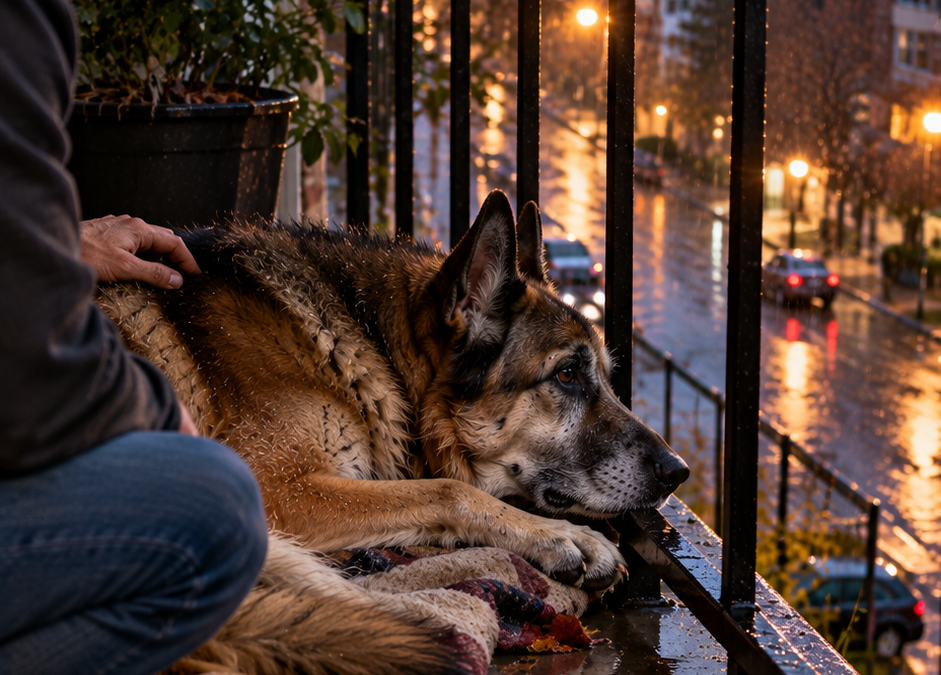
He spent hours staring down at the street.
Cars passed.
People walked beneath us.
Delivery drivers came and went.
Every time someone approached the building, he lifted his head.
Every time a car slowed near the curb, his ears rose.
Then the person passed.
The car continued.
And his head lowered again.
By the fourth day, I understood he was waiting.
For whom, I had no idea.
But he was waiting.
Now, on the sixth morning, he seemed too weak to continue.
I touched his shoulder.
At first, very lightly.
He opened his eyes.
Yellow-brown.
Clouded slightly with age.
But still bright somewhere deep inside.
That look affected me more than I wanted it to.
“Listen to me,” I whispered.
His eyes stayed on mine.
“I don’t know who you’re waiting for.”
I swallowed.
“But you can’t keep doing this.”
One ear moved.
“You barely ate yesterday.”
Nothing.
“You barely drank.”
His nose shifted toward my hand.
“And if you die on my balcony, I’m going to be extremely upset with you.”
That was when he tried to stand.
I hadn’t asked him to.
He simply decided.
His front legs pushed against the concrete.
His nails scraped.
His body rose halfway.
Then his back legs folded beneath him.
He fell.
A small sound escaped him.
Not a bark.
Barely even a whine.
But it went through me.
“Oh God.”
I reached for him, then stopped myself.
He tried again.
Front legs shaking.
Hindquarters struggling.
He fell a second time.
“Stop.”
He ignored me.
Of course he did.
The third attempt was worse.
He got upright.
Barely.
His whole body trembled.
His hips dropped low.
His back legs looked as though they might collapse at any second.
But he stayed standing.
Then he took one step.
Toward me.
Another.
On the third, he stumbled.
I caught his head between my hands.
His heavy muzzle dropped into my palms.
He exhaled.
Warm, weak breath across my fingers.
That was the moment my fear disappeared.
Not gradually.
It simply vanished.
For six days, I’d been thinking of him as a large dog.
Potentially dangerous.
Unfamiliar.
Powerful.
Suddenly, all I could see was old age.
Exhaustion.
A creature whose spirit was asking more from his body than that body could continue giving.
“Okay.”
My voice sounded strange.
Too soft.
“Okay, old man.”
He kept his head in my hands.
“We’re going to the vet.”
He blinked.
“Don’t argue.”
If someone had told me a week earlier that I would be talking to a strange German Shepherd as though he were an elderly relative, I would’ve laughed.
But there I was.
I had no leash.
So I took an old leather belt from the hook near my front door.
I hadn’t worn it in years.
It fit loosely enough around his collar to work as a temporary lead.
“Professional equipment,” I told him.
He looked unimpressed.
The stairs were difficult.
There were twelve steps to the first landing.
Fourteen more after that.
He took each one as though negotiating with his own joints.
Step.
Stop.
Breathe.
Step.
At every landing, he turned his head to check whether I was still there.
“I am.”
We moved another few feet.
“I’m still here.”
Halfway down, his hind legs started shaking badly.
I placed one hand under his belly as much as I could without frightening him.
He allowed it.
That felt important.
A stranger’s dog had decided I was safe enough to help hold him upright.
Trust is heavy when it comes from something vulnerable.
By the time we reached the street, I was sweating despite the cold.
A neighbor named Ellen saw us.
She was in her seventies and considered everyone’s business partly hers.
“Is that your dog?”
“No.”
“Looks like your dog.”
“He’s not.”
The German Shepherd leaned against my leg.
Ellen smiled.
“Right.”
“I found him.”
“On your balcony?”
“You’ve been watching?”
“I have windows.”
Of course.
“Where are you going?”
“Vet.”
She looked at the dog.
Her smile disappeared.
“You need a ride?”
I hesitated.
“Yes.”
Ten minutes later, we were in Ellen’s ancient Subaru.
The dog lay across the back seat.
I turned around every thirty seconds.
“He’s still there,” Ellen said.
“I know.”
“Then why do you keep checking?”
“I don’t know.”
At one point, he lifted his head.
I leaned between the seats.
His muzzle rested briefly against my shoulder.
His breath warmed my neck.
I didn’t flinch.
That surprised me.
Ellen glanced in the mirror.
“Thought you didn’t like big dogs.”
“I didn’t say that.”
“You’ve crossed the street to avoid mine.”
“Your dog weighs ninety pounds.”
“So does this one.”
“Not helping.”
She smiled.
The veterinary clinic was already busy.
We signed in as:
Unknown Male German Shepherd
Age:
Senior
Owner:
I hesitated.
Then wrote:
Unknown
He sat at my feet in the waiting room.
He had enough strength to remain upright, but only just.
What fascinated me was where he looked.
The entrance.
Always.
Every time the door opened, he lifted his head.
A man with a cat carrier.
Ears up.
Not them.
Head down.
A woman with a terrier.
Up.
Down.
An elderly couple with a dachshund.
Up.
Down.
A young man.
Up.
Down.
I counted.
Eleven people.
Eleven times he hoped.
Eleven small disappointments.
The twelfth person through the door was a veterinary assistant calling us back.
The dog looked anyway.
“Come on,” I whispered.
He followed.
Dr. Martinez was probably in her fifties.
Gray hair tied into a bun.
Calm hands.
Calm eyes.
The kind of person animals usually trust before humans decide whether they do.
She crouched instead of standing over him.
“Hello, handsome.”
His ears moved.
“You’ve had a long week, haven’t you?”
I looked at her.
“How can you tell?”
“His coat. His hydration. His paws.”
She gently touched his shoulder.
“And the face.”
“What about his face?”
“Older dogs tell you a lot if you look.”
She examined him slowly.
Heart.
Lungs.
Teeth.
Eyes.
Spine.
Joints.
He tolerated everything.
But even while she worked, he occasionally looked toward the examination-room door.
Dr. Martinez noticed.
“How long has he been doing that?”
“Six days.”
“Waiting?”
“I think so.”
“You don’t know who he belongs to?”
“No.”
“Microchip?”
The technician scanned him.
Nothing.
Dr. Martinez continued the examination.
Finally she sat back.
“He’s very old.”
“How old?”
“At least fourteen.”
I looked at him.
Fourteen.
For a German Shepherd, that was remarkable.
“His arthritis is advanced, especially in the hindquarters. He’s dehydrated. Underweight.”
“He won’t eat.”
“Nothing?”
“Only if I sit beside him. Even then, not much.”
Dr. Martinez’s expression became thoughtful.
“Any vomiting?”
“No.”
“Diarrhea?”
“No.”
“Trouble swallowing?”
“I don’t think so.”
She looked at him.
Then at me.
“Sometimes senior dogs stop eating because they’re physically ill.”
My stomach tightened.
“And?”
“Sometimes they stop because they’re distressed.”
“Distressed how?”
She took a moment before answering.
“Grief. Separation. Severe anxiety.”
I looked at the door.
So did the dog.
Dr. Martinez continued.
“Survival instinct is powerful. But animals can become profoundly affected when they’re separated from someone they’re strongly bonded to.”
“He’s waiting himself sick?”
“I’m saying it’s possible.”
My throat tightened unexpectedly.
I looked away.
There was something about the word waiting that hit a place inside me I hadn’t visited in years.
I knew waiting.
Not six days.
Two years.
When I was twenty-two, I loved a man named Daniel.
Not the mature kind of love people discuss once life has bruised them into realism.
The absolute kind.
The young kind.
The kind that believes promises have the same permanence as gravity.
Daniel had to leave Portland for work.
“A month,” he told me.
We stood outside my old apartment.
He held my face in both hands.
“I’ll be back in a month.”
“You promise?”
“I promise.”
One month passed.
Then he called.
Another month.
A complication.
Another assignment.
More money.
Better opportunity.
“Just a little longer.”
I waited.
One month became six.
Six became twelve.
People told me to move on.
I became angry with them.
They didn’t understand.
He loved me.
He was coming back.
He said so.
Year two was different.
Fewer phone calls.
More excuses.
Eventually, one final conversation.
“I don’t think I’m coming back.”
Just like that.
No betrayal dramatic enough to hate.
No explosion.
No other woman that I knew of.
Just an ending stretched so long that by the time it arrived, I had forgotten what my life looked like before waiting.
I never told people how much that changed me.
I became cautious.
Self-contained.
I stopped believing things simply because someone said them with conviction.
And now, sitting inside a veterinary clinic beside an old dog who stared at the door every time it opened, I felt the old ache rise again.
Different story.
Same posture.
Hope facing an entrance.
Dr. Martinez touched my arm.
“You okay?”
“Yeah.”
Lie.
I looked at the dog.
“I can’t keep him.”
The words sounded cruel.
I hated them immediately.
“My apartment doesn’t allow pets.”
She nodded.
“You’re renting?”
“Yes. Lease specifically says no dogs.”
“We can contact senior-dog rescues.”
“I already posted online.”
“We’ll try shelters too.”
The dog lifted his head when footsteps passed outside.
Nothing.
Head down.
I looked at him.
“One more day.”
Dr. Martinez raised an eyebrow.
“What?”
“I’ll keep trying today. If no one comes by tomorrow, I’ll bring him back and we’ll figure something out.”
“Are you sure?”
No.
“Yes.”
She smiled gently.
“You’re kind.”
I shook my head.
“I’m guilty.”
“About what?”
“I don’t know yet.”
She didn’t push.
We gave him fluids.
Something for pain.
Instructions to encourage food.
Then Ellen drove us home.
The dog climbed back onto my balcony.
Returned to his usual place.
And stared toward the street.
That evening, I cooked chicken and rice.
For myself originally.
Then mostly for him.
I cut the chicken into tiny pieces.
Cooked the rice too soft.
Mixed everything together.
Placed the bowl beside him.
“Five-star restaurant.”
He looked at it.
“Mange.”
Nothing.
“That was French. I don’t know why.”
He looked at me.
“Please eat.”
I sat on the floor.
He leaned forward.
One bite.
Then stopped.
I stayed.
Another.
He ate almost the entire bowl.
When he finished, he licked the edge.
Then my hand.
Slowly.
One long stroke of his tongue across my fingers.
“You’re welcome.”
I put both arms around his neck.
I didn’t plan it.
For years I’d been uncomfortable with large dogs.
Now my face was buried in the neck of one.
He smelled like rain, dust, veterinary antiseptic, and old fur.
He let me hold him.
I sat back against the balcony wall.
He stayed beside me.
The city quieted.
Lights came on in apartment windows.
Cars moved below.
Every few minutes he looked toward the street.
Eventually, I started talking.
“I waited once too.”
His head moved.
“Not for six days.”
I ran my fingers through the fur between his ears.
“Two years.”
He looked at me.
“I know. Terrible judgment.”
I told him everything.
Daniel.
The promises.
The calls.
The excuses.
The humiliation of defending someone who had already emotionally left.
How friends eventually stopped asking.
How I checked my phone before getting out of bed.
How every airport announcement made my chest tighten.
How I dreamt about the doorbell.
How much I hated myself afterward for waiting so long.
“I thought the waiting made me stupid.”
The dog’s head lowered onto my leg.
“But looking at you…”
I swallowed.
“I don’t know.”
His breathing remained slow.
“Maybe sometimes waiting just means you loved someone enough to believe what they told you.”
I looked down at him.
“Who told you they’d come back?”
He couldn’t answer.
Of course.
He simply rested his head more heavily against me.
“You really believe they’re coming, don’t you?”
His eyes closed halfway.
That night, I brought my pillow outside.
Then two blankets.
One for me.
One for him.
I lay down on the balcony floor.
It was uncomfortable.
Cold.
Completely irrational.
He watched me.
“Don’t judge.”
He sighed.
“You’re sleeping outside too.”
Another sigh.
He lowered himself beside me.
Then, after a long hesitation, rested his head against my stomach.
I felt his heartbeat.
Slow.
Steady.
For the first time in six days, he seemed to sleep deeply.
I didn’t.
I watched clouds move across the night sky.
Listened to his breathing.
Thought about strange intersections.
An old dog.
My balcony.
A woman ten years removed from a broken promise still believing she had completely moved on.
Maybe life doesn’t always send lessons.
Sometimes things simply happen.
But sometimes what happens changes the meaning of something you carried for years.
Near dawn, I finally slept.
A sound woke me.
A low, painful cry.
I opened my eyes.
For one panicked second, I thought it was the dog.
It wasn’t.
He was still beside me.
The sound came from the street.
Someone calling.
“Max!”
I sat up.
The old dog woke instantly.
His ears shot upright.
Every muscle in his body changed.
“Max!”
Again.
A woman’s voice.
Breaking around the name.
The German Shepherd scrambled upright.
No slow struggle.
No three attempts.
He stood.
His breathing became fast.
Excited.
He rushed toward the railing.
Then back to the balcony door.
Then forward again.
I got up and looked down.
An old blue car was parked beneath a tree.
A woman stood beside it.
Maybe fifty-five.
Hair tangled.
Face exhausted.
Eyes red.
She looked around desperately.
Then cupped both hands around her mouth.
“MAX!”
The dog barked.
For six days, I had barely heard his voice.
Now it exploded out of him.
A deep, joyful bark.
Again.
Again.
The woman froze.
She looked up.
Her face changed.
“Oh my God.”
“MAX!”
The dog spun in a circle.
His tail moved so fast it became a blur.
He looked at me.
And I swear that expression said:
I told you.
“You were right.”
I opened the balcony door.
“Go.”
He didn’t need permission.
He ran.
His arthritic legs somehow found speed.
I followed, terrified he’d fall down the stairs.
He nearly did.
But pain didn’t seem to matter anymore.
When we reached the building entrance, I opened the door.
Max shot toward the woman.
She dropped to her knees in the street.
He reached her.
And the sound she made when she wrapped her arms around him is something I still remember.
Not a word.
A sound from somewhere beneath language.
She buried her face in his neck.
Max licked her cheeks.
Her hands.
Her ears.
Anything he could reach.
She cried openly.
“You idiot.”
He wagged.
“You old, stupid, wonderful idiot.”
He pushed against her so hard she nearly sat down.
“I looked everywhere.”
Max licked her face.
“I came back.”
That sentence hit me.
I came back.
The woman held him.
“I told them I was coming back.”
Max pressed his head into her.
I stood several feet away.
Something inside my chest gave way.
Not painfully.
The opposite.
A weight I’d been carrying for a decade seemed to dissolve.
Not because Daniel had come back.
He hadn’t.
Not because every person who promises to return eventually does.
They don’t.
But Max had waited.
And Susan had returned.
His story wasn’t mine.
It didn’t need to be.
For some reason, that distinction set me free.
The woman finally noticed me.
“Is he yours?”
I laughed softly.
“No.”
Max looked at me.
“Apparently he’s yours.”
She wiped her face.
“I’m Susan.”
I told her my name.
Then we sat on the curb.
Max wedged himself between us.
Susan kept one hand on him constantly.
“He disappeared two weeks ago.”
“Two weeks?”
“We were driving east to visit our grandson.”
She stroked Max’s face.
“We stopped for gas. I went inside to pay. Dave—my husband—was checking something near the car.”
Her voice shook.
“When we looked up, Max was gone.”
“Did he run?”
“We don’t know.”
She shook her head.
“He never wandered.”
They searched.
Gas station.
Nearby streets.
Fields.
Shelters.
Three days.
No sign.
Then Susan’s husband insisted they continue.
Their family was waiting.
They had commitments.
Susan refused to stop searching emotionally, even when they physically left.
“I posted everywhere.”
“I didn’t see your listing.”
“We were farther west.”
That explained it.
“He must’ve traveled.”
Susan looked at him.
“God knows how far.”
She had returned four days earlier.
Driven road after road.
Checked shelters.
Talked to gas stations.
Asked strangers.
“I barely slept.”
Her hand tightened in Max’s fur.
“Dave told me maybe…”
She stopped.
“Maybe what?”
Susan looked ashamed.
“He’s fourteen. Dave said maybe Max wandered off because he knew he was dying.”
I looked at the dog.
He rested against her leg, eyes closed.
“I don’t think so.”
“No.”
She started crying again.
“I don’t either.”
I told her about the balcony.
Six days.
Barely eating.
Watching the street.
Sleeping only in short stretches.
Looking at the door every time someone entered the veterinary clinic.
“He was waiting for you.”
Susan covered her mouth.
Max placed his head on her knee.
For the first time since I’d met him, his whole body looked loose.
Relaxed.
Finished.
The waiting had ended.
I invited them upstairs.
Susan drank tea at my little kitchen table while Max slept on the floor with his body touching both her feet.
He didn’t watch the balcony anymore.
Didn’t lift his head at passing footsteps.
Didn’t stare at the front door.
He slept.
Deeply.
Susan told me she’d adopted him twelve years earlier.
Her first dog.
She had been living alone then, in an apartment not much different from mine.
“He was impossible.”
She smiled.
“Chewed a couch cushion the first week.”
“I would’ve returned him.”
“I considered it.”
Max slept through the insult.
“But every morning he’d sit beside the bed and look at me like he’d made a decision.”
“What decision?”
“Me.”
She looked down at him.
“He chose me.”
Susan’s voice softened.
“Every day for twelve years.”
I thought about that.
Love as repeated choice.
Not promise.
Not prediction.
Choice.
When it was time for them to leave, I followed Susan downstairs.
Max moved slowly again.
The adrenaline had disappeared.
His body had remembered it was fourteen.
But his tail remained high.
At the car, I crouched.
He stopped in front of me.
“All right, old man.”
He looked at me.
“You won.”
One ear moved.
“She came back.”
I scratched his head.
He stared at me for several seconds.
Then licked my hand.
Once.
No more.
It felt like goodbye.
“Go home.”
Max turned toward Susan.
Climbed into the car.
He didn’t look back.
I thought that might hurt.
It didn’t.
He knew exactly where he belonged.
I stood beside the curb until the old blue car disappeared.
Then I returned upstairs.
The balcony was empty.
That hit me harder than expected.
His blanket remained folded near the railing.
His water bowl still had a little water in it.
There were scratches on the concrete where his nails had slipped that morning.
I sat where he’d been lying.
For six days, the balcony had belonged to his waiting.
Now it was mine again.
I looked at the street.
Nobody was coming.
And for the first time, that thought didn’t feel like abandonment.
That night I sat outside for hours.
I thought about Daniel.
For years, I had judged my younger self harshly.
How could I have waited two years?
How could I have believed him so long?
How could I have built my life around a promise somebody else stopped honoring?
Watching Max had changed that question.
Maybe waiting hadn’t been my failure.
Maybe refusing to live after the waiting ended would’ve been.
There is a difference between loyalty and disappearing inside someone else’s absence.
Max waited because he knew Susan.
Because twelve years had taught him who she was.
I waited because I wanted a promise to become true even after the person behind it had changed.
Different things.
That realization was uncomfortable.
Also freeing.
Three weeks later, an envelope arrived.
Handwritten address.
No return name I recognized.
Inside was a letter from Susan.
She wrote that Max was eating again.
All his meals.
Sleeping at the foot of her bed.
Taking slow walks.
Following her from room to room.
She wrote:
Sometimes he wakes in the middle of the night and goes to the front door. He sits there for five minutes, then comes back.
I think maybe he dreams about your balcony.
I smiled.
Then continued.
Or maybe he just checks that nobody is missing.
That sounded like him.
She said Max had played with one of his old toys for the first time in months.
Not for long.
But enough.
Then:
You gave him somewhere safe to keep believing until I reached him.
I had to put the letter down.
The next paragraph was harder.
You didn’t force him to stop waiting.
You didn’t decide for him that I wasn’t coming.
You simply stayed with him while he waited.
I don’t think I can ever explain what that means to me.
I wrote back.
I told Susan she didn’t owe me anything.
I told her Max had helped me too.
I almost explained Daniel.
Then didn’t.
Some stories don’t have to be exchanged for gratitude to be real.
At the end of the letter, I wrote:
Please tell Max I still have his blanket.
Then, for reasons I still can’t explain, I wrote:
I have a cat now.
That was a lie.
I didn’t own a cat.
I stared at the sentence.
Almost crossed it out.
Didn’t.
Maybe I wanted Susan to believe my balcony wasn’t empty.
Or maybe I wanted to imagine a version of myself capable of letting another living thing into my life.
A month later, I bought a plant.
Not a cat.
A ficus.
The nursery employee warned me they could be temperamental.
“How temperamental?”
“Don’t move it too much.”
“That’s it?”
“Watch the watering.”
“Anything else?”
“It’ll tell you when it’s unhappy.”
“How?”
“The leaves fall off.”
“Very emotionally mature.”
She laughed.
I brought it home.
Placed it exactly where Max had slept.
At first, the balcony looked wrong.
Then gradually, green leaves filled some of the empty space.
Every morning I took my coffee outside.
“Morning.”
I watered the ficus when it needed it.
Not every day.
I learned restraint.
Sometimes I talked to it.
That concerned Ellen.
One morning she leaned over from the neighboring balcony.
“You’re talking to a plant.”
“You talk to your television.”
“The television talks back.”
“Not intelligently.”
She laughed.
“What are you waiting for out there every morning?”
I looked at the street.
That question would’ve hurt months earlier.
Now I considered it.
“Nothing.”
Ellen nodded.
Then I corrected myself.
“Actually, everything.”
She frowned.
“That makes no sense.”
“I know.”
She went back inside.
I stayed.
What I meant was this:
For years, I had treated waiting as a room.
A place you entered.
A place where life stopped until someone else opened the door.
Max taught me something different.
Waiting can also be movement.
Not always.
Not automatically.
But sometimes.
Those six days, he was waiting for Susan.
But he was also trusting me.
Eating when I sat beside him.
Allowing me to help him down the stairs.
Sleeping with his head against my body.
He wasn’t only suspended between loss and reunion.
He was still forming connections.
Still choosing.
Still living.
I had spent ten years telling myself the opposite about my own past.
That those two years with Daniel were wasted.
Gone.
Proof that I had been foolish.
Maybe they weren’t.
Maybe they were simply part of how I became someone who recognized an old dog’s waiting when everyone else might have called it stubbornness.
I don’t romanticize it.
Waiting can destroy people.
Promises can be broken.
People leave.
Sometimes they don’t come back.
I know that better than most.
But Max taught me that the courage isn’t in assuming every absence will end the way you hope.
The courage is staying open to what happens next.
Susan came back for Max.
Daniel didn’t come back for me.
Both truths can exist.
Neither defines my worth.
That was the lesson I hadn’t understood when I was twenty-two.
Love returned for Max because Susan chose to return.
My life returned to me when I finally realized I didn’t need Daniel to do the same.
Months later, Susan sent a photograph.
Max asleep beside a fireplace.
Muzzle completely white.
One paw stretched toward Susan’s shoe.
On the back she wrote:
He still checks the door sometimes. But now he always comes back to bed.
I framed it.
Placed it near the balcony.
The ficus grew.
Against expectations, I didn’t kill it.
New leaves appeared.
Then more.
It became inconveniently large.
Ellen noticed.
“That thing’s taking over.”
“It has ambition.”
“You’re going to need a bigger pot.”
“I know.”
“You going to get one?”
“Yes.”
“You never used to keep plants alive.”
I looked at the ficus.
“No.”
“What changed?”
I thought of an old German Shepherd lying beside a railing in the rain.
“Something stayed long enough to teach me.”
Ellen stared.
“Still weird.”
“Fair.”
Sometimes, before sunrise, I still step outside and remember the sixth morning.
Max struggling to stand.
His claws scraping against the concrete.
The way he placed his enormous head into my hands.
The trust.
I remember the veterinary waiting room.
Eleven doors opening.
Eleven disappointments.
Then the twelfth morning.
Susan standing beneath the balcony.
His name leaving her mouth.
The impossible transformation in him.
A fourteen-year-old dog suddenly moving like a puppy because the voice he’d been waiting for had finally returned.
Mostly, I remember the moment before I opened the balcony door.
Max looked at me.
He knew.
I knew.
The waiting was over.
There was no bitterness in his leaving.
No hesitation.
He didn’t look back.
That used to bother me when I first thought about it.
Now I understand.
He didn’t owe the balcony loyalty.
The balcony was shelter.
A pause.
A safe place between being lost and going home.
Maybe some people are that for us too.
Maybe some seasons of life are.
Not destinations.
Bridges.
I don’t know what will come next for me.
Maybe someday there will be another dog.
Maybe the cat I lied about will become real.
Maybe there will be another person.
Maybe not.
I no longer need to decide all of that before breakfast.
Every morning, I step onto the balcony.
The ficus catches the first weak Portland light.
I drink my coffee.
I water it when the soil is dry.
Sometimes I say,
“Morning, Max.”
Ridiculous.
I know.
But it makes me smile.
Then I watch the street wake up.
Cars.
People.
Dogs.
Bicycles.
The ordinary movement of lives continuing.
I am not waiting for Daniel.
I am not waiting for Susan.
I am not even waiting for Max.
I’m simply here.
Present enough to recognize whatever comes next.
And perhaps that is what the old dog left me.
Not a lesson about waiting forever.
Something better.
The understanding that love can ask you to stay for a while without asking you to stop living.
That loyalty does not require you to disappear.
That sometimes someone comes back.
Sometimes they don’t.
Either way, morning still arrives.
The door still opens.
The world still moves.
And you are allowed to move with it.
I used to think waiting meant putting your life on hold until someone returned.
Now I think it can mean something else.
Keeping a small place inside yourself open.
Not for one specific person.
Not for one promised ending.
For possibility.
For connection.
For whatever life decides to place unexpectedly on your balcony.
Sometimes, apparently, that possibility arrives old, exhausted, and covered in rain.
Sometimes it stares at the street for six days.
And sometimes, without saying a single word, it teaches you how to stop waiting for the past and become ready for whatever comes next.
𝗧𝗛𝗘 𝗘𝗡𝗗
For Six Days, an Old German Shepherd Refused to Leave My Balcony, Staring at the Street as Though Someone Had Promised to Return
For six days, an old German Shepherd lay on my balcony and refused to leave, no matter how cold the Portland nights became.
He barely ate, hardly slept, and lifted his head every single time footsteps sounded below, staring toward the street with the same stubborn certainty.
By the sixth morning, when his legs finally gave out beneath him, I realized he wasn’t lost in the way I had assumed—he was waiting for someone.
The sixth morning was the one that frightened me.
I stepped onto my balcony before sunrise with a cup of coffee in both hands and, for one terrible second, thought the old dog was dead.
He was lying on his side near the railing.
The blanket I’d placed over him sometime during the night had slipped away, exposing the sharp outline of his ribs beneath his faded coat.
He looked thinner than he had the day before.
Older too.
As if each night spent waiting had added another year to his body.
Portland was still dark.
Rain had fallen sometime before dawn, and the concrete beneath my bare feet held that cold, damp chill our city seems capable of producing even when the calendar insists winter is over.
I set my coffee down.
“Hey.”
No movement.
My stomach tightened.
I crouched beside him.
“Hey, old man.”
His chest moved.
Barely.
But it moved.
I let out a breath I hadn’t realized I was holding.
“Don’t do that to me.”
One ear twitched.
For almost a week, I’d been pretending this animal wasn’t becoming my responsibility.
He had appeared on my balcony six days earlier as though he had always belonged there.
That was the strangest part.
I lived on the second floor of an old apartment building, which meant I still didn’t fully understand how he’d gotten up there.
The staircase from the courtyard was accessible, yes, but dogs didn’t usually climb two flights of unfamiliar stairs, cross a narrow exterior walkway, choose one particular balcony, and decide to stay.
Especially fourteen-year-old German Shepherds with arthritic hips.
But Max—although I didn’t know his name yet—had.
On the first morning, I’d opened the sliding door and nearly screamed.
He was sitting beside my small metal patio chair, staring through the railing toward the street.
Huge.
Gray around the muzzle.
One ear standing higher than the other.
I had always been nervous around large dogs.
Not terrified.
Just cautious.
I grew up hearing the usual warnings.
Never approach a strange dog.
Don’t assume a wagging tail means friendly.
Large dogs can hurt you before you have time to react.
So when I saw him, I froze.
The dog looked at me.
I looked at the dog.
Neither of us moved.
Finally I whispered,
“Okay.”
He blinked.
“You’re on my balcony.”
Nothing.
“Just making sure we’re both aware of that.”
He turned his head toward the street.
Apparently the conversation was over.
I put out water.
He drank.
I put out some leftover chicken.
He sniffed it, took two small bites, then returned to his place near the railing.
I expected him to be gone by afternoon.
He wasn’t.
By evening, I called animal control.
They asked whether he was aggressive.
“No.”
Injured?
“I don’t know.”
Collar?
“Yes, but there’s no tag.”
Could I bring him to a shelter?
“I don’t have a car.”
That wasn’t entirely true.
I had access to one occasionally, but I didn’t feel comfortable trying to get a strange German Shepherd into it.
They told me someone might be able to come by.
Nobody did that day.
By the second morning, the dog was still there.
I posted his photograph online.
FOUND SENIOR GERMAN SHEPHERD—PORTLAND
No response.
I called nearby shelters.
Nothing.
Checked local missing-pet pages.
Nothing that matched him.
By the third day, I began leaving the balcony door cracked while I was home.
He never tried to come inside.
That interested me.
He wasn’t looking for shelter.
He wasn’t choosing me.
Not exactly.
He had chosen the balcony.
And the view.
He spent hours staring down at the street.
Cars passed.
People walked beneath us.
Delivery drivers came and went.
Every time someone approached the building, he lifted his head.
Every time a car slowed near the curb, his ears rose.
Then the person passed.
The car continued.
And his head lowered again.
By the fourth day, I understood he was waiting.
For whom, I had no idea.
But he was waiting.
Now, on the sixth morning, he seemed too weak to continue.
I touched his shoulder.
At first, very lightly.
He opened his eyes.
Yellow-brown.
Clouded slightly with age.
But still bright somewhere deep inside.
That look affected me more than I wanted it to.
“Listen to me,” I whispered.
His eyes stayed on mine.
“I don’t know who you’re waiting for.”
I swallowed.
“But you can’t keep doing this.”
One ear moved.
“You barely ate yesterday.”
Nothing.
“You barely drank.”
His nose shifted toward my hand.
“And if you die on my balcony, I’m going to be extremely upset with you.”
That was when he tried to stand.
I hadn’t asked him to.
He simply decided.
His front legs pushed against the concrete.
His nails scraped.
His body rose halfway.
Then his back legs folded beneath him.
He fell.
A small sound escaped him.
Not a bark.
Barely even a whine.
But it went through me.
“Oh God.”
I reached for him, then stopped myself.
He tried again.
Front legs shaking.
Hindquarters struggling.
He fell a second time.
“Stop.”
He ignored me.
Of course he did.
The third attempt was worse.
He got upright.
Barely.
His whole body trembled.
His hips dropped low.
His back legs looked as though they might collapse at any second.
But he stayed standing.
Then he took one step.
Toward me.
Another.
On the third, he stumbled.
I caught his head between my hands.
His heavy muzzle dropped into my palms.
He exhaled.
Warm, weak breath across my fingers.
That was the moment my fear disappeared.
Not gradually.
It simply vanished.
For six days, I’d been thinking of him as a large dog.
Potentially dangerous.
Unfamiliar.
Powerful.
Suddenly, all I could see was old age.
Exhaustion.
A creature whose spirit was asking more from his body than that body could continue giving.
“Okay.”
My voice sounded strange.
Too soft.
“Okay, old man.”
He kept his head in my hands.
“We’re going to the vet.”
He blinked.
“Don’t argue.”
If someone had told me a week earlier that I would be talking to a strange German Shepherd as though he were an elderly relative, I would’ve laughed.
But there I was.
I had no leash.
So I took an old leather belt from the hook near my front door.
I hadn’t worn it in years.
It fit loosely enough around his collar to work as a temporary lead.
“Professional equipment,” I told him.
He looked unimpressed.
The stairs were difficult.
There were twelve steps to the first landing.
Fourteen more after that.
He took each one as though negotiating with his own joints.
Step.
Stop.
Breathe.
Step.
At every landing, he turned his head to check whether I was still there.
“I am.”
We moved another few feet.
“I’m still here.”
Halfway down, his hind legs started shaking badly.
I placed one hand under his belly as much as I could without frightening him.
He allowed it.
That felt important.
A stranger’s dog had decided I was safe enough to help hold him upright.
Trust is heavy when it comes from something vulnerable.
By the time we reached the street, I was sweating despite the cold.
A neighbor named Ellen saw us.
She was in her seventies and considered everyone’s business partly hers.
“Is that your dog?”
“No.”
“Looks like your dog.”
“He’s not.”
The German Shepherd leaned against my leg.
Ellen smiled.
“Right.”
“I found him.”
“On your balcony?”
“You’ve been watching?”
“I have windows.”
Of course.
“Where are you going?”
“Vet.”
She looked at the dog.
Her smile disappeared.
“You need a ride?”
I hesitated.
“Yes.”
Ten minutes later, we were in Ellen’s ancient Subaru.
The dog lay across the back seat.
I turned around every thirty seconds.
“He’s still there,” Ellen said.
“I know.”
“Then why do you keep checking?”
“I don’t know.”
At one point, he lifted his head.
I leaned between the seats.
His muzzle rested briefly against my shoulder.
His breath warmed my neck.
I didn’t flinch.
That surprised me.
Ellen glanced in the mirror.
“Thought you didn’t like big dogs.”
“I didn’t say that.”
“You’ve crossed the street to avoid mine.”
“Your dog weighs ninety pounds.”
“So does this one.”
“Not helping.”
She smiled.
The veterinary clinic was already busy.
We signed in as:
Unknown Male German Shepherd
Age:
Senior
Owner:
I hesitated.
Then wrote:
Unknown
He sat at my feet in the waiting room.
He had enough strength to remain upright, but only just.
What fascinated me was where he looked.
The entrance.
Always.
Every time the door opened, he lifted his head.
A man with a cat carrier.
Ears up.
Not them.
Head down.
A woman with a terrier.
Up.
Down.
An elderly couple with a dachshund.
Up.
Down.
A young man.
Up.
Down.
I counted.
Eleven people.
Eleven times he hoped.
Eleven small disappointments.
The twelfth person through the door was a veterinary assistant calling us back.
The dog looked anyway.
“Come on,” I whispered.
He followed.
Dr. Martinez was probably in her fifties.
Gray hair tied into a bun.
Calm hands.
Calm eyes.
The kind of person animals usually trust before humans decide whether they do.
She crouched instead of standing over him.
“Hello, handsome.”
His ears moved.
“You’ve had a long week, haven’t you?”
I looked at her.
“How can you tell?”
“His coat. His hydration. His paws.”
She gently touched his shoulder.
“And the face.”
“What about his face?”
“Older dogs tell you a lot if you look.”
She examined him slowly.
Heart.
Lungs.
Teeth.
Eyes.
Spine.
Joints.
He tolerated everything.
But even while she worked, he occasionally looked toward the examination-room door.
Dr. Martinez noticed.
“How long has he been doing that?”
“Six days.”
“Waiting?”
“I think so.”
“You don’t know who he belongs to?”
“No.”
“Microchip?”
The technician scanned him.
Nothing.
Dr. Martinez continued the examination.
Finally she sat back.
“He’s very old.”
“How old?”
“At least fourteen.”
I looked at him.
Fourteen.
For a German Shepherd, that was remarkable.
“His arthritis is advanced, especially in the hindquarters. He’s dehydrated. Underweight.”
“He won’t eat.”
“Nothing?”
“Only if I sit beside him. Even then, not much.”
Dr. Martinez’s expression became thoughtful.
“Any vomiting?”
“No.”
“Diarrhea?”
“No.”
“Trouble swallowing?”
“I don’t think so.”
She looked at him.
Then at me.
“Sometimes senior dogs stop eating because they’re physically ill.”
My stomach tightened.
“And?”
“Sometimes they stop because they’re distressed.”
“Distressed how?”
She took a moment before answering.
“Grief. Separation. Severe anxiety.”
I looked at the door.
So did the dog.
Dr. Martinez continued.
“Survival instinct is powerful. But animals can become profoundly affected when they’re separated from someone they’re strongly bonded to.”
“He’s waiting himself sick?”
“I’m saying it’s possible.”
My throat tightened unexpectedly.
I looked away.
There was something about the word waiting that hit a place inside me I hadn’t visited in years.
I knew waiting.
Not six days.
Two years.
When I was twenty-two, I loved a man named Daniel.
Not the mature kind of love people discuss once life has bruised them into realism.
The absolute kind.
The young kind.
The kind that believes promises have the same permanence as gravity.
Daniel had to leave Portland for work.
“A month,” he told me.
We stood outside my old apartment.
He held my face in both hands.
“I’ll be back in a month.”
“You promise?”
“I promise.”
One month passed.
Then he called.
Another month.
A complication.
Another assignment.
More money.
Better opportunity.
“Just a little longer.”
I waited.
One month became six.
Six became twelve.
People told me to move on.
I became angry with them.
They didn’t understand.
He loved me.
He was coming back.
He said so.
Year two was different.
Fewer phone calls.
More excuses.
Eventually, one final conversation.
“I don’t think I’m coming back.”
Just like that.
No betrayal dramatic enough to hate.
No explosion.
No other woman that I knew of.
Just an ending stretched so long that by the time it arrived, I had forgotten what my life looked like before waiting.
I never told people how much that changed me.
I became cautious.
Self-contained.
I stopped believing things simply because someone said them with conviction.
And now, sitting inside a veterinary clinic beside an old dog who stared at the door every time it opened, I felt the old ache rise again.
Different story.
Same posture.
Hope facing an entrance.
Dr. Martinez touched my arm.
“You okay?”
“Yeah.”
Lie.
I looked at the dog.
“I can’t keep him.”
The words sounded cruel.
I hated them immediately.
“My apartment doesn’t allow pets.”
She nodded.
“You’re renting?”
“Yes. Lease specifically says no dogs.”
“We can contact senior-dog rescues.”
“I already posted online.”
“We’ll try shelters too.”
The dog lifted his head when footsteps passed outside.
Nothing.
Head down.
I looked at him.
“One more day.”
Dr. Martinez raised an eyebrow.
“What?”
“I’ll keep trying today. If no one comes by tomorrow, I’ll bring him back and we’ll figure something out.”
“Are you sure?”
No.
“Yes.”
She smiled gently.
“You’re kind.”
I shook my head.
“I’m guilty.”
“About what?”
“I don’t know yet.”
She didn’t push.
We gave him fluids.
Something for pain.
Instructions to encourage food.
Then Ellen drove us home.
The dog climbed back onto my balcony.
Returned to his usual place.
And stared toward the street.
That evening, I cooked chicken and rice.
For myself originally.
Then mostly for him.
I cut the chicken into tiny pieces.
Cooked the rice too soft.
Mixed everything together.
Placed the bowl beside him.
“Five-star restaurant.”
He looked at it.
“Mange.”
Nothing.
“That was French. I don’t know why.”
He looked at me.
“Please eat.”
I sat on the floor.
He leaned forward.
One bite.
Then stopped.
I stayed.
Another.
He ate almost the entire bowl.
When he finished, he licked the edge.
Then my hand.
Slowly.
One long stroke of his tongue across my fingers.
“You’re welcome.”
I put both arms around his neck.
I didn’t plan it.
For years I’d been uncomfortable with large dogs.
Now my face was buried in the neck of one.
He smelled like rain, dust, veterinary antiseptic, and old fur.
He let me hold him.
I sat back against the balcony wall.
He stayed beside me.
The city quieted.
Lights came on in apartment windows.
Cars moved below.
Every few minutes he looked toward the street.
Eventually, I started talking.
“I waited once too.”
His head moved.
“Not for six days.”
I ran my fingers through the fur between his ears.
“Two years.”
He looked at me.
“I know. Terrible judgment.”
I told him everything.
Daniel.
The promises.
The calls.
The excuses.
The humiliation of defending someone who had already emotionally left.
How friends eventually stopped asking.
How I checked my phone before getting out of bed.
How every airport announcement made my chest tighten.
How I dreamt about the doorbell.
How much I hated myself afterward for waiting so long.
“I thought the waiting made me stupid.”
The dog’s head lowered onto my leg.
“But looking at you…”
I swallowed.
“I don’t know.”
His breathing remained slow.
“Maybe sometimes waiting just means you loved someone enough to believe what they told you.”
I looked down at him.
“Who told you they’d come back?”
He couldn’t answer.
Of course.
He simply rested his head more heavily against me.
“You really believe they’re coming, don’t you?”
His eyes closed halfway.
That night, I brought my pillow outside.
Then two blankets.
One for me.
One for him.
I lay down on the balcony floor.
It was uncomfortable.
Cold.
Completely irrational.
He watched me.
“Don’t judge.”
He sighed.
“You’re sleeping outside too.”
Another sigh.
He lowered himself beside me.
Then, after a long hesitation, rested his head against my stomach.
I felt his heartbeat.
Slow.
Steady.
For the first time in six days, he seemed to sleep deeply.
I didn’t.
I watched clouds move across the night sky.
Listened to his breathing.
Thought about strange intersections.
An old dog.
My balcony.
A woman ten years removed from a broken promise still believing she had completely moved on.
Maybe life doesn’t always send lessons.
Sometimes things simply happen.
But sometimes what happens changes the meaning of something you carried for years.
Near dawn, I finally slept.
A sound woke me.
A low, painful cry.
I opened my eyes.
For one panicked second, I thought it was the dog.
It wasn’t.
He was still beside me.
The sound came from the street.
Someone calling.
“Max!”
I sat up.
The old dog woke instantly.
His ears shot upright.
Every muscle in his body changed.
“Max!”
Again.
A woman’s voice.
Breaking around the name.
The German Shepherd scrambled upright.
No slow struggle.
No three attempts.
He stood.
His breathing became fast.
Excited.
He rushed toward the railing.
Then back to the balcony door.
Then forward again.
I got up and looked down.
An old blue car was parked beneath a tree.
A woman stood beside it.
Maybe fifty-five.
Hair tangled.
Face exhausted.
Eyes red.
She looked around desperately.
Then cupped both hands around her mouth.
“MAX!”
The dog barked.
For six days, I had barely heard his voice.
Now it exploded out of him.
A deep, joyful bark.
Again.
Again.
The woman froze.
She looked up.
Her face changed.
“Oh my God.”
“MAX!”
The dog spun in a circle.
His tail moved so fast it became a blur.
He looked at me.
And I swear that expression said:
I told you.
“You were right.”
I opened the balcony door.
“Go.”
He didn’t need permission.
He ran.
His arthritic legs somehow found speed.
I followed, terrified he’d fall down the stairs.
He nearly did.
But pain didn’t seem to matter anymore.
When we reached the building entrance, I opened the door.
Max shot toward the woman.
She dropped to her knees in the street.
He reached her.
And the sound she made when she wrapped her arms around him is something I still remember.
Not a word.
A sound from somewhere beneath language.
She buried her face in his neck.
Max licked her cheeks.
Her hands.
Her ears.
Anything he could reach.
She cried openly.
“You idiot.”
He wagged.
“You old, stupid, wonderful idiot.”
He pushed against her so hard she nearly sat down.
“I looked everywhere.”
Max licked her face.
“I came back.”
That sentence hit me.
I came back.
The woman held him.
“I told them I was coming back.”
Max pressed his head into her.
I stood several feet away.
Something inside my chest gave way.
Not painfully.
The opposite.
A weight I’d been carrying for a decade seemed to dissolve.
Not because Daniel had come back.
He hadn’t.
Not because every person who promises to return eventually does.
They don’t.
But Max had waited.
And Susan had returned.
His story wasn’t mine.
It didn’t need to be.
For some reason, that distinction set me free.
The woman finally noticed me.
“Is he yours?”
I laughed softly.
“No.”
Max looked at me.
“Apparently he’s yours.”
She wiped her face.
“I’m Susan.”
I told her my name.
Then we sat on the curb.
Max wedged himself between us.
Susan kept one hand on him constantly.
“He disappeared two weeks ago.”
“Two weeks?”
“We were driving east to visit our grandson.”
She stroked Max’s face.
“We stopped for gas. I went inside to pay. Dave—my husband—was checking something near the car.”
Her voice shook.
“When we looked up, Max was gone.”
“Did he run?”
“We don’t know.”
She shook her head.
“He never wandered.”
They searched.
Gas station.
Nearby streets.
Fields.
Shelters.
Three days.
No sign.
Then Susan’s husband insisted they continue.
Their family was waiting.
They had commitments.
Susan refused to stop searching emotionally, even when they physically left.
“I posted everywhere.”
“I didn’t see your listing.”
“We were farther west.”
That explained it.
“He must’ve traveled.”
Susan looked at him.
“God knows how far.”
She had returned four days earlier.
Driven road after road.
Checked shelters.
Talked to gas stations.
Asked strangers.
“I barely slept.”
Her hand tightened in Max’s fur.
“Dave told me maybe…”
She stopped.
“Maybe what?”
Susan looked ashamed.
“He’s fourteen. Dave said maybe Max wandered off because he knew he was dying.”
I looked at the dog.
He rested against her leg, eyes closed.
“I don’t think so.”
“No.”
She started crying again.
“I don’t either.”
I told her about the balcony.
Six days.
Barely eating.
Watching the street.
Sleeping only in short stretches.
Looking at the door every time someone entered the veterinary clinic.
“He was waiting for you.”
Susan covered her mouth.
Max placed his head on her knee.
For the first time since I’d met him, his whole body looked loose.
Relaxed.
Finished.
The waiting had ended.
I invited them upstairs.
Susan drank tea at my little kitchen table while Max slept on the floor with his body touching both her feet.
He didn’t watch the balcony anymore.
Didn’t lift his head at passing footsteps.
Didn’t stare at the front door.
He slept.
Deeply.
Susan told me she’d adopted him twelve years earlier.
Her first dog.
She had been living alone then, in an apartment not much different from mine.
“He was impossible.”
She smiled.
“Chewed a couch cushion the first week.”
“I would’ve returned him.”
“I considered it.”
Max slept through the insult.
“But every morning he’d sit beside the bed and look at me like he’d made a decision.”
“What decision?”
“Me.”
She looked down at him.
“He chose me.”
Susan’s voice softened.
“Every day for twelve years.”
I thought about that.
Love as repeated choice.
Not promise.
Not prediction.
Choice.
When it was time for them to leave, I followed Susan downstairs.
Max moved slowly again.
The adrenaline had disappeared.
His body had remembered it was fourteen.
But his tail remained high.
At the car, I crouched.
He stopped in front of me.
“All right, old man.”
He looked at me.
“You won.”
One ear moved.
“She came back.”
I scratched his head.
He stared at me for several seconds.
Then licked my hand.
Once.
No more.
It felt like goodbye.
“Go home.”
Max turned toward Susan.
Climbed into the car.
He didn’t look back.
I thought that might hurt.
It didn’t.
He knew exactly where he belonged.
I stood beside the curb until the old blue car disappeared.
Then I returned upstairs.
The balcony was empty.
That hit me harder than expected.
His blanket remained folded near the railing.
His water bowl still had a little water in it.
There were scratches on the concrete where his nails had slipped that morning.
I sat where he’d been lying.
For six days, the balcony had belonged to his waiting.
Now it was mine again.
I looked at the street.
Nobody was coming.
And for the first time, that thought didn’t feel like abandonment.
That night I sat outside for hours.
I thought about Daniel.
For years, I had judged my younger self harshly.
How could I have waited two years?
How could I have believed him so long?
How could I have built my life around a promise somebody else stopped honoring?
Watching Max had changed that question.
Maybe waiting hadn’t been my failure.
Maybe refusing to live after the waiting ended would’ve been.
There is a difference between loyalty and disappearing inside someone else’s absence.
Max waited because he knew Susan.
Because twelve years had taught him who she was.
I waited because I wanted a promise to become true even after the person behind it had changed.
Different things.
That realization was uncomfortable.
Also freeing.
Three weeks later, an envelope arrived.
Handwritten address.
No return name I recognized.
Inside was a letter from Susan.
She wrote that Max was eating again.
All his meals.
Sleeping at the foot of her bed.
Taking slow walks.
Following her from room to room.
She wrote:
Sometimes he wakes in the middle of the night and goes to the front door. He sits there for five minutes, then comes back.
I think maybe he dreams about your balcony.
I smiled.
Then continued.
Or maybe he just checks that nobody is missing.
That sounded like him.
She said Max had played with one of his old toys for the first time in months.
Not for long.
But enough.
Then:
You gave him somewhere safe to keep believing until I reached him.
I had to put the letter down.
The next paragraph was harder.
You didn’t force him to stop waiting.
You didn’t decide for him that I wasn’t coming.
You simply stayed with him while he waited.
I don’t think I can ever explain what that means to me.
I wrote back.
I told Susan she didn’t owe me anything.
I told her Max had helped me too.
I almost explained Daniel.
Then didn’t.
Some stories don’t have to be exchanged for gratitude to be real.
At the end of the letter, I wrote:
Please tell Max I still have his blanket.
Then, for reasons I still can’t explain, I wrote:
I have a cat now.
That was a lie.
I didn’t own a cat.
I stared at the sentence.
Almost crossed it out.
Didn’t.
Maybe I wanted Susan to believe my balcony wasn’t empty.
Or maybe I wanted to imagine a version of myself capable of letting another living thing into my life.
A month later, I bought a plant.
Not a cat.
A ficus.
The nursery employee warned me they could be temperamental.
“How temperamental?”
“Don’t move it too much.”
“That’s it?”
“Watch the watering.”
“Anything else?”
“It’ll tell you when it’s unhappy.”
“How?”
“The leaves fall off.”
“Very emotionally mature.”
She laughed.
I brought it home.
Placed it exactly where Max had slept.
At first, the balcony looked wrong.
Then gradually, green leaves filled some of the empty space.
Every morning I took my coffee outside.
“Morning.”
I watered the ficus when it needed it.
Not every day.
I learned restraint.
Sometimes I talked to it.
That concerned Ellen.
One morning she leaned over from the neighboring balcony.
“You’re talking to a plant.”
“You talk to your television.”
“The television talks back.”
“Not intelligently.”
She laughed.
“What are you waiting for out there every morning?”
I looked at the street.
That question would’ve hurt months earlier.
Now I considered it.
“Nothing.”
Ellen nodded.
Then I corrected myself.
“Actually, everything.”
She frowned.
“That makes no sense.”
“I know.”
She went back inside.
I stayed.
What I meant was this:
For years, I had treated waiting as a room.
A place you entered.
A place where life stopped until someone else opened the door.
Max taught me something different.
Waiting can also be movement.
Not always.
Not automatically.
But sometimes.
Those six days, he was waiting for Susan.
But he was also trusting me.
Eating when I sat beside him.
Allowing me to help him down the stairs.
Sleeping with his head against my body.
He wasn’t only suspended between loss and reunion.
He was still forming connections.
Still choosing.
Still living.
I had spent ten years telling myself the opposite about my own past.
That those two years with Daniel were wasted.
Gone.
Proof that I had been foolish.
Maybe they weren’t.
Maybe they were simply part of how I became someone who recognized an old dog’s waiting when everyone else might have called it stubbornness.
I don’t romanticize it.
Waiting can destroy people.
Promises can be broken.
People leave.
Sometimes they don’t come back.
I know that better than most.
But Max taught me that the courage isn’t in assuming every absence will end the way you hope.
The courage is staying open to what happens next.
Susan came back for Max.
Daniel didn’t come back for me.
Both truths can exist.
Neither defines my worth.
That was the lesson I hadn’t understood when I was twenty-two.
Love returned for Max because Susan chose to return.
My life returned to me when I finally realized I didn’t need Daniel to do the same.
Months later, Susan sent a photograph.
Max asleep beside a fireplace.
Muzzle completely white.
One paw stretched toward Susan’s shoe.
On the back she wrote:
He still checks the door sometimes. But now he always comes back to bed.
I framed it.
Placed it near the balcony.
The ficus grew.
Against expectations, I didn’t kill it.
New leaves appeared.
Then more.
It became inconveniently large.
Ellen noticed.
“That thing’s taking over.”
“It has ambition.”
“You’re going to need a bigger pot.”
“I know.”
“You going to get one?”
“Yes.”
“You never used to keep plants alive.”
I looked at the ficus.
“No.”
“What changed?”
I thought of an old German Shepherd lying beside a railing in the rain.
“Something stayed long enough to teach me.”
Ellen stared.
“Still weird.”
“Fair.”
Sometimes, before sunrise, I still step outside and remember the sixth morning.
Max struggling to stand.
His claws scraping against the concrete.
The way he placed his enormous head into my hands.
The trust.
I remember the veterinary waiting room.
Eleven doors opening.
Eleven disappointments.
Then the twelfth morning.
Susan standing beneath the balcony.
His name leaving her mouth.
The impossible transformation in him.
A fourteen-year-old dog suddenly moving like a puppy because the voice he’d been waiting for had finally returned.
Mostly, I remember the moment before I opened the balcony door.
Max looked at me.
He knew.
I knew.
The waiting was over.
There was no bitterness in his leaving.
No hesitation.
He didn’t look back.
That used to bother me when I first thought about it.
Now I understand.
He didn’t owe the balcony loyalty.
The balcony was shelter.
A pause.
A safe place between being lost and going home.
Maybe some people are that for us too.
Maybe some seasons of life are.
Not destinations.
Bridges.
I don’t know what will come next for me.
Maybe someday there will be another dog.
Maybe the cat I lied about will become real.
Maybe there will be another person.
Maybe not.
I no longer need to decide all of that before breakfast.
Every morning, I step onto the balcony.
The ficus catches the first weak Portland light.
I drink my coffee.
I water it when the soil is dry.
Sometimes I say,
“Morning, Max.”
Ridiculous.
I know.
But it makes me smile.
Then I watch the street wake up.
Cars.
People.
Dogs.
Bicycles.
The ordinary movement of lives continuing.
I am not waiting for Daniel.
I am not waiting for Susan.
I am not even waiting for Max.
I’m simply here.
Present enough to recognize whatever comes next.
And perhaps that is what the old dog left me.
Not a lesson about waiting forever.
Something better.
The understanding that love can ask you to stay for a while without asking you to stop living.
That loyalty does not require you to disappear.
That sometimes someone comes back.
Sometimes they don’t.
Either way, morning still arrives.
The door still opens.
The world still moves.
And you are allowed to move with it.
I used to think waiting meant putting your life on hold until someone returned.
Now I think it can mean something else.
Keeping a small place inside yourself open.
Not for one specific person.
Not for one promised ending.
For possibility.
For connection.
For whatever life decides to place unexpectedly on your balcony.
Sometimes, apparently, that possibility arrives old, exhausted, and covered in rain.
Sometimes it stares at the street for six days.
And sometimes, without saying a single word, it teaches you how to stop waiting for the past and become ready for whatever comes next.




