𝗙𝗨𝗟𝗟 𝗦𝗧𝗢𝗥𝗬 For Nine Months My Mother Refused to Open Her Door, Until One Morning Something Small and Frightened Was Waiting on the Other Side
𝗣𝗔𝗥𝗧 𝟮
I did.
Then started again a week later.
I couldn’t help it.
I was terrified.
Not that my mother would do something dramatic.
That wasn’t what I feared.
I feared she would simply disappear while remaining alive.
That the woman I knew would fade a little every day until only routine remained.
I remembered her before Dad died.
My mother had been the person who opened every curtain at seven in the morning.
She sang while cleaning.
Badly.
She cooked too much food because she was convinced every visitor was starving.
She kept flowers in coffee mugs because she disliked vases.
She danced in the kitchen when old songs came on.
She knew everyone’s birthday.
She had opinions about absolutely everything.
Then Dad died.
And the world went quiet inside her.
Nine months passed.
By then, I was calling every morning.
Not because she wanted me to.
Because I needed to hear her voice.
“Morning, Mom.”
“Morning.”
“Sleep?”
“A little.”
“Breakfast?”
“Later.”
“Going outside?”
“Maybe.”
“How do you feel?”
“Fine.”
Eventually, I stopped asking.
One evening, I sat in my car outside her house.
The curtains were closed.
Hallway light visible through a small gap.
Nothing moved.
I thought about going in.
I had a key.
She had given it to me years earlier.
But grief had made privacy sacred to her.
If I entered without permission, she would see it as betrayal.
So I sat there.
I don’t know for how long.
Then I noticed something.
A woman walking a small dog down the sidewalk.
The dog was tiny.
Golden and white.
Not a puppy, but close enough that it bounced rather than walked.
The woman stopped to let it sniff a tree.
It pulled in one direction.
She laughed.
Something in that sound made me look at my mother’s house again.
I had an absurd thought.
No.
Immediately.
Absolutely not.
My mother had never been what I would call a dog person.
Dad liked dogs.
Mom tolerated them.
Mostly.
She liked small animals from a safe distance.
She worried about mud.
Hair.
Chewed furniture.
Vet bills.
Commitment.
And since Dad’s death, she rejected anything that required her to care deeply.
Because caring creates risk.
Still, the idea would not leave me.
A dog needs breakfast.
A dog needs the door opened.
A dog needs walks.
A dog doesn’t accept “maybe tomorrow” as an answer.
A dog does not understand that grief has made you unavailable.
It simply needs you.
I spent two weeks arguing with myself.
It would be manipulative.
Irresponsible.
An animal is not medicine.
You cannot place a living creature into someone’s life without consent just because you believe you know what they need.
All true.
Then I pictured Mom in Dad’s chair.
Curtains closed.
Hallway light on.
“I’m fine.”
Something had to change.
I visited a local shelter.
I told myself I was only looking.
The woman working there asked:
“What kind of dog?”
I nearly turned around.
“I’m not sure.”
“Your dog?”
“My mother’s.”
“Does she know?”
I hesitated too long.
The woman crossed her arms.
“That’s usually a bad sign.”
“I know.”
“Pets should not be surprise gifts.”
“I know.”
She looked at me carefully.
“Then why are you here?”
I told her.
Not everything.
Enough.
Seventy-two.
Widowed nine months.
Barely leaving home.
Not eating properly.
Not responding to people.
The worker listened.
When I finished, she said:
“A dog can’t fix grief.”
“I know.”
“And if your mother rejects the dog?”
“I’ll take him.”
“Immediately?”
“Yes.”
“Lifetime?”
“Yes.”
That mattered.
I meant it.
I would never leave an unwanted puppy with Mom because I had created a sentimental plan.
If she said no, the dog became mine.
The worker nodded.
“Then let’s talk.”
She showed me several dogs.
Most were too large.
Too energetic.
Too frightened.
Then I saw him.
A little puppy curled in the corner of an enclosure.
Golden and white.
Floppy ears.
Paws slightly too big for the rest of him.
He looked up when I approached.
Didn’t bark.
Just watched.
The worker said:
“He’s the smallest in his litter.”
“Healthy?”
“Completely.”
“Just small.”
The puppy stood.
Walked toward the gate.
Tripped over his own front foot.
Recovered.
Then sat.
I laughed.
First mistake.
Never laugh at an animal you’re trying not to adopt.
“What’s his name?”
“No official one yet.”
I crouched.
He pushed his nose against the gate.
One eye had a small patch of darker gold around it.
I don’t know why, but I thought of Dad immediately.
Not because Dad looked like a puppy.
That would be strange.
Something in the expression.
Patient.
Curious.
Slightly ridiculous.
Dad had been all three.
“Charlie.”
The name left my mouth before I chose it.
The shelter worker looked at me.
“Charlie?”
“My father’s name.”
I closed my eyes.
“This is a terrible idea.”
The puppy licked my finger through the bars.
The woman smiled.
“Possibly.”
I signed the paperwork.
The entire drive home, Charlie sat in a crate on the passenger seat.
Every few minutes, I looked over.
“This is manipulative.”
He yawned.
“Possibly unethical.”
Tail.
“She might hate me.”
Charlie began chewing the edge of the blanket.
“Excellent.”
“You’re listening.”
I did not take him directly to Mom’s house.
That would have been too obvious.
I spent the evening preparing.
Food.
Bowls.
Small bed.
Veterinary information.
Leash.
Everything.
I wrote a note.
Then tore it up.
Wrote another.
Tore that up too.
No explanation would make the act less intrusive.
Finally, I decided not to leave a note.
If Mom knew immediately that I was responsible, she would refuse on principle.
She had been refusing everything I offered for nine months.
Help.
Counseling.
Lunch.
Walks.
Life.
I needed her to respond before she could argue.
That sounds arrogant.
Maybe it was.
I was desperate.
Just before dawn, I drove to her neighborhood.
Charlie slept most of the way.
I parked several houses away.
The sky was beginning to pale.
No lights in neighboring homes.
The world was still.
I carried Charlie to the porch.
He woke as soon as cold air hit his face.
He looked at me.
Then at the door.
“Okay.”
I whispered.
“This is the worst plan I’ve ever had.”
He sneezed.
“I agree.”
I placed his bed near the door.
Set a small bag with food and basic supplies beside it.
Charlie immediately tried to follow me when I stepped away.
My heart nearly broke.
“No.”
I crouched.
“You need to stay.”
He climbed onto my shoe.
“No.”
I picked him up.
Held him against my chest.
Warm.
Tiny.
His heart beat fast.
“What am I doing?”
For a moment, I almost stopped.
Almost carried him back to the car.
Then I looked through the dark front window.
I knew where Mom was.
Probably awake.
She often woke before dawn now.
Alone.
Waiting for nothing.
I set Charlie down again.
Pressed the doorbell once.
Then twice.
And ran.
Yes.
Forty-five years old.
Running from my mother’s porch like a teenager who had thrown a rock through a window.
I hid behind my car farther down the street.
Nothing happened.
One minute.
Two.
Charlie scratched lightly at the door.
My stomach twisted.
“Come on, Mom.”
A light came on.
Hallway.
Then porch.
The door opened several inches.
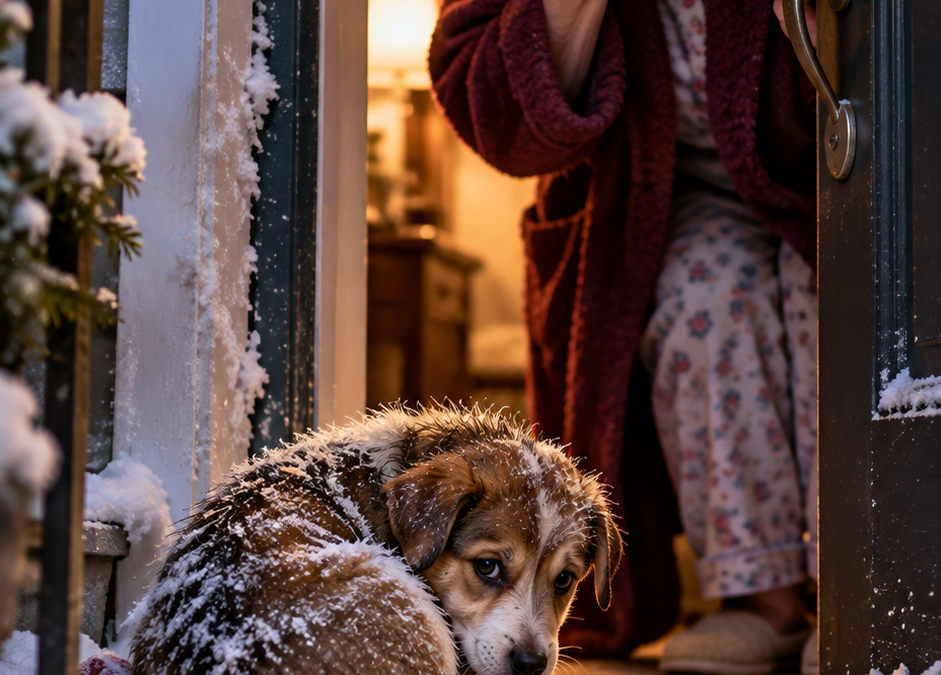
My mother appeared wearing the gray robe.
Hair uncombed.
Face tired.
Charlie sat.
She looked down.
He looked up.
Neither moved.
Mom opened the door wider.
“What on earth?”
Charlie wagged his entire body.
I couldn’t hear everything from where I stood.
I saw her look up and down the street.
Then back at the puppy.
She crouched slowly.
Charlie took two clumsy steps.
One paw caught on the edge of the mat.
He practically fell into her hands.
Mom froze.
Then touched him.
Just once.
A fingertip along his head.
Charlie licked her wrist.
My mother sat down on the porch.
Actually sat.
Still holding the door open.
She picked him up.
I saw her mouth move.
Probably:
“Oh, you poor thing.”
That would have been Mom.
No matter how far grief pushed her away from people, she could never ignore something helpless.
I watched her carry Charlie inside.
The door closed.
My hands were shaking.
I drove away.
Then called at nine.
I pretended nothing had happened.
“Morning, Mom.”
Pause.
“Morning.”
Her voice sounded strange.
Not happy.
Different.
“What?”
“Nothing.”
“Something happened.”
Another pause.
“There is a dog in my house.”
I nearly laughed.
“A dog?”
“Don’t start.”
“What kind?”
“Small.”
“How did it get there?”
“It was on the porch.”
“That’s strange.”
“Very.”
I deserved an award for terrible acting.
“What are you going to do?”
“I don’t know.”
“Call the shelter?”
“I suppose.”
Charlie barked in the background.
Not much of a bark.
More like a squeak.
Mom said:
“Stop that.”
Then, softer:
“You ate already.”
I smiled so hard my face hurt.
“You fed him.”
“He was hungry.”
“Of course.”
“That doesn’t mean he’s staying.”
“Of course.”
There was silence.
Then she said:
“He has your father’s eyes.”
I stopped breathing.
“What?”
“Not literally.”
She sounded almost annoyed.
“I mean the way he looks at you.”
Another pause.
“Like he’s waiting for you to admit something.”
I stared at the road ahead.
“What are you going to call him?”
“I am not calling him anything.”
Charlie made the little bark again.
Mom sighed.
“If he stays until tomorrow, maybe Charlie.”
My eyes filled.
“Why Charlie?”
“You know why.”
Yes.
I knew.
I did not visit that day.
I was afraid if she saw me too soon, she would understand.
The next morning, I called.
“How’s the dog?”
“He kept me awake.”
“That’s bad.”
“He needed the bathroom.”
“Oh.”
“So I had to go outside at five-thirty.”
Outside.
My mother had gone outside.
Before sunrise.
I tightened my grip on the phone.
“Sorry.”
“I didn’t say it was your fault.”
Of course she didn’t.
“Did you call the shelter?”
“Not yet.”
“Why?”
“I was busy.”
Busy.
For nine months, Mom had not described herself as busy.
“What were you doing?”
“Cleaning.”
Pause.
“He got into the laundry basket.”
I laughed.
“Don’t laugh.”
“I wasn’t.”
“You were.”
“How do you know?”
“I’m your mother.”
Charlie remained.
One day.
Two.
Then a week.
I stayed away physically longer than normal, telling myself I was giving her space.
The truth was that I wanted to watch without interfering.
On the first Saturday afternoon, I bought coffee and drove toward her neighborhood.
September light had turned everything gold.
I parked at the corner.
Far enough that she wouldn’t notice my car immediately.
Then I saw her.
My mother was outside.
Not walking to the mailbox.
Outside.
Sitting on the old porch swing she had not used since Dad died.
And she was not wearing the robe.
She wore a pale blue blouse.
I remembered that blouse from childhood.
Or one very much like it.
Dad used to tell her blue made her eyes brighter.
Her hair was combed.
Charlie was curled in her arms.
Golden and white.
Tiny paws hanging awkwardly over her forearm.
Mom spoke to him.
I couldn’t hear the words.
Didn’t need to.
She smiled.
Not the polite smile she gave nurses.
Not the tired expression she used when telling me she was fine.
A real smile.
Her face changed completely.
For one second, she looked twenty years younger.
Then she laughed because Charlie did something.
I cried in my car.
Not quietly.
I covered my face.
Months of frustration.
Fear.
Anger.
Helplessness.
All of it came out.
One puppy had not magically cured my mother.
I knew that.
Grief doesn’t vanish because something cute arrives.
But the door had opened.
Literally.
And perhaps something inside her had opened too.
I wiped my face.
Then drove away without letting her see me.
Four days later, I visited.
I parked in the driveway.
Before I reached the steps, I stopped.
The front door was open.
Not cracked.
Open.
Autumn sunlight spilled into the hallway.
The gray darkness I had come to associate with Mom’s house was gone.
“Mom?”
Her voice came from the kitchen.
“James, come in.”
Then louder:
“Come see how much he’s grown.”
Alive.
That is the only word I can use.
Her voice sounded alive.
I stepped inside.
Charlie came racing around the corner.
His four legs seemed controlled by different committees.
He hit the doormat.
Slid.
Recovered.
Then launched himself at my shoes.
“Hey, buddy.”
I crouched.
He recognized me.
That scared me.
His tail went wild.
“Don’t expose me.”
I whispered.
Mom entered.
“What?”
“Nothing.”
She looked different.
Still thin.
Still older than she had nine months earlier.
Grief leaves marks.
But there was light in her expression.
She laughed when Charlie attacked my shoelace.
A real laugh.
Warm.
Full.
The sound moved through the kitchen.
I had not heard it since Dad died.
I looked away because my eyes burned.
“Coffee?”
she asked.
“Sure.”
We went into the kitchen.
Two cups were already on the table.
“You knew I was coming.”
“You said Thursday.”
I stared at the cups.
For months, when I visited, she barely made tea for herself.
Now she had prepared for me.
The small things hit hardest.
Charlie sat between us.
Mom broke off a tiny safe piece of something and gave it to him.
“You’re spoiling him.”
“He’s had a difficult life.”
“He’s been alive approximately three months.”
“Exactly.”
I laughed.
She smiled.
There were still photographs of Dad everywhere.
His chair still sat untouched.
His coat remained in the hall closet.
Healing had not erased him.
It never did.
But for the first time, his absence was not the only presence in the house.
Charlie grew.
Not much.
The veterinarian told Mom he was unusually small for his litter but healthy.
Full of energy.
“Small is good.”
Mom said.
“Why?”
“He fits.”
“Where?”
“Everywhere.”
He did.
Her lap.
Beside her chair.
Under the kitchen table.
Near her feet in bed.
He became part of the rhythm of the house.
At first, Mom walked him only to the mailbox.
Then the corner.
Then around the block.
A month later, she called me.
“You know the little park near Maple?”
“Yes.”
“We walked there.”
I almost dropped the phone.
“That’s nearly two miles.”
“Not quite.”
“You walked two miles?”
“Charlie wanted to.”
“Mom.”
“What?”
“I’m impressed.”
“Don’t be dramatic.”
But she sounded pleased.
The walks became routine.
Each morning.
Rain unless severe.
Cold unless dangerous.
Charlie needed exercise.
Which meant Mom needed shoes.
A coat.
Hair brushed.
Door opened.
Body moving.
The curtains opened too.
One by one.
First the kitchen.
Then living room.
Then bedroom.
One day, I arrived and noticed the small hallway night-light was unplugged.
I pointed.
“Broken?”
“No.”
“You always leave that on.”
“I don’t need it anymore.”
“Why?”
Mom shrugged.
“The house isn’t as dark.”
I don’t think she meant electricity.
She started cooking again.
At first, for Charlie.
Homemade dog biscuits.
Carrot.
Peanut butter.
Ingredients approved by the vet after I lectured her about not improvising dog nutrition.
She became offended.
“I raised two children.”
“One of us ate glue.”
“That was your sister.”
“Exactly.”
While baking for Charlie, she began cooking for herself.
Soup.
Eggs.
Chicken.
Vegetables.
Food with color.
One afternoon I opened her refrigerator and stared.
“What?”
she asked.
“There is food.”
“Yes.”
“Actual food.”
“James.”
“For a while, this refrigerator looked like a divorced student’s.”
She threw a dish towel at me.
She called old friends.
Carol came for tea.
Then Margaret.
Then two women from church.
Suddenly, there were people on the porch again.
Charlie became an excuse for conversation.
Everyone wanted to meet him.
Mom pretended to complain about the attention.
She loved it.
One afternoon, I arrived without calling first.
Music came from the living room.
An old song.
Dad’s song.
One he always played when cooking Sunday breakfast.
I stopped in the hallway.
Mom stood near the window.
Charlie in her arms.
She was dancing.
Not gracefully.
Charlie looked confused.
Mom laughed.
I stood there and watched.
Then she noticed me.
“How long have you been standing there?”
“Long enough to gather evidence.”
“Of what?”
“Joy.”
Her smile weakened for a second.
Not sadness exactly.
Memory.
She looked toward the speaker.
“Your father loved this song.”
“I know.”
She held Charlie closer.
“I thought listening to it would hurt.”
“Does it?”
“Yes.”
She paused.
“But not only.”
That might have been the clearest sign of healing.
Grief had stopped being one thing.
Dad’s memory could hurt and comfort her at the same time.
Months passed.
Mom stopped saying “I’m fine” automatically.
Sometimes she said:
“Today’s hard.”
That was progress.
One morning she called.
“I miss him terribly today.”
I didn’t try to fix it.
“What happened?”
“Nothing.”
“Just woke up.”
I listened.
“Want me to come over?”
“No.”
Pause.
“Maybe for dinner.”
“I’ll be there.”
“Charlie wants chicken.”
“Charlie always wants chicken.”
That was how our relationship changed too.
My mother began allowing me to see what she felt.
Not every day.
But enough.
Charlie did not replace Dad.
That would have been impossible and insulting.
He gave grief somewhere to move.
A reason for mornings.
A body to care for.
A creature that responded to touch.
A reason to leave the house.
A reason to come home.
Fourteen months after Charlie arrived, I still had not told Mom the truth.
At first, I kept quiet because I feared she would reject him.
Then because she seemed happy.
Then because too much time had passed.
The secret became ridiculous.
Every time Charlie greeted me with suspicious enthusiasm, I thought:
One day, he’s going to expose us.
Mom never asked many questions about where he came from.
That should have been my first clue.
One cold Sunday in December, I finally couldn’t carry it anymore.
The sky was slate gray.
Snow predicted overnight.
Mom’s house was warm.
Lights on.
Fireplace burning.
Charlie slept in her lap.
He had grown, but not dramatically.
Still small.
Golden-white coat fuller now.
Ears no longer quite as floppy.
We sat facing the fire.
Mom was telling me about a woman she had met at the park.
I barely listened.
“Mom.”
She stopped.
“What?”
“There’s something I need to tell you.”
Her expression changed slightly.
Not fear.
Recognition.
“All right.”
“I’ve been keeping it from you for a long time.”
She stroked Charlie’s back.
“How long?”
“Fourteen months.”
Her mouth twitched.
That should have been clue number two.
“The morning Charlie appeared…”
I swallowed.
“Yes?”
“It wasn’t random.”
Mom looked down at the dog.
I forced the words out.
“I put him there.”
Nothing.
No gasp.
No anger.
No surprise.
I had rehearsed reactions.
Every possible one.
None looked like this.
She simply stroked Charlie.
He woke.
Looked at her.
Licked her hand.
Then rested his head again.
“Mom?”
She looked at me.
“James.”
“What?”
“Do you really believe I didn’t know?”
My entire body went still.
“You knew?”
She smiled.
“Maybe not in the first minute.”
“But yes.”
“How?”
“You’re my son.”
“That is not evidence.”
“I have known you forty-five years.”
“Still not evidence.”
“Naming a tiny dog Charlie?”
“You named him.”
“Because you wanted me to.”
I stared.
She continued.
“You knew I would never accept a dog if you brought him through the door and said, ‘Here, Mom, this is good for you.'”
“True.”
“You knew I would say no.”
“Yes.”
“You knew if something helpless was sitting outside, I couldn’t ignore it.”
I felt a little ashamed hearing the manipulation explained so accurately.
She looked toward the fire.
“And you chose dawn.”
“Why does that matter?”
“Because before dawn was the worst.”
Her voice softened.
“The house was quiet.”
“Nobody calling.”
“No traffic.”
“No reason to get up.”
She looked at Charlie.
“You put something alive at the exact hour I felt least alive.”
My eyes filled.
“I didn’t think of it that elegantly.”
“I know.”
“I was terrified.”
She smiled.
“Also obvious.”
“Why didn’t you confront me?”
“Because I wasn’t ready to say thank you.”
That silenced me.
Charlie sighed in her lap.
Mom continued.
“For nine months, everybody listened when I said no.”
“To lunch.”
“To church.”
“To grief groups.”
“To staying with you.”
“Everyone was respectful.”
She looked at me.
“I needed respect.”
“But I also needed someone who knew me well enough to hear what I wasn’t saying.”
I swallowed.
“What weren’t you saying?”
Her eyes filled.
“Please don’t leave me like this.”
The fire cracked.
Neither of us spoke.
Mom blinked back tears.
“I didn’t know how to ask for help.”
“If I said I needed someone, then I had to admit your father was really gone.”
“If I went somewhere without him, I felt guilty.”
“If I laughed, I felt guilty.”
“If I ate well, I felt guilty.”
“If one morning didn’t hurt as much as the day before, I felt guilty for that too.”
She stroked Charlie.
“Then this little creature showed up.”
“He didn’t care whether I was grieving correctly.”
“He needed breakfast.”
I laughed through tears.
“That sounds like him.”
“He needed the door opened.”
“He needed me to take him outside.”
“He needed me to notice whether he was cold.”
“He needed me in the present.”
She looked at me.
“Grief lives mostly in yesterday.”
“Charlie kept demanding today.”
I covered my face for a moment.
“I was afraid you would hate me.”
“I was angry.”
My head snapped up.
“You were?”
“Of course.”
“When?”
“Second day.”
“Why didn’t you say anything?”
“Because he fell asleep on my foot.”
I laughed.
She did too.
Then became serious.
“You took a risk with a living animal.”
“I know.”
“If I had truly refused him?”
“I would have taken him.”
“You had a plan?”
“Yes.”
“Food?”
“Yes.”
“Vet?”
“Yes.”
“Lifetime?”
“Yes.”
Mom nodded.
“Good.”
“You still could’ve yelled at me.”
“Oh, I considered it.”
“Thank you for your restraint.”
She smiled.
“I was waiting.”
“For what?”
“For you to admit it.”
“Fourteen months?”
“I was beginning to worry you were a coward.”
“That’s fair.”
We sat quietly.
Then she said something I will never forget.
“I waited nine months for someone to make the right mistake.”
“What does that mean?”
“Someone to love me enough not to listen only to my no.”
I almost interrupted.
She raised one hand.
“I don’t mean people should ignore boundaries whenever they think they know better.”
“That isn’t love either.”
I nodded.
“But you knew me.”
“You knew my ‘no’ had become the only word I had left.”
She looked down at Charlie.
“And you gave me something I had to answer differently.”
He snored.
Mom smiled.
“I suppose he found the right door.”
I moved from my chair and sat beside her.
She leaned her head against my shoulder.
For a while, we watched the fire.
Charlie slept between us.
I thought about the morning I left him on the porch.
How guilty I had felt.
How frightened.
I had called it deception.
Mom saw it differently.
Not perfect.
Not wise.
Not risk-free.
An act of desperation wrapped in fur.
The next morning, snow began.
Light flakes.
I went to Mom’s house early.
The door was unlocked.
“Mom?”
“Kitchen.”
I entered.
She stood beside the stove.
Charlie in her arms.
They were both looking through the window.
Snow drifted slowly over the backyard.
“He says it’s going to be a good day.”
Mom said.
I took off my coat.
“Does he?”
“Yes.”
“Impressive meteorology.”
Charlie wagged.
“I think so too.”
she added.
We sat at the kitchen table.
Mom.
Me.
Charlie beneath us waiting with shameless optimism for a biscuit.
For the first time in months, Mom spoke about Dad without collapsing into silence afterward.
She told me how they met.
I knew the story, but this version contained details I had forgotten.
Dad had smiled at her first.
She pretended not to notice.
He called her “sunshine” long before they married.
“He had terrible lines.”
Mom said.
“You married him.”
“I was young.”
“Forty-nine years is a long consequence for one bad decision.”
She laughed.
Then went quiet.
Not painfully.
Thoughtfully.
“You know, sometimes I think he sent Charlie.”
I looked down at the dog.
“Who?”
“Your father.”
I smiled.
“You think Dad arranged a puppy?”
“He always knew how to find me when I got lost.”
There was no point arguing.
Maybe she didn’t mean it literally.
Maybe she did.
Grief changes what proof means.
I only said:
“He would’ve liked Charlie.”
“He would have spoiled him.”
“Definitely.”
“He would’ve fed him from the table.”
“You do that.”
“Your father was a bad influence.”
Charlie looked between us.
I could almost imagine Dad laughing.
Two years after Charlie appeared on the porch, my mother was still walking every morning.
Not always two miles.
She was seventy-four by then.
Some mornings were slower.
Her knees hurt.
Cold weather shortened the route.
But she went.
Curtains opened every day.
The hallway light stayed unplugged.
Friends visited.
Mom returned to church occasionally.
Not every Sunday.
Enough.
She began volunteering at the same local shelter where I had found Charlie.
That surprised me more than almost anything.
“What do you do there?”
I asked.
“Talk to people.”
“About dogs?”
“Mostly about themselves.”
“That sounds dangerous.”
“It is.”
She helped older adopters.
Widows.
Widowers.
People whose homes had become too quiet.
She never told everyone to adopt.
She was careful about that.
Not every grieving person needs a dog.
Not every dog belongs in every home.
But when the match was right, she understood something many people didn’t.
Sometimes companionship is not about filling a hole.
It is about giving the heart another direction to move.
She once introduced an elderly man to a small terrier.
He said:
“I’m too old for a dog.”
Mom answered:
“Then don’t get a puppy.”
He smiled.
Eventually he adopted a seven-year-old dog.
Mom called me afterward.
“I found somebody their Charlie.”
“Our Charlie is trademarked.”
“Stop.”
She laughed.
That laugh never stopped mattering to me.
Charlie remained small.
Not puppy-small.
But smaller than expected.
Perfectly healthy.
His coat became more golden.
His eyes kept the same softness.
He followed Mom everywhere.
Kitchen.
Bedroom.
Garden.
Porch.
If she closed the bathroom door, he sat outside like security.
If she napped, he slept nearby.
If she cried, which she still sometimes did, he pressed himself against her.
Grief had not left.
That is important.
I do not want to pretend Charlie cured my mother.
He didn’t.
Two years after Dad died, she still had difficult anniversaries.
Birthdays.
Their wedding date.
The date he died.
Sometimes she woke after dreaming about him and spent the morning quiet.
But grief no longer owned every room.
There was laughter beside it.
Routine.
Purpose.
Memory without collapse.
One evening, we sat on the porch at sunset.
Mom in the swing.
Charlie curled beside her.
I sat on the steps.
The sky turned orange.
Dad used to love evenings like that.
Mom said:
“Your father would be angry that we let this swing rust.”
“Probably.”
“He’d fix it.”
“He’d complain for three hours while fixing it.”
“Correct.”
She smiled.
Charlie lifted his head.
Mom stroked him.
“James?”
“Yeah?”
“Thank you.”
The words surprised me.
“For what?”
She gave me a look.
“You know.”
“We’ve already discussed this.”
“I can thank you more than once.”
“I thought mothers were contractually required to bring up mistakes repeatedly, not gratitude.”
“Don’t ruin the moment.”
“Sorry.”
She looked at Charlie.
“I don’t thank you because he replaced your father.”
“I know.”
“Nothing could.”
“I know.”
“I thank you because I had confused surviving with living.”
That silenced me.
She continued.
“I was breathing.”
“Eating enough not to worry you completely.”
“Answering the phone.”
“But I wasn’t living.”
“Charlie made me participate.”
She smiled.
“And you made Charlie knock.”
I looked at the little dog.
“He barely knocked.”
“He scratched.”
“Technically.”
Mom laughed.
“Sometimes the smallest thing is enough.”
That became one of her favorite sayings.
The greatest love can begin with the smallest step.
A door opened.
A bowl filled.
A leash clipped.
Curtains drawn back.
One walk to a mailbox.
Then a corner.
Then a park.
Healing rarely announces itself.
It accumulates.
One ordinary decision after another.
Looking back, I think that is what frightened me most during those nine months.
I kept waiting for a dramatic change.
A breakthrough.
A conversation where Mom would say:
“I’m ready to live again.”
That never happened.
Instead, she opened the door because a puppy was cold.
Then fed him because he was hungry.
Then walked him because he needed outside.
Then opened the curtains because daylight helped him settle.
Then cooked because she was already in the kitchen.
Then ate because food existed.
Then called a friend because she had a funny Charlie story to tell.
Then laughed.
Then danced.
Then one day I realized my mother had returned without ever declaring she was coming back.
Not the same mother.
She would never be exactly the woman she was before Dad died.
That isn’t how grief works.
Loss changes the architecture.
But a changed house can still hold light.
I learned something about myself too.
For nine months, I had believed love meant solving Mom’s pain.
Every unsuccessful attempt made me feel like I was failing.
Counselors.
Invitations.
Calls.
Groceries.
Advice.
I wanted an answer.
Charlie taught me what Mom needed wasn’t an answer.
It was connection without pressure to explain.
He did not ask:
“Are you over Dad yet?”
He did not tell her:
“You should get out more.”
He did not say:
“You need to eat.”
He simply stood by the door in the morning.
Needed her.
That gave her permission to need him.
There is dignity in being needed.
Especially after loss convinces you your most important role has ended.
My mother had spent forty-nine years being Dad’s person.
Then suddenly, she was nobody’s person in the same way.
Yes, she was my mother.
My sister’s mother.
Friend.
Neighbor.
But those relationships did not live under her roof.
Charlie did.
He knew when she woke.
There it was.
The thing she had told me months earlier.
Every morning, for forty-nine years, somebody knew I woke up.
Charlie knew.
The first morning after his arrival, he knew because he needed the bathroom.
The second because he wanted breakfast.
Eventually because he loved her.
That realization still catches in my throat.
I used to wonder whether leaving Charlie there had been wrong.
Sometimes I still do.
I would never recommend surprise-adopting an animal for someone who clearly doesn’t want one.
A dog is not therapy equipment.
A puppy is not a prescription.
The reason my decision worked was partly luck.
Partly because I knew my mother.
Partly because I had committed to taking full responsibility if she rejected him.
There could have been another ending.
She could have called me furious.
Returned him.
The puppy could have frightened her.
Added stress.
I knew that.
What I did was a gamble.
Love sometimes makes us brave.
Sometimes it makes us foolish.
That morning, I was both.
I am grateful the foolishness found the right door.
Mom eventually told me she recognized my involvement sooner than I thought.
Not the exact first morning.
But when Charlie already knew my smell too well.
“When you came over that fourth day, he ran toward you.”
she said.
“Some puppies like people.”
“He knew you.”
“Prove it.”
“You whispered ‘Don’t expose me.'”
My mouth dropped.
“You heard that?”
“I’m old, not deaf.”
I had no defense.
“Why didn’t you say something?”
“I enjoyed watching you suffer.”
There she was.
My mother.
Fully returned.
One Christmas, we hung a small ornament shaped like a dog on the tree.
Mom wrote two names on the back.
Charlie.
And Charlie.
Dad and dog.
I found her looking at it.
“Confusing.”
I said.
She smiled.
“Not to me.”
The dog lay beneath the tree.
Mom touched the ornament.
“One Charlie taught me how to build a life with someone.”
“The other taught me how to keep one after they were gone.”
I couldn’t answer.
Some truths should be allowed to stand without commentary.
As the years moved, Mom became known at the shelter as “Charlie’s lady.”
People called her when an older person wanted to adopt but felt uncertain.
She listened.
Asked practical questions.
Mobility.
Finances.
Housing.
Support.
Then emotional ones.
“Are you looking for a dog to erase loneliness?”
“If so, no dog can promise that.”
“Are you willing to build a relationship with one?”
“That’s different.”
She had become wiser about animals than I was.
Once, I teased her.
“You used to say dogs smelled.”
“They do.”
“You said they ruin furniture.”
“They do.”
“You said they’re expensive.”
“They are.”
“And?”
She looked down at Charlie.
“Worth it.”
He wagged.
Biased jury.
Dad’s photograph remained on the mantel.
Not hidden.
Not transformed into a shrine.
Simply there.
Some evenings, Mom talked to him.
She admitted that once.
“What do you say?”
I asked.
“None of your business.”
“Do you tell him about Charlie?”
“Obviously.”
“What does Dad think?”
“He thinks I spoil the dog.”
“Accurate.”
“And he has no standing to complain.”
“Also accurate.”
There were days when I found her sitting beside Dad’s photograph with Charlie in her lap.
Sad.
But no longer drowning.
Grief had become something she carried rather than somewhere she lived.
That distinction took me years to understand.
One autumn afternoon, almost exactly like the first time I watched her from my car, I drove over without calling.
She was on the porch swing.
Charlie beside her.
Sunset.
Gold light.
Her hand resting on his back.
For a second, I considered parking at the corner and watching again.
Instead, I pulled into the driveway.
She looked up.
“You’re late.”
“For what?”
“Coffee.”
“I didn’t know we had plans.”
“We do now.”
I walked up.
Charlie greeted me.
Mom poured coffee.
Three lives settled into an ordinary evening.
No miracle.
No dramatic revelation.
Just ordinary life.
And I realized ordinary life was exactly what we had been fighting to recover.
When Dad died, everything extraordinary about grief had been visible.
Funeral.
Flowers.
Condolences.
Tears.
What saved Mom came through ordinary things.
A leash.
A walk.
A biscuit.
A friend calling.
A dog sleeping beside her.
Morning.
That is why, when people ask me whether Charlie saved my mother, I hesitate.
Saved is a dramatic word.
He didn’t pull her from a burning building.
Didn’t cure an illness.
Didn’t erase loss.
He simply gave her enough small reasons to keep moving until those reasons became life again.
Maybe that is rescue too.
Not always pulling someone from danger.
Sometimes sitting beside them until they stand.
My mother says today:
“Sometimes the greatest love begins with the smallest step.”
I know exactly which step she means.
The tiny uncertain step Charlie took across her porch that first morning.
One paw.
Then another.
The step from cold dawn into the warmth of her house.
But I think there was another step too.
Hers.
When she opened the door.
For nine months, grief had taught her to keep the world outside.
Calls could be answered without opening anything.
Groceries could be left on the porch.
Friends could be ignored.
Curtains could remain closed.
Then something small sat outside and needed her.
She opened the door.
That’s all.
One door.
One morning.
One puppy.
And from there:
The curtains.
The kitchen.
The street.
The park.
Friends.
Shelter.
Laughter.
Me.
Life.
I used to think love had to be enormous to change someone.
Forty-nine-year marriages.
Grand sacrifices.
Fourteen desperate minutes trying to keep someone alive.
Those are forms of love.
But not the only ones.
Sometimes love is a son standing on a porch before dawn, terrified he’s making the wrong decision.
Sometimes it’s a seventy-two-year-old woman kneeling in an old robe to lift a trembling puppy.
Sometimes it’s a dog needing to go outside at five-thirty.
Sometimes love doesn’t arrive with answers.
It arrives with needs.
Feed me.
Walk me.
Sit with me.
Wake up.
Open the door.
Two years after that morning, Mom and Charlie were still together.
She was walking every day.
Volunteering.
Cooking.
Calling friends.
Laughing.
Dad remained part of every room without turning every room into a mausoleum.
Charlie was no longer the tiny trembling puppy I had placed beside the door.
He had grown.
Not too much.
Just enough.
His eyes still had the same softness.
Mom swore they were Dad’s eyes.
I stopped arguing.
One morning, I arrived while the first snow was falling.
Same kind of morning as the one after my confession.
Mom stood by the window.
Charlie beside her.
She opened the door before I knocked.
“You’re early.”
“So are you.”
“Charlie wanted to see the snow.”
Charlie looked indifferent.
“Charlie wanted breakfast.”
“Don’t contradict me in my own home.”
I stepped inside.
The house smelled like coffee and something baking.
Light filled the hallway.
No night-light.
No closed curtains.
I stopped for a moment.
Mom noticed.
“What?”
“Nothing.”
“You’re staring.”
“I was remembering.”
She understood.
Her face softened.
“Nine months.”
she said.
I nodded.
“You scared me.”
“I scared myself.”
“Did you ever think you weren’t going to come back?”
She looked around the house.
At Charlie.
At Dad’s photograph.
Then at me.
“Yes.”
My throat tightened.
“When?”
“Most days.”
I sat.
She sat opposite me.
Charlie curled between our feet.
“What changed?”
I asked.
She thought.
Then said:
“I stopped waiting to feel ready.”
I frowned.
“Ready for what?”
“Living.”
She smiled faintly.
“I thought grief would release me first.”
“It doesn’t work that way.”
“No?”
“No.”
She looked at Charlie.
“Sometimes you take a walk while still grieving.”
“You eat while still grieving.”
“You laugh while still grieving.”
“You love something new while still loving what you lost.”
She reached down and touched Charlie’s head.
“The grief comes with you.”
“But eventually, it stops driving.”
I sat quietly.
I wished I could send those words backward nine months.
To the woman in Dad’s chair.
To myself outside the closed door.
But maybe we have to live our way into certain truths.
No shortcut.
No speech.
Just steps.
Mom poured coffee.
Charlie waited for crumbs.
Snow continued falling.
And I thought about Dad.
Would he have approved of what I did?
I don’t know.
He might have called it reckless.
He might have laughed.
He definitely would have spoiled Charlie.
Mom believed he had sent him.
I never decided whether I believed that.
Maybe I didn’t need to.
Dad didn’t physically place a puppy on the porch.
I did.
But love for Dad had shaped the decision.
Mom’s love for Dad gave Charlie his name.
Dad’s absence created the silence Charlie entered.
His memory lived inside every step of what came afterward.
Maybe that is how people continue influencing the world after they’re gone.
Not through ghosts.
Through what their love taught the living.
Dad loved Mom for forty-nine years.
When he couldn’t be there anymore, maybe part of my job as his son was simply to remind her she was still worth showing up for.
I failed at that with words.
Charlie succeeded with paws.
I can live with that.
Sometimes when we sit on the porch at sunset, Mom falls asleep on the swing.
Charlie sleeps pressed against her side.
I sit nearby.
I don’t wake them.
The street quiets.
Light turns orange.
For a moment, I can imagine Dad standing in the yard.
Not literally.
Memory.
Hands in his pockets.
Watching Mom.
Smiling.
He always knew how to find her when she got lost.
Maybe Mom was right.
Maybe in some complicated way, he still did.
Not through magic.
Through us.
Through memory.
Through the love he left behind.
Through a son desperate enough to make one questionable decision.
Through a small golden-and-white puppy who didn’t understand grief but understood that a closed door could be scratched until someone opened it.
That is the version I choose to keep.
Not that Charlie fixed my mother.
Not that grief ended.
Not that a puppy magically repaired forty-nine years of loss.
Something simpler.
Mom opened the door.
Charlie stepped inside.
She chose, one day at a time, not to close it again.
And sometimes that really is all a person needs at the beginning.
Not the strength to rebuild an entire life.
Just enough courage to open one door.
𝗧𝗛𝗘 𝗘𝗡𝗗
For Nine Months My Mother Refused to Open Her Door, Until One Morning Something Small and Frightened Was Waiting on the Other Side
For nine months after my father died, my mother barely opened her front door.
I called every day, visited whenever she let me, brought groceries she rarely touched, and listened to her tell me she was fine in a voice that meant exactly the opposite.
Then one morning, just before sunrise, I did something I knew she would never forgive me for if she understood what I had done.
My mother was seventy-two when my father died.
They had been married forty-nine years.
Forty-nine.
People say numbers like that casually, as though they describe time.
They don’t.
Forty-nine years is not time.
It is thousands of breakfasts.
It is knowing how the other person takes coffee without asking.
It is hearing someone walk through another room and knowing from the rhythm whether they are tired, angry, sick, or simply looking for their glasses.
It is the dent one person leaves permanently in a mattress.
The coat hook that belongs to them.
The chair nobody else sits in.
The way your name sounds different when one particular person says it.
My father, Charlie, was woven into every part of my mother’s life.
Then suddenly he wasn’t there.
I won’t turn his death into a dramatic scene it wasn’t meant to be.
What matters is that my mother was there.
She fought for fourteen minutes to keep him with her.
Fourteen minutes.
She remembered every second.
I knew because months later she could still tell me exactly what the clock looked like.
She could tell me what he had been wearing.
What she had said.
What she had begged him to do.
She could tell me which hand she was holding.
But she rarely talked about it.
Instead, she said:
“I’m fine.”
That became the sentence I hated most.
The first week after the funeral, people filled the house.
Neighbors brought casseroles.
Relatives came with flowers.
Old friends sat at the kitchen table drinking coffee.
Everyone told stories about Dad.
Everyone hugged Mom.
Everyone said:
“Call if you need anything.”
Then, slowly, they returned to their own lives.
That is normal.
It is not cruelty.
People cannot permanently remain inside another person’s grief.
But the person grieving doesn’t get to leave.
By the second month, Mom had stopped attending church.
By the third, she stopped answering most friends.
By the fourth, I noticed the curtains were staying closed.
The house that had always seemed bright, even in winter, became dark.
She kept one small hallway light on day and night.
I asked her why.
“So I don’t trip.”
She had never needed it before.
I didn’t challenge her.
I began buying groceries every Sunday.
At first, she opened the door.
Later, she asked me to leave the bags on the porch.
“Mom.”
“I don’t feel like company.”
“I am not company.”
“James.”
That tone meant stop.
I would stand outside her door holding groceries while my seventy-two-year-old mother stood three feet away on the other side.
“At least let me see you.”
“I’m fine.”
There it was.
Fine.
Always fine.
I hated the word.
“Are you eating?”
“Yes.”
“Properly?”
“Yes.”
“Did you go outside today?”
Silence.
“Mom?”
“I checked the mail.”
The mailbox was less than thirty feet from the front door.
I closed my eyes.
“That’s not going outside.”
“It is geographically outside.”
Even grieving, she could still be stubborn.
I almost laughed.
Almost.
“Come stay with me for a few days.”
“No.”
“I have plenty of room.”
“This is my house.”
“I know.”
“Your father and I lived here thirty-eight years.”
“I know.”
“I’m not leaving.”
“I’m not asking you to leave forever.”
“No.”
That ended the conversation.
My sister lived several states away and called often, but I was the one close enough to see what was happening.
Or, more accurately, to see what was disappearing.
Mom stopped wearing normal clothes.
She lived in an old robe.
Gray once, though years of washing had turned it into a color with no name.
Dad used to tease her about it.
“That thing survived three presidents.”
She would respond:
“So have you.”
After he died, she wore it every day.
I would visit and find her sitting in Dad’s chair.
Not hers.
His.
Television on without sound.
Curtains closed.
A cup of tea growing cold beside her.
“Mom.”
She would look up.
“You’re early.”
“I said two.”
“It’s two?”
“Yes.”
She seemed surprised.
Time had become strange for her.
Days no longer had shape.
She slept badly at night.
Napped in the afternoon.
Forgot meals.
Once, I found a plate of toast in the kitchen that had been sitting there long enough to become hard.
“When did you make this?”
“This morning.”
It was after six in the evening.
I threw it away.
She became angry.
“I was going to eat that.”
“No, you weren’t.”
“Don’t treat me like a child.”
“Then stop pretending this is okay.”
The moment the words left my mouth, I regretted them.
Her face shut down.
Not anger.
Something worse.
Withdrawal.
“I didn’t say it was okay.”
Her voice became very quiet.
“Then talk to me.”
“What do you want me to say?”
“I don’t know.”
“Neither do I.”
I sat across from her.
She looked toward the dark window.
Finally, she whispered:
“Every morning, for forty-nine years, somebody knew I woke up.”
I didn’t understand at first.
She looked at me.
“Do you understand that, James?”
I said nothing.
“Your father knew.”
“If I got out of bed first, he heard me.”
“If he got up first, I heard him.”
“If I coughed, he asked whether I was sick.”
“If I was quiet too long, he came looking.”
She swallowed.
“Now I wake up, and nobody knows.”
That sentence broke something in me.
I reached for her hand.
She let me take it.
“I know you’re here.”
I said.
“Your sister knows.”
“Your friends know.”
She smiled sadly.
“That’s not the same.”
No.
It wasn’t.
I could visit.
Call.
Buy groceries.
Fix the leaking bathroom faucet.
Take out the trash.
None of those things could replace the person who had shared every morning beside her for nearly half a century.
I began researching grief counselors.
Support groups.
Programs for widows.
Senior social groups.
I printed everything.
She refused all of it.
“Mom, just try one meeting.”
“No.”
“You don’t even have to speak.”
“No.”
“Church has a bereavement group.”
“No.”
“What about lunch with Carol?”
“I’ll call her sometime.”
“You’ve been saying that four months.”
“James.”
“What?”
“Stop.”
I did.
Then started again a week later.
I couldn’t help it.
I was terrified.
Not that my mother would do something dramatic.
That wasn’t what I feared.
I feared she would simply disappear while remaining alive.
That the woman I knew would fade a little every day until only routine remained.
I remembered her before Dad died.
My mother had been the person who opened every curtain at seven in the morning.
She sang while cleaning.
Badly.
She cooked too much food because she was convinced every visitor was starving.
She kept flowers in coffee mugs because she disliked vases.
She danced in the kitchen when old songs came on.
She knew everyone’s birthday.
She had opinions about absolutely everything.
Then Dad died.
And the world went quiet inside her.
Nine months passed.
By then, I was calling every morning.
Not because she wanted me to.
Because I needed to hear her voice.
“Morning, Mom.”
“Morning.”
“Sleep?”
“A little.”
“Breakfast?”
“Later.”
“Going outside?”
“Maybe.”
“How do you feel?”
“Fine.”
Eventually, I stopped asking.
One evening, I sat in my car outside her house.
The curtains were closed.
Hallway light visible through a small gap.
Nothing moved.
I thought about going in.
I had a key.
She had given it to me years earlier.
But grief had made privacy sacred to her.
If I entered without permission, she would see it as betrayal.
So I sat there.
I don’t know for how long.
Then I noticed something.
A woman walking a small dog down the sidewalk.
The dog was tiny.
Golden and white.
Not a puppy, but close enough that it bounced rather than walked.
The woman stopped to let it sniff a tree.
It pulled in one direction.
She laughed.
Something in that sound made me look at my mother’s house again.
I had an absurd thought.
No.
Immediately.
Absolutely not.
My mother had never been what I would call a dog person.
Dad liked dogs.
Mom tolerated them.
Mostly.
She liked small animals from a safe distance.
She worried about mud.
Hair.
Chewed furniture.
Vet bills.
Commitment.
And since Dad’s death, she rejected anything that required her to care deeply.
Because caring creates risk.
Still, the idea would not leave me.
A dog needs breakfast.
A dog needs the door opened.
A dog needs walks.
A dog doesn’t accept “maybe tomorrow” as an answer.
A dog does not understand that grief has made you unavailable.
It simply needs you.
I spent two weeks arguing with myself.
It would be manipulative.
Irresponsible.
An animal is not medicine.
You cannot place a living creature into someone’s life without consent just because you believe you know what they need.
All true.
Then I pictured Mom in Dad’s chair.
Curtains closed.
Hallway light on.
“I’m fine.”
Something had to change.
I visited a local shelter.
I told myself I was only looking.
The woman working there asked:
“What kind of dog?”
I nearly turned around.
“I’m not sure.”
“Your dog?”
“My mother’s.”
“Does she know?”
I hesitated too long.
The woman crossed her arms.
“That’s usually a bad sign.”
“I know.”
“Pets should not be surprise gifts.”
“I know.”
She looked at me carefully.
“Then why are you here?”
I told her.
Not everything.
Enough.
Seventy-two.
Widowed nine months.
Barely leaving home.
Not eating properly.
Not responding to people.
The worker listened.
When I finished, she said:
“A dog can’t fix grief.”
“I know.”
“And if your mother rejects the dog?”
“I’ll take him.”
“Immediately?”
“Yes.”
“Lifetime?”
“Yes.”
That mattered.
I meant it.
I would never leave an unwanted puppy with Mom because I had created a sentimental plan.
If she said no, the dog became mine.
The worker nodded.
“Then let’s talk.”
She showed me several dogs.
Most were too large.
Too energetic.
Too frightened.
Then I saw him.
A little puppy curled in the corner of an enclosure.
Golden and white.
Floppy ears.
Paws slightly too big for the rest of him.
He looked up when I approached.
Didn’t bark.
Just watched.
The worker said:
“He’s the smallest in his litter.”
“Healthy?”
“Completely.”
“Just small.”
The puppy stood.
Walked toward the gate.
Tripped over his own front foot.
Recovered.
Then sat.
I laughed.
First mistake.
Never laugh at an animal you’re trying not to adopt.
“What’s his name?”
“No official one yet.”
I crouched.
He pushed his nose against the gate.
One eye had a small patch of darker gold around it.
I don’t know why, but I thought of Dad immediately.
Not because Dad looked like a puppy.
That would be strange.
Something in the expression.
Patient.
Curious.
Slightly ridiculous.
Dad had been all three.
“Charlie.”
The name left my mouth before I chose it.
The shelter worker looked at me.
“Charlie?”
“My father’s name.”
I closed my eyes.
“This is a terrible idea.”
The puppy licked my finger through the bars.
The woman smiled.
“Possibly.”
I signed the paperwork.
The entire drive home, Charlie sat in a crate on the passenger seat.
Every few minutes, I looked over.
“This is manipulative.”
He yawned.
“Possibly unethical.”
Tail.
“She might hate me.”
Charlie began chewing the edge of the blanket.
“Excellent.”
“You’re listening.”
I did not take him directly to Mom’s house.
That would have been too obvious.
I spent the evening preparing.
Food.
Bowls.
Small bed.
Veterinary information.
Leash.
Everything.
I wrote a note.
Then tore it up.
Wrote another.
Tore that up too.
No explanation would make the act less intrusive.
Finally, I decided not to leave a note.
If Mom knew immediately that I was responsible, she would refuse on principle.
She had been refusing everything I offered for nine months.
Help.
Counseling.
Lunch.
Walks.
Life.
I needed her to respond before she could argue.
That sounds arrogant.
Maybe it was.
I was desperate.
Just before dawn, I drove to her neighborhood.
Charlie slept most of the way.
I parked several houses away.
The sky was beginning to pale.
No lights in neighboring homes.
The world was still.
I carried Charlie to the porch.
He woke as soon as cold air hit his face.
He looked at me.
Then at the door.
“Okay.”
I whispered.
“This is the worst plan I’ve ever had.”
He sneezed.
“I agree.”
I placed his bed near the door.
Set a small bag with food and basic supplies beside it.
Charlie immediately tried to follow me when I stepped away.
My heart nearly broke.
“No.”
I crouched.
“You need to stay.”
He climbed onto my shoe.
“No.”
I picked him up.
Held him against my chest.
Warm.
Tiny.
His heart beat fast.
“What am I doing?”
For a moment, I almost stopped.
Almost carried him back to the car.
Then I looked through the dark front window.
I knew where Mom was.
Probably awake.
She often woke before dawn now.
Alone.
Waiting for nothing.
I set Charlie down again.
Pressed the doorbell once.
Then twice.
And ran.
Yes.
Forty-five years old.
Running from my mother’s porch like a teenager who had thrown a rock through a window.
I hid behind my car farther down the street.
Nothing happened.
One minute.
Two.
Charlie scratched lightly at the door.
My stomach twisted.
“Come on, Mom.”
A light came on.
Hallway.
Then porch.
The door opened several inches.
My mother appeared wearing the gray robe.
Hair uncombed.
Face tired.
Charlie sat.
She looked down.
He looked up.
Neither moved.
Mom opened the door wider.
“What on earth?”
Charlie wagged his entire body.
I couldn’t hear everything from where I stood.
I saw her look up and down the street.
Then back at the puppy.
She crouched slowly.
Charlie took two clumsy steps.
One paw caught on the edge of the mat.
He practically fell into her hands.
Mom froze.
Then touched him.
Just once.
A fingertip along his head.
Charlie licked her wrist.
My mother sat down on the porch.
Actually sat.
Still holding the door open.
She picked him up.
I saw her mouth move.
Probably:
“Oh, you poor thing.”
That would have been Mom.
No matter how far grief pushed her away from people, she could never ignore something helpless.
I watched her carry Charlie inside.
The door closed.
My hands were shaking.
I drove away.
Then called at nine.
I pretended nothing had happened.
“Morning, Mom.”
Pause.
“Morning.”
Her voice sounded strange.
Not happy.
Different.
“What?”
“Nothing.”
“Something happened.”
Another pause.
“There is a dog in my house.”
I nearly laughed.
“A dog?”
“Don’t start.”
“What kind?”
“Small.”
“How did it get there?”
“It was on the porch.”
“That’s strange.”
“Very.”
I deserved an award for terrible acting.
“What are you going to do?”
“I don’t know.”
“Call the shelter?”
“I suppose.”
Charlie barked in the background.
Not much of a bark.
More like a squeak.
Mom said:
“Stop that.”
Then, softer:
“You ate already.”
I smiled so hard my face hurt.
“You fed him.”
“He was hungry.”
“Of course.”
“That doesn’t mean he’s staying.”
“Of course.”
There was silence.
Then she said:
“He has your father’s eyes.”
I stopped breathing.
“What?”
“Not literally.”
She sounded almost annoyed.
“I mean the way he looks at you.”
Another pause.
“Like he’s waiting for you to admit something.”
I stared at the road ahead.
“What are you going to call him?”
“I am not calling him anything.”
Charlie made the little bark again.
Mom sighed.
“If he stays until tomorrow, maybe Charlie.”
My eyes filled.
“Why Charlie?”
“You know why.”
Yes.
I knew.
I did not visit that day.
I was afraid if she saw me too soon, she would understand.
The next morning, I called.
“How’s the dog?”
“He kept me awake.”
“That’s bad.”
“He needed the bathroom.”
“Oh.”
“So I had to go outside at five-thirty.”
Outside.
My mother had gone outside.
Before sunrise.
I tightened my grip on the phone.
“Sorry.”
“I didn’t say it was your fault.”
Of course she didn’t.
“Did you call the shelter?”
“Not yet.”
“Why?”
“I was busy.”
Busy.
For nine months, Mom had not described herself as busy.
“What were you doing?”
“Cleaning.”
Pause.
“He got into the laundry basket.”
I laughed.
“Don’t laugh.”
“I wasn’t.”
“You were.”
“How do you know?”
“I’m your mother.”
Charlie remained.
One day.
Two.
Then a week.
I stayed away physically longer than normal, telling myself I was giving her space.
The truth was that I wanted to watch without interfering.
On the first Saturday afternoon, I bought coffee and drove toward her neighborhood.
September light had turned everything gold.
I parked at the corner.
Far enough that she wouldn’t notice my car immediately.
Then I saw her.
My mother was outside.
Not walking to the mailbox.
Outside.
Sitting on the old porch swing she had not used since Dad died.
And she was not wearing the robe.
She wore a pale blue blouse.
I remembered that blouse from childhood.
Or one very much like it.
Dad used to tell her blue made her eyes brighter.
Her hair was combed.
Charlie was curled in her arms.
Golden and white.
Tiny paws hanging awkwardly over her forearm.
Mom spoke to him.
I couldn’t hear the words.
Didn’t need to.
She smiled.
Not the polite smile she gave nurses.
Not the tired expression she used when telling me she was fine.
A real smile.
Her face changed completely.
For one second, she looked twenty years younger.
Then she laughed because Charlie did something.
I cried in my car.
Not quietly.
I covered my face.
Months of frustration.
Fear.
Anger.
Helplessness.
All of it came out.
One puppy had not magically cured my mother.
I knew that.
Grief doesn’t vanish because something cute arrives.
But the door had opened.
Literally.
And perhaps something inside her had opened too.
I wiped my face.
Then drove away without letting her see me.
Four days later, I visited.
I parked in the driveway.
Before I reached the steps, I stopped.
The front door was open.
Not cracked.
Open.
Autumn sunlight spilled into the hallway.
The gray darkness I had come to associate with Mom’s house was gone.
“Mom?”
Her voice came from the kitchen.
“James, come in.”
Then louder:
“Come see how much he’s grown.”
Alive.
That is the only word I can use.
Her voice sounded alive.
I stepped inside.
Charlie came racing around the corner.
His four legs seemed controlled by different committees.
He hit the doormat.
Slid.
Recovered.
Then launched himself at my shoes.
“Hey, buddy.”
I crouched.
He recognized me.
That scared me.
His tail went wild.
“Don’t expose me.”
I whispered.
Mom entered.
“What?”
“Nothing.”
She looked different.
Still thin.
Still older than she had nine months earlier.
Grief leaves marks.
But there was light in her expression.
She laughed when Charlie attacked my shoelace.
A real laugh.
Warm.
Full.
The sound moved through the kitchen.
I had not heard it since Dad died.
I looked away because my eyes burned.
“Coffee?”
she asked.
“Sure.”
We went into the kitchen.
Two cups were already on the table.
“You knew I was coming.”
“You said Thursday.”
I stared at the cups.
For months, when I visited, she barely made tea for herself.
Now she had prepared for me.
The small things hit hardest.
Charlie sat between us.
Mom broke off a tiny safe piece of something and gave it to him.
“You’re spoiling him.”
“He’s had a difficult life.”
“He’s been alive approximately three months.”
“Exactly.”
I laughed.
She smiled.
There were still photographs of Dad everywhere.
His chair still sat untouched.
His coat remained in the hall closet.
Healing had not erased him.
It never did.
But for the first time, his absence was not the only presence in the house.
Charlie grew.
Not much.
The veterinarian told Mom he was unusually small for his litter but healthy.
Full of energy.
“Small is good.”
Mom said.
“Why?”
“He fits.”
“Where?”
“Everywhere.”
He did.
Her lap.
Beside her chair.
Under the kitchen table.
Near her feet in bed.
He became part of the rhythm of the house.
At first, Mom walked him only to the mailbox.
Then the corner.
Then around the block.
A month later, she called me.
“You know the little park near Maple?”
“Yes.”
“We walked there.”
I almost dropped the phone.
“That’s nearly two miles.”
“Not quite.”
“You walked two miles?”
“Charlie wanted to.”
“Mom.”
“What?”
“I’m impressed.”
“Don’t be dramatic.”
But she sounded pleased.
The walks became routine.
Each morning.
Rain unless severe.
Cold unless dangerous.
Charlie needed exercise.
Which meant Mom needed shoes.
A coat.
Hair brushed.
Door opened.
Body moving.
The curtains opened too.
One by one.
First the kitchen.
Then living room.
Then bedroom.
One day, I arrived and noticed the small hallway night-light was unplugged.
I pointed.
“Broken?”
“No.”
“You always leave that on.”
“I don’t need it anymore.”
“Why?”
Mom shrugged.
“The house isn’t as dark.”
I don’t think she meant electricity.
She started cooking again.
At first, for Charlie.
Homemade dog biscuits.
Carrot.
Peanut butter.
Ingredients approved by the vet after I lectured her about not improvising dog nutrition.
She became offended.
“I raised two children.”
“One of us ate glue.”
“That was your sister.”
“Exactly.”
While baking for Charlie, she began cooking for herself.
Soup.
Eggs.
Chicken.
Vegetables.
Food with color.
One afternoon I opened her refrigerator and stared.
“What?”
she asked.
“There is food.”
“Yes.”
“Actual food.”
“James.”
“For a while, this refrigerator looked like a divorced student’s.”
She threw a dish towel at me.
She called old friends.
Carol came for tea.
Then Margaret.
Then two women from church.
Suddenly, there were people on the porch again.
Charlie became an excuse for conversation.
Everyone wanted to meet him.
Mom pretended to complain about the attention.
She loved it.
One afternoon, I arrived without calling first.
Music came from the living room.
An old song.
Dad’s song.
One he always played when cooking Sunday breakfast.
I stopped in the hallway.
Mom stood near the window.
Charlie in her arms.
She was dancing.
Not gracefully.
Charlie looked confused.
Mom laughed.
I stood there and watched.
Then she noticed me.
“How long have you been standing there?”
“Long enough to gather evidence.”
“Of what?”
“Joy.”
Her smile weakened for a second.
Not sadness exactly.
Memory.
She looked toward the speaker.
“Your father loved this song.”
“I know.”
She held Charlie closer.
“I thought listening to it would hurt.”
“Does it?”
“Yes.”
She paused.
“But not only.”
That might have been the clearest sign of healing.
Grief had stopped being one thing.
Dad’s memory could hurt and comfort her at the same time.
Months passed.
Mom stopped saying “I’m fine” automatically.
Sometimes she said:
“Today’s hard.”
That was progress.
One morning she called.
“I miss him terribly today.”
I didn’t try to fix it.
“What happened?”
“Nothing.”
“Just woke up.”
I listened.
“Want me to come over?”
“No.”
Pause.
“Maybe for dinner.”
“I’ll be there.”
“Charlie wants chicken.”
“Charlie always wants chicken.”
That was how our relationship changed too.
My mother began allowing me to see what she felt.
Not every day.
But enough.
Charlie did not replace Dad.
That would have been impossible and insulting.
He gave grief somewhere to move.
A reason for mornings.
A body to care for.
A creature that responded to touch.
A reason to leave the house.
A reason to come home.
Fourteen months after Charlie arrived, I still had not told Mom the truth.
At first, I kept quiet because I feared she would reject him.
Then because she seemed happy.
Then because too much time had passed.
The secret became ridiculous.
Every time Charlie greeted me with suspicious enthusiasm, I thought:
One day, he’s going to expose us.
Mom never asked many questions about where he came from.
That should have been my first clue.
One cold Sunday in December, I finally couldn’t carry it anymore.
The sky was slate gray.
Snow predicted overnight.
Mom’s house was warm.
Lights on.
Fireplace burning.
Charlie slept in her lap.
He had grown, but not dramatically.
Still small.
Golden-white coat fuller now.
Ears no longer quite as floppy.
We sat facing the fire.
Mom was telling me about a woman she had met at the park.
I barely listened.
“Mom.”
She stopped.
“What?”
“There’s something I need to tell you.”
Her expression changed slightly.
Not fear.
Recognition.
“All right.”
“I’ve been keeping it from you for a long time.”
She stroked Charlie’s back.
“How long?”
“Fourteen months.”
Her mouth twitched.
That should have been clue number two.
“The morning Charlie appeared…”
I swallowed.
“Yes?”
“It wasn’t random.”
Mom looked down at the dog.
I forced the words out.
“I put him there.”
Nothing.
No gasp.
No anger.
No surprise.
I had rehearsed reactions.
Every possible one.
None looked like this.
She simply stroked Charlie.
He woke.
Looked at her.
Licked her hand.
Then rested his head again.
“Mom?”
She looked at me.
“James.”
“What?”
“Do you really believe I didn’t know?”
My entire body went still.
“You knew?”
She smiled.
“Maybe not in the first minute.”
“But yes.”
“How?”
“You’re my son.”
“That is not evidence.”
“I have known you forty-five years.”
“Still not evidence.”
“Naming a tiny dog Charlie?”
“You named him.”
“Because you wanted me to.”
I stared.
She continued.
“You knew I would never accept a dog if you brought him through the door and said, ‘Here, Mom, this is good for you.'”
“True.”
“You knew I would say no.”
“Yes.”
“You knew if something helpless was sitting outside, I couldn’t ignore it.”
I felt a little ashamed hearing the manipulation explained so accurately.
She looked toward the fire.
“And you chose dawn.”
“Why does that matter?”
“Because before dawn was the worst.”
Her voice softened.
“The house was quiet.”
“Nobody calling.”
“No traffic.”
“No reason to get up.”
She looked at Charlie.
“You put something alive at the exact hour I felt least alive.”
My eyes filled.
“I didn’t think of it that elegantly.”
“I know.”
“I was terrified.”
She smiled.
“Also obvious.”
“Why didn’t you confront me?”
“Because I wasn’t ready to say thank you.”
That silenced me.
Charlie sighed in her lap.
Mom continued.
“For nine months, everybody listened when I said no.”
“To lunch.”
“To church.”
“To grief groups.”
“To staying with you.”
“Everyone was respectful.”
She looked at me.
“I needed respect.”
“But I also needed someone who knew me well enough to hear what I wasn’t saying.”
I swallowed.
“What weren’t you saying?”
Her eyes filled.
“Please don’t leave me like this.”
The fire cracked.
Neither of us spoke.
Mom blinked back tears.
“I didn’t know how to ask for help.”
“If I said I needed someone, then I had to admit your father was really gone.”
“If I went somewhere without him, I felt guilty.”
“If I laughed, I felt guilty.”
“If I ate well, I felt guilty.”
“If one morning didn’t hurt as much as the day before, I felt guilty for that too.”
She stroked Charlie.
“Then this little creature showed up.”
“He didn’t care whether I was grieving correctly.”
“He needed breakfast.”
I laughed through tears.
“That sounds like him.”
“He needed the door opened.”
“He needed me to take him outside.”
“He needed me to notice whether he was cold.”
“He needed me in the present.”
She looked at me.
“Grief lives mostly in yesterday.”
“Charlie kept demanding today.”
I covered my face for a moment.
“I was afraid you would hate me.”
“I was angry.”
My head snapped up.
“You were?”
“Of course.”
“When?”
“Second day.”
“Why didn’t you say anything?”
“Because he fell asleep on my foot.”
I laughed.
She did too.
Then became serious.
“You took a risk with a living animal.”
“I know.”
“If I had truly refused him?”
“I would have taken him.”
“You had a plan?”
“Yes.”
“Food?”
“Yes.”
“Vet?”
“Yes.”
“Lifetime?”
“Yes.”
Mom nodded.
“Good.”
“You still could’ve yelled at me.”
“Oh, I considered it.”
“Thank you for your restraint.”
She smiled.
“I was waiting.”
“For what?”
“For you to admit it.”
“Fourteen months?”
“I was beginning to worry you were a coward.”
“That’s fair.”
We sat quietly.
Then she said something I will never forget.
“I waited nine months for someone to make the right mistake.”
“What does that mean?”
“Someone to love me enough not to listen only to my no.”
I almost interrupted.
She raised one hand.
“I don’t mean people should ignore boundaries whenever they think they know better.”
“That isn’t love either.”
I nodded.
“But you knew me.”
“You knew my ‘no’ had become the only word I had left.”
She looked down at Charlie.
“And you gave me something I had to answer differently.”
He snored.
Mom smiled.
“I suppose he found the right door.”
I moved from my chair and sat beside her.
She leaned her head against my shoulder.
For a while, we watched the fire.
Charlie slept between us.
I thought about the morning I left him on the porch.
How guilty I had felt.
How frightened.
I had called it deception.
Mom saw it differently.
Not perfect.
Not wise.
Not risk-free.
An act of desperation wrapped in fur.
The next morning, snow began.
Light flakes.
I went to Mom’s house early.
The door was unlocked.
“Mom?”
“Kitchen.”
I entered.
She stood beside the stove.
Charlie in her arms.
They were both looking through the window.
Snow drifted slowly over the backyard.
“He says it’s going to be a good day.”
Mom said.
I took off my coat.
“Does he?”
“Yes.”
“Impressive meteorology.”
Charlie wagged.
“I think so too.”
she added.
We sat at the kitchen table.
Mom.
Me.
Charlie beneath us waiting with shameless optimism for a biscuit.
For the first time in months, Mom spoke about Dad without collapsing into silence afterward.
She told me how they met.
I knew the story, but this version contained details I had forgotten.
Dad had smiled at her first.
She pretended not to notice.
He called her “sunshine” long before they married.
“He had terrible lines.”
Mom said.
“You married him.”
“I was young.”
“Forty-nine years is a long consequence for one bad decision.”
She laughed.
Then went quiet.
Not painfully.
Thoughtfully.
“You know, sometimes I think he sent Charlie.”
I looked down at the dog.
“Who?”
“Your father.”
I smiled.
“You think Dad arranged a puppy?”
“He always knew how to find me when I got lost.”
There was no point arguing.
Maybe she didn’t mean it literally.
Maybe she did.
Grief changes what proof means.
I only said:
“He would’ve liked Charlie.”
“He would have spoiled him.”
“Definitely.”
“He would’ve fed him from the table.”
“You do that.”
“Your father was a bad influence.”
Charlie looked between us.
I could almost imagine Dad laughing.
Two years after Charlie appeared on the porch, my mother was still walking every morning.
Not always two miles.
She was seventy-four by then.
Some mornings were slower.
Her knees hurt.
Cold weather shortened the route.
But she went.
Curtains opened every day.
The hallway light stayed unplugged.
Friends visited.
Mom returned to church occasionally.
Not every Sunday.
Enough.
She began volunteering at the same local shelter where I had found Charlie.
That surprised me more than almost anything.
“What do you do there?”
I asked.
“Talk to people.”
“About dogs?”
“Mostly about themselves.”
“That sounds dangerous.”
“It is.”
She helped older adopters.
Widows.
Widowers.
People whose homes had become too quiet.
She never told everyone to adopt.
She was careful about that.
Not every grieving person needs a dog.
Not every dog belongs in every home.
But when the match was right, she understood something many people didn’t.
Sometimes companionship is not about filling a hole.
It is about giving the heart another direction to move.
She once introduced an elderly man to a small terrier.
He said:
“I’m too old for a dog.”
Mom answered:
“Then don’t get a puppy.”
He smiled.
Eventually he adopted a seven-year-old dog.
Mom called me afterward.
“I found somebody their Charlie.”
“Our Charlie is trademarked.”
“Stop.”
She laughed.
That laugh never stopped mattering to me.
Charlie remained small.
Not puppy-small.
But smaller than expected.
Perfectly healthy.
His coat became more golden.
His eyes kept the same softness.
He followed Mom everywhere.
Kitchen.
Bedroom.
Garden.
Porch.
If she closed the bathroom door, he sat outside like security.
If she napped, he slept nearby.
If she cried, which she still sometimes did, he pressed himself against her.
Grief had not left.
That is important.
I do not want to pretend Charlie cured my mother.
He didn’t.
Two years after Dad died, she still had difficult anniversaries.
Birthdays.
Their wedding date.
The date he died.
Sometimes she woke after dreaming about him and spent the morning quiet.
But grief no longer owned every room.
There was laughter beside it.
Routine.
Purpose.
Memory without collapse.
One evening, we sat on the porch at sunset.
Mom in the swing.
Charlie curled beside her.
I sat on the steps.
The sky turned orange.
Dad used to love evenings like that.
Mom said:
“Your father would be angry that we let this swing rust.”
“Probably.”
“He’d fix it.”
“He’d complain for three hours while fixing it.”
“Correct.”
She smiled.
Charlie lifted his head.
Mom stroked him.
“James?”
“Yeah?”
“Thank you.”
The words surprised me.
“For what?”
She gave me a look.
“You know.”
“We’ve already discussed this.”
“I can thank you more than once.”
“I thought mothers were contractually required to bring up mistakes repeatedly, not gratitude.”
“Don’t ruin the moment.”
“Sorry.”
She looked at Charlie.
“I don’t thank you because he replaced your father.”
“I know.”
“Nothing could.”
“I know.”
“I thank you because I had confused surviving with living.”
That silenced me.
She continued.
“I was breathing.”
“Eating enough not to worry you completely.”
“Answering the phone.”
“But I wasn’t living.”
“Charlie made me participate.”
She smiled.
“And you made Charlie knock.”
I looked at the little dog.
“He barely knocked.”
“He scratched.”
“Technically.”
Mom laughed.
“Sometimes the smallest thing is enough.”
That became one of her favorite sayings.
The greatest love can begin with the smallest step.
A door opened.
A bowl filled.
A leash clipped.
Curtains drawn back.
One walk to a mailbox.
Then a corner.
Then a park.
Healing rarely announces itself.
It accumulates.
One ordinary decision after another.
Looking back, I think that is what frightened me most during those nine months.
I kept waiting for a dramatic change.
A breakthrough.
A conversation where Mom would say:
“I’m ready to live again.”
That never happened.
Instead, she opened the door because a puppy was cold.
Then fed him because he was hungry.
Then walked him because he needed outside.
Then opened the curtains because daylight helped him settle.
Then cooked because she was already in the kitchen.
Then ate because food existed.
Then called a friend because she had a funny Charlie story to tell.
Then laughed.
Then danced.
Then one day I realized my mother had returned without ever declaring she was coming back.
Not the same mother.
She would never be exactly the woman she was before Dad died.
That isn’t how grief works.
Loss changes the architecture.
But a changed house can still hold light.
I learned something about myself too.
For nine months, I had believed love meant solving Mom’s pain.
Every unsuccessful attempt made me feel like I was failing.
Counselors.
Invitations.
Calls.
Groceries.
Advice.
I wanted an answer.
Charlie taught me what Mom needed wasn’t an answer.
It was connection without pressure to explain.
He did not ask:
“Are you over Dad yet?”
He did not tell her:
“You should get out more.”
He did not say:
“You need to eat.”
He simply stood by the door in the morning.
Needed her.
That gave her permission to need him.
There is dignity in being needed.
Especially after loss convinces you your most important role has ended.
My mother had spent forty-nine years being Dad’s person.
Then suddenly, she was nobody’s person in the same way.
Yes, she was my mother.
My sister’s mother.
Friend.
Neighbor.
But those relationships did not live under her roof.
Charlie did.
He knew when she woke.
There it was.
The thing she had told me months earlier.
Every morning, for forty-nine years, somebody knew I woke up.
Charlie knew.
The first morning after his arrival, he knew because he needed the bathroom.
The second because he wanted breakfast.
Eventually because he loved her.
That realization still catches in my throat.
I used to wonder whether leaving Charlie there had been wrong.
Sometimes I still do.
I would never recommend surprise-adopting an animal for someone who clearly doesn’t want one.
A dog is not therapy equipment.
A puppy is not a prescription.
The reason my decision worked was partly luck.
Partly because I knew my mother.
Partly because I had committed to taking full responsibility if she rejected him.
There could have been another ending.
She could have called me furious.
Returned him.
The puppy could have frightened her.
Added stress.
I knew that.
What I did was a gamble.
Love sometimes makes us brave.
Sometimes it makes us foolish.
That morning, I was both.
I am grateful the foolishness found the right door.
Mom eventually told me she recognized my involvement sooner than I thought.
Not the exact first morning.
But when Charlie already knew my smell too well.
“When you came over that fourth day, he ran toward you.”
she said.
“Some puppies like people.”
“He knew you.”
“Prove it.”
“You whispered ‘Don’t expose me.'”
My mouth dropped.
“You heard that?”
“I’m old, not deaf.”
I had no defense.
“Why didn’t you say something?”
“I enjoyed watching you suffer.”
There she was.
My mother.
Fully returned.
One Christmas, we hung a small ornament shaped like a dog on the tree.
Mom wrote two names on the back.
Charlie.
And Charlie.
Dad and dog.
I found her looking at it.
“Confusing.”
I said.
She smiled.
“Not to me.”
The dog lay beneath the tree.
Mom touched the ornament.
“One Charlie taught me how to build a life with someone.”
“The other taught me how to keep one after they were gone.”
I couldn’t answer.
Some truths should be allowed to stand without commentary.
As the years moved, Mom became known at the shelter as “Charlie’s lady.”
People called her when an older person wanted to adopt but felt uncertain.
She listened.
Asked practical questions.
Mobility.
Finances.
Housing.
Support.
Then emotional ones.
“Are you looking for a dog to erase loneliness?”
“If so, no dog can promise that.”
“Are you willing to build a relationship with one?”
“That’s different.”
She had become wiser about animals than I was.
Once, I teased her.
“You used to say dogs smelled.”
“They do.”
“You said they ruin furniture.”
“They do.”
“You said they’re expensive.”
“They are.”
“And?”
She looked down at Charlie.
“Worth it.”
He wagged.
Biased jury.
Dad’s photograph remained on the mantel.
Not hidden.
Not transformed into a shrine.
Simply there.
Some evenings, Mom talked to him.
She admitted that once.
“What do you say?”
I asked.
“None of your business.”
“Do you tell him about Charlie?”
“Obviously.”
“What does Dad think?”
“He thinks I spoil the dog.”
“Accurate.”
“And he has no standing to complain.”
“Also accurate.”
There were days when I found her sitting beside Dad’s photograph with Charlie in her lap.
Sad.
But no longer drowning.
Grief had become something she carried rather than somewhere she lived.
That distinction took me years to understand.
One autumn afternoon, almost exactly like the first time I watched her from my car, I drove over without calling.
She was on the porch swing.
Charlie beside her.
Sunset.
Gold light.
Her hand resting on his back.
For a second, I considered parking at the corner and watching again.
Instead, I pulled into the driveway.
She looked up.
“You’re late.”
“For what?”
“Coffee.”
“I didn’t know we had plans.”
“We do now.”
I walked up.
Charlie greeted me.
Mom poured coffee.
Three lives settled into an ordinary evening.
No miracle.
No dramatic revelation.
Just ordinary life.
And I realized ordinary life was exactly what we had been fighting to recover.
When Dad died, everything extraordinary about grief had been visible.
Funeral.
Flowers.
Condolences.
Tears.
What saved Mom came through ordinary things.
A leash.
A walk.
A biscuit.
A friend calling.
A dog sleeping beside her.
Morning.
That is why, when people ask me whether Charlie saved my mother, I hesitate.
Saved is a dramatic word.
He didn’t pull her from a burning building.
Didn’t cure an illness.
Didn’t erase loss.
He simply gave her enough small reasons to keep moving until those reasons became life again.
Maybe that is rescue too.
Not always pulling someone from danger.
Sometimes sitting beside them until they stand.
My mother says today:
“Sometimes the greatest love begins with the smallest step.”
I know exactly which step she means.
The tiny uncertain step Charlie took across her porch that first morning.
One paw.
Then another.
The step from cold dawn into the warmth of her house.
But I think there was another step too.
Hers.
When she opened the door.
For nine months, grief had taught her to keep the world outside.
Calls could be answered without opening anything.
Groceries could be left on the porch.
Friends could be ignored.
Curtains could remain closed.
Then something small sat outside and needed her.
She opened the door.
That’s all.
One door.
One morning.
One puppy.
And from there:
The curtains.
The kitchen.
The street.
The park.
Friends.
Shelter.
Laughter.
Me.
Life.
I used to think love had to be enormous to change someone.
Forty-nine-year marriages.
Grand sacrifices.
Fourteen desperate minutes trying to keep someone alive.
Those are forms of love.
But not the only ones.
Sometimes love is a son standing on a porch before dawn, terrified he’s making the wrong decision.
Sometimes it’s a seventy-two-year-old woman kneeling in an old robe to lift a trembling puppy.
Sometimes it’s a dog needing to go outside at five-thirty.
Sometimes love doesn’t arrive with answers.
It arrives with needs.
Feed me.
Walk me.
Sit with me.
Wake up.
Open the door.
Two years after that morning, Mom and Charlie were still together.
She was walking every day.
Volunteering.
Cooking.
Calling friends.
Laughing.
Dad remained part of every room without turning every room into a mausoleum.
Charlie was no longer the tiny trembling puppy I had placed beside the door.
He had grown.
Not too much.
Just enough.
His eyes still had the same softness.
Mom swore they were Dad’s eyes.
I stopped arguing.
One morning, I arrived while the first snow was falling.
Same kind of morning as the one after my confession.
Mom stood by the window.
Charlie beside her.
She opened the door before I knocked.
“You’re early.”
“So are you.”
“Charlie wanted to see the snow.”
Charlie looked indifferent.
“Charlie wanted breakfast.”
“Don’t contradict me in my own home.”
I stepped inside.
The house smelled like coffee and something baking.
Light filled the hallway.
No night-light.
No closed curtains.
I stopped for a moment.
Mom noticed.
“What?”
“Nothing.”
“You’re staring.”
“I was remembering.”
She understood.
Her face softened.
“Nine months.”
she said.
I nodded.
“You scared me.”
“I scared myself.”
“Did you ever think you weren’t going to come back?”
She looked around the house.
At Charlie.
At Dad’s photograph.
Then at me.
“Yes.”
My throat tightened.
“When?”
“Most days.”
I sat.
She sat opposite me.
Charlie curled between our feet.
“What changed?”
I asked.
She thought.
Then said:
“I stopped waiting to feel ready.”
I frowned.
“Ready for what?”
“Living.”
She smiled faintly.
“I thought grief would release me first.”
“It doesn’t work that way.”
“No?”
“No.”
She looked at Charlie.
“Sometimes you take a walk while still grieving.”
“You eat while still grieving.”
“You laugh while still grieving.”
“You love something new while still loving what you lost.”
She reached down and touched Charlie’s head.
“The grief comes with you.”
“But eventually, it stops driving.”
I sat quietly.
I wished I could send those words backward nine months.
To the woman in Dad’s chair.
To myself outside the closed door.
But maybe we have to live our way into certain truths.
No shortcut.
No speech.
Just steps.
Mom poured coffee.
Charlie waited for crumbs.
Snow continued falling.
And I thought about Dad.
Would he have approved of what I did?
I don’t know.
He might have called it reckless.
He might have laughed.
He definitely would have spoiled Charlie.
Mom believed he had sent him.
I never decided whether I believed that.
Maybe I didn’t need to.
Dad didn’t physically place a puppy on the porch.
I did.
But love for Dad had shaped the decision.
Mom’s love for Dad gave Charlie his name.
Dad’s absence created the silence Charlie entered.
His memory lived inside every step of what came afterward.
Maybe that is how people continue influencing the world after they’re gone.
Not through ghosts.
Through what their love taught the living.
Dad loved Mom for forty-nine years.
When he couldn’t be there anymore, maybe part of my job as his son was simply to remind her she was still worth showing up for.
I failed at that with words.
Charlie succeeded with paws.
I can live with that.
Sometimes when we sit on the porch at sunset, Mom falls asleep on the swing.
Charlie sleeps pressed against her side.
I sit nearby.
I don’t wake them.
The street quiets.
Light turns orange.
For a moment, I can imagine Dad standing in the yard.
Not literally.
Memory.
Hands in his pockets.
Watching Mom.
Smiling.
He always knew how to find her when she got lost.
Maybe Mom was right.
Maybe in some complicated way, he still did.
Not through magic.
Through us.
Through memory.
Through the love he left behind.
Through a son desperate enough to make one questionable decision.
Through a small golden-and-white puppy who didn’t understand grief but understood that a closed door could be scratched until someone opened it.
That is the version I choose to keep.
Not that Charlie fixed my mother.
Not that grief ended.
Not that a puppy magically repaired forty-nine years of loss.
Something simpler.
Mom opened the door.
Charlie stepped inside.
She chose, one day at a time, not to close it again.
And sometimes that really is all a person needs at the beginning.
Not the strength to rebuild an entire life.
Just enough courage to open one door.




