𝗙𝗨𝗟𝗟 𝗦𝗧𝗢𝗥𝗬 For More Than a Week, the Same Dog Waited Beneath the Streetlight Outside My Store Without Asking Anyone for a Thing
𝗣𝗔𝗥𝗧 𝟮
Large female.
Golden-red coat.
Bent tail.
No visible collar.
I checked local missing-pet pages.
Nothing.
I called the shelter.
They said they were already overcrowded.
“Can you bring her in?”
“She won’t come near me.”
“Is she aggressive?”
“No.”
“Then keep offering water. We’ll send someone if we get an opening.”
Nobody came.
On the fourth morning, it rained.
Not hard.
Portland-style rain.
Steady enough that everything looked permanently damp.
The dog remained under the lamp.
I found an old piece of cardboard and slid it beneath the small awning of the closed storefront beside mine.
She ignored it.
Wouldn’t leave the lamp.
“That’s shelter.”
She stared.
“You’re deliberately making this difficult.”
No reaction.
I put food near the water bowl.
Chicken.
Not dog food.
Real chicken.
She ate after I left.
That became our arrangement.
I provided things.
She accepted them only when I wasn’t looking too closely.
By day five, I had started checking the window before doing almost anything.
Unlock store.
Check dog.
Start coffee.
Check dog.
Delivery arrives.
Check dog.
Customer complains that avocados are too expensive.
Check dog.
She was always there.
It bothered me more each day.
Not because she was causing trouble.
Because she wasn’t.
A barking dog would’ve been easier.
A frightened dog scratching at the door would’ve given me a clear problem to solve.
She wanted nothing from me.
At least, nothing obvious.
She waited.
And waiting is unsettling when you don’t know what for.
On the sixth evening, I walked across the street after closing.
She stood when I came near.
I stopped.
“Look.”
I pointed down Oak Street.
“If you’re waiting for somebody, I don’t think they’re coming.”
She watched me.
I immediately regretted saying it.
“What do I know?”
Her head tilted.
“Exactly.”
I placed a piece of bread near her.
“Good night.”
I walked away.
Halfway to my car, I looked back.
She wasn’t eating.
She was watching me.
The seventh morning was colder.
The eighth, wind came hard between the buildings.
The dog curled into herself.
I found an old blanket in the stockroom.
Took it across the street.
She backed away while I spread it.
Then returned after I left.
By the time I looked again, she was lying on it.
That small victory affected me more than it should have.
“You’re welcome.”
Mr. Hollis followed my gaze.
“You getting attached?”
“No.”
He smiled.
“Sure.”
“I don’t even know her.”
“Doesn’t always stop people.”
“Finish your coffee.”
He laughed.
Then came the ninth morning.
Rain hammered the street before dawn.
Not the steady drizzle we’d had earlier in the week.
Real rain.
Heavy drops bouncing off the pavement.
Water rushed along the curb.
Wind pushed trash against parked cars.
When I arrived at 6:12, I assumed she would finally be gone.
No animal would choose to sit beneath an exposed streetlight in that weather.
I parked.
Looked across the road.
She was there.
Soaked.
Head lowered.
Tail tucked close to her body.
Waiting.
Something inside me shifted.
“Enough.”
I opened the store.
Turned on the lights.
Didn’t bother making coffee.
I grabbed a package of dog biscuits from the pet shelf.
Then crossed Oak Street.
Rain ran into my collar immediately.
The dog lifted her eyes.
I approached slowly.
“Morning.”
Her ears moved.
For nine days, she had mostly looked through me.
That morning, she looked directly at me.
I saw how tired she was.
Not sleepy.
Exhausted.
The kind of exhaustion that lives deeper than muscles.
Her ribs were more visible than they had been at the beginning of the week.
Her coat clung to her body.
Her paws were muddy.
I crouched several feet away.
“You’re going to get sick sitting out here.”
Nothing.
I took out a biscuit.
Set it on the pavement.
She didn’t look at it.
“That’s insulting.”
Her eyes stayed on mine.
“What do you want?”
She stood.
Slowly.
I froze.
She didn’t approach me.
Instead, she crossed the street.
Reached my side.
Then continued past me.
After maybe twenty feet, she stopped.
Turned.
Looked back.
I remained near the lamp.
She waited.
“Seriously?”
She took three more steps.
Stopped again.
Looked back.
Something about the movement was deliberate.
Not wandering.
Not leaving.
Asking.
“You want me to follow you.”
The dog turned forward.
Started walking.
I looked at my store.
Lights on.
Door unlocked.
Register ready.
It was 6:25.
Any minute, Mr. Hollis would show up.
Then nurses.
Then delivery drivers.
For thirteen years, I had never voluntarily left my store during opening hours without someone covering.
Routine.
Responsibility.
Common sense.
All of them told me to stay.
The dog stopped again.
Rain streamed off her ears.
She looked back.
There are moments when your life gives you no dramatic sign that a decision matters.
No music.
No warning.
Just a wet dog looking over her shoulder.
I ran into the store.
Locked the register.
Turned off the coffee machine.
Placed a handwritten sign on the door.
BACK SOON – EMERGENCY
Then I locked up.
When I returned outside, the dog was still waiting.
“All right.”
Her tail moved once.
“Show me.”
She started walking.
I followed.
We headed east along Oak Street.
The rain made the sidewalks shine beneath the lamps.
The dog moved slowly enough for me to keep pace.
Every few minutes, she looked back.
Not nervously.
Checking.
Making sure I hadn’t changed my mind.
“I haven’t.”
She kept moving.
We turned onto Birch Lane.
I’d lived and worked in that neighborhood for thirteen years.
I had never gone down Birch Lane.
It was mostly warehouses and old industrial buildings.
Half of them were empty.
The dog moved like she knew every crack in the pavement.
Left.
Then right.
Through a narrow alley.
Across a vacant lot.
Twenty minutes passed.
My jacket was soaked.
My shoes filled with water.
I started wondering what exactly I was doing.
Following a dog into an abandoned industrial area before seven in the morning.
A smart man would’ve called animal control.
A smarter man would’ve stayed at work.
But every time doubt rose, she looked back.
Something in those eyes kept me moving.
Not desperation exactly.
Determination.
As if she’d tried one plan for nine days and finally, finally, one human had responded correctly.
After roughly twenty-five minutes, we reached an old auto garage.
The building looked abandoned.
A faded sign hung crooked above the entrance.
Several windows were broken.
One garage bay door had collapsed halfway inward.
Weeds grew through cracks in the parking lot.
The dog walked directly toward a side entrance.
“You’re kidding.”
She slipped through.
I stopped.
Glass covered the floor inside.
“Great.”
Her head appeared around the doorway.
“Yeah, yeah.”
I entered.
The smell hit first.
Mildew.
Old oil.
Wet concrete.
Rust.
Somewhere water dripped steadily from the roof.
The dog moved through the garage.
Around a broken workbench.
Down a narrow corridor.
I followed carefully, trying not to step on glass.
“Where are we going?”
She disappeared around a corner.
Then I heard it.
A tiny sound.
Almost nothing.
A squeak.
Then another.
I stopped.
The dog appeared in a doorway.
She looked at me.
And I understood that whatever she had been trying to show me was inside.
I walked toward her.
The room must once have been a storage area.
No windows.
Part of the ceiling sagged.
Cardboard boxes were stacked against one wall.
Old rags and fabric had been gathered into a makeshift nest.
And inside that nest were five puppies.
I couldn’t move.
Five.
Tiny.
Eyes still closed.
Bodies no bigger than my hands.
They pressed against one another for warmth.
One made a weak squeaking sound.
The dog went immediately to them.
Not a stray dog.
A mother.
“Oh.”
That one word was all I managed.
She lowered herself beside the puppies.
They began searching for her.
She licked one.
Then another.
And suddenly the entire week made sense.
She hadn’t been waiting for someone to come get her.
She had been waiting for someone to follow.
Nine days beneath the streetlight.
Not because she had nowhere else to go.
Because she needed to return here.
To them.
But she also needed help.
And apparently the busiest place she had found was my little grocery store.
My knees weakened.
I crouched.
“You’ve been leaving them every morning.”
She watched me.
“For me?”
Of course I couldn’t know that.
Maybe she’d tried other places.
Maybe the streetlight was simply the safest visible spot.
Maybe she’d learned people entered my store early.
Maybe she had no plan in any human sense.
But she had gone there.
Day after day.
Sat.
Waited.
Returned to the garage.
Then done it again.
I looked closely at the puppies.
They were cold.
Not freezing, but colder than they should’ve been.
The nest was damp at the edges.
Rain had worked its way through the damaged building.
Their mother was painfully thin.
Now that I knew she was nursing, her condition looked even worse.
Her body had been feeding five puppies while she barely fed herself.
“How have you done this?”
She lowered her head.
One puppy crawled clumsily toward her belly.
I touched the nearest one with two fingers.
Warm enough.
Alive.
Weak.
I didn’t know what newborn puppies were supposed to look like.
I knew they needed warmth.
Fast.
I pulled off my raincoat.
Opened it across my lap.
One by one, I lifted the puppies.
The mother stood immediately.
Her body tightened.
“Easy.”
I stopped.
She watched my hands.
“I’m helping.”
I moved more slowly.
First puppy.
Then second.
Third.
Fourth.
Fifth.
I tucked the edges of the raincoat around them, creating a warm pocket against my body.
The mother approached.
Sniffed each one.
Licked their heads.
Then looked at me.
I will remember those eyes as long as I live.
For nine days, I’d seen patience in them.
That morning, I saw relief.
Not complete relief.
Mothers don’t relax while their babies are being held by strangers.
But enough.
I pulled out my phone.
Margaret answered on the fourth ring.
“What happened?”
No hello.
Margaret ran the North Millford Animal Rescue and knew that if I called before seven in the morning, something had gone wrong.
“I need help.”
“With what?”
“A dog.”
Pause.
“You adopted a dog?”
“No.”
“You said you’d never own a dog.”
“Margaret.”
“Okay. What’s happening?”
“I followed one.”
Longer pause.
“You followed a dog.”
“Yes.”
“Where?”
I looked around.
“Abandoned garage off Birch Lane.”
“Daniel, what are you doing?”
“Apparently making bad decisions.”
“Is the dog hurt?”
“She’s got puppies.”
“How many?”
“Five.”
“How old?”
“I have absolutely no idea.”
“Eyes open?”
“No.”
“Are they warm?”
“Not really.”
Her voice changed instantly.
“I’m coming.”
“Bring everything.”
“I know.”
She arrived forty minutes later.
Those forty minutes felt longer than nine days.
I sat on the floor with the puppies inside my coat.
Their mother lay close enough that her shoulder touched my knee.
That was the first time she’d voluntarily touched me.
I talked to her because silence made me nervous.
“Margaret is good.”
The dog looked at me.
“She’s bossy.”
One ear moved.
“But good.”
A puppy squeaked.
She immediately lowered her head.
“See? They’re okay.”
She licked my wrist.
I swallowed.
“You’re a hell of a mother.”
When headlights finally appeared through the broken windows, I almost laughed from relief.
Margaret came in carrying blankets and a large crate.
Another volunteer followed with supplies.
Margaret stopped when she saw us.
“Oh, sweetheart.”
She wasn’t talking to me.
She crouched near the mother.
“Look at you.”
The dog stayed beside me.
Margaret looked at the puppies.
“Newborn. Maybe a few days old.”
“Can they survive?”
She gave me a look.
“We don’t ask that first.”
“What do we ask?”
“What do they need right now?”
I nodded.
“Right.”
“Warmth. Food. Medical exam.”
She looked at the mother.
“And she needs calories immediately.”
We transferred the puppies into a padded carrier with heated packs beneath layers of towels.
The mother refused to enter at first.
She stood beside the carrier, looking from Margaret to me.
I crouched.
“Go.”
Nothing.
“Your babies are in there.”
She looked at me.
“Trust her.”
I touched Margaret’s shoulder.
“She’s annoying but competent.”
Margaret glared at me.
The dog’s tail moved faintly.
Then she stepped inside.
Margaret closed the carrier carefully.
“I heard that.”
“Drive.”
The rescue facility was warmer than my store ever managed to be in winter.
The family received a quiet room.
Clean bedding.
Water.
Food.
Margaret placed a bowl in front of the mother.
She sniffed it.
Looked toward the puppies.
Didn’t eat.
I sat beside her.
“Come on.”
She looked at me.
“You made me abandon my store.”
Nothing.
“I’ve walked twenty-five minutes in the rain.”
Nothing.
“I ruined good shoes.”
One ear twitched.
“Eat.”
She lowered her head.
One bite.
Then another.
Soon she was eating steadily.
Not frantically.
She’d take several bites, stop, check the puppies, then eat again.
When she finished, she drank.
Then she lay beside the litter.
The puppies pressed against her.
For the first time since I’d met her, her head dropped completely onto the blanket.
Her eyes closed.
She slept.
Not the light sleep I’d seen under the streetlight.
Not waiting.
Not alert.
Real sleep.
I sat outside the room.
Margaret came over with two coffees.
“You know the store is probably full of angry people.”
“I know.”
“Want me to call someone?”
“I already called my cousin.”
“You have an employee now?”
“For one morning.”
She handed me coffee.
“You’re keeping one.”
“No.”
“You will.”
“I’m not a dog person.”
Margaret looked through the glass.
The mother was sleeping.
“Sure.”
I hated how often people said that to me.
The next morning, I arrived at the rescue before opening the store.
Then again at lunch.
Then after closing.
By the third day, Margaret stopped asking why I was there.
I brought treats for the mother.
Not that she needed them.
She had plenty of food.
I simply didn’t know how else to arrive.
The puppies changed quickly.
That surprised me.
One day, they looked like helpless little potatoes.
The next, they were stronger.
Then their eyes opened.
I happened to be there when the first one tried to stand.
He pushed himself onto four legs.
Wobbled.
Fell directly onto his brother.
“Impressive.”
Margaret laughed.
“Give him time.”
The mother watched everything.
Her coat improved.
Her ribs became less visible.
Her movements gained energy.
And she started greeting me.
At first, one tail movement.
Then two.
Eventually, she’d stand when I entered.
That felt like being promoted.
Three weeks after the rescue, I finally named her.
Margaret had been writing “Oak Street Mom” on her medical paperwork.
“That’s terrible.”
“Then name her.”
I looked through the glass.
The dog was lying beside her puppies while two of them climbed over her front legs.
I thought about nine mornings under that lamp.
Rain.
Cold.
Hunger.
She kept returning.
Kept waiting.
Kept trying.
“Hope.”
Margaret looked at me.
“Hope?”
“Yeah.”
“That’s sentimental.”
“Delete my number.”
She smiled.
Hope.
The name stayed.
And somehow it fit.
By the time the puppies were old enough to explore, the quiet rescue room became chaos.
Five puppies.
Five sets of teeth.
Five different personalities.
The golden male was fearless.
If there was a box, he climbed it.
If there was a shoe, he attacked it.
If there was a person, he ran straight toward them.
The black-and-white female liked laps.
Any lap.
Didn’t care who owned it.
A brown pup with white paws seemed convinced every toy belonged to him.
The smallest was shy.
He watched everyone before deciding whether they were safe.
And the fifth—
The fifth followed me.
Everywhere.
Little reddish-brown male.
Quick eyes.
Fast legs.
Any time I arrived, he somehow knew.
He’d run toward the enclosure.
Jump.
Fall.
Get up.
Try again.
“Don’t start,” I told Margaret the first time she noticed.
“I didn’t say anything.”
“Your face did.”
“What did my face say?”
“You’re keeping that puppy.”
She smiled.
“Interesting.”
“I’m not.”
“Of course.”
“Seriously.”
“Absolutely.”
I lasted until adoption week.
Two months had passed.
The puppies were healthy enough to find homes.
Margaret screened applicants carefully.
The first golden male went to an older couple recently retired.
They told me they were buying a camper.
“We want a dog who’ll enjoy traveling.”
I looked at the puppy, who was attempting to climb the husband’s pant leg.
“He’ll drive.”
The woman laughed.
The black-and-white female went to a young nurse named Maria.
She lived alone.
When the puppy climbed into her lap and immediately fell asleep, Maria started crying.
“Sorry.”
Margaret gave her a tissue.
“You don’t have to apologize.”
Maria looked down at the puppy.
“My apartment has felt empty for years.”
I understood that better than I expected.
The energetic brown puppy went to a family with three kids.
I worried about that one for approximately five seconds.
The children sat on the floor.
The puppy launched himself into the middle of them.
Done.
The shy one went to a writer named Stephen.
Quiet man.
Soft voice.
He sat near the kennel for almost an hour without trying to force contact.
Eventually, the puppy walked over.
Placed one paw on his shoe.
Stephen looked at Margaret.
“Does that mean anything?”
“It means don’t move.”
He didn’t.
Five minutes later, the puppy was sitting beside him.
“I think he picked you.”
Stephen smiled.
“That’s good.”
“Why?”
“I wasn’t sure I knew how to pick him.”
Then there was one puppy left.
Mine.
I mean—
The remaining puppy.
He stood beside my shoe.
Looking up.
Margaret crossed her arms.
“No.”
She hadn’t said anything.
“No.”
Still nothing.
“I have a store.”
“Yes.”
“Food everywhere.”
“Yes.”
“Health regulations.”
“Dog can stay away from food prep areas.”
“I work twelve-hour days.”
“You live above the store.”
“That’s irrelevant.”
The puppy sat on my foot.
Margaret looked down.
Then at me.
“Completely irrelevant.”
I sighed.
The puppy’s tail moved.
“Fine.”
Margaret grinned.
“Fine what?”
“Don’t make me say it.”
“I need paperwork.”
I crouched.
The puppy licked my chin.
I named him Jack.
Don’t ask why.
Unlike Barley or Hope, there was no philosophical meaning.
He looked like a Jack.
Sometimes names work that way.
Hope still needed a home.
That worried me more than I admitted.
People wanted puppies.
Older dogs were harder.
Older mothers sometimes stayed at shelters for months.
Hope wasn’t ancient, but she’d been through enough that Margaret wanted the right person.
Not simply someone willing.
Someone right.
Then Sarah arrived.
She came on a Saturday afternoon.
Mid-forties.
Simple coat.
Nervous.
She told Margaret she’d wanted a dog for years.
Why hadn’t she adopted one before?
“Timing.”
Sarah smiled awkwardly.
“I always thought there’d be a better time.”
I was stocking donated food nearby and pretending not to listen.
Margaret asked,
“And now?”
Sarah looked toward Hope.
“Now I think maybe waiting for the perfect time is just another way of being afraid.”
Hope had been lying in her bed.
She stood.
Walked toward Sarah.
Stopped.
Sarah crouched.
Didn’t reach immediately.
Good.
Hope approached.
Sniffed.
Then pressed her head against Sarah’s chest.
Sarah’s eyes filled instantly.
“Oh.”
She wrapped her arms around Hope.
Not tightly.
Just enough.
Hope stayed.
Sarah whispered something.
I was close enough to hear.
“I think I’ve been looking for you too.”
I turned away.
Margaret found me a minute later.
“You crying?”
“No.”
“Your eyes are red.”
“Allergies.”
“To what?”
“Animal rescue administrators.”
She laughed.
Hope went home with Sarah two days later.
Before she left, I crouched beside her.
Jack was in my arms.
Hope sniffed him.
Licked the top of his head.
Jack tried to bite her ear.
She ignored him.
“Good luck,” I whispered.
Hope looked at me.
There are moments when humans want animals to understand much more than we can know they do.
I wanted her to understand everything.
The lamp.
The rain.
The walk.
The garage.
The fact that she’d changed my life without ever intending to.
I settled for scratching behind her ear.
“You did good.”
Her tail moved.
Then she left with Sarah.
That evening, I returned to Oak Street.
Jack was in a carrier beside me.
I parked near the store.
Before going inside, I stood beneath the streetlight.
The pavement was dry.
No dog.
Just an ordinary lamp.
Cars.
Storefronts.
A few pedestrians.
For nine days, that spot had been the center of Hope’s world.
Or mine.
I wasn’t sure anymore.
Jack whined from the carrier.
“Coming.”
I unlocked the store.
He became part of the place almost immediately.
His bed went beside the counter.
Customers complained if he wasn’t there.
Caleb—the little boy who’d wanted to name Hope Batman—was especially offended by my naming decision.
“Jack is boring.”
“Your suggestion was Batman.”
“Batman is good.”
“He isn’t a bat.”
“Batman isn’t a bat.”
I had no response.
Jack grew.
Fast.
Every morning at 6:15, he was awake before I was.
The moment I touched the store keys, his tail started moving.
He knew the routine.
Unlock.
Lights.
Coffee.
Register.
Customers.
Except now there was another step.
Scratch Jack behind the ears.
If I forgot, he reminded me.
Loudly.
The store changed too.
Not financially.
Not dramatically.
It felt different.
Warmer.
People stayed longer.
Kids begged their parents to come in.
Older customers talked to Jack as though he worked there.
Mr. Hollis started bringing him pieces of cheese.
I objected.
“Stop feeding my employee.”
“He needs benefits.”
“He’s already overpaid.”
Jack sat beside him.
Traitor.
Sarah sent pictures of Hope.
First from her backyard.
Then asleep on a couch.
Then walking through a park.
Her coat became glossy.
She gained weight.
In one photo, she was stretched across Sarah’s bed looking entirely too comfortable.
The message underneath said:
I think she owns the house now.
I responded:
She earned it.
Sometimes Sarah brought Hope by the store.
Those visits were chaos.
Jack could somehow recognize her before she entered.
He’d lose his mind.
Hope walked in with more dignity.
Then Jack attacked her with affection.
She tolerated him.
Barely.
The first time Hope returned to Oak Street, I wondered what she’d do when she saw the streetlight.
She noticed it.
I know she did.
Her head turned.
She stared at the place where she’d spent those mornings.
For several seconds, she didn’t move.
Sarah looked at me.
“Is that where?”
“Yeah.”
Hope walked over.
Sniffed the base of the pole.
Then came back.
That was it.
No sadness.
No longing.
She didn’t need the place anymore.
That taught me something too.
Hope hadn’t been sitting there because she was attached to suffering.
She had been using every ounce of patience she had to get somewhere else.
Once she got there, she moved on.
I think humans could learn from that.
For years, I had mistaken endurance for strength.
I worked every day.
Opened the store.
Closed the store.
Paid bills.
Repeated.
If something went wrong, I handled it.
If I felt tired, I ignored it.
If I was lonely, I called it independence.
Hope complicated that.
She survived because she waited for help.
She didn’t surrender.
She didn’t abandon her puppies.
But she also didn’t pretend she could solve everything alone.
She sat in the most visible place she could find.
And waited for someone to notice.
There is courage in that.
Maybe more than I understood.
People like to imagine heroes charging forward.
Sometimes heroism looks like staying still.
Nine mornings beneath a lamp.
Rain soaking your coat.
Hunger gnawing at you.
Five newborn lives hidden in a ruined building.
And still believing eventually someone will look closely enough to understand.
I almost didn’t.
That’s the part I remember.
I saw Hope the first morning.
And the second.
Third.
Fourth.
Every day, I noticed her.
But noticing isn’t the same as seeing.
For days, I asked:
Why is that dog sitting there?
I didn’t ask:
What is she trying to tell me?
There’s a difference.
On the ninth morning, something changed.
Maybe she changed.
Maybe I did.
She got up.
Walked away.
Looked back.
And I followed.
That’s all.
No special skill.
No great act of courage.
I followed.
Sometimes the most important thing you do starts that simply.
Jack is older now.
Not the tiny puppy who slept beside the register.
He has grown into a lean, energetic dog who still believes every delivery box exists specifically for his inspection.
He knows which customers carry treats.
He knows when school gets out.
He knows exactly how long he can stare at me before I surrender part of my lunch.
Every morning, I open the store at 6:15.
Same as always.
The old refrigerator still hums.
The streetlight still flickers occasionally.
Mr. Hollis still complains about prices.
The nurses still buy unhealthy energy drinks while telling everyone else to take care of themselves.
Life looks almost the same.
But it isn’t.
Jack sleeps near my feet.
A photograph of Hope and her five puppies hangs behind the counter.
Customers ask about it sometimes.
“What’s the story?”
I usually smile.
“Long one.”
Some know already.
Some don’t.
I don’t tell it every time.
Certain memories don’t need constant retelling to remain important.
At night, after I lock the store, I step outside.
Most evenings, I pause near the lamp.
Just for a second.
Cars pass.
People hurry home.
Sometimes rain falls exactly the way it did that morning.
I look down at the pavement.
I can still picture her there.
Soaked.
Thin.
Silent.
Eyes fixed on the road.
Waiting for one person to understand.
Then I think about the garage.
Five tiny bodies inside my coat.
Hope watching every movement.
Margaret arriving with blankets.
Sarah kneeling at the shelter.
Jack asleep beside my register.
All of it began with a dog who never barked for help.
She simply kept showing up.
And eventually, so did I.
For thirteen years before Hope, I believed my little store survived because I understood routines.
Open at 6:15.
Stock shelves.
Serve customers.
Close.
Repeat.
Now I think the most important morning of my life was the one when I broke the routine.
Locked the door.
Stepped into the rain.
And followed a silent dog without knowing where she was taking me.
Hope didn’t teach me that everything turns out perfectly.
It doesn’t.
She taught me something smaller and more useful.
When something living keeps showing up in front of you, pay attention.
Sometimes need doesn’t shout.
Sometimes it doesn’t know how.
Sometimes it sits quietly beneath a streetlight while the whole world walks past.
And sometimes all it needs is one person willing to stop asking why it’s there—
and finally follow.
𝗧𝗛𝗘 𝗘𝗡𝗗
For More Than a Week, the Same Dog Waited Beneath the Streetlight Outside My Store Without Asking Anyone for a Thing
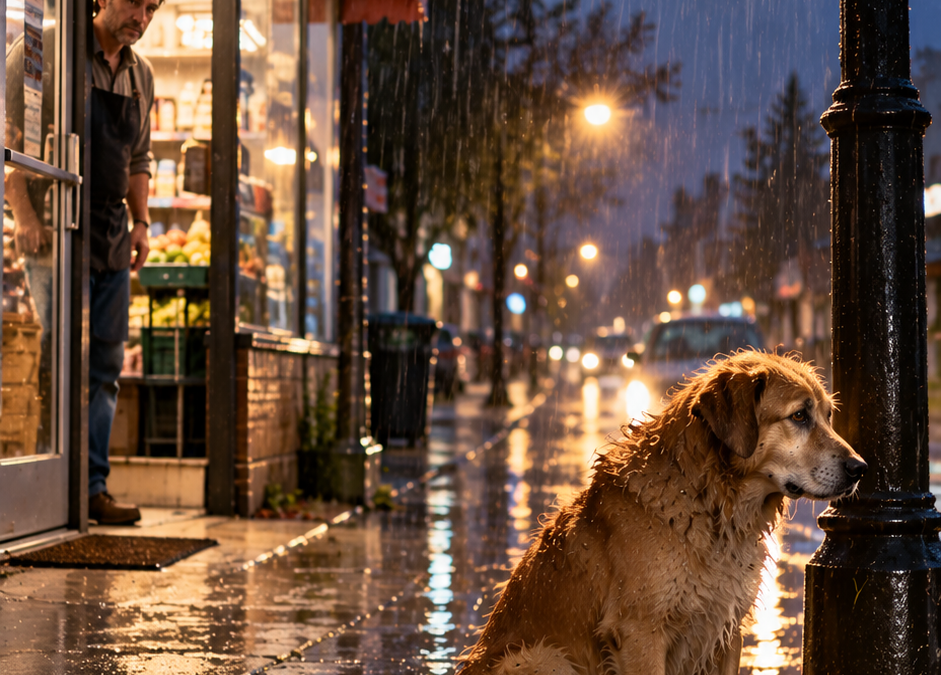
For more than a week, the same dog sat beneath the streetlight across from my grocery store, watching an empty road as if she were waiting for one specific person to notice her.
She never barked, never begged, and never came inside, even when the rain soaked through her coat and the cold drove everyone else off the sidewalk.
Then one morning, after I finally walked across the street toward her, she did something that made me lock my store in the middle of business hours and follow her into a part of town I had never seen before.
My name is Daniel Mercer, and for thirteen years I had opened the same little grocery store at 215 Oak Street every morning at exactly 6:15.
Not 6:10.
Not 6:20.
6:15.
People used to joke that you could set your watch by the sound of my key turning in the lock.
I liked that.
Routine made sense to me.
My store wasn’t impressive.
Four narrow aisles.
Two refrigerators that hummed louder than they should.
A freezer near the back that had needed replacing for at least five years.
A coffee machine by the register.
A produce rack that leaned slightly to the left no matter how many times I tightened the bolts.
But it was mine.
Every morning began the same way.
Lights on.
Coffee started.
Check the milk delivery.
Count the register.
Unlock the front door.
By 6:30, Mr. Hollis usually came in for a newspaper and black coffee.
At 6:45, two nurses from the clinic three blocks away bought yogurt and whatever energy drinks they claimed were keeping them alive.
At seven, construction workers started appearing.
At eight, parents came through after school drop-off.
Routine.
People think routines are boring.
They’re wrong.
Routine can become a kind of shelter.
You know what’s coming.
You know what you’re responsible for.
You know where every object belongs.
Maybe that’s why I noticed the dog immediately.
She didn’t belong to the pattern.
It was 6:15 on a Monday morning.
The sun hadn’t fully risen.
The streetlights were still glowing against the gray dawn.
I had just turned my sign from CLOSED to OPEN when I saw her.
She was sitting beneath the lamp directly across Oak Street.
Large dog.
Reddish-gold coat, though in that light it looked almost brown.
Her tail rested strangely behind her, bent near the middle as if it had been broken years before and never healed correctly.
One ear stood higher than the other.
Her head tilted slightly.
She stared down the street.
Not at me.
Not at the store.
At the road.
I stood behind the front window for a moment.
“Whose dog are you?”
Obviously, she couldn’t hear me.
Mr. Hollis came in five minutes later.
“Morning, Daniel.”
“Morning.”
He poured his coffee.
I nodded toward the window.
“You know that dog?”
He looked.
“What dog?”
“By the light.”
He squinted.
“Nope.”
“Thought maybe she belonged around here.”
“Could be.”
That was all.
People in a neighborhood see dogs all the time.
Someone leaves a gate open.
A leash slips.
A dog takes a walk nobody approved.
I assumed she’d be gone by breakfast.
She wasn’t.
By noon, she was still there.
Sometimes she lay down.
Sometimes she stood.
Mostly she sat.
Watching.
A customer left half a sandwich near her.
She sniffed it after the customer walked away but didn’t eat.
At three, a teenager tried to pet her.
She backed away.
No growl.
No barking.
Just distance.
Then she returned to the exact same spot under the lamp.
When I locked the store that evening, she was still there.
I stood in the doorway.
“Go home.”
She looked at me for the first time.
Then turned her eyes back toward the street.
I went home.
The next morning, she was there before I was.
Same place.
Same posture.
Waiting.
“You’re kidding.”
I crossed the street with a bowl of water.
She watched me approach.
I stopped several feet away.
“Easy.”
She didn’t move.
I set the bowl down.
“I’m not trying anything.”
Still nothing.
I backed away.
Only after I returned to the store did she drink.
That told me something.
She was thirsty.
But caution mattered more than thirst.
Someone had taught her that.
I didn’t like thinking about how.
By the third morning, several regular customers had noticed.
The nurses called her “Streetlight.”
Mr. Hollis called her “Red.”
A little boy named Caleb wanted to call her “Batman.”
I never got an explanation for that.
His mother pulled him away when he tried to cross the street.
“Don’t touch strange dogs.”
“I’m not strange,” Caleb protested.
“The dog.”
“Oh.”
The dog watched them leave.
Nothing interested her for long.
Only the road.
Every few minutes, she’d lift her head if a vehicle slowed.
If someone walked toward us from the far end of Oak Street, her ears would rise.
Then the person passed.
And she settled again.
At first, I thought she was waiting for an owner.
That was the obvious explanation.
So I took a picture and posted it online.
FOUND DOG – OAK STREET
Large female.
Golden-red coat.
Bent tail.
No visible collar.
I checked local missing-pet pages.
Nothing.
I called the shelter.
They said they were already overcrowded.
“Can you bring her in?”
“She won’t come near me.”
“Is she aggressive?”
“No.”
“Then keep offering water. We’ll send someone if we get an opening.”
Nobody came.
On the fourth morning, it rained.
Not hard.
Portland-style rain.
Steady enough that everything looked permanently damp.
The dog remained under the lamp.
I found an old piece of cardboard and slid it beneath the small awning of the closed storefront beside mine.
She ignored it.
Wouldn’t leave the lamp.
“That’s shelter.”
She stared.
“You’re deliberately making this difficult.”
No reaction.
I put food near the water bowl.
Chicken.
Not dog food.
Real chicken.
She ate after I left.
That became our arrangement.
I provided things.
She accepted them only when I wasn’t looking too closely.
By day five, I had started checking the window before doing almost anything.
Unlock store.
Check dog.
Start coffee.
Check dog.
Delivery arrives.
Check dog.
Customer complains that avocados are too expensive.
Check dog.
She was always there.
It bothered me more each day.
Not because she was causing trouble.
Because she wasn’t.
A barking dog would’ve been easier.
A frightened dog scratching at the door would’ve given me a clear problem to solve.
She wanted nothing from me.
At least, nothing obvious.
She waited.
And waiting is unsettling when you don’t know what for.
On the sixth evening, I walked across the street after closing.
She stood when I came near.
I stopped.
“Look.”
I pointed down Oak Street.
“If you’re waiting for somebody, I don’t think they’re coming.”
She watched me.
I immediately regretted saying it.
“What do I know?”
Her head tilted.
“Exactly.”
I placed a piece of bread near her.
“Good night.”
I walked away.
Halfway to my car, I looked back.
She wasn’t eating.
She was watching me.
The seventh morning was colder.
The eighth, wind came hard between the buildings.
The dog curled into herself.
I found an old blanket in the stockroom.
Took it across the street.
She backed away while I spread it.
Then returned after I left.
By the time I looked again, she was lying on it.
That small victory affected me more than it should have.
“You’re welcome.”
Mr. Hollis followed my gaze.
“You getting attached?”
“No.”
He smiled.
“Sure.”
“I don’t even know her.”
“Doesn’t always stop people.”
“Finish your coffee.”
He laughed.
Then came the ninth morning.
Rain hammered the street before dawn.
Not the steady drizzle we’d had earlier in the week.
Real rain.
Heavy drops bouncing off the pavement.
Water rushed along the curb.
Wind pushed trash against parked cars.
When I arrived at 6:12, I assumed she would finally be gone.
No animal would choose to sit beneath an exposed streetlight in that weather.
I parked.
Looked across the road.
She was there.
Soaked.
Head lowered.
Tail tucked close to her body.
Waiting.
Something inside me shifted.
“Enough.”
I opened the store.
Turned on the lights.
Didn’t bother making coffee.
I grabbed a package of dog biscuits from the pet shelf.
Then crossed Oak Street.
Rain ran into my collar immediately.
The dog lifted her eyes.
I approached slowly.
“Morning.”
Her ears moved.
For nine days, she had mostly looked through me.
That morning, she looked directly at me.
I saw how tired she was.
Not sleepy.
Exhausted.
The kind of exhaustion that lives deeper than muscles.
Her ribs were more visible than they had been at the beginning of the week.
Her coat clung to her body.
Her paws were muddy.
I crouched several feet away.
“You’re going to get sick sitting out here.”
Nothing.
I took out a biscuit.
Set it on the pavement.
She didn’t look at it.
“That’s insulting.”
Her eyes stayed on mine.
“What do you want?”
She stood.
Slowly.
I froze.
She didn’t approach me.
Instead, she crossed the street.
Reached my side.
Then continued past me.
After maybe twenty feet, she stopped.
Turned.
Looked back.
I remained near the lamp.
She waited.
“Seriously?”
She took three more steps.
Stopped again.
Looked back.
Something about the movement was deliberate.
Not wandering.
Not leaving.
Asking.
“You want me to follow you.”
The dog turned forward.
Started walking.
I looked at my store.
Lights on.
Door unlocked.
Register ready.
It was 6:25.
Any minute, Mr. Hollis would show up.
Then nurses.
Then delivery drivers.
For thirteen years, I had never voluntarily left my store during opening hours without someone covering.
Routine.
Responsibility.
Common sense.
All of them told me to stay.
The dog stopped again.
Rain streamed off her ears.
She looked back.
There are moments when your life gives you no dramatic sign that a decision matters.
No music.
No warning.
Just a wet dog looking over her shoulder.
I ran into the store.
Locked the register.
Turned off the coffee machine.
Placed a handwritten sign on the door.
BACK SOON – EMERGENCY
Then I locked up.
When I returned outside, the dog was still waiting.
“All right.”
Her tail moved once.
“Show me.”
She started walking.
I followed.
We headed east along Oak Street.
The rain made the sidewalks shine beneath the lamps.
The dog moved slowly enough for me to keep pace.
Every few minutes, she looked back.
Not nervously.
Checking.
Making sure I hadn’t changed my mind.
“I haven’t.”
She kept moving.
We turned onto Birch Lane.
I’d lived and worked in that neighborhood for thirteen years.
I had never gone down Birch Lane.
It was mostly warehouses and old industrial buildings.
Half of them were empty.
The dog moved like she knew every crack in the pavement.
Left.
Then right.
Through a narrow alley.
Across a vacant lot.
Twenty minutes passed.
My jacket was soaked.
My shoes filled with water.
I started wondering what exactly I was doing.
Following a dog into an abandoned industrial area before seven in the morning.
A smart man would’ve called animal control.
A smarter man would’ve stayed at work.
But every time doubt rose, she looked back.
Something in those eyes kept me moving.
Not desperation exactly.
Determination.
As if she’d tried one plan for nine days and finally, finally, one human had responded correctly.
After roughly twenty-five minutes, we reached an old auto garage.
The building looked abandoned.
A faded sign hung crooked above the entrance.
Several windows were broken.
One garage bay door had collapsed halfway inward.
Weeds grew through cracks in the parking lot.
The dog walked directly toward a side entrance.
“You’re kidding.”
She slipped through.
I stopped.
Glass covered the floor inside.
“Great.”
Her head appeared around the doorway.
“Yeah, yeah.”
I entered.
The smell hit first.
Mildew.
Old oil.
Wet concrete.
Rust.
Somewhere water dripped steadily from the roof.
The dog moved through the garage.
Around a broken workbench.
Down a narrow corridor.
I followed carefully, trying not to step on glass.
“Where are we going?”
She disappeared around a corner.
Then I heard it.
A tiny sound.
Almost nothing.
A squeak.
Then another.
I stopped.
The dog appeared in a doorway.
She looked at me.
And I understood that whatever she had been trying to show me was inside.
I walked toward her.
The room must once have been a storage area.
No windows.
Part of the ceiling sagged.
Cardboard boxes were stacked against one wall.
Old rags and fabric had been gathered into a makeshift nest.
And inside that nest were five puppies.
I couldn’t move.
Five.
Tiny.
Eyes still closed.
Bodies no bigger than my hands.
They pressed against one another for warmth.
One made a weak squeaking sound.
The dog went immediately to them.
Not a stray dog.
A mother.
“Oh.”
That one word was all I managed.
She lowered herself beside the puppies.
They began searching for her.
She licked one.
Then another.
And suddenly the entire week made sense.
She hadn’t been waiting for someone to come get her.
She had been waiting for someone to follow.
Nine days beneath the streetlight.
Not because she had nowhere else to go.
Because she needed to return here.
To them.
But she also needed help.
And apparently the busiest place she had found was my little grocery store.
My knees weakened.
I crouched.
“You’ve been leaving them every morning.”
She watched me.
“For me?”
Of course I couldn’t know that.
Maybe she’d tried other places.
Maybe the streetlight was simply the safest visible spot.
Maybe she’d learned people entered my store early.
Maybe she had no plan in any human sense.
But she had gone there.
Day after day.
Sat.
Waited.
Returned to the garage.
Then done it again.
I looked closely at the puppies.
They were cold.
Not freezing, but colder than they should’ve been.
The nest was damp at the edges.
Rain had worked its way through the damaged building.
Their mother was painfully thin.
Now that I knew she was nursing, her condition looked even worse.
Her body had been feeding five puppies while she barely fed herself.
“How have you done this?”
She lowered her head.
One puppy crawled clumsily toward her belly.
I touched the nearest one with two fingers.
Warm enough.
Alive.
Weak.
I didn’t know what newborn puppies were supposed to look like.
I knew they needed warmth.
Fast.
I pulled off my raincoat.
Opened it across my lap.
One by one, I lifted the puppies.
The mother stood immediately.
Her body tightened.
“Easy.”
I stopped.
She watched my hands.
“I’m helping.”
I moved more slowly.
First puppy.
Then second.
Third.
Fourth.
Fifth.
I tucked the edges of the raincoat around them, creating a warm pocket against my body.
The mother approached.
Sniffed each one.
Licked their heads.
Then looked at me.
I will remember those eyes as long as I live.
For nine days, I’d seen patience in them.
That morning, I saw relief.
Not complete relief.
Mothers don’t relax while their babies are being held by strangers.
But enough.
I pulled out my phone.
Margaret answered on the fourth ring.
“What happened?”
No hello.
Margaret ran the North Millford Animal Rescue and knew that if I called before seven in the morning, something had gone wrong.
“I need help.”
“With what?”
“A dog.”
Pause.
“You adopted a dog?”
“No.”
“You said you’d never own a dog.”
“Margaret.”
“Okay. What’s happening?”
“I followed one.”
Longer pause.
“You followed a dog.”
“Yes.”
“Where?”
I looked around.
“Abandoned garage off Birch Lane.”
“Daniel, what are you doing?”
“Apparently making bad decisions.”
“Is the dog hurt?”
“She’s got puppies.”
“How many?”
“Five.”
“How old?”
“I have absolutely no idea.”
“Eyes open?”
“No.”
“Are they warm?”
“Not really.”
Her voice changed instantly.
“I’m coming.”
“Bring everything.”
“I know.”
She arrived forty minutes later.
Those forty minutes felt longer than nine days.
I sat on the floor with the puppies inside my coat.
Their mother lay close enough that her shoulder touched my knee.
That was the first time she’d voluntarily touched me.
I talked to her because silence made me nervous.
“Margaret is good.”
The dog looked at me.
“She’s bossy.”
One ear moved.
“But good.”
A puppy squeaked.
She immediately lowered her head.
“See? They’re okay.”
She licked my wrist.
I swallowed.
“You’re a hell of a mother.”
When headlights finally appeared through the broken windows, I almost laughed from relief.
Margaret came in carrying blankets and a large crate.
Another volunteer followed with supplies.
Margaret stopped when she saw us.
“Oh, sweetheart.”
She wasn’t talking to me.
She crouched near the mother.
“Look at you.”
The dog stayed beside me.
Margaret looked at the puppies.
“Newborn. Maybe a few days old.”
“Can they survive?”
She gave me a look.
“We don’t ask that first.”
“What do we ask?”
“What do they need right now?”
I nodded.
“Right.”
“Warmth. Food. Medical exam.”
She looked at the mother.
“And she needs calories immediately.”
We transferred the puppies into a padded carrier with heated packs beneath layers of towels.
The mother refused to enter at first.
She stood beside the carrier, looking from Margaret to me.
I crouched.
“Go.”
Nothing.
“Your babies are in there.”
She looked at me.
“Trust her.”
I touched Margaret’s shoulder.
“She’s annoying but competent.”
Margaret glared at me.
The dog’s tail moved faintly.
Then she stepped inside.
Margaret closed the carrier carefully.
“I heard that.”
“Drive.”
The rescue facility was warmer than my store ever managed to be in winter.
The family received a quiet room.
Clean bedding.
Water.
Food.
Margaret placed a bowl in front of the mother.
She sniffed it.
Looked toward the puppies.
Didn’t eat.
I sat beside her.
“Come on.”
She looked at me.
“You made me abandon my store.”
Nothing.
“I’ve walked twenty-five minutes in the rain.”
Nothing.
“I ruined good shoes.”
One ear twitched.
“Eat.”
She lowered her head.
One bite.
Then another.
Soon she was eating steadily.
Not frantically.
She’d take several bites, stop, check the puppies, then eat again.
When she finished, she drank.
Then she lay beside the litter.
The puppies pressed against her.
For the first time since I’d met her, her head dropped completely onto the blanket.
Her eyes closed.
She slept.
Not the light sleep I’d seen under the streetlight.
Not waiting.
Not alert.
Real sleep.
I sat outside the room.
Margaret came over with two coffees.
“You know the store is probably full of angry people.”
“I know.”
“Want me to call someone?”
“I already called my cousin.”
“You have an employee now?”
“For one morning.”
She handed me coffee.
“You’re keeping one.”
“No.”
“You will.”
“I’m not a dog person.”
Margaret looked through the glass.
The mother was sleeping.
“Sure.”
I hated how often people said that to me.
The next morning, I arrived at the rescue before opening the store.
Then again at lunch.
Then after closing.
By the third day, Margaret stopped asking why I was there.
I brought treats for the mother.
Not that she needed them.
She had plenty of food.
I simply didn’t know how else to arrive.
The puppies changed quickly.
That surprised me.
One day, they looked like helpless little potatoes.
The next, they were stronger.
Then their eyes opened.
I happened to be there when the first one tried to stand.
He pushed himself onto four legs.
Wobbled.
Fell directly onto his brother.
“Impressive.”
Margaret laughed.
“Give him time.”
The mother watched everything.
Her coat improved.
Her ribs became less visible.
Her movements gained energy.
And she started greeting me.
At first, one tail movement.
Then two.
Eventually, she’d stand when I entered.
That felt like being promoted.
Three weeks after the rescue, I finally named her.
Margaret had been writing “Oak Street Mom” on her medical paperwork.
“That’s terrible.”
“Then name her.”
I looked through the glass.
The dog was lying beside her puppies while two of them climbed over her front legs.
I thought about nine mornings under that lamp.
Rain.
Cold.
Hunger.
She kept returning.
Kept waiting.
Kept trying.
“Hope.”
Margaret looked at me.
“Hope?”
“Yeah.”
“That’s sentimental.”
“Delete my number.”
She smiled.
Hope.
The name stayed.
And somehow it fit.
By the time the puppies were old enough to explore, the quiet rescue room became chaos.
Five puppies.
Five sets of teeth.
Five different personalities.
The golden male was fearless.
If there was a box, he climbed it.
If there was a shoe, he attacked it.
If there was a person, he ran straight toward them.
The black-and-white female liked laps.
Any lap.
Didn’t care who owned it.
A brown pup with white paws seemed convinced every toy belonged to him.
The smallest was shy.
He watched everyone before deciding whether they were safe.
And the fifth—
The fifth followed me.
Everywhere.
Little reddish-brown male.
Quick eyes.
Fast legs.
Any time I arrived, he somehow knew.
He’d run toward the enclosure.
Jump.
Fall.
Get up.
Try again.
“Don’t start,” I told Margaret the first time she noticed.
“I didn’t say anything.”
“Your face did.”
“What did my face say?”
“You’re keeping that puppy.”
She smiled.
“Interesting.”
“I’m not.”
“Of course.”
“Seriously.”
“Absolutely.”
I lasted until adoption week.
Two months had passed.
The puppies were healthy enough to find homes.
Margaret screened applicants carefully.
The first golden male went to an older couple recently retired.
They told me they were buying a camper.
“We want a dog who’ll enjoy traveling.”
I looked at the puppy, who was attempting to climb the husband’s pant leg.
“He’ll drive.”
The woman laughed.
The black-and-white female went to a young nurse named Maria.
She lived alone.
When the puppy climbed into her lap and immediately fell asleep, Maria started crying.
“Sorry.”
Margaret gave her a tissue.
“You don’t have to apologize.”
Maria looked down at the puppy.
“My apartment has felt empty for years.”
I understood that better than I expected.
The energetic brown puppy went to a family with three kids.
I worried about that one for approximately five seconds.
The children sat on the floor.
The puppy launched himself into the middle of them.
Done.
The shy one went to a writer named Stephen.
Quiet man.
Soft voice.
He sat near the kennel for almost an hour without trying to force contact.
Eventually, the puppy walked over.
Placed one paw on his shoe.
Stephen looked at Margaret.
“Does that mean anything?”
“It means don’t move.”
He didn’t.
Five minutes later, the puppy was sitting beside him.
“I think he picked you.”
Stephen smiled.
“That’s good.”
“Why?”
“I wasn’t sure I knew how to pick him.”
Then there was one puppy left.
Mine.
I mean—
The remaining puppy.
He stood beside my shoe.
Looking up.
Margaret crossed her arms.
“No.”
She hadn’t said anything.
“No.”
Still nothing.
“I have a store.”
“Yes.”
“Food everywhere.”
“Yes.”
“Health regulations.”
“Dog can stay away from food prep areas.”
“I work twelve-hour days.”
“You live above the store.”
“That’s irrelevant.”
The puppy sat on my foot.
Margaret looked down.
Then at me.
“Completely irrelevant.”
I sighed.
The puppy’s tail moved.
“Fine.”
Margaret grinned.
“Fine what?”
“Don’t make me say it.”
“I need paperwork.”
I crouched.
The puppy licked my chin.
I named him Jack.
Don’t ask why.
Unlike Barley or Hope, there was no philosophical meaning.
He looked like a Jack.
Sometimes names work that way.
Hope still needed a home.
That worried me more than I admitted.
People wanted puppies.
Older dogs were harder.
Older mothers sometimes stayed at shelters for months.
Hope wasn’t ancient, but she’d been through enough that Margaret wanted the right person.
Not simply someone willing.
Someone right.
Then Sarah arrived.
She came on a Saturday afternoon.
Mid-forties.
Simple coat.
Nervous.
She told Margaret she’d wanted a dog for years.
Why hadn’t she adopted one before?
“Timing.”
Sarah smiled awkwardly.
“I always thought there’d be a better time.”
I was stocking donated food nearby and pretending not to listen.
Margaret asked,
“And now?”
Sarah looked toward Hope.
“Now I think maybe waiting for the perfect time is just another way of being afraid.”
Hope had been lying in her bed.
She stood.
Walked toward Sarah.
Stopped.
Sarah crouched.
Didn’t reach immediately.
Good.
Hope approached.
Sniffed.
Then pressed her head against Sarah’s chest.
Sarah’s eyes filled instantly.
“Oh.”
She wrapped her arms around Hope.
Not tightly.
Just enough.
Hope stayed.
Sarah whispered something.
I was close enough to hear.
“I think I’ve been looking for you too.”
I turned away.
Margaret found me a minute later.
“You crying?”
“No.”
“Your eyes are red.”
“Allergies.”
“To what?”
“Animal rescue administrators.”
She laughed.
Hope went home with Sarah two days later.
Before she left, I crouched beside her.
Jack was in my arms.
Hope sniffed him.
Licked the top of his head.
Jack tried to bite her ear.
She ignored him.
“Good luck,” I whispered.
Hope looked at me.
There are moments when humans want animals to understand much more than we can know they do.
I wanted her to understand everything.
The lamp.
The rain.
The walk.
The garage.
The fact that she’d changed my life without ever intending to.
I settled for scratching behind her ear.
“You did good.”
Her tail moved.
Then she left with Sarah.
That evening, I returned to Oak Street.
Jack was in a carrier beside me.
I parked near the store.
Before going inside, I stood beneath the streetlight.
The pavement was dry.
No dog.
Just an ordinary lamp.
Cars.
Storefronts.
A few pedestrians.
For nine days, that spot had been the center of Hope’s world.
Or mine.
I wasn’t sure anymore.
Jack whined from the carrier.
“Coming.”
I unlocked the store.
He became part of the place almost immediately.
His bed went beside the counter.
Customers complained if he wasn’t there.
Caleb—the little boy who’d wanted to name Hope Batman—was especially offended by my naming decision.
“Jack is boring.”
“Your suggestion was Batman.”
“Batman is good.”
“He isn’t a bat.”
“Batman isn’t a bat.”
I had no response.
Jack grew.
Fast.
Every morning at 6:15, he was awake before I was.
The moment I touched the store keys, his tail started moving.
He knew the routine.
Unlock.
Lights.
Coffee.
Register.
Customers.
Except now there was another step.
Scratch Jack behind the ears.
If I forgot, he reminded me.
Loudly.
The store changed too.
Not financially.
Not dramatically.
It felt different.
Warmer.
People stayed longer.
Kids begged their parents to come in.
Older customers talked to Jack as though he worked there.
Mr. Hollis started bringing him pieces of cheese.
I objected.
“Stop feeding my employee.”
“He needs benefits.”
“He’s already overpaid.”
Jack sat beside him.
Traitor.
Sarah sent pictures of Hope.
First from her backyard.
Then asleep on a couch.
Then walking through a park.
Her coat became glossy.
She gained weight.
In one photo, she was stretched across Sarah’s bed looking entirely too comfortable.
The message underneath said:
I think she owns the house now.
I responded:
She earned it.
Sometimes Sarah brought Hope by the store.
Those visits were chaos.
Jack could somehow recognize her before she entered.
He’d lose his mind.
Hope walked in with more dignity.
Then Jack attacked her with affection.
She tolerated him.
Barely.
The first time Hope returned to Oak Street, I wondered what she’d do when she saw the streetlight.
She noticed it.
I know she did.
Her head turned.
She stared at the place where she’d spent those mornings.
For several seconds, she didn’t move.
Sarah looked at me.
“Is that where?”
“Yeah.”
Hope walked over.
Sniffed the base of the pole.
Then came back.
That was it.
No sadness.
No longing.
She didn’t need the place anymore.
That taught me something too.
Hope hadn’t been sitting there because she was attached to suffering.
She had been using every ounce of patience she had to get somewhere else.
Once she got there, she moved on.
I think humans could learn from that.
For years, I had mistaken endurance for strength.
I worked every day.
Opened the store.
Closed the store.
Paid bills.
Repeated.
If something went wrong, I handled it.
If I felt tired, I ignored it.
If I was lonely, I called it independence.
Hope complicated that.
She survived because she waited for help.
She didn’t surrender.
She didn’t abandon her puppies.
But she also didn’t pretend she could solve everything alone.
She sat in the most visible place she could find.
And waited for someone to notice.
There is courage in that.
Maybe more than I understood.
People like to imagine heroes charging forward.
Sometimes heroism looks like staying still.
Nine mornings beneath a lamp.
Rain soaking your coat.
Hunger gnawing at you.
Five newborn lives hidden in a ruined building.
And still believing eventually someone will look closely enough to understand.
I almost didn’t.
That’s the part I remember.
I saw Hope the first morning.
And the second.
Third.
Fourth.
Every day, I noticed her.
But noticing isn’t the same as seeing.
For days, I asked:
Why is that dog sitting there?
I didn’t ask:
What is she trying to tell me?
There’s a difference.
On the ninth morning, something changed.
Maybe she changed.
Maybe I did.
She got up.
Walked away.
Looked back.
And I followed.
That’s all.
No special skill.
No great act of courage.
I followed.
Sometimes the most important thing you do starts that simply.
Jack is older now.
Not the tiny puppy who slept beside the register.
He has grown into a lean, energetic dog who still believes every delivery box exists specifically for his inspection.
He knows which customers carry treats.
He knows when school gets out.
He knows exactly how long he can stare at me before I surrender part of my lunch.
Every morning, I open the store at 6:15.
Same as always.
The old refrigerator still hums.
The streetlight still flickers occasionally.
Mr. Hollis still complains about prices.
The nurses still buy unhealthy energy drinks while telling everyone else to take care of themselves.
Life looks almost the same.
But it isn’t.
Jack sleeps near my feet.
A photograph of Hope and her five puppies hangs behind the counter.
Customers ask about it sometimes.
“What’s the story?”
I usually smile.
“Long one.”
Some know already.
Some don’t.
I don’t tell it every time.
Certain memories don’t need constant retelling to remain important.
At night, after I lock the store, I step outside.
Most evenings, I pause near the lamp.
Just for a second.
Cars pass.
People hurry home.
Sometimes rain falls exactly the way it did that morning.
I look down at the pavement.
I can still picture her there.
Soaked.
Thin.
Silent.
Eyes fixed on the road.
Waiting for one person to understand.
Then I think about the garage.
Five tiny bodies inside my coat.
Hope watching every movement.
Margaret arriving with blankets.
Sarah kneeling at the shelter.
Jack asleep beside my register.
All of it began with a dog who never barked for help.
She simply kept showing up.
And eventually, so did I.
For thirteen years before Hope, I believed my little store survived because I understood routines.
Open at 6:15.
Stock shelves.
Serve customers.
Close.
Repeat.
Now I think the most important morning of my life was the one when I broke the routine.
Locked the door.
Stepped into the rain.
And followed a silent dog without knowing where she was taking me.
Hope didn’t teach me that everything turns out perfectly.
It doesn’t.
She taught me something smaller and more useful.
When something living keeps showing up in front of you, pay attention.
Sometimes need doesn’t shout.
Sometimes it doesn’t know how.
Sometimes it sits quietly beneath a streetlight while the whole world walks past.
And sometimes all it needs is one person willing to stop asking why it’s there—
and finally follow.




