𝗙𝗨𝗟𝗟 𝗦𝗧𝗢𝗥𝗬 For Eighteen Months, Our Golden Retriever Waited at the Gate Every Morning for a Man the Rest of Us Had Almost Stopped Expecting
𝗣𝗔𝗥𝗧 𝟮
I don’t know why I said it.
Maybe because hope had become dangerous.
After eighteen months, I had learned to protect myself from it.
A man resembling James at the supermarket?
Don’t look twice.
A late phone call?
Don’t imagine.
An unexpected military vehicle?
Wait for someone to speak.
Hope can destroy you when it arrives repeatedly without evidence.
So I said no before anything had happened.
“No.”
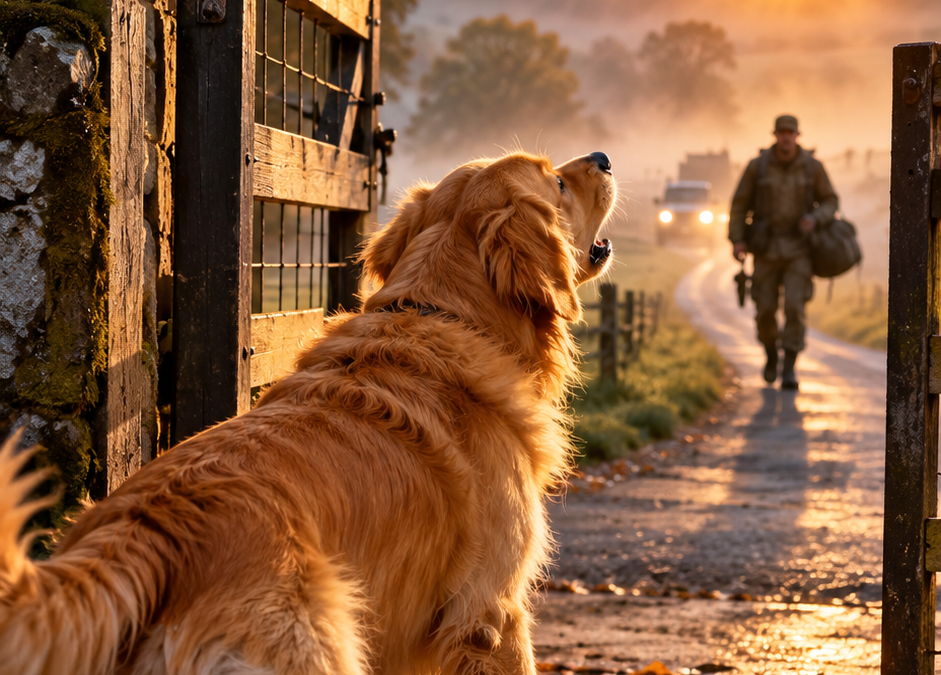
The truck stopped directly in front of our gate.
Its engine remained on for several seconds.
Then shut off.
Silence filled the street.
Bonnie sat perfectly still.
I heard my own breathing.
The driver’s door opened.
Slowly.
A boot appeared.
A worn hiking boot.
Dust ground deep into the leather.
Then another.
A leg.
Faded military trousers.
Not a formal uniform.
No insignia.
No polished boots.
No clear markings.
Just clothing that looked as though it had traveled too far.
The man stepped down.
For one terrible second, I did not recognize him.
He was too thin.
That was the first thing.
James had always been lean, but strong.
This man looked as though something had carved weight away from him.
His face was darker from sun.
Cheekbones sharper.
A beard covered his jaw.
His hair had grown longer.
Dark circles sat beneath his eyes.
He wore an old military-style jacket with no insignia.
My brain rejected him.
Then he looked up.
Green eyes.
The same green eyes I had fallen in love with twenty-two years earlier.
Everything inside me broke.
And somehow healed at the same time.
“James.”
I don’t know whether I said it aloud.
He stood beside the truck.
Didn’t move.
He looked at the house.
At me.
At Bonnie.
His expression changed when he saw her.
Bonnie made a sound.
Not a bark.
A tiny broken whine.
James dropped to his knees.
That was all it took.
Bonnie exploded.
There was a narrow space beneath part of the gate where she could squeeze if determined enough.
I had spent months trying to block it properly.
That morning, she was through before I could move.
A flash of gold.
Honey-colored fur.
Tail wild behind her.
She ran directly into James.
He opened his arms.
Bonnie hit him hard enough to rock him backward.
He caught her.
She climbed all over him.
Face.
Shoulders.
Chest.
Licking his cheeks.
His ears.
His hands.
Barking in short, broken sounds.
Crying.
Dogs can cry in ways that are not tears.
I heard it that morning.
It sounded like a creature trying to release eighteen months of waiting all at once.
James buried his face in her neck.
“I know.”
His voice cracked.
“I know, Bonnie.”
She licked him harder.
“I know.”
His shoulders shook.
“I know.”
He held her with both arms.
For months I had imagined James returning.
In some versions, I ran to him.
In others, I screamed.
Sometimes I slapped him because he had frightened us.
Sometimes I collapsed.
The real moment was nothing like any of them.
I stood behind the gate.
Frozen.
My hands shaking.
Tears running down my face.
Unable to move.
Because Bonnie had reached him first.
And somehow, that felt right.
She had waited most visibly.
She deserved the first embrace.
James looked over her head.
At me.
The world narrowed.
No truck.
No street.
No eighteen months.
Just those green eyes.
His lips moved.
“Sarah.”
That was when my knees nearly gave out.
I opened the gate.
Bonnie stayed pressed against him.
I walked toward my husband.
Walked.
I don’t know how.
James stood slowly.
Bonnie remained against his leg.
He looked at me like he was afraid to touch me.
Maybe he thought I wasn’t real.
Maybe I looked at him the same way.
“You…”
I couldn’t finish.
James swallowed.
“I’m sorry.”
I shook my head.
“No.”
“Sarah—”
“No.”
Not because I was angry.
Because apology was too small.
Questions were too small.
Words themselves seemed insulting.
I crossed the last few feet and put both hands against his face.
Bone beneath skin.
Beard rough under my palms.
Warm.
Real.
I cried harder.
“You’re alive.”
His eyes closed.
“Yes.”
“You’re alive.”
“I am.”
I hit his chest once with the flat of my hand.
Not hard.
Then again.
“You are alive.”
“I know.”
“Don’t say you know.”
A broken laugh escaped him.
Then I wrapped my arms around him.
James held me.
His body felt unfamiliar.
Thinner.
Harder in strange places.
But the way his hand moved onto the back of my head was exactly the same.
Twenty-two years collapsed.
Bonnie moved around our legs.
Whining.
Making sure no one disappeared again.
Inside the house, something moved.
A door.
Then footsteps.
Nathan.
He stepped onto the porch half asleep.
Hair wild.
Wearing an old T-shirt.
He stared at us.
At first, confusion.
Then fear.
Then recognition.
His entire face emptied.
He looked at me.
At James.
At Bonnie.
“Who…”
His voice stopped.
He knew.
Of course he knew.
Children recognize their parents even after time has changed the surface.
James turned.
Nathan took one step.
“Papa?”
The word came out barely audible.
James’s face collapsed.
“My son.”
Nathan had grown during those eighteen months.
That hurt me suddenly.
James was seeing it all at once.
Height.
Shoulders.
Older face.
The boy he’d left was not exactly the one standing there.
Nathan walked toward him.
Then faster.
James reached.
Nathan hit him with both arms.
Hard.
James grunted.
Then laughed.
Actually laughed.
“My son.”
Nathan buried his face against his shoulder.
“I thought—”
He couldn’t finish.
James put one hand behind his head.
“I know.”
“I thought you were dead.”
“I know.”
“Where were you?”
“Later.”
Nathan pulled back.
Looked at his father’s face.
Touched his beard like he couldn’t believe it.
“You look terrible.”
James laughed again.
“You got taller.”
“That’s your response?”
“It was the first thing I noticed.”
Nathan began crying.
Teenage boys like to imagine there is dignity in controlling tears.
That morning there was none.
He cried like the child James had once carried.
And James held him.
Bonnie sat beside them.
Proud.
That is the word I would use.
Proud.
As if all of us had finally caught up with what she had known.
Emily wasn’t home.
That realization struck me suddenly.
“Emily.”
James looked at me.
“School.”
He breathed her name.
“Emily.”
“I’ll call.”
“No.”
He stopped me.
“Can we…”
His voice shook.
“Can we let her come home?”
I understood.
He wanted to see her enter the house.
Wanted one reunion that was not delivered through a phone.
So we waited.
It was the strangest few hours of my life.
James came inside.
Bonnie followed so closely she almost stepped on his heels.
He stopped in the entryway.
Looked around.
Same coat hooks.
Same framed photographs.
Same scratches in the wall near the staircase.
His eyes moved slowly.
“I thought about this hallway.”
I took his hand.
He squeezed mine.
In the kitchen, the coffee had gone cold.
James saw his chair.
The chair I looked at every morning.
His hand rested on the back.
He didn’t sit immediately.
Just touched it.
Nathan stood in the doorway watching him as if he were afraid blinking might make him vanish.
Bonnie lay on James’s feet.
Not near them.
On them.
He bent down.
“Comfortable?”
Tail.
Nathan laughed through tears.
“She waited at the gate every day.”
James looked at him.
“What?”
I pulled out a chair.
“Every morning.”
James stared at me.
“For how long?”
“Since you disappeared.”
His eyes moved to Bonnie.
The dog looked up.
“Every day?”
Nathan nodded.
“Rain too.”
James swallowed.
“Snow?”
“Mom tried to bring her inside.”
“She hated me for it.”
Nathan corrected, “Bonnie hated everyone for interfering with her schedule.”
James’s hand covered his mouth.
He looked down.
Bonnie stood.
Pressed her head into his knees.
He touched her.
“Every day.”
I watched his eyes fill again.
“She knew.”
I said it quietly.
James looked at me.
“I stopped knowing.”
The sentence hurt.
I reached across the table.
“We didn’t stop loving you.”
“I know.”
“But we stopped knowing what to believe.”
He nodded.
“That’s different.”
Bonnie lay down again.
James finally sat.
The chair creaked.
A completely ordinary sound.
I nearly cried at that too.
For eighteen months, grief had turned everything associated with James into a relic.
Now he was sitting in the chair like it had never been empty.
“Coffee?”
I asked.
His face changed.
“Please.”
I turned toward the counter.
My hands shook so badly I spilled grounds.
James noticed.
“Sarah.”
“Don’t.”
“I’m okay.”
“You’re not.”
“No.”
I looked at him.
“You’re sitting in my kitchen after being missing for eighteen months. I am allowed to make terrible coffee.”
He smiled.
Same smile.
Older.
Tired.
But James.
Nathan laughed.
“She already makes terrible coffee.”
“Thank you,” I said.
James looked at him.
“I raised you better.”
“You’ve been gone.”
Silence.
Nathan’s face changed immediately.
Regret.
James looked down.
I stepped in.
“No.”
Nathan whispered, “Sorry.”
James shook his head.
“Don’t apologize.”
“But—”
“You get to be angry.”
Nathan stared.
James continued.
“All of you do.”
I placed the cup in front of him.
He wrapped both hands around it.
For several minutes, no one spoke.
Then James took a sip.
Made a face.
Nathan burst out laughing.
“There.”
He pointed.
“That’s definitely Dad.”
I started laughing too.
Then crying.
Then laughing again.
James joined us.
Bonnie wagged her tail under the table.
There are moments when joy is not clean.
It arrives mixed with rage.
Relief.
Fear.
Confusion.
The body doesn’t know which emotion deserves the room, so it lets all of them in.
That morning our kitchen contained everything.
At three in the afternoon, Emily came home.
I heard the front door.
“Mom?”
Her backpack dropped.
“I’m starving.”
She walked toward the kitchen.
James stood before I could decide whether to warn her.
Emily entered.
Stopped.
She looked at him.
No movement.
Her face became pale.
James said her name.
“Emily.”
Her knees buckled.
I caught her arm.
She pulled away from me.
“Dad?”
James nodded.
She screamed.
Not from fear.
A raw sound.
Then she ran.
James barely had time to brace himself.
She wrapped both arms around his neck.
He held her.
Emily sobbed so hard she couldn’t breathe properly.
“You were dead.”
“No.”
“They said—”
“I know.”
“They didn’t know.”
“I know.”
“I hated you.”
James closed his eyes.
“I know.”
“I hated you for leaving.”
“I know.”
Then she hit him.
Once.
His shoulder.
Again.
“You left.”
“I didn’t choose—”
Another hit.
Then she collapsed against him again.
“I’m sorry.”
“No.”
James held her face.
“You don’t apologize for any of it.”
Emily cried.
Bonnie pushed herself between them.
Emily laughed through tears.
“Oh, now you get him too?”
Bonnie’s tail became a blur.
“She earned it.”
James’s voice was soft.
That evening, all four of us sat around the kitchen table.
Five, if you counted Bonnie, which James always did.
Nobody ate much.
We asked questions.
Then stopped asking because the answers were too large.
Finally, I said the only one that mattered most.
“How?”
James stared into his coffee.
“How did I get back?”
“Yes.”
Nathan leaned forward.
Emily held her arms around herself.
James took a long breath.
“I could tell you a lot.”
“Tell us.”
He looked at me.
“Not tonight.”
I wanted to object.
Then saw his face.
Whatever had happened during those eighteen months was still too close.
He continued.
“Captivity.”
The room went completely still.
“Escape.”
His voice remained flat.
“Embassies.”
He rubbed one thumb against the cup.
“False passports.”
Nathan stared.
“People who helped me when they had no reason to.”
James looked toward the window.
“I’ll tell you what I can. Eventually.”
I nodded.
That was enough.
Then he said, “There is one thing I know.”
“What?”
He looked down at Bonnie.
“I knew someone was waiting.”
My throat tightened.
“Us.”
“Maybe.”
He looked ashamed.
“I didn’t know.”
Emily flinched.
James noticed.
“No. Listen.”
His voice strengthened.
“I didn’t know what eighteen months had done to you.”
He looked at me.
“I didn’t know whether Sarah would still want me.”
“James.”
“I didn’t.”
He looked at Nathan.
“I didn’t know whether you would forgive me for not coming back sooner.”
Nathan opened his mouth.
James continued.
“I didn’t even know whether this house still felt like mine.”
He rubbed Bonnie’s ear.
“But through all of it, I had this feeling.”
He searched for words.
“Someone, somewhere, kept looking in the direction I needed to come from.”
Nobody spoke.
James smiled faintly.
“I didn’t know it was her.”
Bonnie lifted her head.
“But maybe some part of me did.”
I watched him.
“What do you mean?”
“In the worst moments…”
He paused.
“I pictured the gate.”
My breath caught.
“The gate?”
“Yeah.”
“I pictured Bonnie sitting there.”
Nathan stared.
James continued.
“I knew what she was like.”
A small smile.
“Stubborn.”
Emily wiped her eyes.
James looked down at the dog.
“I thought, if she thinks I’m coming home, maybe I shouldn’t be the one to prove her wrong.”
Bonnie stood.
Placed both paws near his knee.
James bent down.
Pressed his forehead to hers.
“You stubborn old girl.”
Her tail moved.
That night, Bonnie did not sleep in her basket.
She did not sleep at the foot of my bed either.
She slept on James.
Literally.
He lay on the couch because he said he wasn’t ready for the bedroom yet.
I understood.
Too many memories.
Too much change.
So he stretched out under an old blanket.
Bonnie climbed onto him.
All seventy pounds of her.
“Bonnie.”
James laughed weakly.
She ignored him.
“You’re heavier.”
Tail.
“Sarah.”
“Don’t look at me.”
“Help.”
“She waited eighteen months.”
“That doesn’t make me furniture.”
“It might.”
Bonnie lowered her head onto his chest.
James stopped complaining.
His hand moved behind her ears.
Slow.
Automatic.
Like no time had passed.
I stood in the doorway.
James looked over.
“You okay?”
I almost laughed at the absurdity of the question.
“No.”
“Me neither.”
That was the first honest thing either of us said that night.
I crossed the room.
Sat on the floor beside the couch.
For a while, we watched Bonnie sleep.
Then James whispered:
“I thought about you every day.”
I looked at him.
“I was angry at you every day.”
“Good.”
“Good?”
“Better than forgetting me.”
I closed my eyes.
“I tried.”
He became still.
“I tried to imagine you dead.”
My voice broke.
“I thought if I could believe it, maybe I could start…”
I couldn’t say moving on.
It felt obscene with him lying three feet away.
James understood.
“You should have.”
“No.”
“Sarah.”
“No.”
“If I had died—”
“Stop.”
He did.
Bonnie opened her eyes.
Looked at me.
Then James.
Closed them again.
“I kept the chair.”
I said.
He smiled.
“I saw.”
“Nathan slept in your computer chair.”
“I saw that too.”
“Emily stopped talking about you.”
James’s face changed.
“Not because she forgot.”
“I know.”
“Because every time she talked about you, she broke.”
James stared at the ceiling.
“I know.”
“No.”
I touched his arm.
“You don’t. Not yet.”
He looked at me.
“And we don’t know what happened to you either.”
I swallowed.
“So maybe none of us says ‘I know’ for a while.”
He nodded.
“Okay.”
Bonnie sighed.
James smiled.
“She knows.”
I laughed.
“Apparently.”
I stayed there until after midnight.
James kept touching Bonnie as though reassuring himself she was real.
Sometimes she opened her eyes.
Checked him.
Went back to sleep.
The peace in her face was unlike anything I had seen in eighteen months.
All that waiting had left her body.
For the first time, she wasn’t listening for an engine.
Not watching a door.
Not ready to run toward the gate.
Her person was beneath her.
Mission complete.
The next morning, I woke before sunrise automatically.
For eighteen months, the first thing I did every morning was look out the kitchen window.
Bonnie at the gate.
Same image.
Same ache.
That morning, I went to the window.
The gate was empty.
For one terrible second, panic seized me.
Then I heard movement behind me.
James.
He stood at the counter making coffee.
Barefoot.
Hair still messy.
Wearing one of Nathan’s old sweatshirts because none of his clothes fit properly anymore.
Bonnie lay across his feet.
I stared.
James looked over.
“What?”
“The gate.”
He glanced toward the window.
“Something wrong?”
I shook my head.
“No.”
My eyes filled.
“It’s empty.”
He looked at Bonnie.
Understanding reached him.
“Oh.”
“For eighteen months, she was there.”
James set the spoon down.
Came toward me.
I watched Bonnie remain on the kitchen floor.
For once, no need to move.
James stood beside me.
We both looked at the empty gate.
“That’s good.”
I nodded.
“Yes.”
The waiting was over.
Not because hope had finally died.
Because it had been answered.
The days that followed were not simple.
That matters.
People like reunion stories because they imagine reunion is the ending.
It isn’t.
James had returned physically.
The rest of him came more slowly.
Some nights, he woke suddenly.
Disoriented.
Sweating.
Once he was halfway to the front door before he seemed to understand where he was.
Bonnie followed.
Not barking.
Just beside him.
He stood with one hand on the wall.
“James?”
He looked at me like he didn’t recognize me.
Then Bonnie touched his hand with her nose.
Something returned to his face.
“Home.”
I said softly.
He looked around.
“Home.”
The word seemed difficult.
Bonnie pressed against his leg.
He lowered himself onto the floor.
Stayed there until his breathing slowed.
Other days, James became silent for hours.
Nathan tried asking questions.
Emily wanted every detail.
I wanted answers too.
But the military had its process.
There were interviews.
Reports.
Medical evaluations.
People arriving with files.
People asking James to repeat pieces of his story.
Reporters eventually came.
At first, they waited politely outside.
Then phone calls multiplied.
Everyone wanted the story.
Missing soldier returns after eighteen months.
Captivity.
Escape.
Unexpected homecoming.
They wanted photographs.
Details.
Heroism.
James hated it.
One morning I found him standing behind the curtain while two reporters waited near the street.
His face looked almost like it had during those first hours home.
Closed.
Bonnie sat beside him.
“We don’t have to talk to them.”
“They’ll keep coming.”
“Let them.”
“They want a story.”
“They already have one.”
James looked down.
Bonnie’s head rested against his thigh.
“What story?”
I followed his gaze.
“That she waited.”
For the first time that morning, he smiled.
“Better story.”
Gradually, the attention faded.
That helped.
Ordinary life began returning.
Not the old ordinary.
A new one.
James had to relearn small things.
Sleeping in his bed.
Shopping.
Being in crowded places.
Hearing a car backfire without his body reacting before his mind.
Nathan had to relearn having a father who could tell him no.
Emily had to relearn that loving James did not require hovering over him constantly.
I had to relearn being a wife to a living man instead of a woman waiting for news.
Sometimes that was more difficult than I expected.
For eighteen months, every decision had been mine.
Bills.
Repairs.
Children.
School.
Appointments.
Everything.
Then James came home and reached for the coffee pot one morning.
“I can do that,” I said.
He looked at me.
“I know.”
I had not meant anything by it.
But we both heard more.
I had learned to survive without him.
He had returned wanting to belong.
Those truths collided in tiny moments.
“Sorry.”
I stepped aside.
He poured coffee.
Spilled some.
“Your hands?”
“Fine.”
They weren’t.
A tremor sometimes appeared.
Bonnie immediately noticed whenever it did.
She would place her head beneath his hand.
James said she made him look pathetic.
I told him she made him look loved.
He stopped arguing after that.
Weeks passed.
Then months.
James began working in the garden.
Slowly.
Nothing ambitious.
Tomatoes.
Herbs.
A few rows of vegetables.
Bonnie followed.
Always.
If he knelt, she sat nearby.
If he stood too quickly, she moved close.
Nathan secretly fed her bread crusts beneath the kitchen table.
I pretended not to notice.
Emily started laughing again.
Not immediately.
At first, every happy moment seemed to surprise her.
Then one evening James made some terrible joke during dinner.
Nathan groaned.
I rolled my eyes.
Emily laughed so hard water came out of her nose.
James froze.
Then laughed too.
And suddenly the house sounded like itself again.
Not because everything was fixed.
Because something living had returned to the rooms.
One afternoon, several weeks after James came home, I sat beside Bonnie in the yard.
James had gone inside to rest.
The dog lay in sunlight.
Her golden coat had begun whitening around the muzzle.
I ran my hand over her back.
“You knew.”
Tail.
“You ridiculous dog.”
She opened one eye.
“For eighteen months.”
Tail again.
“We gave up.”
That wasn’t entirely true.
We hadn’t abandoned James.
But hope had become too painful to hold at full strength.
So we had put parts of it down.
Bonnie never did.
I scratched behind her ears.
“You never stopped.”
Her eyes closed.
“You were smarter than all of us.”
She sighed.
I thought about the mornings I had tried to pull her away from the gate.
Cold mornings.
Rain.
Once snow.
“Come inside, Bonnie.”
She refused.
“He’s not coming today.”
She refused that too.
Eventually, I learned to leave a blanket near the gate on cold days.
Not because I believed James was coming.
Because Bonnie did.
That was the compromise grief forced on me.
I couldn’t share her certainty.
But I could respect it.
Now James was home.
And Bonnie’s faith looked almost like knowledge.
People asked me whether I thought dogs could sense things.
I didn’t know.
I still don’t.
Maybe Bonnie heard the truck before I did that morning.
Maybe she recognized an engine vibration.
A smell.
Something on the wind.
Maybe coincidence made her strange behavior seem meaningful afterward.
I don’t need to make it supernatural.
What mattered was not that she somehow predicted the exact morning.
What mattered was the eighteen months before it.
She kept showing up.
Every day.
That is harder than one miraculous moment.
Anyone can hope once.
Bonnie hoped repeatedly.
Morning after morning.
No evidence.
No reward.
No guarantee.
Just loyalty.
One night, James and I sat on the porch after the children had gone inside.
Bonnie slept between us.
He had been home almost three months.
He looked better.
Still thin.
Beard trimmed now.
Color slowly returning.
But some shadows remained.
They probably always would.
James rubbed his palms together.
“I need to tell you something.”
I stiffened.
“Okay.”
“When I said I knew someone was waiting…”
I nodded.
“I wasn’t being poetic.”
“I didn’t think you were.”
He looked toward the gate.
“There were times I thought I wasn’t going to make it.”
My chest tightened.
“James.”
“I need you to hear this.”
I forced myself not to interrupt.
He continued.
“I couldn’t picture years.”
He spoke slowly.
“Couldn’t picture home clearly.”
His jaw tightened.
“Sometimes I couldn’t even picture your face.”
That hurt more than I expected.
He saw it.
“I’m sorry.”
“No.”
I breathed.
“Keep going.”
“I could picture Bonnie.”
My eyes filled.
“Why?”
“Simple image.”
He looked toward the gate.
“Her sitting there.”
He smiled weakly.
“She always waited when I came home late.”
“Yes.”
“So I imagined it.”
His voice softened.
“Gate. Bonnie. Tail moving.”
He rubbed his eyes.
“I told myself somewhere that dog was still expecting me to show up.”
I put my hand over his.
“And that kept you alive?”
“I don’t know what kept me alive.”
He was careful.
“People helped me.”
“Luck helped.”
“Training helped.”
He looked at Bonnie.
“But when I needed to remember why I had to keep trying…”
His fingers entered her fur.
“I thought of this stubborn animal refusing to accept that I was gone.”
Bonnie woke.
Lifted her head.
James smiled.
“There she is.”
The dog pushed herself closer.
James whispered,
“I didn’t want to disappoint you.”
I started crying.
He looked at me.
“That sounded terrible.”
“No.”
“It’s true.”
I laughed through tears.
“You crossed God knows how far because you were afraid of disappointing a golden retriever.”
“Among other reasons.”
“Good.”
“You’re included.”
“I’d hope so.”
He smiled.
Then his face became serious.
“Sarah.”
“Yeah?”
“I wanted to come back to you.”
“I know.”
He shook his head.
“No.”
Remembering our first night, he corrected himself.
“I wanted to come back to you even when I didn’t know what coming back would look like.”
That was better.
I leaned my head against his shoulder.
Bonnie placed her chin across both our feet.
Months passed.
The reporters disappeared.
Military paperwork slowed.
Neighbors stopped bringing food every other day.
At first, everyone had treated James like a miracle.
Eventually, thankfully, they started treating him like James.
They complained when he parked badly.
Asked for help with tools.
Invited him to barbecues.
That normalization helped more than admiration.
One morning, I saw him at the gate.
Bonnie beside him.
My heart tightened automatically.
Old associations.
But James wasn’t leaving.
He was repairing the latch.
Bonnie supervised.
“What are you doing?”
I asked.
“This thing has been broken for years.”
“It worked.”
“It barely worked.”
“Bonnie liked it.”
James looked at her.
“Because she crawled under it.”
Bonnie wagged.
I smiled.
“Don’t close the gap too much.”
“Why?”
I looked at the dog.
“History.”
James understood.
He left a little space.
Not enough for Bonnie to escape anymore.
She was older and less interested.
But the gesture mattered.
On the anniversary of eighteen months since James’s disappearance, none of us knew what to do.
Was it a date we acknowledged?
Ignored?
James solved it.
He made breakfast.
Badly.
Burned toast.
Eggs.
Coffee.
Bonnie sat under the table waiting for accidents.
Nathan complained.
Emily stole the least burned toast.
I stood near the counter watching all of them.
James looked over.
“What?”
“Nothing.”
“You have the look.”
“What look?”
“The crying one.”
“I’m not crying.”
Emily said, “She’s absolutely crying.”
Nathan nodded.
“Definitely.”
“Eat your breakfast.”
James came over.
Kissed my forehead.
“Everyone’s home.”
That was all.
Everyone’s home.
The sentence became something we used.
When Emily was late:
“Everyone home?”
When Nathan came back from a friend’s house:
“Everyone home.”
When James returned from appointments:
“Everyone home.”
Bonnie heard it often enough that eventually her tail moved whenever we said it.
Maybe she thought it was a command.
Maybe in a way it was.
Years began to move again.
That surprised me.
During James’s disappearance, time had felt frozen.
After his return, it rushed.
Bonnie aged fastest.
White spread across her muzzle.
Her hips stiffened.
She slept more.
The gate interested her less.
Most mornings, she stayed inside near James.
Sometimes, though, she still walked out there.
Early.
Before anyone else was awake.
She sat.
One minute.
Two.
Nose lifted.
Then turned around and came home.
The first time I saw her do it after James returned, I felt a sudden fear.
Was she waiting again?
Did she think he was leaving?
Then James appeared beside me.
He watched her.
“She’s checking.”
“Checking what?”
He smiled.
“That she doesn’t need to wait.”
Bonnie turned toward the house.
Saw James.
Tail.
She came in.
Maybe he was right.
One autumn morning, almost exactly like the one when he had returned, James worked in the garden while Bonnie slept nearby.
I brought him coffee.
He had regained some strength, though his body still carried evidence of what he had survived.
Certain movements were slower.
Certain nights were difficult.
He had learned to talk when he needed help.
Not always.
Enough.
Nathan came outside with bread.
I caught him lowering a piece toward Bonnie.
“Nathan.”
He froze.
“I dropped it.”
“You are holding it.”
“I was about to drop it.”
Bonnie looked between us.
James said, “Give the dog the bread.”
“You are both impossible.”
Nathan grinned.
Bonnie received her reward.
Emily came home later and found all of us outside.
For several minutes, I watched my family without speaking.
James in the garden.
Nathan leaning against the fence.
Emily telling some long story with her hands.
Bonnie sleeping in sunlight.
There had been a time when I believed this exact arrangement had been permanently taken from me.
Not similar.
This.
James.
Children.
Dog.
Home.
I had tried to prepare myself to build something else.
Maybe someday I would have.
I don’t know.
Life doesn’t promise restoration.
That is why when restoration comes, you understand how extraordinary ordinary things are.
A husband complaining about weeds.
A son sneaking food to a dog.
A daughter talking too loudly.
A golden retriever snoring.
I no longer needed grand miracles.
This was enough.
Later that evening, James sat with Bonnie near the gate.
She had walked there slowly.
He sat beside her on the ground.
I watched through the kitchen window.
For a moment, the image reversed the past.
Once Bonnie waited alone for James.
Now James sat beside Bonnie.
He stroked her gray muzzle.
I couldn’t hear what he said.
Later, I asked.
“What were you telling her?”
“Private conversation.”
“James.”
He smiled.
“I thanked her.”
“For what?”
He looked surprised.
“Everything.”
I nodded.
Fair.
That night Bonnie slept beside our bed.
Not on James’s chest anymore.
She was too old and heavy for that.
But one paw rested against his slipper.
Contact.
Always contact.
I lay awake listening to James breathe.
For eighteen months, silence had been the loudest thing in our bedroom.
Now breathing was enough to make me grateful.
I thought about the word waiting.
It sounds passive.
It isn’t.
Real waiting requires endurance.
It means waking up and carrying uncertainty again.
It means choosing not to close every door just because nothing has come through it yet.
Bonnie waited without becoming bitter.
Humans are not built that way.
I don’t blame us.
We protect ourselves.
Hope has a cost.
After months of military officers saying there was no confirmed information, I had begun reducing hope simply so I could function.
Emily did the same.
Nathan too.
None of that meant we loved James less.
It meant we were human.
Bonnie loved differently.
She didn’t calculate probabilities.
Didn’t read reports.
Didn’t understand eighteen months.
She understood absence.
And loyalty.
Maybe that was enough.
Years later, when people ask me about James’s return, they usually want to know about the truck.
The moment he stepped down.
What I felt.
What he said.
How the children reacted.
Those things matter.
But when someone asks me what the story means, I think of the mornings before the truck.
The unremarkable ones.
Bonnie at the gate.
Rain.
Fog.
Cold.
Sunlight.
Leaves.
Same dog.
Same position.
Day after day.
Because the return lasted one morning.
The waiting lasted eighteen months.
That is the real measure of her love.
James sometimes tells people Bonnie saved him.
I tell him not to put that burden on a dog.
He says I’m too literal.
Maybe.
I know people helped him survive.
Training.
Chance.
Strangers.
Determination.
I know his return was far more complicated than one animal sitting at a gate.
But emotionally, I understand what he means.
Bonnie represented home.
Not the building.
Not me alone.
Not the children separately.
Home as one complete idea.
Warm kitchen.
Gate.
Family.
Dog.
A place where someone notices you’re gone.
A place where someone expects you back.
That expectation can be powerful.
Maybe not enough to rescue a person by itself.
Enough to remind him what rescue is for.
James once said:
“When I thought about Bonnie waiting, I remembered that disappearing wasn’t the same as being forgotten.”
I wrote that sentence down later.
Because it explained something I had struggled to understand.
Missing had made James physically absent.
It had not removed him from us.
Bonnie behaved as if she knew the distinction all along.
One evening, long after the chaos was over, James and I sat on the porch.
Bonnie slept near the door.
The children were inside.
The street was quiet.
I asked him something I had avoided.
“Were you afraid we’d stopped waiting?”
He stared ahead.
“Yes.”
“Did you think we’d moved on?”
“Sometimes.”
I felt guilt.
He immediately saw it.
“Don’t.”
“We were trying.”
“Exactly.”
“I stopped going to the gate.”
“You were never supposed to spend your life at the gate.”
I looked at him.
“Bonnie did.”
“She’s a dog.”
He smiled.
“She has fewer responsibilities.”
I laughed.
Then he became serious.
“Sarah, you raised our children while I was gone.”
I looked away.
“You kept the house.”
“You dealt with people asking questions you couldn’t answer.”
His hand covered mine.
“You did not betray me by surviving.”
That sentence mattered.
Perhaps almost as much as his return.
I leaned against him.
Bonnie opened one eye.
Confirmed we were still there.
Closed it.
Life continued.
Not perfectly.
James still had appointments.
Bad nights.
Periods of silence.
I still sometimes woke afraid.
Emily became protective of him in ways that annoyed him.
Nathan used humor when conversations became uncomfortable.
Bonnie got arthritis.
None of us returned to who we had been before.
That person no longer existed.
Recovery isn’t reversal.
It’s construction.
You build something from what remains.
We did.
One morning, Bonnie struggled to get up.
James noticed immediately.
He sat on the floor.
“Easy.”
She tried again.
Her back legs slipped.
His face changed.
“Sarah.”
I came over.
Together, we helped her stand.
She looked embarrassed.
Or perhaps I imagined it.
James kissed her head.
“Don’t you dare.”
Her tail moved weakly.
“You’re allowed to get old.”
We bought ramps.
Changed her bed.
Shortened walks.
James became as devoted to her aging as she had been to his absence.
There was symmetry in it.
When Bonnie couldn’t reach the gate easily anymore, James sometimes carried her outside.
He would sit beside her.
She would sniff the air.
Then they came back in together.
One morning, I stood watching from the window.
I remembered the first year.
The empty gate.
No.
Not empty.
Bonnie had filled it.
Now James filled the space beside her.
Waiting had transformed into companionship.
That was better.
Much better.
Bonnie never fully stopped checking the gate.
Even when she was old.
Sometimes she walked there.
Sat for a few seconds.
Looked down the road.
Then looked back at the house.
James would often be visible through the window.
That seemed to satisfy her.
She returned.
I started imagining her thought.
All good.
Everyone home.
One morning she went to the gate while James was gardening.
She sat.
Smelled the air.
Turned.
Walked toward him.
James crouched.
She reached him.
He put both hands around her face.
“There you are.”
Bonnie licked his wrist.
I stood on the porch.
That image remains one of my favorites.
Not their reunion after eighteen months.
That was too painful even in its joy.
This one.
Old dog.
Older man.
Garden.
No emergency.
No truck.
No waiting.
Just presence.
That’s the part people forget when they talk about miracles.
The miracle is not only getting someone back.
It is every ordinary day you are given afterward.
Every burned breakfast.
Every argument.
Every vet visit.
Every unfinished garden project.
Every time someone leaves the house and returns before dinner.
I stopped taking those returns for granted.
Even small ones.
When James goes to the store, I still notice the sound of his truck coming back.
Not with panic.
With gratitude.
Bonnie usually noticed first.
Of course.
Toward the end of one summer, we had friends over.
Someone who had never heard the whole story asked:
“Sarah, what do you think love is after everything you’ve been through?”
I hated questions like that.
Too large.
Too philosophical.
I almost gave some polite answer.
Then I looked across the yard.
Bonnie was lying beneath a tree.
James nearby.
He was cutting herbs.
She watched him.
Not constantly.
No need anymore.
Every few minutes, she opened her eyes.
Checked.
There.
Closed them.
I pointed.
“That.”
The woman looked confused.
“The dog?”
“Yes.”
James heard.
“Don’t encourage her.”
I smiled.
But I meant it.
Love is not only grand passion.
Not poetry.
Not speeches.
Not promises made while everything is easy.
Sometimes love is repetition.
Showing up at the gate.
Again.
Tomorrow.
Again.
When no one tells you your waiting makes sense.
Again.
Even when the road remains empty.
Bonnie taught me that.
She wasn’t more loving than we were.
She simply had no defense against hope.
Humans learn defenses.
Dogs remain vulnerable.
Maybe that is part of why we love them.
They remind us what loyalty looks like before fear edits it.
Today, Bonnie no longer waits at the gate every morning.
Most days she sleeps in the sun.
Her muzzle is white now.
She walks slowly.
Nathan still sneaks her bread despite being old enough to know better.
Emily comes home and lies beside her on the floor.
James talks to her while gardening as though she is another person.
Maybe she is, in every way that matters.
Sometimes very early, I hear her get up.
Claws slower now.
She walks toward the gate.
I follow from the window.
She sits.
Just for a moment.
Nose lifted.
The road stretches ahead.
Empty.
Then she turns toward the house.
Through the window she can see James.
Coffee in hand.
Alive.
Home.
Her tail moves.
Then she comes back.
No urgency.
No sadness.
Only confirmation.
Everything is where it should be.
The first time I understood that, I cried.
James found me in the kitchen.
“What happened?”
“Nothing.”
He looked outside.
Saw Bonnie returning from the gate.
Understood.
He put one arm around me.
“She’s checking attendance.”
I laughed.
“Apparently.”
Bonnie came inside.
Walked directly to James.
Sat on his feet.
Same place she had chosen on the day he returned.
James looked down.
“Everyone here?”
Her tail moved.
“Good.”
That is the ending I choose.
Not the truck.
Not captivity.
Not the reports.
Not the morning when James appeared looking like someone who had traveled through another lifetime to reach us.
The ending is quieter.
My husband makes coffee.
My children know their father is alive.
Bonnie no longer has to guard the gate.
And when she sometimes goes there out of habit, she doesn’t stay.
She checks the road.
Checks the house.
Then comes home.
For eighteen months, I thought her waiting was breaking my heart.
Now I understand it differently.
Bonnie wasn’t refusing reality.
She was keeping a place open inside it.
A place where James could still return.
Maybe that is all hope ever is.
Not certainty.
Not denial.
A place left open.
A chair not thrown away.
A gate watched.
A name still spoken.
A dog who keeps looking down the road.
And then, one morning, against everything you have taught yourself to expect, an old truck stops.
A door opens.
A familiar pair of green eyes looks up.
And the creature who never stopped believing runs first.
Bonnie had been right.
Not because dogs know the future.
Not because love guarantees everyone comes home.
It doesn’t.
We were lucky in a way many families are not.
I know that.
I carry that knowledge carefully.
Bonnie was right about one thing only.
James was still worth waiting for.
And somehow, somewhere during those eighteen impossible months, James believed someone might still be waiting.
Maybe that was enough to keep a thread between him and home.
Thin.
Invisible.
Unbroken.
When he finally followed it back, Bonnie was exactly where she had always promised to be.
At the gate.
Waiting.
And this time, when she looked down the road, she didn’t see emptiness.
She saw him coming home.
𝗧𝗛𝗘 𝗘𝗡𝗗
For Eighteen Months, Our Golden Retriever Waited at the Gate Every Morning for a Man the Rest of Us Had Almost Stopped Expecting
For eighteen months, Bonnie went to the gate before sunrise.
Every morning, she sat facing the same empty stretch of road, waiting for the man the rest of us had slowly begun teaching ourselves not to expect.
Then one autumn morning, before the sun had fully risen, she started barking in a way I had never heard before.
My husband, James, had been missing for a year and a half.
Not dead.
Not officially.
Missing.
I learned very quickly that there is a particular cruelty in that word.
Death, as unbearable as it is, gives grief a shape.
There is a funeral.
A grave.
A date.
People come to your home with food and flowers and eventually say things like, “I’m sorry for your loss.”
Missing gives you none of that certainty.
It leaves the door unlocked in your mind.
It turns every unfamiliar phone number into a possibility.
Every knock after dark.
Every car slowing near your house.
Every stranger at the grocery store with the same height, the same shoulders, the same walk.
For eighteen months, I existed in the space between believing James was alive and preparing myself for the possibility that he wasn’t.
Bonnie refused to exist in that space.
As far as she was concerned, James was coming home.
That was all.
She had no official reports.
No military briefings.
No sympathetic officer sitting across from her at the kitchen table.
No unanswered questions.
She knew only one thing.
James had left.
James belonged to us.
Therefore James would return.
Every morning she went to the gate to make sure she did not miss him.
At first, I found it comforting.
Then painful.
Then almost unbearable.
Eventually, it became part of the house.
Like the old clock in the hallway.
Like the chair James had used at the kitchen table.
Like the dent in his side of the mattress I refused to replace.
Bonnie waiting was simply another thing that happened every day.
Until the morning it changed.
That morning began so normally that I sometimes think the ordinariness was what made everything afterward feel unreal.
I woke before six.
I had not slept well.
I rarely did anymore.
The bedroom was dark, and for several seconds I forgot.
That happened less often as the months passed, but sometimes I still woke in the first few seconds before memory reached me.
In those seconds, James was simply somewhere else in the house.
Showering.
Making coffee.
Looking for the glasses he always left in the wrong room.
Then the truth returned.
I reached across the bed.
Cold sheet.
Empty.
Eighteen months.
I got up.
Bonnie’s bed was empty.
That did not surprise me.
She had been sleeping at the foot of my bed more often lately despite having her own basket in the corner.
Nathan joked that we had spent money on the world’s most expensive unused dog bed.
At five that morning, I had heard her claws click against the hallway floor.
Usually she went directly to the back door.
She would scratch once.
I would let her outside.
Then she would walk to the gate and begin her daily vigil.
But that morning she did something different.
She sat in front of the door.
I had seen her when I stepped into the hallway.
She wasn’t scratching.
Wasn’t whining.
Wasn’t even looking at me.
Her head tilted slightly.
Her ears were lifted.
Listening.
“Bonnie?”
Nothing.
I switched on the light.
She remained still.
“What is it?”
Her ears moved.
For a strange second, I wondered whether someone was outside.
I listened.
Nothing.
The house was quiet.
Emily had already left early for school that morning because she had something to prepare before class.
Nathan was still asleep downstairs.
He had developed a habit of sleeping in James’s old computer chair lately.
I don’t know why.
Maybe because it smelled faintly of him.
Maybe because teenage boys express grief through strange geography.
I stopped asking.
If sleeping in his father’s chair helped him, then that was where he could sleep.
I went into the bathroom.
When I came out, Bonnie was gone.
The back door stood slightly open.
I froze.
“Bonnie?”
She had somehow opened it herself.
To this day, I still cannot tell you how.
The handle was round.
Smooth.
Difficult even for a human with wet hands.
But Bonnie had learned things over those eighteen months that none of us had taught her.
Waiting had made her resourceful.
I grabbed an old jacket.
Stepped outside.
Cold autumn air hit my face.
Leaves moved across the yard.
And there she was.
At the gate.
Of course.
“Bonnie.”
She didn’t turn.
I almost went back inside.
Then she barked.
One sharp sound.
Pause.
Another.
Pause.
Again.
I stopped.
This was not her normal bark.
Bonnie had a bark for the mail carrier.
A ridiculous, offended bark for squirrels.
A lower warning when unfamiliar dogs approached the fence.
This was none of those.
Short.
Hard.
Repeated.
Almost urgent.
“Bonnie?”
She barked once more.
Then stopped.
Completely.
Her body began trembling.
That frightened me more than the barking.
Bonnie was not a nervous dog.
James used to joke that if the roof fell in, she would probably look annoyed before moving.
But now her entire body shook.
She lifted her head toward the sky.
Then lowered it toward the road.
Then up again.
As though following something I couldn’t detect.
I approached.
“What’s wrong?”
She did not look at me.
Her eyes were fixed beyond the gate.
At the far end of the street.
I followed her gaze.
Nothing.
Only the road.
Yellow and brown leaves scraping across the pavement.
A newspaper lying beside someone’s driveway.
Morning haze.
Then I saw movement.
A vehicle.
Large.
Slow.
At first, it meant nothing.
Delivery truck, I thought.
Utility crew.
Someone lost.
The truck drew closer.
Blue-gray.
Old.
Rust along one side.
Not military.
Not official.
Not anything I recognized.
Bonnie stopped trembling.
That was the first moment my body understood something before my mind did.
She sat.
Her mouth opened.
Her tongue hung out.
Her breathing was fast.
But the panic had vanished.
She looked almost calm.
Not relaxed.
Certain.
Like a dog who had waited through hundreds of mornings and somehow knew this one was not the same.
The truck slowed.
My heart began beating harder.
“No.”
I don’t know why I said it.
Maybe because hope had become dangerous.
After eighteen months, I had learned to protect myself from it.
A man resembling James at the supermarket?
Don’t look twice.
A late phone call?
Don’t imagine.
An unexpected military vehicle?
Wait for someone to speak.
Hope can destroy you when it arrives repeatedly without evidence.
So I said no before anything had happened.
“No.”
The truck stopped directly in front of our gate.
Its engine remained on for several seconds.
Then shut off.
Silence filled the street.
Bonnie sat perfectly still.
I heard my own breathing.
The driver’s door opened.
Slowly.
A boot appeared.
A worn hiking boot.
Dust ground deep into the leather.
Then another.
A leg.
Faded military trousers.
Not a formal uniform.
No insignia.
No polished boots.
No clear markings.
Just clothing that looked as though it had traveled too far.
The man stepped down.
For one terrible second, I did not recognize him.
He was too thin.
That was the first thing.
James had always been lean, but strong.
This man looked as though something had carved weight away from him.
His face was darker from sun.
Cheekbones sharper.
A beard covered his jaw.
His hair had grown longer.
Dark circles sat beneath his eyes.
He wore an old military-style jacket with no insignia.
My brain rejected him.
Then he looked up.
Green eyes.
The same green eyes I had fallen in love with twenty-two years earlier.
Everything inside me broke.
And somehow healed at the same time.
“James.”
I don’t know whether I said it aloud.
He stood beside the truck.
Didn’t move.
He looked at the house.
At me.
At Bonnie.
His expression changed when he saw her.
Bonnie made a sound.
Not a bark.
A tiny broken whine.
James dropped to his knees.
That was all it took.
Bonnie exploded.
There was a narrow space beneath part of the gate where she could squeeze if determined enough.
I had spent months trying to block it properly.
That morning, she was through before I could move.
A flash of gold.
Honey-colored fur.
Tail wild behind her.
She ran directly into James.
He opened his arms.
Bonnie hit him hard enough to rock him backward.
He caught her.
She climbed all over him.
Face.
Shoulders.
Chest.
Licking his cheeks.
His ears.
His hands.
Barking in short, broken sounds.
Crying.
Dogs can cry in ways that are not tears.
I heard it that morning.
It sounded like a creature trying to release eighteen months of waiting all at once.
James buried his face in her neck.
“I know.”
His voice cracked.
“I know, Bonnie.”
She licked him harder.
“I know.”
His shoulders shook.
“I know.”
He held her with both arms.
For months I had imagined James returning.
In some versions, I ran to him.
In others, I screamed.
Sometimes I slapped him because he had frightened us.
Sometimes I collapsed.
The real moment was nothing like any of them.
I stood behind the gate.
Frozen.
My hands shaking.
Tears running down my face.
Unable to move.
Because Bonnie had reached him first.
And somehow, that felt right.
She had waited most visibly.
She deserved the first embrace.
James looked over her head.
At me.
The world narrowed.
No truck.
No street.
No eighteen months.
Just those green eyes.
His lips moved.
“Sarah.”
That was when my knees nearly gave out.
I opened the gate.
Bonnie stayed pressed against him.
I walked toward my husband.
Walked.
I don’t know how.
James stood slowly.
Bonnie remained against his leg.
He looked at me like he was afraid to touch me.
Maybe he thought I wasn’t real.
Maybe I looked at him the same way.
“You…”
I couldn’t finish.
James swallowed.
“I’m sorry.”
I shook my head.
“No.”
“Sarah—”
“No.”
Not because I was angry.
Because apology was too small.
Questions were too small.
Words themselves seemed insulting.
I crossed the last few feet and put both hands against his face.
Bone beneath skin.
Beard rough under my palms.
Warm.
Real.
I cried harder.
“You’re alive.”
His eyes closed.
“Yes.”
“You’re alive.”
“I am.”
I hit his chest once with the flat of my hand.
Not hard.
Then again.
“You are alive.”
“I know.”
“Don’t say you know.”
A broken laugh escaped him.
Then I wrapped my arms around him.
James held me.
His body felt unfamiliar.
Thinner.
Harder in strange places.
But the way his hand moved onto the back of my head was exactly the same.
Twenty-two years collapsed.
Bonnie moved around our legs.
Whining.
Making sure no one disappeared again.
Inside the house, something moved.
A door.
Then footsteps.
Nathan.
He stepped onto the porch half asleep.
Hair wild.
Wearing an old T-shirt.
He stared at us.
At first, confusion.
Then fear.
Then recognition.
His entire face emptied.
He looked at me.
At James.
At Bonnie.
“Who…”
His voice stopped.
He knew.
Of course he knew.
Children recognize their parents even after time has changed the surface.
James turned.
Nathan took one step.
“Papa?”
The word came out barely audible.
James’s face collapsed.
“My son.”
Nathan had grown during those eighteen months.
That hurt me suddenly.
James was seeing it all at once.
Height.
Shoulders.
Older face.
The boy he’d left was not exactly the one standing there.
Nathan walked toward him.
Then faster.
James reached.
Nathan hit him with both arms.
Hard.
James grunted.
Then laughed.
Actually laughed.
“My son.”
Nathan buried his face against his shoulder.
“I thought—”
He couldn’t finish.
James put one hand behind his head.
“I know.”
“I thought you were dead.”
“I know.”
“Where were you?”
“Later.”
Nathan pulled back.
Looked at his father’s face.
Touched his beard like he couldn’t believe it.
“You look terrible.”
James laughed again.
“You got taller.”
“That’s your response?”
“It was the first thing I noticed.”
Nathan began crying.
Teenage boys like to imagine there is dignity in controlling tears.
That morning there was none.
He cried like the child James had once carried.
And James held him.
Bonnie sat beside them.
Proud.
That is the word I would use.
Proud.
As if all of us had finally caught up with what she had known.
Emily wasn’t home.
That realization struck me suddenly.
“Emily.”
James looked at me.
“School.”
He breathed her name.
“Emily.”
“I’ll call.”
“No.”
He stopped me.
“Can we…”
His voice shook.
“Can we let her come home?”
I understood.
He wanted to see her enter the house.
Wanted one reunion that was not delivered through a phone.
So we waited.
It was the strangest few hours of my life.
James came inside.
Bonnie followed so closely she almost stepped on his heels.
He stopped in the entryway.
Looked around.
Same coat hooks.
Same framed photographs.
Same scratches in the wall near the staircase.
His eyes moved slowly.
“I thought about this hallway.”
I took his hand.
He squeezed mine.
In the kitchen, the coffee had gone cold.
James saw his chair.
The chair I looked at every morning.
His hand rested on the back.
He didn’t sit immediately.
Just touched it.
Nathan stood in the doorway watching him as if he were afraid blinking might make him vanish.
Bonnie lay on James’s feet.
Not near them.
On them.
He bent down.
“Comfortable?”
Tail.
Nathan laughed through tears.
“She waited at the gate every day.”
James looked at him.
“What?”
I pulled out a chair.
“Every morning.”
James stared at me.
“For how long?”
“Since you disappeared.”
His eyes moved to Bonnie.
The dog looked up.
“Every day?”
Nathan nodded.
“Rain too.”
James swallowed.
“Snow?”
“Mom tried to bring her inside.”
“She hated me for it.”
Nathan corrected, “Bonnie hated everyone for interfering with her schedule.”
James’s hand covered his mouth.
He looked down.
Bonnie stood.
Pressed her head into his knees.
He touched her.
“Every day.”
I watched his eyes fill again.
“She knew.”
I said it quietly.
James looked at me.
“I stopped knowing.”
The sentence hurt.
I reached across the table.
“We didn’t stop loving you.”
“I know.”
“But we stopped knowing what to believe.”
He nodded.
“That’s different.”
Bonnie lay down again.
James finally sat.
The chair creaked.
A completely ordinary sound.
I nearly cried at that too.
For eighteen months, grief had turned everything associated with James into a relic.
Now he was sitting in the chair like it had never been empty.
“Coffee?”
I asked.
His face changed.
“Please.”
I turned toward the counter.
My hands shook so badly I spilled grounds.
James noticed.
“Sarah.”
“Don’t.”
“I’m okay.”
“You’re not.”
“No.”
I looked at him.
“You’re sitting in my kitchen after being missing for eighteen months. I am allowed to make terrible coffee.”
He smiled.
Same smile.
Older.
Tired.
But James.
Nathan laughed.
“She already makes terrible coffee.”
“Thank you,” I said.
James looked at him.
“I raised you better.”
“You’ve been gone.”
Silence.
Nathan’s face changed immediately.
Regret.
James looked down.
I stepped in.
“No.”
Nathan whispered, “Sorry.”
James shook his head.
“Don’t apologize.”
“But—”
“You get to be angry.”
Nathan stared.
James continued.
“All of you do.”
I placed the cup in front of him.
He wrapped both hands around it.
For several minutes, no one spoke.
Then James took a sip.
Made a face.
Nathan burst out laughing.
“There.”
He pointed.
“That’s definitely Dad.”
I started laughing too.
Then crying.
Then laughing again.
James joined us.
Bonnie wagged her tail under the table.
There are moments when joy is not clean.
It arrives mixed with rage.
Relief.
Fear.
Confusion.
The body doesn’t know which emotion deserves the room, so it lets all of them in.
That morning our kitchen contained everything.
At three in the afternoon, Emily came home.
I heard the front door.
“Mom?”
Her backpack dropped.
“I’m starving.”
She walked toward the kitchen.
James stood before I could decide whether to warn her.
Emily entered.
Stopped.
She looked at him.
No movement.
Her face became pale.
James said her name.
“Emily.”
Her knees buckled.
I caught her arm.
She pulled away from me.
“Dad?”
James nodded.
She screamed.
Not from fear.
A raw sound.
Then she ran.
James barely had time to brace himself.
She wrapped both arms around his neck.
He held her.
Emily sobbed so hard she couldn’t breathe properly.
“You were dead.”
“No.”
“They said—”
“I know.”
“They didn’t know.”
“I know.”
“I hated you.”
James closed his eyes.
“I know.”
“I hated you for leaving.”
“I know.”
Then she hit him.
Once.
His shoulder.
Again.
“You left.”
“I didn’t choose—”
Another hit.
Then she collapsed against him again.
“I’m sorry.”
“No.”
James held her face.
“You don’t apologize for any of it.”
Emily cried.
Bonnie pushed herself between them.
Emily laughed through tears.
“Oh, now you get him too?”
Bonnie’s tail became a blur.
“She earned it.”
James’s voice was soft.
That evening, all four of us sat around the kitchen table.
Five, if you counted Bonnie, which James always did.
Nobody ate much.
We asked questions.
Then stopped asking because the answers were too large.
Finally, I said the only one that mattered most.
“How?”
James stared into his coffee.
“How did I get back?”
“Yes.”
Nathan leaned forward.
Emily held her arms around herself.
James took a long breath.
“I could tell you a lot.”
“Tell us.”
He looked at me.
“Not tonight.”
I wanted to object.
Then saw his face.
Whatever had happened during those eighteen months was still too close.
He continued.
“Captivity.”
The room went completely still.
“Escape.”
His voice remained flat.
“Embassies.”
He rubbed one thumb against the cup.
“False passports.”
Nathan stared.
“People who helped me when they had no reason to.”
James looked toward the window.
“I’ll tell you what I can. Eventually.”
I nodded.
That was enough.
Then he said, “There is one thing I know.”
“What?”
He looked down at Bonnie.
“I knew someone was waiting.”
My throat tightened.
“Us.”
“Maybe.”
He looked ashamed.
“I didn’t know.”
Emily flinched.
James noticed.
“No. Listen.”
His voice strengthened.
“I didn’t know what eighteen months had done to you.”
He looked at me.
“I didn’t know whether Sarah would still want me.”
“James.”
“I didn’t.”
He looked at Nathan.
“I didn’t know whether you would forgive me for not coming back sooner.”
Nathan opened his mouth.
James continued.
“I didn’t even know whether this house still felt like mine.”
He rubbed Bonnie’s ear.
“But through all of it, I had this feeling.”
He searched for words.
“Someone, somewhere, kept looking in the direction I needed to come from.”
Nobody spoke.
James smiled faintly.
“I didn’t know it was her.”
Bonnie lifted her head.
“But maybe some part of me did.”
I watched him.
“What do you mean?”
“In the worst moments…”
He paused.
“I pictured the gate.”
My breath caught.
“The gate?”
“Yeah.”
“I pictured Bonnie sitting there.”
Nathan stared.
James continued.
“I knew what she was like.”
A small smile.
“Stubborn.”
Emily wiped her eyes.
James looked down at the dog.
“I thought, if she thinks I’m coming home, maybe I shouldn’t be the one to prove her wrong.”
Bonnie stood.
Placed both paws near his knee.
James bent down.
Pressed his forehead to hers.
“You stubborn old girl.”
Her tail moved.
That night, Bonnie did not sleep in her basket.
She did not sleep at the foot of my bed either.
She slept on James.
Literally.
He lay on the couch because he said he wasn’t ready for the bedroom yet.
I understood.
Too many memories.
Too much change.
So he stretched out under an old blanket.
Bonnie climbed onto him.
All seventy pounds of her.
“Bonnie.”
James laughed weakly.
She ignored him.
“You’re heavier.”
Tail.
“Sarah.”
“Don’t look at me.”
“Help.”
“She waited eighteen months.”
“That doesn’t make me furniture.”
“It might.”
Bonnie lowered her head onto his chest.
James stopped complaining.
His hand moved behind her ears.
Slow.
Automatic.
Like no time had passed.
I stood in the doorway.
James looked over.
“You okay?”
I almost laughed at the absurdity of the question.
“No.”
“Me neither.”
That was the first honest thing either of us said that night.
I crossed the room.
Sat on the floor beside the couch.
For a while, we watched Bonnie sleep.
Then James whispered:
“I thought about you every day.”
I looked at him.
“I was angry at you every day.”
“Good.”
“Good?”
“Better than forgetting me.”
I closed my eyes.
“I tried.”
He became still.
“I tried to imagine you dead.”
My voice broke.
“I thought if I could believe it, maybe I could start…”
I couldn’t say moving on.
It felt obscene with him lying three feet away.
James understood.
“You should have.”
“No.”
“Sarah.”
“No.”
“If I had died—”
“Stop.”
He did.
Bonnie opened her eyes.
Looked at me.
Then James.
Closed them again.
“I kept the chair.”
I said.
He smiled.
“I saw.”
“Nathan slept in your computer chair.”
“I saw that too.”
“Emily stopped talking about you.”
James’s face changed.
“Not because she forgot.”
“I know.”
“Because every time she talked about you, she broke.”
James stared at the ceiling.
“I know.”
“No.”
I touched his arm.
“You don’t. Not yet.”
He looked at me.
“And we don’t know what happened to you either.”
I swallowed.
“So maybe none of us says ‘I know’ for a while.”
He nodded.
“Okay.”
Bonnie sighed.
James smiled.
“She knows.”
I laughed.
“Apparently.”
I stayed there until after midnight.
James kept touching Bonnie as though reassuring himself she was real.
Sometimes she opened her eyes.
Checked him.
Went back to sleep.
The peace in her face was unlike anything I had seen in eighteen months.
All that waiting had left her body.
For the first time, she wasn’t listening for an engine.
Not watching a door.
Not ready to run toward the gate.
Her person was beneath her.
Mission complete.
The next morning, I woke before sunrise automatically.
For eighteen months, the first thing I did every morning was look out the kitchen window.
Bonnie at the gate.
Same image.
Same ache.
That morning, I went to the window.
The gate was empty.
For one terrible second, panic seized me.
Then I heard movement behind me.
James.
He stood at the counter making coffee.
Barefoot.
Hair still messy.
Wearing one of Nathan’s old sweatshirts because none of his clothes fit properly anymore.
Bonnie lay across his feet.
I stared.
James looked over.
“What?”
“The gate.”
He glanced toward the window.
“Something wrong?”
I shook my head.
“No.”
My eyes filled.
“It’s empty.”
He looked at Bonnie.
Understanding reached him.
“Oh.”
“For eighteen months, she was there.”
James set the spoon down.
Came toward me.
I watched Bonnie remain on the kitchen floor.
For once, no need to move.
James stood beside me.
We both looked at the empty gate.
“That’s good.”
I nodded.
“Yes.”
The waiting was over.
Not because hope had finally died.
Because it had been answered.
The days that followed were not simple.
That matters.
People like reunion stories because they imagine reunion is the ending.
It isn’t.
James had returned physically.
The rest of him came more slowly.
Some nights, he woke suddenly.
Disoriented.
Sweating.
Once he was halfway to the front door before he seemed to understand where he was.
Bonnie followed.
Not barking.
Just beside him.
He stood with one hand on the wall.
“James?”
He looked at me like he didn’t recognize me.
Then Bonnie touched his hand with her nose.
Something returned to his face.
“Home.”
I said softly.
He looked around.
“Home.”
The word seemed difficult.
Bonnie pressed against his leg.
He lowered himself onto the floor.
Stayed there until his breathing slowed.
Other days, James became silent for hours.
Nathan tried asking questions.
Emily wanted every detail.
I wanted answers too.
But the military had its process.
There were interviews.
Reports.
Medical evaluations.
People arriving with files.
People asking James to repeat pieces of his story.
Reporters eventually came.
At first, they waited politely outside.
Then phone calls multiplied.
Everyone wanted the story.
Missing soldier returns after eighteen months.
Captivity.
Escape.
Unexpected homecoming.
They wanted photographs.
Details.
Heroism.
James hated it.
One morning I found him standing behind the curtain while two reporters waited near the street.
His face looked almost like it had during those first hours home.
Closed.
Bonnie sat beside him.
“We don’t have to talk to them.”
“They’ll keep coming.”
“Let them.”
“They want a story.”
“They already have one.”
James looked down.
Bonnie’s head rested against his thigh.
“What story?”
I followed his gaze.
“That she waited.”
For the first time that morning, he smiled.
“Better story.”
Gradually, the attention faded.
That helped.
Ordinary life began returning.
Not the old ordinary.
A new one.
James had to relearn small things.
Sleeping in his bed.
Shopping.
Being in crowded places.
Hearing a car backfire without his body reacting before his mind.
Nathan had to relearn having a father who could tell him no.
Emily had to relearn that loving James did not require hovering over him constantly.
I had to relearn being a wife to a living man instead of a woman waiting for news.
Sometimes that was more difficult than I expected.
For eighteen months, every decision had been mine.
Bills.
Repairs.
Children.
School.
Appointments.
Everything.
Then James came home and reached for the coffee pot one morning.
“I can do that,” I said.
He looked at me.
“I know.”
I had not meant anything by it.
But we both heard more.
I had learned to survive without him.
He had returned wanting to belong.
Those truths collided in tiny moments.
“Sorry.”
I stepped aside.
He poured coffee.
Spilled some.
“Your hands?”
“Fine.”
They weren’t.
A tremor sometimes appeared.
Bonnie immediately noticed whenever it did.
She would place her head beneath his hand.
James said she made him look pathetic.
I told him she made him look loved.
He stopped arguing after that.
Weeks passed.
Then months.
James began working in the garden.
Slowly.
Nothing ambitious.
Tomatoes.
Herbs.
A few rows of vegetables.
Bonnie followed.
Always.
If he knelt, she sat nearby.
If he stood too quickly, she moved close.
Nathan secretly fed her bread crusts beneath the kitchen table.
I pretended not to notice.
Emily started laughing again.
Not immediately.
At first, every happy moment seemed to surprise her.
Then one evening James made some terrible joke during dinner.
Nathan groaned.
I rolled my eyes.
Emily laughed so hard water came out of her nose.
James froze.
Then laughed too.
And suddenly the house sounded like itself again.
Not because everything was fixed.
Because something living had returned to the rooms.
One afternoon, several weeks after James came home, I sat beside Bonnie in the yard.
James had gone inside to rest.
The dog lay in sunlight.
Her golden coat had begun whitening around the muzzle.
I ran my hand over her back.
“You knew.”
Tail.
“You ridiculous dog.”
She opened one eye.
“For eighteen months.”
Tail again.
“We gave up.”
That wasn’t entirely true.
We hadn’t abandoned James.
But hope had become too painful to hold at full strength.
So we had put parts of it down.
Bonnie never did.
I scratched behind her ears.
“You never stopped.”
Her eyes closed.
“You were smarter than all of us.”
She sighed.
I thought about the mornings I had tried to pull her away from the gate.
Cold mornings.
Rain.
Once snow.
“Come inside, Bonnie.”
She refused.
“He’s not coming today.”
She refused that too.
Eventually, I learned to leave a blanket near the gate on cold days.
Not because I believed James was coming.
Because Bonnie did.
That was the compromise grief forced on me.
I couldn’t share her certainty.
But I could respect it.
Now James was home.
And Bonnie’s faith looked almost like knowledge.
People asked me whether I thought dogs could sense things.
I didn’t know.
I still don’t.
Maybe Bonnie heard the truck before I did that morning.
Maybe she recognized an engine vibration.
A smell.
Something on the wind.
Maybe coincidence made her strange behavior seem meaningful afterward.
I don’t need to make it supernatural.
What mattered was not that she somehow predicted the exact morning.
What mattered was the eighteen months before it.
She kept showing up.
Every day.
That is harder than one miraculous moment.
Anyone can hope once.
Bonnie hoped repeatedly.
Morning after morning.
No evidence.
No reward.
No guarantee.
Just loyalty.
One night, James and I sat on the porch after the children had gone inside.
Bonnie slept between us.
He had been home almost three months.
He looked better.
Still thin.
Beard trimmed now.
Color slowly returning.
But some shadows remained.
They probably always would.
James rubbed his palms together.
“I need to tell you something.”
I stiffened.
“Okay.”
“When I said I knew someone was waiting…”
I nodded.
“I wasn’t being poetic.”
“I didn’t think you were.”
He looked toward the gate.
“There were times I thought I wasn’t going to make it.”
My chest tightened.
“James.”
“I need you to hear this.”
I forced myself not to interrupt.
He continued.
“I couldn’t picture years.”
He spoke slowly.
“Couldn’t picture home clearly.”
His jaw tightened.
“Sometimes I couldn’t even picture your face.”
That hurt more than I expected.
He saw it.
“I’m sorry.”
“No.”
I breathed.
“Keep going.”
“I could picture Bonnie.”
My eyes filled.
“Why?”
“Simple image.”
He looked toward the gate.
“Her sitting there.”
He smiled weakly.
“She always waited when I came home late.”
“Yes.”
“So I imagined it.”
His voice softened.
“Gate. Bonnie. Tail moving.”
He rubbed his eyes.
“I told myself somewhere that dog was still expecting me to show up.”
I put my hand over his.
“And that kept you alive?”
“I don’t know what kept me alive.”
He was careful.
“People helped me.”
“Luck helped.”
“Training helped.”
He looked at Bonnie.
“But when I needed to remember why I had to keep trying…”
His fingers entered her fur.
“I thought of this stubborn animal refusing to accept that I was gone.”
Bonnie woke.
Lifted her head.
James smiled.
“There she is.”
The dog pushed herself closer.
James whispered,
“I didn’t want to disappoint you.”
I started crying.
He looked at me.
“That sounded terrible.”
“No.”
“It’s true.”
I laughed through tears.
“You crossed God knows how far because you were afraid of disappointing a golden retriever.”
“Among other reasons.”
“Good.”
“You’re included.”
“I’d hope so.”
He smiled.
Then his face became serious.
“Sarah.”
“Yeah?”
“I wanted to come back to you.”
“I know.”
He shook his head.
“No.”
Remembering our first night, he corrected himself.
“I wanted to come back to you even when I didn’t know what coming back would look like.”
That was better.
I leaned my head against his shoulder.
Bonnie placed her chin across both our feet.
Months passed.
The reporters disappeared.
Military paperwork slowed.
Neighbors stopped bringing food every other day.
At first, everyone had treated James like a miracle.
Eventually, thankfully, they started treating him like James.
They complained when he parked badly.
Asked for help with tools.
Invited him to barbecues.
That normalization helped more than admiration.
One morning, I saw him at the gate.
Bonnie beside him.
My heart tightened automatically.
Old associations.
But James wasn’t leaving.
He was repairing the latch.
Bonnie supervised.
“What are you doing?”
I asked.
“This thing has been broken for years.”
“It worked.”
“It barely worked.”
“Bonnie liked it.”
James looked at her.
“Because she crawled under it.”
Bonnie wagged.
I smiled.
“Don’t close the gap too much.”
“Why?”
I looked at the dog.
“History.”
James understood.
He left a little space.
Not enough for Bonnie to escape anymore.
She was older and less interested.
But the gesture mattered.
On the anniversary of eighteen months since James’s disappearance, none of us knew what to do.
Was it a date we acknowledged?
Ignored?
James solved it.
He made breakfast.
Badly.
Burned toast.
Eggs.
Coffee.
Bonnie sat under the table waiting for accidents.
Nathan complained.
Emily stole the least burned toast.
I stood near the counter watching all of them.
James looked over.
“What?”
“Nothing.”
“You have the look.”
“What look?”
“The crying one.”
“I’m not crying.”
Emily said, “She’s absolutely crying.”
Nathan nodded.
“Definitely.”
“Eat your breakfast.”
James came over.
Kissed my forehead.
“Everyone’s home.”
That was all.
Everyone’s home.
The sentence became something we used.
When Emily was late:
“Everyone home?”
When Nathan came back from a friend’s house:
“Everyone home.”
When James returned from appointments:
“Everyone home.”
Bonnie heard it often enough that eventually her tail moved whenever we said it.
Maybe she thought it was a command.
Maybe in a way it was.
Years began to move again.
That surprised me.
During James’s disappearance, time had felt frozen.
After his return, it rushed.
Bonnie aged fastest.
White spread across her muzzle.
Her hips stiffened.
She slept more.
The gate interested her less.
Most mornings, she stayed inside near James.
Sometimes, though, she still walked out there.
Early.
Before anyone else was awake.
She sat.
One minute.
Two.
Nose lifted.
Then turned around and came home.
The first time I saw her do it after James returned, I felt a sudden fear.
Was she waiting again?
Did she think he was leaving?
Then James appeared beside me.
He watched her.
“She’s checking.”
“Checking what?”
He smiled.
“That she doesn’t need to wait.”
Bonnie turned toward the house.
Saw James.
Tail.
She came in.
Maybe he was right.
One autumn morning, almost exactly like the one when he had returned, James worked in the garden while Bonnie slept nearby.
I brought him coffee.
He had regained some strength, though his body still carried evidence of what he had survived.
Certain movements were slower.
Certain nights were difficult.
He had learned to talk when he needed help.
Not always.
Enough.
Nathan came outside with bread.
I caught him lowering a piece toward Bonnie.
“Nathan.”
He froze.
“I dropped it.”
“You are holding it.”
“I was about to drop it.”
Bonnie looked between us.
James said, “Give the dog the bread.”
“You are both impossible.”
Nathan grinned.
Bonnie received her reward.
Emily came home later and found all of us outside.
For several minutes, I watched my family without speaking.
James in the garden.
Nathan leaning against the fence.
Emily telling some long story with her hands.
Bonnie sleeping in sunlight.
There had been a time when I believed this exact arrangement had been permanently taken from me.
Not similar.
This.
James.
Children.
Dog.
Home.
I had tried to prepare myself to build something else.
Maybe someday I would have.
I don’t know.
Life doesn’t promise restoration.
That is why when restoration comes, you understand how extraordinary ordinary things are.
A husband complaining about weeds.
A son sneaking food to a dog.
A daughter talking too loudly.
A golden retriever snoring.
I no longer needed grand miracles.
This was enough.
Later that evening, James sat with Bonnie near the gate.
She had walked there slowly.
He sat beside her on the ground.
I watched through the kitchen window.
For a moment, the image reversed the past.
Once Bonnie waited alone for James.
Now James sat beside Bonnie.
He stroked her gray muzzle.
I couldn’t hear what he said.
Later, I asked.
“What were you telling her?”
“Private conversation.”
“James.”
He smiled.
“I thanked her.”
“For what?”
He looked surprised.
“Everything.”
I nodded.
Fair.
That night Bonnie slept beside our bed.
Not on James’s chest anymore.
She was too old and heavy for that.
But one paw rested against his slipper.
Contact.
Always contact.
I lay awake listening to James breathe.
For eighteen months, silence had been the loudest thing in our bedroom.
Now breathing was enough to make me grateful.
I thought about the word waiting.
It sounds passive.
It isn’t.
Real waiting requires endurance.
It means waking up and carrying uncertainty again.
It means choosing not to close every door just because nothing has come through it yet.
Bonnie waited without becoming bitter.
Humans are not built that way.
I don’t blame us.
We protect ourselves.
Hope has a cost.
After months of military officers saying there was no confirmed information, I had begun reducing hope simply so I could function.
Emily did the same.
Nathan too.
None of that meant we loved James less.
It meant we were human.
Bonnie loved differently.
She didn’t calculate probabilities.
Didn’t read reports.
Didn’t understand eighteen months.
She understood absence.
And loyalty.
Maybe that was enough.
Years later, when people ask me about James’s return, they usually want to know about the truck.
The moment he stepped down.
What I felt.
What he said.
How the children reacted.
Those things matter.
But when someone asks me what the story means, I think of the mornings before the truck.
The unremarkable ones.
Bonnie at the gate.
Rain.
Fog.
Cold.
Sunlight.
Leaves.
Same dog.
Same position.
Day after day.
Because the return lasted one morning.
The waiting lasted eighteen months.
That is the real measure of her love.
James sometimes tells people Bonnie saved him.
I tell him not to put that burden on a dog.
He says I’m too literal.
Maybe.
I know people helped him survive.
Training.
Chance.
Strangers.
Determination.
I know his return was far more complicated than one animal sitting at a gate.
But emotionally, I understand what he means.
Bonnie represented home.
Not the building.
Not me alone.
Not the children separately.
Home as one complete idea.
Warm kitchen.
Gate.
Family.
Dog.
A place where someone notices you’re gone.
A place where someone expects you back.
That expectation can be powerful.
Maybe not enough to rescue a person by itself.
Enough to remind him what rescue is for.
James once said:
“When I thought about Bonnie waiting, I remembered that disappearing wasn’t the same as being forgotten.”
I wrote that sentence down later.
Because it explained something I had struggled to understand.
Missing had made James physically absent.
It had not removed him from us.
Bonnie behaved as if she knew the distinction all along.
One evening, long after the chaos was over, James and I sat on the porch.
Bonnie slept near the door.
The children were inside.
The street was quiet.
I asked him something I had avoided.
“Were you afraid we’d stopped waiting?”
He stared ahead.
“Yes.”
“Did you think we’d moved on?”
“Sometimes.”
I felt guilt.
He immediately saw it.
“Don’t.”
“We were trying.”
“Exactly.”
“I stopped going to the gate.”
“You were never supposed to spend your life at the gate.”
I looked at him.
“Bonnie did.”
“She’s a dog.”
He smiled.
“She has fewer responsibilities.”
I laughed.
Then he became serious.
“Sarah, you raised our children while I was gone.”
I looked away.
“You kept the house.”
“You dealt with people asking questions you couldn’t answer.”
His hand covered mine.
“You did not betray me by surviving.”
That sentence mattered.
Perhaps almost as much as his return.
I leaned against him.
Bonnie opened one eye.
Confirmed we were still there.
Closed it.
Life continued.
Not perfectly.
James still had appointments.
Bad nights.
Periods of silence.
I still sometimes woke afraid.
Emily became protective of him in ways that annoyed him.
Nathan used humor when conversations became uncomfortable.
Bonnie got arthritis.
None of us returned to who we had been before.
That person no longer existed.
Recovery isn’t reversal.
It’s construction.
You build something from what remains.
We did.
One morning, Bonnie struggled to get up.
James noticed immediately.
He sat on the floor.
“Easy.”
She tried again.
Her back legs slipped.
His face changed.
“Sarah.”
I came over.
Together, we helped her stand.
She looked embarrassed.
Or perhaps I imagined it.
James kissed her head.
“Don’t you dare.”
Her tail moved weakly.
“You’re allowed to get old.”
We bought ramps.
Changed her bed.
Shortened walks.
James became as devoted to her aging as she had been to his absence.
There was symmetry in it.
When Bonnie couldn’t reach the gate easily anymore, James sometimes carried her outside.
He would sit beside her.
She would sniff the air.
Then they came back in together.
One morning, I stood watching from the window.
I remembered the first year.
The empty gate.
No.
Not empty.
Bonnie had filled it.
Now James filled the space beside her.
Waiting had transformed into companionship.
That was better.
Much better.
Bonnie never fully stopped checking the gate.
Even when she was old.
Sometimes she walked there.
Sat for a few seconds.
Looked down the road.
Then looked back at the house.
James would often be visible through the window.
That seemed to satisfy her.
She returned.
I started imagining her thought.
All good.
Everyone home.
One morning she went to the gate while James was gardening.
She sat.
Smelled the air.
Turned.
Walked toward him.
James crouched.
She reached him.
He put both hands around her face.
“There you are.”
Bonnie licked his wrist.
I stood on the porch.
That image remains one of my favorites.
Not their reunion after eighteen months.
That was too painful even in its joy.
This one.
Old dog.
Older man.
Garden.
No emergency.
No truck.
No waiting.
Just presence.
That’s the part people forget when they talk about miracles.
The miracle is not only getting someone back.
It is every ordinary day you are given afterward.
Every burned breakfast.
Every argument.
Every vet visit.
Every unfinished garden project.
Every time someone leaves the house and returns before dinner.
I stopped taking those returns for granted.
Even small ones.
When James goes to the store, I still notice the sound of his truck coming back.
Not with panic.
With gratitude.
Bonnie usually noticed first.
Of course.
Toward the end of one summer, we had friends over.
Someone who had never heard the whole story asked:
“Sarah, what do you think love is after everything you’ve been through?”
I hated questions like that.
Too large.
Too philosophical.
I almost gave some polite answer.
Then I looked across the yard.
Bonnie was lying beneath a tree.
James nearby.
He was cutting herbs.
She watched him.
Not constantly.
No need anymore.
Every few minutes, she opened her eyes.
Checked.
There.
Closed them.
I pointed.
“That.”
The woman looked confused.
“The dog?”
“Yes.”
James heard.
“Don’t encourage her.”
I smiled.
But I meant it.
Love is not only grand passion.
Not poetry.
Not speeches.
Not promises made while everything is easy.
Sometimes love is repetition.
Showing up at the gate.
Again.
Tomorrow.
Again.
When no one tells you your waiting makes sense.
Again.
Even when the road remains empty.
Bonnie taught me that.
She wasn’t more loving than we were.
She simply had no defense against hope.
Humans learn defenses.
Dogs remain vulnerable.
Maybe that is part of why we love them.
They remind us what loyalty looks like before fear edits it.
Today, Bonnie no longer waits at the gate every morning.
Most days she sleeps in the sun.
Her muzzle is white now.
She walks slowly.
Nathan still sneaks her bread despite being old enough to know better.
Emily comes home and lies beside her on the floor.
James talks to her while gardening as though she is another person.
Maybe she is, in every way that matters.
Sometimes very early, I hear her get up.
Claws slower now.
She walks toward the gate.
I follow from the window.
She sits.
Just for a moment.
Nose lifted.
The road stretches ahead.
Empty.
Then she turns toward the house.
Through the window she can see James.
Coffee in hand.
Alive.
Home.
Her tail moves.
Then she comes back.
No urgency.
No sadness.
Only confirmation.
Everything is where it should be.
The first time I understood that, I cried.
James found me in the kitchen.
“What happened?”
“Nothing.”
He looked outside.
Saw Bonnie returning from the gate.
Understood.
He put one arm around me.
“She’s checking attendance.”
I laughed.
“Apparently.”
Bonnie came inside.
Walked directly to James.
Sat on his feet.
Same place she had chosen on the day he returned.
James looked down.
“Everyone here?”
Her tail moved.
“Good.”
That is the ending I choose.
Not the truck.
Not captivity.
Not the reports.
Not the morning when James appeared looking like someone who had traveled through another lifetime to reach us.
The ending is quieter.
My husband makes coffee.
My children know their father is alive.
Bonnie no longer has to guard the gate.
And when she sometimes goes there out of habit, she doesn’t stay.
She checks the road.
Checks the house.
Then comes home.
For eighteen months, I thought her waiting was breaking my heart.
Now I understand it differently.
Bonnie wasn’t refusing reality.
She was keeping a place open inside it.
A place where James could still return.
Maybe that is all hope ever is.
Not certainty.
Not denial.
A place left open.
A chair not thrown away.
A gate watched.
A name still spoken.
A dog who keeps looking down the road.
And then, one morning, against everything you have taught yourself to expect, an old truck stops.
A door opens.
A familiar pair of green eyes looks up.
And the creature who never stopped believing runs first.
Bonnie had been right.
Not because dogs know the future.
Not because love guarantees everyone comes home.
It doesn’t.
We were lucky in a way many families are not.
I know that.
I carry that knowledge carefully.
Bonnie was right about one thing only.
James was still worth waiting for.
And somehow, somewhere during those eighteen impossible months, James believed someone might still be waiting.
Maybe that was enough to keep a thread between him and home.
Thin.
Invisible.
Unbroken.
When he finally followed it back, Bonnie was exactly where she had always promised to be.
At the gate.
Waiting.
And this time, when she looked down the road, she didn’t see emptiness.
She saw him coming home.




