𝗙𝗨𝗟𝗟 𝗦𝗧𝗢𝗥𝗬 For 360 Days He Watched Families Walk Past His Kennel, Until One Woman Stopped and Looked at Him Differently
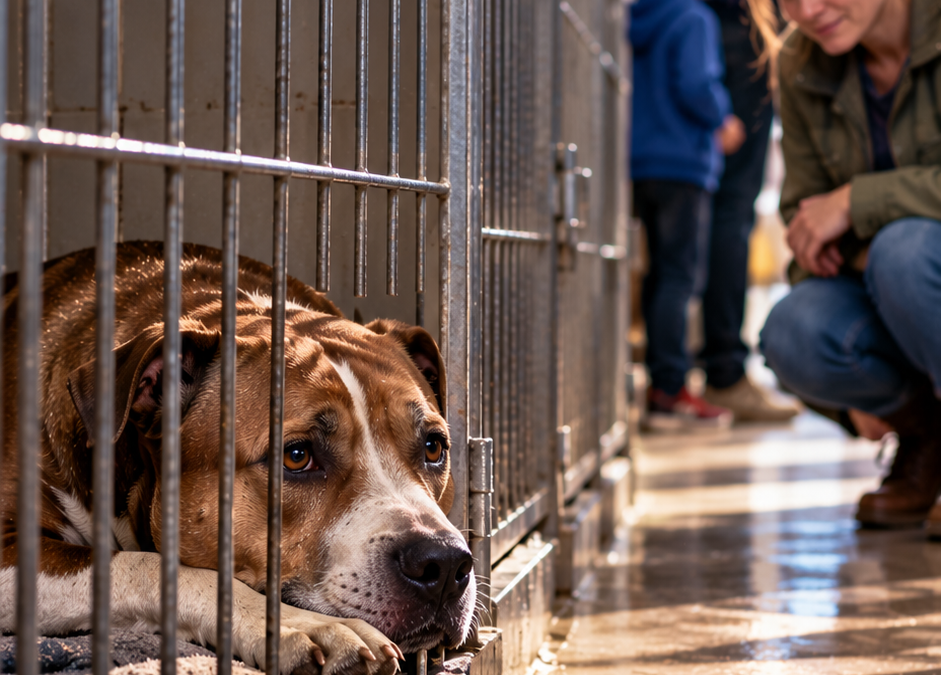
𝗙𝗨𝗟𝗟 𝗦𝗧𝗢𝗥𝗬
The man smiled politely.
Then adopted a younger dog two kennels down.
Hope watched him leave.
That night, when I brought dinner, I sat beside the kennel longer than usual.
“I don’t understand it either.”
Hope ate slowly.
He always ate slowly.
That was another thing people found odd.
Most shelter dogs inhaled meals.
Noise, stress, competition, uncertainty—it made many dogs frantic around food.
Hope was different.
He approached the bowl as if waiting for permission.
He would sniff.
Look toward me.
Then eat.
Small bites.
Sometimes I wondered if someone had taken food from him before.
But we had no history.
No scars that told a clean story.
No former owner.
No records.
Just behavior.
Behavior leaves clues, but clues are not proof.
I learned not to invent a tragedy simply because I wanted an explanation.
The truth was enough.
He was cautious.
He was gentle.
He had learned to wait.
By day one hundred, volunteers had started talking about him differently.
Not because he changed.
Because he didn’t.
“Still here?”
Still here.
“He’s such a good dog.”
I know.
“Why does nobody want him?”
I don’t know.
We posted better photos.
A volunteer named Jenna took him outside at sunset and photographed him sitting in the grass.
The pictures were beautiful.
In one, the sun hit the side of his face and made his coat shine.
We wrote:
Calm adult dog seeking quiet home. Gentle, observant, affectionate once comfortable. Walks well on leash. Loves being near people without demanding attention.
We avoided exaggerated rescue language.
No “desperate.”
No “last chance.”
No manufactured urgency.
We wanted someone to see him as a dog, not a tragedy.
People shared the post.
Comments arrived.
Beautiful boy.
Someone adopt him!
Wish I could.
Poor baby.
Yet his kennel remained occupied.
Day 126.
Day 143.
Day 181.
At six months, I started worrying that the shelter had become his entire world.
That happens.
People imagine shelters as temporary spaces.
Some are.
For long-stay dogs, temporary becomes routine.
Metal gate.
Concrete floor.
Blanket.
Meal cart at seven.
Morning cleaning.
Walk.
Kennel.
Afternoon noise.
Evening walk.
Lights dim.
Repeat.
Hope adapted almost too well.
He learned every sound.
The keys at my belt.
The wheels of the meal cart.
The latch.
The difference between volunteer footsteps and visitor footsteps.
On adoption days, I saw something subtle happen.
He stood straighter.
People came down the aisle.
He watched.
One family.
Then another.
Then another.
By closing time, he would lie down.
Not dramatically.
No whining.
No scratching at the gate.
Just a slow lowering of the body.
Head between his paws.
That image began following me home.
I had worked with animals long enough to know not to humanize everything.
Hope was not necessarily thinking, Nobody loves me.
Dogs do not write narratives about rejection the way humans do.
But animals understand patterns.
People approach.
People leave.
A door opens.
Not for you.
Again.
Again.
Again.
Whatever language his mind used, he knew the pattern.
I could see that.
At around day two hundred, a family nearly adopted him.
A mother.
Father.
Teenage son.
They spent forty minutes with him in the meeting room.
Hope was excellent.
He sat beside the boy.
Accepted treats gently.
Allowed the father to touch his ears.
When the mother stood, Hope followed her.
I remember standing behind the observation window thinking:
This is it.
Finally.
The father came out.
“We really like him.”
My heart lifted.
Then he asked, “You’re sure he’s a pit bull?”
“A mix, yes.”
“We have neighbors with small children.”
“He’s shown no concerning behavior with children here.”
“But you can’t guarantee.”
“No responsible shelter can guarantee any dog’s behavior in every situation.”
The father looked at his wife.
She already seemed uncertain.
“We’re going to think about it.”
I knew.
People who say they will think about it often mean no but want to leave kindly.
They never came back.
Hope stood near the meeting-room door after they left.
He looked toward the hallway.
I sat beside him.
“I’m sorry.”
He leaned lightly against my leg.
Only for a second.
That was unusual.
Hope was affectionate, but quietly.
He did not climb into laps.
He did not push.
He rested near people rather than on them.
That tiny lean nearly broke me.
I scratched his shoulder.
“Your person is taking too long.”
His tail moved.
I began to worry that maybe I was lying to him.
Not intentionally.
But shelters are full of hopeful language.
Someone will come.
Your family is out there.
Soon.
We say these things because the alternative feels unbearable.
But I had seen dogs wait years.
Some never left.
I knew the world did not guarantee every good animal a home.
So I stopped promising.
Instead, I told Hope the truth.
“I’m here today.”
That I could guarantee.
Day 250.
Day 271.
Day 300.
When we crossed three hundred, Jenna brought a small paper sign for the staff room.
300 DAYS.
She had drawn a paw print beneath it.
Nobody celebrated.
It felt wrong.
Three hundred days in a shelter is not an achievement.
It is survival.
That afternoon, I took Hope for a long walk behind the building.
There was a field there.
Fenced.
Quiet.
I unclipped the leash.
Hope stood beside me.
“You’re free.”
He looked at me.
“Go.”
I threw my arms outward dramatically.
“Run.”
Nothing.
I jogged away.
Hope followed slowly.
“Seriously?”
He wagged.
I ran faster.
That finally worked.
Hope began trotting.
Then running.
Not wildly.
Just enough that his ears moved with each stride.
For several seconds, he looked younger.
I laughed.
Hope ran past me.
Turned.
Then stopped in the center of the field.
Wind moved through his coat.
He lifted his head.
Closed his eyes.
I remember that clearly.
He simply stood there.
Breathing.
I wondered how many hours of his life had been spent behind bars listening to open space.
After perhaps thirty seconds, he walked back.
Sat beside me.
I crouched.
“You know you can keep running.”
Hope leaned against my knee.
I smiled sadly.
“Of course.”
He did not understand freedom as distance.
He understood it as having someone nearby.
That thought stayed with me.
By day 330, several employees had become protective of him.
Maybe too protective.
When visitors said, “I want something friendly,” we suggested Hope.
When people said, “We want calm,” we suggested Hope.
When someone asked, “Which dog has been here longest?” we pointed toward Kennel 47.
Sometimes I worried we were turning him into a cause.
Hope did not need to be adopted because we were sad.
He needed a home that actually fit.
Then came Sarah.
Day 360.
I remember the date because I had written the number on Hope’s whiteboard that morning.
360 DAYS.
Almost a full year.
Sarah arrived shortly after eleven with her daughter.
Emily.
Five years old.
Quiet child.
Very quiet.
I noticed that before anything else.
Most children entered the shelter excited.
They pointed.
Asked questions.
Wanted to touch every dog.
Emily stayed close to her mother.
One hand gripping Sarah’s coat.
Her eyes moved from kennel to kennel.
Sarah spoke softly to her.
“No rush.”
Emily nodded.
They walked slowly.
I was cleaning a kennel near the end of the row when I noticed them stop at Hope.
Sarah read his information card.
Emily stood several feet away.
Hope rose.
He did not approach the gate immediately.
He looked at Sarah.
Then Emily.
Sarah crouched.
“Hi.”
Hope moved closer.
Slowly.
Emily whispered, “He’s not barking.”
“No.”
Her mother looked at me.
“Is he always this quiet?”
“Mostly.”
“Is he scared?”
“Sometimes cautious. Not generally fearful.”
“How long has he been here?”
I hesitated.
People often reacted badly to the answer.
“Three hundred sixty days.”
Sarah looked at me.
“What?”
“Today is day 360.”
Her eyes moved back to Hope.
“That’s almost a year.”
“Yes.”
Emily came slightly closer.
“Why?”
There are questions children ask that adults make unnecessarily complicated.
I said, “People kept choosing other dogs.”
Emily frowned.
“Why?”
“I don’t know.”
She looked at Hope for a long time.
Hope sat.
His tail moved once.
Emily moved closer to the bars.
Sarah touched her shoulder.
“Slowly.”
Emily nodded.
Then she sat down on the floor.
Right there.
No request to open the kennel.
No squealing.
No reaching.
She simply sat.
Hope watched.
The aisle was noisy.
A terrier barking.
Metal bowls.
People talking.
Yet somehow that small moment felt separate from everything.
Emily whispered, “Hi.”
Hope stood.
Walked toward the bars.
Stopped.
Emily did not touch him.
She looked at his face.
Then asked me, “What’s his name?”
I hated the answer.
“He doesn’t really have one.”
Sarah looked surprised.
“You’ve had him almost a year.”
“We use nicknames.”
“What do you call him?”
I smiled.
“Honestly?”
“Yes.”
“Mr. 360.”
Sarah laughed softly.
Emily did not.
“That’s not a name.”
“No.”
“What was his name before?”
“We don’t know.”
She looked sad.
Hope sniffed through the bars.
Emily lifted one hand.
Stopped short of touching.
Hope moved forward the final inch himself.
His nose touched her fingers.
Emily smiled.
Not broadly.
A small smile.
But Sarah saw it.
Her face changed.
That became important later.
At the time, I simply thought mother and daughter liked the dog.
Sarah asked if they could meet him.
“Of course.”
We moved into a quieter room.
Hope entered.
He did not rush toward them.
He explored the walls.
Sniffed the chair.
Then sat near me.
Sarah remained on the floor.
Emily sat beside her.
No one pressured him.
After a few minutes, Hope walked toward Sarah.
She held out her hand.
He sniffed.
Then turned toward Emily.
The girl had a small stuffed rabbit clipped to her backpack.
Hope sniffed that too.
Emily whispered, “It’s mine.”
Hope looked at her.
“He won’t take it,” I said.
Emily unclipped the rabbit.
Placed it on the floor.
“You can smell.”
Hope did.
Then lay down.
Not beside me.
Beside Emily.
Sarah looked at me.
I looked at her.
Hope rested his chin on the floor near the girl’s shoe.
Emily’s hand hovered above his head.
She looked at her mother.
“Can I?”
Sarah looked at me.
I nodded.
“Gently.”
Emily touched one ear.
Hope remained still.
Then she stroked the side of his head.
He closed his eyes.
That was the moment.
Not because Hope did anything spectacular.
He simply relaxed.
But Sarah’s face crumpled.
She looked away quickly.
I pretended not to notice.
After several minutes, she asked me, “What should I know?”
I gave the honest version.
“He’s calm. Very good with staff. Walks well. No known aggression. We don’t have a reliable history before intake. He can be cautious in new environments.”
“House-trained?”
“Likely, but shelter behavior doesn’t always predict home behavior.”
“Other dogs?”
“Generally neutral in controlled introductions.”
“Children?”
“He’s done well with respectful children here.”
Sarah looked toward Emily.
Hope had shifted closer.
His shoulder touched the girl’s leg.
Emily was speaking quietly.
I could not hear the words.
Hope looked at her as though listening.
Sarah whispered, “She hasn’t done that in a while.”
“Done what?”
“Talked that much.”
I looked at Emily.
She was still talking.
Hope remained completely still.
Sarah said, “Her father left last year.”
The sentence came softly.
Private.
I did not respond immediately.
“I’m sorry.”
Sarah nodded.
“Divorce.”
She looked toward her daughter.
“It was messy.”
Emily did not appear to hear us.
Sarah continued.
“She stopped talking much after.”
“To everyone?”
“Mostly strangers.”
She exhaled.
“Sometimes even me.”
Hope lifted his head when Emily stopped.
The girl smiled.
Then continued talking.
Sarah watched.
Tears appeared in her eyes.
“I think she likes him.”
I smiled.
“I think he likes her too.”
They stayed almost an hour.
At the end, Sarah said, “I want to adopt him.”
I had heard those words many times.
Usually I remained professional.
That day, I nearly cried.
“Are you sure?”
Sarah looked at me.
“You’re asking me that?”
“I ask everyone.”
“No, you don’t.”
I laughed.
“Fine.”
She looked toward Hope.
“He’s the one.”
Emily hugged her knees.
“Can he come home today?”
Sarah smiled.
“If everything is approved.”
Emily looked at me.
“Please approve.”
“I’ll see what I can do.”
The application process took several hours.
Housing check.
Veterinary references.
Landlord status—Sarah owned the home.
Fenced yard.
No other animals.
Schedule manageable.
Everything fit.
Still, I reviewed every detail twice.
Not because I distrusted Sarah.
Because after 360 days, I was terrified of being wrong.
When it was finally time, I walked to Hope’s kennel.
He stood when he saw the leash.
“Come on.”
Tail wag.
I opened the door.
Hope stepped out.
Then stopped.
He looked back.
People tell stories about animals looking back at shelters as though they understand exactly what is happening.
I am careful with that.
Maybe Hope was simply orienting himself.
Maybe he heard a noise.
Maybe he was checking the space behind him.
But he stood there for several seconds.
Looking at the kennel.
Three hundred sixty days.
Then he turned.
We walked toward the lobby.
Sarah waited with Emily.
The moment Hope saw them, his tail changed.
For almost a year, Hope’s wag had been slow.
Measured.
That day, it moved faster.
Not frantic.
Not wild.
Just freer.
Emily clapped once.
Hope walked to her.
She wrapped both arms around his neck.
I almost told her not to.
Then saw Hope lean into it.
Sarah attached the leash.
“I’ll send updates.”
“Please do.”
“I mean it.”
“Good.”
I knelt beside Hope.
“You behave.”
He sniffed my face.
“You waited long enough.”
His tail moved.
Sarah opened the door.
Hope stepped outside.
Sunlight hit his coat.
He paused.
Then walked toward Sarah’s car.
She opened the back door.
Hope jumped in without hesitation.
No command.
No coaxing.
He turned once on the seat.
Lay down.
As if he had always known where he belonged.
I stood outside.
Emily climbed in beside him.
Sarah looked at me over the car roof.
“Thank you.”
I shook my head.
“No.”
She frowned.
“You’re the one taking him home.”
She smiled.
Then drove away.
I watched until the car disappeared.
When I returned to Kennel 47, it was empty.
Blanket.
Water bowl.
Nothing else.
I stood there longer than I should have.
For months, I had wanted that kennel empty.
Now the emptiness hurt.
That is shelter work.
The goal is goodbye.
And when goodbye comes, you grieve anyway.
The first week, Sarah sent nothing.
Day one.
Nothing.
Day two.
Nothing.
By day four, I started worrying.
Maybe Hope was not adjusting.
Maybe the house frightened him.
Maybe stairs confused him.
Maybe he refused food.
Maybe he had separation anxiety.
Maybe Sarah regretted it.
By day six, I nearly texted her.
I stopped myself.
Families needed space.
Not every adoption required supervision from an anxious shelter employee.
On day seven, my phone buzzed.
Sarah.
One photograph.
Hope stretched across a couch.
Completely stretched.
Legs extended.
Head on a pillow.
Emily sat beside him with one hand resting on his back.
Caption:
Looks like he’s always been here.
I stared at the image.
Then enlarged it.
Hope’s eyes were closed.
Closed.
At the shelter, he slept.
Of course.
But rarely deeply during busy hours.
There was always sound.
Always movement.
Always waiting.
In Sarah’s photograph, his body looked heavy with trust.
I sat down.
Jenna passed the desk.
“What happened?”
I turned the phone.
She covered her mouth.
“Oh.”
We both smiled like idiots.
More updates followed.
Sarah did not romanticize the transition.
I appreciated that.
The first few days, Hope moved carefully through the house.
He did not enter rooms until invited.
He stopped at thresholds.
Kitchen.
Bedroom.
Hallway.
As though invisible rules might exist.
The first night, Sarah showed him a dog bed near her bedroom.
Hope stood beside it.
Would not lie down.
She eventually sat on the floor.
“It’s yours.”
Hope looked at her.
She touched the bed.
“You can sleep here.”
He stepped onto it.
Turned.
Lay down.
The second night, he did not need permission.
Food was another thing.
Hope ate slowly.
Even at home.
Sarah told me he sometimes paused and looked toward her.
“He acts like I might take it,” she wrote.
I replied:
Give him time.
So she did.
No hovering.
No hand in the bowl.
No testing.
Food appeared.
Food remained his.
Within weeks, the pausing stopped.
That detail affected me more than I expected.
Safety is built in repetitions.
The bowl stays.
The door opens.
The person returns.
Nothing bad happens.
Again.
Again.
Again.
Sarah described their morning routine.
She woke around six.
Hope was already beside the bed.
Not touching.
Just standing.
Tail moving.
At the shelter, I had seen the same posture hundreds of mornings.
Standing.
Waiting.
But Sarah wrote:
It feels different now. At the shelter he looked like he was asking whether today might finally be his day. Here he looks like he already knows it is.
I read that sentence three times.
Emily changed too.
That became the part of the story I had not expected.
Sarah began sending videos.
Emily sitting on the floor with a picture book.
Hope beside her.
“I’m reading to him,” Emily announced in one.
“What are you reading?” Sarah asked from behind the camera.
“A dragon book.”
“Does Hope like dragons?”
Emily looked at the dog.
Hope’s head rested on her lap.
“Yes.”
“How do you know?”
“He stayed.”
Simple.
He stayed.
Sarah told me Emily had become quieter after the divorce.
Not ordinary shyness.
Withdrawal.
Teachers noticed.
Friends stopped coming over as often.
At home, Emily spent hours drawing.
She answered questions with one or two words.
Laughter became rare.
Hope did not make her suddenly outgoing.
Healing is not magic.
What he did was provide a listener who demanded nothing.
Emily could speak without interruption.
Without advice.
Without adults asking what she was feeling.
Hope simply sat.
That became enough.
Sarah wrote:
She tells him things she doesn’t tell me.
I replied:
Maybe she needs somewhere to practice saying them first.
Sarah wrote back:
I think you’re right.
By the second week, Emily had developed a ritual.
She came home from school.
Dropped her backpack.
Sat on the rug.
Hope walked over.
Then she told him about her day.
Every detail.
Who sat beside whom.
What they ate.
Which teacher was unfair.
Which child had cried.
Hope listened.
If Emily paused, he looked up.
She interpreted that as a request to continue.
Soon, she began reading aloud to him.
At first simple books.
Then longer ones.
Sarah told me Emily’s teacher noticed improvement in class participation.
The teacher asked what changed.
Sarah said, “We adopted a dog.”
The teacher laughed.
Sarah did not.
“He listens.”
Hope did more than listen.
He learned Emily’s moods.
If she was energetic, he followed her into the yard.
If she was quiet, he lay nearby.
When Sarah was working, Hope positioned himself where he could see both mother and daughter.
He never demanded attention.
That quality—“too calm,” as visitors had called it—became exactly what the family needed.
About two weeks after adoption, Sarah sent me another message.
Took him off leash in the field today.
I froze.
Then continued reading.
She had taken Hope to the fenced field behind their house.
Large.
Open.
For the first time, she unclipped the leash.
Hope stood.
Sarah said, “Go.”
He ran.
Not far.
A few yards.
Then stopped.
He raised his head.
Closed his eyes.
Wind moved through his coat.
Sarah wrote:
He stood like that almost a full minute.
She did not call him.
Did not rush.
Hope breathed.
Then turned.
Walked back.
Sat at Sarah’s feet.
Her final line said:
It felt like he wanted to know freedom was there, and then wanted to choose us.
Maybe that was projection.
Maybe not.
Either way, I kept the message.
Three months after the adoption, Sarah called me at night.
Not text.
Call.
I answered immediately.
“Is Hope okay?”
“Yes.”
My entire body relaxed.
“Emily?”
“She’s okay too.”
Sarah’s voice sounded strange.
Emotional.
“What happened?”
She took a breath.
“Emily had a nightmare.”
I waited.
“That’s not unusual.”
“No.”
“But tonight…”
Her voice broke.
I sat down.
“What?”
“I heard her crying.”
Sarah had been downstairs.
She started up the stairs.
Hope was sleeping near the living room.
The moment he heard Emily, he stood.
He reached the bedroom before Sarah.
When Sarah entered, Hope had climbed onto the bed.
Emily was curled near the headboard.
Crying.
Hope lay beside her.
Not across her.
Not pushing.
Just close.
His head rested against Emily’s chest.
Sarah stopped in the doorway.
Hope was breathing slowly.
Deeply.
Emily’s hands rested on his back.
Gradually, her breathing began matching his.
In.
Out.
In.
Out.
She stopped crying.
Sarah sat beside them.
Then Emily whispered something.
Sarah’s voice broke when she told me.
“She said, ‘He knows.’”
I swallowed.
“Knows what?”
Sarah had asked the same question.
Emily said:
“He knows what it feels like when nobody chooses you.”
I did not speak.
I could not.
Sarah continued.
“I don’t know where she got that.”
Children understand more than adults want to believe.
Emily knew Hope had waited almost a year.
She knew people passed him.
Perhaps she had connected that to her father leaving.
Not logically.
Emotionally.
Someone leaves.
Someone is not chosen.
Those can become the same wound inside a five-year-old mind.
Sarah whispered, “Then she hugged him and fell asleep.”
I stared at the wall.
“What did Hope do?”
“Stayed.”
Of course.
Sarah started crying.
“So I sat there watching them.”
I let her.
After a while, she said, “I think I understand why we needed him.”
I asked, “Why?”
“I thought we needed noise.”
“What?”
“After my husband left, the house became so quiet.”
Her breathing shook.
“I thought I needed to fill it.”
She had considered getting a puppy.
Something playful.
Energetic.
Something that would make the house loud again.
“Instead,” she said, “we got Hope.”
I smiled.
“Quietest dog in the shelter.”
“Exactly.”
She continued.
“I thought silence meant emptiness.”
I listened.
“Hope showed me it doesn’t.”
That sentence stayed with me.
Sarah said, “He knows how to be quiet without making the room feel lonely.”
I closed my eyes.
There it was.
The thing everyone had rejected.
Too calm.
Not playful enough.
Doesn’t perform.
The trait people interpreted as a flaw had become the exact quality that made him perfect for Sarah and Emily.
A dog does not have to rescue someone from a fire to save them.
Sometimes he lies beside a child during a nightmare.
Sometimes he creates a form of silence that feels safe instead of abandoned.
After that call, I saw Hope differently too.
For 360 days, I had thought the tragedy was that nobody recognized what a good dog he was.
Now I wondered whether I had also misunderstood him.
Maybe his calm was not passivity.
Maybe it was strength.
Hope had endured almost a year of noise, doors, strangers, barking, people passing.
He remained gentle.
He had not learned to demand.
He had learned to remain.
There is courage in that.
Sarah later told me something that made me understand her choice better.
“When I saw him,” she said, “I recognized him.”
“You had never met.”
“I don’t mean his face.”
She paused.
“The way he stood.”
Hope had not begged at the kennel.
He stood behind the bars.
Watched.
Waited.
Sarah said, “After my husband left, I begged for months.”
I remained silent.
“I begged him to reconsider.”
She laughed once, without humor.
“I begged him to come home. Begged him to go to counseling. Begged him to remember who we were.”
I could hear the shame in her voice.
“There’s nothing shameful about trying to save a marriage.”
“I know that now.”
She continued.
“But eventually I stopped.”
“Why?”
“Because I realized I could not convince someone to choose us.”
Us.
Sarah and Emily.
“I stopped begging.”
Her voice became quieter.
“I just stood.”
I thought of Hope.
She said, “When I saw him at the shelter, that was what I saw.”
“What?”
“Someone who had stopped begging but had not given up.”
I looked across the empty lobby at work.
“That’s why you chose him?”
“I think so.”
Then she corrected herself.
“That’s why I saw him.”
The distinction mattered.
Around six months after adoption, Hope began playing.
Really playing.
Until then, he had shown interest.
A toy.
A short chase.
Nothing exuberant.
One Saturday, Sarah and Emily were in the yard.
Hope was running.
He stopped suddenly.
Then tucked his body and sprinted in a wild circle.
Zoomies.
I laughed when Sarah sent the video.
Emily screamed with joy.
Hope ran around her.
Changed direction.
Spun.
Chased his own tail.
Then raced again.
The neighbors looked over the fence.
Sarah’s camera shook because she was laughing.
I watched it five times.
The dog who had spent almost a year standing quietly behind bars was racing around a yard simply because he could.
No audience.
No adoption performance.
No one to impress.
Just joy.
That was when Emily named him.
Until then, Sarah had been using a temporary name she wasn’t attached to.
Emily rejected every suggestion.
Buddy.
No.
Cooper.
No.
Bear.
No.
One afternoon she told her mother, “His name is Hope.”
Sarah asked, “Why Hope?”
Emily answered as if it were obvious.
“Because he waited.”
Sarah smiled.
“Lots of dogs wait.”
Emily shook her head.
“No. He kept hoping.”
When Sarah told me, something tightened in my chest.
Hope.
It fit so perfectly that I wondered why we had not seen it.
Maybe because the name did not belong to who he had been at the shelter.
It belonged to what his waiting meant after he left.
Hope for Emily.
Hope for Sarah.
Maybe even hope for the rest of us.
The shelter staff stopped saying Kennel 47.
Stopped saying Mr. 360.
He had a name now.
Hope.
Months passed.
Sarah kept in touch.
Not constantly.
Enough.
Morning walks.
Photos.
Videos.
Small stories.
Hope never tried to run away.
Even in open fields, he frequently looked back.
Not nervously.
Checking.
Sarah said he seemed to need confirmation that she was still there.
That made sense.
One afternoon, Sarah tripped on a trail and hurt her knee.
Hope had been several yards ahead.
When she fell, he stopped.
Turned.
Returned immediately.
He sat beside her.
Licked her hand.
Would not move.
A stranger offered to hold his leash while helping Sarah stand.
Hope stayed close.
Only after Sarah was upright did he begin walking again.
She called me later.
“I swear he understood.”
“Dogs understand more than we give them credit for.”
“He knew I couldn’t get up.”
“He knew you stopped.”
“Same thing to him, maybe.”
That became Hope’s defining quality in the family.
He noticed.
If Sarah came home exhausted, Hope placed his head on her lap.
If Emily was upset, he stayed nearby.
If they were busy, he did not demand.
He simply occupied space with them.
Presence.
People underestimate presence because it is not dramatic.
But when you have lived through abandonment, someone who stays quietly can feel miraculous.
I asked Sarah once if she wondered what happened to Hope before the shelter.
“All the time.”
“Do you want to know?”
She took a long time answering.
“No.”
“Really?”
“If we could learn something medically useful, yes.”
“But otherwise?”
“No.”
“Why?”
“Because I don’t want to build him around a story we can’t confirm.”
I smiled.
That was exactly how I felt.
“He had a life before us,” she said.
“Yes.”
“Maybe it was bad. Maybe parts were good.”
“Yes.”
“I only know who he is now.”
She paused.
“And who he chooses to be.”
That sentence surprised me.
“Chooses?”
“He could be suspicious of everything.”
“Maybe.”
“He isn’t.”
“He’s cautious.”
“But not bitter.”
I laughed.
“Dogs don’t really do bitterness the way humans do.”
“Maybe that’s why they’re better at life.”
Sarah had a point.
Hope carried caution.
But he did not punish new people for old harm.
He allowed trust to form.
Slowly.
That requires something humans often call forgiveness, though I am not sure dogs need the word.
Maybe they simply remain open to evidence.
This person is safe.
This hand is gentle.
This home stays.
Enough repetitions, and the world changes.
A year after adoption, Sarah invited me to visit.
I almost said no.
Shelter workers sometimes avoid post-adoption visits.
Not because we do not care.
Because seeing animals in their new lives can be emotionally overwhelming.
You meet them in crisis.
You hold them through uncertainty.
Then they leave.
Sometimes seeing how fully they belong elsewhere reminds you that you were only temporary.
That is exactly what you want.
It can still hurt.
I went anyway.
Sarah lived in a small house in southern Ohio, surrounded by fields.
White siding.
Blue front door.
Nothing extravagant.
A child’s bicycle near the porch.
I knocked.
Before Sarah answered, I heard nails on the floor.
The door opened.
Hope stood behind her.
For one second, he looked at me.
Then recognition hit.
His tail began moving so hard that his entire body bent.
“Hope!”
I crouched.
He ran toward me.
Not walked.
Ran.
He sniffed my hands.
Licked my face once.
Then turned and ran toward Emily.
He came back.
Then returned to Emily again.
As if showing me.
Look.
This is my person.
Emily sat on the floor drawing.
She had grown.
Not much.
Enough.
“Hi,” she said.
“Hi, Emily.”
She held up a piece of paper.
“I drew Hope.”
The picture showed a large dog beneath a yellow sun.
Beside him stood a girl.
Both smiling.
At the bottom, in large uneven letters:
MY BEST FRIEND.
I looked at Hope.
He was lying across Emily’s feet.
His eyes half closed.
Something struck me immediately.
He was not watching the door.
At the shelter, Hope always knew where the nearest exit was.
Even while resting, one ear followed footsteps.
Here, the front door remained open behind me for several seconds.
Hope never looked.
He did not need to.
He was home.
Sarah noticed my expression.
“Different?”
“Very.”
“Good different?”
“The best kind.”
She made coffee.
We sat at the kitchen table while Emily drew.
Hope moved between us.
Eventually he lay at Sarah’s feet.
I looked around.
Dog toys.
Water bowl.
Photographs.
One picture of Hope and Emily sleeping on the couch.
Another of Hope in the field.
Another with Sarah.
“You know,” Sarah said, “I almost chose a puppy.”
“I remember.”
“I thought Emily needed energy.”
“Hope has energy.”
“Now.”
We laughed.
She became quiet.
“Do you know what I noticed about him that first day?”
“His calm?”
“More than that.”
She looked toward Hope.
“The other dogs were asking.”
“Asking?”
“To be chosen.”
She mimed paws against a kennel.
“Jumping. Barking. Looking at everyone.”
I nodded.
“Hope wasn’t.”
“No.”
“He just stood there.”
“Yes.”
Sarah stared into her coffee.
“And I knew that posture.”
I did not interrupt.
“After my husband left, I spent months asking people for things they couldn’t give.”
Her voice remained steady.
“I asked him to come back. Asked my friends to tell me what to do. Asked my family whether I had failed. Asked Emily if she was okay even when I knew she didn’t have words.”
She looked at me.
“Eventually I stopped.”
“Because you healed?”
“No.”
That answer came quickly.
“Because I got tired.”
I understood.
“I stopped begging life to return what it took.”
She glanced at Hope.
“And when I saw him, he looked like that.”
“Like what?”
“Like someone who had learned not to beg.”
Hope slept peacefully.
Sarah smiled.
“But he had not stopped standing.”
That phrase stayed inside me.
Not begging.
Still standing.
Maybe that was what dignity looked like in both of them.
Emily joined us.
“Mom?”
“Yes?”
“Can Hope have peanut butter?”
“A little.”
Emily looked at me.
“He loves peanut butter.”
“I believe you.”
“He gets it when I read.”
“Why?”
“He listens better.”
Sarah raised an eyebrow.
“He already listens.”
Emily shrugged.
“He deserves payment.”
I laughed.
Hope’s eyes opened at the words peanut butter.
“See?” Emily said.
We spent the afternoon outside.
Hope ran through the yard.
Not far.
He remained close to Emily.
At one point, she fell in the grass laughing.
Hope rushed over.
Stood above her.
Licked her face.
Emily screamed.
“Stop!”
He continued.
Sarah laughed.
I stood near the fence watching.
For almost a year, my main memory of Hope had been stillness.
Now movement.
Tail.
Sunlight.
Girl laughing.
I felt something shift inside me.
All those days had not disappeared.
They were part of him.
But they no longer defined the shape of every day.
Before I left, I knelt beside Hope.
He came close.
I placed both hands against his face.
“You did okay.”
His tail moved.
“That was a long wait.”
Hope licked my wrist.
Sarah stood behind me.
“He doesn’t know how long.”
“Probably not.”
“But we do.”
“Yes.”
I stood.
Emily hugged Hope.
Then hugged me unexpectedly.
“Thank you for keeping him.”
My throat tightened.
“You’re welcome.”
She stepped back.
“If you didn’t, I wouldn’t have him.”
That was true.
Shelter work is full of uncertainty.
Sometimes you care for an animal for months and never see what happens next.
That day I saw next.
It looked like a little girl holding a dog around the neck while the dog remained perfectly still because he trusted her completely.
On the drive home, I thought about 360 days.
I had spent most of that year treating the number as evidence of failure.
Why had nobody chosen him?
What were we doing wrong?
Was the photograph wrong?
The description?
The placement?
Was the breed label hurting him?
Were visitors missing something?
All valid questions.
But after visiting Sarah, the number meant something else too.
Not destiny.
I do not believe every painful delay happens for a cosmic reason.
That idea can become cruel.
Some dogs wait too long because systems fail them.
Some never get the ending Hope did.
I know that.
Still, in his particular story, the long wait shaped the way Sarah understood him.
She saw what others called “too calm” and recognized steadiness.
Emily saw a dog people had passed and recognized herself.
Hope’s history did not make the rejection good.
It made connection possible in a way none of us had predicted.
Back at the shelter, Kennel 47 remained empty for exactly two days.
Then another dog arrived.
Young female hound mix.
Terrified.
She hid in the back.
I stood outside.
For one second, I felt the old ache.
Another wait beginning.
Jenna came beside me.
“You’re thinking about Hope.”
“Yes.”
She smiled.
“How is he?”
“Perfect.”
“Of course.”
I looked at the new dog.
“She might be here a while.”
“Maybe.”
I stopped myself before saying, Someone will come.
I had learned better.
Instead, I opened the kennel.
Sat on the floor.
The hound watched from the corner.
I whispered, “I’m here today.”
That promise I could keep.
Hope’s story became one I told new volunteers.
Not as a fairy tale.
Not as proof every dog gets adopted.
As a lesson about perception.
“What do you see?” I would ask.
A volunteer might answer:
Pit bull.
Older dog.
Quiet dog.
Shy dog.
I would say:
Keep looking.
Behavior.
Posture.
Response to touch.
Recovery from stress.
How the dog takes food.
How the dog behaves when no one is trying to impress him.
See the animal.
Not the category.
Hope taught me that the worst thing about labels is not always that they are false.
Sometimes they are too small.
“Pit bull mix” was technically useful.
It said nothing about the way Hope listened to Emily read.
“Calm” was accurate.
It did not describe how his breathing could steady a child after a nightmare.
“Long-stay dog” was true.
It did not tell you what he looked like running in an open field.
A life cannot fit on an intake card.
Months later, Sarah video-called the shelter.
I answered.
Emily appeared first.
“Look!”
The camera swung wildly.
“Slow down.”
“Hope learned something.”
The screen turned.
Hope sat in the living room.
Emily said, “High five.”
Hope lifted one paw.
She touched it.
“Good boy!”
I laughed.
“That’s impressive.”
“He can spin too.”
Hope spun.
“Sit.”
He was already sitting.
Emily frowned.
“He cheated.”
Sarah’s voice came from behind the camera.
“Dogs cannot cheat.”
“Yes, they can.”
Hope barked once.
I had almost never heard him bark at the shelter except occasionally during play.
Emily laughed.
There it was again.
That loud laugh Sarah once said had disappeared from their house.
Hope looked toward her.
Tail moving.
I realized healing could be measured in sound.
A child laughing.
A dog barking because he is excited.
A house no longer quiet in the same way.
Yet Sarah had been right.
They had not needed noise.
They needed safe silence first.
Noise came later.
Joy often does.
Two years after Hope’s adoption, Emily started school at a larger building.
She struggled the first month.
New classrooms.
New children.
Sarah called me once.
“Emily asked if Hope can go to school.”
I laughed.
“Can he?”
“Not exactly.”
“Therapy certification?”
“That’s what I’m considering.”
Hope’s temperament made him a potential candidate.
Calm.
Patient.
Comfortable around children.
Sarah began working with a trainer.
I was not surprised.
Hope passed his assessments.
Eventually, he began visiting a reading program for children who struggled reading aloud.
The dog nobody noticed became the dog children specifically asked for.
There was something poetic about that.
Kids who were embarrassed to read in front of classmates sat beside Hope.
He did not correct them.
Did not laugh.
Did not become impatient.
He listened.
Just as he had listened to Emily.
Sarah sent me a photograph.
Hope lying on a rug in a library.
Three children nearby.
One reading.
Hope’s head rested on his paws.
Caption:
Apparently silence was his superpower all along.
I printed that one.
It still hangs in the staff room.
People often assume shelter stories are about animals being saved by humans.
Some are.
Hope’s never felt that simple.
Sarah gave him a home.
That is enormous.
She removed him from a kennel after 360 days.
Fed him.
Protected him.
Loved him.
But Hope also entered a house fractured by departure.
A mother who no longer believed a family could feel whole.
A child who had begun associating love with leaving.
Hope did not fix their lives.
Dogs should not carry that burden.
He did something quieter.
He stayed.
Every morning.
Every evening.
At the foot of the bed.
Beside the chair.
Near Emily while she read.
At Sarah’s feet during coffee.
Day after day.
Presence accumulated.
Trust followed.
A family formed around repetition.
Years after his adoption, I asked Emily, “Do you remember the first day you met Hope?”
She was older then.
She smiled.
“Kind of.”
“What do you remember?”
She thought.
“He was quiet.”
“Anything else?”
“I remember his eyes.”
“What about them?”
She shrugged.
“He looked like he knew things.”
I laughed.
“What things?”
“Sad things.”
My throat tightened.
“And now?”
Emily looked toward Hope, sleeping nearby.
“Now he knows good things too.”
Children can say in nine words what adults spend pages trying to understand.
Hope had known waiting.
Now he knew belonging.
He had known doors closing.
Now doors opened for him.
He had known footsteps passing.
Now footsteps came home to him.
He had known a bowl placed inside a kennel.
Now meals were served in a kitchen where his name was spoken with affection.
He had known people looking and moving on.
Now Emily looked for him the moment she entered a room.
The difference was not that his past vanished.
The difference was that the present became larger.
Hope aged.
His face grayed.
He slowed.
The dog people once rejected for being “too calm” became even calmer.
Sarah joked that retirement suited him.
Emily, no longer five, still read beside him.
Different books now.
Longer.
Hope slept through many chapters.
Emily claimed he was listening.
I never argued.
One autumn afternoon, I visited again.
Hope was older.
He took longer reaching the door.
But the tail still moved.
I sat on the floor.
He rested against my leg.
“Remember me?”
Tail.
“Good.”
Emily entered carrying schoolbooks.
“You know he remembers.”
“I like confirmation.”
She sat beside us.
Hope shifted until he was partly touching both of us.
I looked at her.
“How old were you when you named him?”
“Five.”
“You chose a good name.”
Emily stroked his head.
“I know.”
“Still think it fits?”
She looked down.
“More now.”
“Why?”
“Because hope isn’t waiting for something perfect.”
I stared at her.
She continued.
“It’s waiting without becoming mean.”
I laughed softly.
“That’s pretty good.”
“My English teacher said something like that.”
“Still counts.”
She smiled.
Then became serious.
“Hope never got mean.”
No.
He didn’t.
That, perhaps, was what affected me most.
He had been ignored.
Misjudged.
Passed.
Confined.
Yet when the gate finally opened, he walked into his new life without punishing anyone for the old one.
Animals do not romanticize suffering.
They simply respond to the environment in front of them.
Give safety.
Some learn safety.
Give patience.
Some return trust.
Hope did.
Sarah once told me, “He came to us with a clean heart.”
I would not say that exactly.
He came with history.
Caution.
Habits formed by uncertainty.
But he remained capable of connection.
Maybe that was enough.
Years later, shelter visitors still sometimes ask me my favorite adoption story.
I have hundreds.
The senior dog whose owner died and who found a retired couple.
The bonded cats adopted together.
The terrified shepherd who learned to walk on leash.
The dog returned twice before the right home.
But I always think of Hope.
Not because 360 days is an impressive number.
It isn’t.
It is a sad one.
I think of him because his story taught me the difference between being looked at and being seen.
Hundreds of people looked at Hope.
They saw breed.
Age.
Silence.
Stillness.
They saw risk.
They saw something missing.
Sarah saw endurance.
Emily saw recognition.
That changed everything.
When Sarah stopped in front of Kennel 47, she did not rescue a dog from being defective.
There had never been anything defective about him.
She simply noticed qualities other people had misread.
The shelter had called him calm.
Families called him boring.
Sarah called him safe.
People called him unresponsive.
Emily called him a listener.
Visitors saw a dog who did not beg for attention.
Sarah saw a dog who had survived being passed over without losing the ability to connect.
Perspective changed the story before Hope himself changed at all.
That lesson followed me into every adoption conversation afterward.
When people ask, “Which dog is best?” I ask, “Best for what?”
Runner?
Quiet companion?
Children?
Apartment?
Experienced owner?
Senior household?
There is no universally perfect dog.
Only matches.
Hope waited almost a year because most people coming through our doors wanted something else.
Then Sarah needed exactly what he already was.
That did not make the waiting necessary.
But it made
𝗧𝗛𝗘 𝗘𝗡𝗗
For 360 Days He Watched Families Walk Past His Kennel, Until One Woman Stopped and Looked at Him Differently
For 360 days, I watched people walk past his kennel.
Some slowed down.
Some stared.
Some whispered.
A few asked questions.
Most moved on.
And every evening, after the last family left and the shelter fell quiet again, he would lie down in the same corner with his head between his paws, as though he had somehow learned not to expect anything from the sound of footsteps.
I kept wondering what everyone else saw when they looked at him.
Because I knew what I saw.
A healthy dog.
A gentle dog.
A dog who had never once shown aggression toward a volunteer, visitor, veterinarian, or frightened child.
A dog who waited politely for meals.
A dog who sat calmly when we clipped on his leash.
A dog who never barked at people passing his kennel.
Yet somehow, in a place full of animals waiting to be chosen, his silence made him nearly invisible.
His name, eventually, would be Hope.
But during most of those 360 days, he had no real name at all.
On his intake card, he was listed as Kennel 47.
Male.
Pit bull mix.
Approximately four years old.
Healthy.
Calm temperament.
No known bite history.
Found as stray.
That was it.
A few lines.
Not enough to explain a life.
We sometimes called him “Mr. 360” behind the scenes, though the nickname did not start until much later.
At first, I assumed he would be adopted quickly.
I had worked at the shelter long enough to understand which dogs typically attracted attention.
Puppies went fast.
Small dogs usually did well.
Fluffy dogs photographed beautifully online.
Young active families wanted dogs that ran to the gate, jumped, wagged, begged.
Hope did none of that.
When someone approached his kennel, he stood.
That was all.
He did not throw himself against the bars.
Did not bark.
Did not paw.
Did not perform.
He simply stood there and looked.
His eyes were dark brown and steady.
Serious.
Almost too serious.
I used to kneel outside his kennel and tell him, “You have to sell yourself a little.”
His tail would move once.
“See? That’s what I mean.”
Another slow wag.
“You’re not helping.”
He would sit.
I laughed the first few times.
Later, I stopped laughing.
Because week after week, the same thing happened.
Families came.
They passed the kennels.
Dogs barked and bounced.
People smiled.
Then they reached him.
They read the card.
Pit bull mix.
And I watched their faces change.
Sometimes only slightly.
Sometimes immediately.
One man pulled his daughter closer.
Another woman said, “No, I don’t want one of those.”
One couple did not even stop.
The husband read the breed label and said, “Too risky.”
Hope sat behind the bars and watched them leave.
He never barked.
Never growled.
Never lunged.
But the label walked out of the kennel before he ever could.
There were others who did stop.
Those hurt differently.
A young man once stood there for almost ten minutes.
Hope remained close to the gate.
Interested.
Calm.
The man asked, “Why isn’t he barking?”
“Because he’s quiet.”
“Is he depressed?”
“Not necessarily.”
“He looks sad.”
“He’s been here a while.”
“How long?”
At that point, seventy-three days.
The man stared.
“Something has to be wrong with him.”
That sentence became familiar.
Something has to be wrong.
People assumed length of stay was evidence.
If a dog had not been adopted, surely other people had discovered something they had not.
Maybe hidden aggression.
Maybe medical issues.
Maybe behavior problems.
Nobody wanted to be the person who chose the dog everyone else rejected.
It is strange how quickly people trust the judgment of strangers they have never met.
I said, “Nothing is wrong with him.”
The man smiled politely.
Then adopted a younger dog two kennels down.
Hope watched him leave.
That night, when I brought dinner, I sat beside the kennel longer than usual.
“I don’t understand it either.”
Hope ate slowly.
He always ate slowly.
That was another thing people found odd.
Most shelter dogs inhaled meals.
Noise, stress, competition, uncertainty—it made many dogs frantic around food.
Hope was different.
He approached the bowl as if waiting for permission.
He would sniff.
Look toward me.
Then eat.
Small bites.
Sometimes I wondered if someone had taken food from him before.
But we had no history.
No scars that told a clean story.
No former owner.
No records.
Just behavior.
Behavior leaves clues, but clues are not proof.
I learned not to invent a tragedy simply because I wanted an explanation.
The truth was enough.
He was cautious.
He was gentle.
He had learned to wait.
By day one hundred, volunteers had started talking about him differently.
Not because he changed.
Because he didn’t.
“Still here?”
Still here.
“He’s such a good dog.”
I know.
“Why does nobody want him?”
I don’t know.
We posted better photos.
A volunteer named Jenna took him outside at sunset and photographed him sitting in the grass.
The pictures were beautiful.
In one, the sun hit the side of his face and made his coat shine.
We wrote:
Calm adult dog seeking quiet home. Gentle, observant, affectionate once comfortable. Walks well on leash. Loves being near people without demanding attention.
We avoided exaggerated rescue language.
No “desperate.”
No “last chance.”
No manufactured urgency.
We wanted someone to see him as a dog, not a tragedy.
People shared the post.
Comments arrived.
Beautiful boy.
Someone adopt him!
Wish I could.
Poor baby.
Yet his kennel remained occupied.
Day 126.
Day 143.
Day 181.
At six months, I started worrying that the shelter had become his entire world.
That happens.
People imagine shelters as temporary spaces.
Some are.
For long-stay dogs, temporary becomes routine.
Metal gate.
Concrete floor.
Blanket.
Meal cart at seven.
Morning cleaning.
Walk.
Kennel.
Afternoon noise.
Evening walk.
Lights dim.
Repeat.
Hope adapted almost too well.
He learned every sound.
The keys at my belt.
The wheels of the meal cart.
The latch.
The difference between volunteer footsteps and visitor footsteps.
On adoption days, I saw something subtle happen.
He stood straighter.
People came down the aisle.
He watched.
One family.
Then another.
Then another.
By closing time, he would lie down.
Not dramatically.
No whining.
No scratching at the gate.
Just a slow lowering of the body.
Head between his paws.
That image began following me home.
I had worked with animals long enough to know not to humanize everything.
Hope was not necessarily thinking, Nobody loves me.
Dogs do not write narratives about rejection the way humans do.
But animals understand patterns.
People approach.
People leave.
A door opens.
Not for you.
Again.
Again.
Again.
Whatever language his mind used, he knew the pattern.
I could see that.
At around day two hundred, a family nearly adopted him.
A mother.
Father.
Teenage son.
They spent forty minutes with him in the meeting room.
Hope was excellent.
He sat beside the boy.
Accepted treats gently.
Allowed the father to touch his ears.
When the mother stood, Hope followed her.
I remember standing behind the observation window thinking:
This is it.
Finally.
The father came out.
“We really like him.”
My heart lifted.
Then he asked, “You’re sure he’s a pit bull?”
“A mix, yes.”
“We have neighbors with small children.”
“He’s shown no concerning behavior with children here.”
“But you can’t guarantee.”
“No responsible shelter can guarantee any dog’s behavior in every situation.”
The father looked at his wife.
She already seemed uncertain.
“We’re going to think about it.”
I knew.
People who say they will think about it often mean no but want to leave kindly.
They never came back.
Hope stood near the meeting-room door after they left.
He looked toward the hallway.
I sat beside him.
“I’m sorry.”
He leaned lightly against my leg.
Only for a second.
That was unusual.
Hope was affectionate, but quietly.
He did not climb into laps.
He did not push.
He rested near people rather than on them.
That tiny lean nearly broke me.
I scratched his shoulder.
“Your person is taking too long.”
His tail moved.
I began to worry that maybe I was lying to him.
Not intentionally.
But shelters are full of hopeful language.
Someone will come.
Your family is out there.
Soon.
We say these things because the alternative feels unbearable.
But I had seen dogs wait years.
Some never left.
I knew the world did not guarantee every good animal a home.
So I stopped promising.
Instead, I told Hope the truth.
“I’m here today.”
That I could guarantee.
Day 250.
Day 271.
Day 300.
When we crossed three hundred, Jenna brought a small paper sign for the staff room.
300 DAYS.
She had drawn a paw print beneath it.
Nobody celebrated.
It felt wrong.
Three hundred days in a shelter is not an achievement.
It is survival.
That afternoon, I took Hope for a long walk behind the building.
There was a field there.
Fenced.
Quiet.
I unclipped the leash.
Hope stood beside me.
“You’re free.”
He looked at me.
“Go.”
I threw my arms outward dramatically.
“Run.”
Nothing.
I jogged away.
Hope followed slowly.
“Seriously?”
He wagged.
I ran faster.
That finally worked.
Hope began trotting.
Then running.
Not wildly.
Just enough that his ears moved with each stride.
For several seconds, he looked younger.
I laughed.
Hope ran past me.
Turned.
Then stopped in the center of the field.
Wind moved through his coat.
He lifted his head.
Closed his eyes.
I remember that clearly.
He simply stood there.
Breathing.
I wondered how many hours of his life had been spent behind bars listening to open space.
After perhaps thirty seconds, he walked back.
Sat beside me.
I crouched.
“You know you can keep running.”
Hope leaned against my knee.
I smiled sadly.
“Of course.”
He did not understand freedom as distance.
He understood it as having someone nearby.
That thought stayed with me.
By day 330, several employees had become protective of him.
Maybe too protective.
When visitors said, “I want something friendly,” we suggested Hope.
When people said, “We want calm,” we suggested Hope.
When someone asked, “Which dog has been here longest?” we pointed toward Kennel 47.
Sometimes I worried we were turning him into a cause.
Hope did not need to be adopted because we were sad.
He needed a home that actually fit.
Then came Sarah.
Day 360.
I remember the date because I had written the number on Hope’s whiteboard that morning.
360 DAYS.
Almost a full year.
Sarah arrived shortly after eleven with her daughter.
Emily.
Five years old.
Quiet child.
Very quiet.
I noticed that before anything else.
Most children entered the shelter excited.
They pointed.
Asked questions.
Wanted to touch every dog.
Emily stayed close to her mother.
One hand gripping Sarah’s coat.
Her eyes moved from kennel to kennel.
Sarah spoke softly to her.
“No rush.”
Emily nodded.
They walked slowly.
I was cleaning a kennel near the end of the row when I noticed them stop at Hope.
Sarah read his information card.
Emily stood several feet away.
Hope rose.
He did not approach the gate immediately.
He looked at Sarah.
Then Emily.
Sarah crouched.
“Hi.”
Hope moved closer.
Slowly.
Emily whispered, “He’s not barking.”
“No.”
Her mother looked at me.
“Is he always this quiet?”
“Mostly.”
“Is he scared?”
“Sometimes cautious. Not generally fearful.”
“How long has he been here?”
I hesitated.
People often reacted badly to the answer.
“Three hundred sixty days.”
Sarah looked at me.
“What?”
“Today is day 360.”
Her eyes moved back to Hope.
“That’s almost a year.”
“Yes.”
Emily came slightly closer.
“Why?”
There are questions children ask that adults make unnecessarily complicated.
I said, “People kept choosing other dogs.”
Emily frowned.
“Why?”
“I don’t know.”
She looked at Hope for a long time.
Hope sat.
His tail moved once.
Emily moved closer to the bars.
Sarah touched her shoulder.
“Slowly.”
Emily nodded.
Then she sat down on the floor.
Right there.
No request to open the kennel.
No squealing.
No reaching.
She simply sat.
Hope watched.
The aisle was noisy.
A terrier barking.
Metal bowls.
People talking.
Yet somehow that small moment felt separate from everything.
Emily whispered, “Hi.”
Hope stood.
Walked toward the bars.
Stopped.
Emily did not touch him.
She looked at his face.
Then asked me, “What’s his name?”
I hated the answer.
“He doesn’t really have one.”
Sarah looked surprised.
“You’ve had him almost a year.”
“We use nicknames.”
“What do you call him?”
I smiled.
“Honestly?”
“Yes.”
“Mr. 360.”
Sarah laughed softly.
Emily did not.
“That’s not a name.”
“No.”
“What was his name before?”
“We don’t know.”
She looked sad.
Hope sniffed through the bars.
Emily lifted one hand.
Stopped short of touching.
Hope moved forward the final inch himself.
His nose touched her fingers.
Emily smiled.
Not broadly.
A small smile.
But Sarah saw it.
Her face changed.
That became important later.
At the time, I simply thought mother and daughter liked the dog.
Sarah asked if they could meet him.
“Of course.”
We moved into a quieter room.
Hope entered.
He did not rush toward them.
He explored the walls.
Sniffed the chair.
Then sat near me.
Sarah remained on the floor.
Emily sat beside her.
No one pressured him.
After a few minutes, Hope walked toward Sarah.
She held out her hand.
He sniffed.
Then turned toward Emily.
The girl had a small stuffed rabbit clipped to her backpack.
Hope sniffed that too.
Emily whispered, “It’s mine.”
Hope looked at her.
“He won’t take it,” I said.
Emily unclipped the rabbit.
Placed it on the floor.
“You can smell.”
Hope did.
Then lay down.
Not beside me.
Beside Emily.
Sarah looked at me.
I looked at her.
Hope rested his chin on the floor near the girl’s shoe.
Emily’s hand hovered above his head.
She looked at her mother.
“Can I?”
Sarah looked at me.
I nodded.
“Gently.”
Emily touched one ear.
Hope remained still.
Then she stroked the side of his head.
He closed his eyes.
That was the moment.
Not because Hope did anything spectacular.
He simply relaxed.
But Sarah’s face crumpled.
She looked away quickly.
I pretended not to notice.
After several minutes, she asked me, “What should I know?”
I gave the honest version.
“He’s calm. Very good with staff. Walks well. No known aggression. We don’t have a reliable history before intake. He can be cautious in new environments.”
“House-trained?”
“Likely, but shelter behavior doesn’t always predict home behavior.”
“Other dogs?”
“Generally neutral in controlled introductions.”
“Children?”
“He’s done well with respectful children here.”
Sarah looked toward Emily.
Hope had shifted closer.
His shoulder touched the girl’s leg.
Emily was speaking quietly.
I could not hear the words.
Hope looked at her as though listening.
Sarah whispered, “She hasn’t done that in a while.”
“Done what?”
“Talked that much.”
I looked at Emily.
She was still talking.
Hope remained completely still.
Sarah said, “Her father left last year.”
The sentence came softly.
Private.
I did not respond immediately.
“I’m sorry.”
Sarah nodded.
“Divorce.”
She looked toward her daughter.
“It was messy.”
Emily did not appear to hear us.
Sarah continued.
“She stopped talking much after.”
“To everyone?”
“Mostly strangers.”
She exhaled.
“Sometimes even me.”
Hope lifted his head when Emily stopped.
The girl smiled.
Then continued talking.
Sarah watched.
Tears appeared in her eyes.
“I think she likes him.”
I smiled.
“I think he likes her too.”
They stayed almost an hour.
At the end, Sarah said, “I want to adopt him.”
I had heard those words many times.
Usually I remained professional.
That day, I nearly cried.
“Are you sure?”
Sarah looked at me.
“You’re asking me that?”
“I ask everyone.”
“No, you don’t.”
I laughed.
“Fine.”
She looked toward Hope.
“He’s the one.”
Emily hugged her knees.
“Can he come home today?”
Sarah smiled.
“If everything is approved.”
Emily looked at me.
“Please approve.”
“I’ll see what I can do.”
The application process took several hours.
Housing check.
Veterinary references.
Landlord status—Sarah owned the home.
Fenced yard.
No other animals.
Schedule manageable.
Everything fit.
Still, I reviewed every detail twice.
Not because I distrusted Sarah.
Because after 360 days, I was terrified of being wrong.
When it was finally time, I walked to Hope’s kennel.
He stood when he saw the leash.
“Come on.”
Tail wag.
I opened the door.
Hope stepped out.
Then stopped.
He looked back.
People tell stories about animals looking back at shelters as though they understand exactly what is happening.
I am careful with that.
Maybe Hope was simply orienting himself.
Maybe he heard a noise.
Maybe he was checking the space behind him.
But he stood there for several seconds.
Looking at the kennel.
Three hundred sixty days.
Then he turned.
We walked toward the lobby.
Sarah waited with Emily.
The moment Hope saw them, his tail changed.
For almost a year, Hope’s wag had been slow.
Measured.
That day, it moved faster.
Not frantic.
Not wild.
Just freer.
Emily clapped once.
Hope walked to her.
She wrapped both arms around his neck.
I almost told her not to.
Then saw Hope lean into it.
Sarah attached the leash.
“I’ll send updates.”
“Please do.”
“I mean it.”
“Good.”
I knelt beside Hope.
“You behave.”
He sniffed my face.
“You waited long enough.”
His tail moved.
Sarah opened the door.
Hope stepped outside.
Sunlight hit his coat.
He paused.
Then walked toward Sarah’s car.
She opened the back door.
Hope jumped in without hesitation.
No command.
No coaxing.
He turned once on the seat.
Lay down.
As if he had always known where he belonged.
I stood outside.
Emily climbed in beside him.
Sarah looked at me over the car roof.
“Thank you.”
I shook my head.
“No.”
She frowned.
“You’re the one taking him home.”
She smiled.
Then drove away.
I watched until the car disappeared.
When I returned to Kennel 47, it was empty.
Blanket.
Water bowl.
Nothing else.
I stood there longer than I should have.
For months, I had wanted that kennel empty.
Now the emptiness hurt.
That is shelter work.
The goal is goodbye.
And when goodbye comes, you grieve anyway.
The first week, Sarah sent nothing.
Day one.
Nothing.
Day two.
Nothing.
By day four, I started worrying.
Maybe Hope was not adjusting.
Maybe the house frightened him.
Maybe stairs confused him.
Maybe he refused food.
Maybe he had separation anxiety.
Maybe Sarah regretted it.
By day six, I nearly texted her.
I stopped myself.
Families needed space.
Not every adoption required supervision from an anxious shelter employee.
On day seven, my phone buzzed.
Sarah.
One photograph.
Hope stretched across a couch.
Completely stretched.
Legs extended.
Head on a pillow.
Emily sat beside him with one hand resting on his back.
Caption:
Looks like he’s always been here.
I stared at the image.
Then enlarged it.
Hope’s eyes were closed.
Closed.
At the shelter, he slept.
Of course.
But rarely deeply during busy hours.
There was always sound.
Always movement.
Always waiting.
In Sarah’s photograph, his body looked heavy with trust.
I sat down.
Jenna passed the desk.
“What happened?”
I turned the phone.
She covered her mouth.
“Oh.”
We both smiled like idiots.
More updates followed.
Sarah did not romanticize the transition.
I appreciated that.
The first few days, Hope moved carefully through the house.
He did not enter rooms until invited.
He stopped at thresholds.
Kitchen.
Bedroom.
Hallway.
As though invisible rules might exist.
The first night, Sarah showed him a dog bed near her bedroom.
Hope stood beside it.
Would not lie down.
She eventually sat on the floor.
“It’s yours.”
Hope looked at her.
She touched the bed.
“You can sleep here.”
He stepped onto it.
Turned.
Lay down.
The second night, he did not need permission.
Food was another thing.
Hope ate slowly.
Even at home.
Sarah told me he sometimes paused and looked toward her.
“He acts like I might take it,” she wrote.
I replied:
Give him time.
So she did.
No hovering.
No hand in the bowl.
No testing.
Food appeared.
Food remained his.
Within weeks, the pausing stopped.
That detail affected me more than I expected.
Safety is built in repetitions.
The bowl stays.
The door opens.
The person returns.
Nothing bad happens.
Again.
Again.
Again.
Sarah described their morning routine.
She woke around six.
Hope was already beside the bed.
Not touching.
Just standing.
Tail moving.
At the shelter, I had seen the same posture hundreds of mornings.
Standing.
Waiting.
But Sarah wrote:
It feels different now. At the shelter he looked like he was asking whether today might finally be his day. Here he looks like he already knows it is.
I read that sentence three times.
Emily changed too.
That became the part of the story I had not expected.
Sarah began sending videos.
Emily sitting on the floor with a picture book.
Hope beside her.
“I’m reading to him,” Emily announced in one.
“What are you reading?” Sarah asked from behind the camera.
“A dragon book.”
“Does Hope like dragons?”
Emily looked at the dog.
Hope’s head rested on her lap.
“Yes.”
“How do you know?”
“He stayed.”
Simple.
He stayed.
Sarah told me Emily had become quieter after the divorce.
Not ordinary shyness.
Withdrawal.
Teachers noticed.
Friends stopped coming over as often.
At home, Emily spent hours drawing.
She answered questions with one or two words.
Laughter became rare.
Hope did not make her suddenly outgoing.
Healing is not magic.
What he did was provide a listener who demanded nothing.
Emily could speak without interruption.
Without advice.
Without adults asking what she was feeling.
Hope simply sat.
That became enough.
Sarah wrote:
She tells him things she doesn’t tell me.
I replied:
Maybe she needs somewhere to practice saying them first.
Sarah wrote back:
I think you’re right.
By the second week, Emily had developed a ritual.
She came home from school.
Dropped her backpack.
Sat on the rug.
Hope walked over.
Then she told him about her day.
Every detail.
Who sat beside whom.
What they ate.
Which teacher was unfair.
Which child had cried.
Hope listened.
If Emily paused, he looked up.
She interpreted that as a request to continue.
Soon, she began reading aloud to him.
At first simple books.
Then longer ones.
Sarah told me Emily’s teacher noticed improvement in class participation.
The teacher asked what changed.
Sarah said, “We adopted a dog.”
The teacher laughed.
Sarah did not.
“He listens.”
Hope did more than listen.
He learned Emily’s moods.
If she was energetic, he followed her into the yard.
If she was quiet, he lay nearby.
When Sarah was working, Hope positioned himself where he could see both mother and daughter.
He never demanded attention.
That quality—“too calm,” as visitors had called it—became exactly what the family needed.
About two weeks after adoption, Sarah sent me another message.
Took him off leash in the field today.
I froze.
Then continued reading.
She had taken Hope to the fenced field behind their house.
Large.
Open.
For the first time, she unclipped the leash.
Hope stood.
Sarah said, “Go.”
He ran.
Not far.
A few yards.
Then stopped.
He raised his head.
Closed his eyes.
Wind moved through his coat.
Sarah wrote:
He stood like that almost a full minute.
She did not call him.
Did not rush.
Hope breathed.
Then turned.
Walked back.
Sat at Sarah’s feet.
Her final line said:
It felt like he wanted to know freedom was there, and then wanted to choose us.
Maybe that was projection.
Maybe not.
Either way, I kept the message.
Three months after the adoption, Sarah called me at night.
Not text.
Call.
I answered immediately.
“Is Hope okay?”
“Yes.”
My entire body relaxed.
“Emily?”
“She’s okay too.”
Sarah’s voice sounded strange.
Emotional.
“What happened?”
She took a breath.
“Emily had a nightmare.”
I waited.
“That’s not unusual.”
“No.”
“But tonight…”
Her voice broke.
I sat down.
“What?”
“I heard her crying.”
Sarah had been downstairs.
She started up the stairs.
Hope was sleeping near the living room.
The moment he heard Emily, he stood.
He reached the bedroom before Sarah.
When Sarah entered, Hope had climbed onto the bed.
Emily was curled near the headboard.
Crying.
Hope lay beside her.
Not across her.
Not pushing.
Just close.
His head rested against Emily’s chest.
Sarah stopped in the doorway.
Hope was breathing slowly.
Deeply.
Emily’s hands rested on his back.
Gradually, her breathing began matching his.
In.
Out.
In.
Out.
She stopped crying.
Sarah sat beside them.
Then Emily whispered something.
Sarah’s voice broke when she told me.
“She said, ‘He knows.’”
I swallowed.
“Knows what?”
Sarah had asked the same question.
Emily said:
“He knows what it feels like when nobody chooses you.”
I did not speak.
I could not.
Sarah continued.
“I don’t know where she got that.”
Children understand more than adults want to believe.
Emily knew Hope had waited almost a year.
She knew people passed him.
Perhaps she had connected that to her father leaving.
Not logically.
Emotionally.
Someone leaves.
Someone is not chosen.
Those can become the same wound inside a five-year-old mind.
Sarah whispered, “Then she hugged him and fell asleep.”
I stared at the wall.
“What did Hope do?”
“Stayed.”
Of course.
Sarah started crying.
“So I sat there watching them.”
I let her.
After a while, she said, “I think I understand why we needed him.”
I asked, “Why?”
“I thought we needed noise.”
“What?”
“After my husband left, the house became so quiet.”
Her breathing shook.
“I thought I needed to fill it.”
She had considered getting a puppy.
Something playful.
Energetic.
Something that would make the house loud again.
“Instead,” she said, “we got Hope.”
I smiled.
“Quietest dog in the shelter.”
“Exactly.”
She continued.
“I thought silence meant emptiness.”
I listened.
“Hope showed me it doesn’t.”
That sentence stayed with me.
Sarah said, “He knows how to be quiet without making the room feel lonely.”
I closed my eyes.
There it was.
The thing everyone had rejected.
Too calm.
Not playful enough.
Doesn’t perform.
The trait people interpreted as a flaw had become the exact quality that made him perfect for Sarah and Emily.
A dog does not have to rescue someone from a fire to save them.
Sometimes he lies beside a child during a nightmare.
Sometimes he creates a form of silence that feels safe instead of abandoned.
After that call, I saw Hope differently too.
For 360 days, I had thought the tragedy was that nobody recognized what a good dog he was.
Now I wondered whether I had also misunderstood him.
Maybe his calm was not passivity.
Maybe it was strength.
Hope had endured almost a year of noise, doors, strangers, barking, people passing.
He remained gentle.
He had not learned to demand.
He had learned to remain.
There is courage in that.
Sarah later told me something that made me understand her choice better.
“When I saw him,” she said, “I recognized him.”
“You had never met.”
“I don’t mean his face.”
She paused.
“The way he stood.”
Hope had not begged at the kennel.
He stood behind the bars.
Watched.
Waited.
Sarah said, “After my husband left, I begged for months.”
I remained silent.
“I begged him to reconsider.”
She laughed once, without humor.
“I begged him to come home. Begged him to go to counseling. Begged him to remember who we were.”
I could hear the shame in her voice.
“There’s nothing shameful about trying to save a marriage.”
“I know that now.”
She continued.
“But eventually I stopped.”
“Why?”
“Because I realized I could not convince someone to choose us.”
Us.
Sarah and Emily.
“I stopped begging.”
Her voice became quieter.
“I just stood.”
I thought of Hope.
She said, “When I saw him at the shelter, that was what I saw.”
“What?”
“Someone who had stopped begging but had not given up.”
I looked across the empty lobby at work.
“That’s why you chose him?”
“I think so.”
Then she corrected herself.
“That’s why I saw him.”
The distinction mattered.
Around six months after adoption, Hope began playing.
Really playing.
Until then, he had shown interest.
A toy.
A short chase.
Nothing exuberant.
One Saturday, Sarah and Emily were in the yard.
Hope was running.
He stopped suddenly.
Then tucked his body and sprinted in a wild circle.
Zoomies.
I laughed when Sarah sent the video.
Emily screamed with joy.
Hope ran around her.
Changed direction.
Spun.
Chased his own tail.
Then raced again.
The neighbors looked over the fence.
Sarah’s camera shook because she was laughing.
I watched it five times.
The dog who had spent almost a year standing quietly behind bars was racing around a yard simply because he could.
No audience.
No adoption performance.
No one to impress.
Just joy.
That was when Emily named him.
Until then, Sarah had been using a temporary name she wasn’t attached to.
Emily rejected every suggestion.
Buddy.
No.
Cooper.
No.
Bear.
No.
One afternoon she told her mother, “His name is Hope.”
Sarah asked, “Why Hope?”
Emily answered as if it were obvious.
“Because he waited.”
Sarah smiled.
“Lots of dogs wait.”
Emily shook her head.
“No. He kept hoping.”
When Sarah told me, something tightened in my chest.
Hope.
It fit so perfectly that I wondered why we had not seen it.
Maybe because the name did not belong to who he had been at the shelter.
It belonged to what his waiting meant after he left.
Hope for Emily.
Hope for Sarah.
Maybe even hope for the rest of us.
The shelter staff stopped saying Kennel 47.
Stopped saying Mr. 360.
He had a name now.
Hope.
Months passed.
Sarah kept in touch.
Not constantly.
Enough.
Morning walks.
Photos.
Videos.
Small stories.
Hope never tried to run away.
Even in open fields, he frequently looked back.
Not nervously.
Checking.
Sarah said he seemed to need confirmation that she was still there.
That made sense.
One afternoon, Sarah tripped on a trail and hurt her knee.
Hope had been several yards ahead.
When she fell, he stopped.
Turned.
Returned immediately.
He sat beside her.
Licked her hand.
Would not move.
A stranger offered to hold his leash while helping Sarah stand.
Hope stayed close.
Only after Sarah was upright did he begin walking again.
She called me later.
“I swear he understood.”
“Dogs understand more than we give them credit for.”
“He knew I couldn’t get up.”
“He knew you stopped.”
“Same thing to him, maybe.”
That became Hope’s defining quality in the family.
He noticed.
If Sarah came home exhausted, Hope placed his head on her lap.
If Emily was upset, he stayed nearby.
If they were busy, he did not demand.
He simply occupied space with them.
Presence.
People underestimate presence because it is not dramatic.
But when you have lived through abandonment, someone who stays quietly can feel miraculous.
I asked Sarah once if she wondered what happened to Hope before the shelter.
“All the time.”
“Do you want to know?”
She took a long time answering.
“No.”
“Really?”
“If we could learn something medically useful, yes.”
“But otherwise?”
“No.”
“Why?”
“Because I don’t want to build him around a story we can’t confirm.”
I smiled.
That was exactly how I felt.
“He had a life before us,” she said.
“Yes.”
“Maybe it was bad. Maybe parts were good.”
“Yes.”
“I only know who he is now.”
She paused.
“And who he chooses to be.”
That sentence surprised me.
“Chooses?”
“He could be suspicious of everything.”
“Maybe.”
“He isn’t.”
“He’s cautious.”
“But not bitter.”
I laughed.
“Dogs don’t really do bitterness the way humans do.”
“Maybe that’s why they’re better at life.”
Sarah had a point.
Hope carried caution.
But he did not punish new people for old harm.
He allowed trust to form.
Slowly.
That requires something humans often call forgiveness, though I am not sure dogs need the word.
Maybe they simply remain open to evidence.
This person is safe.
This hand is gentle.
This home stays.
Enough repetitions, and the world changes.
A year after adoption, Sarah invited me to visit.
I almost said no.
Shelter workers sometimes avoid post-adoption visits.
Not because we do not care.
Because seeing animals in their new lives can be emotionally overwhelming.
You meet them in crisis.
You hold them through uncertainty.
Then they leave.
Sometimes seeing how fully they belong elsewhere reminds you that you were only temporary.
That is exactly what you want.
It can still hurt.
I went anyway.
Sarah lived in a small house in southern Ohio, surrounded by fields.
White siding.
Blue front door.
Nothing extravagant.
A child’s bicycle near the porch.
I knocked.
Before Sarah answered, I heard nails on the floor.
The door opened.
Hope stood behind her.
For one second, he looked at me.
Then recognition hit.
His tail began moving so hard that his entire body bent.
“Hope!”
I crouched.
He ran toward me.
Not walked.
Ran.
He sniffed my hands.
Licked my face once.
Then turned and ran toward Emily.
He came back.
Then returned to Emily again.
As if showing me.
Look.
This is my person.
Emily sat on the floor drawing.
She had grown.
Not much.
Enough.
“Hi,” she said.
“Hi, Emily.”
She held up a piece of paper.
“I drew Hope.”
The picture showed a large dog beneath a yellow sun.
Beside him stood a girl.
Both smiling.
At the bottom, in large uneven letters:
MY BEST FRIEND.
I looked at Hope.
He was lying across Emily’s feet.
His eyes half closed.
Something struck me immediately.
He was not watching the door.
At the shelter, Hope always knew where the nearest exit was.
Even while resting, one ear followed footsteps.
Here, the front door remained open behind me for several seconds.
Hope never looked.
He did not need to.
He was home.
Sarah noticed my expression.
“Different?”
“Very.”
“Good different?”
“The best kind.”
She made coffee.
We sat at the kitchen table while Emily drew.
Hope moved between us.
Eventually he lay at Sarah’s feet.
I looked around.
Dog toys.
Water bowl.
Photographs.
One picture of Hope and Emily sleeping on the couch.
Another of Hope in the field.
Another with Sarah.
“You know,” Sarah said, “I almost chose a puppy.”
“I remember.”
“I thought Emily needed energy.”
“Hope has energy.”
“Now.”
We laughed.
She became quiet.
“Do you know what I noticed about him that first day?”
“His calm?”
“More than that.”
She looked toward Hope.
“The other dogs were asking.”
“Asking?”
“To be chosen.”
She mimed paws against a kennel.
“Jumping. Barking. Looking at everyone.”
I nodded.
“Hope wasn’t.”
“No.”
“He just stood there.”
“Yes.”
Sarah stared into her coffee.
“And I knew that posture.”
I did not interrupt.
“After my husband left, I spent months asking people for things they couldn’t give.”
Her voice remained steady.
“I asked him to come back. Asked my friends to tell me what to do. Asked my family whether I had failed. Asked Emily if she was okay even when I knew she didn’t have words.”
She looked at me.
“Eventually I stopped.”
“Because you healed?”
“No.”
That answer came quickly.
“Because I got tired.”
I understood.
“I stopped begging life to return what it took.”
She glanced at Hope.
“And when I saw him, he looked like that.”
“Like what?”
“Like someone who had learned not to beg.”
Hope slept peacefully.
Sarah smiled.
“But he had not stopped standing.”
That phrase stayed inside me.
Not begging.
Still standing.
Maybe that was what dignity looked like in both of them.
Emily joined us.
“Mom?”
“Yes?”
“Can Hope have peanut butter?”
“A little.”
Emily looked at me.
“He loves peanut butter.”
“I believe you.”
“He gets it when I read.”
“Why?”
“He listens better.”
Sarah raised an eyebrow.
“He already listens.”
Emily shrugged.
“He deserves payment.”
I laughed.
Hope’s eyes opened at the words peanut butter.
“See?” Emily said.
We spent the afternoon outside.
Hope ran through the yard.
Not far.
He remained close to Emily.
At one point, she fell in the grass laughing.
Hope rushed over.
Stood above her.
Licked her face.
Emily screamed.
“Stop!”
He continued.
Sarah laughed.
I stood near the fence watching.
For almost a year, my main memory of Hope had been stillness.
Now movement.
Tail.
Sunlight.
Girl laughing.
I felt something shift inside me.
All those days had not disappeared.
They were part of him.
But they no longer defined the shape of every day.
Before I left, I knelt beside Hope.
He came close.
I placed both hands against his face.
“You did okay.”
His tail moved.
“That was a long wait.”
Hope licked my wrist.
Sarah stood behind me.
“He doesn’t know how long.”
“Probably not.”
“But we do.”
“Yes.”
I stood.
Emily hugged Hope.
Then hugged me unexpectedly.
“Thank you for keeping him.”
My throat tightened.
“You’re welcome.”
She stepped back.
“If you didn’t, I wouldn’t have him.”
That was true.
Shelter work is full of uncertainty.
Sometimes you care for an animal for months and never see what happens next.
That day I saw next.
It looked like a little girl holding a dog around the neck while the dog remained perfectly still because he trusted her completely.
On the drive home, I thought about 360 days.
I had spent most of that year treating the number as evidence of failure.
Why had nobody chosen him?
What were we doing wrong?
Was the photograph wrong?
The description?
The placement?
Was the breed label hurting him?
Were visitors missing something?
All valid questions.
But after visiting Sarah, the number meant something else too.
Not destiny.
I do not believe every painful delay happens for a cosmic reason.
That idea can become cruel.
Some dogs wait too long because systems fail them.
Some never get the ending Hope did.
I know that.
Still, in his particular story, the long wait shaped the way Sarah understood him.
She saw what others called “too calm” and recognized steadiness.
Emily saw a dog people had passed and recognized herself.
Hope’s history did not make the rejection good.
It made connection possible in a way none of us had predicted.
Back at the shelter, Kennel 47 remained empty for exactly two days.
Then another dog arrived.
Young female hound mix.
Terrified.
She hid in the back.
I stood outside.
For one second, I felt the old ache.
Another wait beginning.
Jenna came beside me.
“You’re thinking about Hope.”
“Yes.”
She smiled.
“How is he?”
“Perfect.”
“Of course.”
I looked at the new dog.
“She might be here a while.”
“Maybe.”
I stopped myself before saying, Someone will come.
I had learned better.
Instead, I opened the kennel.
Sat on the floor.
The hound watched from the corner.
I whispered, “I’m here today.”
That promise I could keep.
Hope’s story became one I told new volunteers.
Not as a fairy tale.
Not as proof every dog gets adopted.
As a lesson about perception.
“What do you see?” I would ask.
A volunteer might answer:
Pit bull.
Older dog.
Quiet dog.
Shy dog.
I would say:
Keep looking.
Behavior.
Posture.
Response to touch.
Recovery from stress.
How the dog takes food.
How the dog behaves when no one is trying to impress him.
See the animal.
Not the category.
Hope taught me that the worst thing about labels is not always that they are false.
Sometimes they are too small.
“Pit bull mix” was technically useful.
It said nothing about the way Hope listened to Emily read.
“Calm” was accurate.
It did not describe how his breathing could steady a child after a nightmare.
“Long-stay dog” was true.
It did not tell you what he looked like running in an open field.
A life cannot fit on an intake card.
Months later, Sarah video-called the shelter.
I answered.
Emily appeared first.
“Look!”
The camera swung wildly.
“Slow down.”
“Hope learned something.”
The screen turned.
Hope sat in the living room.
Emily said, “High five.”
Hope lifted one paw.
She touched it.
“Good boy!”
I laughed.
“That’s impressive.”
“He can spin too.”
Hope spun.
“Sit.”
He was already sitting.
Emily frowned.
“He cheated.”
Sarah’s voice came from behind the camera.
“Dogs cannot cheat.”
“Yes, they can.”
Hope barked once.
I had almost never heard him bark at the shelter except occasionally during play.
Emily laughed.
There it was again.
That loud laugh Sarah once said had disappeared from their house.
Hope looked toward her.
Tail moving.
I realized healing could be measured in sound.
A child laughing.
A dog barking because he is excited.
A house no longer quiet in the same way.
Yet Sarah had been right.
They had not needed noise.
They needed safe silence first.
Noise came later.
Joy often does.
Two years after Hope’s adoption, Emily started school at a larger building.
She struggled the first month.
New classrooms.
New children.
Sarah called me once.
“Emily asked if Hope can go to school.”
I laughed.
“Can he?”
“Not exactly.”
“Therapy certification?”
“That’s what I’m considering.”
Hope’s temperament made him a potential candidate.
Calm.
Patient.
Comfortable around children.
Sarah began working with a trainer.
I was not surprised.
Hope passed his assessments.
Eventually, he began visiting a reading program for children who struggled reading aloud.
The dog nobody noticed became the dog children specifically asked for.
There was something poetic about that.
Kids who were embarrassed to read in front of classmates sat beside Hope.
He did not correct them.
Did not laugh.
Did not become impatient.
He listened.
Just as he had listened to Emily.
Sarah sent me a photograph.
Hope lying on a rug in a library.
Three children nearby.
One reading.
Hope’s head rested on his paws.
Caption:
Apparently silence was his superpower all along.
I printed that one.
It still hangs in the staff room.
People often assume shelter stories are about animals being saved by humans.
Some are.
Hope’s never felt that simple.
Sarah gave him a home.
That is enormous.
She removed him from a kennel after 360 days.
Fed him.
Protected him.
Loved him.
But Hope also entered a house fractured by departure.
A mother who no longer believed a family could feel whole.
A child who had begun associating love with leaving.
Hope did not fix their lives.
Dogs should not carry that burden.
He did something quieter.
He stayed.
Every morning.
Every evening.
At the foot of the bed.
Beside the chair.
Near Emily while she read.
At Sarah’s feet during coffee.
Day after day.
Presence accumulated.
Trust followed.
A family formed around repetition.
Years after his adoption, I asked Emily, “Do you remember the first day you met Hope?”
She was older then.
She smiled.
“Kind of.”
“What do you remember?”
She thought.
“He was quiet.”
“Anything else?”
“I remember his eyes.”
“What about them?”
She shrugged.
“He looked like he knew things.”
I laughed.
“What things?”
“Sad things.”
My throat tightened.
“And now?”
Emily looked toward Hope, sleeping nearby.
“Now he knows good things too.”
Children can say in nine words what adults spend pages trying to understand.
Hope had known waiting.
Now he knew belonging.
He had known doors closing.
Now doors opened for him.
He had known footsteps passing.
Now footsteps came home to him.
He had known a bowl placed inside a kennel.
Now meals were served in a kitchen where his name was spoken with affection.
He had known people looking and moving on.
Now Emily looked for him the moment she entered a room.
The difference was not that his past vanished.
The difference was that the present became larger.
Hope aged.
His face grayed.
He slowed.
The dog people once rejected for being “too calm” became even calmer.
Sarah joked that retirement suited him.
Emily, no longer five, still read beside him.
Different books now.
Longer.
Hope slept through many chapters.
Emily claimed he was listening.
I never argued.
One autumn afternoon, I visited again.
Hope was older.
He took longer reaching the door.
But the tail still moved.
I sat on the floor.
He rested against my leg.
“Remember me?”
Tail.
“Good.”
Emily entered carrying schoolbooks.
“You know he remembers.”
“I like confirmation.”
She sat beside us.
Hope shifted until he was partly touching both of us.
I looked at her.
“How old were you when you named him?”
“Five.”
“You chose a good name.”
Emily stroked his head.
“I know.”
“Still think it fits?”
She looked down.
“More now.”
“Why?”
“Because hope isn’t waiting for something perfect.”
I stared at her.
She continued.
“It’s waiting without becoming mean.”
I laughed softly.
“That’s pretty good.”
“My English teacher said something like that.”
“Still counts.”
She smiled.
Then became serious.
“Hope never got mean.”
No.
He didn’t.
That, perhaps, was what affected me most.
He had been ignored.
Misjudged.
Passed.
Confined.
Yet when the gate finally opened, he walked into his new life without punishing anyone for the old one.
Animals do not romanticize suffering.
They simply respond to the environment in front of them.
Give safety.
Some learn safety.
Give patience.
Some return trust.
Hope did.
Sarah once told me, “He came to us with a clean heart.”
I would not say that exactly.
He came with history.
Caution.
Habits formed by uncertainty.
But he remained capable of connection.
Maybe that was enough.
Years later, shelter visitors still sometimes ask me my favorite adoption story.
I have hundreds.
The senior dog whose owner died and who found a retired couple.
The bonded cats adopted together.
The terrified shepherd who learned to walk on leash.
The dog returned twice before the right home.
But I always think of Hope.
Not because 360 days is an impressive number.
It isn’t.
It is a sad one.
I think of him because his story taught me the difference between being looked at and being seen.
Hundreds of people looked at Hope.
They saw breed.
Age.
Silence.
Stillness.
They saw risk.
They saw something missing.
Sarah saw endurance.
Emily saw recognition.
That changed everything.
When Sarah stopped in front of Kennel 47, she did not rescue a dog from being defective.
There had never been anything defective about him.
She simply noticed qualities other people had misread.
The shelter had called him calm.
Families called him boring.
Sarah called him safe.
People called him unresponsive.
Emily called him a listener.
Visitors saw a dog who did not beg for attention.
Sarah saw a dog who had survived being passed over without losing the ability to connect.
Perspective changed the story before Hope himself changed at all.
That lesson followed me into every adoption conversation afterward.
When people ask, “Which dog is best?” I ask, “Best for what?”
Runner?
Quiet companion?
Children?
Apartment?
Experienced owner?
Senior household?
There is no universally perfect dog.
Only matches.
Hope waited almost a year because most people coming through our doors wanted something else.
Then Sarah needed exactly what he already was.
That did not make the waiting necessary.
But it made




