Every Morning the Stray Dog Went Straight to My Dying Grandmother’s Bed, but on Her Final Morning He Carried Something I Had Never Seen Before
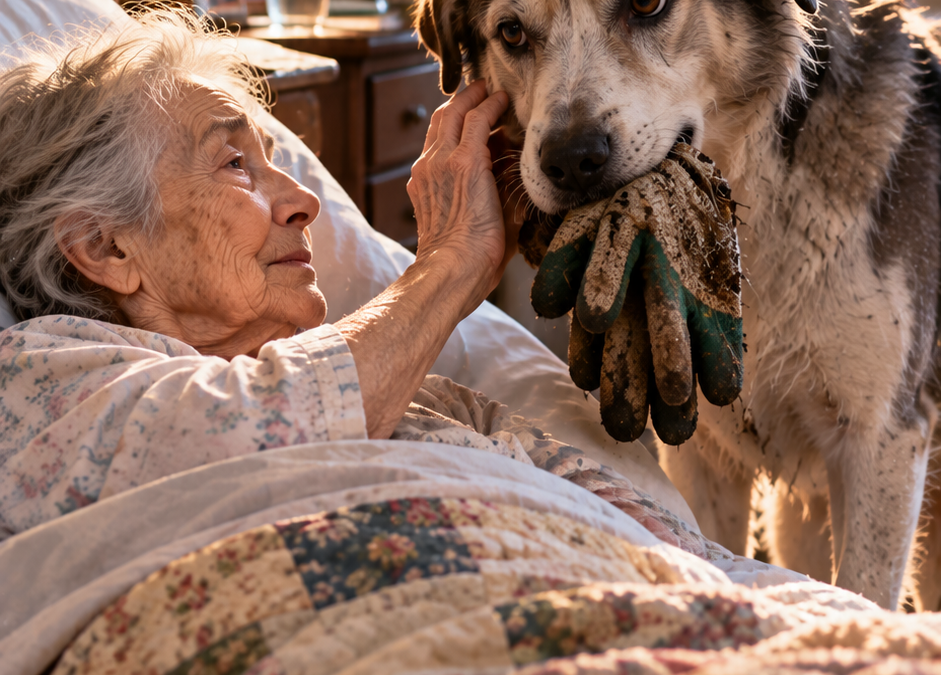
Every Morning the Stray Dog Went Straight to My Dying Grandmother’s Bed, but on Her Final Morning He Carried Something I Had Never Seen Before
For weeks, the gray-and-white dog arrived at exactly the same time every morning.
He never stopped at the kitchen, never searched for food, and never waited for me to call him.
He simply walked through the back door, crossed the hallway, and went straight to my eighty-six-year-old grandmother’s bed as if he had an appointment only the two of them understood.
At first, I had no idea where he came from.
No collar.
No microchip.
No missing-dog notice.
No neighbor claimed him.
But the stranger his body recognized was not really a stranger at all.
My grandmother Ruth had known him long before I did.
And on the morning she died, he brought back something she had lost months earlier.
That was the moment I finally understood what she had been trying to teach me.
My name is Jennifer.
For most of my adult life, my grandmother was the strongest person I knew.
Not strong in the loud way.
Ruth never raised her voice unless a raccoon was destroying her tomatoes or someone was trying to sell her something over the phone.
Her strength was quieter than that.
It lived in routine.
In getting up at six thirty every morning whether she felt well or not.
In making coffee before speaking to anyone.
In tending a garden with knees that had been hurting since she was seventy.
In continuing to send birthday cards to people who had stopped sending them back.
In knowing exactly how many jars of tomatoes were left in the basement without ever checking.
She had lived on the same piece of land for almost seventy years.
The house belonged to her before it belonged to anyone else in my memory.
A small white farmhouse at the edge of a wooded property, with green shutters, a covered back porch, and floorboards that complained whenever anyone walked through the hall after midnight.
My grandfather had died fifteen years before.
Afterward, people expected Ruth to move.
She refused.
“This house knows me,” she said.
I laughed the first time.
“You know houses aren’t alive.”
She looked at me over her glasses.
“That’s what people say when they haven’t lived somewhere long enough.”
That was Ruth.
She could make a ridiculous sentence sound like a fact you had simply been too young to understand.
By the time she turned eighty-four, I had moved in with her.
I told everyone it was temporary.
She had begun falling occasionally.
Nothing catastrophic.
A stumble near the bathroom.
A dizzy spell in the kitchen.
Once, I found her sitting on the back steps because she had become too tired halfway up.
“I’m resting,” she insisted.
“You’re sitting on the steps at eleven in the morning.”
“Yes.”
“With groceries beside you.”
“I was going to bring them in.”
“You bought twelve cans of tomatoes.”
“There was a sale.”
I carried the bags.
She objected.
I ignored her.
Eventually, temporary became permanent.
I worked long days as an office manager for a medical supply company about twenty minutes away.
Ruth stayed home.
She did not need constant care then.
She cooked.
Read.
Watched old game shows.
Called friends.
And, most importantly, maintained her garden.
The garden sat about a hundred feet behind the house, near the edge of the woods.
Small.
Maybe twenty feet by thirty.
Tomatoes.
Basil.
Green beans.
Marigolds around the edges because Ruth insisted they kept pests away.
At one corner stood an old oak tree.
And beneath it was a wooden bench my grandfather had built for her sometime in the early eighties.
The bench leaned slightly.
The paint had disappeared years ago.
One leg had been repaired twice.
Ruth refused to replace it.
“Your grandfather made that.”
“I know.”
“He measured everything wrong.”
“I know.”
“So why would I want a perfect one now?”
There was no answer to that.
Every morning at seven, Ruth walked to the garden carrying a small basket.
She wore the same faded gardening gloves for years.
Brown cloth.
Green rubber palms.
One had a small tear along the thumb.
She could have bought new ones.
I bought her new ones.
She never used them.
“These know where the weeds are.”
“Grandma, they’re gloves.”
“Exactly.”
I stopped arguing.
It was around that time she first mentioned the dog.
I came home after work one evening and found her at the kitchen table snapping green beans.
“There’s a dog in the woods,” she said.
I stopped with my keys still in my hand.
“What kind?”
“Dog kind.”
“Very helpful.”
“Gray and white.”
“Collar?”
“No.”
“Friendly?”
She shrugged.
“He hasn’t introduced himself.”
I put my purse down.
“Grandma.”
“What?”
“Don’t approach a stray dog.”
She looked up.
“I didn’t.”
“He could be sick.”
“I know.”
“Rabies.”
“Jennifer.”
“Or scared.”
“Yes.”
“Scared dogs bite.”
She smiled.
“I have lived on this land for seventy years.”
“I’m aware.”
“I know when to be afraid.”
“That is exactly the kind of sentence people say before something bites them.”
Ruth laughed.
“He sits under the oak.”
“Every day?”
“Three mornings now.”
“What does he do?”
“Watches.”
“Watches what?”
“Me.”
That made me uncomfortable.
“How close?”
“Far enough.”
“Don’t feed him.”
Ruth looked back at the beans.
That should have told me everything.
The next morning, I woke earlier than usual.
I walked into the kitchen and saw Ruth putting something into her gardening basket.
Bread.
A piece of chicken.
“Grandma.”
She did not turn around.
“What?”
“What did I say?”
“Many things.”
“About feeding him.”
“You said not to.”
“And?”
“I heard you.”
“That isn’t the same as agreeing.”
“No.”
I sighed.
She smiled.
“Coffee is ready.”
I followed her to the back door.
“At least let me come.”
“You have work.”
“I have fifteen minutes.”
“You’ll make him nervous.”
“How do you know?”
“Because you make me nervous.”
I stared.
She kissed my cheek.
“Go drink your coffee.”
I watched from the kitchen window instead.
Ruth walked slowly toward the garden.
Basket on one arm.
Old gloves.
Blue sweater.
She reached the bench.
And there he was.
Under the oak.
At first, I barely saw him.
Gray fur blended with the shadows.
Medium-sized.
Lean.
His ribs visible even from the house.
White on his chest.
One white front paw.
Ears partly folded.
He sat perfectly still.
Ruth did not look directly at him.
She placed the food on the ground about fifteen feet from the bench.
Then she turned away.
Started pulling weeds.
For almost five minutes, nothing happened.
I stood at the window holding my coffee.
The dog watched.
Ruth worked.
Finally, he rose.
Slowly.
One step.
Stop.
Another.
He reached the bread first.
Sniffed.
Picked it up.
Retreated beneath the oak.
He ate there.
Never taking his eyes off her.
Then the chicken.
Same routine.
Approach.
Take.
Retreat.
Ruth did not acknowledge him once.
When she came inside an hour later, I was waiting.
“You fed him.”
“Yes.”
“He’s going to come back.”
“That appears to be the idea.”
“Grandma.”
She removed one glove.
Then the other.
“Jennifer, he is hungry.”
“We don’t know anything about him.”
“We know he is hungry.”
“He could belong to someone.”
“Then they aren’t feeding him enough.”
“What if he becomes dependent on you?”
Ruth stopped.
Looked at me.
“Everyone is dependent on someone.”
“That is not the point.”
“I think it is.”
I sighed.
“You cannot adopt every creature that walks through the woods.”
“No.”
She looked toward the window.
“Just the one that keeps coming back.”
That summer, the dog became part of her mornings.
At first, he remained beneath the oak.
Ruth placed food near the bench.
Then closer.
Week by week, the distance shortened.
She never forced it.
That surprised me.
Ruth was not naturally patient with most things.
She hated slow drivers.
Long lines.
People who took too long ordering coffee.
With that dog, she seemed willing to wait forever.
“Why don’t you call him?” I asked one Saturday.
We were sitting in the garden together.
The dog was about ten feet away.
“Because he knows where I am.”
“That doesn’t answer the question.”
“He’ll come when he’s ready.”
“You want him to.”
“Yes.”
“Then call him.”
Ruth smiled.
“Wanting someone close doesn’t give you the right to pull them closer.”
I looked at her.
“That was annoyingly wise.”
“I’m eighty-four. I’ve had time.”
The dog eventually came within arm’s reach.
It happened on an ordinary morning.
No breakthrough.
No dramatic rescue.
Ruth was sitting on the bench because her knees hurt.
The dog approached.
Stopped beside her.
She kept her hands in her lap.
He sniffed her shoe.
Then her basket.
Then, slowly, rested his chin against her knee.
Ruth’s face changed.
Softened.
She looked toward the house, knowing I was probably watching.
I was.
She raised one eyebrow.
See?
That expression said.
I smiled despite myself.
After that, the dog stayed closer.
He lay beside the garden rows while Ruth worked.
Sometimes under the bench.
Sometimes beneath the oak.
He never wandered toward the house.
Never begged at the kitchen.
His world seemed to exist between the woods, the oak, and Ruth’s garden.
Ruth talked to him constantly.
About weather.
Neighbors.
Tomatoes.
My job.
My lack of dating life.
I discovered that last part because I went outside one morning and heard her say, “Jennifer is too serious.”
“Excuse me?”
Ruth looked over.
The dog lifted his head.
“I was explaining you.”
“To the dog?”
“He asked.”
“He did not.”
The dog’s tail moved.
Ruth pointed.
“See?”
I shook my head.
“He agrees with everything you say because you bring chicken.”
“Smart boy.”
She started calling him boy.
Not a name.
Just boy.
“Morning, boy.”
“There you are, boy.”
“Stay out of my tomatoes, boy.”
Sometimes he seemed to respond.
Other times not.
I asked again why she did not name him.
“He may already have one.”
“No collar.”
“Names don’t require collars.”
“Do you think someone abandoned him?”
Ruth’s hands stopped moving among the basil.
“Probably.”
“Why?”
She looked toward him.
“Because he knows people.”
“What do you mean?”
“A truly feral dog doesn’t watch hands like that.”
I studied him.
Whenever Ruth reached too quickly, the dog flinched.
Barely.
But it was there.
Whenever a truck backfired on the road, he disappeared into the woods.
When I approached, he remained farther away than when Ruth did.
“He trusted someone before,” she said.
“And?”
“They disappointed him.”
I hated the certainty in her voice.
“You don’t know that.”
“No.”
She went back to work.
“But I know what disappointment looks like.”
I never asked what she meant.
Maybe I should have.
By late summer, the dog began touching Ruth.
Not just tolerating contact.
Seeking it.
If she sat too long, he rested against her leg.
If she bent over the plants, he followed.
Several times, I saw him place one paw gently on her hand.
The first time, I laughed.
“What’s he doing?”
“Supervising.”
“Maybe he thinks you’re falling.”
“I’m not falling.”
“You fall.”
“Occasionally.”
The dog touched her wrist again.
Ruth smiled.
“See? He worries.”
She was right.
As her body weakened, his attention sharpened.
The change in Ruth happened slowly enough that I could pretend not to notice.
At first, it was fatigue.
She came inside earlier.
Then stopped carrying a full basket.
Then began using the bench more.
By September, walking the hundred feet to the garden became an event.
I offered to move some pots onto the porch.
“No.”
“Why not?”
“It’s not the same.”
“You’re exhausted when you get there.”
“So?”
“So maybe listen to your body.”
“My body has been complaining for twenty years.”
“Grandma.”
She touched my hand.
“I’ll stop when I can’t go.”
That sentence frightened me.
A doctor had already told us her heart was weakening.
Congestive heart failure.
Medication helped.
Not enough.
She was eighty-five by then.
Her body was simply becoming tired.
I wanted treatment.
Answers.
Numbers.
Timelines.
Ruth wanted tomatoes.
We compromised.
I drove her closer to the garden in an old utility cart one Saturday.
She hated it.
“This is ridiculous.”
“You like ridiculous.”
“I can walk.”
“Then walk home.”
She glared.
The dog trotted beside us.
“Even he thinks this is embarrassing.”
“No, he thinks you should stop pretending you’re twenty.”
Ruth muttered something under her breath.
At the garden, the dog lay beside her chair.
She rested one hand on his back.
For the first time, I realized he had gained weight.
Not much.
His ribs were less visible.
His coat looked better.
Ruth had been feeding him every day.
But he still disappeared into the woods each afternoon.
I wondered where he slept.
Where he went during storms.
Why he never entered the house.
I contacted local rescues.
Posted photographs.
Had a volunteer bring a microchip scanner when the dog finally allowed me close enough.
Nothing.
No chip.
No matching missing report.
No one came.
He belonged nowhere officially.
Ruth hated when I said that.
“He belongs somewhere.”
“Where?”
She looked at him.
“He’ll decide.”
Autumn came early.
Leaves turned.
The garden slowed.
Tomato vines browned.
Basil disappeared after the first frost.
Ruth’s health worsened faster.
One morning, she stood from bed and almost collapsed.
I caught her.
“Enough.”
She protested.
“No.”
“I need to go outside.”
“No.”
“The dog—”
“I’ll feed him.”
“He doesn’t come for food.”
I looked at her.
She was breathing hard from simply standing.
“Grandma.”
Her face softened.
“I know.”
That was the first morning she did not go to the garden.
At seven, the dog appeared beneath the oak.
I carried food out.
He watched me.
Would not approach.
“It’s me today.”
His ears moved.
I placed the food.
“She’s sick.”
I felt ridiculous explaining.
“She’ll come out when she can.”
The dog looked toward the house.
Then back at me.
He waited almost an hour.
The next morning, same.
On the third day, he followed me toward the house.
Not inside.
To the back steps.
He sat there.
The following day, closer.
Then directly at the door.
Ruth was in bed.
I told her.
“He’s on the porch.”
Her tired face brightened.
“Let him in.”
I hesitated.
“He has never been inside.”
“Neither had you until your mother brought you home.”
“That is not comparable.”
“Open the door.”
I did.
The dog stood at the threshold.
He sniffed.
Looked at me.
Then past me.
I stepped aside.
“Ruth is down the hall.”
I did not expect him to understand.
He entered anyway.
Slowly.
Nose working.
Through the kitchen.
Hallway.
Straight to her bedroom.
No wandering.
No searching.
As though he already knew.
Ruth was propped against pillows.
The dog stopped in the doorway.
Her eyes filled.
“There you are.”
His tail moved.
He approached the bed.
Placed his front paws carefully against the mattress.
I reached to stop him.
Ruth lifted one hand.
“Leave him.”
The dog rested his chin near her hip.
Ruth stroked his face.
“You found me.”
That was the beginning of their final routine.
Every morning, around seven, he appeared.
I opened the back door.
He entered.
Walked directly to Ruth.
Sometimes he lay at the foot of the bed.
Sometimes beside it.
As she weakened, he moved closer.
Eventually, he learned to place his front half against the mattress without disturbing her.
Ruth would wrap one thin arm around his neck.
They stayed like that.
Minutes.
Sometimes an hour.
I stood in the doorway more than once, feeling like I was witnessing something I did not entirely understand.
The dog did not behave the way he had in the garden anymore.
There, he had been a companion.
In the bedroom, he became a guardian.
If Ruth coughed, his head lifted.
If she shifted painfully, he stood.
If nurses came, he watched.
Not threatening.
Alert.
A home-care nurse named Melissa asked, “Is he yours?”
“No.”
She looked at the dog.
“He seems to disagree.”
“He’s a stray.”
“He doesn’t act like one.”
I glanced toward Ruth.
She was sleeping.
The dog lay beside her bed.
“I don’t think she considers him a stray either.”
Ruth woke.
Without opening her eyes, she said, “Because he isn’t.”
Melissa smiled.
I did too.
That evening, after the dog left, Ruth called me close.
Her voice had become softer over the previous weeks.
“What happens to him after me?”
My chest tightened.
“We don’t need to talk about that.”
“Yes, we do.”
“No.”
“Jennifer.”
I hated when she used that tone.
“You’re not going anywhere.”
She gave me the look.
The one that said I was insulting both of us by pretending.
“Everyone goes somewhere.”
I sat beside her.
“Grandma.”
“I’m not afraid.”
“I am.”
“I know.”
She touched my hand.
Her fingers felt light.
Almost weightless.
“There’s only one thing I worry about.”
“What?”
She looked toward the window.
“The dog.”
I swallowed.
“He’ll be okay.”
“How?”
“I’ll call a rescue.”
Her expression changed immediately.
“No.”
“Grandma.”
“No kennel.”
“Then a foster.”
“He knows this place.”
“What do you want me to do?”
“Choose him.”
The words startled me.
“He isn’t ours.”
Ruth looked directly at me.
For someone so weak, her eyes remained sharp.
“A stray is only a dog nobody has chosen.”
I said nothing.
She continued.
“I chose him.”
I looked away.
“He chose me too.”
My eyes burned.
“And when I’m gone, he’ll need someone.”
“You’re asking me to take him.”
“I’m asking you not to make him lose everything twice.”
That sentence hurt.
“Grandma, I work ten hours a day.”
“He waits.”
“I’ve never owned a dog.”
“You learn.”
“What if he doesn’t want me?”
Ruth smiled.
“He already comes through your door.”
“For you.”
“Maybe at first.”
I shook my head.
She squeezed my fingers.
Weakly.
“Jennifer, you spend too much time being afraid you won’t be enough for people.”
I looked at her.
“This is not about me.”
“It’s always a little about us.”
I could not answer.
She closed her eyes.
A minute later, she whispered, “Promise you’ll look after him.”
I wanted to say yes.
Instead, I said, “Rest.”
She smiled without opening her eyes.
“That means no.”
“It means rest.”
“Stubborn girl.”
“You raised me.”
“True.”
November arrived with fog.
Ruth stopped leaving bed entirely.
Her appetite disappeared.
Some days she spoke.
Others she mostly slept.
The dog continued coming.
Seven in the morning.
Every day.
Rain.
Cold.
Fog.
He waited at the door.
I let him in.
He went to her.
Sometimes Ruth was awake.
“Morning, boy.”
Tail wag.
Sometimes asleep.
He lay beside her quietly.
I began leaving the back door cracked when weather allowed because he hated waiting outside after dark.
He still disappeared each evening.
I wondered where.
I tried coaxing him to stay.
Food.
Blanket.
Nothing worked.
He belonged to Ruth’s mornings.
The rest of his life remained somewhere in the woods.
One evening, Ruth was unusually alert.
She asked me to brush her hair.
I did.
The dog lay beside the bed.
She looked down at him.
“I should name you.”
His ears moved.
I smiled.
“You waited long enough.”
Ruth frowned.
“Names are serious.”
“You named me Jennifer.”
“That was your mother.”
“Good point.”
She studied the dog.
“Barnaby.”
I laughed.
“Barnaby?”
“Yes.”
“That is an old man’s name.”
“He has an old soul.”
The dog’s tail moved.
Ruth smiled.
“See?”
“Apparently he agrees.”
But she never called him Barnaby again.
Her health declined too quickly.
The name remained between us.
Waiting.
The last night, fog covered the property.
I sat beside Ruth until almost midnight.
Her breathing was shallow.
Hospice had prepared me.
That did not make anything easier.
The dog had left around sunset.
I remember wondering whether he knew.
Ruth opened her eyes around eleven.
“Jennifer.”
“I’m here.”
“Window.”
I adjusted the curtain.
“No.”
She moved one finger toward the glass.
“Open.”
“It’s cold.”
“Open it.”
I cracked the window.
Cool air entered.
The smell of wet leaves.
Earth.
The woods.
Ruth breathed in.
“Garden.”
“Yes.”
“Tomatoes were terrible this year.”
I laughed through tears.
“They were.”
“Too much rain.”
“Yes.”
She closed her eyes.
“Your grandfather never knew how to build that bench.”
“No.”
“He was proud of it.”
“I know.”
Silence.
Then she whispered, “Don’t be afraid of loving something because you might lose it.”
My throat closed.
“Grandma.”
“Promise.”
I took her hand.
“I promise.”
I don’t know whether she heard.
Her breathing deepened.
She slept.
I fell asleep in the chair beside her sometime before dawn.
When I woke, the room felt different.
People describe death as silence.
That is not exactly right.
The house still made sounds.
The furnace clicked.
A branch touched the window.
The refrigerator hummed down the hall.
But there was an absence beneath those sounds.
I looked at Ruth.
Her chest was still.
I knew before touching her.
Still, I placed two fingers near her neck.
Nothing.
“Grandma?”
My voice sounded very small.
No answer.
Her face looked peaceful.
Hands resting across her chest.
I sat there.
I don’t know how long.
Then I heard something near the door.
A soft scrape.
I turned.
The dog stood there.
I had not opened the back door.
Later, I realized I must have left it unlocked and partly ajar when I let the hospice nurse out the night before.
He had pushed through.
His fur was damp with fog.
Something hung from his mouth.
At first, I could not see what.
Then he walked toward the bed.
Slowly.
He stopped beside Ruth.
Placed his front paws against the mattress.
Then lowered his head onto her hands.
The object fell.
A gardening glove.
Brown cloth.
Green rubber palm.
Small tear at the thumb.
Ruth’s glove.
The one she had lost the previous summer.
I stared.
I remembered her searching the garden.
“I swear I had two.”
“You probably dropped it.”
“I don’t drop things.”
“You dropped me once.”
“You were three.”
The glove had never been found.
Until that morning.
The dog had brought it back.
A final gift.
Or maybe simply something that smelled like her.
I will never know how dogs understand death.
I will never claim he knew in the human sense.
But he understood something.
Ruth did not move when he touched her.
Did not speak.
Did not take the glove.
He nudged her hand once.
Then again.
Nothing.
His ears lowered.
He rested his head across her fingers.
And became completely still.
That broke me.
I slid from the chair onto the floor.
I put my arms around him.
For months, he had barely allowed me to touch him for more than a few seconds.
That morning, he did not move away.
I buried my face against his neck.
Cried into his fur.
He licked my hand.
Once.
Then again.
I held him tighter.
“I’m sorry.”
I don’t know whether I was speaking to him.
To Ruth.
To myself.
“I’m so sorry.”
He leaned against me.
For the first time, I understood what my grandmother had meant.
He wasn’t a stray.
Not anymore.
He had a family.
His family had simply become smaller.
I looked at the glove.
Then at him.
“Barnaby.”
His head lifted.
That was the name Ruth had chosen.
“Your name is Barnaby.”
His tail moved.
Once.
Twice.
Three times.
I laughed through tears.
“Of course.”
Barnaby put his head back against me.
That was the morning he became mine.
Not because I filled out paperwork.
Not because I bought a collar.
Because Ruth had already left him to me in every way that mattered.
The weeks after her death were some of the hardest of my life.
The house changed.
Her chair sat empty.
Her coffee cup remained in the cabinet.
Her gardening basket stayed near the back door because I could not move it.
Every room contained evidence that a person could be gone and still somehow occupy space.
Barnaby grieved too.
Again, I cannot say what he understood.
I can tell you what he did.
Every morning at seven, he went to the back door.
Sat.
Watched the path to the garden.
Whenever the house creaked, his tail moved.
Whenever a car entered the driveway, he stood.
If someone approached the front door, he hurried down the hall.
Then slowed when it was not her.
The first week, he barely ate.
I placed food down.
He sniffed.
Walked away.
I tried chicken.
Tuna.
Wet food.
Nothing.
“Barnaby.”
He sat near the back door.
“She’s not coming.”
I hated saying it.
His ears moved.
“She’s not.”
He looked outside.
I sat beside him.
“I know.”
That became our routine.
Two grieving creatures sitting beside a door.
I returned to work after the funeral.
I hated leaving him.
The first morning, Barnaby followed me to the front entrance.
When I picked up my keys, his body changed.
He backed away.
That old fear.
I understood immediately.
“You think I’m leaving too.”
I crouched.
“I’m coming back.”
He stared.
“I promise.”
I went to work.
For ten hours, I worried.
When I came home, Barnaby was sitting inside the back door.
The moment he saw me, he stood.
Tail wag.
Tentative.
I put my bag down.
“I told you.”
He approached.
“I came back.”
That happened every day.
Leave.
Return.
Leave.
Return.
Trust through repetition.
But he still would not eat properly.
By the third week, I called the vet.
Medical tests were normal.
“Stress,” she said.
“Grief?”
“Possibly.”
“What do I do?”
“Routine. Patience. Offer food. Don’t force him.”
Patience.
Ruth would have laughed.
One evening, I sat on the kitchen floor beside Barnaby’s untouched bowl.
“You have to eat.”
He looked away.
“I know you miss her.”
Silence.
“So do I.”
My voice broke.
Barnaby’s ears moved.
“I don’t know how to do this house without her either.”
I touched his back.
He allowed it.
“Maybe we figure it out together.”
Without thinking, I started humming.
A song Ruth had sung to me as a child.
“You Are My Sunshine.”
I did not sing much of it.
Just the familiar melody under my breath.
Barnaby turned his head.
I kept humming.
His body shifted closer.
Then he licked my hand.
I stopped.
He looked at the bowl.
Took one bite.
I held my breath.
Another.
Then another.
I started humming again.
Barnaby ate.
Slowly.
Not much.
Enough.
I cried quietly while he did.
That was the first real meal he had eaten since Ruth died.
Something changed after that.
Not immediately.
Grief rarely releases anyone that politely.
But Barnaby started eating.
He stopped waiting at the door all day.
Still checked.
Still sat there every morning.
But he also followed me into the living room.
Then upstairs.
Then one night, instead of sleeping near the back entrance, he came into my bedroom.
He stood at the foot of the bed.
“Hey.”
His tail moved.
“You staying?”
He circled twice on the rug.
Lay down.
That became his place.
A week later, I woke in the middle of the night and felt something warm against my feet.
Barnaby had climbed onto the bed.
I did not move him.
After that, he rarely slept anywhere else.
We learned each other.
His quirks.
My routines.
He disliked vacuum cleaners.
Loved toast.
Was suspicious of umbrellas.
Hated thunder but pretended not to until the second clap.
He brought gifts.
That started in spring.
A stick appeared beside my shoe.
Then a smooth stone.
Then a feather.
Once, a living butterfly.
I had no idea how he managed that without hurting it.
He entered the kitchen carrying the butterfly delicately between his lips.
Its wings moved.
“Barnaby!”
He froze.
I approached carefully.
“Drop.”
He did.
The butterfly sat stunned in my hand.
I opened the window.
It flew.
Barnaby watched.
Then looked at me.
“You are extremely strange.”
Tail wag.
The gifts reminded me of the glove.
I kept Ruth’s old glove in a drawer near my bed.
I could not wash it.
Sometimes Barnaby sniffed the drawer.
I wondered what remained of her scent.
Probably little.
Maybe enough for him.
I began tending the garden.
Badly.
Ruth would have been horrified.
I overwatered tomatoes.
Planted basil too early.
Forgot which marigolds she preferred.
The bench finally lost another board.
I repaired it.
Poorly.
That felt appropriate.
Barnaby came with me.
The first time we walked toward the garden after Ruth died, he stopped halfway.
I did too.
“You remember.”
He looked toward the oak.
Then continued.
At the garden, he went directly beneath the tree.
Sat.
Exactly where I had first seen him years earlier.
For several minutes, he watched the empty bench.
Then me.
I sat.
Barnaby approached.
Lay at my feet.
That became our new morning ritual.
Not every day.
My work schedule did not allow it.
Weekends.
Early mornings.
Coffee for me.
Barnaby under the oak.
Eventually the garden stopped feeling like a place where Ruth was missing and became a place where I could remember her without collapsing.
That difference took time.
Two years have passed now.
Barnaby no longer goes into the woods.
Not far, anyway.
The first few months, he sometimes disappeared between the trees for an hour.
I would panic.
Then he came back.
Eventually he stopped going altogether.
Home expanded around him.
He has a collar now.
Tag.
Microchip.
Veterinarian.
Food he likes.
An orthopedic bed he ignores.
He prefers mine.
Every morning, he wakes before I do.
Usually I open my eyes to find him watching.
Not anxiously.
Just waiting.
“Morning.”
Tail wag.
Then we get up.
Breakfast.
Coffee.
Walk.
Ordinary things.
Those are the things I treasure most.
Before Ruth became sick, I never understood why she loved routine so much.
Now I do.
Routine is not boring when someone you love is part of it.
Routine is proof that yesterday continued into today.
Barnaby still sits by the back door sometimes.
Especially early in the morning.
He looks toward the garden.
Toward the old oak.
I used to wonder whether he was waiting for Ruth.
I do not anymore.
His body is different now.
No tension.
No sudden lift at every sound.
He looks the way people look at old photographs.
Remembering without expecting the past to walk through the door.
I sit beside him sometimes.
“You miss her?”
Barnaby leans against me.
“Me too.”
Then he gets up.
Follows me to the kitchen.
That is how I know he understands the difference between memory and waiting.
At least as much as any of us do.
Every evening when I come home from work, Barnaby is at the door.
He hears my car.
By the time I turn the key, his tail is already hitting the wall.
And almost always, he has something in his mouth.
Leaf.
Feather.
Stick.
Rock.
Once one of my own socks.
“Very thoughtful.”
He drops it into my hand.
I always accept.
“Thank you.”
Then he puts his head against my knee.
And every time, I remember Ruth.
She knew before I did.
She knew the dog had chosen her.
She knew love did not require ownership papers.
She knew that being abandoned did not make a creature incapable of belonging again.
And she knew something about me I had not wanted to admit.
I was afraid of being responsible for someone I could lose.
Maybe because I was already losing her.
Taking Barnaby felt like accepting another future grief.
Ruth understood that.
That is why her final lesson mattered.
Do not be afraid of loving something because you might lose it.
I have thought about that sentence for two years.
It sounds obvious.
It is not.
Loss can make people cautious.
You begin calculating.
If I never become attached, I cannot be devastated.
If I expect people to leave, departure will not surprise me.
If I keep enough distance, grief will have less to take.
But love does not work according to those calculations.
Neither does life.
Ruth loved my grandfather knowing one of them would eventually be left behind.
She loved the house knowing age would someday take it from her.
She planted tomatoes every spring knowing frost would kill the vines.
She fed a stray dog without knowing whether he would ever let her touch him.
She loved anyway.
Barnaby did too.
Someone had abandoned him once.
Maybe more than once.
He had every reason to distrust people.
Yet each morning he returned to the oak.
Each day he moved a little closer.
Eventually he put his head on Ruth’s knee.
Then walked into our house.
Then placed his heart back into human hands.
I do not know whether animals think of courage.
But that looks like courage to me.
Sometimes people tell me I saved Barnaby.
I never agree.
Ruth saved him first.
Food.
Patience.
A bench beneath an oak.
No demands.
Then he gave something back.
Companionship.
Watchfulness.
A reason for an eighty-six-year-old woman with a failing heart to smile at seven every morning.
After Ruth died, Barnaby and I carried each other through the silence.
I fed him.
He made me get out of bed.
I took him to the vet.
He made me walk outside when I would have stayed inside crying.
I gave him a permanent home.
He made the house feel inhabited again.
Who saved whom?
I stopped trying to answer.
Love does not always move in one direction.
Last fall, I replaced some boards around the garden.
Barnaby supervised.
I found one of Ruth’s old tomato markers beneath the soil.
Her handwriting still visible.
BEEFSTEAK.
I sat on the bench holding it.
Barnaby rested his chin on my knee.
“You knew her longer than I knew you.”
Tail movement.
“I think she loved you more.”
Another wag.
“Rude.”
I laughed.
The sound surprised me.
There was a time after Ruth died when laughter in the garden felt impossible.
Now it belonged there again.
Grief had not vanished.
It had changed shape.
That is something Barnaby taught me too.
Continuing to love does not betray the person who died.
Joy afterward is not disloyalty.
The heart does not have one room.
Loving Barnaby after Ruth did not replace her.
It carried something forward.
On the anniversary of her death, I took the old glove from my drawer.
Barnaby was sleeping on the bed.
I sat beside him.
He opened his eyes.
I let him smell it.
His nose moved.
He became very still.
Then he licked the glove once.
I cried.
Not like the first morning.
Quiet tears.
The kind grief becomes after time.
“I kept it.”
Barnaby looked at me.
“You brought it back.”
His tail moved against the blanket.
I placed the glove beside Ruth’s photograph on my dresser.
That is where it stays now.
I no longer hide it in a drawer.
Some memories should be visible.
The old oak still stands.
The bench still leans.
The garden is not as good as Ruth’s.
Never will be.
I have accepted that.
My tomatoes are inconsistent.
Basil survives mostly by luck.
The marigolds grow everywhere because apparently those are the only plants I cannot kill.
Barnaby loves them.
He lies beside the beds while I work.
Sometimes places one paw on my hand.
The same thing he used to do with Ruth.
The first time, I stopped completely.
Looked at him.
“You used to do that to her.”
He kept his paw there.
I smiled.
“Checking on me?”
Tail.
“I’m okay.”
Maybe he was telling me the same.
On certain mornings, the sunlight comes through the trees at exactly the angle I remember from that first summer.
For a second, if I am not paying attention, I expect to see Ruth sitting on the bench.
Blue sweater.
Old gloves.
Basket beside her.
Barnaby under the oak.
Then the image passes.
I feel the loss.
But I also feel lucky.
I had her for most of my life.
Barnaby had her for a few seasons.
Neither of us got enough.
No one ever does.
Enough is not measured by whether you wanted more.
It is measured by whether the love existed while there was time.
Ours did.
Sometimes I imagine what Ruth would say if she saw Barnaby now.
Clean coat.
Healthy weight.
Sleeping in my bed.
Entire basket of toys.
She would probably accuse me of spoiling him.
“You let him on the furniture?”
“Yes.”
“Jennifer.”
“He likes it.”
“He’s a dog.”
“You fed him chicken from your table.”
“That was different.”
It wasn’t.
I can hear her laugh.
That memory no longer destroys me.
It comforts me.
Two years after Ruth died, Barnaby is no longer the dog waiting beneath the oak for someone to choose him.
He is not the dog sitting by the back door hoping Ruth will return.
He is not the dog refusing food because the person he loved disappeared.
He is Barnaby.
My dog.
Family.
He knows the sound of my car.
Knows which cabinet holds treats.
Knows that Saturday mornings mean the garden.
Knows that thunder means he is allowed under the blanket even though technically he is always allowed there.
He knows I come home.
That last one matters most.
Every morning when I leave for work, Barnaby walks me to the door.
Sometimes a tiny piece of old fear still appears in his eyes.
Or maybe I only imagine it.
I crouch.
“Back tonight.”
He touches my hand with his nose.
“I promise.”
Then I leave.
And I return.
Every time.
Not because promises make bad things impossible.
Ruth taught me better than that.
One day, someday, I will fail to return because every life ends.
Barnaby’s too.
Mine too.
But love cannot be lived entirely in fear of the last day.
It has to exist in the ordinary ones.
Today.
Breakfast.
Walk.
A hand on fur.
A gift carried through the door.
A dog waiting at the end of a long workday.
That is where love lives.
Not only in endings.
This evening, when I came home, Barnaby met me at the door carrying a small green leaf.
He placed it in my palm.
I crouched.
“Evening, Barnaby.”
His tail moved.
“What did you bring me today?”
He looked at the leaf.
Then at me.
I took it seriously.
I always do.
“Beautiful.”
Barnaby placed his head against my knee.
I stroked the gray beginning to appear around his muzzle.
For a moment, I could see all three of us.
Ruth in her garden.
Barnaby beneath the oak.
Me behind the kitchen window telling myself not to get involved.
I had been wrong about almost everything.
The dog was not dangerous.
Ruth was not foolish.
And love was not something you could avoid simply by refusing to name it.
By the time I accepted Barnaby as family, Ruth had already known for years.
She always knew when to trust.
When to wait.
When to love.
Barnaby taught me the part that came afterward.
How to keep loving when the person who first connected you is gone.
How to let grief become memory without turning memory into a prison.
How to understand that moving forward does not mean leaving anyone behind.
Some mornings, Barnaby and I still sit beneath the oak.
I drink coffee.
He watches the woods.
The bench creaks beneath me.
The garden smells like damp soil and basil.
I talk to Ruth sometimes.
Not because I expect an answer.
Because I think love deserves somewhere to go.
“Your dog is doing well.”
Barnaby looks up.
“All right. Our dog.”
Tail wag.
“He still steals chicken.”
Tail.
“He sleeps in my bed.”
Tail.
“He is spoiled beyond repair.”
Full wag.
I laugh.
Then we sit quietly.
There is no sadness in Barnaby’s eyes anymore when he looks toward the trees.
Only calm.
I think that is what healing looks like for him.
And perhaps for me too.
Remembering without waiting for the impossible.
Loving what remains.
Being grateful for what was.
Then standing up and going home.
When we reach the back door, Barnaby always waits for me to open it.
He could push it with his nose.
He knows how.
But he waits.
I open the door.
“Come on.”
He walks through first.
Every time.
And I think about Ruth’s words.
A stray is only a dog no one has chosen.
She chose him.
He chose her.
Then, when she could no longer stay, somehow they both chose me.
That was the gift Ruth left behind.
Not a responsibility.
Not an obligation.
A relationship already begun.
A heart still willing to love.
A dog still willing to trust.
And a home that, even after death had taken one of us, still had room for the two who remained.
Barnaby does not wait for Ruth at the door anymore.
He waits for me.
And every evening, I come back.
𝗧𝗛𝗘 𝗘𝗡𝗗
Every Morning the Stray Dog Went Straight to My Dying Grandmother’s Bed, but on Her Final Morning He Carried Something I Had Never Seen Before
For weeks, the gray-and-white dog arrived at exactly the same time every morning.
He never stopped at the kitchen, never searched for food, and never waited for me to call him.
He simply walked through the back door, crossed the hallway, and went straight to my eighty-six-year-old grandmother’s bed as if he had an appointment only the two of them understood.
At first, I had no idea where he came from.
No collar.
No microchip.
No missing-dog notice.
No neighbor claimed him.
But the stranger his body recognized was not really a stranger at all.
My grandmother Ruth had known him long before I did.
And on the morning she died, he brought back something she had lost months earlier.
That was the moment I finally understood what she had been trying to teach me.
My name is Jennifer.
For most of my adult life, my grandmother was the strongest person I knew.
Not strong in the loud way.
Ruth never raised her voice unless a raccoon was destroying her tomatoes or someone was trying to sell her something over the phone.
Her strength was quieter than that.
It lived in routine.
In getting up at six thirty every morning whether she felt well or not.
In making coffee before speaking to anyone.
In tending a garden with knees that had been hurting since she was seventy.
In continuing to send birthday cards to people who had stopped sending them back.
In knowing exactly how many jars of tomatoes were left in the basement without ever checking.
She had lived on the same piece of land for almost seventy years.
The house belonged to her before it belonged to anyone else in my memory.
A small white farmhouse at the edge of a wooded property, with green shutters, a covered back porch, and floorboards that complained whenever anyone walked through the hall after midnight.
My grandfather had died fifteen years before.
Afterward, people expected Ruth to move.
She refused.
“This house knows me,” she said.
I laughed the first time.
“You know houses aren’t alive.”
She looked at me over her glasses.
“That’s what people say when they haven’t lived somewhere long enough.”
That was Ruth.
She could make a ridiculous sentence sound like a fact you had simply been too young to understand.
By the time she turned eighty-four, I had moved in with her.
I told everyone it was temporary.
She had begun falling occasionally.
Nothing catastrophic.
A stumble near the bathroom.
A dizzy spell in the kitchen.
Once, I found her sitting on the back steps because she had become too tired halfway up.
“I’m resting,” she insisted.
“You’re sitting on the steps at eleven in the morning.”
“Yes.”
“With groceries beside you.”
“I was going to bring them in.”
“You bought twelve cans of tomatoes.”
“There was a sale.”
I carried the bags.
She objected.
I ignored her.
Eventually, temporary became permanent.
I worked long days as an office manager for a medical supply company about twenty minutes away.
Ruth stayed home.
She did not need constant care then.
She cooked.
Read.
Watched old game shows.
Called friends.
And, most importantly, maintained her garden.
The garden sat about a hundred feet behind the house, near the edge of the woods.
Small.
Maybe twenty feet by thirty.
Tomatoes.
Basil.
Green beans.
Marigolds around the edges because Ruth insisted they kept pests away.
At one corner stood an old oak tree.
And beneath it was a wooden bench my grandfather had built for her sometime in the early eighties.
The bench leaned slightly.
The paint had disappeared years ago.
One leg had been repaired twice.
Ruth refused to replace it.
“Your grandfather made that.”
“I know.”
“He measured everything wrong.”
“I know.”
“So why would I want a perfect one now?”
There was no answer to that.
Every morning at seven, Ruth walked to the garden carrying a small basket.
She wore the same faded gardening gloves for years.
Brown cloth.
Green rubber palms.
One had a small tear along the thumb.
She could have bought new ones.
I bought her new ones.
She never used them.
“These know where the weeds are.”
“Grandma, they’re gloves.”
“Exactly.”
I stopped arguing.
It was around that time she first mentioned the dog.
I came home after work one evening and found her at the kitchen table snapping green beans.
“There’s a dog in the woods,” she said.
I stopped with my keys still in my hand.
“What kind?”
“Dog kind.”
“Very helpful.”
“Gray and white.”
“Collar?”
“No.”
“Friendly?”
She shrugged.
“He hasn’t introduced himself.”
I put my purse down.
“Grandma.”
“What?”
“Don’t approach a stray dog.”
She looked up.
“I didn’t.”
“He could be sick.”
“I know.”
“Rabies.”
“Jennifer.”
“Or scared.”
“Yes.”
“Scared dogs bite.”
She smiled.
“I have lived on this land for seventy years.”
“I’m aware.”
“I know when to be afraid.”
“That is exactly the kind of sentence people say before something bites them.”
Ruth laughed.
“He sits under the oak.”
“Every day?”
“Three mornings now.”
“What does he do?”
“Watches.”
“Watches what?”
“Me.”
That made me uncomfortable.
“How close?”
“Far enough.”
“Don’t feed him.”
Ruth looked back at the beans.
That should have told me everything.
The next morning, I woke earlier than usual.
I walked into the kitchen and saw Ruth putting something into her gardening basket.
Bread.
A piece of chicken.
“Grandma.”
She did not turn around.
“What?”
“What did I say?”
“Many things.”
“About feeding him.”
“You said not to.”
“And?”
“I heard you.”
“That isn’t the same as agreeing.”
“No.”
I sighed.
She smiled.
“Coffee is ready.”
I followed her to the back door.
“At least let me come.”
“You have work.”
“I have fifteen minutes.”
“You’ll make him nervous.”
“How do you know?”
“Because you make me nervous.”
I stared.
She kissed my cheek.
“Go drink your coffee.”
I watched from the kitchen window instead.
Ruth walked slowly toward the garden.
Basket on one arm.
Old gloves.
Blue sweater.
She reached the bench.
And there he was.
Under the oak.
At first, I barely saw him.
Gray fur blended with the shadows.
Medium-sized.
Lean.
His ribs visible even from the house.
White on his chest.
One white front paw.
Ears partly folded.
He sat perfectly still.
Ruth did not look directly at him.
She placed the food on the ground about fifteen feet from the bench.
Then she turned away.
Started pulling weeds.
For almost five minutes, nothing happened.
I stood at the window holding my coffee.
The dog watched.
Ruth worked.
Finally, he rose.
Slowly.
One step.
Stop.
Another.
He reached the bread first.
Sniffed.
Picked it up.
Retreated beneath the oak.
He ate there.
Never taking his eyes off her.
Then the chicken.
Same routine.
Approach.
Take.
Retreat.
Ruth did not acknowledge him once.
When she came inside an hour later, I was waiting.
“You fed him.”
“Yes.”
“He’s going to come back.”
“That appears to be the idea.”
“Grandma.”
She removed one glove.
Then the other.
“Jennifer, he is hungry.”
“We don’t know anything about him.”
“We know he is hungry.”
“He could belong to someone.”
“Then they aren’t feeding him enough.”
“What if he becomes dependent on you?”
Ruth stopped.
Looked at me.
“Everyone is dependent on someone.”
“That is not the point.”
“I think it is.”
I sighed.
“You cannot adopt every creature that walks through the woods.”
“No.”
She looked toward the window.
“Just the one that keeps coming back.”
That summer, the dog became part of her mornings.
At first, he remained beneath the oak.
Ruth placed food near the bench.
Then closer.
Week by week, the distance shortened.
She never forced it.
That surprised me.
Ruth was not naturally patient with most things.
She hated slow drivers.
Long lines.
People who took too long ordering coffee.
With that dog, she seemed willing to wait forever.
“Why don’t you call him?” I asked one Saturday.
We were sitting in the garden together.
The dog was about ten feet away.
“Because he knows where I am.”
“That doesn’t answer the question.”
“He’ll come when he’s ready.”
“You want him to.”
“Yes.”
“Then call him.”
Ruth smiled.
“Wanting someone close doesn’t give you the right to pull them closer.”
I looked at her.
“That was annoyingly wise.”
“I’m eighty-four. I’ve had time.”
The dog eventually came within arm’s reach.
It happened on an ordinary morning.
No breakthrough.
No dramatic rescue.
Ruth was sitting on the bench because her knees hurt.
The dog approached.
Stopped beside her.
She kept her hands in her lap.
He sniffed her shoe.
Then her basket.
Then, slowly, rested his chin against her knee.
Ruth’s face changed.
Softened.
She looked toward the house, knowing I was probably watching.
I was.
She raised one eyebrow.
See?
That expression said.
I smiled despite myself.
After that, the dog stayed closer.
He lay beside the garden rows while Ruth worked.
Sometimes under the bench.
Sometimes beneath the oak.
He never wandered toward the house.
Never begged at the kitchen.
His world seemed to exist between the woods, the oak, and Ruth’s garden.
Ruth talked to him constantly.
About weather.
Neighbors.
Tomatoes.
My job.
My lack of dating life.
I discovered that last part because I went outside one morning and heard her say, “Jennifer is too serious.”
“Excuse me?”
Ruth looked over.
The dog lifted his head.
“I was explaining you.”
“To the dog?”
“He asked.”
“He did not.”
The dog’s tail moved.
Ruth pointed.
“See?”
I shook my head.
“He agrees with everything you say because you bring chicken.”
“Smart boy.”
She started calling him boy.
Not a name.
Just boy.
“Morning, boy.”
“There you are, boy.”
“Stay out of my tomatoes, boy.”
Sometimes he seemed to respond.
Other times not.
I asked again why she did not name him.
“He may already have one.”
“No collar.”
“Names don’t require collars.”
“Do you think someone abandoned him?”
Ruth’s hands stopped moving among the basil.
“Probably.”
“Why?”
She looked toward him.
“Because he knows people.”
“What do you mean?”
“A truly feral dog doesn’t watch hands like that.”
I studied him.
Whenever Ruth reached too quickly, the dog flinched.
Barely.
But it was there.
Whenever a truck backfired on the road, he disappeared into the woods.
When I approached, he remained farther away than when Ruth did.
“He trusted someone before,” she said.
“And?”
“They disappointed him.”
I hated the certainty in her voice.
“You don’t know that.”
“No.”
She went back to work.
“But I know what disappointment looks like.”
I never asked what she meant.
Maybe I should have.
By late summer, the dog began touching Ruth.
Not just tolerating contact.
Seeking it.
If she sat too long, he rested against her leg.
If she bent over the plants, he followed.
Several times, I saw him place one paw gently on her hand.
The first time, I laughed.
“What’s he doing?”
“Supervising.”
“Maybe he thinks you’re falling.”
“I’m not falling.”
“You fall.”
“Occasionally.”
The dog touched her wrist again.
Ruth smiled.
“See? He worries.”
She was right.
As her body weakened, his attention sharpened.
The change in Ruth happened slowly enough that I could pretend not to notice.
At first, it was fatigue.
She came inside earlier.
Then stopped carrying a full basket.
Then began using the bench more.
By September, walking the hundred feet to the garden became an event.
I offered to move some pots onto the porch.
“No.”
“Why not?”
“It’s not the same.”
“You’re exhausted when you get there.”
“So?”
“So maybe listen to your body.”
“My body has been complaining for twenty years.”
“Grandma.”
She touched my hand.
“I’ll stop when I can’t go.”
That sentence frightened me.
A doctor had already told us her heart was weakening.
Congestive heart failure.
Medication helped.
Not enough.
She was eighty-five by then.
Her body was simply becoming tired.
I wanted treatment.
Answers.
Numbers.
Timelines.
Ruth wanted tomatoes.
We compromised.
I drove her closer to the garden in an old utility cart one Saturday.
She hated it.
“This is ridiculous.”
“You like ridiculous.”
“I can walk.”
“Then walk home.”
She glared.
The dog trotted beside us.
“Even he thinks this is embarrassing.”
“No, he thinks you should stop pretending you’re twenty.”
Ruth muttered something under her breath.
At the garden, the dog lay beside her chair.
She rested one hand on his back.
For the first time, I realized he had gained weight.
Not much.
His ribs were less visible.
His coat looked better.
Ruth had been feeding him every day.
But he still disappeared into the woods each afternoon.
I wondered where he slept.
Where he went during storms.
Why he never entered the house.
I contacted local rescues.
Posted photographs.
Had a volunteer bring a microchip scanner when the dog finally allowed me close enough.
Nothing.
No chip.
No matching missing report.
No one came.
He belonged nowhere officially.
Ruth hated when I said that.
“He belongs somewhere.”
“Where?”
She looked at him.
“He’ll decide.”
Autumn came early.
Leaves turned.
The garden slowed.
Tomato vines browned.
Basil disappeared after the first frost.
Ruth’s health worsened faster.
One morning, she stood from bed and almost collapsed.
I caught her.
“Enough.”
She protested.
“No.”
“I need to go outside.”
“No.”
“The dog—”
“I’ll feed him.”
“He doesn’t come for food.”
I looked at her.
She was breathing hard from simply standing.
“Grandma.”
Her face softened.
“I know.”
That was the first morning she did not go to the garden.
At seven, the dog appeared beneath the oak.
I carried food out.
He watched me.
Would not approach.
“It’s me today.”
His ears moved.
I placed the food.
“She’s sick.”
I felt ridiculous explaining.
“She’ll come out when she can.”
The dog looked toward the house.
Then back at me.
He waited almost an hour.
The next morning, same.
On the third day, he followed me toward the house.
Not inside.
To the back steps.
He sat there.
The following day, closer.
Then directly at the door.
Ruth was in bed.
I told her.
“He’s on the porch.”
Her tired face brightened.
“Let him in.”
I hesitated.
“He has never been inside.”
“Neither had you until your mother brought you home.”
“That is not comparable.”
“Open the door.”
I did.
The dog stood at the threshold.
He sniffed.
Looked at me.
Then past me.
I stepped aside.
“Ruth is down the hall.”
I did not expect him to understand.
He entered anyway.
Slowly.
Nose working.
Through the kitchen.
Hallway.
Straight to her bedroom.
No wandering.
No searching.
As though he already knew.
Ruth was propped against pillows.
The dog stopped in the doorway.
Her eyes filled.
“There you are.”
His tail moved.
He approached the bed.
Placed his front paws carefully against the mattress.
I reached to stop him.
Ruth lifted one hand.
“Leave him.”
The dog rested his chin near her hip.
Ruth stroked his face.
“You found me.”
That was the beginning of their final routine.
Every morning, around seven, he appeared.
I opened the back door.
He entered.
Walked directly to Ruth.
Sometimes he lay at the foot of the bed.
Sometimes beside it.
As she weakened, he moved closer.
Eventually, he learned to place his front half against the mattress without disturbing her.
Ruth would wrap one thin arm around his neck.
They stayed like that.
Minutes.
Sometimes an hour.
I stood in the doorway more than once, feeling like I was witnessing something I did not entirely understand.
The dog did not behave the way he had in the garden anymore.
There, he had been a companion.
In the bedroom, he became a guardian.
If Ruth coughed, his head lifted.
If she shifted painfully, he stood.
If nurses came, he watched.
Not threatening.
Alert.
A home-care nurse named Melissa asked, “Is he yours?”
“No.”
She looked at the dog.
“He seems to disagree.”
“He’s a stray.”
“He doesn’t act like one.”
I glanced toward Ruth.
She was sleeping.
The dog lay beside her bed.
“I don’t think she considers him a stray either.”
Ruth woke.
Without opening her eyes, she said, “Because he isn’t.”
Melissa smiled.
I did too.
That evening, after the dog left, Ruth called me close.
Her voice had become softer over the previous weeks.
“What happens to him after me?”
My chest tightened.
“We don’t need to talk about that.”
“Yes, we do.”
“No.”
“Jennifer.”
I hated when she used that tone.
“You’re not going anywhere.”
She gave me the look.
The one that said I was insulting both of us by pretending.
“Everyone goes somewhere.”
I sat beside her.
“Grandma.”
“I’m not afraid.”
“I am.”
“I know.”
She touched my hand.
Her fingers felt light.
Almost weightless.
“There’s only one thing I worry about.”
“What?”
She looked toward the window.
“The dog.”
I swallowed.
“He’ll be okay.”
“How?”
“I’ll call a rescue.”
Her expression changed immediately.
“No.”
“Grandma.”
“No kennel.”
“Then a foster.”
“He knows this place.”
“What do you want me to do?”
“Choose him.”
The words startled me.
“He isn’t ours.”
Ruth looked directly at me.
For someone so weak, her eyes remained sharp.
“A stray is only a dog nobody has chosen.”
I said nothing.
She continued.
“I chose him.”
I looked away.
“He chose me too.”
My eyes burned.
“And when I’m gone, he’ll need someone.”
“You’re asking me to take him.”
“I’m asking you not to make him lose everything twice.”
That sentence hurt.
“Grandma, I work ten hours a day.”
“He waits.”
“I’ve never owned a dog.”
“You learn.”
“What if he doesn’t want me?”
Ruth smiled.
“He already comes through your door.”
“For you.”
“Maybe at first.”
I shook my head.
She squeezed my fingers.
Weakly.
“Jennifer, you spend too much time being afraid you won’t be enough for people.”
I looked at her.
“This is not about me.”
“It’s always a little about us.”
I could not answer.
She closed her eyes.
A minute later, she whispered, “Promise you’ll look after him.”
I wanted to say yes.
Instead, I said, “Rest.”
She smiled without opening her eyes.
“That means no.”
“It means rest.”
“Stubborn girl.”
“You raised me.”
“True.”
November arrived with fog.
Ruth stopped leaving bed entirely.
Her appetite disappeared.
Some days she spoke.
Others she mostly slept.
The dog continued coming.
Seven in the morning.
Every day.
Rain.
Cold.
Fog.
He waited at the door.
I let him in.
He went to her.
Sometimes Ruth was awake.
“Morning, boy.”
Tail wag.
Sometimes asleep.
He lay beside her quietly.
I began leaving the back door cracked when weather allowed because he hated waiting outside after dark.
He still disappeared each evening.
I wondered where.
I tried coaxing him to stay.
Food.
Blanket.
Nothing worked.
He belonged to Ruth’s mornings.
The rest of his life remained somewhere in the woods.
One evening, Ruth was unusually alert.
She asked me to brush her hair.
I did.
The dog lay beside the bed.
She looked down at him.
“I should name you.”
His ears moved.
I smiled.
“You waited long enough.”
Ruth frowned.
“Names are serious.”
“You named me Jennifer.”
“That was your mother.”
“Good point.”
She studied the dog.
“Barnaby.”
I laughed.
“Barnaby?”
“Yes.”
“That is an old man’s name.”
“He has an old soul.”
The dog’s tail moved.
Ruth smiled.
“See?”
“Apparently he agrees.”
But she never called him Barnaby again.
Her health declined too quickly.
The name remained between us.
Waiting.
The last night, fog covered the property.
I sat beside Ruth until almost midnight.
Her breathing was shallow.
Hospice had prepared me.
That did not make anything easier.
The dog had left around sunset.
I remember wondering whether he knew.
Ruth opened her eyes around eleven.
“Jennifer.”
“I’m here.”
“Window.”
I adjusted the curtain.
“No.”
She moved one finger toward the glass.
“Open.”
“It’s cold.”
“Open it.”
I cracked the window.
Cool air entered.
The smell of wet leaves.
Earth.
The woods.
Ruth breathed in.
“Garden.”
“Yes.”
“Tomatoes were terrible this year.”
I laughed through tears.
“They were.”
“Too much rain.”
“Yes.”
She closed her eyes.
“Your grandfather never knew how to build that bench.”
“No.”
“He was proud of it.”
“I know.”
Silence.
Then she whispered, “Don’t be afraid of loving something because you might lose it.”
My throat closed.
“Grandma.”
“Promise.”
I took her hand.
“I promise.”
I don’t know whether she heard.
Her breathing deepened.
She slept.
I fell asleep in the chair beside her sometime before dawn.
When I woke, the room felt different.
People describe death as silence.
That is not exactly right.
The house still made sounds.
The furnace clicked.
A branch touched the window.
The refrigerator hummed down the hall.
But there was an absence beneath those sounds.
I looked at Ruth.
Her chest was still.
I knew before touching her.
Still, I placed two fingers near her neck.
Nothing.
“Grandma?”
My voice sounded very small.
No answer.
Her face looked peaceful.
Hands resting across her chest.
I sat there.
I don’t know how long.
Then I heard something near the door.
A soft scrape.
I turned.
The dog stood there.
I had not opened the back door.
Later, I realized I must have left it unlocked and partly ajar when I let the hospice nurse out the night before.
He had pushed through.
His fur was damp with fog.
Something hung from his mouth.
At first, I could not see what.
Then he walked toward the bed.
Slowly.
He stopped beside Ruth.
Placed his front paws against the mattress.
Then lowered his head onto her hands.
The object fell.
A gardening glove.
Brown cloth.
Green rubber palm.
Small tear at the thumb.
Ruth’s glove.
The one she had lost the previous summer.
I stared.
I remembered her searching the garden.
“I swear I had two.”
“You probably dropped it.”
“I don’t drop things.”
“You dropped me once.”
“You were three.”
The glove had never been found.
Until that morning.
The dog had brought it back.
A final gift.
Or maybe simply something that smelled like her.
I will never know how dogs understand death.
I will never claim he knew in the human sense.
But he understood something.
Ruth did not move when he touched her.
Did not speak.
Did not take the glove.
He nudged her hand once.
Then again.
Nothing.
His ears lowered.
He rested his head across her fingers.
And became completely still.
That broke me.
I slid from the chair onto the floor.
I put my arms around him.
For months, he had barely allowed me to touch him for more than a few seconds.
That morning, he did not move away.
I buried my face against his neck.
Cried into his fur.
He licked my hand.
Once.
Then again.
I held him tighter.
“I’m sorry.”
I don’t know whether I was speaking to him.
To Ruth.
To myself.
“I’m so sorry.”
He leaned against me.
For the first time, I understood what my grandmother had meant.
He wasn’t a stray.
Not anymore.
He had a family.
His family had simply become smaller.
I looked at the glove.
Then at him.
“Barnaby.”
His head lifted.
That was the name Ruth had chosen.
“Your name is Barnaby.”
His tail moved.
Once.
Twice.
Three times.
I laughed through tears.
“Of course.”
Barnaby put his head back against me.
That was the morning he became mine.
Not because I filled out paperwork.
Not because I bought a collar.
Because Ruth had already left him to me in every way that mattered.
The weeks after her death were some of the hardest of my life.
The house changed.
Her chair sat empty.
Her coffee cup remained in the cabinet.
Her gardening basket stayed near the back door because I could not move it.
Every room contained evidence that a person could be gone and still somehow occupy space.
Barnaby grieved too.
Again, I cannot say what he understood.
I can tell you what he did.
Every morning at seven, he went to the back door.
Sat.
Watched the path to the garden.
Whenever the house creaked, his tail moved.
Whenever a car entered the driveway, he stood.
If someone approached the front door, he hurried down the hall.
Then slowed when it was not her.
The first week, he barely ate.
I placed food down.
He sniffed.
Walked away.
I tried chicken.
Tuna.
Wet food.
Nothing.
“Barnaby.”
He sat near the back door.
“She’s not coming.”
I hated saying it.
His ears moved.
“She’s not.”
He looked outside.
I sat beside him.
“I know.”
That became our routine.
Two grieving creatures sitting beside a door.
I returned to work after the funeral.
I hated leaving him.
The first morning, Barnaby followed me to the front entrance.
When I picked up my keys, his body changed.
He backed away.
That old fear.
I understood immediately.
“You think I’m leaving too.”
I crouched.
“I’m coming back.”
He stared.
“I promise.”
I went to work.
For ten hours, I worried.
When I came home, Barnaby was sitting inside the back door.
The moment he saw me, he stood.
Tail wag.
Tentative.
I put my bag down.
“I told you.”
He approached.
“I came back.”
That happened every day.
Leave.
Return.
Leave.
Return.
Trust through repetition.
But he still would not eat properly.
By the third week, I called the vet.
Medical tests were normal.
“Stress,” she said.
“Grief?”
“Possibly.”
“What do I do?”
“Routine. Patience. Offer food. Don’t force him.”
Patience.
Ruth would have laughed.
One evening, I sat on the kitchen floor beside Barnaby’s untouched bowl.
“You have to eat.”
He looked away.
“I know you miss her.”
Silence.
“So do I.”
My voice broke.
Barnaby’s ears moved.
“I don’t know how to do this house without her either.”
I touched his back.
He allowed it.
“Maybe we figure it out together.”
Without thinking, I started humming.
A song Ruth had sung to me as a child.
“You Are My Sunshine.”
I did not sing much of it.
Just the familiar melody under my breath.
Barnaby turned his head.
I kept humming.
His body shifted closer.
Then he licked my hand.
I stopped.
He looked at the bowl.
Took one bite.
I held my breath.
Another.
Then another.
I started humming again.
Barnaby ate.
Slowly.
Not much.
Enough.
I cried quietly while he did.
That was the first real meal he had eaten since Ruth died.
Something changed after that.
Not immediately.
Grief rarely releases anyone that politely.
But Barnaby started eating.
He stopped waiting at the door all day.
Still checked.
Still sat there every morning.
But he also followed me into the living room.
Then upstairs.
Then one night, instead of sleeping near the back entrance, he came into my bedroom.
He stood at the foot of the bed.
“Hey.”
His tail moved.
“You staying?”
He circled twice on the rug.
Lay down.
That became his place.
A week later, I woke in the middle of the night and felt something warm against my feet.
Barnaby had climbed onto the bed.
I did not move him.
After that, he rarely slept anywhere else.
We learned each other.
His quirks.
My routines.
He disliked vacuum cleaners.
Loved toast.
Was suspicious of umbrellas.
Hated thunder but pretended not to until the second clap.
He brought gifts.
That started in spring.
A stick appeared beside my shoe.
Then a smooth stone.
Then a feather.
Once, a living butterfly.
I had no idea how he managed that without hurting it.
He entered the kitchen carrying the butterfly delicately between his lips.
Its wings moved.
“Barnaby!”
He froze.
I approached carefully.
“Drop.”
He did.
The butterfly sat stunned in my hand.
I opened the window.
It flew.
Barnaby watched.
Then looked at me.
“You are extremely strange.”
Tail wag.
The gifts reminded me of the glove.
I kept Ruth’s old glove in a drawer near my bed.
I could not wash it.
Sometimes Barnaby sniffed the drawer.
I wondered what remained of her scent.
Probably little.
Maybe enough for him.
I began tending the garden.
Badly.
Ruth would have been horrified.
I overwatered tomatoes.
Planted basil too early.
Forgot which marigolds she preferred.
The bench finally lost another board.
I repaired it.
Poorly.
That felt appropriate.
Barnaby came with me.
The first time we walked toward the garden after Ruth died, he stopped halfway.
I did too.
“You remember.”
He looked toward the oak.
Then continued.
At the garden, he went directly beneath the tree.
Sat.
Exactly where I had first seen him years earlier.
For several minutes, he watched the empty bench.
Then me.
I sat.
Barnaby approached.
Lay at my feet.
That became our new morning ritual.
Not every day.
My work schedule did not allow it.
Weekends.
Early mornings.
Coffee for me.
Barnaby under the oak.
Eventually the garden stopped feeling like a place where Ruth was missing and became a place where I could remember her without collapsing.
That difference took time.
Two years have passed now.
Barnaby no longer goes into the woods.
Not far, anyway.
The first few months, he sometimes disappeared between the trees for an hour.
I would panic.
Then he came back.
Eventually he stopped going altogether.
Home expanded around him.
He has a collar now.
Tag.
Microchip.
Veterinarian.
Food he likes.
An orthopedic bed he ignores.
He prefers mine.
Every morning, he wakes before I do.
Usually I open my eyes to find him watching.
Not anxiously.
Just waiting.
“Morning.”
Tail wag.
Then we get up.
Breakfast.
Coffee.
Walk.
Ordinary things.
Those are the things I treasure most.
Before Ruth became sick, I never understood why she loved routine so much.
Now I do.
Routine is not boring when someone you love is part of it.
Routine is proof that yesterday continued into today.
Barnaby still sits by the back door sometimes.
Especially early in the morning.
He looks toward the garden.
Toward the old oak.
I used to wonder whether he was waiting for Ruth.
I do not anymore.
His body is different now.
No tension.
No sudden lift at every sound.
He looks the way people look at old photographs.
Remembering without expecting the past to walk through the door.
I sit beside him sometimes.
“You miss her?”
Barnaby leans against me.
“Me too.”
Then he gets up.
Follows me to the kitchen.
That is how I know he understands the difference between memory and waiting.
At least as much as any of us do.
Every evening when I come home from work, Barnaby is at the door.
He hears my car.
By the time I turn the key, his tail is already hitting the wall.
And almost always, he has something in his mouth.
Leaf.
Feather.
Stick.
Rock.
Once one of my own socks.
“Very thoughtful.”
He drops it into my hand.
I always accept.
“Thank you.”
Then he puts his head against my knee.
And every time, I remember Ruth.
She knew before I did.
She knew the dog had chosen her.
She knew love did not require ownership papers.
She knew that being abandoned did not make a creature incapable of belonging again.
And she knew something about me I had not wanted to admit.
I was afraid of being responsible for someone I could lose.
Maybe because I was already losing her.
Taking Barnaby felt like accepting another future grief.
Ruth understood that.
That is why her final lesson mattered.
Do not be afraid of loving something because you might lose it.
I have thought about that sentence for two years.
It sounds obvious.
It is not.
Loss can make people cautious.
You begin calculating.
If I never become attached, I cannot be devastated.
If I expect people to leave, departure will not surprise me.
If I keep enough distance, grief will have less to take.
But love does not work according to those calculations.
Neither does life.
Ruth loved my grandfather knowing one of them would eventually be left behind.
She loved the house knowing age would someday take it from her.
She planted tomatoes every spring knowing frost would kill the vines.
She fed a stray dog without knowing whether he would ever let her touch him.
She loved anyway.
Barnaby did too.
Someone had abandoned him once.
Maybe more than once.
He had every reason to distrust people.
Yet each morning he returned to the oak.
Each day he moved a little closer.
Eventually he put his head on Ruth’s knee.
Then walked into our house.
Then placed his heart back into human hands.
I do not know whether animals think of courage.
But that looks like courage to me.
Sometimes people tell me I saved Barnaby.
I never agree.
Ruth saved him first.
Food.
Patience.
A bench beneath an oak.
No demands.
Then he gave something back.
Companionship.
Watchfulness.
A reason for an eighty-six-year-old woman with a failing heart to smile at seven every morning.
After Ruth died, Barnaby and I carried each other through the silence.
I fed him.
He made me get out of bed.
I took him to the vet.
He made me walk outside when I would have stayed inside crying.
I gave him a permanent home.
He made the house feel inhabited again.
Who saved whom?
I stopped trying to answer.
Love does not always move in one direction.
Last fall, I replaced some boards around the garden.
Barnaby supervised.
I found one of Ruth’s old tomato markers beneath the soil.
Her handwriting still visible.
BEEFSTEAK.
I sat on the bench holding it.
Barnaby rested his chin on my knee.
“You knew her longer than I knew you.”
Tail movement.
“I think she loved you more.”
Another wag.
“Rude.”
I laughed.
The sound surprised me.
There was a time after Ruth died when laughter in the garden felt impossible.
Now it belonged there again.
Grief had not vanished.
It had changed shape.
That is something Barnaby taught me too.
Continuing to love does not betray the person who died.
Joy afterward is not disloyalty.
The heart does not have one room.
Loving Barnaby after Ruth did not replace her.
It carried something forward.
On the anniversary of her death, I took the old glove from my drawer.
Barnaby was sleeping on the bed.
I sat beside him.
He opened his eyes.
I let him smell it.
His nose moved.
He became very still.
Then he licked the glove once.
I cried.
Not like the first morning.
Quiet tears.
The kind grief becomes after time.
“I kept it.”
Barnaby looked at me.
“You brought it back.”
His tail moved against the blanket.
I placed the glove beside Ruth’s photograph on my dresser.
That is where it stays now.
I no longer hide it in a drawer.
Some memories should be visible.
The old oak still stands.
The bench still leans.
The garden is not as good as Ruth’s.
Never will be.
I have accepted that.
My tomatoes are inconsistent.
Basil survives mostly by luck.
The marigolds grow everywhere because apparently those are the only plants I cannot kill.
Barnaby loves them.
He lies beside the beds while I work.
Sometimes places one paw on my hand.
The same thing he used to do with Ruth.
The first time, I stopped completely.
Looked at him.
“You used to do that to her.”
He kept his paw there.
I smiled.
“Checking on me?”
Tail.
“I’m okay.”
Maybe he was telling me the same.
On certain mornings, the sunlight comes through the trees at exactly the angle I remember from that first summer.
For a second, if I am not paying attention, I expect to see Ruth sitting on the bench.
Blue sweater.
Old gloves.
Basket beside her.
Barnaby under the oak.
Then the image passes.
I feel the loss.
But I also feel lucky.
I had her for most of my life.
Barnaby had her for a few seasons.
Neither of us got enough.
No one ever does.
Enough is not measured by whether you wanted more.
It is measured by whether the love existed while there was time.
Ours did.
Sometimes I imagine what Ruth would say if she saw Barnaby now.
Clean coat.
Healthy weight.
Sleeping in my bed.
Entire basket of toys.
She would probably accuse me of spoiling him.
“You let him on the furniture?”
“Yes.”
“Jennifer.”
“He likes it.”
“He’s a dog.”
“You fed him chicken from your table.”
“That was different.”
It wasn’t.
I can hear her laugh.
That memory no longer destroys me.
It comforts me.
Two years after Ruth died, Barnaby is no longer the dog waiting beneath the oak for someone to choose him.
He is not the dog sitting by the back door hoping Ruth will return.
He is not the dog refusing food because the person he loved disappeared.
He is Barnaby.
My dog.
Family.
He knows the sound of my car.
Knows which cabinet holds treats.
Knows that Saturday mornings mean the garden.
Knows that thunder means he is allowed under the blanket even though technically he is always allowed there.
He knows I come home.
That last one matters most.
Every morning when I leave for work, Barnaby walks me to the door.
Sometimes a tiny piece of old fear still appears in his eyes.
Or maybe I only imagine it.
I crouch.
“Back tonight.”
He touches my hand with his nose.
“I promise.”
Then I leave.
And I return.
Every time.
Not because promises make bad things impossible.
Ruth taught me better than that.
One day, someday, I will fail to return because every life ends.
Barnaby’s too.
Mine too.
But love cannot be lived entirely in fear of the last day.
It has to exist in the ordinary ones.
Today.
Breakfast.
Walk.
A hand on fur.
A gift carried through the door.
A dog waiting at the end of a long workday.
That is where love lives.
Not only in endings.
This evening, when I came home, Barnaby met me at the door carrying a small green leaf.
He placed it in my palm.
I crouched.
“Evening, Barnaby.”
His tail moved.
“What did you bring me today?”
He looked at the leaf.
Then at me.
I took it seriously.
I always do.
“Beautiful.”
Barnaby placed his head against my knee.
I stroked the gray beginning to appear around his muzzle.
For a moment, I could see all three of us.
Ruth in her garden.
Barnaby beneath the oak.
Me behind the kitchen window telling myself not to get involved.
I had been wrong about almost everything.
The dog was not dangerous.
Ruth was not foolish.
And love was not something you could avoid simply by refusing to name it.
By the time I accepted Barnaby as family, Ruth had already known for years.
She always knew when to trust.
When to wait.
When to love.
Barnaby taught me the part that came afterward.
How to keep loving when the person who first connected you is gone.
How to let grief become memory without turning memory into a prison.
How to understand that moving forward does not mean leaving anyone behind.
Some mornings, Barnaby and I still sit beneath the oak.
I drink coffee.
He watches the woods.
The bench creaks beneath me.
The garden smells like damp soil and basil.
I talk to Ruth sometimes.
Not because I expect an answer.
Because I think love deserves somewhere to go.
“Your dog is doing well.”
Barnaby looks up.
“All right. Our dog.”
Tail wag.
“He still steals chicken.”
Tail.
“He sleeps in my bed.”
Tail.
“He is spoiled beyond repair.”
Full wag.
I laugh.
Then we sit quietly.
There is no sadness in Barnaby’s eyes anymore when he looks toward the trees.
Only calm.
I think that is what healing looks like for him.
And perhaps for me too.
Remembering without waiting for the impossible.
Loving what remains.
Being grateful for what was.
Then standing up and going home.
When we reach the back door, Barnaby always waits for me to open it.
He could push it with his nose.
He knows how.
But he waits.
I open the door.
“Come on.”
He walks through first.
Every time.
And I think about Ruth’s words.
A stray is only a dog no one has chosen.
She chose him.
He chose her.
Then, when she could no longer stay, somehow they both chose me.
That was the gift Ruth left behind.
Not a responsibility.
Not an obligation.
A relationship already begun.
A heart still willing to love.
A dog still willing to trust.
And a home that, even after death had taken one of us, still had room for the two who remained.
Barnaby does not wait for Ruth at the door anymore.
He waits for me.
And every evening, I come back.




