𝗙𝗨𝗟𝗟 𝗦𝗧𝗢𝗥𝗬 Eight Years After Rusty Vanished, a Familiar White Star on a Stranger’s Dog Stopped Me Cold on a Chicago Train
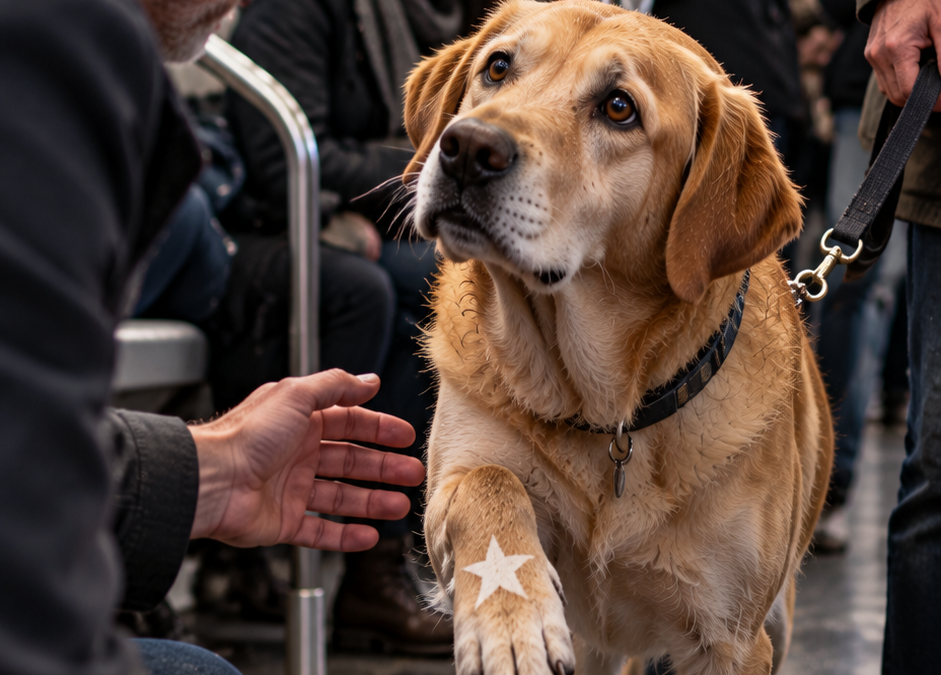
𝗙𝗨𝗟𝗟 𝗦𝗧𝗢𝗥𝗬
There were too many ways for him to come home.
So I did what anyone would do.
I called every shelter.
Every veterinary clinic.
Police non-emergency.
Animal control.
I posted his photograph everywhere I could.
I printed flyers.
Hundreds at first.
Then thousands.
LOST LABRADOR.
HONEY-COLORED MALE.
WHITE STAR-SHAPED PATCH ON LEFT FRONT PAW.
MICROCHIPPED.
PLEASE CALL.
I stapled them to poles.
Placed them in stores.
Gas stations.
Libraries.
Community centers.
Coffee shops.
I drove neighborhoods until midnight.
Then got up at five and drove again.
Every yellow Labrador made my heart stop.
I followed strangers walking dogs because for half a second I thought I recognized the body.
A woman once called and said she had seen a dog matching Rusty near a highway entrance.
I left work immediately.
Drove almost forty miles.
There was no dog.
Another caller said a Labrador had been picked up near Indiana.
Wrong dog.
Someone else claimed he had Rusty and wanted money.
When I asked for a photograph of the left paw, he hung up.
That one made me furious.
For six months, my life became a search.
My wife supported me longer than I had any right to expect.
The children came with me on weekends.
My daughter would sit in the back seat holding Rusty’s old leash.
My son would point out every dog.
“Dad, there!”
Wrong one.
Again.
Again.
Again.
By the third month, people stopped saying, “You’ll find him.”
They started saying, “I’m so sorry.”
I hated that change.
Sorry meant people had moved Rusty from missing to gone.
I had not.
Not yet.
I checked shelters all the way toward the Indiana border.
I walked kennel rows until the sound of barking gave me headaches.
Every time I entered one, hope rose automatically.
Every time I left, it collapsed again.
There was one thing I could not understand.
The microchip.
I knew Rusty had one.
I had watched the veterinarian inject it years earlier.
I had registered the information.
If someone scanned him, they should call me.
That fact became the center of my hope.
Someone will scan him.
Someone will call.
But no one did.
Six months passed.
Then seven.
I still searched, but differently.
Less every day.
More on weekends.
My wife eventually sat beside me at the kitchen table one night.
Rusty’s photograph was still pinned to the refrigerator.
“David.”
I knew the tone.
“No.”
“I haven’t said anything.”
“You’re going to.”
She reached for my hand.
“You have to sleep.”
“I sleep.”
“No.”
“I do.”
“You wake up every time the phone rings.”
“What if it’s about him?”
“I know.”
Her eyes filled.
“I know.”
I looked away.
“What do you want me to do?”
“I don’t know.”
“That’s the problem.”
My voice became harder than I intended.
“Everyone keeps telling me to stop, but no one can tell me what I’m supposed to do instead.”
She did not argue.
“What am I supposed to do with his bed?”
I continued.
“His leash? His bowls?”
My throat tightened.
“What if he comes home?”
She squeezed my hand.
“If he comes home, we’ll be here.”
That sentence broke me.
Not because it promised anything.
Because it did not.
If he comes home.
Eventually, I stopped searching every day.
There was no single decision.
No morning when I announced, I am giving up.
Life simply began filling the hours again.
Work.
Children.
Bills.
School.
Marriage.
Groceries.
Birthdays.
Rusty remained missing, but the search became something I carried rather than something I did.
I never got another dog.
People suggested it.
Even my children.
Years later my daughter asked, “Why don’t we adopt one?”
I said we were too busy.
That was not the truth.
The truth was that bringing another dog home felt like closing a door.
As if I were admitting Rusty would never walk through it again.
So eight years passed.
My children became teenagers.
My hair grayed.
My marriage continued.
My life settled.
I work in a library now.
Quiet job.
Predictable.
I like shelves.
Records.
Books returned where they belong.
There is comfort in a world where missing things can be tracked.
Home became quiet too.
Not unhappy.
Just calm.
A life after waves.
Rusty’s old photographs remained in an album in a cabinet.
I did not look at them often.
But I never threw them away.
And sometimes, usually without warning, I dreamed about him.
Always the same Rusty.
Not old.
Not missing.
Healthy.
Golden.
His tail moving.
I would wake with the strange sensation that he had just left the room.
Then morning would come.
I would make coffee.
Go to work.
Continue.
Until that train.
It was an ordinary weekday.
That matters.
Nothing about the morning suggested my life was about to split open.
I left home later than usual and took the Blue Line toward the Loop.
Chicago commuters know that kind of morning.
Half-awake faces.
Coffee cups.
Backpacks.
People reading phones.
No one making eye contact.
The mechanical voice announcing stops.
The screech of wheels entering tunnels.
I found a seat at first.
After a few stations, the car filled and I gave it up to an older woman.
I stood near the doors holding the overhead rail.
Then the train stopped.
Doors opened.
People entered.
Among them was a man roughly my age.
Maybe a few years younger.
Dark hair cut short.
Simple jacket.
Earbuds.
Phone in hand.
Beside him was a dog.
I noticed the dog because I always noticed Labradors.
Even after Rusty.
Especially after Rusty.
This one was older.
Honey-colored.
Golden-copper beneath the fluorescent lights.
I looked once.
Then away.
My heart had done that trick before.
That dog looks like Rusty.
It happened less often as years passed, but it never disappeared entirely.
I told myself the same thing I had told myself a hundred times.
Labradors look alike.
Then the dog shifted his weight.
His left front paw lifted slightly off the floor.
I looked down.
White fur.
A small patch.
Five uneven points.
Star-shaped.
The train seemed to disappear around me.
I could hear voices, wheels, announcements, but they became distant.
My hand tightened around the metal rail.
No.
I stared.
The dog was looking through the window.
His profile.
The broad muzzle.
The darker fur around the ears.
The old gray along his chin.
If Rusty were alive, he would be twenty-one.
That was extremely old for a Labrador.
Immediately, reason pushed back.
Impossible.
It cannot be him.
But some dogs live that long.
Rarely.
Not impossible.
My heart began beating harder.
Then the dog turned.
Our eyes met.
I stopped breathing.
Dark brown.
Nearly black.
But with that warm amber under the light.
I had stared into those eyes through fifteen years of my life.
During heartbreak.
Joy.
Exhaustion.
Fatherhood.
Marriage.
Loss.
The dog stared at me.
Not the casual look dogs give strangers.
He held my gaze.
His ears lifted.
The train moved.
I forgot to breathe.
Then his tail moved.
Once.
Slowly.
Hesitant.
Rusty used to do that when something confused him but interested him.
One wag.
Wait.
Another.
My fingers began trembling.
“Rusty?”
I did not say it loudly.
Barely more than air.
The dog stepped toward me.
The man beside him looked up.
“Sam.”
The dog stopped.
Sam.
Of course.
Different name.
Different man.
Different life.
“Come here.”
The dog looked at him.
Then at me.
My throat tightened.
The train entered a tunnel.
Lights flickered.
For less than a second, the car dimmed.
When the lights steadied again, the dog had taken another step toward me.
The man shortened the leash.
“Sam.”
I should have looked away.
I could not.
Then the dog tilted his head.
Not slightly.
Far.
Almost toward his shoulder.
One eye widening more than the other.
I felt the blood leave my face.
That gesture.
I knew that gesture.
Not all head tilts are unique.
I understand that.
But grief does not reason in statistics.
It recognizes.
My knees felt weak.
I moved closer.
“Excuse me.”
The man looked up.
I almost stopped.
What was I going to say?
Excuse me, I think your dog belongs to me from eight years ago?
It sounded insane.
Still, I had to ask.
“Where did you get him?”
The man removed one earbud.
“Sorry?”
“The dog.”
His expression became cautious.
“He’s mine.”
“I understand.”
My voice shook.
“I’m sorry. I just…”
The dog was still staring.
“I lost a dog eight years ago.”
The man looked at me more carefully.
“He looked exactly like this one.”
A pause.
“I mean exactly.”
The man glanced down.
Then back at me.
“Eight years?”
“Yes.”
“What was his name?”
I swallowed.
“Rusty.”
The reaction was immediate.
The dog’s body jerked.
Not dramatically.
His ears rose sharply.
His tail began moving.
Faster now.
He made a low sound in his throat.
Not growling.
Rusty used to make that noise when he wanted something and did not know how to communicate it.
Almost talking.
I felt tears burn my eyes.
The man looked down.
“Sam?”
The dog ignored him.
For the first time, his entire attention was on me.
“Rusty.”
His tail struck the side of a seat.
Once.
Twice.
Three times.
Someone nearby looked over.
I did not care.
The man stared at me.
Then at the dog.
“How old was your dog when you lost him?”
“Thirteen.”
His eyebrows lifted.
“That would make him…”
“Twenty-one.”
“That’s…”
“I know.”
Rare.
Almost unbelievable.
I felt foolish saying it aloud.
I wiped my eyes quickly.
“I know how this sounds.”
The man looked at the white patch.
“What else?”
“What?”
“How would you know?”
I looked at the dog.
“Left front paw. White mark shaped like a star.”
The man glanced down.
“That could be coincidence.”
“Yes.”
“What else?”
“He tilts his head.”
The man almost smiled.
“Most dogs do.”
“Not like that.”
I pointed carefully.
“When he’s confused, he takes it almost all the way to his shoulder. His right eye opens wider.”
The smile disappeared.
The man looked at the dog.
“Anything else?”
My mind flooded.
“He hates vacuum cleaners.”
The man blinked.
“He sleeps with one rear paw hanging off whatever bed he’s on.”
Another pause.
“He won’t drink immediately after you refill his water bowl.”
The man stared at me.
I continued.
“He waits.”
“How long?”
“Maybe five seconds.”
The man looked down at the dog.
Then at me.
His face had changed.
Not belief.
Not yet.
But something had shifted.
The train stopped.
People got off.
More got on.
For everyone else it was still an ordinary commute.
For me, eight years had collapsed into one moving train car.
The man spoke slowly.
“I found him.”
My chest tightened.
“When?”
“About eight years ago.”
The entire car seemed to tilt.
“Where?”
“Near the Indiana border.”
I grabbed the pole.
“That’s where I searched.”
The man nodded slowly.
“I lived out there then.”
“What happened?”
“It was autumn.”
His voice became quieter.
“Cold day. I was driving home from work and saw him near the shoulder.”
I could barely listen.
“He was thin. Dirty. No collar.”
“His collar was gone?”
“When I found him, yes.”
“What did he do?”
The man looked at the dog.
“He didn’t run.”
Of course.
“He just sat.”
My throat closed.
“And put his paw on my hand.”
I looked at the white star.
That was how Rusty had chosen me as a puppy.
A paw on my shoe.
Years later, lost, frightened, alone, he had apparently done it again.
The man continued.
“I took him to a vet.”
“Did they scan him?”
“Yes.”
“And?”
“No chip.”
I shook my head immediately.
“No. He had one.”
“I believe you believe that.”
“I watched them put it in.”
“I’m not arguing.”
My voice rose despite myself.
“Then how did they miss it?”
“I don’t know.”
“Chips can migrate.”
“I know.”
“Scanners fail.”
“I know.”
“Different frequencies used to be an issue.”
The man nodded.
“I understand.”
I realized I sounded desperate.
I forced myself to breathe.
“I’m sorry.”
“No.”
He looked genuinely shaken now.
“I posted flyers.”
“So did I.”
“I called shelters.”
“So did I.”
“Newspapers.”
“I searched everywhere.”
The words came out harder.
“Six months.”
The man stared.
“I went to kennels all the way to Indiana.”
His eyes dropped.
For the first time, I understood something painful.
This was not the man who took my dog.
This was the man who found a lost dog.
There was a difference.
He had searched too.
Somehow our searches had missed each other.
Wrong roads.
Wrong shelters.
Wrong days.
A microchip that did not register.
Thousands of small failures aligning into eight lost years.
“I’m sorry,” he said.
I shook my head.
“You didn’t know.”
“I tried.”
“I know.”
The dog stepped toward me again.
The man allowed more leash.
I crouched.
My knees protested against the hard train floor.
People stared.
Let them.
I held out my hand.
“Rusty.”
The dog approached slowly.
He sniffed my fingertips.
Once.
Twice.
His eyes moved across my face.
I wondered what he saw.
I had changed.
Eight years mattered.
More gray.
More lines.
Different glasses.
Different coat.
Different smell, probably.
Was there anything left for him to recognize?
He sniffed again.
Then licked my fingers.
My breath caught.
He licked them a second time.
Then placed his head into my palm.
Exactly like he used to.
Not similar.
Exactly.
His forehead settled into the center of my hand.
Weight.
Warmth.
Trust.
For eight years, I had remembered that weight.
Now it was there again.
I closed my fingers around the side of his face.
“Rusty.”
His tail moved against the floor.
I could not stop crying.
I did not sob.
The tears simply came.
Quietly.
The man stood above us.
I looked up.
“I’m not going to take him.”
He frowned.
“What?”
“I’m not asking you to give him back.”
I needed to say it before some terrible struggle formed between us.
“You’ve had him eight years.”
The man remained silent.
“You saved him.”
I looked down at the dog.
“He knows you.”
The dog looked toward him when I said that.
That hurt.
And comforted me.
Both at once.
“I just need to know something.”
“What?”
“Was he happy?”
The man’s expression softened.
“Yes.”
I closed my eyes.
That one word released something in me that had been trapped for eight years.
“Really?”
“Yes.”
“He slept inside?”
The man almost laughed.
“Usually on my bed.”
I smiled through tears.
“Of course.”
“He had his own bed.”
“He ignored it?”
“Completely.”
I laughed.
So did the man.
“He loves snow.”
“Yes.”
“Hates baths.”
“Yes.”
“Steals socks.”
I looked at Rusty.
“He started that with you?”
The man smiled.
“Apparently.”
I wiped my face.
“Was he ever sick?”
“Minor things.”
“Anything serious?”
“No.”
“Did he…”
I hesitated.
“What?”
“Did he wait by doors?”
The man’s face changed.
“Yes.”
My chest tightened.
“How?”
“For years, he slept near the front door.”
I looked down.
“Sometimes at night he scratched.”
The man swallowed.
“I thought he wanted outside.”
“What happened?”
“I’d let him out.”
“And?”
“He’d stand there.”
My throat hurt.
“Looking where?”
“Down the street.”
We both became silent.
“Now I think maybe…”
He did not finish.
I did.
“He was trying to go home.”
The dog sat between us.
Eight years.
Had Rusty waited?
How long?
Weeks?
Months?
Years?
Had he remembered our house?
The children?
Me?
Had he heard cars outside and thought one might be mine?
That thought could have destroyed me.
Instead, something else entered beside it.
He had not been alone.
That mattered more.
The man had given him food.
Shelter.
Warmth.
A bed.
A life.
When Rusty could not find the first home, he had been given another.
I looked up.
“What do you call him?”
“Sam.”
Rusty did not react.
The man laughed softly.
“That’s another strange thing.”
“What?”
“He never really responds to it.”
I stared.
“We tried other names at first.”
“Why?”
“Because Sam didn’t seem to fit.”
“What else?”
“Max. Charlie. Buddy.”
I almost smiled.
“All terrible.”
“Agreed.”
“What did he do?”
“Nothing.”
The man looked at the dog.
“He learned commands. He knows I’m speaking to him. But his name…”
He shook his head.
“He never seemed to believe it belonged to him.”
My heart started pounding again.
“Rusty.”
The dog looked at me instantly.
Both men froze.
I whispered it again.
“Rusty.”
His ears lifted.
Tail moved.
The stranger closed his eyes briefly.
“Well.”
I laughed through tears.
“I’m sorry.”
“Don’t be.”
He looked down at the dog he had loved for eight years.
“I think I owe him an apology.”
“For what?”
“Calling him the wrong name for nearly a decade.”
I smiled.
Rusty leaned against his leg.
The man immediately touched his back.
That gesture told me everything.
Automatic.
Familiar.
Love expressed without thought.
I realized then that if anyone asked me who Rusty belonged to, I would not know how to answer.
Me?
Legally once, perhaps.
Emotionally, always.
But this man had given him eight years.
Eight breakfasts every morning multiplied by nearly three thousand days.
Vet appointments.
Walks.
Storms.
Winter nights.
Ordinary afternoons.
That counted too.
Love is not erased because another love came first.
The train slowed.
The man looked toward the doors.
“This is my stop.”
Panic hit me unexpectedly.
Already?
After eight years, I had gotten minutes.
“That’s your stop?”
“Yes.”
Rusty stood when he did.
Of course.
I stared at the dog.
“What am I supposed to do?”
The question came out before I could stop it.
The man looked at me.
Not confused.
He understood.
“What do I do with this?”
I said.
“I spent eight years thinking he might be dead.”
My voice shook.
“Or hurt. Or alone.”
Rusty watched me.
“And now he’s standing here.”
The man considered.
Then reached into his pocket.
He took out his phone.
“Give me your number.”
I stared.
“What?”
“You can see him.”
My throat tightened.
“When?”
“Whenever makes sense.”
“Are you sure?”
“No.”
That honesty surprised me.
He smiled faintly.
“But I think we’ll figure it out.”
I gave him my number.
He called it once so I had his.
The doors opened.
The man stepped toward them.
Rusty followed.
At the threshold, the dog stopped.
He looked back.
That look is still one of the clearest memories of my life.
The train doors waited.
The man did not pull him.
“Come on.”
Rusty stared at me.
His tail moved.
Once.
Slowly.
I raised my hand.
“Go.”
The word almost did not come.
“It’s okay.”
Rusty tilted his head.
There it was again.
That ridiculous, impossible angle.
I laughed while crying.
“Go home.”
Rusty turned.
Followed the man onto the platform.
The doors closed.
As the train began moving, Rusty looked through the glass.
I kept my hand raised until the platform disappeared.
Then I stood alone among strangers.
My palm was still warm where his head had rested.
For the first time in eight years, I knew exactly where Rusty was.
And he was leaving me.
Again.
But this time, I knew he was safe.
That changed everything.
I missed my stop.
Didn’t notice until the doors opened several stations later.
I got off, crossed the platform, and rode back.
At work, I accomplished almost nothing.
My supervisor asked if I was sick.
“No.”
“You look like you’ve seen a ghost.”
“I think I did.”
He laughed.
I did not explain.
How could I?
All day, I kept checking my phone.
The man had sent one message.
This is us. You can call anytime.
Attached was a photograph.
Rusty—Sam—lying on a couch.
Gray muzzle.
White star on the paw.
Alive.
I enlarged the image until it filled the screen.
Then saved it.
Then saved it again unnecessarily.
That evening, I went home.
My wife was in the kitchen.
She looked at me and knew something had happened.
“What?”
I put my bag down.
“I saw Rusty.”
She stared.
Not laughed.
Not questioned.
“What did you say?”
“I saw Rusty.”
Her face changed.
“David.”
“On the train.”
“Rusty?”
“Yes.”
“Your Rusty?”
“Yes.”
She slowly sat.
“That’s impossible.”
“I know.”
“The dog would be…”
“Twenty-one.”
She shook her head.
“No.”
I took out my phone.
Showed the photograph.
Her hand flew to her mouth.
“Oh my God.”
“Look at the paw.”
She zoomed in.
The star.
She started crying.
The children—teenagers now—came downstairs after hearing us.
My daughter was the first to understand.
“Dad?”
I showed her.
She had been young when Rusty vanished, but she remembered.
Not as I did.
But enough.
“That’s him.”
My son looked skeptical.
“How can you know?”
“The mark.”
“Could be another dog.”
“He answered to Rusty.”
Silence.
“He did?”
“Yes.”
My daughter sat beside me.
“Can we see him?”
The question hurt because it sounded so much like something she might have asked eight years earlier.
“I think so.”
That night, after everyone went to bed, I opened the old album.
I had not looked through it in years.
Rusty as a puppy.
Rusty in the snow.
Rusty beside my wife before we were married.
Rusty lying near the baby carrier.
Rusty with my daughter’s hand buried in his fur.
Rusty older.
Gray starting around his face.
I expected to cry.
Instead, I smiled.
For eight years, every photograph had been evidence of absence.
Now it became evidence of a life that had actually happened.
And somewhere across the city, Rusty was alive.
Loved.
Sleeping near someone who had protected him when I could not.
That was enough to let the photographs become memories again instead of wounds.
The next morning, I called.
The man answered quickly.
“David?”
“Yes.”
“How are you?”
“I don’t know.”
He laughed softly.
“Same.”
“How is he?”
“Asleep.”
“Where?”
“My pillow.”
I closed my eyes.
“Sounds right.”
A pause.
Then I asked, “Could I see him?”
“Yes.”
We agreed to meet in a park the next afternoon.
I arrived twenty minutes early.
Of course I did.
I sat on a bench and watched every person entering.
At exactly two, I saw them.
Rusty walked slowly beside the man.
His age was obvious in daylight.
Gray face.
Slight stiffness in the hips.
Slower steps.
But still Rusty.
When he saw me, he stopped.
His tail began moving.
I stood.
“Hey.”
The man let go of some leash.
Rusty came toward me.
Not running.
He was too old for that.
But determined.
I crouched.
He pressed his forehead into my chest.
I wrapped my arms around him.
For several seconds, I was thirty again.
Then forty.
Then forty-three, running down a street shouting his name.
Then fifty-one, holding the dog I had buried only in my imagination.
“I’m sorry.”
The words came without planning.
“I’m so sorry.”
Rusty breathed against my jacket.
“I looked.”
My voice broke.
“I looked for you.”
His tail moved.
“I didn’t stop because I forgot.”
The man stood several feet away.
Giving us space.
“You weren’t abandoned.”
I whispered it into Rusty’s fur.
“I need you to know that.”
Maybe he did.
Maybe dogs do not carry accusations the way humans fear they do.
Maybe there was nothing to forgive.
But I had carried guilt for eight years.
I needed to say it.
“You were never abandoned.”
Rusty licked my chin.
I laughed.
“Still disgusting.”
He leaned against me.
We spent nearly two hours in the park.
The man told me about Rusty’s second life.
He liked sitting near windows.
He had once destroyed an entire bag of hamburger buns.
He slept through fireworks now.
He had a favorite tree near their apartment.
He loved an elderly neighbor who gave him biscuits.
He had been healthy almost the entire time.
Every story hurt slightly.
I had missed all of it.
But every story also healed something.
Rusty had not spent eight years wandering.
He had not suffered alone.
He had lived.
That distinction changed grief into gratitude.
Eventually, it was time to leave.
Rusty stood between us.
The moment I had dreaded arrived.
I had imagined that seeing him again might create a fight inside me.
Take him home.
He is yours.
You lost eight years.
Bring him back.
But looking at Rusty beside the man, I knew.
This was his home now.
Dogs live in the present more honestly than we do.
Rusty loved me.
I believed that.
He remembered me.
I knew it.
But he had also spent eight years building another attachment.
Another routine.
Another home.
Taking him away to satisfy my grief would not undo the lost years.
It would create another loss for him.
So I placed my hand on his head.
“Go home.”
The man looked at me.
“You can visit.”
“I know.”
“We can work something out.”
“Thank you.”
I crouched again.
Rusty placed his paw on my knee.
White star.
I covered it with my hand.
“You always did know how to pick people.”
The man smiled.
“What?”
“Nothing.”
I looked at Rusty.
“You picked me first.”
Tail wag.
“Then apparently you picked him.”
Rusty looked toward the man.
I laughed.
“Good choices.”
I stood.
The man offered his hand.
I shook it.
There were a hundred things I could have said.
Thank you for feeding him.
For taking him to the veterinarian.
For letting him sleep on your bed.
For looking for me.
For not abandoning him when nobody came.
Instead, I said the simplest thing.
“Thank you for loving him.”
The man looked down at Rusty.
“I didn’t have much choice.”
I understood exactly.
We walked in opposite directions.
I looked back once.
Rusty did too.
Then he continued.
That evening, something happened I had not expected.
I began thinking about getting another dog.
Not replacing Rusty.
That was the reason I had resisted for eight years.
People say “you can always get another dog” as though love were interchangeable.
It is not.
Rusty could not be replaced.
Seeing him again finally taught me that replacement had never been required.
Love does not demand an empty chair remain empty forever to prove the person who once sat there mattered.
The next Saturday, I drove to an animal shelter.
My wife came with me.
She did not ask why.
We walked through the kennels.
Puppies barked.
Young dogs jumped.
People gathered around the most energetic ones.
Near the back was an old black Labrador.
He was lying with his head between his paws.
Gray muzzle.
Heavy body.
Tired eyes.
I stopped.
The shelter worker said, “That’s Hope.”
I almost laughed.
“What?”
“His name.”
“Hope?”
“Yes.”
“How long?”
“Almost three years.”
I stared.
“Three years here?”
“On and off. A couple of foster placements.”
“Age?”
“About eleven.”
“What’s wrong with him?”
The worker smiled sadly.
“Nothing dramatic.”
She looked at the dog.
“He’s old.”
That sentence hurt.
I opened the kennel gate.
The Labrador lifted his head.
I sat on the floor.
Did not call.
Did not reach.
After a minute, he stood.
Walked over.
Then lowered his head onto my knee.
I closed my eyes.
Different weight.
Different fur.
Different dog.
I felt no betrayal.
Only recognition of something simple.
Another life waiting to be noticed.
My wife stood outside the kennel.
“Well?”
I scratched the Labrador’s ear.
“Hi, Hope.”
The dog looked up.
No head tilt.
No white star.
No Rusty.
That was good.
He did not need to be Rusty.
“Want to come home?”
Hope leaned harder against me.
My wife smiled.
“I think that’s a yes.”
We adopted him that afternoon.
The first night, Hope slept beside our bed.
Not on it.
He was too stiff to climb.
I put down a thick blanket.
He circled twice.
Lay down.
At two in the morning, I woke.
For one disoriented second, I thought I heard Rusty breathing.
Then I looked down.
Black fur.
Gray muzzle.
Hope.
Something inside me tightened.
Then relaxed.
I placed my hand on his head.
He opened one eye.
“Sorry.”
He sighed.
Went back to sleep.
I smiled in the darkness.
The next morning, my daughter came downstairs and found Hope waiting near the kitchen.
“He looks sad.”
“No.”
I poured coffee.
“He looks old.”
“There’s a difference?”
“Yes.”
Hope’s tail moved.
She crouched.
He immediately leaned against her.
“Okay.”
She smiled.
“Maybe he looks happy.”
Months passed.
Hope learned our house.
Which floorboards creaked.
Where sunlight reached the living room in the afternoon.
Which family member dropped the most food.
My son.
Not even close.
Hope did not erase Rusty.
If anything, he made me think about Rusty more often.
But the memories changed.
I could tell stories now without feeling that terrible closing inside my chest.
My children began asking questions.
“What was Rusty like as a puppy?”
“Terrible.”
“Really?”
“Absolutely.”
“What did he destroy?”
“Shoes. Books. One chair.”
My wife laughed.
“You loved him.”
“Yes.”
I did.
Still did.
That was another thing I finally understood.
Past tense is not always necessary for love.
Rusty remained part of me while living somewhere else.
Hope became part of me without pushing Rusty out.
There was room.
More than I knew.
I continued seeing Rusty occasionally.
Not every week.
I did not want to disrupt his routine.
Sometimes the man sent photographs.
Rusty asleep.
Rusty in snow.
Rusty staring at food.
We met in the park.
Once I brought my children.
My daughter knelt beside Rusty and cried.
“You remember me?”
Rusty sniffed her.
Tail moved.
She laughed through tears.
“I’ll take that.”
My son stood farther back at first.
He had been younger when Rusty disappeared.
His memories were less clear.
Eventually he approached.
Rusty let him scratch his chest.
My son looked at me.
“This is weird.”
“Yes.”
“Good weird.”
“Yes.”
Then he asked a question I had asked myself many times.
“Why didn’t the chip work?”
“I don’t know.”
That was the truth.
Maybe migration.
Scanner limitations.
Registration problems.
Maybe someone made a mistake.
Maybe the technology simply failed at exactly the worst time.
For years, I wanted a person to blame.
Someone must have failed.
A shelter.
A veterinarian.
The man.
Me.
But blame did not return those eight years.
Eventually, I let that question remain unanswered.
What mattered was simpler.
Rusty survived.
Someone cared for him.
We found each other again.
And when we did, neither of us had to destroy his second life to honor the first.
That became the part of the story I treasured most.
Not that I recognized him.
The star-shaped paw was extraordinary.
The head tilt.
His response to his old name.
All of that felt impossible.
But the real choice came afterward.
I could have seen the man as someone who possessed what was mine.
I did not.
I saw someone who had cared for Rusty when I could not.
And he could have seen me as a threat.
Instead, he gave me his number.
Allowed me back into Rusty’s life.
There was no winner.
There did not need to be.
Rusty had been loved twice.
That is not a tragedy.
It is the best possible answer to a terrible accident.
One evening, months after the train, I sat in our living room.
Hope was asleep with his head on my foot.
My phone buzzed.
A photograph.
Rusty lying near a window.
Sunlight across his honey-colored coat.
His white paw stretched in front of him.
The message read:
He had a good day. Thought you’d want to see him.
I stared at the picture.
Then looked down at Hope.
Two dogs.
Two lives.
One lost.
One found.
But even that description felt wrong.
Rusty had not truly been lost for eight years.
Not in the way I imagined.
He had been somewhere else.
Living.
Eating.
Sleeping.
Being loved.
I was the one trapped in not knowing.
The train gave me something I had stopped expecting.
Not Rusty back.
Something perhaps more important.
An ending.
For eight years, the story had stopped at an open door.
Rusty ran out.
I searched.
Nothing.
There was no final chapter.
No body.
No goodbye.
No explanation.
Grief without an ending is strange.
Part of you keeps the story open forever.
The train closed it.
Not by returning Rusty to me.
By showing me what came next.
He had found someone.
He had survived.
He had grown old.
He had been happy.
That was enough to let me stop searching in my head.
A year after that morning, I rode the same train line.
I stood near the doors.
Same mechanical announcements.
Same tired faces.
Same Chicago tunnels.
At the station where Rusty and the man had boarded, I found myself watching.
The doors opened.
People entered.
No Rusty.
Of course.
I smiled.
For years, every place connected to his disappearance carried pain.
Now this station carried something else.
Proof that life could surprise you long after you had accepted silence.
I looked down.
On my phone was a photograph from that morning.
Hope sleeping upside down on the couch.
Old black Labrador.
Gray face.
One rear leg stretched absurdly into the air.
I laughed.
A woman nearby glanced at me.
I put the phone away.
When I reached home that evening, Hope was waiting behind the door.
His tail began moving before I entered.
I opened it.
He leaned against my legs.
“Hey.”
I bent down.
He placed his head against my chest.
Different dog.
Different greeting.
Same astonishing privilege.
Someone was waiting.
I once thought loyalty to Rusty meant preserving his absence.
Keeping the bed empty.
The leash unused.
The house unchanged.
I know better now.
Love does not need emptiness as proof.
I did not betray Rusty by adopting Hope.
And Rusty did not betray me by loving the man who found him.
That may sound obvious.
It was not obvious to me for eight years.
I had imagined Rusty in one of two conditions.
Trying to return.
Or gone forever.
I never seriously imagined a third possibility.
That he had adapted.
That he had found warmth.
That he had accepted another hand.
Another bed.
Another name—even one he never completely answered to.
Dogs understand survival better than we do.
They mourn.
They remember.
But they also live where life is happening.
I am grateful Rusty did.
Sometimes I think about the night the man found him near the Indiana border.
Rusty thin.
Cold.
No collar.
Sitting beside a road.
A stranger approaching.
I imagine Rusty looking at him with those dark eyes.
Unsure.
Then raising one paw.
White star.
Placing it on the man’s hand.
Exactly as he had once placed it on my shoe.
Maybe Rusty did not know where home was anymore.
Maybe he was tired.
Maybe he simply recognized kindness.
Whatever happened, he made a second choice.
I am grateful for it.
Had he run from that man, perhaps he would not have survived.
Had the man ignored him, perhaps I would never have seen Rusty on that train.
The moment I once thought meant I had lost everything had another story running beside it for eight years.
I just couldn’t see it.
That idea has changed the way I understand loss.
When someone disappears from our life, our view ends at the edge of our own experience.
We know only absence.
We do not know every road beyond it.
Sometimes there is suffering there.
Sometimes loneliness.
But sometimes there is kindness we never witness.
A stranger opening a car door.
A bowl of food.
A warm room.
A hand resting on a frightened dog’s back.
For eight years, while I imagined Rusty alone, someone else was saying good morning to him.
Someone was filling his water.
Taking him to the vet.
Watching him sleep.
Someone was loving the dog I still loved.
That truth used to make me sad.
Now it gives me peace.
I do not know how much longer Rusty will live.
Twenty-one is already beyond what I ever expected.
Every time my phone shows the man’s number, part of me still becomes afraid.
One day the message will be different.
I know that.
That is the price of finding him again.
I will lose Rusty twice.
But the second time will not be like the first.
The first was uncertainty.
The second, when it comes, will carry gratitude.
I will know where he was.
Who loved him.
How his story continued.
I will be able to say goodbye.
That matters more than I can explain.
Hope is older too.
His hips are stiff.
He takes medication every morning.
When he stands, he stretches for almost a full minute.
My son says we run a retirement home for Labradors.
He is not entirely wrong.
Hope has changed me in quiet ways.
He forces me outside.
Makes me laugh.
Steals blankets.
Leaves black fur everywhere.
He sleeps beside me while I read.
Sometimes at night, when my wife is already asleep and the house is quiet, I put my hand on Hope’s back.
I feel him breathing.
And I think about the years I denied myself that simple comfort because I believed loving another dog would somehow reduce what Rusty had meant.
It would not.
Nothing can.
Rusty is the dog who taught me what it felt like to be chosen.
Hope is the dog who taught me that being chosen can happen more than once.
I think Rusty taught the stranger the same thing.
Maybe that is the final gift dogs give us.
They make love feel specific without making it scarce.
No dog replaces another.
No relationship duplicates the previous one.
The heart simply discovers another room.
The last time I saw Rusty, he was lying beneath a tree in the park.
The man sat nearby.
I had brought Hope.
We were careful introducing them because both were old.
Rusty sniffed Hope.
Hope sniffed Rusty.
Then both lost interest almost immediately.
I laughed.
“Very emotional.”
The man smiled.
“Deep reunion.”
We sat on the grass.
Rusty eventually rested his head near my knee.
Hope lay against my other leg.
For a few minutes, I had both.
Not as possessions.
Just presence.
I looked at Rusty’s white paw.
Then Hope’s black one.
The man noticed.
“You okay?”
“Yes.”
And I meant it.
I touched Rusty’s ear.
“Remember that train?”
His eyes stayed closed.
“Ruined my whole week.”
The man laughed.
Rusty’s tail moved once.
I looked at him.
Then at Hope.
Something about that small movement brought me back to the first day I adopted Rusty.
A shy puppy behind his littermates.
One paw on my shoe.
A white star I had never imagined would become the detail that found me again eight years after I believed I had lost everything.
Eventually, the man stood.
“We should go.”
I nodded.
Rusty took longer getting up.
I helped steady him instinctively.
The man did too.
Our hands met briefly against the same dog’s body.
For some reason, that nearly brought tears to my eyes.
Two men.
Two homes.
One old dog.
No conflict.
Just care.
Rusty stood.
I scratched beneath his chin.
“See you.”
I no longer said goodbye.
Not unless I had to.
The man walked away with him.
Hope watched for a moment.
Then leaned against my leg.
I looked down.
“Ready?”
Hope’s tail moved.
We went home.
Today, the old photo album still sits in the cabinet.
But it is not hidden anymore.
Beside it is another album.
Hope.
My daughter made it.
There are photographs of his first day.
His first Christmas with us.
His ridiculous sleeping positions.
One picture shows him with Rusty in the park.
Two elderly Labradors lying several feet apart, both looking deeply unimpressed by the camera.
That one is my favorite.
Sometimes I open the albums side by side.
I do not feel the old ache anymore.
Not the same way.
Rusty’s album no longer ends with disappearance.
Now I know more of the story.
I know that after he ran through that open door, he somehow traveled far beyond the area where I expected him.
I know a stranger found him near Indiana.
I know the man searched for an owner.
I know the chip was not detected.
I know Rusty stayed.
I know he was loved.
I know he still remembered his name.
And I know that eight years later, on a crowded Chicago train, he looked at me.
That is enough.
More than I expected to receive.
For years, I thought closure meant forgetting.
It does not.
Closure is simply when the memory stops demanding an answer you cannot give.
I have my answer now.
Rusty lived.
He was safe.
He was loved.
And when life placed us in the same train car after eight years, he remembered enough to turn his head when I said his name.
Sometimes I wonder what he thought in that moment.
Maybe nothing complicated.
Dogs may be wiser than us precisely because they do not construct entire philosophies around recognition.
Maybe he smelled something familiar.
Heard an old sound.
Saw a face buried beneath eight years of change.
Maybe his body knew before his mind did.
I like that possibility.
Because that was how I recognized him too.
Before logic.
Before proof.
Before the story.
There was simply that feeling.
I know you.
Then the white star.
Then the head tilt.
Then his name.
Rusty.
And a tail beginning to move.
I spent eight years believing the worst thing that happened to me was that I never found my dog.
I was wrong.
The worst part was believing his story ended where my knowledge ended.
It did not.
Rusty kept living.
So did I.
We took different roads.
And when those roads crossed again, I learned that love does not always return in the form we expect.
Sometimes what comes back is not ownership.
Not restoration.
Not the chance to undo the past.
Sometimes it is simply knowledge.
He made it.
He was loved.
You were remembered.
That can be enough to heal a wound you thought would stay open forever.
And sometimes, once that wound closes, you finally notice another dog waiting quietly at the back of a shelter.
An old black Labrador.
Three years overlooked.
Different eyes.
Different paws.
Different history.
A dog who does not need to become the one you lost.
He only needs you to see him.
Hope is sleeping beside me now.
His head is partly on my pillow because apparently boundaries are still impossible with Labradors.
His paws move occasionally.
Dreaming.
I do not know where he goes in those dreams.
Maybe somewhere from before the shelter.
Maybe a field.
Maybe nowhere at all.
Rusty is across town, probably asleep near the man who found him all those years ago.
That thought no longer hurts the way it once would have.
It makes me smile.
Two old dogs.
Two homes.
Two lives still being lived.
And one man who finally understands that loving what comes next does not mean betraying what came before.
Eight years ago, I lost Rusty through an open door.
For a long time, I believed that door represented failure.
Now I think about another door.
The doors of a Chicago train sliding open.
A stranger walking in.
An old Labrador beside him.
Honey-colored fur.
Dark eyes.
One white star on the left front paw.
For only a few seconds, neither of us knew what was happening.
Then Rusty looked at me.
And after eight years of silence, my story finally continued.
𝗧𝗛𝗘 𝗘𝗡𝗗
Eight Years After Rusty Vanished, a Familiar White Star on a Stranger’s Dog Stopped Me Cold on a Chicago Train
Eight years after I lost Rusty, I saw him standing beside a stranger on a crowded Chicago train.
At least, that was what every part of me believed.
My mind tried to argue.
Dogs looked alike.
Memory was unreliable.
Eight years was a long time.
But then the dog turned his head, looked directly at me, and lifted his left front paw.
There it was.
A small white mark shaped almost perfectly like a star.
I had touched that mark thousands of times.
My name is David. I am fifty-one years old, and for most of my adult life I believed there were some losses you did not recover from.
You simply became better at carrying them.
Rusty was one of those losses.
I adopted him when I was thirty.
Back then, I lived alone in a small rental house outside Chicago and worked irregular hours. I had no serious intention of getting a dog. A friend had convinced me to visit a breeder who had a litter of Labradors ready for homes, and I went mostly because I had nothing better to do on a Saturday morning.
I remember the puppies rushing toward the fence when we arrived.
All except one.
He stood behind the others.
Honey-colored coat.
Dark brown eyes.
Quiet.
Observing.
While the rest climbed over one another trying to reach us, that puppy waited until the excitement settled.
Then he walked forward.
Slowly.
He sat in front of me.
And placed one paw on my shoe.
The breeder laughed.
“Looks like he made the decision for you.”
I looked down.
On the puppy’s left front paw was a patch of white fur no bigger than a coin.
Not round.
Not random.
It spread in five little points.
“A star,” I said.
The breeder crouched.
“Huh. I never noticed that.”
Rusty looked up at me.
That was it.
There was no dramatic moment.
No thunderbolt.
No certainty that we were destined for each other.
I simply knew I was not leaving without him.
I named him Rusty because of the warmth in his coat.
It looked golden indoors, but under sunlight it turned almost copper.
He grew quickly.
By his second birthday, he had become a solid, muscular Labrador with a broad chest and the gentlest temperament of any dog I had ever known.
Rusty had habits.
Dogs always do.
He slept with one rear paw hanging off his bed.
He refused to drink water immediately after someone filled the bowl. He would stare at it for several seconds as though waiting for impurities to settle.
He hated the vacuum cleaner.
Loved snow.
And whenever he was trying to understand something I said, he tilted his head so far to one side that one ear almost touched his shoulder.
I had never seen another dog do it quite the same way.
“Walk?”
Head tilt.
“Bath?”
Head tilt.
“Where are my keys?”
Head tilt.
The word did not matter.
If Rusty was confused, he leaned that head nearly sideways and widened one eye.
I used to laugh every time.
Those details sound small until they are all you have left.
Rusty was thirteen when he disappeared.
He was older, but still healthy.
Slower on long walks.
A little gray around the muzzle.
But strong.
I was forty-three.
By then I was married and had two children.
Rusty had been there before all of them.
He was there when I met my wife.
There when we moved into our house.
There when we brought our first baby home.
I remember placing the carrier on the living-room floor and watching Rusty approach.
My wife was nervous.
“Careful.”
“He’s fine.”
Rusty sniffed the blanket.
Then lay down beside the carrier.
That was all.
From then on, he treated the children as part of whatever responsibility he believed he had been given.
If one of them cried, Rusty came to find us.
If they played outside, he lay where he could see them.
When they were sick, he stayed near their beds.
He was not just my dog anymore.
He belonged to the architecture of our family.
Then one autumn afternoon, the door stayed open too long.
That was all it took.
I used to replay that moment endlessly.
Someone carrying groceries.
Children running between rooms.
A delivery.
The screen door not catching properly.
Rusty saw something outside.
A squirrel, maybe.
A cat.
Another dog.
I never knew.
By the time I realized the house was too quiet, he was gone.
“Rusty?”
I checked the kitchen.
Bedroom.
Backyard.
“Rusty!”
Nothing.
The front door was slightly open.
My stomach dropped.
I ran outside.
“RUSTY!”
Our street was empty.
I began walking quickly.
Then running.
I checked every yard.
Every side street.
Behind garages.
The park.
My wife drove one direction while I drove another.
The kids stood at the window waiting.
Night came.
Rusty did not.
The first twenty-four hours, I was convinced we would find him.
Dogs wandered.
People picked them up.
Animal control would call.
A neighbor would see him.
He was microchipped.
He had tags.
He knew our neighborhood.
There were too many ways for him to come home.
So I did what anyone would do.
I called every shelter.
Every veterinary clinic.
Police non-emergency.
Animal control.
I posted his photograph everywhere I could.
I printed flyers.
Hundreds at first.
Then thousands.
LOST LABRADOR.
HONEY-COLORED MALE.
WHITE STAR-SHAPED PATCH ON LEFT FRONT PAW.
MICROCHIPPED.
PLEASE CALL.
I stapled them to poles.
Placed them in stores.
Gas stations.
Libraries.
Community centers.
Coffee shops.
I drove neighborhoods until midnight.
Then got up at five and drove again.
Every yellow Labrador made my heart stop.
I followed strangers walking dogs because for half a second I thought I recognized the body.
A woman once called and said she had seen a dog matching Rusty near a highway entrance.
I left work immediately.
Drove almost forty miles.
There was no dog.
Another caller said a Labrador had been picked up near Indiana.
Wrong dog.
Someone else claimed he had Rusty and wanted money.
When I asked for a photograph of the left paw, he hung up.
That one made me furious.
For six months, my life became a search.
My wife supported me longer than I had any right to expect.
The children came with me on weekends.
My daughter would sit in the back seat holding Rusty’s old leash.
My son would point out every dog.
“Dad, there!”
Wrong one.
Again.
Again.
Again.
By the third month, people stopped saying, “You’ll find him.”
They started saying, “I’m so sorry.”
I hated that change.
Sorry meant people had moved Rusty from missing to gone.
I had not.
Not yet.
I checked shelters all the way toward the Indiana border.
I walked kennel rows until the sound of barking gave me headaches.
Every time I entered one, hope rose automatically.
Every time I left, it collapsed again.
There was one thing I could not understand.
The microchip.
I knew Rusty had one.
I had watched the veterinarian inject it years earlier.
I had registered the information.
If someone scanned him, they should call me.
That fact became the center of my hope.
Someone will scan him.
Someone will call.
But no one did.
Six months passed.
Then seven.
I still searched, but differently.
Less every day.
More on weekends.
My wife eventually sat beside me at the kitchen table one night.
Rusty’s photograph was still pinned to the refrigerator.
“David.”
I knew the tone.
“No.”
“I haven’t said anything.”
“You’re going to.”
She reached for my hand.
“You have to sleep.”
“I sleep.”
“No.”
“I do.”
“You wake up every time the phone rings.”
“What if it’s about him?”
“I know.”
Her eyes filled.
“I know.”
I looked away.
“What do you want me to do?”
“I don’t know.”
“That’s the problem.”
My voice became harder than I intended.
“Everyone keeps telling me to stop, but no one can tell me what I’m supposed to do instead.”
She did not argue.
“What am I supposed to do with his bed?”
I continued.
“His leash? His bowls?”
My throat tightened.
“What if he comes home?”
She squeezed my hand.
“If he comes home, we’ll be here.”
That sentence broke me.
Not because it promised anything.
Because it did not.
If he comes home.
Eventually, I stopped searching every day.
There was no single decision.
No morning when I announced, I am giving up.
Life simply began filling the hours again.
Work.
Children.
Bills.
School.
Marriage.
Groceries.
Birthdays.
Rusty remained missing, but the search became something I carried rather than something I did.
I never got another dog.
People suggested it.
Even my children.
Years later my daughter asked, “Why don’t we adopt one?”
I said we were too busy.
That was not the truth.
The truth was that bringing another dog home felt like closing a door.
As if I were admitting Rusty would never walk through it again.
So eight years passed.
My children became teenagers.
My hair grayed.
My marriage continued.
My life settled.
I work in a library now.
Quiet job.
Predictable.
I like shelves.
Records.
Books returned where they belong.
There is comfort in a world where missing things can be tracked.
Home became quiet too.
Not unhappy.
Just calm.
A life after waves.
Rusty’s old photographs remained in an album in a cabinet.
I did not look at them often.
But I never threw them away.
And sometimes, usually without warning, I dreamed about him.
Always the same Rusty.
Not old.
Not missing.
Healthy.
Golden.
His tail moving.
I would wake with the strange sensation that he had just left the room.
Then morning would come.
I would make coffee.
Go to work.
Continue.
Until that train.
It was an ordinary weekday.
That matters.
Nothing about the morning suggested my life was about to split open.
I left home later than usual and took the Blue Line toward the Loop.
Chicago commuters know that kind of morning.
Half-awake faces.
Coffee cups.
Backpacks.
People reading phones.
No one making eye contact.
The mechanical voice announcing stops.
The screech of wheels entering tunnels.
I found a seat at first.
After a few stations, the car filled and I gave it up to an older woman.
I stood near the doors holding the overhead rail.
Then the train stopped.
Doors opened.
People entered.
Among them was a man roughly my age.
Maybe a few years younger.
Dark hair cut short.
Simple jacket.
Earbuds.
Phone in hand.
Beside him was a dog.
I noticed the dog because I always noticed Labradors.
Even after Rusty.
Especially after Rusty.
This one was older.
Honey-colored.
Golden-copper beneath the fluorescent lights.
I looked once.
Then away.
My heart had done that trick before.
That dog looks like Rusty.
It happened less often as years passed, but it never disappeared entirely.
I told myself the same thing I had told myself a hundred times.
Labradors look alike.
Then the dog shifted his weight.
His left front paw lifted slightly off the floor.
I looked down.
White fur.
A small patch.
Five uneven points.
Star-shaped.
The train seemed to disappear around me.
I could hear voices, wheels, announcements, but they became distant.
My hand tightened around the metal rail.
No.
I stared.
The dog was looking through the window.
His profile.
The broad muzzle.
The darker fur around the ears.
The old gray along his chin.
If Rusty were alive, he would be twenty-one.
That was extremely old for a Labrador.
Immediately, reason pushed back.
Impossible.
It cannot be him.
But some dogs live that long.
Rarely.
Not impossible.
My heart began beating harder.
Then the dog turned.
Our eyes met.
I stopped breathing.
Dark brown.
Nearly black.
But with that warm amber under the light.
I had stared into those eyes through fifteen years of my life.
During heartbreak.
Joy.
Exhaustion.
Fatherhood.
Marriage.
Loss.
The dog stared at me.
Not the casual look dogs give strangers.
He held my gaze.
His ears lifted.
The train moved.
I forgot to breathe.
Then his tail moved.
Once.
Slowly.
Hesitant.
Rusty used to do that when something confused him but interested him.
One wag.
Wait.
Another.
My fingers began trembling.
“Rusty?”
I did not say it loudly.
Barely more than air.
The dog stepped toward me.
The man beside him looked up.
“Sam.”
The dog stopped.
Sam.
Of course.
Different name.
Different man.
Different life.
“Come here.”
The dog looked at him.
Then at me.
My throat tightened.
The train entered a tunnel.
Lights flickered.
For less than a second, the car dimmed.
When the lights steadied again, the dog had taken another step toward me.
The man shortened the leash.
“Sam.”
I should have looked away.
I could not.
Then the dog tilted his head.
Not slightly.
Far.
Almost toward his shoulder.
One eye widening more than the other.
I felt the blood leave my face.
That gesture.
I knew that gesture.
Not all head tilts are unique.
I understand that.
But grief does not reason in statistics.
It recognizes.
My knees felt weak.
I moved closer.
“Excuse me.”
The man looked up.
I almost stopped.
What was I going to say?
Excuse me, I think your dog belongs to me from eight years ago?
It sounded insane.
Still, I had to ask.
“Where did you get him?”
The man removed one earbud.
“Sorry?”
“The dog.”
His expression became cautious.
“He’s mine.”
“I understand.”
My voice shook.
“I’m sorry. I just…”
The dog was still staring.
“I lost a dog eight years ago.”
The man looked at me more carefully.
“He looked exactly like this one.”
A pause.
“I mean exactly.”
The man glanced down.
Then back at me.
“Eight years?”
“Yes.”
“What was his name?”
I swallowed.
“Rusty.”
The reaction was immediate.
The dog’s body jerked.
Not dramatically.
His ears rose sharply.
His tail began moving.
Faster now.
He made a low sound in his throat.
Not growling.
Rusty used to make that noise when he wanted something and did not know how to communicate it.
Almost talking.
I felt tears burn my eyes.
The man looked down.
“Sam?”
The dog ignored him.
For the first time, his entire attention was on me.
“Rusty.”
His tail struck the side of a seat.
Once.
Twice.
Three times.
Someone nearby looked over.
I did not care.
The man stared at me.
Then at the dog.
“How old was your dog when you lost him?”
“Thirteen.”
His eyebrows lifted.
“That would make him…”
“Twenty-one.”
“That’s…”
“I know.”
Rare.
Almost unbelievable.
I felt foolish saying it aloud.
I wiped my eyes quickly.
“I know how this sounds.”
The man looked at the white patch.
“What else?”
“What?”
“How would you know?”
I looked at the dog.
“Left front paw. White mark shaped like a star.”
The man glanced down.
“That could be coincidence.”
“Yes.”
“What else?”
“He tilts his head.”
The man almost smiled.
“Most dogs do.”
“Not like that.”
I pointed carefully.
“When he’s confused, he takes it almost all the way to his shoulder. His right eye opens wider.”
The smile disappeared.
The man looked at the dog.
“Anything else?”
My mind flooded.
“He hates vacuum cleaners.”
The man blinked.
“He sleeps with one rear paw hanging off whatever bed he’s on.”
Another pause.
“He won’t drink immediately after you refill his water bowl.”
The man stared at me.
I continued.
“He waits.”
“How long?”
“Maybe five seconds.”
The man looked down at the dog.
Then at me.
His face had changed.
Not belief.
Not yet.
But something had shifted.
The train stopped.
People got off.
More got on.
For everyone else it was still an ordinary commute.
For me, eight years had collapsed into one moving train car.
The man spoke slowly.
“I found him.”
My chest tightened.
“When?”
“About eight years ago.”
The entire car seemed to tilt.
“Where?”
“Near the Indiana border.”
I grabbed the pole.
“That’s where I searched.”
The man nodded slowly.
“I lived out there then.”
“What happened?”
“It was autumn.”
His voice became quieter.
“Cold day. I was driving home from work and saw him near the shoulder.”
I could barely listen.
“He was thin. Dirty. No collar.”
“His collar was gone?”
“When I found him, yes.”
“What did he do?”
The man looked at the dog.
“He didn’t run.”
Of course.
“He just sat.”
My throat closed.
“And put his paw on my hand.”
I looked at the white star.
That was how Rusty had chosen me as a puppy.
A paw on my shoe.
Years later, lost, frightened, alone, he had apparently done it again.
The man continued.
“I took him to a vet.”
“Did they scan him?”
“Yes.”
“And?”
“No chip.”
I shook my head immediately.
“No. He had one.”
“I believe you believe that.”
“I watched them put it in.”
“I’m not arguing.”
My voice rose despite myself.
“Then how did they miss it?”
“I don’t know.”
“Chips can migrate.”
“I know.”
“Scanners fail.”
“I know.”
“Different frequencies used to be an issue.”
The man nodded.
“I understand.”
I realized I sounded desperate.
I forced myself to breathe.
“I’m sorry.”
“No.”
He looked genuinely shaken now.
“I posted flyers.”
“So did I.”
“I called shelters.”
“So did I.”
“Newspapers.”
“I searched everywhere.”
The words came out harder.
“Six months.”
The man stared.
“I went to kennels all the way to Indiana.”
His eyes dropped.
For the first time, I understood something painful.
This was not the man who took my dog.
This was the man who found a lost dog.
There was a difference.
He had searched too.
Somehow our searches had missed each other.
Wrong roads.
Wrong shelters.
Wrong days.
A microchip that did not register.
Thousands of small failures aligning into eight lost years.
“I’m sorry,” he said.
I shook my head.
“You didn’t know.”
“I tried.”
“I know.”
The dog stepped toward me again.
The man allowed more leash.
I crouched.
My knees protested against the hard train floor.
People stared.
Let them.
I held out my hand.
“Rusty.”
The dog approached slowly.
He sniffed my fingertips.
Once.
Twice.
His eyes moved across my face.
I wondered what he saw.
I had changed.
Eight years mattered.
More gray.
More lines.
Different glasses.
Different coat.
Different smell, probably.
Was there anything left for him to recognize?
He sniffed again.
Then licked my fingers.
My breath caught.
He licked them a second time.
Then placed his head into my palm.
Exactly like he used to.
Not similar.
Exactly.
His forehead settled into the center of my hand.
Weight.
Warmth.
Trust.
For eight years, I had remembered that weight.
Now it was there again.
I closed my fingers around the side of his face.
“Rusty.”
His tail moved against the floor.
I could not stop crying.
I did not sob.
The tears simply came.
Quietly.
The man stood above us.
I looked up.
“I’m not going to take him.”
He frowned.
“What?”
“I’m not asking you to give him back.”
I needed to say it before some terrible struggle formed between us.
“You’ve had him eight years.”
The man remained silent.
“You saved him.”
I looked down at the dog.
“He knows you.”
The dog looked toward him when I said that.
That hurt.
And comforted me.
Both at once.
“I just need to know something.”
“What?”
“Was he happy?”
The man’s expression softened.
“Yes.”
I closed my eyes.
That one word released something in me that had been trapped for eight years.
“Really?”
“Yes.”
“He slept inside?”
The man almost laughed.
“Usually on my bed.”
I smiled through tears.
“Of course.”
“He had his own bed.”
“He ignored it?”
“Completely.”
I laughed.
So did the man.
“He loves snow.”
“Yes.”
“Hates baths.”
“Yes.”
“Steals socks.”
I looked at Rusty.
“He started that with you?”
The man smiled.
“Apparently.”
I wiped my face.
“Was he ever sick?”
“Minor things.”
“Anything serious?”
“No.”
“Did he…”
I hesitated.
“What?”
“Did he wait by doors?”
The man’s face changed.
“Yes.”
My chest tightened.
“How?”
“For years, he slept near the front door.”
I looked down.
“Sometimes at night he scratched.”
The man swallowed.
“I thought he wanted outside.”
“What happened?”
“I’d let him out.”
“And?”
“He’d stand there.”
My throat hurt.
“Looking where?”
“Down the street.”
We both became silent.
“Now I think maybe…”
He did not finish.
I did.
“He was trying to go home.”
The dog sat between us.
Eight years.
Had Rusty waited?
How long?
Weeks?
Months?
Years?
Had he remembered our house?
The children?
Me?
Had he heard cars outside and thought one might be mine?
That thought could have destroyed me.
Instead, something else entered beside it.
He had not been alone.
That mattered more.
The man had given him food.
Shelter.
Warmth.
A bed.
A life.
When Rusty could not find the first home, he had been given another.
I looked up.
“What do you call him?”
“Sam.”
Rusty did not react.
The man laughed softly.
“That’s another strange thing.”
“What?”
“He never really responds to it.”
I stared.
“We tried other names at first.”
“Why?”
“Because Sam didn’t seem to fit.”
“What else?”
“Max. Charlie. Buddy.”
I almost smiled.
“All terrible.”
“Agreed.”
“What did he do?”
“Nothing.”
The man looked at the dog.
“He learned commands. He knows I’m speaking to him. But his name…”
He shook his head.
“He never seemed to believe it belonged to him.”
My heart started pounding again.
“Rusty.”
The dog looked at me instantly.
Both men froze.
I whispered it again.
“Rusty.”
His ears lifted.
Tail moved.
The stranger closed his eyes briefly.
“Well.”
I laughed through tears.
“I’m sorry.”
“Don’t be.”
He looked down at the dog he had loved for eight years.
“I think I owe him an apology.”
“For what?”
“Calling him the wrong name for nearly a decade.”
I smiled.
Rusty leaned against his leg.
The man immediately touched his back.
That gesture told me everything.
Automatic.
Familiar.
Love expressed without thought.
I realized then that if anyone asked me who Rusty belonged to, I would not know how to answer.
Me?
Legally once, perhaps.
Emotionally, always.
But this man had given him eight years.
Eight breakfasts every morning multiplied by nearly three thousand days.
Vet appointments.
Walks.
Storms.
Winter nights.
Ordinary afternoons.
That counted too.
Love is not erased because another love came first.
The train slowed.
The man looked toward the doors.
“This is my stop.”
Panic hit me unexpectedly.
Already?
After eight years, I had gotten minutes.
“That’s your stop?”
“Yes.”
Rusty stood when he did.
Of course.
I stared at the dog.
“What am I supposed to do?”
The question came out before I could stop it.
The man looked at me.
Not confused.
He understood.
“What do I do with this?”
I said.
“I spent eight years thinking he might be dead.”
My voice shook.
“Or hurt. Or alone.”
Rusty watched me.
“And now he’s standing here.”
The man considered.
Then reached into his pocket.
He took out his phone.
“Give me your number.”
I stared.
“What?”
“You can see him.”
My throat tightened.
“When?”
“Whenever makes sense.”
“Are you sure?”
“No.”
That honesty surprised me.
He smiled faintly.
“But I think we’ll figure it out.”
I gave him my number.
He called it once so I had his.
The doors opened.
The man stepped toward them.
Rusty followed.
At the threshold, the dog stopped.
He looked back.
That look is still one of the clearest memories of my life.
The train doors waited.
The man did not pull him.
“Come on.”
Rusty stared at me.
His tail moved.
Once.
Slowly.
I raised my hand.
“Go.”
The word almost did not come.
“It’s okay.”
Rusty tilted his head.
There it was again.
That ridiculous, impossible angle.
I laughed while crying.
“Go home.”
Rusty turned.
Followed the man onto the platform.
The doors closed.
As the train began moving, Rusty looked through the glass.
I kept my hand raised until the platform disappeared.
Then I stood alone among strangers.
My palm was still warm where his head had rested.
For the first time in eight years, I knew exactly where Rusty was.
And he was leaving me.
Again.
But this time, I knew he was safe.
That changed everything.
I missed my stop.
Didn’t notice until the doors opened several stations later.
I got off, crossed the platform, and rode back.
At work, I accomplished almost nothing.
My supervisor asked if I was sick.
“No.”
“You look like you’ve seen a ghost.”
“I think I did.”
He laughed.
I did not explain.
How could I?
All day, I kept checking my phone.
The man had sent one message.
This is us. You can call anytime.
Attached was a photograph.
Rusty—Sam—lying on a couch.
Gray muzzle.
White star on the paw.
Alive.
I enlarged the image until it filled the screen.
Then saved it.
Then saved it again unnecessarily.
That evening, I went home.
My wife was in the kitchen.
She looked at me and knew something had happened.
“What?”
I put my bag down.
“I saw Rusty.”
She stared.
Not laughed.
Not questioned.
“What did you say?”
“I saw Rusty.”
Her face changed.
“David.”
“On the train.”
“Rusty?”
“Yes.”
“Your Rusty?”
“Yes.”
She slowly sat.
“That’s impossible.”
“I know.”
“The dog would be…”
“Twenty-one.”
She shook her head.
“No.”
I took out my phone.
Showed the photograph.
Her hand flew to her mouth.
“Oh my God.”
“Look at the paw.”
She zoomed in.
The star.
She started crying.
The children—teenagers now—came downstairs after hearing us.
My daughter was the first to understand.
“Dad?”
I showed her.
She had been young when Rusty vanished, but she remembered.
Not as I did.
But enough.
“That’s him.”
My son looked skeptical.
“How can you know?”
“The mark.”
“Could be another dog.”
“He answered to Rusty.”
Silence.
“He did?”
“Yes.”
My daughter sat beside me.
“Can we see him?”
The question hurt because it sounded so much like something she might have asked eight years earlier.
“I think so.”
That night, after everyone went to bed, I opened the old album.
I had not looked through it in years.
Rusty as a puppy.
Rusty in the snow.
Rusty beside my wife before we were married.
Rusty lying near the baby carrier.
Rusty with my daughter’s hand buried in his fur.
Rusty older.
Gray starting around his face.
I expected to cry.
Instead, I smiled.
For eight years, every photograph had been evidence of absence.
Now it became evidence of a life that had actually happened.
And somewhere across the city, Rusty was alive.
Loved.
Sleeping near someone who had protected him when I could not.
That was enough to let the photographs become memories again instead of wounds.
The next morning, I called.
The man answered quickly.
“David?”
“Yes.”
“How are you?”
“I don’t know.”
He laughed softly.
“Same.”
“How is he?”
“Asleep.”
“Where?”
“My pillow.”
I closed my eyes.
“Sounds right.”
A pause.
Then I asked, “Could I see him?”
“Yes.”
We agreed to meet in a park the next afternoon.
I arrived twenty minutes early.
Of course I did.
I sat on a bench and watched every person entering.
At exactly two, I saw them.
Rusty walked slowly beside the man.
His age was obvious in daylight.
Gray face.
Slight stiffness in the hips.
Slower steps.
But still Rusty.
When he saw me, he stopped.
His tail began moving.
I stood.
“Hey.”
The man let go of some leash.
Rusty came toward me.
Not running.
He was too old for that.
But determined.
I crouched.
He pressed his forehead into my chest.
I wrapped my arms around him.
For several seconds, I was thirty again.
Then forty.
Then forty-three, running down a street shouting his name.
Then fifty-one, holding the dog I had buried only in my imagination.
“I’m sorry.”
The words came without planning.
“I’m so sorry.”
Rusty breathed against my jacket.
“I looked.”
My voice broke.
“I looked for you.”
His tail moved.
“I didn’t stop because I forgot.”
The man stood several feet away.
Giving us space.
“You weren’t abandoned.”
I whispered it into Rusty’s fur.
“I need you to know that.”
Maybe he did.
Maybe dogs do not carry accusations the way humans fear they do.
Maybe there was nothing to forgive.
But I had carried guilt for eight years.
I needed to say it.
“You were never abandoned.”
Rusty licked my chin.
I laughed.
“Still disgusting.”
He leaned against me.
We spent nearly two hours in the park.
The man told me about Rusty’s second life.
He liked sitting near windows.
He had once destroyed an entire bag of hamburger buns.
He slept through fireworks now.
He had a favorite tree near their apartment.
He loved an elderly neighbor who gave him biscuits.
He had been healthy almost the entire time.
Every story hurt slightly.
I had missed all of it.
But every story also healed something.
Rusty had not spent eight years wandering.
He had not suffered alone.
He had lived.
That distinction changed grief into gratitude.
Eventually, it was time to leave.
Rusty stood between us.
The moment I had dreaded arrived.
I had imagined that seeing him again might create a fight inside me.
Take him home.
He is yours.
You lost eight years.
Bring him back.
But looking at Rusty beside the man, I knew.
This was his home now.
Dogs live in the present more honestly than we do.
Rusty loved me.
I believed that.
He remembered me.
I knew it.
But he had also spent eight years building another attachment.
Another routine.
Another home.
Taking him away to satisfy my grief would not undo the lost years.
It would create another loss for him.
So I placed my hand on his head.
“Go home.”
The man looked at me.
“You can visit.”
“I know.”
“We can work something out.”
“Thank you.”
I crouched again.
Rusty placed his paw on my knee.
White star.
I covered it with my hand.
“You always did know how to pick people.”
The man smiled.
“What?”
“Nothing.”
I looked at Rusty.
“You picked me first.”
Tail wag.
“Then apparently you picked him.”
Rusty looked toward the man.
I laughed.
“Good choices.”
I stood.
The man offered his hand.
I shook it.
There were a hundred things I could have said.
Thank you for feeding him.
For taking him to the veterinarian.
For letting him sleep on your bed.
For looking for me.
For not abandoning him when nobody came.
Instead, I said the simplest thing.
“Thank you for loving him.”
The man looked down at Rusty.
“I didn’t have much choice.”
I understood exactly.
We walked in opposite directions.
I looked back once.
Rusty did too.
Then he continued.
That evening, something happened I had not expected.
I began thinking about getting another dog.
Not replacing Rusty.
That was the reason I had resisted for eight years.
People say “you can always get another dog” as though love were interchangeable.
It is not.
Rusty could not be replaced.
Seeing him again finally taught me that replacement had never been required.
Love does not demand an empty chair remain empty forever to prove the person who once sat there mattered.
The next Saturday, I drove to an animal shelter.
My wife came with me.
She did not ask why.
We walked through the kennels.
Puppies barked.
Young dogs jumped.
People gathered around the most energetic ones.
Near the back was an old black Labrador.
He was lying with his head between his paws.
Gray muzzle.
Heavy body.
Tired eyes.
I stopped.
The shelter worker said, “That’s Hope.”
I almost laughed.
“What?”
“His name.”
“Hope?”
“Yes.”
“How long?”
“Almost three years.”
I stared.
“Three years here?”
“On and off. A couple of foster placements.”
“Age?”
“About eleven.”
“What’s wrong with him?”
The worker smiled sadly.
“Nothing dramatic.”
She looked at the dog.
“He’s old.”
That sentence hurt.
I opened the kennel gate.
The Labrador lifted his head.
I sat on the floor.
Did not call.
Did not reach.
After a minute, he stood.
Walked over.
Then lowered his head onto my knee.
I closed my eyes.
Different weight.
Different fur.
Different dog.
I felt no betrayal.
Only recognition of something simple.
Another life waiting to be noticed.
My wife stood outside the kennel.
“Well?”
I scratched the Labrador’s ear.
“Hi, Hope.”
The dog looked up.
No head tilt.
No white star.
No Rusty.
That was good.
He did not need to be Rusty.
“Want to come home?”
Hope leaned harder against me.
My wife smiled.
“I think that’s a yes.”
We adopted him that afternoon.
The first night, Hope slept beside our bed.
Not on it.
He was too stiff to climb.
I put down a thick blanket.
He circled twice.
Lay down.
At two in the morning, I woke.
For one disoriented second, I thought I heard Rusty breathing.
Then I looked down.
Black fur.
Gray muzzle.
Hope.
Something inside me tightened.
Then relaxed.
I placed my hand on his head.
He opened one eye.
“Sorry.”
He sighed.
Went back to sleep.
I smiled in the darkness.
The next morning, my daughter came downstairs and found Hope waiting near the kitchen.
“He looks sad.”
“No.”
I poured coffee.
“He looks old.”
“There’s a difference?”
“Yes.”
Hope’s tail moved.
She crouched.
He immediately leaned against her.
“Okay.”
She smiled.
“Maybe he looks happy.”
Months passed.
Hope learned our house.
Which floorboards creaked.
Where sunlight reached the living room in the afternoon.
Which family member dropped the most food.
My son.
Not even close.
Hope did not erase Rusty.
If anything, he made me think about Rusty more often.
But the memories changed.
I could tell stories now without feeling that terrible closing inside my chest.
My children began asking questions.
“What was Rusty like as a puppy?”
“Terrible.”
“Really?”
“Absolutely.”
“What did he destroy?”
“Shoes. Books. One chair.”
My wife laughed.
“You loved him.”
“Yes.”
I did.
Still did.
That was another thing I finally understood.
Past tense is not always necessary for love.
Rusty remained part of me while living somewhere else.
Hope became part of me without pushing Rusty out.
There was room.
More than I knew.
I continued seeing Rusty occasionally.
Not every week.
I did not want to disrupt his routine.
Sometimes the man sent photographs.
Rusty asleep.
Rusty in snow.
Rusty staring at food.
We met in the park.
Once I brought my children.
My daughter knelt beside Rusty and cried.
“You remember me?”
Rusty sniffed her.
Tail moved.
She laughed through tears.
“I’ll take that.”
My son stood farther back at first.
He had been younger when Rusty disappeared.
His memories were less clear.
Eventually he approached.
Rusty let him scratch his chest.
My son looked at me.
“This is weird.”
“Yes.”
“Good weird.”
“Yes.”
Then he asked a question I had asked myself many times.
“Why didn’t the chip work?”
“I don’t know.”
That was the truth.
Maybe migration.
Scanner limitations.
Registration problems.
Maybe someone made a mistake.
Maybe the technology simply failed at exactly the worst time.
For years, I wanted a person to blame.
Someone must have failed.
A shelter.
A veterinarian.
The man.
Me.
But blame did not return those eight years.
Eventually, I let that question remain unanswered.
What mattered was simpler.
Rusty survived.
Someone cared for him.
We found each other again.
And when we did, neither of us had to destroy his second life to honor the first.
That became the part of the story I treasured most.
Not that I recognized him.
The star-shaped paw was extraordinary.
The head tilt.
His response to his old name.
All of that felt impossible.
But the real choice came afterward.
I could have seen the man as someone who possessed what was mine.
I did not.
I saw someone who had cared for Rusty when I could not.
And he could have seen me as a threat.
Instead, he gave me his number.
Allowed me back into Rusty’s life.
There was no winner.
There did not need to be.
Rusty had been loved twice.
That is not a tragedy.
It is the best possible answer to a terrible accident.
One evening, months after the train, I sat in our living room.
Hope was asleep with his head on my foot.
My phone buzzed.
A photograph.
Rusty lying near a window.
Sunlight across his honey-colored coat.
His white paw stretched in front of him.
The message read:
He had a good day. Thought you’d want to see him.
I stared at the picture.
Then looked down at Hope.
Two dogs.
Two lives.
One lost.
One found.
But even that description felt wrong.
Rusty had not truly been lost for eight years.
Not in the way I imagined.
He had been somewhere else.
Living.
Eating.
Sleeping.
Being loved.
I was the one trapped in not knowing.
The train gave me something I had stopped expecting.
Not Rusty back.
Something perhaps more important.
An ending.
For eight years, the story had stopped at an open door.
Rusty ran out.
I searched.
Nothing.
There was no final chapter.
No body.
No goodbye.
No explanation.
Grief without an ending is strange.
Part of you keeps the story open forever.
The train closed it.
Not by returning Rusty to me.
By showing me what came next.
He had found someone.
He had survived.
He had grown old.
He had been happy.
That was enough to let me stop searching in my head.
A year after that morning, I rode the same train line.
I stood near the doors.
Same mechanical announcements.
Same tired faces.
Same Chicago tunnels.
At the station where Rusty and the man had boarded, I found myself watching.
The doors opened.
People entered.
No Rusty.
Of course.
I smiled.
For years, every place connected to his disappearance carried pain.
Now this station carried something else.
Proof that life could surprise you long after you had accepted silence.
I looked down.
On my phone was a photograph from that morning.
Hope sleeping upside down on the couch.
Old black Labrador.
Gray face.
One rear leg stretched absurdly into the air.
I laughed.
A woman nearby glanced at me.
I put the phone away.
When I reached home that evening, Hope was waiting behind the door.
His tail began moving before I entered.
I opened it.
He leaned against my legs.
“Hey.”
I bent down.
He placed his head against my chest.
Different dog.
Different greeting.
Same astonishing privilege.
Someone was waiting.
I once thought loyalty to Rusty meant preserving his absence.
Keeping the bed empty.
The leash unused.
The house unchanged.
I know better now.
Love does not need emptiness as proof.
I did not betray Rusty by adopting Hope.
And Rusty did not betray me by loving the man who found him.
That may sound obvious.
It was not obvious to me for eight years.
I had imagined Rusty in one of two conditions.
Trying to return.
Or gone forever.
I never seriously imagined a third possibility.
That he had adapted.
That he had found warmth.
That he had accepted another hand.
Another bed.
Another name—even one he never completely answered to.
Dogs understand survival better than we do.
They mourn.
They remember.
But they also live where life is happening.
I am grateful Rusty did.
Sometimes I think about the night the man found him near the Indiana border.
Rusty thin.
Cold.
No collar.
Sitting beside a road.
A stranger approaching.
I imagine Rusty looking at him with those dark eyes.
Unsure.
Then raising one paw.
White star.
Placing it on the man’s hand.
Exactly as he had once placed it on my shoe.
Maybe Rusty did not know where home was anymore.
Maybe he was tired.
Maybe he simply recognized kindness.
Whatever happened, he made a second choice.
I am grateful for it.
Had he run from that man, perhaps he would not have survived.
Had the man ignored him, perhaps I would never have seen Rusty on that train.
The moment I once thought meant I had lost everything had another story running beside it for eight years.
I just couldn’t see it.
That idea has changed the way I understand loss.
When someone disappears from our life, our view ends at the edge of our own experience.
We know only absence.
We do not know every road beyond it.
Sometimes there is suffering there.
Sometimes loneliness.
But sometimes there is kindness we never witness.
A stranger opening a car door.
A bowl of food.
A warm room.
A hand resting on a frightened dog’s back.
For eight years, while I imagined Rusty alone, someone else was saying good morning to him.
Someone was filling his water.
Taking him to the vet.
Watching him sleep.
Someone was loving the dog I still loved.
That truth used to make me sad.
Now it gives me peace.
I do not know how much longer Rusty will live.
Twenty-one is already beyond what I ever expected.
Every time my phone shows the man’s number, part of me still becomes afraid.
One day the message will be different.
I know that.
That is the price of finding him again.
I will lose Rusty twice.
But the second time will not be like the first.
The first was uncertainty.
The second, when it comes, will carry gratitude.
I will know where he was.
Who loved him.
How his story continued.
I will be able to say goodbye.
That matters more than I can explain.
Hope is older too.
His hips are stiff.
He takes medication every morning.
When he stands, he stretches for almost a full minute.
My son says we run a retirement home for Labradors.
He is not entirely wrong.
Hope has changed me in quiet ways.
He forces me outside.
Makes me laugh.
Steals blankets.
Leaves black fur everywhere.
He sleeps beside me while I read.
Sometimes at night, when my wife is already asleep and the house is quiet, I put my hand on Hope’s back.
I feel him breathing.
And I think about the years I denied myself that simple comfort because I believed loving another dog would somehow reduce what Rusty had meant.
It would not.
Nothing can.
Rusty is the dog who taught me what it felt like to be chosen.
Hope is the dog who taught me that being chosen can happen more than once.
I think Rusty taught the stranger the same thing.
Maybe that is the final gift dogs give us.
They make love feel specific without making it scarce.
No dog replaces another.
No relationship duplicates the previous one.
The heart simply discovers another room.
The last time I saw Rusty, he was lying beneath a tree in the park.
The man sat nearby.
I had brought Hope.
We were careful introducing them because both were old.
Rusty sniffed Hope.
Hope sniffed Rusty.
Then both lost interest almost immediately.
I laughed.
“Very emotional.”
The man smiled.
“Deep reunion.”
We sat on the grass.
Rusty eventually rested his head near my knee.
Hope lay against my other leg.
For a few minutes, I had both.
Not as possessions.
Just presence.
I looked at Rusty’s white paw.
Then Hope’s black one.
The man noticed.
“You okay?”
“Yes.”
And I meant it.
I touched Rusty’s ear.
“Remember that train?”
His eyes stayed closed.
“Ruined my whole week.”
The man laughed.
Rusty’s tail moved once.
I looked at him.
Then at Hope.
Something about that small movement brought me back to the first day I adopted Rusty.
A shy puppy behind his littermates.
One paw on my shoe.
A white star I had never imagined would become the detail that found me again eight years after I believed I had lost everything.
Eventually, the man stood.
“We should go.”
I nodded.
Rusty took longer getting up.
I helped steady him instinctively.
The man did too.
Our hands met briefly against the same dog’s body.
For some reason, that nearly brought tears to my eyes.
Two men.
Two homes.
One old dog.
No conflict.
Just care.
Rusty stood.
I scratched beneath his chin.
“See you.”
I no longer said goodbye.
Not unless I had to.
The man walked away with him.
Hope watched for a moment.
Then leaned against my leg.
I looked down.
“Ready?”
Hope’s tail moved.
We went home.
Today, the old photo album still sits in the cabinet.
But it is not hidden anymore.
Beside it is another album.
Hope.
My daughter made it.
There are photographs of his first day.
His first Christmas with us.
His ridiculous sleeping positions.
One picture shows him with Rusty in the park.
Two elderly Labradors lying several feet apart, both looking deeply unimpressed by the camera.
That one is my favorite.
Sometimes I open the albums side by side.
I do not feel the old ache anymore.
Not the same way.
Rusty’s album no longer ends with disappearance.
Now I know more of the story.
I know that after he ran through that open door, he somehow traveled far beyond the area where I expected him.
I know a stranger found him near Indiana.
I know the man searched for an owner.
I know the chip was not detected.
I know Rusty stayed.
I know he was loved.
I know he still remembered his name.
And I know that eight years later, on a crowded Chicago train, he looked at me.
That is enough.
More than I expected to receive.
For years, I thought closure meant forgetting.
It does not.
Closure is simply when the memory stops demanding an answer you cannot give.
I have my answer now.
Rusty lived.
He was safe.
He was loved.
And when life placed us in the same train car after eight years, he remembered enough to turn his head when I said his name.
Sometimes I wonder what he thought in that moment.
Maybe nothing complicated.
Dogs may be wiser than us precisely because they do not construct entire philosophies around recognition.
Maybe he smelled something familiar.
Heard an old sound.
Saw a face buried beneath eight years of change.
Maybe his body knew before his mind did.
I like that possibility.
Because that was how I recognized him too.
Before logic.
Before proof.
Before the story.
There was simply that feeling.
I know you.
Then the white star.
Then the head tilt.
Then his name.
Rusty.
And a tail beginning to move.
I spent eight years believing the worst thing that happened to me was that I never found my dog.
I was wrong.
The worst part was believing his story ended where my knowledge ended.
It did not.
Rusty kept living.
So did I.
We took different roads.
And when those roads crossed again, I learned that love does not always return in the form we expect.
Sometimes what comes back is not ownership.
Not restoration.
Not the chance to undo the past.
Sometimes it is simply knowledge.
He made it.
He was loved.
You were remembered.
That can be enough to heal a wound you thought would stay open forever.
And sometimes, once that wound closes, you finally notice another dog waiting quietly at the back of a shelter.
An old black Labrador.
Three years overlooked.
Different eyes.
Different paws.
Different history.
A dog who does not need to become the one you lost.
He only needs you to see him.
Hope is sleeping beside me now.
His head is partly on my pillow because apparently boundaries are still impossible with Labradors.
His paws move occasionally.
Dreaming.
I do not know where he goes in those dreams.
Maybe somewhere from before the shelter.
Maybe a field.
Maybe nowhere at all.
Rusty is across town, probably asleep near the man who found him all those years ago.
That thought no longer hurts the way it once would have.
It makes me smile.
Two old dogs.
Two homes.
Two lives still being lived.
And one man who finally understands that loving what comes next does not mean betraying what came before.
Eight years ago, I lost Rusty through an open door.
For a long time, I believed that door represented failure.
Now I think about another door.
The doors of a Chicago train sliding open.
A stranger walking in.
An old Labrador beside him.
Honey-colored fur.
Dark eyes.
One white star on the left front paw.
For only a few seconds, neither of us knew what was happening.
Then Rusty looked at me.
And after eight years of silence, my story finally continued.




