𝗙𝗨𝗟𝗟 𝗦𝗧𝗢𝗥𝗬 By the Eleventh Time He Came Through the Flames, I Knew His Body Had Almost Nothing Left to Give
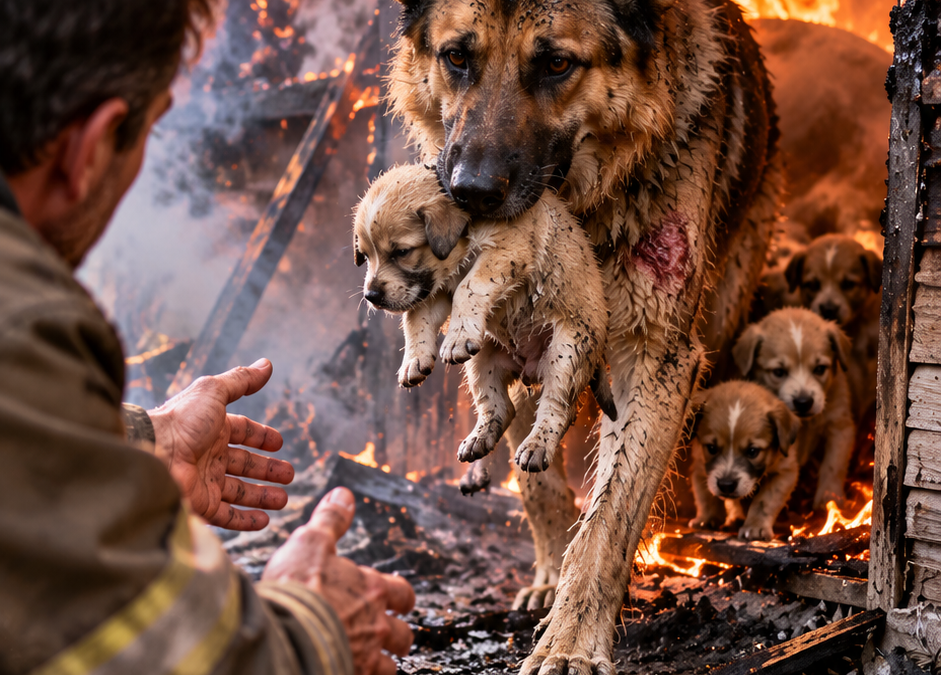
𝗙𝗨𝗟𝗟 𝗦𝗧𝗢𝗥𝗬
I grabbed for his collar.
Missed.
He ran back.
That was one.
I picked up the puppy.
Its body was hot.
It made a thin squeaking sound.
I carried it farther from the fire and placed it on my shirt, which I had pulled off to make a dry patch in the grass.
“Porte!”
He emerged again.
Another puppy.
Two.
He dropped it beside the first.
Turned.
This time I caught his collar.
“Stop.”
He struggled.
Not violently.
Just forward.
“Porte.”
I pulled harder.
“No.”
Then the sound came again.
A puppy crying inside.
Porte looked toward the flames.
Then at me.
Something in his face changed.
I wish I could explain it without making him sound human.
I can’t.
He didn’t look confused.
He looked decided.
He pulled once.
My grip slipped.
He went back.
Three.
Four.
Five.
I stopped trying to hold him after the fourth.
I hated myself for it.
But each time he returned, another puppy was alive.
What was I supposed to do?
Tie him to a tree while something screamed inside?
Go in myself?
I tried.
After the fifth trip, I wrapped part of my shirt around my face and moved toward the rear opening.
The heat hit me like a wall.
Smoke swallowed everything.
I couldn’t see.
I took maybe three steps.
Then my lungs closed.
I fell backward into the grass coughing.
Porte ran past me into the same darkness.
I remember screaming after him.
“Don’t!”
He went anyway.
Six.
When he came back that time, he was slower.
His front paws touched the grass strangely.
Not fully.
He carried the puppy carefully and released it.
I saw the pads of his feet.
Red.
Raw.
My stomach turned.
“Porte.”
He tried to turn back.
I blocked him.
“Enough.”
He stepped around me.
“Porte!”
Seven.
By then, I was crying.
Not because of the trailer.
I had almost forgotten it existed.
My entire world had narrowed to one dog entering a place that was hurting him more every time.
He returned with another puppy.
Seven.
I looked at the small bodies gathered in the grass.
Some moved strongly.
Some barely.
I had no blankets.
No water close enough.
No phone in my hand.
I had left it inside.
My nearest neighbor lived far enough away that no one had seen the fire yet.
I shouted anyway.
“Help!”
Nothing.
Only fire.
Puppies.
My own breathing.
And Porte.
He went back.
Eight.
When he emerged, part of the fur along his face looked different.
Shorter.
Singed.
He blinked rapidly.
Smoke poured around him.
I reached for the puppy.
He released it into my hands.
Then stood there breathing hard.
“That’s enough.”
I put both hands around his face.
His fur was hot.
“You hear me?”
He looked at me.
“Enough.”
Behind us, something inside the trailer collapsed.
The sound was enormous.
A shower of sparks rose into the dark sky.
Porte flinched.
I thought that would stop him.
Then another cry came.
Faint.
But there.
Porte turned.
“No.”
I held his neck.
“No.”
He pulled.
“Porte.”
I tightened my arms around him.
His heart was beating impossibly fast.
“I can’t lose you too.”
He stopped for half a second.
Then twisted free.
Nine.
I don’t know exactly how long each trip took.
Seconds?
A minute?
Time had become useless.
I counted because numbers were all I had.
Nine.
He came out dragging one front paw slightly.
The puppy in his mouth was barely moving.
I took it.
Pressed it against my chest.
“Porte.”
He collapsed briefly onto his chest.
I thought he was finished.
I wanted him to be finished.
Then he heard another sound.
He pushed himself up.
His paws shook.
I moved in front of him.
“No more.”
He tried to pass.
I blocked him.
He went right.
I went right.
Left.
I followed.
He looked at me.
There are moments that divide your life.
Before you understood something.
After.
That look was one.
I realized I was not going to stop him without physically restraining him.
And even if I did, I would have to sit in that grass listening to whatever remained inside die.
Porte made the choice for both of us.
He went around me.
Ten.
When he came out, his body was lower to the ground.
His legs looked wrong.
The hair near his ears had burned away in patches.
The puppy he carried was limp.
I took it.
For several seconds, I thought it was dead.
Then its tiny chest moved.
Once.
Again.
“Porte, please.”
I said the word because commands had stopped meaning anything.
“Please.”
He stood beside me.
His head hung low.
Smoke coated his fur.
His breathing made a rough sound.
I touched his back.
He was trembling.
“No more.”
Silence.
No crying.
Nothing.
I almost collapsed from relief.
Then somewhere inside the burning structure came one final sound.
Small.
Weak.
One puppy.
Porte heard it.
I saw his ears move.
“No.”
He looked toward the fire.
“No.”
His legs were shaking.
“You can’t.”
He took one step.
His front paw buckled.
He corrected himself.
“Porte.”
Another step.
“Please.”
He went back into the fire.
Eleven.
I stood in the grass staring at the opening.
Seconds passed.
Then more.
I don’t remember breathing.
I remember saying his name.
Quietly first.
Then louder.
“Porte.”
Nothing.
“Porte!”
The flames were worse.
Part of the roof was coming down.
I started toward the fire.
I don’t know what I thought I could do.
Then he appeared.
Not running.
Not even walking normally.
Crawling.
His muzzle nearly touched the ground.
His legs trembled with every step.
Smoke moved around him.
And in his mouth was the smallest puppy yet.
It was alive.
I knew because its little legs moved once.
Porte made it several feet onto the grass.
Then his front legs stopped obeying him.
He collapsed.
Not suddenly.
Slowly.
Like an old tree giving up after a storm.
He went down chest first.
Then the rest of his body followed.
He still didn’t release the puppy.
“Porte!”
I dropped beside him.
The grass was wet with morning dew.
His body was burning hot beneath my hands.
I touched his mouth carefully.
“Let go.”
His jaw remained closed.
Not tightly.
Protectively.
“Porte.”
His eyes opened.
I put one hand against his cheek.
“It’s okay.”
Slowly, he released.
I took the puppy.
It fit into my palm.
That small.
Its fur was warm and damp.
Its heart fluttered so quickly beneath my fingers that it felt like a trapped bird.
I placed it beside the others.
Then turned back to Porte.
His breathing terrified me.
Slow.
Heavy.
Rough.
Every breath sounded like work.
I put my hand on his side.
“I’m here.”
His eyes opened.
He looked at me.
I expected fear.
Pain.
Confusion.
There was none.
Only exhaustion.
And something I can still only call trust.
He had done what he could do.
Now he was handing everything else to me.
“I’ve got them.”
His eyelids lowered.
“I’ve got them.”
Around us, my trailer burned.
Twenty years.
Furniture.
Clothes.
Photographs.
Tools.
Everything.
I barely looked at it.
I sat in wet grass with one hand on Porte’s ribs and counted his breaths.
One.
Two.
Three.
Every breath became the only thing I owned.
The volunteer firefighters arrived twenty-two minutes later.
I know because someone told me afterward.
To me, it felt like hours.
I had eleven puppies arranged around me.
Some crying.
Some barely moving.
Porte on his side.
Smoke filling the dawn.
When the first firefighter reached us, he stopped.
“What happened?”
“My dog.”
He dropped to his knees.
“He went in.”
The firefighter looked toward the trailer.
“How many times?”
I couldn’t answer immediately.
“Eleven.”
He stared at me.
“What?”
“Eleven.”
His face changed.
He touched Porte’s chest.
Checked his gums.
Looked at his paws.
Then at another firefighter.
They exchanged a look I didn’t understand.
I hated that look.
“What?”
The man said something about oxygen.
Transport.
Burns.
Smoke inhalation.
I heard only pieces.
“Is he dying?”
The firefighter looked at me.
“We need to move now.”
That was not an answer.
They took Porte and the puppies.
I went with them.
I did not stay to watch my trailer collapse.
I did not see the roof fall.
I didn’t watch twenty years become black timber and ash.
I saw photographs later.
That was enough.
At the veterinary clinic, they took Porte away from me.
That might have been the hardest part.
After everything, someone closed a door between us.
I stood there covered in soot, barefoot, hands shaking.
A veterinary technician offered me water.
I couldn’t drink.
Another brought me a blanket.
I didn’t feel cold.
“Where is he?”
“They’re working on him.”
“Is he alive?”
“Yes.”
“Then I want to see him.”
“You can’t right now.”
“I need to.”
“The doctor needs room.”
I sat.
Stood.
Sat again.
The puppies were being treated too.
Eleven tiny bodies.
Oxygen.
Warmth.
Fluids.
I watched people move quickly between rooms.
Every time a door opened, I looked for Porte.
Hours later, a veterinarian sat beside me.
His name was Dr. Collins.
His face told me before he spoke that the news was serious.
“He’s alive.”
I exhaled.
Everything after that came slowly.
Severe burns.
All four paw pads badly damaged.
Parts of the tissue would need weeks to regenerate.
Burns along his face.
Nose.
Ears.
A strip across his back.
Smoke inhalation.
Inflamed lungs.
Possible long-term respiratory damage.
His heart rate had been dangerously high.
They were giving him oxygen.
Pain medication.
Fluids.
Monitoring.
“Will he live?”
Dr. Collins hesitated.
I hated him for that hesitation.
Only for a second.
“I don’t know.”
I looked away.
“He walked through the fire twenty-two times.”
I turned back.
“What?”
“Eleven times in.”
He counted with his hand as though confirming the impossible.
“Eleven times out.”
He shook his head.
“I have never seen anything like it.”
I didn’t care whether he’d seen it.
“Will he live?”
“We’re doing everything we can.”
“What can I do?”
“Wait.”
The cruelest instruction in the world.
Wait.
I had spent my life believing action mattered.
Pull the net.
Repair the roof.
Fix the motor.
Solve the problem.
There was nothing I could fix.
So I waited.
The first night, Porte remained on oxygen.
I sat nearby whenever they allowed me.
Most of his feet were wrapped.
His face looked wrong without patches of fur.
The skin around his nose was red.
His breathing rasped.
Every time he inhaled, I leaned forward.
Every time he exhaled, I waited for another breath.
“Come on.”
Rasp.
“Again.”
Rasp.
“Again.”
I don’t know how many times I said it.
Sometime after midnight, he opened his eyes.
I moved closer.
“Hey.”
His tail didn’t move.
Nothing moved except his eyes.
“It’s me.”
He knew.
I saw it.
I touched the side of his neck where the skin wasn’t burned.
“You don’t have to do anything now.”
His eyes stayed on me.
“You hear me?”
I swallowed.
“No more running.”
For the first time since the fire, I cried.
Not loudly.
I put my forehead near his.
“You did enough.”
His eyes closed.
“More than enough.”
The puppies struggled too.
The smallest ones had inhaled smoke.
Two were in worse condition than the others.
For several days, everyone hoped.
Hope becomes dangerous in places like veterinary hospitals.
You become afraid to hold it too tightly.
Afraid it will punish you.
Nine puppies survived.
Two didn’t.
I was there when Dr. Collins told me.
I had known it was possible.
Still, hearing the words felt like another piece of the fire arriving late.
“We lost two.”
I closed my eyes.
“Which ones?”
He told me.
One was the tenth puppy Porte had carried out.
The other had been rescued earlier but had severe lung damage.
I looked toward Porte’s recovery area.
“Did he…”
Then I stopped.
Of course he didn’t know.
Dogs don’t count rescues the way we do.
They don’t ask whether effort was wasted if the outcome isn’t perfect.
Still, I felt the need to explain.
That evening, I sat beside him.
“Nine made it.”
Porte breathed.
Rasp.
Pause.
Rasp.
“Nine.”
I stroked his neck.
“The other two…”
My voice failed.
“I don’t know if you understand any of this.”
His eyes remained closed.
“But they weren’t alone.”
That mattered to me.
Maybe too much.
“They were warm.”
I swallowed.
“They weren’t in the fire.”
Porte’s breathing continued.
“They got out.”
I stayed there until the clinic lights dimmed for the night.
The nine surviving puppies began recovering.
One by one, they became louder.
Hungry.
Restless.
Alive.
Eventually, families offered to adopt them.
People had heard what happened.
I wanted to keep them away from cameras and noise.
They had already had enough drama for one lifetime.
But good homes came.
One puppy went to a retired couple with a wood stove.
They later sent me a photograph of him sleeping beside it.
Another went to a family with two children.
They said she followed the father everywhere.
One slept under blankets.
One hated being alone.
One grew into a dog larger than anyone expected.
Nine different lives.
Nine homes.
Nine futures that existed because Porte had entered that fire again and again.
The two who died stayed with me differently.
I couldn’t call their deaths a failure.
Porte had gotten them out.
That mattered.
Their final hours were warm.
Hands held them.
Someone tried.
There are times when rescue does not mean saving a life forever.
Sometimes it means changing how the end happens.
That took me years to understand.
Porte’s recovery was slower.
Much slower.
The first major concern was his lungs.
Smoke had done damage that no bandage could cover.
Some nights his breathing sounded worse.
I would wake at every change in rhythm.
Rasp.
Rasp.
Pause.
My entire body would go rigid.
Then—
Rasp.
I learned to love that sound.
At first, I hated it.
It reminded me of fire.
Pain.
Smoke.
Then it became proof.
He’s breathing.
He’s still here.
He’s still here.
He’s still here.
His paws were another battle.
The pads had been burned so badly that walking was impossible.
The veterinarian explained tissue growth.
Dressings.
Infection risk.
Pain control.
Therapy.
Weeks.
Maybe months.
I looked at Porte lying on a blanket.
“Will he run again?”
Dr. Collins looked at me carefully.
“Let’s get him walking first.”
That answer hurt.
But it was honest.
We began there.
One step.
Not running.
Not beaches.
One step.
The first time they tried to help him stand, Porte looked confused.
His body remembered how to rise.
His feet did not.
He pushed himself up.
Pain hit.
His legs folded immediately.
I caught him around the chest.
“Easy.”
He trembled.
“Easy.”
He tried again.
“Porte.”
Another attempt.
He always had been stubborn.
That had saved eleven puppies.
Now it made recovery complicated.
“You don’t have to prove anything.”
Of course, he tried again.
We used support straps beneath his body.
Soft surfaces.
Very short sessions.
At first, simply standing for a few seconds counted as success.
Five seconds.
Then ten.
One step.
Two.
Rest.
The first time he managed three careful steps toward me, I nearly celebrated as if he had crossed an ocean.
“That’s it.”
His tail moved once.
I crouched.
“Come on.”
Another step.
His face tightened.
He stopped.
“That’s enough.”
He wanted another.
“No.”
For once, I became the one who refused to let him continue.
“You’ve done enough.”
Sixteen weeks.
That was how long it took before Porte could walk without obvious pain.
Sixteen weeks after running through fire.
By then, the new tissue on his pads was thick and uneven.
Different from before.
Rough.
Almost like old leather.
He learned to place his feet differently.
Carefully.
Slowly.
Every step seemed considered.
At first, I hated watching him move that way.
It reminded me of what he’d lost.
Then one morning, I realized he was not thinking about what he’d lost.
He was walking.
That was enough for him.
So I tried to make it enough for me.
Before the fire, Porte and I had walked beaches together.
He would run ahead.
Turn.
Wait impatiently.
Run back.
Circle me.
Charge toward the waves.
Then retreat when cold water reached him.
Afterward, things changed.
We returned to the coast once he was strong enough.
I expected some dramatic moment.
Maybe he would run.
Maybe he would recognize the place and become his old self.
Instead, he walked beside me.
Slowly.
One careful paw after another.
The waves came in.
Porte watched.
I adjusted my pace.
For years, he had waited for me when I was too slow.
Now I waited for him.
Neither of us complained.
We had both learned something.
Speed had never been the point.
The scars stayed.
Some areas of Porte’s coat grew back differently.
The texture changed.
The color too.
There were pale sections where the fire had marked him.
At first, every scar made me angry.
It felt like damage.
Evidence of something cruel.
Over time, I saw them differently.
Not beautiful exactly.
I don’t romanticize burns.
Pain is pain.
But scars are honest.
They say something happened.
And the body remained.
Porte remained.
That mattered more.
I lost the trailer completely.
There was no repairing it.
Insurance covered some things.
Not enough for everything.
Friends helped.
Neighbors helped.
I eventually moved into a small house nearby.
The first thing I thought about was not furniture.
It was Porte.
I wanted a place where walking would not hurt him.
There were three steps at the front door.
I built a ramp.
Not steep.
Wide.
Stable.
I covered the floors with soft rugs.
Room to room.
Bedroom.
Hallway.
Kitchen.
Living room.
Places where his paws could land gently.
I changed the heating system.
That surprised people.
The house had an open fireplace.
Before the fire, I would have loved it.
Porte did not.
The first time I lit it, he froze.
He did not bark.
Did not run.
His body simply became rigid.
His eyes fixed on the flame.
I extinguished it immediately.
He relaxed slowly.
That was the last time I used that fireplace.
I installed another heating system instead.
Someone said, “That’s expensive for a dog.”
I said nothing.
What could I say?
Porte had crossed fire twenty-two times for lives he had never seen before that morning.
I could change a heater.
That wasn’t sacrifice.
That was accounting.
He had given more than I would ever be able to return.
The nights were hardest during the first year.
His breathing never returned completely to what it had been.
There was always a rasp.
Low.
Continuous.
I would wake in darkness and listen.
At first, every variation terrified me.
If he coughed, I sat up.
If he paused too long, I reached down.
“Hey.”
His eyes would open.
“I’m sorry.”
He would settle again.
Eventually, the sound became part of the room.
Like rain.
Like distant waves.
Like wind through an old window.
Rasp.
Rasp.
Rasp.
Proof.
One night, I realized I had fallen asleep because of it instead of despite it.
I woke at two in the morning.
Porte was breathing beside my bed.
I smiled.
“You’ve become my white-noise machine.”
He didn’t care.
He slept.
I did too.
People heard the story.
Some came because they were curious.
I didn’t always like that.
Porte was not an exhibit.
He was a dog recovering from burns.
I didn’t want strangers crowding him because they’d read something online or heard something from a neighbor.
Most respected that.
Some families who adopted the puppies stayed in touch.
That I appreciated.
Photographs came.
Updates.
Healthy dogs.
Happy homes.
Sometimes I showed them to Porte.
“Look.”
He sniffed the picture once.
“You risked your life for him.”
No reaction.
“At least pretend to be impressed.”
He walked away.
Maybe that was one of the things I loved most.
Porte did not know he was a hero.
He didn’t live inside the story other people told about him.
He lived inside today.
Breakfast.
Walk.
Nap.
Me.
Water.
Sun.
The rest belonged to humans.
One afternoon, a young woman stopped at my gate.
She had heard about the puppies and was looking for information.
By then, all nine had homes.
She seemed disappointed.
Then she saw Porte lying inside on one of the rugs.
“Is that him?”
“Yes.”
“The dog?”
“Yes.”
She looked at his paws.
Even from a distance, the scars were visible.
“Can I meet him?”
I hesitated.
“Quietly.”
She came inside.
Porte lifted his head.
The woman sat several feet away on the floor.
She didn’t touch him immediately.
That made me like her.
After a while, she asked, “Why do you do all this?”
I frowned.
“All what?”
“The ramp.”
She pointed.
“The rugs.”
“The heater.”
I looked at her.
“For him.”
“I know.”
She seemed embarrassed.
“I mean…”
She searched for words.
“It must cost a lot.”
“Some.”
“And take a lot of time.”
“Yes.”
“He can’t really run anymore.”
I understood what she was trying to ask.
Why spend so much on a damaged dog?
Not cruelly.
Ignorantly.
There is a difference.
I looked at Porte.
He was lying peacefully.
His head on his paws.
Eyes closed.
“This dog went through fire eleven times for puppies he’d never seen before.”
The woman said nothing.
“Eleven times in.”
I paused.
“Eleven times out.”
I pointed toward his paws.
“Those feet were already burning when he went back.”
Her eyes dropped.
“He knew it hurt.”
My voice tightened.
“I watched him know.”
I remembered the tenth trip.
The shaking.
The eleventh.
The collapse.
“And he still went.”
The woman swallowed.
“So if the price of his comfort now is rugs on my floor and a ramp outside…”
I looked at her.
“That’s not a sacrifice.”
Porte opened one eye.
“The least I can do is make sure walking to his water bowl doesn’t hurt.”
The woman remained silent.
Then she moved slowly toward him.
She sat beside him.
Touched the fur behind his ear.
Porte opened his eyes.
Looked at her.
Then closed them again.
She cried.
Quietly.
I pretended not to notice.
Porte didn’t need to run anymore.
That became something I told myself often.
At first, I mourned the dog he had been.
Fast.
Strong.
Explosive.
I missed watching him race toward the waves.
I missed throwing something and seeing him take off.
But gradually, I understood I had been comparing his present to a past he was not asking to return to.
He was alive.
He was comfortable.
He wanted food.
Sunlight.
My company.
A slow walk.
That was his life now.
It wasn’t inferior because it was slower.
Different is not the same as less.
That was a lesson I needed too.
The fire changed me.
People asked whether I regretted losing the trailer.
At first, the question annoyed me.
Of course I regretted it.
There were things I would never replace.
Photographs.
Tools my father had owned.
A chair I’d repaired three times because I was too stubborn to throw it away.
Books.
Letters.
Twenty years of small objects whose value existed only because they had shared time with me.
Yes.
I grieved those things.
But regret is not the same as wishing the night had gone differently.
Because when I imagined changing that night, where would I stop?
Would I prevent the fire?
Of course.
But then Porte never runs into it.
The puppies never need saving.
Fine.
But life doesn’t offer editing that precise.
The night happened.
What followed became part of us.
So when people asked, “Don’t you miss your home?”
I eventually knew how to answer.
I looked at Porte.
Sleeping in sunlight.
His scarred paws crossed.
His side rising.
Falling.
Rasping softly.
“I didn’t lose everything.”
That answer sometimes disappointed people.
They wanted something inspirational.
Something neat.
I didn’t have that.
Fire is not neat.
Loss isn’t.
Recovery isn’t.
Two puppies died.
My home burned.
Porte suffered.
Nothing about that became good simply because something beautiful came afterward.
But pain and beauty can exist in the same life.
I learned that.
I didn’t have to choose one explanation.
Terrible things happened.
Porte was extraordinary.
Both were true.
The years continued.
I stopped fishing almost completely.
My hands weren’t as strong.
My balance wasn’t what it had been.
Porte slowed too.
We became an old pair.
Sometimes I joked that we were competing to see who could stand up more slowly.
He usually won.
We spent more time near the sea.
There was a rock overlooking the water where I liked to sit.
Porte would settle beside me.
Sometimes his head rested on my knee.
We watched the waves.
His breathing rasped.
The ocean breathed too.
In.
Out.
Porte.
Sea.
Porte.
Sea.
At some point, the sounds became connected in my mind.
Both reminding me that movement continues.
Not unchanged.
Continues.
On windy days, I put a blanket around Porte.
He pretended to hate it.
Then refused to stand when I tried removing it.
“Fraud.”
He closed his eyes.
Sometimes he still surprised me.
We would be walking slowly, his careful old steps beside mine.
Then something would catch his attention.
A bird.
A smell.
Another dog.
And for three or four steps, he’d move faster.
Not running.
Almost.
I would pretend not to see.
I didn’t want him to feel watched.
As if dogs care about pride the way we do.
Still, I gave him that privacy.
One morning, he accelerated toward the beach.
Maybe five steps.
Then slowed.
I laughed.
“Show-off.”
His tail moved.
The scars did not hurt like they once had.
The veterinarian said the tissue had settled as well as we could hope.
His lungs would always carry some damage.
That rasp would remain.
I no longer wanted it gone.
It had become part of the sound of home.
That surprised me.
After the fire, I used to dream about silence.
Not peaceful silence.
The silence after Porte’s breathing stopped.
I would wake terrified and put my hand on him.
Years later, I understood that I had turned his breath into a measure of safety.
If I heard it, everything essential was still present.
Rasp.
We’re okay.
Rasp.
Still here.
Rasp.
Another morning.
I often thought about that eleventh puppy.
The last one.
The tiny body in Porte’s mouth when he collapsed.
That puppy survived.
Eventually, she was adopted by a family inland.
They named her Lucy.
They sent me photographs sometimes.
She grew into a strong, awkward dog with ears too large for her head.
In one photograph, she was asleep on a teenager’s bed.
I stared at that picture for a long time.
Porte had nearly died carrying that tiny animal.
Now she was taking up somebody’s entire pillow.
Life can be strange that way.
Huge sacrifice disappears into ordinary happiness.
Maybe that’s the goal.
Not eternal gratitude.
Normal life.
Lucy did not know Porte had saved her.
She didn’t need to.
She was alive.
That was the point.
The other puppies didn’t know either.
One chased tennis balls.
Another slept near a stove.
One followed his owner from room to room.
Their lives went forward without understanding their beginning.
I found comfort in that.
Sometimes the best thing you can give another life is the chance to forget the emergency.
Porte couldn’t forget physically.
His body carried the record.
But emotionally, he moved forward better than I did.
I was the one who sometimes froze at the smell of smoke.
One winter, a neighbor burned branches nearby.
Smoke drifted across my yard.
My chest tightened.
I was suddenly barefoot in wet grass again.
Porte crawling from flames.
I went inside.
Porte followed.
He didn’t panic.
He simply lay near me.
I laughed bitterly.
“You’re comforting me now?”
He put his head down.
Of course he was.
Even after everything.
That was Porte.
The fire had not made him bitter.
It had not made him suspicious of every warmth.
He disliked open flame afterward, yes.
His body remembered.
But he still lay in sunlight.
Still came close to the stove when the room was cold.
Still lived.
I found that harder than he did.
Humans turn pain into stories.
Stories into warnings.
Warnings into walls.
Dogs seem better at distinguishing between then and now.
Then, fire hurt.
Now, the sun is warm.
Then, running saved lives.
Now, resting is enough.
I tried to learn from him.
One evening, years after the fire, I sat beside Porte as sunset turned the ocean orange.
For a moment, the color reminded me of flames.
I felt the old tension.
Then Porte sighed.
The sound brought me back.
I looked at the horizon.
Orange was not only fire.
It was sunset too.
Heat was not only danger.
It was sunlight.
Smoke was not every cloud.
The world had not become the night we survived.
That realization came slowly.
Like Porte’s recovery.
One step at a time.
Sometimes people asked whether I believed Porte knew what he was doing.
Did he understand danger?
Did he know the puppies weren’t his?
Did he understand he could die?
I don’t know.
I refuse to pretend I know an animal’s mind perfectly.
Maybe instinct drove him.
Maybe the puppies’ cries triggered something.
Maybe each time he heard another one, leaving it behind was simply impossible for him.
Does that make it less extraordinary?
Not to me.
He felt pain.
I saw that.
He was afraid of the heat.
I saw hesitation.
He was exhausted.
I watched his legs fail.
Whatever instinct existed, he still had to move a burned body forward.
Again.
Again.
Again.
Eleven times.
There is courage even when courage has no language.
Maybe especially then.
I learned something else from those people who adopted the puppies.
Most of them wanted to thank me.
I corrected them.
“Thank Porte.”
They would kneel beside him.
Some cried.
Some hugged him gently.
Some brought treats.
Porte accepted the treats and ignored the speeches.
That felt appropriate.
Heroism is often more useful to the people telling the story than to the one who did the act.
Porte didn’t need a title.
He needed soft floors.
Medication.
Rest.
Food.
Love.
That’s what I gave him.
Not as repayment.
You cannot repay what he did.
You can only care for what remains afterward.
That became my work.
For years, I had measured usefulness differently.
How much did I catch?
How much could I repair?
How far could I walk?
How strong was my back?
After the fire, usefulness became smaller.
Changing a bandage.
Helping Porte stand.
Carrying him when his paws hurt.
Moving a rug so he didn’t slip.
Waking at three because his breathing changed.
Sitting beside him while he slept.
Small acts.
No applause.
No witnesses.
They mattered.
Maybe more than anything I had done before.
Porte had shown me dramatic courage.
Recovery taught me quiet devotion.
People celebrate the run into the fire.
They rarely talk about the sixteen weeks afterward.
The cleaning.
The pain.
The setbacks.
The night fear.
The first failed step.
The second.
The third.
The work of staying alive after the spectacular moment is over.
I think about that often.
Saving is not only rescue.
Sometimes saving is what happens after everyone stops watching.
One day, a man who had heard the story visited.
He shook my hand.
Then looked at Porte.
“That’s the hero?”
Porte was asleep.
“That’s him.”
“He doesn’t look like much.”
I stared.
The man realized what he’d said.
“I mean now.”
I almost became angry.
Then I looked at Porte.
Old.
Scarred.
Sleeping.
“No.”
I said.
“He looks exactly like what surviving looks like.”
The man went quiet.
I didn’t intend it as wisdom.
It was simply true.
Survival is rarely impressive up close.
Sometimes it limps.
Sometimes it scars.
Sometimes it sleeps half the day.
Sometimes it breathes noisily.
Sometimes it needs a ramp.
That doesn’t make it less miraculous.
Porte never returned to the dog he was before the fire.
Neither did I.
That sentence used to sound tragic.
Now it doesn’t.
Why should the goal always be to become who we were before pain?
Before the fire, I was a man who thought home meant an old trailer.
Before the fire, Porte was a dog who thought strength meant running fast.
Afterward, we learned other definitions.
Home became presence.
Strength became endurance.
Love became adjustment.
Life became slower.
Not smaller.
We watched more sunsets.
I talked more.
Porte listened.
I noticed birds.
Weather.
The way sunlight moved across his scars.
Things I had been too busy to notice before.
There was beauty in the slower life.
Not because suffering was necessary to appreciate beauty.
I would never say that.
But once suffering had happened, we still had to decide what to look at afterward.
I chose Porte.
He chose the sea.
Together, we learned the rest.
Now, every morning, I wake before sunrise.
Habit.
Porte sleeps nearby.
He is very old.
Older than I want to count.
His muzzle is almost white.
His paws are rough.
His breathing still has that small rasp.
I lie still for a moment.
Listen.
Rasp.
Pause.
Rasp.
I smile.
“Morning.”
Sometimes his tail moves without his eyes opening.
I get up.
Breakfast is simple.
Coffee for me.
Food for him.
Then we walk toward the ramp I built years ago.
He used to need help.
Now he mostly doesn’t.
He moves carefully.
One foot.
Then another.
I follow.
The sea is not far.
On clear mornings, the sky becomes enormous.
Blue.
Clean.
Nothing like that night.
We sit where we can see the water.
Porte leans against me.
Some mornings, I think about my trailer.
I can almost see it.
The porch.
The crooked steps.
The old window.
For twenty years, I thought that structure contained my life.
Then it burned.
And my life was sitting in the grass beside me.
Breathing.
Scarred.
Alive.
People still ask occasionally whether I regret losing everything.
I understand the question better now.
I usually look at Porte before answering.
“I didn’t lose everything.”
Sometimes that’s enough.
If they press, I say:
“I lost a building.”
That sounds cold.
It isn’t.
I loved that place.
But buildings do not lie beside you when you can’t sleep.
Buildings do not enter fire for strangers.
Buildings do not look at you after eleven trips through flame as though trusting you to carry the rest.
A home can burn.
What made me feel at home survived.
That’s the difference.
I don’t know how much longer Porte and I have.
At my age, I no longer pretend time is infinite.
At his age, neither does the veterinarian.
But I don’t spend our mornings calculating endings.
That’s another thing Porte taught me.
A life is not made more valuable by pretending it won’t end.
You love it because it will.
I put my hand on his head.
His eyes close.
Sometimes he makes that rasping sound and I remember the clinic.
The first night.
The fear.
Then I hear the waves.
Now.
Not then.
Now.
We’re here.
That is enough.
The fire gave me one image I know I will carry until my own last day.
Porte emerging for the eleventh time.
His muzzle nearly touching the ground.
Legs shaking.
A puppy in his mouth.
He had nothing left.
And still, he moved.
People call that heroism.
Maybe it is.
But the part that matters most to me came after.
He trusted me enough to stop.
He collapsed in front of me because he knew his work was done.
He gave me the puppy.
He gave me his broken body.
He let me carry him.
That trust changed me.
For years afterward, my promise became simple.
He would never again have to push past pain because no one else would take over.
I would.
If he couldn’t climb, I built a ramp.
If the floor hurt, I covered it.
If fire frightened him, I removed the flame.
If he needed to walk slowly, I slowed.
If he couldn’t sleep, I stayed awake.
He had spent one night doing more than anyone could ask.
The rest of his life did not belong to duty.
It belonged to rest.
That felt right.
A few days ago, Porte surprised me.
We were near the water.
The morning was cool.
A gull landed farther down the beach.
Porte lifted his head.
For a second, something changed in his body.
He moved faster.
Not much.
Four steps.
Maybe five.
Then he stopped.
Looked back.
I laughed.
“Go on.”
He didn’t.
He returned to my side.
I scratched his neck.
“You could’ve had him.”
The gull flew away.
Porte sighed.
He knew better.
We sat together.
The sea moved.
His breathing rasped.
Mine probably wasn’t much quieter.
Two old creatures.
Still here.
I thought about those eleven puppies.
Nine lives continuing somewhere because this dog refused to stop.
Two lives that ended outside the fire instead of inside it.
Maybe there is no perfect outcome.
Maybe courage isn’t measured only by success.
Maybe it’s measured by what you are willing to give when you don’t know the ending.
Porte didn’t know nine would survive.
He didn’t know he would survive.
He didn’t know there would be a soft house later.
A ramp.
Rugs.
A man sitting beside him years afterward.
He knew one thing.
There were lives inside.
He could carry them.
So he went.
That was enough.
It has always been enough.
I used to believe wisdom came from age.
It doesn’t.
Age gives you time.
Wisdom depends on what you notice.
I learned more from Porte than from most people.
He taught me there are moments to run into fire.
Moments when hesitation costs too much.
Moments when something needs you and all you can do is go.
But he also taught me there are moments to slow down.
To heal.
To accept help.
To stop proving how strong you are.
To let someone build the ramp.
To let somebody walk at your pace.
Both require courage.
Maybe that is the whole lesson.
Find something worth running for.
Then, if you’re lucky enough to survive, find something worth slowing down for too.
I found both in the same dog.
This morning, Porte is sleeping beside me as I finish my coffee.
One scarred paw rests against my foot.
The room is quiet except for his breathing.
Rasp.
Pause.
Rasp.
Once, that sound terrified me.
Now I love it more than any song I know.
It is not beautiful because damage is beautiful.
Damage isn’t.
It is beautiful because it means life remained.
The fire took things.
It took my trailer.
It took two puppies.
It took the smooth skin from Porte’s paws.
It took some of his breath.
It took speed from his legs.
But it did not take him.
And because it did not take him, it did not take me either.
I look down.
He opens one eye.
“Ready?”
His tail moves.
Slowly.
I stand.
He stands too.
Carefully.
We walk toward the ramp.
No rushing.
No flames.
No screaming puppies.
Only morning.
Blue sky.
Clean air.
The sea waiting in front of us.
For years, I thought home was the trailer that burned.
I know better now.
Home is the sound beside me in the dark.
Home is the scarred paw touching my foot.
Home is the creature who ran eleven times into fire and then trusted me enough to carry him through everything that came after.
Porte walks down the ramp.
I follow at his pace.
The ocean comes into view.
He stops.
Breathes.
Rasp.
Then another breath.
And another.
We are both still breathing.
We are both still here.
That is more than enough.
That is home.
𝗧𝗛𝗘 𝗘𝗡𝗗
By the Eleventh Time He Came Through the Flames, I Knew His Body Had Almost Nothing Left to Give
I was counting because counting was the only thing keeping me from losing my mind.
One.
Two.
Three.
Each time Porte disappeared into the fire, I told myself it would be the last.
Each time he came back with another puppy in his mouth, I was wrong.
By the eleventh time, he was no longer running.
He was barely walking.
And when I saw him emerge through the smoke with one final tiny body hanging gently between his teeth, I knew I was watching a creature spend the last of whatever strength he had left.
My name is Thomas.
For twenty years, I lived in an old trailer not far from the coast.
It wasn’t much to look at.
The paint had faded.
The steps leaned slightly to one side.
The wind got through the windows during winter.
When rain came hard from the west, I had to place a bucket beneath one corner of the roof.
People sometimes asked why I stayed.
I never had a good answer.
Maybe because after enough years, a place stops being something you own and becomes something that knows you.
I knew every sound that trailer made.
The creak of the kitchen floor.
The rattle in the window frame when a storm came in.
The little knock inside the wall whenever the heater started.
I knew where the morning light entered.
I knew which side stayed cool in summer.
I knew exactly where to stand on the porch if I wanted to see the ocean between two low hills.
It wasn’t a beautiful life.
It was mine.
I had spent most of those years fishing.
Not professionally anymore.
My back had convinced me to stop pretending I was younger than I was.
But I still went down to the water often.
Sometimes I carried a rod.
Sometimes I only sat.
The sea never required conversation.
That mattered to me.
Porte understood that too.
He had been with me for years by then.
He wasn’t young.
Not old enough to be fragile, but old enough that his face had started showing small signs of time.
A little gray near the muzzle.
A little slower after long walks.
He had once been the kind of dog who could run along the beach for an hour and still look insulted when I suggested going home.
By the night of the fire, he had learned moderation.
Or so I thought.
Porte was not a trained rescue dog.
He had never been taught to enter burning buildings.
He had never worked with firefighters.
No one had trained him to carry animals gently.
He was simply my dog.
Large enough to look intimidating from a distance.
Gentle enough to sleep with his nose against my ankle.
He liked fish skin.
He hated rain.
He loved the beach.
He had a habit of sitting exactly where I needed to walk.
And if I stayed in bed too long, he would stand beside me and breathe on my face until I surrendered.
That was Porte.
Ordinary.
At least, that was what I believed until the night everything burned.
The fire started before dawn.
I woke to smell before sound.
Smoke.
Dense.
Bitter.
Wrong.
For one confused second, I thought something had burned on the stove.
Then I opened my eyes and saw orange light moving across the ceiling.
Porte was already standing.
His body rigid.
Ears forward.
I sat up.
“Outside.”
The word came automatically.
He didn’t move.
“Porte.”
A crack sounded somewhere near the back of the trailer.
Then another.
Heat rushed through the hallway.
I got up too quickly, stumbled, and grabbed the wall.
“Porte, out!”
This time he moved.
We made it through the front door.
Cold air hit my face.
I coughed until my eyes watered.
When I turned around, I saw flames pushing through one of the windows.
My home was burning.
Not smoking.
Burning.
Fully.
The dry wood around the rear section had caught quickly.
Part of the awning was already collapsing.
I stood barefoot in wet grass, watching twenty years turn orange.
Then I heard it.
A sound from behind the trailer.
High.
Sharp.
Repeated.
I knew immediately it wasn’t part of the fire.
Puppies.
There had been a stray female around the property for several weeks.
Yellow-brown coat.
Nervous.
She never let me get close.
I had seen her disappear beneath the old storage section behind the trailer.
I knew she had puppies somewhere.
I had left food out for her twice.
Never seen the litter.
I hadn’t known exactly where they were.
Until that moment.
The crying came from near the back structure.
My stomach turned.
“No.”
Porte heard them too.
He ran toward the side of the trailer.
“Porte!”
He stopped.
Looked back at me.
“No.”
I pointed toward the road.
“Stay.”
The puppies cried again.
Porte turned.
“No!”
He disappeared around the side.
I ran after him.
Heat forced me back before I reached the corner.
“Porte!”
No answer.
Flames had spread through the rear wall.
Smoke rolled low across the ground.
I shouted his name again.
Then he appeared.
He came out carrying something.
A puppy.
So small I barely understood what I was looking at.
He crossed the grass and dropped it carefully near my feet.
The puppy moved.
Alive.
Porte turned immediately.
“No.”
I grabbed for his collar.
Missed.
He ran back.
That was one.
I picked up the puppy.
Its body was hot.
It made a thin squeaking sound.
I carried it farther from the fire and placed it on my shirt, which I had pulled off to make a dry patch in the grass.
“Porte!”
He emerged again.
Another puppy.
Two.
He dropped it beside the first.
Turned.
This time I caught his collar.
“Stop.”
He struggled.
Not violently.
Just forward.
“Porte.”
I pulled harder.
“No.”
Then the sound came again.
A puppy crying inside.
Porte looked toward the flames.
Then at me.
Something in his face changed.
I wish I could explain it without making him sound human.
I can’t.
He didn’t look confused.
He looked decided.
He pulled once.
My grip slipped.
He went back.
Three.
Four.
Five.
I stopped trying to hold him after the fourth.
I hated myself for it.
But each time he returned, another puppy was alive.
What was I supposed to do?
Tie him to a tree while something screamed inside?
Go in myself?
I tried.
After the fifth trip, I wrapped part of my shirt around my face and moved toward the rear opening.
The heat hit me like a wall.
Smoke swallowed everything.
I couldn’t see.
I took maybe three steps.
Then my lungs closed.
I fell backward into the grass coughing.
Porte ran past me into the same darkness.
I remember screaming after him.
“Don’t!”
He went anyway.
Six.
When he came back that time, he was slower.
His front paws touched the grass strangely.
Not fully.
He carried the puppy carefully and released it.
I saw the pads of his feet.
Red.
Raw.
My stomach turned.
“Porte.”
He tried to turn back.
I blocked him.
“Enough.”
He stepped around me.
“Porte!”
Seven.
By then, I was crying.
Not because of the trailer.
I had almost forgotten it existed.
My entire world had narrowed to one dog entering a place that was hurting him more every time.
He returned with another puppy.
Seven.
I looked at the small bodies gathered in the grass.
Some moved strongly.
Some barely.
I had no blankets.
No water close enough.
No phone in my hand.
I had left it inside.
My nearest neighbor lived far enough away that no one had seen the fire yet.
I shouted anyway.
“Help!”
Nothing.
Only fire.
Puppies.
My own breathing.
And Porte.
He went back.
Eight.
When he emerged, part of the fur along his face looked different.
Shorter.
Singed.
He blinked rapidly.
Smoke poured around him.
I reached for the puppy.
He released it into my hands.
Then stood there breathing hard.
“That’s enough.”
I put both hands around his face.
His fur was hot.
“You hear me?”
He looked at me.
“Enough.”
Behind us, something inside the trailer collapsed.
The sound was enormous.
A shower of sparks rose into the dark sky.
Porte flinched.
I thought that would stop him.
Then another cry came.
Faint.
But there.
Porte turned.
“No.”
I held his neck.
“No.”
He pulled.
“Porte.”
I tightened my arms around him.
His heart was beating impossibly fast.
“I can’t lose you too.”
He stopped for half a second.
Then twisted free.
Nine.
I don’t know exactly how long each trip took.
Seconds?
A minute?
Time had become useless.
I counted because numbers were all I had.
Nine.
He came out dragging one front paw slightly.
The puppy in his mouth was barely moving.
I took it.
Pressed it against my chest.
“Porte.”
He collapsed briefly onto his chest.
I thought he was finished.
I wanted him to be finished.
Then he heard another sound.
He pushed himself up.
His paws shook.
I moved in front of him.
“No more.”
He tried to pass.
I blocked him.
He went right.
I went right.
Left.
I followed.
He looked at me.
There are moments that divide your life.
Before you understood something.
After.
That look was one.
I realized I was not going to stop him without physically restraining him.
And even if I did, I would have to sit in that grass listening to whatever remained inside die.
Porte made the choice for both of us.
He went around me.
Ten.
When he came out, his body was lower to the ground.
His legs looked wrong.
The hair near his ears had burned away in patches.
The puppy he carried was limp.
I took it.
For several seconds, I thought it was dead.
Then its tiny chest moved.
Once.
Again.
“Porte, please.”
I said the word because commands had stopped meaning anything.
“Please.”
He stood beside me.
His head hung low.
Smoke coated his fur.
His breathing made a rough sound.
I touched his back.
He was trembling.
“No more.”
Silence.
No crying.
Nothing.
I almost collapsed from relief.
Then somewhere inside the burning structure came one final sound.
Small.
Weak.
One puppy.
Porte heard it.
I saw his ears move.
“No.”
He looked toward the fire.
“No.”
His legs were shaking.
“You can’t.”
He took one step.
His front paw buckled.
He corrected himself.
“Porte.”
Another step.
“Please.”
He went back into the fire.
Eleven.
I stood in the grass staring at the opening.
Seconds passed.
Then more.
I don’t remember breathing.
I remember saying his name.
Quietly first.
Then louder.
“Porte.”
Nothing.
“Porte!”
The flames were worse.
Part of the roof was coming down.
I started toward the fire.
I don’t know what I thought I could do.
Then he appeared.
Not running.
Not even walking normally.
Crawling.
His muzzle nearly touched the ground.
His legs trembled with every step.
Smoke moved around him.
And in his mouth was the smallest puppy yet.
It was alive.
I knew because its little legs moved once.
Porte made it several feet onto the grass.
Then his front legs stopped obeying him.
He collapsed.
Not suddenly.
Slowly.
Like an old tree giving up after a storm.
He went down chest first.
Then the rest of his body followed.
He still didn’t release the puppy.
“Porte!”
I dropped beside him.
The grass was wet with morning dew.
His body was burning hot beneath my hands.
I touched his mouth carefully.
“Let go.”
His jaw remained closed.
Not tightly.
Protectively.
“Porte.”
His eyes opened.
I put one hand against his cheek.
“It’s okay.”
Slowly, he released.
I took the puppy.
It fit into my palm.
That small.
Its fur was warm and damp.
Its heart fluttered so quickly beneath my fingers that it felt like a trapped bird.
I placed it beside the others.
Then turned back to Porte.
His breathing terrified me.
Slow.
Heavy.
Rough.
Every breath sounded like work.
I put my hand on his side.
“I’m here.”
His eyes opened.
He looked at me.
I expected fear.
Pain.
Confusion.
There was none.
Only exhaustion.
And something I can still only call trust.
He had done what he could do.
Now he was handing everything else to me.
“I’ve got them.”
His eyelids lowered.
“I’ve got them.”
Around us, my trailer burned.
Twenty years.
Furniture.
Clothes.
Photographs.
Tools.
Everything.
I barely looked at it.
I sat in wet grass with one hand on Porte’s ribs and counted his breaths.
One.
Two.
Three.
Every breath became the only thing I owned.
The volunteer firefighters arrived twenty-two minutes later.
I know because someone told me afterward.
To me, it felt like hours.
I had eleven puppies arranged around me.
Some crying.
Some barely moving.
Porte on his side.
Smoke filling the dawn.
When the first firefighter reached us, he stopped.
“What happened?”
“My dog.”
He dropped to his knees.
“He went in.”
The firefighter looked toward the trailer.
“How many times?”
I couldn’t answer immediately.
“Eleven.”
He stared at me.
“What?”
“Eleven.”
His face changed.
He touched Porte’s chest.
Checked his gums.
Looked at his paws.
Then at another firefighter.
They exchanged a look I didn’t understand.
I hated that look.
“What?”
The man said something about oxygen.
Transport.
Burns.
Smoke inhalation.
I heard only pieces.
“Is he dying?”
The firefighter looked at me.
“We need to move now.”
That was not an answer.
They took Porte and the puppies.
I went with them.
I did not stay to watch my trailer collapse.
I did not see the roof fall.
I didn’t watch twenty years become black timber and ash.
I saw photographs later.
That was enough.
At the veterinary clinic, they took Porte away from me.
That might have been the hardest part.
After everything, someone closed a door between us.
I stood there covered in soot, barefoot, hands shaking.
A veterinary technician offered me water.
I couldn’t drink.
Another brought me a blanket.
I didn’t feel cold.
“Where is he?”
“They’re working on him.”
“Is he alive?”
“Yes.”
“Then I want to see him.”
“You can’t right now.”
“I need to.”
“The doctor needs room.”
I sat.
Stood.
Sat again.
The puppies were being treated too.
Eleven tiny bodies.
Oxygen.
Warmth.
Fluids.
I watched people move quickly between rooms.
Every time a door opened, I looked for Porte.
Hours later, a veterinarian sat beside me.
His name was Dr. Collins.
His face told me before he spoke that the news was serious.
“He’s alive.”
I exhaled.
Everything after that came slowly.
Severe burns.
All four paw pads badly damaged.
Parts of the tissue would need weeks to regenerate.
Burns along his face.
Nose.
Ears.
A strip across his back.
Smoke inhalation.
Inflamed lungs.
Possible long-term respiratory damage.
His heart rate had been dangerously high.
They were giving him oxygen.
Pain medication.
Fluids.
Monitoring.
“Will he live?”
Dr. Collins hesitated.
I hated him for that hesitation.
Only for a second.
“I don’t know.”
I looked away.
“He walked through the fire twenty-two times.”
I turned back.
“What?”
“Eleven times in.”
He counted with his hand as though confirming the impossible.
“Eleven times out.”
He shook his head.
“I have never seen anything like it.”
I didn’t care whether he’d seen it.
“Will he live?”
“We’re doing everything we can.”
“What can I do?”
“Wait.”
The cruelest instruction in the world.
Wait.
I had spent my life believing action mattered.
Pull the net.
Repair the roof.
Fix the motor.
Solve the problem.
There was nothing I could fix.
So I waited.
The first night, Porte remained on oxygen.
I sat nearby whenever they allowed me.
Most of his feet were wrapped.
His face looked wrong without patches of fur.
The skin around his nose was red.
His breathing rasped.
Every time he inhaled, I leaned forward.
Every time he exhaled, I waited for another breath.
“Come on.”
Rasp.
“Again.”
Rasp.
“Again.”
I don’t know how many times I said it.
Sometime after midnight, he opened his eyes.
I moved closer.
“Hey.”
His tail didn’t move.
Nothing moved except his eyes.
“It’s me.”
He knew.
I saw it.
I touched the side of his neck where the skin wasn’t burned.
“You don’t have to do anything now.”
His eyes stayed on me.
“You hear me?”
I swallowed.
“No more running.”
For the first time since the fire, I cried.
Not loudly.
I put my forehead near his.
“You did enough.”
His eyes closed.
“More than enough.”
The puppies struggled too.
The smallest ones had inhaled smoke.
Two were in worse condition than the others.
For several days, everyone hoped.
Hope becomes dangerous in places like veterinary hospitals.
You become afraid to hold it too tightly.
Afraid it will punish you.
Nine puppies survived.
Two didn’t.
I was there when Dr. Collins told me.
I had known it was possible.
Still, hearing the words felt like another piece of the fire arriving late.
“We lost two.”
I closed my eyes.
“Which ones?”
He told me.
One was the tenth puppy Porte had carried out.
The other had been rescued earlier but had severe lung damage.
I looked toward Porte’s recovery area.
“Did he…”
Then I stopped.
Of course he didn’t know.
Dogs don’t count rescues the way we do.
They don’t ask whether effort was wasted if the outcome isn’t perfect.
Still, I felt the need to explain.
That evening, I sat beside him.
“Nine made it.”
Porte breathed.
Rasp.
Pause.
Rasp.
“Nine.”
I stroked his neck.
“The other two…”
My voice failed.
“I don’t know if you understand any of this.”
His eyes remained closed.
“But they weren’t alone.”
That mattered to me.
Maybe too much.
“They were warm.”
I swallowed.
“They weren’t in the fire.”
Porte’s breathing continued.
“They got out.”
I stayed there until the clinic lights dimmed for the night.
The nine surviving puppies began recovering.
One by one, they became louder.
Hungry.
Restless.
Alive.
Eventually, families offered to adopt them.
People had heard what happened.
I wanted to keep them away from cameras and noise.
They had already had enough drama for one lifetime.
But good homes came.
One puppy went to a retired couple with a wood stove.
They later sent me a photograph of him sleeping beside it.
Another went to a family with two children.
They said she followed the father everywhere.
One slept under blankets.
One hated being alone.
One grew into a dog larger than anyone expected.
Nine different lives.
Nine homes.
Nine futures that existed because Porte had entered that fire again and again.
The two who died stayed with me differently.
I couldn’t call their deaths a failure.
Porte had gotten them out.
That mattered.
Their final hours were warm.
Hands held them.
Someone tried.
There are times when rescue does not mean saving a life forever.
Sometimes it means changing how the end happens.
That took me years to understand.
Porte’s recovery was slower.
Much slower.
The first major concern was his lungs.
Smoke had done damage that no bandage could cover.
Some nights his breathing sounded worse.
I would wake at every change in rhythm.
Rasp.
Rasp.
Pause.
My entire body would go rigid.
Then—
Rasp.
I learned to love that sound.
At first, I hated it.
It reminded me of fire.
Pain.
Smoke.
Then it became proof.
He’s breathing.
He’s still here.
He’s still here.
He’s still here.
His paws were another battle.
The pads had been burned so badly that walking was impossible.
The veterinarian explained tissue growth.
Dressings.
Infection risk.
Pain control.
Therapy.
Weeks.
Maybe months.
I looked at Porte lying on a blanket.
“Will he run again?”
Dr. Collins looked at me carefully.
“Let’s get him walking first.”
That answer hurt.
But it was honest.
We began there.
One step.
Not running.
Not beaches.
One step.
The first time they tried to help him stand, Porte looked confused.
His body remembered how to rise.
His feet did not.
He pushed himself up.
Pain hit.
His legs folded immediately.
I caught him around the chest.
“Easy.”
He trembled.
“Easy.”
He tried again.
“Porte.”
Another attempt.
He always had been stubborn.
That had saved eleven puppies.
Now it made recovery complicated.
“You don’t have to prove anything.”
Of course, he tried again.
We used support straps beneath his body.
Soft surfaces.
Very short sessions.
At first, simply standing for a few seconds counted as success.
Five seconds.
Then ten.
One step.
Two.
Rest.
The first time he managed three careful steps toward me, I nearly celebrated as if he had crossed an ocean.
“That’s it.”
His tail moved once.
I crouched.
“Come on.”
Another step.
His face tightened.
He stopped.
“That’s enough.”
He wanted another.
“No.”
For once, I became the one who refused to let him continue.
“You’ve done enough.”
Sixteen weeks.
That was how long it took before Porte could walk without obvious pain.
Sixteen weeks after running through fire.
By then, the new tissue on his pads was thick and uneven.
Different from before.
Rough.
Almost like old leather.
He learned to place his feet differently.
Carefully.
Slowly.
Every step seemed considered.
At first, I hated watching him move that way.
It reminded me of what he’d lost.
Then one morning, I realized he was not thinking about what he’d lost.
He was walking.
That was enough for him.
So I tried to make it enough for me.
Before the fire, Porte and I had walked beaches together.
He would run ahead.
Turn.
Wait impatiently.
Run back.
Circle me.
Charge toward the waves.
Then retreat when cold water reached him.
Afterward, things changed.
We returned to the coast once he was strong enough.
I expected some dramatic moment.
Maybe he would run.
Maybe he would recognize the place and become his old self.
Instead, he walked beside me.
Slowly.
One careful paw after another.
The waves came in.
Porte watched.
I adjusted my pace.
For years, he had waited for me when I was too slow.
Now I waited for him.
Neither of us complained.
We had both learned something.
Speed had never been the point.
The scars stayed.
Some areas of Porte’s coat grew back differently.
The texture changed.
The color too.
There were pale sections where the fire had marked him.
At first, every scar made me angry.
It felt like damage.
Evidence of something cruel.
Over time, I saw them differently.
Not beautiful exactly.
I don’t romanticize burns.
Pain is pain.
But scars are honest.
They say something happened.
And the body remained.
Porte remained.
That mattered more.
I lost the trailer completely.
There was no repairing it.
Insurance covered some things.
Not enough for everything.
Friends helped.
Neighbors helped.
I eventually moved into a small house nearby.
The first thing I thought about was not furniture.
It was Porte.
I wanted a place where walking would not hurt him.
There were three steps at the front door.
I built a ramp.
Not steep.
Wide.
Stable.
I covered the floors with soft rugs.
Room to room.
Bedroom.
Hallway.
Kitchen.
Living room.
Places where his paws could land gently.
I changed the heating system.
That surprised people.
The house had an open fireplace.
Before the fire, I would have loved it.
Porte did not.
The first time I lit it, he froze.
He did not bark.
Did not run.
His body simply became rigid.
His eyes fixed on the flame.
I extinguished it immediately.
He relaxed slowly.
That was the last time I used that fireplace.
I installed another heating system instead.
Someone said, “That’s expensive for a dog.”
I said nothing.
What could I say?
Porte had crossed fire twenty-two times for lives he had never seen before that morning.
I could change a heater.
That wasn’t sacrifice.
That was accounting.
He had given more than I would ever be able to return.
The nights were hardest during the first year.
His breathing never returned completely to what it had been.
There was always a rasp.
Low.
Continuous.
I would wake in darkness and listen.
At first, every variation terrified me.
If he coughed, I sat up.
If he paused too long, I reached down.
“Hey.”
His eyes would open.
“I’m sorry.”
He would settle again.
Eventually, the sound became part of the room.
Like rain.
Like distant waves.
Like wind through an old window.
Rasp.
Rasp.
Rasp.
Proof.
One night, I realized I had fallen asleep because of it instead of despite it.
I woke at two in the morning.
Porte was breathing beside my bed.
I smiled.
“You’ve become my white-noise machine.”
He didn’t care.
He slept.
I did too.
People heard the story.
Some came because they were curious.
I didn’t always like that.
Porte was not an exhibit.
He was a dog recovering from burns.
I didn’t want strangers crowding him because they’d read something online or heard something from a neighbor.
Most respected that.
Some families who adopted the puppies stayed in touch.
That I appreciated.
Photographs came.
Updates.
Healthy dogs.
Happy homes.
Sometimes I showed them to Porte.
“Look.”
He sniffed the picture once.
“You risked your life for him.”
No reaction.
“At least pretend to be impressed.”
He walked away.
Maybe that was one of the things I loved most.
Porte did not know he was a hero.
He didn’t live inside the story other people told about him.
He lived inside today.
Breakfast.
Walk.
Nap.
Me.
Water.
Sun.
The rest belonged to humans.
One afternoon, a young woman stopped at my gate.
She had heard about the puppies and was looking for information.
By then, all nine had homes.
She seemed disappointed.
Then she saw Porte lying inside on one of the rugs.
“Is that him?”
“Yes.”
“The dog?”
“Yes.”
She looked at his paws.
Even from a distance, the scars were visible.
“Can I meet him?”
I hesitated.
“Quietly.”
She came inside.
Porte lifted his head.
The woman sat several feet away on the floor.
She didn’t touch him immediately.
That made me like her.
After a while, she asked, “Why do you do all this?”
I frowned.
“All what?”
“The ramp.”
She pointed.
“The rugs.”
“The heater.”
I looked at her.
“For him.”
“I know.”
She seemed embarrassed.
“I mean…”
She searched for words.
“It must cost a lot.”
“Some.”
“And take a lot of time.”
“Yes.”
“He can’t really run anymore.”
I understood what she was trying to ask.
Why spend so much on a damaged dog?
Not cruelly.
Ignorantly.
There is a difference.
I looked at Porte.
He was lying peacefully.
His head on his paws.
Eyes closed.
“This dog went through fire eleven times for puppies he’d never seen before.”
The woman said nothing.
“Eleven times in.”
I paused.
“Eleven times out.”
I pointed toward his paws.
“Those feet were already burning when he went back.”
Her eyes dropped.
“He knew it hurt.”
My voice tightened.
“I watched him know.”
I remembered the tenth trip.
The shaking.
The eleventh.
The collapse.
“And he still went.”
The woman swallowed.
“So if the price of his comfort now is rugs on my floor and a ramp outside…”
I looked at her.
“That’s not a sacrifice.”
Porte opened one eye.
“The least I can do is make sure walking to his water bowl doesn’t hurt.”
The woman remained silent.
Then she moved slowly toward him.
She sat beside him.
Touched the fur behind his ear.
Porte opened his eyes.
Looked at her.
Then closed them again.
She cried.
Quietly.
I pretended not to notice.
Porte didn’t need to run anymore.
That became something I told myself often.
At first, I mourned the dog he had been.
Fast.
Strong.
Explosive.
I missed watching him race toward the waves.
I missed throwing something and seeing him take off.
But gradually, I understood I had been comparing his present to a past he was not asking to return to.
He was alive.
He was comfortable.
He wanted food.
Sunlight.
My company.
A slow walk.
That was his life now.
It wasn’t inferior because it was slower.
Different is not the same as less.
That was a lesson I needed too.
The fire changed me.
People asked whether I regretted losing the trailer.
At first, the question annoyed me.
Of course I regretted it.
There were things I would never replace.
Photographs.
Tools my father had owned.
A chair I’d repaired three times because I was too stubborn to throw it away.
Books.
Letters.
Twenty years of small objects whose value existed only because they had shared time with me.
Yes.
I grieved those things.
But regret is not the same as wishing the night had gone differently.
Because when I imagined changing that night, where would I stop?
Would I prevent the fire?
Of course.
But then Porte never runs into it.
The puppies never need saving.
Fine.
But life doesn’t offer editing that precise.
The night happened.
What followed became part of us.
So when people asked, “Don’t you miss your home?”
I eventually knew how to answer.
I looked at Porte.
Sleeping in sunlight.
His scarred paws crossed.
His side rising.
Falling.
Rasping softly.
“I didn’t lose everything.”
That answer sometimes disappointed people.
They wanted something inspirational.
Something neat.
I didn’t have that.
Fire is not neat.
Loss isn’t.
Recovery isn’t.
Two puppies died.
My home burned.
Porte suffered.
Nothing about that became good simply because something beautiful came afterward.
But pain and beauty can exist in the same life.
I learned that.
I didn’t have to choose one explanation.
Terrible things happened.
Porte was extraordinary.
Both were true.
The years continued.
I stopped fishing almost completely.
My hands weren’t as strong.
My balance wasn’t what it had been.
Porte slowed too.
We became an old pair.
Sometimes I joked that we were competing to see who could stand up more slowly.
He usually won.
We spent more time near the sea.
There was a rock overlooking the water where I liked to sit.
Porte would settle beside me.
Sometimes his head rested on my knee.
We watched the waves.
His breathing rasped.
The ocean breathed too.
In.
Out.
Porte.
Sea.
Porte.
Sea.
At some point, the sounds became connected in my mind.
Both reminding me that movement continues.
Not unchanged.
Continues.
On windy days, I put a blanket around Porte.
He pretended to hate it.
Then refused to stand when I tried removing it.
“Fraud.”
He closed his eyes.
Sometimes he still surprised me.
We would be walking slowly, his careful old steps beside mine.
Then something would catch his attention.
A bird.
A smell.
Another dog.
And for three or four steps, he’d move faster.
Not running.
Almost.
I would pretend not to see.
I didn’t want him to feel watched.
As if dogs care about pride the way we do.
Still, I gave him that privacy.
One morning, he accelerated toward the beach.
Maybe five steps.
Then slowed.
I laughed.
“Show-off.”
His tail moved.
The scars did not hurt like they once had.
The veterinarian said the tissue had settled as well as we could hope.
His lungs would always carry some damage.
That rasp would remain.
I no longer wanted it gone.
It had become part of the sound of home.
That surprised me.
After the fire, I used to dream about silence.
Not peaceful silence.
The silence after Porte’s breathing stopped.
I would wake terrified and put my hand on him.
Years later, I understood that I had turned his breath into a measure of safety.
If I heard it, everything essential was still present.
Rasp.
We’re okay.
Rasp.
Still here.
Rasp.
Another morning.
I often thought about that eleventh puppy.
The last one.
The tiny body in Porte’s mouth when he collapsed.
That puppy survived.
Eventually, she was adopted by a family inland.
They named her Lucy.
They sent me photographs sometimes.
She grew into a strong, awkward dog with ears too large for her head.
In one photograph, she was asleep on a teenager’s bed.
I stared at that picture for a long time.
Porte had nearly died carrying that tiny animal.
Now she was taking up somebody’s entire pillow.
Life can be strange that way.
Huge sacrifice disappears into ordinary happiness.
Maybe that’s the goal.
Not eternal gratitude.
Normal life.
Lucy did not know Porte had saved her.
She didn’t need to.
She was alive.
That was the point.
The other puppies didn’t know either.
One chased tennis balls.
Another slept near a stove.
One followed his owner from room to room.
Their lives went forward without understanding their beginning.
I found comfort in that.
Sometimes the best thing you can give another life is the chance to forget the emergency.
Porte couldn’t forget physically.
His body carried the record.
But emotionally, he moved forward better than I did.
I was the one who sometimes froze at the smell of smoke.
One winter, a neighbor burned branches nearby.
Smoke drifted across my yard.
My chest tightened.
I was suddenly barefoot in wet grass again.
Porte crawling from flames.
I went inside.
Porte followed.
He didn’t panic.
He simply lay near me.
I laughed bitterly.
“You’re comforting me now?”
He put his head down.
Of course he was.
Even after everything.
That was Porte.
The fire had not made him bitter.
It had not made him suspicious of every warmth.
He disliked open flame afterward, yes.
His body remembered.
But he still lay in sunlight.
Still came close to the stove when the room was cold.
Still lived.
I found that harder than he did.
Humans turn pain into stories.
Stories into warnings.
Warnings into walls.
Dogs seem better at distinguishing between then and now.
Then, fire hurt.
Now, the sun is warm.
Then, running saved lives.
Now, resting is enough.
I tried to learn from him.
One evening, years after the fire, I sat beside Porte as sunset turned the ocean orange.
For a moment, the color reminded me of flames.
I felt the old tension.
Then Porte sighed.
The sound brought me back.
I looked at the horizon.
Orange was not only fire.
It was sunset too.
Heat was not only danger.
It was sunlight.
Smoke was not every cloud.
The world had not become the night we survived.
That realization came slowly.
Like Porte’s recovery.
One step at a time.
Sometimes people asked whether I believed Porte knew what he was doing.
Did he understand danger?
Did he know the puppies weren’t his?
Did he understand he could die?
I don’t know.
I refuse to pretend I know an animal’s mind perfectly.
Maybe instinct drove him.
Maybe the puppies’ cries triggered something.
Maybe each time he heard another one, leaving it behind was simply impossible for him.
Does that make it less extraordinary?
Not to me.
He felt pain.
I saw that.
He was afraid of the heat.
I saw hesitation.
He was exhausted.
I watched his legs fail.
Whatever instinct existed, he still had to move a burned body forward.
Again.
Again.
Again.
Eleven times.
There is courage even when courage has no language.
Maybe especially then.
I learned something else from those people who adopted the puppies.
Most of them wanted to thank me.
I corrected them.
“Thank Porte.”
They would kneel beside him.
Some cried.
Some hugged him gently.
Some brought treats.
Porte accepted the treats and ignored the speeches.
That felt appropriate.
Heroism is often more useful to the people telling the story than to the one who did the act.
Porte didn’t need a title.
He needed soft floors.
Medication.
Rest.
Food.
Love.
That’s what I gave him.
Not as repayment.
You cannot repay what he did.
You can only care for what remains afterward.
That became my work.
For years, I had measured usefulness differently.
How much did I catch?
How much could I repair?
How far could I walk?
How strong was my back?
After the fire, usefulness became smaller.
Changing a bandage.
Helping Porte stand.
Carrying him when his paws hurt.
Moving a rug so he didn’t slip.
Waking at three because his breathing changed.
Sitting beside him while he slept.
Small acts.
No applause.
No witnesses.
They mattered.
Maybe more than anything I had done before.
Porte had shown me dramatic courage.
Recovery taught me quiet devotion.
People celebrate the run into the fire.
They rarely talk about the sixteen weeks afterward.
The cleaning.
The pain.
The setbacks.
The night fear.
The first failed step.
The second.
The third.
The work of staying alive after the spectacular moment is over.
I think about that often.
Saving is not only rescue.
Sometimes saving is what happens after everyone stops watching.
One day, a man who had heard the story visited.
He shook my hand.
Then looked at Porte.
“That’s the hero?”
Porte was asleep.
“That’s him.”
“He doesn’t look like much.”
I stared.
The man realized what he’d said.
“I mean now.”
I almost became angry.
Then I looked at Porte.
Old.
Scarred.
Sleeping.
“No.”
I said.
“He looks exactly like what surviving looks like.”
The man went quiet.
I didn’t intend it as wisdom.
It was simply true.
Survival is rarely impressive up close.
Sometimes it limps.
Sometimes it scars.
Sometimes it sleeps half the day.
Sometimes it breathes noisily.
Sometimes it needs a ramp.
That doesn’t make it less miraculous.
Porte never returned to the dog he was before the fire.
Neither did I.
That sentence used to sound tragic.
Now it doesn’t.
Why should the goal always be to become who we were before pain?
Before the fire, I was a man who thought home meant an old trailer.
Before the fire, Porte was a dog who thought strength meant running fast.
Afterward, we learned other definitions.
Home became presence.
Strength became endurance.
Love became adjustment.
Life became slower.
Not smaller.
We watched more sunsets.
I talked more.
Porte listened.
I noticed birds.
Weather.
The way sunlight moved across his scars.
Things I had been too busy to notice before.
There was beauty in the slower life.
Not because suffering was necessary to appreciate beauty.
I would never say that.
But once suffering had happened, we still had to decide what to look at afterward.
I chose Porte.
He chose the sea.
Together, we learned the rest.
Now, every morning, I wake before sunrise.
Habit.
Porte sleeps nearby.
He is very old.
Older than I want to count.
His muzzle is almost white.
His paws are rough.
His breathing still has that small rasp.
I lie still for a moment.
Listen.
Rasp.
Pause.
Rasp.
I smile.
“Morning.”
Sometimes his tail moves without his eyes opening.
I get up.
Breakfast is simple.
Coffee for me.
Food for him.
Then we walk toward the ramp I built years ago.
He used to need help.
Now he mostly doesn’t.
He moves carefully.
One foot.
Then another.
I follow.
The sea is not far.
On clear mornings, the sky becomes enormous.
Blue.
Clean.
Nothing like that night.
We sit where we can see the water.
Porte leans against me.
Some mornings, I think about my trailer.
I can almost see it.
The porch.
The crooked steps.
The old window.
For twenty years, I thought that structure contained my life.
Then it burned.
And my life was sitting in the grass beside me.
Breathing.
Scarred.
Alive.
People still ask occasionally whether I regret losing everything.
I understand the question better now.
I usually look at Porte before answering.
“I didn’t lose everything.”
Sometimes that’s enough.
If they press, I say:
“I lost a building.”
That sounds cold.
It isn’t.
I loved that place.
But buildings do not lie beside you when you can’t sleep.
Buildings do not enter fire for strangers.
Buildings do not look at you after eleven trips through flame as though trusting you to carry the rest.
A home can burn.
What made me feel at home survived.
That’s the difference.
I don’t know how much longer Porte and I have.
At my age, I no longer pretend time is infinite.
At his age, neither does the veterinarian.
But I don’t spend our mornings calculating endings.
That’s another thing Porte taught me.
A life is not made more valuable by pretending it won’t end.
You love it because it will.
I put my hand on his head.
His eyes close.
Sometimes he makes that rasping sound and I remember the clinic.
The first night.
The fear.
Then I hear the waves.
Now.
Not then.
Now.
We’re here.
That is enough.
The fire gave me one image I know I will carry until my own last day.
Porte emerging for the eleventh time.
His muzzle nearly touching the ground.
Legs shaking.
A puppy in his mouth.
He had nothing left.
And still, he moved.
People call that heroism.
Maybe it is.
But the part that matters most to me came after.
He trusted me enough to stop.
He collapsed in front of me because he knew his work was done.
He gave me the puppy.
He gave me his broken body.
He let me carry him.
That trust changed me.
For years afterward, my promise became simple.
He would never again have to push past pain because no one else would take over.
I would.
If he couldn’t climb, I built a ramp.
If the floor hurt, I covered it.
If fire frightened him, I removed the flame.
If he needed to walk slowly, I slowed.
If he couldn’t sleep, I stayed awake.
He had spent one night doing more than anyone could ask.
The rest of his life did not belong to duty.
It belonged to rest.
That felt right.
A few days ago, Porte surprised me.
We were near the water.
The morning was cool.
A gull landed farther down the beach.
Porte lifted his head.
For a second, something changed in his body.
He moved faster.
Not much.
Four steps.
Maybe five.
Then he stopped.
Looked back.
I laughed.
“Go on.”
He didn’t.
He returned to my side.
I scratched his neck.
“You could’ve had him.”
The gull flew away.
Porte sighed.
He knew better.
We sat together.
The sea moved.
His breathing rasped.
Mine probably wasn’t much quieter.
Two old creatures.
Still here.
I thought about those eleven puppies.
Nine lives continuing somewhere because this dog refused to stop.
Two lives that ended outside the fire instead of inside it.
Maybe there is no perfect outcome.
Maybe courage isn’t measured only by success.
Maybe it’s measured by what you are willing to give when you don’t know the ending.
Porte didn’t know nine would survive.
He didn’t know he would survive.
He didn’t know there would be a soft house later.
A ramp.
Rugs.
A man sitting beside him years afterward.
He knew one thing.
There were lives inside.
He could carry them.
So he went.
That was enough.
It has always been enough.
I used to believe wisdom came from age.
It doesn’t.
Age gives you time.
Wisdom depends on what you notice.
I learned more from Porte than from most people.
He taught me there are moments to run into fire.
Moments when hesitation costs too much.
Moments when something needs you and all you can do is go.
But he also taught me there are moments to slow down.
To heal.
To accept help.
To stop proving how strong you are.
To let someone build the ramp.
To let somebody walk at your pace.
Both require courage.
Maybe that is the whole lesson.
Find something worth running for.
Then, if you’re lucky enough to survive, find something worth slowing down for too.
I found both in the same dog.
This morning, Porte is sleeping beside me as I finish my coffee.
One scarred paw rests against my foot.
The room is quiet except for his breathing.
Rasp.
Pause.
Rasp.
Once, that sound terrified me.
Now I love it more than any song I know.
It is not beautiful because damage is beautiful.
Damage isn’t.
It is beautiful because it means life remained.
The fire took things.
It took my trailer.
It took two puppies.
It took the smooth skin from Porte’s paws.
It took some of his breath.
It took speed from his legs.
But it did not take him.
And because it did not take him, it did not take me either.
I look down.
He opens one eye.
“Ready?”
His tail moves.
Slowly.
I stand.
He stands too.
Carefully.
We walk toward the ramp.
No rushing.
No flames.
No screaming puppies.
Only morning.
Blue sky.
Clean air.
The sea waiting in front of us.
For years, I thought home was the trailer that burned.
I know better now.
Home is the sound beside me in the dark.
Home is the scarred paw touching my foot.
Home is the creature who ran eleven times into fire and then trusted me enough to carry him through everything that came after.
Porte walks down the ramp.
I follow at his pace.
The ocean comes into view.
He stops.
Breathes.
Rasp.
Then another breath.
And another.
We are both still breathing.
We are both still here.
That is more than enough.
That is home.




