𝗙𝗨𝗟𝗟 𝗦𝗧𝗢𝗥𝗬 At Eighty-Two, I Fell Where No One Could Hear Me, and My Dog Did Something I Had Never Taught Her to Do
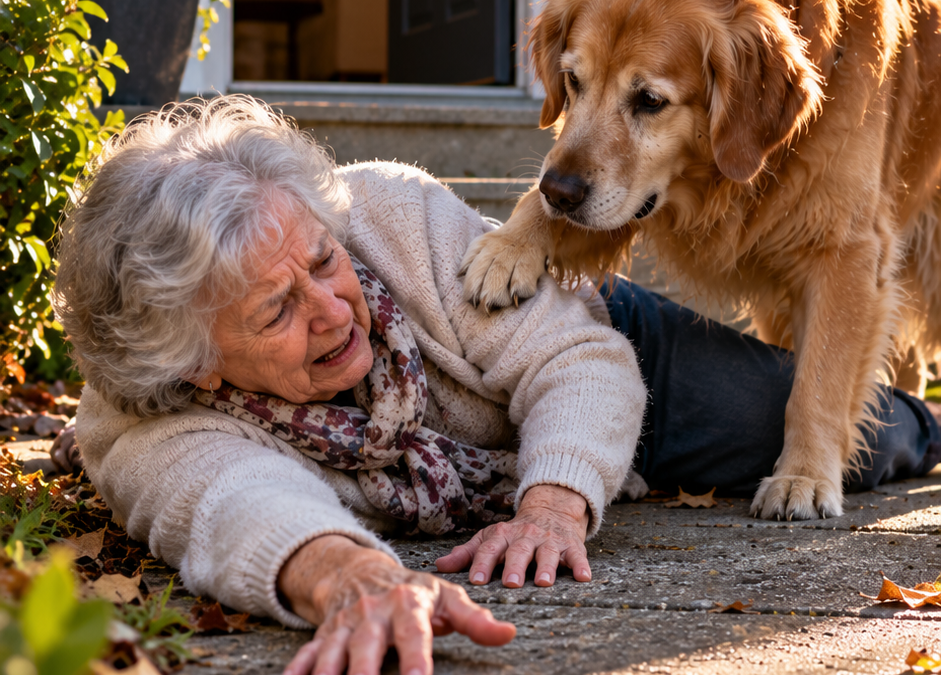
𝗙𝗨𝗟𝗟 𝗦𝗧𝗢𝗥𝗬
Five.
I found myself counting.
Six.
Seven.
Then she stopped.
Exactly seven.
Why seven?
I don’t know.
Maybe she was tired.
Maybe something changed in her mind.
Maybe I only remember the number because I had nothing else to hold onto.
Vira looked at me.
Then the street.
Then the house.
Then me again.
Her whole posture changed.
Until that second, she had looked worried.
Now she looked purposeful.
I know how foolish that sounds.
People love to place human reasoning inside animals.
We turn every tilted head into a question and every sigh into philosophy.
I am careful about that.
But I know what I saw.
Vira made a decision.
She spun around and ran inside.
“Vira?”
Claws across the living room.
Then kitchen tile.
Then silence.
I waited.
“What are you doing?”
No answer.
Of course.
Then came a scraping noise.
Wood against tile.
A chair.
The kitchen chair.
My heart started beating harder.
“Vira?”
Another scrape.
Something struck the floor.
Hard.
A thump followed by a smaller clatter.
Then silence again.
I stared at the doorway.
Nothing.
For a second, fear arrived from a new direction.
What if she had hurt herself?
What if she knocked something over?
What if—
Claws.
Coming back.
Slower this time.
I saw her head first.
Then her shoulders.
Then what she carried in her mouth.
My phone.
For a moment, I truly thought pain had made me imagine it.
“No.”
Vira walked toward me.
Phone held between her teeth.
She had never been trained to retrieve objects.
She was not a service dog.
Not an assistance animal.
Not one of those extraordinary dogs you see in videos opening cabinets or fetching medicine.
She was simply Vira.
My dog.
A dog I constantly told to stay off the couch.
A dog I corrected for running inside.
A dog I once spent ten minutes arguing with because she refused to drop a sock.
And she was bringing me my phone.
“How did you…”
She reached me.
Lowered her head.
Dropped it beside my hand.
The screen was wet with saliva.
There were small tooth marks in the case.
It was the most beautiful thing I had ever seen.
I started crying.
Not quietly.
“Vira.”
She sat.
Looked at me.
Waiting.
I grabbed the phone.
Almost dropped it because my fingers were shaking so badly.
“Good girl.”
My thumb slipped across the screen.
“Good girl.”
I wiped the glass against my shirt.
The phone still worked.
That itself felt like mercy.
I opened my contacts.
Christine.
My daughter.
I pressed her name.
One ring.
Two.
She answered.
“Mom?”
I tried to speak.
Nothing came out.
Only breathing.
Fast.
Uneven.
“Mom?”
Her voice sharpened immediately.
“Mama, what happened?”
I forced air into my lungs.
“I fell.”
Silence.
Then movement on her end.
“What?”
“Outside.”
“Where?”
“Porch.”
“Are you hurt?”
“I think my leg is broken.”
“Oh my God.”
The words came fast.
“Mama, don’t move.”
“I wasn’t planning to.”
Normally she would have laughed at that.
Not this time.
“Do you have your phone?”
I looked at Vira.
“Yes.”
“How?”
That question made me cry harder.
“Vira brought it.”
“What?”
“Vira brought me the phone.”
Silence.
I heard Christine breathing.
Then:
“Vira brought you your phone?”
“Yes.”
“From inside?”
“Yes.”
Another pause.
I could hear her brain refusing the information.
“How?”
“I don’t know.”
I looked toward the kitchen.
“The chair…”
I remembered the scraping.
“She knocked it down somehow.”
“Oh my God.”
“Christine.”
“I’m here.”
“I’m calling an ambulance.”
“Don’t hang up.”
“Don’t you hang up.”
“I’m not.”
“Put me on speaker.”
My fingers shook.
I managed.
Then laid the phone across my chest.
Christine’s voice filled the morning.
“Mama?”
“I’m here.”
“Stay awake.”
“I’m not dying.”
“I didn’t say you were.”
“You sound like you think I am.”
“I sound like my eighty-two-year-old mother is lying outside with a broken leg.”
Fair enough.
Vira lowered herself beside me.
Very carefully.
Her body touched my left side.
Warm.
Solid.
She placed her head against my shoulder.
The contrast between the cold concrete and her heat was almost overwhelming.
I put one hand on her neck.
“She’s lying beside me.”
I told Christine.
“Good.”
“Keep her there.”
“As if I could stop her.”
Christine’s voice shook.
She was frightened.
I heard it.
Parents spend their lives trying to hide fear from children.
Then one day the direction reverses.
Your child becomes the person telling you help is coming.
I hated that.
And loved it.
I stared upward.
The sky had brightened.
Pale blue now.
A few thin clouds.
Somewhere farther away, I heard a school bus.
Ordinary life starting.
People getting dressed.
Coffee brewing.
Cars leaving driveways.
Nobody knowing an old woman lay broken behind a porch railing.
Except Christine.
And Vira.
Pain came in waves.
When it rose, I clenched my teeth.
Once, I couldn’t stop a moan.
Vira immediately lifted her head.
She looked directly into my eyes.
“I’m okay.”
She did not believe me.
Neither did Christine.
“I heard that.”
“It’s just pain.”
“Mama.”
“What?”
“Stop trying to sound tough.”
“I’m eighty-two.”
“I’ve earned it.”
“You’ve earned the right to complain too.”
“I’ll complain after they give me something for the pain.”
Vira rested her head again.
I stroked the fur behind her ear.
“She knew.”
I whispered.
“What?”
Christine asked.
“Vira.”
I looked at the dog.
“She knew I needed the phone.”
Christine’s voice softened.
“Yeah.”
“No, I mean…”
I struggled to explain.
“She tried to pull me first.”
“What?”
“My shoe.”
“She tried to drag me.”
“Oh, Mom.”
“It hurt.”
“Don’t let her do that again.”
“She stopped.”
“Then she barked.”
“Seven times.”
“Why seven?”
“I don’t know.”
“Then she went inside.”
I swallowed.
“And she came back with the phone.”
Christine was quiet.
“I always thought she was spoiled.”
I said.
Vira’s ear moved.
Christine gave a wet little laugh.
“You spoil her.”
“I do not.”
“You absolutely do.”
“Not before today.”
That was partly true.
I had rules.
Many rules.
No dog on the sofa.
No dog on the bed.
No running in the kitchen.
No lying directly in the middle of the tile where I might trip.
No begging.
No jumping.
No stealing dish towels.
No chewing shoes.
Vira knew them all.
Mostly.
At that moment, I decided she could break every rule for the rest of her life.
Sirens eventually became audible.
Faint.
Then louder.
Christine heard them through the phone.
“They’re there.”
“Almost.”
Vira raised her head.
Her ears went forward.
The sirens stopped.
Tires on the road.
Doors slamming.
Footsteps.
Fourteen minutes.
Christine told me later.
From the call to the ambulance pulling up.
Fourteen minutes.
I would have sworn it was an hour.
Two paramedics appeared around the side of the house.
A man carrying equipment.
And a young woman with short hair.
They came quickly, then slowed when they saw Vira.
The woman stopped about three feet away.
“Ma’am?”
“Yes.”
“Is that your dog?”
“Yes.”
“Does she bite?”
I looked at Vira.
She was sitting upright now.
Between me and them.
Not growling.
Not aggressive.
Watching.
“She has never bitten anyone in her life.”
The paramedic nodded cautiously.
“Okay.”
“But.”
The word made both of them pause.
“If you touch her before helping me, I will personally complain to your hospital administrator.”
The man blinked.
The woman looked surprised.
“This dog just brought me my phone.”
Neither spoke.
“You heard me.”
I continued.
“She brought it from my kitchen.”
The woman looked at Vira.
Then at the phone resting on my chest.
Then back at me.
“She brought you that?”
“Yes.”
The male paramedic said:
“Seriously?”
“Do I look like I am in a position to invent stories?”
He smiled despite himself.
“Fair point.”
The woman crouched slightly.
Not close enough to invade Vira’s space.
“Hi, Vira.”
Vira’s ears moved.
“I’m going to help your mom.”
Mom.
I liked that.
The paramedic slowly extended the back of one hand.
Vira leaned forward.
Sniffed.
Then allowed the woman to touch the top of her head.
Her tail moved.
Once.
The woman smiled.
“Good girl.”
Vira licked one finger.
“Very smart girl.”
I could have kissed that paramedic for saying it.
Then everything became medical.
Questions.
“Did you hit your head?”
“I don’t think so.”
“Any neck pain?”
“No.”
“Blood thinners?”
“No.”
“Can you feel your toes?”
“Yes.”
“Can you move them?”
I tried.
Pain.
“Enough.”
The woman touched around my leg carefully.
I cursed.
I am not ashamed.
At eighty-two, if someone touches a broken bone, profanity becomes therapeutic.
The male paramedic almost laughed.
“Sorry.”
“You will be.”
They stabilized the leg.
Moved me onto a stretcher.
Every motion hurt.
Vira stayed close.
Too close at times.
“Back, sweetheart.”
She moved exactly one step.
When they lifted me, she followed.
Across the porch.
Down the walk.
Toward the ambulance.
At the open rear doors, she stopped.
I looked at her.
The driver asked:
“Is she coming with you?”
I wanted to say yes.
Every part of me wanted to.
But I knew she couldn’t simply ride along.
“No.”
My voice broke.
“The house is open.”
“She’ll wait.”
The paramedic looked concerned.
“Someone coming for her?”
“My daughter.”
Christine had already told me she would go there as soon as she could.
“She’ll be here.”
Vira stood at the edge of the driveway.
I raised one hand.
“Stay.”
She knew that word.
Her body became still.
“Stay, Vira.”
The doors began to close.
For one second, all I saw was her face through the narrowing gap.
Then the doors shut.
I cried again.
The short-haired paramedic touched my arm.
“She’ll be okay.”
“I know.”
“She did really well.”
“I know.”
“That’s one smart dog.”
I looked at the ceiling of the ambulance.
“No.”
My voice shook.
“She’s more than that.”
At the hospital, X-rays confirmed what I already knew.
My tibia was broken.
Not cracked.
Broken cleanly enough that surgery was necessary.
I spent three days there.
Three days is not a long hospital stay.
At eighty-two, it feels longer.
There are too many noises at night.
Too many lights.
Too many people asking your name and date of birth as if they expect you to change either one between rounds.
Christine came.
Of course she did.
She sat beside my bed with the expression adult children wear when frightened by their parents’ mortality.
“You look terrible.”
I told her.
She laughed.
“You’re the one in the hospital.”
“I’m not wearing that expression.”
“What expression?”
“The one where you’re mentally moving me into your house.”
She tried to look innocent.
I pointed.
“Don’t.”
“Mama.”
“I fell once.”
“You broke your leg.”
“Same event.”
“You’re eighty-two.”
“I was eighty-two yesterday too.”
Christine sighed.
“Fine.”
Then she took my hand.
For a minute, neither of us spoke.
Finally, I asked:
“How is Vira?”
Her entire face changed.
“She misses you.”
My chest tightened.
“What is she doing?”
“Every time I go to the house, she runs straight to the porch.”
Christine shook her head.
“She sniffs the landing.”
“The exact place you fell.”
I closed my eyes.
“Then she goes back inside.”
“Is she eating?”
“Yes.”
“Walking?”
“Yes.”
“Sleeping?”
“I assume.”
“Don’t assume.”
“Mama.”
“What?”
“I am taking care of your dog.”
“I know.”
“Better than I take care of myself, apparently.”
“Probably.”
Christine rolled her eyes.
Then smiled.
“You know, I tried putting your phone on the kitchen table.”
My eyes opened.
“What?”
“I wanted to understand how she did it.”
“And?”
“I still don’t.”
We looked at each other.
“The chair was moved.”
she said.
“Like you heard.”
“And the phone?”
“Had been on the table.”
“Exactly.”
“She must have gotten onto the chair somehow.”
“Vira hates that chair.”
“I know.”
“She won’t even sit under it.”
“I know.”
Christine leaned back.
“Maybe she jumped.”
“She’s never jumped onto furniture.”
“She has now.”
I pictured it.
Vira inside.
Hearing me.
Trying one solution.
Failing.
Barking.
Then searching.
Maybe she knew the phone was something I constantly held.
Something that made voices appear.
Maybe she had seen me answer it every day for five years.
Did she understand what it did?
Probably not as I did.
But she knew it mattered.
That was enough.
On the third day, they let me go home.
Crutches.
Instructions.
Medication.
More instructions.
Warnings about falling again.
Christine drove me.
I complained about her braking.
She reminded me my driving days were temporarily suspended.
I reminded her I taught her how to drive.
She said that explained everything wrong with her technique.
Normal conversation.
A relief.
When we reached my house, the front door opened before I got fully out of the car.
Christine had gone ahead.
Vira stood just inside.
She did not run.
That surprised me.
Normally, after I had been gone even several hours, she rushed me.
This time she sat.
Perfectly still.
Watching.
I moved slowly.
Crutches.
Good leg.
Step.
Pause.
Christine stayed near without hovering enough to annoy me.
Vira’s eyes never left me.
I crossed the threshold.
“Hi.”
Her tail moved.
Small.
Almost cautious.
I made it into the living room.
Then, ignoring every sensible instruction I had just been given about getting down onto floors, I lowered myself carefully using my good leg.
“Mama.”
Christine protested.
“I’m fine.”
“That word is banned.”
“Help me down.”
She did.
I sat on the floor.
Vira came immediately.
No hesitation now.
She pressed her head into my lap.
I wrapped both arms around her.
Hard.
Her body trembled.
Or maybe mine did.
“You saved me.”
I whispered.
She licked my chin.
“You know that?”
Another lick.
“You are an absolute hero.”
Her tail struck the floor.
Christine stood behind us crying.
I looked up.
“Are you crying?”
“No.”
“Liar.”
“Shut up and hug your dog.”
So I did.
That first night home, I broke one of my oldest rules.
Vira got on the couch.
Not accidentally.
Not because I wasn’t watching.
I invited her.
“Come up.”
She stared.
I patted the cushion.
“Come on.”
She looked toward Christine as if seeking confirmation that I had suffered brain damage.
“She means it.”
Christine said.
Vira put one paw up.
Then another.
Climbed carefully.
Curled beside me.
I stroked her back.
Christine laughed.
“I need photographic evidence.”
“Do not.”
“No one will believe me.”
“If that phone comes out, you’re leaving.”
She took the picture anyway.
I still have it.
Me in a blanket.
Leg elevated.
Vira pressed against my hip.
Both of us looking tired.
Both alive.
The following week, Martha knocked on my door.
Martha lived nearby.
She had known Vira for years.
Or, more accurately, she had spent years avoiding her.
Whenever her grandchildren visited, I heard:
“Stay away from that dog.”
Vira had never done anything to them.
Nothing.
Martha simply didn’t trust her.
Some people look at a dog and see a companion.
Some see teeth.
I had never bothered arguing much.
People are allowed their fears.
That afternoon, Martha stood on my porch holding a cake.
A whole cake.
I opened the door as far as I could while balancing on my crutches.
“Good Lord.”
I said.
“Who died?”
“Nobody.”
“Then why is there cake?”
She looked embarrassed.
“I heard what happened.”
Vira sat beside me.
Martha’s eyes dropped toward her.
Vira remained still.
“I wanted to come over.”
“You could’ve brought soup.”
“I made cake.”
“I see that.”
Martha did not laugh.
Instead, she looked at Vira again.
Then said:
“I need to apologize.”
I frowned.
“For the cake?”
“To her.”
Now I really stared.
Vira’s ear shifted.
Martha swallowed.
“For everything I’ve thought.”
I did not rescue her from the awkwardness.
She needed to say it.
“I always assumed…”
She paused.
“Assumed what?”
“That she was dangerous.”
“Why?”
“I don’t know.”
She gave a helpless shrug.
“Her size.”
“The way she watches.”
“Stories you hear.”
“I told the grandchildren not to go near her.”
“I know.”
Martha’s face reddened.
“And then I heard she brought you the phone.”
“Yes.”
“From inside?”
“Yes.”
“And stayed with you?”
“The entire time.”
Martha looked at Vira.
Something changed in her face.
Fear becoming shame.
She slowly crouched.
Not all the way.
Her knees weren’t much younger than mine.
“Hello, Vira.”
Vira’s tail moved.
Martha held out a hand.
Vira stood.
Walked toward her.
For one second, Martha tensed.
Then Vira placed her head directly against Martha’s palm.
Martha’s eyes filled instantly.
“Oh.”
That one little sound.
She stroked Vira’s head.
“I’m sorry.”
Vira wagged harder.
No resentment.
No moral lecture.
No list of previous insults.
Martha cried.
I did too.
We were becoming ridiculous.
Two old women crying over a dog in a doorway while a cake slowly tilted in Martha’s other hand.
“Give me that before you drop it.”
I said.
She laughed through her tears.
From that day forward, Martha came every Wednesday.
At first, only while my leg healed.
“I’ll walk Vira.”
she offered.
“You don’t have to.”
“I know.”
“You used to cross the street to avoid her.”
“I have evolved.”
“Apparently.”
She took Vira out.
The first walk lasted fifteen minutes.
The next thirty.
Soon Vira began recognizing Wednesday.
She would sit near the door before Martha arrived.
“Traitor.”
I told her.
Tail wag.
Martha began bringing treats.
I told her not to.
She ignored me.
Vira learned quickly who the weak one was.
Four months after the fall, I was still using crutches.
Recovery at eighty-two does not respect impatience.
Some days were good.
Some weren’t.
Sometimes my leg ached so deeply at night that sleep became impossible.
Physical therapy irritated me.
The exercises seemed invented by people who enjoyed making old women suffer.
But I improved.
Slowly.
Vira adjusted to every stage.
Before the accident, she walked the way dogs walk when they believe the entire world has been designed for their investigation.
Fast.
Stop.
Sniff.
Pull.
Turn.
Repeat.
After I came home, she changed.
When I used crutches, she walked beside me.
Not ahead.
Not behind.
Exactly beside me.
If I slowed, she slowed.
If I stopped, she stopped.
No one taught her.
The first time I noticed, I thought it was coincidence.
The second, habit.
By the third, I knew.
She was watching me.
One afternoon, Martha joined us.
Vira matched my pace.
Martha looked down.
“She didn’t walk like that with me.”
“No?”
“She drags me halfway down the block.”
I smiled.
“She knows I’m fragile.”
“Or you’re her favorite.”
“Obviously.”
Martha laughed.
I looked at Vira.
Her shoulder stayed near my leg.
Close enough to touch.
Never close enough to trip me.
I had spent years thinking I was the one responsible for her.
Food.
Water.
Veterinarian.
Walks.
Rules.
Safety.
I was the adult.
She was the dog.
Simple.
After the fall, that hierarchy did not feel so simple.
Vira had watched over me too.
Maybe always.
I had simply never needed to see it.
I changed rules.
A lot of them.
Kitchen tile?
She could lie there.
If I needed to step around her, I stepped around her.
Couch?
Hers now.
She still waited for permission at first.
Eventually she realized permission had become permanent.
Bed?
That one took longer.
I had sworn for five years:
“No dog will ever sleep on my bed.”
Christine reminded me of this often.
Then one evening, my leg hurt badly.
I had taken medication.
I felt tired and vulnerable.
Vira stood in the bedroom doorway.
Watching.
“Don’t.”
I told her.
She sat.
“I know what you’re thinking.”
Tail.
“No.”
She lay down.
I got into bed.
Ten minutes later, I heard her sigh from the floor.
“Fine.”
Her head rose.
“Come up.”
She jumped onto the mattress.
Again, something she supposedly didn’t know how to do.
“Interesting.”
I muttered.
“So furniture is possible when you feel like it.”
Vira circled once.
Then lay at the foot of the bed.
Not near my pillow.
Not across my stomach.
Above my ankles.
Close to where the injured leg rested.
Her body made a warm line across the blanket.
She sighed.
A small sound.
Content.
Present.
I reached down.
Could barely touch her head from where I lay.
My fingertips found one ear.
“I’m here too.”
I whispered.
That became our nighttime routine.
Vira at my feet.
Her warmth through the blanket.
A sigh.
My hand reaching down.
Some nights I woke and felt her still there.
I cannot properly explain what that did to the loneliness of aging.
People hear the phrase “living alone” and think only of practical risks.
Falling.
Medical emergencies.
Forgetting medication.
But being alone is not only about emergencies.
It is about silence.
No one hearing you get up at night.
No one noticing you’ve been in one room too long.
No one reacting when you sigh.
A dog does.
Vira knew when I moved.
When I hurt.
When I was restless.
I had once thought I gave her company.
After the fall, I understood she had given it back every single day.
Christine changed too.
She called more.
Not dramatically more.
Enough.
And every call began the same way.
“How are you?”
“Fine.”
“How is Vira?”
“Perfect.”
“So the dog gets a real answer.”
“She earned it.”
Once Christine said:
“You know, Mom, if she hadn’t brought that phone…”
I interrupted.
“I know.”
We did not finish the sentence.
Some possibilities do not deserve repeated examination.
If Vira had only barked.
If no neighbor heard.
If I had remained outside.
If the morning warmed slowly enough that nobody passed.
If shock set in.
If I tried to move and injured myself more.
There are too many ifs.
I prefer the real version.
I fell.
Vira came.
She tried to help.
When one method failed, she tried another.
The phone worked.
Christine answered.
The ambulance came.
I lived.
That is the story.
One afternoon, the short-haired paramedic who had helped me appeared at my door.
I recognized her immediately.
She smiled.
“Hope this isn’t strange.”
“At my age, strange is welcome.”
She laughed.
“I was nearby.”
She held a small dog toy.
A rope with a ball attached.
“For Vira.”
Vira appeared behind me.
Her tail started immediately.
The paramedic crouched.
“Hey, hero.”
Vira went to her.
I leaned against my crutches.
“She remembers you.”
“Or the toy.”
“Don’t ruin it.”
The paramedic rubbed Vira’s neck.
“I’ve told that story about twenty times.”
“What story?”
“The phone.”
I groaned.
“Oh no.”
“Everyone at the station knows.”
“Wonderful.”
“One guy said she should work dispatch.”
“She has better judgment than most people.”
The paramedic looked at me.
Then smiled.
“You know what impressed me most?”
“What?”
“She wasn’t panicking.”
I thought about that morning.
“She was worried.”
“Yes.”
“But she kept trying things.”
The woman stood.
“That’s rare.”
“Even people freeze.”
“Vira didn’t.”
I looked at my dog.
She was already trying to destroy the new toy.
“Apparently intelligence has limits.”
The paramedic laughed.
Before leaving, she said:
“Take care of each other.”
Not:
Take care of yourself.
Each other.
I liked that better.
The story spread through the neighborhood.
I did not intend it to.
Martha told someone.
Christine told family.
The ambulance crew talked.
Soon people I barely knew stopped me.
“Is this the dog?”
“She’s the one?”
“What breed is she?”
I hated that last question because it seemed beside the point.
Vira was Vira.
People brought treats.
She became shameless.
One man crouched to photograph her.
I said:
“Ask permission.”
He looked embarrassed.
“Yours?”
“Hers.”
He actually did.
“Can I take your picture?”
Vira wagged.
“Apparently yes.”
I became protective of her in ways I had not been before.
Not because she was famous.
Because I realized how easily we reduce animals to stories that serve us.
Hero dog.
Smart dog.
Miracle dog.
Vira didn’t wake that morning planning to become anything.
She saw me hurt.
She responded.
That mattered more.
I did not want her turned into something unreal.
She still stole tissues.
Still barked at delivery trucks.
Still occasionally ignored me when squirrels were involved.
Still snored.
Still shed.
Still smelled unpleasant after rain.
Heroism did not make her perfect.
It made me understand her differently.
That may be the real change.
Before the accident, I thought Vira’s intelligence was amusing.
She knew where treats were kept.
Recognized the sound of the leash.
Understood which neighbor was most likely to give her food.
Afterward, I started watching more carefully.
When I was tired, she noticed.
When I struggled to stand, she rose.
When I used the crutches near her, she moved out of the way without being told.
If I winced, her head came up.
Was all of that new?
Or had she always been paying attention?
I don’t know.
Maybe the fall didn’t change Vira.
Maybe it changed me enough to finally see the dog who had been living beside me for five years.
That thought humbled me.
We humans assume animals are simple because they do not explain themselves.
We fill silence with our own conclusions.
Dog is lying down.
Dog is waiting.
Dog is watching.
We rarely ask what information is moving through them.
Smells we cannot detect.
Sounds beyond our hearing.
Patterns we dismiss.
Emotions they learn from our posture.
Vira knew the difference between my ordinary voice and the broken sound I made that morning.
She knew pulling me hurt.
She knew barking did not immediately bring help.
She knew something inside the house mattered enough to retrieve.
I don’t have to claim she understood emergency services or phones.
She didn’t.
She understood me.
That was enough.
Recovery took patience.
More than I had.
One morning, after four months, I tried walking farther than my therapist recommended.
Vira stayed beside me.
Halfway down the block, my leg began aching.
I kept going.
Vira stopped.
I took another step.
She didn’t.
“Come on.”
Nothing.
“Vira.”
She looked at my leg.
Then at me.
“Don’t start.”
She remained planted.
I tried another step.
Pain.
I stopped.
“You think you’re my doctor now?”
Tail.
I turned around.
Vira immediately walked.
Toward home.
Martha saw us from her yard.
“Who’s walking who?”
“Mind your business.”
She laughed.
Vira looked pleased with herself.
Back inside, I sat.
She lay at my feet.
I pointed.
“You are becoming insufferable.”
She closed her eyes.
I smiled.
There were days when I became frightened about another fall.
I had never been afraid of my own stairs before.
Afterward, the porch steps looked different.
Higher.
Harder.
Dangerous.
The first time I approached them alone with crutches, my hands began sweating.
I stopped.
Memory returned physically.
Falling.
Impact.
Pain.
Concrete against my back.
I could not move.
Vira was beside me.
She waited.
I took one step.
Then another.
Reached the bottom.
Nothing happened.
I turned.
Vira stood at the top.
“Come.”
She descended slowly.
Not running.
She reached me.
I touched her head.
“See?”
I whispered.
“We can do it.”
I wasn’t sure whether I meant her or myself.
Probably both.
Christine wanted handrails improved.
I agreed.
Martha offered to check in mornings.
I allowed it.
That was another change.
Before the fall, I valued independence almost as a moral virtue.
I hated asking.
Hated needing.
If I could carry something myself, I did.
If I could manage alone, I preferred it.
Age slowly removes the luxury of that certainty.
The fall removed more.
I began letting people help without treating help as evidence of failure.
Christine carried groceries.
Martha walked Vira.
The therapist taught me how to move safely.
Vira waited.
Dependence is not always weakness.
Sometimes it is simply life shared properly.
One Wednesday, Martha returned from a walk laughing.
“What?”
I asked.
“She defended me.”
My heart jumped.
“What happened?”
“Nothing.”
“Then don’t say defended.”
“A little dog rushed a fence and barked.”
“And?”
“Vira stepped between us.”
I stared at her.
Martha looked delighted.
“Didn’t growl.”
“Didn’t do anything.”
“Just stood there.”
“You realize the other dog was probably twelve pounds.”
“Threat is subjective.”
“Three months ago, you thought Vira was dangerous.”
Martha became quiet.
“Yeah.”
She looked at the dog.
“I wasted years being afraid of her.”
Vira sat near her legs.
Martha scratched her head.
“I suppose we all do that.”
“Do what?”
“Decide what something is before knowing it.”
I looked at Vira.
“Sometimes.”
Martha smiled.
“She forgave me quickly.”
“Dogs don’t keep spreadsheets.”
“Humans do.”
True.
I thought about how many judgments I had made in eighty-two years.
People.
Animals.
Situations.
What belonged on furniture.
What counted as proper behavior.
What independence should look like.
A broken leg rearranged more than bone.
It rearranged priorities.
I still had rules.
I wasn’t dead.
Vira was still not allowed to eat from my plate.
Mostly.
She was not allowed to bark at three in the morning.
Unless there was an emergency.
She was not allowed to steal socks.
Hero status has limits.
But the furniture rules disappeared.
One evening, Christine visited and found Vira stretched across the entire sofa.
I sat in the chair.
My daughter stopped.
“Whose house is this now?”
“Mine.”
“Really?”
“Technically.”
“She has the couch.”
“I have the chair.”
“She sleeps on your bed.”
“At the foot.”
“She gets homemade chicken.”
“Doctor’s orders.”
“No doctor ordered chicken for the dog.”
“You don’t know every doctor.”
Christine folded her arms.
“I remember you saying, and I quote, ‘No animal belongs on furniture.'”
“I was younger.”
“Four months younger.”
“People grow.”
Christine laughed.
I did too.
Vira opened one eye and went back to sleep.
That laughter felt important.
The accident had frightened Christine badly.
I knew.
She tried hiding it.
But afterward, every time I took too long to answer the phone, she called again.
Then texted.
Then called Martha.
I finally said:
“You cannot monitor me every second.”
“I know.”
“You have a life.”
“I know.”
“I’m not made of glass.”
“I know.”
“Then stop.”
She looked at Vira.
“I almost lost you.”
The sentence softened me immediately.
I reached for her hand.
“But you didn’t.”
“Because of her.”
“Yes.”
We both looked at Vira.
Christine whispered:
“I don’t know how to thank a dog.”
“You feed her.”
“That’s your solution to everything.”
“It’s hers too.”
She smiled.
Then became serious.
“Promise you’ll keep your phone with you now.”
“I promise.”
I did.
Mostly.
A lanyard.
Pocket.
Small pouch.
I learned.
Vira still watched the kitchen table whenever I left it there.
As if she didn’t trust me.
Fair.
At night, I often thought about the moment she dropped the phone beside me.
It replayed differently from the fall.
The fall was sharp.
Chaotic.
The phone moment was almost still.
Vira standing over me.
Device in her mouth.
Then lowering it carefully.
What had happened inside the house?
I would never know exactly.
Had she jumped onto the chair?
Climbed somehow?
Pushed it with paws?
Knocked the phone deliberately or by accident after searching?
Does it matter?
Not to me.
She succeeded.
Sometimes intelligence is not knowing the perfect solution.
It is refusing to stop after the first one fails.
Vira tried pulling me.
Failed.
Tried calling attention.
No response.
Went inside.
Found another way.
At eighty-two, that became a lesson I did not expect from a dog.
Adapt.
Try again.
Do not confuse one failed method with no possible answer.
My leg healed slowly.
My confidence slower.
Both returned.
Not exactly as before.
I became more careful.
Accepted limitations.
Used assistance.
But I still lived in my own home.
Still made my own coffee.
Still argued with Christine.
Still scolded Vira when she deserved it.
Mostly.
Four months after the accident, I could stand near the porch landing and look at the exact spot where I had fallen without feeling panic.
One morning, Vira walked outside with me.
I stopped there.
She sniffed the concrete.
Even after all that time.
Then looked up.
“Still checking?”
Her tail moved.
“I’m fine.”
This time the word was true.
Not perfect.
Not young.
Not uninjured.
Fine.
Alive.
Recovering.
Accompanied.
There is a difference between being alone and being isolated.
I learned that late.
I live alone.
Technically.
One woman.
One house.
But I am not isolated.
Christine calls.
Martha appears Wednesdays.
The paramedic once sent Vira a Christmas card, which is ridiculous and wonderful.
And every day, Vira moves through the rooms with me.
She knows my footsteps.
My moods.
My routines.
If I disappear into the bathroom too long, she checks.
If I cough at night, her ears rise.
If I drop something, she investigates.
Sometimes that is annoying.
I treasure it.
Every evening, when I go to bed, she waits near the doorway.
At first, she waited for invitation.
Now she knows.
She jumps up.
Turns twice.
Settles at my feet.
Always near my ankles.
Perhaps because that is where the broken leg once was.
Perhaps because the blanket is warm there.
Perhaps no reason at all.
I no longer need explanations for everything.
She sighs.
That little sound fills the room.
I’m here.
That is what I hear in it.
Not because she says those words.
Because that is what presence means.
I reach down.
My fingers find the fur on her head.
She licks them once.
Then settles.
Some nights, before sleeping, I picture myself on that concrete landing.
Eighty-two.
Frightened.
Sweating in the cold morning.
Phone inside.
No one around.
Then I remember Vira running through the doorway.
Her nose against my leg.
Her teeth gently on my shoe.
Seven long barks.
The kitchen chair scraping.
The phone dropping.
Her return.
Those details no longer frighten me.
They comfort me.
Because the story is not about the fall.
It is about what happened after I called her name.
I had believed I was helpless because the only other living creature in the house could not dial emergency services.
I underestimated her.
Perhaps I had underestimated her for five years.
Vira did not know medicine.
She did not know my tibia was broken.
She did not know Christine’s number.
She did not know what an ambulance was.
She knew I was hurt.
She knew I could not get up.
And she knew she was not leaving me.
Everything else grew from that.
People like to call her heroic now.
I do too.
But I think the more accurate word is loyal.
Not the sentimental kind of loyalty people print on signs about dogs.
Practical loyalty.
She stayed.
Observed.
Tried.
Adjusted.
Stayed again.
When help arrived, she trusted them only after deciding they were safe.
When I disappeared into the ambulance, she waited.
When I came home, she did not overwhelm me.
She approached gently.
She adapted to my crutches.
Matched my pace.
Slept near my injured leg.
That is not one heroic moment.
That is a relationship.
I wish I had understood sooner that love can look like attention.
Not dramatic affection.
Attention.
Watching closely enough to notice when something changes.
Listening to a broken version of someone’s voice and recognizing it matters.
I had spent years feeding Vira.
Walking her.
Setting rules.
I thought that was care.
It was.
But care was also what she did for me.
She noticed.
At eighty-two, you start thinking you have learned most of the lessons available.
That is vanity.
Life keeps finding new teachers.
Mine had four paws.
A wet nose.
And a habit of lying exactly where I once told her not to.
Now when she stretches across my kitchen tile, I step around her.
Carefully.
When she takes over the sofa, I sit beside her.
When she climbs onto the bed, I lift the blanket slightly so she can settle comfortably.
Rules matter less once you understand what is irreplaceable.
A clean couch can be replaced.
A quiet kitchen can be disturbed.
Routine can change.
The creature who stayed beside you when you could not stand—
that matters.
Sometimes Martha still tells visitors the story.
She exaggerates.
According to Martha, Vira “dragged a chair across the kitchen, climbed it like a mountain, rescued the phone, and delivered it like a trained paramedic.”
I correct her.
“We don’t know how she did it.”
Martha waves me away.
“It sounds better my way.”
Vira likes Martha’s version because it usually comes with treats.
Christine tells a simpler version.
“My mom fell.”
“Her dog saved her.”
I used to object.
“Emergency services saved me.”
“Doctors fixed the fracture.”
“You called.”
Christine always answers:
“And how did you call me?”
Then I stop arguing.
Fair enough.
Vira started the chain.
Maybe rescue is often like that.
Not one magnificent act.
A sequence.
Dog notices.
Phone arrives.
Daughter answers.
Ambulance comes.
Surgeon operates.
Neighbor helps.
Family adjusts.
Healing happens.
Everyone does one part.
Vira did the part no one else could.
She was there.
That is why, when people ask whether I still live alone, I say no.
Technically, they may disagree.
I don’t.
A house with Vira in it is not an empty house.
At night, I hear her breathing.
In the morning, her paws against the floor.
When I move too quickly, she watches.
When I laugh, her tail moves even if she has no idea why.
And sometimes, when I remember how helpless I felt on the porch, I look at her and think:
I wasn’t helpless.
I just didn’t yet understand what kind of help I had.
At eighty-two, I broke my leg.
That part was terrible.
I would not recommend it.
But the fall showed me something five ordinary years had not.
I had thought Vira depended on me.
She did.
I depended on her too.
Not only on that morning.
Every day.
For company.
For rhythm.
For the quiet certainty that another heartbeat shares the house.
Tonight, she is lying at the foot of my bed as I tell this story.
My leg still aches occasionally.
Cold weather makes it worse.
The doctors say that may happen.
Vira doesn’t care what the doctors say.
When I rub my ankle, she raises her head.
Every time.
“Go back to sleep.”
I tell her.
She waits until I stop.
Then lowers her head again.
A minute later comes the sigh.
Soft.
Content.
I’m here.
Everything’s okay.
I reach down through the darkness and touch her fur.
She licks my fingertips once.
And I close my eyes.
Eighty-two years old.
A leg that has been broken and repaired.
A daughter who worries too much.
A neighbor who now adores the dog she once feared.
And Vira.
Still watching.
Still waiting.
Still close enough to hear me if I call her name.
I live alone.
But I have not been alone for a single day since she chose to make my safety her business.
And now, every night before I fall asleep, I make sure she knows one thing too.
“I’m here, girl.”
My hand rests on her head.
“We’re okay.”
Her tail taps the mattress once.
That is enough.
𝗧𝗛𝗘 𝗘𝗡𝗗
At Eighty-Two, I Fell Where No One Could Hear Me, and My Dog Did Something I Had Never Taught Her to Do
At eighty-two, I thought the worst part of falling would be the pain.
I was wrong.
The worst part was realizing that I was lying on cold concrete outside my own house, unable to stand, and nobody knew I was there.
Then Vira looked at me.
And I watched my dog make a decision I had never taught her to make.
“Vira.”
My voice did not sound like mine.
I had meant to call her name firmly, the way I always did when I wanted her to come in from the yard or stop sniffing something she had no business investigating.
Instead, the first syllable cracked in my throat.
What came out was more whimper than command.
“Vi…ra.”
Pain shot through my leg again.
I sucked in a breath and closed my eyes.
For eighty-two years, I had believed I understood pain.
I had known headaches that blurred my vision.
Back pain that made getting out of bed an argument between me and my own body.
Arthritis in both hands.
A knee that predicted rain more accurately than the television forecast.
But this was different.
This pain had a shape.
It began just above my ankle, burned upward through my shin, and seemed to reach all the way into my hip.
At the same time, parts of my lower leg felt strangely numb.
Burning and numb.
Sharp and heavy.
My body could not decide how it wanted to punish me.
I lay on the small concrete landing at the bottom of the porch steps, my shoulders slightly lower than my legs because of the way I had fallen.
I had gone outside early.
That was all.
Nothing dramatic.
The sun was barely coming up.
The morning air still held the chill of night.
I had stepped onto the porch the way I had thousands of times before.
Then my foot slipped.
I remember one instant of surprise.
My hand reaching for the railing.
Missing.
The sky tilting.
And then impact.
Hard.
Fast.
Final.
I knew almost immediately that something was wrong.
Not bruised.
Not twisted.
Broken.
There are moments when the body understands before the mind catches up.
I tried once to move the leg.
The pain that followed was so violent that I nearly blacked out.
After that, I stopped experimenting.
I lay still.
The early morning was quiet.
Too quiet.
No cars yet.
No children.
No neighbors cutting grass.
No one walking down the sidewalk.
My phone was inside.
On the kitchen table.
I knew exactly where it was.
That detail became almost insulting.
Twenty feet away, perhaps.
Maybe thirty.
Close enough that I could picture it.
Too far for an eighty-two-year-old woman with a broken leg.
I tried to push myself up on my elbows.
The world went white.
I dropped back down.
“Vira!”
This time her name came louder.
Not much.
Enough.
Inside the house, she heard me.
I know because seconds later I heard claws striking the kitchen tile.
Fast.
Then the living room.
She crossed the rug she knew perfectly well she was not supposed to run across.
I would have scolded her any other morning.
That thought seems ridiculous now.
She came through the open door and stopped so suddenly that her paws slid slightly.
Her eyes went wide.
Her ears lifted.
Vira had lived with me for five years.
Five years is long enough to know an animal’s normal expressions.
Hungry.
Sleepy.
Bored.
Excited.
Annoyed.
Suspicious.
Guilty after stealing food.
What I saw on her face that morning was different.
She knew something was wrong.
Maybe not what.
But enough.
“Come here, girl.”
She moved toward me.
Slowly now.
Her nose worked constantly.
She sniffed my hand.
My sleeve.
Then my leg.
I tensed.
“Careful.”
She lowered her head toward my shoe.
Sniff.
Then the cuff of my pants.
Then back to the shoe.
Her nose paused near my ankle.
I groaned before she even touched me.
Vira froze.
Her head came up.
“I’m okay.”
I lied.
“Just… don’t touch that.”
Of course she did not understand the sentence.
But she understood the sound.
She stepped around me.
Sniffed again.
Then she did something I had never seen her do.
She opened her mouth and placed her teeth gently around the toe of my shoe.
Not biting.
Holding.
“Vira?”
She pulled.
Pain exploded.
“No!”
She released immediately.
I gasped.
My fingers dug into the concrete.
Tears came to my eyes without permission.
“No, sweetheart.”
I tried to control my breathing.
“That won’t work.”
Vira stood perfectly still.
Her ears shifted.
Her eyes moved from my face to my leg.
I could almost see confusion becoming thought.
She had tried the most obvious solution.
Move me.
It failed.
She sat down.
For a moment, neither of us moved.
Then Vira raised her head.
Not toward me.
Not toward the door.
Toward the open sky.
And barked.
I had heard Vira bark thousands of times.
At delivery trucks.
At squirrels.
At someone knocking unexpectedly.
At absolutely nothing I could see.
This sound was different.
Long.
Low.
Almost mournful.
It rose from deep in her chest and stretched through the morning air.
One.
She stopped.
Listened.
No answer.
Then again.
Two.
The sound echoed between the houses.
Three.
“That’s right.”
I whispered.
“Make noise.”
Four.
My voice shook.
“Good girl.”
Five.
I found myself counting.
Six.
Seven.
Then she stopped.
Exactly seven.
Why seven?
I don’t know.
Maybe she was tired.
Maybe something changed in her mind.
Maybe I only remember the number because I had nothing else to hold onto.
Vira looked at me.
Then the street.
Then the house.
Then me again.
Her whole posture changed.
Until that second, she had looked worried.
Now she looked purposeful.
I know how foolish that sounds.
People love to place human reasoning inside animals.
We turn every tilted head into a question and every sigh into philosophy.
I am careful about that.
But I know what I saw.
Vira made a decision.
She spun around and ran inside.
“Vira?”
Claws across the living room.
Then kitchen tile.
Then silence.
I waited.
“What are you doing?”
No answer.
Of course.
Then came a scraping noise.
Wood against tile.
A chair.
The kitchen chair.
My heart started beating harder.
“Vira?”
Another scrape.
Something struck the floor.
Hard.
A thump followed by a smaller clatter.
Then silence again.
I stared at the doorway.
Nothing.
For a second, fear arrived from a new direction.
What if she had hurt herself?
What if she knocked something over?
What if—
Claws.
Coming back.
Slower this time.
I saw her head first.
Then her shoulders.
Then what she carried in her mouth.
My phone.
For a moment, I truly thought pain had made me imagine it.
“No.”
Vira walked toward me.
Phone held between her teeth.
She had never been trained to retrieve objects.
She was not a service dog.
Not an assistance animal.
Not one of those extraordinary dogs you see in videos opening cabinets or fetching medicine.
She was simply Vira.
My dog.
A dog I constantly told to stay off the couch.
A dog I corrected for running inside.
A dog I once spent ten minutes arguing with because she refused to drop a sock.
And she was bringing me my phone.
“How did you…”
She reached me.
Lowered her head.
Dropped it beside my hand.
The screen was wet with saliva.
There were small tooth marks in the case.
It was the most beautiful thing I had ever seen.
I started crying.
Not quietly.
“Vira.”
She sat.
Looked at me.
Waiting.
I grabbed the phone.
Almost dropped it because my fingers were shaking so badly.
“Good girl.”
My thumb slipped across the screen.
“Good girl.”
I wiped the glass against my shirt.
The phone still worked.
That itself felt like mercy.
I opened my contacts.
Christine.
My daughter.
I pressed her name.
One ring.
Two.
She answered.
“Mom?”
I tried to speak.
Nothing came out.
Only breathing.
Fast.
Uneven.
“Mom?”
Her voice sharpened immediately.
“Mama, what happened?”
I forced air into my lungs.
“I fell.”
Silence.
Then movement on her end.
“What?”
“Outside.”
“Where?”
“Porch.”
“Are you hurt?”
“I think my leg is broken.”
“Oh my God.”
The words came fast.
“Mama, don’t move.”
“I wasn’t planning to.”
Normally she would have laughed at that.
Not this time.
“Do you have your phone?”
I looked at Vira.
“Yes.”
“How?”
That question made me cry harder.
“Vira brought it.”
“What?”
“Vira brought me the phone.”
Silence.
I heard Christine breathing.
Then:
“Vira brought you your phone?”
“Yes.”
“From inside?”
“Yes.”
Another pause.
I could hear her brain refusing the information.
“How?”
“I don’t know.”
I looked toward the kitchen.
“The chair…”
I remembered the scraping.
“She knocked it down somehow.”
“Oh my God.”
“Christine.”
“I’m here.”
“I’m calling an ambulance.”
“Don’t hang up.”
“Don’t you hang up.”
“I’m not.”
“Put me on speaker.”
My fingers shook.
I managed.
Then laid the phone across my chest.
Christine’s voice filled the morning.
“Mama?”
“I’m here.”
“Stay awake.”
“I’m not dying.”
“I didn’t say you were.”
“You sound like you think I am.”
“I sound like my eighty-two-year-old mother is lying outside with a broken leg.”
Fair enough.
Vira lowered herself beside me.
Very carefully.
Her body touched my left side.
Warm.
Solid.
She placed her head against my shoulder.
The contrast between the cold concrete and her heat was almost overwhelming.
I put one hand on her neck.
“She’s lying beside me.”
I told Christine.
“Good.”
“Keep her there.”
“As if I could stop her.”
Christine’s voice shook.
She was frightened.
I heard it.
Parents spend their lives trying to hide fear from children.
Then one day the direction reverses.
Your child becomes the person telling you help is coming.
I hated that.
And loved it.
I stared upward.
The sky had brightened.
Pale blue now.
A few thin clouds.
Somewhere farther away, I heard a school bus.
Ordinary life starting.
People getting dressed.
Coffee brewing.
Cars leaving driveways.
Nobody knowing an old woman lay broken behind a porch railing.
Except Christine.
And Vira.
Pain came in waves.
When it rose, I clenched my teeth.
Once, I couldn’t stop a moan.
Vira immediately lifted her head.
She looked directly into my eyes.
“I’m okay.”
She did not believe me.
Neither did Christine.
“I heard that.”
“It’s just pain.”
“Mama.”
“What?”
“Stop trying to sound tough.”
“I’m eighty-two.”
“I’ve earned it.”
“You’ve earned the right to complain too.”
“I’ll complain after they give me something for the pain.”
Vira rested her head again.
I stroked the fur behind her ear.
“She knew.”
I whispered.
“What?”
Christine asked.
“Vira.”
I looked at the dog.
“She knew I needed the phone.”
Christine’s voice softened.
“Yeah.”
“No, I mean…”
I struggled to explain.
“She tried to pull me first.”
“What?”
“My shoe.”
“She tried to drag me.”
“Oh, Mom.”
“It hurt.”
“Don’t let her do that again.”
“She stopped.”
“Then she barked.”
“Seven times.”
“Why seven?”
“I don’t know.”
“Then she went inside.”
I swallowed.
“And she came back with the phone.”
Christine was quiet.
“I always thought she was spoiled.”
I said.
Vira’s ear moved.
Christine gave a wet little laugh.
“You spoil her.”
“I do not.”
“You absolutely do.”
“Not before today.”
That was partly true.
I had rules.
Many rules.
No dog on the sofa.
No dog on the bed.
No running in the kitchen.
No lying directly in the middle of the tile where I might trip.
No begging.
No jumping.
No stealing dish towels.
No chewing shoes.
Vira knew them all.
Mostly.
At that moment, I decided she could break every rule for the rest of her life.
Sirens eventually became audible.
Faint.
Then louder.
Christine heard them through the phone.
“They’re there.”
“Almost.”
Vira raised her head.
Her ears went forward.
The sirens stopped.
Tires on the road.
Doors slamming.
Footsteps.
Fourteen minutes.
Christine told me later.
From the call to the ambulance pulling up.
Fourteen minutes.
I would have sworn it was an hour.
Two paramedics appeared around the side of the house.
A man carrying equipment.
And a young woman with short hair.
They came quickly, then slowed when they saw Vira.
The woman stopped about three feet away.
“Ma’am?”
“Yes.”
“Is that your dog?”
“Yes.”
“Does she bite?”
I looked at Vira.
She was sitting upright now.
Between me and them.
Not growling.
Not aggressive.
Watching.
“She has never bitten anyone in her life.”
The paramedic nodded cautiously.
“Okay.”
“But.”
The word made both of them pause.
“If you touch her before helping me, I will personally complain to your hospital administrator.”
The man blinked.
The woman looked surprised.
“This dog just brought me my phone.”
Neither spoke.
“You heard me.”
I continued.
“She brought it from my kitchen.”
The woman looked at Vira.
Then at the phone resting on my chest.
Then back at me.
“She brought you that?”
“Yes.”
The male paramedic said:
“Seriously?”
“Do I look like I am in a position to invent stories?”
He smiled despite himself.
“Fair point.”
The woman crouched slightly.
Not close enough to invade Vira’s space.
“Hi, Vira.”
Vira’s ears moved.
“I’m going to help your mom.”
Mom.
I liked that.
The paramedic slowly extended the back of one hand.
Vira leaned forward.
Sniffed.
Then allowed the woman to touch the top of her head.
Her tail moved.
Once.
The woman smiled.
“Good girl.”
Vira licked one finger.
“Very smart girl.”
I could have kissed that paramedic for saying it.
Then everything became medical.
Questions.
“Did you hit your head?”
“I don’t think so.”
“Any neck pain?”
“No.”
“Blood thinners?”
“No.”
“Can you feel your toes?”
“Yes.”
“Can you move them?”
I tried.
Pain.
“Enough.”
The woman touched around my leg carefully.
I cursed.
I am not ashamed.
At eighty-two, if someone touches a broken bone, profanity becomes therapeutic.
The male paramedic almost laughed.
“Sorry.”
“You will be.”
They stabilized the leg.
Moved me onto a stretcher.
Every motion hurt.
Vira stayed close.
Too close at times.
“Back, sweetheart.”
She moved exactly one step.
When they lifted me, she followed.
Across the porch.
Down the walk.
Toward the ambulance.
At the open rear doors, she stopped.
I looked at her.
The driver asked:
“Is she coming with you?”
I wanted to say yes.
Every part of me wanted to.
But I knew she couldn’t simply ride along.
“No.”
My voice broke.
“The house is open.”
“She’ll wait.”
The paramedic looked concerned.
“Someone coming for her?”
“My daughter.”
Christine had already told me she would go there as soon as she could.
“She’ll be here.”
Vira stood at the edge of the driveway.
I raised one hand.
“Stay.”
She knew that word.
Her body became still.
“Stay, Vira.”
The doors began to close.
For one second, all I saw was her face through the narrowing gap.
Then the doors shut.
I cried again.
The short-haired paramedic touched my arm.
“She’ll be okay.”
“I know.”
“She did really well.”
“I know.”
“That’s one smart dog.”
I looked at the ceiling of the ambulance.
“No.”
My voice shook.
“She’s more than that.”
At the hospital, X-rays confirmed what I already knew.
My tibia was broken.
Not cracked.
Broken cleanly enough that surgery was necessary.
I spent three days there.
Three days is not a long hospital stay.
At eighty-two, it feels longer.
There are too many noises at night.
Too many lights.
Too many people asking your name and date of birth as if they expect you to change either one between rounds.
Christine came.
Of course she did.
She sat beside my bed with the expression adult children wear when frightened by their parents’ mortality.
“You look terrible.”
I told her.
She laughed.
“You’re the one in the hospital.”
“I’m not wearing that expression.”
“What expression?”
“The one where you’re mentally moving me into your house.”
She tried to look innocent.
I pointed.
“Don’t.”
“Mama.”
“I fell once.”
“You broke your leg.”
“Same event.”
“You’re eighty-two.”
“I was eighty-two yesterday too.”
Christine sighed.
“Fine.”
Then she took my hand.
For a minute, neither of us spoke.
Finally, I asked:
“How is Vira?”
Her entire face changed.
“She misses you.”
My chest tightened.
“What is she doing?”
“Every time I go to the house, she runs straight to the porch.”
Christine shook her head.
“She sniffs the landing.”
“The exact place you fell.”
I closed my eyes.
“Then she goes back inside.”
“Is she eating?”
“Yes.”
“Walking?”
“Yes.”
“Sleeping?”
“I assume.”
“Don’t assume.”
“Mama.”
“What?”
“I am taking care of your dog.”
“I know.”
“Better than I take care of myself, apparently.”
“Probably.”
Christine rolled her eyes.
Then smiled.
“You know, I tried putting your phone on the kitchen table.”
My eyes opened.
“What?”
“I wanted to understand how she did it.”
“And?”
“I still don’t.”
We looked at each other.
“The chair was moved.”
she said.
“Like you heard.”
“And the phone?”
“Had been on the table.”
“Exactly.”
“She must have gotten onto the chair somehow.”
“Vira hates that chair.”
“I know.”
“She won’t even sit under it.”
“I know.”
Christine leaned back.
“Maybe she jumped.”
“She’s never jumped onto furniture.”
“She has now.”
I pictured it.
Vira inside.
Hearing me.
Trying one solution.
Failing.
Barking.
Then searching.
Maybe she knew the phone was something I constantly held.
Something that made voices appear.
Maybe she had seen me answer it every day for five years.
Did she understand what it did?
Probably not as I did.
But she knew it mattered.
That was enough.
On the third day, they let me go home.
Crutches.
Instructions.
Medication.
More instructions.
Warnings about falling again.
Christine drove me.
I complained about her braking.
She reminded me my driving days were temporarily suspended.
I reminded her I taught her how to drive.
She said that explained everything wrong with her technique.
Normal conversation.
A relief.
When we reached my house, the front door opened before I got fully out of the car.
Christine had gone ahead.
Vira stood just inside.
She did not run.
That surprised me.
Normally, after I had been gone even several hours, she rushed me.
This time she sat.
Perfectly still.
Watching.
I moved slowly.
Crutches.
Good leg.
Step.
Pause.
Christine stayed near without hovering enough to annoy me.
Vira’s eyes never left me.
I crossed the threshold.
“Hi.”
Her tail moved.
Small.
Almost cautious.
I made it into the living room.
Then, ignoring every sensible instruction I had just been given about getting down onto floors, I lowered myself carefully using my good leg.
“Mama.”
Christine protested.
“I’m fine.”
“That word is banned.”
“Help me down.”
She did.
I sat on the floor.
Vira came immediately.
No hesitation now.
She pressed her head into my lap.
I wrapped both arms around her.
Hard.
Her body trembled.
Or maybe mine did.
“You saved me.”
I whispered.
She licked my chin.
“You know that?”
Another lick.
“You are an absolute hero.”
Her tail struck the floor.
Christine stood behind us crying.
I looked up.
“Are you crying?”
“No.”
“Liar.”
“Shut up and hug your dog.”
So I did.
That first night home, I broke one of my oldest rules.
Vira got on the couch.
Not accidentally.
Not because I wasn’t watching.
I invited her.
“Come up.”
She stared.
I patted the cushion.
“Come on.”
She looked toward Christine as if seeking confirmation that I had suffered brain damage.
“She means it.”
Christine said.
Vira put one paw up.
Then another.
Climbed carefully.
Curled beside me.
I stroked her back.
Christine laughed.
“I need photographic evidence.”
“Do not.”
“No one will believe me.”
“If that phone comes out, you’re leaving.”
She took the picture anyway.
I still have it.
Me in a blanket.
Leg elevated.
Vira pressed against my hip.
Both of us looking tired.
Both alive.
The following week, Martha knocked on my door.
Martha lived nearby.
She had known Vira for years.
Or, more accurately, she had spent years avoiding her.
Whenever her grandchildren visited, I heard:
“Stay away from that dog.”
Vira had never done anything to them.
Nothing.
Martha simply didn’t trust her.
Some people look at a dog and see a companion.
Some see teeth.
I had never bothered arguing much.
People are allowed their fears.
That afternoon, Martha stood on my porch holding a cake.
A whole cake.
I opened the door as far as I could while balancing on my crutches.
“Good Lord.”
I said.
“Who died?”
“Nobody.”
“Then why is there cake?”
She looked embarrassed.
“I heard what happened.”
Vira sat beside me.
Martha’s eyes dropped toward her.
Vira remained still.
“I wanted to come over.”
“You could’ve brought soup.”
“I made cake.”
“I see that.”
Martha did not laugh.
Instead, she looked at Vira again.
Then said:
“I need to apologize.”
I frowned.
“For the cake?”
“To her.”
Now I really stared.
Vira’s ear shifted.
Martha swallowed.
“For everything I’ve thought.”
I did not rescue her from the awkwardness.
She needed to say it.
“I always assumed…”
She paused.
“Assumed what?”
“That she was dangerous.”
“Why?”
“I don’t know.”
She gave a helpless shrug.
“Her size.”
“The way she watches.”
“Stories you hear.”
“I told the grandchildren not to go near her.”
“I know.”
Martha’s face reddened.
“And then I heard she brought you the phone.”
“Yes.”
“From inside?”
“Yes.”
“And stayed with you?”
“The entire time.”
Martha looked at Vira.
Something changed in her face.
Fear becoming shame.
She slowly crouched.
Not all the way.
Her knees weren’t much younger than mine.
“Hello, Vira.”
Vira’s tail moved.
Martha held out a hand.
Vira stood.
Walked toward her.
For one second, Martha tensed.
Then Vira placed her head directly against Martha’s palm.
Martha’s eyes filled instantly.
“Oh.”
That one little sound.
She stroked Vira’s head.
“I’m sorry.”
Vira wagged harder.
No resentment.
No moral lecture.
No list of previous insults.
Martha cried.
I did too.
We were becoming ridiculous.
Two old women crying over a dog in a doorway while a cake slowly tilted in Martha’s other hand.
“Give me that before you drop it.”
I said.
She laughed through her tears.
From that day forward, Martha came every Wednesday.
At first, only while my leg healed.
“I’ll walk Vira.”
she offered.
“You don’t have to.”
“I know.”
“You used to cross the street to avoid her.”
“I have evolved.”
“Apparently.”
She took Vira out.
The first walk lasted fifteen minutes.
The next thirty.
Soon Vira began recognizing Wednesday.
She would sit near the door before Martha arrived.
“Traitor.”
I told her.
Tail wag.
Martha began bringing treats.
I told her not to.
She ignored me.
Vira learned quickly who the weak one was.
Four months after the fall, I was still using crutches.
Recovery at eighty-two does not respect impatience.
Some days were good.
Some weren’t.
Sometimes my leg ached so deeply at night that sleep became impossible.
Physical therapy irritated me.
The exercises seemed invented by people who enjoyed making old women suffer.
But I improved.
Slowly.
Vira adjusted to every stage.
Before the accident, she walked the way dogs walk when they believe the entire world has been designed for their investigation.
Fast.
Stop.
Sniff.
Pull.
Turn.
Repeat.
After I came home, she changed.
When I used crutches, she walked beside me.
Not ahead.
Not behind.
Exactly beside me.
If I slowed, she slowed.
If I stopped, she stopped.
No one taught her.
The first time I noticed, I thought it was coincidence.
The second, habit.
By the third, I knew.
She was watching me.
One afternoon, Martha joined us.
Vira matched my pace.
Martha looked down.
“She didn’t walk like that with me.”
“No?”
“She drags me halfway down the block.”
I smiled.
“She knows I’m fragile.”
“Or you’re her favorite.”
“Obviously.”
Martha laughed.
I looked at Vira.
Her shoulder stayed near my leg.
Close enough to touch.
Never close enough to trip me.
I had spent years thinking I was the one responsible for her.
Food.
Water.
Veterinarian.
Walks.
Rules.
Safety.
I was the adult.
She was the dog.
Simple.
After the fall, that hierarchy did not feel so simple.
Vira had watched over me too.
Maybe always.
I had simply never needed to see it.
I changed rules.
A lot of them.
Kitchen tile?
She could lie there.
If I needed to step around her, I stepped around her.
Couch?
Hers now.
She still waited for permission at first.
Eventually she realized permission had become permanent.
Bed?
That one took longer.
I had sworn for five years:
“No dog will ever sleep on my bed.”
Christine reminded me of this often.
Then one evening, my leg hurt badly.
I had taken medication.
I felt tired and vulnerable.
Vira stood in the bedroom doorway.
Watching.
“Don’t.”
I told her.
She sat.
“I know what you’re thinking.”
Tail.
“No.”
She lay down.
I got into bed.
Ten minutes later, I heard her sigh from the floor.
“Fine.”
Her head rose.
“Come up.”
She jumped onto the mattress.
Again, something she supposedly didn’t know how to do.
“Interesting.”
I muttered.
“So furniture is possible when you feel like it.”
Vira circled once.
Then lay at the foot of the bed.
Not near my pillow.
Not across my stomach.
Above my ankles.
Close to where the injured leg rested.
Her body made a warm line across the blanket.
She sighed.
A small sound.
Content.
Present.
I reached down.
Could barely touch her head from where I lay.
My fingertips found one ear.
“I’m here too.”
I whispered.
That became our nighttime routine.
Vira at my feet.
Her warmth through the blanket.
A sigh.
My hand reaching down.
Some nights I woke and felt her still there.
I cannot properly explain what that did to the loneliness of aging.
People hear the phrase “living alone” and think only of practical risks.
Falling.
Medical emergencies.
Forgetting medication.
But being alone is not only about emergencies.
It is about silence.
No one hearing you get up at night.
No one noticing you’ve been in one room too long.
No one reacting when you sigh.
A dog does.
Vira knew when I moved.
When I hurt.
When I was restless.
I had once thought I gave her company.
After the fall, I understood she had given it back every single day.
Christine changed too.
She called more.
Not dramatically more.
Enough.
And every call began the same way.
“How are you?”
“Fine.”
“How is Vira?”
“Perfect.”
“So the dog gets a real answer.”
“She earned it.”
Once Christine said:
“You know, Mom, if she hadn’t brought that phone…”
I interrupted.
“I know.”
We did not finish the sentence.
Some possibilities do not deserve repeated examination.
If Vira had only barked.
If no neighbor heard.
If I had remained outside.
If the morning warmed slowly enough that nobody passed.
If shock set in.
If I tried to move and injured myself more.
There are too many ifs.
I prefer the real version.
I fell.
Vira came.
She tried to help.
When one method failed, she tried another.
The phone worked.
Christine answered.
The ambulance came.
I lived.
That is the story.
One afternoon, the short-haired paramedic who had helped me appeared at my door.
I recognized her immediately.
She smiled.
“Hope this isn’t strange.”
“At my age, strange is welcome.”
She laughed.
“I was nearby.”
She held a small dog toy.
A rope with a ball attached.
“For Vira.”
Vira appeared behind me.
Her tail started immediately.
The paramedic crouched.
“Hey, hero.”
Vira went to her.
I leaned against my crutches.
“She remembers you.”
“Or the toy.”
“Don’t ruin it.”
The paramedic rubbed Vira’s neck.
“I’ve told that story about twenty times.”
“What story?”
“The phone.”
I groaned.
“Oh no.”
“Everyone at the station knows.”
“Wonderful.”
“One guy said she should work dispatch.”
“She has better judgment than most people.”
The paramedic looked at me.
Then smiled.
“You know what impressed me most?”
“What?”
“She wasn’t panicking.”
I thought about that morning.
“She was worried.”
“Yes.”
“But she kept trying things.”
The woman stood.
“That’s rare.”
“Even people freeze.”
“Vira didn’t.”
I looked at my dog.
She was already trying to destroy the new toy.
“Apparently intelligence has limits.”
The paramedic laughed.
Before leaving, she said:
“Take care of each other.”
Not:
Take care of yourself.
Each other.
I liked that better.
The story spread through the neighborhood.
I did not intend it to.
Martha told someone.
Christine told family.
The ambulance crew talked.
Soon people I barely knew stopped me.
“Is this the dog?”
“She’s the one?”
“What breed is she?”
I hated that last question because it seemed beside the point.
Vira was Vira.
People brought treats.
She became shameless.
One man crouched to photograph her.
I said:
“Ask permission.”
He looked embarrassed.
“Yours?”
“Hers.”
He actually did.
“Can I take your picture?”
Vira wagged.
“Apparently yes.”
I became protective of her in ways I had not been before.
Not because she was famous.
Because I realized how easily we reduce animals to stories that serve us.
Hero dog.
Smart dog.
Miracle dog.
Vira didn’t wake that morning planning to become anything.
She saw me hurt.
She responded.
That mattered more.
I did not want her turned into something unreal.
She still stole tissues.
Still barked at delivery trucks.
Still occasionally ignored me when squirrels were involved.
Still snored.
Still shed.
Still smelled unpleasant after rain.
Heroism did not make her perfect.
It made me understand her differently.
That may be the real change.
Before the accident, I thought Vira’s intelligence was amusing.
She knew where treats were kept.
Recognized the sound of the leash.
Understood which neighbor was most likely to give her food.
Afterward, I started watching more carefully.
When I was tired, she noticed.
When I struggled to stand, she rose.
When I used the crutches near her, she moved out of the way without being told.
If I winced, her head came up.
Was all of that new?
Or had she always been paying attention?
I don’t know.
Maybe the fall didn’t change Vira.
Maybe it changed me enough to finally see the dog who had been living beside me for five years.
That thought humbled me.
We humans assume animals are simple because they do not explain themselves.
We fill silence with our own conclusions.
Dog is lying down.
Dog is waiting.
Dog is watching.
We rarely ask what information is moving through them.
Smells we cannot detect.
Sounds beyond our hearing.
Patterns we dismiss.
Emotions they learn from our posture.
Vira knew the difference between my ordinary voice and the broken sound I made that morning.
She knew pulling me hurt.
She knew barking did not immediately bring help.
She knew something inside the house mattered enough to retrieve.
I don’t have to claim she understood emergency services or phones.
She didn’t.
She understood me.
That was enough.
Recovery took patience.
More than I had.
One morning, after four months, I tried walking farther than my therapist recommended.
Vira stayed beside me.
Halfway down the block, my leg began aching.
I kept going.
Vira stopped.
I took another step.
She didn’t.
“Come on.”
Nothing.
“Vira.”
She looked at my leg.
Then at me.
“Don’t start.”
She remained planted.
I tried another step.
Pain.
I stopped.
“You think you’re my doctor now?”
Tail.
I turned around.
Vira immediately walked.
Toward home.
Martha saw us from her yard.
“Who’s walking who?”
“Mind your business.”
She laughed.
Vira looked pleased with herself.
Back inside, I sat.
She lay at my feet.
I pointed.
“You are becoming insufferable.”
She closed her eyes.
I smiled.
There were days when I became frightened about another fall.
I had never been afraid of my own stairs before.
Afterward, the porch steps looked different.
Higher.
Harder.
Dangerous.
The first time I approached them alone with crutches, my hands began sweating.
I stopped.
Memory returned physically.
Falling.
Impact.
Pain.
Concrete against my back.
I could not move.
Vira was beside me.
She waited.
I took one step.
Then another.
Reached the bottom.
Nothing happened.
I turned.
Vira stood at the top.
“Come.”
She descended slowly.
Not running.
She reached me.
I touched her head.
“See?”
I whispered.
“We can do it.”
I wasn’t sure whether I meant her or myself.
Probably both.
Christine wanted handrails improved.
I agreed.
Martha offered to check in mornings.
I allowed it.
That was another change.
Before the fall, I valued independence almost as a moral virtue.
I hated asking.
Hated needing.
If I could carry something myself, I did.
If I could manage alone, I preferred it.
Age slowly removes the luxury of that certainty.
The fall removed more.
I began letting people help without treating help as evidence of failure.
Christine carried groceries.
Martha walked Vira.
The therapist taught me how to move safely.
Vira waited.
Dependence is not always weakness.
Sometimes it is simply life shared properly.
One Wednesday, Martha returned from a walk laughing.
“What?”
I asked.
“She defended me.”
My heart jumped.
“What happened?”
“Nothing.”
“Then don’t say defended.”
“A little dog rushed a fence and barked.”
“And?”
“Vira stepped between us.”
I stared at her.
Martha looked delighted.
“Didn’t growl.”
“Didn’t do anything.”
“Just stood there.”
“You realize the other dog was probably twelve pounds.”
“Threat is subjective.”
“Three months ago, you thought Vira was dangerous.”
Martha became quiet.
“Yeah.”
She looked at the dog.
“I wasted years being afraid of her.”
Vira sat near her legs.
Martha scratched her head.
“I suppose we all do that.”
“Do what?”
“Decide what something is before knowing it.”
I looked at Vira.
“Sometimes.”
Martha smiled.
“She forgave me quickly.”
“Dogs don’t keep spreadsheets.”
“Humans do.”
True.
I thought about how many judgments I had made in eighty-two years.
People.
Animals.
Situations.
What belonged on furniture.
What counted as proper behavior.
What independence should look like.
A broken leg rearranged more than bone.
It rearranged priorities.
I still had rules.
I wasn’t dead.
Vira was still not allowed to eat from my plate.
Mostly.
She was not allowed to bark at three in the morning.
Unless there was an emergency.
She was not allowed to steal socks.
Hero status has limits.
But the furniture rules disappeared.
One evening, Christine visited and found Vira stretched across the entire sofa.
I sat in the chair.
My daughter stopped.
“Whose house is this now?”
“Mine.”
“Really?”
“Technically.”
“She has the couch.”
“I have the chair.”
“She sleeps on your bed.”
“At the foot.”
“She gets homemade chicken.”
“Doctor’s orders.”
“No doctor ordered chicken for the dog.”
“You don’t know every doctor.”
Christine folded her arms.
“I remember you saying, and I quote, ‘No animal belongs on furniture.'”
“I was younger.”
“Four months younger.”
“People grow.”
Christine laughed.
I did too.
Vira opened one eye and went back to sleep.
That laughter felt important.
The accident had frightened Christine badly.
I knew.
She tried hiding it.
But afterward, every time I took too long to answer the phone, she called again.
Then texted.
Then called Martha.
I finally said:
“You cannot monitor me every second.”
“I know.”
“You have a life.”
“I know.”
“I’m not made of glass.”
“I know.”
“Then stop.”
She looked at Vira.
“I almost lost you.”
The sentence softened me immediately.
I reached for her hand.
“But you didn’t.”
“Because of her.”
“Yes.”
We both looked at Vira.
Christine whispered:
“I don’t know how to thank a dog.”
“You feed her.”
“That’s your solution to everything.”
“It’s hers too.”
She smiled.
Then became serious.
“Promise you’ll keep your phone with you now.”
“I promise.”
I did.
Mostly.
A lanyard.
Pocket.
Small pouch.
I learned.
Vira still watched the kitchen table whenever I left it there.
As if she didn’t trust me.
Fair.
At night, I often thought about the moment she dropped the phone beside me.
It replayed differently from the fall.
The fall was sharp.
Chaotic.
The phone moment was almost still.
Vira standing over me.
Device in her mouth.
Then lowering it carefully.
What had happened inside the house?
I would never know exactly.
Had she jumped onto the chair?
Climbed somehow?
Pushed it with paws?
Knocked the phone deliberately or by accident after searching?
Does it matter?
Not to me.
She succeeded.
Sometimes intelligence is not knowing the perfect solution.
It is refusing to stop after the first one fails.
Vira tried pulling me.
Failed.
Tried calling attention.
No response.
Went inside.
Found another way.
At eighty-two, that became a lesson I did not expect from a dog.
Adapt.
Try again.
Do not confuse one failed method with no possible answer.
My leg healed slowly.
My confidence slower.
Both returned.
Not exactly as before.
I became more careful.
Accepted limitations.
Used assistance.
But I still lived in my own home.
Still made my own coffee.
Still argued with Christine.
Still scolded Vira when she deserved it.
Mostly.
Four months after the accident, I could stand near the porch landing and look at the exact spot where I had fallen without feeling panic.
One morning, Vira walked outside with me.
I stopped there.
She sniffed the concrete.
Even after all that time.
Then looked up.
“Still checking?”
Her tail moved.
“I’m fine.”
This time the word was true.
Not perfect.
Not young.
Not uninjured.
Fine.
Alive.
Recovering.
Accompanied.
There is a difference between being alone and being isolated.
I learned that late.
I live alone.
Technically.
One woman.
One house.
But I am not isolated.
Christine calls.
Martha appears Wednesdays.
The paramedic once sent Vira a Christmas card, which is ridiculous and wonderful.
And every day, Vira moves through the rooms with me.
She knows my footsteps.
My moods.
My routines.
If I disappear into the bathroom too long, she checks.
If I cough at night, her ears rise.
If I drop something, she investigates.
Sometimes that is annoying.
I treasure it.
Every evening, when I go to bed, she waits near the doorway.
At first, she waited for invitation.
Now she knows.
She jumps up.
Turns twice.
Settles at my feet.
Always near my ankles.
Perhaps because that is where the broken leg once was.
Perhaps because the blanket is warm there.
Perhaps no reason at all.
I no longer need explanations for everything.
She sighs.
That little sound fills the room.
I’m here.
That is what I hear in it.
Not because she says those words.
Because that is what presence means.
I reach down.
My fingers find the fur on her head.
She licks them once.
Then settles.
Some nights, before sleeping, I picture myself on that concrete landing.
Eighty-two.
Frightened.
Sweating in the cold morning.
Phone inside.
No one around.
Then I remember Vira running through the doorway.
Her nose against my leg.
Her teeth gently on my shoe.
Seven long barks.
The kitchen chair scraping.
The phone dropping.
Her return.
Those details no longer frighten me.
They comfort me.
Because the story is not about the fall.
It is about what happened after I called her name.
I had believed I was helpless because the only other living creature in the house could not dial emergency services.
I underestimated her.
Perhaps I had underestimated her for five years.
Vira did not know medicine.
She did not know my tibia was broken.
She did not know Christine’s number.
She did not know what an ambulance was.
She knew I was hurt.
She knew I could not get up.
And she knew she was not leaving me.
Everything else grew from that.
People like to call her heroic now.
I do too.
But I think the more accurate word is loyal.
Not the sentimental kind of loyalty people print on signs about dogs.
Practical loyalty.
She stayed.
Observed.
Tried.
Adjusted.
Stayed again.
When help arrived, she trusted them only after deciding they were safe.
When I disappeared into the ambulance, she waited.
When I came home, she did not overwhelm me.
She approached gently.
She adapted to my crutches.
Matched my pace.
Slept near my injured leg.
That is not one heroic moment.
That is a relationship.
I wish I had understood sooner that love can look like attention.
Not dramatic affection.
Attention.
Watching closely enough to notice when something changes.
Listening to a broken version of someone’s voice and recognizing it matters.
I had spent years feeding Vira.
Walking her.
Setting rules.
I thought that was care.
It was.
But care was also what she did for me.
She noticed.
At eighty-two, you start thinking you have learned most of the lessons available.
That is vanity.
Life keeps finding new teachers.
Mine had four paws.
A wet nose.
And a habit of lying exactly where I once told her not to.
Now when she stretches across my kitchen tile, I step around her.
Carefully.
When she takes over the sofa, I sit beside her.
When she climbs onto the bed, I lift the blanket slightly so she can settle comfortably.
Rules matter less once you understand what is irreplaceable.
A clean couch can be replaced.
A quiet kitchen can be disturbed.
Routine can change.
The creature who stayed beside you when you could not stand—
that matters.
Sometimes Martha still tells visitors the story.
She exaggerates.
According to Martha, Vira “dragged a chair across the kitchen, climbed it like a mountain, rescued the phone, and delivered it like a trained paramedic.”
I correct her.
“We don’t know how she did it.”
Martha waves me away.
“It sounds better my way.”
Vira likes Martha’s version because it usually comes with treats.
Christine tells a simpler version.
“My mom fell.”
“Her dog saved her.”
I used to object.
“Emergency services saved me.”
“Doctors fixed the fracture.”
“You called.”
Christine always answers:
“And how did you call me?”
Then I stop arguing.
Fair enough.
Vira started the chain.
Maybe rescue is often like that.
Not one magnificent act.
A sequence.
Dog notices.
Phone arrives.
Daughter answers.
Ambulance comes.
Surgeon operates.
Neighbor helps.
Family adjusts.
Healing happens.
Everyone does one part.
Vira did the part no one else could.
She was there.
That is why, when people ask whether I still live alone, I say no.
Technically, they may disagree.
I don’t.
A house with Vira in it is not an empty house.
At night, I hear her breathing.
In the morning, her paws against the floor.
When I move too quickly, she watches.
When I laugh, her tail moves even if she has no idea why.
And sometimes, when I remember how helpless I felt on the porch, I look at her and think:
I wasn’t helpless.
I just didn’t yet understand what kind of help I had.
At eighty-two, I broke my leg.
That part was terrible.
I would not recommend it.
But the fall showed me something five ordinary years had not.
I had thought Vira depended on me.
She did.
I depended on her too.
Not only on that morning.
Every day.
For company.
For rhythm.
For the quiet certainty that another heartbeat shares the house.
Tonight, she is lying at the foot of my bed as I tell this story.
My leg still aches occasionally.
Cold weather makes it worse.
The doctors say that may happen.
Vira doesn’t care what the doctors say.
When I rub my ankle, she raises her head.
Every time.
“Go back to sleep.”
I tell her.
She waits until I stop.
Then lowers her head again.
A minute later comes the sigh.
Soft.
Content.
I’m here.
Everything’s okay.
I reach down through the darkness and touch her fur.
She licks my fingertips once.
And I close my eyes.
Eighty-two years old.
A leg that has been broken and repaired.
A daughter who worries too much.
A neighbor who now adores the dog she once feared.
And Vira.
Still watching.
Still waiting.
Still close enough to hear me if I call her name.
I live alone.
But I have not been alone for a single day since she chose to make my safety her business.
And now, every night before I fall asleep, I make sure she knows one thing too.
“I’m here, girl.”
My hand rests on her head.
“We’re okay.”
Her tail taps the mattress once.
That is enough.




