At 9,000 Feet, I Found a Dog Curled in the Snow Guarding Something Beneath Her Body
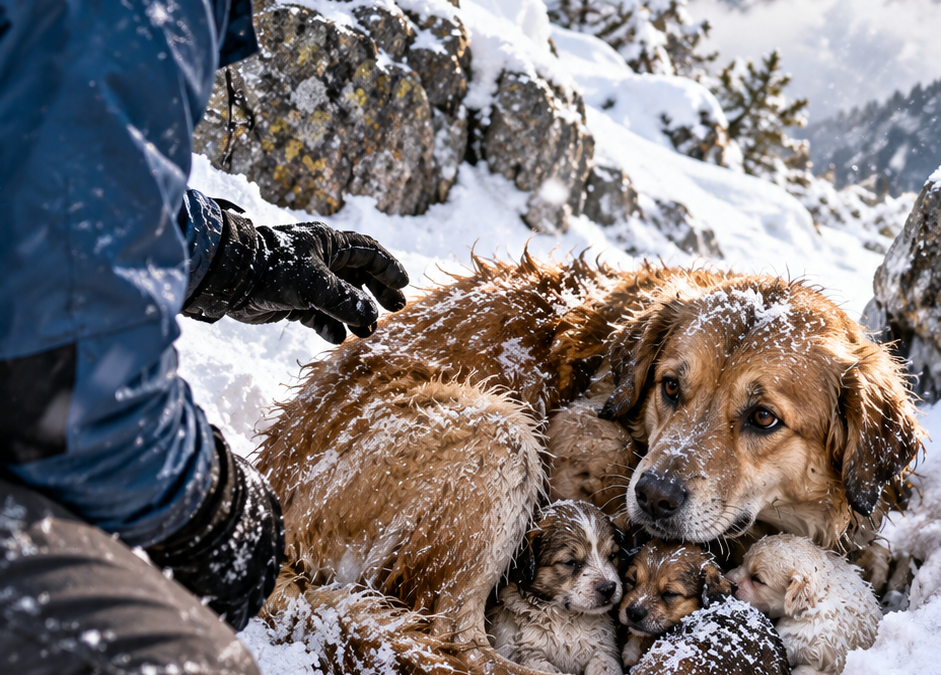
At 9,000 Feet, I Found a Dog Curled in the Snow Guarding Something Beneath Her Body
At nearly 9,000 feet, I saw what looked like a dark shape half buried beside the trail and almost convinced myself it was nothing more than a rock covered in snow.
Then the shape lifted its head, and two exhausted eyes locked onto mine while the wind tore across the ridge hard enough to knock me sideways.
When I finally got close enough to see what she was protecting beneath her body, reaching the summit stopped mattering.
My name is Daniel White, and by the time I found her, I had been hiking alone in the mountains for almost twenty years.
People often ask why anyone chooses solitude at altitude.
The easy answer is peace.
The honest answer is control.
Mountains are brutally honest.
If the weather changes, it changes.
If the trail disappears beneath snow, it disappears.
If your legs are too tired to continue, no amount of pretending makes them stronger.
There are no office politics at 9,000 feet.
No polite conversations.
No expectations except the ones imposed by gravity, cold, distance, and your own judgment.
I liked that.
For most of my adult life, I had trusted mountains more easily than people.
That morning, I had started before sunrise.
The goal was a familiar high-country route that climbed toward a ridge above Pine Ridge Shelter before continuing to a summit I’d wanted to revisit for years.
The forecast wasn’t perfect, but it wasn’t alarming either.
Cold.
Wind increasing in the afternoon.
Light snow possible after sunset.
Normal mountain conditions if you respected them.
My pack was intentionally light.
One wool blanket.
First-aid kit.
Thermos of hot tea.
Several energy bars.
A small emergency stove.
Extra gloves.
Headlamp.
Basic tools.
Enough for one experienced hiker who intended to be back below the dangerous elevation before nightfall.
Not enough for what I found.
By late morning, the sky had begun turning the flat gray that usually means weather is thinking about becoming a problem.
Snow from earlier in the week still covered much of the trail.
The higher I climbed, the deeper it became.
I was somewhere around 2,800 meters—just over 9,000 feet—when I noticed the shape.
It was maybe forty yards ahead.
Near the edge of the trail.
Brown against white.
At first, I thought it was a partially exposed tree stump.
Then it moved.
I stopped.
Pulled off one glove.
Shielded my eyes from the blowing snow.
The shape lifted its head.
Dog.
“Jesus.”
There are moments when your brain refuses to accept what your eyes are giving it because the image doesn’t belong where you’re seeing it.
A dog on a city sidewalk makes sense.
A dog at a campground makes sense.
A dog alone above 9,000 feet in winter does not.
I approached slowly.
The wind was coming hard from the west, pushing loose snow across the trail in silver sheets.
The dog watched me.
Medium-sized female.
Golden-brown coat.
No visible collar.
Her fur was wet and frozen around the edges.
Snow had accumulated along her back.
Her ears were pinned behind her head.
I expected her to run.
She didn’t.
I expected a growl.
Nothing.
She remained curled tightly around something beneath her.
“Hey, girl.”
Her eyes followed me.
I stopped about fifteen feet away.
“You’re a long way from home.”
She lowered her head but didn’t break eye contact.
Something moved beneath her chest.
Tiny.
I stared.
Then heard the sound.
A weak squeak.
The kind of sound so small the wind nearly carried it away.
My stomach dropped.
“No.”
I moved another step closer.
The dog shifted.
Not toward me.
Around what she was protecting.
And I saw them.
Three puppies.
I remember standing there unable to breathe for a second.
Three tiny bodies pressed beneath their mother’s belly.
They couldn’t have been very old.
Small enough that all three would fit against my chest.
One was pale gray.
Another darker.
The third almost the same golden color as their mother.
Their eyes were barely open, if at all.
They were trembling.
The mother had curled herself around them so completely that the snow had formed a shallow wall against her back.
She had turned her own body into shelter.
I checked my watch.
Then looked uphill.
Summit route.
Downhill.
Pine Ridge.
Three hours under good conditions.
Maybe more now.
My mind automatically began calculating.
Continue upward?
Impossible.
Higher elevation.
Lower temperature.
No shelter.
More wind.
Not even a serious option.
Stay here?
Also impossible.
Exposure would kill them.
Build a temporary shelter and call rescue?
My phone had intermittent signal at best.
A helicopter in those winds was unlikely.
Ground rescue would take hours.
Maybe longer.
The mother looked at me.
She was exhausted.
I could see it in her posture.
Every breath required effort.
But she wasn’t leaving those puppies.
I crouched.
Kept my hands visible.
“Okay.”
Her ears moved.
“I don’t have a perfect plan.”
I don’t know why I told her that.
Maybe I needed to say it out loud.
My first climbing guide had been an old man named Arthur Bennett.
He taught me more about mountains in two seasons than every book I’d read before meeting him.
One day, during a storm in Wyoming, I’d asked him what you do when every available option is bad.
He had answered:
“You stop looking for the perfect solution.”
I remembered laughing.
“Then what?”
“You take the next useful step.”
At twenty-six, I thought that sounded annoyingly philosophical.
At forty-something, kneeling in snow beside a freezing dog and three newborn puppies, I finally understood.
Next useful step.
Warmth.
I removed my pack.
“Good girl.”
The mother watched me.
I took out the wool blanket.
When I moved closer, her body tightened.
I stopped.
“Easy.”
She was scared.
Of course she was.
She had three babies beneath her and some strange man in heavy clothing crawling toward them.
I placed the blanket on the snow between us.
Let her smell it.
Then moved slowly.
She didn’t growl.
That surprised me.
Instead, her tail moved.
Once.
Barely.
A weak sweep against the snow.
Trust wasn’t the right word yet.
Hope, maybe.
“That’s enough for me.”
I draped the wool blanket over her back and sides, careful not to cover the puppies’ faces.
She flinched at first.
Then relaxed.
I opened the thermos.
The tea was too hot and obviously unsuitable, but beneath it I had warm water in a smaller container.
I poured a little into my palm.
Held it toward her.
“Drink.”
She stared.
“Please.”
She leaned forward.
One lick.
Then another.
Suddenly she drank desperately.
Her tongue moved across my palm until there was nothing left.
I poured more.
“Slow.”
She didn’t know the meaning of slow.
She drank until I finally stopped her.
“Enough for a minute.”
She licked my fingers.
That felt like permission.
I checked the puppies more closely.
Cold.
But not yet rigid.
Warmest where they touched her body.
She had kept them alive.
I looked toward the trail.
Three hours.
Three puppies.
One exhausted mother.
One man.
The math was terrible.
Still, there was no other equation.
“I’m taking you down.”
Her eyes remained on mine.
“You don’t get a vote.”
She blinked.
“Good.”
I emptied my backpack.
Anything nonessential came out.
Spare layer.
Cooking utensils.
Extra food I couldn’t carry elsewhere.
A few climbing items.
I kept the medical kit.
Thermos.
Energy bars.
Headlamp.
Emergency gear.
Then I used snow to build a low windbreak around the mother while I worked.
Nothing sophisticated.
Just enough to reduce direct wind.
My hands went numb even through gloves.
I kept flexing my fingers.
When everything was ready, I faced the hardest part.
The puppies.
“I need to move them.”
The mother immediately raised her head.
“I know.”
I unzipped my outer jacket.
Then the insulated layer beneath it.
I needed body heat.
Putting newborn puppies against my skin sounded ridiculous until you understood how quickly something that small loses warmth.
I reached for the first puppy.
The mother watched.
My hand stopped inches away.
“Trust me.”
No growl.
I slid both hands underneath the gray puppy.
He weighed almost nothing.
That scared me.
Living things should feel heavier.
He trembled between my palms.
I tucked him inside my jacket against my chest.
His little claws touched my skin through a thin base layer.
Then the second.
Then the third.
Three tiny bodies pressed against me.
Their hearts were unbelievable.
Fast.
Rapid fluttering.
Like hummingbird wings beneath my ribs.
I looked down.
“You three better stay with me.”
The mother stood.
Tried, anyway.
Her legs shook.
She nearly collapsed.
I caught her shoulder.
She stiffened.
Then allowed me to steady her.
“We’re going together.”
I didn’t have a proper leash.
I used a length of soft climbing cord attached loosely to my belt and looped safely through what remained of an old collar hidden beneath her fur.
Not to pull her.
Never that.
Only so that if visibility collapsed, we wouldn’t lose each other.
“If you need to stop, stop.”
She looked downhill.
Then took one step.
That became our plan.
One useful step.
Then another.
The first twenty minutes went better than I expected.
The mother—Luna, though I hadn’t named her yet—moved carefully behind me.
She understood the trail.
That became obvious immediately.
She didn’t fight the cord.
Didn’t wander.
Didn’t pull.
She simply followed my footprints.
Every few minutes, I touched my chest.
One puppy moved.
Then another.
Three heartbeats.
Still there.
Wind increased.
Snow struck the side of my face.
The trail descended through a narrow section bordered by rock.
Normally, I would have moved quickly there.
That afternoon, speed was dangerous.
The dog’s footing was terrible.
Her back legs sometimes slipped.
Whenever she fell, I stopped.
She would lie there for several seconds.
Head against snow.
Breathing hard.
Then push herself up.
“Stay down if you need to.”
She always rose.
“Stubborn.”
Her ears moved.
“Fine.”
After an hour, I started worrying about time.
Daylight was disappearing faster than expected.
Clouds had thickened.
At altitude, sunset doesn’t simply darken the sky.
Cold changes.
Visibility changes.
Every mistake becomes more expensive.
I checked the puppies.
The golden one moved immediately.
The darker one squirmed.
The gray puppy barely reacted.
My pulse jumped.
“No.”
I stopped.
Found a small break in the wind behind a rock outcrop.
The mother collapsed beside me.
I opened my jacket.
The gray puppy’s head rested against my chest.
Too still.
“Come on.”
I touched him.
Tiny movement.
Not enough.
I took out the thermos.
Not tea.
Warm water.
I couldn’t pour into his mouth.
Too dangerous.
So I warmed a drop on my finger.
Touched it to his lips.
Nothing.
“Come on, little guy.”
I tried again.
His tongue moved.
Barely.
He swallowed.
I laughed.
Then realized tears were running down my face.
The cold turned them painful almost immediately.
“That’s it.”
Another tiny drop.
The puppy swallowed.
“Stay angry.”
The mother crawled closer.
She sniffed him.
Then licked his head once.
I looked at her.
“I know.”
Her eyes were fixed on him.
“I’ve got him.”
She licked him again.
Then looked at me.
Something passed between us.
I don’t call it human.
Dogs don’t need to be human for their emotions to matter.
But I understood that look.
A mother watching a stranger hold her weakest child.
Fear.
Need.
Trust because there was no other choice.
“I won’t stop.”
We moved again.
Darkness began falling.
I switched on my headlamp.
The beam hit snowflakes and created a white tunnel in front of me.
That can be disorienting.
You start feeling as though the entire world is moving toward your face.
I focused on the trail.
Step.
Plant pole.
Check dog.
Touch puppies.
Breathe.
Repeat.
The mother fell again.
This time, she stayed down.
I turned.
“Hey.”
Her head lifted.
“Come on.”
Nothing.
I moved beside her.
She was breathing fast.
I gave her more warm water.
Then broke off a small piece of an energy bar.
She sniffed it.
Wouldn’t eat.
“You’re going to hate me for this.”
I chewed part of it myself to soften it, mixed it with a little water, and placed a small amount near her mouth.
She took it.
“Good.”
Another.
She ate.
I waited five minutes.
The cold punished us immediately.
We couldn’t stay longer.
“Ready?”
She looked downhill.
Then stood.
That’s when I named her.
Not formally.
Not thoughtfully.
It simply came out.
“Come on, Luna.”
I don’t know why Luna.
Maybe because darkness had settled around us.
Maybe because the moon had started appearing behind torn clouds.
Maybe because I needed something to call her other than “girl.”
Her head turned toward me.
“Luna.”
She stepped forward.
“Guess that’s your name.”
We continued.
The second hour blurred.
My shoulders hurt from holding my body rigid around the puppies.
My back screamed from the pack.
My thighs burned.
The mother moved slower.
Several times I considered carrying her.
Impossible.
She was too heavy.
Carrying her would risk falling and crushing the puppies.
So we walked.
At one point, I began counting steps.
Twenty.
Stop.
Listen.
Twenty more.
Stop.
Three heartbeats against my chest.
Luna breathing behind me.
Again.
Ten thousand eight hundred seconds.
That’s three hours.
You don’t think about a descent that way under ordinary conditions.
That night, every second mattered.
Somewhere during the final hour, I saw a dark shape below.
Pine Ridge Shelter.
For a moment, I thought exhaustion was making me imagine it.
Then the headlamp caught the wooden wall.
“There.”
Luna didn’t understand.
“That’s it.”
I started laughing.
“We made it.”
Too early.
Never celebrate before the door closes.
The final slope was slick.
I nearly fell twice.
The second time, I went down on one knee.
My hand hit the snow.
My other arm instantly covered my chest.
The puppies squeaked.
“I’m sorry.”
Luna came beside me.
She pressed her shoulder against my arm.
For a second, it almost felt like she was checking me.
“I’m okay.”
She remained there.
“You’re supposed to be the patient.”
Tail movement.
One.
We reached the shelter after dark.
Completely dark.
I hit the door with my shoulder because my hands barely worked.
Locked?
No.
Just swollen in the frame.
Again.
The door opened.
We stumbled inside.
The difference was immediate.
No wind.
That alone felt like luxury.
I shut the door.
Locked it.
Dropped to my knees.
For the first time in three hours, I opened my jacket fully.
“All right.”
One by one, I removed the puppies.
Gray.
Breathing.
Golden.
Breathing.
Dark one.
Breathing.
All three.
Alive.
I sat on the wooden floor.
And cried.
Not loudly.
There wasn’t enough energy left for that.
Tears simply came.
Relief.
Pure relief.
Luna crawled toward the puppies.
I spread the wool blanket near the old wood stove.
Then fought with shaking fingers to get a fire started.
The shelter had dry wood stored inside.
Thank God for whoever maintained Pine Ridge.
My first match failed.
Second too.
“Come on.”
Third caught.
Paper.
Kindling.
Then flame.
The stove began warming.
I melted snow.
Cooled the water enough to drink.
Luna drank for what seemed like forever.
Then she lay down.
I placed the puppies against her stomach.
Something changed in her instantly.
She licked them.
One.
Two.
Three.
Again.
The puppies pressed toward her.
The gray one moved weakly but moved.
“That’s my guy.”
Luna looked at me.
Her eyes seemed softer.
I sat beside her.
She lowered her head onto my boot.
That night, I didn’t sleep.
Not really.
I sat beside the stove.
Fed wood into the fire.
Checked the puppies.
Checked Luna.
Gave her small amounts of food.
Water.
More food.
Her body relaxed gradually.
At around two in the morning, she rolled slightly to one side.
One puppy squeaked.
She immediately adjusted.
I smiled.
“You’re not sleeping either.”
Her eyes closed again.
Outside, wind hit the walls.
Inside, firelight moved across rough timber.
I placed my hand on Luna’s head.
Twenty years hiking alone.
Countless nights in cabins.
Tents.
Shelters.
Never had one felt less lonely.
At sunrise, the storm had weakened.
I climbed to a point outside where I could get a signal.
One bar.
Enough.
I called an animal rescue organization in the nearest town.
A woman named Emily Johnson answered.
I explained.
There was a pause.
“You found what?”
“Female dog. Three puppies.”
“At Pine Ridge?”
“Above it.”
“How far above?”
“About three hours.”
Another pause.
“Are the puppies alive?”
“Yes.”
“Mother?”
“Exhausted. Dehydrated. But alert.”
“We’ll come.”
“When?”
“As soon as access is safe.”
The team arrived late that morning.
Two people.
Supplies.
Crate.
Veterinary equipment.
Emily was younger than I expected, maybe early thirties, with a red winter hat and the calm efficiency of someone who had transported frightened animals out of worse places than this.
She crouched near Luna.
“Hey, sweetheart.”
Luna moved closer to me.
Emily looked at my leg.
Then at Luna.
“Interesting.”
“What?”
“She doesn’t want to leave you.”
“She’s tired.”
“No.”
Emily smiled.
“She’s attached.”
Luna pressed against my boot.
“She met me yesterday.”
“Sometimes that’s enough.”
They examined the puppies.
Mild hypothermia.
Weakness.
Dehydration.
But viable.
The gray puppy needed more help than the others.
I hovered.
Emily noticed.
“He’s okay.”
“Define okay.”
“He needs warmth and calories.”
“That doesn’t sound okay.”
“It sounds treatable.”
I nodded.
That was enough.
Then came the question I hadn’t prepared for.
“Where should we take them?”
“Your facility.”
“Of course.”
Emily looked at Luna.
“But what happens after?”
“I don’t know.”
“Do you want us to start looking for a foster home?”
I looked down.
Luna looked up.
I had been a solitary man for two decades.
Not lonely, I told myself.
Solitary.
There was a distinction.
I liked leaving for the mountains without arranging anything around anyone else’s schedule.
I liked a quiet cabin.
Liked eating when I wanted.
Sleeping when I wanted.
Going days without conversation.
A dog changed that.
Four dogs changed it catastrophically.
“No.”
Emily tilted her head.
“No foster home?”
“I’ll take them.”
All three rescue workers looked at me.
I heard myself more clearly.
“I’ll take them.”
Emily smiled.
“All of them?”
“Temporary.”
She smiled wider.
“Of course.”
“I mean it.”
“Absolutely.”
Luna’s tail moved.
Traitor.
That was how Luna came home with me.
And the puppies.
Three of them.
My quiet cabin transformed within forty-eight hours.
I built a protected enclosure beside the stove.
Warm bedding.
Low walls.
Food and water for Luna.
I drove into town and returned with more supplies than I’d carried during some expeditions.
Formula.
Puppy pads.
Blankets.
Bowls.
Toys they were too young to use.
Emily looked at the receipt.
“You panicked.”
“I prepared.”
“You bought twelve blankets.”
“It gets cold.”
“You live indoors.”
“It still gets cold.”
She laughed.
Winter passed differently that year.
Normally, I measured winter by snowfall.
Trail access.
Temperature.
Hours of daylight.
That year, I measured it by puppies.
The first week, they mostly slept.
The second, they began moving.
The third, chaos arrived.
Luna recovered quickly.
Her coat thickened.
Her eyes brightened.
She gained weight.
The first time I saw her run through fresh snow, I stopped what I was doing and simply watched.
This dog I had found barely able to stand now tore across my yard with her tail high.
She looked younger.
Free.
Then the puppies followed.
Poorly.
One fell face-first into the snow.
The second climbed over him.
The third attacked my boot.
“Excellent coordination.”
Luna watched from several feet away.
I swear she looked embarrassed.
The gray male remained my favorite.
I tried not to have one.
Failed.
His fur was pale gray.
His nose had a strange pink marking.
He had been the weakest during the descent.
The puppy whose heartbeat had faded beneath my jacket.
The one who made me stop in the dark and beg something tiny not to die.
I named him Peak.
Not subtle.
But earned.
The other two eventually received names too.
Willow, the golden female.
Storm, the darker male.
I intended to keep all three.
That was unrealistic.
By spring, my cabin felt like a training facility operated by criminals.
Shoes disappeared.
Gloves disappeared.
A wooden spoon vanished for two days and appeared beneath Luna’s blanket.
Peak learned how to open a cabinet.
Storm discovered mud.
Willow discovered that looking innocent was more effective than behaving well.
I loved them.
Which created another problem.
They needed more room than I could offer long term.
Two neighboring farms had families I trusted.
People who had watched them grow.
People with land.
People who understood dogs.
Eventually Willow went to the Henderson farm.
Storm went to the Garcia property.
Close enough that I could visit.
Close enough that Luna could see them.
Peak went to another nearby farm owned by friends who had helped me through the winter, though he still spent so much time at my place that nobody was completely sure whose dog he was.
Luna stayed with me.
That wasn’t a decision.
It was simply reality.
The first time I tried to take a solo overnight hike after spring arrived, I packed my bag.
Luna sat beside the door.
“No.”
She stared.
“You stay.”
Still staring.
“This is not a democracy.”
Her tail moved.
I left.
Got thirty yards down the driveway.
Turned around.
Luna was standing at the window.
I went back.
“Fine.”
She came.
That was the last time I pretended I was still a solo hiker.
Every summer, I return to that trail.
The first year, Luna stopped before I did.
Same place.
Same bend.
Same exposed section.
Snow had melted.
Wildflowers grew near the rocks.
Nothing about the landscape suggested what had happened there months earlier.
But Luna knew.
She stopped.
Looked toward the shallow depression where I’d found her.
Then looked at me.
I sat on a rock.
“You remember.”
She walked over.
Rested beside me.
For a while, neither of us moved.
I thought about the calculation I’d made that day.
Summit.
Shelter.
Three hours.
Three puppies.
No perfect solution.
Just the next useful step.
People later called what happened heroic.
I dislike that word in this case.
I wasn’t brave.
I was scared constantly.
Scared a puppy would stop breathing.
Scared Luna would collapse.
Scared I’d fall.
Scared the weather would close the route.
Scared I’d reach the shelter with three tiny bodies that had stopped moving beneath my jacket.
Courage didn’t remove any of that.
It simply didn’t get a vote.
That may be the most useful thing mountains ever taught me.
You don’t have to feel fearless.
You take the next step anyway.
The story spread among hikers.
I don’t know exactly how.
Emily probably told someone.
Someone told another person.
Eventually, people on the regional trails began recognizing Luna.
“Is that the snow dog?”
I’d usually answer,
“She’s Luna.”
Some started carrying extra blankets.
One hiker showed me his pack.
“Emergency dog blanket.”
“That’s ridiculous.”
He grinned.
“You started it.”
“I carried one blanket.”
“Still.”
I couldn’t argue.
Someone began calling that part of the route the Trail of Trust.
Not officially.
No sign.
No map designation.
Just a name among local climbers.
I pretended to dislike it.
Secretly, I understood.
Because trust was the part that stayed with me.
Luna had three newborn puppies.
She was cold.
Exhausted.
Hungry.
Probably terrified.
Then a stranger approached.
A large animal had every reason to protect her young from me.
She could have bitten.
Run.
Hidden.
Instead, she watched me place her babies against my chest.
And let me carry them away from her body.
People sometimes romanticize animals and say she “knew” I would save them.
I don’t know that.
Maybe she was simply too weak to resist.
Maybe instinct told her something about my posture.
Maybe hunger made the choice for her.
But on the descent, every time she fell and stood again, she followed me.
At the shelter, she slept with her head on my boot.
When rescue arrived, she pressed herself against my leg.
Whatever trust means in a dog, I felt it.
And once something trusts you that completely, responsibility follows.
You don’t get to pretend you didn’t feel it.
Years have passed.
Luna’s muzzle has begun to gray.
Not much.
Just enough that I notice.
She still loves snow.
That’s the strangest thing.
You might expect an animal found half frozen on a mountain to hate winter.
Luna doesn’t.
First snowfall every year, she loses her mind.
Runs through the yard.
Rolls.
Burrows nose-first into drifts.
Comes back covered in white.
“You know this stuff nearly killed you.”
She sneezes.
“Selective memory.”
Tail wag.
Peak still recognizes me instantly.
So do Willow and Storm.
Whenever I visit the neighboring farms, they run toward the truck.
Luna often comes along.
The reunions are chaos.
Four dogs racing.
Jumping.
Barking.
Circling.
If you’d seen them that first afternoon on the mountain, you wouldn’t believe these were the same lives.
That’s the image I carry.
Not Luna in the snow.
Not the weak gray puppy beneath my jacket.
I remember them running.
Strong.
Loud.
Annoying.
Alive.
Every summer, Luna and I hike back to the place where we met.
I’ve stopped trying to reach that old summit.
Funny.
For years, reaching the top was the point.
Elevation.
Distance.
Achievement.
Now I turn around at the bend where I found her.
We sit.
I drink tea.
Luna lies beside me.
Sometimes hikers pass.
One once asked,
“Not going to the summit?”
“No.”
“Weather bad?”
“No.”
“Tired?”
I looked at Luna.
“No.”
“Then why stop?”
I thought about it.
“Already got what I came for.”
He probably thought I was some irritating old mountain philosopher.
Maybe I am.
But the truth is simple.
I spent twenty years walking into the mountains looking for solitude.
Then one winter day, at nearly 9,000 feet, I found four lives that destroyed it.
Best thing that ever happened to me.
I still love silence.
Still love snow.
Still need the mountains.
But solitude isn’t the same anymore.
At night, my cabin isn’t quiet.
Luna breathes near the stove.
Sometimes she dreams.
Her paws move.
Occasionally she makes a tiny sound.
I wonder whether she dreams about that first winter.
The puppies.
The snow.
The descent.
I hope not.
I hope dogs are better than humans at leaving certain memories where they belong.
On difficult days, I think about Arthur Bennett, my first guide.
No perfect solution.
Take the next useful step.
That lesson saved more than one life on the mountain.
Maybe mine too.
Because before Luna, I had spent years choosing only situations I could control.
Alone was safe.
Alone was efficient.
Nobody depended on me.
Nobody could disrupt the plan.
Then Luna handed me—without words—three tiny lives.
Nothing controlled about that.
Nothing efficient.
The plan disappeared immediately.
And somehow, for the first time in years, I stopped thinking about where I was trying to get.
I thought only about who was beside me.
That’s what I remember whenever we return to that ridge.
I stand where the snow had nearly buried her.
Luna raises her nose into the wind.
The mountain doesn’t care about our story.
Mountains don’t care about anything.
Snow falls.
Wind moves.
Rock remains rock.
Maybe that’s why what happened there matters to me.
In a place completely indifferent to whether four animals survived, one living creature trusted another.
Then we walked.
One step.
Then another.
Then another.
For three hours through cold and darkness.
Until there was a door.
A stove.
Warmth.
Breathing.
Life.
People call that section the Trail of Trust now.
I never named it.
But I don’t object anymore.
Because every time Luna and I pass through it, I remember exactly what trust looked like that first day.
A freezing mother dog watching me lift her newborn puppies from beneath her body.
No growl.
No fight.
Just tired eyes fixed on mine.
And one faint movement of her tail.
As if she were saying:
I can’t do this alone anymore.
Neither could I.
I just hadn’t known it yet.
𝗧𝗛𝗘 𝗘𝗡𝗗
At 9,000 Feet, I Found a Dog Curled in the Snow Guarding Something Beneath Her Body
At nearly 9,000 feet, I saw what looked like a dark shape half buried beside the trail and almost convinced myself it was nothing more than a rock covered in snow.
Then the shape lifted its head, and two exhausted eyes locked onto mine while the wind tore across the ridge hard enough to knock me sideways.
When I finally got close enough to see what she was protecting beneath her body, reaching the summit stopped mattering.
My name is Daniel White, and by the time I found her, I had been hiking alone in the mountains for almost twenty years.
People often ask why anyone chooses solitude at altitude.
The easy answer is peace.
The honest answer is control.
Mountains are brutally honest.
If the weather changes, it changes.
If the trail disappears beneath snow, it disappears.
If your legs are too tired to continue, no amount of pretending makes them stronger.
There are no office politics at 9,000 feet.
No polite conversations.
No expectations except the ones imposed by gravity, cold, distance, and your own judgment.
I liked that.
For most of my adult life, I had trusted mountains more easily than people.
That morning, I had started before sunrise.
The goal was a familiar high-country route that climbed toward a ridge above Pine Ridge Shelter before continuing to a summit I’d wanted to revisit for years.
The forecast wasn’t perfect, but it wasn’t alarming either.
Cold.
Wind increasing in the afternoon.
Light snow possible after sunset.
Normal mountain conditions if you respected them.
My pack was intentionally light.
One wool blanket.
First-aid kit.
Thermos of hot tea.
Several energy bars.
A small emergency stove.
Extra gloves.
Headlamp.
Basic tools.
Enough for one experienced hiker who intended to be back below the dangerous elevation before nightfall.
Not enough for what I found.
By late morning, the sky had begun turning the flat gray that usually means weather is thinking about becoming a problem.
Snow from earlier in the week still covered much of the trail.
The higher I climbed, the deeper it became.
I was somewhere around 2,800 meters—just over 9,000 feet—when I noticed the shape.
It was maybe forty yards ahead.
Near the edge of the trail.
Brown against white.
At first, I thought it was a partially exposed tree stump.
Then it moved.
I stopped.
Pulled off one glove.
Shielded my eyes from the blowing snow.
The shape lifted its head.
Dog.
“Jesus.”
There are moments when your brain refuses to accept what your eyes are giving it because the image doesn’t belong where you’re seeing it.
A dog on a city sidewalk makes sense.
A dog at a campground makes sense.
A dog alone above 9,000 feet in winter does not.
I approached slowly.
The wind was coming hard from the west, pushing loose snow across the trail in silver sheets.
The dog watched me.
Medium-sized female.
Golden-brown coat.
No visible collar.
Her fur was wet and frozen around the edges.
Snow had accumulated along her back.
Her ears were pinned behind her head.
I expected her to run.
She didn’t.
I expected a growl.
Nothing.
She remained curled tightly around something beneath her.
“Hey, girl.”
Her eyes followed me.
I stopped about fifteen feet away.
“You’re a long way from home.”
She lowered her head but didn’t break eye contact.
Something moved beneath her chest.
Tiny.
I stared.
Then heard the sound.
A weak squeak.
The kind of sound so small the wind nearly carried it away.
My stomach dropped.
“No.”
I moved another step closer.
The dog shifted.
Not toward me.
Around what she was protecting.
And I saw them.
Three puppies.
I remember standing there unable to breathe for a second.
Three tiny bodies pressed beneath their mother’s belly.
They couldn’t have been very old.
Small enough that all three would fit against my chest.
One was pale gray.
Another darker.
The third almost the same golden color as their mother.
Their eyes were barely open, if at all.
They were trembling.
The mother had curled herself around them so completely that the snow had formed a shallow wall against her back.
She had turned her own body into shelter.
I checked my watch.
Then looked uphill.
Summit route.
Downhill.
Pine Ridge.
Three hours under good conditions.
Maybe more now.
My mind automatically began calculating.
Continue upward?
Impossible.
Higher elevation.
Lower temperature.
No shelter.
More wind.
Not even a serious option.
Stay here?
Also impossible.
Exposure would kill them.
Build a temporary shelter and call rescue?
My phone had intermittent signal at best.
A helicopter in those winds was unlikely.
Ground rescue would take hours.
Maybe longer.
The mother looked at me.
She was exhausted.
I could see it in her posture.
Every breath required effort.
But she wasn’t leaving those puppies.
I crouched.
Kept my hands visible.
“Okay.”
Her ears moved.
“I don’t have a perfect plan.”
I don’t know why I told her that.
Maybe I needed to say it out loud.
My first climbing guide had been an old man named Arthur Bennett.
He taught me more about mountains in two seasons than every book I’d read before meeting him.
One day, during a storm in Wyoming, I’d asked him what you do when every available option is bad.
He had answered:
“You stop looking for the perfect solution.”
I remembered laughing.
“Then what?”
“You take the next useful step.”
At twenty-six, I thought that sounded annoyingly philosophical.
At forty-something, kneeling in snow beside a freezing dog and three newborn puppies, I finally understood.
Next useful step.
Warmth.
I removed my pack.
“Good girl.”
The mother watched me.
I took out the wool blanket.
When I moved closer, her body tightened.
I stopped.
“Easy.”
She was scared.
Of course she was.
She had three babies beneath her and some strange man in heavy clothing crawling toward them.
I placed the blanket on the snow between us.
Let her smell it.
Then moved slowly.
She didn’t growl.
That surprised me.
Instead, her tail moved.
Once.
Barely.
A weak sweep against the snow.
Trust wasn’t the right word yet.
Hope, maybe.
“That’s enough for me.”
I draped the wool blanket over her back and sides, careful not to cover the puppies’ faces.
She flinched at first.
Then relaxed.
I opened the thermos.
The tea was too hot and obviously unsuitable, but beneath it I had warm water in a smaller container.
I poured a little into my palm.
Held it toward her.
“Drink.”
She stared.
“Please.”
She leaned forward.
One lick.
Then another.
Suddenly she drank desperately.
Her tongue moved across my palm until there was nothing left.
I poured more.
“Slow.”
She didn’t know the meaning of slow.
She drank until I finally stopped her.
“Enough for a minute.”
She licked my fingers.
That felt like permission.
I checked the puppies more closely.
Cold.
But not yet rigid.
Warmest where they touched her body.
She had kept them alive.
I looked toward the trail.
Three hours.
Three puppies.
One exhausted mother.
One man.
The math was terrible.
Still, there was no other equation.
“I’m taking you down.”
Her eyes remained on mine.
“You don’t get a vote.”
She blinked.
“Good.”
I emptied my backpack.
Anything nonessential came out.
Spare layer.
Cooking utensils.
Extra food I couldn’t carry elsewhere.
A few climbing items.
I kept the medical kit.
Thermos.
Energy bars.
Headlamp.
Emergency gear.
Then I used snow to build a low windbreak around the mother while I worked.
Nothing sophisticated.
Just enough to reduce direct wind.
My hands went numb even through gloves.
I kept flexing my fingers.
When everything was ready, I faced the hardest part.
The puppies.
“I need to move them.”
The mother immediately raised her head.
“I know.”
I unzipped my outer jacket.
Then the insulated layer beneath it.
I needed body heat.
Putting newborn puppies against my skin sounded ridiculous until you understood how quickly something that small loses warmth.
I reached for the first puppy.
The mother watched.
My hand stopped inches away.
“Trust me.”
No growl.
I slid both hands underneath the gray puppy.
He weighed almost nothing.
That scared me.
Living things should feel heavier.
He trembled between my palms.
I tucked him inside my jacket against my chest.
His little claws touched my skin through a thin base layer.
Then the second.
Then the third.
Three tiny bodies pressed against me.
Their hearts were unbelievable.
Fast.
Rapid fluttering.
Like hummingbird wings beneath my ribs.
I looked down.
“You three better stay with me.”
The mother stood.
Tried, anyway.
Her legs shook.
She nearly collapsed.
I caught her shoulder.
She stiffened.
Then allowed me to steady her.
“We’re going together.”
I didn’t have a proper leash.
I used a length of soft climbing cord attached loosely to my belt and looped safely through what remained of an old collar hidden beneath her fur.
Not to pull her.
Never that.
Only so that if visibility collapsed, we wouldn’t lose each other.
“If you need to stop, stop.”
She looked downhill.
Then took one step.
That became our plan.
One useful step.
Then another.
The first twenty minutes went better than I expected.
The mother—Luna, though I hadn’t named her yet—moved carefully behind me.
She understood the trail.
That became obvious immediately.
She didn’t fight the cord.
Didn’t wander.
Didn’t pull.
She simply followed my footprints.
Every few minutes, I touched my chest.
One puppy moved.
Then another.
Three heartbeats.
Still there.
Wind increased.
Snow struck the side of my face.
The trail descended through a narrow section bordered by rock.
Normally, I would have moved quickly there.
That afternoon, speed was dangerous.
The dog’s footing was terrible.
Her back legs sometimes slipped.
Whenever she fell, I stopped.
She would lie there for several seconds.
Head against snow.
Breathing hard.
Then push herself up.
“Stay down if you need to.”
She always rose.
“Stubborn.”
Her ears moved.
“Fine.”
After an hour, I started worrying about time.
Daylight was disappearing faster than expected.
Clouds had thickened.
At altitude, sunset doesn’t simply darken the sky.
Cold changes.
Visibility changes.
Every mistake becomes more expensive.
I checked the puppies.
The golden one moved immediately.
The darker one squirmed.
The gray puppy barely reacted.
My pulse jumped.
“No.”
I stopped.
Found a small break in the wind behind a rock outcrop.
The mother collapsed beside me.
I opened my jacket.
The gray puppy’s head rested against my chest.
Too still.
“Come on.”
I touched him.
Tiny movement.
Not enough.
I took out the thermos.
Not tea.
Warm water.
I couldn’t pour into his mouth.
Too dangerous.
So I warmed a drop on my finger.
Touched it to his lips.
Nothing.
“Come on, little guy.”
I tried again.
His tongue moved.
Barely.
He swallowed.
I laughed.
Then realized tears were running down my face.
The cold turned them painful almost immediately.
“That’s it.”
Another tiny drop.
The puppy swallowed.
“Stay angry.”
The mother crawled closer.
She sniffed him.
Then licked his head once.
I looked at her.
“I know.”
Her eyes were fixed on him.
“I’ve got him.”
She licked him again.
Then looked at me.
Something passed between us.
I don’t call it human.
Dogs don’t need to be human for their emotions to matter.
But I understood that look.
A mother watching a stranger hold her weakest child.
Fear.
Need.
Trust because there was no other choice.
“I won’t stop.”
We moved again.
Darkness began falling.
I switched on my headlamp.
The beam hit snowflakes and created a white tunnel in front of me.
That can be disorienting.
You start feeling as though the entire world is moving toward your face.
I focused on the trail.
Step.
Plant pole.
Check dog.
Touch puppies.
Breathe.
Repeat.
The mother fell again.
This time, she stayed down.
I turned.
“Hey.”
Her head lifted.
“Come on.”
Nothing.
I moved beside her.
She was breathing fast.
I gave her more warm water.
Then broke off a small piece of an energy bar.
She sniffed it.
Wouldn’t eat.
“You’re going to hate me for this.”
I chewed part of it myself to soften it, mixed it with a little water, and placed a small amount near her mouth.
She took it.
“Good.”
Another.
She ate.
I waited five minutes.
The cold punished us immediately.
We couldn’t stay longer.
“Ready?”
She looked downhill.
Then stood.
That’s when I named her.
Not formally.
Not thoughtfully.
It simply came out.
“Come on, Luna.”
I don’t know why Luna.
Maybe because darkness had settled around us.
Maybe because the moon had started appearing behind torn clouds.
Maybe because I needed something to call her other than “girl.”
Her head turned toward me.
“Luna.”
She stepped forward.
“Guess that’s your name.”
We continued.
The second hour blurred.
My shoulders hurt from holding my body rigid around the puppies.
My back screamed from the pack.
My thighs burned.
The mother moved slower.
Several times I considered carrying her.
Impossible.
She was too heavy.
Carrying her would risk falling and crushing the puppies.
So we walked.
At one point, I began counting steps.
Twenty.
Stop.
Listen.
Twenty more.
Stop.
Three heartbeats against my chest.
Luna breathing behind me.
Again.
Ten thousand eight hundred seconds.
That’s three hours.
You don’t think about a descent that way under ordinary conditions.
That night, every second mattered.
Somewhere during the final hour, I saw a dark shape below.
Pine Ridge Shelter.
For a moment, I thought exhaustion was making me imagine it.
Then the headlamp caught the wooden wall.
“There.”
Luna didn’t understand.
“That’s it.”
I started laughing.
“We made it.”
Too early.
Never celebrate before the door closes.
The final slope was slick.
I nearly fell twice.
The second time, I went down on one knee.
My hand hit the snow.
My other arm instantly covered my chest.
The puppies squeaked.
“I’m sorry.”
Luna came beside me.
She pressed her shoulder against my arm.
For a second, it almost felt like she was checking me.
“I’m okay.”
She remained there.
“You’re supposed to be the patient.”
Tail movement.
One.
We reached the shelter after dark.
Completely dark.
I hit the door with my shoulder because my hands barely worked.
Locked?
No.
Just swollen in the frame.
Again.
The door opened.
We stumbled inside.
The difference was immediate.
No wind.
That alone felt like luxury.
I shut the door.
Locked it.
Dropped to my knees.
For the first time in three hours, I opened my jacket fully.
“All right.”
One by one, I removed the puppies.
Gray.
Breathing.
Golden.
Breathing.
Dark one.
Breathing.
All three.
Alive.
I sat on the wooden floor.
And cried.
Not loudly.
There wasn’t enough energy left for that.
Tears simply came.
Relief.
Pure relief.
Luna crawled toward the puppies.
I spread the wool blanket near the old wood stove.
Then fought with shaking fingers to get a fire started.
The shelter had dry wood stored inside.
Thank God for whoever maintained Pine Ridge.
My first match failed.
Second too.
“Come on.”
Third caught.
Paper.
Kindling.
Then flame.
The stove began warming.
I melted snow.
Cooled the water enough to drink.
Luna drank for what seemed like forever.
Then she lay down.
I placed the puppies against her stomach.
Something changed in her instantly.
She licked them.
One.
Two.
Three.
Again.
The puppies pressed toward her.
The gray one moved weakly but moved.
“That’s my guy.”
Luna looked at me.
Her eyes seemed softer.
I sat beside her.
She lowered her head onto my boot.
That night, I didn’t sleep.
Not really.
I sat beside the stove.
Fed wood into the fire.
Checked the puppies.
Checked Luna.
Gave her small amounts of food.
Water.
More food.
Her body relaxed gradually.
At around two in the morning, she rolled slightly to one side.
One puppy squeaked.
She immediately adjusted.
I smiled.
“You’re not sleeping either.”
Her eyes closed again.
Outside, wind hit the walls.
Inside, firelight moved across rough timber.
I placed my hand on Luna’s head.
Twenty years hiking alone.
Countless nights in cabins.
Tents.
Shelters.
Never had one felt less lonely.
At sunrise, the storm had weakened.
I climbed to a point outside where I could get a signal.
One bar.
Enough.
I called an animal rescue organization in the nearest town.
A woman named Emily Johnson answered.
I explained.
There was a pause.
“You found what?”
“Female dog. Three puppies.”
“At Pine Ridge?”
“Above it.”
“How far above?”
“About three hours.”
Another pause.
“Are the puppies alive?”
“Yes.”
“Mother?”
“Exhausted. Dehydrated. But alert.”
“We’ll come.”
“When?”
“As soon as access is safe.”
The team arrived late that morning.
Two people.
Supplies.
Crate.
Veterinary equipment.
Emily was younger than I expected, maybe early thirties, with a red winter hat and the calm efficiency of someone who had transported frightened animals out of worse places than this.
She crouched near Luna.
“Hey, sweetheart.”
Luna moved closer to me.
Emily looked at my leg.
Then at Luna.
“Interesting.”
“What?”
“She doesn’t want to leave you.”
“She’s tired.”
“No.”
Emily smiled.
“She’s attached.”
Luna pressed against my boot.
“She met me yesterday.”
“Sometimes that’s enough.”
They examined the puppies.
Mild hypothermia.
Weakness.
Dehydration.
But viable.
The gray puppy needed more help than the others.
I hovered.
Emily noticed.
“He’s okay.”
“Define okay.”
“He needs warmth and calories.”
“That doesn’t sound okay.”
“It sounds treatable.”
I nodded.
That was enough.
Then came the question I hadn’t prepared for.
“Where should we take them?”
“Your facility.”
“Of course.”
Emily looked at Luna.
“But what happens after?”
“I don’t know.”
“Do you want us to start looking for a foster home?”
I looked down.
Luna looked up.
I had been a solitary man for two decades.
Not lonely, I told myself.
Solitary.
There was a distinction.
I liked leaving for the mountains without arranging anything around anyone else’s schedule.
I liked a quiet cabin.
Liked eating when I wanted.
Sleeping when I wanted.
Going days without conversation.
A dog changed that.
Four dogs changed it catastrophically.
“No.”
Emily tilted her head.
“No foster home?”
“I’ll take them.”
All three rescue workers looked at me.
I heard myself more clearly.
“I’ll take them.”
Emily smiled.
“All of them?”
“Temporary.”
She smiled wider.
“Of course.”
“I mean it.”
“Absolutely.”
Luna’s tail moved.
Traitor.
That was how Luna came home with me.
And the puppies.
Three of them.
My quiet cabin transformed within forty-eight hours.
I built a protected enclosure beside the stove.
Warm bedding.
Low walls.
Food and water for Luna.
I drove into town and returned with more supplies than I’d carried during some expeditions.
Formula.
Puppy pads.
Blankets.
Bowls.
Toys they were too young to use.
Emily looked at the receipt.
“You panicked.”
“I prepared.”
“You bought twelve blankets.”
“It gets cold.”
“You live indoors.”
“It still gets cold.”
She laughed.
Winter passed differently that year.
Normally, I measured winter by snowfall.
Trail access.
Temperature.
Hours of daylight.
That year, I measured it by puppies.
The first week, they mostly slept.
The second, they began moving.
The third, chaos arrived.
Luna recovered quickly.
Her coat thickened.
Her eyes brightened.
She gained weight.
The first time I saw her run through fresh snow, I stopped what I was doing and simply watched.
This dog I had found barely able to stand now tore across my yard with her tail high.
She looked younger.
Free.
Then the puppies followed.
Poorly.
One fell face-first into the snow.
The second climbed over him.
The third attacked my boot.
“Excellent coordination.”
Luna watched from several feet away.
I swear she looked embarrassed.
The gray male remained my favorite.
I tried not to have one.
Failed.
His fur was pale gray.
His nose had a strange pink marking.
He had been the weakest during the descent.
The puppy whose heartbeat had faded beneath my jacket.
The one who made me stop in the dark and beg something tiny not to die.
I named him Peak.
Not subtle.
But earned.
The other two eventually received names too.
Willow, the golden female.
Storm, the darker male.
I intended to keep all three.
That was unrealistic.
By spring, my cabin felt like a training facility operated by criminals.
Shoes disappeared.
Gloves disappeared.
A wooden spoon vanished for two days and appeared beneath Luna’s blanket.
Peak learned how to open a cabinet.
Storm discovered mud.
Willow discovered that looking innocent was more effective than behaving well.
I loved them.
Which created another problem.
They needed more room than I could offer long term.
Two neighboring farms had families I trusted.
People who had watched them grow.
People with land.
People who understood dogs.
Eventually Willow went to the Henderson farm.
Storm went to the Garcia property.
Close enough that I could visit.
Close enough that Luna could see them.
Peak went to another nearby farm owned by friends who had helped me through the winter, though he still spent so much time at my place that nobody was completely sure whose dog he was.
Luna stayed with me.
That wasn’t a decision.
It was simply reality.
The first time I tried to take a solo overnight hike after spring arrived, I packed my bag.
Luna sat beside the door.
“No.”
She stared.
“You stay.”
Still staring.
“This is not a democracy.”
Her tail moved.
I left.
Got thirty yards down the driveway.
Turned around.
Luna was standing at the window.
I went back.
“Fine.”
She came.
That was the last time I pretended I was still a solo hiker.
Every summer, I return to that trail.
The first year, Luna stopped before I did.
Same place.
Same bend.
Same exposed section.
Snow had melted.
Wildflowers grew near the rocks.
Nothing about the landscape suggested what had happened there months earlier.
But Luna knew.
She stopped.
Looked toward the shallow depression where I’d found her.
Then looked at me.
I sat on a rock.
“You remember.”
She walked over.
Rested beside me.
For a while, neither of us moved.
I thought about the calculation I’d made that day.
Summit.
Shelter.
Three hours.
Three puppies.
No perfect solution.
Just the next useful step.
People later called what happened heroic.
I dislike that word in this case.
I wasn’t brave.
I was scared constantly.
Scared a puppy would stop breathing.
Scared Luna would collapse.
Scared I’d fall.
Scared the weather would close the route.
Scared I’d reach the shelter with three tiny bodies that had stopped moving beneath my jacket.
Courage didn’t remove any of that.
It simply didn’t get a vote.
That may be the most useful thing mountains ever taught me.
You don’t have to feel fearless.
You take the next step anyway.
The story spread among hikers.
I don’t know exactly how.
Emily probably told someone.
Someone told another person.
Eventually, people on the regional trails began recognizing Luna.
“Is that the snow dog?”
I’d usually answer,
“She’s Luna.”
Some started carrying extra blankets.
One hiker showed me his pack.
“Emergency dog blanket.”
“That’s ridiculous.”
He grinned.
“You started it.”
“I carried one blanket.”
“Still.”
I couldn’t argue.
Someone began calling that part of the route the Trail of Trust.
Not officially.
No sign.
No map designation.
Just a name among local climbers.
I pretended to dislike it.
Secretly, I understood.
Because trust was the part that stayed with me.
Luna had three newborn puppies.
She was cold.
Exhausted.
Hungry.
Probably terrified.
Then a stranger approached.
A large animal had every reason to protect her young from me.
She could have bitten.
Run.
Hidden.
Instead, she watched me place her babies against my chest.
And let me carry them away from her body.
People sometimes romanticize animals and say she “knew” I would save them.
I don’t know that.
Maybe she was simply too weak to resist.
Maybe instinct told her something about my posture.
Maybe hunger made the choice for her.
But on the descent, every time she fell and stood again, she followed me.
At the shelter, she slept with her head on my boot.
When rescue arrived, she pressed herself against my leg.
Whatever trust means in a dog, I felt it.
And once something trusts you that completely, responsibility follows.
You don’t get to pretend you didn’t feel it.
Years have passed.
Luna’s muzzle has begun to gray.
Not much.
Just enough that I notice.
She still loves snow.
That’s the strangest thing.
You might expect an animal found half frozen on a mountain to hate winter.
Luna doesn’t.
First snowfall every year, she loses her mind.
Runs through the yard.
Rolls.
Burrows nose-first into drifts.
Comes back covered in white.
“You know this stuff nearly killed you.”
She sneezes.
“Selective memory.”
Tail wag.
Peak still recognizes me instantly.
So do Willow and Storm.
Whenever I visit the neighboring farms, they run toward the truck.
Luna often comes along.
The reunions are chaos.
Four dogs racing.
Jumping.
Barking.
Circling.
If you’d seen them that first afternoon on the mountain, you wouldn’t believe these were the same lives.
That’s the image I carry.
Not Luna in the snow.
Not the weak gray puppy beneath my jacket.
I remember them running.
Strong.
Loud.
Annoying.
Alive.
Every summer, Luna and I hike back to the place where we met.
I’ve stopped trying to reach that old summit.
Funny.
For years, reaching the top was the point.
Elevation.
Distance.
Achievement.
Now I turn around at the bend where I found her.
We sit.
I drink tea.
Luna lies beside me.
Sometimes hikers pass.
One once asked,
“Not going to the summit?”
“No.”
“Weather bad?”
“No.”
“Tired?”
I looked at Luna.
“No.”
“Then why stop?”
I thought about it.
“Already got what I came for.”
He probably thought I was some irritating old mountain philosopher.
Maybe I am.
But the truth is simple.
I spent twenty years walking into the mountains looking for solitude.
Then one winter day, at nearly 9,000 feet, I found four lives that destroyed it.
Best thing that ever happened to me.
I still love silence.
Still love snow.
Still need the mountains.
But solitude isn’t the same anymore.
At night, my cabin isn’t quiet.
Luna breathes near the stove.
Sometimes she dreams.
Her paws move.
Occasionally she makes a tiny sound.
I wonder whether she dreams about that first winter.
The puppies.
The snow.
The descent.
I hope not.
I hope dogs are better than humans at leaving certain memories where they belong.
On difficult days, I think about Arthur Bennett, my first guide.
No perfect solution.
Take the next useful step.
That lesson saved more than one life on the mountain.
Maybe mine too.
Because before Luna, I had spent years choosing only situations I could control.
Alone was safe.
Alone was efficient.
Nobody depended on me.
Nobody could disrupt the plan.
Then Luna handed me—without words—three tiny lives.
Nothing controlled about that.
Nothing efficient.
The plan disappeared immediately.
And somehow, for the first time in years, I stopped thinking about where I was trying to get.
I thought only about who was beside me.
That’s what I remember whenever we return to that ridge.
I stand where the snow had nearly buried her.
Luna raises her nose into the wind.
The mountain doesn’t care about our story.
Mountains don’t care about anything.
Snow falls.
Wind moves.
Rock remains rock.
Maybe that’s why what happened there matters to me.
In a place completely indifferent to whether four animals survived, one living creature trusted another.
Then we walked.
One step.
Then another.
Then another.
For three hours through cold and darkness.
Until there was a door.
A stove.
Warmth.
Breathing.
Life.
People call that section the Trail of Trust now.
I never named it.
But I don’t object anymore.
Because every time Luna and I pass through it, I remember exactly what trust looked like that first day.
A freezing mother dog watching me lift her newborn puppies from beneath her body.
No growl.
No fight.
Just tired eyes fixed on mine.
And one faint movement of her tail.
As if she were saying:
I can’t do this alone anymore.
Neither could I.
I just hadn’t known it yet.




