𝗙𝗨𝗟𝗟 𝗦𝗧𝗢𝗥𝗬 At 8:30 One Night, a Seven-Year-Old Boy Walked Into My Pharmacy Carrying Someone He Refused to Leave Behind
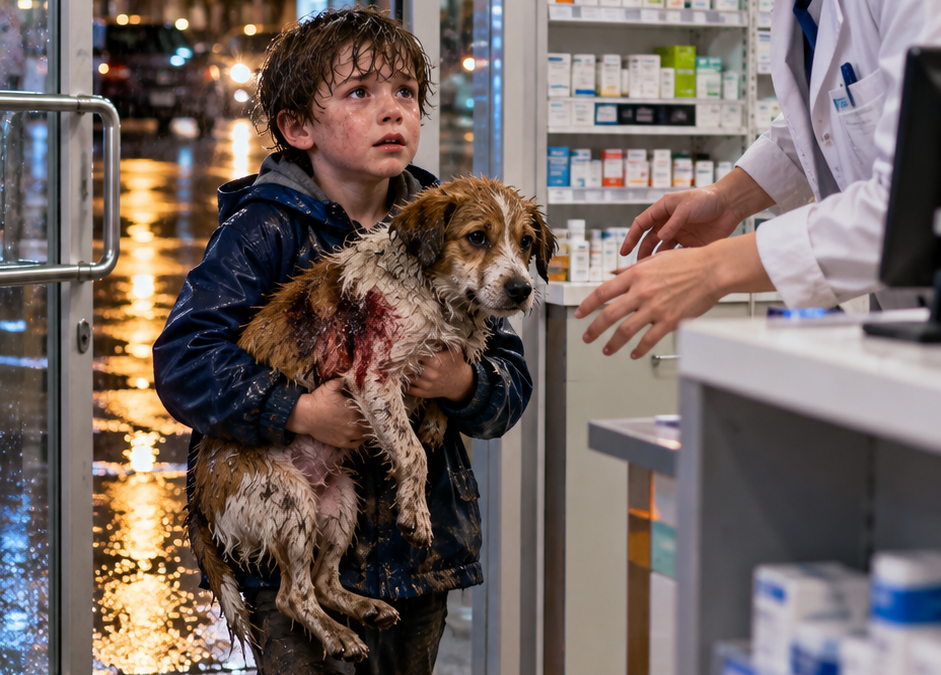
𝗣𝗔𝗥𝗧 𝟮
I did not correct him.
“What happened next?”
“I heard him behind the fence.”
“You went in?”
“There’s a hole.”
Of course there was.
“You crawled through?”
He nodded.
“And he was lying there?”
“Yes.”
“Could he walk?”
“A little.”
Liam’s voice became softer.
“He tried.”
I looked at the dog.
“He fell?”
“Yes.”
“And then?”
“I picked him up.”
I stared at the boy.
The dog must have weighed thirty pounds.
Maybe more.
“You carried him here?”
“Yes.”
“Why the pharmacy?”
That question confused him.
“Because you help people.”
I had no answer.
He said it as if it were obvious.
There was a drugstore sign.
A white coat.
Medicine behind a counter.
Therefore help existed inside.
Children’s logic can sometimes expose things adults forget.
“You did the right thing coming somewhere safe,” I said.
“But can you fix his leg?”
“I can’t.”
His face changed immediately.
“But I know someone who can.”
Hope returned just as quickly.
“Who?”
“My friend Sarah.”
Sarah and I had known each other since we were nine.
While I became a pharmacist, she became a veterinarian.
Her clinic was in the next neighborhood, about ten minutes away by car.
I pulled out my phone.
“What are you doing?”
“Calling her.”
“Now?”
“Yes.”
“But it’s late.”
“Sarah has forgiven me for worse.”
That earned the smallest smile.
I called.
She answered on the second ring.
“Claire?”
“Are you still at the clinic?”
“I was about to leave.”
“I need a favor.”
“That sentence has never ended well.”
“There’s a little boy here with an injured dog.”
Silence.
“How injured?”
“Limping badly. Scrapes. Possible leg injury. I’m not qualified to guess beyond that.”
“Is the dog conscious?”
“Yes.”
“Breathing normally?”
“Seems to be.”
“Bring him.”
No hesitation.
“I’ll wait.”
“Thank you.”
“You owe me dinner.”
“I already owe you four.”
“Five now.”
I hung up.
Liam was watching me.
“She’ll help?”
“She’ll examine him.”
“Will she fix him?”
“I’m not going to promise something I don’t know yet.”
His eyes dropped.
“But Sarah is very good.”
He nodded.
I glanced at the clock.
8:37.
I could close the pharmacy briefly.
The technician working with me that evening had already left early because her daughter was sick, so there was no one else to cover.
I looked at Liam.
“Can you walk to my car?”
“Yes.”
“Okay. I’m taking both of you to the clinic.”
He nodded.
But he did not stand.
I waited.
His fingers tightened in the dog’s fur.
“Liam?”
Nothing.
Then I understood.
I was an adult stranger asking a seven-year-old boy to get into my car at night.
Every sensible thing he had ever been taught was telling him not to.
I crouched again.
“You don’t know me.”
He shook his head slightly.
“And you know you aren’t supposed to get into a stranger’s car.”
Another tiny nod.
“Good.”
That surprised him.
“That means somebody taught you well.”
He looked uncertain.
“I’m going to stay where you can see me the whole time,” I said. “You can sit in the back with the dog. I’ll leave the doors unlocked until we get moving. If you feel scared before we leave, you can get out. And when we reach the clinic, Sarah will be outside waiting.”
Liam thought about it.
Very seriously.
Then nodded.
“Okay.”
I wrote a quick sign.
BACK IN 15 MINUTES.
That was wildly optimistic.
I taped it to the front door, turned off part of the lights, locked the pharmacy, and walked to the car with Liam beside me.
He never loosened his hold on the dog.
I opened the rear door.
Liam climbed in.
I left his door open while I moved around to the driver’s seat.
When I looked in the mirror, he was stroking the dog’s head.
Slow.
Regular.
“You’re a good dog,” he whispered.
Pause.
“You’re brave.”
The dog’s eyes were closed.
“You’re really brave.”
I would understand those words differently later.
At the time, I thought Liam was comforting an injured animal.
I did not yet realize he was rehearsing the same words he needed someone to say to him.
I started the car.
“You ready?”
“Yes.”
We drove.
For the first few minutes, Liam said nothing.
I kept checking the rearview mirror.
He was watching the dog’s breathing.
Every rise.
Every fall.
“Do you think he has a name?” I asked.
Liam considered.
“Probably.”
“What would you call him?”
“I don’t know.”
“Nothing comes to mind?”
“We should ask him.”
I smiled despite myself.
“When?”
“When he wakes up properly.”
“You think he’ll tell us?”
Liam looked completely serious.
“Maybe not with words.”
That child was seven years old.
I was thirty-nine.
And somehow he was already better at understanding certain things than I was.
We reached Sarah’s clinic in nine minutes.
She was waiting near the entrance wearing dark blue scrubs beneath a jacket.
I parked.
Before I could get out, Sarah was opening the rear door.
Her expression changed when she saw Liam.
“Hi.”
He held the dog tighter.
Sarah stopped.
“I’m Sarah.”
No response.
“I’m the animal doctor.”
That got his attention.
“You can fix dogs?”
“I try.”
“His leg hurts.”
“I see that.”
Sarah crouched instead of reaching immediately.
“Can I take him?”
Liam looked down.
For the first time since entering my pharmacy, he looked truly frightened.
Not for himself.
For the dog.
“If I take him, I can examine him properly.”
“Will he be alone?”
“No.”
“You’ll stay?”
“Yes.”
“Promise?”
Sarah glanced at me.
Then back at Liam.
“I promise.”
Very carefully, Liam transferred the dog into her arms.
The instant his arms became empty, his whole posture changed.
He looked smaller.
Much smaller.
The dog had been giving him something to hold together.
Without that weight, Liam stood frozen on the sidewalk.
“Come on,” I said.
Sarah carried the dog inside.
Liam did not move.
“Is he going to die?”
There it was.
The fear he had been hiding.
His voice trembled.
I walked back to him.
“I don’t know yet.”
His eyes filled.
“Sarah will do everything she can.”
“What if it’s not enough?”
That question did not sound like it came from a seven-year-old worried only about a dog.
I touched his shoulder.
“Then we will deal with that when we know.”
He stared at the clinic door.
“Come sit with me.”
Inside, Sarah disappeared into the treatment area.
Liam and I sat in the waiting room.
His feet barely touched the floor.
He kept his hands folded in his lap.
I noticed scratches on his forearms.
Probably from crawling through that fence.
“Are you hurt?”
He looked.
“No.”
“You’re bleeding.”
“It doesn’t hurt.”
I found antiseptic wipes and a small bandage from the front desk.
“Can I clean that?”
He shrugged.
I wiped one scratch.
Liam barely reacted.
“You’re tough.”
He looked at me.
Then looked away.
We sat quietly.
A clock ticked above the reception desk.
Ten minutes.
Then fifteen.
Every time a door opened, Liam straightened.
Finally, without looking at me, he said, “My mom is sick.”
The sentence came so unexpectedly I almost thought I had misheard him.
“What?”
“My mom.”
His gaze remained on the floor.
“She’s sick.”
“I’m sorry.”
“She’s tired all the time.”
I did not ask what illness she had.
It was not my place.
“My dad says she needs quiet.”
I nodded.
“He works a lot.”
“How much?”
“Double shifts.”
That explained why Liam had been walking alone.
Not all of it.
But enough.
“Do you have brothers or sisters?”
“No.”
He rubbed his palms together.
“We can’t have a dog.”
“I see.”
“I asked.”
“What did your dad say?”
“He said we already have too much to take care of.”
There was no anger in Liam’s voice.
That made it worse.
He understood.
A seven-year-old should be allowed to misunderstand adult problems.
To resent them.
To complain.
Liam sounded as though he had already learned to make himself smaller so no one had to carry his needs too.
“My mom used to take me to the park,” he said.
“She doesn’t now?”
“She tries.”
He paused.
“Sometimes she sleeps all day.”
I looked at him.
“Does that make you scared?”
He shrugged.
“Sometimes.”
“Does anyone stay with you?”
“Dad when he’s home.”
“And when he’s working?”
“Mrs. Palmer next door checks on us.”
That reassured me slightly.
Liam’s eyes remained on the treatment-room door.
“Sometimes I’m alone anyway.”
He said it casually.
“Even when people are there.”
I felt something tighten in my chest.
Then he said, “That dog was alone too.”
I finally understood.
“This is why you brought him.”
Liam nodded.
“He was behind the fence and nobody came.”
His voice became very quiet.
“I called.”
“For help?”
“Yes.”
“Did anyone hear?”
“No.”
“So you went in.”
“He was crying.”
Liam looked at me now.
“I couldn’t leave him.”
I swallowed.
“You carried him all the way to the pharmacy.”
“Yes.”
“Because you thought I could help.”
“You had medicine.”
I almost smiled.
“I have human medicine.”
“I didn’t know.”
“That’s okay.”
His lower lip trembled for the first time.
“I just didn’t want him to be alone.”
That was when I hugged him.
I did not plan to.
I simply moved closer and opened my arms.
Liam stiffened.
For a second, I worried I had crossed a line.
Then his shoulders collapsed.
He leaned against me.
Not crying loudly.
Just breathing.
A seven-year-old boy who had carried a wounded dog through dark streets because loneliness was something he already understood too well.
I held him carefully.
“You did good.”
He said nothing.
“You did really good.”
The treatment-room door opened.
Liam pulled away instantly.
Sarah walked out.
Her face looked tired.
But she was smiling.
Liam stood.
“Is he alive?”
“Yes.”
The relief on his face was so immediate it looked like someone had switched on a light behind his eyes.
Sarah continued.
“His leg isn’t broken.”
“Really?”
“Really.”
“What happened?”
“Looks like he took a hard hit or twisted it badly. The ligaments are strained. He has some cuts and scrapes.”
“Will he walk?”
“He already can a little.”
“Will he run?”
“Probably after some rest.”
Liam covered his mouth.
Then laughed.
A tiny breathless laugh.
“Can I see him?”
Sarah smiled.
“Yes.”
She led us inside.
The dog was lying on a padded bed.
One rear leg wrapped.
Several scratches cleaned.
His eyes were half closed from exhaustion.
When Liam approached, the dog’s tail moved.
Once.
Then again.
Liam knelt.
“Hi.”
The tail moved harder.
“Hi, my friend.”
He touched the top of the dog’s head with two fingers.
Very gently.
“You were brave.”
The dog’s eyes closed.
Liam’s filled with tears.
I stood beside Sarah.
“He found him?”
I whispered.
“Yes.”
“Any chip?”
“None.”
“Any sign of ownership?”
“No collar. No tags.”
Sarah folded her arms.
“He’s underweight too.”
“How long do you think he was out?”
“Impossible to say.”
I looked at Liam.
“Can he stay here?”
“For a few days.”
“And then?”
Sarah gave me the look I already knew.
That was the problem.
Liam could not take him home.
The pharmacy obviously was not an option.
Sarah’s clinic was not a shelter.
“Let’s solve tonight first,” she said.
I nodded.
Liam looked back.
“Where will he sleep?”
“Here,” Sarah answered. “Someone checks the animals through the night.”
“He won’t be alone?”
“No.”
Liam seemed satisfied.
Then I remembered something much more immediate.
His parents.
“What time is it?”
Sarah looked.
“Almost ten.”
My stomach dropped.
“Liam.”
He looked at me.
“We need to call your dad.”
Fear returned.
Not the same fear as before.
This was child fear.
“I’ll get in trouble.”
“Probably.”
His shoulders sank.
“But he needs to know you’re safe.”
Liam looked at the dog.
“Can I tell him why?”
“Of course.”
He gave me the number.
I called.
A man answered immediately.
“Hello?”
“Is this Liam’s father?”
Silence.
Then everything changed.
“Who is this?”
“My name is Claire. I’m a pharmacist at—”
“Where is Liam?”
His voice cracked.
“He’s safe.”
I said it quickly.
“He’s with me at a veterinary clinic.”
“A what?”
“He found an injured dog.”
Another silence.
“Where?”
I gave the address.
“I’m coming.”
The call ended.
Twenty minutes later, a man rushed through the clinic doors.
Early forties.
Work clothes.
Face exhausted.
He saw Liam.
Stopped.
Then crossed the room in seconds.
“Liam.”
He knelt and wrapped both arms around his son.
Liam disappeared against his chest.
“Dad—”
“Do you have any idea—”
His father stopped himself.
Held him tighter.
“I thought something happened.”
“I’m sorry.”
“You left the house.”
“I was coming back from Noah’s.”
“You didn’t go home.”
“The dog was hurt.”
His father pulled back.
“You call someone.”
“I did.”
“Who?”
Liam pointed at me.
The man’s expression moved from fear to confusion.
Then he looked toward the treatment area.
“There’s really a dog?”
Liam nodded.
“I couldn’t leave him.”
His father closed his eyes.
For a moment, he looked as though he was deciding whether to yell or cry.
Then he pressed his forehead against Liam’s.
“You scared me.”
“I’m sorry.”
“I know.”
His father looked at me.
“Thank you.”
“You can thank him for knowing where to go.”
“I don’t know how he even—”
“I saw the pharmacy sign.”
Liam explained.
“People there help.”
His father laughed once.
Exhausted.
“I guess they do.”
He stood.
“My wife is sick.”
“I know.”
The words escaped before I thought.
He looked at Liam.
“Of course you told her.”
Liam lowered his eyes.
The man rubbed one hand over his face.
“I’m working doubles right now.”
“You don’t have to explain.”
“Yes, I do.”
He looked ashamed.
“I should’ve known where he was.”
“You found him.”
“Eventually.”
He glanced at his son.
“His mother is going through treatment. I’m trying to keep everything going.”
His voice became quieter.
“Sometimes I don’t.”
No one said anything.
Sarah emerged.
Liam immediately asked, “Can Dad see him?”
Five minutes later, the three of them stood beside the dog.
I watched Liam tell his father every detail as if he were presenting a medical case.
“His leg isn’t broken.”
“I heard.”
“He needs rest.”
“Okay.”
“And medicine.”
“Yes.”
“And he can’t be alone.”
His father looked at him.
That final sentence carried more weight than the others.
“I understand.”
The next question was still waiting.
Who would take the dog after recovery?
Sarah could keep him for several days.
Not forever.
I posted in a neighborhood Facebook group that night.
I kept the message simple.
Injured dog found by a seven-year-old boy. Recovering at local veterinary clinic. No microchip or tag found. Looking for owner or responsible foster/adoptive home if no owner is located.
Responses began within minutes.
Some offered money.
Food.
Blankets.
Transportation.
One person offered a backyard kennel.
Another said her sister worked with rescue dogs.
Then a woman named Emily messaged me.
My husband and I lost our dog recently. We have been discussing adopting again. We don’t want to buy a dog. We’d rather give a home to one who needs it. If the owner isn’t found, we’d like to meet him.
I forwarded the message to Sarah.
“Promising,” she said.
We still gave time for an owner to come forward.
No one did.
Two days later, Sarah called.
“He can leave.”
“Already?”
“With rest and medication. He’s stable.”
“What about Emily?”
“Coming at three.”
“And Liam?”
“I thought you’d ask.”
I called his father.
“Can Liam come?”
“Yes.”
Pause.
“He hasn’t stopped talking about that dog.”
At three, Liam arrived holding his little red wallet.
I noticed it immediately.
“What’s that?”
“My money.”
“For what?”
“The doctor.”
Sarah laughed.
“You cannot afford me.”
Liam’s face fell.
She crouched.
“Because I’m expensive.”
His eyes widened.
Then Sarah smiled.
“And because you’re not paying.”
“I have twenty-three dollars.”
“Keep it.”
“But you helped Jack.”
“Jack?”
That was the first time we heard the name.
Liam looked suddenly embarrassed.
“I picked one.”
“You named him?”
“He needs a name.”
“Why Jack?”
Liam looked toward the treatment room.
“Jack sounds brave.”
Sarah glanced at me.
Neither of us commented.
Emily arrived with her husband.
They were carrying far too much.
A new dog bed.
Leash.
Food bowls.
Two toys.
A blanket.
The kind of preparation people make when they are trying to contain hope.
Emily shook my hand.
“Thank you for calling.”
“Thank Liam.”
She turned.
He stood beside Jack.
The dog was stronger now.
Bandage still on his leg.
Tail working perfectly.
Emily knelt.
“Hi, Jack.”
Liam watched closely.
Jack sniffed her.
Then her husband.
Neither rushed him.
That reassured me.
After a few minutes, Jack sat beside Emily.
Liam swallowed.
I could see what was happening inside him.
He had saved the dog.
But saving did not mean keeping.
Sometimes adults barely understand that distinction.
Liam was seven.
Emily noticed too.
“You can visit him.”
Liam looked up.
“Really?”
“If your dad says yes.”
His father nodded.
“We can arrange it.”
Liam knelt.
He wrapped both arms around Jack’s neck.
“Hey, buddy.”
Jack licked his cheek.
Liam laughed.
Then the laughter disappeared.
“I found you a name.”
Jack’s tail moved.
“Jack.”
Liam stroked his head.
“Because Jack is a brave name.”
The dog leaned closer.
“And now you have a family.”
His voice trembled.
“They’re going to take care of you.”
Emily pressed her lips together.
Liam looked at her.
“He doesn’t like loud noises.”
Emily nodded solemnly.
“Okay.”
“He likes sleeping against somebody.”
“We can do that.”
“He doesn’t like carrots.”
Her husband smiled.
“Good to know.”
“But he likes potatoes.”
Sarah looked at me.
“How does he know that?”
Liam heard.
“I tried both.”
Of course he had.
In two days, he had learned more about Jack than some people learn about their pets in months.
He continued giving instructions.
“He gets scared if you move too fast near his bad leg.”
“Okay.”
“And when he’s sleeping, don’t touch his paw.”
“We won’t.”
“And…”
Liam stopped.
Emily waited.
“If he cries at night, don’t leave him alone.”
Emily’s eyes filled.
“I promise.”
That was what Liam needed to hear.
He kissed Jack on the forehead.
Then slowly released him.
Jack took two steps toward Emily.
Stopped.
Looked back at Liam.
Liam smiled.
“Go.”
Jack went.
I had seen goodbyes between people before.
Parents leaving children at college.
Families leaving hospital rooms.
Adult children leaving nursing homes after visits.
But there was something unusually pure about Liam’s goodbye.
He wanted Jack.
That was obvious.
He could not have him.
And still, he cared more about the dog having a home than about the home being his.
That is a hard kind of love.
One week later, I was working at the pharmacy when the door opened.
Liam walked in.
This time he was not alone.
His father was beside him.
I smiled.
“Back again?”
Liam grinned.
“No injured animals today?”
“No.”
“Good. I’m running out of veterinarian friends.”
His father stepped forward.
“I wanted to come properly.”
He extended his hand.
“Thank you.”
I shook it.
“You already thanked me.”
“Not enough.”
His face still looked tired.
Maybe even more tired.
But there was something steadier in him.
“Liam told me everything.”
“I figured he would.”
“He also told his mother.”
“How is she?”
The question slipped out gently.
He paused.
“Still sick.”
“I’m sorry.”
“She’s fighting.”
Liam looked up.
“She’s brave.”
His father placed a hand on his shoulder.
“Yes.”
That word held an entire family inside it.
His father looked at me again.
“I didn’t know he left Noah’s place alone that night.”
“He knew the way home.”
“I know.”
His jaw tightened.
“That doesn’t make it okay.”
“No.”
“I work double shifts. My wife needs help. Sometimes I think Liam understands too much, so I forget he’s still seven.”
I looked at the boy.
He was examining a display of cough drops.
“He does understand a lot.”
“Too much.”
His father’s voice became quiet.
“I’m trying.”
“I can tell.”
That seemed to surprise him.
“I should’ve been there.”
“For what?”
“For him.”
I shook my head.
“You are.”
His eyes dropped.
“Not enough.”
“Maybe ask Liam.”
He looked at his son.
Liam had found a small stuffed dog on a seasonal display.
He was making it limp dramatically across the counter.
His father laughed.
The sound seemed unfamiliar to him.
“He’s proud of you,” I said.
“I’m proud of him.”
“You should tell him more often.”
“I will.”
Liam heard the last part.
“Tell me what?”
His father smiled.
“That I’m proud of you.”
Liam immediately became embarrassed.
“Dad.”
“What?”
“Not here.”
I laughed.
His father pulled him closer.
“Especially here.”
Liam escaped.
“Jack is better,” he announced, changing the subject.
“You saw him?”
“This morning.”
“How is he?”
“Running.”
“Already?”
“Emily says he runs too much.”
“That sounds healthy.”
“He has a couch.”
“Most dogs do.”
“No.”
Liam became serious.
“I mean his own couch.”
I stared.
“Jack owns furniture now?”
“Yes.”
“Successful rescue.”
Liam smiled.
Before leaving, his father thanked me again.
I shook my head.
“Your son reminded me of something.”
“What?”
I looked around the pharmacy.
Rows of bottles.
Boxes.
Labels.
Insurance forms.
Computer screens.
It was easy to spend years in that environment thinking the profession was primarily about products.
Dosages.
Interactions.
Inventory.
Safety.
Those things matter.
They matter enormously.
But that night, Liam did not walk through my door because he understood what pharmacists were trained to do.
He came because he believed people who worked behind a medical counter helped those who were hurting.
“I became a pharmacist because I wanted to help people,” I said.
His father nodded.
“Some days I forget that.”
He smiled.
“Liam has that effect.”
After they left, I thought the story was over.
It wasn’t.
Emily sent photographs.
Jack on a couch.
Jack wearing a ridiculous blue sweater.
Jack sleeping with his head on her husband’s leg.
Jack at the park.
Jack stealing what appeared to be a baked potato from a plate.
I forwarded every picture to Liam’s father.
He showed them to Liam.
Sometimes Liam replied through his phone.
Tell Jack I said hi.
Tell him not to run too fast.
Did he eat carrots yet?
The answer to that remained no.
A month passed.
Then two.
Sarah saw Jack for follow-up visits.
His leg healed well.
He gained weight.
The abrasions disappeared beneath new fur.
He remained afraid of sudden loud sounds, exactly as Liam had noticed.
But otherwise he became what he had probably always been before he was injured.
Playful.
Affectionate.
Mischievous.
Safe.
Liam visited him.
Not constantly.
Enough.
Emily told me something once that stayed with me.
“The first time Liam came over, Jack heard his voice from the backyard.”
“What happened?”
“He ran to the door.”
I smiled.
“Liam loved that.”
“I did too.”
She paused.
“But then something surprised me.”
“What?”
“After greeting him, Jack came back and lay beside me.”
I understood.
“Home.”
“Yes.”
There was relief in her voice.
Not competition.
Liam had saved Jack.
Emily had become his family.
Both could be true.
That was one of the quiet lessons running through the entire story.
Love did not have to mean possession.
About four months after that night, Liam’s father came to pick up a prescription.
He looked exhausted.
I recognized the name before I saw him.
“How are things?”
He gave the answer adults give automatically.
“Fine.”
Then he stopped.
“No.”
He laughed weakly.
“Not fine.”
I waited.
“My wife had a difficult week.”
“I’m sorry.”
“She hates people saying that.”
“I can say nothing.”
“That might be better.”
We stood quietly.
Then he said, “Liam spends a lot of time drawing.”
“Good.”
“Mostly dogs.”
“Also good.”
“He drew one with a white coat.”
I smiled.
“Better be Sarah.”
“No.”
He pointed at me.
“You.”
“I don’t treat dogs.”
“Apparently facts are flexible in art.”
I laughed.
Then he became serious.
“He’s different since Jack.”
“How?”
“Less… closed.”
I knew exactly what he meant.
“He talks about his mother more.”
“That’s good.”
“I think he saw himself in that dog.”
“So did I.”
He nodded.
“Something hurt. Something alone.”
His eyes became wet.
“And he thought if he could save one…”
He stopped.
Neither of us needed to finish.
Children cannot control cancer.
Or treatment.
Or exhaustion.
They cannot force parents to recover.
They cannot fix financial stress or double shifts or fear.
But Liam could pick up an injured dog.
He could carry him.
He could find a pharmacy.
He could ask for help.
He could watch one frightened living thing become safe.
Maybe Jack gave Liam proof that not everything painful ended badly.
That mattered.
Nearly a year after that night, Liam came into the pharmacy again.
He had grown.
Not dramatically.
But children change quickly.
His hair was longer.
He wore a green jacket instead of the old red one.
And in his hand was the same small red wallet.
“You still have that?”
“Yes.”
“You planning to pay me?”
“No.”
“Excellent.”
He smiled.
“My mom is better.”
I stopped.
“What?”
“She finished treatment.”
His smile grew.
“She still gets tired.”
“But she’s improving?”
“Yes.”
“That’s wonderful.”
“She went to the park.”
“With you?”
“And Jack.”
I laughed.
“Jack was invited?”
“Emily brought him.”
“Of course.”
Liam reached into his backpack.
“I made you something.”
He pulled out a sheet of drawing paper.
Crayon.
Colored pencil.
Three figures.
A little boy.
A brown dog.
A woman in a white coat.
I stared.
The proportions were terrible.
My arms were apparently longer than my entire body.
Jack was nearly the size of a horse.
Liam had given himself bright red shoes.
It was perfect.
At the bottom, in uneven handwriting, he had written:
THE PEOPLE WHO SAVE.
For several seconds, I could not speak.
“That’s me?”
“Yes.”
“And you?”
He pointed.
“And Jack.”
“Where’s Sarah?”
Liam thought.
“I ran out of room.”
I laughed.
Then my eyes filled.
“Can I keep it?”
“That’s why I brought it.”
I looked at the words again.
The People Who Save.
“No.”
Liam frowned.
“What?”
“I think you got something wrong.”
He looked worried.
“You’re one of the people who save.”
He shook his head.
“I didn’t fix Jack.”
“Neither did I.”
“Sarah did.”
“Sarah treated him.”
I placed the drawing on the counter.
“You heard him crying.”
Liam listened.
“You climbed through the fence.”
He looked down.
“You picked him up even though he was heavy.”
A small smile.
“You walked through the dark carrying him.”
“It wasn’t that far.”
“It was far enough.”
I crouched so we were level.
“And you refused to leave him alone.”
Liam shrugged.
“I couldn’t.”
“Exactly.”
He looked confused.
“Being brave doesn’t mean having special skills.”
I touched the drawing.
“Sometimes it means seeing something hurting and deciding you are not going to walk past.”
Liam’s cheeks turned red.
“I’m not a hero.”
“Fine.”
I smiled.
“Then neither am I.”
He considered.
“That’s different.”
“Why?”
“You’re an adult.”
“That is an extremely disappointing explanation.”
Liam laughed.
I framed the picture.
Not immediately.
A few days later.
Simple black frame.
I hung it behind the pharmacy counter.
Customers asked about it.
“Who drew that?”
“A friend.”
“What does it say?”
“The People Who Save.”
“What’s the story?”
“Long one.”
Sometimes I told it.
Sometimes I didn’t.
But I looked at that drawing every day.
Especially on difficult days.
Days when insurance companies refused coverage.
Days when phones never stopped ringing.
Days when customers yelled about delays I could not control.
Days when the work felt like nothing but numbers, labels, forms, and problems.
Then I would see the boy.
Dog.
White coat.
The People Who Save.
And I would remember 8:30 on a Tuesday night.
The bell above the door.
Wet sneakers.
A terrified injured dog.
A child carrying more weight than his arms should have been strong enough to hold.
One year after the rescue, Jack was completely settled with Emily and her husband.
He had gained several pounds.
The limp disappeared except after very long walks.
He developed an obsession with sleeping on the couch.
Not beside it.
Not on a dog bed.
The couch.
Apparently his near-death experience had convinced him comfort was a constitutional right.
He remained terrified of loud bangs.
He still disliked carrots.
And potatoes remained his greatest weakness.
Emily sent me a video once.
Jack sitting beside the kitchen table staring at a baked potato.
Not moving.
Just staring.
Her husband said off camera, “No.”
Jack stared harder.
“No.”
Stare.
“Jack.”
The dog’s tail moved.
Then Liam’s voice came from somewhere behind the camera.
“Give him a little.”
Everyone laughed.
I replayed that video several times.
Liam visited Jack whenever schedules allowed.
Sometimes in the park.
Sometimes at Emily’s house.
He always carried the red wallet.
I once asked why.
“You still planning an emergency?”
“You never know.”
That sounded exactly like Liam.
His mother improved slowly.
Not magically.
There were still difficult days.
But treatment ended.
Her strength began returning.
Eventually she came to the pharmacy herself.
I recognized her immediately because Liam had her eyes.
She was thinner than I expected.
A scarf covered her hair.
She stood near the counter for several seconds before speaking.
“You’re Claire?”
“Yes.”
“I’m Liam’s mom.”
I came around the counter.
“How are you?”
She smiled.
“That question has become complicated.”
“I can imagine.”
“No.”
Her smile softened.
“You probably can.”
She looked at the framed drawing.
“He gave you that.”
“He did.”
She touched the bottom of the frame.
“He talks about that night constantly.”
“I hope not because he got in trouble.”
“He did.”
“Fair.”
“A lot of trouble.”
“Also fair.”
She laughed.
Then her eyes filled.
“But I couldn’t stay angry.”
I waited.
“He told me the dog was alone.”
Her voice broke.
“He said he knew what that felt like.”
I closed my eyes briefly.
“He told me too.”
She nodded.
“I didn’t realize.”
“You were sick.”
“That doesn’t make it hurt less.”
“No.”
“I was physically there.”
She swallowed.
“But sometimes I couldn’t be his mother the way I wanted.”
“You were surviving.”
“I know.”
She looked toward the drawing.
“He was surviving too.”
Neither of us spoke.
Finally she said, “Thank you for helping him.”
“I helped Jack.”
“You helped both.”
I thought about correcting her.
Then didn’t.
Maybe she was right.
Maybe none of us had saved anyone alone.
Liam found Jack.
I drove.
Sarah treated him.
Emily and her husband gave him a home.
Liam’s father worked impossible hours trying to hold his family together.
His mother endured treatment.
Neighbors helped.
People in the Facebook group responded.
Every act was small compared with the whole problem.
Together, they became enough.
That changed how I understood the word rescue.
We often imagine rescue as one dramatic moment.
Someone runs into danger.
Pulls another person out.
Carries them to safety.
Sometimes it is.
But often rescue is a chain.
One person notices.
Another transports.
Another treats.
Another pays.
Another opens a home.
Another comes back tomorrow.
No single link gets to claim the entire outcome.
The night Liam entered my pharmacy, he did not have the knowledge to treat Jack.
He had no car.
No money worth mentioning.
No authority.
No plan.
He had one useful thing.
He refused to ignore suffering.
That was enough to begin.
I think about his words in my car.
“You’re a good dog.”
“You’re brave.”
At the time, I believed he was talking only to Jack.
Later, I understood.
Liam was scared.
His mother was sick.
His father was exhausted.
His home had become a place where adults whispered about treatments and bills and schedules.
He could not fix any of it.
Children hear more than adults realize.
They hear the silence after phone calls.
The tired voices.
The words people think they whispered quietly enough.
Liam must have been afraid every day.
But no one had given him language for that fear.
Then he found Jack.
Injured.
Alone.
Unable to explain what had happened.
Liam knew that feeling.
So he carried him.
Maybe every time he whispered, “You’re brave,” some part of him was asking the dog to prove bravery could be real.
Jack did.
He healed.
He ran again.
He found a family.
And Liam’s mother, slowly, began healing too.
I would never tell Liam those things were connected by fate.
Life is not that neat.
Sometimes dogs recover while people do not.
Sometimes children do everything right and still lose someone.
I learned enough in healthcare to respect how unfair outcomes can be.
But I do believe Jack gave Liam somewhere to place his hope during a time when hope at home was frightening.
That alone mattered.
A year and several months after that first night, Sarah and I had dinner.
I finally paid one of the five dinners I owed her.
Only one.
She reminded me.
“Remember the dog?”
“Jack?”
“Yes.”
“Of course.”
“He was in for vaccines.”
“How is he?”
“Fat.”
I laughed.
“Emily calls it healthy.”
“It’s fat.”
“Potatoes.”
“Probably.”
Sarah drank from her glass.
“Liam came too.”
“He usually does.”
“He asked me whether dogs remember who saved them.”
“What did you say?”
“I said dogs remember people in their own way.”
“That sounds veterinary.”
“I am a veterinarian.”
“Did he like that answer?”
“No.”
“Of course not.”
“What would you have said?”
I thought.
“I’d tell him it doesn’t matter.”
Sarah raised an eyebrow.
“Really?”
“Jack doesn’t owe him memory.”
She smiled.
“That’s better.”
“Liam helped because Jack needed help. Not so Jack would remember forever.”
Sarah nodded.
“Look at you becoming philosophical.”
“I sell blood-pressure medication for a living. It happens.”
She laughed.
Then became quiet.
“Do you know what I remember?”
“What?”
“That kid standing in my doorway after I took the dog from him.”
I remembered.
Empty arms.
Fear.
“He looked lost.”
“Yes.”
Sarah stirred her drink.
“I almost gave the dog back just so he could hold something.”
That sentence stayed with me.
Sometimes we carry others because we need the weight.
The injured dog had needed Liam.
But Liam had needed Jack too.
Not as a pet.
Not permanently.
For that one walk.
That one car ride.
That one waiting room.
Someone he could comfort while his own world remained frightening.
There is dignity in being useful when you feel powerless.
Liam found that dignity in a wounded dog.
Years later, I still have his drawing.
The paper has faded slightly.
The red crayon on his shoes is softer now.
The frame has a small scratch.
I have moved pharmacies once since then.
The drawing moved with me.
It hangs behind my counter again.
Sometimes new employees ask.
“What’s that?”
I tell them.
Sometimes young pharmacy students shadow me.
They arrive focused on medications.
Dosages.
Guidelines.
Accuracy.
Good.
They should.
Medication errors can hurt people.
Precision matters.
But before they leave, I often point at Liam’s picture.
“Don’t forget that.”
They think I mean compassion.
I do.
But I mean something more specific.
Do not let your role become smaller than your purpose.
That night, I could have looked at Liam and said:
We don’t treat animals.
Go somewhere else.
Technically correct.
Professionally defensible.
Completely inadequate.
I did not treat the dog.
I made one phone call.
Then drove ten minutes.
Sarah did the medical work.
Emily provided the home.
Liam supplied the courage that started everything.
Helping does not always mean having the answer.
Sometimes it means knowing the next person to call.
Sometimes it means leaving your counter.
Sometimes it means keeping a frightened child where he can see you.
Sometimes it means listening when a seven-year-old says, “I couldn’t leave him alone.”
The last time I saw Liam, he was eight.
He came into the pharmacy after visiting Jack.
Same red wallet.
He placed it on the counter.
“Do you have dog medicine?”
“Prescription?”
“No.”
“What kind?”
“For old dogs.”
“Jack is not old.”
“I know.”
“Then why?”
He shrugged.
“I was thinking maybe when I grow up I could help dogs too.”
“A veterinarian?”
“Maybe.”
“Sarah will be thrilled.”
“Or a pharmacist.”
I smiled.
“Choose veterinarian. Better patients.”
He laughed.
Then he looked at the drawing behind me.
“You still have it.”
“Of course.”
“I can draw better now.”
“I don’t want a better one.”
He frowned.
“Why?”
“Because that one is perfect.”
He looked embarrassed again.
Children are often embarrassed by the evidence of who they used to be.
I pointed to the three figures.
“Do you remember making it?”
“Yes.”
“What did you mean by ‘The People Who Save’?”
He shrugged.
“You.”
“Only me?”
“And Sarah.”
“She isn’t in the picture.”
“I told you. No room.”
“Emily?”
“Yes.”
“Your dad?”
Liam thought.
“Yes.”
“Your mom?”
His expression softened.
“She’s getting better.”
“And you?”
He rolled his eyes.
“You always say that.”
“Because you keep forgetting.”
“I just carried him.”
Exactly.
He had carried him.
Through the dark.
With no guarantee that the pharmacy would help.
No guarantee Jack would survive.
No guarantee Liam himself wouldn’t get in trouble.
He carried him anyway.
People spend their entire lives looking for grand definitions of courage.
Liam had found one at seven.
Pick up what is hurting.
Take the next step.
Ask for help when your own strength is not enough.
Don’t leave someone alone simply because you don’t know how to save them.
I leaned across the counter.
“You know something?”
“What?”
“When you came here that night, were you scared?”
He hesitated.
Then nodded.
“A lot?”
“Yes.”
“Did you still come in?”
“Yes.”
“That’s courage.”
Liam considered.
“What if I had gone home?”
“Then you would still be you.”
He looked surprised.
“I wouldn’t think you were bad.”
“But Jack—”
“I know.”
I paused.
“Courage isn’t about proving you’re a good person. It’s what you choose when fear and kindness are both telling you what to do.”
Liam stared at me.
Then said, “Adults talk weird.”
I laughed so hard I had to lean against the counter.
“Fair.”
Before leaving, he took out his red wallet.
“Want to see how much I have now?”
“How much?”
“Thirty-eight dollars.”
“Impressive.”
“I’m saving.”
“For what?”
He smiled.
“A dog.”
I felt my chest tighten.
“Does your dad know?”
“Yes.”
“Your mom?”
“Yes.”
“And?”
“She said maybe when she’s stronger.”
Maybe.
Not yes.
Not yet.
But hope had entered the sentence.
I watched Liam walk out.
His father waited outside.
They left together.
I looked at the drawing.
The People Who Save.
One year earlier, Liam had carried an injured dog into my pharmacy because he believed a white coat meant someone would know what to do.
He had been wrong in the literal sense.
I had no idea how to treat Jack.
But maybe he had been right about something larger.
People who help are rarely the ones who know everything.
They’re the ones who refuse to let not knowing become an excuse to do nothing.
Jack is still with Emily.
He sleeps on the couch.
He still hates carrots.
He still loves potatoes.
He still runs too fast whenever Liam visits.
Liam’s mother continues recovering.
His father no longer works quite as many double shifts.
And Liam still visits Jack.
They have a routine now.
Jack sees him.
Runs.
Liam kneels.
The dog crashes into him.
For a few seconds, both seem to forget everything difficult that came before.
Maybe that is enough.
Maybe rescue does not erase what happened.
It creates somewhere safe after it.
That is what Jack got.
That is what Liam needed.
And in an unexpected way, that is what he gave me too.
Before that night, I had started feeling tired of pharmacy work.
Not enough to quit.
Just enough to forget why I began.
Paperwork.
Insurance denials.
Inventory.
Phones.
Angry customers.
Long hours standing beneath fluorescent lights.
The work had become mechanical.
Then a muddy seven-year-old walked through my door carrying a dog.
He did not know my qualifications.
Did not understand professional boundaries.
Did not care which medications I stocked.
He believed only one thing.
People who help can be found where medicine is.
I wanted to deserve that belief.
Not blindly.
Not recklessly.
Just enough to remember that a profession becomes meaningful when there is a person attached to the problem.
Or sometimes a dog.
Every morning, when I unlock the pharmacy, I switch on the lights.
Computers start.
Registers wake.
Phones begin ringing.
And behind me is Liam’s drawing.
Three figures.
A boy.
A dog.
A woman in a white coat.
The People Who Save.
Some days I look at it and smile.
Some days it hurts.
Because I remember how small Liam looked when Sarah took Jack from his arms.
How empty those arms suddenly were.
How quietly he said his mother was sick.
How he explained that sometimes he felt alone too.
I think that is the part of the story I will never forget.
Liam did not rescue Jack because he was fearless.
He did it because he understood fear.
He did not carry Jack because he was strong.
He carried him because leaving him felt worse.
He did not know whether the dog would live.
He simply decided the animal would not face whatever happened next alone.
And maybe that is the clearest definition of compassion I have ever seen.
Not fixing.
Not promising.
Staying.
Walking beside.
Finding help.
Keeping the door open.
Jack recovered because many people did their parts.
But it began with Liam.
Seven years old.
Twenty-three dollars in a red wallet.
Mud on his shoes.
A wounded dog against his chest.
And a belief that somewhere under the white lights of a small neighborhood pharmacy, somebody would help.
He was right.
Not because I had the medicine.
Because when he walked through that door, I chose not to send him back into the night alone.
𝗧𝗛𝗘 𝗘𝗡𝗗
At 8:30 One Night, a Seven-Year-Old Boy Walked Into My Pharmacy Carrying Someone He Refused to Leave Behind
At 8:30 on a Tuesday night, a seven-year-old boy walked into my pharmacy carrying an injured dog in both arms.
He was alone.
The dog was bleeding.
And the first thing the boy said to me was not, “Can you help him?”
It was, “Please don’t make me leave him outside.”
My name is Claire. I had been a pharmacist for eleven years by then, and I thought I had become good at recognizing emergencies.
Chest pain.
Severe allergic reactions.
Children with dangerous fevers.
Elderly people confused about their medications.
Parents standing at the counter with panic written across their faces.
But nothing in my training had prepared me for the sight of that child.
The pharmacy was almost empty.
We closed at nine.
The fluorescent lights buzzed softly overhead, and I had already begun straightening the counter, counting the last prescriptions, and thinking about going home.
Outside, the street was dark except for the orange glow from the lamps along the sidewalk.
It had been raining earlier.
The pavement still reflected light.
I heard the front door open.
The small bell above it rang once.
I looked up.
At first, I saw the dog.
Then I realized a child was carrying him.
The boy could not have been more than seven.
Small for his age.
Brown hair stuck to his forehead.
Red jacket half-zipped.
Sneakers dark with mud.
His arms were wrapped tightly around a medium-sized dog with dirty tan fur.
The animal’s head rested against the boy’s shoulder.
One rear leg hung strangely.
There was dried blood near the paw.
“Can you help him?” the boy asked.
His voice was steady.
Too steady.
That was the first thing that frightened me.
Children usually show fear immediately.
They cry.
They rush.
They speak too quickly.
This boy seemed to be holding every emotion inside because he believed that if he let himself fall apart, the dog might fall apart too.
I came around the counter.
“Put him down here.”
I pulled a clean folded blanket from beneath a shelf.
The boy shook his head.
“No.”
“It’s okay. I just want to look at him.”
“He’s scared.”
“I understand.”
“He doesn’t know you.”
I stopped.
The boy tightened his arms around the dog.
The animal opened one eye.
His breathing was shallow but regular.
“All right,” I said softly. “You can keep holding him.”
The boy nodded.
I crouched in front of them.
“What’s your name?”
“Liam.”
“Hi, Liam. I’m Claire.”
He did not answer.
His attention remained entirely on the dog.
“Is he yours?”
“No.”
“Do you know who owns him?”
Liam shook his head.
“Where did you find him?”
“Near the empty lot behind the bus stop.”
“How long ago?”
He thought carefully.
“Maybe twenty minutes.”
“You carried him all the way here?”
Another nod.
I looked through the front window.
The nearest houses were several blocks away.
“You were alone?”
“Yes.”
“Where are your parents?”
That question changed him.
Not dramatically.
But I saw his mouth tighten.
“Dad’s at work.”
“And your mom?”
“At home.”
“Does she know where you are?”
He looked down.
“No.”
I took a breath.
The pharmacist in me immediately began making lists.
Injured dog.
Seven-year-old child.
No parent.
Possible animal trauma.
Possible missing-child situation if someone had already noticed.
But Liam looked at me with such seriousness that I knew rushing him would only make things worse.
I pointed toward the small waiting chairs near the wall.
“Why don’t you sit down?”
He hesitated.
“You can keep holding him.”
That worked.
He sat.
His legs barely reached the floor.
The dog remained against his chest.
I brought water in a paper cup.
“For you.”
“I’m okay.”
“You carried him a long way.”
“I’m not thirsty.”
“You can be brave and thirsty at the same time.”
That made him look at me for the first time.
He took the cup.
One small sip.
Then another.
“Good.”
I turned my attention toward the dog.
“Can I touch him?”
Liam lowered his head near the dog’s ear.
“She wants to help you.”
As if permission had to come from the animal himself.
Then Liam looked at me.
“Okay.”
I moved slowly.
The dog flinched when I touched near his injured leg.
“Sorry, buddy.”
Liam immediately stroked his head.
“You’re okay. You’re okay.”
The dog relaxed again.
I could see abrasions along one side of his body.
Nothing that looked catastrophic from where I was standing, but I was not a veterinarian.
And the leg worried me.
“What happened to him?” I asked.
“I don’t know.”
“You didn’t see?”
“No.”
Liam swallowed.
“I heard something.”
“What?”
“A dog crying.”
He looked toward the door.
“I was walking home.”
“From where?”
“My friend Noah’s house.”
“By yourself?”
“It’s close.”
I did not correct him.
“What happened next?”
“I heard him behind the fence.”
“You went in?”
“There’s a hole.”
Of course there was.
“You crawled through?”
He nodded.
“And he was lying there?”
“Yes.”
“Could he walk?”
“A little.”
Liam’s voice became softer.
“He tried.”
I looked at the dog.
“He fell?”
“Yes.”
“And then?”
“I picked him up.”
I stared at the boy.
The dog must have weighed thirty pounds.
Maybe more.
“You carried him here?”
“Yes.”
“Why the pharmacy?”
That question confused him.
“Because you help people.”
I had no answer.
He said it as if it were obvious.
There was a drugstore sign.
A white coat.
Medicine behind a counter.
Therefore help existed inside.
Children’s logic can sometimes expose things adults forget.
“You did the right thing coming somewhere safe,” I said.
“But can you fix his leg?”
“I can’t.”
His face changed immediately.
“But I know someone who can.”
Hope returned just as quickly.
“Who?”
“My friend Sarah.”
Sarah and I had known each other since we were nine.
While I became a pharmacist, she became a veterinarian.
Her clinic was in the next neighborhood, about ten minutes away by car.
I pulled out my phone.
“What are you doing?”
“Calling her.”
“Now?”
“Yes.”
“But it’s late.”
“Sarah has forgiven me for worse.”
That earned the smallest smile.
I called.
She answered on the second ring.
“Claire?”
“Are you still at the clinic?”
“I was about to leave.”
“I need a favor.”
“That sentence has never ended well.”
“There’s a little boy here with an injured dog.”
Silence.
“How injured?”
“Limping badly. Scrapes. Possible leg injury. I’m not qualified to guess beyond that.”
“Is the dog conscious?”
“Yes.”
“Breathing normally?”
“Seems to be.”
“Bring him.”
No hesitation.
“I’ll wait.”
“Thank you.”
“You owe me dinner.”
“I already owe you four.”
“Five now.”
I hung up.
Liam was watching me.
“She’ll help?”
“She’ll examine him.”
“Will she fix him?”
“I’m not going to promise something I don’t know yet.”
His eyes dropped.
“But Sarah is very good.”
He nodded.
I glanced at the clock.
8:37.
I could close the pharmacy briefly.
The technician working with me that evening had already left early because her daughter was sick, so there was no one else to cover.
I looked at Liam.
“Can you walk to my car?”
“Yes.”
“Okay. I’m taking both of you to the clinic.”
He nodded.
But he did not stand.
I waited.
His fingers tightened in the dog’s fur.
“Liam?”
Nothing.
Then I understood.
I was an adult stranger asking a seven-year-old boy to get into my car at night.
Every sensible thing he had ever been taught was telling him not to.
I crouched again.
“You don’t know me.”
He shook his head slightly.
“And you know you aren’t supposed to get into a stranger’s car.”
Another tiny nod.
“Good.”
That surprised him.
“That means somebody taught you well.”
He looked uncertain.
“I’m going to stay where you can see me the whole time,” I said. “You can sit in the back with the dog. I’ll leave the doors unlocked until we get moving. If you feel scared before we leave, you can get out. And when we reach the clinic, Sarah will be outside waiting.”
Liam thought about it.
Very seriously.
Then nodded.
“Okay.”
I wrote a quick sign.
BACK IN 15 MINUTES.
That was wildly optimistic.
I taped it to the front door, turned off part of the lights, locked the pharmacy, and walked to the car with Liam beside me.
He never loosened his hold on the dog.
I opened the rear door.
Liam climbed in.
I left his door open while I moved around to the driver’s seat.
When I looked in the mirror, he was stroking the dog’s head.
Slow.
Regular.
“You’re a good dog,” he whispered.
Pause.
“You’re brave.”
The dog’s eyes were closed.
“You’re really brave.”
I would understand those words differently later.
At the time, I thought Liam was comforting an injured animal.
I did not yet realize he was rehearsing the same words he needed someone to say to him.
I started the car.
“You ready?”
“Yes.”
We drove.
For the first few minutes, Liam said nothing.
I kept checking the rearview mirror.
He was watching the dog’s breathing.
Every rise.
Every fall.
“Do you think he has a name?” I asked.
Liam considered.
“Probably.”
“What would you call him?”
“I don’t know.”
“Nothing comes to mind?”
“We should ask him.”
I smiled despite myself.
“When?”
“When he wakes up properly.”
“You think he’ll tell us?”
Liam looked completely serious.
“Maybe not with words.”
That child was seven years old.
I was thirty-nine.
And somehow he was already better at understanding certain things than I was.
We reached Sarah’s clinic in nine minutes.
She was waiting near the entrance wearing dark blue scrubs beneath a jacket.
I parked.
Before I could get out, Sarah was opening the rear door.
Her expression changed when she saw Liam.
“Hi.”
He held the dog tighter.
Sarah stopped.
“I’m Sarah.”
No response.
“I’m the animal doctor.”
That got his attention.
“You can fix dogs?”
“I try.”
“His leg hurts.”
“I see that.”
Sarah crouched instead of reaching immediately.
“Can I take him?”
Liam looked down.
For the first time since entering my pharmacy, he looked truly frightened.
Not for himself.
For the dog.
“If I take him, I can examine him properly.”
“Will he be alone?”
“No.”
“You’ll stay?”
“Yes.”
“Promise?”
Sarah glanced at me.
Then back at Liam.
“I promise.”
Very carefully, Liam transferred the dog into her arms.
The instant his arms became empty, his whole posture changed.
He looked smaller.
Much smaller.
The dog had been giving him something to hold together.
Without that weight, Liam stood frozen on the sidewalk.
“Come on,” I said.
Sarah carried the dog inside.
Liam did not move.
“Is he going to die?”
There it was.
The fear he had been hiding.
His voice trembled.
I walked back to him.
“I don’t know yet.”
His eyes filled.
“Sarah will do everything she can.”
“What if it’s not enough?”
That question did not sound like it came from a seven-year-old worried only about a dog.
I touched his shoulder.
“Then we will deal with that when we know.”
He stared at the clinic door.
“Come sit with me.”
Inside, Sarah disappeared into the treatment area.
Liam and I sat in the waiting room.
His feet barely touched the floor.
He kept his hands folded in his lap.
I noticed scratches on his forearms.
Probably from crawling through that fence.
“Are you hurt?”
He looked.
“No.”
“You’re bleeding.”
“It doesn’t hurt.”
I found antiseptic wipes and a small bandage from the front desk.
“Can I clean that?”
He shrugged.
I wiped one scratch.
Liam barely reacted.
“You’re tough.”
He looked at me.
Then looked away.
We sat quietly.
A clock ticked above the reception desk.
Ten minutes.
Then fifteen.
Every time a door opened, Liam straightened.
Finally, without looking at me, he said, “My mom is sick.”
The sentence came so unexpectedly I almost thought I had misheard him.
“What?”
“My mom.”
His gaze remained on the floor.
“She’s sick.”
“I’m sorry.”
“She’s tired all the time.”
I did not ask what illness she had.
It was not my place.
“My dad says she needs quiet.”
I nodded.
“He works a lot.”
“How much?”
“Double shifts.”
That explained why Liam had been walking alone.
Not all of it.
But enough.
“Do you have brothers or sisters?”
“No.”
He rubbed his palms together.
“We can’t have a dog.”
“I see.”
“I asked.”
“What did your dad say?”
“He said we already have too much to take care of.”
There was no anger in Liam’s voice.
That made it worse.
He understood.
A seven-year-old should be allowed to misunderstand adult problems.
To resent them.
To complain.
Liam sounded as though he had already learned to make himself smaller so no one had to carry his needs too.
“My mom used to take me to the park,” he said.
“She doesn’t now?”
“She tries.”
He paused.
“Sometimes she sleeps all day.”
I looked at him.
“Does that make you scared?”
He shrugged.
“Sometimes.”
“Does anyone stay with you?”
“Dad when he’s home.”
“And when he’s working?”
“Mrs. Palmer next door checks on us.”
That reassured me slightly.
Liam’s eyes remained on the treatment-room door.
“Sometimes I’m alone anyway.”
He said it casually.
“Even when people are there.”
I felt something tighten in my chest.
Then he said, “That dog was alone too.”
I finally understood.
“This is why you brought him.”
Liam nodded.
“He was behind the fence and nobody came.”
His voice became very quiet.
“I called.”
“For help?”
“Yes.”
“Did anyone hear?”
“No.”
“So you went in.”
“He was crying.”
Liam looked at me now.
“I couldn’t leave him.”
I swallowed.
“You carried him all the way to the pharmacy.”
“Yes.”
“Because you thought I could help.”
“You had medicine.”
I almost smiled.
“I have human medicine.”
“I didn’t know.”
“That’s okay.”
His lower lip trembled for the first time.
“I just didn’t want him to be alone.”
That was when I hugged him.
I did not plan to.
I simply moved closer and opened my arms.
Liam stiffened.
For a second, I worried I had crossed a line.
Then his shoulders collapsed.
He leaned against me.
Not crying loudly.
Just breathing.
A seven-year-old boy who had carried a wounded dog through dark streets because loneliness was something he already understood too well.
I held him carefully.
“You did good.”
He said nothing.
“You did really good.”
The treatment-room door opened.
Liam pulled away instantly.
Sarah walked out.
Her face looked tired.
But she was smiling.
Liam stood.
“Is he alive?”
“Yes.”
The relief on his face was so immediate it looked like someone had switched on a light behind his eyes.
Sarah continued.
“His leg isn’t broken.”
“Really?”
“Really.”
“What happened?”
“Looks like he took a hard hit or twisted it badly. The ligaments are strained. He has some cuts and scrapes.”
“Will he walk?”
“He already can a little.”
“Will he run?”
“Probably after some rest.”
Liam covered his mouth.
Then laughed.
A tiny breathless laugh.
“Can I see him?”
Sarah smiled.
“Yes.”
She led us inside.
The dog was lying on a padded bed.
One rear leg wrapped.
Several scratches cleaned.
His eyes were half closed from exhaustion.
When Liam approached, the dog’s tail moved.
Once.
Then again.
Liam knelt.
“Hi.”
The tail moved harder.
“Hi, my friend.”
He touched the top of the dog’s head with two fingers.
Very gently.
“You were brave.”
The dog’s eyes closed.
Liam’s filled with tears.
I stood beside Sarah.
“He found him?”
I whispered.
“Yes.”
“Any chip?”
“None.”
“Any sign of ownership?”
“No collar. No tags.”
Sarah folded her arms.
“He’s underweight too.”
“How long do you think he was out?”
“Impossible to say.”
I looked at Liam.
“Can he stay here?”
“For a few days.”
“And then?”
Sarah gave me the look I already knew.
That was the problem.
Liam could not take him home.
The pharmacy obviously was not an option.
Sarah’s clinic was not a shelter.
“Let’s solve tonight first,” she said.
I nodded.
Liam looked back.
“Where will he sleep?”
“Here,” Sarah answered. “Someone checks the animals through the night.”
“He won’t be alone?”
“No.”
Liam seemed satisfied.
Then I remembered something much more immediate.
His parents.
“What time is it?”
Sarah looked.
“Almost ten.”
My stomach dropped.
“Liam.”
He looked at me.
“We need to call your dad.”
Fear returned.
Not the same fear as before.
This was child fear.
“I’ll get in trouble.”
“Probably.”
His shoulders sank.
“But he needs to know you’re safe.”
Liam looked at the dog.
“Can I tell him why?”
“Of course.”
He gave me the number.
I called.
A man answered immediately.
“Hello?”
“Is this Liam’s father?”
Silence.
Then everything changed.
“Who is this?”
“My name is Claire. I’m a pharmacist at—”
“Where is Liam?”
His voice cracked.
“He’s safe.”
I said it quickly.
“He’s with me at a veterinary clinic.”
“A what?”
“He found an injured dog.”
Another silence.
“Where?”
I gave the address.
“I’m coming.”
The call ended.
Twenty minutes later, a man rushed through the clinic doors.
Early forties.
Work clothes.
Face exhausted.
He saw Liam.
Stopped.
Then crossed the room in seconds.
“Liam.”
He knelt and wrapped both arms around his son.
Liam disappeared against his chest.
“Dad—”
“Do you have any idea—”
His father stopped himself.
Held him tighter.
“I thought something happened.”
“I’m sorry.”
“You left the house.”
“I was coming back from Noah’s.”
“You didn’t go home.”
“The dog was hurt.”
His father pulled back.
“You call someone.”
“I did.”
“Who?”
Liam pointed at me.
The man’s expression moved from fear to confusion.
Then he looked toward the treatment area.
“There’s really a dog?”
Liam nodded.
“I couldn’t leave him.”
His father closed his eyes.
For a moment, he looked as though he was deciding whether to yell or cry.
Then he pressed his forehead against Liam’s.
“You scared me.”
“I’m sorry.”
“I know.”
His father looked at me.
“Thank you.”
“You can thank him for knowing where to go.”
“I don’t know how he even—”
“I saw the pharmacy sign.”
Liam explained.
“People there help.”
His father laughed once.
Exhausted.
“I guess they do.”
He stood.
“My wife is sick.”
“I know.”
The words escaped before I thought.
He looked at Liam.
“Of course you told her.”
Liam lowered his eyes.
The man rubbed one hand over his face.
“I’m working doubles right now.”
“You don’t have to explain.”
“Yes, I do.”
He looked ashamed.
“I should’ve known where he was.”
“You found him.”
“Eventually.”
He glanced at his son.
“His mother is going through treatment. I’m trying to keep everything going.”
His voice became quieter.
“Sometimes I don’t.”
No one said anything.
Sarah emerged.
Liam immediately asked, “Can Dad see him?”
Five minutes later, the three of them stood beside the dog.
I watched Liam tell his father every detail as if he were presenting a medical case.
“His leg isn’t broken.”
“I heard.”
“He needs rest.”
“Okay.”
“And medicine.”
“Yes.”
“And he can’t be alone.”
His father looked at him.
That final sentence carried more weight than the others.
“I understand.”
The next question was still waiting.
Who would take the dog after recovery?
Sarah could keep him for several days.
Not forever.
I posted in a neighborhood Facebook group that night.
I kept the message simple.
Injured dog found by a seven-year-old boy. Recovering at local veterinary clinic. No microchip or tag found. Looking for owner or responsible foster/adoptive home if no owner is located.
Responses began within minutes.
Some offered money.
Food.
Blankets.
Transportation.
One person offered a backyard kennel.
Another said her sister worked with rescue dogs.
Then a woman named Emily messaged me.
My husband and I lost our dog recently. We have been discussing adopting again. We don’t want to buy a dog. We’d rather give a home to one who needs it. If the owner isn’t found, we’d like to meet him.
I forwarded the message to Sarah.
“Promising,” she said.
We still gave time for an owner to come forward.
No one did.
Two days later, Sarah called.
“He can leave.”
“Already?”
“With rest and medication. He’s stable.”
“What about Emily?”
“Coming at three.”
“And Liam?”
“I thought you’d ask.”
I called his father.
“Can Liam come?”
“Yes.”
Pause.
“He hasn’t stopped talking about that dog.”
At three, Liam arrived holding his little red wallet.
I noticed it immediately.
“What’s that?”
“My money.”
“For what?”
“The doctor.”
Sarah laughed.
“You cannot afford me.”
Liam’s face fell.
She crouched.
“Because I’m expensive.”
His eyes widened.
Then Sarah smiled.
“And because you’re not paying.”
“I have twenty-three dollars.”
“Keep it.”
“But you helped Jack.”
“Jack?”
That was the first time we heard the name.
Liam looked suddenly embarrassed.
“I picked one.”
“You named him?”
“He needs a name.”
“Why Jack?”
Liam looked toward the treatment room.
“Jack sounds brave.”
Sarah glanced at me.
Neither of us commented.
Emily arrived with her husband.
They were carrying far too much.
A new dog bed.
Leash.
Food bowls.
Two toys.
A blanket.
The kind of preparation people make when they are trying to contain hope.
Emily shook my hand.
“Thank you for calling.”
“Thank Liam.”
She turned.
He stood beside Jack.
The dog was stronger now.
Bandage still on his leg.
Tail working perfectly.
Emily knelt.
“Hi, Jack.”
Liam watched closely.
Jack sniffed her.
Then her husband.
Neither rushed him.
That reassured me.
After a few minutes, Jack sat beside Emily.
Liam swallowed.
I could see what was happening inside him.
He had saved the dog.
But saving did not mean keeping.
Sometimes adults barely understand that distinction.
Liam was seven.
Emily noticed too.
“You can visit him.”
Liam looked up.
“Really?”
“If your dad says yes.”
His father nodded.
“We can arrange it.”
Liam knelt.
He wrapped both arms around Jack’s neck.
“Hey, buddy.”
Jack licked his cheek.
Liam laughed.
Then the laughter disappeared.
“I found you a name.”
Jack’s tail moved.
“Jack.”
Liam stroked his head.
“Because Jack is a brave name.”
The dog leaned closer.
“And now you have a family.”
His voice trembled.
“They’re going to take care of you.”
Emily pressed her lips together.
Liam looked at her.
“He doesn’t like loud noises.”
Emily nodded solemnly.
“Okay.”
“He likes sleeping against somebody.”
“We can do that.”
“He doesn’t like carrots.”
Her husband smiled.
“Good to know.”
“But he likes potatoes.”
Sarah looked at me.
“How does he know that?”
Liam heard.
“I tried both.”
Of course he had.
In two days, he had learned more about Jack than some people learn about their pets in months.
He continued giving instructions.
“He gets scared if you move too fast near his bad leg.”
“Okay.”
“And when he’s sleeping, don’t touch his paw.”
“We won’t.”
“And…”
Liam stopped.
Emily waited.
“If he cries at night, don’t leave him alone.”
Emily’s eyes filled.
“I promise.”
That was what Liam needed to hear.
He kissed Jack on the forehead.
Then slowly released him.
Jack took two steps toward Emily.
Stopped.
Looked back at Liam.
Liam smiled.
“Go.”
Jack went.
I had seen goodbyes between people before.
Parents leaving children at college.
Families leaving hospital rooms.
Adult children leaving nursing homes after visits.
But there was something unusually pure about Liam’s goodbye.
He wanted Jack.
That was obvious.
He could not have him.
And still, he cared more about the dog having a home than about the home being his.
That is a hard kind of love.
One week later, I was working at the pharmacy when the door opened.
Liam walked in.
This time he was not alone.
His father was beside him.
I smiled.
“Back again?”
Liam grinned.
“No injured animals today?”
“No.”
“Good. I’m running out of veterinarian friends.”
His father stepped forward.
“I wanted to come properly.”
He extended his hand.
“Thank you.”
I shook it.
“You already thanked me.”
“Not enough.”
His face still looked tired.
Maybe even more tired.
But there was something steadier in him.
“Liam told me everything.”
“I figured he would.”
“He also told his mother.”
“How is she?”
The question slipped out gently.
He paused.
“Still sick.”
“I’m sorry.”
“She’s fighting.”
Liam looked up.
“She’s brave.”
His father placed a hand on his shoulder.
“Yes.”
That word held an entire family inside it.
His father looked at me again.
“I didn’t know he left Noah’s place alone that night.”
“He knew the way home.”
“I know.”
His jaw tightened.
“That doesn’t make it okay.”
“No.”
“I work double shifts. My wife needs help. Sometimes I think Liam understands too much, so I forget he’s still seven.”
I looked at the boy.
He was examining a display of cough drops.
“He does understand a lot.”
“Too much.”
His father’s voice became quiet.
“I’m trying.”
“I can tell.”
That seemed to surprise him.
“I should’ve been there.”
“For what?”
“For him.”
I shook my head.
“You are.”
His eyes dropped.
“Not enough.”
“Maybe ask Liam.”
He looked at his son.
Liam had found a small stuffed dog on a seasonal display.
He was making it limp dramatically across the counter.
His father laughed.
The sound seemed unfamiliar to him.
“He’s proud of you,” I said.
“I’m proud of him.”
“You should tell him more often.”
“I will.”
Liam heard the last part.
“Tell me what?”
His father smiled.
“That I’m proud of you.”
Liam immediately became embarrassed.
“Dad.”
“What?”
“Not here.”
I laughed.
His father pulled him closer.
“Especially here.”
Liam escaped.
“Jack is better,” he announced, changing the subject.
“You saw him?”
“This morning.”
“How is he?”
“Running.”
“Already?”
“Emily says he runs too much.”
“That sounds healthy.”
“He has a couch.”
“Most dogs do.”
“No.”
Liam became serious.
“I mean his own couch.”
I stared.
“Jack owns furniture now?”
“Yes.”
“Successful rescue.”
Liam smiled.
Before leaving, his father thanked me again.
I shook my head.
“Your son reminded me of something.”
“What?”
I looked around the pharmacy.
Rows of bottles.
Boxes.
Labels.
Insurance forms.
Computer screens.
It was easy to spend years in that environment thinking the profession was primarily about products.
Dosages.
Interactions.
Inventory.
Safety.
Those things matter.
They matter enormously.
But that night, Liam did not walk through my door because he understood what pharmacists were trained to do.
He came because he believed people who worked behind a medical counter helped those who were hurting.
“I became a pharmacist because I wanted to help people,” I said.
His father nodded.
“Some days I forget that.”
He smiled.
“Liam has that effect.”
After they left, I thought the story was over.
It wasn’t.
Emily sent photographs.
Jack on a couch.
Jack wearing a ridiculous blue sweater.
Jack sleeping with his head on her husband’s leg.
Jack at the park.
Jack stealing what appeared to be a baked potato from a plate.
I forwarded every picture to Liam’s father.
He showed them to Liam.
Sometimes Liam replied through his phone.
Tell Jack I said hi.
Tell him not to run too fast.
Did he eat carrots yet?
The answer to that remained no.
A month passed.
Then two.
Sarah saw Jack for follow-up visits.
His leg healed well.
He gained weight.
The abrasions disappeared beneath new fur.
He remained afraid of sudden loud sounds, exactly as Liam had noticed.
But otherwise he became what he had probably always been before he was injured.
Playful.
Affectionate.
Mischievous.
Safe.
Liam visited him.
Not constantly.
Enough.
Emily told me something once that stayed with me.
“The first time Liam came over, Jack heard his voice from the backyard.”
“What happened?”
“He ran to the door.”
I smiled.
“Liam loved that.”
“I did too.”
She paused.
“But then something surprised me.”
“What?”
“After greeting him, Jack came back and lay beside me.”
I understood.
“Home.”
“Yes.”
There was relief in her voice.
Not competition.
Liam had saved Jack.
Emily had become his family.
Both could be true.
That was one of the quiet lessons running through the entire story.
Love did not have to mean possession.
About four months after that night, Liam’s father came to pick up a prescription.
He looked exhausted.
I recognized the name before I saw him.
“How are things?”
He gave the answer adults give automatically.
“Fine.”
Then he stopped.
“No.”
He laughed weakly.
“Not fine.”
I waited.
“My wife had a difficult week.”
“I’m sorry.”
“She hates people saying that.”
“I can say nothing.”
“That might be better.”
We stood quietly.
Then he said, “Liam spends a lot of time drawing.”
“Good.”
“Mostly dogs.”
“Also good.”
“He drew one with a white coat.”
I smiled.
“Better be Sarah.”
“No.”
He pointed at me.
“You.”
“I don’t treat dogs.”
“Apparently facts are flexible in art.”
I laughed.
Then he became serious.
“He’s different since Jack.”
“How?”
“Less… closed.”
I knew exactly what he meant.
“He talks about his mother more.”
“That’s good.”
“I think he saw himself in that dog.”
“So did I.”
He nodded.
“Something hurt. Something alone.”
His eyes became wet.
“And he thought if he could save one…”
He stopped.
Neither of us needed to finish.
Children cannot control cancer.
Or treatment.
Or exhaustion.
They cannot force parents to recover.
They cannot fix financial stress or double shifts or fear.
But Liam could pick up an injured dog.
He could carry him.
He could find a pharmacy.
He could ask for help.
He could watch one frightened living thing become safe.
Maybe Jack gave Liam proof that not everything painful ended badly.
That mattered.
Nearly a year after that night, Liam came into the pharmacy again.
He had grown.
Not dramatically.
But children change quickly.
His hair was longer.
He wore a green jacket instead of the old red one.
And in his hand was the same small red wallet.
“You still have that?”
“Yes.”
“You planning to pay me?”
“No.”
“Excellent.”
He smiled.
“My mom is better.”
I stopped.
“What?”
“She finished treatment.”
His smile grew.
“She still gets tired.”
“But she’s improving?”
“Yes.”
“That’s wonderful.”
“She went to the park.”
“With you?”
“And Jack.”
I laughed.
“Jack was invited?”
“Emily brought him.”
“Of course.”
Liam reached into his backpack.
“I made you something.”
He pulled out a sheet of drawing paper.
Crayon.
Colored pencil.
Three figures.
A little boy.
A brown dog.
A woman in a white coat.
I stared.
The proportions were terrible.
My arms were apparently longer than my entire body.
Jack was nearly the size of a horse.
Liam had given himself bright red shoes.
It was perfect.
At the bottom, in uneven handwriting, he had written:
THE PEOPLE WHO SAVE.
For several seconds, I could not speak.
“That’s me?”
“Yes.”
“And you?”
He pointed.
“And Jack.”
“Where’s Sarah?”
Liam thought.
“I ran out of room.”
I laughed.
Then my eyes filled.
“Can I keep it?”
“That’s why I brought it.”
I looked at the words again.
The People Who Save.
“No.”
Liam frowned.
“What?”
“I think you got something wrong.”
He looked worried.
“You’re one of the people who save.”
He shook his head.
“I didn’t fix Jack.”
“Neither did I.”
“Sarah did.”
“Sarah treated him.”
I placed the drawing on the counter.
“You heard him crying.”
Liam listened.
“You climbed through the fence.”
He looked down.
“You picked him up even though he was heavy.”
A small smile.
“You walked through the dark carrying him.”
“It wasn’t that far.”
“It was far enough.”
I crouched so we were level.
“And you refused to leave him alone.”
Liam shrugged.
“I couldn’t.”
“Exactly.”
He looked confused.
“Being brave doesn’t mean having special skills.”
I touched the drawing.
“Sometimes it means seeing something hurting and deciding you are not going to walk past.”
Liam’s cheeks turned red.
“I’m not a hero.”
“Fine.”
I smiled.
“Then neither am I.”
He considered.
“That’s different.”
“Why?”
“You’re an adult.”
“That is an extremely disappointing explanation.”
Liam laughed.
I framed the picture.
Not immediately.
A few days later.
Simple black frame.
I hung it behind the pharmacy counter.
Customers asked about it.
“Who drew that?”
“A friend.”
“What does it say?”
“The People Who Save.”
“What’s the story?”
“Long one.”
Sometimes I told it.
Sometimes I didn’t.
But I looked at that drawing every day.
Especially on difficult days.
Days when insurance companies refused coverage.
Days when phones never stopped ringing.
Days when customers yelled about delays I could not control.
Days when the work felt like nothing but numbers, labels, forms, and problems.
Then I would see the boy.
Dog.
White coat.
The People Who Save.
And I would remember 8:30 on a Tuesday night.
The bell above the door.
Wet sneakers.
A terrified injured dog.
A child carrying more weight than his arms should have been strong enough to hold.
One year after the rescue, Jack was completely settled with Emily and her husband.
He had gained several pounds.
The limp disappeared except after very long walks.
He developed an obsession with sleeping on the couch.
Not beside it.
Not on a dog bed.
The couch.
Apparently his near-death experience had convinced him comfort was a constitutional right.
He remained terrified of loud bangs.
He still disliked carrots.
And potatoes remained his greatest weakness.
Emily sent me a video once.
Jack sitting beside the kitchen table staring at a baked potato.
Not moving.
Just staring.
Her husband said off camera, “No.”
Jack stared harder.
“No.”
Stare.
“Jack.”
The dog’s tail moved.
Then Liam’s voice came from somewhere behind the camera.
“Give him a little.”
Everyone laughed.
I replayed that video several times.
Liam visited Jack whenever schedules allowed.
Sometimes in the park.
Sometimes at Emily’s house.
He always carried the red wallet.
I once asked why.
“You still planning an emergency?”
“You never know.”
That sounded exactly like Liam.
His mother improved slowly.
Not magically.
There were still difficult days.
But treatment ended.
Her strength began returning.
Eventually she came to the pharmacy herself.
I recognized her immediately because Liam had her eyes.
She was thinner than I expected.
A scarf covered her hair.
She stood near the counter for several seconds before speaking.
“You’re Claire?”
“Yes.”
“I’m Liam’s mom.”
I came around the counter.
“How are you?”
She smiled.
“That question has become complicated.”
“I can imagine.”
“No.”
Her smile softened.
“You probably can.”
She looked at the framed drawing.
“He gave you that.”
“He did.”
She touched the bottom of the frame.
“He talks about that night constantly.”
“I hope not because he got in trouble.”
“He did.”
“Fair.”
“A lot of trouble.”
“Also fair.”
She laughed.
Then her eyes filled.
“But I couldn’t stay angry.”
I waited.
“He told me the dog was alone.”
Her voice broke.
“He said he knew what that felt like.”
I closed my eyes briefly.
“He told me too.”
She nodded.
“I didn’t realize.”
“You were sick.”
“That doesn’t make it hurt less.”
“No.”
“I was physically there.”
She swallowed.
“But sometimes I couldn’t be his mother the way I wanted.”
“You were surviving.”
“I know.”
She looked toward the drawing.
“He was surviving too.”
Neither of us spoke.
Finally she said, “Thank you for helping him.”
“I helped Jack.”
“You helped both.”
I thought about correcting her.
Then didn’t.
Maybe she was right.
Maybe none of us had saved anyone alone.
Liam found Jack.
I drove.
Sarah treated him.
Emily and her husband gave him a home.
Liam’s father worked impossible hours trying to hold his family together.
His mother endured treatment.
Neighbors helped.
People in the Facebook group responded.
Every act was small compared with the whole problem.
Together, they became enough.
That changed how I understood the word rescue.
We often imagine rescue as one dramatic moment.
Someone runs into danger.
Pulls another person out.
Carries them to safety.
Sometimes it is.
But often rescue is a chain.
One person notices.
Another transports.
Another treats.
Another pays.
Another opens a home.
Another comes back tomorrow.
No single link gets to claim the entire outcome.
The night Liam entered my pharmacy, he did not have the knowledge to treat Jack.
He had no car.
No money worth mentioning.
No authority.
No plan.
He had one useful thing.
He refused to ignore suffering.
That was enough to begin.
I think about his words in my car.
“You’re a good dog.”
“You’re brave.”
At the time, I believed he was talking only to Jack.
Later, I understood.
Liam was scared.
His mother was sick.
His father was exhausted.
His home had become a place where adults whispered about treatments and bills and schedules.
He could not fix any of it.
Children hear more than adults realize.
They hear the silence after phone calls.
The tired voices.
The words people think they whispered quietly enough.
Liam must have been afraid every day.
But no one had given him language for that fear.
Then he found Jack.
Injured.
Alone.
Unable to explain what had happened.
Liam knew that feeling.
So he carried him.
Maybe every time he whispered, “You’re brave,” some part of him was asking the dog to prove bravery could be real.
Jack did.
He healed.
He ran again.
He found a family.
And Liam’s mother, slowly, began healing too.
I would never tell Liam those things were connected by fate.
Life is not that neat.
Sometimes dogs recover while people do not.
Sometimes children do everything right and still lose someone.
I learned enough in healthcare to respect how unfair outcomes can be.
But I do believe Jack gave Liam somewhere to place his hope during a time when hope at home was frightening.
That alone mattered.
A year and several months after that first night, Sarah and I had dinner.
I finally paid one of the five dinners I owed her.
Only one.
She reminded me.
“Remember the dog?”
“Jack?”
“Yes.”
“Of course.”
“He was in for vaccines.”
“How is he?”
“Fat.”
I laughed.
“Emily calls it healthy.”
“It’s fat.”
“Potatoes.”
“Probably.”
Sarah drank from her glass.
“Liam came too.”
“He usually does.”
“He asked me whether dogs remember who saved them.”
“What did you say?”
“I said dogs remember people in their own way.”
“That sounds veterinary.”
“I am a veterinarian.”
“Did he like that answer?”
“No.”
“Of course not.”
“What would you have said?”
I thought.
“I’d tell him it doesn’t matter.”
Sarah raised an eyebrow.
“Really?”
“Jack doesn’t owe him memory.”
She smiled.
“That’s better.”
“Liam helped because Jack needed help. Not so Jack would remember forever.”
Sarah nodded.
“Look at you becoming philosophical.”
“I sell blood-pressure medication for a living. It happens.”
She laughed.
Then became quiet.
“Do you know what I remember?”
“What?”
“That kid standing in my doorway after I took the dog from him.”
I remembered.
Empty arms.
Fear.
“He looked lost.”
“Yes.”
Sarah stirred her drink.
“I almost gave the dog back just so he could hold something.”
That sentence stayed with me.
Sometimes we carry others because we need the weight.
The injured dog had needed Liam.
But Liam had needed Jack too.
Not as a pet.
Not permanently.
For that one walk.
That one car ride.
That one waiting room.
Someone he could comfort while his own world remained frightening.
There is dignity in being useful when you feel powerless.
Liam found that dignity in a wounded dog.
Years later, I still have his drawing.
The paper has faded slightly.
The red crayon on his shoes is softer now.
The frame has a small scratch.
I have moved pharmacies once since then.
The drawing moved with me.
It hangs behind my counter again.
Sometimes new employees ask.
“What’s that?”
I tell them.
Sometimes young pharmacy students shadow me.
They arrive focused on medications.
Dosages.
Guidelines.
Accuracy.
Good.
They should.
Medication errors can hurt people.
Precision matters.
But before they leave, I often point at Liam’s picture.
“Don’t forget that.”
They think I mean compassion.
I do.
But I mean something more specific.
Do not let your role become smaller than your purpose.
That night, I could have looked at Liam and said:
We don’t treat animals.
Go somewhere else.
Technically correct.
Professionally defensible.
Completely inadequate.
I did not treat the dog.
I made one phone call.
Then drove ten minutes.
Sarah did the medical work.
Emily provided the home.
Liam supplied the courage that started everything.
Helping does not always mean having the answer.
Sometimes it means knowing the next person to call.
Sometimes it means leaving your counter.
Sometimes it means keeping a frightened child where he can see you.
Sometimes it means listening when a seven-year-old says, “I couldn’t leave him alone.”
The last time I saw Liam, he was eight.
He came into the pharmacy after visiting Jack.
Same red wallet.
He placed it on the counter.
“Do you have dog medicine?”
“Prescription?”
“No.”
“What kind?”
“For old dogs.”
“Jack is not old.”
“I know.”
“Then why?”
He shrugged.
“I was thinking maybe when I grow up I could help dogs too.”
“A veterinarian?”
“Maybe.”
“Sarah will be thrilled.”
“Or a pharmacist.”
I smiled.
“Choose veterinarian. Better patients.”
He laughed.
Then he looked at the drawing behind me.
“You still have it.”
“Of course.”
“I can draw better now.”
“I don’t want a better one.”
He frowned.
“Why?”
“Because that one is perfect.”
He looked embarrassed again.
Children are often embarrassed by the evidence of who they used to be.
I pointed to the three figures.
“Do you remember making it?”
“Yes.”
“What did you mean by ‘The People Who Save’?”
He shrugged.
“You.”
“Only me?”
“And Sarah.”
“She isn’t in the picture.”
“I told you. No room.”
“Emily?”
“Yes.”
“Your dad?”
Liam thought.
“Yes.”
“Your mom?”
His expression softened.
“She’s getting better.”
“And you?”
He rolled his eyes.
“You always say that.”
“Because you keep forgetting.”
“I just carried him.”
Exactly.
He had carried him.
Through the dark.
With no guarantee that the pharmacy would help.
No guarantee Jack would survive.
No guarantee Liam himself wouldn’t get in trouble.
He carried him anyway.
People spend their entire lives looking for grand definitions of courage.
Liam had found one at seven.
Pick up what is hurting.
Take the next step.
Ask for help when your own strength is not enough.
Don’t leave someone alone simply because you don’t know how to save them.
I leaned across the counter.
“You know something?”
“What?”
“When you came here that night, were you scared?”
He hesitated.
Then nodded.
“A lot?”
“Yes.”
“Did you still come in?”
“Yes.”
“That’s courage.”
Liam considered.
“What if I had gone home?”
“Then you would still be you.”
He looked surprised.
“I wouldn’t think you were bad.”
“But Jack—”
“I know.”
I paused.
“Courage isn’t about proving you’re a good person. It’s what you choose when fear and kindness are both telling you what to do.”
Liam stared at me.
Then said, “Adults talk weird.”
I laughed so hard I had to lean against the counter.
“Fair.”
Before leaving, he took out his red wallet.
“Want to see how much I have now?”
“How much?”
“Thirty-eight dollars.”
“Impressive.”
“I’m saving.”
“For what?”
He smiled.
“A dog.”
I felt my chest tighten.
“Does your dad know?”
“Yes.”
“Your mom?”
“Yes.”
“And?”
“She said maybe when she’s stronger.”
Maybe.
Not yes.
Not yet.
But hope had entered the sentence.
I watched Liam walk out.
His father waited outside.
They left together.
I looked at the drawing.
The People Who Save.
One year earlier, Liam had carried an injured dog into my pharmacy because he believed a white coat meant someone would know what to do.
He had been wrong in the literal sense.
I had no idea how to treat Jack.
But maybe he had been right about something larger.
People who help are rarely the ones who know everything.
They’re the ones who refuse to let not knowing become an excuse to do nothing.
Jack is still with Emily.
He sleeps on the couch.
He still hates carrots.
He still loves potatoes.
He still runs too fast whenever Liam visits.
Liam’s mother continues recovering.
His father no longer works quite as many double shifts.
And Liam still visits Jack.
They have a routine now.
Jack sees him.
Runs.
Liam kneels.
The dog crashes into him.
For a few seconds, both seem to forget everything difficult that came before.
Maybe that is enough.
Maybe rescue does not erase what happened.
It creates somewhere safe after it.
That is what Jack got.
That is what Liam needed.
And in an unexpected way, that is what he gave me too.
Before that night, I had started feeling tired of pharmacy work.
Not enough to quit.
Just enough to forget why I began.
Paperwork.
Insurance denials.
Inventory.
Phones.
Angry customers.
Long hours standing beneath fluorescent lights.
The work had become mechanical.
Then a muddy seven-year-old walked through my door carrying a dog.
He did not know my qualifications.
Did not understand professional boundaries.
Did not care which medications I stocked.
He believed only one thing.
People who help can be found where medicine is.
I wanted to deserve that belief.
Not blindly.
Not recklessly.
Just enough to remember that a profession becomes meaningful when there is a person attached to the problem.
Or sometimes a dog.
Every morning, when I unlock the pharmacy, I switch on the lights.
Computers start.
Registers wake.
Phones begin ringing.
And behind me is Liam’s drawing.
Three figures.
A boy.
A dog.
A woman in a white coat.
The People Who Save.
Some days I look at it and smile.
Some days it hurts.
Because I remember how small Liam looked when Sarah took Jack from his arms.
How empty those arms suddenly were.
How quietly he said his mother was sick.
How he explained that sometimes he felt alone too.
I think that is the part of the story I will never forget.
Liam did not rescue Jack because he was fearless.
He did it because he understood fear.
He did not carry Jack because he was strong.
He carried him because leaving him felt worse.
He did not know whether the dog would live.
He simply decided the animal would not face whatever happened next alone.
And maybe that is the clearest definition of compassion I have ever seen.
Not fixing.
Not promising.
Staying.
Walking beside.
Finding help.
Keeping the door open.
Jack recovered because many people did their parts.
But it began with Liam.
Seven years old.
Twenty-three dollars in a red wallet.
Mud on his shoes.
A wounded dog against his chest.
And a belief that somewhere under the white lights of a small neighborhood pharmacy, somebody would help.
He was right.
Not because I had the medicine.
Because when he walked through that door, I chose not to send him back into the night alone.




