𝗙𝗨𝗟𝗟 𝗦𝗧𝗢𝗥𝗬 At 1:47 A.M., I Fell Out of Bed Without My Inhaler and Realized the Only One Who Could Reach It Was My Dog
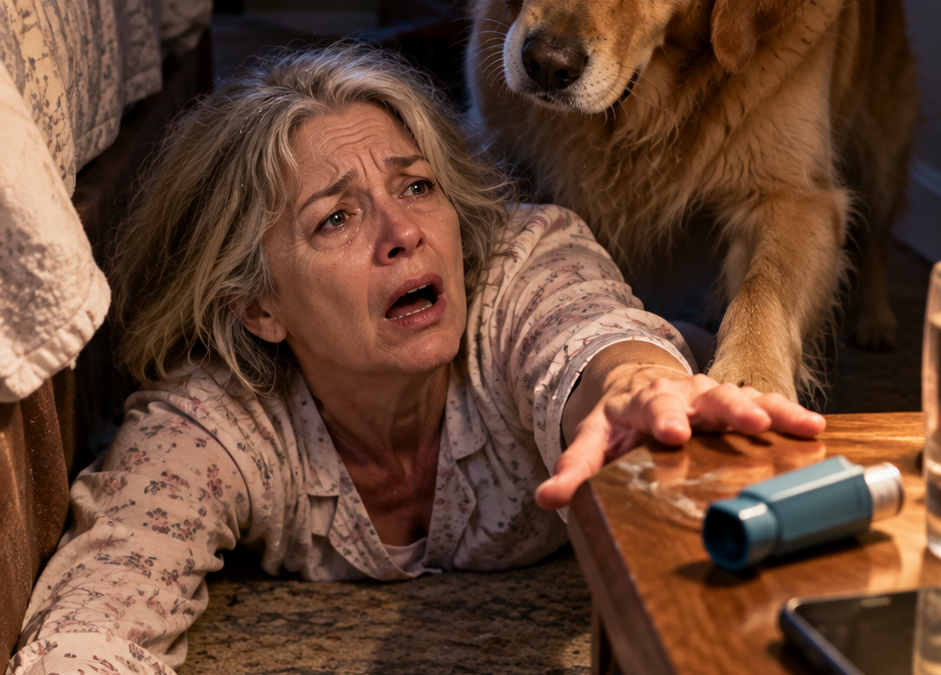
𝗣𝗔𝗥𝗧 𝟮
Rex stared at me.
I tried lifting my left hand toward the nightstand.
My fingers barely rose.
The room had started blurring at the edges.
Rex followed my movement.
He looked at my hand.
Then at the nightstand.
Then at me.
Again.
Table.
Me.
Something in his body changed.
He stood.
Moved toward the nightstand.
I wanted to say yes.
Couldn’t.
The inhaler sat near the lamp.
Small.
Light.
Plastic.
Nothing like the toys I’d trained him to retrieve.
Nothing like a shoe.
Nothing that smelled strongly of me, except perhaps from years of handling.
And it was too high for him to simply grab.
Rex rose onto his hind legs.
His front paws hit the edge of the table.
Claws scraped wood.
I heard objects shift.
He could not see the surface.
The table was just high enough that his nose barely reached the edge.
He dropped back down.
I tried breathing.
Almost nothing.
My chest felt hot now.
Not metaphorically.
Burning.
As if my lungs were trying to drag air through fire.
“Bring.”
The word barely existed.
Rex jumped again.
Front paws on the table.
Scrape.
Drop.
Nothing.
He looked at me.
I looked toward the inhaler.
If he knocked everything off, that was fine.
Lamp.
Phone.
Clock.
I didn’t care.
I needed that small piece of plastic.
Rex backed away.
For one second, I thought he had given up.
Then he ran forward.
Jumped.
His whole eighty-four-pound body struck the table.
The wood shook.
The lamp rattled.
Nothing fell.
He landed.
Backed up.
Again.
Impact.
The alarm clock shifted.
My phone moved closer to the edge.
The inhaler stayed.
“Come on.”
No voice.
Only thought.
Come on, Rex.
Again.
He hit the table a third time.
The lamp tilted.
Recovered.
Fourth.
The lamp fell.
I heard the shade hit carpet.
Then the base.
No glass breaking.
Rex immediately investigated what had fallen.
Lamp.
Not useful.
He turned back.
I had known him three years, and until that moment I had never seen such concentration in him.
He was not frantic.
That is important.
He could have become frightened by my breathing.
Could have barked.
Could have paced.
Could have climbed over me.
Instead, he was solving something.
The command had told him there was an object.
My eyes, my hand, my body had told him the direction.
The table was blocking him.
So he kept trying.
Fifth attempt.
His shoulder hit the edge harder.
Something small rolled.
A familiar plastic rattle.
My heart seemed to stop.
The inhaler appeared at the edge.
Fell.
Hit the carpet.
Rex was on it before it stopped rolling.
He lowered his head.
I suddenly experienced a new fear.
His jaws.
A German Shepherd’s mouth is not delicate by design.
He could crush the inhaler in one bite.
Puncture it.
Damage the canister.
Carry it away.
But Rex opened his mouth.
Picked it up.
Carefully.
So carefully.
Like he’d somehow understood that this object was different.
He turned toward me.
“Bring.”
I did not know whether any sound came out.
He came.
Three steps.
Four.
Then lowered his head and dropped the inhaler beside my face.
It landed inches from my left hand.
Too far.
That sounds impossible.
It wasn’t.
When you cannot lift your shoulder properly and your body is deprived of air, three inches can be a distance.
I tried.
My fingers scraped carpet.
Missed.
Rex watched.
I tried again.
Nothing.
The inhaler was right there.
I wanted to scream.
Rex looked down.
Looked at me.
Looked at the inhaler.
Then he did something I had never trained him to do.
Something no command covered.
He lowered his nose.
Touched the inhaler.
Pushed.
It rolled.
Once.
Stopped against my fingers.
He pushed again.
The plastic slid into the curve of my palm.
My fingers closed.
I don’t remember deciding to close them.
I just felt it.
Cold plastic.
Mine.
I brought it toward my mouth.
That motion hurt my shoulder so badly that spots flashed across my vision.
I didn’t care.
I used it.
First breath.
Almost nothing.
The medication entered, but my lungs still felt sealed.
I waited.
Too long.
Probably only seconds.
Again.
A little more.
The airway shifted.
Not open.
Not normal.
Enough that air reached deeper.
I inhaled again.
For the first time since falling, I felt a real breath enter my lungs.
Small.
Ragged.
But real.
I cried.
Not emotionally at first.
Physically.
Tears just ran down my face from strain.
I took another breath.
Then another.
Each one slightly better.
My chest slowly began to release.
Like a lock turning one millimeter at a time.
Rex sat directly in front of me.
He did not bark.
Did not lick my face.
Did not wag wildly.
His tail moved slowly against the carpet.
Once.
Twice.
His eyes never left me.
I have thought about those eyes many times since.
People often describe dogs as concerned or worried, and I know we project human emotions onto them.
But whatever Rex understood, he knew the emergency was not finished.
He watched each breath.
Literally.
His gaze moved with my chest.
In.
Out.
Pause.
In.
I leaned against the wall.
My shoulder throbbed.
My entire body felt weak.
But air continued moving.
“Good boy.”
This time, sound came out.
Rough.
Tiny.
Rex stood immediately.
His ears lifted.
“Good boy.”
He stepped closer.
Touched his nose to my cheek.
I wrapped my left arm around his neck as best I could.
“Good boy.”
That was all I had language for.
It didn’t come close.
I stayed on the floor.
Getting back into bed seemed impossible.
My shoulder hurt too much.
I was afraid standing might trigger another episode or make me faint.
The safe choice would have been to call someone once I could breathe well enough.
I know that now.
At the time, exhaustion took over.
Anyone who has experienced a severe asthma attack knows what happens afterward.
The fight drains you.
Your chest hurts.
Your muscles hurt.
Your head pounds.
You feel as though you’ve been running while lying still.
I kept the inhaler clenched in my left hand.
Rex circled me.
Then lay down.
I rested my head against something warm.
At first, I thought I’d somehow pulled a pillow from the bed.
Then I heard a heartbeat.
Boom.
Boom.
Boom.
Rex.
He had placed his body beside me.
His side under my head.
His belly warm against my cheek.
I shifted slightly.
He did not move away.
The sound of his heart was steady.
Completely different from mine.
Mine felt frantic.
His was slow.
Regular.
Boom.
Boom.
I began matching my breathing to it.
In.
Out.
Boom.
In.
Out.
Boom.
It gave me something to follow.
A rhythm.
The room stopped spinning.
I don’t know when I fell asleep.
Probably sometime after three.
Maybe later.
I remember waking briefly once.
Rex’s body still beneath my head.
The inhaler still in my hand.
Darkness.
Then sleep again.
When I opened my eyes fully, the clock showed 5:30.
Early morning light had begun slipping around the edges of the curtains.
My first thought was:
I’m breathing.
A normal breath.
Not perfect.
But easy enough that I didn’t have to think about it.
My second thought was the inhaler.
It was still in my hand.
But something was strange.
It was warm.
Not room temperature.
Warm like skin.
I looked down.
Rex was lying on the carpet beside me.
His head rested partly against my chest.
His eyes were open.
He was watching me.
At first, I smiled.
Then I realized something.
He had not been sleeping.
His ears were angled toward my chest.
Every time I inhaled, they moved slightly.
Every exhale.
Movement.
Rex had stayed awake.
How long?
I don’t know exactly.
Maybe from 1:47 until 5:30.
Nearly four hours.
Possibly he dozed in small moments.
I cannot prove otherwise.
But when I looked at him, he looked exhausted in a way I recognized.
His eyes were heavy.
His head low.
But still focused.
Then I saw his front paw.
It was resting on top of my left hand.
The same hand holding the inhaler.
A large German Shepherd paw covering my fingers.
I stared.
That was why the inhaler felt warm.
My hand had been trapped between his paw and my body heat for hours.
It looked almost absurd.
Almost funny.
Then the meaning of the whole night reached me at once.
Rex had gotten the inhaler.
Pushed it into my hand.
Stayed beside me.
Given me his body as a pillow.
And remained close enough to monitor every breath until morning.
I started crying.
This time not from asthma.
Not pain.
Something else.
Something I still don’t have a perfect word for.
Gratitude is too small.
Relief isn’t enough.
Love sounds too familiar.
It was the feeling of suddenly understanding that another living creature had treated your continued existence as his responsibility.
Not because anyone ordered him.
Not because there was a reward.
Because you mattered to him.
I put my hand on his head.
“Rex.”
He lifted his eyes.
“You stayed awake.”
He licked one finger.
Once.
Then, as if that small acknowledgement completed something, he finally closed his eyes.
He slept.
Only then.
After I was awake.
After I was breathing normally.
After the inhaler was in my hand.
I remained on the floor another ten minutes.
I didn’t want to move him.
My shoulder still hurt badly.
I would later have it examined.
Bruising.
Strain.
Nothing broken.
At that moment, it barely mattered.
I stroked Rex’s back while he slept.
His body was heavy against my leg.
His breathing deepened almost immediately.
He was exhausted.
I thought about the things people had said when I adopted him.
German Shepherds are intense.
Be careful with that breed.
They’re protective.
They’re too strong for older people.
They can be dangerous if you don’t handle them properly.
Some of those statements contain practical truth.
German Shepherds are powerful animals.
They need training.
Exercise.
Structure.
Any large dog deserves responsible handling.
But that morning, looking at Rex, I thought about how incomplete those warnings were.
Nobody had told me:
He may learn the sound of your breathing.
He may know something is wrong before anyone else could.
He may use those powerful jaws to carry something fragile without making a mark.
He may stay awake for hours because your chest sounds different.
He may place his body beneath your head when you are too weak to climb back into bed.
Dangerous?
That word felt absurd in that moment.
At 5:45, I called my daughter Sarah.
She answered quickly.
“Mama?”
Her voice was thick with sleep.
“Why are you calling at five forty-five?”
Then instantly more alert.
“Are you okay?”
“I’m okay.”
“What happened?”
I looked at Rex.
He was asleep now.
Completely.
One paw twitched.
“Rex saved me.”
Silence.
“What?”
I told her.
Not beautifully.
I was tired.
I kept losing the sequence.
I told her about the fall.
The shoulder.
The asthma.
The inhaler.
The table.
Rex jumping.
Again.
Again.
The inhaler falling.
His mouth.
The way he nudged it into my hand.
By the time I finished, Sarah was crying.
“Oh my God, Mom.”
“I’m okay.”
“What if he hadn’t been there?”
I didn’t answer.
There was no answer I wanted to think about.
“You need to go to a doctor.”
“I know.”
“You could have died.”
“I know.”
“Mom.”
“I know.”
She took a breath.
Then said quietly, “That dog is an angel.”
I looked down at Rex.
His large body on the carpet.
Black-and-tan fur.
Heavy paws.
One ear slightly turned in sleep.
“No.”
“What?”
“He’s just a dog.”
Sarah was silent.
I continued.
“I think that’s the point.”
“What do you mean?”
“We keep saying things like that when dogs do something extraordinary.”
Angel.
Miracle.
Human-like.
As though being “just a dog” isn’t already enough.
“He isn’t an angel.”
My voice cracked.
“He’s Rex.”
I stroked his shoulder.
“And maybe we never understood what that meant.”
Sarah didn’t say anything for a long moment.
Then:
“Give him something ridiculous for breakfast.”
I laughed.
“I will.”
After we hung up, I made changes.
Practical changes first.
I moved the nightstand closer.
Very close.
Close enough that if I fell again, I could reach it from the floor.
I bought a second inhaler.
One stayed on the right.
One on the left.
I kept my phone where it could fall within reach more easily.
I spoke to my doctor.
Reviewed my asthma plan.
I did all the responsible things I should have done before.
I also changed how I trained Rex.
I began working intentionally with the inhaler.
Not during emergencies.
During calm afternoons.
I let him smell it.
Retrieve a practice object similar in size.
Bring it.
Place it in my hand.
Reward.
Again.
Again.
He learned quickly.
Of course he did.
The strange part was that after that night, I almost never needed the command.
If I coughed heavily in bed, Rex woke.
If my breathing became noisy, his head lifted.
Sometimes before I even considered it significant.
I do not claim he became a formally trained medical alert dog.
He didn’t.
I never certified him.
Never put a vest on him.
Never pretended he had specialized training he did not have.
He was simply Rex.
But he knew me.
That may have been enough.
For months afterward, I would wake in the night and see his silhouette beside the bed.
Ears up.
Watching.
At first, that made me feel guilty.
“Sleep.”
He would stare.
“Rex.”
Nothing.
“I’m fine.”
Sometimes he put his head back down.
Sometimes he didn’t.
Gradually, the fear I had always carried around nighttime asthma changed.
I had never admitted how much I feared sleeping alone.
Asthma is cruel partly because attacks can arrive when the world is quiet.
There are nights when every other person you love is somewhere else.
Every emergency system requires you to stay conscious enough to use it.
Rex altered that equation.
I still took precautions.
Still followed medical advice.
Still knew he could not replace emergency care.
But I no longer felt completely alone in the dark.
There was another pair of ears in the room.
Another body aware of mine.
That mattered more than I can explain.
People sometimes ask whether Rex understood he saved my life.
I don’t know.
Probably not in human terms.
He didn’t wake the next morning expecting a medal.
He didn’t behave differently.
When I finally got up that day, he ate breakfast.
Drank water.
Followed me into the kitchen.
Waited hopefully for something to fall from the counter.
Life resumed.
That simplicity moved me.
He had done something that changed the way I understood our relationship.
To him, it might simply have been:
Marguerite needed something.
I brought it.
She couldn’t breathe.
I stayed.
That was enough.
A few days after the incident, Sarah told Kevin and Denis.
My phone became unbearable.
Kevin:
“Mom, why didn’t you call us?”
“Because I couldn’t breathe, Kevin.”
Silence.
“Right.”
Denis:
“Can we install some emergency device?”
“Probably.”
“Do it.”
“I will.”
Then:
“Give Rex steak.”
“Everyone keeps saying that.”
“Because he’s earned steak.”
Rex received steak.
Too much.
He had no objections.
My children began talking about him differently after that.
Before, Rex had been “Mom’s dog.”
Afterward, he became part of family conversations like another person.
“How’s Rex?”
“Is Rex with you?”
“Did Rex eat?”
“Put Rex on video.”
I would aim the camera at him.
Rex would stare at the screen without interest.
Sarah once said, “That’s the dog who saved Grandma,” while showing him to her children.
I corrected her.
“That’s Rex.”
“Same thing.”
Maybe.
The story spread farther than I expected.
Neighbors heard.
Then friends.
People had questions.
Did he know what an inhaler was?
No.
Did he understand asthma?
Probably not.
Was he trained to do that?
Not specifically.
How did he know?
I don’t know.
That answer frustrated people.
Humans love explanations.
We are uncomfortable when instinct, learning, smell, routine, attachment, and chance all blend together.
I can tell you what I saw.
I said a known command.
Rex followed my gaze and limited movement.
He recognized the area I needed.
He knocked the object down.
He retrieved it gently.
When I couldn’t reach it, he pushed it closer.
Then he stayed.
Those are facts.
Anything beyond that becomes interpretation.
I don’t need more.
One woman I knew said, “German Shepherds are naturally protective.”
Maybe.
Another said, “He sensed your fear.”
Maybe.
A trainer told me dogs are excellent at combining learned behavior with environmental cues.
Probably.
None of those explanations reduce what happened.
If anything, they make it more impressive.
Rex wasn’t performing magic.
He was using everything he knew about me.
My voice.
My breathing.
My gestures.
The command.
The room.
The object.
And somehow, under pressure, he made the right choices.
I think about that when people underestimate animals.
We often judge intelligence by how closely another creature thinks like us.
Maybe that’s the wrong measure.
Rex didn’t need to understand asthma.
He needed to understand me.
He did.
Months later, I accidentally dropped my inhaler in the living room.
It rolled beneath a chair.
Before I could bend down, Rex stood.
He looked at it.
Looked at me.
Then retrieved it.
Placed it beside my foot.
I laughed.
“Show-off.”
His tail moved.
“Bring it to my hand.”
I held my palm out.
He picked it up.
Placed it directly there.
Very gently.
I cried again.
I was becoming embarrassing.
There is another part of that night I rarely tell people.
After the emergency passed, after the medication worked, after I knew I was going to live, I felt ashamed.
Not logically.
Emotionally.
Ashamed that I had needed help.
That at fifty-nine, I had fallen from bed.
Couldn’t stand.
Couldn’t reach eight inches upward.
Couldn’t save myself.
Independence had always mattered to me.
Especially after my husband was gone.
I had spent years proving I could manage the house.
Bills.
Repairs.
Health.
Life.
Then one bad minute on a bedroom floor stripped that illusion completely.
Rex helped me understand something I had resisted.
Needing help is not failure.
Receiving help does not make you weak.
Sometimes survival is collaborative.
Sometimes you breathe because something outside yourself reaches what you cannot.
That lesson became larger than asthma.
I started accepting help more easily.
When Sarah offered to visit, I stopped saying she didn’t need to.
When Kevin wanted to install grab bars in one bathroom after hearing about the fall, I let him.
When Denis suggested an emergency call device, I didn’t argue for three days.
Only one.
Aging does not announce itself politely.
Neither does illness.
Rex had no pride about helping me.
Why should I have pride about being helped?
Every night, our routine changed slightly.
Rex had always slept beside the bed.
After 1:47, I stopped telling him to get down when he climbed onto it.
The first night afterward, he jumped up.
Turned in a circle.
Lay beside me.
His head rested heavily near my shoulder.
I looked at him.
“You know you’re not supposed to be here.”
His eyes closed.
“No response?”
Nothing.
“Fine.”
He stayed.
I placed one hand against his chest.
Breathing.
Steady.
Then mine.
Steady too.
I slept.
Over time, the night became less frightening.
Not because I believed Rex made me invincible.
He didn’t.
I still had asthma.
Still needed medication.
Still had to be careful.
But fear had changed shape.
Before, nighttime represented what could happen when nobody was watching.
Afterward, I knew somebody was watching.
Even if that somebody had four paws.
One evening, a neighbor visited.
She liked Rex but always seemed slightly nervous around him.
He was large.
I understood.
She sat on my couch while Rex lay nearby.
At some point, she said, “I don’t know how you sleep with a German Shepherd that size in your bed.”
I smiled.
“Very well.”
“Aren’t you afraid he’ll roll over on you?”
“No.”
She laughed.
“I’m serious.”
“So am I.”
I looked at Rex.
“He spent four hours making sure I kept breathing.”
She stopped smiling.
I told her the story.
When I finished, she looked at him differently.
That happened often.
People saw the same body.
Same teeth.
Same eighty-four pounds.
But context changed perception.
Rex lifted his head.
She slowly reached out.
He sniffed her hand.
Then let her touch his forehead.
“He’s gentle.”
“Yes.”
She smiled.
“I guess I’ve been a little afraid of him.”
“That’s okay.”
I meant it.
Fear isn’t always cruelty.
Sometimes it is unfamiliarity.
The problem begins when we refuse to look again after learning more.
Rex taught me that too.
There is a phrase people repeat:
We don’t deserve dogs.
I used to say it.
After that night, I stopped.
It sounds humble, but I don’t think it’s quite right.
Dogs don’t need our guilt.
They need us to deserve them through our behavior.
Feed them.
Train them.
Protect them.
Notice them.
Stay when they’re old.
Take them to the veterinarian.
Learn what frightens them.
Give them structure.
Give them patience.
Love isn’t worship.
It’s responsibility.
Rex had taken responsibility for me that night in the only way he knew.
I owed him the same.
So I paid more attention.
Not because I had ignored him before.
But because once someone saves your life, ordinary care feels different.
I noticed when he slowed during hot Tucson afternoons.
We walked earlier.
I noticed stiffness after long naps.
We discussed it with the veterinarian.
I changed his food as he aged.
Bought a better bed.
Then accepted that he preferred mine.
I brushed him more.
Talked to him constantly.
He listened to everything.
Complaints about utility bills.
Arguments I’d had over the phone.
Stories about my husband.
Memories of the children.
Once I said, “You know more family secrets than anyone alive.”
Rex yawned.
“Good. Keep them.”
On the anniversary of that night, I woke accidentally around 1:40.
The clock glowed.
1:40.
I stared at it.
My chest was fine.
Room quiet.
Rex lay beside me.
I stayed awake.
1:45.
1:46.
1:47.
Nothing happened.
Just another minute.
That should have felt meaningless.
Instead, I started crying.
Rex opened his eyes.
His head lifted immediately.
“Fine.”
He stood.
“No, no.”
I laughed through tears.
“I’m breathing.”
He moved closer anyway.
I put my hand on his face.
“We made it a year.”
Of course, he had no idea what I meant.
He licked my wrist.
Then lay back down.
I listened to him breathe.
One year earlier, that minute had almost been the dividing line at the end of my life.
Now it simply passed.
1:48.
Time continued.
There is something profoundly beautiful about the next minute after a crisis.
And the next.
We rarely notice them.
Most life happens there.
After.
The morning after Rex saved me, I thought the story was about an extraordinary dog retrieving an inhaler.
Years later, I think that is only half of it.
The more important part was what happened after he delivered it.
He stayed.
Had he dropped the inhaler and returned to sleep, he still would have saved me.
But he didn’t.
He watched.
He listened.
He put his body beneath my head.
He kept one paw over my hand.
He waited until I was awake before allowing himself to sleep.
That is the part I carry deepest.
Retrieval was training plus intelligence.
Staying was relationship.
People often think love reveals itself through dramatic acts.
Sometimes it does.
But the dramatic act lasts a minute.
Staying can last hours.
Years.
A lifetime.
My husband taught me that.
Then Rex reminded me.
Sarah once asked, “Do you think Rex was scared?”
I had never considered it.
“I don’t know.”
“He must’ve known something was wrong.”
“Yes.”
“What if he thought you were dying?”
I looked at him.
He was asleep near the patio door.
“Then he didn’t leave.”
That was all I could say.
I don’t know whether dogs imagine death.
I don’t know whether Rex understood the stakes.
But he understood distress.
He understood abnormal breathing.
He understood that I couldn’t get up.
And rather than retreat from something frightening, he moved closer.
That is courage in any language.
As Rex got older, people sometimes commented on the gray appearing around his muzzle.
“He’s aging.”
I hated hearing it.
Then I reminded myself of what I had learned.
Loving someone includes accepting time.
Rex would not always be the five-year-old dog who knocked my inhaler from the table.
His legs would slow.
His hearing might change.
His eyes might cloud.
Maybe someday I would become the one staying awake for him.
That thought didn’t frighten me the way it once would have.
It felt fair.
He had listened to my breathing.
I could listen to his.
He had brought me what I couldn’t reach.
I could carry him when he couldn’t manage something alone.
That’s what relationships become when they’re real.
Roles change.
Love doesn’t.
One afternoon, I found the old lamp that had fallen from the nightstand.
The base still had a small scratch from hitting the floor.
I almost replaced it.
Instead, I kept it.
Not as some sacred object.
Just a reminder.
There was the mark from Rex’s fourth attempt.
Four tries.
Then five.
I sometimes run my finger over that scratch.
Persistence leaves evidence.
The inhaler itself eventually expired.
I kept that too for longer than I should admit.
Sarah finally said, “Mom, you are not building a museum.”
“I’m not.”
“You have the lamp.”
“It’s functional.”
“You have the old inhaler.”
“It’s sentimental.”
“That is a museum.”
I threw the expired inhaler away.
Eventually.
The memory did not need plastic.
Now, when people meet Rex and say he’s beautiful, I agree.
When they say he’s big, I agree.
When they say German Shepherds can be intimidating, I agree.
Then sometimes, if the conversation feels right, I tell them:
“Those jaws once carried my inhaler more gently than I could have.”
They usually think I’m joking.
Then I tell the story.
I don’t tell it because I want them to worship Rex.
I tell it because I want people to look more carefully at animals.
They’re not tiny humans in fur.
They’re something else.
Something with senses we don’t share.
Learning patterns we underestimate.
Attachments we sometimes trivialize.
That difference is what makes what Rex did so remarkable.
He did not need to become human to save me.
He needed to be exactly what he was.
A dog who knew his person.
That is enough.
Today, my nightstand is different.
Closer.
Organized.
Two inhalers.
Phone.
Water.
Emergency numbers.
Everything within reach.
My doctor would approve.
Rex still sleeps beside me.
Sometimes on the bed.
Sometimes on the floor if the Arizona night is warm.
Before turning off the light, I check my inhaler.
Then I check him.
“Ready?”
His ears move.
“For what?”
No answer.
“Exactly.”
I lie down.
The room becomes dark.
For a long time after the incident, I couldn’t fall asleep without touching him.
A foot against his back.
A hand on his shoulder.
Now I don’t always need to.
Trust becomes quieter with time.
But if I wake in the night, I usually hear him.
Breathing.
Sometimes snoring.
Sometimes moving in dreams.
And every once in a while, when my breathing changes even slightly, Rex’s head rises.
I see two eyes in the dark.
Watching.
“Fine.”
He waits.
“I’m fine.”
Sometimes he believes me.
Sometimes he comes closer to check.
I let him.
At fifty-nine, I thought independence meant being able to handle every emergency alone.
Rex taught me a better definition.
Strength is also knowing what to do when you cannot reach the thing you need.
Sometimes you call.
Sometimes you crawl.
Sometimes you whisper one word into the darkness and trust that someone who loves you will understand enough.
“Bring.”
That word sounds different to me now.
It once meant fetch the ball.
Bring the rope.
Bring my slipper.
That night, it meant:
Please help me.
Please understand.
Please don’t let this be the end.
Rex didn’t understand those words.
He understood enough.
And when the inhaler was still too far from my hand, he solved the final distance himself.
That part still astonishes me.
The nose.
The small push.
Plastic rolling.
My fingers closing.
Maybe it was chance.
Maybe he simply saw me reaching.
Maybe dogs understand more than we realize.
I don’t need to choose.
I know what happened.
I was on the floor.
I couldn’t breathe.
I couldn’t reach my medication.
Rex put it in my hand.
Everything after that is explanation.
The fact remains.
Sometimes, on quiet mornings, I sit on the edge of the bed and look at the floor where I fell.
It is just carpet.
No mark.
Nothing dramatic.
The room gives no evidence that one night death and survival were separated by inches.
Rex will walk through that same spot.
Maybe turn once.
Lie down.
To him, perhaps, it’s just where he sleeps.
To me, it became sacred in the most ordinary way.
Not because something supernatural happened there.
Because something loyal did.
I fell.
He came.
I could not reach.
He reached.
I could not stay awake.
He did.
That is the entire story.
Everything important fits inside those sentences.
At 1:47 in the morning, I thought I was alone in a dark room with my lungs closing.
At 5:30, I woke with my inhaler warm in my hand and Rex’s head resting against my chest.
Between those two times, the world did not change.
Tucson slept.
Cars passed somewhere outside.
My children remained miles away.
The sun moved toward the horizon like it does every morning.
But inside one small house on the east side of the city, an eighty-four-pound German Shepherd decided my breathing mattered enough to watch.
Every inhale.
Every exhale.
Until morning.
I still think about the first time I saw Rex at the shelter.
Other people walked past him.
Too large.
Too serious.
German Shepherd.
Maybe too much dog.
I stopped.
He came toward the gate.
Sat.
Waited.
I thought I was choosing him.
That is what adopters like to believe.
Maybe I was.
But three years later, on a bedroom floor, Rex chose me again.
Not once.
Five times against a nightstand.
One careful grip around an inhaler.
One push into my hand.
Four hours awake beside me.
Choice after choice.
Stay.
Watch.
Help.
Wait.
Sometimes love is not one grand feeling.
Sometimes it is a series of decisions made when no one is watching.
Rex made his in the dark.
These days, when Sarah calls and asks how I’m doing, she still asks about him too.
“Is the hero there?”
I look at Rex.
Usually sleeping.
“He’s here.”
She says, “Tell him I love him.”
“I will.”
I don’t tell him he’s a hero.
I don’t think he needs that word.
I tell him the words he understands.
“Good boy.”
“Come here.”
“Stay.”
“Let’s go.”
And sometimes, when I hold my inhaler and remember the cold plastic rolling toward my hand, I say one more.
“Thank you.”
He usually looks at me.
Tail moving once.
Maybe twice.
Then he puts his head on my leg.
That’s enough.
One day, Rex will not be beside my bed.
I know that.
I hate knowing it.
But love that refuses to acknowledge endings becomes fear.
I don’t want to spend our remaining years afraid.
I want to notice them.
The heavy paws on my floor.
The fur on my blankets.
The way he checks my face when I cough.
The way his ears move when I whisper his name.
The way his breathing fills the room after he finally falls asleep.
He once spent a night making sure I reached morning.
The least I can do is make sure every morning he has with me feels like home.
So I let him on the bed now.
No rules.
He climbs up, circles, drops his enormous body beside mine.
Sometimes his head lands on my shoulder.
Sometimes directly across my legs.
I complain because that’s part of our routine.
“You’re eighty-four pounds.”
His eyes close.
“You have your own bed.”
Nothing.
“This is unreasonable.”
Tail movement.
Then I turn off the light.
I put one hand on him.
Breathe in.
Breathe out.
Rex listens.
And sometimes I listen to him too.
Two living creatures in a dark room.
Neither invincible.
Neither completely independent.
Both trusting the other to still be there when morning comes.
That night at 1:47, I learned something I hope I never forget.
Love is not measured by how loudly someone says they need you.
Sometimes they cannot speak at all.
It is measured by who notices.
Who moves closer.
Who keeps trying when the first attempt fails.
Who carries something fragile without breaking it.
Who stays awake when you cannot.
At 5:30 that morning, my inhaler was warm in my hand.
Rex was finally closing his eyes.
And for the first time in a long time, I understood exactly what home meant.
It was not the house my husband and I bought in 2008.
It was not the bed.
The walls.
The familiar desert outside.
Home was the living creature beside me who had listened to every breath until he knew I was going to keep taking them.
I stroked his head.
He sighed.
Then slept.
I stayed there on the floor a little longer, breathing normally.
In.
Out.
In.
Out.
And every breath felt like something Rex had carried back to me in his mouth.
𝗧𝗛𝗘 𝗘𝗡𝗗
At 1:47 A.M., I Fell Out of Bed Without My Inhaler and Realized the Only One Who Could Reach It Was My Dog
I could see my inhaler on the nightstand, less than a foot above me, but I could not lift my arm high enough to reach it.
My chest was closing, my voice had disappeared, and Rex had never been trained to understand what I needed.
Then I whispered one word into the darkness and heard his claws hit the floor.
My name is Marguerite.
I am fifty-nine years old, and I live on the east side of Tucson, Arizona, in the small house my husband and I bought in 2008.
I know every room in that house.
Every loose tile.
Every window that rattles when the desert wind gets strong.
Every shadow the moon makes across the bedroom wall.
For years, that familiarity made me feel safe.
Then, at exactly 1:47 one morning, my own bedroom became a place where I could have died less than two feet from the medicine that could save me.
I know the exact time because my alarm clock casts pale blue numbers into the room all night.
1:47.
I saw them the moment my eyes opened.
At first, I didn’t understand why I was awake.
There had been no nightmare.
No sound.
No phone call.
Just a sudden violent jolt through my body, the kind that makes you sit upright before your brain has caught up.
Except I didn’t sit upright.
I tried.
My balance shifted.
The edge of the mattress disappeared beneath me.
And I fell.
My right shoulder hit first.
The pain was immediate.
Sharp enough to make my vision flash white.
Then my hip hit the floor.
For a second, I lay completely still.
Not because I was calm.
Because my body needed a moment to understand what had happened.
Then I tried to inhale.
Nothing.
Not nothing exactly.
A thin, high whistle.
The sound of air trying to squeeze through something almost completely closed.
Anyone who has severe asthma knows the fear I’m talking about.
It is not the same as simply being short of breath after running.
It is not being winded.
It is the sensation that your chest has turned into a locked room and someone has taken the key.
You know air exists.
You can feel your body demanding it.
Your mouth opens.
Your lungs pull.
But something refuses to let enough through.
I rolled partly onto my back.
Pain shot through my shoulder.
My first thought was the inhaler.
Nightstand.
Right side of the bed.
Always there.
I looked up.
There it was.
Small.
Blue and gray plastic.
Maybe eight inches above me.
Possibly less.
It might as well have been on the roof.
I lifted my right arm.
Pain exploded through the shoulder.
I dropped it.
“Help.”
At least, that was the word I tried to say.
What came out was air and almost no sound.
A hiss.
My heart began racing.
I reached with my left hand.
Too far.
I tried pushing myself onto my knees.
My chest locked harder.
The room tilted.
I collapsed again.
“Phone.”
Also on the nightstand.
Beside the inhaler.
I almost laughed.
I didn’t have enough breath.
Two things that could help me.
Both inches away.
Both unreachable.
That is when panic truly arrived.
I have lived with asthma for years.
I know what I am supposed to do.
Stay calm.
Control your breathing.
Use medication.
Call for help if symptoms become severe.
Excellent advice when you are sitting upright with your inhaler in your hand.
On the floor, in pain, unable to speak, calm becomes another thing you cannot reach.
My chest burned.
I tried inhaling again.
The whistle grew tighter.
My fingertips began tingling.
I looked toward the bedroom doorway.
Dark.
No one.
I lived alone.
My husband had been gone for several years by then.
My children lived far away.
Sarah.
Kevin.
Denis.
All of them sleeping somewhere else.
Thousands of miles might as well have separated us.
I remember thinking of them all at once.
Not clearly.
Images.
Sarah laughing.
Kevin standing in my kitchen the previous Christmas.
Denis calling from an airport.
And then a much more practical thought cut through everything.
Rex.
I had adopted Rex three years earlier from a shelter.
Five-year-old male German Shepherd.
Black and tan.
Eighty-four pounds.
Thirty-eight kilos according to the last vet record.
Large head.
Heavy paws.
Deep chest.
The kind of dog strangers sometimes crossed the sidewalk to avoid.
He had been unwanted when I first saw him.
Not because he had bitten anyone.
Not because there was anything wrong with him.
He was simply big.
Serious-looking.
A German Shepherd.
People make assumptions about dogs the same way they make assumptions about humans.
Dangerous.
Difficult.
Too much responsibility.
I saw something else.
A dog sitting quietly at the back of his kennel watching every movement around him.
He didn’t jump at the gate.
Didn’t bark.
Didn’t perform.
When I stopped, he came forward slowly and sat.
That was all.
I asked to meet him.
Three days later, he was in my house.
For three years, Rex slept beside my bed almost every night.
One thousand ninety-five nights, if you count exactly.
I never had until afterward.
Usually he slept on the floor.
He had a thick bed of his own, but half the time he ignored it and stretched out on the rug where one paw could touch the bed frame.
Occasionally, when I was restless, he climbed onto the mattress without permission.
He would settle near my feet as if hoping I wouldn’t notice eighty-four pounds of German Shepherd appearing beside me.
That night, apparently, he had climbed up.
I didn’t realize it until I fell.
Then I heard movement above me.
Claws against bedding.
A heavy body shifting.
“Rex.”
Almost no sound.
He appeared at the edge of the bed.
Dark head against darker room.
His ears lifted.
I tried again.
“Rex.”
His head lowered.
Then I remembered the word.
A command I had taught him three years earlier.
Not for asthma.
Not for emergencies like this.
Just something useful.
Retrieve.
In my house, the command was “bring.”
One syllable.
Clear.
Simple.
I taught it because Rex loved carrying things.
Balls.
Rope toys.
My slippers.
Once, an entire dish towel.
I began turning it into a game.
I would point at something.
“Bring.”
If he picked it up and carried it to me, reward.
Eventually he understood.
Bring meant:
Get the thing I’m indicating and put it near me.
I had used the command once in a real emergency.
Months earlier, I fell from a short ladder while trying to reach something in a cabinet.
Nothing serious.
Bruised leg.
Embarrassed pride.
My phone had landed several feet away.
Rex was nearby.
I pointed.
“Bring.”
He picked up the phone by the case and brought it.
Afterward, I thought it was clever.
Useful.
I never imagined my life might depend on the same word.
On the bedroom floor, I whispered it.
“Bring.”
Rex jumped down.
His paws hit the floor beside me.
The sound was enormous in the quiet room.
He came directly to my face.
His nose touched my cheek.
Warm.
Wet.
He sniffed hard.
Then my mouth.
My chest.
He knew something was wrong.
Dogs notice changes humans miss.
Smell.
Body tension.
Movement.
Breathing.
I had once read that some dogs can detect shifts in respiration before a person fully understands what is happening.
At the time, I’d thought it was interesting.
On the floor, I needed it to be true.
“Bring.”
Rex stared at me.
I tried lifting my left hand toward the nightstand.
My fingers barely rose.
The room had started blurring at the edges.
Rex followed my movement.
He looked at my hand.
Then at the nightstand.
Then at me.
Again.
Table.
Me.
Something in his body changed.
He stood.
Moved toward the nightstand.
I wanted to say yes.
Couldn’t.
The inhaler sat near the lamp.
Small.
Light.
Plastic.
Nothing like the toys I’d trained him to retrieve.
Nothing like a shoe.
Nothing that smelled strongly of me, except perhaps from years of handling.
And it was too high for him to simply grab.
Rex rose onto his hind legs.
His front paws hit the edge of the table.
Claws scraped wood.
I heard objects shift.
He could not see the surface.
The table was just high enough that his nose barely reached the edge.
He dropped back down.
I tried breathing.
Almost nothing.
My chest felt hot now.
Not metaphorically.
Burning.
As if my lungs were trying to drag air through fire.
“Bring.”
The word barely existed.
Rex jumped again.
Front paws on the table.
Scrape.
Drop.
Nothing.
He looked at me.
I looked toward the inhaler.
If he knocked everything off, that was fine.
Lamp.
Phone.
Clock.
I didn’t care.
I needed that small piece of plastic.
Rex backed away.
For one second, I thought he had given up.
Then he ran forward.
Jumped.
His whole eighty-four-pound body struck the table.
The wood shook.
The lamp rattled.
Nothing fell.
He landed.
Backed up.
Again.
Impact.
The alarm clock shifted.
My phone moved closer to the edge.
The inhaler stayed.
“Come on.”
No voice.
Only thought.
Come on, Rex.
Again.
He hit the table a third time.
The lamp tilted.
Recovered.
Fourth.
The lamp fell.
I heard the shade hit carpet.
Then the base.
No glass breaking.
Rex immediately investigated what had fallen.
Lamp.
Not useful.
He turned back.
I had known him three years, and until that moment I had never seen such concentration in him.
He was not frantic.
That is important.
He could have become frightened by my breathing.
Could have barked.
Could have paced.
Could have climbed over me.
Instead, he was solving something.
The command had told him there was an object.
My eyes, my hand, my body had told him the direction.
The table was blocking him.
So he kept trying.
Fifth attempt.
His shoulder hit the edge harder.
Something small rolled.
A familiar plastic rattle.
My heart seemed to stop.
The inhaler appeared at the edge.
Fell.
Hit the carpet.
Rex was on it before it stopped rolling.
He lowered his head.
I suddenly experienced a new fear.
His jaws.
A German Shepherd’s mouth is not delicate by design.
He could crush the inhaler in one bite.
Puncture it.
Damage the canister.
Carry it away.
But Rex opened his mouth.
Picked it up.
Carefully.
So carefully.
Like he’d somehow understood that this object was different.
He turned toward me.
“Bring.”
I did not know whether any sound came out.
He came.
Three steps.
Four.
Then lowered his head and dropped the inhaler beside my face.
It landed inches from my left hand.
Too far.
That sounds impossible.
It wasn’t.
When you cannot lift your shoulder properly and your body is deprived of air, three inches can be a distance.
I tried.
My fingers scraped carpet.
Missed.
Rex watched.
I tried again.
Nothing.
The inhaler was right there.
I wanted to scream.
Rex looked down.
Looked at me.
Looked at the inhaler.
Then he did something I had never trained him to do.
Something no command covered.
He lowered his nose.
Touched the inhaler.
Pushed.
It rolled.
Once.
Stopped against my fingers.
He pushed again.
The plastic slid into the curve of my palm.
My fingers closed.
I don’t remember deciding to close them.
I just felt it.
Cold plastic.
Mine.
I brought it toward my mouth.
That motion hurt my shoulder so badly that spots flashed across my vision.
I didn’t care.
I used it.
First breath.
Almost nothing.
The medication entered, but my lungs still felt sealed.
I waited.
Too long.
Probably only seconds.
Again.
A little more.
The airway shifted.
Not open.
Not normal.
Enough that air reached deeper.
I inhaled again.
For the first time since falling, I felt a real breath enter my lungs.
Small.
Ragged.
But real.
I cried.
Not emotionally at first.
Physically.
Tears just ran down my face from strain.
I took another breath.
Then another.
Each one slightly better.
My chest slowly began to release.
Like a lock turning one millimeter at a time.
Rex sat directly in front of me.
He did not bark.
Did not lick my face.
Did not wag wildly.
His tail moved slowly against the carpet.
Once.
Twice.
His eyes never left me.
I have thought about those eyes many times since.
People often describe dogs as concerned or worried, and I know we project human emotions onto them.
But whatever Rex understood, he knew the emergency was not finished.
He watched each breath.
Literally.
His gaze moved with my chest.
In.
Out.
Pause.
In.
I leaned against the wall.
My shoulder throbbed.
My entire body felt weak.
But air continued moving.
“Good boy.”
This time, sound came out.
Rough.
Tiny.
Rex stood immediately.
His ears lifted.
“Good boy.”
He stepped closer.
Touched his nose to my cheek.
I wrapped my left arm around his neck as best I could.
“Good boy.”
That was all I had language for.
It didn’t come close.
I stayed on the floor.
Getting back into bed seemed impossible.
My shoulder hurt too much.
I was afraid standing might trigger another episode or make me faint.
The safe choice would have been to call someone once I could breathe well enough.
I know that now.
At the time, exhaustion took over.
Anyone who has experienced a severe asthma attack knows what happens afterward.
The fight drains you.
Your chest hurts.
Your muscles hurt.
Your head pounds.
You feel as though you’ve been running while lying still.
I kept the inhaler clenched in my left hand.
Rex circled me.
Then lay down.
I rested my head against something warm.
At first, I thought I’d somehow pulled a pillow from the bed.
Then I heard a heartbeat.
Boom.
Boom.
Boom.
Rex.
He had placed his body beside me.
His side under my head.
His belly warm against my cheek.
I shifted slightly.
He did not move away.
The sound of his heart was steady.
Completely different from mine.
Mine felt frantic.
His was slow.
Regular.
Boom.
Boom.
I began matching my breathing to it.
In.
Out.
Boom.
In.
Out.
Boom.
It gave me something to follow.
A rhythm.
The room stopped spinning.
I don’t know when I fell asleep.
Probably sometime after three.
Maybe later.
I remember waking briefly once.
Rex’s body still beneath my head.
The inhaler still in my hand.
Darkness.
Then sleep again.
When I opened my eyes fully, the clock showed 5:30.
Early morning light had begun slipping around the edges of the curtains.
My first thought was:
I’m breathing.
A normal breath.
Not perfect.
But easy enough that I didn’t have to think about it.
My second thought was the inhaler.
It was still in my hand.
But something was strange.
It was warm.
Not room temperature.
Warm like skin.
I looked down.
Rex was lying on the carpet beside me.
His head rested partly against my chest.
His eyes were open.
He was watching me.
At first, I smiled.
Then I realized something.
He had not been sleeping.
His ears were angled toward my chest.
Every time I inhaled, they moved slightly.
Every exhale.
Movement.
Rex had stayed awake.
How long?
I don’t know exactly.
Maybe from 1:47 until 5:30.
Nearly four hours.
Possibly he dozed in small moments.
I cannot prove otherwise.
But when I looked at him, he looked exhausted in a way I recognized.
His eyes were heavy.
His head low.
But still focused.
Then I saw his front paw.
It was resting on top of my left hand.
The same hand holding the inhaler.
A large German Shepherd paw covering my fingers.
I stared.
That was why the inhaler felt warm.
My hand had been trapped between his paw and my body heat for hours.
It looked almost absurd.
Almost funny.
Then the meaning of the whole night reached me at once.
Rex had gotten the inhaler.
Pushed it into my hand.
Stayed beside me.
Given me his body as a pillow.
And remained close enough to monitor every breath until morning.
I started crying.
This time not from asthma.
Not pain.
Something else.
Something I still don’t have a perfect word for.
Gratitude is too small.
Relief isn’t enough.
Love sounds too familiar.
It was the feeling of suddenly understanding that another living creature had treated your continued existence as his responsibility.
Not because anyone ordered him.
Not because there was a reward.
Because you mattered to him.
I put my hand on his head.
“Rex.”
He lifted his eyes.
“You stayed awake.”
He licked one finger.
Once.
Then, as if that small acknowledgement completed something, he finally closed his eyes.
He slept.
Only then.
After I was awake.
After I was breathing normally.
After the inhaler was in my hand.
I remained on the floor another ten minutes.
I didn’t want to move him.
My shoulder still hurt badly.
I would later have it examined.
Bruising.
Strain.
Nothing broken.
At that moment, it barely mattered.
I stroked Rex’s back while he slept.
His body was heavy against my leg.
His breathing deepened almost immediately.
He was exhausted.
I thought about the things people had said when I adopted him.
German Shepherds are intense.
Be careful with that breed.
They’re protective.
They’re too strong for older people.
They can be dangerous if you don’t handle them properly.
Some of those statements contain practical truth.
German Shepherds are powerful animals.
They need training.
Exercise.
Structure.
Any large dog deserves responsible handling.
But that morning, looking at Rex, I thought about how incomplete those warnings were.
Nobody had told me:
He may learn the sound of your breathing.
He may know something is wrong before anyone else could.
He may use those powerful jaws to carry something fragile without making a mark.
He may stay awake for hours because your chest sounds different.
He may place his body beneath your head when you are too weak to climb back into bed.
Dangerous?
That word felt absurd in that moment.
At 5:45, I called my daughter Sarah.
She answered quickly.
“Mama?”
Her voice was thick with sleep.
“Why are you calling at five forty-five?”
Then instantly more alert.
“Are you okay?”
“I’m okay.”
“What happened?”
I looked at Rex.
He was asleep now.
Completely.
One paw twitched.
“Rex saved me.”
Silence.
“What?”
I told her.
Not beautifully.
I was tired.
I kept losing the sequence.
I told her about the fall.
The shoulder.
The asthma.
The inhaler.
The table.
Rex jumping.
Again.
Again.
The inhaler falling.
His mouth.
The way he nudged it into my hand.
By the time I finished, Sarah was crying.
“Oh my God, Mom.”
“I’m okay.”
“What if he hadn’t been there?”
I didn’t answer.
There was no answer I wanted to think about.
“You need to go to a doctor.”
“I know.”
“You could have died.”
“I know.”
“Mom.”
“I know.”
She took a breath.
Then said quietly, “That dog is an angel.”
I looked down at Rex.
His large body on the carpet.
Black-and-tan fur.
Heavy paws.
One ear slightly turned in sleep.
“No.”
“What?”
“He’s just a dog.”
Sarah was silent.
I continued.
“I think that’s the point.”
“What do you mean?”
“We keep saying things like that when dogs do something extraordinary.”
Angel.
Miracle.
Human-like.
As though being “just a dog” isn’t already enough.
“He isn’t an angel.”
My voice cracked.
“He’s Rex.”
I stroked his shoulder.
“And maybe we never understood what that meant.”
Sarah didn’t say anything for a long moment.
Then:
“Give him something ridiculous for breakfast.”
I laughed.
“I will.”
After we hung up, I made changes.
Practical changes first.
I moved the nightstand closer.
Very close.
Close enough that if I fell again, I could reach it from the floor.
I bought a second inhaler.
One stayed on the right.
One on the left.
I kept my phone where it could fall within reach more easily.
I spoke to my doctor.
Reviewed my asthma plan.
I did all the responsible things I should have done before.
I also changed how I trained Rex.
I began working intentionally with the inhaler.
Not during emergencies.
During calm afternoons.
I let him smell it.
Retrieve a practice object similar in size.
Bring it.
Place it in my hand.
Reward.
Again.
Again.
He learned quickly.
Of course he did.
The strange part was that after that night, I almost never needed the command.
If I coughed heavily in bed, Rex woke.
If my breathing became noisy, his head lifted.
Sometimes before I even considered it significant.
I do not claim he became a formally trained medical alert dog.
He didn’t.
I never certified him.
Never put a vest on him.
Never pretended he had specialized training he did not have.
He was simply Rex.
But he knew me.
That may have been enough.
For months afterward, I would wake in the night and see his silhouette beside the bed.
Ears up.
Watching.
At first, that made me feel guilty.
“Sleep.”
He would stare.
“Rex.”
Nothing.
“I’m fine.”
Sometimes he put his head back down.
Sometimes he didn’t.
Gradually, the fear I had always carried around nighttime asthma changed.
I had never admitted how much I feared sleeping alone.
Asthma is cruel partly because attacks can arrive when the world is quiet.
There are nights when every other person you love is somewhere else.
Every emergency system requires you to stay conscious enough to use it.
Rex altered that equation.
I still took precautions.
Still followed medical advice.
Still knew he could not replace emergency care.
But I no longer felt completely alone in the dark.
There was another pair of ears in the room.
Another body aware of mine.
That mattered more than I can explain.
People sometimes ask whether Rex understood he saved my life.
I don’t know.
Probably not in human terms.
He didn’t wake the next morning expecting a medal.
He didn’t behave differently.
When I finally got up that day, he ate breakfast.
Drank water.
Followed me into the kitchen.
Waited hopefully for something to fall from the counter.
Life resumed.
That simplicity moved me.
He had done something that changed the way I understood our relationship.
To him, it might simply have been:
Marguerite needed something.
I brought it.
She couldn’t breathe.
I stayed.
That was enough.
A few days after the incident, Sarah told Kevin and Denis.
My phone became unbearable.
Kevin:
“Mom, why didn’t you call us?”
“Because I couldn’t breathe, Kevin.”
Silence.
“Right.”
Denis:
“Can we install some emergency device?”
“Probably.”
“Do it.”
“I will.”
Then:
“Give Rex steak.”
“Everyone keeps saying that.”
“Because he’s earned steak.”
Rex received steak.
Too much.
He had no objections.
My children began talking about him differently after that.
Before, Rex had been “Mom’s dog.”
Afterward, he became part of family conversations like another person.
“How’s Rex?”
“Is Rex with you?”
“Did Rex eat?”
“Put Rex on video.”
I would aim the camera at him.
Rex would stare at the screen without interest.
Sarah once said, “That’s the dog who saved Grandma,” while showing him to her children.
I corrected her.
“That’s Rex.”
“Same thing.”
Maybe.
The story spread farther than I expected.
Neighbors heard.
Then friends.
People had questions.
Did he know what an inhaler was?
No.
Did he understand asthma?
Probably not.
Was he trained to do that?
Not specifically.
How did he know?
I don’t know.
That answer frustrated people.
Humans love explanations.
We are uncomfortable when instinct, learning, smell, routine, attachment, and chance all blend together.
I can tell you what I saw.
I said a known command.
Rex followed my gaze and limited movement.
He recognized the area I needed.
He knocked the object down.
He retrieved it gently.
When I couldn’t reach it, he pushed it closer.
Then he stayed.
Those are facts.
Anything beyond that becomes interpretation.
I don’t need more.
One woman I knew said, “German Shepherds are naturally protective.”
Maybe.
Another said, “He sensed your fear.”
Maybe.
A trainer told me dogs are excellent at combining learned behavior with environmental cues.
Probably.
None of those explanations reduce what happened.
If anything, they make it more impressive.
Rex wasn’t performing magic.
He was using everything he knew about me.
My voice.
My breathing.
My gestures.
The command.
The room.
The object.
And somehow, under pressure, he made the right choices.
I think about that when people underestimate animals.
We often judge intelligence by how closely another creature thinks like us.
Maybe that’s the wrong measure.
Rex didn’t need to understand asthma.
He needed to understand me.
He did.
Months later, I accidentally dropped my inhaler in the living room.
It rolled beneath a chair.
Before I could bend down, Rex stood.
He looked at it.
Looked at me.
Then retrieved it.
Placed it beside my foot.
I laughed.
“Show-off.”
His tail moved.
“Bring it to my hand.”
I held my palm out.
He picked it up.
Placed it directly there.
Very gently.
I cried again.
I was becoming embarrassing.
There is another part of that night I rarely tell people.
After the emergency passed, after the medication worked, after I knew I was going to live, I felt ashamed.
Not logically.
Emotionally.
Ashamed that I had needed help.
That at fifty-nine, I had fallen from bed.
Couldn’t stand.
Couldn’t reach eight inches upward.
Couldn’t save myself.
Independence had always mattered to me.
Especially after my husband was gone.
I had spent years proving I could manage the house.
Bills.
Repairs.
Health.
Life.
Then one bad minute on a bedroom floor stripped that illusion completely.
Rex helped me understand something I had resisted.
Needing help is not failure.
Receiving help does not make you weak.
Sometimes survival is collaborative.
Sometimes you breathe because something outside yourself reaches what you cannot.
That lesson became larger than asthma.
I started accepting help more easily.
When Sarah offered to visit, I stopped saying she didn’t need to.
When Kevin wanted to install grab bars in one bathroom after hearing about the fall, I let him.
When Denis suggested an emergency call device, I didn’t argue for three days.
Only one.
Aging does not announce itself politely.
Neither does illness.
Rex had no pride about helping me.
Why should I have pride about being helped?
Every night, our routine changed slightly.
Rex had always slept beside the bed.
After 1:47, I stopped telling him to get down when he climbed onto it.
The first night afterward, he jumped up.
Turned in a circle.
Lay beside me.
His head rested heavily near my shoulder.
I looked at him.
“You know you’re not supposed to be here.”
His eyes closed.
“No response?”
Nothing.
“Fine.”
He stayed.
I placed one hand against his chest.
Breathing.
Steady.
Then mine.
Steady too.
I slept.
Over time, the night became less frightening.
Not because I believed Rex made me invincible.
He didn’t.
I still had asthma.
Still needed medication.
Still had to be careful.
But fear had changed shape.
Before, nighttime represented what could happen when nobody was watching.
Afterward, I knew somebody was watching.
Even if that somebody had four paws.
One evening, a neighbor visited.
She liked Rex but always seemed slightly nervous around him.
He was large.
I understood.
She sat on my couch while Rex lay nearby.
At some point, she said, “I don’t know how you sleep with a German Shepherd that size in your bed.”
I smiled.
“Very well.”
“Aren’t you afraid he’ll roll over on you?”
“No.”
She laughed.
“I’m serious.”
“So am I.”
I looked at Rex.
“He spent four hours making sure I kept breathing.”
She stopped smiling.
I told her the story.
When I finished, she looked at him differently.
That happened often.
People saw the same body.
Same teeth.
Same eighty-four pounds.
But context changed perception.
Rex lifted his head.
She slowly reached out.
He sniffed her hand.
Then let her touch his forehead.
“He’s gentle.”
“Yes.”
She smiled.
“I guess I’ve been a little afraid of him.”
“That’s okay.”
I meant it.
Fear isn’t always cruelty.
Sometimes it is unfamiliarity.
The problem begins when we refuse to look again after learning more.
Rex taught me that too.
There is a phrase people repeat:
We don’t deserve dogs.
I used to say it.
After that night, I stopped.
It sounds humble, but I don’t think it’s quite right.
Dogs don’t need our guilt.
They need us to deserve them through our behavior.
Feed them.
Train them.
Protect them.
Notice them.
Stay when they’re old.
Take them to the veterinarian.
Learn what frightens them.
Give them structure.
Give them patience.
Love isn’t worship.
It’s responsibility.
Rex had taken responsibility for me that night in the only way he knew.
I owed him the same.
So I paid more attention.
Not because I had ignored him before.
But because once someone saves your life, ordinary care feels different.
I noticed when he slowed during hot Tucson afternoons.
We walked earlier.
I noticed stiffness after long naps.
We discussed it with the veterinarian.
I changed his food as he aged.
Bought a better bed.
Then accepted that he preferred mine.
I brushed him more.
Talked to him constantly.
He listened to everything.
Complaints about utility bills.
Arguments I’d had over the phone.
Stories about my husband.
Memories of the children.
Once I said, “You know more family secrets than anyone alive.”
Rex yawned.
“Good. Keep them.”
On the anniversary of that night, I woke accidentally around 1:40.
The clock glowed.
1:40.
I stared at it.
My chest was fine.
Room quiet.
Rex lay beside me.
I stayed awake.
1:45.
1:46.
1:47.
Nothing happened.
Just another minute.
That should have felt meaningless.
Instead, I started crying.
Rex opened his eyes.
His head lifted immediately.
“Fine.”
He stood.
“No, no.”
I laughed through tears.
“I’m breathing.”
He moved closer anyway.
I put my hand on his face.
“We made it a year.”
Of course, he had no idea what I meant.
He licked my wrist.
Then lay back down.
I listened to him breathe.
One year earlier, that minute had almost been the dividing line at the end of my life.
Now it simply passed.
1:48.
Time continued.
There is something profoundly beautiful about the next minute after a crisis.
And the next.
We rarely notice them.
Most life happens there.
After.
The morning after Rex saved me, I thought the story was about an extraordinary dog retrieving an inhaler.
Years later, I think that is only half of it.
The more important part was what happened after he delivered it.
He stayed.
Had he dropped the inhaler and returned to sleep, he still would have saved me.
But he didn’t.
He watched.
He listened.
He put his body beneath my head.
He kept one paw over my hand.
He waited until I was awake before allowing himself to sleep.
That is the part I carry deepest.
Retrieval was training plus intelligence.
Staying was relationship.
People often think love reveals itself through dramatic acts.
Sometimes it does.
But the dramatic act lasts a minute.
Staying can last hours.
Years.
A lifetime.
My husband taught me that.
Then Rex reminded me.
Sarah once asked, “Do you think Rex was scared?”
I had never considered it.
“I don’t know.”
“He must’ve known something was wrong.”
“Yes.”
“What if he thought you were dying?”
I looked at him.
He was asleep near the patio door.
“Then he didn’t leave.”
That was all I could say.
I don’t know whether dogs imagine death.
I don’t know whether Rex understood the stakes.
But he understood distress.
He understood abnormal breathing.
He understood that I couldn’t get up.
And rather than retreat from something frightening, he moved closer.
That is courage in any language.
As Rex got older, people sometimes commented on the gray appearing around his muzzle.
“He’s aging.”
I hated hearing it.
Then I reminded myself of what I had learned.
Loving someone includes accepting time.
Rex would not always be the five-year-old dog who knocked my inhaler from the table.
His legs would slow.
His hearing might change.
His eyes might cloud.
Maybe someday I would become the one staying awake for him.
That thought didn’t frighten me the way it once would have.
It felt fair.
He had listened to my breathing.
I could listen to his.
He had brought me what I couldn’t reach.
I could carry him when he couldn’t manage something alone.
That’s what relationships become when they’re real.
Roles change.
Love doesn’t.
One afternoon, I found the old lamp that had fallen from the nightstand.
The base still had a small scratch from hitting the floor.
I almost replaced it.
Instead, I kept it.
Not as some sacred object.
Just a reminder.
There was the mark from Rex’s fourth attempt.
Four tries.
Then five.
I sometimes run my finger over that scratch.
Persistence leaves evidence.
The inhaler itself eventually expired.
I kept that too for longer than I should admit.
Sarah finally said, “Mom, you are not building a museum.”
“I’m not.”
“You have the lamp.”
“It’s functional.”
“You have the old inhaler.”
“It’s sentimental.”
“That is a museum.”
I threw the expired inhaler away.
Eventually.
The memory did not need plastic.
Now, when people meet Rex and say he’s beautiful, I agree.
When they say he’s big, I agree.
When they say German Shepherds can be intimidating, I agree.
Then sometimes, if the conversation feels right, I tell them:
“Those jaws once carried my inhaler more gently than I could have.”
They usually think I’m joking.
Then I tell the story.
I don’t tell it because I want them to worship Rex.
I tell it because I want people to look more carefully at animals.
They’re not tiny humans in fur.
They’re something else.
Something with senses we don’t share.
Learning patterns we underestimate.
Attachments we sometimes trivialize.
That difference is what makes what Rex did so remarkable.
He did not need to become human to save me.
He needed to be exactly what he was.
A dog who knew his person.
That is enough.
Today, my nightstand is different.
Closer.
Organized.
Two inhalers.
Phone.
Water.
Emergency numbers.
Everything within reach.
My doctor would approve.
Rex still sleeps beside me.
Sometimes on the bed.
Sometimes on the floor if the Arizona night is warm.
Before turning off the light, I check my inhaler.
Then I check him.
“Ready?”
His ears move.
“For what?”
No answer.
“Exactly.”
I lie down.
The room becomes dark.
For a long time after the incident, I couldn’t fall asleep without touching him.
A foot against his back.
A hand on his shoulder.
Now I don’t always need to.
Trust becomes quieter with time.
But if I wake in the night, I usually hear him.
Breathing.
Sometimes snoring.
Sometimes moving in dreams.
And every once in a while, when my breathing changes even slightly, Rex’s head rises.
I see two eyes in the dark.
Watching.
“Fine.”
He waits.
“I’m fine.”
Sometimes he believes me.
Sometimes he comes closer to check.
I let him.
At fifty-nine, I thought independence meant being able to handle every emergency alone.
Rex taught me a better definition.
Strength is also knowing what to do when you cannot reach the thing you need.
Sometimes you call.
Sometimes you crawl.
Sometimes you whisper one word into the darkness and trust that someone who loves you will understand enough.
“Bring.”
That word sounds different to me now.
It once meant fetch the ball.
Bring the rope.
Bring my slipper.
That night, it meant:
Please help me.
Please understand.
Please don’t let this be the end.
Rex didn’t understand those words.
He understood enough.
And when the inhaler was still too far from my hand, he solved the final distance himself.
That part still astonishes me.
The nose.
The small push.
Plastic rolling.
My fingers closing.
Maybe it was chance.
Maybe he simply saw me reaching.
Maybe dogs understand more than we realize.
I don’t need to choose.
I know what happened.
I was on the floor.
I couldn’t breathe.
I couldn’t reach my medication.
Rex put it in my hand.
Everything after that is explanation.
The fact remains.
Sometimes, on quiet mornings, I sit on the edge of the bed and look at the floor where I fell.
It is just carpet.
No mark.
Nothing dramatic.
The room gives no evidence that one night death and survival were separated by inches.
Rex will walk through that same spot.
Maybe turn once.
Lie down.
To him, perhaps, it’s just where he sleeps.
To me, it became sacred in the most ordinary way.
Not because something supernatural happened there.
Because something loyal did.
I fell.
He came.
I could not reach.
He reached.
I could not stay awake.
He did.
That is the entire story.
Everything important fits inside those sentences.
At 1:47 in the morning, I thought I was alone in a dark room with my lungs closing.
At 5:30, I woke with my inhaler warm in my hand and Rex’s head resting against my chest.
Between those two times, the world did not change.
Tucson slept.
Cars passed somewhere outside.
My children remained miles away.
The sun moved toward the horizon like it does every morning.
But inside one small house on the east side of the city, an eighty-four-pound German Shepherd decided my breathing mattered enough to watch.
Every inhale.
Every exhale.
Until morning.
I still think about the first time I saw Rex at the shelter.
Other people walked past him.
Too large.
Too serious.
German Shepherd.
Maybe too much dog.
I stopped.
He came toward the gate.
Sat.
Waited.
I thought I was choosing him.
That is what adopters like to believe.
Maybe I was.
But three years later, on a bedroom floor, Rex chose me again.
Not once.
Five times against a nightstand.
One careful grip around an inhaler.
One push into my hand.
Four hours awake beside me.
Choice after choice.
Stay.
Watch.
Help.
Wait.
Sometimes love is not one grand feeling.
Sometimes it is a series of decisions made when no one is watching.
Rex made his in the dark.
These days, when Sarah calls and asks how I’m doing, she still asks about him too.
“Is the hero there?”
I look at Rex.
Usually sleeping.
“He’s here.”
She says, “Tell him I love him.”
“I will.”
I don’t tell him he’s a hero.
I don’t think he needs that word.
I tell him the words he understands.
“Good boy.”
“Come here.”
“Stay.”
“Let’s go.”
And sometimes, when I hold my inhaler and remember the cold plastic rolling toward my hand, I say one more.
“Thank you.”
He usually looks at me.
Tail moving once.
Maybe twice.
Then he puts his head on my leg.
That’s enough.
One day, Rex will not be beside my bed.
I know that.
I hate knowing it.
But love that refuses to acknowledge endings becomes fear.
I don’t want to spend our remaining years afraid.
I want to notice them.
The heavy paws on my floor.
The fur on my blankets.
The way he checks my face when I cough.
The way his ears move when I whisper his name.
The way his breathing fills the room after he finally falls asleep.
He once spent a night making sure I reached morning.
The least I can do is make sure every morning he has with me feels like home.
So I let him on the bed now.
No rules.
He climbs up, circles, drops his enormous body beside mine.
Sometimes his head lands on my shoulder.
Sometimes directly across my legs.
I complain because that’s part of our routine.
“You’re eighty-four pounds.”
His eyes close.
“You have your own bed.”
Nothing.
“This is unreasonable.”
Tail movement.
Then I turn off the light.
I put one hand on him.
Breathe in.
Breathe out.
Rex listens.
And sometimes I listen to him too.
Two living creatures in a dark room.
Neither invincible.
Neither completely independent.
Both trusting the other to still be there when morning comes.
That night at 1:47, I learned something I hope I never forget.
Love is not measured by how loudly someone says they need you.
Sometimes they cannot speak at all.
It is measured by who notices.
Who moves closer.
Who keeps trying when the first attempt fails.
Who carries something fragile without breaking it.
Who stays awake when you cannot.
At 5:30 that morning, my inhaler was warm in my hand.
Rex was finally closing his eyes.
And for the first time in a long time, I understood exactly what home meant.
It was not the house my husband and I bought in 2008.
It was not the bed.
The walls.
The familiar desert outside.
Home was the living creature beside me who had listened to every breath until he knew I was going to keep taking them.
I stroked his head.
He sighed.
Then slept.
I stayed there on the floor a little longer, breathing normally.
In.
Out.
In.
Out.
And every breath felt like something Rex had carried back to me in his mouth.




