PART 2: They Gave Luna 48 Hours to Live—Then Five Orphaned Kittens Made the Vet Stop With the Papers in His Hand
PART 2
Now she was in a shelter.
And because our shelter was overcrowded, one more clock had already started.
I hated that clock.
Everyone did.
But hating it didn’t make more kennels appear.
It didn’t make food cheaper.
It didn’t make foster homes multiply.
It didn’t stop the vans from arriving every morning with more animals than we had safe space to hold.
Adult cats were the hardest.
Kittens disappeared quickly.
People saw tiny paws, oversized ears, playful little bodies, and imagined a future.
Adult cats made people think about histories they hadn’t been part of.
Bad habits.
Veterinary bills.
Adjustment.
Loss.
Our policy was brutally simple during capacity emergencies.
Once an adult animal cleared its mandatory intake and medical assessment, it received a forty-eight-hour adoption window if no foster placement was available.
After that, space decisions were made.
I never used the polite shelter language in my own head.
“Space decision.”
“Capacity outcome.”
“Humane population management.”
All those phrases meant the same thing when you loved the animal inside the cage.
Time was running out.
Luna was placed in the second quarantine room.
Her cage was clean.
She had food.
Fresh water.
A soft folded towel.
A small litter box.
Compared with the empty apartment where she had been abandoned, maybe it should have felt safer.
It didn’t.
She walked to the far back corner, tucked all four paws beneath herself, wrapped her tail tightly around her body, and became almost motionless.
For the rest of that day, Luna barely changed position.
People passed.
She lifted her head a little each time.
That was all.
We opened the cage.
Offered treats.
Tried a feather toy.
A soft brush.
A warm voice.
Nothing.
At one point I sat cross-legged on the floor outside her kennel and read emails aloud because silence felt cruel.
Luna looked at me once.
Then toward the door again.
“You’re waiting for her, aren’t you?” I whispered.
Her ears moved.
I knew the answer.
That afternoon, potential adopters began walking through.
A young couple chose an eight-week-old orange kitten within fifteen minutes.
A father with two children adopted a black-and-white kitten who kept climbing the cage door.
An older woman spent half an hour with a playful one-year-old tabby and filled out paperwork.
No one stopped for Luna.
They glanced.
Read her card.
LUNA.
FEMALE.
ADULT.
DOMESTIC SHORTHAIR.
GRAY/WHITE.
Then they moved on.
Adult.
No breed.
Not especially fluffy.
Not running to the bars begging for attention.
Nothing about her demanded to be chosen.
By closing time, her food bowl was nearly untouched.
I was replacing her water when my coworker Ana stopped behind me.
“How much time?”
I didn’t turn.
“Forty-one hours.”
Ana exhaled.
“She needs a foster.”
“I know.”
“We’re full.”
“I know.”
“Rescue partners?”
“I emailed six.”
“And?”
“Two auto-replies. Three full. One hasn’t answered.”
Ana looked through the bars at Luna.
“Poor girl.”
I hated those words.
Poor girl.
Because pity didn’t open doors either.
Across from Luna, the room was much louder.
Five orphaned kittens had arrived the night before.
They had been found inside a cardboard box beside a row of trash containers behind an apartment building.
Two weeks old.
Maybe slightly younger.
Eyes barely open.
Ears still folded.
No mother.
No blanket.
Just five tiny bodies piled on top of one another, screaming.
We had searched for a nursing mother.
Every rescue contact.
Every clinic.
Every foster coordinator.
Nothing.
So we bottle-fed them.
Every three hours.
Around the clock.
Even with heating pads and formula, they weren’t doing well.
The smallest kitten—a little brown tabby with white paws—had lost weight overnight.
One of the gray babies refused half his feeding.
Their stools were inconsistent.
They cried constantly.
Neonatal kittens without a mother can decline terrifyingly fast.
You can do everything correctly and still lose them.
That night, I stayed late.
At 11:20 p.m., I warmed formula.
At 11:35, I fed the first kitten.
At 11:47, the second.
By 12:18, I had formula on my sleeve, scratches on my wrist, and a headache behind both eyes.
The kittens cried when I put them back.
“Come on, babies.”
I adjusted the heating pad.
“You’re warm. You ate.”
They kept crying.
Across the room, Luna lifted her head.
I noticed because it was the first real reaction I had seen from her all day.
Her ears pointed toward the kittens.
One tiny cry rose above the others.
Luna stood.
Slowly.
She walked to the front of her cage.
I stopped.
“Luna?”
She ignored me.
Another kitten cried.
Luna moved closer to the metal door.
Then she sat.
Watching.
For nearly ten minutes, she stayed there.
The kittens cried.
Luna listened.
At 12:31, she began to purr.
Softly.
Almost too softly to hear.
I moved closer.
“What are you doing?”
She pressed one cheek against the bars.
The kittens couldn’t see her clearly from their enclosure across the aisle.
But one by one, their cries changed.
Not stopped.
Changed.
Quieter.
Less frantic.
I stared between them.
“No way.”
Luna lay down at the front of the cage.
Her body pressed against the metal.
She purred until the room was almost silent.
I stood there holding an empty bottle.
It could have been coincidence.
That’s what I told myself.
Exhaustion makes patterns out of anything.
I finished cleaning.
Before leaving, I touched Luna’s cage.
“Good night.”
She didn’t return to the back corner.
She stayed by the door.
Facing the kittens.
The next morning, she was still there.
That was when the countdown reached thirty-two hours.
I checked my email before I took off my coat.
No foster.
No adopter.
No rescue.
I felt sick.
But there was no time to sit with it.
The kittens needed feeding.
I warmed five bottles.
When I entered quarantine, all five babies were crowded toward the front of their enclosure.
Not toward me.
Toward Luna.
Luna was lying directly opposite them.
Purring.
“Okay.”
I set the bottles down.
“This is weird.”
I picked up the smallest kitten.
She protested.
Normally, once the bottle touched her mouth, she latched.
This time she turned her head.
“Come on.”
She squeaked.
Then twisted toward Luna’s cage.
I tried again.
She took two weak sucks.
Stopped.
“What is going on with you?”
I returned her to the bedding.
Immediately, she crawled toward the front bars.
The other four followed.
Luna stood.
She walked as close to the cage door as she could.
Then she did something I will never forget.
She reached one paw through the bars.
Carefully.
Not swatting.
Not grabbing.
Reaching.
Her toes opened.
The smallest kitten pressed her face toward the paw from across the aisle.
They were too far apart to touch.
Luna made a sound.
Not a meow.
A low, vibrating trill.
The kittens stopped crying.
All five.
I stood completely still.
Ana walked in carrying towels.
She almost bumped into me.
“What?”
I pointed.
She looked.
For thirty seconds neither of us said anything.
Then Ana whispered, “Are they responding to her?”
“I think so.”
“Why?”
“I don’t know.”
Luna lay down again.
The kittens settled.
Ana looked at me.
“What if we move the cages closer?”
“We can’t just move quarantine animals around because it looks cute.”
“I didn’t say because it looks cute.”
She was right.
I knew it.
But shelters survive on protocols because protocols prevent disease.
Still, the kittens were failing.
And Luna was healthy.
Dr. Petrescu arrived twenty minutes later.
I told him.
He raised one eyebrow.
“You want me to authorize moving five fragile neonates next to an adult cat with an unknown medical history?”
“She was examined.”
“She was screened.”
“She’s healthy.”
“So far.”
Ana crossed her arms.
“The kittens are losing weight.”
He looked toward the enclosure.
The smallest one was crying again.
Across the room, Luna stood.
She pressed herself against the bars.
The crying stopped.
Dr. Petrescu stared.
Then looked at me.
“Again.”
“I told you.”
“No. Make the kitten vocalize.”
I picked up the smallest baby.
She squeaked.
Luna immediately trilled.
The kitten turned toward her.
Dr. Petrescu’s expression changed.
He walked to Luna’s cage.
She allowed him to touch her.
He checked her temperature.
Mucous membranes.
Abdomen.
Then he frowned.
“What?”
He didn’t answer.
His fingers moved along Luna’s underside.
He parted the fur.
Pressed gently.
Luna turned her head but didn’t protest.
Dr. Petrescu looked at me.
“She has mammary development.”
Ana stepped closer.
“What does that mean?”
“It means I want to examine her properly.”
We moved Luna to the treatment table.
He palpated carefully.
Then expressed one teat.
A tiny bead of milk appeared.
I stared.
“No.”
Ana actually laughed from shock.
“She has milk?”
Dr. Petrescu looked as surprised as we were.
“Yes.”
“But she’s spayed.”
“Yes.”
“So how?”
He wiped the drop away.
“Possible recent pregnancy before sterilization, depending on when she was spayed. Pseudopregnancy. Hormonal response. Galactorrhea. There are explanations.”
“Could the kittens have triggered it?”
“Potentially contributed.”
Ana stared at Luna.
“Can she feed them?”
Dr. Petrescu did not answer immediately.
That silence made my heart pound.
Finally he said, “Under controlled conditions.”
I almost hugged him.
“Seriously?”
“Do not make me regret this.”
We moved the enclosures.
Not together.
Side by side.
Metal doors aligned.
Less than an inch between them.
The kittens went crazy.
All five crawled toward Luna.
Luna pushed herself against her cage door so hard her fur poked between the bars.
The smallest kitten somehow got her mouth through a wider gap.
She rooted blindly.
Luna shifted.
Turned onto her side.
The kitten found her.
Latched.
Ana covered her mouth.
“Oh my God.”
A second kitten shoved beside the first.
The bars prevented them from reaching easily.
Dr. Petrescu watched.
“This setup is unsafe.”
My heart sank.
Then he pointed.
“Open both cages.”
I looked at him.
“What?”
“Supervised contact.”
Ana moved before he could change his mind.
We placed a clean fleece blanket on the floor.
I lifted Luna down first.
She stood for one second.
The moment I placed the kittens near her, she lay on her side.
No hesitation.
Five tiny bodies crawled toward her belly.
One found a nipple.
Then another.
Then another.
The fourth climbed over everyone.
The smallest tabby struggled.
Luna lifted one front leg.
Curled it around the baby.
Pulled her closer.
That was the moment I had to sit down.
Ana was crying.
I was too.
Dr. Petrescu pretended he wasn’t.
Five orphaned kittens who had screamed through every feeding became silent except for the tiny rhythmic sounds of nursing.
Luna licked the smallest one’s head.
Then the next.
She cleaned them with slow, deliberate strokes.
Her entire body changed.
The cat who had spent the previous day staring at a door as though she had lost any reason to move now looked completely awake.
Present.
Needed.
“She thinks they’re hers,” Ana whispered.
Dr. Petrescu shook his head slightly.
“I don’t know what she thinks.”
Luna pulled another kitten closer.
Ana wiped her eyes.
“I do.”
For twenty minutes, we supervised.
The kittens nursed.
Luna groomed.
When we returned them to their enclosure, they slept.
Not cried.
Slept.
Luna returned to the front of her cage.
That afternoon, I checked their weights.
The smallest had gained six grams.
Six grams sounds like nothing.
For her, it was everything.
By evening, another had gained eight.
The gray one who barely ate from the bottle suddenly nursed aggressively.
We still supplemented.
We still monitored.
We still followed veterinary instructions.
But something had changed.
The kittens wanted to live.
Or maybe they had finally found what formula could never give them.
A heartbeat.
Warm fur.
A tongue cleaning their faces.
The smell of a mother.
That night, I went home at 1:00 a.m.
Before leaving, I checked Luna’s file.
Twenty-one hours.
That number erased every bit of happiness.
I went to the office.
Our shelter director, Mara, was still there.
She was staring at intake numbers on her computer.
“We need to talk about Luna.”
She didn’t look up.
“I know.”
“She’s nursing the orphans.”
“I heard.”
“They’re gaining.”
“I heard that too.”
“Then we can’t—”
Mara finally looked at me.
“Don’t.”
My mouth closed.
Her face was tired.
Not cold.
That mattered.
“Do you think I like this policy?”
“No.”
“Do you think I don’t know her name?”
“I didn’t say that.”
“We have three dogs arriving tomorrow from a cruelty seizure. Eleven cats on the waiting list. Two isolation cages already blocked for respiratory cases.”
“She’s one cat.”
“That is what everyone says.”
I hated how rational she sounded.
“She is keeping five kittens alive.”
“Maybe.”
“Not maybe.”
“Twenty-four hours ago those kittens were alive without her.”
“Barely.”
Mara rubbed her forehead.
“What are you asking?”
“Extend her hold.”
“How long?”
“Until the kittens are weaned.”
Her eyebrows lifted.
“Six weeks?”
“Yes.”
“With what space?”
I had no answer.
“Exactly.”
“She could stay in foster.”
“With whom?”
“Me.”
The word left my mouth before I had fully considered it.
Mara stared.
I stared back.
“You have two cats.”
“I know.”
“One of them hates other cats.”
“I know.”
“You work twelve-hour shifts.”
“I know.”
“And your landlord has a two-pet limit.”
“I know.”
Mara leaned back.
“So that is not a foster plan.”
“I’ll find one.”
“You have until tomorrow morning.”
“Tomorrow morning?”
“Her review is at eight.”
My stomach twisted.
“Her forty-eight hours aren’t up until eleven.”
“Medical review at eight. Capacity meeting at eight-thirty.”
“Then make an exception.”
Mara’s eyes hardened.
“You think I haven’t made exceptions?”
I said nothing.
“Last month I extended three cats. We ended up housing one in a dog crate in the laundry room.”
“She saved five kittens.”
“She may be helping five kittens.”
“She is nursing them.”
“Irina, I am not your enemy.”
“I know.”
“Then stop talking to me like I put her here.”
That hit me.
I looked down.
Mara’s voice softened.
“I will give you until morning.”
I nodded.
“What happens if I can’t find a foster?”
She didn’t answer.
She didn’t have to.
That night I contacted everyone.
Friends.
Coworkers.
Former adopters.
Rescues.
People I barely knew.
I sent photographs of Luna nursing the kittens.
I explained the urgency.
I did not dramatize.
The truth was dramatic enough.
At 2:00 a.m., one person replied.
Already has four cats.
At 2:17, another.
Allergic spouse.
At 3:05, a woman offered to foster the kittens but not Luna.
I stared at that message for a long time.
The kittens without Luna.
That defeated the purpose.
At 4:40, I fell asleep sitting on my couch with my phone in my hand.
My alarm rang at 6:15.
No new offers.
I showered in three minutes.
Skipped breakfast.
Reached the shelter at 6:58.
Luna was nursing.
All five kittens were latched.
The smallest had gained another nine grams overnight.
I took the scale result straight to Mara.
“Look.”
She looked.
“They’re improving.”
“Yes.”
“It is good.”
“Good?”
“Irina.”
“They were failing.”
“I know.”
“She changed that.”
“I know.”
“Then why are we still discussing this?”
Mara stood.
“Because emotion does not create a cage.”
I hated the sentence because it was true.
At 7:25, a municipal van arrived.
Two cats.
Not scheduled until noon.
One had a bite wound.
Needed isolation.
Mara closed her eyes when she saw them.
I felt my chances narrowing.
At 7:40, Dr. Petrescu came in.
He checked the kittens.
Weights up.
Hydration improved.
Temperature stable.
Then he examined Luna.
“She’s producing enough to supplement but not fully feed all five.”
“So we keep bottle-feeding too.”
“Yes.”
“She’s helping?”
He looked at me.
“Significantly.”
“Put that in writing.”
He raised an eyebrow.
“Why?”
“You know why.”
He looked toward the office.
“Ah.”
I followed him.
“Please.”
He stopped.
“Irina.”
“If this were purely medical, would you separate them?”
“No.”
“Would you euthanize her?”
His face changed immediately.
“That is not a medical question.”
“Answer it.”
“No.”
“Then write that.”
“I cannot tell the shelter how to manage capacity.”
“You can say she has clinical value to the kittens.”
He studied me.
“You are becoming dangerous.”
“Good.”
At 7:58, he printed a note.
Lactating adult female currently providing maternal care and supplemental nursing to five neonates. Removal may negatively affect feeding, thermoregulation, elimination, behavioral stability, and survival.
I held the page like it was a court order.
It wasn’t.
But it was something.
At 8:03, Dr. Petrescu entered quarantine holding Luna’s review packet.
I thought he was coming to discuss her.
Then I saw the second form clipped behind it.
My stomach dropped.
I knew that form.
Every shelter worker did.
I stood so fast my chair hit the wall.
“What is that?”
He didn’t answer.
Across the room, the kittens were pressed against the front of their cage.
Luna was lying against hers.
One kitten reached through the bars.
Luna reached back.
Dr. Petrescu stopped.
Completely.
“Doctor?”
He stared at them.
The smallest tabby was crying.
Luna pushed one paw through the bars.
The kitten pressed her forehead against it.
The crying stopped.
Dr. Petrescu looked down at the papers in his hand.
Then at me.
“Where is Mara?”
“Office.”
He turned around.
I followed.
He walked into Mara’s office without knocking.
She looked up.
“Morning.”
He placed the papers on her desk.
“No.”
Mara frowned.
“What?”
“I’m not signing this.”
My heart started pounding.
Mara looked toward me.
“Irina, give us—”
“No,” Dr. Petrescu said. “She stays.”
Mara leaned back.
“You know the situation.”
“Yes.”
“We need the cage.”
“She is medically supporting five patients.”
“She is not required for their survival.”
“You do not know that.”
“You told me formula—”
“Formula is not equivalent to maternal care in neonates this compromised.”
Mara’s jaw tightened.
“Don’t exaggerate.”
“I’m not.”
He opened his medical note.
“They were losing weight. They were crying constantly. Feeding poorly. Since contact with Luna, weight gain has improved, nursing has improved, resting behavior has improved.”
“She can’t stay in quarantine six weeks.”
“Then move them.”
“To where?”
Dr. Petrescu looked at me.
I realized he had no answer either.
Mara spread both hands.
“This is the reality.”
I stepped forward.
“Give me twenty-four more hours.”
“No.”
“Twelve.”
“Irina.”
“Six.”
Mara stood.
“You had all night.”
“I need more time.”
“And tomorrow somebody else will need more time.”
Her phone rang.
She ignored it.
A dog barked from intake.
Then another.
The building was waking up around us.
Animals.
Phones.
Doors.
Problems.
Mara looked older than she had the day before.
“I need a concrete solution.”
I said the only thing I had left.
“Put them in the conference room.”
Silence.
Mara blinked.
“What?”
“The old conference room.”
“It has carpet.”
“We cover it.”
“It has no floor drain.”
“We use liners.”
“It isn’t licensed as animal housing.”
“Temporary medical overflow.”
Dr. Petrescu tilted his head.
Mara looked at him.
He shrugged.
“It could qualify for supervised neonatal foster care if access is restricted and I document it.”
She stared at both of us.
“You two planned this?”
“No,” we said together.
For the first time in two days, Mara almost smiled.
Almost.
Then the front desk coordinator knocked.
“There’s a family here for a cat.”
My heart jumped.
“Adult?”
She checked the clipboard.
“Kitten.”
Of course.
Mara rubbed her temples.
“How long would the conference room buy us?”
Dr. Petrescu answered.
“Seventy-two hours before we need a more permanent arrangement.”
Mara looked at me.
“Seventy-two.”
I nodded.
“No promises after that.”
“Understood.”
“You handle cleaning.”
“Yes.”
“Feedings.”
“Yes.”
“Disinfection.”
“Yes.”
“Documentation.”
“Yes.”
“And if municipal inspection walks in and asks why there are six cats in my conference room—”
“I’ll tell them it was my idea.”
Mara stared.
“That is not helpful.”
But she picked up the euthanasia paperwork.
She tore it in half.
I had to look away.
I didn’t want her to see me cry.
Luna got seventy-two more hours.
Sometimes seventy-two hours is the difference between a life and an ending.
We moved her and the kittens into the conference room.
It became ridiculous almost immediately.
The long table went against the wall.
The carpet disappeared under waterproof tarps.
A large puppy pen went in the center.
Blankets.
Heating pad.
Litter box for Luna.
Food.
Water.
Five tiny kittens.
One exhausted adult cat.
And instead of spending her final morning in a shelter cage, Luna climbed into the pen, curled around the babies, and went to sleep.
I sat on the floor beside them.
“You have no idea what just happened.”
Luna opened one eye.
“You almost died because we needed a cage.”
She closed it again.
“I know. Very dramatic.”
One kitten crawled onto her neck.
She licked him.
I touched her head.
“You bought yourself three days.”
She purred.
But I knew the truth.
The kittens had bought her three days too.
The next challenge was finding somewhere they could all go together.
We posted a foster request through rescue channels.
Not public adoption hype.
Not sentimental manipulation.
A straightforward medical foster request.
Adult lactating female providing care to five orphaned neonates. Must remain together temporarily. Supplies and veterinary care provided.
By noon, the post had been shared hundreds of times.
By 3:00 p.m., we had twelve messages.
Nine people wanted the kittens.
Three wanted Luna.
Nobody wanted all six.
The pattern made me furious.
One message read:
I can take the babies if you get rid of the older cat.
I stared at those words until they blurred.
Get rid of.
I deleted the message.
Ana saw my face.
“Bad?”
“People.”
She nodded.
That was enough explanation.
That evening, Luna ate her entire meal.
The first full meal since arriving.
She groomed herself afterward.
Then she returned to the kittens.
The smallest tabby had gained twenty-seven grams since nursing began.
The gray kitten was no longer dehydrated.
Their bellies felt rounder.
Their cries had become stronger but less constant.
Dr. Petrescu checked them.
“Better.”
“Because of her?”
“Because of all of it.”
He pointed at me.
“Do not simplify medicine into a miracle story.”
“I didn’t.”
“You were about to.”
I smiled.
“Maybe.”
He looked at Luna.
“Biology is complicated.”
“She still saved them.”
He sighed.
“She helped save them.”
That was enough.
At 9:15 that night, I received a call.
Unknown number.
I almost ignored it.
“Hello?”
“Is this Irina from the shelter?”
“Yes.”
“My name is Claire Bennett.”
American name, though our shelter served a mixed community and the story works in American English; I answered automatically.
“I saw the foster post.”
My body went alert.
“All six?”
A pause.
“Yes.”
I stood.
“You understand that means Luna and five bottle-age kittens?”
“Yes.”
“Feedings every few hours.”
“Yes.”
“Supplemental bottle feeding.”
“I raised orphaned kittens before.”
“Do you have other pets?”
“One elderly dog. Cat-friendly. He mostly sleeps.”
“Housing?”
“I own my home.”
“Separate room?”
“Guest bedroom.”
My heart began pounding.
“Experience with medical fosters?”
“My daughter is a veterinary technician.”
I actually sat back down.
“Where have you been for the last forty-eight hours?”
Claire laughed.
“At work.”
I didn’t.
Because I was too close to crying.
She continued.
“I lost my cat last winter. I told myself I wasn’t ready for another one.”
I looked at Luna curled around the kittens.
“And now?”
“I don’t know if I’m ready.”
She inhaled.
“But I have a room. And they need one.”
That was enough.
Claire came the next morning for the foster interview.
She was sixty-two.
Short silver hair.
Practical shoes.
Calm voice.
She did not run toward the kittens.
That impressed me.
Instead, she sat on the conference room floor.
Luna watched her.
Claire extended one hand.
Waited.
Luna did not approach.
Claire didn’t move closer.
Five minutes passed.
Then ten.
One kitten squeaked.
Luna looked down.
Claire smiled.
“You’re busy.”
Luna’s ears moved.
Another five minutes.
Then Luna stood.
She walked toward Claire.
Sniffed her fingers.
Claire stayed still.
Luna rubbed one cheek against her hand.
I knew.
Before the paperwork.
Before the home check.
Before anything.
I knew.
Claire whispered, “Oh.”
That one word carried everything.
She stroked Luna once.
Then stopped.
Luna pushed into her hand again.
Claire looked at me.
“I think she said yes.”
I smiled.
“She doesn’t say much.”
“Maybe she doesn’t need to.”
The home check happened that afternoon.
Guest room clean.
Door secure.
No toxic plants.
Windows screened.
Heating setup safe.
Old dog indifferent.
Supplies delivered.
By evening, Luna and the five kittens left the shelter.
Not through the euthanasia room.
Through the front door.
I carried the kitten crate.
Claire carried Luna.
Luna looked over Claire’s shoulder at me.
For one ridiculous second, I felt abandoned.
Then I laughed at myself.
“Go.”
Her amber eyes stayed on mine.
“You’re supposed to leave.”
Claire smiled.
“I can bring her back.”
“No.”
I touched Luna’s paw.
“Absolutely not.”
Luna purred.
The car door closed.
I stood in the parking lot until they disappeared.
Ana came outside.
“You okay?”
“No.”
“Good.”
I looked at her.
“What?”
She smiled.
“If you were okay after that, I’d worry.”
The shelter felt strange without Luna.
Too quiet in the wrong places.
The conference room smelled like formula.
A tiny gray hair clung to one blanket.
I found myself checking the empty room twice that night.
Habit.
Or maybe hope.
Claire sent updates constantly.
Not annoying updates.
The kind shelter workers secretly live for.
Day one:
All five nursed. Luna ate two meals. Everyone slept.
Day two:
Small tabby gained 14 grams. Luna followed me into the hallway and explored.
Day three:
Luna slept on the bed.
The photograph attached showed Luna stretched across Claire’s guest bed with all five kittens piled against her stomach.
Her body looked relaxed.
Not waiting at a cage door.
Not searching.
Sleeping.
I saved that picture.
One week passed.
Then two.
The kittens grew.
Their ears unfolded.
Eyes brightened.
They learned to wobble.
Then walk.
Then run badly.
The smallest tabby became the loudest.
The gray kitten became obsessed with climbing Luna.
One white-and-gray female slept under Luna’s chin.
Luna tolerated all of it.
Sometimes with patience.
Sometimes with the exhausted expression of a mother reconsidering every life choice.
Claire sent one video of a kitten attacking Luna’s tail.
Luna looked directly into the camera as if asking us to reconsider the rescue.
I watched it seven times.
At three weeks, Luna’s milk supply began decreasing.
Normal.
The kittens transitioned gradually to slurry and formula.
At four weeks, they were eating from shallow plates.
At five, they were using litter boxes.
Badly.
Claire called me one evening.
“I have a problem.”
My stomach dropped.
“What?”
“I don’t think Luna knows she isn’t their mother.”
I laughed from relief.
“What happened?”
“They can eat on their own. She still rounds them up every time one cries.”
“That sounds like Luna.”
“Yesterday one climbed the curtains.”
“Oh no.”
“She stood underneath and screamed until I rescued him.”
I pictured it.
“What did you do?”
“Rescued him.”
“So Luna trained you.”
“Apparently.”
At six weeks, the kittens returned to the shelter for vaccines and checks.
Luna came too.
The moment she entered quarantine, she froze.
I saw it immediately.
Body low.
Pupils wide.
Tail tight.
The room.
She remembered.
I opened the carrier.
“Hey.”
Luna stared at the cages.
“No.”
I reached inside.
“You’re not staying.”
She didn’t move.
I lifted her gently.
She pressed herself against my chest.
I felt her heart hammering.
“You are not staying.”
I carried her into the treatment room.
Away from quarantine.
Claire followed.
“She hates it here.”
“I don’t blame her.”
Dr. Petrescu examined the kittens.
Healthy.
Excellent weight.
Clear lungs.
Bright eyes.
He examined Luna.
Weight up.
Coat improved.
Milk drying normally.
No mammary infection.
“She’s done well.”
Claire rubbed Luna’s head.
“She’s perfect.”
Dr. Petrescu looked at her.
“Are you fostering her after the kittens are adopted?”
Claire paused.
I noticed.
So did he.
“Maybe.”
Luna leaned into Claire.
Dr. Petrescu smiled.
“That sounds like yes.”
Claire rolled her eyes.
“I am not discussing this with people who manipulate vulnerable women with cats.”
I laughed.
The kittens became adoption eligible at eight weeks.
All five had applications.
Of course they did.
Tiny.
Healthy.
Playful.
Photogenic.
People wanted them immediately.
That part was easy.
The hard part was Luna.
Again.
I watched each kitten leave.
The smallest tabby went to a retired couple who had raised cats for thirty years.
The gray one went to a family with a teenage daughter.
The white-and-gray female went home with two brothers who had saved allowance money for adoption supplies.
Every adoption made me happy.
Every adoption also made me nervous.
Because one by one, Luna’s borrowed family disappeared.
Would she shut down again?
Would losing the kittens remind her of losing her owner?
Would Claire give her back?
On the day the final kitten left, I drove to Claire’s house.
I pretended I was there to collect shelter supplies.
Claire knew I was lying.
We sat in the kitchen.
Luna was nowhere in sight.
“Where is she?”
Claire pointed upstairs.
“Guest bed.”
“Is she okay?”
“She ate.”
“Did she search?”
“For about an hour.”
My chest tightened.
“Cried?”
“A little.”
I looked toward the stairs.
Claire put down her coffee.
“Irina.”
“What?”
“You have the face.”
“What face?”
“The face that says you’re about to ask whether I’m returning her.”
I said nothing.
Claire smiled.
“I’m not.”
I stared.
“You’re not?”
“No.”
“You’re adopting her?”
“She already moved into my bedroom three weeks ago.”
I laughed.
“You didn’t tell me.”
“I wanted to be sure.”
I stood.
“Where’s the form?”
Claire blinked.
“What?”
“The adoption form.”
“In your car?”
“I have copies.”
“Of course you do.”
I practically ran outside.
When I returned, Claire was laughing.
“Slow down.”
“No.”
“You act like someone is coming to take her.”
I stopped.
That sentence hit too close.
Claire saw it.
Her smile faded.
“No one is taking her.”
I looked toward the stairs.
“Promise?”
“I promise.”
Luna appeared at the top.
She saw me.
Paused.
Then walked down.
Not ran.
Luna never did anything dramatic.
She reached the kitchen.
Rubbed against Claire’s leg first.
Then mine.
That tiny order mattered.
Claire was home now.
I filled out the paperwork.
Applicant: Claire Bennett.
Animal: Luna.
Age: approximately four.
Color: gray and white.
Special notes.
I stopped.
Claire looked at me.
“What are you writing?”
“Nothing.”
“You’re crying.”
“I’m not.”
“You absolutely are.”
I wiped my face.
“Shelter dust.”
“In my kitchen?”
“Traveling dust.”
She laughed.
I wrote:
Gentle adult female. Former maternal foster to five orphaned kittens.
Then I crossed it out.
Claire raised an eyebrow.
“What?”
“That’s not who she is.”
“What do you mean?”
I thought about Luna in the first cage.
Adult.
No breed.
No special features.
A line on a card people barely read.
Then Luna nursing five babies through steel bars.
Luna’s paw reaching.
Luna lying beside kittens that weren’t hers.
Luna almost dying because nobody had chosen her quickly enough.
I left the special notes blank.
“She doesn’t need a sales pitch anymore.”
Claire signed.
So did I.
Luna became hers.
Officially.
That should have been the ending.
It wasn’t.
Because two weeks later Mara called me into her office.
“Close the door.”
My stomach dropped.
“What happened?”
She turned her computer screen.
Shelter capacity policy review.
I stared.
“What is this?”
“The board is revising the forty-eight-hour adult-cat rule.”
I looked at her.
“Why?”
She gave me a look.
“You know why.”
My throat tightened.
“Luna?”
“Not only Luna.”
She scrolled.
Data.
Adult adoption times.
Foster outcomes.
Euthanasia rates.
Medical exceptions.
Mara folded her hands.
“Her case forced us to document something we all already knew.”
“What?”
“That two days is not enough to evaluate what an animal can become after acute grief.”
I sat.
She continued.
“Especially owner-death surrenders.”
I thought of Luna staring at the door.
Waiting.
“New proposal gives bereavement intake cats a longer observation period when space allows and prioritizes emergency foster recruitment before euthanasia review.”
“When space allows.”
“We still have limits.”
“I know.”
“We can’t promise miracles.”
“I know.”
“But we can stop pretending forty-eight hours tells us who they are.”
That sentence stayed with me.
Because Luna had looked like nothing special during her first forty-eight hours.
Quiet.
Withdrawn.
Unresponsive.
Easy to overlook.
Then five kittens cried.
And everything she carried inside herself suddenly had somewhere to go.
Care.
Patience.
Instinct.
Love.
Maybe grief too.
The revised policy passed.
Not because Luna became famous.
She didn’t.
There were no television cameras.
No national headlines.
No celebrity adoption.
Just records.
Numbers.
A veterinarian’s testimony.
Staff reports.
And one case nobody in our building could forget.
Months later, a woman brought in an eleven-year-old cat after her father died.
The cat stopped eating.
Wouldn’t come out of a blanket cave.
Under the old rule, she would have entered the same countdown Luna had.
Under the new procedure, we contacted bereavement fosters immediately.
A foster took her on day three.
She began eating on day five.
She was adopted six weeks later.
I sent Claire a message.
Luna changed something.
Claire replied with a photograph.
Luna was lying in a sunbeam on the couch.
She looked annoyed.
The caption said:
She says she expects royalties.
I laughed so hard Ana came into the office to check on me.
A year passed.
I visited Claire often.
Not because the shelter required follow-up.
Because Luna had somehow become part of all our lives.
She had changed.
Her body was fuller.
Her coat gleamed.
The tightness in her face disappeared.
Her torn ear was still torn.
The scar on her leg remained.
Those things didn’t matter.
She developed habits.
She slept in Claire’s bed but only on the left side.
She hated closed bathroom doors.
She sat beside the refrigerator every evening at exactly 6:10 because dinner came at 6:15.
She stole chicken.
Ignored expensive toys.
Loved crumpled receipts.
Whenever kittens cried on videos playing from Claire’s phone, Luna still came running.
The first time that happened, Claire called me.
“You’re not going to believe this.”
“What?”
“I watched a rescue video.”
“And?”
“A kitten cried.”
I smiled before she finished.
“She came over?”
“She climbed onto my lap and looked behind the phone.”
Of course she did.
A part of Luna would always listen for kittens.
Maybe motherhood had existed in her before those five babies.
Maybe she had lost a litter we never knew about.
Maybe her body had responded hormonally.
Maybe none of us would ever know.
The medical explanation mattered.
But it was not the whole story.
The whole story was what she did when she heard someone smaller than herself crying.
She moved closer.
That is the part I remember.
Because on her first day, people had walked past Luna.
Nobody moved closer.
She did for them what no one was doing for her.
That was what made the ending so satisfying.
Not revenge.
Not punishment.
Not watching somebody who ignored her suffer.
Luna’s victory was simpler.
She became impossible to overlook.
Two years after her adoption, Claire brought Luna to the shelter for our volunteer appreciation day.
I protested.
“She hates this building.”
“She hates quarantine.”
“Same building.”
“She’ll be in the community room.”
Luna arrived in a soft carrier.
When I opened it, she stayed inside for almost a minute.
Then she stepped out.
Slowly.
Sniffed.
No panic.
No trembling.
Claire sat beside her.
“You’re okay.”
Luna looked around.
Then walked straight to me.
I crouched.
“Hey, mama.”
She rubbed against my knees.
Ana saw her from across the room.
“No way.”
She ran over.
Luna tolerated the attention with dignity.
Mara came last.
She stopped several feet away.
For a moment, she simply looked.
Then she said, “You caused a lot of paperwork.”
Luna blinked.
Mara crouched.
“You know that?”
Luna sniffed her hand.
“You almost got me fired.”
I laughed.
“You approved the conference room.”
“Yes. Under emotional duress.”
Luna rubbed against her fingers.
Mara’s face softened.
“Worth it.”
Those words meant more coming from her than anyone else.
Later that afternoon, something happened I had not planned.
A foster arrived carrying three bottle babies.
They were being transferred between homes.
One began crying.
Luna’s head snapped up.
Claire looked at me.
I looked at her.
“No.”
She smiled.
“I didn’t say anything.”
Luna walked toward the carrier.
The foster crouched.
“Is she friendly?”
“With kittens?”
I laughed.
“You could say that.”
We did not let her nurse them.
She had no milk now.
But the foster opened the top.
Luna sniffed one baby.
Then another.
She began purring.
The crying kitten settled.
Same sound.
Same reaction.
Two years later.
My eyes filled.
Ana whispered, “She remembers.”
Maybe.
Or maybe some part of her had always been this way.
I touched Luna’s back.
“You’re retired.”
She ignored me.
Of course.
Years passed.
Luna aged beautifully.
Gray fur slowly appeared around her muzzle even though most people didn’t notice because she was already gray.
She became less interested in jumping.
More interested in warm blankets.
Claire bought stairs for the bed.
Luna refused to use them for two weeks out of principle.
Then one day she did.
No announcement.
No surrender of dignity.
Just climbed them as if she had invented the idea herself.
The five kittens grew too.
We kept track.
The smallest tabby was named Pip.
He became enormous.
The gray kitten became Oscar.
The white-and-gray female became Daisy.
The other two were Milo and June.
Their adopters occasionally sent updates.
Birthdays.
Vet visits.
Naps.
Broken houseplants.
One Christmas, Claire suggested something ridiculous.
“What if we invite them?”
“All five?”
“Yes.”
“To your house?”
“Yes.”
“With Luna?”
“Yes.”
“That sounds like chaos.”
“It sounds perfect.”
We did it anyway.
Not all five adopters could come.
Three did.
Pip.
Daisy.
Oscar.
All adults now.
Large.
Healthy.
Beautiful.
None looked like the fragile neonates we had measured by grams.
When Pip entered the room, Luna stared.
He stared back.
I held my breath.
Would they recognize one another?
Probably not in the sentimental human way we wanted.
Scent memories fade.
Cats change.
Years pass.
Pip approached.
Luna sniffed him.
He sniffed her.
Then he head-butted her cheek.
Claire gasped.
Daisy followed.
Oscar remained under a chair for twenty minutes because apparently becoming an adult had not made him brave.
Eventually Luna lay on the rug.
Pip stretched nearby.
Daisy curled against Claire.
Oscar emerged.
No miracle reunion.
No dramatic chorus.
Just peace.
That was better.
I sat on the couch watching them.
Claire handed me tea.
“You’re crying again.”
“I have allergies.”
“To cats?”
“To emotional situations.”
She laughed.
I had stolen Daniel’s old excuse from another rescue story in my head, but the sentiment fit.
Luna looked up.
Amber eyes.
Same eyes from the shelter cage.
Different life behind them.
“Do you remember that first morning?” I asked Claire.
“The foster visit?”
“No.”
“The morning she was supposed to die.”
Claire became quiet.
“You never told me exactly how close it was.”
I looked at Luna.
“Minutes.”
Claire’s face changed.
“The vet had the papers.”
She stared.
“Irina.”
“I know.”
“And nobody had applied?”
“No.”
“No one?”
“No one.”
Claire looked down at Luna.
The cat was washing one paw.
Entirely unaware that two humans were revisiting the day her life almost ended.
Claire whispered, “That makes me sick.”
“It used to make me angry.”
“Used to?”
I thought about it.
“I’m still angry.”
“At the shelter?”
“No.”
“At the family who abandoned her?”
“Sometimes.”
“At the rules?”
“Yes.”
I looked around Claire’s warm living room.
“But mostly I’m grateful the kittens cried.”
Claire smiled through wet eyes.
“That’s a strange thing to be grateful for.”
“I know.”
But it was true.
If those kittens had been healthier, maybe Luna would never have moved forward.
If they had not cried, maybe we would never have noticed her response.
If we had not moved the cages, maybe nobody would have discovered the milk.
If Dr. Petrescu had entered five minutes later, maybe the paperwork would already have been signed.
Life sometimes turns on moments too small to see until afterward.
A kitten cries.
A cat reaches through bars.
Someone pauses.
A door remains open.
When Luna was around ten, her kidneys began to fail.
Slowly.
Not suddenly.
Claire called me after the diagnosis.
“She still eats.”
“That’s good.”
“Drinks more.”
“I’ll come over.”
“You don’t have to.”
“I know.”
I went anyway.
Luna was on the couch.
She looked older.
Thinner.
But when I sat down, she walked onto my lap without asking.
That was new.
Luna had never been a lap cat.
Claire stared.
“You have got to be kidding me.”
I smiled.
“She likes me more.”
“After all these years?”
“Obviously.”
Luna turned twice and settled.
I stroked her back.
Her purr was quieter than before.
Still there.
Dr. Petrescu managed her disease.
Diet.
Fluids.
Medication.
Monitoring.
She did well for almost two more years.
Claire gave her everything.
Warmth.
Patience.
Medical care.
The same things Luna had once given five babies who weren’t hers.
Near the end, Luna stopped jumping onto the couch.
Then she stopped climbing the stairs.
Claire moved a mattress downstairs and slept beside her.
When I came over, Luna was curled under a blanket.
Amber eyes still bright.
Body tired.
Claire sat on the floor.
“I think we’re close.”
I knew.
You learn that look after enough years in rescue.
Not emergency.
Not panic.
A body reaching the end of what it can carry.
I sat beside Luna.
“Hey, mama.”
One ear moved.
I touched her head.
“Remember me?”
Claire laughed softly through tears.
“She remembers food.”
“I brought chicken.”
Luna lifted her head.
Claire stared.
“You didn’t.”
“I absolutely did.”
Tiny pieces.
Approved by the vet.
Luna ate three.
Refused the fourth.
That hurt more than anything.
The next morning, Dr. Petrescu came to Claire’s house.
Same veterinarian.
Same hands that had found milk in her body years earlier.
Same man who had once walked into quarantine holding papers that could have ended her life.
Now he sat on the floor beside her.
Luna was wrapped in her favorite blanket.
Claire held her.
I sat on the other side.
Dr. Petrescu listened to her heart.
Then looked at us.
“It’s time.”
Claire broke.
Not loudly.
Just folded over Luna and cried into her fur.
I looked away because some grief deserves privacy even when you’re sitting inches from it.
Luna purred.
Faintly.
Still comforting someone else.
Of course she was.
Claire whispered, “You took care of everybody.”
My throat closed.
That was Luna.
Her owner died.
Her family abandoned her.
People passed her cage.
A rule reduced her remaining future to forty-eight hours.
And still, when five babies cried, she moved toward them.
Not away.
Claire kissed her torn ear.
“You can rest now.”
Dr. Petrescu gave the first injection.
Luna relaxed.
Her head settled into Claire’s arm.
I touched her paw.
The same paw I remembered reaching through metal bars.
“Good girl.”
Her breathing slowed.
One breath.
Then another.
Then quiet.
Luna died at home.
Not in a cage.
Not because a clock ran out.
Not because space was needed.
Not because nobody chose her.
She died old.
Loved.
With Claire holding her and two people who had once fought over seventy-two borrowed hours sitting beside her.
Afterward, none of us spoke for a long time.
Dr. Petrescu finally looked at me.
“Do you remember the paperwork?”
I nodded.
“I still think about it.”
“So do I.”
Claire looked between us.
“What paperwork?”
He exhaled.
“The morning we almost lost her.”
Claire’s face tightened.
Dr. Petrescu stared at Luna.
“I walked into that room prepared to follow policy.”
He rubbed his forehead.
“Then I saw those kittens.”
I whispered, “And stopped.”
He nodded.
“One minute.”
Claire frowned.
“What?”
“One minute can be a lot.”
He looked at Luna.
“Apparently.”
Months later, Claire brought Luna’s old blanket to the shelter.
“I can’t throw it away.”
“Then don’t.”
“I thought maybe kittens could use it.”
I took it.
It still had gray fur woven into the fabric.
We washed it according to shelter protocol.
Then placed it with a litter of abandoned kittens.
That night, one tiny orange baby slept curled in the center.
I sent Claire a photograph.
She replied:
She’d approve.
I believed that.
The shelter eventually removed the strict forty-eight-hour rule entirely.
Not because overcrowding disappeared.
It never did.
Not because every animal could stay indefinitely.
They couldn’t.
But Luna’s case forced us to stop treating a short window of grief as evidence of an animal’s value.
New policy focused on triage.
Medical condition.
Behavior after decompression.
Foster outreach.
Quality of life.
Available alternatives.
It was still imperfect.
Rescue always is.
But more adult cats got time.
Some used that time to hide.
Some to heal.
Some to finally eat.
Some to walk to the front of a cage and ask to be touched.
And every once in a while, a cat did something nobody expected.
Years after Luna’s death, a new volunteer asked me about a framed photograph hanging near the shelter office.
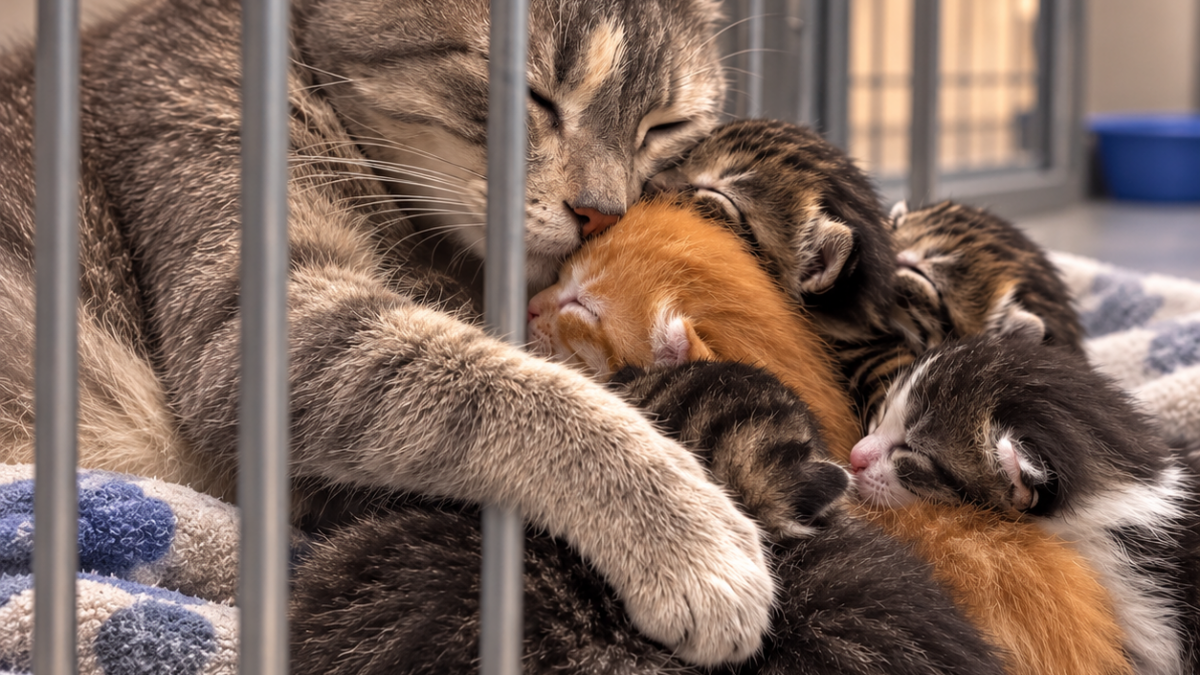
It showed a gray-and-white cat lying on her side.
Five tiny kittens were piled against her.
The volunteer pointed.
“Who’s that?”
“Luna.”
“Was she their mother?”
I looked at the picture.
“Yes.”
Then I smiled.
“No.”
The volunteer laughed.
“Which one?”
“Both.”
I told her the story.
Not every detail.
Just enough.
Owner died.
Family left her.
Adult shelter cat.
Forty-eight hours.
Five orphaned kittens.
Milk.
The papers.
The conference room.
Foster.
Adoption.
The volunteer looked horrified.
“She was really that close?”
“Very.”
“And the kittens saved her?”
I thought about the question.
Then shook my head.
“They saved each other.”
That was the truth.
The kittens needed milk.
Warmth.
A mother.
Luna needed something too.
A reason to stop waiting at the cage door for a person who would never come back.
They gave her one.
She gave them what she had.
And somewhere between the steel bars, the bottle feedings, the weight charts, and a deadline nobody wanted to face, six animals changed one another’s futures.
People love to say Luna was special because she nursed kittens that weren’t hers.
She was.
But that is not the part that stays with me most.
What stays with me is how ordinary she looked before we knew.
Gray and white.
Adult.
No breed.
A torn ear.
An old scar.
Quiet.
Easy to pass.
That terrifies me.
Because how many animals like Luna do people overlook because their most extraordinary part hasn’t had a chance to appear yet?
How many frightened dogs are labeled unfriendly before they feel safe?
How many grieving cats are labeled withdrawn when they are simply waiting?
How many old animals are ignored because they don’t perform happiness through cage bars?
Luna taught me not to confuse silence with emptiness.
There was an entire world inside that quiet cat.
We nearly never saw it.
The last photograph Claire ever gave me sits on my desk.
Luna is old.
Her face thinner.
Amber eyes soft.
She is sleeping in a sunbeam.
Nothing dramatic.
No kittens.
No shelter bars.
No medical equipment.
No countdown.
Just a cat asleep in her own home.
That is my favorite image of her.
Because people often think the rescue moment is the climax.
It isn’t.
The rescue is only the door.
The real victory is what comes after.
Breakfasts.
Naps.
Vet visits.
Annoying habits.
Favorite blankets.
Years.
Luna got years.
The five kittens got years.
And every adult cat who received more patience because of the policy Luna helped change got something too.
Time.
The thing she almost ran out of.
Sometimes I think back to that final shelter morning.
Dr. Petrescu standing at the quarantine doorway.
The papers in his hand.
Mara waiting for a decision.
Me feeling like I was about to watch something unforgivable happen because there simply wasn’t space.
And Luna?
Luna wasn’t thinking about the paperwork.
She wasn’t thinking about policy.
She wasn’t thinking about whether anyone had chosen her.
She was lying against the bars because five tiny kittens were on the other side.
One cried.
She reached out.
That was all.
One paw through cold metal.
A tiny head pressing against it.
A veterinarian stopping.
A decision delayed.
A life continuing.
People sometimes ask me whether I believe animals understand when they have saved one another.
I don’t know.
I don’t need to know.
Luna never needed to understand what she had done.
The kittens never needed to understand what they had done for her.
We understood.
That had to be enough.
On difficult days at the shelter, I still walk past Luna’s photograph.
When intake is full.
When foster homes are scarce.
When the phone keeps ringing.
When I start thinking in numbers because thinking in names hurts too much.
I look at that torn ear.
Those amber eyes.
Five kittens against her belly.
And I remember the danger of deciding too quickly that an animal has nothing left to offer.
Luna arrived after losing everything.
Her home.
Her person.
Her routine.
Her safety.
Then she was placed inside a cage with a clock running over her head.
Nobody chose her.
Nobody stopped.
Until five babies who could barely see began crawling toward her voice.
And in trying to keep them alive, Luna showed us something we had almost failed to see.
She was not disposable.
She was not an empty cage waiting to become available.
She was not “adult female, domestic shorthair.”
She was Luna.
A grieving cat.
A foster mother.
A survivor.
A home waiting to happen.
She had been given forty-eight hours.
She lived almost nine more years.
And every one of them proved that the most dangerous mistake we made was never running out of space.
It was almost believing forty-eight hours were enough to decide what her life was worth.








