PART 2: THE TINY PUPPY REACHED OUR RESCUE BOAT—THEN TURNED AROUND AND DOVE BACK INTO THE SINKING SUV
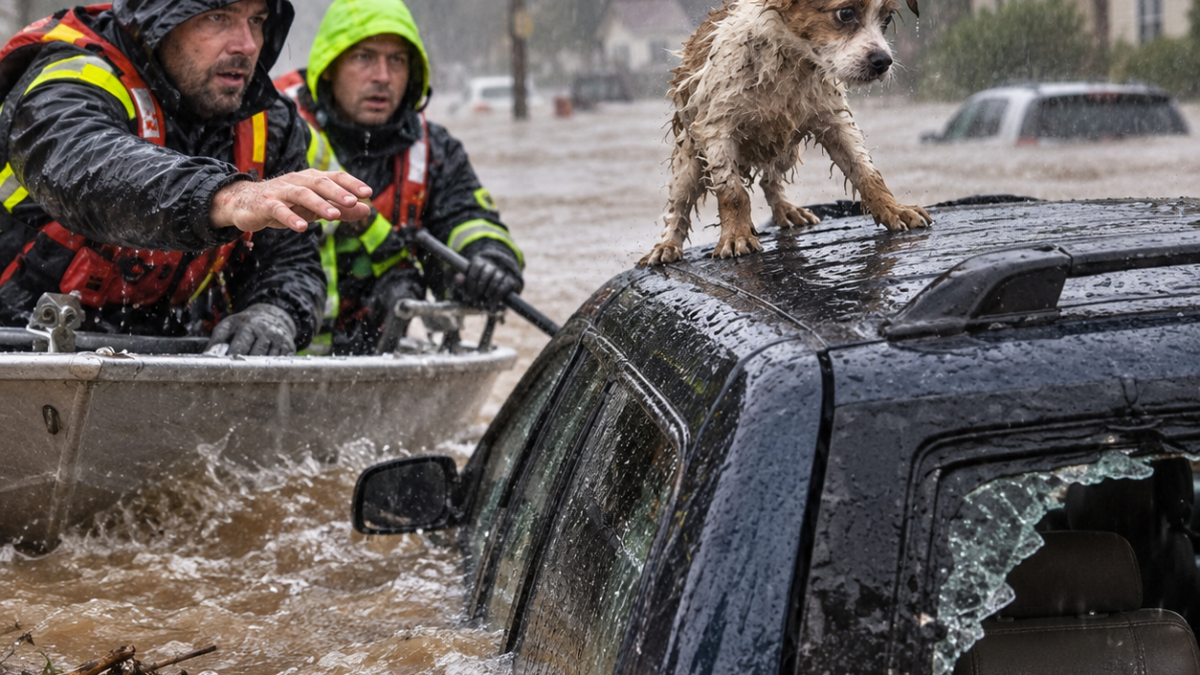
The smallest puppy had finally reached our rescue boat when he suddenly turned, slipped through my hands, and dove back into the SUV that was disappearing beneath the floodwater. For one terrible second, I thought panic had destroyed whatever survival instinct a ten-week-old puppy was supposed to have. Then I heard something from inside that sinking vehicle that made Julien and me stop thinking about saving one dog.
My name is Claire Morel, and I was thirty-six when two days of relentless rain turned parts of southern France into brown, fast-moving rivers.
I was volunteering with a local emergency rescue team outside a village in the Gard.
Roads had vanished.
Gardens had become channels of muddy water.
Cars had been lifted, spun around and deposited in places no car belonged.
Julien and I had already helped evacuate several families that morning and recovered two cats, an elderly Labrador and a terrified goat from flooded properties.
Then we saw the puppy.
A dark-blue SUV had been pushed off the road and lodged against a line of trees.
Only the upper section remained above water.
Standing on the curved roof was a tiny white-and-tan puppy.
He was soaked.
One ear stood straight while the other flopped across his forehead.
Mud coated his paws.
Every few seconds, another wave pushed against the SUV and reduced the little patch of metal beneath him.
“He’s not going to stay up there much longer,” Julien said.
“I know.”
He maneuvered our aluminum rescue boat closer.
I moved to the bow with a towel and a soft rescue loop.
“Hey, sweetheart.”
The puppy stared at me.
His entire body shook.
“It’s okay. Come here.”
He looked at the boat.
Then he turned toward the shattered rear window of the SUV.
A tiny cry came from his throat.
Not toward us.
Toward the vehicle.
I stretched the rescue loop farther.
“We’ve got you.”
The puppy stepped forward.
The SUV shifted under the current.
He slipped, scrambled and regained his footing.
“Easy,” Julien whispered.
I reached.
My fingers finally closed around the loose skin and wet fur behind his shoulders.
“Got you.”
For half a second, relief went through me.
Then the puppy twisted with a strength I didn’t know something that small could have.
He slipped from my grip.
“Claire!”
Before I could catch him again, he flattened himself against the roof, crawled toward the broken rear window and disappeared through it.
I stared at the empty roof.
“What is he doing?”
Julien brought the boat closer.
The current slammed our side against the SUV.
I grabbed the railing.
“Back up!”
“I’m trying.”
Then we heard it.
A deep bark.
Muffled.
Inside the vehicle.
Julien looked at me.
“That wasn’t the puppy.”
Before I could answer, three high-pitched whimpers rose from somewhere below the broken window.
My stomach turned cold.
“There are more dogs in there.”
The puppy’s face appeared briefly in the darkness.
He barked once.
Then disappeared again.
The SUV shifted.
A tree branch cracked somewhere behind us.
Water surged over the lower edge of the rear window.
Whatever air remained inside that vehicle was disappearing.
“We need to get in there,” I said.
Julien looked at the current.
“We can’t both leave the boat.”
“I’ll go.”
“Claire—”
“Hold us against the vehicle.”
I secured my flotation vest, clipped a safety line to my harness and climbed onto the partially submerged rear bumper.
The water was colder and stronger than I expected.
I pushed my arm through the broken window.
“Come on! Bring them to me!”
Something moved in the darkness.
Then the puppy appeared again.
But he wasn’t trying to climb out.
He was biting and pulling at something below the waterline.
A strap.
I leaned farther inside.
My hand found wet fur.
Large wet fur.
Then I felt a collar.
A much bigger dog was trapped across the rear seat, and something was holding her down.
“Julien!”
“What?”
“There’s an adult dog in here!”
Another wave hit.
The vehicle groaned.
The water inside rose several inches.
Then my fingers found the strap wrapped tightly beneath the dog’s body.
It wasn’t part of the car.
It was a leash.
Someone had tied her inside.
And as the puppy kept pulling desperately beside my hand, I realized we weren’t simply rescuing animals caught in a flood.
Someone had left them unable to escape.
PART 2
“Knife!”
Julien didn’t ask why.
He reached into the emergency bag and slapped the rescue knife into my open hand.
The SUV moved again.
Not much.
Maybe two inches.
But beneath my knees, I felt metal scraping against whatever was holding the vehicle in place.
A tree.
A rock.
Debris.
I didn’t know.
I only knew that if the SUV shifted completely into the current, we were going with it.
“Claire, thirty seconds!”
“I know!”
I pushed my upper body through the broken rear window.
The smell inside hit me immediately.
Mud.
Wet fabric.
Dog.
Oil.
And the sharp chemical odor of floodwater that had passed through fuel tanks, farm sheds and everything else the river had swallowed.
My eyes adjusted.
The adult dog was a shepherd mix, maybe forty-five pounds, black across the back with tan legs and face.
Her head was barely above water.
A red nylon leash ran from her collar around the base of a folded seat.
Every time she tried to lift herself higher, the leash tightened.
Beside her, the tiny white-and-tan puppy was pulling uselessly at the strap with his teeth.
“Hey, mama.”
The shepherd’s eyes found mine.
She did not growl.
She didn’t have enough strength for that.
“Hold on.”
I slipped the knife beneath the leash.
The blade caught.
The angle was wrong.
Water surged against my ribs.
Behind me Julien shouted, “Another wave!”
“I know!”
“Claire!”
“I know!”
The puppy pressed against my arm.
I tried again.
The knife sliced halfway through.
The dog shifted.
The leash tightened even more.
She gave one short choking sound.
“Don’t move.”
Ridiculous.
Of course she was going to move.
She was drowning.
I hooked two fingers beneath the remaining nylon and cut toward myself.
The leash snapped.
The shepherd surged upward.
At the same instant, something struck the SUV.
Hard.
The entire vehicle rolled several degrees toward the river.
“Out!” Julien shouted.
I grabbed the adult dog’s collar.
She scrambled.
Her front paws hit the window frame.
Julien reached over me.
“Give me the dog!”
The shepherd tried to climb through.
Her body became wedged for half a second.
Then Julien caught the loose skin around her shoulders and pulled.
I pushed from behind.
She spilled into the boat.
The puppy came after her.
This time I caught him with both arms.
“No you don’t.”
He fought me immediately.
Not to escape us.
To turn back.
“Claire!”
“I hear them.”
The whimpering was still inside.
Three puppies.
Somewhere lower in the vehicle.
The adult dog stumbled in the boat and tried to turn toward the window.
Julien caught her.
“She’ll jump back in.”
“So will this one.”
The little puppy in my arms screamed.
That is the only word I can use.
A high, desperate sound that did not resemble the frightened whining from the roof.
He knew the others were still inside.
And he knew exactly where they were.
I looked at Julien.
“One more time.”
He shook his head immediately.
“The car is moving.”
“Three puppies.”
“I heard them.”
“We can’t leave.”
“I didn’t say we leave.”
He grabbed the radio.
“Rescue Two to command, four canines located in submerged vehicle, two recovered, three juveniles still trapped. Vehicle unstable. Request immediate second boat and downstream support.”
Static.
Then confirmation.
But immediate during a flood does not mean immediate.
Everybody was somewhere dangerous.
Everybody needed someone.
We had the next minute.
Maybe less.
I handed the rescued puppy to Julien.
“Do not let him go.”
“Claire—”
I looked at him.
He knew.
“Line tight.”
He clipped my secondary line to the boat.
I climbed through the window again.
The rear footwell was almost completely underwater.
I could hear puppies but could not see them.
“Come on, babies.”
One squealed.
Left side.
I reached between the front and rear seats.
My fingers found fur.
I grabbed carefully.
A puppy emerged from beneath floating debris, black-and-tan like the mother.
I lifted him.
“Got one!”
Julien took him.
Two.
Another whimper.
I reached again.
Nothing.
Water.
Seat.
Mud.
A loose bag.
My fingertips touched something soft.
It moved.
I stretched until the edge of the broken glass pressed against my life vest.
“Come on.”
The puppy was wedged beneath the front passenger seat.
I hooked my fingers under its chest.
It wouldn’t move.
Something was caught.
“Julien!”
“Twenty seconds!”
I ran my hand along the puppy’s body.
A thin cord was wrapped around one rear leg.
Electrical cable.
I pulled.
No.
I brought the knife down carefully.
The water was nearly at my shoulders now.
I could not see the blade beneath the surface.
The puppy screamed when I touched the leg.
“Sorry. Sorry.”
I felt for the cable.
Cut once.
Nothing.
Again.
It loosened.
I pulled the puppy free.
“Two!”
Julien took him.
“Where’s the third?”
I listened.
Nothing.
My heart stopped.
“Baby?”
No sound.
I reached blindly.
Under the seat.
Behind the center console.
Along the floor.
Nothing.
The SUV lurched.
My safety line snapped tight.
“Claire, NOW!”
“I’m missing one!”
The water was at my neck.
Then something touched my wrist.
A paw.
I plunged my arm down.
My hand closed around a tiny body.
Completely underwater.
I pulled.
The puppy came up limp.
“No.”
I shoved myself backward.
Julien grabbed my vest and hauled me through the window.
The SUV shifted again behind me.
We hit the boat floor together.
I laid the puppy on a dry section of aluminum.
No movement.
The mother saw him.
She crawled toward us.
“Keep her back.”
Julien held her chest.
I cleared the puppy’s mouth.
Mud.
Water.
I tipped his head.
Nothing.
“Come on.”
I rubbed hard with the towel.
No breath.
I began tiny chest compressions with two fingers.
“One, two, three…”
The first rescued puppy was crying beside his mother.
The other two huddled against her.
She kept stretching her neck toward the motionless one.
“Come on, little one.”
Compress.
Release.
Compress.
I breathed gently into his nose.
His chest rose.
Nothing.
Again.
“Claire.”
“Not yet.”
I rubbed him.
Harder.
His body felt impossibly small.
“Come on.”
A cough.
I froze.
The puppy’s mouth opened.
Dirty water spilled out.
Then another cough.
A tiny breath.
Julien laughed once.
Not because anything was funny.
Because sometimes relief needs somewhere to go.
“He’s breathing.”
The mother pushed harder against him.
I placed the puppy beside her chest.
She immediately began licking his face.
The first white-and-tan puppy climbed over his siblings and pressed against him too.
“That little idiot saved them.”
Julien stared at him.
“He brought us back.”
The SUV groaned behind us.
We turned.
The roof was almost level with the surface.
“Move.”
Julien started the motor.
We pulled away.
Less than a minute later, the vehicle slipped completely from the trees.
The current took it.
The dark-blue roof disappeared.
Then the entire SUV rolled once and vanished into the flood.
Neither of us spoke.
If the puppy had not turned around…
I couldn’t finish the thought.
I looked at him.
He was curled against his mother, shaking violently.
I wrapped all five dogs together beneath towels.
“You did enough,” I whispered.
His eyes stayed on mine.
“You hear me?”
His tail moved once.
“You did enough.”
Our command post had been established at a community hall on higher ground.
When we arrived, one of the veterinary volunteers met us outside.
“What do you have?”
“Adult female, four puppies, flood exposure, possible near drowning on one juvenile, adult tethered inside submerged vehicle.”
The veterinarian stopped.
“Tethered?”
“Inside the car.”
Her expression changed.
“Bring them in.”
The mother had hypothermia.
Two puppies were dangerously cold.
The one I had resuscitated needed oxygen.
The white-and-tan puppy—the one who had been on the roof—had several cuts on his paws and a small wound along his shoulder, probably from the broken window.
But he was alert.
Too alert.
Every time someone separated him from his mother, he fought.
Not aggressively.
Desperately.
So they let him stay close while they worked.
We called him Scout.
It was Julien’s idea.
“He found the rescue team,” he said.
“That’s not scouting.”
“He scouted us.”
“He nearly drowned himself.”
“Brave scouts make questionable decisions.”
Scout looked at him.
“See? He agrees.”
The mother became Mara.
The other puppies were temporarily identified by colored collars.
Blue.
Green.
Yellow.
I kept telling myself not to name them.
Naming animals during emergency work is dangerous.
It creates attachment.
By lunchtime, Green had become Milo.
Yellow became Daisy.
The puppy I had pulled up unconscious became Finn.
So much for professional distance.
For the next several hours, Julien and I returned to flood work.
People still needed evacuation.
An elderly couple refused to leave without their rabbits.
A farmer had become stranded trying to move sheep.
A woman needed insulin from a house surrounded by water.
Disaster does not pause because one story has reached safety.
But every time our boat returned to the command post, I checked the veterinary room.
Scout was always watching the door.
By late afternoon, he started wagging when he saw me.
“Don’t do that,” I told him.
His tail wagged harder.
“I’m serious.”
Julien leaned over my shoulder.
“You’re done.”
“What?”
“He owns you now.”
“He does not.”
Scout climbed onto my boot.
Julien smiled.
“Completely finished.”
The animals survived the first night.
That alone felt like enough.
It wasn’t.
The next morning, a gendarme named Benoît came to find me.
“We identified the vehicle.”
I was eating coffee and what might once have been bread.
“Owner?”
“Registered to a man named Pascal Renaud.”
“Local?”
“About twenty kilometers away.”
“Has anyone spoken with him?”
Benoît pulled out his phone.
“That’s the problem.”
He showed me a social media post.
A public post.
Uploaded the previous morning, after the worst flooding had already begun.
Pascal Renaud stood beside another vehicle on dry ground.
The caption said he had evacuated safely.
No mention of dogs.
I looked at Benoît.
“Maybe somebody else had the SUV.”
“Possible.”
“Maybe it was stolen.”
“Possible.”
“Maybe—”
“We found him.”
My stomach tightened.
“And?”
“He says he abandoned the SUV when the road flooded.”
“With five dogs inside?”
“He says the animals were not in it when he left.”
I stared at him.
“That mother was tied to the rear seat.”
“I know.”
“The puppies were trapped in the footwell.”
“I know.”
“He’s lying.”
“Probably.”
“Probably?”
Benoît remained calm.
“I need facts, Claire.”
I hated that.
Not because it was wrong.
Because it was right.
“When can I give a statement?”
“Now.”
I spent almost an hour describing the rescue.
Where the SUV was located.
Condition.
Broken rear window.
Leash tied to the seat base.
Positions of each animal.
The cord around Finn’s leg.
The near drowning.
Scout’s behavior.
The mother’s reaction.
Everything.
When I finished, Benoît asked, “Could the leash have become wrapped accidentally during the flood?”
“No.”
“How can you tell?”
“The leash was looped twice around the metal seat support and secured with a knot.”
“You saw the knot?”
“I cut below it. If the vehicle is recovered, the remaining section should still be there.”
He wrote.
“What about the puppies?”
“Loose.”
“Could they have entered the vehicle after the owner left?”
“All four?”
He looked at me.
“I have to ask.”
I exhaled.
“No. They were approximately ten weeks old. Mara was their mother. They were behaving as a family group. One of them was on the roof. The others were trapped inside.”
“Understood.”
That afternoon, the water began to recede.
The SUV was found almost a kilometer downstream, lodged against a stand of trees.
Recovery crews documented it before moving anything.
Part of the red leash remained tied to the seat support.
Inside the rear cargo area were several dog-related items.
An empty food sack.
A metal crate.
Advertising flyers.
And a cardboard folder sealed in plastic.
The folder contained vaccination records.
Mara.
Female shepherd mix.
Age three.
Owner: Pascal Renaud.
There were also handwritten notes.
**Litter born 06/04.**
Four puppies.
The animals were his.
The question was no longer whether he knew they existed.
It was what he had done.
Pascal changed his account.
He said he had been evacuating the dogs when the vehicle stalled.
Water had risen too quickly.
He became afraid.
He left to seek help.
“Did he call anyone?” I asked Benoît.
“No.”
“Emergency services?”
“No.”
“Fire department?”
“No.”
“Animal rescue?”
“No.”
“Police?”
“No.”
“He posted online that he was safe.”
“Yes.”
“Did he mention five animals trapped in his car?”
“No.”
My anger became something cold.
“What does he say now?”
“That he thought someone would see the vehicle.”
I laughed.
I couldn’t help it.
“Someone did.”
Benoît looked at me.
“Claire.”
“I know.”
“Let us handle it.”
“I know.”
But I wasn’t good at knowing.
Not when Scout’s paws were cut because he had climbed through broken glass trying to get help.
Not when Mara had nearly drowned tied to a seat.
Not when Finn had been underwater in my hands.
I wanted Pascal to see them.
Not because I wanted drama.
Because I wanted him forced to look at what he had left behind.
He never came to the emergency veterinary area.
He asked about reclaiming the dogs through official channels.
That made my blood boil.
The request was denied temporarily while the investigation continued.
Mara remained under veterinary supervision for four days.
She was severely dehydrated despite the floodwater around her.
That seemed cruelly ironic.
She had inflammation around her neck where the leash had pulled during the vehicle’s movement.
Her paws were raw.
She had several older pressure marks that concerned the veterinarian.
Not evidence of the flood.
Older.
Scout and the other puppies were underweight.
Not catastrophically.
But enough that the veterinary team started asking questions.
“How were they living before this?” I asked.
“We don’t know yet,” the veterinarian said.
That changed three days later.
A woman named Élise Fournier contacted authorities after seeing a photograph of Mara in a local news report.
She recognized her.
Élise had visited Pascal’s property two weeks before the flood.
She had answered an advertisement for puppies.
“What did she see?” I asked Benoît.
He hesitated.
“You’re not investigating this case.”
“I pulled four puppies from a sinking vehicle.”
“You’re also emotionally involved.”
“Yes.”
“Which is why you’re not investigating it.”
I stared at him.
He finally sighed.
“She says Mara and the litter were kept in a makeshift enclosure behind a shed.”
“Condition?”
“She left without buying a puppy because she was uncomfortable.”
“Why?”
“Dirty water. Strong smell. Puppies thin. Mara tethered.”
I closed my eyes.
“She reported it?”
“No.”
That answer hurt.
But before I could say anything, Benoît added, “She regrets that.”
Regret.
Disaster is full of it.
I should have called.
I should have left sooner.
I should have taken the higher road.
I should have noticed.
Sometimes regret leads nowhere.
Sometimes it becomes evidence.
Élise had taken photographs.
She had photographed Scout because she thought his crooked ear was cute.
In the background, Mara’s tether was visible.
So were the conditions.
The date metadata placed the images twelve days before the flood.
Pascal’s story started collapsing.
He was not simply a frightened owner who made one catastrophic decision in rising water.
The flood exposed something that had begun long before the rain.
He had been selling puppies.
Mara had produced at least two litters.
Neighbors described barking, outdoor pens and frequent visitors.
Records showed several puppy advertisements over the previous eighteen months.
None of that was automatically illegal.
But the veterinary evidence, witness photographs and conditions on the property told a larger story.
The surviving dogs were placed under protective custody.
Pascal was formally investigated for animal neglect and abandonment.
When I learned that, I expected satisfaction.
Instead, I went to see Scout.
He was sleeping beside Mara.
Finn was curled across her front legs.
Daisy had somehow climbed on top of Milo.
Scout heard me enter.
His eyes opened.
Then his tail began.
That ridiculous little tail.
I sat on the floor.
“You nearly killed me.”
He crawled into my lap.
“You know that?”
He licked my chin.
“I thought you were safe.”
Another lick.
“You got onto the boat.”
Scout began chewing the strap of my watch.
“And then you went back.”
I picked him up.
His body was warmer now.
Heavier than that first morning.
Strong.
“You knew they were still there.”
I had spent years around animals.
I knew better than to turn instinct into a human story.
Scout did not plan a rescue operation.
He did not understand drowning the way we did.
He did not make a moral decision.
But he knew his mother and littermates were inside.
And when given a route to safety, he returned to them.
Whatever word people wanted to use for that was fine with me.
I called it love.
The floodwater continued dropping.
Families returned to homes filled with mud.
Walls were marked by brown lines showing how high the water had reached.
Furniture sat outside in piles.
Photographs dried across tables.
Road crews worked from dawn until dark.
Julien and I spent days helping with cleanup when emergency rescues slowed.
Scout’s story spread through the volunteer teams.
Every time I arrived at the animal facility, someone had brought something.
Blankets.
Food.
Toys.
One volunteer donated four tiny collars.
“Four?” I asked.
“Mara doesn’t need one?”
“She deserves jewelry too.”
Mara received a red collar.
Not like the red leash.
Bright.
Soft.
Loose enough that two fingers fit comfortably beneath it.
The first time they put it on, she froze.
I saw it.
The veterinarian saw it too.
We removed it.
For several days, Mara wore nothing around her neck.
Then they introduced a soft harness.
She tolerated that better.
Recovery cannot be forced simply because danger has ended.
Sometimes the body remains where fear left it.
Scout, on the other hand, seemed determined to experience everything immediately.
Toys.
Shoelaces.
Paper towels.
My rescue bag.
Julien’s gloves.
A cardboard box.
One morning I found him dragging a medical towel twice his size across the room.
“Criminal.”
He growled playfully.
“Oh, now you’re dangerous?”
He attacked the towel.
Mara watched him.
Then something beautiful happened.
She play-bowed.
Barely.
Front legs down.
Rear end slightly raised.
Scout froze.
Mara bounced sideways.
Within seconds, four puppies were climbing over her.
The entire veterinary room erupted in laughter.
I covered my mouth.
Julien stood beside me.
“She’s becoming a dog again.”
I looked at him.
“Maybe she never stopped.”
The legal investigation moved quietly.
Pascal’s property was inspected.
The shed behind his house contained several empty wire pens.
No other dogs.
Receipts and messages showed he had sold puppies regularly.
Several buyers were contacted.
Some animals were healthy and loved.
Others raised concerns.
One family had purchased a puppy that arrived with worms and an untreated skin infection.
Another said Pascal refused to let them see the mother.
Another remembered puppies being brought from behind the shed one at a time.
More statements.
More records.
More evidence.
Nothing cinematic.
That surprised me.
I think people imagine accountability as handcuffs, shouting and a courtroom full of gasps.
Most of it is paper.
Dates.
Photographs.
Invoices.
Veterinary notes.
Quiet people telling the truth carefully.
Months later, Pascal faced charges related to animal neglect, abandonment during the flood and unlicensed commercial breeding violations.
The proceedings took time.
By then, the dogs were no longer living in emergency kennels.
Mara had been placed with a foster family named Thomas and Élodie on a small property outside Nîmes.
They had experience with fearful adult dogs.
No chains.
No kennels.
A fenced garden.
And a couch Mara initially refused to approach.
Three weeks later, Élodie sent me a photograph.
Mara was on the couch.
Upside down.
Four legs in the air.
I stared at it for a long time.
The dog I had first touched while floodwater reached her neck was sleeping so deeply her mouth hung slightly open.
That was justice.
The puppies were old enough for adoption soon afterward.
Milo went to a retired couple who had recently lost their seventeen-year-old terrier.
Daisy went to a family with two teenage daughters.
Finn—the puppy I had pulled underwater—was adopted by a veterinary technician from the emergency team.
Then there was Scout.
Applications came in.
A lot of them.
His story had become known locally.
Everyone wanted the brave flood puppy.
I hated that description.
Not because it was false.
Because I worried people wanted the story more than the dog.
Scout was not an inspirational object.
He was energetic.
Mouthy.
Stubborn.
He stole food.
He had separation anxiety.
He hated closed car doors.
He barked if he could not see where people had gone.
He needed patience.
I reviewed applications even though nobody had technically asked me to.
The coordinator finally looked at me.
“Claire.”
“What?”
“You understand you’re behaving like his mother?”
“No.”
“You rejected a family because their garden fence was twelve centimeters shorter than recommended.”
“It was a bad fence.”
“You rejected another because they said they wanted a ‘hero dog.’”
“That concerned me.”
“You rejected one because they work full time.”
“They’re gone ten hours.”
She crossed her arms.
“So what household qualifies?”
I opened my mouth.
Nothing came out.
She smiled.
“No.”
“What?”
“You know.”
“I do not.”
Julien, who had been listening from the doorway, started laughing.
“Absolutely not.”
I pointed at him.
“You stay out of this.”
The coordinator slid an adoption form toward me.
I looked down.
“No.”
Scout was under my chair chewing my shoelace.
“I volunteer for emergency rescue.”
“Yes.”
“I’m gone unpredictably.”
“You have a partner network.”
“I live alone.”
“So?”
“I’ve never owned a puppy.”
“You’ve spent two months rearranging your life around this one.”
“That’s different.”
Julien laughed again.
I threw a pen at him.
Scout chased it.
That did not help my argument.
I took Scout home “temporarily.”
Three days.
That was the agreement.
The first night, he cried when I closed the bedroom door.
I opened it.
He climbed onto the rug beside my bed.
Fine.
Second night, he climbed onto the bed.
Not fine.
I put him down.
He climbed back up.
I put him down again.
By the fifth attempt, I gave up.
At 3:12 a.m., Scout was asleep with his head across my ankle.
I stared at the ceiling.
“This is temporary.”
His tail tapped once.
The second day, he urinated on a rug.
Chewed my phone charger.
Stole half a sandwich.
Dragged my shoe into the bathroom.
Then fell asleep against my chest as I sat on the floor cleaning up shredded paper.
On the third day, the adoption coordinator called.
“Well?”
“I need another day.”
“Of course.”
On the fourth day, I bought him a larger bed.
On the fifth, I installed a baby gate.
On the sixth, I signed the papers.
Scout Morel.
Julien saw the name and shook his head.
“You lasted six days.”
“I was evaluating.”
“You bought him health insurance on day two.”
“Responsible evaluation.”
Scout jumped against my knees.
I picked him up.
He licked my nose.
“Stop encouraging him.”
Julien laughed.
Scout became part of my life with astonishing speed.
Morning walks.
Training.
Meals.
Veterinary visits.
Mud.
So much mud.
He hated deep water at first.
That surprised me.
Puddles were acceptable.
Streams were suspicious.
Baths were betrayal.
The first time we walked near the river, Scout stopped twenty feet from the bank.
His body stiffened.
I did not pull.
“Okay.”
We stood there.
People passed.
Another dog splashed in the shallows.
Scout watched.
Then he turned away.
We went home.
A week later, we returned.
He got closer.
Then closer.
For months, I let Scout choose.
One summer morning, nearly a year after the flood, he walked to the edge himself.
He touched the water with one paw.
Pulled back.
Tried again.
Then stepped into the shallows.
I sat on the bank and cried like an idiot.
Scout drank from the river.
I laughed through tears.
“Probably not the symbolic moment I wanted.”
He splashed me.
Apparently not.
We visited Mara regularly.
The first reunion after the puppies had been separated worried me.
Would they recognize each other?
Would Mara become stressed?
Scout answered within seconds.
He ran toward her.
Mara froze.
Then her whole body began wagging.
Scout dropped low.
Mara charged.
Not angrily.
Joyfully.
They ran around Thomas and Élodie’s garden until both collapsed.
I sat under a tree watching them.
Élodie brought lemonade.
“Do you ever think about that car?”
“All the time.”
“Does Scout?”
I looked at him.
He was chewing Mara’s ear.
“I hope not.”
That was the difference between humans and dogs.
We carry narratives.
They carry associations.
Sometimes fear.
Sometimes trust.
I wanted Scout’s life to become so full that the flood became only something his body had once survived.
The court case ended almost eighteen months after the rescue.
Pascal admitted several violations rather than contest every charge.
He received financial penalties, a prohibition on commercial breeding for a period set by the court, restrictions on animal ownership, and obligations related to the costs of veterinary and protective care.
Was it enough?
I didn’t know.
I still don’t.
No sentence could put air back into Finn’s lungs.
No fine could erase the marks on Mara’s neck.
Nothing could make Scout unlearn the moment he stood on a sinking roof calling into a car where his family was trapped.
But consequences mattered.
More important to me, Pascal did not get the dogs back.
Mara belonged to Thomas and Élodie by then.
Milo had his retired couple.
Daisy had two girls who sent birthday photographs.
Finn slept every night at the foot of a veterinary technician’s bed.
And Scout was currently stealing a sock from my laundry basket.
Pascal no longer controlled any part of their future.
That became enough.
When I returned from the final hearing, Scout met me at the door with the stolen sock.
“Give me that.”
He ran.
“Scout.”
Faster.
I chased him through the kitchen.
He circled the table.
“Really?”
He stopped.
I stopped.
We stared at each other.
Then his tail began wagging.
Something inside me released.
I started laughing.
Months earlier, I thought revenge would feel like watching Pascal lose.
It didn’t.
This did.
A dog who nearly drowned because someone had abandoned him was playing keep-away in my kitchen.
That felt bigger than punishment.
It felt like victory.
Scout grew.
The crooked ear never straightened completely.
I was glad.
It made him recognizable from across a park.
At one year, he was lean and athletic.
At eighteen months, he developed an embarrassing obsession with tennis balls.
At two years, he learned to open the lower kitchen cabinet with his nose.
I installed a child lock.
He learned where I stored the treats instead.
“You are not intelligent in useful ways.”
Scout stared.
“You could learn to put laundry away.”
Nothing.
“But cabinets?”
Tail wag.
“Criminal.”
We continued volunteer rescue work.
Scout did not become an official rescue dog.
He lacked the specialized training.
And I did not want his story turned into something it wasn’t.
But occasionally he accompanied me during community events.
Children loved him.
Adults asked about his ear.
Sometimes people recognized him from old flood photographs.
“Is that the puppy?”
I always knew which puppy they meant.
“Yes.”
“The one who went back into the car?”
“Yes.”
People would kneel.
Scout would immediately investigate their pockets for food.
They expected solemn bravery.
They got a shameless thief.
Perfect.
Three years after the flood, another major storm system crossed the region.
Not as severe.
But enough that emergency teams prepared.
The first thunder woke Scout around midnight.
He stood beside my bed.
Panting.
I switched on the lamp.
“Hey.”
His ears were back.
Rain struck the shutters.
Another thunderclap.
Scout went to the bedroom door.
For a moment, I thought he wanted outside.
Then he came back.
He jumped onto the bed.
Pressed his entire body against my side.
I put one arm over him.
“You’re safe.”
He trembled.
I could not tell whether his body remembered the flood.
Maybe.
Maybe not.
But I remembered.
The roof.
The broken window.
The tiny body disappearing into dark water.
“You don’t have to save anyone tonight.”
Scout pushed his nose under my hand.
“Everybody’s here.”
Thunder rolled.
He stayed.
The storm passed.
Morning arrived.
Scout ate breakfast like nothing had happened.
That may have been one of the most beautiful things about him.
He never built an identity around being brave.
He did not wake up trying to be the puppy who saved his family.
He was hungry.
He wanted walks.
He stole socks.
He hated the vacuum cleaner.
He loved cheese.
His heroic moment mattered more to everyone else than it ever did to him.
Years passed.
Mara grew gray first.
She had earned it.
When Scout was six, Thomas called.
“Mara’s slowing down.”
We visited that weekend.
She stood when Scout entered the garden.
Slowly.
Scout approached differently than usual.
No charging.
No jumping.
He sniffed her face.
Mara licked his ear.
They lay together beneath the same tree where they had played years earlier.
I sat nearby.
Mara’s red harness had been replaced by a soft blue one.
No collar.
She still disliked pressure around her neck.
Some things remained.
Scout rested his head across her front legs.
I thought about the SUV.
Mara barely able to keep her nose above water.
Scout pulling at the leash.
He had been ten weeks old.
Now he was a full-grown dog lying beside an old mother.
“You came back for her,” I whispered.
Scout lifted one ear.
Mara slept.
Three months later, Mara died peacefully at home.
Thomas called me before they made the final decision.
Scout and I went.
I wasn’t sure whether bringing him was right.
The veterinarian said it could help.
Scout approached Mara’s bed.
He sniffed her face.
Her paws.
Her chest.
Then sat beside her.
After she died, he remained there for several minutes.
No crying.
No dramatic understanding I could prove.
He simply stayed.
Then eventually he stood and walked toward me.
I knelt.
He leaned against my chest.
“You did everything you could for her.”
I had said almost the same words on the boat.
You did enough.
Maybe all our lives are built around learning when we have done enough.
When to keep fighting.
When to let go.
Scout slept more than usual for several days.
Then one morning, he brought me a tennis ball.
Life resumed.
Not because Mara no longer mattered.
Because love and living are allowed to exist after loss.
I learned that from him too.
Years later, I returned to the road where we had found the SUV.
The landscape had changed.
Flood defenses had been improved.
Some damaged trees were gone.
The exact spot where the vehicle had lodged was difficult to identify.
Scout was with me.
Older now.
White around the muzzle.
The crooked ear still crooked.
I parked on safe ground and walked him along the road.
He sniffed weeds.
Fence posts.
A discarded bottle.
No reaction.
Then we reached the stretch I believed was closest to the rescue site.
I stopped.
Scout continued sniffing.
I looked toward the drainage channel.
The floodwater was long gone.
Just grass.
Stones.
A narrow stream.
This was where I had first seen him on the roof.
I expected something.
From him.
From myself.
Scout urinated on a bush.
I laughed.
“Very moving.”
He looked at me.
That was when I understood.
The place belonged to me more than it belonged to him.
I was the one who had frozen the moment in memory.
Scout had kept moving.
He had never needed to defeat that road.
He had already left it.
I knelt and scratched his chest.
“Want to go home?”
His tail wagged.
Home.
Years earlier, that word had meant nowhere to him.
A sinking vehicle.
A frightened mother.
Three littermates.
No safe person returning.
Now home meant my kitchen.
His bed.
A basket overflowing with toys.
The couch he was technically not allowed to use.
My shoes by the door.
The sound of my keys.
Dinner.
Me.
We drove back.
That evening, rain started.
Nothing serious.
Just an ordinary autumn rain.
Scout stood at the glass door watching it.
I opened the door.
He looked outside.
Then at me.
“You don’t have to.”
Scout stepped onto the patio.
Rain landed on his face.
He sneezed.
Took another step.
Then ran into the garden.
I stood under the doorway watching him.
He chased a leaf.
Slipped in mud.
Recovered.
Ran again.
For a moment, the white-and-tan puppy on the SUV existed beside the older dog in my garden.
Same crooked ear.
Same stubborn heart.
But there was one difference.
That first day, Scout had turned back because everyone he loved was trapped behind him.
Now nobody was trapped.
No one needed saving.
He could simply run.
He circled the garden once.
Twice.
Then came straight back.
He stopped inside the doorway and shook water all over me.
“Scout!”
He wagged.
I laughed.
“You are impossible.”
He walked toward the kitchen.
Dinner.
Of course.
I followed.
Sometimes people still asked me what I remembered most from that flood.
They expected me to say the SUV sinking.
Or Finn beginning to breathe.
Or the moment we discovered Mara tied inside.
Those memories stayed.
But they were not the strongest.
The strongest came later.
A half-full food bowl because Scout knew there would be breakfast tomorrow.
Mara asleep upside down on a couch.
Finn running at a veterinary picnic.
Daisy in a ridiculous birthday hat.
Milo lying between the feet of the retired couple who adored him.
Those were the images that mattered.
Pascal had left five animals inside a vehicle and walked toward safety alone.
For a long time, I hated him for that.
Part of me probably always will.
But hatred is greedy.
It tries to remain the center of the story.
Eventually, I refused to give him that.
The story belonged to the dogs.
To Mara, who survived.
To Finn, who breathed again.
To Daisy and Milo, who grew up knowing ordinary homes.
And to Scout.
The smallest puppy.
The one who had already reached safety.
The one who turned around.
I used to describe that moment by saying Scout went back into a sinking car.
Years later, I realized that wasn’t quite right.
In his mind, he had never left what mattered.
His mother was still inside.
His siblings were still inside.
So safety was not the boat yet.
Not until they were there too.
That thought still breaks my heart.
But it also explains why I never regretted taking him home.
Scout eventually became old.
Much faster than seemed fair.
His muzzle whitened.
His running slowed.
The dog who once launched himself through a broken window began needing help climbing into the car.
I bought a ramp.
Scout hated it.
“Come on.”
He stared.
“Do you know how many people would like a custom ramp?”
Nothing.
I placed cheese halfway up.
Scout walked across immediately.
“Corrupt animal.”
Tail wag.
We adapted.
Shorter walks.
More rest.
Fewer stairs.
A softer bed.
He still wanted the garden whenever it rained.
Not every time.
But often.
He would stand at the doorway deciding.
I never pushed.
Choice mattered.
Then, one spring morning many years after the flood, Scout stopped before the back door.
He looked at me.
Looked outside.
Rain was falling lightly.
“You want to go?”
His tail moved.
I opened the door.
Scout stepped out.
Slowly.
One paw.
Then another.
He walked to the center of the garden.
Raised his face.
Rain touched his nose.
For several seconds, he stood completely still.
Then he turned around.
He came back toward me.
His legs were slower.
His body older.
But the eyes were the same.
I crouched as far as my knees allowed.
Scout stopped in front of me.
He placed his head against my chest.
I wrapped my arms around him.
“You know something?”
Tail movement.
“You did enough.”
I had told him that as a puppy.
On the rescue boat.
Soaked.
Bleeding.
His family finally beside him.
Now I said it again.
“You did enough, little man.”
He breathed against my neck.
“You don’t have to save anyone anymore.”
Scout licked my chin.
Then walked inside.
Straight toward the kitchen.
I laughed.
Some things remained sacred.
Dinner among them.
That evening, he slept beside me.
Rain continued outside.
I listened to his breathing.
Steady.
Safe.
And I thought back to the tiny puppy standing on the roof of a sinking SUV.
I remembered reaching for him.
Almost having him.
Then losing him as he turned away from safety.
At the time, I thought he was making the worst decision of his short life.
I was wrong.
Scout knew something I had not yet understood.
Sometimes survival is not about getting yourself out first.
Sometimes the thing that makes you turn back is the very thing that leads everyone home.
The smallest puppy had finally reached our rescue boat when he suddenly twisted out of my hands and dove back into the SUV that was disappearing beneath the floodwater. For one terrible second, I thought panic had destroyed whatever survival instinct a ten-week-old puppy was supposed to have. Then I heard something from inside that sinking vehicle that made Julien and me stop thinking about saving one dog.
My name is Claire Morel, and I was thirty-six when two days of relentless rain turned parts of the Gard into brown, violent rivers.
I was volunteering with a local emergency rescue team outside a village where roads had vanished beneath muddy water, gardens had become channels, and cars had been picked up and carried away like toys.
Julien and I had already evacuated several families that morning.
We had pulled an elderly Labrador from a flooded kitchen, carried two terrified cats out through an upstairs window, and somehow convinced a farmer to let us rescue his goats before his furniture.
Then we saw the puppy.
A dark-blue SUV had been swept off the road and wedged against several trees.
Only the upper section of the vehicle remained above water.
Standing on the curved roof was the smallest white-and-tan puppy I had ever seen.
He was soaked to the skin.
One ear stood straight while the other folded over his forehead.
Mud covered his paws.
Every time the current struck the SUV, the metal beneath him shifted.
“He doesn’t have long,” Julien said.
“I know.”
He brought our aluminum rescue boat closer.
I moved to the bow with a towel and a soft rescue loop.
“Come here, sweetheart.”
The puppy stared at me.
His entire body shook.
I stretched the loop toward him.
“Come on. We’ve got you.”
He took one step.
Then stopped.
Instead of looking at me, he turned toward the SUV’s shattered rear window.
A tiny cry escaped him.
Not toward us.
Toward the vehicle.
I followed his stare.
The interior looked black.
Water moved through it.
Nothing else.
“Come on, baby.”
Another wave struck.
The SUV shifted.
The puppy’s back legs slipped.
He scrambled frantically and recovered.
Julien swore under his breath.
“Get him now.”
I leaned out.
My fingers finally closed around wet fur.
“Got you.”
For half a second, relief flooded through me.
Then the puppy twisted.
Hard.
He slipped free.
“Claire!”
Before I could grab him again, he flattened himself against the roof, crawled toward the broken rear window and disappeared inside.
I stared at the empty metal.
“What is he doing?”
Julien pushed the boat closer.
The current slammed us sideways against the SUV.
I grabbed the rail.
Then we heard it.
A deep bark.
Muffled.
Inside the vehicle.
Julien looked at me.
“That wasn’t the puppy.”
Before I could answer, three high-pitched whimpers came from somewhere below the broken glass.
My stomach dropped.
“There are more dogs in there.”
The puppy’s face appeared briefly in the darkness.
He barked once.
Then vanished again.
Water surged across the lower edge of the rear window.
Whatever air remained inside was disappearing.
“We have to get in.”
Julien looked at the current.
“We can’t both leave the boat.”
“I’ll go.”
“Claire—”
“Keep us against the vehicle.”
I clipped my safety line to the boat and climbed onto the partially submerged rear bumper.
The water was colder and stronger than I expected.
I pushed my arm through the broken window.
“Come on! Bring them to me!”
Something moved.
The puppy appeared again.
But he wasn’t trying to climb out.
He was biting and pulling at something below the waterline.
A strap.
I leaned farther inside.
My fingers found fur.
A lot of fur.
Then a collar.
A much larger dog was trapped across the rear seat.
Her muzzle barely cleared the rising water.
“Julien!”
“What?”
“There’s an adult dog in here!”
Another wave hit.
The SUV groaned beneath me.
I found the strap wrapped around the dog’s body.
It wasn’t part of the seat belt.
It was a leash.
Someone had secured her inside.
And when the puppy kept tugging desperately beside my hand, I realized this wasn’t simply a family of animals caught in a flood.
Someone had left them without a way to escape.
[END OF FACEBOOK CAPTION]
[FIRST COMMENT / FULL STORY CONTINUATION]
“Knife!”
Julien reached into the emergency bag without asking why and slapped the rescue knife into my hand.
The SUV moved beneath me.
Only a few inches.
But I felt it.
Metal scraping against whatever was keeping the vehicle from being swept farther downstream.
Trees.
Debris.
Maybe the edge of the old drainage ditch.
I didn’t know.
I only knew those few inches felt like a warning.
“Claire, you have seconds!”
“I know!”
I pushed my upper body through the shattered rear window.
The smell inside was overwhelming.
Wet fabric.
Mud.
Oil.
Dog.
Rotting debris carried into the vehicle by the flood.
The mother—because I knew now that was what she was—lay sideways across the rear seat.
Black-and-tan shepherd mix.
Maybe three years old.
Maybe forty-five pounds if she had been healthy.
She wasn’t.
Her ribs were visible even through soaked fur.
The red nylon leash attached to her collar had been wound around the metal base of the seat.
Twice.
Then knotted.
She could lift her head.
Nothing more.
The white-and-tan puppy was beside her, biting at the leash.
His tiny teeth had already frayed part of the material.
“You were trying to free her.”
The puppy looked at me.
Water surged around my waist.
The mother’s eyes widened.
“Easy.”
I slid the knife beneath the leash.
The angle was terrible.
The nylon was pulled tight beneath her neck.
If I cut carelessly, I could cut her too.
“Come on.”
The knife caught.
I sawed once.
Twice.
Nothing.
Behind me, Julien shouted, “Wave!”
Water slammed through the vehicle.
The mother’s muzzle disappeared.
I grabbed her collar and lifted.
Her head broke the surface.
She coughed violently.
The puppy screamed.
“Hold on.”
I hooked two fingers beneath the strap and pulled it away from her fur.
The knife sliced.
Halfway.
Again.
The leash snapped.
The mother lunged upward.
At that exact moment, the SUV rolled toward the current.
“Out!” Julien shouted.
I caught the mother beneath her chest.
Her front paws clawed at the broken window frame.
For one second she wedged there.
Then Julien grabbed her from outside.
“Push!”
I shoved.
He pulled.
She collapsed into the boat.
The puppy shot after her.
I caught him against my chest.
“No.”
He fought me instantly.
“Claire!”
“He’s trying to go back.”
“Hold him!”
The puppy twisted hard enough to scratch my arm.
Not because he wanted away from us.
Because something was still inside.
Then we heard the whimpering again.
Three tiny voices.
Julien looked at me.
“We’re not done.”
The mother tried to stand.
Her legs folded.
Still, she crawled toward the broken window.
Julien blocked her with his body.
“Easy, mama. We know.”
I looked at the puppy in my arms.
He was staring at that window.
Shaking.
Crying.
He had climbed onto the roof alone.
He had reached the boat.
He had been seconds from safety.
And he had gone back because his family had not.
I handed him to Julien.
“Don’t let him out of your hands.”
“You going back in?”
“There are three puppies.”
“The SUV is shifting.”
“I heard them.”
He stared at me for half a second.
Then clipped my second safety line.
“Thirty seconds.”
“Fine.”
“I mean it.”
“So do I.”
I climbed back through the broken window.
The water inside had risen.
The rear seat was nearly covered now.
“Come on, babies.”
A squeal came from my left.
I reached between the seats.
My fingers found a tiny body.
Black-and-tan.
I pulled the puppy free.
He coughed but immediately began crying.
“Got one!”
Julien took him.
“Two left.”
The next whimper was lower.
I reached toward the floor.
My hand met mud.
Plastic.
A floating shoe.
Seat frame.
Then fur.
I grabbed carefully.
The puppy jerked but didn’t come free.
“What’s holding you?”
I ran my fingers down one rear leg.
A thin electrical cable had wrapped around it.
Maybe from something stored inside.
Maybe torn loose during the flood.
I tried pulling.
It tightened.
The puppy screamed.
“I know. I know.”
The water rose to my shoulders.
Julien shouted something.
I couldn’t hear him clearly.
I brought the knife under the water.
I couldn’t see what I was cutting.
I had to feel it.
Cable.
Puppy leg.
Cable.
Blade.
“Please don’t move.”
I cut once.
Nothing.
Again.
The cable loosened.
I pulled.
The puppy came free.
I pushed him through the window.
Julien grabbed him.
“One more!”
No sound.
I froze.
“Baby?”
Nothing.
I searched beneath the seat.
No movement.
“Come on.”
My heart began pounding harder.
The vehicle shifted.
My harness snapped against the safety line.
“Claire! OUT!”
“One more!”
“You don’t have time!”
I knew.
I also knew that if I climbed out then, I would hear that missing puppy for the rest of my life.
I plunged my hand into the dark water.
Under the front seat.
Along the floor.
Nothing.
Then something brushed my wrist.
Soft.
I reached again.
A paw.
I grabbed.
Pulled.
The puppy surfaced limp in my hands.
“Oh no.”
I pushed backward.
Julien grabbed my vest and dragged me through the broken window.
We landed hard in the bottom of the boat.
“Move!”
I laid the puppy on the driest section of aluminum.
No breath.
No movement.
Mud covered his nose.
The mother crawled toward us.
“Hold her.”
Julien blocked her gently.
I cleared the puppy’s mouth.
Water spilled out.
Nothing.
I tilted his head.
Rubbed his tiny chest.
Nothing.
“Come on.”
I started compressions with two fingers.
“One, two, three…”
The white-and-tan puppy cried beside me.
The other two pressed against their mother.
She stretched her neck toward the motionless one.
“Come on, sweetheart.”
Compress.
Release.
Compress.
I gave a tiny breath into his nose.
His chest rose.
No response.
Again.
“Claire.”
“Not yet.”
I rubbed harder with the towel.
His body felt impossibly small.
“Come on.”
A cough.
I stopped.
The puppy’s mouth opened.
Dirty water spilled across the boat floor.
Then another cough.
A shallow breath.
Julien made a sound that was half laugh, half sob.
“He’s breathing.”
I moved the puppy beside his mother.
She immediately began licking his face.
The white-and-tan puppy pushed between us and pressed against him too.
“That crazy little thing brought us back,” Julien said.
I looked at him.
“He knew.”
Behind us, the SUV groaned.
Julien grabbed the motor.
“Hold them.”
I wrapped towels around all five dogs and braced myself.
We moved away.
Less than a minute later, the trees holding the SUV shifted.
The vehicle rolled.
The roof vanished.
Then the entire dark-blue body disappeared beneath the brown water.
I stared at the place where it had been.
If Scout—the name we would later give that white-and-tan puppy—had climbed into our boat and stayed there, we might never have known.
Mara would have drowned tied inside.
Milo and Daisy would have drowned in the footwell.
Finn would have died beneath the seat.
Scout had reached safety and rejected it because, for him, safety did not count while his family remained behind.
At the community hall, our veterinary volunteers met us at the door.
“What happened?”
“Adult female and four pups. Flood exposure. One juvenile near drowning. Adult was tethered inside the vehicle.”
The veterinarian stopped walking.
“Tethered?”
“Yes.”
Her expression changed.
“Inside. Now.”
Mara’s temperature was dangerously low.
So was Finn’s.
Daisy’s gums were pale.
Milo had swallowed floodwater but remained alert.
Scout had cuts on two paw pads and a shallow wound along his shoulder from the broken glass.
None of that slowed him down.
Whenever someone separated him from Mara, he screamed.
So the staff worked around him whenever possible.
He pressed himself against her neck.
Mara barely had energy to lift her head.
Still, every few minutes, she licked him.
“You both nearly killed yourselves trying to get back to each other,” I whispered.
Scout looked at me.
His crooked ear fell across his forehead.
Julien stood beside me.
“He needs a name.”
“Why?”
“Because calling him ‘the crazy little flood dog’ is getting long.”
“We’re rescuers. We don’t name every animal.”
“Scout.”
I stared.
“Scout?”
“He found us.”
“We found him.”
“He was standing on a car roof.”
“He almost drowned.”
“Scout.”
The puppy wagged.
Julien pointed.
“Decision made.”
I rolled my eyes.
The mother became Mara.
The black-and-tan puppy became Milo.
The little female became Daisy.
The puppy I had resuscitated became Finn.
We told ourselves those were temporary names.
They weren’t.
For the rest of that day, rescue work pulled us back outside.
The flood did not care that one family had been saved.
People still needed help.
An elderly couple refused evacuation until we found their rabbits.
A farmer tried to drive a tractor across water that had already moved two cars.
A woman needed insulin from a flooded house.
A teenager had climbed onto a garden wall and could not get down because the current below him had strengthened.
By evening, my body felt bruised everywhere.
Still, before going home, I returned to the veterinary room.
Scout was awake.
The second he saw me, his tail began moving.
“Don’t start.”
More wagging.
“You have people here whose job is to spoil you.”
Scout stood.
His legs shook from exhaustion.
He walked toward me anyway.
I sat on the floor.
He climbed into my lap.
Julien appeared in the doorway.
“There it is.”
“What?”
“You’re finished.”
“I’m tired.”
“No. I mean emotionally.”
Scout fell asleep against my stomach.
“I am not adopting a puppy.”
“I didn’t say adopt.”
“You were thinking it.”
“I was absolutely thinking it.”
The next morning, Benoît, a local gendarme, found me outside the command post.
“We identified the SUV.”
I was drinking coffee strong enough to remove paint.
“Owner?”
“Pascal Renaud.”
“Local?”
“About twenty kilometers from here.”
“Is he alive?”
“Yes.”
“Was he injured?”
“No.”
“Did he report the dogs missing?”
Benoît hesitated.
That was answer enough.
“He didn’t.”
“No.”
“When did he leave the vehicle?”
“He says when the road began flooding.”
“With Mara tied inside?”
“He says she wasn’t tied.”
“I cut the leash myself.”
“I know.”
“And the puppies?”
“He claims they were already out.”
“All four?”
“That’s what he says.”
I stared at him.
“He’s lying.”
“Probably.”
“Probably?”
“Claire.”
“I know. Facts.”
“Yes.”
I hated facts when they refused to move as quickly as anger.
Still, I gave a statement.
Everything.
Location.
Time.
Water level.
The knot in Mara’s leash.
Finn’s trapped leg.
Scout’s return.
The SUV’s final movement.
Benoît asked precise questions.
Could the leash have tangled accidentally?
No.
It had been looped around the seat support and tied.
Could the puppies have climbed into the vehicle after Pascal left?
Possible in some imaginary universe, perhaps.
Not in the one I had seen.
Four ten-week-old puppies did not voluntarily enter a flooding SUV together, leaving their mother tied inside.
Still, I answered carefully.
“I cannot say what happened before we arrived. I can tell you what I found.”
That afternoon, crews recovered the SUV downstream.
Part of Mara’s red leash remained tied beneath the rear seat.
They also found veterinary paperwork sealed in a plastic folder.
Mara’s name.
Her vaccination history.
Pascal Renaud listed as owner.
Another page documented the litter.
Four puppies.
Scout.
Milo.
Daisy.
Finn.
The possibility that Pascal did not know they were inside disappeared.
His story changed.
Now he said he had intended to evacuate them.
The water rose faster than expected.
The engine stalled.
He panicked.
He climbed out.
He planned to return with help.
“Who did he call?” I asked.
“No one,” Benoît said.
“Emergency services?”
“No.”
“Fire brigade?”
“No.”
“Animal rescue?”
“No.”
“He posted online that he had reached safety.”
“Yes.”
“Did he mention the dogs?”
“No.”
I looked through the veterinary-room window.
Mara was sleeping.
Scout had wedged himself between her front legs.
“You know what the worst part is?”
Benoît waited.
“He had a phone.”
“I know.”
“He could have told anyone.”
“Yes.”
“He didn’t even have to go back himself.”
“I know.”
That was the part I could not understand.
Fear, I understood.
Floodwater is terrifying.
People make terrible decisions when they believe they might die.
But Pascal had reached safety.
Then remained silent.
That was no longer panic.
That was a choice.
More questions followed.
The veterinary examination revealed that Mara had been underweight before the flood.
The puppies were also lighter than expected.
Mara had irritation around her neck that the flood alone could not explain.
Older pressure marks.
Signs of repeated tethering.
Twelve days later, a woman named Élise Fournier contacted the authorities after seeing Mara’s photograph in a local report.
She had visited Pascal’s property two weeks before the storm.
She had answered an advertisement for puppies.
“What did she see?” I asked.
Benoît looked at me.
“You are aware this is not technically your investigation.”
“I’m aware.”
“She saw Mara tethered behind a shed.”
I said nothing.
“The puppies were in a makeshift pen.”
“Water?”
“She described it as dirty.”
“Food?”
“Couldn’t tell.”
“Condition?”
“She thought the puppies were too thin.”
“Why didn’t she report it?”
“She says she didn’t know if it was bad enough.”
I closed my eyes.
Bad enough.
People wait for certainty.
They wait for a bruise large enough.
A bowl empty enough.
A scream loud enough.
Sometimes suffering happens in that waiting period.
Then Benoît added, “She took photographs.”
I opened my eyes.
“For the puppy advertisement?”
“She photographed Scout because she liked his ear.”
Of course she did.
That crooked ear.
In the background of one image, Mara’s tether was visible.
Another showed the dirty water.
Another showed the pen.
Time stamps placed them twelve days before the flood.
Pascal was not simply a man who had made one bad decision during an emergency.
The flood had exposed a situation that existed before the rain.
He had been breeding puppies.
Not on a huge scale.
Enough to make money.
Enough that neighbors remembered buyers coming and going.
Enough that several advertisements appeared over the previous two years.
Authorities inspected his property.
No other animals remained.
But the old pens remained.
So did records.
Messages.
Payments.
Several previous puppy buyers were contacted.
One said their puppy had arrived with worms.
Another had paid cash and received no veterinary paperwork.
A third remembered being told the mother dog was “resting” and was never shown.
Mara had become a source of litters.
Not family.
Not companion.
Inventory.
That realization made me angrier than the flood.
Pascal requested the dogs back.
The request was denied while the investigation continued.
When Benoît told me, I laughed once.
“You find that funny?”
“No.”
Scout was chewing my bootlace.
I lifted his chin.
“Just imagining handing him back.”
Benoît understood.
“Not happening today.”
“Good.”
Mara remained hospitalized four days.
The first time she was strong enough to stand, her legs trembled.
Scout immediately stood under her belly.
Not supporting her.
He was far too small.
Still, he positioned himself there as if he could.
Mara took three steps.
Then lay down.
Everyone clapped quietly.
Scout barked.
“You did nothing,” I told him.
He barked again.
“Fine. Excellent medical work.”
Within a week, the puppies were running.
Scout first.
Obviously.
His shoulder wound healed.
His paws toughened.
Finn recovered without obvious complications from nearly drowning.
Milo became obsessed with shoelaces.
Daisy learned to scream dramatically whenever someone was late with food by more than thirty seconds.
Mara’s progress was slower.
She flinched when anyone reached toward her neck.
When staff first tried a soft collar, her body froze.
So they removed it.
No force.
No “she has to learn.”
No rushing.
Eventually, a harness replaced anything around her throat.
The first time she wore it without shutting down, I cried.
Recovery often looked embarrassingly small from the outside.
A dog wearing a harness.
A puppy leaving food in a bowl.
A mother sleeping deeply.
Those were victories.
Mara entered foster care with Thomas and Élodie, a couple outside Nîmes who had experience with fearful dogs.
They had a fenced garden and, more importantly, patience.
The first week, Mara slept near the back door.
The second, she started entering the living room.
The third, Élodie sent me a photograph.
Mara was upside down on the couch.
Mouth slightly open.
All four legs in the air.
I laughed so hard Julien came over.
“What?”
I showed him.
He stared.
“That is not the same dog.”
“Yes, it is.”
“No. The dog in the boat looked like she expected the world to end.”
I studied the photograph again.
“This one knows it didn’t.”
The puppies became available for adoption several weeks later.
Milo went to a retired couple.
They had recently lost their elderly terrier and swore they wanted a calm dog.
Milo destroyed three slippers during his first week.
They adored him.
Daisy went to a family with two teenage daughters.
Within a month, Daisy had her own bed in each girl’s bedroom.
Finn was adopted by one of the veterinary technicians who helped keep him alive after the flood.
Then there was Scout.
Everyone wanted Scout.
Or rather, everyone wanted the story of Scout.
That worried me.
Applications mentioned “hero puppy.”
“Brave little rescuer.”
“The dog who saved his family.”
Scout was all those things if you wanted to tell the story that way.
He was also a nightmare.
He stole food.
Chewed electrical cords.
Screamed if a bathroom door closed between him and a person.
Hated crates.
Panicked in parked cars if he could not see an open door.
Had no understanding of personal space.
And believed socks were communal property.
The adoption coordinator caught me reading applications.
“You know this is not your job.”
“I’m helping.”
“You rejected the Martin family.”
“Their garden fence is too low.”
“By twelve centimeters.”
“He climbs.”
“He weighs seven kilos.”
“He climbs.”
“You rejected another family.”
“They called him an inspirational pet.”
“That bothered you?”
“Yes.”
She crossed her arms.
“Why?”
“Because when he chews their sofa, they may discover inspiration has limits.”
She laughed.
Then pushed an application form toward me.
“No.”
“You haven’t read it.”
“It’s mine, isn’t it?”
“Maybe.”
“I work rescue.”
“Yes.”
“I can be called out at any hour.”
“You have friends.”
“I live alone.”
“Many people do.”
“I have never raised a puppy.”
“You’ve spent two months rearranging your schedule for this one.”
Under the table, Scout chewed my lace.
I pulled my foot away.
“He has behavioral issues.”
“You know them.”
“I travel during emergency deployments.”
“We can arrange care.”
“I—”
“Claire.”
I stopped.
She smiled.
“You’re not worried you’re wrong for Scout.”
“What am I worried about?”
“That if you take him home, you’ll admit he already belongs there.”
I hated her for almost ten seconds.
Then I looked down.
Scout was asleep across my feet.
Three days.
That was the foster trial I agreed to.
Temporary.
The first night, Scout cried outside my bedroom.
Not whining.
Screaming.
I opened the door.
He stopped immediately.
“You’re manipulative.”
He climbed onto the rug.
At two in the morning, he put both front paws on my mattress.
“No.”
He climbed anyway.
I placed him back on the floor.
He climbed again.
After six attempts, I surrendered.
Scout slept with his head across my ankle.
“This means nothing.”
His tail tapped.
Day two, he urinated on a rug.
Chewed through a phone cable.
Dragged a shoe into the bathroom.
Stole half my sandwich while I answered the door.
Then, while I sat surrounded by shredded paper and questioning every decision I had ever made, Scout climbed into my lap.
He rested his head beneath my chin.
And fell asleep.
I did not move for forty minutes.
On day three, the coordinator called.
“Well?”
“One more day.”
“Of course.”
Day four, I bought him a larger bed.
Day five, I installed a gate.
Day six, I signed the adoption paperwork.
Julien looked at the form.
“Six days.”
“I conducted an assessment.”
“You purchased pet insurance forty-eight hours after bringing him home.”
“Responsible risk management.”
“You bought him a raincoat.”
“It was discounted.”
Scout attacked Julien’s shoelace.
Julien pointed.
“He’s perfect for you.”
“Leave.”
Scout Morel became official.
Our life was not instantly beautiful.
Healing rarely is.
Scout hated water deeper than his ankles.
That surprised everyone.
“He dove into a flooding SUV,” Julien said.
“That doesn’t mean he enjoyed it.”
The first time I brought Scout near a river months later, he stopped twenty feet from the bank.
His body stiffened.
Tail low.
I did not pull.
We stood there.
A Labrador splashed through the shallows.
Scout watched.
Then turned toward the car.
“Okay.”
We left.
A week later, we returned.
This time he approached fifteen feet.
Then ten.
We left again.
Eventually, one summer morning nearly a year after the flood, Scout walked to the river himself.
He touched the surface with one paw.
Pulled it back.
Then stepped into the shallows.
I cried.
Scout drank muddy river water.
I laughed through tears.
“Beautiful symbolic moment ruined.”
He splashed me.
A year earlier, water had nearly taken his entire family.
Now he could step into it and step back out.
Choice changes fear.
We visited Mara regularly.
The first reunion happened in Thomas and Élodie’s garden.
Scout spotted her first.
He froze.
Mara lifted her head.
For three seconds, neither moved.
Then Mara’s entire body started wagging.
Scout dropped into a play bow.
Mara ran.
Scout ran.
They collided in the middle of the lawn.
For ten minutes they chased each other until Mara finally collapsed under a tree.
Scout threw himself beside her.
I sat nearby.
Élodie handed me lemonade.
“Think they remember?”
I watched Mara lick Scout’s face.
“Yes.”
Maybe that wasn’t scientifically provable.
I didn’t care.
The legal case ended almost eighteen months after the flood.
Pascal admitted several animal welfare and commercial breeding violations rather than contesting everything.
He received fines, restrictions on breeding and animal ownership, and financial responsibility for part of the dogs’ veterinary and protective care.
I attended the final proceeding.
I thought I wanted to see him punished.
Then I saw him.
He looked smaller than the man I had built inside my anger.
Not physically.
Morally.
Ordinary.
A person who had made a sequence of selfish choices and left vulnerable animals to absorb the consequences.
When the court finished, I did not feel triumphant.
Julien met me outside.
“Well?”
“It’s over.”
“You okay?”
“I thought I’d feel more.”
“More what?”
“Satisfied.”
He nodded.
“What do you feel?”
I thought about it.
“Like going home.”
Scout was waiting.
That answer told me everything.
When I opened my front door, he met me holding one of my socks.
“Give me that.”
He ran.
“Scout.”
He circled the table.
I followed.
“You realize I rescued you from a flood?”
Faster.
“You owe me respect.”
Scout stopped.
Tail wagging.
Sock hanging from his mouth.
I laughed.
That was when I understood what revenge actually looked like.
It wasn’t Pascal losing money.
It wasn’t restrictions.
It wasn’t court.
It was Scout being naughty because he felt safe enough to be naughty.
It was Mara sleeping upside down on a couch.
It was Finn stealing food at the veterinary clinic.
It was Daisy wearing a ridiculous birthday hat.
It was Milo destroying slippers in a home where nobody would throw him away for doing it.
Pascal no longer controlled any part of their future.
That was enough.
Years passed.
Scout grew into a lean, athletic dog with a white chest, tan patches and that ridiculous crooked ear.
He never became an official rescue dog.
People assumed he should.
The brave flood puppy becoming a rescue dog made a perfect story.
Real life does not owe us perfect circles.
Scout hated loud engines.
Distrusted boats.
Was mediocre at recall if squirrels were involved.
And once hid behind me because a plastic bag blew across a parking lot.
He did not need to turn his trauma into a profession.
He only needed to live.
He came with me to community events sometimes.
Children loved him.
Adults recognized the crooked ear from old photographs.
“Is that the puppy who went back?”
“Yes.”
People expected dignity.
Scout searched their pockets for treats.
Perfect.
Three years after the flood, another violent storm crossed the region.
The rain was heavy enough that emergency teams prepared for possible rescues.
The first thunder woke Scout after midnight.
He stood beside my bed.
Panting.
“Hey.”
Another thunderclap.
He walked toward the bedroom door.
Then returned.
He jumped onto the bed and pressed against me.
I wrapped one arm around him.
“You don’t have to save anyone tonight.”
Scout trembled.
“Everyone is safe.”
His head slid beneath my hand.
The storm continued.
He stayed.
By morning, he behaved as though nothing had happened.
Breakfast mattered.
Then his tennis ball.
That was another gift Scout gave me.
He did not spend every day honoring his trauma.
Humans do that.
We build anniversaries.
Explanations.
Symbols.
Scout preferred breakfast.
When he was six, Mara began slowing down.
Thomas called.
“She’s having more trouble standing.”
Scout and I visited.
Mara rose when he entered the garden.
Slowly.
Scout did not charge toward her this time.
He walked.
He sniffed her face.
Mara licked his crooked ear.
Then they lay together beneath the tree where they had played years earlier.
I sat nearby.
The image of the SUV returned without permission.
Mara with her head barely above water.
Scout chewing at the leash.
Now his head rested across her paws.
“You came back for her,” I whispered.
Scout’s ear moved.
Three months later, Mara’s health declined sharply.
Her family chose to let her die at home before pain took everything else from her.
Scout and I went.
I wasn’t certain he needed to be there.
The veterinarian said it could help.
Scout approached Mara’s bed.
Sniffed her muzzle.
Her chest.
Her paws.
Then sat beside her.
When Mara died, Scout remained there quietly.
Five minutes.
Maybe ten.
Then he stood.
Walked toward me.
Pressed his body against my legs.
I knelt.
“You did enough.”
Those words came back from the rescue boat.
The soaked little puppy.
The mother finally free.
The siblings breathing.
“You did everything you could.”
Scout slept more for several days.
Then one morning, he dropped a tennis ball into my lap.
Life continued.
Not because Mara stopped mattering.
Because grief and life can occupy the same room.
Years later, I drove past the road where we had found the SUV.
Scout was with me.
His muzzle had started turning white.
I stopped at a safe pull-off.
We walked toward what I believed was the rescue location.
The landscape had changed.
Flood-control work.
New barriers.
Different vegetation.
I could no longer identify the exact tree line that had caught the vehicle.
Scout sniffed weeds.
A signpost.
A discarded bottle.
Nothing.
No panic.
No frozen stare.
Then he urinated on a bush.
I laughed.
“Very profound.”
Scout looked at me.
That was when I realized the place belonged to my memory more than his.
I had carried the image for years.
The sinking roof.
The broken glass.
The moment he disappeared from my hands.
Scout had carried something else.
Instinct.
Fear.
Family.
Then life had layered thousands of new experiences over it.
The road was no longer the center of his story.
Why should it be?
We went home.
That evening, rain began.
Nothing dangerous.
Ordinary autumn rain.
Scout stood at the glass door.
I opened it.
He looked outside.
Then at me.
“You don’t have to.”
He stepped onto the patio.
Rain landed on his face.
He sneezed.
Then ran into the garden.
He chased leaves.
Slid in mud.
Recovered.
Ran again.
For one second, I saw both versions of him at once.
The ten-week-old puppy on the roof.
The older dog in my garden.
Same ear.
Same eyes.
Different world.
Scout circled once.
Then came running back.
He entered the house and shook water all over me.
“Scout!”
Tail wag.
“You’re impossible.”
He walked toward the kitchen.
Dinner.
Of course.
People continued asking what moment from the flood stayed with me most.
They expected the rescue.
Finn coughing water from his lungs.
Mara escaping the leash.
Scout going back.
Those moments mattered.
But the memories I treasured came afterward.
Scout leaving food unfinished because he knew there would be another meal.
Mara asleep on a couch.
Milo’s owners sending photographs of destroyed slippers with laughing messages.
Daisy at Christmas wearing antlers she clearly hated.
Finn sleeping beside the veterinary technician who helped save him.
The ordinary aftermath.
That was the victory.
Pascal had left them in a situation where survival became uncertain.
Their revenge was certainty.
Breakfast tomorrow.
Warm beds tonight.
People returning.
Scout aged faster than I believed possible.
Dogs do that to us.
One year they are chewing furniture.
Then suddenly you are discussing arthritis.
His rear legs became stiff first.
The veterinarian prescribed medication.
Walks shortened.
I bought a ramp for the car.
Scout refused it.
“Come on.”
Nothing.
“You are too old to be dramatic.”
Nothing.
I put cheese halfway up.
He crossed immediately.
“Corrupt.”
His tail wagged.
We adapted.
That was something Scout and I had become good at.
He could no longer run five kilometers.
We walked one.
Then half.
He could no longer jump onto my bed.
I bought steps.
When even those became difficult, I put a thick bed beside mine.
At night, I lowered my hand and rested it against his back.
Enough.
The crooked ear never changed.
His face whitened around it.
One spring, nearly twelve years after the flood, Scout’s appetite began fading.
At first, one unfinished breakfast.
Then two.
He still wanted cheese.
Always cheese.
The veterinarian found kidney disease.
Manageable for a while.
Not curable.
I sat in the examination room.
Scout’s head rested on my foot.
“How long?”
The veterinarian gave me the answer veterinarians always seem forced to give.
“We don’t know.”
Months, perhaps.
Maybe longer if treatment worked.
Maybe less.
I hated uncertainty.
Then I remembered how little certainty Scout had ever needed.
One safe day.
Then another.
So that became the plan.
Good days.
He gave me another summer.
We visited Thomas and Élodie.
Mara was gone, but Scout still walked to the old tree.
He lay there.
Maybe habit.
Maybe memory.
We went to the river.
Scout no longer entered deeply.
He stood in the shallows.
Water around his ankles.
I sat beside him.
“You once jumped into a flooded car.”
Scout ignored me.
“Now eight centimeters is enough?”
He drank.
“Coward.”
Tail wag.
We sat there until sunset.
In autumn, Scout began needing help to stand some mornings.
I used a support harness.
The first time I lifted him, he looked back at me.
No panic.
No resistance.
Trust.
I remembered Mara tied inside the SUV.
I remembered Scout pulling at the leash because he could not free her.
Now I held his weight gently.
“I’ve got you.”
He believed me.
That might have been the greatest privilege of my life.
Then came the morning Scout did not stand at all.
I knew before the veterinarian arrived.
Scout knew nothing except that I was beside him.
Maybe that was better.
I opened the back door.
Soft rain was falling.
He lifted his head when he smelled it.
“You want outside?”
His tail moved once.
I used the harness.
Slowly.
We stepped into the garden.
Scout stood with most of his weight against me.
Rain touched his muzzle.
His eyes closed.
We stayed there perhaps five minutes.
Then he turned toward the house.
I helped him inside.
He drank a little water.
Wouldn’t eat.
Not even cheese.
That was when I called.
The veterinarian examined him on his bed.
Kidneys worse.
Body tired.
Pain manageable, but everything else failing.
I listened.
Then asked the question I already knew the answer to.
“Can we make him better?”
A pause.
“No.”
Scout watched me.
The white around his eyes made him look ancient.
I sat beside him.
“You’re supposed to fight me on this.”
His tail moved.
I laughed and cried at the same time.
“You’re supposed to steal something.”
Nothing.
The veterinarian gave us time.
I lay on the floor.
Scout put his head against my chest.
Exactly where he used to sleep as a puppy.
I thought about that first rescue.
The boat.
My hands reaching.
Scout almost safe.
Then turning.
Going back.
For years, I had told the story as bravery.
Now I understood another part of it.
Scout had always known when someone he loved could not leave alone.
That morning, he was the one who could not make the next journey alone.
So I stayed.
I told him about Mara.
Milo.
Daisy.
Finn.
Julien.
The river.
The socks.
The destroyed phone charger.
The raincoat he hated.
Every stupid thing.
Then I whispered the sentence I had first told him on the rescue boat.
“You did enough.”
His breathing was slow.
“You hear me?”
One tail movement.
“You saved them.”
Another breath.
“You saved me too, in ways you’ll never understand.”
I put my forehead against his.
“You do not have to save anyone anymore.”
The veterinarian administered the first medication.
Scout relaxed.
His body softened.
No fear.
I held his face.
The crooked ear folded against my hand.
“You can go.”
The final medication entered the line.
Scout took one slow breath.
Then another.
Then none.
For several seconds, I waited.
Part of me expected him to move.
He had always come back.
From the SUV.
From fear.
From illness.
From old age, over and over in small ways.
But not this time.
I stayed on the floor holding him.
Outside, the rain continued.
Ordinary rain.
Nothing flooded.
Nothing needed rescuing.
The house afterward felt physically wrong.
Scout’s bowls.
Leash.
Bed.
Tennis ball beneath the table.
A sock he had stolen weeks earlier and hidden behind the couch.
I found it three days after he died.
I sat on the floor holding that ridiculous sock and cried until I could barely breathe.
Julien came over.
He didn’t tell me Scout had lived a good life.
I knew.
He didn’t tell me I had done everything possible.
I knew that too.
He made coffee.
Sat down.
Stayed.
Later, Thomas and Élodie came.
Finn’s owner sent photographs.
Milo’s family wrote a letter.
Daisy’s girls sent a picture of all four puppies from one of their reunion days.
Mara in the middle.
Scout with his crooked ear.
Everyone alive.
Everyone together.
I framed it.
Not the flood photograph.
Not the SUV.
That picture.
Because the worst moment of a life should not always become the image that represents it.
Months passed.
I returned to rescue work.
The first flood call after Scout died scared me more than I expected.
Not because the water was severe.
Because the smell of mud and fuel brought everything back.
For one second, I was thirty-six again.
Scout was ten weeks old.
The SUV was sinking.
Then Julien touched my shoulder.
“You good?”
I looked at the water.
“Yes.”
And I was.
We launched the boat.
Not because grief was gone.
Because grief had stopped being a command to retreat.
A year after Scout died, I visited the road where we had found him.
Alone.
I walked to the place I believed was closest.
The stream was low.
Grass moved in the wind.
No evidence remained.
No SUV.
No marks.
No broken glass.
Nothing.
I stood there a long time.
Then I realized I had spent years thinking this was where Scout’s story began.
It wasn’t.
His story had begun somewhere else.
With Mara.
With his littermates.
With ten weeks of puppy life before the flood.
And it had continued for more than a decade after.
This road was only one terrible morning.
One chapter.
Important.
Not defining.
I went home.
Scout’s old leash still hung near the door.
For months, I had considered removing it.
That evening, I finally did.
Not to erase him.
To make room.
Weeks later, the rescue organization called.
A foster home had fallen through for a nervous young dog.
“Just for two nights,” they said.
I laughed.
I knew that sentence.
The dog arrived that evening.
Brown.
Long legs.
Terrified of doors.
She stood outside my kitchen and refused to enter.
I did not pull.
I sat on the floor.
Put a piece of chicken halfway between us.
Then I waited.
For almost twenty minutes, she did nothing.
Finally, one paw crossed the threshold.
Then another.
I looked away so I would not frighten her.
A minute later, she was inside.
No miracle.
No dramatic rescue.
Just one frightened animal choosing a doorway.
I smiled.
“Good girl.”
She looked at me.
And for one strange second, I thought of Scout standing on the roof of that SUV.
A puppy who had once turned away from the safest place available because the ones he loved were still trapped.
People called him brave for the rest of his life.
Maybe he was.
But bravery was never the lesson that stayed with me.
The lesson was that safety means more when it includes someone else.
That saving yourself and loving others are not opposites.
That sometimes you return because someone needs you.
And sometimes, after years of returning for everybody else, love means being told you have done enough.
Scout spent his life teaching me both.
The day I found him, he reached our boat and turned back.
The day I lost him, I stayed beside him until he no longer had to.
Those two moments sat at opposite ends of one extraordinary life.
Between them were thousands of ordinary days.
Breakfast.
Walks.
Mud.
Tennis balls.
Vet appointments.
Chewed shoes.
Rain.
Sleep.
Family.
Home.
That was the part Pascal could never take from him.
That was the part the flood could not wash away.
And when people ask me now about the tiny puppy who dove back into a sinking SUV, I no longer tell them first about the danger.
I tell them what came after.
I tell them his mother lived.
His siblings lived.
They were loved.
Scout grew old.
He slept in a warm house.
He learned the sound of my keys.
He knew exactly where the treats were hidden.
He stole socks until arthritis made running away difficult.
He grew gray around that crooked ear.
He lived long enough for the flood to become a story other people remembered more vividly than he did.
And in the end, the puppy who once believed he had to go back for everyone finally learned the one thing I had spent years trying to give him.
He was allowed to rest.
He had already brought everyone home.