PART 2: HOA Karen Built 58 Houses on My Family’s Land—Then Told Me I Was the Trespasser
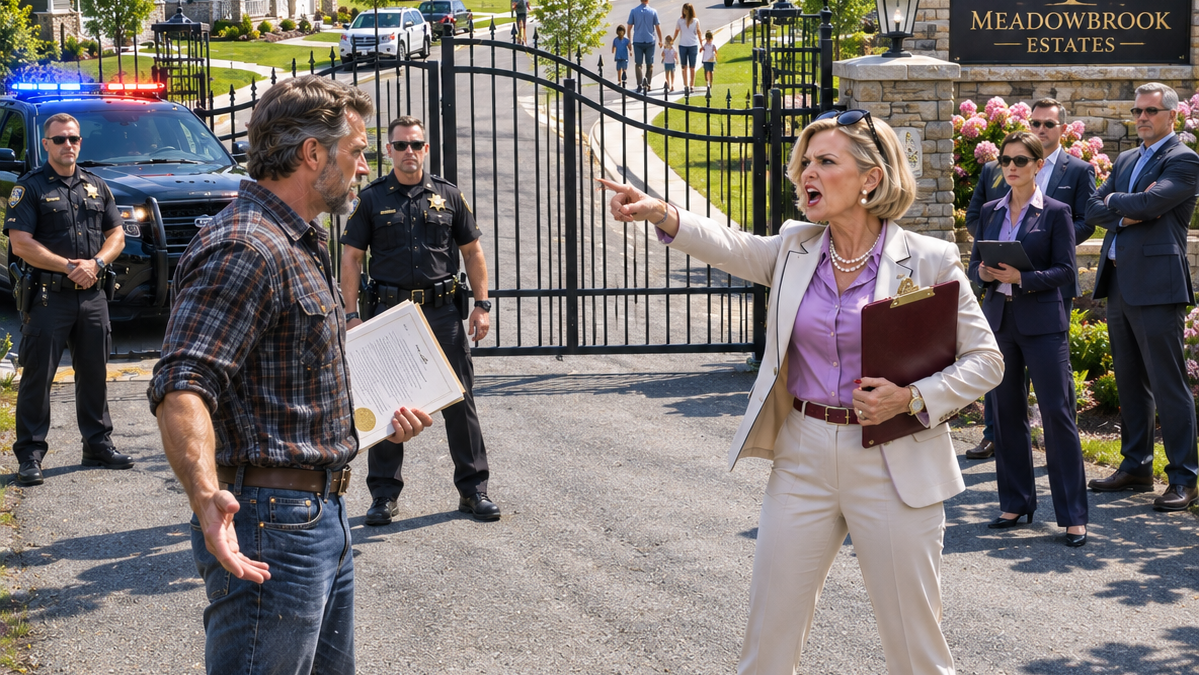
When I came home after two years overseas and found a wrought-iron gate across the entrance to my family’s eighty acres, I thought I had taken a wrong turn—until I looked past it and saw fifty-eight brand-new houses, sidewalks, streetlights, manicured lawns, and an HOA sign planted where my father’s pasture used to be.
Before I could even process how an entire subdivision had appeared on land my grandfather bought in 1947, a woman in designer sunglasses marched up to the gate, introduced herself as Emma Johnson, president of Meadowbrook Estates, and warned me that if I didn’t leave immediately she would call the police and have me arrested for trespassing on what she called “her community.”
I had the original deed folded in my jacket pocket, every property-tax receipt was paid, and one question kept pounding through my head as families drove past me toward homes they clearly believed were theirs: if Emma was confident enough to build a neighborhood on my land and threaten me at my own gate, what exactly had she done while no one was watching?
My name is Michael Brennan, and that land had been in my family longer than almost anything else we owned.
My grandfather bought the eighty acres after World War II. It was Pennsylvania countryside then—rolling meadow, a creek along the eastern boundary, patches of old-growth trees, and one weathered farmhouse where my father eventually raised me. He spent his entire life refusing offers from developers.
“They can make more land on paper,” Dad used to say. “They can’t make more of this.”
Three years before I returned, cancer took him fast.
By then I had already signed a two-year demolition contract in Dubai, the largest project my company had ever landed. Dad had pushed me to take it before he got sick.
“Build your future, son,” he told me. “This land isn’t going anywhere.”
For the first several months after his death, our neighbor Harold Henderson checked the property for me. Harold had lived next door for thirty years, and every Sunday he sent pictures—fence lines, creek levels, the farmhouse porch, sometimes a deer standing where Dad used to park his tractor.
Then Harold died in his sleep.
His daughter left me a voicemail while I was buried in an overseas demolition schedule I couldn’t walk away from. I sent flowers, called the family, and told myself I would get home as soon as the contract ended.
Apparently, eighteen months was all somebody needed.
Now I stood outside a gate that had never existed, staring at a sign reading MEADOWBROOK ESTATES while children rode bicycles across what had once been my father’s hay field.
Emma folded her arms.
“You need to leave.”
“This is the Brennan property.”
“No. It isn’t.”
I pulled the deed halfway from my pocket.
Her eyes flicked toward it, and for the first time her smile changed.
Only for a second.
Then she laughed.
“You have some old paper?”
“It’s the deed.”
“The county records say this property was legally sold.”
“Sold by whom?”
“The county.”
My hand stopped.
“What are you talking about?”
“Tax foreclosure. Abandoned land. Public auction.”
I stared at her.
“My taxes were never delinquent.”
“That’s not what the records say.”
Behind her, a black SUV slowed. A man lowered his window and asked if everything was okay.
Emma smiled without looking away from me.
“Just a trespasser.”
The word landed harder than it should have.
I had learned to drive on that land. I had buried my father from that farmhouse. My grandfather’s initials were still carved into an oak near the creek.
And she had called me a trespasser.
“I want to see the auction record.”
“You can speak to the county.”
“I will.”
Her smile returned.
“You should.”
Then she leaned closer to the gate.
“My husband is the deputy county administrator. He oversaw the records himself.”
That was the first moment I understood I wasn’t looking at a simple boundary mistake.
I looked past Emma again at the fifty-eight homes, at families unloading groceries, at children playing basketball, at people who had no idea their mortgages might be sitting on top of a crime.
Then I looked back at her.
She was still smiling.
And suddenly the neighborhood in front of me didn’t look newly built anymore.
It looked like evidence.
PART 2
I didn’t argue with Emma at the gate.
That surprised her.
I could see it in the slight lift of her chin when I folded the deed and put it back inside my jacket.
She had been preparing for anger.
A shouting match.
Maybe even a scene dramatic enough for her to call the police and tell everyone the crazy stranger claiming to own Meadowbrook Estates had threatened their HOA president.
Instead, I nodded.
“Thank you.”
Her smile faltered.
“For what?”
“For telling me who to look at first.”
The color shifted slightly in her face.
“What is that supposed to mean?”
“Nothing yet.”
I walked back toward my truck.
“Mr. Brennan.”
I stopped.
“If you come onto Meadowbrook property again without permission, security will remove you.”
I looked over my shoulder.
“Emma, if that deed in my pocket is valid, every road behind that gate is on Brennan property.”
“It isn’t.”
“Then you have nothing to worry about.”
Her mouth tightened.
I got into my truck and drove away.
My hands didn’t start shaking until I was almost five miles down the road.
Not from fear.
From rage.
I pulled into an empty church parking lot, shut off the engine, and sat there staring through the windshield.
Fifty-eight houses.
My first instinct was ugly.
I owned a demolition company.
I had spent most of my adult life tearing down structures other people no longer wanted—factories, warehouses, bridges, parking garages, concrete plants, old port facilities.
I knew exactly how quickly fifty-eight cheaply built houses could disappear with the right equipment.
For about thirty seconds, I let myself imagine excavators rolling through that gate.
Then a little girl from inside the subdivision flashed through my mind.
Pink bicycle.
Training wheels.
Her father had been carrying grocery bags toward a front door.
They weren’t Emma.
Those families had probably signed mortgages, paid down payments, hired inspectors, bought furniture, enrolled children in school.
If the land was stolen, they had been stolen from too.
I started the engine.
There would be no bulldozers.
Not yet.
Maybe never.
First I needed facts.
My attorney Marcus Chen answered on the third ring.
“Michael? You’re back.”
“Yeah.”
“How was Dubai?”
“I have fifty-eight houses on my land.”
Silence.
Then:
“I’m sorry, what?”
“Fifty-eight.”
“Are you drunk?”
“It’s ten in the morning.”
“That wasn’t my question.”
“I’m sending you pictures.”
I sent three.
The gate.
The houses.
Meadowbrook Estates.
Marcus called back almost immediately.
“Come to my office.”
By four that afternoon, the table in Marcus’s conference room was buried under documents.
My original deed.
Dad’s will.
County tax receipts.
Automatic bank-payment records.
Old surveys.
Aerial photographs.
Marcus had already pulled the online property file.
He stared at his monitor for so long I finally asked:
“Well?”
“This is bad.”
“For me?”
“For everybody.”
He turned the screen.
The county database showed my eighty acres had been declared tax delinquent eighteen months earlier.
I leaned closer.
“That’s impossible.”
“I know.”
The system claimed notices had been mailed.
Then the property was declared abandoned.
Then it supposedly went to county auction.
Winning bidder:
Emma Johnson.
Purchase price:
Forty-seven thousand dollars.
I actually laughed.
Not because it was funny.
Because sometimes your brain rejects something before your emotions can catch up.
“Forty-seven grand?”
Marcus nodded.
“The county appraisal before your father died valued the land at just over two million.”
“I never missed a tax payment.”
“I see that.”
He had my bank records beside him.
Every tax payment had cleared.
Same account.
Same schedule.
No interruption.
“So the auction is fake.”
“That’s what it looks like.”
“Then we fix the record.”
Marcus didn’t answer.
“What?”
He pulled another file onto the screen.
“Emma’s husband is Dale Johnson.”
“I know.”
“Deputy county administrator.”
“I know that too.”
“He oversees tax assessments, property-record corrections, and delinquency procedures.”
I leaned back slowly.
Marcus continued.
“Meaning if someone wanted to make an eighty-acre property look delinquent when it wasn’t, he had exactly the kind of access you’d need.”
My mouth went dry.
“How did fifty-eight houses get permitted?”
“That’s the next problem.”
He pulled up subdivision records.
Emma had transferred the land to a development entity after the fake auction.
Greenfield Development Corporation.
Sale price:
$4.2 million.
Greenfield subdivided the property.
Built fifty-eight houses.
Sold them between $300,000 and $450,000 each.
All within roughly fourteen months.
I stared at the screen.
“Who owns Greenfield?”
“Richard Pearson.”
“Where is he?”
Marcus typed.
“Florida.”
“Of course.”
“Retired six months ago.”
I stood and walked to the window.
Below us, people moved along the sidewalk downtown.
Normal afternoon.
Normal lives.
Behind me, Marcus said, “Michael.”
“What?”
“We can challenge this.”
“Can we win?”
“If those records are forged and your taxes were current? Yes.”
I turned.
“What happens to the homeowners?”
He was quiet.
That silence frightened me more than Emma had.
“Marcus.”
“They bought from someone who didn’t have legal title.”
“So?”
“So their deeds may be defective.”
I stared at him.
“You’re telling me fifty-eight families might have mortgages on houses sitting on land they don’t legally own.”
“Yes.”
“Can they lose them?”
“Yes.”
I looked back out the window.
That little girl with the bicycle appeared in my mind again.
“Then Emma knew exactly what she was doing when she dared me to sue.”
Marcus nodded.
“She built herself a human shield.”
I drove back to Meadowbrook that evening.
Not through the gate.
I parked across the county road.
From there, I could see most of what had once been the eastern meadow.
Porch lights came on one by one.
A man threw a ball for a golden retriever.
A teenager washed a car.
Someone burned hamburgers badly enough that I could smell them from across the road.
Those people weren’t land thieves.
They were homeowners.
At least they believed they were.
My phone rang.
Marcus.
“I found something else.”
“That sentence is becoming unpleasant.”
“Emma didn’t just become HOA president.”
“What do you mean?”
“She created the management company.”
“What management company?”
“Meadowbrook Management LLC. The HOA pays it to manage Meadowbrook Estates.”
“How much?”
“Six hundred dollars per house per month.”
I did the math in my head.
“Thirty-four thousand eight hundred.”
“Every month.”
“Over four hundred thousand a year.”
“Correct.”
“Who owns the LLC?”
“Technically Emma’s sister.”
I laughed bitterly.
“Technically.”
“We need professionals.”
“I already have a lawyer.”
“You need a fraud investigator.”
“Hire one.”
“And a document examiner.”
“Hire one.”
“Michael, this will get expensive.”
I looked at the neighborhood.
“She stole eighty acres.”
“I know.”
“And sold houses on it.”
“I know.”
“And now she’s charging the victims rent disguised as HOA fees.”
“Management fees, technically.”
“Marcus.”
“Right.”
“How much?”
“To start?”
“Yes.”
“Probably fifteen thousand.”
“Do it.”
That was the cheapest week of the case.
Rebecca Stone was the private investigator.
She was in her early forties, former insurance-fraud investigator, and had the unnerving habit of letting people talk past the point where they should have stopped.
David Kim handled the documents.
He had testified in federal court more times than I could count and looked at signatures the way I looked at cracked concrete—small defects told him where the whole structure was failing.
Three weeks later, we met in Marcus’s office.
Rebecca had a timeline on the wall.
“Emma and Dale moved into the county eight years ago.”
She pointed.
“Dale joined county administration six months later. Promotion to assistant administrator. Then deputy administrator.”
“Fast.”
“Very.”
She changed slides.
“Eighteen months ago, just after Harold Henderson died, someone flagged your property delinquent.”
The timing hit me.
Harold.
He had been the last person regularly checking the acreage.
Rebecca continued.
“Notice was supposedly mailed to your U.S. address.”
“I never got it.”
“Because I don’t think it was mailed.”
She showed me the record.
No certified-mail number.
No postal receipt.
No scan of the envelope.
Just a system entry saying notice sent.
“A ghost record,” she said.
David pushed a folder toward me.
“The signatures are forged.”
“You’re sure?”
“Yes.”
“How?”
He placed enlarged copies side by side.
“County officials use digital signature templates for some internal forms, but these were produced from high-resolution scans and printed onto genuine county paper.”
“Genuine paper?”
“That’s important.”
Marcus leaned forward.
“Meaning whoever made them likely had access inside the county.”
David nodded.
“The seal is real stock too.”
I looked at Rebecca.
“Dale.”
“Probably.”
“Probably?”
She smiled slightly.
“I found somebody else.”
She put a photograph on the table.
A man in his fifties.
Thin hair.
Nervous eyes.
“Thomas Webb. County tax assessor.”
“What about him?”
“He processed the abandonment designation and the auction documents.”
“So he’s involved.”
“Yes.”
“Can we prove it?”
Rebecca’s smile became sharper.
“He’s terrified.”
“Of us?”
“Of Emma.”
That got my attention.
“He kept records.”
“What kind?”
“Emails. Text messages. Notes.”
Marcus leaned forward.
“Why?”
“Insurance.”
Rebecca tapped the photo.
“Thomas Webb knew somebody would eventually need a scapegoat, and he had no intention of being the only one.”
The next month changed the case.
Webb hadn’t agreed to testify yet, but Rebecca gathered enough corroboration to map the scheme.
Emma had apparently noticed our property after Harold died.
No neighbor watching.
Owner overseas.
Father deceased.
Eighty acres.
Clear title.
High value.
Then Dale used county access to flag it as delinquent.
Webb generated false notices.
The auction was rushed through with no real public notice.
Emma was the only bidder.
Forty-seven thousand dollars.
She transferred the land.
Greenfield paid her $4.2 million.
Then fifty-eight houses appeared.
“What did Emma make personally?” I asked.
Rebecca slid over a spreadsheet.
“Land sale, management fees, kickbacks, associated shell companies…”
She looked at Marcus.
Marcus looked at me.
“At least $6.8 million so far.”
I stared.
“From my land.”
“From your land and from the people living on it.”
Rebecca showed me landscaping contracts.
Pool maintenance.
Security.
Snow removal.
Everything billed above market.
Several vendors connected to Emma’s friends or Dale’s relatives.
A management-company transfer landed in Emma’s personal account almost every month.
The sheer arrogance was impressive.
Then Marcus said:
“There’s another issue.”
“Of course there is.”
“The homeowners.”
“I haven’t forgotten them.”
“You need to decide what you want.”
“My land.”
“That’s not specific enough.”
He folded his hands.
“Do you want possession? Money damages? Restitution? Do you want the homes removed?”
I looked at him.
“I own a demolition company, Marcus. That doesn’t mean I’m a psychopath.”
“I know.”
“Those families didn’t do this.”
“I agree.”
“But Emma is counting on that.”
“Yes.”
I stood.
“She thinks the houses make the theft irreversible.”
Marcus didn’t answer.
Because we both knew that was exactly what she thought.
I went to an HOA meeting the following Tuesday.
The clubhouse sat near the center of what used to be Dad’s hay field.
Marble counters.
Leather chairs.
Decorative lighting.
A framed photograph of Emma cutting the ribbon.
I almost admired the audacity.
She had stolen my land, sold it, then hung her own portrait on it.
About sixty residents filled the room.
Emma stood behind a polished podium.
“Beginning next quarter, Meadowbrook Management will implement a fifteen-percent assessment adjustment.”
Someone groaned.
Emma looked toward the sound.
“Our insurance and security requirements have increased.”
A man asked, “Can we see the financial breakdown?”
Emma smiled.
“The board has reviewed it.”
“That wasn’t my question.”
“The board was elected to handle those decisions.”
I sat in the back.
She spotted me.
Her expression froze.
“Security.”
Two men near the door straightened.
I stood.
“I’m leaving.”
Emma stepped around the podium.
“This man has no right to be here.”
A few residents turned.
She pointed at me.
“He is attempting to make fraudulent ownership claims against your community.”
Murmurs.
I raised my hands.
“I’m not here to threaten anybody.”
“You’re trespassing.”
“On land my family owned since 1947.”
The room went still.
Emma laughed.
“There it is.”
She looked at everyone.
“This is the individual who appeared at our entrance claiming he owns Meadowbrook Estates.”
Voices rose.
Someone said, “What?”
Another: “Is this that guy?”
Emma continued.
“He has produced outdated documents and is threatening litigation.”
I looked around.
“I’m not threatening your homes.”
“You claim the land beneath them.”
“Yes.”
People started shouting.
One man stood.
“You trying to throw us out?”
“No.”
“Then why are you here?”
“To find out who was lied to.”
Emma slammed the gavel.
“That is enough.”
A young woman near the front raised her hand.
“Wait.”
Emma looked irritated.
The woman stood.
“Can he show us what he has?”
Emma’s eyes narrowed.
“No.”
“Why?”
“Because this meeting concerns legitimate Meadowbrook business.”
The woman turned toward me.
“I’m Sarah Miller.”
Her husband stood beside her.
“Jake.”
I walked over and handed them a copy of the original deed and tax payment record.
Sarah studied it.
Emma shouted:
“Do not accept fraudulent materials.”
Jake looked up.
“This has a county recording number.”
“So?”
“Can we see your auction documents?”
The room shifted.
Emma’s face went hard.
“Those are confidential.”
I almost smiled.
Jake frowned.
“Why would a land auction be confidential?”
Emma hit the gavel again.
“Meeting adjourned.”
That told the room more than anything I could have said.
Sarah and Jake met me in the parking lot.
They had two kids.
Seven and nine.
Their house cost $385,000.
“We put almost everything we had into the down payment,” Sarah said.
“I’m not taking your house.”
Her eyes filled.
“But if you own the land…”
“I’m going after the people who did this.”
Jake looked suspicious.
“And then?”
“I don’t know yet.”
“That’s not reassuring.”
“I’m not going to lie to you.”
He appreciated that.
I showed them tax records.
The deed.
My father’s will.
They asked questions.
Hard ones.
At the end, Sarah whispered:
“So we were scammed.”
“I think so.”
Jake leaned against their car.
“Emma told us the development was county-backed.”
“I’m sure she did.”
“What do you need from us?”
“Nothing yet.”
Sarah looked toward the clubhouse.
“She’s going to tell everyone you want to bulldoze us.”
I almost laughed at the accuracy.
“She already knows what I do for a living.”
“What do you do?”
“I own Brennan Demolition.”
Jake stared at me.
“The Brennan Demolition?”
“Probably.”
He looked toward the houses.
Then back at me.
“That’s going to scare people.”
“I know.”
And it did.
Emma’s next meeting drew nearly every homeowner.
This time she had printed photographs of my demolition equipment.
She projected them onto a screen.
Excavators.
Hydraulic shears.
Concrete crushers.
A high-reach demolition machine from one of our industrial jobs.
Emma stood beside the image like a prosecutor presenting a murder weapon.
“This is Michael Brennan’s company.”
People whispered.
She advanced the slide.
A demolition excavator tearing into an old warehouse.
“This is what he does.”
I stood in the back.
“Industrial structures.”
Emma pointed at me.
“You want to destroy this community.”
“No.”
“He has filed claims against our land.”
“Against your fraudulent title.”
“Security.”
Sarah stood.
“Emma, show us the auction paperwork.”
Emma ignored her.
Jake joined.
“If he’s lying, prove it.”
“I don’t owe explanations to people disrupting official proceedings.”
A retired man shouted, “It’s our homes!”
Emma slammed the gavel.
“I am protecting your homes.”
I watched her.
That was the brilliance of her strategy.
She had committed the theft.
Now she was positioning herself as the only person who could protect the victims from the rightful owner.
Fear is powerful when people have mortgages.
I tried to speak.
“My company is not going to demolish occupied houses.”
Emma smiled.
“For now.”
“That’s not what I said.”
“You hear him?”
She faced the room.
“For now.”
People erupted.
A man near me shouted:
“Stay away from my family.”
I didn’t blame him.
I left.
Outside, Sarah caught up.
“You shouldn’t have said ‘occupied.’”
“I know.”
“She’ll twist everything.”
“I know that too.”
“You’re not very good at politics.”
“I demolish buildings.”
She almost smiled.
“Maybe learn.”
The next morning Rebecca called.
“Phase Two.”
“What?”
“Emma filed permits for forty more houses.”
I stood.
“Where?”
“The remaining twenty-two acres.”
“That can’t be right.”
“Your signature is on the applications.”
Silence.
“My what?”
She emailed the scans.
There it was.
Michael T. Brennan.
Not my signature.
Not even close if you knew what to look for.
But good enough for a clerk processing hundreds of forms.
“She forged my name.”
“Yes.”
“How far along?”
“She’s sold pre-construction interests.”
“How much?”
“About $1.8 million in deposits.”
I stared at the screen.
This wasn’t greed anymore.
It was compulsion.
Emma had already made millions.
Already built fifty-eight houses.
Already knew I had returned with the original deed.
And she was still selling land.
“Why would she keep going?”
Rebecca said quietly:
“Because stopping would admit something is wrong.”
That made more sense than I wanted it to.
Marcus assembled what he called the war council.
Rebecca.
David Kim.
Forensic accountant Jennifer Park.
Me.
Four walls of evidence.
Jennifer traced Meadowbrook Management.
Vendor kickbacks.
Transfers.
Fake maintenance contracts.
She looked up from her laptop.
“HOA embezzlement alone is roughly $380,000.”
“Separate from the land?”
“Yes.”
“And Phase Two?”
“Separate.”
Marcus summarized.
“Forgery. Fraudulent conveyance. Theft by deception. Potential wire fraud. Conspiracy. Possible money laundering.”
“What about Webb?”
Rebecca nodded.
“He’ll cooperate if prosecutors consider leniency.”
“Does he have proof?”
“Emails where Emma tells him what dates to use.”
Marcus stopped writing.
“What?”
Rebecca smiled grimly.
“She actually wrote instructions.”
“Show me.”
One email read:
Use the prior-year delinquency date. Make sure no postal tracking attaches to the notice. Dale will handle the system entry.
I felt sick.
Not because it surprised me.
Because it was so casual.
Like ordering lunch.
Jennifer added:
“I have bank transfers that line up with the auction.”
“To Webb?”
“Not directly. To an LLC his brother controls.”
Marcus nodded.
“We go federal.”
We filed a quiet-title action.
Then criminal referrals.
But Marcus suggested something strange.
“First filing stays narrow.”
“Why?”
“Because Emma believes you don’t understand the system.”
“I don’t understand the system.”
“You understand demolition sequencing.”
I looked at him.
“Explain.”
“When you bring down a structure, do you hit the strongest support first?”
“No.”
“Why?”
“You weaken the system. Separate loads. Control collapse.”
He smiled.
“Exactly.”
We filed an initial amended claim that was intentionally conservative and procedurally easy to attack without misrepresenting facts.
Emma celebrated publicly.
She held a press conference.
Local television cameras.
Dale beside her.
Their attorney smiling.
“Mr. Brennan’s claims are legally defective,” Emma announced. “Meadowbrook Estates was lawfully acquired and developed.”
A reporter asked:
“Was your husband involved in the original county sale?”
“Yes, and he personally ensured the process followed every requirement.”
Dale nodded.
I watched from Marcus’s office.
Marcus paused the video.
“Thank you.”
“For what?”
“She just tied him directly to the process on camera.”
I smiled.
The first support had cracked.
Rebecca found Phase Two was worse than we thought.
Emma’s new survey claimed thirty-five acres.
My property only had twenty-two undeveloped acres remaining.
The extra land came from an adjacent protected state-forest parcel.
“She moved the boundary again,” Rebecca said.
I stared.
“She’s stealing from the state?”
“Trying.”
“Does she have a death wish?”
“Greed makes people think past success proves future immunity.”
The FBI became much more interested after that.
Special Agent Lisa Torres met us in a plain conference room.
No dramatic entrance.
No television version of federal law enforcement.
Just a woman with a legal pad and a careful voice.
“We are looking at a possible pattern involving public-record manipulation.”
She looked at me.
“Your case may not be the only property.”
I frowned.
“What do you mean?”
“We’re not ready to discuss that.”
“But there are others?”
She didn’t answer.
Which was an answer.
The real civil filing hit the next morning.
Forty-seven pages.
Hundreds of exhibits.
Original deed chain.
Tax records.
Bank confirmations.
Document analysis.
Webb’s preliminary statement.
Vendor transfers.
Phase Two forged signature.
State-land survey manipulation.
The same day, federal agents served search warrants.
Emma’s home.
Dale’s office.
The HOA building.
Computers came out.
Phones.
Boxes.
The neighborhood chat exploded.
Emma posted online:
MEADOWBROOK UNDER ATTACK BY CORRUPT OFFICIALS WORKING WITH A LAND SPECULATOR.
Then she called an emergency meeting.
Forty residents came.
Not sixty.
That mattered.
Carlos Martinez stood before she could finish her opening statement.
“Show us the auction documents.”
Emma stared.
“They’re with counsel.”
Sophia Martinez stood beside him.
“You’ve said that for three weeks.”
“Because we are in litigation.”
A man near the back shouted:
“The FBI took our financial records!”
Emma raised the gavel.
“That investigation is politically motivated.”
“It’s our money!”
Someone else:
“Where did the management fees go?”
Another:
“Why is your sister’s company being paid?”
Emma shouted:
“Order!”
Nobody listened.
For years, the gavel had controlled the room.
That night, it sounded like a toy.
She left through the back door.
Rebecca called me at 11:40 p.m.
“She bought a plane ticket.”
I sat up in bed.
“Where?”
“Costa Rica.”
“When?”
“Three days.”
“Round trip?”
“One way.”
I called Torres.
She already knew.
“We’re monitoring her.”
“You going to arrest her?”
“When appropriate.”
“She’s running.”
“Which is useful.”
“How?”
“Flight conduct matters at bail.”
I rubbed my face.
“You people really do play the long game.”
“So do fraudsters.”
Two days later, Emma arrived at the airport with forty-seven thousand dollars in cash.
She didn’t board.
Federal agents arrested her near security.
At the same time, Dale was arrested in his county office.
The video hit local news by lunch.
Emma in handcuffs.
No pearls.
No HOA podium.
No gate.
Just a woman screaming:
“This is a setup!”
I watched once.
Then turned it off.
Sarah Miller called.
“Is it over?”
“No.”
“How do you know?”
“Because people like Emma don’t stop when they’re caught.”
I wish I’d been wrong.
Seventeen felony counts were unsealed.
Wire fraud.
Forgery.
Conspiracy.
Money laundering.
Theft.
Dale faced similar charges.
Thomas Webb cut a deal.
Then Dale broke.
His attorney negotiated cooperation.
In sworn testimony, he described the scheme.
Emma identified vulnerable property.
He manipulated county records.
Webb created false delinquency documents.
Auctions were rushed.
Emma bought cheap.
Developers paid millions.
It had happened before.
That last part caught my attention.
“What do you mean before?” I asked Marcus.
He scanned Dale’s deposition.
“Two smaller properties.”
“Here?”
“One neighboring county. One several years earlier.”
I sat back.
My property wasn’t an opportunity Emma discovered.
It was an escalation.
Meanwhile, we still had fifty-eight families trapped inside the problem.
Marcus and I spent nights working through options.
I could demand land value.
I could litigate against title insurers.
Banks.
Greenfield.
County government.
Every path meant years.
And every month of uncertainty hurt homeowners.
“What would your father want?” Marcus asked one night.
I stared at him.
“That’s unfair.”
“Probably.”
“He’d want the land protected.”
“And?”
“He wouldn’t throw kids out of their homes.”
Marcus nodded.
I said:
“What if the seized money fixes both?”
He leaned forward.
“Go on.”
“Emma made millions from the fraud.”
“Yes.”
“Freeze it.”
“That’s happening.”
“Use restitution to compensate the land loss.”
“That requires court approval and negotiation.”
“Then negotiate.”
He stared at me.
“You’d sell the lots?”
“To the families.”
“At what price?”
“Enough to make the title legitimate, not enough to punish victims.”
Marcus started writing.
That became the plan.
Emma’s money would repair Emma’s damage.
We held a town hall.
Fifty-three families came.
Five stayed away.
I stood in front of the room without a podium.
“I know some of you think I came here to destroy your homes.”
No one spoke.
“I own a demolition company. That made Emma’s story easy to believe.”
A few people shifted.
“I was angry enough, that first day, to imagine bulldozers.”
Sarah looked at me.
I continued.
“Then I saw your kids.”
The room became still.
“You bought these houses in good faith. You paid mortgages. You trusted permits. You trusted county records.”
I held up the original deed.
“I was defrauded.”
Then gestured toward them.
“So were you.”
Carlos asked:
“What are you proposing?”
Marcus explained the restitution fund.
Seized Johnson assets.
Land parcels sold individually.
Approximate lot value for settlement purposes around fifteen thousand dollars.
Restitution covering roughly twelve thousand per family.
Three thousand balance.
Payment plans.
No interest.
A woman asked:
“What if we truly can’t afford it?”
“I’ll work with you.”
Someone else:
“You could make more selling to a developer.”
“Yes.”
“So why aren’t you?”
I thought about Dad.
“Because the developer didn’t put your children to bed in these houses.”
Silence.
Then Sarah started clapping.
Jake joined.
Carlos.
Sophia.
Soon most of the room.
It was the first time applause in Meadowbrook didn’t belong to Emma.
Then she got bail.
Five hundred thousand dollars secured against remaining family property.
I couldn’t believe it.
Torres wasn’t happy either.
“She has restrictions.”
“She tried to flee.”
“Her lawyer argued the ticket predated the indictment.”
“She had forty-seven thousand dollars.”
“Apparently shopping money.”
I stared.
“You said that with a straight face.”
“I’m practicing.”
Emma came home furious.
Rebecca’s car was keyed.
Someone spray-painted LIAR across Marcus’s front window.
No proof.
Then Emma came to my demolition company.
Three black SUVs.
Four large men.
She walked into my yard like she still owned a gate somewhere.
Danny, my foreman, came running.
“Boss.”
“I see them.”
“You want security?”
“Have them nearby.”
Emma smiled.
“Can we speak privately?”
“No.”
The four men stood behind her.
She glanced at them.
“I think you’ll reconsider.”
I slipped my phone into my shirt pocket and hit record.
“Office.”
Inside, she sat without invitation.
“You’ve caused enough damage.”
I shut the door.
“I exposed damage.”
“Semantics.”
“What do you want?”
She leaned forward.
“Two million dollars.”
I almost laughed.
“For me?”
“For you.”
“What do I have to do?”
“Drop the civil suit. Tell prosecutors the evidence was misunderstood. Withdraw your cooperation.”
“You know I can’t drop federal charges.”
“You can make the case weak.”
“And the homeowners?”
“They keep their current arrangement.”
“With you as president?”
“Yes.”
I stared.
“You’re under federal indictment and still worried about being HOA president?”
“You wouldn’t understand.”
“No. I really don’t.”
Her expression hardened.
“This community is mine.”
“There it is.”
“What?”
“The actual problem.”
She pulled out her phone.
Photographs appeared.
Marcus leaving a casino fundraiser.
Rebecca meeting a man in a garage.
Pictures designed to look suspicious.
“I have information on everyone.”
“Blackmail.”
“Leverage.”
“Same thing with better tailoring.”
Her face tightened.
“You take the money or I destroy your team.”
“What about the families?”
She smiled without warmth.
“I have violation files on dozens of them. Liens. Architectural problems. Undisclosed modifications. I can bury their titles in litigation for years.”
“You’d hurt fifty-eight families to protect yourself.”
“I’ll protect what’s mine.”
I looked at her.
“None of it was yours.”
She stood.
“Forty-eight hours.”
Then leaned close.
“If I go down, everyone goes down.”
She left.
My hands shook after the door closed.
I wasn’t scared until I listened to the recording.
Not because of what she said to me.
Because of how calmly she said it.
I called Torres.
“Emma threatened witnesses.”
“Send the recording.”
Then Thomas Webb called.
His voice trembled.
“They were in my house.”
“Who?”
“I don’t know.”
“What happened?”
“Nothing stolen.”
He started crying.
“They left a photo of my grandchildren on the kitchen table.”
My stomach twisted.
“What was on it?”
“Their school address.”
I stood.
“Where are you?”
“Police station.”
“Stay there.”
“I can’t testify.”
“Yes, you can.”
“She’ll hurt them.”
“Torres can protect you.”
“You don’t know that.”
He was right.
I didn’t.
But I said:
“If you recant now, Emma learns threats work.”
Silence.
Then Webb whispered:
“I hate you for saying that.”
“I know.”
“I’ll stay.”
The media turned against me the next day.
Headline:
BUSINESS OWNER DEMANDS FAMILIES BUY THEIR OWN LAND
Someone leaked the settlement plan without the restitution details.
Television commentators called it a land grab.
Emma stood on courthouse steps with Dale—who was cooperating privately while publicly pretending otherwise—and supporters holding signs.
SAVE OUR HOMES
STOP BRENNAN
She looked directly into the cameras.
“Michael Brennan is using federal authorities to evict working families.”
I watched from the FBI field office.
Torres paused the broadcast.
“She’s good.”
“I know.”
Marcus looked at me.
“You okay?”
“No.”
Carlos called later.
His family was getting threats online.
Several homeowners wanted out of the coalition.
Sarah cried on the phone.
“This is exactly what Emma wanted.”
I sat alone in my kitchen that night.
For the first time, quitting sounded reasonable.
Take damages.
Let title insurers fight it.
Sell what I could.
Leave.
I poured Dad’s favorite whiskey.
Didn’t drink it.
Just stared.
His words came back.
This land isn’t going anywhere.
He had been wrong physically.
On paper, it had gone everywhere.
Maybe what he meant was that responsibility doesn’t disappear because things get difficult.
My phone rang.
Torres.
“We’re building a racketeering case.”
I sat straighter.
“RICO?”
“Yes.”
“Against Emma?”
“Against the enterprise.”
“What do you need?”
“One more meeting.”
I knew immediately.
“No.”
“Michael.”
“She brought hired muscle to my business.”
“We’ll control the environment.”
“How?”
Torres placed a small recording device on the table the next morning.
“Wire.”
I stared at it.
“She’ll search me.”
“Maybe.”
“She’s paranoid.”
“She’s also arrogant.”
Marcus said:
“That’s the bet.”
I didn’t like the bet.
Then I thought about Webb’s grandchildren.
Carlos’s death threats.
Fifty-eight families.
“Set it up.”
Emma agreed in two hours.
Private estate outside town.
I wore the wire beneath my shirt.
Torres’s team waited nearby.
Before I walked in, Marcus stopped me.
“If anything feels wrong, leave.”
“I know.”
“No heroics.”
“I demolish buildings.”
“That statement does not reassure me.”
Emma opened the door herself.
“Smart decision.”
The house was borrowed luxury.
Marble.
Artwork.
Crystal.
No family photographs.
She poured whiskey.
“To new beginnings.”
I didn’t drink.
“Terms.”
“Two million cash.”
“No trail?”
“No taxes.”
“You’d commit tax evasion while under indictment?”
She smiled.
“Don’t be naïve.”
“And you remain HOA president?”
“Yes.”
“Why is that so important?”
For the first time, she hesitated.
Then:
“Because I built Meadowbrook.”
“You stole Meadowbrook.”
“I built it.”
“You forged title.”
“I created value from dead land.”
The words landed.
“Dead land?”
“Your father sat on eighty acres doing nothing.”
“He farmed it.”
“He wasted it.”
“You saw emptiness.”
“I saw opportunity.”
There it was.
Her entire worldview in two words.
Opportunity meant whatever nobody strong enough was currently guarding.
I asked:
“And if I refuse?”
Her smile vanished.
“I destroy every homeowner who sided with you.”
“How?”
“Liens. lawsuits. private information.”
“What information?”
“Affairs. debt. criminal records. employment problems.”
“You’d expose them.”
“I’ll make them regret choosing you.”
“What about Webb?”
Her eyes narrowed.
“He should have kept his mouth shut.”
“His grandchildren?”
She didn’t answer.
That silence was enough.
I pushed.
“You sent people to his house.”
“You don’t need to know everything.”
“And Marcus?”
“Gambling problems can ruin careers.”
“Rebecca?”
“Everyone has something.”
“You’re blackmailing people.”
“I’m surviving.”
“What about prosecutors?”
She leaned closer.
“I have files.”
“On federal prosecutors?”
“Judges too.”
“You think you can blackmail a federal case away.”
“I know I can make it expensive.”
I stood.
“Then we’re done.”
Her eyes flashed.
“You’re saying no?”
“Yes.”
“Think carefully.”
“I have.”
“If I go down, those families lose everything.”
“No.”
“Yes.”
She stepped closer.
“You don’t get to play hero and walk away.”
“Move.”
“Or what?”
I looked at her.
“The FBI has been listening since I walked through the door.”
For one second, Emma didn’t move.
Then she laughed.
“You’re bluffing.”
I took out my phone.
Played a short segment.
Her own voice:
I destroy every homeowner who sided with you.
The color left her face.
She lunged.
I stepped back.
The study door burst open.
“Federal agents!”
Torres entered with four others.
Emma froze.
“Emma Johnson, hands where we can see them.”
“You can’t—”
“Now.”
They cuffed her.
She twisted toward me.
“You think they’ll thank you when they lose everything?”
Torres guided her toward the door.
Emma shouted over her shoulder:
“They’ll hate you!”
I stood in the silent room.
My knees suddenly felt weak.
Torres returned.
“You okay?”
“No.”
She nodded.
“Good answer.”
“What happens now?”
Her expression turned hard.
“Now bail disappears.”
Judge Claudia Morrison revoked it.
No hesitation.
The government presented the Costa Rica ticket.
Cash.
Threats.
My recording.
Webb intimidation.
Emma’s attorney called her a respected community leader.
Judge Morrison looked at him.
“Respected community leaders generally do not offer witnesses two million dollars to obstruct federal proceedings.”
Emma stared at the table.
For the first time since I met her, she had nothing to say.
Dale’s cooperation became public soon afterward.
The neighborhood finally saw the split.
Husband blaming wife.
Treasurer cooperating.
Assessor testifying.
Federal agents holding records.
Emma’s story could no longer support its own weight.
And I knew something about unsupported structures.
Eventually gravity wins.
The trial lasted three weeks.
Thomas Webb testified first.
He looked terrified.
The prosecutor asked:
“Did Mrs. Johnson instruct you to create false tax records concerning the Brennan property?”
“Yes.”
“How?”
“She gave me dates.”
“Did she know the taxes were current?”
“Yes.”
Emma stared at him.
He avoided her eyes.
“Why did you participate?”
Webb swallowed.
“Dale said my job depended on it.”
“And Mrs. Johnson?”
“She said everybody deserved a chance to get ahead.”
The prosecutor displayed the email.
Make sure there’s no postal tracking.
The jury read it.
Silence.
David Kim testified about forged signatures.
Enlarged images.
Pixel inconsistencies.
Printed seals.
Altered dates.
Jennifer Park traced money.
Greenfield payment.
Management fees.
Vendor kickbacks.
Phase Two deposits.
Shell companies.
Millions moving through accounts.
Rebecca explained the timeline.
Harold Henderson’s death.
My overseas contract.
The immediate property flag.
The fake auction.
The rushed development.
Then Dale testified.
He looked twenty years older.
“It was Emma’s idea.”
Her attorney objected.
Overruled.
Dale continued.
“She identified absent owners. I manipulated records. Webb processed paperwork.”
“How many properties?”
“Three that I know of.”
My stomach tightened.
There were others.
Then it was my turn.
I told the jury about Dad.
Dubai.
Harold.
Coming home.
The wrought-iron gate.
Fifty-eight houses.
Emma calling me a trespasser.
Her lawyer stood for cross-examination.
“Mr. Brennan, you own a demolition company.”
“Yes.”
“You have equipment capable of destroying homes.”
“Yes.”
“You were angry when you discovered Meadowbrook.”
“Yes.”
“Did you imagine demolishing the houses?”
Marcus shifted beside me.
I answered honestly.
“For about thirty seconds.”
The courtroom stirred.
The lawyer smiled.
“So you wanted them destroyed.”
“No.”
“But you considered it.”
“I was looking at eighty acres stolen from my family.”
“Yes or no?”
“Yes.”
He turned toward the jury like he had scored something.
I continued:
“Then I saw children living there.”
He stopped.
“I decided the families were victims.”
“No further—”
The prosecutor stood.
“Redirect.”
He approached.
“Mr. Brennan, how many houses did your company demolish in Meadowbrook Estates?”
“Zero.”
“How many homeowners did you evict?”
“Zero.”
“How many offers did you make to preserve their homes?”
“All fifty-eight.”
The lawyer looked away.
Then the government played the wire recording.
Emma’s voice filled the courtroom.
I destroy their lives one by one until they beg you to take my deal.
Nobody moved.
Even Emma looked smaller hearing herself.
If I go down, everyone goes down.
The recording ended.
Six hours of jury deliberation.
Guilty.
All seventeen counts.
Emma’s face collapsed.
Not dramatically.
Her shoulders simply dropped.
Like something holding her upright had finally been removed.
I felt no joy.
Just release.
At sentencing, Judge Morrison spoke for nearly ten minutes.
Sophisticated fraud.
Abuse of public systems.
Witness intimidation.
No remorse.
Dozens of victims.
Land stolen from a family that had owned it for generations.
Emma received twelve years in federal prison.
Five years supervised release.
$7.5 million restitution.
Permanent prohibition from HOA and property-management positions.
Dale received eight years under his cooperation agreement.
Thomas Webb received probation and community service.
Some people thought Webb deserved prison.
Maybe he did.
But without his records, proving the scheme would have been harder.
Justice is rarely clean.
Then came the part I cared about most.
The families.
Emma and Dale’s seized assets created roughly $6.8 million in available restitution funds after proceedings.
Marcus negotiated the settlement.
Each residential parcel would receive valid title.
Settlement land value roughly fifteen thousand dollars per lot.
Restitution would cover about twelve thousand.
Families would pay approximately three thousand.
No-interest plans up to five years.
I personally covered five families who genuinely couldn’t manage even that.
At the final town hall, a woman raised her hand.
“What happens if we don’t want another HOA?”
“Then don’t create one.”
The room laughed.
Carlos asked:
“What if we do?”
“Write rules you’re willing to live under yourselves.”
Sarah smiled.
“Term limits?”
“Yes.”
“Open books?”
“Yes.”
“Independent audits?”
“Please.”
Jake called out:
“No president-for-life?”
“Especially that.”
All fifty-eight families accepted.
Not one house came down.
The old Meadowbrook HOA dissolved.
Residents voted to rename their association.
Henderson Fields.
Partly for Harold Henderson.
Partly for my father, Thomas Brennan, whose farm had become the ground beneath their homes.
Carlos Martinez became president.
Sarah handled community communications.
Jake joined the finance committee.
Their bylaws required term limits.
Public budgets.
Conflict disclosures.
Resident votes for major spending.
No management company owned by relatives.
It sounded obvious.
After Emma, obvious felt revolutionary.
I kept twenty acres around the old homestead.
The rest went to the families.
My demolition company got involved anyway.
Just not the way Emma predicted.
During inspections, we found serious construction problems.
Bad electrical work.
Cheap plumbing.
Underbuilt decks.
Questionable foundation work.
Greenfield had rushed construction.
I offered Brennan Demolition and our affiliated contractors at cost.
No profit.
Danny complained.
“You know this is a terrible business model.”
“I know.”
“You planning to run every job like charity now?”
“No.”
“Good.”
He looked at a cracked support beam.
“Because this place might bankrupt us.”
I laughed.
We spent months correcting code issues.
The irony wasn’t lost on anybody.
The demolition man Emma had used to terrify residents became the guy fixing their houses.
Six months after sentencing, I went to Dad’s grave.
Bottle of his favorite whiskey.
I poured a little at the base of the stone.
“We got the land back.”
Wind moved through the cemetery trees.
“But I gave most of it away.”
I smiled.
“You’d probably call that terrible negotiating.”
Dad had been practical.
He would have complained about the price.
Then secretly loved the outcome.
“The houses stayed.”
I sat beside the headstone.
“Families stayed.”
My throat tightened.
“I think that’s what you would’ve wanted.”
For a moment, I could almost hear him.
Not words.
Just the familiar sense that I had finally come home.
One Saturday, I was repairing the Martinez deck when Carlos called:
“Michael.”
I looked up.
A young woman stood beside my truck.
Mid-twenties.
Jeans.
Dark jacket.
Nervous.
“Mr. Brennan?”
“Yes.”
“My name is Ashley Johnson.”
I stopped.
Emma’s daughter.
I had known she existed but had never seen her.
“What can I do for you?”
“I came to apologize.”
“You didn’t do anything.”
“Yes, I did.”
She shook her head.
“Not directly. But I spent years pretending my mother’s behavior was somebody else’s problem.”
We walked beneath an old oak.
“Are you close?”
“To my mother?”
She laughed sadly.
“I haven’t spoken to her in four years.”
“What happened?”
“She’s always been like this.”
Ashley looked toward the houses.
“Not this big. But schemes. Insurance claims. Returning things after using them. Contractors she refused to pay because she knew they couldn’t afford lawyers.”
She rubbed her hands together.
“When I was young, she taught me everyone was either competition or a mark.”
“That’s a hard way to grow up.”
“I didn’t realize it was abnormal.”
“What changed?”
“College.”
She smiled faintly.
“Ethics professor.”
“Seriously?”
“He destroyed half the things I believed about my family in one semester.”
She showed me a picture of a little boy.
“This is Marcus.”
Her son.
Bright smile.
Three years old.
“I don’t want him learning what I learned.”
“Does Emma know him?”
“She’s never met him.”
Ashley looked down.
“I visited her after sentencing.”
“How was she?”
“Still blaming everyone.”
Me.
Dale.
The FBI.
Webb.
Homeowners.
The judge.
Everyone except herself.
Ashley pulled out an envelope.
“I wrote apologies.”
“How many?”
“Fifty-eight.”
I stared at her.
“You don’t owe them your mother’s debt.”
“I know.”
She looked toward Meadowbrook—Henderson Fields now.
“But I want my son to know our family did at least one thing after this that wasn’t selfish.”
I helped her deliver them.
Some residents hugged her.
Some were polite.
Some wanted nothing to do with her.
She accepted every reaction.
That impressed me.
Then Marcus forwarded a letter.
Richard Paulson.
Oregon.
He had seen news coverage.
Ten years earlier, Emma and Dale had allegedly used a similar scheme against his family.
Forty-acre farm.
Fake tax documents.
Commercial development.
He fought.
Lost.
Spent everything.
His marriage collapsed.
His letter ended:
I stopped believing the truth mattered because nobody cared enough to look. Seeing your case proved I wasn’t crazy.
I read that line five times.
Then called Torres.
She answered:
“You found Richard.”
“You know him?”
“We’re beginning to.”
“How many others?”
“Michael…”
“How many?”
“More than one.”
Over the following months, seven other victims emerged.
Different states.
Different variations.
Same pattern.
Owners absent.
Elderly.
Estates in probate.
Tax records manipulated.
Cheap acquisition.
Quick resale.
Dale’s government connections changed from place to place, but the fraud was familiar.
The scale made me sick.
Emma hadn’t invented her personality at Meadowbrook.
She had refined a method.
Richard’s case reopened.
Investigators discovered local officials had helped bury his original complaint.
Some had been pressured.
One had accepted money.
Another had been blackmailed with fabricated material Dale created.
Richard eventually received a $2.3 million settlement from the city and recovered part of his property.
He called me.
His voice shook.
“You gave me back ten years.”
“No.”
“Yes.”
“Richard, investigators did that.”
“You made them look.”
I didn’t know what to say.
He continued:
“I thought justice was for people with more money than me.”
I stared out at Dad’s old field.
“Sometimes it just needs somebody stubborn.”
He laughed through tears.
“That too.”
One year after Emma’s sentencing, Henderson Fields held a barbecue.
Two hundred people.
Kids.
Dogs.
Neighbors.
Families who once looked at me like I had come to destroy them.
Carlos gave a speech.
I hated every second of it.
“Michael Brennan could have taken the land back.”
I stared at my shoes.
“He could have sold it.”
Sarah clapped.
“He could have demolished everything.”
Someone shouted:
“He brought the equipment!”
Everybody laughed.
I did too.
Carlos continued.
“Instead, he fought the people who stole from all of us.”
Then he pointed toward a new community park.
Sarah brought her children over.
“Come see.”
Playground.
Picnic tables.
Small memorial garden.
In the center stood a stone.
I read the inscription.
HENDERSON FIELDS
BUILT ON JUSTICE, SUSTAINED BY COMMUNITY
Below:
IN MEMORY OF HAROLD HENDERSON AND THOMAS BRENNAN,
WHO LOVED THIS LAND AND TAUGHT US TO CARE FOR WHAT WE INHERIT.
My father’s name.
I couldn’t speak.
Jake put a hand on my shoulder.
“Take your time.”
I touched the stone.
Dad had never met any of these families.
But somehow they knew what he had believed.
Land was supposed to mean something beyond price.
That evening, I drove to the old farmhouse.
I had been repairing it slowly.
Maybe I would live there.
Maybe not.
I sat on the porch.
In the distance, porch lights glowed across Henderson Fields.
A dog barked.
Kids shouted.
Someone started music too loud.
No HOA officer appeared with a decibel meter.
My phone buzzed.
Rebecca.
Emma denied early release. Lack of remorse cited. Full sentence expected.
I put the phone down.
Another message arrived.
Ashley.
A photograph.
Her son Marcus holding a drawing.
Stick figure.
Excavator.
A row of houses.
Words in a child’s handwriting:
MR MICHAEL SAVED THE HOUSES
I laughed.
The drawing got one thing wrong.
The excavator was knocking down a giant pink building labeled BAD RULES.
I saved it.
Three years after I first came home, the old wrought-iron gate disappeared.
Not because I tore it down in anger.
Henderson Fields voted to replace it with something simpler.
Open stone pillars.
No guardhouse.
No threatening sign.
My crew handled the removal.
Danny stood beside one of our excavators.
“You sure you want to do this yourself?”
“Yes.”
“You’ve been waiting three years to demolish something here.”
“Very funny.”
I climbed into the machine.
The old sign still read:
MEADOWBROOK ESTATES
PRIVATE COMMUNITY
I lowered the bucket.
Metal groaned.
The sign folded.
Residents watched from a safe distance.
Some applauded.
I didn’t destroy a house.
I didn’t destroy a family’s home.
I destroyed a gate Emma had put across land she stole.
That felt right.
When the debris was cleared, Carlos and Jake installed the new sign.
HENDERSON FIELDS
Nothing underneath about exclusivity.
No warning about trespassing.
No president’s name.
Just the community.
Sarah’s daughter—the same little girl I had seen riding a bicycle the day I returned—stood beside me.
“You broke the old sign.”
“I did.”
“Are you going to break our houses?”
The question hit me.
Even after three years.
Even after everything.
Some part of Emma’s fear campaign had survived in that child.
I crouched.
“No.”
“Never?”
“Never.”
She looked at the excavator.
“Then what do you break?”
I thought for a second.
“Things that shouldn’t be standing anymore.”
She seemed satisfied.
Then ran back toward her friends.
I watched her go.
That was when the title everyone gave the story finally made sense to me.
Emma had built fifty-eight houses on my land.
And yes, she had picked the wrong man to steal from.
I owned a demolition company.
But the part she never understood was that demolition isn’t simply destruction.
Good demolition is controlled.
You identify what is dangerous.
You protect what needs to stay.
You separate it from what has failed.
Then you remove the failed structure carefully enough that the good things around it survive.
That was exactly what we had done.
The houses stayed.
The families stayed.
The land stayed in the hands of people who respected it.
The fraudulent records disappeared.
The fake HOA collapsed.
Emma’s shell companies vanished.
Dale lost his position.
Corrupt officials were exposed.
Other victims found their cases reopened.
The only thing I really demolished was the system she built out of lies.
One piece at a time.
I looked across Henderson Fields as evening settled over the old Brennan acreage.
Different paint colors now.
Different gardens.
A basketball hoop leaning slightly over one driveway.
Wind chimes somewhere near the creek.
Kids racing bicycles along the sidewalk.
Nothing like the sterile rows I had first seen through Emma’s gate.
It had become what Dad always hoped the land might become someday.
Useful.
Alive.
Loved.
I drove the excavator back toward the old homestead.
Before shutting it down, I looked at the memorial garden in the distance.
Dad’s name was still visible on the stone.
I thought about the last thing he told me before I left for Dubai.
“This land isn’t going anywhere.”
For a long time, I had believed he was wrong.
The paperwork disappeared.
The boundaries changed.
Fifty-eight houses appeared.
Someone else put up a gate and told me I was trespassing.
But sitting there in the cab of a demolition excavator, listening to families laugh across what used to be his fields, I finally understood.
Dad hadn’t been talking about deeds.
He meant what the land stood for.
Emma could forge a document.
She could corrupt an auction.
She could buy influence.
She could build a gate.
She could even put fifty-eight houses where my father once grew hay.
But she couldn’t permanently turn stolen ground into something that belonged to greed.
Eventually the truth caught up.
And when it did, I didn’t need to bulldoze fifty-eight homes to take my land back.
I only had to make sure the people who had been cheated finally had the right to call it theirs.
I shut off the excavator.
The engine rumbled down into silence.
Then I walked home across my father’s remaining twenty acres while the lights of Henderson Fields came on behind me, one house at a time.
[END OF STORY]