7 People Failed to Control the Aggressive Military K9—Until One Nurse Walked In
7 People Failed to Control the Aggressive Military K9—Until One Nurse Walked In
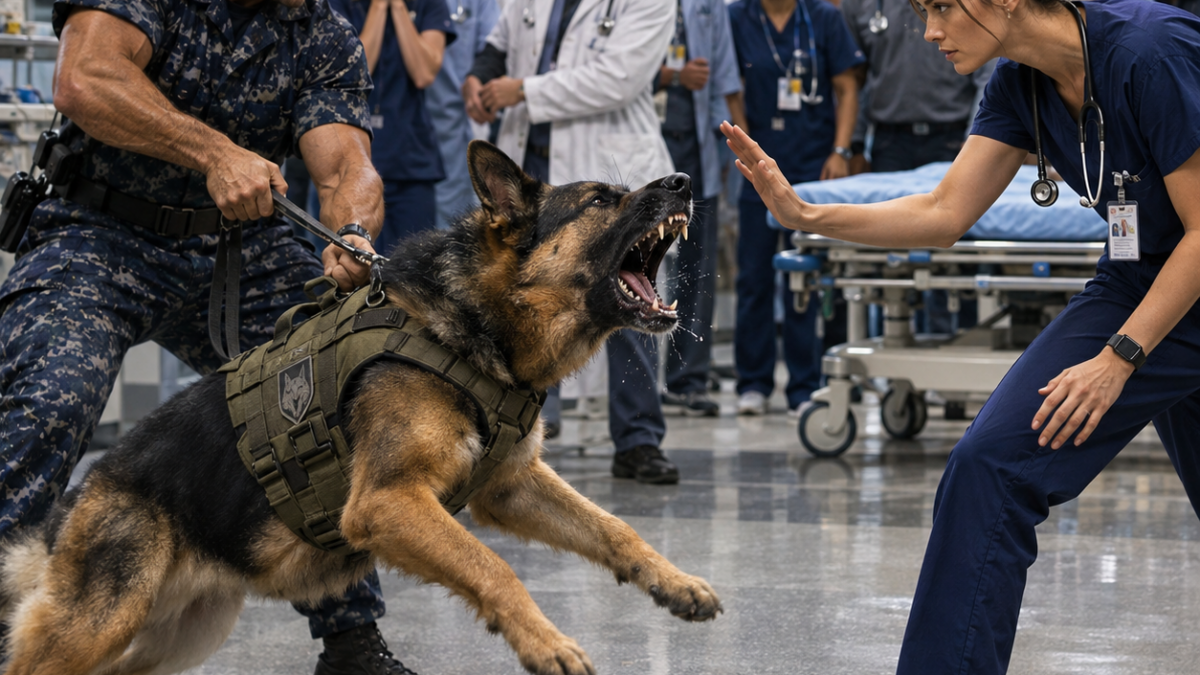
Seven trained professionals tried to get close to the military German Shepherd standing in the middle of our emergency wing, and every one of them backed away when Atlas lowered his head, showed his teeth, and refused to surrender his harness.
Then Nurse Nora Bennett walked through the doors, studied the trembling K9 for less than five seconds, and quietly said, “You’re not trying to hurt anyone. You’re waiting for someone.”
But the reason Atlas recognized her—and the reason that hospital hallway had suddenly become terrifying to him—was hidden beneath his tactical harness and on a security camera none of us had thought to check.
At 8:26 on a Tuesday morning, the emergency department at Redwood Point Naval Medical Center was already losing its battle with the day.
A retired Marine was arguing with registration because he had forgotten his wallet.
A toddler screamed from triage.
A corpsman pushed a portable monitor down the hall.
Two nurses were trying to find a room for a patient who had been waiting forty minutes.
Somebody’s coffee had spilled beside the medication station.
In other words, it was normal.
Then the automatic doors opened.
Lieutenant Owen Ross walked in holding a black tactical leash with both hands.
At the other end was a seventy-eight-pound German Shepherd named Atlas.
The entire atmosphere changed.
You could tell Atlas was a military working dog before you saw the markings on his harness.
He moved differently.
Head usually high.
Eyes usually scanning.
Muscles balanced beneath a black-and-tan coat.
Seven years old.
Still powerful.
Still athletic.
A little gray beginning around his muzzle.
Olive-drab tactical harness.
Military identification tag beneath his collar.
Normally, Atlas entered a building as if he already knew where every exit was.
That morning, he looked like he did not know where anything was.
His breathing was too fast.
His tail was low.
His ears moved constantly.
And instead of responding to Owen, he stared down the emergency corridor.
“Easy, Atlas.”
Nothing.
Owen shortened the leash.
“Heel.”
Atlas didn’t look at him.
That alone worried Owen.
PART2:
Atlas had worked with him enough to recognize the command.
Owen was not his primary handler, but they had trained together for years.
Atlas respected him.
Normally.
That morning, the dog seemed to barely know he was there.
A nurse approached carrying a stainless-steel water bowl.
Atlas saw her.
His body changed instantly.
Head lower.
Shoulders forward.
Upper lip lifted.
A deep growl came from his chest.
The nurse stopped.
Owen raised a hand.
“Don’t come closer.”
She backed away.
Atlas did not follow her.
That mattered.
He wasn’t lunging.
He wasn’t trying to chase.
He simply wanted distance.
Owen guided him toward an unused treatment area.
“Come on, buddy.”
Atlas pulled instead toward the opposite hallway.
“Atlas.”
Nothing.
“Heel.”
Nothing.
Then Atlas stopped so suddenly Owen almost walked into him.
The dog became rigid.
Ears forward.
Nose slightly lifted.
His eyes locked on a closed door near the surgical corridor.
Owen followed his stare.
“Nothing there, pal.”
Atlas growled.
Not at Owen.
At the door.
That was when Dr. Elias Monroe arrived.
Elias was our hospital veterinarian and the calmest man I knew around frightened animals.
Fifty-two.
Thin.
Glasses always sliding down his nose.
The kind of veterinarian who could examine an injured working dog without turning the room into a contest.
“What happened?”
Owen looked exhausted already.
“I don’t know.”
“Was he injured?”
“No.”
“Heat?”
“No.”
“Vomiting?”
“No.”
“When did he last eat?”
“Last night.”
“Drink?”
“A little this morning.”
Elias stayed six feet away.
He did not crouch directly in front of Atlas.
Did not stare.
Did not extend a hand.
He simply observed.
Breathing elevated.
No obvious blood.
No limping.
Gait had appeared normal on arrival.
Eyes clear.
Gums looked normal from what could be seen.
Nothing immediately explained the dog’s behavior.
Elias shifted one step sideways.
“Atlas.”
The dog’s eyes snapped toward him.
Lip rose.
Elias stopped.
“Okay.”
He looked at Owen.
“He doesn’t want contact.”
“You think?”
“I’m making it official.”
Owen almost smiled.
Then Atlas looked back at the surgical door.
Elias noticed.
“What’s behind there?”
“Treatment rooms and access to the surgical wing.”
“Was he brought through there earlier?”
Owen hesitated.
“Not exactly.”
Before he could explain, another man came down the corridor.
Chief Marcus Flynn.
Military K9 handler.
More than a decade of experience.
Marcus knew Atlas well enough that under normal circumstances the dog would greet him with a relaxed tail and immediate recognition.
Marcus stopped about ten feet away.
“Hey, buddy.”
Atlas’s ears moved.
Good sign.
Marcus crouched sideways.
“Come here.”
Atlas backed away.
Marcus froze.
His expression changed.
“That’s strange.”
Owen gave him a tired look.
“Welcome to the morning.”
Marcus tried a familiar command.
Atlas ignored it.
Favorite reward.
Ignored.
Water.
Ignored.
Then Marcus took half a step closer.
Atlas growled.
Marcus stood.
“All right.”
The hospital security officer appeared.
“Do you need the hallway cleared?”
Marcus nodded.
“Yes.”
Within minutes, the area looked completely different.
Patients redirected.
Doors closed.
Staff asked to use another corridor.
Nobody wanted a frightened military dog cornered by strangers.
By 9:15, seven people had tried some form of approach or intervention.
Two Navy handlers.
Elias.
A veterinary technician.
An ER physician.
A senior nurse.
Security.
Seven people.
Seven failures.
Not because they were incompetent.
Not because Atlas attacked them.
Because every time somebody tried to take control of the situation, Atlas told them the same thing.
Stay away.
He paced.
Stopped.
Sniffed.
Returned to the same door.
Paced again.
Owen sat on the floor several yards away.
“Atlas.”
The dog’s ears moved.
But he did not approach.
Marcus watched.
“He’s waiting.”
“For what?”
Marcus shook his head.
“I don’t know.”
Elias studied the floor.
“He’s searching too.”
“Searching for what?”
“I don’t know that either.”
Atlas walked toward the closed treatment-room door.
Sniffed beneath it.
Returned.
The door opened.
A nurse stepped out.
Atlas immediately tensed.
She froze.
He growled.
She stepped away.
A doctor tried later.
Same response.
Security.
Same.
Anyone who moved between Atlas and the surgical corridor became something he wanted to avoid.
Then Senior Nurse Linda Chavez said:
“Where’s Nora?”
Owen looked over.
“Nora Bennett?”
“Yes.”
“Why?”
“She worked with him a few weeks ago.”
Owen frowned.
“With Atlas?”
Linda nodded.
“Training injury. He came through here.”
Marcus looked interested.
“What happened?”
“Nothing major.”
Linda glanced toward the hallway.
“She should be coming back from imaging.”
The strange thing was that Atlas reacted before any of us saw her.
His ears lifted.
Growling stopped.
His head turned.
A woman in navy-blue scrubs came around the corner carrying a small medical tray.
Thirty-five.
Slim athletic build.
Dark auburn hair tied low.
White hospital badge clipped to her scrub top.
Black stethoscope around her neck.
Nora Bennett.
She saw the crowd.
Then Atlas.
And stopped.
Atlas stopped moving too.
For several seconds, they just looked at each other.
Nora slowly lowered the tray onto a counter.
“What happened?”
Owen said:
“He won’t let anyone near him.”
Nora studied Atlas.
Not his teeth.
Not the leash.
His entire body.
“He’s not aggressive.”
Owen gave a humorless laugh.
“He growled at me.”
“He’s afraid of you taking him somewhere.”
“That’s a pretty confident diagnosis from twenty feet away.”
Nora ignored the sarcasm.
She looked toward the surgical corridor.
Then at Atlas.
Then at the path between him and the door.
“You’re standing between him and what he wants.”
Owen’s expression changed.
“What does he want?”
Nora did not answer.
Instead:
“Where’s his handler?”
Owen raised both hands slightly.
“I’m right here.”
Nora looked at him.
“No.”
Then:
“His handler.”
Owen’s face lost color.
“Chief Petty Officer Grant Mercer.”
“Where is he?”
Nobody answered quickly enough.
Nora looked toward the surgical wing.
“Oh.”
Owen nodded.
“He’s in surgery.”
“What happened?”
“Training accident yesterday.”
Marcus answered this time.
“Head injury.”
“How bad?”
“Bad enough they brought him here overnight.”
Nora looked at Atlas.
“Did Atlas see Grant arrive?”
Owen nodded.
“Yes.”
“Did he see where Grant went?”
“No.”
Nora exhaled.
“There it is.”
Owen stared.
“There what is?”
She walked closer.
Not toward Atlas directly.
To one side.
Several feet away.
Then she sat on the floor.
Cross-legged.
Hands resting on her knees.
No command.
No eye contact demand.
No reaching.
Atlas watched every movement.
Nora spoke quietly.
“He thinks Grant disappeared.”
Owen frowned.
“He knows Grant is here.”
“Does he?”
“He saw the ambulance.”
“He saw Grant brought through this hospital.”
“Yes.”
“And then?”
Owen said nothing.
Nora continued.
“Then people took Grant through a door Atlas couldn’t follow.”
Atlas looked toward the surgical corridor.
Nora’s voice softened.
“He doesn’t understand surgery.”
Marcus said:
“He’s been in hospitals before.”
“That isn’t the same thing.”
She looked at Atlas.
“He understands scent.”
“Routine.”
“Movement.”
“Grant.”
Then:
“He knows Grant came through that hallway and didn’t come back.”
Something changed in Owen’s expression.
Nora looked at Atlas.
“You’ve been waiting all morning, haven’t you?”
Atlas’s ears moved.
His mouth closed.
For the first time that morning, his face looked less like a threat.
More like what Nora had said.
A frightened dog.
Atlas took one step toward her.
Owen instinctively tightened the leash.
Nora lifted one hand.
“Don’t.”
“He’s moving.”
“Yes.”
“That’s why I’m holding him.”
“No.”
She looked at Owen.
“He isn’t trying to escape.”
Atlas stopped.
Nora pointed gently toward the hallway.
“Every time somebody approaches him, he backs away.”
“Because?”
“He thinks they’ll move him.”
“To another room?”
“Away from the place Grant disappeared.”
Owen looked at Atlas.
The entire morning suddenly made sense in a way seven failed commands had not.
Atlas had not been defending a room.
He had been refusing to leave a location.
Owen loosened the leash.
Atlas noticed immediately.
One step.
Then another.
Nora stayed completely still.
He reached her.
Stopped.
Sniffed her hand.
She did not touch him yet.
Atlas sniffed again.
Then pressed his nose into her palm.
Somebody behind the observation glass covered her mouth.
Marcus whispered:
“How did she do that?”
Owen had no answer.
Nora slowly moved her hand beneath Atlas’s jaw.
One light touch.
He leaned into her.
Not dramatically.
Just enough.
A seventy-eight-pound military K9 who had rejected seven people rested part of his weight against a nurse sitting on the hospital floor.
Nora reached toward his harness.
Stopped.
Something blue was caught beneath one buckle.
A narrow piece of fabric.
She leaned closer.
“What is that?”
Owen approached carefully.
Atlas glanced at him.
No growl.
Owen looked.
“Blue cloth.”
Nora touched it gently.
Faded cotton.
Her expression changed.
“That’s Grant’s.”
Owen looked at her.
“How do you know?”
“Undershirt.”
Grant wore the same kind of faded blue shirt beneath his uniform during training.
The day before, when he went down during the accident, part of the fabric must have torn.
Atlas had carried it beneath his harness all night.
Scent.
Grant’s scent.
Nora looked at Owen.
“He’s been carrying him.”
That sentence broke something in the room.
Nobody spoke.
Atlas sniffed the strip.
Then looked toward surgery.
Nora said:
“He needs confirmation.”
Owen swallowed.
“We can’t take him into an operating room.”
“I didn’t say we should.”
“Then what?”
“Bring Grant to him.”
Owen stared.
“Grant is unconscious.”
“Not Grant himself.”
She stood carefully.
“Something that smells like him.”
A nurse contacted the surgical team.
There was a blanket Grant had used before being prepared for surgery.
Clean enough to safely bring out.
Still carrying his scent.
When Owen returned with it, Atlas stood immediately.
Nora placed the blanket on the floor.
Atlas approached.
Sniffed once.
Then again.
His whole body changed.
Shoulders dropped.
Tail loosened.
Breathing slowed.
He circled the blanket once.
Then lay beside it.
Head on the fabric.
Eyes closed.
For the first time in hours.
Owen sat against the wall.
Looked at Nora.
“You’ve done this before.”
“With scared animals?”
“No.”
He nodded toward Atlas.
“Military dogs.”
Nora was silent.
Owen noticed.
“What aren’t you telling me?”
She rubbed Atlas’s neck.
“Before nursing, I worked two years in civilian medical support around military working-dog programs.”
Marcus stepped closer.
“What kind of support?”
“Treatment recovery.”
“Behavior observations.”
“Training injuries.”
“Anything the veterinary teams needed.”
Owen looked surprised.
“You never mentioned that.”
“Most people at work don’t list every job they had in their twenties.”
Marcus asked:
“That’s how you read him?”
“Some of it.”
Nora looked down.
“Mostly I understand fear.”
“Because?”
She glanced toward the surgical corridor.
“Because treatment isn’t only about what’s physically happening.”
Then:
“It’s about what the patient thinks is happening.”
Atlas opened his eyes.
Nora touched his muzzle.
“And right now, he thinks the person he trusts most went through a door and disappeared.”
Hours passed.
Grant remained in surgery.
Atlas remained beside Nora.
Eventually he drank.
Not much.
Enough.
Then ate several bites from Owen’s hand.
The emergency department slowly reopened the corridor.
Nobody crowded Atlas.
Nobody tried to prove they could handle him now.
That change alone made him calmer.
Around four that afternoon, the surgical doors opened.
A neurosurgeon stepped into the hall.
Owen stood.
“How is he?”
The surgeon removed his mask.
“Stable.”
Owen closed his eyes.
Marcus exhaled.
Nora looked down.
Atlas was already standing.
Nobody had spoken his name.
His ears were forward.
Eyes on the surgeon.
He knew something had changed.
“Can we see Grant?”
“In a few minutes.”
Owen turned toward Atlas.
The dog’s tail moved.
Once.
One small sweep.
The room reacted as if someone had announced a miracle.
Because after hours of rigidity, that tiny motion meant something.
Relief.
But Atlas did not follow Owen when he stepped away.
He stayed beside Nora.
Owen looked back.
“Seriously?”
Nora smiled faintly.
“He had a long day.”
“So did I.”
Owen reached for the leash.
Atlas looked at Nora first.
Not permission exactly.
A check.
Safe?
Nora nodded.
“It’s okay.”
Atlas allowed Owen to take the leash.
That should have been the end of it.
A frightened K9.
Handler in surgery.
Smart nurse.
Emotional reunion.
Instead, fifteen minutes later, our hospital administrator came down the corridor so fast his badge was bouncing against his jacket.
“Marcus.”
Marcus looked up.
“What?”
“We need you in security.”
“What happened?”
“Footage.”
Owen frowned.
“What footage?”
The administrator hesitated.
“Something we found while reviewing this morning.”
Nora stood.
Marcus looked at her.
“You too.”
The security office was small enough that six people made it feel crowded.
A monitor showed the hospital’s emergency entrance.
Timestamp:
7:43 A.M.
Atlas and Owen arrived later.
The security officer switched feeds.
Another camera.
A man wearing maintenance clothing entered the K9 observation corridor.
Cap low.
Face mostly hidden.
Small black case in one hand.
Marcus leaned forward.
“Who is that?”
“No badge scan.”
“Contractor?”
“Not on the schedule.”
The video showed the man entering a ventilation-access corridor.
Then leaving several minutes later.
Owen crossed his arms.
“What does this have to do with Atlas?”
The officer played footage from Atlas’s arrival.
Atlas entered.
Stopped.
Looked down the hallway.
Nora leaned toward the screen.
“Pause.”
The frame froze.
Atlas’s head was turned.
Not toward surgery.
Toward the maintenance corridor.
“Go back.”
Replay.
Atlas looked toward the surgical wing.
Then suddenly toward the maintenance corridor.
Then back toward surgery.
Nora pointed.
“He noticed something.”
Marcus frowned.
“What?”
“I don’t know.”
She watched again.
“Nose first.”
“What?”
“He turns before the man appears on the next feed.”
Marcus understood.
“Scent.”
“Or sound.”
Security searched the maintenance area.
Ten minutes later, one officer returned carrying the same black case.
Inside was a small electronic device.
Elias came down to examine it.
He turned it over.
Read a serial number.
Pressed nothing.
His expression changed.
“What is it?”
“A programmable acoustic emitter.”
Marcus stared.
“In English.”
“It can generate frequencies above what most people notice.”
Owen looked toward the K9 area.
“But dogs would.”
“Yes.”
“How loud?”
“Depends on the settings.”
Nora shook her head.
“That didn’t create his entire reaction.”
Marcus looked at her.
“How do you know?”
“Because Atlas kept orienting toward Grant.”
She pointed at the screen.
“The sound may have increased his stress.”
“Made the environment feel unsafe.”
“But it didn’t create the thing he was searching for.”
“Grant did.”
Owen’s jaw tightened.
“Someone deliberately stressed him.”
“Yes.”
That changed everything.
Military authorities were contacted.
The hospital locked down access to the K9 treatment corridor.
Security continued reviewing footage.
At 5:18, they got a clear face.
Marcus recognized him first.
“Peter Rowan.”
Nora went completely still.
Owen looked at her.
“You know him.”
“Yes.”
“Who is he?”
Marcus answered.
“Former behavioral research consultant.”
Nora corrected:
“Former military working-dog researcher.”
“What was he researching?”
Nora took a long breath.
“Stress.”
Owen waited.
“What kind?”
“The kind that should’ve ended years ago.”
Nobody spoke.
Nora looked at Atlas through the glass.
“Rowan believed controlled fear could improve obedience.”
Marcus’s face hardened.
“I remember some of that.”
Nora nodded.
“He thought you could create pressure, then measure how quickly the dog returned to the handler.”
“And you disagreed?”
“Completely.”
“Why?”
“Because if the dog obeys because he thinks the alternative is worse, you haven’t strengthened the partnership.”
She looked at Owen.
“You’ve damaged it.”
Marcus asked:
“Was an animal hurt?”
Nora hesitated.
“One dog was psychologically ruined.”
Silence.
“Name?”
“Miles.”
She looked down.
“Military working dog.”
“Six years ago.”
“Rowan ran a stress-response trial that should never have been approved at the intensity he used.”
“What happened?”
“Miles stopped responding reliably to commands.”
“Became fearful of unfamiliar handlers.”
“Started shutting down.”
“Couldn’t continue working.”
Owen asked:
“Did anyone investigate?”
“Yes.”
“You?”
“I filed a report.”
Marcus gave her a long look.
“That’s why you left.”
“Partly.”
The answer told us there was more.
Nora was not ready to tell it.
Security found Rowan had entered using legitimate old credentials tied to a research-access agreement that should have expired.
Administrative failure.
Nobody had flagged it.
The device near Atlas had been active before he arrived.
The question became:
Why Atlas?
Nora thought about it.
“Maybe not Atlas.”
Owen looked at her.
“What does that mean?”
“He may not have chosen the dog.”
“Then what did he choose?”
“The situation.”
Nora pointed toward the operating wing.
“A military K9 whose primary handler was unavailable.”
Marcus understood first.
“He wanted to see what happened when the dog was stressed without the handler.”
Nora nodded.
“How much pressure before Atlas stopped responding to secondary handlers.”
Owen looked sick.
“He used him as a test subject.”
“Without consent.”
“Without authorization.”
“Inside a hospital.”
Nora’s voice hardened.
“He hasn’t changed.”
Grant woke shortly before six.
First question:
“Atlas?”
Not:
What happened?
Not:
How bad is my injury?
Atlas.
Owen smiled.
“He’s okay.”
Grant closed his eyes.
“Bring him.”
The physician objected.
Then Grant asked again.
“Five minutes.”
Atlas was lying beside Nora when Owen returned.
The moment Owen said Grant’s name, Atlas stood.
Nora smiled.
“Come on.”
He walked beside Owen toward recovery.
At the glass outside Grant’s room, Atlas froze.
Grant lay propped in bed.
Bandage around his head.
Pale.
Exhausted.
Alive.
Atlas stared.
Then his tail started moving.
Fast now.
Grant smiled.
“Hey, buddy.”
Atlas looked at Nora.
Then back at Grant.
Nora opened the door.
“Go.”
Atlas walked in.
Not running.
Working dogs are trained around medical equipment.
He approached carefully.
Grant extended one hand.
Atlas pushed his head beneath it.
Grant’s eyes closed.
“I knew you’d find me.”
Nobody spoke.
Grant scratched his ear.
Then noticed Nora.
“Who’s that?”
Owen grinned.
“The nurse who figured him out before the rest of us.”
Grant looked at her.
“Thank you.”
Nora shook her head.
“He found you.”
Grant smiled weakly.
“No.”
Then:
“He found you.”
Nora looked confused.
Grant studied her face.
“Three weeks ago.”
Rain.
Training complex.
A K9 separated temporarily from his handler.
Nora remembered.
“Wait.”
Grant smiled.
“That was Atlas.”
Her eyes widened.
Three weeks earlier, Nora had finished a twelve-hour shift and been leaving an auxiliary training facility after helping with an injured service member.
Rain poured.
She heard barking behind a maintenance building.
Found a German Shepherd in tactical gear pressed beneath an awning.
No handler visible.
No obvious injury.
He would not allow anyone to approach.
Nora had sat down.
Forty minutes.
No commands.
No force.
Eventually the dog came to her.
Grant arrived moments later.
The dog immediately returned to him.
Nora had never learned his name.
Grant had.
“You stayed with him.”
Nora looked at Atlas.
“He remembered.”
“Military working dogs remember people.”
Grant smiled.
“Especially people who don’t make a bad moment worse.”
Atlas lifted his head.
Looked at Nora.
Then Grant.
Then placed one paw across Grant’s wrist.
That image stayed with me.
Not because it looked heroic.
Because it looked ordinary.
A dog touching his person.
A person touching his dog.
The simple thing Atlas had been trying to get back to all day.
Later that evening, Marcus called Nora into his office.
He placed the recovered acoustic device on the desk.
Beside it:
An old investigation file.
Nora saw the date.
Six years earlier.
She went pale.
“This is the Miles report.”
“Yes.”
“Why do you have it?”
“Because Rowan’s access code links back to the same research program.”
Nora opened the folder.
Stress compliance.
Handler response.
Distraction threshold.
Behavior recovery.
Language designed to sound clean.
Clinical.
Neutral.
Six years earlier, it had described fear in acceptable vocabulary.
Marcus said:
“The program officially ended.”
Nora looked at him.
“Officially?”
He slid another page toward her.
Someone had continued submitting small research requests under modified project names.
Different institutions.
Different funding.
Different terminology.
Same basic idea.
Create controlled stress.
Measure compliance.
“How long?”
“Unclear.”
“Here?”
“At least some equipment was stored through this hospital system.”
Nora leaned back.
“You’re telling me nobody noticed?”
“I’m telling you somebody knew how to hide it.”
She looked through the office window.
Atlas sat outside with Owen.
Waiting.
Nora opened the door.
Atlas immediately stood.
She crouched.
“Hey.”
He pressed his nose against her forehead.
Marcus watched.
“You think he sensed Rowan?”
“Maybe.”
“Recognized him?”
“I doubt Atlas knows him personally.”
“Then?”
Nora looked toward the hallway.
“Dogs notice patterns before we do.”
Suddenly Atlas turned.
His body went rigid.
Ears forward.
At the far end of the corridor stood a man in a dark jacket.
Middle-aged.
Thin.
Gray at the temples.
He looked at Nora.
Then Atlas.
Turned.
Entered the stairwell.
Owen tightened the leash.
“Rowan?”
Nora nodded.
“Should I follow him?”
“No.”
Owen stared.
“Why?”
“Because he wants that.”
Atlas gave a low whine.
Nora watched him.
The dog was not actually staring at the stairwell.
His nose had turned toward a storage corridor.
“He didn’t go down.”
“What?”
“He wants us to think he did.”
They followed Atlas.
Slowly.
No running.
No pursuit.
He stopped outside a locked supply room.
Sniffed beneath the door.
Sat.
Owen unlocked it.
Shelves.
Boxes.
Medical supplies.
Nothing obvious.
Atlas walked directly to a cardboard container on the floor.
Stopped.
Nora opened it.
Electronic components.
Wires.
Two small acoustic emitters.
And beneath them:
A military K9 identification tag.
Owen picked it up.
Not Atlas.
Engraving:
MILES — MWD.
Nora stopped breathing for a second.
“That’s impossible.”
Owen looked at her.
“Miles?”
“The dog I told you about.”
“What happened to him?”
“He was medically retired.”
“After Rowan’s study?”
“Yes.”
“Did he die?”
“No.”
Relief.
“He went to his handler.”
“But he never worked again.”
“Why keep his tag here?”
Nora didn’t know.
Then Atlas sniffed it.
Ears lifted.
He turned toward the doorway.
Peter Rowan stood there.
No disguise now.
No maintenance clothes.
Dark jacket.
Tired face.
He did not look triumphant.
He looked irritated.
“You always were good at finding things, Nora.”
She moved between Rowan and Atlas.
Owen stepped beside her.
Security had already been called.
Nora said:
“You used this hospital.”
Rowan shrugged.
“I used available infrastructure.”
“You placed a stress device near a military dog whose handler was in surgery.”
“I measured response.”
“You terrorized him.”
“No.”
Rowan’s voice sharpened.
“I exposed an already-trained animal to a controlled stimulus.”
“Without consent.”
“He wasn’t injured.”
Nora looked at him.
“You still don’t understand.”
“Oh, I understand perfectly.”
Rowan pointed toward Atlas.
“He failed.”
Owen’s face hardened.
“Careful.”
Rowan ignored him.
“He stopped obeying.”
“He rejected secondary control.”
“He became handler-dependent.”
Nora shook her head.
“He was afraid.”
“Exactly.”
“And despite fear, he maintained his objective.”
Rowan almost smiled.
“Which objective?”
“Finding Grant.”
“He ignored seven people.”
“Because none of them had what he needed.”
“Obedience isn’t supposed to depend on need.”
Nora stepped closer.
“No.”
“Military working-dog performance depends on partnership.”
Rowan laughed softly.
“Partnership is a comforting word.”
“It’s an accurate one.”
“Control is accurate.”
“Control is what you wanted from Miles.”
That stopped him.
Nora continued.
“And when he stopped responding the way you wanted, you called the dog defective instead of questioning the method.”
Rowan looked at Atlas.
“The dog is a tool.”
Owen answered before Nora could.
“No.”
Rowan’s eyes moved toward him.
“He has a job.”
“Yes.”
“Which requires obedience.”
“Which requires trust.”
Rowan scoffed.
“That word again.”
Nora said:
“You want to know why seven people failed?”
Rowan smiled.
“I already know.”
“Because Atlas is poorly conditioned under stress.”
“No.”
“Then?”
“Because they were trying to make the situation stop.”
She pointed toward herself.
“I tried to understand why it started.”
Rowan reached slowly inside his jacket.
Owen stepped forward.
“Hands.”
Rowan stopped.
Then removed a small remote.
Atlas growled.
Nora heard it.
So did everyone else.
“Peter.”
He held the remote.
“Let’s see whether understanding matters.”
He pressed the button.
There was almost no sound to us.
A faint pressure more than a tone.
Atlas reacted instantly.
Ears flattened.
Body lowered.
Breathing accelerated.
He tried to move backward.
Owen reached toward Rowan.
Nora raised her hand.
“Wait.”
“What?”
“Atlas.”
She lowered herself.
Same position as that morning.
Floor.
Several feet away.
Hands down.
No restraint.
Atlas trembled.
“Look at me.”
The dog’s eyes shifted.
Not immediately.
Then found hers.
“You’re safe.”
The frequency continued.
Atlas’s breathing stayed fast.
“You’re safe.”
One step.
Toward Nora.
Rowan stared.
Atlas hesitated.
Another step.
Nora did not reach.
“You don’t have to fight it.”
Atlas moved closer.
Sat beside her.
Pressed his shoulder against hers.
The sound continued.
He was still uncomfortable.
Still stressed.
But he had chosen what to do.
Rowan’s expression changed.
“No.”
Nora rested a hand on Atlas’s shoulder.
“He learned.”
“You conditioned him.”
“No.”
“Then what?”
“He learned fear isn’t the same as danger.”
Security officers entered.
Rowan released the remote.
The tone stopped.
Atlas exhaled.
Nora looked up.
“He learned that because Grant taught him trust.”
Then:
“Not because you taught him fear.”
Security took Rowan into custody for questioning by military authorities.
He didn’t resist.
As he passed Nora, he said:
“You know what your problem was?”
She waited.
“You cared too much.”
Nora looked down at Atlas.
Then back at Rowan.
“No.”
“I cared enough.”
The following morning, Grant was sitting upright.
Color better.
Head still bandaged.
Atlas entered with Owen.
The dog’s entire body lit up.
Tail.
Ears.
Movement.
Grant smiled.
“Come here.”
Atlas went straight to him.
Pressed his head against Grant’s chest.
“I missed you too.”
Nora stood near the doorway.
Grant noticed.
“Come in.”
She stepped closer.
Atlas moved between them.
Grant looked at Nora.
“Owen told me everything.”
“That sounds dangerous.”
Owen laughed from behind them.
Grant rubbed Atlas’s neck.
“He ignored seven people.”
Nora smiled.
“He wasn’t looking for seven people.”
Grant studied her.
“What was he looking for?”
“Someone who understood why he was afraid.”
Grant nodded.
Then:
“He found one.”
Over the next several days, the investigation expanded.
Rowan’s equipment was seized.
Access logs reviewed.
Old records reopened.
Military investigators determined that he had used unauthorized hospital infrastructure to continue a private version of his old stress-response research.
Atlas had not been specifically selected weeks in advance.
That almost made it worse.
Rowan had learned of Grant’s injury and recognized an opportunity.
Primary handler unavailable.
Dog already distressed.
Controlled environment.
He inserted the acoustic stimulus to measure whether Atlas would transfer obedience to another familiar handler under stress.
He treated a living partnership like an experiment.
The conclusion was not what he expected.
Atlas did not become more compliant.
He became more selective.
He refused pressure.
Maintained proximity to the location connected to Grant.
Sought familiar scent.
Then accepted Nora because Nora did not challenge the one objective governing his behavior.
Wait for Grant.
Rowan called that failure.
The handlers called it loyalty.
Nora called it something simpler.
Fear with a reason.
Grant remained hospitalized five days.
Atlas visited under controlled conditions.
Every morning.
Same routine.
Wait outside.
Grant says:
“Come in.”
Atlas enters.
Head under hand.
Five minutes.
Sometimes ten.
Then leaves.
No drama.
By the third day, Atlas began eating normally.
Sleeping.
Responding fully to Owen.
He was not ruined.
He had been overwhelmed.
There is a difference.
On discharge day, Grant walked slowly toward the hospital exit.
Atlas waited with Owen.
The moment he saw Grant, the dog pulled forward.
Owen let the leash loosen.
Atlas pressed himself against Grant.
Grant laughed.
Then winced because apparently laughing with a healing head injury was unpleasant.
“Easy.”
Atlas leaned harder.
“Buddy.”
Nora watched from several yards away.
She did not insert herself.
This was their reunion.
Grant noticed her.
Reached into his pocket.
“Before I go.”
He pulled out a small strip of faded blue cloth.
Not the original contaminated piece from the harness.
A clean strip cut from another old undershirt.
He held it out.
Nora stared.
“What am I supposed to do with that?”
“Keep it.”
“Why?”
Grant looked at Atlas.
“He carried part of one here.”
Then:
“Maybe you should have one too.”
Nora accepted it.
“That is either thoughtful or extremely weird.”
Grant smiled.
“Probably both.”
She looked at Atlas.
“Where does he belong?”
Grant answered immediately.
“With his unit.”
Then he thought.
“With me.”
Then smiled.
“Maybe wherever the people he trusts are.”
Atlas watched Nora.
She held out one hand.
He pressed his nose into her palm.
Exactly the way he had that first morning.
No hesitation.
Then returned to Grant.
That was how it should be.
Three months passed.
The emergency department became chaotic again because emergency departments do not care about emotional closure.
Nora went back to work.
Charts.
IVs.
Medication.
Families.
Bad coffee.
One afternoon, the automatic doors opened.
Another Navy handler came in.
Different German Shepherd.
Young.
Frightened.
Wouldn’t allow anyone to touch an injured rear leg.
The handler looked overwhelmed.
“Can somebody help?”
Several nurses looked toward Nora.
She sighed.
“Why is everybody looking at me?”
Linda smiled.
“You’re the dog whisperer.”
“No.”
Nora approached.
Stopped well outside the dog’s defensive space.
Sat.
“Give him room.”
The handler loosened the leash.
Nora didn’t call.
Didn’t reach.
Waited.
Five minutes.
The dog looked.
Then one step.
Another.
The handler whispered:
“How did you do that?”
Nora looked at him.
“I didn’t.”
She nodded toward the dog.
“He did.”
Across the department, Linda said:
“That’s what she always says.”
Later that afternoon, Nora went outside on break.
The weather had turned cool.
She sat on a bench beneath two old trees.
A familiar sound came from behind her.
Paws on pavement.
Nora turned.
Atlas.
Grant walking beside him.
No tactical emergency.
No ambulance.
Routine follow-up.
Nora smiled.
“You came back.”
Grant nodded.
“He insisted.”
Atlas stopped in front of her.
Nora extended her hand.
He pressed his nose against it.
Then sat beside her.
Grant remained standing.
“He still remembers.”
“I know.”
She scratched behind Atlas’s ear.
For several seconds, nobody spoke.
Then Grant said:
“You know what you got wrong that morning?”
Nora looked up.
“That sounds promising.”
“You said he was looking for me.”
“He was.”
Grant shook his head.
“Not exactly.”
Nora frowned.
“He knew I was alive.”
“How?”
“He saw me moving when they brought me in.”
“He knew I went through the hospital.”
Grant looked at Atlas.
“He just didn’t know whether he could trust what happened next.”
Nora stayed quiet.
Grant continued.
“He wasn’t only looking for me.”
“Then what?”
“Somebody safe while he waited.”
Nora looked at Atlas.
The dog rested his head against her knee.
Grant smiled.
“That’s why he remembered you.”
Three weeks before.
Rain.
Training facility.
Forty minutes.
A nurse sitting on concrete beside a frightened military dog.
No commands.
No force.
No demand.
Simply staying.
Nora touched Atlas’s head.
The morning at Redwood Point made sense differently after that.
Seven people had not failed because they were bad at their jobs.
Owen was a skilled handler.
Marcus had over a decade of experience.
Elias understood working dogs.
The nurses and doctors were trying to keep everyone safe.
But every person approached the same problem from the outside.
How do we get Atlas under control?
How do we move him?
How do we get his harness?
How do we make him eat?
How do we stop the growling?
Nora asked a different question.
Why is he doing this?
That question changed the room.
Atlas’s primary handler was behind a surgical door.
His scent was trapped beneath the harness.
A hidden high-frequency device had made an already frightening environment worse.
Every unfamiliar approach looked like another attempt to pull him farther away from the last place he knew Grant had been.
Atlas did not need a stronger command.
He needed information.
Scent.
Space.
Time.
A familiar kind of patience.
And one person who did not treat fear like disobedience.
Months later, a photograph appeared inside the K9 treatment area.
Nobody knew whether Owen, Marcus, or Grant arranged it.
Atlas sat in the middle.
Grant on one side.
Nora on the other.
Atlas’s ears high.
Grant smiling.
Nora looking mildly uncomfortable because she hated posed photographs.
Underneath was a small plaque.
It read:
HE WASN’T LOOKING FOR THE STRONGEST PERSON IN THE ROOM.
HE WAS LOOKING FOR THE PERSON WHO UNDERSTOOD HIM.
Patients walked past it.
Some asked about the story.
Some didn’t.
New nurses heard fragments.
The morning Atlas shut down the ER.
The seven people.
The quiet nurse.
The blue fabric.
The hidden device.
The researcher.
The reunion.
Eventually details blurred the way hospital stories always do.
But one part stayed.
When a frightened working dog arrived after that, people became slower.
Less reaching.
Less commanding.
More observing.
Someone would ask:
What changed before this behavior started?
Who is the dog searching for?
What scent is he following?
What does his body tell us?
Does he need control?
Or does he need space?
Nora never liked being credited for that.
“She didn’t invent patience,” she once said when somebody thanked her.
Maybe not.
But sometimes one moment changes what people remember to use.
Atlas eventually returned to duty after Grant recovered.
Carefully.
Reevaluated.
No lasting behavioral deficit.
The first time Grant brought him back to training, Atlas hesitated near a medical transport vehicle.
Grant saw it.
Stopped.
Did not pull.
Waited.
Atlas looked at him.
Grant said:
“You’re good.”
The dog moved forward.
That was partnership.
Not fearlessness.
Not perfect obedience.
Trust strong enough to keep moving while fear is still present.
Nora visited the training facility months later for a medical support event.
Atlas saw her across the field.
Broke his perfect heel for exactly three steps.
Grant groaned.
“Really?”
Atlas reached Nora.
Sat.
Nora laughed.
“You’re going to get me blamed for ruining military discipline.”
Grant walked over.
“You already did.”
She looked offended.
“I improved morale.”
Atlas leaned against her leg.
Grant shook his head.
“You know, six months ago I would’ve corrected that.”
“What changed?”
Grant looked at Atlas.
“I started asking why first.”
Nora smiled.
“That’ll get you in trouble.”
“Apparently.”
Then Grant became serious.
“Miles.”
Nora’s smile faded.
“What about him?”
Military investigators had located him.
Alive.
Retired with his former handler in Arizona.
Older now.
Gray.
Arthritis.
Still cautious with strangers.
But safe.
Rowan’s old report had described Miles as a failed working dog.
His handler described him differently.
Best dog I ever had.
That sentence mattered to Nora.
She requested permission to contact the handler.
Several weeks later, a photograph arrived.
Miles lying beneath a porch chair.
Old military tag on his collar.
A handwritten note:
He never failed me.
Nora kept it in her locker.
Beside the faded blue strip of fabric Grant had given her.
Years later, when new staff asked why one of the emergency department nurses cared so much about frightened working dogs, Nora rarely told the full story.
She would just say:
“Fear changes behavior.”
Then:
“Don’t punish the behavior before you understand the fear.”
Atlas got older.
Military dogs do.
Eventually the gray around his muzzle spread.
His speed decreased.
Training sessions shortened.
Then came retirement.
There was never any question where he would go.
Grant.
Home.
No kennel.
No transfer.
No debate.
On Atlas’s final official day, the unit held a small retirement ceremony.
No giant crowd.
Grant hated spectacle.
Atlas probably would have preferred food.
Nora was invited.
She stood near the back.
Grant gave a short speech.
Very short.
“Atlas served well.”
Pause.
“Better than some people I’ve worked with.”
Laughter.
“He found things we couldn’t see.”
“He protected people.”
“He kept me honest.”
Then Grant looked toward Nora.
“And once, when I couldn’t be there for him, he found someone else worth trusting.”
Atlas turned his head toward her.
Still remembered.
Nora crouched.
He walked over.
Older now.
Slower.
Pressed his nose into her palm.
The same greeting.
First rainy afternoon.
Hospital floor.
Bench beneath trees.
Training field.
Retirement.
A small ritual between two living things who remembered each other.
Grant called:
“Traitor.”
Atlas ignored him.
Everybody laughed.
That evening, Grant drove home with Atlas in the back.
No tactical harness.
No mission.
Just a retired dog watching the road.
At home, Grant placed the old harness in a box.
The faded blue undershirt too.
He considered throwing it away.
Didn’t.
Some objects become more than objects after enough history passes through them.
Atlas slept beside Grant’s bed that night.
For the first time in years, no alarm scheduled before dawn.
No training.
No deployment.
No command waiting.
Just sleep.
Weeks later, Grant sent Nora a photograph.
Atlas asleep on his back.
Four paws in the air.
Completely undignified.
Caption:
Elite military readiness.
Nora replied:
Clearly dangerous.
Grant:
Seven people couldn’t control him.
Nora:
Neither can you.
Grant:
Correct.
Then one final message:
Never needed to.
Nora stared at that for a while.
That was the entire lesson.
People remembered the morning as the day seven professionals failed to control an aggressive military K9.
That description was wrong in almost every important way.
Atlas had not been uncontrollably aggressive.
The seven people had not been incompetent.
Nora had not possessed some magical ability.
And the solution had never been control.
A working dog had watched the person he trusted disappear behind a door.
A hidden stressor had made a frightening environment worse.
Then everybody around him focused on his behavior instead of his reason.
Until one nurse walked in.
She looked at the teeth.
The pacing.
The refusal to eat.
The way he guarded distance.
The way his eyes kept returning to one corridor.
And instead of asking:
How do I make this dog obey?
She asked:
What is he afraid of losing?
That was the question Atlas had been waiting for somebody to understand.
Once she did, everything else became possible.
Water.
Food.
Touch.
Trust.
Grant.
Home.
Years later, the plaque remained on the hospital wall.
The photograph faded slightly.
New staff came.
Old staff left.
Patients passed without reading it.
But every so often somebody stopped.
A child.
A sailor.
A nurse.
A handler.
They would read the sentence beneath the photograph:
He wasn’t looking for the strongest person in the room.
He was looking for the person who understood him.
And those of us who were there that Tuesday morning always remembered the same thing.
Seven people had tried to handle Atlas.
Nora Bennett was the first person who stopped trying to control him.
She sat down.
She listened.
She stayed.
And when Atlas finally walked toward her, it wasn’t because she had proven she was stronger.
It was because, for the first time since Grant disappeared behind that surgical door, the frightened K9 had found someone who made him feel safe enough to wait.