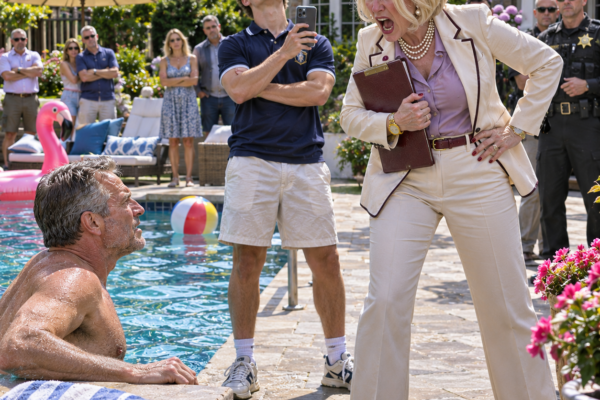
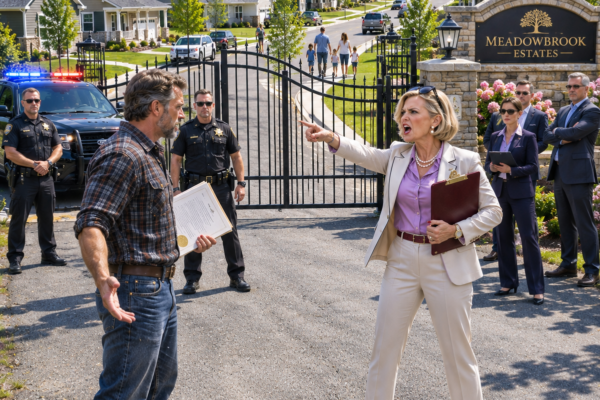
“GET OUT, JASON—THIS HOUSE BELONGS TO ME NOW!” My Sister Took Our Family Home and Left Me a Ruined House on Gair Road—She Never Imagined What Dad Had Really Given Me
“GET OUT, JASON—THIS HOUSE BELONGS TO ME NOW!” My Sister Took Our Family Home and Left Me a Ruined House on Gair Road—She Never Imagined What Dad Had Really Given Me
“Leave now or I’ll call the police,” my sister Victoria threatened as her husband blocked the doorway of the family home where I had grown up.
I had returned exhausted from a long journey, only to discover that my father was gone, my sister had inherited our beautiful house, and the only thing left for me was an abandoned property that nobody had cared for in twenty years.
Victoria thought she had walked away with everything valuable our father owned, but neither of us understood what was waiting beneath the neglected roof and ancient trees of that forgotten property.
The first thing I noticed was the lock.
It was different.
For as long as I could remember, our front door had carried an old brass lock that my father refused to replace because, according to him, anything that still worked deserved another year.
Now there was a shiny electronic keypad.
I stood on the porch with my travel bag hanging from my shoulder, staring at the unfamiliar numbers.
“That’s weird.”
I knocked.
“Victoria? It’s me. Can you open up?”
Footsteps approached.
The door swung inward, revealing my brother-in-law, David.
He looked at me with an expression that was somewhere between amusement and annoyance.
“Well, well. Look who’s back.”
“Hey, David. Good to see you.”
I stepped forward.
His arm immediately shot across the doorway.
“Whoa. Where are you going?”
I stopped.
“Inside?”
“Wait here.”
I glanced at his arm.
“David, I’ve been traveling all day. Can I at least put my bag down?”
“Stay there. I’ll get Victoria.”
He left the door partially open, just enough for me to see the hallway where Dad used to hang his work jacket.
The jacket was gone.
So were the family photographs.
Something cold settled in my stomach.
“Victoria!” David called. “Your little brother’s back.”
“I’m coming!”
A moment later, my sister appeared wearing a cream-colored sweater and holding a coffee mug.
She didn’t hug me.
She didn’t ask how I was doing.
She didn’t even invite me inside.
“Oh, hello, Jason. You look well. Long trip?”
“Yeah. What’s going on? Why won’t David let me in?”
Victoria exchanged a glance with her husband.
Then she said something I would remember for the rest of my life.
“Jason, this isn’t your home anymore.”
I laughed because I genuinely thought she was joking.
“What?”
“Things have changed.”
“Victoria, I’m exhausted. Can we have this conversation inside?”
“No.”
That single word hurt more than I expected.
“What are you talking about?”
David folded his arms.
“Watch your mouth, kid.”
I ignored him.
“Victoria, explain.”
She took a slow sip of coffee.
“Dad left the house to me. It’s mine now.”
I stared at her.
“No. This is our family home.”
“It was.”
“You can’t just throw me out.”
Her expression hardened.
“You really think I can’t?”
For a moment, I couldn’t speak.
I remembered Dad sitting on those porch steps, teaching me how to tie my shoes. I remembered Christmas mornings, birthday dinners, and the nights Victoria and I had stayed awake whispering after everyone else had gone to bed.
Now my sister stood in the same doorway telling me I no longer belonged there.
“What about me?” I finally asked.
“Dad left you something.”
She disappeared into the hallway and returned with a folded piece of paper.
“Gair Road. East of town.”
I looked down.
“The old property?”
“That’s right.”
“The one that’s been sitting empty for twenty years?”
David smirked.
“Congratulations, homeowner.”
I looked at Victoria, waiting for some sign of embarrassment.
There was none.
“You got this house,” I whispered, “and I got that wreck?”
“Those were Dad’s wishes.”
“Let me see the will.”
“You can deal with the paperwork yourself.”
“Victoria, please. Just let me come inside. We can talk about this.”
She stepped backward.
“Leave now, Jason, or I’ll call the police.”
My own sister.
Calling the police on me for standing at my father’s front door.
I slowly picked up my bag.
“Fine.”
David began closing the door.
I looked directly at Victoria.
“Someday, you’re going to regret treating me like this.”
She didn’t answer.
The door clicked shut.
An hour later, I stood on Gair Road before a house nearly swallowed by weeds. Broken shutters hung crookedly, the roof sagged, and decades of neglect had turned the surrounding land into a wilderness.
I pushed open the front door.
Dust drifted through the sunlight.
“Oh, Dad,” I whispered. “What am I supposed to do with this?”
Then I walked through the back of the house, pushed aside a curtain of overgrown branches, and stepped into the yard.
I saw the enormous old oak trees standing beyond the ruined house.
And for the first time that day, something inside me refused to surrender.
PART2
The trees were magnificent.
Even after years of neglect, their thick trunks stood straight, their branches stretching over the property like enormous protective arms.
I walked toward the nearest one and placed my palm against its rough bark.
There were weeds around my ankles, fallen branches scattered across the ground, and an old fence that appeared ready to collapse if the wind blew hard enough.
But the tree was alive.
That seemed important somehow.
I had spent the entire afternoon thinking about what had been taken from me. Standing there, I began wondering whether I should pay more attention to what remained.
I turned toward the house.
It looked terrible.
There was no point pretending otherwise.
A section of the gutter had fallen. Several windows were cracked. The wooden steps leading to the back door were rotten, and the porch leaned slightly toward the ground.
My sister had inherited polished hardwood floors, beautiful furniture, a modern kitchen, and a house filled with memories.
I had inherited a building that looked like it needed permission from the weather to remain standing.
“Well, Dad,” I muttered, “at least it has a roof.”
I looked up at a missing patch of shingles.
“Sort of.”
For the first time since Victoria had closed that door in my face, I almost smiled.
Then I remembered her words.
This isn’t your home anymore.
The smile disappeared.
I went back inside.
The smell of damp wood was overwhelming. Every step produced a different creak. Old newspapers lay beneath a broken chair, and the wallpaper had peeled away in long, yellow strips.
I tried a light switch.
Nothing.
Of course.
I walked into what had once been the kitchen.
The cabinets were filthy. The countertop was stained. A rusty faucet stood over a sink filled with dead insects and dust.
I dropped my bag onto the least damaged chair I could find.
Then I sat down.
There was nobody to impress.
Nobody to argue with.
Nobody to tell me what I deserved.
For several minutes, I simply stared at the floor.
The anger slowly gave way to something worse.
Grief.
Dad was gone.
Whatever disagreement I had with Victoria, whatever questions I had about his final decisions, I could no longer walk into his room and ask him what he had been thinking.
I couldn’t hear his voice.
I couldn’t watch him shake his head when I complained.
I couldn’t sit beside him at the kitchen table and wait for one of his long explanations that usually began with, “Son, you’re looking at this the wrong way.”
I would have given almost anything to hear those words again.
I pressed my hands against my face.
“Dad, I know you’d never want this.”
My voice cracked.
“I know you wouldn’t want us treating each other this way.”
The empty kitchen offered no answer.
I looked toward the dirty windows.
Outside, the trees moved gently in the wind.
I remembered something Dad used to say whenever he repaired something that everyone else considered worthless.
“Don’t judge a thing by what neglect has done to it, Jason. Judge it by what it could become.”
He had said that about furniture, lawn mowers, fences, and once about an old pickup truck that took him nearly an entire summer to get running.
I had been impatient back then.
I wanted him to buy something new.
Dad always preferred finding out whether the old thing still had life left in it.
I wondered what he would say if he saw me sitting in that ruined kitchen.
Probably something irritatingly practical.
Probably something about getting off my backside and finding a broom.
I lowered my hands.
“All right.”
I stood.
“One room at a time.”
It wasn’t a plan.
Not yet.
But it was a decision.
And after the day I had just experienced, making one decision for myself felt like a small victory.
I returned to the front of the house and carried my bag into the driest room.
There was enough daylight left to inspect the worst damage.
I began making notes on my phone.
Roof.
Windows.
Water.
Electricity.
Floors.
Walls.
Porch.
The list grew quickly.
By the time I finished, I had stopped feeling brave.
I had no idea how much the repairs would cost. I didn’t know how long they would take, and I certainly didn’t know whether the money I had saved would be enough.
The house needed more than paint and determination.
Some of the problems could be dangerous.
I wasn’t foolish enough to think enthusiasm would keep a damaged roof from collapsing or make twenty-year-old electrical wiring safe.
Still, I looked at the list and realized something.
Every problem had a name.
And anything I could identify, I could begin figuring out how to address.
That was better than standing on Victoria’s porch begging to be treated like family.
I went outside again.
The sunlight was beginning to fade.
I walked along the edge of the property until I reached an old stretch of fencing almost completely hidden beneath vines.
Beyond it, the land opened into a broad, uneven clearing.
There was room here.
More room than I had realized when I first arrived.
I could build something.
I didn’t know what.
But there was space to try.
I stood beneath those ancient trees until the evening air turned cold.
Then I made a promise.
Not to Victoria.
Not to David.
To my father.
“I’ll make a life here, Dad.”
I swallowed.
“Don’t worry about me.”
The wind moved through the branches above my head.
For a moment, I almost felt as though he had heard me.
The following morning, reality arrived in the form of a leaking ceiling.
Rain began before sunrise.
Water dripped into a metal container I had found in the kitchen, producing a steady, irritating rhythm that seemed determined to remind me how much work stood between me and a decent home.
I moved my belongings away from the damp wall.
Then I stood beneath the doorway, watching rainwater slide through a damaged section of the ceiling.
“Great.”
I had barely begun, and the house was already making its priorities clear.
The roof came first.
Everything else would be pointless if water continued pouring inside.
I arranged for the property and its utilities to be inspected. I needed to know what could be repaired and what needed professional attention before I put myself or anyone else at risk.
When I explained the situation to one of the contractors who came out, he stood in the yard for several seconds without saying anything.
Then he looked at me.
“You planning to live here?”
“Eventually.”
He glanced back at the house.
“That’s quite a project.”
“I’ve noticed.”
“Anybody else helping you?”
“Not family, if that’s what you’re asking.”
He studied my face, then nodded.
“All right. Let’s see what we’ve got.”
We walked around the property.
He pointed out damaged sections of roofing, moisture problems, weakened exterior wood, and places where neglect had allowed small issues to become expensive ones.
I listened carefully.
Every new concern felt like another blow.
Eventually, I asked the question I had been afraid to ask.
“Is it worth saving?”
He didn’t answer immediately.
He stepped backward and examined the structure.
“That’s two different questions.”
“What do you mean?”
“Can it be saved? From what I’m seeing so far, probably. Whether it’s worth saving depends on what you want from it and what the final inspection turns up.”
I looked at the house.
“I want a home.”
“Then don’t waste money making it pretty before you make it sound.”
It was exactly the kind of advice Dad would have given me.
I nodded.
“Understood.”
When I saw the initial estimates, I nearly lost my determination.
I sat in my car for a long time, staring at the figures.
Roof repairs alone would consume a significant portion of my savings.
Then there were the utilities, damaged wood, windows, and countless smaller expenses nobody could fully predict until the work began.
For one terrible moment, I understood why Victoria had been so comfortable handing me that address.
Perhaps she had already looked at the place and decided it was nothing but trouble.
Perhaps David had laughed at the thought of me trying to restore it.
I could almost hear him.
Congratulations, homeowner.
I wanted to throw my phone across the car.
Instead, I opened my banking information and started calculating.
If I paid for the specialized work that I couldn’t safely perform myself, handled the simpler jobs carefully, avoided unnecessary upgrades, and purchased materials gradually, I might have a chance.
It would mean sacrificing comfort.
It would mean long days.
It would mean giving up nearly every convenience I had expected to enjoy when I returned home.
I stared at the numbers again.
Then I looked through the windshield at the house.
“You’re not beating me.”
I wasn’t sure whether I was speaking to the building or to the memory of David standing in that doorway.
Probably both.
The first days of work were ugly.
There was nothing cinematic about dragging ruined furniture outside, filling garbage bags with decades of debris, and discovering unpleasant surprises beneath old carpets.
Every time I cleared one corner, another problem appeared.
I removed damaged curtains.
I emptied cabinets.
I sorted through junk.
I scrubbed surfaces that seemed determined to remain dirty.
Some objects could be saved.
Most couldn’t.
The house had been neglected for so long that ordinary things had become strange.
An old cooking pot sat beneath a broken window.
A faded calendar remained pinned to a wall.
A wooden coat rack leaned against the hallway, waiting for coats that hadn’t hung there in years.
I wondered about the people who had once lived there.
Had someone stood in this kitchen making coffee before work?
Had children run down that hallway?
Had a family gathered beneath those oak trees on summer afternoons?
The building hadn’t always looked like this.
At some point, it had been someone’s home.
That thought made me more patient.
Whenever I became overwhelmed, I chose one small task.
Clear the table.
Empty the cabinet.
Sweep the hallway.
Wash the window.
Finish something.
Then move on.
Late one afternoon, after hours of cleaning, I sat on the front steps eating a sandwich.
My shirt was filthy.
My shoulders ached.
There was dust in my hair and a small blister forming on my hand.
I looked toward the road.
For a few minutes, I imagined Victoria arriving.
In my imagination, she stepped from her car, saw me sitting there covered in dirt, and finally understood what she had done.
Maybe she would apologize.
Maybe she would admit that refusing to let me enter our childhood home had been cruel.
Maybe she would tell me she had acted badly because she was grieving too.
I waited for a vehicle that wasn’t coming.
Then I laughed at myself.
I was rebuilding an entire house, yet part of me was still standing on that porch, waiting for my sister to open the door.
I finished my sandwich.
“Enough.”
I stood and went back inside.
There were things I could repair.
Victoria’s attitude wasn’t one of them.
The roofing work made the first visible difference.
Damaged materials came away. Problem areas were exposed and addressed. The house began receiving the kind of protection it had needed for years.
I watched the transformation from the ground whenever I wasn’t occupied with my own tasks.
Each section of completed roof felt like a burden being lifted.
For weeks, I had looked at the house and seen everything that was wrong.
Now I could point to something that was right.
One afternoon, I stood beside the contractor as he checked the progress.
“Looking better,” he said.
“Best thing I’ve heard all month.”
He smiled.
“Still got plenty to do.”
“Don’t remind me.”
When the next heavy rain arrived, I waited nervously.
The sound of water hitting the roof filled the house.
I walked from room to room.
No new drips appeared in the repaired areas.
I checked the kitchen.
Then the hallway.
Then the room where I kept my belongings.
Nothing.
I stood perfectly still.
The house was dry.
It was such an ordinary thing.
Millions of people slept beneath roofs every night without thinking about them.
But I had spent too many days worrying about rainwater to take that silence for granted.
I looked up.
“That’s one, Dad.”
One problem solved.
One promise kept.
I crossed the roof off my original list.
Then I looked at everything underneath it.
My celebration lasted approximately thirty seconds.
The walls came next.
There were days when I worked until my arms felt too heavy to lift.
Removing loose material, cleaning, preparing surfaces, and dealing with necessary repairs seemed endless.
I learned to recognize the difference between something that simply looked bad and something that genuinely needed replacement.
I learned that rushing usually meant doing the same job twice.
And I learned that buying the cheapest material wasn’t always the cheapest decision in the long run.
Dad would have enjoyed watching me discover that.
As a teenager, I had once helped him repaint a room.
I wanted to skip the preparation.
He refused.
“Nobody sees that part,” I had complained.
“You’ll see it when the paint starts peeling.”
At the time, I thought he was unnecessarily strict.
Now, standing in the middle of a house that had suffered from years of neglected maintenance, I understood.
The invisible work mattered.
Good foundations mattered.
Doing things correctly when nobody was watching mattered.
I thought about Victoria.
She had spoken so confidently about ownership.
This house belongs to me now.
Ownership.
It was such a powerful word when people wanted to keep something from somebody else.
But standing in that dusty room, I began to understand another meaning.
Ownership meant responsibility.
It meant being the person who dealt with a broken window instead of walking past it.
It meant paying attention to the places nobody else could see.
It meant accepting that something valuable required care.
Victoria had received a finished home.
I was learning how to create one.
The difference didn’t make my situation easier.
But it gave the work meaning.
One evening, I accidentally knocked over a container of supplies after spending nearly an hour organizing the room.
I stood there staring at the mess.
Then I lost my temper.
“Damn it!”
My voice echoed through the empty house.
I kicked an empty cardboard box.
For a few seconds, everything came rushing back.
The exhaustion.
The money.
The loneliness.
The humiliation.
I thought about David’s arm blocking the door.
I thought about Victoria calmly drinking coffee while telling me I no longer belonged.
She hadn’t even asked whether I had somewhere to sleep.
I sank onto a chair.
“Why am I the one doing all this?”
I said it aloud because there was nobody there to hear.
“Why do I have to start over?”
There was no inspiring answer.
No miraculous revelation.
Just a mess on the floor and another evening of work.
I sat for a while.
Then I stood, picked up the supplies, and began putting everything back.
Sometimes perseverance doesn’t feel heroic.
Sometimes it’s nothing more than cleaning up a mess when you’d rather walk away.
Weeks passed.
The house began looking less abandoned.
The necessary electrical and plumbing work progressed.
Damaged materials were replaced.
The windows improved.
Rooms that once smelled of moisture and decay began smelling of fresh wood and paint.
I remember the first time I turned on a light and watched the room brighten.
I stood beneath it, grinning like a fool.
“Would you look at that.”
Electricity.
Another thing I had once taken for granted.
Later, when I could stand at the kitchen sink and use running water, I felt an absurd amount of satisfaction.
I washed my hands slowly.
Then I washed them again.
These were not luxurious achievements.
Nobody was going to publish photographs of a functioning faucet in an ordinary house.
But to me, every improvement represented hours of labor, sacrifice, and problems solved.
I wasn’t merely watching someone else enjoy the result.
I knew what each improvement had required.
I remembered every frustrating day that preceded it.
That made the satisfaction different.
There were still expenses that frightened me.
There were still mornings when getting out of bed felt like a punishment.
But something had changed.
I no longer looked at the house and felt only resentment.
I felt protective of it.
When rain threatened, I checked the windows.
When the wind picked up, I checked the yard.
When I noticed another small issue, I wrote it down instead of ignoring it.
The old property was becoming mine in a way that had nothing to do with paperwork.
It was becoming mine because I cared what happened to it.
One afternoon, a delivery arrived while I was working on the exterior.
The driver stepped down, glanced toward the house, and looked genuinely surprised.
“Didn’t realize anybody was living out here.”
“Working on it.”
He looked at the materials stacked nearby.
“Doing the whole place?”
“That’s the idea.”
He whistled.
“Used to drive past here years ago. Thought they’d eventually tear it down.”
I laughed.
“You’re not the first person to tell me that.”
He helped unload what I needed.
Before leaving, he turned toward the house again.
“Looks a lot better already.”
It was a small compliment from a stranger.
Yet I stood there smiling long after his truck disappeared down the road.
Nobody in my family had told me they were proud of what I was doing.
Nobody had come to see the progress.
I hadn’t realized how badly I wanted someone to look at the house and recognize that I was accomplishing something.
That afternoon, a man who knew almost nothing about me had given me more encouragement than my sister had offered on the day I returned.
I went back to work with renewed energy.
By sunset, I had finished the task I had planned for the following morning.
The most difficult part of rebuilding the house wasn’t always the physical work.
Sometimes it was the quiet.
I would eat dinner alone.
I would sit outside after a long day and watch the light disappear behind the trees.
I would pick up my phone, almost call Victoria, and then put it down again.
There were things I wanted to tell her.
The roof was repaired.
The kitchen was improving.
The windows looked better.
I was making progress.
Part of me wanted her to know because she was my sister.
Part of me wanted her to know because she had underestimated me.
I couldn’t always tell which feeling was stronger.
Once, I opened our old message thread.
There were photographs from years earlier, birthday wishes, ordinary conversations, and reminders about family gatherings.
I found a photograph of the two of us standing beside Dad.
Victoria was smiling.
So was I.
Dad had one arm around each of us.
Nobody in that picture looked like a person who would one day threaten to call the police on the other.
I stared at it until my eyes burned.
Then I locked my phone.
There were wounds a new roof couldn’t repair.
I was beginning to accept that.
I could rebuild the house.
I could create something beautiful.
But I couldn’t force my sister to remember the meaning of family.
That choice belonged to her.
And I had already spent too much of my life hoping other people would make choices that allowed me to be happy.
When I finally began painting the repaired rooms, the atmosphere changed almost immediately.
Fresh, bright walls reflected the sunlight.
The rooms felt larger.
The windows framed the trees instead of hiding them behind dirty curtains.
I chose simple colors.
Nothing extravagant.
Nothing intended to impress visitors.
I wanted the house to feel peaceful.
There had been enough ugliness in my life recently.
One morning, I arrived in the front room and stood with a paint roller in my hand.
Sunlight spilled across the floor.
Outside, birds moved among the branches.
I could smell fresh paint instead of dampness.
For the first time, I could clearly imagine living there.
Not enduring it.
Not staying temporarily because I had nowhere else to go.
Living.
I imagined a comfortable chair near the window.
A table where friends might gather.
Coffee in the kitchen.
Rain against a roof that no longer frightened me.
The picture felt so real that I stopped working.
“Who knew?”
I looked around.
“Who knew you could look like this?”
The house had not become a mansion.
It would never resemble the family home Victoria had inherited.
But that was no longer what I wanted.
It was developing a character of its own.
And so was I.
The exterior demanded its own kind of patience.
The overgrown yard had concealed damaged fencing, uneven ground, discarded materials, and years of accumulated branches.
I began clearing sections slowly.
At first, the work seemed ridiculous.
I could spend an entire afternoon removing debris and barely see a difference from the road.
Then, gradually, paths appeared.
The space around the house opened.
The enormous oak trees became more prominent.
I kept returning to them.
They fascinated me.
The house had suffered visibly from its years of neglect.
The trees had endured them differently.
They had continued growing.
Their branches had expanded.
Their roots had remained anchored in the soil.
They didn’t look like survivors because they had avoided hardship.
They looked like survivors because hardship hadn’t stopped them.
I began imagining what the surrounding land could become.
A garden.
A productive piece of property.
A place where work extended beyond repairs.
I didn’t want to spend the rest of my life fixing things that had already been broken.
Eventually, I wanted to create something new.
That possibility became more exciting with every cleared section of land.
I walked around the property carrying a notebook.
I sketched rough layouts.
I marked the areas that received the most sunlight.
I made notes about access, drainage, existing trees, and places where new plantings might thrive.
I knew enough to realize that growing things successfully required more than enthusiasm.
I needed advice.
I needed to understand the soil and the conditions.
But for the first time since arriving, I was making plans that weren’t about repairing damage.
They were about the future.
Months after Victoria had turned me away, I stood inside the front room and realized there was nothing urgent left to do.
There were still small improvements I could make.
There always would be.
But the main restoration was finished.
The house was comfortable, bright, functional, and welcoming.
I walked slowly through the rooms.
The hallway that had once been cluttered was clean.
The kitchen that had once smelled of decay was ready for cooking.
The damaged walls had been repaired.
The windows allowed sunlight to pour inside.
The floor was clean beneath my feet.
I stood in the doorway where I had dropped my bag on that first terrible afternoon.
I could almost see the man I had been.
Exhausted.
Humiliated.
Angry.
Terrified about what came next.
If I could have spoken to him, I would have told him that the work would be harder than he imagined.
I would have told him there would be days when he regretted trying.
I would have told him that some problems would cost more than expected and that other problems would require him to admit he needed help.
But I would also have told him not to leave.
Because one day he would stand in that same doorway and feel something he hadn’t felt in a very long time.
Pride.
I walked outside.
The house stood beneath the trees, its restored exterior shining in the afternoon light.
I took several photographs.
Then I lowered my phone.
Photographs couldn’t capture the feeling.
They couldn’t show the exhaustion behind every repaired surface.
They couldn’t reveal the mornings I had wanted to quit.
They couldn’t explain what it meant to stand before a place that had once represented my rejection and recognize it as my home.
I looked toward the sky.
“It’s finished, Dad.”
My throat tightened.
“Look at it.”
I stood there for a long time.
I wished he could have walked up beside me.
I wished he could have inspected the windows, criticized something about the paint, and pretended not to be impressed before finally telling me I had done a good job.
I would have welcomed every criticism.
Every lecture.
Every story I had already heard twenty times.
But he wasn’t there.
So I gave myself permission to imagine his smile.
And for the first time in months, remembering him brought more comfort than pain.
I could have stopped there.
The house was restored.
I had accomplished something that once seemed impossible.
But every morning, when I stepped outside carrying my coffee, I looked at the land beyond the house and felt the same restless thought.
There was more here.
The neglected property wasn’t limited to its walls and roof.
The soil, trees, open spaces, and natural resources represented possibilities I had barely considered.
I began planning the next stage.
This time, the work wasn’t motivated by anger.
I wasn’t thinking about Victoria while sketching ideas or discussing how to prepare the ground.
I wasn’t trying to prove David wrong.
I was excited.
That surprised me.
When I first arrived, everything I did had been fueled by humiliation.
Every bag of rubbish I carried outside felt like an argument with my sister.
Every repaired board felt like an answer to her rejection.
But anger was a poor companion for the future.
It could get me moving.
It couldn’t tell me where I wanted to go.
Now I had a direction of my own.
I wanted to build a productive life around the property.
Something connected to the land.
Something I could improve with patience rather than purchase all at once.
Something Dad would have understood.
I contacted people who knew more about working with the land than I did.
We discussed clearing selected areas, protecting the existing trees, preparing suitable planting spaces, and choosing materials and equipment that made sense for the property.
The first time I stood outside watching supplies arrive for that new project, I felt a familiar nervousness.
There was money involved.
There was uncertainty.
There were things that could go wrong.
But unlike the restoration, I had chosen this work freely.
Nobody had pushed me into it.
Nobody had handed me a piece of paper and told me to disappear.
I was standing on my own land, deciding what to create.
“All right,” I said as we prepared to move the first heavy materials into position. “Easy does it.”
We worked carefully.
“Lower it down slowly.”
The equipment shifted.
I watched the placement.
“That’s good. Right there.”
For years, I had imagined success as something dramatic.
A moment when everything changed.
A victory that forced the people who doubted you to admit they had been wrong.
Now I was discovering that success could look like a group of people working together on a quiet piece of land east of town.
It could look like planning.
Sweat.
Patience.
And the satisfaction of seeing an idea take physical form.
Not every part of the new project went smoothly.
Some materials arrived later than expected.
Certain sections of ground required more attention.
We changed plans when we realized the original layout wasn’t suitable.
There were days when the weather interfered with everything.
But I approached those problems differently now.
During the first weeks of restoring the house, each setback had felt personal.
A broken board had seemed like proof that Victoria was right about my circumstances.
An unexpected expense had seemed like another reason to give up.
Now setbacks were simply setbacks.
I had already survived months of them.
A problem didn’t automatically mean failure.
Sometimes it meant the plan needed adjustment.
Sometimes it meant asking someone with more experience.
Sometimes it meant doing less today so that tomorrow’s work would be better.
When we began selecting young plants, I examined them carefully.
“That one out,” I said, indicating a specimen that wasn’t in good condition.
We set it aside.
“Keep the firm ones.”
I watched the healthy plants being organized.
There was something deeply satisfying about selecting living things for a place that had once seemed forgotten.
We weren’t covering damage.
We weren’t replacing what had rotted.
We were introducing new life.
During planting, I became especially concerned about protecting the roots.
“Careful with that one.”
I steadied the young plant.
“Keep the roots undisturbed.”
The person working beside me smiled.
“You’ve gotten particular about this.”
“I’ve learned what happens when people neglect foundations.”
He laughed.
I smiled too.
But I meant it.
Roots were invisible once they were in the ground.
People admired the leaves, flowers, branches, and fruit.
Few stopped to think about the hidden structure supporting everything.
Dad would have liked that lesson.
He had spent his life caring about the parts other people overlooked.
Perhaps that was why I felt so comfortable working outside now.
The land rewarded attention to those invisible things.
It didn’t care whether I had inherited a beautiful house or an ugly one.
It didn’t care whether my sister respected me.
It cared about conditions.
Timing.
Water.
Healthy roots.
Consistent care.
There was a comforting fairness in that.
As the planting progressed, I began establishing routines.
Morning inspections.
Checking the condition of young plants.
Watching for problems.
Keeping tools organized.
Making adjustments according to the weather.
I spent considerable time learning instead of assuming that hard work alone guaranteed results.
Sometimes I would stand over a newly planted area, wondering whether I was doing everything correctly.
Then I would remind myself that the project was supposed to grow gradually.
I didn’t need the entire property transformed overnight.
I had already learned the value of one completed task at a time.
During one particularly warm afternoon, we were working around the new plantings.
Someone began directing water across the upper leaves.
“Good,” I said, adjusting our position. “Keep it at the roots.”
We continued.
Water darkened the soil.
The young leaves moved gently in the breeze.
I stepped back.
The area looked nothing like the neglected ground I had first encountered.
It was organized.
Purposeful.
Alive.
I thought about the first day I had stood beneath those enormous oak trees.
Back then, I hadn’t known what I was going to do with the land.
I hadn’t even known whether I could afford to make the house livable.
Now I was establishing something that could continue growing for years.
The thought made me unexpectedly emotional.
I turned away for a moment and pretended to examine a tool.
I didn’t need anyone seeing my eyes fill with tears over a row of plants.
But I knew what those plants represented.
They were proof that my life had continued after the worst day of my return.
They were proof that being rejected wasn’t the same thing as being finished.
There were still times when I thought about my father’s will.
I wondered why he had chosen to leave the family home to Victoria and this property to me.
I could not honestly say that I understood.
Maybe he had reasons I would never fully know.
Maybe he believed the two properties were appropriate for us in different ways.
Maybe his decisions had nothing to do with what Victoria and David assumed they meant.
I resisted the temptation to invent an explanation simply because it would make me feel better.
I didn’t know Dad’s private thoughts.
I knew only what he had left behind and what I had chosen to do with it.
Whatever his intentions, the inheritance had not required Victoria to humiliate me.
She could have explained the situation kindly.
She could have invited me inside.
She could have offered a cup of coffee and given me time to absorb the news.
Ownership of the house didn’t make cruelty necessary.
That was what I found hardest to forgive.
Not the distribution of property.
The way she had treated me.
There was a difference.
I might have been disappointed if she had sat beside me and explained everything with compassion.
But disappointment was something we could have worked through together.
Instead, she had made me feel like a stranger.
For a long time, I believed I needed an apology before I could move forward.
The house taught me otherwise.
Not because apologies were meaningless.
They weren’t.
But I couldn’t leave my future waiting outside someone else’s locked door.
I had work to do.
And every morning on Gair Road, that work was waiting for me.
The old oak trees became the next great discovery.
As the season progressed, I noticed the acorns appearing in increasing numbers.
At first, I thought of them primarily as part of the natural cycle of the property.
They fell.
Squirrels collected some.
Others disappeared into the grass.
Then I began paying closer attention.
There were a lot of them.
Those ancient trees had been standing there long before I arrived, producing something year after year whether anyone appreciated it or not.
I looked down at the acorns scattered across the ground.
I remembered hearing that acorns could be processed into food, including flour.
I had never tried it.
Like most people I knew, I associated acorns with squirrels, autumn decorations, and the occasional unpleasant crunch beneath a shoe.
The idea of turning them into something useful intrigued me.
I began researching.
What I discovered was that acorns had a long history as food in different cultures, but they required careful identification and proper processing.
They weren’t something I could casually gather, grind, and eat.
Their tannins needed to be removed appropriately, and their condition mattered.
I wanted to learn correctly.
The more I read and discussed the possibilities with people who understood the process, the more interested I became.
Here was a resource already growing on the property.
It didn’t require me to pretend I had discovered gold beneath the house.
It didn’t require some incredible stroke of luck.
It was visible.
Ordinary.
Overlooked.
And potentially useful.
I walked beneath the nearest oak and picked up an acorn.
“All these years,” I whispered.
The house had been neglected.
The land had been overgrown.
Nobody had been paying much attention to its possibilities.
Yet the trees had continued producing.
I rolled the acorn between my fingers.
Victoria had inherited something beautiful that already existed.
I had inherited something whose beauty and value required effort to uncover.
The distinction suddenly felt less like a punishment.
It felt like an opportunity.
When the first serious collection began, I found myself more excited than I expected.
I stood beneath the trees, looking at the scattered crop.
“We’ve actually got something here.”
The person helping me glanced across the ground.
“Looks that way.”
“Let’s collect the good ones.”
We began sorting carefully.
Not everything was suitable.
Some acorns were damaged.
Some showed signs of deterioration.
Others needed to be left where they were.
We approached the work with patience, selecting appropriate ones rather than treating everything that fell from a tree as food.
The collection took time.
My back complained.
My knees complained.
At one point, I straightened up and laughed.
“What?”
“Nothing,” I said. “Just thinking about how different this is from what I expected my life to look like.”
I had returned home imagining familiar rooms, family conversations, and a comfortable place to rest.
Instead, I was standing beneath an oak tree on Gair Road, collecting acorns.
And strangely enough, I was happy.
Not because everything in my life had been resolved.
Not because I had suddenly become wealthy.
I was happy because I had a reason to get up in the morning that didn’t depend on anybody’s permission.
The first containers filled.
We carried them to the sorting area.
I looked down at the harvest.
It was modest compared with what might be possible in the future.
But it was real.
The property had produced something.
Our first crop.
I felt an almost ridiculous desire to photograph everything.
The containers.
The trees.
The acorns resting in my hands.
I wanted to remember what that beginning looked like.
Years later, whatever happened with the property, I hoped I would never forget the excitement of that first harvest.
Sorting was slower than collecting.
We examined the acorns.
Separated questionable ones.
Removed debris.
Set suitable material aside for the next stage.
“Let’s sort them before we start washing,” I said.
There was no point washing things we couldn’t use.
We worked in small batches.
I held up one and studied its condition.
“Green.”
We separated what wasn’t ready or appropriate for processing.
I was amazed by how much attention such a simple-looking food required.
From a distance, a container of acorns looked like a container of acorns.
Up close, there were differences in maturity, condition, size, and suitability.
The process demanded patience.
Fortunately, patience was something Gair Road had been teaching me from the beginning.
I thought about the house again.
At first glance, it had looked like a complete disaster.
Closer examination revealed things that could be preserved and things that needed replacement.
The land had looked like a wilderness.
Closer attention revealed productive spaces, healthy trees, and opportunities.
The acorns were another version of the same lesson.
Appearance wasn’t enough.
You needed to understand what you were looking at.
And sometimes the most valuable possibilities were the ones people overlooked because they weren’t immediately impressive.
By the time we finished preparing the first selected batch, I was exhausted.
But it was a good exhaustion.
I looked at the organized containers.
“First batch is ready.”
We still had work ahead.
Processing.
Storage.
Quality checks.
Learning how to use the finished product.
None of it was guaranteed to succeed just because we wanted it to.
But I could see the path forward.
That was enough.
The next stage challenged my impatience.
I wanted to rush.
After collecting and sorting everything, I wanted to see flour.
I wanted proof that our idea worked.
But acorns required careful preparation before they could safely become food.
We followed appropriate guidance for processing the selected crop, making sure the necessary leaching and drying were properly completed before milling.
I reminded myself repeatedly that speed wasn’t the objective.
The objective was doing it correctly.
“Keep the sacks dry,” I told the people helping me handle the prepared material.
Moisture control mattered.
Clean handling mattered.
Paying attention mattered.
I refused to undermine months of work by becoming careless at the final stage.
As we progressed, I grew more fascinated by the transformation.
Something I had once kicked aside while walking beneath a tree was becoming an ingredient.
The process connected the land to the kitchen in a way I had never experienced before.
I had grown accustomed to buying food without thinking much about how it reached me.
Now every stage was visible.
The trees.
The harvest.
The sorting.
The washing and processing.
The drying.
The milling.
The finished flour represented all of it.
I stood watching the first properly prepared acorns being milled.
The equipment produced its steady sound.
I leaned closer, fascinated.
After everything we had done, this was the moment when the idea became something I could physically hold.
I picked up a small amount of the finished flour and examined it.
It wasn’t especially dramatic.
There was no bright light.
No cheering crowd.
No mysterious revelation.
Just flour.
But my hands were shaking slightly.
I thought of my father’s house.
I thought of the electronic lock.
David’s arm.
Victoria’s coffee mug.
The address on that folded piece of paper.
I remembered sitting in a filthy kitchen wondering where my life had gone wrong.
And now I was standing on the same property, holding something we had produced ourselves.
“Would you look at that.”
I smiled.
“We did it.”
That evening, I carried a portion of the flour into my restored kitchen.
I set it on the countertop.
The same kitchen where I had once sat with my face buried in my hands.
The same room where the sink had been filthy, the walls damaged, and the ceiling threatened by water.
Now it was warm and clean.
There were utensils in the drawers.
There were plates in the cabinets.
The lights worked.
The countertop held something that hadn’t been purchased at a grocery store.
It had come from the trees outside my window.
I looked around the room.
Every part of this moment felt connected.
The repairs had made the kitchen usable.
The land had made the crop possible.
The work had transformed that crop into flour.
And the flour was waiting to become food.
I thought about how satisfying it would be to make something simple from it.
Something familiar.
Something that didn’t require pretending I had suddenly become a professional chef.
“Pancakes,” I said.
The idea made me laugh.
After months of hardship, repairs, landscaping, collecting, researching, and processing, my first culinary ambition was pancakes.
It seemed wonderfully ordinary.
Dad had loved breakfast food.
He believed there was rarely a bad time for eggs, toast, or pancakes.
Sometimes, when we were younger, he would make breakfast for dinner.
Victoria and I used to think that was hilarious.
I opened a cabinet and took out a mixing bowl.
Then I paused.
Perhaps it was too soon to experiment alone without checking the best approach for using the flour.
The next day, when someone experienced with the product was helping me, I asked.
“Would it work in pancakes?”
“Yes,” came the answer. “Mix it with regular flour.”
“Really?”
“Sure.”
I looked at the container.
“Okay. Let’s try it.”
We prepared a small batch.
I was nervous in a way that seemed completely disproportionate to the situation.
They were pancakes.
If they turned out badly, we could learn from the experience and adjust.
Still, I wanted them to work.
I wanted the first food we made from those trees to taste good.
I wanted something I could associate with this new chapter of my life.
I watched the batter come together.
Then the pan began warming.
A familiar smell slowly filled the kitchen.
And suddenly, without warning, I was a child again.
I could see Dad standing beside the stove.
I could hear the television playing in the next room.
I remembered Victoria laughing when Dad flipped a pancake badly and insisted that the misshapen result was intentional.
I remembered being impatient for breakfast.
I remembered a house that had once felt safe.
For a moment, the memories were overwhelming.
I turned toward the window.
The oak trees stood beyond the yard.
I reminded myself where I was.
Gair Road.
My home.
Not the home I had lost.
The home I had made.
The first pancake didn’t look perfect.
It was uneven around the edges.
I studied it with unreasonable seriousness.
“Well?”
“Looks like a pancake.”
“That’s encouraging.”
We laughed.
Another went into the pan.
Then another.
The kitchen filled with warmth.
I placed the finished pancakes on a plate.
They looked ordinary enough that someone unfamiliar with our work would never have guessed how much effort stood behind them.
I picked up a fork.
For a second, I hesitated.
What if I didn’t like the taste?
What if all this work resulted in something disappointing?
Then I shook my head.
I’d survived far greater disappointments.
I cut a small piece.
Took a bite.
Chewed slowly.
And stopped.
“Okay.”
I took another bite.
“That’s actually really good.”
The person beside me smiled.
“Told you.”
I laughed.
Not politely.
Not because somebody expected me to.
I laughed because I was genuinely delighted.
The flavor was different from an ordinary pancake, but pleasantly so.
It was real.
It worked.
I looked at the plate.
Then at the trees outside.
And then, without warning, my eyes filled with tears.
I put the fork down.
For several seconds, I couldn’t speak.
“Jason?”
“I’m fine.”
I wiped my face.
“Sorry.”
There was a moment of quiet.
I looked down at the pancakes again.
“Dad would love this.”
That was all I managed to say.
Later, when the kitchen was quiet again, I carried my plate outside.
The afternoon sunlight fell across the restored house.
The new plantings moved gently in the breeze.
The oak trees stood where they had always stood, indifferent to the arguments, grief, and misunderstandings that had brought me there.
I sat beneath one of them and thought about everything that had happened.
When I first arrived on Gair Road, I believed my sister had received the better inheritance.
By conventional measures, perhaps she had.
The family house was valuable.
It was comfortable.
It was familiar.
Nobody had asked her to restore a leaking roof or spend months repairing neglected rooms.
But I no longer measured the value of my life by comparing it with hers.
I didn’t need to know what her house was worth.
I didn’t need to imagine David discovering that I had become successful.
I didn’t need a dramatic confrontation in which they begged for forgiveness and I delivered a perfect speech.
I had imagined that moment many times during the early weeks.
Back then, revenge had seemed like the only satisfying ending.
I wanted Victoria to see the finished house.
I wanted her to stand in my beautiful kitchen and remember the way she had refused to let me enter hers.
I wanted David to understand what the man he had mocked was capable of accomplishing.
I wanted them to feel ashamed.
But sitting beneath the tree, eating pancakes made partly from the first crop we had collected, I realized something unexpected.
I didn’t need them there.
Their presence wouldn’t make the house more beautiful.
Their approval wouldn’t make the food taste better.
Their regret wouldn’t return the months I had spent working.
And their apology, however meaningful it might have been, wasn’t the foundation on which I wanted to build the rest of my life.
I hoped Victoria would eventually understand what she had done.
I hoped she would remember that I had been her brother before either of us had inherited a house.
But whether that happened or not, I had a life to live.
I looked toward the front porch.
The place that had once looked ready to collapse now welcomed me home.
There was no arm blocking the entrance.
No one standing behind the door deciding whether I belonged.
No one threatening to call the police if I stayed.
I could walk inside whenever I wanted.
It was such a simple freedom.
Yet I understood its value better than ever.
In the days that followed, I found myself paying closer attention to the possibilities of the acorn harvest.
We had only begun.
The first batch wasn’t the culmination of some extraordinary business empire.
It was an experiment that had succeeded.
That mattered.
There would be questions about consistency, future harvests, storage, processing capacity, and what the finished product could eventually become.
There would be more work.
More learning.
More decisions.
But I welcomed those challenges.
The difference between my first day on Gair Road and those later mornings was enormous.
Back then, uncertainty had frightened me because it seemed to threaten everything.
Now uncertainty contained possibility.
I didn’t know how much the property might produce in the coming years.
I didn’t know how far I would take the project.
I didn’t know whether the flour would remain something we made for ourselves or develop into a larger opportunity.
I refused to pretend that one successful batch guaranteed a fortune.
I had learned too much about patience to make that mistake.
What I knew was that the land had already given me something valuable.
Purpose.
Every morning, I had a reason to look ahead.
Every completed task suggested another useful possibility.
Every season promised lessons.
There was a future here.
Not a fantasy about becoming richer than Victoria.
A real future built through work I understood and decisions I could make.
That was more satisfying than the revenge I had once imagined.
One morning, I walked through the restored house with a cup of coffee.
I stopped beside the window overlooking the yard.
Sunlight filtered through the branches.
The new plants were establishing themselves.
The ground that had once been nearly inaccessible looked cared for.
I thought about Dad.
He had never been particularly impressed by flashy possessions.
He liked things that lasted.
A well-made tool.
A repaired piece of furniture.
A healthy tree.
A home that had been cared for.
He believed there was dignity in useful work, regardless of whether anyone applauded it.
As a younger man, I hadn’t fully understood.
I thought the important part of success was having something impressive to show other people.
Dad seemed more interested in whether what you had made would still be standing after the applause ended.
Now I understood him better.
This house would require continued care.
The trees would need attention.
The land would present new challenges.
There was no final day when I could declare every responsibility permanently finished.
But that was the nature of having something worth keeping.
You cared for it.
You protected it.
You improved it when you could.
And you appreciated it before something happened that made you realize how much it had meant.
I wished Victoria understood that.
I wished I could have told Dad that I finally did.
I eventually placed a photograph of him inside the house.
Nothing elaborate.
Just a picture that made me smile.
I positioned it where I could see it often.
For a while, I had avoided looking at photographs because they reminded me that he was gone.
Now I wanted his memory to be part of the home I was creating.
When I walked past, I would sometimes speak to him.
Ordinary things.
The weather.
The work outside.
Something I had repaired.
Something I had learned.
Once, after another afternoon spent caring for the plantings, I stopped beside the photograph.
“You know, you could’ve made this a little easier.”
I smiled.
“Wouldn’t have killed you to leave me a place with a decent roof.”
The joke caught in my throat.
I stood quietly.
Then I reached out and straightened the picture.
“But I’m doing okay.”
I looked toward the kitchen.
“Better than okay.”
For months, I had been carrying a question about why Dad had left me this property.
I still didn’t have a definitive answer.
I didn’t pretend that finding a purpose here revealed his intentions.
Perhaps I would never know.
But the question no longer controlled my happiness.
What mattered was what I had made of the inheritance.
I had taken a neglected house and restored it.
I had taken overgrown land and begun making it productive.
I had discovered a use for something that had been falling from those trees for years.
I had learned things I would never have learned if I had spent my days inside the comfortable family home.
And perhaps most importantly, I had discovered that I could create a life even when someone I loved refused to make room for me in theirs.
Sometimes I still remembered Victoria’s face when she told me to leave.
That memory hadn’t disappeared simply because the house was beautiful.
Some wounds remain tender long after everything around them changes.
I remembered how casually she had said that Dad’s wishes made her the owner.
I remembered David calling me “kid” when I challenged them.
I remembered the awful realization that I was standing outside a place filled with my childhood memories, asking for permission to enter.
For a long time, I had felt ashamed about that moment.
Ashamed that I had begged.
Ashamed that I had been powerless.
Ashamed that my own family had treated me as though I were an inconvenience.
But I eventually understood that asking my sister for kindness was not something I needed to regret.
Trusting her had not made me weak.
Expecting compassion from family had not made me foolish.
The shame belonged to the decision to withhold that compassion.
I had simply been the person standing on the wrong side of a closed door.
I could not change that afternoon.
I could decide what it meant for the rest of my life.
And I refused to let it mean that I was unwanted everywhere.
On a clear evening, I walked down the length of the property.
I passed the restored house, the organized working areas, and the new plantings.
I inspected the ground beneath the trees.
More acorns lay among the leaves.
I bent down and picked one up.
It was small enough to disappear inside my hand.
Yet everything necessary for another oak tree, given the right conditions, began with something like it.
I thought that was extraordinary.
Something so small could contain a possibility that wouldn’t become obvious for years.
People could step over it.
Ignore it.
Dismiss it as worthless.
But under the right conditions, with time and care, it could become something enormous.
I stood looking at the old trees.
Then I looked at the house.
For the first time, I realized how little resemblance my present life bore to the future I had imagined when Victoria first handed me that address.
I had thought the old property represented the end of something.
The end of belonging.
The end of family.
The end of the comfortable future I had expected.
Instead, it had become the beginning of something I hadn’t known I wanted.
A home.
Meaningful work.
Independence.
A connection to my father that didn’t depend on possessing his old living room or sitting at his former kitchen table.
I could remember him here.
I could honor what he had taught me.
I could build something worthy of those memories.
Nobody could take that away by changing a lock.
The following weekend, I decided to make another batch of pancakes.
I took the container of acorn flour from its storage place.
Mixed the ingredients.
Heated the pan.
The familiar smell began filling the kitchen.
This time, I wasn’t nervous about whether the idea would work.
I was simply enjoying breakfast.
That ordinary pleasure felt like a reward.
I looked through the window as the morning light spread across the yard.
For months, I had been working toward the moment when the house would stop being a project and start being a home.
Perhaps that moment had arrived quietly, somewhere between the first working faucet and the first harvest.
There hadn’t been an announcement.
No one had handed me a certificate.
No one had declared that my life was officially restored.
I had simply reached a morning when I was no longer afraid of what came next.
I placed the pancakes on a plate.
Sat down at the table.
And realized I hadn’t thought about Victoria until just then.
That was new.
There had been a time when she occupied every quiet moment.
I had replayed the conversation repeatedly, imagining different responses.
I should have said this.
I should have refused to leave.
I should have demanded an explanation.
I should have made David move his arm.
But none of those imagined arguments would have changed what I needed to do afterward.
I still would have needed somewhere to live.
I still would have needed a future.
I still would have needed to decide whether my life belonged to my resentment or to me.
Now I knew the answer.
I cut into my breakfast.
Outside, the branches moved in the wind.
The house was quiet.
Not the terrible silence of abandonment I had experienced on that first afternoon.
A peaceful silence.
The kind Dad used to enjoy early in the morning before everybody else woke up.
I smiled.
People often imagine that the best revenge is making the person who hurt you watch you become successful.
I used to believe that too.
I thought Victoria’s regret would be the final reward for everything I endured.
I wanted her to see photographs of the renovated house.
I wanted David to hear about the progress.
I wanted them to compare the ruined property they had dismissed with the beautiful home standing there now.
Perhaps someday they would.
Perhaps Victoria would drive along Gair Road and remember the afternoon she handed me that piece of paper.
Perhaps she would look at the house and realize how badly she had underestimated me.
But I wasn’t going to arrange my life around making that happen.
I had better things to do.
The property needed care.
The plantings needed attention.
Future harvests needed planning.
There were new things to learn.
Meals to enjoy.
People to welcome.
And mornings when I could sit beneath those trees without feeling that I owed anyone an explanation for my existence.
I didn’t need to become a millionaire to prove that I had succeeded.
I didn’t need to take Victoria’s house away from her.
I didn’t need to make her suffer the humiliation I had experienced.
What I needed was something far more important.
I needed to become a man whose happiness couldn’t be taken away by someone closing a door.
And on Gair Road, I had become that man.
Before going outside that morning, I stopped beside Dad’s photograph.
I carried my plate to the window.
The trees stood beyond the glass, their leaves catching the sunlight.
I could almost imagine Dad examining the property with his usual careful expression.
He would probably notice something that still needed fixing.
He would ask about the roof.
The drainage.
The condition of the young plants.
Then, eventually, he would sit down at the kitchen table.
I would place a stack of pancakes in front of him.
He would ask what was different about them.
And I would tell him about the oak trees.
About the first harvest.
About learning to process the acorns properly.
About standing in this kitchen and discovering that something I had once considered worthless could become something wonderful.
I imagined him taking a bite.
Nodding thoughtfully.
Reaching for another.
The image made me smile.
I looked at his photograph.
“Remember what you used to tell me, Dad?”
My voice was quiet.
“Don’t judge something by what neglect has done to it.”
I glanced around the room.
“Judge it by what it could become.”
I took a deep breath.
“I think I finally understand.”
The sunlight warmed the kitchen.
Outside, there was another day of work waiting.
Another opportunity to care for what I had built.
Another chance to create something that hadn’t existed before.
I finished my breakfast, washed my plate, and opened the back door.
Fresh air filled the house.
For once, I wasn’t thinking about the past.
I wasn’t wondering why Victoria had received more.
I wasn’t imagining David laughing at me.
I was looking forward to the day ahead.
I walked toward the trees and stopped beneath the largest one.
There was work to do.
But I was home.
Victoria had inherited the house where my childhood ended.
And Dad had left me the place where the rest of my life began.