PART 2: THE HOA BOARD CHEERED WHEN SHE OUTBID ME—THEN THEY LEARNED I HELD THE TAX LIEN ON THEIR CLUBHOUSE
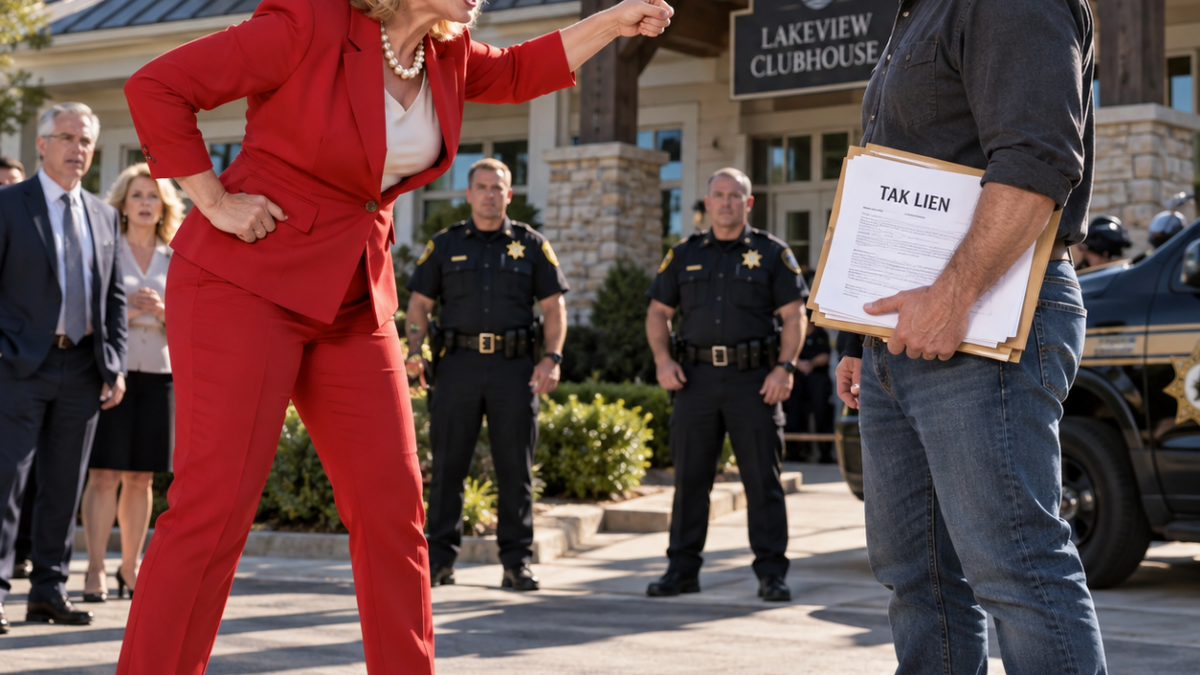
The entire HOA board stood up and applauded when Lenora Wickham outbid me for a piece of land I had wanted for years.
She turned around, raised her bidder paddle over her head like a championship trophy, and smiled at me as if four hundred homeowners had just watched her finally put the stubborn landowner next door in his place.
I folded my card, slid it into my jacket, and walked out without telling her that the most expensive mistake she had ever made would come due before the county offices closed that afternoon.
My name is Grant Calder. I was forty-eight then, and for more than twenty years I had run a small grading and land-investment company on the western edge of Black Ridge County.
I wasn’t rich in the way Lenora seemed to imagine.
I owned equipment, dirt, commercial acreage, and more paperwork than any sane person would willingly read.
What I did understand was land.
I understood drainage maps, access easements, tax certificates, road frontage, utility corridors, survey lines, and the difference between what a property looked like on a glossy rendering and what you could legally do with it once somebody bothered to read the county records.
Crest View Reserve had been built beside my property years after I bought most of my land.
It was the kind of subdivision with stone entrance pillars, decorative ponds, an expensive clubhouse, and a homeowners association that somehow believed the rules printed in its covenants continued beyond the subdivision boundary.
Lenora believed that more strongly than anyone.
For months, she had mailed me notices accusing me of violating Crest View rules.
My trucks were visible.
My company sign was too large.
My grading work created dust.
My fencing wasn’t attractive enough.
There was only one problem.
I didn’t live in Crest View.
I didn’t own property inside Crest View.
Their HOA had exactly as much authority over my land as I had over Lenora’s kitchen cabinets.
So I never fought with her.
I filed every notice.
That seemed to make her angrier.
The real war started over Lot 17B.
It was 11.4 acres of abandoned development land sitting between my commercial property and County Route 18.
For me, it was practical.
Owning it would give my trucks direct road access and eliminate a six-mile detour we made every day.
For Lenora, it was something else entirely.
She had promised Crest View a project she called the Grand Commons—a private event lawn, conference pavilion, parking area, and small retail strip.
There were renderings.
Presentation boards.
Newsletter articles.
A banner inside the clubhouse that said:
OUR LAND. OUR FUTURE.
They didn’t own it yet.
That detail didn’t seem to bother her.
Then Black Ridge County scheduled Lot 17B for auction.
I decided what the land was worth to me, including the value of the access road, and set a hard ceiling of $405,000.
Not one dollar more.
Lenora apparently had a different strategy.
Win.
At any cost.
The bidding started at $118,000.
By $200,000, most of the room had lost interest.
At $300,000, only Lenora and I remained.
She bid $325,000.
I answered $340,000.
She went to $360,000.
I bid $385,000.
People behind her started whispering and laughing.
Then I said, “$405,000.”
Lenora barely waited for the auctioneer to acknowledge me.
“Four hundred twenty thousand.”
Silence.
I looked at Everett Boone, my attorney.
He didn’t move.
Neither did I.
I lowered my paddle.
“Sold. Four hundred twenty thousand dollars.”
The Crest View section exploded.
People clapped.
One board member slapped another on the shoulder.
Their newsletter photographer started taking pictures.
Lenora turned toward me.
“Looks like Crest View wanted it more.”
I stood.
“You certainly paid more.”
Then I left.
Behind me, the applause continued.
What none of those people understood was that $420,000 wasn’t the amount Crest View was actually about to spend.
After the buyer premium, recording fees, and required charges, the cash leaving their reserve account would be roughly $438,600.
And at 10:47 that morning, while Lenora was still accepting congratulations, Crest View’s treasurer, Tobias Kemp, opened the association’s banking portal.
He stared at the remaining balance.
Then he stared at the clock.
Then he found Lenora.
She was smiling when he reached her.
He wasn’t.
“We have a problem,” Tobias said.
Lenora barely looked at him.
“We just won. Whatever it is can wait.”
“No.”
Something in his voice finally made her turn.
Tobias held out a printed statement with one trembling hand.
“It can’t wait.”
PART 2
“What can’t wait?”
Lenora’s smile disappeared slowly rather than all at once.
Tobias looked around the civic hall before answering. Residents were still congratulating one another. Mallerie Vance, the vice president, was talking with the association photographer near the aisle. One of the board members had already started discussing where the pavilion entrance should go.
Tobias lowered his voice.
“The clubhouse.”
Lenora’s expression hardened.
“What about it?”
“The redemption deadline is today.”
For the first time since the auctioneer had called Lot 17B sold, she stopped looking like a winner.
I wasn’t there to see that conversation.
I learned the details later from financial records, depositions, board minutes, emails, and eventually from Tobias himself.
But I already knew about the deadline.
That was the part Lenora never understood.
Several weeks before the auction, I had gone to the Black Ridge County Records Office to do the same thing I did before nearly every land purchase: verify what everybody else was too impatient to verify.
Lot 17B had problems.
A major drainage easement crossed a substantial portion of it.
There was also a utility corridor that limited permanent construction across part of the site.
Neither problem mattered much for what I wanted.
I needed access.
A properly engineered road could still work.
A giant event pavilion, retail strip, and landscaped gathering lawn were another matter.
While reviewing the parcel map, however, something else caught my eye.
A notation sat over the parcel belonging to the Crest View clubhouse.
TAX CERTIFICATE — REDEMPTION PENDING.
I remember leaning closer to the screen.
“Can you pull the file for this one?”
The county employee beside me looked at the parcel number.
“Clubhouse?”
“Looks like it.”
A few minutes later, Delia Prescott brought out the record.
Delia had worked in county tax administration for years. She wasn’t dramatic. She didn’t gossip. She answered exactly what you asked and stopped.
That was one reason I trusted her.
I went through the paperwork.
Three years earlier, Crest View had begun using part of its clubhouse as a paid event venue. That change triggered a dispute over the property’s tax treatment. The association appealed.
Nothing unusual so far.
What was unusual was what happened next.
Instead of paying the disputed assessment and seeking reimbursement if it won, the association withheld the payment.
Then it lost the appeal.
Interest accumulated.
Penalties followed.
Administrative charges were added.
Required publication and notice expenses accumulated.
An original obligation in the neighborhood of $86,000 grew until the redemption figure had reached $143,870.62.
I looked at Delia.
“They know about this?”
She turned several pages.
“Six notices that I can see immediately.”
“Certified?”
“Two.”
“Received?”
She pointed.
One had a signature.
Lenora Wickham.
I sat back.
That changed everything.
Not because I intended to use it against her.
At that point, I didn’t even know who owned the tax certificate.
My company bought distressed land, easement interests, occasional tax certificates, and small investment bundles through several entities. Most of those investments were serviced by third parties.
I wasn’t sitting around studying every delinquent parcel in the county.
What mattered to me that morning was simpler.
Lenora knew.
The board might not know.
The homeowners might not know.
But Lenora knew.
“When does redemption expire?”
Delia pointed to the date.
I stared at it.
It was the same day as the Lot 17B auction.
“Four o’clock?”
“Four o’clock.”
I called Everett from the courthouse parking lot.
He listened without interrupting.
When I finished, he said, “Don’t contact the association.”
“I wasn’t planning to.”
“Don’t warn them. Don’t threaten them. Don’t mention the certificate at all.”
“I didn’t say I owned it.”
“I’m not saying you do. I’m saying this is their obligation. Let their counsel and their board handle their affairs. You concentrate on the parcel you’re considering bidding on.”
That was exactly what I did.
What I didn’t know then was that Tobias Kemp had already been fighting the same battle from inside Crest View.
Tobias was sixty-one, a retired corporate accountant, and probably the least theatrical human being Lenora had ever encountered.
He didn’t care about slogans.
He cared about balances.
At a closed board session, he placed the clubhouse redemption figure in front of the other directors.
“$143,870.62,” he said. “This needs to be reserved now.”
Lenora shook her head.
“We’ve discussed this.”
“No. You’ve dismissed it. That’s different.”
Mallerie shifted uncomfortably in her chair.
Lenora leaned back.
“Lot 17B determines the future of this community.”
“The clubhouse is currently the property that determines whether this community has a clubhouse.”
“We’re appealing our options.”
“The tax appeal is over.”
“We can request more time.”
“From whom?”
“The county.”
Tobias pushed the paper toward her.
“Show me the written extension.”
Lenora didn’t touch it.
“We’ll deal with it.”
“When?”
“After the auction.”
“There is no after the auction. The redemption deadline is the same day.”
According to the meeting notes, the room went quiet.
Then Lenora said something that later became very important.
“We are not going to let a technical tax issue cost us Lot 17B.”
Tobias stared at her.
“The technical tax issue is attached to a building worth more than a million dollars.”
“We have over half a million in reserves.”
“And if you spend most of it at the auction?”
“We won’t.”
“How do you know?”
“Because Calder won’t go that high.”
That was the foundation of her financial strategy.
Not an appraisal.
Not an approved line of credit.
Not a contingency plan.
Her belief that I would quit first.
Tobias recommended reserving at least $175,000 so the association could satisfy the tax obligation regardless of auction costs.
Lenora refused.
Instead, she pushed for authorization to spend as much as $450,000 acquiring Lot 17B.
Tobias voted no.
Another board member joined him.
Five voted yes.
Before the meeting ended, Tobias insisted that Lenora state in writing where the acquisition money would come from.
She wrote:
RESERVE FUND.
Then she signed her name.
Afterward, he sent her an email.
If total acquisition costs exceed approximately $390,000, he warned, the remaining unrestricted reserves may be insufficient to redeem the clubhouse before the statutory deadline.
Her reply came seventeen minutes later.
Lot acquisition is the priority. We can solve the tax matter afterward.
That sentence would eventually be projected onto a courtroom screen.
But at the time, almost nobody outside the board knew the email existed.
The homeowners certainly didn’t.
Lenora made sure of that.
At another meeting, Tobias recommended disclosing the clubhouse obligation before residents were asked to support the Lot 17B purchase.
Lenora refused.
She called it “unnecessary alarm.”
Then she stood in front of nearly eighty homeowners and gave a presentation about the Grand Commons.
She showed them the pavilion.
The event lawn.
The parking.
The retail strip.
She showed projected revenue.
She showed landscaping.
She even showed a computer-generated image of families walking across a property the HOA did not yet own.
At the end of the presentation, Walter Higby, a longtime resident, raised his hand.
“What happens if Grant Calder bids?”
Lenora smiled.
“We outbid him.”
The room applauded.
Tobias didn’t.
In the weeks leading up to the auction, Lenora turned me into a convenient enemy.
I was supposedly planning to run heavy trucks beside their homes.
I supposedly wanted to buy the land merely to hold it hostage.
I supposedly resented Crest View’s success.
None of that came from me.
My plan was a road.
That was it.
A road.
She also encouraged residents to petition the county to prohibit outside bidders.
There was no legal basis for that.
The county rejected it.
Lenora apparently never announced the rejection with the same enthusiasm she had announced the petition.
Meanwhile, I reviewed the land.
The more I looked at it, the more certain I became that Crest View was bidding on a fantasy.
The drainage easement alone affected roughly forty percent of the site.
Permanent structures inside parts of that corridor would face serious restrictions.
Their beautiful pavilion rendering was positioned almost directly over one of the worst locations.
I showed Everett the plans.
He stared at them.
“Did they order a survey?”
“I don’t know.”
“Did they read the easement?”
“I don’t know that either.”
“Then why are they advertising this?”
“Ask Lenora.”
I wasn’t going to.
I had learned a long time earlier that there are people who want information and people who want confirmation.
Lenora wanted confirmation.
She already knew what she wanted the story to be.
All facts were expected to cooperate.
The morning of the auction, I arrived alone except for Everett.
Lenora arrived with an entourage.
Mallerie.
Three directors.
A real-estate adviser.
Several residents.
A photographer.
I remember Everett looking across the room.
“Subtle.”
“She’s confident.”
“That’s one word.”
Lot 17B opened at $118,000.
Several investors participated.
At $200,000, interest narrowed.
At $250,000, two people dropped out.
By $300,000, only Lenora and I remained.
I had calculated my maximum carefully.
A direct connection to Route 18 would reduce fuel costs, maintenance, driver hours, and wear across multiple trucks over many years.
I could justify $405,000.
Barely.
But I could justify it.
Lenora bid $325,000.
I raised to $340,000.
She said $360,000.
I said $385,000.
The room had become strangely quiet.
Then I called my final number.
“$405,000.”
Everett didn’t look at me.
He knew that was the ceiling.
Lenora turned.
For a fraction of a second, I thought she might stop.
Then her face changed.
It wasn’t valuation anymore.
It was pride.
“$420,000.”
The auctioneer looked at me.
I shook my head.
“Four hundred twenty thousand once.”
Lenora was already smiling.
“Twice.”
Someone behind her whispered, “We’ve got him.”
“Sold.”
Applause.
Real applause.
People stood.
Mallerie hugged Lenora.
A board member said, loudly enough that I could hear him, “We finally beat Calder.”
Lenora raised the paddle.
Then she looked at me.
“Looks like Crest View wanted it more.”
“You certainly paid more.”
I walked out.
What she had actually committed wasn’t $420,000.
With fees, premiums, and recording costs, the cash requirement reached about $438,600.
Crest View had roughly $552,000 in reserves before the purchase.
Afterward, the account sat near $113,400.
The clubhouse required $143,870.62.
They were more than $30,000 short.
And the clock was running.
At 10:47 a.m., Tobias showed Lenora the numbers.
She stared at them.
“That’s all that’s left?”
“That’s all that’s available in the reserve account after the auction charge.”
“We need thirty thousand.”
“More than thirty.”
She waved a hand.
“Then move it from operating.”
“I can’t move money that isn’t there.”
“Call the bank.”
“I did.”
That got her attention.
“What did they say?”
“No emergency facility has been approved.”
“We discussed one.”
“You discussed one casually with a loan officer. There is no approved credit line.”
“Then we get one approved.”
“Today?”
“Yes.”
Tobias looked at his watch.
“We have five hours.”
Lenora walked out of the room and called the bank herself.
The answer didn’t improve because she was the president.
No same-day unsecured facility.
No ability to use the clubhouse as clean collateral while it was already subject to an advanced tax certificate process.
Lot 17B couldn’t help either because the transaction had barely occurred and recording was incomplete.
She returned furious.
“Emergency assessment.”
Tobias shook his head.
“We need notice and a vote.”
“Call one.”
“We still need notice.”
“Waive it.”
“I don’t have authority to waive bylaws because you spent too much at an auction.”
According to Mallerie, that was the moment Lenora started blaming people.
“You should have arranged backup financing.”
Tobias opened his folder.
“I warned you on August 3.”
He placed an email on the table.
“Again on August 18.”
A second email.
“Again last week.”
A third.
“You acknowledged the first two.”
Mallerie picked up one of the pages.
Her eyes moved down the message.
Then she looked at Lenora.
“You knew the deadlines were the same day?”
Lenora didn’t answer immediately.
“Of course I knew.”
“And you still spent $438,000?”
“We expected the land to cost less.”
“You personally bid $420,000.”
“Because Calder forced the price.”
“No,” Tobias said quietly. “He stopped.”
That sentence made Lenora turn toward him.
“He bid us up.”
“He stopped at his ceiling. You made the last bid.”
“He knew I wanted the land.”
“So did everybody in the room.”
At 1:15 p.m., Lenora called Delia Prescott.
She demanded a forty-eight-hour extension.
Delia explained that the deadline was statutory.
Lenora threatened litigation.
Delia pulled the file.
She read the certified-mail dates.
She read the notice dates.
Then she read the name signed on the receipt.
“Lenora Wickham.”
Mallerie was standing close enough to hear.
She closed her eyes.
By two o’clock, desperation had replaced celebration.
Lenora called wealthy homeowners.
One was Priscilla Doyle, a retired attorney.
Lenora described the situation as a temporary cash-flow problem.
Priscilla asked one question.
“Why didn’t the board reserve the redemption funds before spending money at the auction?”
Lenora said the timing had been unfortunate.
Priscilla replied, “A deadline disclosed months in advance isn’t unfortunate timing.”
She did not offer money.
Two other homeowners also declined.
At 2:05, my phone rang.
I recognized Lenora’s number because her office had called mine enough times over the years.
“Grant.”
Her voice was controlled.
“I’m calling on behalf of Crest View.”
“Okay.”
“We have a short-duration liquidity issue related to the purchase this morning.”
I looked at Everett.
He raised an eyebrow.
Lenora continued.
“We need approximately forty thousand dollars for no more than forty-eight hours.”
“You want to borrow forty thousand dollars from me.”
“This could resolve some of the unnecessary tension between us.”
“What tension?”
“The disputes.”
“Which disputes?”
Silence.
“Your trucks. Signage. Access issues.”
“Lenora, your association doesn’t regulate my property.”
“I’m trying to offer an opportunity for everybody to move forward.”
“At what interest rate?”
Another pause.
“We can discuss terms later.”
“Then you don’t have terms.”
“Grant.”
“No.”
Her voice sharpened.
“You’re seriously refusing to help an entire community over personal hostility?”
“I didn’t create your deadline.”
“You know what’s at stake.”
“I assume your board does too.”
She hung up.
At 3:37, Tobias located $2,856.62 in unrestricted operating cash that could legally be moved.
It wasn’t enough.
The remaining shortage was still around $27,614.
Lenora asked directors to advance the money personally.
No one did.
These were the same people who had cheered less than five hours earlier.
Now nobody wanted their personal signature attached to an emergency loan they barely understood.
At 3:59 p.m., Tobias stood inside the county office holding a cashier’s check for less than the amount required.
Delia looked at the clock.
He knew.
She knew.
At four o’clock, the redemption period expired.
Tobias drove home in silence.
Lenora drove home believing she would fix everything in the morning.
That was another mistake.
The redemption deadline wasn’t a courtesy date.
The certificate holder’s servicing agent had already completed the required notices, waiting periods, fees, and application steps necessary to advance the matter toward a tax deed.
When midnight passed, no magical grace period appeared.
The next morning, the county record showed the application advancing.
The clubhouse was worth well over $1.3 million.
The unpaid redemption amount had been $143,870.62.
Mallerie stared at the paperwork during an emergency board meeting.
“This can’t be real.”
Tobias looked exhausted.
“It is.”
“We could lose a million-dollar building?”
“Yes.”
“Over one hundred forty-three thousand dollars?”
“Yes.”
“After spending more than four hundred thousand on land?”
Tobias didn’t answer.
He didn’t need to.
Lenora stood at the head of the table.
“We’ll seek an injunction.”
Tobias looked at her.
“On what basis?”
“Improper notice.”
“You signed for the notice.”
“Excessive penalties.”
“We had years to dispute those.”
“Conflict of interest.”
That phrase would become important.
Because later that same day, I discovered something even I had not known.
Everett and I were reviewing the tax certificate file when he read the holder information.
“Black Ridge Land Recovery LLC.”
I looked up.
“Say that again.”
“Black Ridge Land Recovery.”
“That’s mine.”
Everett stared at me.
“What?”
I took the document.
Two years earlier, Black Ridge Land Recovery LLC, one of my investment companies, had purchased a bundle of tax certificates from a retiring investor.
We hadn’t selected the certificates one by one.
It was a portfolio acquisition.
A third-party servicing company handled notices, statutory deadlines, redemption tracking, and legal processing.
I pulled our original acquisition records.
There it was.
The Crest View clubhouse certificate.
Acquired almost two years before the Lot 17B fight.
Long before the auction.
Long before Lenora started mailing me notices.
Long before I knew the clubhouse had any tax problem.
I sat there looking at the file.
Everett finally said, “Well.”
“That’s not ideal.”
“Actually, legally, the timing helps.”
“She’s going to say I engineered this.”
“She can say whatever she wants. Your purchase date is public.”
I leaned back.
“So I hold the certificate.”
“Your LLC does.”
“And the deed process is advancing.”
“Correct.”
“Can I stop it?”
“You may have options to negotiate voluntarily, depending on the stage and applicable procedure.”
I thought about that.
“Am I required to?”
“No.”
I remembered the auction.
The applause.
The months of letters.
The fake violations.
More than any of that, though, I remembered Lenora’s signature on the county notice.
She had known.
She had had the money.
She had been warned by her treasurer.
And she had chosen to spend it because beating me in a room full of people mattered more to her than protecting the clubhouse those people actually owned.
“Let the process continue,” I said.
Everett studied me.
“You’re sure?”
“Yes.”
Lenora found out the next morning.
She called me immediately.
“You planned this.”
“No.”
“You bought our tax lien.”
“Almost two years ago, as part of a portfolio.”
“You knew exactly what you were doing.”
“I didn’t know the certificate was connected to Crest View until after the redemption deadline.”
“That’s absurd.”
“The purchase records are public.”
“You sat in that auction knowing we’d lose the clubhouse.”
“I knew you had a deadline.”
“And you didn’t tell us.”
I paused.
“You signed the notice, Lenora.”
Silence.
“You knew too.”
“I didn’t know you held it.”
“What difference would that have made to your obligation?”
“You baited us.”
“How?”
“You pushed the bidding.”
“I stopped at the number I set before the auction.”
“You drove the price above four hundred thousand.”
“And then I stopped.”
“You knew I would keep going.”
“No. I knew what the land was worth to me. You decided what winning was worth to you.”
Her breathing changed.
“We’re filing an injunction.”
“Okay.”
“We’ll prove conflict of interest.”
“Bring the financial records.”
Another silence.
“What?”
“If you’re going to court, bring the reserve records too.”
Then I hung up.
Everett looked at me.
“You enjoyed that more than you should have.”
“Probably.”
Crest View filed for emergency relief.
Their attorneys attacked the process three ways.
First, they argued insufficient notice.
Second, they argued that losing a property valued above $1.3 million over a $143,000 redemption amount was grossly disproportionate.
Third, they argued that my ownership of the certificate created an appearance of manipulation because I had also bid against the association for Lot 17B.
The first argument collapsed almost immediately.
The county produced the file.
Notice after notice.
Dates.
Certified receipts.
Appeal records.
Publication records.
Payment histories.
Lenora’s signature.
The second argument was emotionally stronger.
Even I understood why homeowners were furious.
Most of them hadn’t made these decisions.
Most had trusted their board.
But emotion didn’t erase the statutory process.
The third argument created discovery.
And discovery destroyed Lenora.
Everett subpoenaed internal communications relating to both the tax obligation and the decision to purchase Lot 17B.
Tobias complied.
The first email was bad.
Six weeks before the auction, he had written:
If acquisition costs exceed approximately $390,000, the association risks being unable to satisfy the clubhouse redemption amount by the statutory deadline.
Lenora replied:
Lot acquisition is the priority. The tax matter can be addressed afterward.
The second email was worse.
Tobias wrote:
Given the magnitude of the outstanding certificate, I recommend full disclosure to members before the board commits reserve funds to Lot 17B.
Lenora answered:
Do not include the lien figure in the member packet. It will create unnecessary panic and undermine support for the acquisition.
I read that email twice.
Everett looked across the table.
“That’s the case.”
“No.”
He frowned.
“What?”
“That’s the end of her case.”
He nodded slowly.
“Fair.”
Mallerie called an emergency board session after the emails circulated.
This time residents attended.
No banner.
No photographer.
No applause.
Lenora stood at the front.
“The current situation is the result of an aggressive outside investor exploiting a technical process.”
Tobias raised his hand.
Lenora ignored him.
He stood anyway.
“No.”
Everybody turned.
Tobias was not a man who raised his voice.
That made it more effective when he did.
“This situation is the result of a decision to spend money that I repeatedly advised this board to reserve.”
Lenora stared at him.
“We all approved the acquisition.”
“Five of you did.”
“You processed the transfer.”
“Because I am treasurer. Processing an authorized payment is not the same as recommending it.”
“You should have stopped us.”
“I tried.”
He lifted a binder.
“Would you like me to read the meeting minutes?”
The room became still.
Mallerie looked at Lenora.
“Did you tell us the lien figure shouldn’t be disclosed to residents?”
Lenora’s mouth tightened.
“I said public discussion could cause panic during a sensitive negotiation.”
“There was no negotiation.”
“We were dealing with the county.”
“The county sent us a bill.”
A resident near the back called out, “Did you hide it?”
Lenora looked toward the audience.
“No one hid anything.”
Tobias opened the binder.
Mallerie said, “Read the email.”
He did.
Do not include the lien figure in the member packet.
The reaction wasn’t loud.
It was worse.
A low movement passed through the room.
People leaned toward one another.
Someone whispered, “Oh my God.”
Walter Higby, the man who had asked what would happen if I bid, stood up.
“We cheered because you told us buying that land protected our future.”
Lenora answered, “It does.”
“Does it?”
“Yes.”
“Can we build the Grand Commons?”
“We’re evaluating final engineering.”
That was when the next problem arrived.
The new board faction had hired an independent surveyor.
He walked to the front carrying a rolled plan.
Mallerie said, “Show them.”
The surveyor spread the map across a table.
He highlighted the drainage easement.
Then the utility corridor.
Approximately forty percent of Lot 17B was substantially constrained.
The location where Lenora’s promotional rendering placed the main pavilion fell directly across the most problematic section.
The event lawn design also interfered with drainage requirements.
The retail component would need major redesign, additional approvals, and possibly could not be built in anything resembling the advertised form.
Walter looked at the map.
Then at the glossy rendering still hanging on the wall.
Then at Lenora.
“Did you know?”
“We knew the site had easements.”
“Did you know the pavilion couldn’t go where you showed us?”
“We had not completed final engineering.”
“You told us the plan was ready.”
“I said it was conceptual.”
Walter pointed at the banner from an earlier campaign that someone had left folded against a wall.
“Our land. Our future.”
His voice cracked.
“We spent $438,600 on land we couldn’t use the way you promised while our clubhouse needed $143,000?”
Nobody answered.
A director who had cheered beside Lenora at the auction leaned forward.
“So let me understand this.”
His voice was almost unnaturally calm.
“We overpaid for a property that cannot support the project used to justify the purchase, and we used the exact reserve funds that could have protected the clubhouse?”
Lenora said nothing.
This time, nobody applauded.
The emergency hearing took place less than two weeks later.
The courtroom was small.
Residents filled almost every bench.
I sat beside Everett.
Lenora sat with the association’s attorneys.
She wore the same kind of tailored clothes she had worn at the auction, but something about her looked different.
At the auction, she had occupied the room.
In court, the room didn’t care who she was.
Documents mattered.
Dates mattered.
Signatures mattered.
The association’s lawyer began by arguing that no reasonable board could have anticipated such a catastrophic result from what began as a tax-classification disagreement.
The judge interrupted.
“Did the association receive the statutory notices?”
The county attorney stood.
“Yes, Your Honor.”
“All required notices?”
“Yes.”
“Evidence?”
A binder was opened.
The first receipt went up.
Lenora Wickham.
Then another.
Then the appeal decision.
Then the final redemption notice.
Then the deadline.
The association’s attorney shifted to proportionality.
“Your Honor, we are talking about the transfer of a clubhouse valued at more than $1.3 million over a redemption amount of approximately $143,000.”
The judge nodded.
“I understand the figures.”
“This is an extraordinary forfeiture.”
“The question before me is whether the statutory process was legally defective.”
“We believe equitable considerations—”
“Counsel, did your client have the ability to redeem before the deadline?”
A pause.
“Yes.”
“Did your client have funds exceeding the redemption amount before purchasing Lot 17B?”
Another pause.
“Yes.”
“Did your client voluntarily spend those funds on the parcel?”
“Yes, but—”
The judge looked down.
“Continue.”
Then they came after me.
The association’s lawyer suggested I had deliberately manipulated the auction to exhaust Crest View’s reserve funds.
Everett stood.
“We have the auction log.”
The official record showed every bid.
It showed my final number.
$405,000.
It showed Lenora’s final number.
$420,000.
The lawyer turned toward me.
“Mr. Calder, you knew Crest View wanted this parcel badly.”
“Yes.”
“You knew the association was willing to pay a premium.”
“I assumed they were.”
“And you continued bidding.”
“Until the property exceeded my predetermined ceiling.”
“You knew every bid you made forced Crest View higher.”
“Every bid she made forced me higher too.”
A few residents shifted.
The judge looked over his glasses.
“Mr. Calder, when did you establish the $405,000 limit?”
“Before the auction.”
“Do you have supporting documentation?”
Everett handed him my acquisition worksheet.
Fuel savings.
Estimated road construction.
Annual mileage reduction.
Equipment wear.
Access premium.
Maximum acquisition price.
Created days before the auction.
The attorney tried again.
“Yet you also held the clubhouse certificate.”
“My LLC held it.”
“And you knew the redemption date.”
“I learned the date while reviewing county records.”
“So you understood that if Crest View spent enough money on Lot 17B, it might become unable to redeem the clubhouse.”
“I understood that possibility.”
“And you kept bidding.”
“Yes.”
“Why?”
“Because I wanted Lot 17B.”
“Until you didn’t?”
“Until it exceeded what I believed it was worth to me.”
“You expect this court to believe it was coincidence that you stopped at exactly the point where the association’s remaining reserves would become inadequate?”
Everett started to object.
I answered first.
“My ceiling wasn’t based on their reserve balance.”
“Then what was it based on?”
“The land.”
The attorney stared at me.
I continued.
“If Crest View had reserved its clubhouse money first, none of my bids would have mattered.”
Silence.
The judge wrote something.
Then Everett introduced the certificate acquisition records.
Black Ridge Land Recovery LLC had bought the portfolio nearly two years before Lot 17B was scheduled for auction.
There was no way I had purchased the lien as revenge for a dispute that didn’t exist yet.
The servicing agreement showed that an independent company had tracked notices and deadlines.
The county had advanced the tax-deed process through normal channels.
Then Tobias’s emails came in.
The courtroom atmosphere changed.
The first appeared on a display.
If acquisition costs exceed approximately $390,000…
Then Lenora’s reply.
Lot acquisition is the priority.
Then the second email.
I recommend full disclosure…
And her reply.
Do not include the lien figure…
Nobody had to interpret them.
The language did the work.
The judge eventually denied the injunction.
No evidence of fraud by me.
No fatal defect in notice.
No proof the lien had been manufactured in retaliation.
No legal basis to erase the consequences of a financial choice merely because those consequences had become painful.
Outside the courtroom, residents gathered around Mallerie and Tobias.
I was walking toward the parking lot when I heard Lenora behind me.
“Grant.”
I stopped.
She came down the courthouse steps fast.
“You took a clubhouse worth over a million dollars because we were twenty-seven thousand short.”
I looked at her.
“No.”
Her eyes flashed.
“What do you mean, no?”
“You spent the twenty-seven thousand trying to beat me.”
Her face went still.
“I didn’t choose your auction bid.”
“You knew what would happen.”
“You knew the deadline.”
“You could have helped.”
“You could have paid the lien before raising your paddle.”
For once, she had nothing ready.
No slogan.
No board resolution.
No notice.
No threat.
She turned away.
But Lenora wasn’t finished.
She was still technically president.
At the next association meeting, held in a rented hotel conference room because the clubhouse was now entangled in the transfer process, she proposed what she called a recovery plan.
It was brutal.
A special assessment of $4,800 per household.
Sell Lot 17B.
Continue litigation against me.
Raise enough money to attempt to reacquire the clubhouse.
Tobias presented the financial damage.
“Lot 17B acquisition cost: approximately $438,600.”
He changed the slide.
“Unredeemed clubhouse obligation: $143,870.62.”
Another slide.
“Legal fees to date.”
People groaned.
Another.
“Current highest preliminary market indication for Lot 17B: substantially below acquisition cost.”
Then he displayed the clubhouse valuation.
More than $1.3 million.
A woman in the second row began crying.
Not loudly.
She simply covered her face.
I later learned her husband had died the previous year.
The clubhouse had been where the neighborhood held his memorial.
For people like her, the building wasn’t a number.
That was what made Lenora’s decisions so ugly.
She had convinced herself she was defending the community while gambling with things that belonged to everyone else.
Mallerie stood.
“I move that Lenora Wickham be removed as president immediately.”
The room erupted.
Lenora hit the table.
“You cannot possibly believe replacing leadership in the middle of litigation is responsible.”
Mallerie looked straight at her.
“I think leaving you in charge for one more hour would be irresponsible.”
A director seconded the motion.
The vote was six to one.
Lenora cast the only vote against removing Lenora.
Nobody laughed.
That was how angry they were.
Her closest allies began resigning over the following weeks.
The association hired outside auditors.
New financial controls were adopted.
The insurer opened a review into whether decisions surrounding the concealed lien and reserve expenditure could constitute a breach of fiduciary obligations.
It never needed to become a criminal story.
The civil consequences were already devastating.
Then came Lot 17B.
The association had paid $420,000 at auction and about $438,600 all-in.
Now it needed cash.
The land went back on the market.
Weeks passed.
No buyer came close.
$180,000.
$205,000.
$215,000.
Finally, one outside bidder offered $226,000.
I watched from a distance.
Everett asked whether I wanted to participate.
“Not yet.”
“You still need the access.”
“I do.”
“Then what are you waiting for?”
“The market to finish explaining something.”
He smiled.
A few days later, I submitted an offer.
$235,000.
Higher than any other serious bid.
Far below what Crest View had paid.
Mallerie called me herself.
“You’re enjoying this.”
“Not really.”
“Grant.”
“I want the property.”
“You wanted it before.”
“Yes.”
“And we paid almost twice your offer to stop you from getting it.”
“Also yes.”
She exhaled.
“Can you come up?”
“No.”
“Five thousand?”
“No.”
“You’re impossible.”
“That’s not what the old notices said. According to those, I was noisy, dusty, improperly fenced, commercially unsightly, and in violation of landscaping standards.”
She laughed despite herself.
It was the first time I had heard anyone on the Crest View board laugh in months.
“Two hundred thirty-five?”
“That’s my offer.”
The board accepted.
The land Lenora had paid $420,000 to keep away from me ended up becoming mine for $235,000.
The association absorbed a loss approaching $200,000 after related costs.
I finally had my access route.
But the clubhouse matter still wasn’t finished.
The tax deed process continued.
Crest View’s final legal challenges failed.
Eventually, the deed was recorded to Black Ridge Land Recovery LLC.
The clubhouse officially belonged to my company.
I drove over there the morning after recording.
I expected to feel something.
Victory, maybe.
Vindication.
Instead, I saw an older man carrying folding chairs through a side entrance.
A woman was taping a flyer for a neighborhood blood drive to a bulletin board.
Two maintenance employees were checking a leaking irrigation valve.
These weren’t the people who had created the mess.
They were just living inside it.
Everett joined me in the parking lot.
“So?”
“So what?”
“What are you going to do?”
“About the building?”
“Yes.”
I looked at the clubhouse.
I could have locked it.
Legally, once possession issues were resolved, I had options.
I could have converted it.
Sold it.
Redeveloped it.
Used the parking for something else.
I thought about Lenora standing at the auction with that paddle above her head.
Then I thought about the woman who cried when Tobias showed the loss.
“I don’t want the neighborhood punished for her.”
Everett nodded.
“Lease?”
“Temporary.”
“Market rate?”
“Fair market rate.”
“Conditions?”
“No HOA authority over my land.”
“Obviously.”
“Every violation notice against my properties gets formally rescinded.”
“Reasonable.”
“No claim on Lot 17B.”
“Agreed.”
“And the new board has to deal with me directly. No games.”
Everett smiled.
“I’ll draft it.”
Mallerie and Tobias came to my office two days later.
Tobias looked older than he had before the auction.
Mallerie looked tired.
I put the proposed agreement on the table.
She read the first page.
Then the second.
“You’d let us keep using it?”
“As tenants.”
“For how long?”
“Long enough for you to reorganize and decide what the association actually needs.”
She studied me.
“Why?”
“Because four hundred homeowners didn’t make Lenora’s decisions.”
Tobias looked toward the window.
Then back at me.
“Thank you.”
I shook my head.
“Don’t thank me yet. You’re paying rent.”
He laughed.
“I’d be suspicious if we weren’t.”
Mallerie reached the clause involving my property.
She read it slowly.
“The association acknowledges that Calder-owned parcels outside Crest View Reserve are not subject to Crest View covenants, restrictions, enforcement authority, architectural standards, or assessment powers.”
She looked up.
“You’ve been waiting years to see that sentence.”
“I may frame it.”
She turned the page.
All prior notices were formally rescinded.
The new board approved the agreement.
The first meeting under the new arrangement was held in the same hall where Lenora had once displayed her Grand Commons rendering.
The rendering was gone.
The banner was gone.
Tobias presented a financial statement.
It was boring.
Painfully boring.
Every dollar was categorized.
Every obligation was shown.
Every reserve was explained.
Every outstanding liability appeared on the screen.
People asked questions.
Nobody was shouted down.
Nobody was told unpleasant numbers would cause unnecessary panic.
They adopted a rule requiring any proposed expenditure above $50,000 to be cross-checked against all outstanding statutory, tax, insurance, maintenance, and contractual obligations before the board could even schedule the vote.
Someone called it the Lenora Clause.
The name stuck.
Months passed.
My crews built the access road across Lot 17B.
Nothing grand.
No pavilion.
No retail strip.
Just a properly engineered commercial lane with drainage controls, compacted base, signage, and connection to County Route 18.
The first morning one of my dump trucks used it, my operations manager stood beside me.
“Six miles saved.”
“Every trip.”
“Should’ve bought this years ago.”
“I tried.”
He looked toward Crest View.
“Expensive detour.”
“Not for us.”
One afternoon, I was at the clubhouse checking a contractor’s estimate for roof repairs when I noticed a car stopped near the edge of the parking lot.
Lenora.
She had not lived there for several months by then, but her home had not yet sold.
She sat behind the wheel.
The old Crest View Reserve Clubhouse sign had been removed.
In its place was a smaller sign:
CALDER PROPERTY SERVICES
PRIVATE PROPERTY
Nothing insulting.
Nothing about her.
No trophy.
No joke.
Just ownership.
She stayed in the car for several minutes.
I could see her through the windshield.
For years, that building had been her stage.
She had chaired meetings there.
Hosted events.
Made announcements.
Issued warnings.
Posed for newsletters.
She had treated it as proof of her authority.
Now she couldn’t even walk into it without entering property held by the man she had spent months trying to humiliate.
I could have gone outside.
I didn’t.
There was nothing left to say.
Within the year, Lenora sold her house and moved away.
The family who bought it had small children and apparently knew almost nothing about the fight except for the kind of half-accurate stories neighborhoods preserve after scandals have become history.
Mallerie remained involved with the board.
Tobias stayed treasurer.
The reserve fund recovered slowly.
There were no dramatic expansion projects.
No glossy promises.
No Grand Commons.
They repaired roofs.
Updated pumps.
Renegotiated insurance.
Rebuilt reserves.
Published financial statements.
It wasn’t exciting.
It worked.
About a year after everything settled, Tobias stopped by my office.
He had brought paperwork relating to an access maintenance arrangement, but after we finished, he stood beside the window looking across at Lot 17B.
“You know what’s strange?”
“What?”
“I still remember that auction.”
“So do I.”
“The applause.”
I smiled slightly.
“Hard to forget.”
“I was sitting behind Lenora when you lowered your paddle.”
“I remember seeing you.”
“You looked completely calm.”
“I’d reached my number.”
“That’s not what I mean.”
He turned from the window.
“You knew about the deadline.”
“Yes.”
“You knew we were cutting it close.”
“Yes.”
“Did you know we’d miss it?”
“No.”
He seemed surprised.
“I thought maybe you had calculated everything.”
“I calculated my bid. Lenora calculated hers.”
“But when she said four-twenty, you didn’t even hesitate.”
“Because $405,000 was my ceiling.”
He looked toward the two files on my desk.
The Lot 17B deed.
The old clubhouse tax certificate.
Then he started laughing.
Not loudly.
Just enough to shake his head.
“You ended up with both.”
“I didn’t plan that.”
“I believe you.”
He picked up the auction sheet.
“$420,000.”
Then he picked up my later purchase agreement.
“$235,000.”
“Market changed.”
“No, Grant. Leadership changed.”
I didn’t answer.
He put the papers down.
Then he asked the question people had been asking in different forms since the court hearing.
“What was going through your mind when everybody stood up and cheered?”
I looked across the road.
Lot 17B stretched between my property and the highway.
Beyond it stood the clubhouse.
“I was thinking the same thing I think at every auction.”
“Which is?”
“Winning the bid isn’t the same thing as winning.”
Tobias nodded.
He left a few minutes later.
I never gave interviews about what happened.
I never wrote Lenora’s name into some public victory statement.
I didn’t need to.
The records existed.
The auction existed.
Her emails existed.
Her signature existed.
That was enough.
For a while, Crest View residents told the story as though it were about revenge.
The stubborn landowner.
The arrogant HOA president.
The auction.
The tax lien.
The million-dollar clubhouse.
But revenge wasn’t really what destroyed Lenora.
I didn’t create her tax debt.
I didn’t hide the deadline.
I didn’t authorize her spending.
I didn’t approve her bid.
I didn’t design a project on land without checking the easements.
I didn’t tell homeowners to applaud.
She did those things herself.
All I did was refuse to rescue her from the consequences when the clock finally reached four.
And maybe that is why the ending bothered her more than if I had engineered some elaborate trap.
There was no trap.
There was a ledger.
There was a deadline.
There was a woman who became so obsessed with defeating one man publicly that she forgot her actual responsibility was protecting hundreds of people privately.
At that county auction, Lenora Wickham got exactly what she wanted.
The auctioneer called Lot 17B sold to Crest View Reserve.
Her board rose to its feet.
The room applauded.
I walked out without the property.
For a few hours, she could honestly say she had beaten me.
Then four o’clock came.
Months later, Lot 17B belonged to me anyway.
The clubhouse belonged to my company.
Her presidency was gone.
Her Grand Commons project was gone.
Nearly $200,000 had disappeared in the resale loss.
The association she once controlled adopted new rules specifically designed to prevent another leader from doing what she had done.
And the people who had once cheered her loudest became the people who demanded the clearest answers.
In the end, the thing Lenora never understood was also the simplest thing I had learned in twenty years of buying land.
A higher bid can buy you property.
It cannot buy you good judgment.
Applause can make a reckless decision feel like a victory.
It cannot change a deadline.
And sometimes the person who walks quietly out of the room isn’t the one who lost.
Sometimes he’s simply the only person in the room who already knows what winning is actually worth.








