PART 2: THE HOA BOARD CHEERED WHEN SHE OUTBID ME—THEN THEY LEARNED I HELD THE TAX LIEN ON THEIR BEACH CLUB
PART 2
For a second, I honestly thought I had misheard her.
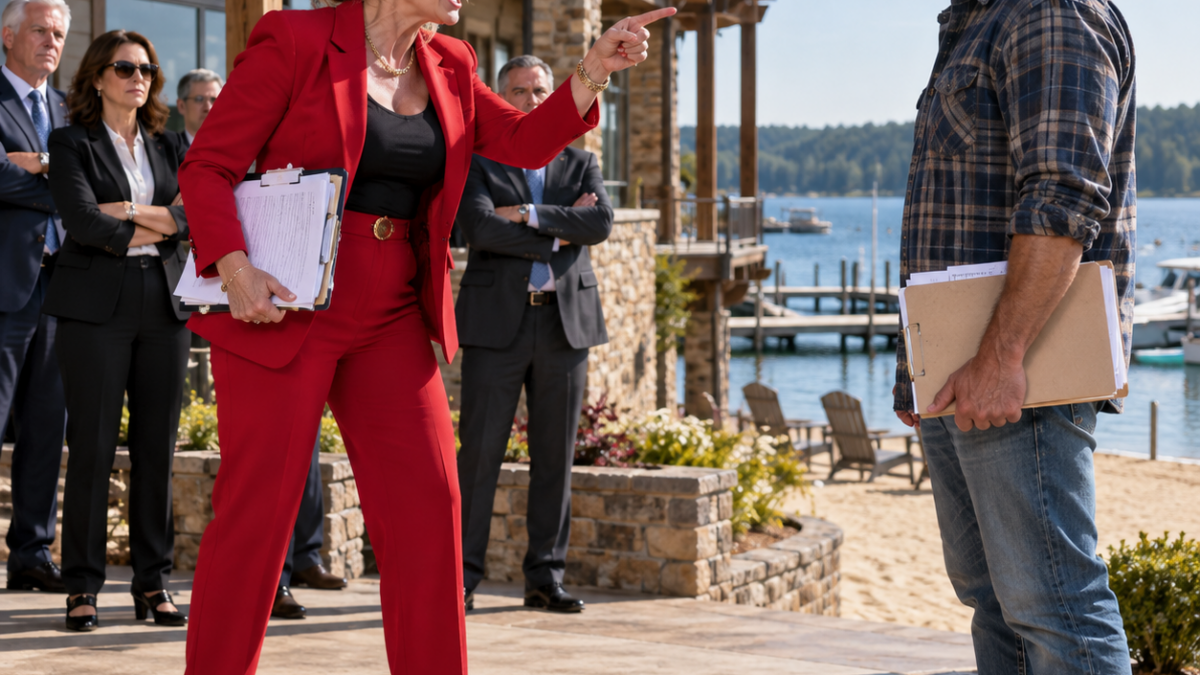
That morning Celeste Vandermir had stood in a county auction room while half her board celebrated the fact that she had beaten me. She had told me my trucks were finished using the shoreline. Less than four hours later, she was standing in my service yard asking me for fifty thousand dollars.
I wiped grease from my hands with a shop rag.
“No hello?”
Her jaw tightened.
“Forty-eight hours,” she said. “You give Harbor Pines fifty thousand. The chain comes down tonight. Every notice we’ve ever sent your business goes in the trash.”
Behind me, one of my mechanics quietly shut off his impact wrench.
The sudden silence made her offer sound even worse.
“Let me understand this,” I said. “You want me to loan you money so you can pay the county bill you ignored, and in exchange you’ll stop blocking a turnout you bought this morning specifically to hurt my business?”
“It’s a loan.”
“For what?”
“You know for what.”
“The beach club.”
Her eyes narrowed.
So that was what she really wanted to know.
How much did I know?
Celeste stepped closer and dropped her voice.
“What else did you find at the county?”
I folded the rag once.
“It’s a public records office, Celeste. I didn’t break into Fort Knox.”
“What did you find?”
“Your signatures.”
For the first time since I had met her, Celeste Vandermir had no immediate answer.
It lasted perhaps two seconds.
Then she found her voice again, and when she did, she raised it just enough for the men behind me to hear.
“When that beach club is gone, every family in Harbor Pines will know whose name to curse.”
“Then tell them everything.”
“I intend to.”
“No,” I said. “I mean everything. Tell them I warned you three weeks ago to pay the county before you spent the reserve. Tell them your treasurer warned you. Tell them exactly why you thought buying Kettle Point mattered more than protecting the beach club.”
Her cheeks colored beneath her makeup.
“You don’t care about those families.”
“You don’t know what I care about.”
“I know exactly what you care about. Winning.”
I almost laughed.
That was the strange part.
Celeste genuinely believed we were alike.
To her, every disagreement had to contain a winner and a loser.
A boatyard versus an HOA.
Working shoreline versus planned community.
My gravel lot versus her architectural renderings.
My customers versus her residents.
If somebody else got something, Celeste believed she had been deprived of it.
“I’m not giving you fifty thousand dollars,” I said.
“You’ll regret that.”
“Maybe.”
Her eyes stayed on mine.
I could see her calculating how much threat to put into whatever came next.
Finally, she stepped back.
“You had better hope that little business of yours can survive being hated by two hundred families.”
Then she turned, got into her SUV, shoved the auction paddle off the passenger seat and onto the floor, and drove out so fast the tires spit gravel against my fence.
Frank came over after she disappeared.
“She really came here to borrow money from the man she beat this morning?”
“She came to see whether I’d panic.”
“Did you?”
“No.”
Frank studied me.
He had worked for my father before he worked for me. He knew what my face looked like when there was more to a situation than I was saying.
“What aren’t you telling me?”
I looked toward the office.
“Plenty.”
Then I went inside and locked the county printout in my desk.
At the bottom of that sheet was a name Celeste had never bothered to research.
BLUE HERON LAKESHORE LLC.
My company.
Not Merritt Marine.
Not Dale Merritt.
Blue Heron.
Two years earlier, I had purchased a package of sixty tax certificates from a retired real-estate investor who was liquidating his lake holdings. I hadn’t bought them because I wanted anybody’s property. Most tax certificates are dull investments. You pay delinquent taxes, the owner eventually redeems, and you collect the legally allowed return.
I had never even read every parcel number in the bundle.
Then, three weeks before the auction, I had gone to the Asher County records office to research Kettle Point.
That was when the beach club file landed in front of me.
And that was when I saw Blue Heron’s name.
I still remembered the way my stomach had tightened.
“Norma,” I had said to the clerk behind the counter, “tell me I’m reading this wrong.”
Norma Bellock had been the deputy treasurer longer than I had been running boats on Canard Lake.
She leaned over the paper.
“You’re reading it right.”
The beach club had been taxed for years as a private amenity. But five summers earlier Harbor Pines had begun selling daily pool and beach passes to outsiders. That changed the county’s classification of part of the property.
The tax bill jumped.
Celeste appealed.
While the appeal moved through the process, she chose not to pay.
The association lost the appeal.
The unpaid balance accumulated penalties.
Eventually the tax certificate went to sale.
Blue Heron had acquired it as one line item inside that package.
Harbor Pines then had the statutory redemption period to pay what it owed and save the property.
The deadline happened to be the same date as the Kettle Point auction.
Nobody had designed that coincidence.
The calendar had.
Norma spread the notices across the counter.
“There were six.”
“How many did they receive?”
“Enough.”
She showed me certified-mail cards.
Celeste’s signature appeared on two.
Then Norma showed me a counter receipt.
“She came in herself for this one.”
Same signature.
Large loops.
CELESTE VANDERMIR.
I had left the courthouse with copies and driven directly to Arthur Quinn’s law office.
Arthur had been my attorney since the year after Dad died. He had white hair, a voice that never rose above conversational volume, and the irritating habit of letting you finish being angry before telling you why anger was useless.
When I put the documents on his desk, he read them twice.
Then he asked one question.
“Does Celeste know Blue Heron is yours?”
“No.”
“Keep it that way.”
“Why?”
“Because you are bidding against Harbor Pines next week for a separate parcel. If you tell her you control the certificate, any warning you give her can later be characterized as leverage.”
“I’m supposed to watch her spend half a million dollars while this deadline comes?”
“You may tell her to pay her taxes.”
“That’s it?”
“That’s enough.”
He tapped the paper.
“More importantly, Dale, you need to understand something. You do not control this deadline.”
“I’m the certificate holder.”
“You are not the county. You can’t extend the statutory deadline because you feel generous. You can’t accept Celeste’s check privately. Redemption has to be made through the treasurer.”
“So if she asks me to wait until tomorrow—”
“You can’t.”
“And if she’s ten minutes late?”
Arthur looked directly at me.
“Then she is ten minutes late.”
I leaned back in the chair.
“That beach club has been there longer than Harbor Pines.”
“I know.”
“Kids use it.”
“I know.”
“Families use it.”
“I know that too.”
He folded his hands.
“That’s why the best thing you can do is warn them through proper channels.”
A week before the auction, Arthur mailed a certified letter to the association as counsel for Blue Heron Lakeshore.
It listed the exact redemption amount.
The exact date.
The exact time.
The county treasurer’s address.
No threat.
No demand.
Just a formal notice telling them how to protect the property.
Nobody answered.
Three weeks before the auction, when Celeste walked down my dock offering me twenty-five thousand dollars to stay away from Kettle Point, I had warned her personally too.
She came with Joanne Reese and two other directors.
Celeste held out a white envelope.
“Twenty-five thousand.”
“For what?”
“A neighbor accommodation.”
“That doesn’t mean anything.”
“It means you skip the auction.”
I didn’t touch the envelope.
She smiled as if we were discussing a restaurant reservation.
“Everybody wins.”
“Everybody?”
“Harbor Pines gets the strip. You get twenty-five thousand dollars for doing absolutely nothing.”
“And what do you do with Kettle Point?”
That was when she unrolled her rendering.
Restaurant.
Boardwalk.
Forty marina slips.
A deck extending over the shoreline.
A project large enough to appear impressive in a campaign newsletter.
“The marina pays for itself,” she said. “Then it produces enough revenue to stabilize dues.”
“You mean freeze dues before your reelection.”
Joanne looked at Celeste.
Celeste smiled.
“There’s nothing wrong with good leadership being recognized.”
I studied the drawing.
I had worked Canard Lake since I was sixteen. My father had launched boats there before Harbor Pines existed. I knew where the spring floods reached. I knew what half-buried brass markers meant.
“Before you spend your reserve account buying that strip,” I said, “pay what you owe the county on the beach club.”
Celeste’s smile vanished.
“And find the flowage line before you build a restaurant.”
For a moment Joanne stopped looking at me and looked toward the water.
Celeste laughed.
“Is this how you win auctions, Dale? You scare people?”
“I’m telling you where to look.”
“You worry about your boat trailers. I’ll worry about Harbor Pines.”
She rolled up the plan.
Then she held the envelope toward me one more time.
I left her standing with it.
Now, on auction day, I had warned her, Arthur had warned her, Lyall had warned her, and the county had warned her.
And at 2:40 p.m., according to Lyall’s next text, she was still trying to solve the problem with other people’s money.
COUNTY WON’T EXTEND.
Thirty minutes later:
OPERATING CASH + 2 PERSONAL CHECKS. STILL $29K SHORT.
At 3:55, I was nine miles up the lake at the public ramp helping the retired couple launch their pontoon.
They had waited nearly five hours.
The woman still had that blue cooler.
“I’m sorry your first day turned into this,” I told them.
Her husband shook my hand.
“You got us here.”
I backed the trailer until the stern lifted.
He started the engine.
The pontoon slid free.
The wife actually applauded.
At 3:59, my phone rang.
Lyall.
The moment I answered, I heard the echo of a large public room.
Shoes on tile.
A counter bell.
Voices.
“Dale?”
“I’m here.”
“I have you on speaker.”
“All right.”
“She asked me to call one more time.”
I knew exactly who she was.
“The answer hasn’t changed, Lyall.”
“I know.”
Then Celeste’s voice broke through the line.
“Fifty thousand for forty-eight hours.”
“You don’t have forty-eight hours.”
“We’ll refinance Monday.”
“That’s something you need to discuss with the county.”
“You know they won’t listen.”
“That isn’t my decision.”
“This is your certificate.”
“Yes.”
There was silence.
It was the first time I had acknowledged it directly to her.
Her breathing changed.
“You.”
I watched the pontoon idle away from the dock.
“Blue Heron Lakeshore,” she said.
“Yes.”
“You owned it.”
“Yes.”
“And you sat in that auction room—”
“I warned you before the auction.”
“You let us spend almost half a million dollars.”
“I stopped bidding at four forty-five.”
“You knew!”
“I also knew you had been told repeatedly to pay the county.”
Someone spoke in the background.
A woman.
Calm.
Professional.
“Mr. Pennington, it is four o’clock.”
Celeste snapped, “We’re handling it.”
The woman continued.
“The redemption period has expired.”
Celeste’s voice rose.
“We’ll bring the rest tomorrow morning.”
“No, ma’am.”
“It’s twenty-nine thousand dollars.”
“No, ma’am.”
“This is a community facility.”
“I understand.”
“We’ve owned it for years.”
“I understand that too.”
“It’s a technical deadline!”
“No, ma’am. It is a statutory redemption deadline.”
Nobody spoke.
Even through a phone speaker, I could feel the room change.
The retired couple’s pontoon passed the no-wake buoy.
The woman waved from the bow.
I lifted one hand and waved back.
It should have felt like victory.
Instead, I stood on the public ramp watching children in life jackets jump from another dock across the bay and thought about Harbor Pines.
Those children had not ignored a tax bill.
Their parents had not hidden notices.
Grandparents sitting under beach umbrellas had not chosen Kettle Point over the club.
Celeste had.
That distinction mattered to me.
It would matter even more later.
But that afternoon, all I knew was that the deadline had passed.
Arthur called twenty minutes later.
“You heard?”
“I was on the phone.”
“You understand what happens now?”
“We apply for the deed.”
“Yes.”
I looked across the water.
“Not yet.”
Arthur paused.
“Why?”
“I want to give the board one last chance.”
“They already had a chance.”
“Celeste had a chance. I’m not sure the board did.”
That Monday, Arthur sent Harbor Pines another letter.
It offered them ten days to acquire Blue Heron’s certificate rights for exactly the amount required to make Blue Heron whole.
No profit.
No premium.
No punishment.
In return, I wanted the Kettle Point chain removed and every bogus HOA violation against Merritt Marine withdrawn.
Arthur called after mailing it.
“You know you could make money here.”
“I make money fixing boats.”
“The beach club land is probably worth close to two million.”
“Then Harbor Pines should have protected it.”
“And if they don’t accept?”
“Then we figure out how to protect the families without protecting Celeste.”
Arthur chuckled softly.
“You always make simple files complicated.”
“I learned from you.”
“No. I charge by the hour. Complexity is rational for me.”
The first weekend after the auction, Celeste held what she called the Kettle Point Marina Kickoff.
White tent.
Caterer.
Printed brochures.
More than a hundred residents.
A giant banner displayed the marina rendering.
I could see all of it from my service yard.
They had placed the tent close enough to my fence that Celeste’s amplified voice carried across the gravel.
“The future of Harbor Pines begins here.”
Applause.
I kept working.
Frank handed me a socket.
“You want the doors closed?”
“No.”
“She’s doing this to get under your skin.”
“Then closing the doors tells her it worked.”
At three o’clock, Celeste took the microphone again.
“You should all know that this week an out-of-town speculator contacted Harbor Pines demanding money related to our beach club.”
I stopped turning the wrench.
Arthur’s letter had not demanded a dollar of profit.
Celeste continued.
“This is what happens when investors circle communities like ours.”
A few people murmured.
“They see what families built together and think they can turn our memories into leverage.”
Then she said the word.
“Vultures.”
Somebody whistled.
Frank slowly looked at me.
“Out-of-town?”
“Apparently my boatyard moved while we were eating lunch.”
Celeste lifted her glass.
“And some neighbors would rather see Harbor Pines fail than succeed.”
Dozens of heads turned toward our fence.
Phones came up.
People photographed me.
I went back to the outboard.
A half hour later, an older man wearing a Harbor Pines cap wandered close to the property line.
He looked at the giant rendering.
Then at me.
“You the marina guy?”
“I’m a boat mechanic.”
“You’re Dale Merritt.”
“That too.”
“Why are you so dead set against our marina?”
“I’m not.”
He frowned.
“Celeste says you are.”
“I’m against building a restaurant where the lake is legally allowed to flood.”
He stared at me.
“What?”
“Ask her about the Army Corps flowage line.”
He looked back at the rendering.
“Where is it?”
I pointed.
“See that brass cap in the grass about twenty feet from the tent?”
He squinted.
“Yes.”
“Start there.”
The man walked back slowly.
That was when I saw Joanne Reese standing near the edge of the party.
She had no drink.
No phone.
No smile.
She was staring at the brass marker.
The ten-day deadline on Arthur’s offer expired the following Wednesday.
No response.
Not even a rejection.
Arthur called.
“File for the deed?”
“Give me one more meeting.”
“You’re unusually patient.”
“I’m unusually irritated.”
He sent a third letter.
The certificate holder would meet Harbor Pines’ board in person Thursday morning at ten.
Location:
Merritt Marine.
Celeste accepted within an hour.
I imagined she expected a conference room downtown, maybe some elderly investor from another county, somebody she could intimidate with the association lawyer and a camera.
At 10:00 Thursday morning, her white SUV turned through my gate.
Behind her came a gray sedan.
Lyall.
Joanne.
The association attorney.
And the Harbor Pines newsletter photographer.
His camera was already in his hand.
Arthur waited beside the office.
I was under a cruiser replacing a fitting.
When Celeste got out, I rolled from beneath the hull, stood, and wiped my hands.
Her eyes moved from me to Arthur.
Then back to me.
“We’re here to meet Blue Heron Lakeshore.”
Arthur opened my office door.
“You’re standing in its yard.”
Nobody moved.
The photographer lowered his camera.
Slowly.
Celeste looked at Arthur.
Then me.
Then the Merritt Marine sign.
Then the papers in her hand.
The realization arrived piece by piece.
“The certificate holder…”
“Blue Heron Lakeshore LLC,” Arthur said.
She stared at me.
“You?”
“Yes.”
“You sat in that auction knowing you owned our debt.”
“I knew Blue Heron held the certificate.”
“And you bid against us anyway.”
“On different property.”
“You set me up.”
“You set the price.”
“You knew I needed that money.”
“I told you three weeks before the auction where the money belonged.”
Joanne spoke behind her.
“He did.”
Celeste turned.
Joanne didn’t look away.
“I was standing on his dock when he told you to pay the county before buying Kettle Point.”
“That wasn’t a warning. It was intimidation.”
Lyall’s face tightened.
“I sent you three emails saying the same thing.”
Celeste ignored him.
Arthur opened his briefcase.
He removed copies of the second letter.
The one offering the certificate back at cost.
He handed one to each director.
Lyall read it first.
Then Joanne.
Her expression changed halfway down the page.
“No profit?” she asked.
“No profit,” Arthur said.
Lyall looked up.
“This was sent to the board?”
“Yes.”
“It never reached us.”
Celeste folded her copy.
“It came to the association office.”
Joanne turned toward her.
“The office you control.”
“Don’t start.”
“The letter you called extortion at that party was an offer to let us save the club at cost?”
“I said don’t start, Joanne.”
The photographer raised the camera again.
Celeste noticed.
“Put that down.”
He lowered it.
She turned toward me.
“You think you’re clever.”
“No.”
“You think people here will thank you?”
“I’m not asking them to.”
“You’ll never set foot in our beach club.”
Arthur glanced at me.
I said nothing.
Celeste took another step closer.
“And by the time this is finished, nobody on Canard Lake will trust you with a rowboat.”
Then she walked away.
Her attorney hesitated.
For the first time, he looked less like her lawyer and more like a man wondering exactly what his client had told him.
He followed.
Lyall stayed.
Joanne stayed.
Both held copies of the letter.
Joanne stared at the paragraph offering the certificate at cost.
“She never showed us this.”
“No.”
Lyall looked at me.
“You could have filed for the deed as soon as the deadline passed.”
“Yes.”
“But you waited.”
“Yes.”
“Why?”
“Because I don’t think two hundred families should lose something because one president refuses to read her mail.”
That evening, Celeste answered.
Not to me.
To every household in Harbor Pines.
A customer forwarded the email.
The subject line read:
THE MAN WHO LOST OUR AUCTION SECRETLY BOUGHT OUR DEBT TO TAKE OUR BEACH.
My name appeared four times.
So did “vulture.”
She accused me of manipulating the auction.
Of hiding my interest.
Of financially cornering the association.
Of attempting to steal “generations of community property.”
Arthur called at seven.
“She filed an emergency motion.”
“Of course she did.”
“Bid manipulation. Conflict of interest. Defective notice.”
“Anything else?”
“She implies you deliberately increased the Kettle Point price to prevent redemption.”
“I stopped at the number I documented the night before.”
“I know.”
“So does she.”
Arthur exhaled.
“She moves fast.”
“She always has.”
I looked at the forwarded email again.
“It’s the reading she skips.”
By Friday, six Harbor Pines customers canceled winter storage.
Two had their boats hauled away without speaking to me.
Saturday morning, a man fueled his ski boat at my dock, walked past me, and said one word loudly enough for my dock hand to hear.
“Vulture.”
I kept pumping.
At home that night, I opened the Canard Lake community page.
Eight hundred members.
I started typing.
I wrote about the certified letters.
The signatures.
The tax deadline.
My warning on the dock.
Arthur’s offer.
I attached nothing.
My thumb hovered over POST.
Then I deleted everything.
Frank would later ask why.
The answer was simple.
I didn’t want to win on Facebook.
I wanted the truth placed somewhere Celeste couldn’t drown it in another email.
Sunday evening, I drove past the beach club.
I pulled over outside the fence.
Children were jumping from the swim platform.
A lifeguard whistled.
A grandmother sat ankle-deep in the water.
A little girl wearing a yellow life jacket counted, “One, two, three!” before jumping toward her father.
The club looked exactly as it always had.
That was when the conflict finally became clear in my mind.
I wanted Celeste held responsible.
I did not want those families punished for trusting her.
I called Arthur.
“I want you to draft something.”
“That sentence is rarely cheap.”
“Whatever happens with the deed, Harbor Pines residents keep access to the beach and pool.”
“For how long?”
“Long term.”
“At what rent?”
“Cost.”
Arthur was silent.
“Dale, the property may be worth two million dollars.”
“I know.”
“You could sell it.”
“I know.”
“You could redevelop it.”
“I know.”
“You could lease it commercially.”
“Arthur.”
“Yes?”
“Write the agreement.”
Another pause.
“All right.”
“And don’t send it yet.”
“Why?”
“Because Celeste will call it another trick.”
“She calls breathing a trick if you do it near her.”
“Put it in the drawer. We’ll use it when the people who need to see it are ready to listen.”
The emergency hearing took place eight days later.
The second floor of the Asher County courthouse was packed.
Harbor Pines filled half the benches.
Celeste arrived wearing navy instead of fuchsia.
I almost respected the choice.
Navy said responsible community leader.
Fuchsia said auction victory.
Her attorney was good.
That mattered.
He didn’t shout.
He didn’t insult me.
He simply arranged the facts in the worst possible order.
“Your Honor, Mr. Merritt controlled a tax certificate against Harbor Pines. He then attended an auction in which Harbor Pines was attempting to acquire adjacent shoreline. He bid against the association, causing it to spend nearly half a million dollars. Hours later, the association lacked enough liquid reserves to redeem the club. Mr. Merritt then sought a deed.”
He stopped.
Behind me, I could feel people leaning forward.
It sounded terrible because, arranged that way, it was terrible.
Arthur stood.
He carried three sheets.
The first documented the date Blue Heron acquired the certificate package.
Two years before the Kettle Point auction.
Before the marina plan existed.
Before Celeste and I had begun fighting over trailer access.
“The certificate was acquired as part of a sixty-parcel bundle,” Arthur said. “Mr. Merritt did not target Harbor Pines.”
He lifted the second sheet.
“My client established his maximum auction bid the night before the sale.”
The email I had sent him showed 9:14 p.m.
$445,000.
Arthur lifted the county auction log.
“Mr. Merritt’s final bid was exactly four hundred forty-five thousand dollars. He did not chase Harbor Pines upward. He reached his predetermined business limit and stopped.”
The judge read both documents.
Her expression didn’t change.
Then Arthur handed over the certified letter.
“This letter was delivered to Harbor Pines one week before the auction. It listed the redemption deadline, the payoff, the location of the treasurer’s office, and instructed the association to protect its property.”
Celeste’s attorney rose.
“My client’s board never received that letter.”
Celeste nodded.
I saw Joanne in the benches.
She stared at the floor.
The judge studied the auction log.
“I see no evidence before me that Mr. Merritt manipulated the bidding,” she said. “He bid to a documented limit and stopped.”
My shoulders loosened.
Then Celeste’s lawyer brought up the county notices.
Two of the six had been mailed to Harbor Pines’ former management company at an outdated address.
The judge frowned.
“That concerns me.”
Arthur stood.
“Other notices were received directly.”
“But if statutory notice requirements were not satisfied, I will review them.”
She signed a temporary stay.
Twenty-one days.
The deed could not issue while the notice record was examined.
The moment we stepped outside, Harbor Pines residents applauded.
For the second time in less than two weeks, I stood while people cheered because they believed I had lost.
Celeste stopped on the courthouse steps.
“Twenty-one days, Dale.”
I kept walking.
She turned toward the crowd.
“We will hold a special membership meeting next Saturday at the beach club.”
People gathered around.
“We need a legal defense fund and the capital to move our marina forward.”
Arthur stopped beside my truck.
Celeste raised her voice.
“Three thousand nine hundred dollars per household.”
A few people gasped.
Then she framed it.
“Three thousand nine hundred dollars to save our beach, defeat a speculator, and build a marina that will repay every family through stable dues.”
Applause started.
Not everyone.
Enough.
Arthur opened my passenger door.
“Twenty-one days is a long time.”
“For her to raise money?”
“For us to find stronger notice evidence.”
I looked back at the courthouse.
“We don’t have to find it.”
Arthur looked at me.
“I already saw it.”
Monday morning, we stood at Norma Bellock’s counter.
She pulled the file.
I pointed at the two notices sent to the old management address.
“These are the ones they’re challenging.”
“Yes.”
“Show him the ones Celeste signed.”
Norma laid down two green certified-mail cards.
Then the counter receipt.
Arthur put on his reading glasses.
“Same recipient?”
“Yes.”
“Same parcel?”
“Yes.”
“Same delinquency?”
“Yes.”
“Same redemption process?”
“Yes.”
“And this receipt?”
“She signed it right here.”
Norma tapped the counter.
“Standing about where you’re standing.”
Arthur looked at her.
“Would you swear to that?”
Norma gave him the expression of somebody mildly insulted by the question.
“I’ve been swearing it since the day she signed it.”
By two that afternoon, we had her affidavit.
Certified copies.
Dates.
Signatures.
Arthur filed a motion asking the judge to lift the stay.
The hearing was set for the Monday after Harbor Pines’ special membership meeting.
Wednesday night, around nine, headlights crossed my yard.
I was finishing paperwork in the office.
A sedan parked outside.
Joanne Reese stepped out carrying a manila envelope and a thumb drive.
“You open?”
“For customers? No.”
“For board members having a crisis of conscience?”
I opened the door.
She sat across from my desk.
“I’ve had a key to the HOA office for six years.”
“All right.”
“I’ve never used it after hours.”
I didn’t like where this was going.
“What did you do?”
“I went looking.”
She placed the thumb drive on my desk.
“For what?”
“The board packet.”
The drive contained an earlier draft of the directors’ packet from the week before the auction.
The version Lyall originally prepared.
In that draft was the beach-club tax-lien page.
Beside it, a digital comment from Celeste’s account:
PULL THIS PAGE. CAUSES PANIC.
I read it twice.
Joanne opened the envelope.
Then she slid a photocopy toward me.
Arthur’s certified letter.
The one Celeste claimed the board never received.
Across the margin, written in blue ink:
SCARE TACTIC. DO NOT CIRCULATE.
The handwriting matched Celeste’s signature.
“Where did you find this?”
“Bottom drawer of her desk.”
“You took the original?”
“No. I copied it and put it back.”
“Good.”
“I’m bringing the original to the meeting Saturday.”
I looked at her.
“She’ll call you a traitor.”
Joanne gave a tired smile.
“She called you a vulture.”
“That’s different.”
“Why?”
“I don’t have to sit next to her at monthly board meetings.”
Joanne laughed despite herself.
Then her expression hardened.
“She let our attorney stand in court and say the board never saw the letter.”
“Technically, the board didn’t.”
“Because she hid it.”
“Yes.”
“She nodded while he said it.”
“Yes.”
Joanne looked out my office window toward the dark lake.
“I voted for her twice.”
That was the first moment I understood that Joanne wasn’t doing this because she liked me.
She was doing it because she had believed Celeste.
There is a particular kind of anger that comes from discovering somebody used your trust as camouflage.
It burns colder than hatred.
The following evening, I met Joanne and Lyall at Kettle Point.
The chain was still across the turnout.
Joanne looked at it.
Then at me.
“Did you really leave this untouched all this time?”
“Yes.”
She unlocked it herself.
“I’m a director,” she said. “At least until Saturday.”
We walked down the slope.
The grass was knee-high.
I counted my steps.
Then stopped.
I pushed aside the grass with my boot until metal caught the sunset.
A round brass cap.
I brushed the dirt away.
UNITED STATES ARMY CORPS OF ENGINEERS
FLOWAGE EASEMENT
DO NOT DISTURB
Lyall crouched.
“What does that mean?”
“It means below this elevation, the Corps retains flooding rights.”
We walked another forty yards.
Second marker.
Then a third.
Straight line.
I removed the Harbor Pines marina rendering from a tube.
We held it up against the shoreline.
The proposed restaurant stood about sixty feet below the marked elevation.
Lyall stared at the drawing.
“Could they permit it?”
“A dock? Probably.”
“The restaurant?”
“No.”
“Could they fill the area?”
“Not without creating an even bigger problem, and they still wouldn’t erase the federal flowage rights.”
Joanne looked toward the lake.
“What happens in a wet year?”
“The water goes where the water goes.”
Lyall slowly folded the plan.
“She’s asking two hundred twelve households for thirty-nine hundred dollars each.”
“Eight hundred twenty-six thousand eight hundred dollars.”
“To fund litigation and build a restaurant that can’t legally be built.”
“That’s what the rendering says.”
Lyall sat down in the grass.
For a retired accountant, the insult was apparently mathematical.
“She knows?”
“I told her to find the flowage line.”
Joanne closed her eyes.
“On your dock.”
“Yes.”
“She laughed.”
“Yes.”
I photographed the markers.
Then I photographed the rendering aligned with them.
No dramatic captions.
No arrows.
Just the facts.
Saturday morning, Harbor Pines’ clubhouse parking lot filled before nine-thirty.
By ten, every folding chair inside the beach-club meeting room was occupied.
Residents stood along the walls.
Others filled the deck outside.
Through the windows, the swim dock sat empty.
Lyall had requested that I be allowed to speak as the certificate holder.
Three of the five directors voted yes.
Celeste could not block it.
She tried to control everything else.
The giant marina rendering glowed from a projector behind her.
Celeste stood beside it in a cream suit.
“Three thousand nine hundred dollars per household,” she began. “That is what it costs to defend our community.”
A few people clapped.
“We have already won one important court delay.”
More applause.
“We now have the opportunity to save the beach club permanently and build the marina that will protect our dues for years.”
A man near the front raised his hand.
“Is the assessment refundable if we win?”
Celeste smiled.
“This is an investment in Harbor Pines.”
“That’s not what I asked.”
“We can address individual accounting questions after the presentation.”
Lyall stood.
“The treasurer’s report is first on the agenda.”
Celeste turned.
“We can do that afterward.”
“You approved the agenda.”
“Lyall.”
He remained standing.
For the first time since I had met him, the careful accountant looked angry.
“My report is first.”
The room quieted.
Lyall walked to the front carrying a folder.
“My name is Lyall Pennington. Most of you know me. I’ve been the association treasurer for eight years.”
Celeste folded her arms.
Lyall opened the folder.
“Three weeks before the Kettle Point auction, I emailed President Vandermir regarding the beach-club redemption balance.”
He read the date.
Then the second email.
Then the third.
“In each message, I advised that the reserve account could not safely cover both the Kettle Point purchase and the beach-club redemption unless financing was secured first.”
A woman behind me whispered, “Financing?”
Lyall continued.
“I was told a bridge loan would cover the difference.”
Celeste interrupted.
“We had verbal assurances.”
Lyall looked at her.
“I contacted the bank on auction day. No loan application had ever been submitted.”
The room shifted.
Celeste stepped toward him.
“Informal financing discussions occur all the time.”
“The loan officer described it as lunch.”
A few nervous laughs.
Celeste’s expression sharpened.
Lyall held up the thumb-drive printout.
“This is the draft board packet I prepared.”
He put the lien page on the projector.
Numbers filled the screen.
Redemption amount.
Deadline.
Then the comment bubble.
PULL THIS PAGE. CAUSES PANIC.
The room went silent.
“Who wrote that?” someone asked.
Lyall didn’t answer.
He didn’t need to.
Celeste’s account name appeared beside the comment.
She raised her chin.
“The board receives enormous amounts of preliminary information. Draft packets are edited.”
Joanne stood.
“Not like that.”
Celeste turned.
“Joanne.”
Joanne walked to the front carrying Arthur’s letter.
“This arrived at the association office a week before the auction.”
She held it up.
“It states the exact payoff, the exact deadline, and the county office where payment had to be made.”
She unfolded the original.
In blue ink, large enough to see from several rows away:
SCARE TACTIC. DO NOT CIRCULATE.
A sound rolled through the meeting room.
Not shouting.
Not yet.
It was lower.
A collective intake of breath mixed with whispers.
Celeste stared at Joanne.
“You went through my desk.”
“It is the association’s desk.”
“You had no authority.”
“That was association mail.”
“You stole privileged documents.”
“I brought the original association letter to an association meeting.”
“Joanne—”
A woman in the third row stood.
“Did you get that letter before the auction?”
Celeste looked at her.
“I receive many letters.”
“That’s not what she asked,” a man said.
The woman tried again.
“Did you receive that specific letter?”
Celeste’s mouth tightened.
“It was clearly designed to scare us away from Kettle Point.”
“So yes?”
Celeste didn’t answer.
Joanne did.
“Yes.”
The room erupted.
Celeste grabbed the microphone.
“One at a time!”
Lyall raised his voice for the first time.
“After the redemption deadline passed, the certificate holder offered to let Harbor Pines recover its position at cost.”
People stopped.
A man near the windows said, “At what?”
“At cost.”
Lyall held up Arthur’s second letter.
“No profit.”
Celeste swung toward him.
“That offer had conditions.”
“Yes,” Lyall replied. “Remove the chain blocking Merritt Marine’s turnout and withdraw notices against a business that is not part of our HOA.”
“He wanted leverage over Kettle Point.”
“He wanted access he had used for twenty years.”
“You are taking his side.”
“I’m taking the side of arithmetic.”
That line landed.
Hard.
Celeste looked around the room as if searching for the version of Harbor Pines that had cheered on the courthouse steps.
Some people still believed her.
I could see it.
They had spent years trusting her.
Trust does not evaporate immediately just because evidence enters a room.
Celeste knew that.
So she pivoted.
“None of this changes the central fact.”
She pointed at me.
“This man benefits if our beach club is taken.”
I stood.
She continued.
“He held the debt. He bid against us. He waited for the deadline.”
I walked toward the front.
“May I?”
She didn’t hand me the microphone.
Joanne did.
I faced the residents.
“I’m Dale Merritt.”
Someone in back said, “We know.”
A few people laughed.
Good.
Tension needs somewhere to go.
“I own Merritt Marine next door. I also own Blue Heron Lakeshore LLC.”
Murmuring.
“Blue Heron acquired the beach-club tax certificate two years before the Kettle Point auction as part of a sixty-certificate package. I did not know Harbor Pines was in that package until three weeks before the auction.”
Celeste scoffed.
I ignored her.
“The night before the Kettle Point auction, I wrote down the maximum value of that land to my business: four hundred forty-five thousand dollars.”
I held up the email.
“I sent the number to my attorney before bidding began.”
Lyall projected it.
9:14 P.M.
$445,000.
“The county auction log shows I stopped at exactly that number.”
Another slide.
My last bid.
$445,000.
“Harbor Pines bid above it.”
I looked at Celeste.
“You did not spend $489,300 because I forced you. You spent it because you decided Kettle Point mattered more than keeping enough cash to redeem the beach club.”
Celeste stepped forward.
“You knew the deadline.”
“Yes.”
“You could have stayed home.”
“Yes.”
People murmured.
I let them.
That was the hardest question, and I wasn’t going to hide from it.
“If I had stayed home, Harbor Pines might have bought Kettle Point for less.”
Celeste lifted her hands.
“There.”
I continued.
“But Kettle Point was worth four hundred forty-five thousand dollars to my business. I had forty boat launches scheduled the week you chained that turnout. That land mattered to my employees, my customers, and the future of a company my father built.”
Celeste opened her mouth.
I kept going.
“Three weeks before the auction, when you offered me twenty-five thousand dollars not to bid, I told you to pay the county first.”
The room went quiet again.
Joanne nodded.
“I heard him.”
Lyall removed the work order I had written on auction day.
He read my words.
BEFORE YOU SPEND YOUR RESERVE ON THAT STRIP, PAY WHAT YOU OWE THE COUNTY ON YOUR BEACH CLUB AND FIND THE FLOWAGE LINE BEFORE YOU DRAW A RESTAURANT ON IT.
Celeste stared at the floor for half a second.
Then she looked up.
“So this is about the marina.”
“No.”
“Of course it is.”
I took the clicker.
“It’s about whether the marina exists anywhere except on that screen.”
I changed the slide.
The photograph of the brass Army Corps markers appeared.
People leaned forward.
“These markers cross Kettle Point.”
Another photograph.
The rendering aligned with the markers.
“The restaurant in your proposal sits roughly sixty feet below the Corps flowage line.”
A man near the door said, “What does that mean?”
“It means the federal government retains the right to flood that ground when reservoir operations require it.”
Celeste took the microphone.
“We can appeal permitting restrictions.”
“You can appeal a permit decision.”
I looked at her.
“You can’t appeal a flood.”
For a second, nobody made a sound.
Then questions came from everywhere.
“Can the restaurant be built?”
“Not as drawn.”
“What can be built?”
“A properly permitted dock, ramp, shoreline improvements.”
“What about the forty slips?”
“Possibly some water-access elements, depending on Corps approval. But the revenue projection Celeste showed you depends on the restaurant.”
Lyall turned toward the screen.
“So the projected restaurant revenue is zero.”
“As designed, yes.”
Celeste shook her head.
“We have consultants.”
“Where is their Corps approval?”
“We aren’t at that stage.”
“Where is their feasibility letter?”
No answer.
“Where is the survey showing the flowage line?”
No answer.
A man stood.
“You’re asking us for almost four thousand dollars each before knowing if the main building can be built?”
Celeste raised both hands.
“The assessment also protects the beach club.”
Joanne stepped beside her.
“The beach club would not need protecting if you had paid the bill before buying Kettle Point.”
There it was.
The sentence that ended everything.
Not because it was dramatic.
Because it was simple.
Celeste looked around.
The room that had once applauded her was now full of people avoiding her eyes.
She tried one final defense.
“I was protecting this community.”
Her voice had changed.
It no longer carried the polish she used at auctions and parties.
“I was trying to build something that would keep dues from crushing retirees. I was trying to create revenue. I was trying to stop that industrial boatyard from controlling the shoreline beside our homes.”
There were people in the room who understood parts of that argument.
I did too.
A marina that generated revenue was not inherently foolish.
Protecting dues was not selfish.
Wanting an attractive shoreline was not wrong.
The problem was everything she had done after those goals became more important than facts.
Lyall closed his folder.
“You removed liabilities from the board packet.”
Celeste looked at him.
“You hid a certified warning.”
Joanne lifted the letter.
“You let us spend nearly half a million dollars while a tax deadline was hours away.”
Another director spoke from the front row.
“And then you asked residents for more money to build something you hadn’t verified could be built.”
Celeste pressed the fuchsia folder against her chest.
Joanne looked toward the other directors.
“Motion to remove Celeste Vandermir as president.”
The room froze.
Lyall said, “Second.”
The board consisted of five members.
Joanne raised her hand.
Lyall raised his.
A third director slowly raised hers.
The fourth looked at Celeste for a long time.
Then his hand went up.
Four.
Celeste’s hand stayed down.
Joanne turned toward the residents.
“All in favor of proceeding with the proposed three-thousand-nine-hundred-dollar special assessment?”
Not one hand rose.
Celeste looked as though somebody had removed the floor beneath her.
I had imagined this moment more than once during the previous two weeks.
I thought I would feel satisfaction.
I did.
But not the kind I expected.
It wasn’t joy at watching her lose.
It was relief that she could no longer make decisions in the dark and call them community decisions.
I reached inside my jacket.
Arthur’s envelope.
“One more thing.”
People looked at me.
“This was drafted before today’s meeting.”
I handed copies to Joanne and Lyall.
“Whatever happens in court Monday, if Blue Heron receives title to the beach club, Harbor Pines families keep their pool and beach access.”
Someone near the back said, “For how long?”
“Under a long-term lease.”
“What rent?”
“Operating cost.”
The room quieted.
Celeste stared at me.
I continued.
“I’m not interested in turning your swim dock into condominiums. I’m not interested in kicking out families. I’m not interested in charging market rent.”
Lyall read the page.
“It says at cost.”
“Yes.”
“Why?”
I looked through the windows at the beach.
“Because none of the kids swimming out there signed a tax notice.”
Nobody applauded.
I was glad.
Applause had caused enough trouble.
An older man wearing the same Harbor Pines cap I had seen at the marina party stood near the back.
He looked at me.
Then at Celeste.
Then at Arthur’s agreement.
“Some vulture.”
A few people laughed.
An older woman in the second row simply nodded at me once.
That meant more.
I added three conditions.
Remove the chain from the Kettle Point turnout immediately.
Withdraw every HOA violation ever sent to Merritt Marine.
And if Harbor Pines wanted to sell Kettle Point after abandoning the marina project, the property would be independently appraised rather than transferred through some private revenge deal.
Joanne looked at the directors.
“I can live with that.”
Lyall nodded.
Celeste said nothing.
She collected her papers.
For once, she left a room without making the last speech.
Monday morning, the courthouse was quieter.
Fewer residents came.
No cheering.
Norma Bellock’s affidavit lay on the judge’s desk.
So did the certified cards.
So did the counter receipt bearing Celeste’s signature.
The judge read them.
Celeste’s attorney argued that two defective mailings still created enough uncertainty to justify continued review.
Arthur responded that actual receipt through multiple other statutorily valid notices cured the concern.
The judge asked questions for about ten minutes.
Then she removed her glasses.
“The stay is lifted.”
That was it.
No speech.
No gavel drama.
Just four words.
By that afternoon, the county completed the tax-deed process.
Blue Heron Lakeshore LLC became owner of the Harbor Pines Beach Club parcel.
By Friday, Harbor Pines dismissed its remaining claims.
Its insurance carrier opened a review of Celeste’s conduct.
The new board commissioned an independent audit.
I never learned every detail in the audit.
I didn’t need to.
Enough became public that Celeste’s name disappeared from the November ballot.
By early fall, a realtor’s sign stood in front of her house.
Some Harbor Pines residents celebrated.
I didn’t.
I had spent enough time being the person a crowd cheered against to know crowds rarely understand every private cost.
Celeste had made reckless decisions.
She had lied by omission.
She had hidden information.
She had blamed me for consequences she had been warned about.
But losing her position was enough.
I didn’t need to see her destroyed.
Kettle Point became the association’s next problem.
They had paid $489,300 with fees.
Without the impossible restaurant plan, the property was worth far less.
The new board decided that if they sold it directly to me, residents might suspect another private arrangement.
So they listed it openly.
That was fine with me.
Two prospective buyers walked the property.
Both requested surveys.
Both found the Corps markers.
Both walked away.
The best outside offer came in at $250,000.
The independent appraisal valued the strip at $262,000.
I paid $262,000.
No discount.
No backroom negotiation.
No victory lap.
Harbor Pines lost more than $227,000 on land its board had once cheered for.
That number hurt residents.
I knew it.
But it also forced something useful to happen.
Lyall proposed a new bylaw.
Any association expenditure above fifty thousand dollars required the treasurer to present every material obligation due within the following ninety days before members could vote.
Residents started calling it the Four O’Clock Rule.
Because no future board was supposed to forget what happened at four o’clock.
The beach-club lease was signed the same week.
The sign remained:
HARBOR PINES BEACH CLUB.
I could have changed it to Blue Heron.
I didn’t.
The only new addition was a small plaque near the gate acknowledging property ownership and confirming continued Harbor Pines access under the lease.
The pool stayed open.
The swim dock stayed.
The lifeguards stayed.
The little yellow life jackets stayed hanging on their rack.
Families who had called me a vulture kept bringing coolers through the gate.
Some avoided looking at me for a while.
That was all right.
A few apologized.
That was all right too.
One man who had canceled his winter storage contract returned two months later.
He stood in my office holding his keys.
“I acted before I knew everything.”
I looked at the keys.
“You want indoor storage again?”
“If you’ll take me.”
“Bay six.”
“That’s it?”
“What else do you want?”
“I don’t know. I figured you might make me say something.”
“You just did.”
He smiled.
We shook hands.
Lyall personally removed the chain from Kettle Point.
He coiled it neatly and carried it into my yard.
“You want this thrown away?”
“No.”
“Why keep it?”
I hung it on a fence post beside the service building.
“Reminder.”
“Of Celeste?”
“Of me.”
Lyall raised an eyebrow.
“Every time I’m tempted to prove a point faster than I should, I want to remember what happens when people start treating property disputes like personal wars.”
He looked at the chain.
“That sounds almost wise.”
“Don’t tell Frank.”
By late August, the Army Corps approved our boat-ramp permit.
Nothing fancy.
No restaurant.
No giant boardwalk.
No forty-slip marina.
Just a well-engineered concrete ramp, proper drainage, legal shoreline protection, and enough turning radius to keep boat trailers off the county road.
The first customer scheduled to use it was not an accident.
I called the retired couple whose pontoon had been trapped by the chain on auction day.
“Ramp opens Friday.”
The husband laughed.
“You serious?”
“You still have the pontoon?”
“Of course.”
“Then you’re first.”
Friday morning, they arrived at nine.
The wife stepped out carrying the same blue cooler.
I stared.
She laughed.
“I told him we couldn’t come without it.”
Frank backed the trailer toward the ramp.
“No,” I said.
“I’ve got it.”
I climbed into the truck.
The new ramp sloped smoothly toward Canard Lake.
No ditch.
No dangerous reverse maneuver.
No nine-mile detour.
No chain.
The pontoon floated free.
The husband started the engine.
His wife stood at the bow.
Before they pulled away, she looked toward the fence post.
“What’s that old chain doing there?”
“Decoration.”
“That thing caused all this?”
“It helped.”
She shook her head.
“People are strange.”
“That may be the smartest thing anybody has said about the whole situation.”
They motored out.
Across the cove, children were already swimming at Harbor Pines.
Their voices carried over the water.
Whistles.
Splashes.
Parents calling names.
Somebody counting before jumping.
I stood on the ramp listening.
Frank came beside me.
“You know what everybody expected you to do?”
“What?”
“Raise the club rent.”
“I know.”
“Or close it.”
“I know.”
“Or rename it.”
“I know.”
“You didn’t even put your name on the big sign.”
“No.”
He looked across the lake.
“Why?”
I thought about it.
Because revenge is satisfying when you imagine it.
Reality is different.
Real revenge has collateral damage.
The person who hurts you is rarely standing alone.
Behind them are employees.
Neighbors.
Spouses.
Children.
People who trusted them.
People who may have made mistakes but did not create the original wrong.
Celeste had wanted me to lose.
She had tried to choke my business by buying Kettle Point.
She had chained my access before the auction paperwork was even complete.
She had tried to turn my customers against me.
She had sent my name into two hundred households beside the word vulture.
I could not pretend those things didn’t matter.
But I had also watched a little girl jump from the Harbor Pines swim dock in a yellow life jacket.
Closing that beach would not have punished only Celeste.
It would have proved her story about me true.
So I told Frank the simplest version.
“Because I wanted access to the lake. I never wanted their memories.”
That fall, I saw Celeste one last time.
Or at least I think she saw me.
I was closing the beach-club gate after meeting a contractor about winter drainage.
A white SUV slowed on the road.
Same model.
Same color.
It stopped for several seconds.
The windows were tinted.
I could not see her face clearly.
The engine kept running.
For a moment the SUV sat pointed toward the building she had once treated as proof of her leadership.
Children’s bicycles leaned against the fence.
A Harbor Pines grandmother was walking toward the parking lot carrying two towels.
Nothing dramatic happened.
Celeste didn’t get out.
I didn’t walk toward her.
The SUV moved again.
It disappeared around the bend.
I never saw it at Harbor Pines after that.
Months later, I cleaned out my truck and found the old county printout in the glove box.
The paper was folded along the same creases.
At the top:
HARBOR PINES BEACH CLUB.
Below it:
$168,420.55.
And still circled in red:
4:00 P.M. TODAY.
At the bottom was the name that changed the entire fight.
BLUE HERON LAKESHORE LLC.
I considered throwing the paper away.
Instead, I put it back.
Not because it reminded me that I won.
Because it reminded me how close everybody came to losing.
Harbor Pines almost lost its beach because one person believed confidence could substitute for accounting.
My business almost lost access because that same person treated a working boatyard as something ugly she could squeeze out of the picture.
Two hundred twelve households almost paid another $826,800 chasing a marina plan nobody had checked against three brass markers sitting openly in the grass.
And I came dangerously close to becoming exactly what Celeste accused me of being.
There had been moments when I wanted to file the deed immediately, lock the club gate, and let Harbor Pines discover what arrogance costs.
I am glad I didn’t.
Years earlier, my father had taught me something while we were rebuilding an old Chris-Craft engine.
I had stripped a bolt and blamed the cheap metal.
Dad looked at it and said, “Metal doesn’t care why you turned the wrench too hard. It just remembers that you did.”
Consequences are like that.
They do not care whether you were angry.
They do not care whether you thought you were protecting people.
They do not care how loudly your friends cheered while you made the decision.
Eventually the thread strips.
Eventually the payment comes due.
Celeste spent almost half a million dollars because she wanted to beat me in a room full of people.
I stopped at the number my business could justify.
She chained my turnout because she wanted the victory visible before the ink was dry.
I left the chain untouched because I knew a photograph could tell a lie faster than I could explain the truth.
She hid the tax notice because she thought admitting risk would weaken her authority.
I kept copies.
She called the certificate holder a vulture before knowing who held it.
I offered the debt back at cost.
She raised money for a restaurant she had not checked against the shoreline restrictions.
Three brass markers ended that dream more effectively than any argument I could have made.
And when everything was finally over, I learned something I had not expected.
The most satisfying part was not watching Celeste lose her presidency.
It was seeing that twenty-four-foot pontoon slide down my new ramp.
It was watching that blue cooler disappear across the lake.
It was hearing children laughing from a beach club everybody had once been certain I wanted to steal.
It was seeing the chain hanging uselessly on my fence.
That was enough.
Maybe more than enough.
Every once in a while, somebody new comes through Merritt Marine and notices that chain.
They ask why it is there.
Frank usually tells them, “Long story.”
Lyall still comes by sometimes too.
He retired as treasurer two years later, though the Four O’Clock Rule survived him.
Joanne served one term as Harbor Pines president.
She refused to run again.
“Once is enough,” she told me.
Under her board, Harbor Pines replaced the marina fantasy with a modest shoreline project: new docks, safer lighting, accessible paths, and a small picnic pavilion placed safely above the flowage line.
They paid cash.
Lyall made sure everybody knew exactly what bills were due first.
Merritt Marine eventually expanded.
The Kettle Point ramp let us handle more launches without blocking the county road.
We hired two more mechanics.
Frank complained that I gave the new guys better tools than he had when he started.
I told him progress was unfair.
He told me I was cheap.
Some things stayed normal.
And the Harbor Pines Beach Club?
It is still there.
Same pool.
Same beach.
Same white sign.
On summer afternoons, if my office door is open, I can hear the whistle from their swim dock.
Sometimes I hear children counting.
“One! Two! Three!”
Then a splash.
I never know whose child it is.
That’s the point.
The beach never belonged to Celeste.
Not really.
It never belonged to me either.
A deed can tell you who owns dirt.
It cannot tell you what hundreds of people have attached to that dirt over decades.
That is why I kept it open.
But the Kettle Point strip was different.
That land had one practical job.
Get boats safely into the lake.
On clear mornings, I walk down that ramp before the yard opens.
The concrete is usually wet from fishermen launching before sunrise.
Across the water, Harbor Pines catches the first light.
The brass Army Corps markers are still there in the grass.
We never moved them.
We mow around them.
One is only a few yards from where Celeste’s white party tent once stood.
The giant marina banner is long gone.
The restaurant rendering is gone.
Her chain is gone.
Her campaign promises are gone.
But those brass markers are still exactly where they were when more than a hundred people walked past them while celebrating a project that could never be built.
That may be the part of the story I remember most.
The truth was never hidden.
Not really.
The county records were public.
The tax notices were signed.
The flowage markers were in the grass.
The bank account balance existed.
The deadline was printed on paper.
The offer to save the club was sitting in a desk.
The truth was everywhere.
People just had to be willing to look at it before they cheered.
Sometimes they do.
Sometimes they don’t.
And sometimes, at exactly four o’clock in the afternoon, the truth stops waiting.
[END]








