PART 2: The Foal Cried Beside His Bound Mother for Hours—Then We Learned Who Left Her There to Di3
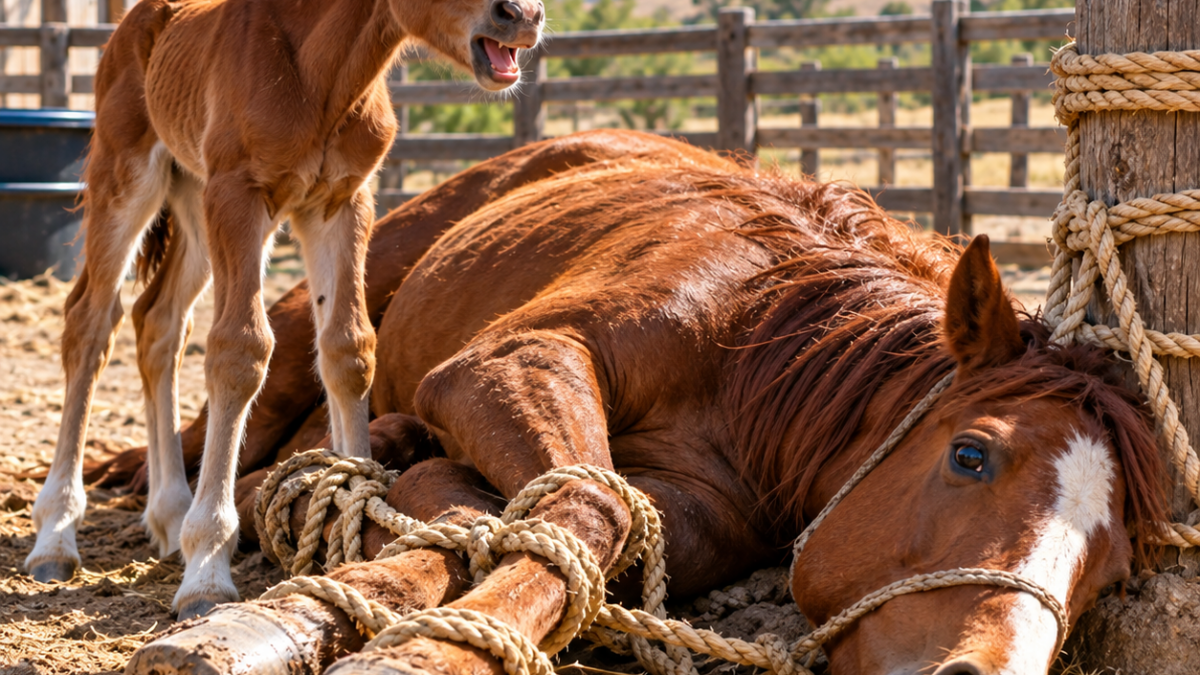
PART 2
I stayed outside the mare’s kicking range and watched her breathing.
Slow.
Shallow.
Too slow for my liking.
The foal wouldn’t leave her.
Every few moments, he walked around her head, pressed himself against her neck, then returned to the same position between her and me.
I found a clean five-gallon bucket near the barn and filled it with water.
I couldn’t safely bring it close enough for the mare to drink without risking startling her, so I placed it several feet from her head.
She smelled it.
That alone seemed to wake something inside her.
She tried to lift herself.
The ropes tightened.
Her entire body went rigid.
“Don’t,” I said instinctively.
The foal cried.
The mare stopped struggling.
I had grown up around horses.
My father had kept two old quarter horses behind our house when I was a kid, and one lesson had been repeated more than almost anything else.
A horse doesn’t understand why pain is happening.
It only understands that it hurts.
And when fear and pain come together, a thousand-pound animal can destroy itself trying to escape.
That was exactly what I was afraid of.
A truck appeared beyond the pasture.
Dr. Bennett.
Frank arrived less than a minute behind her.
Laura climbed out carrying a veterinary bag and several pieces of equipment.
One glance at the mare changed her expression.
“How long?” she asked.
“I don’t know.”
She looked at the rope.
“Who tied her?”
“I was hoping you could tell me this was an accident.”
She didn’t answer.
Frank walked around the outside of the mare’s reach, examining the knots.
He had been handling horses for more than forty years.
When he finally stood up, his jaw tightened.
“That’s no accident.”
The words made my stomach twist.
Laura looked at him.
“You’re sure?”
“I’ve used that restraint.”
I stared at him.
“What restraint?”
He pointed.
“That loop around the hind legs. Somebody was trying to immobilize her.”
“For what?”
“That’s what I’d like to know.”
Laura moved slowly toward the mare’s head.
The foal blocked her too.
She crouched.
“Hey, little man.”
He pinned his ears.
“He’s protecting her,” I said.
“I know.”
Laura waited.
After several seconds, she extended one hand.
The foal sniffed it.
Then immediately turned back toward his mother.
“Good boy,” Laura whispered.
With Frank keeping watch, she examined the mare.
Her gums were pale.
She was badly dehydrated.
The skin around one fetlock was scraped raw where rope had rubbed against it.
There were several smaller abrasions along her legs.
Laura listened to her heart.
Then her lungs.
Finally, she stood.
“We need to free her, but slowly.”
“Can she stand?” I asked.
“I don’t know.”
That answer frightened me more than I wanted to admit.
Horses are built to stand.
When one has been lying down too long, especially under extreme heat and stress, complications can become severe very quickly.
Laura prepared a mild sedative.
Frank began working on the rope.
The foal paced.
Every time the rope moved, he cried.
I moved with him, keeping him from getting too close to Frank’s hands.
“It’s okay,” I whispered.
I knew it wasn’t.
Not yet.
The first knot loosened.
Then the second.
Frank frowned.
“What?”
He held part of the rope toward me.
“Look.”
A section had been wrapped around the wooden beam multiple times.
“This wasn’t temporary.”
“What do you mean?”
“If somebody tied her this way to treat an injury, they would have stayed with her. And they wouldn’t have left her in full sun without water.”
Laura looked over.
“Take pictures before you remove the rest.”
I pulled out my phone.
That was the moment the situation changed from a rescue into something else.
Evidence.
I photographed everything.
The knots.
The position of the mare.
The beam.
The scrapes.
The water trough more than thirty feet away.
The empty enclosure.
Even the shadows, because Laura said they might help estimate how long the mare had been exposed.
Frank cut the final section.
The rope fell loose.
For several seconds, nothing happened.
The mare remained on the ground.
The foal approached her.
He sniffed one of her legs.
Then her shoulder.
Then he returned to her head.
“Come on, girl,” Frank whispered.
Laura shook her head.
“Don’t rush her.”
She gave the mare water slowly.
Only a little at first.
Then more.
The horse swallowed.
The foal watched every movement.
Ten minutes passed.
Then fifteen.
The mare tried to raise her head again.
This time she kept it up.
The foal immediately pressed his face against hers.
Laura smiled faintly.
“That’s something.”
We gave her another few minutes.
Then Frank moved into position near her shoulder.
“If she decides to get up, everyone backs away.”
I nodded.
Laura nodded.
The mare shifted.
Her front legs moved first.
She struggled onto her chest.
The foal jumped backward.
For one terrifying moment, I thought she would collapse.
But she stayed upright.
Her sides heaved.
Dust clung to the sweat running down her body.
Then she gathered her hind legs beneath her.
“Easy,” Frank said.
The mare pushed.
Her legs shook.
She slipped.
The foal screamed.
I felt every muscle in my body tighten.
“Come on,” I whispered.
She pushed again.
This time she rose.
Not gracefully.
Not strongly.
But she stood.
The moment she was upright, the foal ran to her.
He pressed himself against her chest so hard that she had to shift one foot to keep her balance.
Then she lowered her neck over his back.
Nobody spoke.
Even Frank looked away for a second.
I had seen newborn calves stand for the first time.
I had watched horses recover from colic.
I had helped pull animals from flooded pastures.
But nothing prepared me for that little foal standing beneath his mother as though he had spent the entire afternoon believing that if he cried loudly enough, she would somehow return to him.
And somehow, she had.
We moved them into a shaded stall.
Laura started fluids.
The foal refused to stand more than a few feet from her.
I brought fresh hay.
She ignored it.
Water interested her more.
“Small amounts,” Laura reminded me. “She’s been deprived long enough that we don’t let her gorge.”
I nodded.
Then I heard a truck outside.
An old black pickup rolled into the yard.
I recognized it immediately.
Wade Harlan.
Wade was the farm’s full-time foreman.
He was fifty-two, broad-shouldered, permanently sunburned, and convinced that every animal problem could be solved with force.
We had argued before.
Nothing serious.
Mostly about handling.
He believed fear made animals obedient.
I believed fear made animals dangerous.
Wade climbed from the truck.
He saw Laura’s vehicle.
Then Frank’s.
His expression changed.
“What’s going on?”
I looked at him.
“You tell me.”
He glanced toward the stall.
His face went blank.
Not surprised.
Blank.
That bothered me.
Laura walked out behind me.
“Who restrained that mare?”
Wade looked at her.
“What mare?”
“Daisy.”
That was the horse’s name.
Until that moment, I had been so focused on keeping her alive that I hadn’t even thought to use it.
Wade scratched his jaw.
“Oh. Her.”
Frank stepped out of the stall.
“You tied her?”
Wade shrugged.
“She was acting up.”
The casual way he said it made something hot rise in my chest.
“Acting up?”
“She wouldn’t load.”
“Load where?”
“Other pasture.”
Laura stared at him.
“So you restrained all four legs and left her on the ground?”
“I didn’t leave her like that.”
I stepped toward him.
“I found her exactly like that.”
“Then she rolled.”
Frank shook his head.
“No.”
Wade’s eyes narrowed.
“What do you mean, no?”
“I mean those knots weren’t made by a horse rolling.”
Silence.
Wade looked at each of us.
Then he changed his story.
“I had to get her under control. She kicked at me.”
Laura folded her arms.
“How long ago?”
“I don’t know.”
“How long?”
“Couple hours.”
I looked at the sun.
The foal had been crying when I first heard him.
No telling how long before that.
“You left her tied in ninety-five-degree heat for a couple hours?”
Wade’s expression hardened.
“She’s livestock, Daniel.”
Those three words told me more about him than anything else he could have said.
Laura stepped between us before I moved closer.
“Livestock can suffer.”
“Oh, spare me.”
He looked toward Daisy.
“She alive?”
“Yes.”
“Then what’s the problem?”
Frank muttered something under his breath.
I looked directly at Wade.
“The problem is her foal stood beside her crying while she was tied to the ground without water.”
Wade laughed once.
Not because anything was funny.
Because he wanted us to know he didn’t care.
“The colt will get over it.”
Behind me came a sharp cry.
The foal.
Wade glanced toward the sound.
“See? Loud little thing.”
My fists tightened.
Laura noticed.
“Daniel.”
I didn’t move.
Wade smiled.
“You gonna hit me over a horse?”
“No.”
My voice sounded calmer than I felt.
“I’m going to make sure everybody sees what you did.”
His smile disappeared.
“You took pictures?”
“Yes.”
“Delete them.”
“No.”
“This isn’t your property.”
“It isn’t yours either.”
He stepped closer.
“You don’t know what you’re getting involved in.”
Frank moved to my side.
“Actually, I think we do.”
Wade stared at him.
Then Laura.
Then me.
“You report this, Reynolds will fire every one of you he can.”
Laura almost laughed.
“I don’t work for Reynolds.”
Frank said, “Neither do I.”
Wade looked at me.
That left one person.
Me.
“You need this job, Danny.”
He was right.
At the time, I did.
My construction work had slowed.
My truck payment was late.
My daughter Emily was starting community college that fall, and I had promised her I would help with books.
Losing the farm income would hurt.
Wade knew it.
He leaned closer.
“Think carefully.”
I looked through the open stall door.
The foal stood pressed against Daisy.
She had lowered her head toward him.
One of her legs trembled.
Then I looked back at Wade.
“I already did.”
I called the county sheriff’s office.
Wade was still there when Deputy Maria Collins arrived.
He spent the next twenty minutes telling her four different versions of what had happened.
First, Daisy had fallen.
Then she had kicked.
Then she had tangled herself.
Then he claimed he had only tied one leg.
Maria wrote everything down.
Laura showed her the injuries.
Frank explained the restraint technique.
I showed her the photographs.
The deputy looked at Wade.
“Were you responsible for this horse today?”
“Yes.”
“Did you restrain her?”
He hesitated.
“Yes, but—”
“And did you leave the enclosure?”
“For a while.”
“How long?”
“I don’t remember.”
“You just told Dr. Bennett two hours.”
“I guessed.”
Maria glanced at me.
“When did you find the mare?”
“A little after three.”
She checked her watch.
It was nearly five.
“When did you last see Wade on the property?”
That question stopped me.
I thought back.
I had seen his truck leaving that morning.
“What time did you leave?” I asked him.
He said nothing.
Maria repeated the question.
Wade finally answered.
“Maybe eleven.”
My stomach dropped.
Four hours.
Possibly more.
Laura’s expression went cold.
“You left that horse restrained in direct sun for four hours?”
“I planned to come back.”
“When?”
Wade didn’t answer.
The foal cried from inside the stall.
Everyone heard it.
Maria closed her notebook.
“I’m going to need you to stay available.”
Wade snorted.
“You arresting me?”
“Not right now.”
“Then I’m leaving.”
He pointed at me.
“And you’re done here.”
“You don’t own the farm,” I said.
“I run it.”
He drove away.
The dust from his truck hung over the road long after he disappeared.
Frank looked at me.
“You probably just lost your job.”
“Probably.”
Laura turned toward the stall.
“You might have saved a horse.”
At the time, I thought that was the trade.
A job for a life.
I had no idea how much bigger it was about to become.
The owner of the property, Thomas Reynolds, called me that evening.
He was seventy-one and lived most of the year in Tulsa.
His family had owned the land for decades, but he rarely visited.
Wade handled almost everything.
When Thomas spoke, his voice sounded tired rather than angry.
“Daniel, Wade tells me you brought the sheriff onto my property.”
“I did.”
“Why?”
I explained.
There was a long silence.
Then Thomas said something I didn’t expect.
“Send me the pictures.”
I did.
Twenty minutes later, he called again.
His voice was different.
“Is Daisy alive?”
“Yes.”
“And the foal?”
“Fine, physically.”
Another silence.
“I bought that mare for my granddaughter.”
I hadn’t known that.
Thomas continued.
“She named her Daisy.”
I sat on my back steps.
“Mr. Reynolds, I’m sorry.”
“No. Don’t apologize.”
His breathing became heavier.
“What exactly did Wade say?”
I told him.
Everything.
When I finished, Thomas said, “Do not leave that property tonight.”
“What?”
“I’m driving down.”
He arrived shortly after nine.
By then, the worst heat had passed.
Daisy had eaten a small amount of hay.
Laura had returned home but planned to come back in the morning.
Frank had left too.
I stayed.
The foal, whom Thomas’s granddaughter had apparently named Copper, finally fell asleep beside his mother.
Thomas entered the barn quietly.
He looked older than I remembered.
He wore a white shirt with the sleeves rolled up and carried no rancher’s swagger.
He approached Daisy slowly.
She lifted her head.
Thomas stopped several feet away.
“Hey, girl.”
His voice broke.
I looked away.
For several minutes, he said nothing.
Then he saw the rope burns.
His face changed.
“Where is Wade?”
“Home, I assume.”
Thomas nodded.
“He’s fired.”
I looked at him.
“You don’t need to decide tonight.”
“I decided when I saw the photographs.”
He stepped closer to Daisy.
“I hired that man because I thought he knew horses.”
“He knows them.”
Thomas looked at me.
“That makes it worse.”
He was right.
Cruelty from ignorance is terrible.
Cruelty from someone who understands exactly what he is doing is worse.
The following morning, Wade returned.
Not to work.
To argue.
I was helping Laura change the wrap on Daisy’s leg when we heard his truck slam to a stop outside.
Thomas walked from the office.
Wade jumped out.
“You can’t fire me over this.”
Thomas didn’t raise his voice.
“I already did.”
“I’ve worked here sixteen years.”
“And yesterday you left one of my horses tied in the dirt for half a day.”
“She tried to kick me!”
“Then you walk away.”
“She needed teaching.”
Thomas stared at him.
“Teaching what?”
“Respect.”
That word hung in the air.
Laura stepped out of the stall.
“Horses don’t understand revenge.”
Wade looked at her.
“I wasn’t talking to you.”
“No,” she said. “You were talking about punishing an animal because you were angry.”
His face turned red.
Thomas pointed toward the road.
“Leave.”
Wade laughed.
“You think Daniel can run this place?”
“I didn’t say he was.”
“Then who?”
“Anyone but you.”
Wade stepped toward him.
I moved between them.
He looked at me.
“This is what you wanted?”
“No.”
“Yes, it is.”
“You did this to yourself.”
He shoved my shoulder.
Not hard.
Just enough to challenge me.
I didn’t respond.
Thomas pulled out his phone.
“Touch him again and I’ll call the sheriff.”
Wade pointed at all of us.
“You’re going to regret this.”
Then he left.
For three days, Daisy improved.
Copper improved even faster.
Once he understood his mother wasn’t disappearing, his personality changed.
The frightened little foal became curious.
He followed me around the stall.
He investigated buckets.
He tried to bite the end of a broom.
The first time I heard him make a playful little snort instead of that desperate cry, I stood there smiling like an idiot.
Daisy remained cautious.
Especially around ropes.
Laura tested that reaction carefully.
Even seeing a lead line made the mare tense.
“That’s not new,” Laura said.
“What do you mean?”
“She was already afraid of restraint before this happened.”
I looked at her.
“You think Wade did something before?”
“I think we need to ask.”
The question sent us digging.
Thomas gave me permission to check the barn office.
Wade had kept handwritten records.
Feed.
Veterinary appointments.
Breeding dates.
Transport.
Most of it looked normal.
Then I found a notebook in the bottom drawer.
It wasn’t official.
Just a cheap black notebook full of Wade’s personal notes.
Most pages contained short comments.
“Bay gelding stubborn.”
“Grey mare needs stronger correction.”
“Calf won’t load.”
Then I found Daisy.
Beside her name were three words.
“Still fighting ropes.”
I read it twice.
Then another entry.
“Daisy kicked again. Fix attitude.”
My skin went cold.
Thomas read the page.
“When was that written?”
“Two months ago.”
We checked the dates.
On the same week, Daisy’s veterinary record showed treatment for a swollen hind leg.
The cause listed was unknown.
Thomas sat down.
“Oh, God.”
We kept reading.
There were other horses.
One gelding named Ranger had been sold the year before after developing what Wade described as “dangerous behavior.”
In the notebook, Wade had written:
“Ranger broke halter. Had to put him down hard.”
Another mare had a notation:
“Won’t stand tied. Left until she learned.”
Thomas pushed away from the desk.
“What does that mean?”
I knew.
So did Laura when we showed her later.
“He uses restraint as punishment.”
Thomas closed his eyes.
“How did I not know?”
Because he trusted the person he hired.
Because the property was large.
Because animals cannot call owners.
Because suffering can stay invisible when the people causing it control the story.
The sheriff’s department took the notebook as evidence.
Animal control opened a broader investigation.
And Wade stopped laughing.
A week later, someone slashed two tires on my truck.
No camera caught it.
No witness saw anything.
But I knew.
I reported it.
Maria took photographs.
“Do not confront him,” she told me.
“I’m not planning to.”
“I mean it, Daniel.”
“So do I.”
Two nights later, the barn door was found open.
Daisy and Copper were still inside because I had installed a second latch.
Nothing was stolen.
Thomas immediately paid for cameras.
That was when the story stopped being just about one injured horse.
Someone wanted us afraid.
I refused.
Not because I was fearless.
I wasn’t.
I lived alone.
My daughter stayed with me some weekends.
I started checking the driveway before walking outside at night.
I kept my phone charged.
But every morning when I went to the barn, Copper would trot toward me.
Every morning Daisy would watch from behind him.
And every time I saw the healing wounds around her legs, I remembered what silence would have meant.
Silence would have protected Wade.
So I kept talking.
The investigation uncovered more.
Former workers were interviewed.
Most said Wade was rough but claimed they had never seen serious abuse.
Then a man named Luis Ortega came forward.
Luis had worked at Reynolds Farm three years earlier.
He told deputies Wade sometimes used what he called “patience lessons.”
The method was simple.
A horse that resisted being tied would be restrained until it stopped fighting.
Sometimes for hours.
Luis said he had objected once.
Wade threatened to have him fired.
Two weeks later, Luis lost his job.
“Why didn’t you report it?” I asked when we met.
He looked ashamed.
“My wife was pregnant. I needed the money.”
I understood that answer more than he realized.
If Wade hadn’t made the mistake of threatening me after Daisy was found, part of me might have wondered whether reporting him was worth losing my income.
That is how people like him survive.
They don’t need everyone to approve.
They only need everyone to have something to lose.
Luis gave a statement.
Then another former worker did.
A woman named Hannah Price remembered a pony that had developed severe rope burns.
Wade told everyone the pony had caught itself in fencing.
Hannah believed him.
Now she wasn’t sure.
Thomas began contacting people who had purchased horses from the farm.
Most were healthy.
One owner told us Ranger—the supposedly “dangerous” gelding—had transformed after leaving.
“He hated men with ropes,” the woman said.
“But once he learned we weren’t going to hurt him, he became the gentlest horse my daughter ever rode.”
Ranger was alive.
Wade had told Thomas the horse was sold because he was unsafe.
In reality, Ranger had been traumatized.
The pattern was becoming clear.
Then Wade made his biggest mistake.
He came back to the farm.
It was just after midnight.
The cameras caught his truck parking half a mile down the road.
They caught him walking through the pasture.
They caught him carrying something.
I wasn’t there.
Thomas had hired a night watchman after the barn incident.
His name was Curtis Bell, a retired deputy.
Curtis saw movement near the equipment shed.
He called Maria before approaching.
Wade never reached the barn.
He was intercepted near the fence.
In his backpack were bolt cutters, a can of gasoline, gloves, and a length of rope.
He later claimed he had come for tools he owned.
Nobody believed him.
Especially after investigators found text messages on his phone.
One message to a friend read:
“They’re making me look like some kind of monster over that stupid mare.”
Another:
“Danny boy thinks he’s a hero. Won’t be smiling when this is over.”
The friend had replied:
“Leave it alone.”
Wade didn’t.
The threatening behavior changed everything.
He was arrested.
Not convicted that night.
Arrested.
There is a difference, and I learned quickly that justice moves slower than anger.
Months passed.
Daisy healed.
The criminal case developed.
Thomas replaced nearly the entire horse-handling system on the property.
No punishment tying.
No unattended restraint.
Every incident documented.
Cameras in the main barn.
Regular veterinary evaluations.
He asked Laura and Frank to create handling guidelines.
Then he surprised me.
“I want you to manage the horse side.”
I stared at him.
“I’m not a manager.”
“You’re the man who stopped working because you heard one foal crying.”
“That doesn’t make me qualified.”
“No. But everything you did afterward does.”
I accepted.
Not because I suddenly knew everything.
Because I knew what I didn’t know.
I called Frank constantly.
I asked Laura questions until she probably regretted giving me her number.
I learned more about equine behavior in six months than I had in the previous twenty years.
Copper grew.
Fast.
His legs became stronger.
His chest filled out.
The frightened foal became a bold young colt who believed every bucket contained something interesting.
Daisy remained protective.
For months, she refused to allow anyone except Laura and me to handle her hind legs.
The first time she voluntarily stood while I touched a soft lead rope near her shoulder, I nearly cried.
Not because it was dramatic.
Because trust returned in inches.
People imagine recovery as a moment.
An animal stands.
A wound closes.
A court case ends.
But recovery is usually smaller.
It is a mare eating while a rope lies twenty feet away.
Then ten feet.
Then five.
It is a foal sleeping without waking every time his mother moves.
It is a horse choosing not to run when a human enters a stall.
Daisy taught me that.
The court hearing began almost nine months after the day I found her.
Wade faced animal cruelty charges connected to Daisy, along with property damage and attempted criminal mischief related to his return to the farm.
His attorney tried to frame the incident as a misunderstanding.
A ranching technique taken out of context.
The defense argued that horses are sometimes restrained for legitimate reasons.
Laura agreed.
Then the prosecutor asked her one question.
“Doctor, is there a legitimate reason to leave a restrained horse unattended in direct summer heat without access to water?”
“No.”
“Could that kill a horse?”
“Yes.”
“How?”
She explained dehydration.
Heat stress.
Muscle damage.
Circulatory compromise.
Injury from struggling.
Possible organ failure.
Then the photographs appeared on the courtroom monitor.
Daisy in the dirt.
Copper beside her.
The ropes.
I couldn’t look at them for long.
I had seen the real thing.
The pictures still hurt.
Frank testified next.
The defense attorney asked whether Daisy could have tangled herself.
Frank leaned toward the microphone.
“Not into those knots.”
“You’re certain?”
“I’ve tied horses for forty-three years.”
“Could another handler disagree?”
“About tying? Sure. About whether a horse tied all four legs tied those knots herself? No.”
A few people in the courtroom smiled.
The judge did not.
Then Luis testified.
Then Hannah.
Then the owner of Ranger.
The defense objected repeatedly.
Some testimony was limited.
Some evidence was excluded.
That frustrated me.
I wanted everything known.
But court is not a campfire story.
Rules matter.
Evidence matters.
What can be proven matters.
Finally, I testified.
The prosecutor asked me to describe the sound that brought me to the enclosure.
I looked toward Wade.
For the first time since the case began, he wasn’t staring at the table.
He was staring at me.
“What did you hear?” the prosecutor asked.
“A foal crying.”
“How long?”
“Repeatedly.”
“What did you find?”
I described Daisy.
The ropes.
The heat.
Copper.
The water trough.
The knots.
Then the prosecutor asked, “What happened when you entered the enclosure?”
I stopped.
That memory was the hardest.
“The foal stood between me and his mother.”
“Why?”
“He was afraid of me.”
“But he didn’t run?”
“No.”
“Why not?”
I looked down.
“Because she couldn’t.”
The courtroom became very quiet.
I continued.
“He was terrified. I could see it. But he wouldn’t leave her.”
The prosecutor showed one photograph.
Copper’s small body beside Daisy’s head.
“That’s the foal?”
“Yes.”
“And that photograph was taken before the ropes were removed?”
“Yes.”
“No further questions.”
Wade’s attorney stood.
“Mr. Harper, you disliked my client before this incident, didn’t you?”
“We disagreed.”
“You believed his handling methods were too harsh.”
“Yes.”
“So you had a reason to make him look bad.”
“No.”
“You called law enforcement.”
“Yes.”
“You photographed the scene.”
“Yes.”
“You later accepted his position at the farm.”
I knew where he was going.
“So after Mr. Harlan was fired, you benefited.”
“I got more work.”
“You got his job.”
“Eventually.”
The attorney walked closer.
“That sounds like a benefit.”
“It was.”
“So you gained financially from accusing my client.”
The prosecutor objected.
The judge allowed the question.
I looked at Wade.
Then at the attorney.
“If I wanted his job, there were easier ways to get it than nearly watching a horse die.”
The attorney paused.
“But you did get it.”
“Yes.”
He smiled slightly.
Then I added, “And if Wade had walked back into that enclosure, admitted what he did, helped us save Daisy, and never hurt another horse again, I would have been perfectly happy staying exactly where I was.”
The smile disappeared.
A week later, Wade accepted a plea deal.
Some people were disappointed.
They wanted a dramatic trial ending.
I understood.
Part of me wanted one too.
I wanted a judge to tell him exactly what I had thought every time Copper cried.
I wanted a punishment big enough to match that sound.
But real justice is rarely as clean as revenge stories.
The plea included convictions for animal cruelty, property damage, and violating restrictions imposed after his arrest.
He received jail time, probation, restitution, mandatory counseling, and—most important to me—a court order prohibiting him from owning, managing, training, or working professionally with horses during the probationary period.
The state also pursued additional licensing consequences.
Thomas sued him for damages related to the property and veterinary bills.
Wade lost.
Not everything.
But enough.
The money mattered less than the fact that he could no longer hide behind the title of “experienced horseman.”
The local agricultural community learned what happened.
Word travels fast in small towns.
For years, Wade had built his identity around being the man who could “handle any horse.”
Now people knew what that sometimes meant.
He blamed me.
Of course he did.
About a month after sentencing, I saw him outside a hardware store.
I had hoped never to see him again.
He stood beside an old pickup.
For a moment, we simply looked at each other.
Then he walked toward me.
“You happy?”
I didn’t answer.
“You ruined my life over one horse.”
I stared at him.
“One horse?”
“You know what I mean.”
“No. I don’t.”
He shook his head.
“You got my job. Got your name in the paper. Everybody thinks you’re some kind of saint.”
“I’m not.”
“Then admit what this was.”
“What?”
“Revenge.”
For several seconds, I thought about that.
There had been moments when I wanted revenge.
When I found my tires cut.
When the barn door was opened.
When I saw his notebook.
When I heard Luis talk about Ranger.
When I watched Daisy panic at the sight of a rope.
There were moments I wanted Wade afraid.
I wanted him powerless.
I wanted him to feel trapped.
Then I remembered Copper standing over his mother.
I shook my head.
“No.”
Wade laughed bitterly.
“You expect me to believe that?”
“I don’t care what you believe.”
I stepped closer.
“If I wanted revenge, I would have wanted you hurt.”
His expression changed.
“I didn’t.”
I pointed toward the road.
“I wanted you stopped.”
For once, Wade had nothing to say.
I walked away.
That was the last conversation I ever had with him.
A year after Daisy’s rescue, Thomas invited his granddaughter Sophie back to the farm.
She was thirteen.
She hadn’t visited for months after learning what happened.
She blamed herself.
That surprised all of us.
Children have a strange way of taking responsibility for pain they didn’t cause.
“If Grandpa hadn’t bought Daisy for me,” she told me, “she wouldn’t have been there.”
I crouched beside the stall.
“No.”
“But—”
“No.”
I pointed toward Daisy.
“She was hurt because somebody made a cruel decision. That belongs to him. Not you.”
Sophie wiped her face.
Copper approached.
He was no longer tiny.
He pushed his nose toward her shoulder.
She laughed through her tears.
“He remembers me?”
“Maybe.”
I smiled.
“Or maybe he thinks you have snacks.”
She reached into her pocket.
“I do.”
“Then he definitely remembers you.”
That was the first time I had heard her laugh since she arrived.
Over the next few months, Sophie visited regularly.
Daisy trusted her.
Maybe because Sophie never rushed.
She would sit on an overturned bucket outside the stall and read.
Sometimes for an hour.
No touching.
No demands.
Just presence.
Eventually Daisy began approaching her.
One afternoon, I watched the mare walk across the paddock voluntarily and place her nose against Sophie’s shoulder.
Sophie froze.
I stayed silent.
“Can I touch her?” she whispered.
“If she stays.”
Sophie lifted one hand.
Daisy remained.
Her fingers touched the mare’s neck.
That simple contact meant more than any ribbon or training milestone.
Because Daisy had chosen it.
Two years passed.
The old enclosure where I found her was torn down.
Thomas wanted the beam removed too.
I stopped him.
“Why?”
“I don’t know.”
That wasn’t true.
I knew.
I wanted to remember.
Not the suffering.
The choice.
The difference between hearing a cry and walking past it.
We moved the beam near the barn.
Frank helped me sand it.
Sophie painted a small wooden sign.
It read:
LISTEN.
Nothing else.
Visitors sometimes asked what it meant.
We told them.
Eventually Thomas decided the farm should become more than a private property.
He had more acreage than he needed.
We converted one pasture and an old barn into a temporary rehabilitation space for neglected horses.
Nothing huge.
We weren’t a full rescue organization.
But we partnered with a local nonprofit and provided short-term housing when they were full.
The first horse that arrived was a skinny sorrel gelding confiscated from a property two counties away.
He was terrified of men.
When I entered his pen, he turned his hindquarters toward me.
I stayed at the gate.
For several days, that was all I did.
On the fourth morning, Copper walked along the fence.
The gelding noticed him.
Copper stopped.
The two horses touched noses through the rails.
I smiled.
“Showing him around?”
Copper looked at me as if I were interrupting.
Daisy grazed nearby.
She was older now.
Calmer.
Her scars remained faintly visible around one hind leg.
I used to hate those scars.
Eventually I understood them differently.
They were not proof that Wade won.
They were proof that Daisy survived him.
The rehabilitation program grew slowly.
Local students volunteered.
Sophie helped organize supply drives.
Laura donated several hours each month.
Frank pretended he was retired while spending half his life at the barn.
Whenever I teased him about it, he would say, “I’m supervising.”
“You’re cleaning stalls.”
“Supervising the manure.”
Copper became especially useful around frightened young horses.
He was confident without being aggressive.
Curious without being reckless.
Sometimes animals teach each other what people cannot.
A new horse would arrive trembling.
Copper would stand across the fence eating.
Nothing terrible happened.
He would drink.
Nothing terrible happened.
He would lie down.
Nothing terrible happened.
Slowly, the other horse would begin to believe the same might be true for him.
That became our entire philosophy.
Safety repeated often enough becomes trust.
Five years after the rescue, Thomas’s health began declining.
He called me into the farmhouse one morning.
Sophie, now eighteen, sat beside him.
There were papers on the table.
“I’m too old for this,” he said.
“You’ve been saying that for five years.”
“This time my doctor agrees.”
Sophie smiled.
Thomas pushed the papers toward me.
He was transferring management of the horse facility into a nonprofit trust.
Sophie would serve on the board.
Laura had agreed too.
Then I saw my name.
“You didn’t ask me.”
“I’m asking now.”
I shook my head.
“I don’t know anything about running a nonprofit.”
Thomas smiled.
“You didn’t know anything about running the horse operation either.”
“That’s not encouraging.”
“You learned.”
I looked at Sophie.
She nodded.
“We want to call it Copper’s Cry.”
I almost laughed.
“Copper’s Cry?”
“Grandpa wanted Daisy’s Hope.”
Thomas frowned.
“That is a perfectly good name.”
“It sounds like a romance novel.”
“It does not.”
I looked from one to the other.
“What about Listen Farm?”
They both went quiet.
Sophie smiled first.
Thomas nodded slowly.
“Listen Farm.”
That became the name.
We registered it officially that winter.
Our mission was simple:
Temporary rehabilitation for neglected and traumatized horses, combined with education about humane handling.
The sign made from the old beam hung above the barn entrance.
LISTEN.
The same word.
The same lesson.
Daisy lived another twelve years after the day I found her.
Twelve.
That number still feels like a gift.
She saw Copper grow into a magnificent adult horse.
She watched Sophie graduate college.
She watched Listen Farm take in more than eighty horses.
Some stayed weeks.
Some months.
A few stayed permanently.
Daisy herself became something of a teacher.
Not because people rode her.
We rarely asked her to work.
But anxious horses often settled near her.
She had a quietness about her.
Maybe she understood fear.
Maybe that is just something humans say because we want animals’ lives to form beautiful patterns.
I don’t know.
What I do know is that frightened horses stood beside her and calmed down.
That was enough.
When Daisy turned twenty-three, her joints began bothering her.
Laura monitored her closely.
We adjusted her feed.
Medication helped.
Sophie visited almost every weekend.
Copper stayed with her constantly.
One cool autumn morning, I found Daisy standing beneath the large cottonwood in the west pasture.
Copper was beside her.
The sight stopped me.
For a second, I saw that terrible afternoon again.
Only reversed.
Years earlier, Daisy had been on the ground while her tiny foal stood over her.
Now Copper was a powerful adult horse.
His coat shone in the morning light.
And Daisy, gray around the muzzle, leaned lightly against him.
I approached.
Copper looked at me.
Daisy lifted her head.
“Morning, girl.”
She walked toward me slowly.
I rubbed her forehead.
There was a scar near her hind leg that had never disappeared completely.
My fingers moved over it.
I remembered ropes.
Heat.
Dust.
A crying foal.
Then Daisy nudged my chest.
I laughed.
“You’re right. No sad speeches.”
She wanted breakfast.
Some things remain wonderfully ordinary.
That winter was harder.
Laura warned us.
“She’s comfortable now, but eventually we may have to make a decision.”
I hated those words.
Anyone who loves an animal eventually learns to hate them.
Sophie cried.
Thomas had died two years earlier.
Daisy had become one of the last living connections to her grandfather’s farm as she remembered it.
“I’m not ready,” she said.
Laura hugged her.
“You don’t have to be ready today.”
Daisy made it through winter.
Then spring.
She spent her final months on green grass.
One morning in May, Laura called me from the pasture.
“Daniel.”
I heard it in her voice.
I drove there immediately.
Daisy had gone down beneath the cottonwood.
This time there were no ropes.
No heat.
No terror.
Just age.
Copper stood nearby.
Sophie arrived twenty minutes later.
She sat in the grass beside Daisy’s head.
The mare was tired.
We all knew.
Sophie placed one hand against her face.
“You can rest.”
Daisy breathed slowly.
Copper approached.
He lowered his head.
His nose touched hers.
The same gesture.
The same simple contact I had seen when he was only weeks old.
Except now he towered over her.
For several seconds, Daisy kept her muzzle against his.
Then she relaxed.
Laura helped her leave peacefully.
No panic.
No struggle.
No one walked away.
Copper remained beside her after she was gone.
I stood several feet away with my hand over my mouth.
I thought I had cried everything I had in me over that horse years earlier.
I was wrong.
Sophie cried into my shoulder.
Laura wiped her eyes.
Even Frank, now in his eighties, had come out and stood silently beside the fence.
We buried Daisy on a rise overlooking the west pasture.
Sophie placed a small piece of the original rope beside the grave.
I hadn’t known she had saved it.
I looked at her.
“I thought we threw all that away.”
“I kept one piece.”
“Why?”
She looked toward Copper.
“To remember that the worst thing that happened to her wasn’t the last thing that happened to her.”
I will never forget that sentence.
Because she was right.
People often think a rescue story is about the moment somebody arrives.
The gate opens.
The rope is cut.
The animal stands.
Everyone cries.
End of story.
But that isn’t rescue.
That is interruption.
Rescue is what comes afterward.
It is medical care.
Trust.
Patience.
Accountability.
Years of ordinary mornings.
It is a frightened animal learning that hands can bring food instead of pain.
It is a child learning that cruelty committed by someone else is not her guilt to carry.
It is a man who once believed domination made him powerful discovering that the community no longer considers cruelty expertise.
It is a farm changing its rules.
Then its purpose.
Then its name.
And sometimes it begins with something as small as a sound nobody else bothers to follow.
Copper lived at Listen Farm for many years after Daisy died.
Visitors always asked about him.
We never turned him into a mascot exactly.
He didn’t wear costumes.
We didn’t force him into photographs.
Copper was Copper.
He had opinions.
He disliked blue tarps.
He loved apples.
He regularly stole Frank’s hat.
And whenever a frightened new horse arrived, Copper somehow seemed to find the fence nearest that horse.
He would stand there.
Quiet.
Present.
Waiting.
Once, a little girl visiting with her mother asked me why the farm was called Listen Farm.
She couldn’t have been older than eight.
We were standing beneath the sign made from the old wooden beam.
“What are we supposed to listen to?” she asked.
I looked toward Copper.
He was grazing in the west pasture.
For a moment, I saw him as he had been all those years ago.
Tiny.
Sweating.
Terrified.
Standing beneath a merciless afternoon sun beside the mother he refused to abandon.
I crouched so I was level with the girl.
“Anything that sounds like it needs somebody.”
She thought about that.
“Even if it can’t talk?”
“Especially then.”
She nodded very seriously.
Then she ran back toward her mother.
I remained beneath the sign.
LISTEN.
One word.
It had become more important to me than almost anything else I had learned.
Because cruelty often survives in silence.
It survives when someone says, “That’s just how he handles animals.”
It survives when workers need a paycheck too badly to argue.
It survives when owners trust without checking.
It survives when suffering happens behind barns, fences, doors, or walls where nobody thinks to look.
And it survives every time somebody hears something wrong and decides it is easier to keep walking.
Wade believed strength meant making a frightened animal surrender.
Daisy taught me the opposite.
Real strength was the mare lifting her head in the dirt because her baby was crying.
Real strength was Copper refusing to leave her even when a stranger approached.
Real strength was Luis returning years later to tell the truth even though he was ashamed he hadn’t spoken sooner.
Real strength was Thomas admitting that trusting the wrong man had consequences and changing the farm instead of protecting his reputation.
Real strength was Sophie sitting beside a traumatized horse without demanding affection.
And maybe my own small piece of strength was simply opening a gate when I heard that cry.
People occasionally asked whether I regretted what happened afterward.
The threats.
The slashed tires.
The court hearings.
The months of worry.
The job uncertainty.
I always gave the same answer.
No.
I regret that Daisy suffered.
I regret that other horses may have suffered before her.
I regret that Wade’s behavior went unnoticed for years.
But I have never regretted following that sound.
If I had ignored it, Daisy might have died before sunset.
Copper might have been found beside her body.
Wade might have continued handling horses the same way.
Listen Farm would never have existed.
Dozens of other horses might never have found temporary shelter there.
One decision can travel farther than the person making it will ever understand.
Wade wanted to know whether I had gotten my revenge.
Years later, I finally knew the answer.
No.
Revenge would have been making him suffer because Daisy suffered.
What happened was better.
He lost the thing he had abused: authority over vulnerable animals.
He was exposed.
He was held accountable.
The farm changed.
The animals were protected.
And the horse he nearly destroyed lived long enough to grow old in a pasture where nobody ever tied her down again.
That was enough.
More than enough.
Sometimes, on the hottest afternoons of summer, when the air becomes still and insects buzz around the barn, I think about that first day.
I remember putting down my tools.
I remember listening.
I remember walking toward that old enclosure.
And I remember one little foal lifting his head when he saw me, terrified of what I might do but unwilling to abandon his mother.
At the time, I thought I was the one rescuing them.
Years later, I understood something else.
That little horse had already been fighting for her long before I arrived.
He just needed somebody to hear him.
And because somebody finally did, his mother got twelve more years beneath an open sky.
She watched her baby grow up.
She learned to trust again.
She became part of something larger than the cruelty that nearly ended her life.
And when her final day came, she was not trapped beneath a burning sun.
There were no ropes around her legs.
No stranger walking away.
She lay beneath a tree she knew, on grass she had walked for years, with the people who loved her gathered nearby.
And once again, Copper stood beside his mother.
Only this time, he wasn’t crying for someone to save her.
He was simply there.
The way she had always been there for him.
The way he had always been there for her.
The way love sometimes asks us to be when nothing more can be fixed.
Present.
Listening.
And refusing to walk away.








