PART 2: The Black Lab Waited Two Days in the Rain Because His Owner Said Five Words—Then I Learned Where the Ambulance Had Taken Him
PART 2
“He’s still there,” she said.
For a second I misunderstood her.
“The dog?”
“No. The patient.”
I stood perfectly still.
“He’s alive?”
“As far as the information I can see, yes. That’s all I can tell you.”
I closed my eyes.
Alive.
Not home.
Not discharged.
Not dead.
Alive.
It was not an answer, exactly.
But it was something.
“What hospital?”
She gave me the name.
St. Matthew’s Medical Center.
About twenty minutes away without traffic.
Forty in the rain.
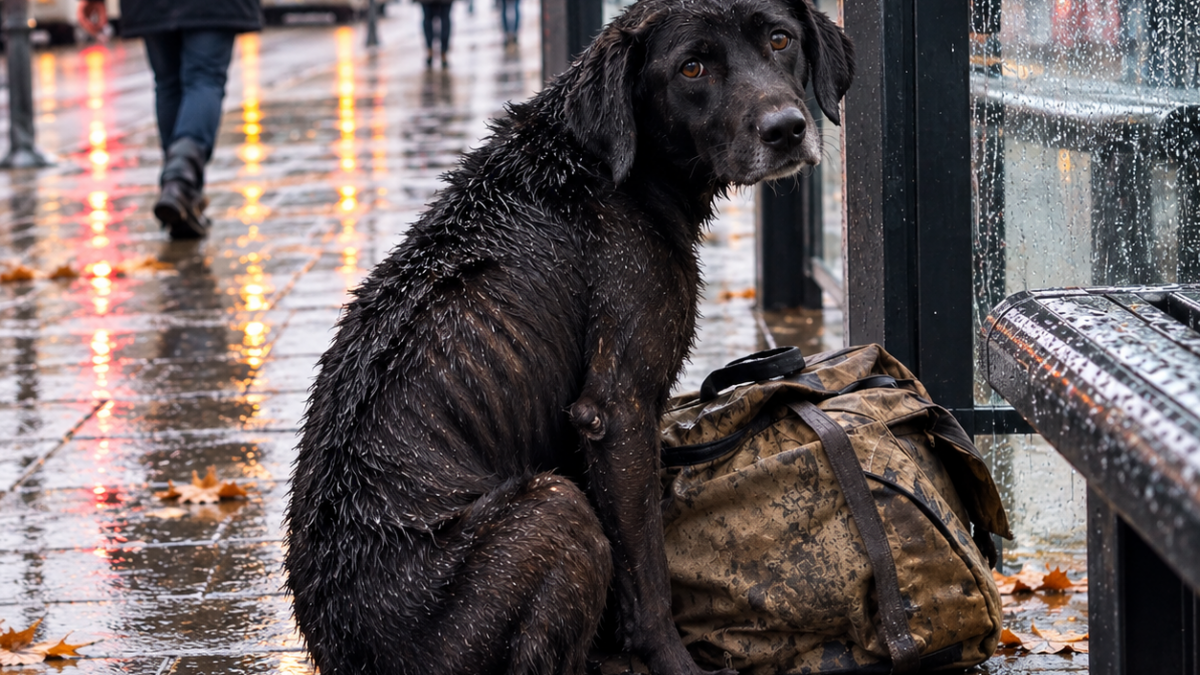
I looked at the Labrador.
He had lowered his head slightly, but his eyes remained pointed toward the road.
The store owner was watching me.
“Well?”
“He’s alive.”
Her hand flew to her chest.
“Oh, thank God.”
“Apparently.”
“You’re going to bring the dog?”
“I don’t know yet.”
“Why not?”
Because hospitals had rules.
Because the man might be unconscious.
Because I didn’t know whether he had family.
Because I still didn’t even know his name.
Because I couldn’t simply walk a soaked eighty-pound Labrador through an emergency department because the emotional logic of the situation seemed obvious to me.
I crouched beside the duffel again.
The wallet contained an identification card.
JAMES HALE.
Age fifty-eight.
An old address about six miles away.
No current insurance card.
No emergency-contact card.
Inside one side pocket of the duffel was a folded envelope.
I opened it only enough to see that it was addressed to James.
The return address belonged to a housing-support nonprofit I knew.
That mattered.
I called my supervisor.
“Maria, I need ten minutes.”
“That sentence always means twenty.”
“This time maybe thirty.”
“Go.”
I explained.
She listened without interrupting.
When I finished, she said, “You haven’t moved the dog?”
“No.”
“Can you?”
“Not yet.”
“Animal control?”
“I can call them.”
“Do that first.”
“I want to find the owner.”
“You can do both.”
“I know.”
Maria’s tone softened.
“Emma.”
“What?”
“You cannot solve the man’s medical problem, his housing problem, and the dog’s problem while sitting at a bus stop.”
“I know.”
“You sound like you don’t.”
I looked at the Labrador.
“I’m working on it.”
“Start with the dog.”
I called animal services.
Officer Luis Ramirez arrived twenty-five minutes later.
He was one of those people animals seemed to assess differently from the rest of us.
He didn’t walk directly toward the Labrador.
He didn’t talk in a high voice.
He didn’t wave food.
He simply stood under the shelter roof with me for several minutes.
“He hasn’t eaten?”
“Not that anyone’s seen.”
“Water?”
“Maybe rain.”
“Two days?”
“Approximately.”
Luis sighed.
“Poor guy.”
The Labrador finally looked at him.
Luis looked away.
“That’s good,” he said.
“What is?”
“He noticed me.”
“That seems like a low bar.”
“Right now, low bars are good.”
He set down cooked chicken.
The dog sniffed.
Then turned back toward the street.
Luis frowned.
“He’s committed.”
“He was told to stay.”
Luis looked at me.
“Seriously?”
I told him.
He rubbed one hand over his jaw.
“Well, that’s going to ruin my day.”
“Welcome to mine.”
We waited.
A city bus pulled in.
The Labrador stood.
His legs were stiff from sitting.
Passengers came down the steps.
He examined each one.
No James.
He sat again.
That hurt.
Luis looked away.
“We need to move him.”
“I know.”
“But force is the last option.”
“I agree.”
“Do you have anything that smells like the owner?”
I looked at the duffel.
The small towel.
One of James’s shirts.
I pulled out a dark sweatshirt.
The Labrador noticed instantly.
His nose lifted.
I held it low.
“Hey.”
He stood.
One step.
Then another.
For the first time since I arrived, he moved voluntarily away from the spot.
I placed the sweatshirt near me.
He came closer.
Three feet.
Two.
He sniffed the fabric.
Then his eyes met mine.
I didn’t reach for him.
I said, “He’s still here.”
The dog obviously could not understand the sentence.
But saying it mattered to me.
“James is still here.”
His tail did not move.
He sniffed the sweatshirt again.
Luis slowly placed a slip lead beside it.
The Labrador tensed.
We froze.
“Easy,” Luis said.
The dog backed up.
Returned to his original spot.
We started again.
It took almost an hour.
By the time the loop finally settled around his neck, my jeans were soaked from the knees down and Luis had given up pretending his waterproof jacket was waterproof.
The Labrador did not fight.
He simply refused to walk.
Luis applied gentle pressure.
Nothing.
I picked up James’s duffel.
The dog’s eyes followed it.
I took one step.
He stood.
Another step.
He followed.
Luis whispered, “That’s our leash.”
He meant the bag.
He was right.
We walked him toward the animal-services van.
The moment he saw the open compartment, he stopped.
Hard.
I looked at Luis.
“No.”
“Agreed.”
“What about my car?”
“Back seat?”
“Yes.”
I opened both rear doors.
Placed James’s sweatshirt on the seat.
Then the duffel.
The Labrador approached.
His front paws went up.
His rear legs hesitated.
Luis supported him gently.
The dog climbed in.
I slid onto the other side.
He immediately moved toward the duffel and pressed his shoulder against it.
Luis looked through the door.
“Where are we going?”
“Veterinary clinic first.”
“Good answer.”
“And then I’m going to St. Matthew’s.”
He smiled.
“I knew there was a second part.”
The clinic scanned the Labrador for a microchip.
There was one.
Registered owner:
James Hale.
Dog’s name:
Milo.
“Milo,” I said.
The Labrador’s head came up.
I smiled before I could stop myself.
“Okay. That’s definitely you.”
Milo was about nine years old.
Maybe ten.
Mildly underweight.
Dehydrated.
His paws were irritated from wet pavement.
Otherwise, he was remarkably healthy.
The veterinarian warmed him, gave him fluids, and finally coaxed him into eating a small amount.
I stayed.
Every time I stepped toward the door, Milo stood.
Every time I returned to the chair, he lay down again.
By noon, I had learned enough about James to understand why there had been no family rushing to the bus stop.
The address on his ID was no longer his.
The housing nonprofit confirmed that James had been staying in a small transitional apartment for six months.
Before that, he had spent nearly a year moving between shelters, temporary rooms and occasionally his car.
Milo had been with him through all of it.
The caseworker at the housing agency, Tessa, knew them immediately.
“Milo?”
“Yes.”
“Is he okay?”
“He will be.”
“What happened to James?”
“That’s what I’m trying to find out.”
Tessa became quiet.
“James has heart problems.”
That stopped me.
“How serious?”
“He was hospitalized last year.”
“Does he have anyone?”
“A daughter.”
“Name?”
“I can’t release contact information without checking the file.”
“Can you call her?”
“I’ll try.”
“Please.”
I drove to St. Matthew’s after leaving Milo temporarily with Luis.
The duffel went with me.
I had expected the hospital to be the easy part.
It wasn’t.
At the information desk, I gave James’s name.
The clerk looked at her computer.
“I can’t confirm whether he’s a patient.”
“I already know he was brought here.”
“I understand.”
“I’m a licensed social worker.”
“I understand.”
“His dog has been waiting at the bus stop for two days.”
The clerk blinked.
“I’m sorry?”
“His black Labrador. Milo.”
People always hear the dog part differently.
The clerk softened.
But she still had rules.
“I need to contact patient services.”
I waited.
Twenty minutes became forty.
Eventually a hospital social worker named Natalie came down.
“You’re Emma?”
“Yes.”
She shook my hand.
“I heard about the dog.”
“Good. Then can somebody please tell me whether James is conscious?”
Natalie studied me.
“You’re not family.”
“No.”
“Not his assigned caseworker.”
“No.”
“You found the dog.”
“Yes.”
“And belongings.”
I held up the duffel.
“That.”
She sighed.
“Come with me.”
We went into a small consultation room.
Natalie closed the door.
“I can’t disclose detailed medical information.”
“I understand.”
“He’s alive.”
“I know that much.”
“He’s in intensive care.”
My stomach tightened.
“Conscious?”
“Intermittently.”
“Can he speak?”
“Not right now.”
“Does he know about the dog?”
Natalie looked at me.
“I don’t know.”
“Milo waited two days because James told him to.”
“I heard.”
“I need to get them together.”
Natalie’s face changed immediately.
“No.”
I leaned back.
“That was fast.”
“ICU rules.”
“I’m not asking to put Milo in his bed.”
“Animals are restricted.”
“Service animals?”
“Milo isn’t documented as one.”
“Therapy visitation?”
“Requires approval.”
“Then let’s get approval.”
“Emma—”
“He is nine years old. He stayed in rain for two days.”
“I understand the emotional—”
“It’s not just emotional.”
I heard my own voice hardening.
“Milo stopped eating. James may be conscious enough to worry about him. If they’re both distressed because each believes the other disappeared, that is relevant.”
Natalie didn’t answer.
I continued.
“You don’t have to say yes. Tell me who can.”
That got me somewhere.
“Patient-experience director. Infection prevention. ICU charge nurse. Attending physician.”
“Great.”
“That’s four separate approvals.”
“I have all afternoon.”
She stared at me.
Then laughed once.
“You really are a social worker.”
“So are you.”
“That’s why I recognize the problem.”
For the next three hours, I became the most annoying polite person in St. Matthew’s Medical Center.
I filled out forms.
I sent vaccination records from Milo’s veterinary history.
Luis faxed the health report from that morning.
The veterinarian confirmed Milo had no contagious illness.
The ICU charge nurse said no.
I asked her what specific condition would change the answer.
She said the attending physician would have to request an exception.
I found Natalie again.
The attending physician agreed the visit might help but said infection control had authority.
Infection control requested grooming, paw cleaning, vaccination verification and controlled transport.
I called Luis.
“You still have Milo?”
“He’s sleeping.”
“Can you get him professionally cleaned?”
Luis laughed.
“You’re serious.”
“I have conditional approval.”
“For the hospital?”
“Yes.”
He went quiet.
“Give me an hour.”
At 5:20 that evening, Milo arrived at St. Matthew’s.
Clean.
Brushed.
Wearing a simple blue harness.
Luis walked him through a service entrance.
Milo was nervous.
Until we reached the elevator.
Then he lifted his nose.
The doors opened on the sixth floor.
Milo pulled forward.
Not wildly.
Purposefully.
Natalie looked at me.
“He knows.”
“I think so.”
We passed two rooms.
Then three.
At the fourth, Milo stopped.
The door was closed.
I looked at Natalie.
She checked the number.
“That’s him.”
Every hair on my arms lifted.
Milo sat.
He stared at the door.
Inside, machines beeped softly.
Natalie went in first.
The attending physician followed.
Five minutes later, she came back.
“He’s awake.”
My heart started pounding.
“Can we?”
She nodded.
“Five minutes. Quiet. Milo stays on the floor.”
Luis handed me the leash.
“You take him.”
I looked down.
Milo was already standing.
The door opened.
James looked smaller than the man in the photograph.
He lay propped slightly upright.
Medical lines disappeared beneath blankets.
A monitor blinked beside him.
His beard was gray at the chin.
His face looked exhausted.
Milo froze.
James’s eyes moved toward the door.
For a second, nothing happened.
Then his entire expression changed.
His mouth moved.
No sound came.
Milo gave one small whine.
The first sound I had heard from him.
He crossed the room.
Not running.
Not jumping.
He went to the bedside and pressed his head against the mattress.
James’s hand moved.
Slowly.
Weakly.
His fingers reached the top of Milo’s head.
Milo closed his eyes.
James’s lips moved again.
This time I heard it.
“You stayed.”
Milo’s tail struck the floor.
Once.
Again.
James began crying.
No dramatic sobbing.
Tears simply ran sideways toward his ears.
I looked at Natalie.
She was crying too.
James whispered something else.
I leaned closer.
“I’m sorry.”
Milo pressed harder against the bed.
“You stayed.”
I turned away.
I had spent the entire day trying to reunite them.
I hadn’t prepared myself for what happened when I succeeded.
The five-minute visit became ten.
Nobody said anything.
Eventually the nurse touched my shoulder.
“We have to stop.”
I nodded.
James looked frightened when I lifted the leash.
“No.”
It was barely audible.
I leaned closer.
“Milo is safe.”
His eyes locked on mine.
“Safe?”
“Yes.”
“He has food. A warm place. People watching him.”
James swallowed.
“Don’t…”
“I won’t leave him at the stop.”
His eyes closed.
Relief changed his face.
I said, “You focus on getting stronger.”
He opened his eyes again.
“Milo.”
“I’ve got Milo.”
That was a promise.
I didn’t understand how complicated keeping it would become.
James remained in ICU for another week.
The diagnosis was serious cardiac failure complicated by an irregular rhythm and pneumonia.
Doctors were cautiously optimistic.
Cautiously.
That word became our life.
Milo went into temporary foster care with me because county kennels were full and because, after the hospital visit, he refused to settle anywhere except beside James’s duffel or beside me.
Maria approved it for seven days.
“Seven,” she emphasized.
“I heard you.”
“Emma.”
“Yes?”
“You have a one-bedroom apartment.”
“I know.”
“You work ten-hour days.”
“I know.”
“You don’t own a dog.”
“I know.”
“You’ve already bought him a bed, haven’t you?”
I looked toward the dog bed beside my couch.
“No.”
She sighed.
“You’re a terrible liar.”
Milo slept beside the front door that first night.
James’s sweatshirt beneath his head.
At 2:00 a.m., I woke and found him sitting upright.
Waiting.
I sat beside him.
“He’s still there.”
Milo looked at me.
“Hospital.”
His ears moved.
“I know you don’t understand.”
He rested his chin on my knee.
I stayed until he slept.
James’s daughter called the next morning.
Her name was Claire.
She lived in Ohio.
James was in Pennsylvania.
They had not spoken in nearly four years.
That first conversation lasted nine uncomfortable minutes.
“My father and I aren’t close,” she said.
“I understand.”
“No, I mean we don’t speak.”
“I understand that too.”
“What happened?”
I explained.
When I mentioned Milo, her voice changed.
“He still has that dog?”
“Yes.”
A pause.
“Dad loves him more than anything.”
“Apparently.”
“What do you need from me?”
“Right now? Information.”
“About?”
“James’s housing. Medical history if you know it. Anyone else who can help.”
She laughed bitterly.
“That’s the problem. There isn’t anyone else.”
I didn’t ask why they were estranged.
Not yet.
That wasn’t my assignment.
Over the next several days, James improved.
Then worsened.
Then improved again.
Milo visited twice more under the hospital exception.
Each time, James became visibly calmer.
Each time, Milo returned home with me and waited beside the door.
On the eighth day, the housing nonprofit called.
Tessa sounded angry.
“Emma, we have a problem.”
“What?”
“James’s apartment.”
“What about it?”
“Management posted a termination notice.”
I stood.
“For what?”
“Unauthorized absence.”
“He’s hospitalized.”
“I know.”
“They know?”
“Yes.”
“How long has he been gone?”
“Eight days.”
“That makes no sense.”
“There’s more.”
I closed my eyes.
“Of course there is.”
“The building manager claims James violated pet rules.”
“Milo was approved.”
“Correct.”
“Then what violation?”
“Size.”
“Milo was approved.”
“I know.”
“You’re repeating that a lot.”
“Because I’m angry.”
I grabbed a notebook.
“Send me the lease, pet addendum, approval letter and notice.”
“I already did.”
“What is management trying to do?”
“I think they want the unit.”
“Why?”
Tessa hesitated.
“Waiting list.”
That made sense.
The transitional program had subsidized units.
Demand exceeded supply.
If management could remove a tenant who was likely to require long-term medical care, the unit could be reassigned.
But they couldn’t simply throw James’s belongings into the street.
Not legally.
Not because he had been hospitalized.
Not if his tenancy was protected under the program.
“Who is the property manager?”
“Gerald Pike.”
I wrote it down.
“Has he entered the apartment?”
“Apparently yesterday.”
“With permission?”
“Not from us.”
My anger sharpened.
“Why?”
“He says emergency inspection.”
“For what emergency?”
“He hasn’t answered.”
I called Maria.
Then our agency’s housing attorney.
Then the nonprofit’s legal department.
By noon, Gerald Pike had gone from casually clearing a vulnerable man’s apartment to receiving three separate notices telling him not to touch anything.
He called me personally at 1:17.
“Are you Emma Reed?”
“Yes.”
“You need to stop interfering with my property.”
I almost admired the opening.
“James Hale’s apartment is his lawful residence.”
“He hasn’t been there in over a week.”
“He’s in intensive care.”
“That doesn’t change occupancy requirements.”
“It absolutely can.”
“He can’t maintain the unit.”
“He has a case-management team.”
“There’s a dog.”
“The dog is temporarily fostered.”
“It’s a large animal.”
“Approved in writing.”
Silence.
I knew he hadn’t expected me to have the paperwork.
He changed tactics.
“The place is unsanitary.”
“When did you inspect?”
“Yesterday.”
“Under what emergency authorization?”
Another pause.
“I don’t have to explain building operations to you.”
“Then explain them to the housing nonprofit and their attorney.”
His voice cooled.
“You people think rules don’t apply because somebody has problems.”
“No. I think rules apply to you too.”
He hung up.
That was the first time Gerald Pike underestimated me.
It wasn’t the last.
James left ICU after eleven days.
He could speak better.
He was still weak.
When Milo visited him in the step-down unit, James scratched behind his ears and asked me, “How long did he stay?”
I knew what he meant.
“At the bus stop?”
He nodded.
“Two days.”
James looked away.
His hand stopped moving.
“I told him I’d come back.”
“I know.”
“I thought the ambulance would check him.”
“They couldn’t take him.”
“I should’ve…”
His voice broke.
I pulled a chair closer.
“You were having a medical emergency.”
“He listened to me.”
“Yes.”
“All that rain.”
“Yes.”
James rubbed his eyes.
“Stupid dog.”
Milo immediately lifted his head.
James laughed and cried at the same time.
“Not you.”
I smiled.
“He disagrees.”
James looked at me.
“Thank you.”
“You’re welcome.”
“No.”
His voice strengthened.
“You don’t know.”
I did, though.
Or I was beginning to.
Milo wasn’t simply James’s dog.
When James’s marriage ended years earlier, Milo had stayed.
When he lost his job, Milo stayed.
When an eviction pushed him into temporary housing, Milo stayed.
When Claire stopped answering his calls, Milo stayed.
When he slept in his car, Milo stayed.
When an ambulance took him away, Milo stayed.
The dog had become the one relationship in James’s life that had never become conditional.
That was why the promise at the bus stop mattered.
Stay here.
I’ll come back.
To James it had probably been something said in panic.
To Milo it had been a contract.
James’s medical team eventually recommended several weeks of cardiac rehabilitation.
That created another problem.
He couldn’t take Milo.
His apartment remained disputed.
His benefits paperwork was behind.
His wallet had almost no money.
And Gerald Pike had not stopped trying to remove him.
The property manager filed a formal claim alleging abandonment of the unit.
This time we were ready.
The hearing was scheduled.
James couldn’t attend in person, so he appeared remotely from rehabilitation.
Gerald sat across from me beside the building’s attorney.
He wore an expensive-looking watch and the expression of a man annoyed that paperwork had turned into resistance.
The housing officer reviewed the documents.
James’s lease.
Medical admission.
Pet approval.
Caseworker correspondence.
Gerald’s termination notice.
Then came the inspection photographs.
I hadn’t seen them before.
Gerald’s side submitted them to prove the apartment was “unsanitary.”
The first photograph showed James’s tiny kitchen.
Some dishes.
A bag of dog food.
Medication.
The second showed the living room.
Old couch.
Milo’s bed.
A folding table.
Nothing extraordinary.
The third showed a closet.
Gerald’s attorney said, “The tenant appears unable to maintain appropriate living conditions.”
The housing officer frowned.
“Based on what?”
The attorney pointed to clutter.
The officer looked again.
“This?”
“Yes.”
“Those are clothes.”
Gerald shifted.
The fourth photograph became important.
Not because of the apartment.
Because of the date.
A timestamp appeared in the corner.
10:42 a.m.
The day before Gerald officially claimed he had entered the unit.
I leaned toward our attorney.
“Look.”
She saw it.
During questioning, Gerald insisted he had entered only once.
Our attorney asked, “On Thursday?”
“Yes.”
“At approximately noon?”
“Correct.”
She projected his photograph.
“Then why does this image show Wednesday at 10:42?”
Gerald stared.
“Camera date was wrong.”
“Every photograph?”
“Yes.”
“Interesting.”
She produced another document.
A maintenance log.
Building staff had recorded Gerald requesting a master key Wednesday morning.
Reason:
UNIT CLEAR-OUT PREP.
The room went quiet.
Gerald’s attorney whispered something.
Our attorney continued.
“Mr. Pike, had you already decided Mr. Hale was vacating before he received notice?”
“No.”
“What were you preparing to clear out?”
“No specific unit.”
“The log lists apartment 2B.”
James’s apartment.
Gerald stopped answering confidently after that.
The housing officer denied the termination.
James retained his unit.
Management was ordered to give proper notice for future non-emergency entry.
The nonprofit opened its own compliance review.
Outside the hearing room, Gerald passed me.
He stopped.
“This isn’t over.”
I looked at him.
“For James, I hope it almost is.”
He smirked.
“He won’t last there.”
I hated the sentence.
Not because it was a threat.
Because James was sick enough that part of it might be true.
I stepped closer.
“Then let him leave on his terms.”
Gerald walked away.
That should have been the end of him.
It wasn’t.
Two weeks later, James was preparing to leave rehabilitation.
Milo was ready.
I was ready.
The apartment had been cleaned professionally.
Food stocked.
Medication organized.
A home-health nurse scheduled.
I took Milo there the afternoon before James’s return so he could settle.
The moment we entered, Milo changed.
He ran from room to room.
The dog who had moved carefully for weeks suddenly became young again.
Bedroom.
Kitchen.
Living room.
He found his old bed.
Sniffed it.
Then raced back to me.
Tail everywhere.
“Yeah,” I said. “You know this place.”
He grabbed a worn tennis ball from beneath the couch.
That nearly made me cry.
Then I noticed the window.
It was open.
Not cracked.
Open six inches.
The apartment was on the second floor.
I walked over.
The latch was broken.
I called Tessa.
“Was maintenance here?”
“Not today.”
“The window latch is damaged.”
“Which one?”
“Living room.”
She paused.
“Do not leave Milo alone.”
That sentence changed everything.
I checked the door.
No obvious damage.
Nothing missing.
But someone had entered.
Police took a report.
Gerald denied knowledge.
Building access records showed a master key had been used that morning.
The electronic system logged the credential.
Credential assigned to:
Gerald Pike.
This time, he could not explain it away.
He claimed he was checking a leak.
No leak had been reported.
He claimed the window had already been broken.
The inspection photographs showed it closed and intact.
Then the building’s hallway camera produced the final piece.
Gerald entering James’s apartment.
Alone.
Coming out nine minutes later.
No tools.
No maintenance cart.
The housing nonprofit suspended him pending investigation.
James came home the following afternoon.
I did not tell him every detail immediately.
He had enough stress.
Milo rode with me to the rehabilitation center.
The moment James appeared in a wheelchair near the entrance, Milo began whining.
Then barking.
One bark.
Two.
The most noise I had ever heard from him.
James laughed.
“I’m coming, buddy.”
We used a ramp into the transport van.
Milo sat beside James the entire way.
Not at his feet.
Beside him.
His head rested on James’s knee.
James kept one hand on his neck.
When we reached the apartment, James stopped outside the door.
He looked frightened.
“What’s wrong?” I asked.
“Nothing.”
“That isn’t a nothing face.”
He looked at the key in his hand.
“I haven’t had many places I got to come back to.”
I didn’t answer.
Sometimes my job was knowing when not to fill silence.
James unlocked the door.
Milo pushed past him.
James laughed.
“Apparently he pays rent now.”
“Given recent events, maybe he should.”
Inside, Milo found the tennis ball again and dropped it at James’s feet.
James stared down.
“He kept that?”
“Apparently.”
James bent slowly and picked it up.
Milo waited.
James tossed it three feet.
The ball rolled.
Milo chased it.
Returned.
James threw it again.
Five feet.
Milo returned.
By the fourth throw, James was crying.
“I thought I’d lost him.”
I sat on the arm of the couch.
“So did he.”
James looked at me.
“You think he understands I’m back?”
I looked at Milo standing in front of him with the tennis ball.
“Yes.”
For three months, things improved.
James took his medication.
Attended cardiac rehabilitation.
Started walking short distances.
Milo went with him.
Never far.
Never fast.
But together.
Claire eventually came from Ohio.
That reunion was harder.
She stood outside James’s apartment for almost ten minutes before knocking.
I was there because she asked me to be.
James opened the door.
They looked at each other.
Four years of anger stood between them.
Milo solved the first minute.
He recognized Claire.
Immediately.
He shoved his head against her hand and wagged so violently his entire rear end moved.
Claire dropped to her knees.
“Milo.”
James looked away.
Claire cried into the dog’s fur.
Then she looked up at her father.
“You look terrible.”
James laughed once.
“You drove six hours to say that?”
“I considered eight.”
That broke something.
Not fixed it.
Broke the surface.
They talked.
Not perfectly.
Not romantically.
There were accusations.
James had disappeared into pride after losing his job.
Claire had stopped answering because every conversation became a request for money or help.
James believed she was ashamed of him.
Claire believed he chose Milo over her.
Neither version was entirely true.
Both were partly true.
At one point Claire said, “You could’ve called me.”
James answered, “You stopped picking up.”
She said, “Because every call scared me.”
He looked at her.
“Why?”
“Because I knew one day it would be a hospital.”
That silenced him.
Milo lay between them.
James finally said, “It was.”
Claire wiped her face.
“Yes.”
She stayed three days.
When she left, they hugged.
Awkwardly.
Briefly.
But they hugged.
Gerald Pike’s story ended less gently.
The investigation found multiple questionable entries into subsidized tenants’ units.
Not only James’s.
Several residents reported belongings moved or discarded after hospitalizations.
One older tenant had been charged improper cleaning fees.
Another had received a termination warning while in rehabilitation.
Once James’s complaint created scrutiny, other people spoke.
That was the real consequence.
Gerald had relied on isolation.
One tenant alone was easy to dismiss.
Seven were harder.
The nonprofit terminated his management contract.
The building owner settled several tenant claims and implemented new access controls.
Gerald later faced a civil action related to unauthorized entry and improper property handling.
There was no dramatic arrest.
No screaming courtroom scene.
No satisfying movie moment where somebody in handcuffs apologized.
Real accountability was slower.
Documents.
Testimony.
Records.
People comparing stories and realizing the same thing had happened to more than one of them.
James once asked me whether that disappointed me.
“A little,” I admitted.
He smiled.
“You wanted him dragged out?”
“I wanted a dramatic ending.”
“Social workers aren’t supposed to admit that.”
“We’re human.”
“What did you want him to say?”
I thought about it.
“I guess I wanted him to understand what he almost took from you.”
James scratched Milo’s ear.
“People like that don’t usually learn because somebody explains it better.”
“So what counts as justice?”
He looked around his apartment.
At Milo.
At the framed photograph of Claire he had placed on the shelf.
“This.”
I understood.
Gerald had tried to make James disappear because he seemed easy to remove.
Instead, James stayed.
That was enough.
A year after the bus-stop morning, I received a photograph from Claire.
James and Milo sat on a park bench.
Almost exactly like the old photograph from the duffel.
James looked thinner than he once had, but healthier.
Milo’s muzzle had turned gray.
Claire had written:
He made Dad walk almost half a mile today.
I replied:
Milo should bill insurance.
She sent back:
Dad says Milo accepts cheese.
I smiled for the rest of the afternoon.
My role in James’s case gradually became smaller.
That is what good social work is supposed to do.
If someone needs you forever, something hasn’t gone right.
James learned his medication schedule.
He rebuilt contact with Claire.
The housing nonprofit assigned regular support.
He started volunteering twice a week at a community food pantry.
Milo came when permitted and stayed home when not.
For a while, my only contact was an occasional photograph.
Then, eighteen months after I first found Milo, James called.
His voice sounded different.
Weak.
“Emma?”
“James?”
“Yeah.”
“What happened?”
“Hospital.”
My stomach dropped.
“Where?”
“St. Matthew’s.”
I closed my eyes.
“What happened?”
“Heart again.”
“Is Claire coming?”
“She knows.”
“Milo?”
Silence.
“James?”
“He’s with Tessa.”
That was good.
Safe.
But James’s breathing sounded shallow.
“What are doctors saying?”
“That I’m stubborn.”
“That isn’t new medical information.”
He laughed.
Then coughed.
“Emma.”
“Yes?”
“I need a favor.”
I knew before he asked.
“Milo.”
“Yes.”
“You want me to bring him.”
A pause.
“If they’ll let you.”
They did.
This time nobody made me fight four departments.
The hospital remembered them.
One nurse even remembered the first visit.
“That’s the bus-stop dog?”
“The same one.”
She bent down.
“Hi, celebrity.”
Milo ignored her.
The moment the elevator opened, he knew where he was going.
James was not in ICU.
He was in a private cardiac room.
Claire sat beside the bed.
When Milo entered, she stood.
“He’s been asking.”
Milo went directly to James.
No hesitation.
James touched his head.
“There you are.”
I stood near the door.
James looked at me.
“You kept the promise.”
“What promise?”
“At the hospital.”
I remembered.
I’ve got Milo.
“I said until you got better.”
He smiled faintly.
“Technicality.”
The truth was that James was not going to get fully better this time.
His heart had weakened significantly.
Doctors could treat symptoms.
Adjust medication.
Maybe give him time.
But there would be no complete recovery.
James knew.
Claire knew.
I knew.
Milo didn’t.
Or maybe he knew in the way dogs know changes in breathing, smell and routine.
He became quieter.
For the next several months, Claire arranged to work remotely and stayed nearby.
James returned home under hospice support.
I visited once a week.
Sometimes for work.
Mostly not.
Milo rarely left James’s side.
The old dog who once obeyed “stay here” now seemed determined never to be told it again.
One afternoon James called me into the kitchen.
Milo slept beside the couch.
“I want to change something.”
“What?”
“If something happens to me.”
I sat.
“Okay.”
“Milo goes to Claire.”
“Have you discussed it?”
“She agreed.”
“Good.”
“But if she can’t…”
He looked at me.
There it was.
“You want me.”
“I know it’s a lot.”
I looked toward Milo.
He was asleep.
His paws moved slightly in a dream.
“Yes.”
James blinked.
“You didn’t let me finish.”
“You were going to ask whether I’d take him.”
“Yes.”
“Yes.”
He looked away.
“I don’t have money to leave you.”
“Don’t insult me.”
“I’m serious.”
“So am I.”
He rubbed his eyes.
“Thank you.”
“Claire comes first.”
“Yes.”
“And we’ll put everything in writing.”
“Of course.”
“No more roadside verbal contracts.”
That made him laugh.
“Fair.”
James lived another seven months.
Some weeks were good.
He walked to the corner.
Sat outside.
Played a slow version of fetch with Milo.
Other weeks he barely left bed.
Claire became his daughter again, not simply his emergency contact.
That mattered.
They did not recover four lost years.
Nobody can.
But they stopped wasting the time that remained.
On James’s last good afternoon, he asked Claire to drive us to the old bus stop.
I didn’t like the idea.
“Why?”
“Because I want to see it.”
“You’ve seen it.”
“Not since.”
Milo was in the back seat.
Claire looked at me.
I looked at James.
He had that stubborn expression I had come to know.
“Fine.”
We parked nearby.
The stop looked ordinary.
New advertisement panel.
Same scratched shelter.
Same curb.
James got out slowly using a cane.
Milo followed.
The dog sniffed the sidewalk.
No dramatic reaction.
No trembling.
No sudden memory.
Just smells.
James sat on the bench.
Milo sat beside him.
“This is where?”
“Yes.”
“You found him right there?”
I pointed.
“About six feet from the shelter.”
James stared.
“He really stayed two days?”
“Yes.”
“In the rain?”
“Yes.”
“Idiot.”
Milo looked at him.
James smiled.
“I mean me.”
Claire sat on James’s other side.
For a while nobody spoke.
Then James said something I didn’t expect.
“I shouldn’t have told him I’d come back.”
I looked at him.
“What should you have said?”
“I don’t know.”
“Neither did you. You were being put in an ambulance.”
He nodded.
“I think I wanted him not to be afraid.”
Claire took his hand.
James looked down at Milo.
“I made him wait.”
I said, “You also came back.”
He looked at me.
“It took a while.”
“Milo didn’t seem to mind.”
James scratched the gray fur around his ears.
After a minute he whispered, “I did come back, buddy.”
Milo leaned against him.
That was the last time James visited the bus stop.
He died at home in early autumn.
Peacefully.
Claire was there.
So was Milo.
I arrived afterward.
Milo was lying beside James’s bed.
He would not move.
That scared Claire.
“Is he going to do this again?”
I knew what she meant.
Wait.
Refuse food.
Refuse water.
Refuse the world.
I sat on the floor beside him.
James’s hand rested near the edge of the blanket.
Milo’s nose was inches away.
“He needs time.”
Claire cried.
“What do we do?”
“We don’t lie to him.”
She looked at me.
“How do you explain death to a dog?”
“You don’t. You let him understand absence.”
We allowed Milo to remain for a while.
Nobody dragged him away.
Nobody repeated James’s old words.
Nobody said stay.
Nobody said I’ll come back.
When it was time, Claire picked up Milo’s leash.
He did not move.
She knelt.
“Come on.”
Nothing.
Then she reached into James’s closet and brought out the old sweatshirt.
The same one I had used at the bus stop.
Milo sniffed it.
Stood.
Claire held the shirt against her chest.
Milo followed her out of the room.
This time he did not stay behind.
For the first month, Milo lived with Claire.
She loved him.
He loved her.
But her work required frequent travel.
Her apartment was twelve floors up, and Milo’s aging hips struggled with the routine even with elevators.
Claire called me one night.
“I think I’m being selfish.”
“About what?”
“Milo.”
I knew where this was going.
“He’s okay.”
“But?”
“He waits at my door every afternoon.”
“Dogs do that.”
“Not like this.”
I said nothing.
“He perks up when someone with your car pulls into the lot.”
“That’s oddly specific.”
“You know what I mean.”
I did.
Claire continued.
“He knows you.”
“So?”
“So maybe Dad was right.”
“About?”
“You.”
I looked around my small house.
I had moved six months earlier.
Ground floor.
Small fenced yard.
I had not chosen it for Milo.
At least, that was what I told myself.
“Bring him this weekend.”
“Temporary?”
“No.”
Claire was quiet.
“You sure?”
“Yes.”
Milo moved in on a Saturday.
He inspected every room.
Found the dog bed I had kept from his first foster stay.
Sniffed it.
Then ignored it and lay on the rug.
“Good to see you’ve matured,” I told him.
His tail moved.
Claire stayed for dinner.
When she left, Milo followed her to the door.
My chest tightened.
But he didn’t panic.
He watched her go.
Then he turned.
Walked back to me.
And lay down.
That was the moment I knew something fundamental had changed.
Milo still loved people who left.
He had simply learned that leaving was not always abandonment.
For the next two years, he became part of my life in ways I never planned.
He came to my office occasionally.
Everyone knew him.
He had a bed in Maria’s office, although she continued insisting it was “temporary.”
He attended outreach events.
Not as an official therapy dog.
Just as Milo.
He had a gift for sitting beside people without demanding conversation.
Maybe because waiting had taught him something about silence.
One afternoon I found him sitting beside a teenage boy outside our resource center.
The boy had refused to speak to anyone for nearly an hour.
Milo sat three feet away.
Not touching.
Not staring.
Just there.
Eventually the boy reached out.
His fingers touched Milo’s shoulder.
Milo moved closer.
I watched from inside.
Maria stood beside me.
“You realize the dog is better at your job than you are.”
“I’ve known that for years.”
“He doesn’t do paperwork.”
“That’s his main advantage.”
Milo grew old.
Really old.
His muzzle went almost completely white.
His hearing faded.
His hips worsened.
He still recognized the sound of a cheese wrapper from three rooms away, which made me suspect selective hearing.
Claire visited often.
We kept James’s photograph on a shelf.
The old duffel stayed in my closet.
I could never throw it away.
Inside were the same papers.
Wallet.
Towel.
Photograph.
And the sweatshirt.
Every once in a while Milo would find me opening the bag.
He would sniff the shirt.
Then walk away.
The scent was fading.
The memory wasn’t.
On the third anniversary of James’s death, Claire came to town.
We took Milo to the park.
He walked slowly.
Stopped often.
We sat near a pond.
Claire said, “Dad would never believe this.”
“What?”
“That Milo ended up with a social worker.”
“Why?”
“He hated social workers.”
I laughed.
“I knew there was something wrong with him.”
“He said they asked too many questions.”
“Accurate.”
She looked at Milo.
“He would’ve liked you.”
“He did like me.”
“He complained about you constantly.”
“Exactly.”
We both laughed.
Then Claire became quiet.
“Emma?”
“Yeah?”
“I used to think Milo was the reason Dad and I didn’t repair things sooner.”
I turned toward her.
She continued.
“Every time I called, Dad talked about Milo. Milo needed food. Milo needed a vet. Milo couldn’t stay somewhere. I got jealous of a dog.”
“That happens.”
“I thought Dad chose him.”
“Did he?”
“No.”
She looked toward the pond.
“He was easier to love.”
I knew what she meant.
Dogs don’t remember arguments the way people do.
They don’t keep score.
They don’t ask whether you called last Christmas.
Human relationships require things loyalty alone cannot solve.
Apologies.
Boundaries.
Conversation.
Humility.
Milo had waited because James told him to.
Claire had needed more.
That didn’t make her less loyal.
It made her human.
By Milo’s final year, stairs were impossible.
Long walks ended.
Then medium walks.
Then most walks.
The veterinarian managed his arthritis carefully.
His heart remained strong.
His mind stayed clear.
He still enjoyed food.
Still wanted company.
Still followed me from room to room.
Until one week he didn’t.
He started sleeping longer.
Then he stopped finishing breakfast.
I knew.
I didn’t want to know.
But I knew.
The veterinarian found a large abdominal mass.
At Milo’s age, aggressive treatment would have meant major procedures with little chance of giving him meaningful time.
I asked the question every pet owner hates.
“What would you do if he were yours?”
Dr. Chen looked at Milo.
“Keep him comfortable.”
I nodded.
“How long?”
“Maybe weeks.”
“Maybe?”
“Maybe less.”
I drove home with one hand on the steering wheel and the other resting near Milo’s head.
At a red light, he looked up at me.
“Don’t,” I said.
His tail tapped once.
“I am not emotionally prepared for you to be sweet right now.”
Another tap.
“Very manipulative.”
He closed his eyes.
Claire came the next day.
She stayed.
For five days, Milo surprised us.
He ate chicken.
Walked into the yard.
Barked once at a delivery driver.
Slept in a patch of sunlight.
Then Friday morning, he couldn’t stand without help.
I lifted him.
His legs trembled.
He looked at me.
And I knew waiting longer would be for me, not him.
I called Dr. Chen.
She came to the house.
Claire sat on Milo’s left.
I sat on his right.
The old brown duffel was open beside us.
James’s sweatshirt lay under Milo’s head.
He sniffed it once.
His eyes softened.
Claire whispered, “Tell Dad we finally learned how to share you.”
I laughed through tears.
Milo’s breathing slowed.
I placed my hand on his shoulder.
For one second, I remembered the first morning perfectly.
Rain.
Traffic.
Wet black fur.
That battered bag.
A dog staring down a road because the person he loved had said five words.
Stay here.
I’ll come back.
I leaned close to Milo.
This time, I chose different words.
“You don’t have to stay.”
His eyes met mine.
“You’ve waited enough.”
His body relaxed.
Dr. Chen gave the medication.
Milo’s head became heavier against James’s sweatshirt.
I stroked his ear.
“You can go.”
His breathing slowed.
Then stopped.
Claire pressed her forehead against his.
I kept my hand on him long after Dr. Chen quietly confirmed he was gone.
For days afterward, my house felt wrong.
Too clean.
Too quiet.
No water bowl.
No nails clicking against the floor.
No black shape blocking the hallway.
I kept waking up at night because I thought I heard him moving.
Then one Saturday, I finally opened James’s duffel.
I took out the photograph from the bus stop.
James younger.
Milo younger.
Both looking toward the camera.
I turned it over.
There was writing on the back I had somehow never noticed.
Faded blue ink.
Two words.
My constant.
I sat on the floor.
That was when I cried harder than I had the day Milo died.
Because suddenly the whole story felt different.
People had praised Milo for waiting.
Called him loyal.
Extraordinary.
Faithful.
He was all of those things.
But loyalty had never belonged to only one side.
James had spent the last years of his life trying to become worthy of the dog who believed him.
Claire had crossed state lines because she decided estrangement didn’t have to become permanent.
I had sat under an umbrella beside a dog because I couldn’t make myself walk away.
Tessa fought for an apartment.
Luis stood in the rain.
Natalie challenged hospital rules.
A veterinarian stayed late.
A housing attorney read timestamps carefully enough to catch a lie.
Seven tenants eventually spoke because one case showed them they were not alone.
Milo waited for one man.
But in the end, dozens of people learned to stay for one another.
A month later, St. Matthew’s invited Claire and me to a small ceremony.
The hospital had changed its companion-animal visitation procedure.
Patients in long-term or critical care could now request case-by-case visits from bonded household pets when medical and safety conditions allowed.
Nobody named the policy after Milo.
I was glad.
He would have found that kind of attention exhausting.
But Natalie found me afterward.
“You know why this happened.”
“I have suspicions.”
She smiled.
“You were impossible.”
“So I’ve been told.”
“Worth it.”
We hugged.
Outside the hospital, Claire handed me a small framed photograph.
I looked at it.
James in his hospital bed.
Milo beside him.
The first reunion.
I hadn’t known anyone took the picture.
“Who?”
“One of the nurses. Dad asked her.”
I stared at it.
James’s hand rested on Milo’s head.
Milo’s eyes were closed.
On the back Claire had written the date.
Below it:
He kept his promise.
I shook my head.
“That’s not quite right.”
“What would you write?”
I thought about the bus stop.
The rain.
The two days.
James coming home.
Losing the apartment battle and winning it back.
Claire returning.
Milo eventually leaving the stop, then the hospital, then James’s room, then Claire’s apartment, always learning that love could survive movement.
Finally I said, “They both did.”
Years have passed now.
I still drive by that bus stop sometimes.
It has been renovated.
The old shelter is gone.
The bench is new.
Most people waiting there have no idea what happened on that patch of sidewalk.
I prefer it that way.
Stories don’t need plaques to matter.
Once, I stopped there on a rainy afternoon.
Not for any practical reason.
I parked across the road.
Sat in my car.
Watched people come and go.
A bus arrived.
Doors opened.
Passengers stepped off.
Then the bus pulled away.
For half a second, I could see him again.
A soaked black Labrador.
Sitting beside a battered brown bag.
Eyes fixed down the road.
Waiting because the person he loved had told him he would return.
Back then, I thought the saddest part of Milo’s story was that he believed James.
I was wrong.
The beautiful part was that, eventually, James did come back.
Not when Milo expected.
Not the way either of them planned.
But he came back.
And after that, Milo spent the rest of his life learning that love did not always mean sitting still until someone returned.
Sometimes love meant getting into the car.
Following a stranger.
Walking through a hospital door.
Going home again.
Forgiving someone for leaving.
And, when the time finally came, trusting them enough to leave first.
I started the engine and drove away from the bus stop.
For once, I didn’t look in the rearview mirror.
[END OF STORY]








