PART 2: She Buried Her Face in the Dirt Whenever a Hand Came Near—Months Later, Her Silence Helped a Little Boy Speak Again
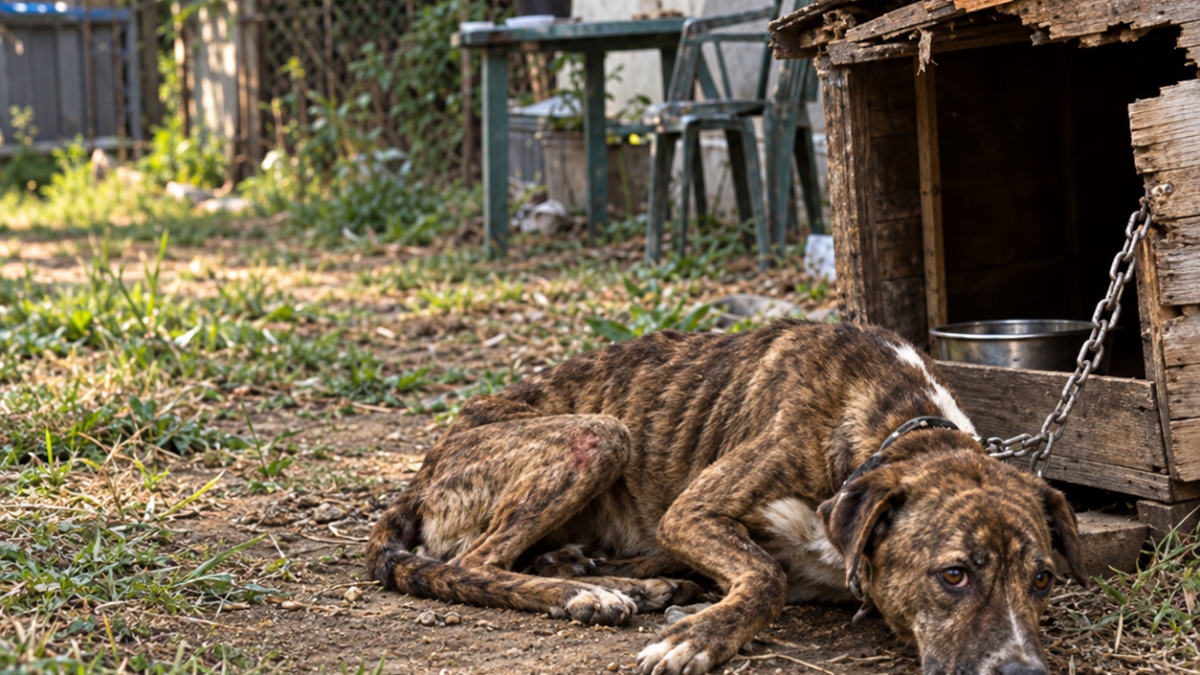
The brindle dog didn’t growl when I entered the yard—she pressed her face into the dirt as if becoming invisible was the only thing that had ever kept her safe.
Her chain was too short to reach the shade or the overturned water bucket, and when the metal on my belt made one small sound, her whole body began to shake.
But when we finally carried her away from that house, she buried her muzzle against my arm—and months later, that same terrified silence would become the one thing a frightened child trusted enough to answer.
My name is Claire Morel.
I was thirty-eight and on patrol outside Toulouse when a seventy-two-year-old woman named Mrs. Lambert called about a dog crying behind the fence next door.
She met us in gardening clogs.
“I heard her all night yesterday,” she said. “But today there’s nothing.”
That last sentence bothered me.
Noise means an animal is still trying to be heard.
Silence can mean something else.
My partner, Julien, knocked repeatedly on the front door.
No answer.
The shutters were closed.
Mail bulged from the box.
I walked around the property and found a gap between two warped fence boards.
At first I saw burned grass.
Two broken lawn chairs.
An overturned bucket.
Then something moved.
A chain.
It led to a stocky brindle female lying beside a homemade doghouse with half its roof missing.
She had a wide white patch across her chest.
Her ribs showed.
The chain was so short she couldn’t reach the narrow strip of shade beneath the terrace.
One front leg remained folded beneath her at an unnatural angle.
“Hey, sweetheart.”
Her eyes shifted toward me.
Her head didn’t.
Once we received authorization to enter, Julien forced the gate.
The moment the lock snapped and the chain scraped across the ground, the dog flattened herself.
I approached sideways.
Slow.
Hands low.
Then the metal on my duty belt tapped against its case.
She began trembling violently.
I stopped.
Beside the back door hung an old electrical cable.
Brindle hair was tangled around part of it.
There were marks beneath the dust on her back too.
Older injuries.
Healing injuries.
I didn’t need a veterinarian to understand one thing.
This dog had not simply been forgotten for several days.
Someone had taught her to fear sound.
I took off my jacket and placed it on the ground between us.
“You don’t have to come to me,” I whispered. “I’ll stay here.”
Nothing happened.
Then she raised her head slightly.
I filled a clean container with water and placed it halfway between us.
She stared at it.
Then at me.
She moved only after I backed away.
She dragged herself forward on three legs and drank without standing.
When Sophie from animal services arrived, we decided to cut the chain instead of pulling the damaged collar over her irritated neck.
We slid a blanket beneath her.
The dog stayed silent.
No barking.
No growling.
No fight.
But when we lifted her, she did something I have never forgotten.
She pressed her muzzle into the crook of my arm.
Just for a second.
As if she had decided that maybe a human hand could hold without hurting.
At the emergency veterinary clinic, the examination confirmed what we feared.
Severe dehydration.
Malnutrition.
Multiple old injuries.
A badly damaged front leg that might still be saved.
The veterinarian told us her body had a reasonable chance.
Her trust was another question entirely.
The tenant was located several days later.
His name was Marc Delon.
He claimed the dog was “difficult.”
He said she injured herself pulling against the chain.
He said he had been away “only a little while.”
None of his explanations matched the evidence.
Then a woman named Élodie Martin contacted us.
She was thirty-two.
She arrived carrying an old photograph in both hands.
The moment I saw the dog in that picture, healthy and sleeping beside a little boy, I stopped breathing.
“That’s her,” Élodie whispered.
Then she told me the dog’s real name.
Maya.
And what she revealed next changed the meaning of everything we had found in that backyard.
PART 2
Élodie placed the photograph on the table between us.
Maya looked almost unrecognizable.
Healthy weight.
Bright eyes.
Clean coat.
No chain.
She was lying on a blue rug beside a little boy who had one arm thrown across her neck.
The boy looked about six.
Curly brown hair.
Serious eyes.
A dinosaur shirt.
“Who is he?” I asked.
Élodie swallowed.
“My son.”
“What’s his name?”
“Lucas.”
I looked from the photograph to her.
“And Maya belonged to you?”
She nodded.
“To us.”
Her fingers tightened around the edge of the picture.
“She was his dog before she was mine.”
I waited.
People tell the truth differently when you stop filling the silence for them.
Eventually Élodie began.
She had met Marc four years earlier.
At first, she said, he had been charming.
Generous.
Funny.
The kind of man who remembered birthdays, brought flowers for no reason, and made himself useful in ways that felt like love.
She had already been raising Lucas alone.
His father lived elsewhere and had limited contact.
Maya had come into their lives before Marc.
A rescue from a local association.
Young.
Nervous.
Gentle.
“She slept outside Lucas’s bedroom every night,” Élodie said.
“If he had nightmares, she went in before I did.”
“What changed?”
Élodie looked at the floor.
“Marc.”
I had expected that answer.
It still tightened something in my chest.
The controlling behavior started slowly.
Who was texting?
Where had she been?
Why had she spent money without telling him?
Why did Lucas need so much attention?
Why was Maya allowed on the couch?
Why did the dog follow Élodie instead of him?
Small complaints became rules.
Rules became fear.
Marc hated the bond between Maya and Lucas.
Not because the dog was aggressive.
Because she made Lucas feel safe.
“Whenever Marc raised his voice,” Élodie said, “Maya would go sit beside Lucas.”
I leaned forward.
“What happened after that?”
“She started becoming afraid of Marc.”
“Before you were?”
Élodie looked at me.
“No.”
The answer came quietly.
“I was already afraid. I just hadn’t admitted it.”
Marc began shutting Maya outside.
Then chaining her.
Élodie would release her when Marc was gone.
That led to arguments.
Then threats.
“He told me if I kept choosing the dog over him, I could leave with nothing.”
“Why didn’t you?”
I hated the question as soon as I said it.
Not because it was unreasonable.
Because people who have never lived inside coercion imagine leaving as a door.
Often it is a maze.
Élodie did not become defensive.
She simply said, “I tried.”
Then she told us about the first time.
She packed bags while Marc was at work.
Put Lucas in the car.
Called Maya.
Marc came home early.
The argument that followed ended with the bags dumped back inside and the car keys in Marc’s pocket.
After that, he watched everything more closely.
Bank access.
Phone.
Car.
Even groceries.
Élodie began planning again in secret.
A women’s support organization helped her.
The plan was to leave while Marc was away for two days.
Take Lucas.
Take Maya.
Go somewhere protected.
But on the morning she was supposed to leave, Maya was gone.
“What did Marc tell you?”
Élodie’s eyes filled.
“He said she ran away.”
I felt my jaw tighten.
“Did you believe him?”
“No.”
“Did you search?”
“For three days.”
“Police report?”
“Yes.”
“Chip?”
“Yes.”
That caught my attention.
“Maya was microchipped?”
Élodie nodded.
“In my name.”
Sophie, who was sitting beside me, immediately opened her laptop.
“The clinic didn’t find one.”
Élodie stared.
“That’s impossible.”
Sophie typed.
“Unless it was removed.”
The room went very quiet.
Élodie covered her mouth.
“No.”
I remembered the irritated skin around Maya’s neck.
The old injuries.
The shaved-looking patch near her shoulder that I had assumed came from rubbing.
A microchip is usually placed between the shoulder blades.
I looked at Sophie.
She was already thinking the same thing.
“Was there scar tissue?” I asked.
“Yes.”
“Could someone have cut it out?”
Sophie’s face hardened.
“A veterinarian wouldn’t.”
“That wasn’t my question.”
“It’s possible for someone to attempt it.”
Élodie started crying.
Not loudly.
Her body simply folded forward.
“He told me she was dead.”
I looked at her.
“What?”
“After I kept searching. He told me he’d found her on the road.”
My stomach turned.
“Did he show you a body?”
“No.”
“He told you Maya had died?”
“Yes.”
“Why didn’t you report him?”
“Report what? He said she ran away.”
She wiped her face.
“And I still had Lucas.”
That sentence changed the room.
Because there was the other part.
The part Marc understood.
If Élodie pushed too hard over the dog, Lucas remained within his reach.
So she left.
Without Maya.
She took Lucas and went into protected housing.
Marc sent messages for months.
Apologies.
Threats.
Promises.
Accusations.
He demanded she return.
She didn’t.
Eventually a protective order followed.
Then he disappeared from her daily life.
“I thought Maya was dead,” Élodie whispered.
I pushed the photograph closer to her.
“She isn’t.”
Élodie pressed her lips together.
“I need to see her.”
Sophie and I exchanged a look.
Maya was still hospitalized.
More importantly, she was terrified of sudden movement, unfamiliar rooms, men, belts, metal sounds, and raised voices.
The last thing she needed was an emotional reunion forced on her because it would make humans feel better.
“You can,” I said. “But we have to do it her way.”
Élodie nodded immediately.
“Anything.”
We arranged it for the next afternoon.
I arrived early.
Maya was in a quiet recovery room.
Her injured leg had been stabilized.
The veterinarians believed surgery could preserve it.
She still ate only when nobody stood too close.
She slept pressed against the wall.
When I entered, she lifted her head.
That alone felt like progress.
“Hey, girl.”
Her eyes followed me.
No tail.
I sat on the floor several feet away.
Élodie entered five minutes later.
She stopped in the doorway.
Maya froze.
So did Élodie.
For several seconds, neither moved.
Then Élodie whispered one word.
“Maya.”
The dog’s ears lifted.
Not slowly.
Instantly.
Her head came up.
Élodie covered her mouth.
“Maya.”
The dog tried to stand.
Her injured leg slipped.
I moved instinctively.
Sophie held out a hand.
“Let her choose.”
Maya stared at Élodie.
Something changed in her whole body.
Her tail moved.
Once.
Twice.
Then faster.
Élodie dropped to her knees.
“I’m sorry.”
Maya tried again.
Three-legged.
Unsteady.
She crossed the room.
Not running.
Barely walking.
But going.
When she reached Élodie, she pressed her entire body against her.
Élodie wrapped her arms around Maya’s chest and started sobbing.
“I thought you were gone.”
Maya buried her face beneath Élodie’s chin.
No trembling.
No flattening.
No dirt to disappear into.
Just recognition.
I looked away.
Some reunions belong to the people who survived the same house.
Then Élodie whispered something I almost missed.
“Lucas needs you.”
Maya’s ears moved.
Élodie closed her eyes.
“He stopped talking.”
I looked back.
“What do you mean?”
She wiped tears from her cheek.
“He talks to me sometimes. One or two words. But outside the apartment? At school? With therapists? Almost nothing.”
“How long?”
“Since we left Marc.”
My chest tightened.
“Has he been evaluated?”
“Yes.”
Élodie nodded.
“Trauma-related shutdown, they think. He understands everything. He communicates in other ways. But when adults ask him what happened in that house…”
She shook her head.
“He disappears.”
That word.
Disappears.
I looked at Maya.
The dog who had tried to disappear into dirt.
I understood before anyone said it.
“Does Lucas know Maya is alive?”
“No.”
“Why not?”
Élodie looked terrified.
“What if she dies?”
That was fair.
Maya still needed surgery.
Still had infections to clear.
Still had weight to regain.
Still had a long recovery.
I sat beside her.
“Then don’t tell him yet.”
Élodie nodded.
“Not until we know.”
Maya’s surgery happened three days later.
The damage to her front leg was extensive.
Old fracture.
Ligament injury.
Scar tissue.
But blood flow was good.
The surgeon repaired what could be repaired and warned us that she might always limp.
Nobody cared.
The important thing was pain.
Could she be comfortable?
Yes.
Could she walk?
Probably.
Could she run?
Maybe not normally.
Again, nobody cared.
Maya had spent months chained to dirt.
Normal was no longer our standard.
Freedom was.
For the next six weeks, she stayed with a specialized foster named Nathalie.
Nathalie had experience with severely fearful dogs.
Her house was quiet.
No children.
No men living there.
Large garden.
No metal chain sounds.
No pressure.
The first week, Maya remained mostly beneath a table.
Nathalie texted updates.
ATE WHEN I LEFT ROOM.
TOOK TREAT FROM FLOOR WHILE I SAT NEARBY.
SLEPT ON BLANKET INSTEAD OF TILE.
SMELLED MY HAND TODAY.
Tiny things.
Huge things.
Trust does not return in dramatic leaps.
It returns in millimeters.
One afternoon, Nathalie sent a photograph.
Maya asleep in sunlight.
On her side.
Belly partly exposed.
I stared at it for a long time.
An animal that sleeps that way is surrendering control.
Not to fear.
To safety.
Meanwhile, the case against Marc strengthened.
Veterinary evidence showed repeated untreated injuries.
The cable from the backyard had biological material consistent with Maya’s fur.
The rental property owner confirmed Marc had been absent for at least five days before our entry.
Meaning he knowingly left Maya chained without reliable access to water.
Then investigators found something worse.
Marc had kept old videos on a cloud account associated with his phone.
Not videos of direct severe violence.
But enough.
Maya chained.
Marc taunting her with food.
Metal objects thrown near her to make her flinch.
Commands barked at her while she cowered.
One recording included his voice saying:
“Let’s see if you learn this time.”
I watched only what I needed for the report.
Then stopped.
Anger is useful until it begins consuming the same space compassion needs.
Julien handled more of the evidence after that.
“You don’t have to watch everything,” he told me.
“I know.”
“You act like you do.”
“I know.”
Marc was arrested on animal cruelty charges and for violating conditions related to Élodie’s protective order after investigators found he had continued contacting her indirectly.
He denied abusing Maya.
Said he was “training” her.
Said she was “unmanageable.”
Said the chain was necessary because she escaped.
People often rename cruelty when the real word makes them uncomfortable.
Training.
Discipline.
Control.
Management.
The evidence did not care what he called it.
Then came the question of Maya’s legal ownership.
Her microchip had been removed.
But Élodie still had adoption records.
Veterinary records.
Photographs.
The original chip registration.
Maya was legally hers.
That should have meant Maya returned immediately.
But Élodie surprised me.
“She’s not coming home yet.”
I looked at her.
“You don’t want her?”
Élodie flinched.
“Of course I want her.”
“Then why?”
She stared through the clinic window.
“Because wanting her and being ready for her are different.”
That answer changed how I saw Élodie.
She lived in a small second-floor apartment.
Lucas had unpredictable episodes of fear.
Maya was still triggered by sudden movement and certain sounds.
Putting them together simply because love existed could harm both.
“What do you want?”
“I want them to meet.”
I nodded.
“But carefully.”
“Yes.”
A child trauma therapist named Dr. Amina Bensaïd helped plan the reunion.
She worked with Lucas.
She was direct.
“Do not expect a movie scene.”
Élodie almost laughed.
“I don’t.”
“Do not tell Lucas Maya needs him.”
“I won’t.”
“Do not tell him she will make him feel better.”
“Okay.”
“Do not ask him to pet her.”
“I understand.”
Amina looked at me.
“Same for Maya.”
“Agreed.”
“They are both allowed to say no.”
That became the foundation.
Both allowed to say no.
A quiet room at the therapy center.
One door open.
Maya free to retreat.
Lucas free to leave.
No cameras.
No audience.
Only Élodie, Amina, Nathalie, me, and Julien outside if needed.
Lucas arrived holding a green plastic dinosaur.
He was eight now.
Small for his age.
Brown hair falling into his eyes.
He spoke to nobody.
Amina sat beside him on the floor.
Élodie did not tell him Maya was coming.
Instead she said, “Someone you know is here.”
Lucas looked at her.
Then at the door.
Nathalie entered with Maya.
Maya stopped.
Lucas stopped breathing.
I mean that almost literally.
His chest held still.
The dinosaur slipped from his hand.
Maya stared.
Her ears rose.
Her tail moved.
Lucas made a sound.
Not a word.
A broken inhale.
Maya took one step.
Stopped.
Lucas stood.
Amina did nothing.
Élodie covered her mouth.
Maya moved another step.
Then another.
Lucas began shaking.
Not fear exactly.
Overload.
Memory.
Love.
Everything at once.
Maya reached him.
Then, as if some old instinct returned, she sat.
Not touching.
Just close.
Lucas stared at the white patch on her chest.
His hand lifted.
Stopped.
Maya lowered her head.
Lucas touched one ear.
That was all.
One touch.
Maya closed her eyes.
Lucas sat on the floor.
Then Maya lay beside him.
No one spoke.
Five minutes.
Ten.
Fifteen.
Lucas began stroking her neck.
Slow.
Repetitive.
Maya’s breathing matched his.
Eventually Lucas leaned against her.
The session lasted forty-two minutes.
He did not say one word.
And it was one of the most successful sessions Amina had seen with him.
Outside, Élodie cried.
“She didn’t make him speak.”
Amina looked at her.
“That was never the goal today.”
Élodie wiped her face.
“What was?”
“For him to stay present.”
I remembered Maya in the yard.
Face in dirt.
Body flattened.
Disappear.
Lucas had been doing the same thing in a human way.
And for forty-two minutes, he stayed.
The visits continued.
Once a week.
Then twice.
No pressure.
Sometimes Lucas touched Maya.
Sometimes not.
Sometimes Maya entered and lay beneath a chair.
Lucas would sit nearby.
Their silence did something the adults had failed to understand.
Nobody demanded anything from the other.
Maya did not ask Lucas to explain.
Lucas did not ask Maya to trust.
They simply occupied the same room.
That was enough.
On the fourth visit, Lucas brought a blanket.
He spread it on the floor.
Maya lay on one corner.
Lucas sat on the other.
Halfway through the session, Amina asked a simple question.
“Do you want the light brighter or darker?”
Lucas pointed toward darker.
No words.
Fine.
On the sixth visit, Maya sneezed.
Lucas laughed.
It was the first sound of laughter Amina had heard from him in months.
Élodie went into the hallway and cried again.
I was starting to think crying was simply part of the treatment plan.
On the eighth visit, something happened.
Nothing dramatic.
Lucas was brushing Maya with a soft grooming brush.
Maya shifted her damaged front leg.
Lucas stopped.
Looked at it.
Then whispered:
“Does it hurt?”
Every adult in the room froze internally.
Nobody showed it.
Amina answered normally.
“Sometimes.”
Lucas brushed more gently.
No one celebrated.
That mattered.
If everyone reacted emotionally, speaking would become performance.
So we let the sentence exist.
Later, outside, Élodie leaned against the wall shaking.
“He spoke.”
Amina nodded.
“To Maya.”
Élodie smiled through tears.
“That counts.”
“Yes.”
It absolutely counted.
The next week, Lucas said three words.
“Come here, Maya.”
The week after that:
“No, stay there.”
Choice.
Boundary.
Voice.
The week after:
“She likes blue.”
Nobody knew why.
Maya did not seem to have a color preference.
But Lucas had decided.
So blue it was.
The first painful sentence came months later.
Lucas was sitting beside Maya.
Amina was sorting cards on the floor.
Élodie waited outside.
I was not present in the room that day.
I heard about it afterward.
Lucas put his hand over Maya’s white chest.
Then said:
“He scared her.”
Amina did not ask who.
She said, “Yes.”
Lucas continued stroking Maya.
“He scared Mom too.”
Pause.
“And you?”
Lucas went silent.
Amina waited.
Maya placed her head in his lap.
Lucas whispered:
“Me too.”
Three words.
That was the beginning.
Not of a dramatic confession.
Of speech returning where fear had occupied everything.
Over subsequent sessions, Lucas began describing small memories.
Marc shouting.
Doors slamming.
Maya being sent outside.
His mother crying.
The sound of something hitting the wall.
A time Marc grabbed Maya’s collar and dragged her away after she tried to sit beside Lucas.
Nothing was forced.
Nothing was extracted.
The statements were documented carefully by trained professionals.
And eventually, they became relevant to the broader domestic abuse investigation.
Élodie had struggled to prove coercive behavior because much of it had happened privately.
Lucas’s statements were treated with strict safeguards.
I stayed out of that part as much as possible.
He was a child, not evidence first.
That distinction mattered.
But Marc’s lawyer could no longer dismiss everything as a bitter ex-partner and an unfortunate dog.
There was a pattern.
The animal cruelty case moved first.
Marc’s defense argued that Maya’s injuries could have come from accidents.
The veterinarian testified.
Repeated trauma.
Untreated fracture.
Dehydration.
Malnutrition.
Pressure injuries.
A neck wound consistent with chronic tethering.
The removed microchip site.
Then the videos.
Then Mrs. Lambert.
The seventy-two-year-old neighbor.
She entered court wearing the same practical shoes she wore when she first called us.
Marc’s attorney asked whether she actually witnessed anyone strike the dog.
“No.”
“So you are assuming abuse.”
“No.”
“What did you personally observe?”
Mrs. Lambert looked at him.
“I observed a dog cry for nights until one day she stopped.”
The room became very quiet.
“That is why I called.”
No drama.
No accusation.
Just fact.
Sometimes fact is enough.
Marc was convicted on multiple animal welfare offenses.
He received a sentence that included a period of incarceration, probationary restrictions afterward, significant fines, and a prohibition on owning animals.
People online complained it was not enough.
Others thought it was excessive.
I stopped reading comments.
Punishment was not the only outcome that mattered.
The record mattered.
The restrictions mattered.
Maya mattered.
And then there was Élodie.
The domestic abuse proceedings took longer.
More complicated evidence.
Different legal standards.
Different injuries.
Some visible.
Many not.
Marc tried every familiar strategy.
He said Élodie was unstable.
Vindictive.
Manipulative.
He said Lucas had been coached.
He said police had turned an animal case into a personal vendetta.
He said everyone misunderstood him.
The evidence kept answering.
Messages.
Financial control.
Threats.
Witness statements.
Violation of protective restrictions.
And carefully obtained testimony regarding Lucas’s environment.
Eventually there were consequences there too.
Not a cinematic courtroom explosion.
No judge pounding a desk while Marc confessed.
Real justice was slower.
Orders.
Convictions on applicable charges.
Restrictions.
Custody protections.
Monitoring.
Documentation.
The machinery of law grinding forward.
The revenge Élodie ultimately wanted was not Marc suffering.
It was Marc no longer controlling the terms of her life.
She got that.
The first time I visited her new apartment after everything, Maya was there.
Permanent.
The transition had happened gradually.
One night.
Then weekends.
Then most of the week.
Finally, full-time.
The apartment had rugs everywhere for Maya’s leg.
A blue bed in Lucas’s room.
A water bowl in the kitchen.
A soft crate with the door permanently open.
Maya no longer needed it, but sometimes she slept there.
Choice.
Always choice.
I entered slowly.
Maya approached.
She still disliked the sound of metal equipment, so I left my duty belt at the station when visiting.
She sniffed me.
Then pushed her head under my hand.
“That’s new,” I said.
Élodie smiled.
“She does that now.”
Lucas was sitting at the table drawing.
He looked older.
Not only because months had passed.
Because fear no longer occupied his entire face.
“Hi, Lucas.”
He looked at me.
“Hi.”
One word.
Perfect.
“What are you drawing?”
“A Spinosaurus.”
I knew nothing about dinosaurs.
“Big one?”
He gave me the look children reserve for incompetent adults.
“Yes.”
Maya sat beside him.
I pointed at the page.
“Is Maya in it?”
Lucas frowned.
“No. Dinosaurs are extinct.”
“Right.”
He sighed.
“Claire doesn’t know science,” he told Maya.
Élodie laughed.
I had never been happier to be insulted.
Maya’s physical recovery continued.
She always limped.
Especially after long walks.
The surgeon warned early arthritis might develop in the injured leg.
So there were checkups.
Supplements.
Weight management.
Shorter walks.
No jumping from cars.
A ramp when needed.
She did not care.
She discovered couches.
That was enough.
The first time I saw her asleep upside down, legs in the air, I took a photograph.
Months earlier, she had pressed her face into dirt to disappear.
Now she slept exposing her entire belly in the middle of a living room while a child drew dinosaurs six feet away.
No one could have explained safety to me better.
Mrs. Lambert remained part of the story too.
Élodie visited her.
Maya went along.
The older woman cried when she saw her.
“Oh, my girl.”
Maya approached cautiously.
Mrs. Lambert held out one hand.
No touching until Maya chose.
We had all learned.
Maya sniffed.
Then leaned forward.
Mrs. Lambert rubbed her neck.
“I’m sorry I didn’t call sooner.”
I stopped her.
“You called.”
“But I heard her before.”
“You called.”
That distinction matters.
Guilt wants perfect timing.
Life rarely offers it.
Mrs. Lambert noticed.
She acted.
Maya lived.
That was enough.
A year after the rescue, the animal service asked whether I would speak at a training session for officers about recognizing animal abuse in domestic violence environments.
I almost refused.
I hated presentations.
Julien laughed when I told him.
“You interrogate armed men.”
“Yes.”
“But PowerPoint scares you.”
“Yes.”
I did it anyway.
I used Maya’s case carefully.
No sensational photographs.
No graphic detail.
Just patterns.
Animal threats used to control partners.
Pets isolated from family members.
Veterinary care withheld.
Animals used as leverage when victims consider leaving.
Dogs becoming visibly fearful around particular people or objects.
The way harm to animals can exist inside broader household coercion.
At the end, a young officer asked:
“What made you realize it wasn’t simple neglect?”
I thought about the yard.
The chain.
The dry earth.
Maya staring at my belt.
“The fear had structure.”
He frowned.
“What does that mean?”
“She wasn’t afraid of everything equally.”
I explained.
Metal sounds.
Fast hands.
The cable.
The back door.
Certain positions.
Fear can tell a history even before anyone speaks.
That sentence stayed with me.
Because months later, Lucas’s silence did the same.
Silence is not emptiness.
Sometimes it is information.
Sometimes it is the shape survival takes.
Two years passed.
Maya turned seven, according to the shelter estimate from her original adoption records.
Lucas turned ten.
He talked now.
Not constantly.
He was still quiet by temperament.
People sometimes assumed recovery meant becoming loud.
It didn’t.
He liked quiet.
So did Maya.
They could spend an entire hour together without speaking.
That was not pathology.
That was friendship.
Amina once told Élodie:
“Do not confuse silence with fear just because fear once used silence.”
I wrote that down.
Lucas joined a small school science club.
His first presentation was about theropod dinosaurs.
Élodie invited me.
I sat in the back.
Maya obviously couldn’t attend school.
Though Lucas argued she should.
He stood in front of twelve children and three adults.
Paper shaking slightly in his hands.
He looked at the door twice.
Then began.
His voice was soft.
But it was there.
At the end, everyone applauded.
Lucas flinched at the volume.
Then smiled.
Afterward he found me.
“Did you understand it?”
“No.”
He stared.
“I understood some.”
“You thought pterosaurs were dinosaurs.”
“I made one mistake.”
“They’re not dinosaurs.”
“Fine.”
He shook his head.
“Adults.”
I smiled.
“You did good.”
His expression changed.
Not closed.
Just thoughtful.
“Maya helped.”
“I know.”
“She didn’t make me talk.”
“I know.”
“She just waited.”
There it was.
The whole story.
She just waited.
That was exactly what I had done in the yard.
Take off jacket.
Sit.
Don’t touch.
Wait.
Exactly what Maya later did for Lucas.
Sit.
No demand.
Wait.
Animals learn fear from humans.
Sometimes they also learn patience.
And then give it back.
Élodie eventually trained Maya for structured therapeutic visits.
Not formal assistance work requiring tasks Maya could not physically perform.
Nothing demanding.
No crowded hospitals.
No overstimulation.
Just carefully supervised visits at Amina’s center for children who preferred quiet interaction.
The first time I heard about it, I objected.
“She’s been through enough.”
Élodie nodded.
“I said the same thing.”
“So why?”
“Because Maya chooses.”
That mattered.
Sessions lasted fifteen or twenty minutes.
If Maya walked away, session over.
If she stayed, children could sit nearby.
No hugging unless Maya initiated contact.
No pulling.
No crowd.
Choice for everyone.
One child named Sami became especially attached to her.
Nine years old.
Recently placed with an aunt after upheaval at home.
He spoke very little to adults.
The first three visits, he ignored Maya.
Maya ignored him.
Excellent.
Fourth visit, he rolled a tennis ball across the room.
Maya watched.
Did not chase.
Bad leg.
Sami rolled it again.
Maya nudged it back with her nose.
A game began.
No speech.
Fifth visit, same.
Sixth visit, Sami whispered:
“Again.”
Maya pushed the ball.
Amina later told me the story.
I laughed.
“So now she has two children talking?”
Amina corrected me immediately.
“No.”
I knew that voice.
Professional boundary.
“She is not curing children.”
“Fine.”
“She creates a low-pressure interaction.”
“Which helps.”
“Sometimes.”
I smiled.
“You hate sentimental stories.”
“I hate inaccurate ones.”
That is why I liked her.
Maya did not possess magic.
She did not repair trauma.
She offered something simpler.
Predictability.
Quiet.
No questions.
No hidden demand.
For some children, that was enough space to take one small step.
The local newspaper eventually heard about Maya.
A reporter wanted a feature.
“Abused Dog Becomes Therapy Hero.”
Élodie hated the title.
So did I.
Maya was not valuable because she became useful.
We had already learned that lesson.
I told the reporter:
“If Maya spent the rest of her life sleeping on a couch, her rescue would still matter.”
To her credit, the journalist listened.
The final headline was different.
**THE DOG WHO LEARNED SHE COULD LEAVE THE ROOM**
That one I liked.
The article focused on choice.
How Maya could now walk away from a hand.
How Lucas could refuse a question.
How recovery required agency, not obedience.
Marc’s name appeared only briefly.
I liked that too.
Abusers often occupy too much space in stories about survivors.
Maya’s life became larger than what he had done.
Élodie’s too.
Lucas’s too.
Three years after the rescue, Julien retired from patrol work after a shoulder injury.
We joked that Maya had outlasted him.
He visited her.
She had always been more cautious with men.
But over years, Julien became familiar.
On his retirement day, he came wearing civilian clothes.
No belt.
No radio.
Maya walked directly toward him.
He froze.
“Is she…”
“Yes.”
Maya sniffed his hand.
Then leaned against his leg.
Julien looked at me.
“Three years.”
“Worth it.”
He crouched slowly.
Maya let him scratch behind her ear.
His eyes filled.
“I was there when we cut the chain.”
“I remember.”
“She wouldn’t look at me.”
“She looked at nobody.”
Julien whispered, “Good girl.”
Tail wag.
There are victories measured in years.
That was one.
Around the same time, Mrs. Lambert died.
Peacefully.
Her niece called Élodie.
Among her belongings was a small envelope marked:
FOR THE WOMAN WITH MAYA.
Inside was a handwritten note.
Élodie let me read it.
It said:
**I still hear the night that dog cried. For a long time I felt guilty because I did not act the first hour. Please remember me not for the hours I waited, but for the morning I finally called. I hope Maya has a garden with shade.**
Élodie cried.
Then she framed the note.
Maya did have a garden by then.
Élodie had moved to a small ground-floor rental outside the city.
Nothing fancy.
But there was grass.
A tree.
Shade.
The first afternoon there, Maya walked beneath the tree and lay down.
Élodie sent me the picture.
No chain.
Water beside her.
Lucas reading nearby.
I saved it.
Some photographs answer old wounds better than words.
Marc was released under supervision eventually.
That worried Élodie.
Protections remained.
He was prohibited from contacting her.
The system was not perfect.
No system is.
They changed routines.
Schools had instructions.
Police had records.
For months, Élodie became jumpy again.
Maya noticed.
One evening, Élodie told me something I found strangely moving.
“I thought I was protecting Maya.”
“What happened?”
“She started sleeping beside my bedroom door.”
Like she once slept outside Lucas’s room.
Not attacking.
Not patrolling aggressively.
Just there.
Presence.
Élodie said, “I told her she doesn’t have to.”
“What did she do?”
“Stayed.”
Of course.
That was Maya.
Years after the yard, her response to fear was no longer to disappear.
It was to remain.
Not because she had forgotten.
Because she had choices now.
Eventually Marc moved away.
No dramatic confrontation.
No final revenge scene.
His control simply became less relevant with distance and legal restrictions.
I was glad.
The best revenge had already happened.
Élodie laughed again.
Lucas spoke.
Maya slept in sunlight.
Marc’s power had shrunk until it occupied paperwork.
That was satisfying enough.
Then came the day I understood the title of Maya’s life had changed completely.
I was visiting Amina’s center.
Not as an officer.
Just Claire.
Maya was older.
Gray beginning around her muzzle.
She moved with the familiar limp.
A small boy sat in the corner.
Not Lucas.
Another child.
Maybe seven.
He would not look at anyone.
Maya entered.
Paused.
Looked toward Élodie.
Élodie unclipped the leash.
Maya could choose.
She walked halfway across the room.
Stopped.
The boy glanced at her.
Maya lowered herself onto the floor.
Not near him.
Not far.
She rested her head on her paws.
Nothing happened.
Five minutes.
Ten.
The boy moved his chair closer.
Maya did not react.
Another five.
He moved again.
Eventually his shoe touched the edge of Maya’s blanket.
She remained still.
The boy looked at Amina.
Then whispered:
“Can she stay?”
Amina answered softly.
“If Maya wants to.”
The boy looked at the dog.
Maya sighed.
Closed her eyes.
The boy almost smiled.
I stood in the doorway and felt my throat tighten.
Years earlier, I had looked through a broken fence and seen a dog making herself invisible.
Now a child was asking that same dog not to leave.
Not because Maya performed.
Not because she rescued him from danger.
Because she knew how to be quiet without making silence frightening.
That was her gift.
Not born from the abuse.
I refuse to give cruelty credit for what survivors become.
Marc did not create Maya’s gentleness.
He tried to bury it.
She kept it anyway.
That distinction matters.
Maya’s body aged.
The repaired front leg developed arthritis earlier than we hoped.
The veterinarian adjusted medication.
Walks became shorter.
Therapy visits became less frequent.
Eventually, Élodie retired her completely.
No ceremony.
No announcement.
Maya simply stopped going.
She had given enough.
Lucas was thirteen by then.
Tall.
Still obsessed with prehistoric animals, though now he talked about paleontology careers.
He had a voice deeper than I expected.
He came home from school one afternoon and found Maya struggling to stand.
He helped with the support harness.
No panic.
Just care.
Élodie watched from the kitchen.
Later she told me:
“He used to need Maya to stay present.”
“And now?”
“Now he helps her.”
That is time.
Roles change.
Love doesn’t always.
Maya’s favorite place became beneath the garden tree.
Same photograph, older dog.
Gray muzzle.
Lucas’s legs longer beside her.
One summer evening, I visited.
Lucas was doing homework.
Élodie made coffee.
Maya slept near us.
We talked about Mrs. Lambert.
Julien.
Amina.
The case.
All the people connected by one call about a crying dog.
Then Lucas looked up.
“Claire?”
“Yes?”
“Did she really put her face in the dirt?”
Élodie became still.
I looked at Maya.
“Yes.”
“Why?”
I thought carefully.
“Because she was scared.”
“Of you?”
“Probably of everybody.”
Lucas looked down.
“Was she scared when she saw me again?”
“No.”
I smiled.
“She recognized you before you touched her.”
He rubbed Maya’s ear.
“She waited for me to talk.”
“She did.”
He was quiet.
Then said, “I think she knew.”
“Knew what?”
“That I didn’t want people asking questions.”
I nodded.
“Maybe.”
Lucas looked at me.
“You ask a lot of questions.”
“Occupational hazard.”
He smiled.
Then his expression became serious.
“Did she tell you what happened?”
I understood.
“No.”
“Then how did you know?”
“Her body told us some things.”
He looked at Maya.
“Without talking.”
“Yes.”
Lucas nodded slowly.
“I like that.”
Years earlier, adults had needed Lucas to speak before they understood the full household.
Maya reminded us that speech is one kind of testimony.
Behavior is another.
Fear has grammar.
Trust does too.
Maya taught me both.
She turned eleven.
Then twelve.
No exact birthday, so Élodie celebrated the date of her first adoption.
Chicken.
A new blanket.
Lucas bought her a blue collar.
Of course.
“She likes blue,” he reminded everyone.
Still no evidence.
Nobody argued.
By twelve, Maya’s world was small.
Garden.
Kitchen.
Living room.
Short walks.
Veterinary clinic.
Lucas’s room.
That was enough.
She no longer needed large adventures.
Safety had become ordinary.
That is the ending most rescue stories skip.
Not the dramatic recovery.
The boring years afterward.
Medication.
Naps.
Water refilled.
Doors opening.
Someone returning home.
No one disappearing.
No chain.
That was the miracle.
One autumn, Maya began eating less.
Tests showed kidney decline.
Not sudden.
Age.
Medication.
Time.
Élodie called me.
“I know what this means.”
“Not necessarily today.”
“I know.”
We had learned not to panic at every change.
Supportive care helped.
Maya rallied.
Winter passed.
Spring returned.
She made it to the garden again.
Under the tree.
Lucas studied beside her for an exam.
I took another picture.
She looked ancient.
Loved.
Those can coexist.
By summer, standing became harder.
Lucas built a small wooden ramp with Julien’s help.
Julien complained the measurements were wrong.
Lucas said retired police officers don’t understand engineering.
Julien said teenagers don’t understand anything.
Maya slept through the argument.
Perfect.
Then one September morning, Élodie called before sunrise.
Her voice told me.
“She won’t get up.”
I drove over.
No uniform.
No police car.
Just me.
Maya lay on her blue blanket.
Lucas sat beside her.
He was fifteen.
His hand rested against the white patch on her chest.
Élodie sat on the other side.
Maya opened her eyes when I entered.
Her tail moved.
Once.
Slow.
I sat on the floor.
“Hey, sweetheart.”
She breathed.
I remembered the dry yard.
The chain.
My jacket on dirt.
You don’t have to come.
I’ll stay here.
Now we had returned to the same promise.
She did not have to do anything.
We would stay.
The veterinarian came to the house later.
Examined her.
Maya’s body was failing.
Comfort could not be maintained much longer.
Élodie asked every question.
Lucas asked one.
“Will she be scared?”
The veterinarian answered carefully.
“We can make sure she is relaxed and surrounded by people she knows.”
Lucas nodded.
Then he looked at Maya.
For a long time, nobody spoke.
Finally Lucas whispered:
“You helped me.”
Élodie started crying.
Lucas continued.
“I’m okay now.”
Maya’s ear moved.
“You can stop.”
That sentence broke me.
Not because it was sad.
Because it was complete.
Years earlier, Maya’s silence had given Lucas permission not to perform.
Now Lucas’s voice gave Maya permission to rest.
I put my hand against her shoulder.
No flinch.
No trembling.
No eyes watching my belt.
Just trust.
The veterinarian gave the sedative.
Maya relaxed.
Lucas lay beside her.
Élodie held her face.
I stroked the brindle fur.
Maya’s breathing slowed.
Then stopped.
Quietly.
The dog who had once survived by becoming invisible left this world as the center of a room full of people who could not imagine not seeing her.
For a while, no one moved.
Then Lucas said:
“She wasn’t quiet because she was weak.”
I looked at him.
“No.”
“She was quiet because she was listening.”
Maybe.
Or maybe that was the meaning he needed.
Either way, I liked it.
Maya was cremated.
Lucas kept her blue collar.
Élodie planted lavender beneath the garden tree.
Mrs. Lambert’s note went into a weatherproof frame inside the house.
The old chain?
Evidence storage had kept it until the case formally closed.
Years later, the department asked whether Élodie wanted it released.
She said no.
So did I.
Some objects do not deserve memorials.
We remember the animal.
Not the chain.
Months after Maya died, Amina’s center created a quiet room for children who struggled with conventional interview spaces.
No televisions.
No bright overhead lights.
Soft rug.
Low chair.
Books.
A basket of sensory objects.
One photograph on the wall.
Not a heroic image.
Just Maya sleeping under a tree.
Beneath it, a small plaque:
**YOU DO NOT HAVE TO SPEAK BEFORE YOU FEEL SAFE.**
I stood there reading it.
Amina came beside me.
“Too sentimental?”
“No.”
“That from you?”
“Don’t get used to it.”
She smiled.
Lucas visited once.
He stood in front of the photograph.
Then said, “She looks fat.”
I laughed.
“She was comfortable.”
“She was fat.”
Fair.
He touched the frame.
Then walked out.
No dramatic goodbye.
He didn’t need one.
Maya remained in the way he approached frightened animals.
In the way he respected silence.
In the way Élodie refused to mistake control for love again.
In the way officers in our unit learned to look at pets when responding to domestic disturbances.
In the way Mrs. Lambert’s phone call was used in training:
If the crying stops, don’t always assume the problem ended.
Sometimes silence is the emergency.
I eventually became a training supervisor.
On my final patrol shift years later, Julien—already retired and extremely pleased about it—sent me a message.
**TRY NOT TO BRING HOME ANOTHER DOG.**
I replied:
**NO PROMISES.**
I didn’t bring one home.
But I drove past hundreds of fences differently after Maya.
I listened.
That was her legacy for me.
Not heroism.
Attention.
Notice what stops making noise.
Notice who stops asking.
Notice the animal that doesn’t growl because fear has gone beyond defense.
Notice the child who answers with posture instead of words.
Notice the person who says nothing because speaking has never felt safe.
Silence does not always mean peace.
Sometimes it means somebody is waiting to learn whether the next hand will hurt.
Maya learned the answer.
So did Lucas.
So did Élodie.
And if there was revenge in their story, it was not Marc’s conviction.
It was not the fines.
Not the court orders.
Not the fact that he lost the power he once used so casually.
The real revenge was everything he failed to destroy.
Élodie built a life where nobody checked her phone.
Lucas grew into a teenager who could stand in front of a classroom and speak when he chose.
Maya learned to sleep on her back.
She learned that footsteps in a hallway could mean someone coming home instead of someone coming to hurt her.
She learned that a metal bowl could hold water every day.
That doors could open without anyone dragging her outside.
That a hand could reach toward her and stop if she moved away.
That “no” could exist without punishment.
That silence could be shared instead of feared.
And for years, whenever Lucas needed a little more courage, he did not remember the chain.
He remembered the dog lying beside him without asking a single question.
That was what Maya gave him.
Not a voice.
His voice was always his.
She gave him enough quiet to find it again.
And that is how I remember her now.
Not flattened against dirt.
Not chained beside an empty bucket.
Not trembling at the sound of metal.
I see her in the garden.
Older.
Gray around the muzzle.
One bad leg stretched in front of her.
Lucas sitting beside her with a book.
Élodie watching from the kitchen.
No one demanding anything.
No one afraid.
Maya asleep in the shade she once could not reach.
Completely visible.
Completely safe.
And finally, with nothing left to hide from.
[EXTENDED ENDING — APPROX. 3,000 WORDS]
For a long time after Maya died, I thought that final image beneath the garden tree would be enough.
Lucas with his book.
Élodie in the kitchen.
Maya stretched beneath the shade she once could not reach.
No chain.
No fear.
No reason to disappear.
But Maya’s story kept moving after she was gone.
I learned that about certain lives.
They end.
Their consequences don’t.
About six months after Maya’s death, I was sitting in my office reviewing incident reports when a young officer named Baptiste knocked on my door.
He had been with our unit less than a year.
Good instincts.
Too much confidence.
Exactly the kind of officer I probably was at twenty-five.
“You busy?”
“Yes.”
He stood there anyway.
I looked up.
“What?”
He put a file on my desk.
“Domestic disturbance last night.”
“That belongs with your supervisor.”
“I know.”
“Then why is it here?”
He hesitated.
“There was a dog.”
That got my attention.
“What happened?”
“Couple arguing. Neighbors called. Woman says everything is fine. Man says everything is fine.”
“That’s common.”
“Yeah.”
He sat without being invited.
“The dog didn’t.”
I leaned back.
“What do you mean?”
“German Shepherd mix. Maybe four years old. When the husband entered the kitchen, the dog crawled under the table.”
I said nothing.
“When he raised his voice, she urinated.”
My stomach tightened.
“And?”
“He said she’s always nervous.”
“What did the woman say?”
“Nothing.”
“Nothing at all?”
“She kept saying the argument was over.”
I waited.
Baptiste looked uncomfortable.
“There was a leash hanging by the door.”
“So?”
“Dog flinched every time he touched it.”
I felt something old stir.
Not memory exactly.
Training.
Attention.
“Any visible injuries?”
“Nothing obvious.”
“Did you document behavior?”
“Yes.”
“Photos?”
“Of the environment. Not the dog’s fear.”
“Did you ask about veterinary records?”
“No.”
“Animal services?”
“No.”
He looked embarrassed.
“I didn’t know if I was overreacting.”
Years earlier, I might have given him a lecture.
Instead I thought about Mrs. Lambert.
I heard her voice again.
She cried all night.
But today… nothing.
“You noticed,” I said.
Baptiste looked at me.
“That matters.”
“So what do I do?”
“You go back.”
“With what cause?”
“Welfare follow-up. Speak to the woman separately if circumstances allow. Ask about the dog. Not just the argument.”
He nodded.
“Claire?”
“Yes?”
“Was Maya like that?”
I looked at her photograph on my shelf.
Not the yard.
The garden.
Visible.
Safe.
“Yes.”
Baptiste swallowed.
“I thought so.”
They went back.
That dog’s story did not become another Maya.
Thank God.
But the follow-up uncovered enough concern to trigger a broader intervention.
The woman eventually disclosed escalating coercion.
Animal services documented untreated injuries.
A safety plan followed.
She left weeks later.
The dog went with her.
Baptiste came to my office afterward.
“You were right.”
“No.”
He frowned.
“You were.”
“You were right.”
“What?”
“You saw it.”
He stood quietly.
“Remember that.”
I pointed at the report.
“Training helps. Procedures help. But none of it matters if you stop noticing.”
He nodded.
As he left, my eyes moved back toward Maya’s picture.
That was when I realized something.
We had spent years saying Maya helped Lucas recover his voice.
But Maya had changed the way adults listened too.
Maybe that mattered just as much.
The quiet room at Amina’s center became permanent.
At first, it had been created because of Maya.
Then therapists began using the principles more broadly.
Low stimulation.
No forced eye contact.
No automatic touch.
No assumption that speech was the only sign of engagement.
Children could draw.
Point.
Arrange objects.
Write.
Sit.
Leave.
Amina called me one afternoon.
“You should come see something.”
“Is this another attempt to turn me into a therapist?”
“No. You would be terrible.”
“Good.”
I went.
The quiet room looked almost unchanged.
Soft rug.
Low light.
Books.
Sensory objects.
Maya’s photograph.
Except there was something new beside it.
A wooden box.
“What’s that?”
“Children started leaving things.”
“What things?”
She opened the lid.
Drawings.
Notes.
Plastic animals.
A blue ribbon.
A tennis ball.
One child had drawn a brindle dog under a tree.
Another had written:
SHE DID NOT LOOK AT ME UNTIL I LOOKED AT HER FIRST. I LIKED THAT.
Another:
I TALKED ONE WORD TODAY.
Another:
I DIDN’T TALK AND THAT WAS OKAY TOO.
That one caught me.
I read it again.
Amina watched me.
“Important, isn’t it?”
“Yes.”
“People like transformation stories.”
“I know.”
“Speaking again. Smiling again. Going back to school. Big milestones.”
I looked at the note.
“And sometimes the milestone is being allowed not to perform.”
“Exactly.”
That was pure Maya.
Permission.
Choice.
The right to exist without proving recovery.
I touched the edge of the box.
“Lucas know about this?”
“He contributed something.”
She handed me a folded sheet.
I opened it.
A drawing.
Not very good.
I told him that later.
A teenage boy sitting beneath a tree.
Beside him, an old brindle dog.
Above them, no words.
Just sky.
On the bottom Lucas had written:
SHE NEVER ASKED ME WHY.
I stood there longer than I expected.
That sentence went straight through me.
Because adults always want why.
Why didn’t you say something?
Why didn’t you leave?
Why did you go back?
Why are you afraid?
Why won’t you talk?
Why didn’t you call sooner?
Sometimes “why” is an accusation wearing curiosity as a coat.
Maya had never asked Lucas why.
She stayed.
Years later, Lucas told me that was the first reason he trusted her.
“She didn’t wait for me to explain before she believed me.”
He was sixteen then.
Tall enough that I still found it disorienting.
We were sitting outside a café near the university where he had begun attending a weekend science program.
“You know dogs don’t technically believe testimony,” I said.
He rolled his eyes.
“You know what I mean.”
“I do.”
He stirred his drink.
“She saw me being scared and didn’t make it weird.”
“That is a very teenage way of describing trauma-sensitive support.”
He smiled.
“Exactly.”
“What do you remember most about when Maya came back?”
He thought.
“Her smell.”
That surprised me.
“Not seeing her?”
“No.”
“What did she smell like?”
“Clinic. Shampoo. Something medicine-y.”
He frowned.
“And underneath that, Maya.”
I understood.
Memory is strange that way.
A whole person—or dog—can return through smell before the mind has caught up.
“I remember thinking she was dead,” Lucas said.
I stayed quiet.
“Marc told Mom she was dead.”
“I know.”
“I believed him.”
“You were a child.”
“I know.”
He looked across the street.
“Then she walked into the room.”
He swallowed.
“And everyone expected me to do something.”
“Did we?”
“No.”
He looked at me.
“That’s why it worked.”
I smiled slightly.
“You’re welcome.”
He laughed.
“Don’t ruin it.”
I laughed too.
A year later, Lucas wrote an essay for school about Maya.
Not about abuse.
Not directly.
The title was:
Animals That Wait
He compared predator behavior in paleontology—of course he did—to modern companion animal observation.
Half science.
Half memory.
His teacher sent Élodie a note saying the essay was unusually mature.
Lucas was furious.
“What does that mean?”
“It means good.”
“It means adults think I sound old.”
“Welcome.”
He ignored me.
The essay ended with a paragraph Élodie later read aloud at dinner.
Waiting is not doing nothing. Sometimes waiting is how you prove you are not going to force someone. Maya waited beside me before I could talk. People thought she was quiet because she was afraid. Later I understood she was also patient. Those are not the same thing.
Élodie cried.
I cried.
Lucas threatened never to write anything personal again.
He lied.
Years later, he would study animal behavior alongside environmental science.
Not because Maya “inspired” him in some tidy cinematic way.
He still loved dinosaurs more.
But he had become fascinated by how animals communicated without language.
Body orientation.
Distance.
Eyes.
Movement.
Avoidance.
Choice.
The first time he explained displacement behavior to me, I nodded wisely.
Then asked him to repeat everything.
He groaned.
“Claire.”
“I’m law enforcement, not a wolf.”
“You don’t have to be a wolf.”
“Good.”
“You’re impossible.”
Also true.
Élodie changed too.
People assumed that once Marc was convicted and protective orders were in place, she would feel free.
Freedom was slower than paperwork.
She still checked locks twice.
Still froze when an unknown number called.
Still apologized for things that required no apology.
Still had moments when she would say, “I’m being ridiculous.”
I stopped letting that sentence pass.
“You’re responding to history.”
“Same thing.”
“No.”
Maya had taught us that fear could outlive danger.
Why should humans be different?
Élodie went to therapy.
So did Lucas.
Separately.
Together when useful.
She rebuilt finances.
Found work with a community housing office.
Then, years later, began volunteering with women leaving coercive households.
Not counseling.
Practical support.
Forms.
Appointments.
Housing applications.
School transfers.
The unglamorous work that determines whether leaving is sustainable.
One evening, she told me, “I used to think I stayed because I was weak.”
“And now?”
“I think I stayed because I was trying to survive with what I had.”
I nodded.
“And I left when I could.”
“Yes.”
She looked toward the framed photograph of Maya under the tree.
“I hate that people ask why women don’t leave sooner.”
I thought of the wooden box.
Maya never asked me why.
“I know.”
“Sometimes the better question is what made leaving so dangerous.”
I wrote that sentence into a training presentation the next week.
Not attributed.
She noticed later.
“You stole my line.”
“Police work.”
“That is not police work.”
“Evidence collection.”
She laughed.
That laugh still mattered to me.
Marc’s name faded from conversation.
Not because the harm disappeared.
Because survivors deserve stories where the person who hurt them eventually becomes a smaller character.
That took years.
There were still updates from legal services.
Administrative paperwork.
Changes in restrictions.
A final notice when certain conditions expired and others remained.
But there was no final showdown.
No confrontation at a gate.
No apology.
No perfect remorse.
I used to think satisfying endings required the person responsible to understand what they had done.
Now I know better.
Accountability matters.
Understanding is optional.
Marc could spend the rest of his life calling himself misunderstood.
Maya did not need him to admit anything.
Élodie didn’t either.
Lucas certainly didn’t.
Their recovery could not be held hostage by his self-awareness.
That may have been the greatest revenge of all.
He became unnecessary to the ending.
Five years after Maya’s death, Mrs. Lambert’s old house was sold.
Her niece contacted Élodie.
The new owners were replacing the garden fence and had found something wedged beneath an old shed.
A metal water bowl.
Rusty.
Dented.
Mrs. Lambert had apparently put it there after Maya’s rescue.
Why?
No one knew.
Maybe she intended to return it.
Maybe she couldn’t throw it away.
Élodie asked whether I wanted it.
“No.”
She seemed surprised.
“You don’t?”
“No.”
“Why?”
I thought about the chain.
The cable.
The evidence.
Objects from suffering have a strange power.
Sometimes people confuse preserving them with honoring the survivor.
“Maya got better bowls,” I said.
Élodie smiled.
“True.”
We left it.
Some things belong to the past.
That same summer, Amina asked if I would speak to a group of foster families about fearful animals.
“I am not an animal behaviorist.”
“I know.”
“Then why?”
“Because people need to understand patience from a human perspective too.”
I reluctantly agreed.
I told Maya’s story.
Not all of it.
No graphic detail.
I described entering the yard.
Taking off my jacket.
Sitting sideways.
Waiting.
One foster parent raised her hand.
“How long did it take before Maya trusted you?”
I laughed.
“She didn’t.”
The room looked confused.
“She tolerated me enough to drink.”
I continued.
“That day was not trust. That was survival.”
Someone asked, “When did she trust you?”
“Months.”
I thought.
“Maybe years in some ways.”
Another person frowned.
“How do you know when a fearful dog is ready?”
“You ask someone qualified.”
They laughed.
“I’m serious. Don’t turn trauma into a test of your intuition.”
Then I added what I could truthfully say.
“You stop making your need to be loved by the animal more important than the animal’s need to feel safe.”
That silenced the room.
Because humans want rescue to reward us.
We want the trembling dog to crawl into our arms.
We want the abused horse to nuzzle the rescuer.
We want proof we are good.
Animals owe us none.
Maya did not owe me affection because I cut a chain.
She did not owe Élodie immediate trust because Élodie loved her.
She did not owe Lucas healing.
Every step mattered because it was chosen.
That became one of the central principles at Amina’s center too.
Choice before performance.
Years later, a plaque was added outside the quiet room.
Not with Maya’s name.
Amina said naming it after her would turn a dog into a program.
Instead, it read:
SAFETY FIRST. WORDS LATER—IF THEY COME.
I liked that.
Lucas hated the dash.
Apparently teenagers grow into adults who develop punctuation opinions.
He was nineteen by then.
Studying in Montpellier.
When he came home, he still visited the garden tree.
Maya was buried elsewhere—Élodie had chosen cremation—but the tree had become the place everyone associated with her.
One afternoon, I found Lucas sitting there.
University textbooks beside him.
“You hiding?”
“Yes.”
“From?”
“Mom.”
“Excellent.”
He smiled.
“She keeps asking about exams.”
“Parents love questions.”
“You’re worse.”
“True.”
I sat beside him.
For a while, neither spoke.
Then he said, “Do you remember the first time I talked in front of Maya?”
“Yes.”
“What did I say?”
“Does it hurt?”
He nodded.
“I thought so.”
“You remember?”
“Not the exact session.”
He touched the grass.
“I remember her leg.”
“What about it?”
“I thought if she hurt too, maybe she knew what being scared felt like.”
I let the silence stay.
Then he said, “I used to think broken things recognized each other.”
My throat tightened.
“And now?”
He looked at me.
“I don’t like calling us broken.”
“Good.”
“I think scared things recognize permission.”
That was even better.
I repeated it quietly.
“Scared things recognize permission.”
“Don’t put that in one of your presentations.”
“No promises.”
“Claire.”
I smiled.
But I didn’t.
Some sentences belonged to him.
He continued.
“Maya never trapped me.”
“What do you mean?”
“She always left space.”
I remembered the therapy room.
Maya lying not too near, not too far.
Distance.
Choice.
An exit.
Lucas said, “Marc made every room feel like there was no door.”
That sentence hurt.
“Maya always left me one.”
For years, I had focused on her stillness.
Now I understood the architecture of it.
Maya did not corner him with affection.
She made contact possible without making escape impossible.
That is trust.
Not closeness alone.
Freedom inside closeness.
I wish more humans understood it.
By then, Élodie had begun considering another dog.
Not replacement.
Never that.
She waited seven years.
Then called me.
“I did something stupid.”
“What?”
“I visited a shelter.”
“That is usually how these stories start.”
“There’s a dog.”
“Of course.”
“Old.”
“Of course.”
“Terrified.”
I closed my eyes.
“Élodie.”
“What?”
“You know what you’re doing?”
“No.”
“Good.”
The dog was named Nala.
Nine years old.
Black coat.
White eyebrows.
She had been surrendered after her owner entered long-term care.
No abuse history.
Just confusion.
She refused food in the shelter.
Stayed pressed to the back of the kennel.
Élodie visited three times.
Did not touch her once.
On the fourth visit, Nala approached.
Élodie called me afterward.
“She sniffed my shoe.”
“Historic.”
“I’m serious.”
“So am I.”
Lucas came home for the fifth visit.
He sat outside the kennel.
No eye contact.
No reaching.
A shelter worker apparently asked if he had experience with fearful dogs.
Lucas said:
“One.”
That was enough.
Nala eventually went home with them.
The first night, she slept near the door.
The second, beneath the kitchen table.
The third week, she chose the blue bed Élodie had kept in storage.
Maya’s bed.
Élodie sent me a photograph.
I stared at it.
“Too much?” she asked when I called.
“No.”
“Feels weird.”
“Good weird?”
“Both.”
That is grief.
Room for another life does not mean the previous one shrinks.
Nala never became Maya.
Thank God.
Different dog.
Different habits.
Hated rain.
Loved carrots.
Barked at vacuum cleaners.
Maya had barely barked at all.
Élodie laughed more because of that dog.
Lucas complained Nala lacked dignity.
Nala once stole his sock and buried it in a flowerpot.
I said Maya would have approved.
He disagreed.
Of course.
One day, I visited and found Nala sleeping beneath the same garden tree.
For a second, my chest tightened.
Not because I confused them.
Because the tree remained useful.
Shade is not a memorial.
It is shade.
A living thing should get to use it.
That mattered.
Mrs. Lambert’s framed note was still inside.
I reread it.
I hope Maya has a garden with shade.
She had.
And now another dog did too.
That felt right.
My own career moved toward its end.
Training supervisor became mostly meetings.
Then mostly paperwork.
Young officers began treating me the way I once treated older supervisors.
Respectfully.
Impatiently.
They believed they had invented urgency.
I enjoyed disappointing them.
At sixty-two, I announced my retirement.
Julien sent:
FINALLY.
I replied:
YOU WERE WAITING TEN YEARS TO TYPE THAT.
He wrote:
YES.
On my final day, the unit held a small gathering.
No huge speeches.
My choice.
Baptiste—no longer young, now supervising others—gave me a framed photograph.
The rescue team in Maya’s backyard after she had already been transported.
Empty chain visible on the ground.
I stared.
“I hate this picture.”
He panicked.
“Sorry.”
“No.”
I touched the frame.
“I mean I hate what it shows.”
He nodded.
“Turn it over.”
On the back was another image.
Maya beneath the tree.
Lucas beside her.
Two pictures.
Chain.
Shade.
Baptiste said, “We use both in training now.”
My throat tightened.
“What do you tell them?”
“That rescue isn’t finished when the animal leaves the scene.”
Good.
“What else?”
“That silence is evidence too.”
Better.
“And?”
He smiled.
“To listen to old supervisors before they retire.”
I rolled my eyes.
“Throw the frame away.”
Everyone laughed.
I didn’t.
It sits in my house now.
Chain on one side.
Shade on the other.
I keep the shade facing out.
Some mornings in retirement, I still wake early.
Habit.
No radio.
No uniform.
No reports.
The quiet is different now.
Not empty.
Earned.
I walk.
Visit Élodie sometimes.
Argue with Lucas about science he understands and I don’t.
Meet Julien for coffee.
Help Amina with training sessions when she promises not to call me a therapist.
Nala pretends to tolerate me.
Life continued.
That may be the most satisfying part.
Nobody froze forever in the worst moment.
Not Maya.
Not Lucas.
Not Élodie.
Not me.
Even Mrs. Lambert became more than the woman who wished she had called sooner.
She became the woman whose call mattered.
People ask me, when I tell Maya’s story, what moment changed everything.
They expect me to say when we cut the chain.
Or when Maya recognized Élodie.
Or when Lucas first said, “Does it hurt?”
Those mattered.
But I think the real turning point happened before any of us knew her name.
It was the moment I stopped moving toward her.
That sounds strange.
Police work trains action.
Approach.
Control.
Resolve.
But Maya needed me to do less.
Hands low.
Body turned.
Jacket on dirt.
Wait.
I had to show her that I could enter her space without taking it away.
Years later, Lucas needed the same thing.
No interrogation.
No celebration when he spoke.
No demand that silence become something else on our schedule.
Just room.
Maya’s life became proof that sometimes the most powerful form of help is not pushing someone forward.
It is making sure they can move when they are ready.
That is what she gave Lucas.
That is what Lucas eventually gave Maya at the end.
“You helped me.”
“I’m okay now.”
“You can stop.”
Permission both directions.
I think about that often.
Especially when people talk about saving.
We like the word.
Saver.
Rescuer.
Hero.
It creates clear roles.
But real relationships blur them.
I cut Maya’s chain.
Élodie gave her home.
Veterinarians repaired her leg.
Nathalie taught her that rooms could be quiet.
Amina protected her choices.
Lucas gave her companionship without demands.
Mrs. Lambert made the call.
Julien opened the gate.
Sophie cut the collar.
Maya then gave something back to all of us without ever owing it.
She made us better listeners.
She changed procedures.
Changed one child’s relationship with speech.
Changed one mother’s relationship with control.
Changed the way officers looked at frightened animals during domestic calls.
No single hero.
A chain of people making one humane decision after another.
That is usually how rescue really works.
Not miracles.
Sequences.
Notice.
Call.
Enter carefully.
Offer water.
Treat.
Wait.
Believe.
Document.
Protect.
Return tomorrow.
Then tomorrow again.
Until fear becomes less useful than trust.
If I close my eyes now, I can still see Maya in that first yard.
Brindle coat dusty.
White chest.
One injured leg folded beneath her.
Chain cutting a circle into the ground.
Face nearly buried in dirt.
Trying to disappear before a human hand reached her.
For years, that image hurt me.
Now another arrives immediately afterward.
Older Maya.
Gray around the muzzle.
Under the tree.
Lucas sitting beside her.
A book open.
Élodie inside.
Water bowl full.
The gate closed not to trap her, but to keep her safe.
No one calling her name.
No one demanding she come.
She is asleep.
So deeply asleep she does not hear a bird land near the fence.
That image matters more.
Because the opposite of fear is not bravery.
Not always.
Sometimes the opposite of fear is sleep.
Deep sleep in a place where your body finally believes nobody is coming to hurt you.
Maya reached that place.
Lucas did too, in his own way.
So did Élodie.
That is why I no longer tell the story as one about a chained dog who helped a child speak.
That is true.
But incomplete.
It is a story about what becomes possible when nobody is forced to disappear anymore.
A dog becomes visible.
A child becomes audible.
A woman becomes free.
And everyone around them learns that silence is not an empty space to fill.
Sometimes it is a room.
Sometimes the kindest thing you can do is enter slowly, sit down, and make sure the door stays open.