PART 2: My Son Wanted a Puppy for His 11th Birthday—Then He Saw the 13-Year-Old Dog Who Had Been Waiting 412 Days
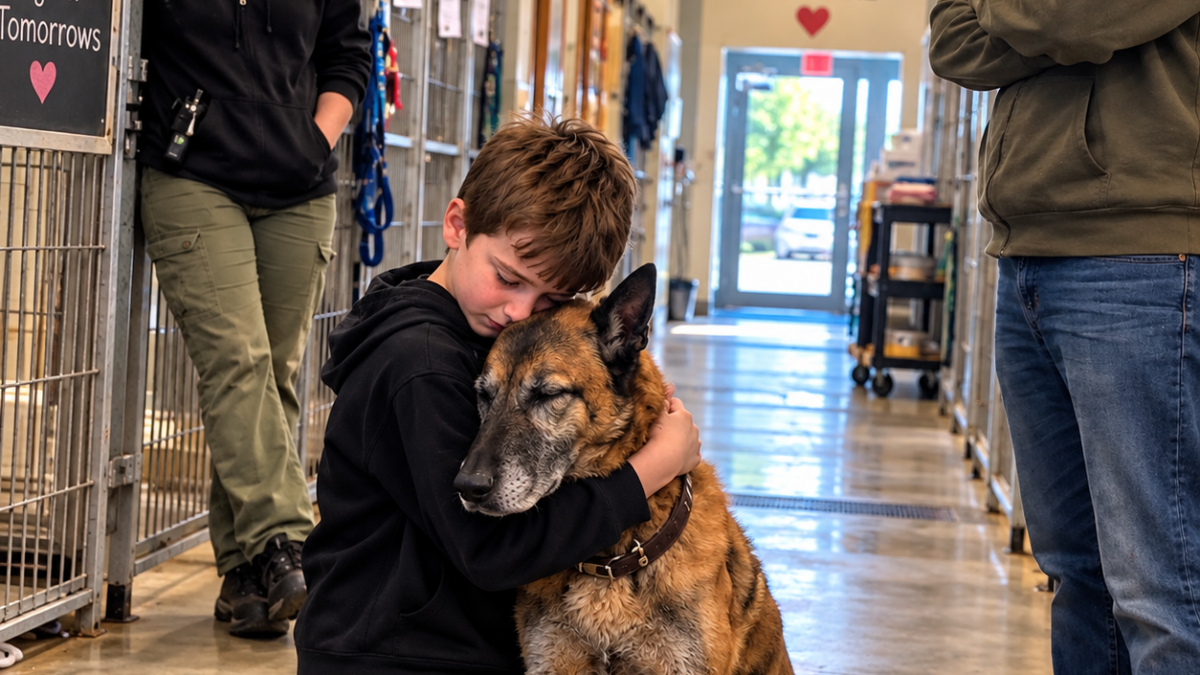
PART 2
I looked at the file.
Then at Marissa.
“What does that mean?”
She turned the folder toward us.
On top was Ranger’s intake photograph.
He looked different.
Not younger exactly—the photo was only a little over a year old—but fuller. His coat was thicker. His ears were higher. There was still gray around his muzzle, but his eyes had more light in them.
Beside the picture was a surrender form.
OWNER RELINQUISHMENT.
SIGNED.
Marissa tapped the date.
“Ranger lived with the same family for almost twelve years.”
Noah was still standing beside the desk.
He looked toward the hallway leading back to Ranger’s kennel.
“Twelve?”
“Yes.”
“Since he was a puppy?”
“Almost.”
Noah’s voice dropped.
“Then why did they leave him?”
Marissa sat back.
According to the surrender notes, Ranger’s arthritis had become more difficult to manage. He needed medication, regular veterinary visits, and changes around the home to keep him comfortable.
His owner, a man named Martin Hale, had told the shelter he had recently lost work and could no longer afford the medical expenses.
“That happens,” Marissa said. “We don’t judge people simply because they reach a point where they can’t provide care.”
I nodded.
I’d never had to surrender an animal, but I could understand being trapped by circumstances.
Marissa continued.
“The problem is the way Ranger responded afterward.”
“What do you mean?” Emily asked.
“For the first few weeks, every time a middle-aged man came through the adoption hallway, Ranger stood up.”
Noah’s face changed.
“He thought it was his person.”
“We think so.”
Marissa looked at the file.
“He’d go to the kennel door and wait. If the man kept walking, Ranger would sit down again.”
I glanced toward Noah.
He was trying very hard not to cry.
Marissa continued more softly.
“Eventually, he stopped getting up.”
That sentence hurt more than I expected.
Emily reached for Noah’s hand.
Marissa turned several pages.
“We worked on his arthritis. His blood tests are stable. His heart sounds good for his age. He has some hearing loss. His hips are stiff, especially in cold weather.”
“How long does he have?” I asked.
It was the question I didn’t want to ask.
But I was a father before I was anything else.
If we took this dog home, Noah needed to understand what that could mean.
Marissa didn’t pretend she had an answer.
“Could be months. Could be two years. Maybe longer. Nobody can promise.”
Noah looked at me.
“Dad.”
I knew what he was asking.
I also knew exactly why I was afraid.
Our family had never owned a dog.
We had planned for scraped doors, chewed shoes, puppy classes, and house-training accidents.
We had not planned for joint supplements, ramps, pain medication, and the possibility that my son’s first dog might not make it to his thirteenth birthday.
I said, “Noah, we need to think about this.”
His eyes filled.
“You said I could choose.”
“A dog, yes.”
“I choose him.”
“This isn’t about not wanting him.”
“Then what is it?”
I paused.
How do you explain anticipatory grief to an eleven-year-old?
“You could love him a lot,” I said, “and still not get much time.”
Noah stared at me.
Then he looked toward Ranger’s kennel.
Finally he said, “He’s already not getting much time.”
Nobody in that office moved.
Noah continued.
“If he has six months, shouldn’t somebody make them good?”
Emily turned away and wiped beneath one eye.
I lost the argument right there.
Not because Noah had manipulated us.
Because there was nothing left to argue with.
I looked at Marissa.
“What do we need to do?”
Noah’s face changed instantly.
“Really?”
I pointed at him.
“You’re involved in everything.”
“I will be.”
“Medicine.”
“Yes.”
“Walking.”
“Yes.”
“Cleaning up.”
“Yes.”
“And if you get tired of doing it?”
“I won’t.”
“You will.”
He blinked.
I continued.
“Everybody gets tired. You do it anyway.”
He nodded.
“Okay.”
I signed the first form.
Then another.
Then another.
When we went back to Ranger’s kennel, Marissa clipped on a leash.
Ranger stood slowly.
Noah took the handle.
For a few seconds, the old dog didn’t move.
Then Noah crouched.
“We’re going home.”
Ranger’s ears lifted.
He followed.
The entire shelter staff seemed to notice.
A woman from the front desk came out.
Then a volunteer.
Then another employee.
Someone whispered, “Is Ranger leaving?”
Marissa smiled.
“He’s leaving.”
A few people clapped.
Not loudly.
Nobody wanted to frighten him.
But Ranger heard.
He turned his head.
One volunteer was openly crying.
“You better not come back,” she told him.
Ranger wagged his tail.
Just once.
Noah saw it.
“Dad!”
“I saw.”
“He wagged!”
“I saw.”
The ride home was quiet.
Ranger lay across the back seat beside Noah.
At first, his body stayed tense.
Every turn made him lift his head.
Every stop made him look toward the window.
Noah kept one hand beside him without constantly touching.
That impressed me.
At one point, Ranger lowered his head onto Noah’s leg.
Noah looked at me through the mirror.
He didn’t say anything.
He didn’t need to.
When we got home, Ranger refused to enter.
He stood at the bottom of the porch steps.
Three steps.
That was all.
But his hips wouldn’t cooperate.
Noah immediately ran toward him.
“Wait,” I said.
Ranger flinched at Noah’s movement.
My son stopped.
“Sorry.”
I went into the garage and found two pieces of plywood left from an old project.
They weren’t enough for a proper ramp, but together they made a temporary slope.
Ranger looked at it.
Then at us.
Noah walked up first.
“See?”
Ranger put one paw onto the board.
Then another.
Slowly, he climbed.
That became our first lesson.
We had imagined teaching a puppy how to live in our house.
Instead, Ranger taught us how to change the house for him.
His food bowl went onto a raised stand so he wouldn’t have to bend too far.
We bought runners for the hardwood floors because his back feet slipped.
We moved his bed away from the draft.
I built a proper ramp for the porch.
Emily bought orthopedic bedding so expensive I accused her of choosing Ranger over me.
She looked at our mattress and said, “He has worse hips.”
I couldn’t argue.
The first night, we put Ranger’s bed beside Noah’s.
At 11:30, Noah came into our room.
“He won’t sleep.”
I sat up.
“Is he whining?”
“No.”
“Pacing?”
“No.”
“What is he doing?”
“Sitting at my door.”
I followed him.
Ranger sat facing the hallway.
Not the bedroom.
The hallway.
His ears were up.
His eyes were fixed toward the front of the house.
Waiting.
I remembered Marissa’s words.
Every time a man came down the shelter hallway, Ranger used to stand.
I sat beside him.
“Come on, buddy.”
He didn’t move.
Noah sat on the other side.
For nearly twenty minutes, all three of us stayed there.
Then Noah picked up Ranger’s bed and dragged it into the hallway.
“What are you doing?”
“If he wants to wait here, he can wait somewhere soft.”
That became the arrangement.
Ranger slept in the hallway for six nights.
On the seventh, his bed was empty when I woke up.
I panicked for half a second.
Then I found him in Noah’s room.
Curled beside the bed.
Noah’s arm hung over the edge, fingertips resting against Ranger’s shoulder.
I didn’t wake them.
The next few weeks were not a magical transformation.
Ranger didn’t suddenly become a puppy.
Some mornings he didn’t want to walk.
Some nights his hips bothered him.
He had two accidents inside.
He hated his medication if we put it directly into food and became an expert at eating everything around the pill.
Noah learned to hide it in a piece of chicken.
Ranger learned to separate the chicken from the pill.
It became a competition.
One evening Noah stood in the kitchen holding a wet tablet.
“He spit it at me.”
I laughed.
“Maybe he doesn’t like your technique.”
“He’s doing it on purpose.”
Ranger looked innocent.
Emily said, “He spent twelve years training humans. You’re not winning.”
Noah tried cheese.
Ranger swallowed the pill immediately.
“Traitor,” Noah said.
Ranger wagged.
Little by little, something returned.
At first, it was only his tail.
Then he started greeting us at the door.
Then came the tennis ball.
I found an old one in the box of puppy supplies we’d bought before going to the shelter.
I rolled it across the living room.
Ranger’s head came up.
The ball stopped beside the couch.
He stared at it.
Noah whispered, “He knows.”
Ranger stood.
Walked over.
Picked it up.
We both froze.
He returned halfway.
Stopped.
Then lay down with the ball.
Noah laughed.
“That’s not fetch.”
Ranger chewed once.
Then looked at him.
Noah rolled a second ball.
Ranger’s ears lifted.
That evening he retrieved exactly three times.
After the third, he lay down.
Noah sat beside him.
“That was enough?”
Ranger rested his chin on the tennis ball.
Noah nodded.
“Okay. Three is good.”
That became our rule.
We measured joy differently with Ranger.
A puppy might run for an hour.
Ranger chased a ball three times.
A puppy might leap onto the couch.
Ranger climbed halfway onto the rug and rolled onto his back.
A puppy might drag us down the street.
Ranger walked one block, stopped under the big oak tree, and sniffed for two full minutes.
Noah never complained.
One afternoon I saw him sitting on the porch with Ranger.
No phone.
No tablet.
Nothing.
Just the two of them watching cars.
I leaned against the doorway.
“What are you doing?”
Noah shrugged.
“Nothing.”
Ranger leaned against him.
I realized that was exactly the point.
About six weeks after the adoption, the shelter asked whether they could share a photograph.
“Ranger was our longest-stay senior,” Marissa said. “People ask about him.”
I thought she meant a small update.
We agreed.
The picture showed Noah kneeling beside Ranger on our porch.
Ranger wore a blue bandanna.
Noah had one arm around him.
The shelter caption was simple:
412 days waiting.
One 11-year-old boy decided that was long enough.
The post spread farther than any of us expected.
Local pages shared it.
Then a television station asked the shelter for permission to mention Ranger in a weekend adoption segment.
We said yes on the condition that Noah not be turned into some child celebrity.
The story aired for less than two minutes.
It showed Ranger walking slowly beside Noah.
Noah said one sentence:
“He didn’t need to be young. He just needed someone to pick him.”
That was it.
By Monday, the shelter had received dozens of inquiries about senior dogs.
It should have been nothing but good.
Then Marissa called.
Her voice was tense.
“Have you heard from anyone named Chloe Hale?”
“No.”
“Who is she?”
“Martin Hale’s daughter.”
Ranger’s previous owner.
I stood from my desk at work.
“What happened?”
“She saw the news piece.”
“Okay.”
“She called us crying.”
That I hadn’t expected.
“What did she want?”
“Ranger.”
My stomach tightened.
“To take him back?”
“No.”
Marissa hesitated.
“Rachel—sorry, wrong story.” Wait, need catch. Narrator name not established. We should not introduce Rachel. Use “She said…” Need correct in final. Let’s continue carefully. Need maybe narrator named David? Haven’t named him. We can remain unnamed. We can avoid.
Marissa said, “She didn’t know he was here.”
I sat back down.
“What do you mean she didn’t know?”
“She says her father told her Ranger had gone to live with a family friend.”
I looked through the glass wall of my office.
“What does that have to do with us?”
“Maybe nothing. But she also says she had been sending her father money for Ranger’s medication.”
That changed everything.
“How long?”
“Almost a year.”
Ranger had been in the shelter for 412 days.
More than thirteen months.
I did the math twice.
“She was sending money after Ranger had already been surrendered?”
“Yes.”
“For his medicine?”
“That is what she says.”
“How much?”
“About a hundred fifty dollars a month.”
I stared at my desk.
“Does Martin know she called?”
“Not yet.”
“What does she want from us?”
“To see Ranger.”
My first reaction was no.
Not because I thought Chloe had done anything wrong.
Because Ranger had finally stopped waiting.
I didn’t want another person from his old life walking into our house and turning every clock backward.
Marissa must have heard it in my silence.
“You don’t have to agree.”
“Is she local?”
“About two hours away.”
“How old is she?”
“Twenty-two.”
That made me pause.
A college student.
If Ranger had lived with Martin’s family for almost twelve years, Chloe had grown up with him.
She would have been ten when they got him.
Nearly Noah’s age.
I thought about that.
“Let me talk to Emily.”
That evening, we told Noah.
He was sitting on the floor brushing Ranger.
“What if he wants to go with her?” he asked immediately.
The question hurt.
Emily sat beside him.
“Ranger belongs to us now.”
“I know.”
“But what if he loves her more?”
I looked at Ranger.
He was asleep through the entire family crisis.
“Noah, loving somebody from before doesn’t mean he loves you less.”
“What if seeing her makes him sad?”
That was the question I had been asking myself.
Finally Noah said, “If she loves him, she should get to know he’s okay.”
I stared at my son.
There are moments when your child says something that makes you proud.
There are other moments when they say something that makes you feel slightly embarrassed that they got to the better answer before you did.
This was the second kind.
We arranged the visit at the shelter, not our home.
Neutral place.
Familiar staff.
No pressure.
Chloe arrived carrying a faded red leash.
She was small, with dark hair pulled into a ponytail.
The moment she saw Ranger through the fenced yard, she stopped walking.
Her face crumpled.
“Oh my God.”
Ranger was beside Noah.
His ears lifted.
Chloe covered her mouth.
“Ranger?”
He froze.
Then something happened I will never forget.
His tail moved.
Not the gentle old-dog wag we’d grown used to.
Harder.
Faster.
His entire back end began moving.
Chloe dropped to her knees.
Ranger pulled the leash.
Noah let it slide through his hand.
Ranger crossed the yard as quickly as his hips allowed.
Chloe buried her face in his neck.
“I’m sorry.”
Ranger licked her chin.
She laughed and cried at the same time.
“You old idiot.”
Noah stood beside me.
I looked down at him.
He looked scared.
I placed my hand on his shoulder.
After several minutes, Chloe finally looked at us.
“Thank you.”
I nodded.
She touched Ranger’s white muzzle.
“We got him when I was ten.”
Noah stepped closer.
“I’m eleven.”
Chloe looked at him.
A strange understanding passed between them.
“You chose him?”
Noah nodded.
“He chose pretty good.”
Noah smiled slightly.
We sat at a picnic table inside the shelter courtyard.
Ranger lay between Noah and Chloe.
Chloe told us the rest.
Her parents had divorced when she was sixteen.
Ranger stayed with her father.
Chloe left for college several years later but came home often.
Then her father’s financial situation deteriorated.
“He called me last year,” she said. “Said Ranger’s medicine was getting expensive.”
“How much did he say?”
“Two hundred a month.”
Marissa, sitting nearby, frowned.
“His medication at the shelter costs less than forty.”
Chloe looked sick.
“I didn’t know.”
She had begun sending money.
Sometimes one hundred fifty.
Sometimes two hundred.
She believed it paid for veterinary visits and arthritis medication.
The last photograph her father sent her showed Ranger asleep near a fireplace.
“How old was the picture?” I asked.
Chloe looked away.
“I checked yesterday.”
That told me enough.
“Old?”
“Two years.”
Noah was listening carefully.
I wished he wasn’t.
But this was Ranger’s story, and pretending the uncomfortable parts didn’t exist wouldn’t help him understand what had happened.
Chloe continued.
“I asked Dad if I could visit Ranger at Christmas. He said Ranger was staying with a family friend because he had to travel.”
“When did he tell you Ranger went there permanently?”
“About nine months ago.”
Ranger had already been at the shelter for months by then.
“What did he say?”
“That it was better. Big yard. Retired couple.”
There had been no retired couple.
No family friend.
Ranger had been in kennel 37.
Chloe started crying again.
“I would’ve taken him.”
Noah looked at her.
“You can still visit.”
She stared at him.
“Really?”
Noah shrugged.
“He knows you.”
I swallowed hard.
There are adults who spend years learning generosity children sometimes produce in one sentence.
Chloe visited again two weeks later.
Then a month after that.
Ranger gradually began treating her visits as something good rather than something that might take him away.
That mattered.
The first time Chloe left, Ranger watched the shelter door for several minutes.
Noah crouched beside him.
“She’ll come back.”
Ranger looked at him.
“So will we.”
Then he walked to our car.
That was progress.
The problem was Martin.
Chloe confronted him.
I learned about it because the shelter received a certified letter from an attorney three days later.
Martin claimed there had been a misunderstanding.
He claimed Ranger was never intended to be permanently surrendered.
He said the shelter had agreed to “temporary care” while he stabilized financially.
He demanded Ranger be returned.
When Marissa called me, I thought she was joking.
“He signed the surrender.”
“Yes.”
“Permanent surrender.”
“Yes.”
“He signed the line that says ownership transfers immediately.”
“Yes.”
“So why are we talking?”
“Because he has an attorney.”
That sentence has a way of turning obvious things complicated.
The shelter’s attorney reviewed the file.
Ranger’s paperwork was clear.
The danger wasn’t that Martin had a strong ownership claim.
The danger was disruption.
Letters.
Hearings.
Complaints.
Possible civil filings.
A man embarrassed by his daughter discovering the truth had decided changing the story might be easier than admitting it.
Chloe called me that evening.
“I’m sorry.”
“This isn’t your fault.”
“I confronted him.”
“You had a right to.”
“He thinks you all made him look bad.”
“We didn’t mention his name.”
“I know.”
“He surrendered Ranger more than a year ago.”
“I know.”
“He kept taking money from you.”
Silence.
“Yes.”
I sat on the back porch.
Ranger was lying beside Noah in the yard.
“What does he actually want?”
Chloe’s voice became quieter.
“I think he wants me to stop asking questions.”
That made sense.
If Martin could convince everyone Ranger had merely been placed temporarily, then the monthly payments from Chloe might look less deliberate.
Maybe he could say he intended to bring Ranger home.
Maybe he could make the entire timeline fuzzy.
“Do you have the transfers?”
“All of them.”
“Messages?”
“Yes.”
“Keep everything.”
“The shelter attorney told me the same thing.”
Good.
Martin’s first formal complaint was filed with the county department that licensed the shelter.
He alleged improper adoption of a dog under temporary boarding status.
The county asked for records.
Harbor County Animal Rescue gave them everything.
The surrender form.
Intake notes.
Medical authorization.
A copy of Martin’s identification.
His signature in four separate places.
Most important was a page Marissa had forgotten existed.
A final relinquishment acknowledgement.
I WILL NOT RETAIN OWNERSHIP OR RECLAIM RIGHTS AFTER SURRENDER.
Martin’s initials appeared beside it.
The county dismissed the complaint.
That should have ended it.
It didn’t.
Martin filed a civil petition.
This time he claimed his signature had been obtained while he was under “extreme financial pressure” and that shelter staff had misrepresented his options.
He also alleged that Ranger’s adoption had been exploited for publicity.
That part made me angry.
Noah had never asked to be on television.
We had never made money from Ranger’s story.
The shelter used his adoption to encourage people to consider older dogs.
Martin’s attorney sent us a letter asking that we stop posting images of Ranger until the ownership question was resolved.
I put the letter on the kitchen table.
Emily read it twice.
“This is ridiculous.”
“Yes.”
“Can they take Ranger?”
“The shelter attorney says probably not.”
“Probably?”
“I hate that word too.”
Noah had walked into the room.
“What are you talking about?”
We both stopped.
Ranger followed him.
Noah looked from me to Emily.
“Is someone taking Ranger?”
“No.”
I answered too quickly.
Children hear that.
“Dad.”
I stood.
“No one is taking him tonight.”
“That isn’t what I asked.”
I hated how much he had grown in only a few months.
We sat down.
I explained the situation carefully.
Martin had challenged the adoption.
The shelter believed our paperwork was valid.
A court might need to confirm it.
Noah’s face went pale.
“He left Ranger.”
“Yes.”
“For 412 days.”
“Yes.”
“And now he wants him?”
“That’s what he’s saying.”
“Why?”
There are questions children ask that adults should answer honestly.
There are others where the honest answer is: I don’t know because grown-ups are complicated.
“I think he wants to change what people believe happened.”
Noah looked at Ranger.
The dog was sitting beside his chair.
“Does Ranger have to go to court?”
I almost laughed from relief.
“No.”
“Good.”
Noah put both arms around him.
“He hates waiting rooms.”
The hearing was set six weeks later.
During those six weeks, Ranger had no idea his ownership was being argued by adults.
He continued living.
That helped me.
Every morning Noah gave him medication hidden in cheese.
Every afternoon, one of us walked him around the block.
On Saturdays we took him to a park where the paths were flat.
Ranger developed a habit of stopping at the same bench.
Noah would sit.
Ranger would lean against his knees.
Sometimes strangers approached.
“Beautiful dog.”
“How old?”
When Noah said fourteen—because Ranger’s birthday had passed by then—people looked surprised.
“He looks great.”
Noah always smiled.
“He waited a long time.”
He rarely said 412 days anymore.
At first, that number defined Ranger.
Eventually, it became only something that had happened before.
The best day came in early spring.
I was throwing a tennis ball gently across the backyard.
Ranger had been retrieving three or four times at most.
That day he brought it back five times.
Then six.
Noah shouted, “Six!”
Ranger barked.
A real bark.
Deep.
Surprised.
He dropped the ball.
Noah laughed so hard he fell into the grass.
Ranger walked over and licked his face.
I took a picture.
Not for social media.
For us.
The hearing arrived on a rainy Tuesday.
The shelter’s attorney told us I might be called as a witness.
Noah stayed in school.
I refused to let an eleven-year-old sit through adults arguing over the dog he loved.
Chloe came.
So did Marissa.
Martin sat across the room.
It was the first time I had seen him.
He looked nothing like the villain I had built in my head.
That bothered me.
He looked tired.
Late forties.
Pressed shirt.
Wedding ring.
Graying hair.
Ordinary.
He glanced at me once.
Then away.
The judge began with the ownership documents.
Martin’s attorney argued the surrender had occurred during temporary financial hardship.
He said Martin loved Ranger and intended to reclaim him once stable.
The judge asked, “Where is that written?”
The attorney pointed to an intake note mentioning financial hardship.
The judge looked at the actual surrender agreement.
“This says permanent relinquishment.”
Martin’s attorney replied, “My client misunderstood.”
Then Marissa testified.
She described the surrender.
The judge asked, “Did Mr. Hale ask for temporary boarding?”
“No.”
“Foster assistance?”
“No.”
“Financial assistance?”
“We discussed a low-cost senior pet program.”
Martin’s head lifted.
That was new to me.
Marissa continued.
“We offered to help him apply.”
“And?”
“He declined.”
The judge looked at Martin.
His attorney stood.
“My client believed the process would take too long.”
Marissa said nothing.
The judge continued.
“Did he ever ask when he could retrieve Ranger?”
“No.”
“Did he contact the shelter during the 412 days Ranger remained there?”
“No.”
That landed hard.
Not once.
Four hundred twelve days.
No phone call.
No email.
No visit.
Then Martin testified.
He said he had been overwhelmed.
He had lost work.
His marriage had been strained.
He was behind on bills.
He loved Ranger.
He believed the shelter would care for him temporarily.
He claimed that months later, when his finances improved, he assumed Ranger had already been rehomed and didn’t know how to correct the situation.
The shelter’s attorney asked one question.
“If you believed Ranger was in temporary care, why did you tell your daughter he was living with a retired couple?”
Martin looked toward Chloe.
She did not look away.
“I was embarrassed.”
The attorney nodded.
“Embarrassed about what?”
“That I couldn’t care for him.”
“Then why continue accepting money from Chloe for Ranger’s medication?”
Martin’s attorney objected.
The judge allowed limited questioning because it related to his claimed intent to reclaim Ranger.
Martin’s face changed.
“The money wasn’t specifically—”
Chloe’s attorney handed over printed messages.
I hadn’t known there would be messages.
The judge read one.
Chloe:
How’s Ranger’s hip today? I sent the $150 for his meds.
Martin:
He’s better. Vet says stay on the same dose.
Date:
Three months after Ranger entered the shelter.
Another.
Chloe:
Can you send me a new picture?
Martin:
He’s sleeping. I’ll do it tomorrow.
Date:
Five months after surrender.
Another.
Chloe:
Please tell him I miss him.
Martin:
He misses you too.
Ranger was in kennel 37.
I looked at Martin.
His shoulders had dropped.
The shelter’s attorney asked, “What veterinarian told you to keep Ranger on the same dose?”
Martin said nothing.
“Mr. Hale?”
“I don’t remember.”
“No veterinary visit occurred because Ranger was no longer in your care, correct?”
Martin’s attorney rose again.
The judge stopped him.
“I want the answer.”
Martin looked down.
“Yes.”
That single word ended the fiction.
The hearing continued another hour.
But everyone in the room understood.
This was no longer about a confused surrender.
Martin had made one painful decision.
Then instead of admitting it, he had built lie after lie around it.
Maybe the first lie came from shame.
Maybe the next came because Chloe sent money.
Maybe financial pressure made keeping that money seem easier than telling his daughter the truth.
But eventually the lies required Ranger’s story to remain hidden.
Then Noah chose him.
And suddenly Ranger was visible.
That was why Martin had come back.
Not because the dog had changed.
Because the secret had.
The judge dismissed Martin’s claim.
The adoption remained valid.
Ranger was legally ours.
I closed my eyes.
For several seconds, all I could hear was paper moving.
Then Chloe started crying quietly.
Martin stood.
His attorney touched his arm.
He pulled away.
For one terrifying second, I thought he was going to come toward me.
Instead he turned toward Chloe.
“You did this.”
She stared at him.
“No.”
Her voice shook, but she didn’t lower it.
“You did.”
He looked as if she had struck him, though she had barely raised her voice.
“You could’ve told me,” she continued. “I would’ve taken Ranger. I would’ve helped you honestly.”
“I was trying to survive.”
“So was he.”
The room went silent.
Martin looked toward the door.
Chloe continued.
“You didn’t lose Ranger because of these people.”
She pointed toward me and Marissa.
“You lost him when you decided telling the truth was harder than leaving him there.”
Martin left.
I never spoke to him that day.
I didn’t need to.
Outside the courthouse, Chloe hugged me.
“Can I still see him?”
“Of course.”
She laughed through tears.
“I didn’t want to ask in there.”
“You’re part of his life.”
“Noah said that first.”
“He’s usually ahead of me.”
Martin’s financial dispute with Chloe continued separately.
She eventually recovered much of the money she had sent after Ranger’s surrender through an agreement handled by their attorneys.
I didn’t ask for details.
That was between them.
The shelter never published Martin’s name.
Neither did we.
I didn’t want revenge to become humiliation.
The consequence that mattered was simpler.
He couldn’t rewrite Ranger’s history.
His signatures existed.
His messages existed.
His own decisions existed.
And Ranger stayed with Noah.
That night, when I returned home, Noah met me at the door.
“Well?”
I looked serious for half a second.
Then I smiled.
“He’s yours.”
Noah ran past me toward Ranger.
“He was already mine!”
Ranger barked.
Emily started laughing.
I stood in the doorway watching my son wrestle carefully with a fourteen-year-old dog who had once stopped expecting anyone.
That was the victory.
Not the hearing.
Not Martin’s embarrassment.
This.
The following month, Harbor County Animal Rescue launched a senior-dog program.
The attention around Ranger had produced donations.
Enough to cover adoption fees and initial medication costs for several older dogs.
Marissa called Noah.
“We need a name.”
“For what?”
“The program.”
Noah thought about it.
“Don’t name it after Ranger.”
“Why not?”
“He already has a home.”
Marissa laughed.
“Okay. What would you call it?”
Noah looked at Ranger lying beside him.
“The 412 Project.”
I felt my throat tighten.
Marissa went quiet too.
“Why?”
“Because nobody should have to wait that long.”
The name stayed.
The 412 Project paid for medication, senior blood work, orthopedic beds, and reduced adoption costs for older animals.
Within the first six months, fourteen senior dogs left the shelter.
One had waited 233 days.
Another 301.
A twelve-year-old beagle named Daisy had been overlooked for almost a year.
An elderly man adopted her.
When Noah heard, he smiled.
“Good.”
That was all.
Ranger’s story was no longer only about Ranger.
It was opening doors behind him.
He turned fifteen the following winter.
We had a small birthday party.
No hats.
Emily tried one.
Ranger shook it off.
Noah said, “Respect his dignity.”
Then fed him a dog-safe cupcake.
Ranger ate it in three bites.
“Very dignified,” I said.
Chloe came.
So did Marissa.
Ranger spent most of the afternoon asleep between Noah and Chloe.
At one point Chloe touched the scar near his ear.
“Do you think he remembers our old house?”
Noah shrugged.
“Probably.”
“Does that bother you?”
He looked confused.
“Why?”
“Because it was his home before.”
Noah thought about it.
Then said, “People can have more than one home.”
Chloe looked down.
“That’s a pretty good answer.”
Ranger’s fifteenth year was slower.
His arthritis progressed.
We added another medication.
Then another rug.
Then a ramp to the backyard because even the modified step became difficult.
Noah helped me build it.
He was twelve now.
Taller.
Less round in the face.
He used the drill while I held the boards.
“Think he’ll use it?”
“He’ll complain first.”
Ranger stood nearby watching us.
“You’re welcome,” I told him.
When the ramp was finished, Ranger sniffed it.
Then walked around and tried the old step.
His back legs slipped.
Noah caught him.
“Dude.”
Ranger looked offended.
Noah guided him to the ramp.
He used it.
“See?”
Tail wag.
By thirteen, Noah could give Ranger medication without reminders.
He knew which days required longer rest.
He knew how to support Ranger’s hips getting into the car.
He knew that love was not only the fun part.
That was the gift Ranger gave him.
Not childhood happiness exactly.
Responsibility without resentment.
Patience.
The ability to sit beside someone who couldn’t do what they used to do and not make them feel like a burden.
One evening, Noah came into my room.
“Dad?”
“Yeah?”
“How old do dogs like Ranger live?”
I put down my book.
He already knew the answer wasn’t going to be comfortable.
“Depends.”
“I looked it up.”
Of course he had.
“Then why are you asking me?”
“Because websites don’t know Ranger.”
I smiled sadly.
“No. They don’t.”
He sat on the edge of the bed.
“Do you think he’ll make sixteen?”
I looked toward the hallway.
Ranger was asleep outside Noah’s room.
“I hope so.”
“That means you don’t know.”
“No.”
Noah stared at his hands.
“I hate that.”
“Me too.”
“What if I picked the puppy?”
I knew immediately what he meant.
The puppy would probably still have ten years ahead.
Maybe more.
Ranger did not.
“Do you regret picking him?”
“No.”
The answer came instantly.
Then Noah whispered, “I just wish picking him meant I got to keep him.”
I moved closer.
“That’s not how choosing someone works.”
“I know.”
“You don’t choose how long.”
He looked at me.
“You choose what you do with the time.”
He rolled his eyes slightly.
“That sounds like something from a movie.”
“Probably is.”
“Still true?”
“Unfortunately.”
He nodded.
Then got up.
At the door he stopped.
“Dad?”
“Yeah?”
“If he wakes up tonight, can I sleep downstairs?”
“Sure.”
Ranger did wake.
Noah slept beside him.
In March, Ranger stopped eating breakfast.
That alarmed us because Ranger loved food with a devotion bordering on religion.
Emily called the veterinarian.
Blood tests showed early kidney disease.
Not severe.
Manageable.
We changed food.
Adjusted medication.
Ranger improved.
For several months, things stabilized.
He made it to sixteen.
Barely, but he made it.
Noah insisted on another birthday.
This one was quieter.
Ranger wore no hat.
Nobody tried.
Chloe brought the old red leash from her childhood.
“I found it in a box,” she said.
Ranger sniffed it.
Then rested his head on her knee.
Chloe cried.
Noah didn’t look uncomfortable anymore when adults cried around Ranger.
He understood.
A week later, he asked if he could hang the leash in his room.
Chloe gave it to him.
Summer arrived.
Ranger’s walks became shorter.
At first, around the block.
Then halfway.
Then just to the mailbox.
Noah never pulled him.
Never hurried.
Sometimes the walk to the mailbox took fifteen minutes.
Our neighbors learned not to ask whether something was wrong.
Ranger was simply reading the neighborhood one smell at a time.
One July evening, we sat on the porch.
Ranger lay between Noah and me.
A family walked past with a puppy.
The puppy bounced against the leash, tail flying.
Noah watched.
I wondered if part of him imagined the dog he’d originally expected on his eleventh birthday.
“You okay?” I asked.
He looked at me.
“Yeah.”
“Cute puppy.”
“Very.”
“Still wish we’d gotten one?”
He thought about it.
Then scratched Ranger’s head.
“Maybe someday.”
Ranger sighed.
Noah smiled.
“But that would’ve been a different dog.”
Exactly.
By September, Ranger needed help standing some mornings.
The vet talked with us about quality of life.
Pain.
Appetite.
Sleep.
Mobility.
Interest.
Good days and bad.
I hated the conversation.
Noah sat beside us.
I considered asking him to leave.
Then I realized he had earned the right to hear it.
Dr. Lewis spoke gently.
“We aren’t making a decision today.”
Noah nodded.
“We’re watching.”
“Yes.”
“How do we know?”
“You look at whether Ranger still has things he enjoys.”
“Tennis balls?”
“If he wants them.”
“Food?”
“Yes.”
“Being with us?”
“Absolutely.”
Noah looked at Ranger.
“What if he still wants us but his body doesn’t work?”
Dr. Lewis paused.
“That is often the hardest part.”
Noah swallowed.
Ranger leaned against his leg.
We went home.
For several weeks, Ranger remained stable.
Then one Saturday morning, Noah brought the tennis ball outside.
He rolled it.
Ranger watched.
Didn’t move.
Noah rolled it closer.
Ranger sniffed it.
Then looked at Noah.
My son sat down.
“Okay.”
No disappointment in his voice.
No attempt to make Ranger perform the past.
He placed the ball beside him.
“We can just sit.”
They sat.
I watched from the kitchen.
That may have been the moment Noah stopped being a child in one small corner of his heart.
Not when Ranger ran.
When Ranger couldn’t.
And Noah stayed anyway.
Two weeks later, Ranger’s appetite disappeared.
The veterinarian came to our house.
I knew why.
So did Emily.
Noah knew before anyone said it.
He sat on the floor beside Ranger’s bed.
“Is this the day?”
Dr. Lewis didn’t lie.
“I think he’s very tired.”
Noah nodded.
He didn’t cry immediately.
He stroked Ranger’s ear.
Chloe drove down.
Marissa came after the shelter closed.
Nobody made it crowded.
Ranger had spent enough of his life around people deciding things for him.
His last evening was quiet.
He ate three pieces of chicken.
Ignored the fourth.
Noah carried the old tennis ball outside.
We placed Ranger on a blanket in the backyard because he had always liked the evening air.
The sun was low.
Ranger looked toward the fence.
Birds moved in the trees.
Noah lay beside him.
“I picked you because you waited 412 days.”
His voice cracked.
Ranger’s ear moved.
“I thought I was rescuing you.”
Noah laughed softly through tears.
“That was kind of arrogant.”
I put my hand over my mouth.
Emily was crying openly.
Noah continued.
“You taught me how to be patient.”
Ranger breathed slowly.
“And how to hide pills in cheese.”
Chloe laughed through tears.
Noah’s voice broke again.
“And you taught me that old doesn’t mean finished.”
He pressed his forehead against Ranger’s.
“I’d pick you again.”
That finished me.
I turned away for a second.
When I looked back, Ranger’s tail had moved.
Just once.
Maybe because Noah touched him.
Maybe because he heard his voice.
Maybe coincidence.
It didn’t matter.
We saw it.
Dr. Lewis came just before sunset.
She explained everything.
Noah insisted on staying.
I asked twice.
He said, “He’s never been alone since we got him.”
There was no answer to that.
Ranger lay on his side.
His head rested in Noah’s lap.
Chloe sat near his front paws.
Emily and I sat behind Noah.
Marissa knelt nearby.
The old tennis ball was beside Ranger.
The red leash lay folded under his blanket.
Noah whispered, “You don’t have to wait anymore.”
Ranger’s eyes were half closed.
“We’re all here.”
His breathing became easier.
Then slower.
Dr. Lewis administered the final medication only after Ranger was deeply relaxed.
No fear.
No rushing.
No kennel.
No unfamiliar room.
No one walking away.
His last breath came with Noah’s hand on his head.
For several minutes, nobody spoke.
The backyard was almost completely dark when Noah finally whispered, “Sixteen.”
I nodded.
“He made sixteen.”
Noah cried then.
Not quietly.
Not politely.
He wrapped both arms around Ranger and cried the way children do before they learn to hide grief from other people.
I held my son.
Emily held both of us.
Chloe sat beside Ranger and cried too.
There was nothing beautiful about losing him.
I won’t pretend otherwise.
The beautiful part had come before.
The mornings.
The cheese.
The ramps.
The three-ball games.
Then six.
The porch.
The walks that took fifteen minutes to reach a mailbox.
The simple fact that a dog who had stopped standing when people entered the shelter eventually spent years getting up every time Noah came home.
The house felt enormous afterward.
No nails on the floor.
No medicine on the counter.
No black-and-tan shape blocking the hallway.
No reason for the ramp.
I couldn’t bring myself to remove it.
Neither could Noah.
Weeks passed.
Then months.
The 412 Project continued.
By the second anniversary of Ranger’s adoption, forty-seven senior dogs had been placed.
The shelter invited Noah to visit.
He was fourteen now.
Marissa showed us a kennel near the end of the hall.
Inside sat an eleven-year-old hound mix named Walter.
He had been there 187 days.
Noah crouched.
Walter looked away.
I felt something familiar.
Noah sat on the floor outside the kennel.
Didn’t call.
Didn’t reach.
Just waited.
After several minutes, Walter came closer.
I looked at Emily.
She looked at me.
“No,” I whispered.
She smiled.
“We’re not doing this today.”
Noah turned around.
“I’m not asking.”
“Good.”
“I just wanted to sit with him.”
And he did.
That became a weekly habit.
Noah volunteered at the shelter on Saturdays.
Not every senior dog came home with us.
That was another lesson Ranger had taught him.
You can care without owning.
You can help without promising forever to everyone.
You can sit beside one frightened animal today and let another person take them home tomorrow.
Six months later, Walter was adopted by a retired couple.
Noah helped carry his bed to their car.
When the vehicle drove away, Marissa asked, “You sad?”
“A little.”
“You wanted him?”
“I wanted him to go home.”
That answer told me Ranger’s work was finished.
On what would have been Ranger’s seventeenth birthday, the shelter unveiled a small plaque near the senior-dog wing.
I had expected a photograph.
Instead, it was simple.
RANGER
WAITED 412 DAYS
LOVED FOR THE REST OF HIS LIFE
Below it:
OLDER DOES NOT MEAN TOO LATE.
Noah stood in front of it.
Chloe came too.
She had rebuilt parts of her relationship with her father, though not all of it.
Martin never visited us.
Never contacted Noah.
Years later, Chloe told me he had finally admitted what happened.
No excuse.
No legal argument.
He told her he had been ashamed of losing his job, embarrassed about needing help, and angry at how quickly his life seemed to be shrinking.
Surrendering Ranger had felt, in that moment, like removing one problem.
Then he couldn’t admit what he’d done.
So he lied.
One lie became months of lies.
The money Chloe sent went toward overdue bills.
He eventually repaid her.
Not because a dramatic punishment transformed him.
Because consequences finally forced him to stop hiding from what he’d done.
I never forgave or hated him in any grand way.
He became less important over time.
Ranger had already outgrown him.
That was the real payback.
Martin had once decided an old dog was too difficult, too expensive, too close to the end to be worth the burden.
That dog went on to change my son’s life.
He inspired dozens of adoptions.
He created a fund that paid for medicine and beds for dogs nobody had chosen.
He repaired part of Chloe’s childhood simply by surviving long enough for her to find him again.
He taught an eleven-year-old boy that love is not measured by how much future someone can promise you.
And after waiting 412 days for one person to choose him, Ranger spent the rest of his life never having to wonder whether he belonged.
A few weeks after the plaque ceremony, Noah came into the garage while I was organizing tools.
“Dad?”
“Yeah?”
“I think I’m ready.”
I looked at him.
“For what?”
“Another dog.”
I put down the wrench.
“You sure?”
“No.”
That made me smile.
“Good answer.”
“I don’t want another Ranger.”
“I know.”
“I mean, I don’t want to replace him.”
“You can’t.”
“What if it feels wrong?”
“It probably will at first.”
He looked toward the old ramp still leaning against the garage wall.
“I want a dog who’s been waiting.”
Of course he did.
We returned to the shelter the following Saturday.
Not on a birthday.
No balloons.
No puppy plans.
No expectations.
We walked through the kennels.
Young dogs barked.
A puppy jumped against the glass.
Noah smiled.
Then kept walking.
Near the senior wing, he stopped.
Inside one kennel sat a nine-year-old shepherd mix named Millie.
She had been there ninety-six days.
Noah read the card.
Then he looked at me.
“Ninety-six isn’t 412.”
“No.”
“Still a long time.”
“Yeah.”
Marissa was standing behind us.
She smiled.
“Want to meet her?”
Noah looked at me.
This time I didn’t remind him of age.
Didn’t warn him about years.
Didn’t ask whether he was sure he wanted a dog who might not run as fast or live as long.
We already knew what those questions were worth.
I opened the gate.
Noah sat on the floor.
Millie stayed in the far corner.
He didn’t reach for her.
Didn’t call repeatedly.
He simply waited.
I watched my fourteen-year-old son sitting quietly in the same kind of kennel where, three years earlier, an eleven-year-old boy had once told an exhausted old dog:
“You’re not alone. I’m here.”
After several minutes, Millie stood.
She walked toward him.
Slowly.
Carefully.
Then leaned her shoulder against his chest.
Noah closed his eyes.
I felt Emily take my hand.
Nobody said Ranger’s name.
We didn’t have to.
He was already there in everything Noah knew how to do.
And when Millie finally followed my son out of the kennel, I looked back once at Ranger’s plaque down the hall.
Four hundred twelve days had sounded like an ending when we first met him.
It wasn’t.
It was only the amount of time Ranger had waited for the rest of his life to begin.
[END OF STORY]








