PART 2: My Inherited Mountain Cabin Was Ignored for Years—Until I Discovered Gold and the HOA Tried to Take
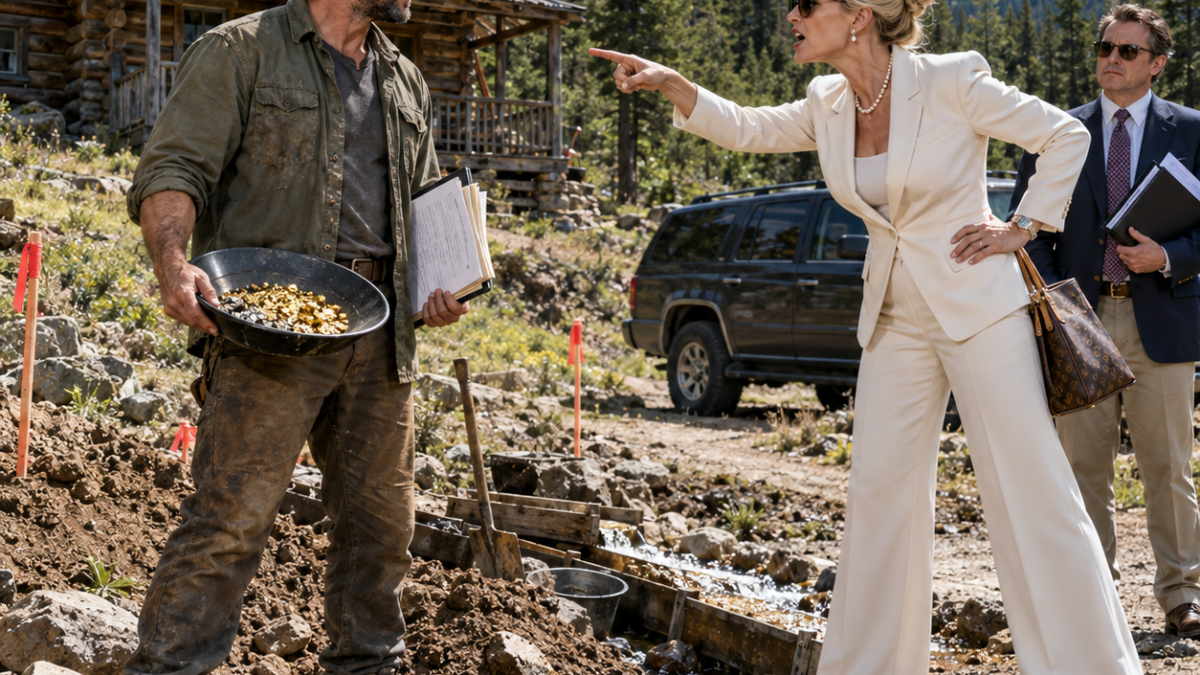
They came through my gate at dawn with a bulldozer and started carving a road across land my father had protected for more than sixty years.
The HOA president stood above the machine in a bright fuchsia jacket and told me one hundred thirty-eight families mattered more than one man with a woodworking shop.
What stopped me from fighting back that morning was not fear—it was knowing there was one phone call I could make only once, and I had to make it exactly right.
“Shut the machine down!”
The bulldozer operator looked toward me, but before he could touch the controls, Camille Dorsett raised one hand.
“Keep grading, Lonnie.”
I climbed through the torn opening where my north gate had been less than an hour earlier.
“That fence is on my property.”
Camille didn’t move.
“The board approved an emergency-access corridor Tuesday night.”
“You cut my gate before you mailed the notice?”
“Your notice went out.”
“That isn’t what I asked.”
She looked past me.
“Lonnie, keep moving.”
The blade dropped.
Broken shale rolled forward.
So did the last ten feet of the stone edge around my father’s springhouse.
I felt that in my chest more than I heard it.
My father had finished that springhouse in 1961, the last summer before his health started going downhill. He had laid every coping stone himself, cursed the grade twice, pulled two stones back out because the fall was wrong, then bragged about the finished line for the next thirty years.
Now water was spraying sideways into fresh bulldozer tracks.
I wanted to climb onto that machine.
Instead, I pulled out my phone and started recording.
Camille gave me a tight smile.
“You’re costing your neighbors twenty-one days, Wade.”
“What happens in twenty-one days?”
“The valley insurance survey.”
She pointed uphill toward Saddlebrook Ridge.
“One hundred thirty-eight homes. One entrance. If a brush fire drops a tree across that entrance road, those families are trapped.”
“That’s a real problem.”
“Good. Then stop creating another one.”
I crouched beside the nearest survey stake.
Pink ribbon.
Fresh dirt.
Black marker on one side.
A date.
I read it again.
Then once more.
The stake had been placed eleven days before the board meeting Camille claimed had authorized the road.
I stood.
“Where did this date come from?”
She was already walking uphill.
She never answered.
I went down into the cut.
The bulldozer had sliced through the ground beside the springhouse and exposed the old water line. The brass shutoff my father installed was bent nearly sideways beneath a broken slab.
I put both hands on it.
Closed it.
For four seconds, the flow weakened.
Then water burst from the shale six feet away.
The hill had already found a new path.
By the time I climbed back up, another trailer was coming down the pass carrying a small excavator.
Three laminated signs had appeared along my shop lane.
FIRE LANE
NO PARKING
The HOA had spent one morning turning my property into something they could later pretend had always existed.
Lonnie Pike leaned from the bulldozer cab.
“I’m not looking for trouble, Mr. Corrigan.”
“Then shut it down.”
“The office told me the owner signed off.”
“Did they show you my signature?”
He didn’t answer.
His eyes moved toward the water.
That told me enough.
I walked nine hundred feet down my gravel lane, past my woodworking shop, past the low bridge my father and I had built when I was nineteen, and down to the pond.
A faded county plate was still bolted beside the dry hydrant.
The volunteer fire company had drafted water there for decades.
I took out my phone.
Made one call.
Four sentences.
“It’s Corrigan. There’s a grading crew on my north field this morning. Send the standard conflict memorandum immediately and put it in writing. I do not touch this file.”
Then I hung up.
I pulled one of the HOA’s new FIRE LANE cards from a fence post, wrote the exact time on the back, and put it inside my jacket.
At 11:40 that morning, Saddlebrook Ridge emailed me an accusation.
Unauthorized interference with approved emergency corridor.
Attached was a map showing a red twenty-foot-wide line crossing my property.
Under it were five words:
EXISTING ACCESS AND WATER LINE EASEMENT.
I stared at those words for a long time.
Because there was an easement.
A twelve-foot easement.
For a rural water cooperative.
It allowed one maintenance truck to reach a buried pipe.
It did not authorize an HOA road.
It did not authorize emergency vehicles.
And it stopped two hundred feet before Coldwater Road.
Somebody had taken one real line on an old map and stretched it into something that had never existed.
I replied with five questions.
Who owns the claimed vehicle rights?
Where is the recorded instrument?
Who authorized cutting my gate?
What permit identifies my seven-ton bridge as fire-apparatus access?
Who gave permission to bulldoze my land?
The management company answered none of them.
That afternoon I measured the new road myself.
And when I reached the top curve, I already knew something else was wrong.
No full-size fire engine could make that turn without leaving the graded surface and driving farther into my field.
Then I looked back toward the springhouse.
Water was still pouring down the middle of a road I had never approved.
And for the first time, I understood that Camille had not simply crossed my property.
She had built her entire emergency plan on things nobody had bothered to verify.
PART 2
The next morning, Camille Dorsett came down to my shop at 10:09 carrying a black binder thick enough to make a small argument look official.
I had already been working since six. The kitchen water had turned cloudy overnight, so I had boiled two kettles before sunrise, filled a thermos, and spent the first few hours of the day trying to pretend that the muddy water under my shop sink did not smell like the inside of an iron pipe.
Camille stopped at the edge of my turning apron.
“You’ve made this personal.”
I set down the orbital sander.
“No. You brought a bulldozer through my gate.”
“The gate can be replaced.”
“My spring may not be.”
She didn’t look toward it.
That told me more than anything she said next.
She opened the binder.
“Saddlebrook Ridge has one hundred thirty-eight homes and one legal entrance. One. If a wildfire comes up that draw and a tree falls across Ridge Road, every family behind it has nowhere to go.”
“I know.”
“Then you know why this matters.”
“I know why emergency access matters.”
“Good.”
“I don’t know why you think that gives you my land.”
Her jaw tightened.
She had expected resistance.
What she had not expected was agreement with the part of her argument that was actually true.
“Twenty-one days,” she said.
“Until what?”
“The Insurance Rating Bureau conducts its field survey.”
I waited.
“If we cannot demonstrate a secondary emergency route, the valley classification may drop.”
“How far?”
“Potentially two classes.”
“That’s significant.”
“It’s about fourteen hundred dollars a year in additional premiums for some households.”
“Some?”
“Many.”
“In Saddlebrook.”
“In the valley.”
She took a step toward me.
“Including yours.”
I looked up the hill at the fresh gravel scar.
“You’re telling me the road you put through my spring was for my own insurance bill?”
“I’m telling you that you are one landowner with a shop.”
“And?”
“There are one hundred thirty-eight families.”
I looked at her.
“That sentence doesn’t create an easement.”
She shut the binder.
“I am not asking for your land.”
“You already took it.”
“We created emergency access.”
“You created a twenty-foot road.”
“For life safety.”
“Across property you do not own.”
“Across an existing access corridor.”
“No.”
“It is in the association documents.”
“No.”
Her face changed slightly.
Not because she doubted herself.
Because she wasn’t used to somebody answering her that cleanly.
I motioned toward my lane.
“Come with me.”
She hesitated, then followed.
We walked past the shop toward the bridge.
The bridge was narrow, timber deck, concrete abutments. Dad and I had poured the abutments when I was nineteen. I had replaced the deck twice. I had changed bolts, repaired rail posts, reset approach timbers after floods, and crawled under it enough times to know exactly which beams carried which scars.
On the near post was a small metal plate.
SEVEN TONS.
I put two fingers against it.
“Has anyone evaluated my bridge?”
Camille looked at the plate.
I watched her read it.
“Emergency access corridors serve multiple uses.”
“That isn’t an answer.”
“It’s the answer I have.”
“A fire engine can weigh more than seven tons before you add water.”
“I am aware.”
“A tanker can weigh several times that.”
“I am aware.”
“Then has anyone evaluated this bridge?”
She closed her binder.
“You’re trying to bury a safety project in technicalities.”
“A weight limit is not a technicality when the plan is to drive a fire truck over it.”
“You are one man, Mr. Corrigan.”
“You mentioned that already.”
“One man with a woodworking business and a field.”
I pointed up the lane.
“And one bridge.”
She stared at me.
“There are one hundred thirty-eight of us.”
Then she walked back uphill.
She passed the springhouse without looking at it once.
By then the water had carved a channel nearly eight inches deep through the center of the newly graded corridor.
Four days later, Saddlebrook Ridge installed a steel gate at the top of the cut.
On my side of the line.
They put a padlock on it.
The notice posted on the association website called it a controlled evacuation point.
Controlled was the correct word.
The direction was the problem.
It controlled my movement.
Not theirs.
Residents started walking through almost immediately.
The first was a woman with two golden retrievers.
She waved.
I didn’t wave back.
Not because I was angry at her.
Because I didn’t know what to do with the absurdity of standing on my own property while someone treated it like a new public trail.
Then came a man in a reflective vest who jogged through around six each morning.
Then teenagers on bikes.
One boy nodded politely every time he passed.
None of them thought they were trespassing.
Why would they?
Their board had told them the community had opened an emergency route.
There was gravel.
There were FIRE LANE signs.
There was a steel gate.
Everything visible told the same lie.
That Thursday, my lumber delivery arrived.
The driver got down from the cab, stood beside the loaded truck, and stared at the torn edge of my turning apron.
“I can’t make that.”
“You can.”
“Not loaded.”
He pointed toward the loose berm the bulldozer had pushed into my turning radius.
“I swing the trailer there, the rear axle drops.”
I knew he was right.
“How much room do you need?”
“More than you have now.”
I lost the delivery day.
Friday, I rented a smaller truck from Deerfield, transferred the load, brought it in across two trips, and paid two men overtime to restack the white oak by hand.
Every invoice went into a folder.
Truck rental.
Labor.
Lost shop hours.
Delivery rescheduling.
I wrote everything down.
Then I taped the largest rental receipt to the inside of my shop door.
Not because I was afraid of forgetting the amount.
Because I was afraid I might someday forget how casually somebody else had decided my business could absorb it.
That Friday evening, Lonnie Pike came back.
No bulldozer.
No trailer.
Just his pickup.
He parked at the edge of the damaged apron and stood there with both hands in his coat pockets.
“They pulled me off the job.”
“Who?”
“My insurer.”
“Good.”
He nodded once.
“Insurance wants written entry rights before I put a machine back on that property.”
“That sounds responsible.”
He looked toward the hill.
“I want to show you something.”
He pulled out his phone.
A work order.
Actually, a staking authorization.
I read the file name.
Then the date.
My stomach went tight.
Eleven days before the Saddlebrook board vote.
I looked up.
“Your survey stakes went in before their emergency-access vote.”
“Yes.”
“Who ordered them?”
“The project office.”
“The HOA?”
“Their management office.”
“When?”
“The date’s there.”
“Did anybody tell you the approval hadn’t happened yet?”
“No.”
“Did anybody tell you the landowner had approved?”
“My crew was told all offsite rights had been cleared.”
“By whom?”
Lonnie rubbed his jaw.
“Mr. Corrigan, I grade what’s on the paper.”
He looked at the torn field.
“I don’t own the paper.”
He sent me the screenshot.
Then he left.
I sat inside my truck for almost twenty minutes after his taillights disappeared.
The dome light was on.
Lonnie’s screenshot filled my phone.
One date.
That was all.
But dates are dangerous things when someone has built a story around sequence.
Camille said the board recognized an emergency and authorized a route.
The document said the route had been staked eleven days before the vote.
That did not prove everything.
It proved enough to keep digging.
I got orange farm fencing from the barn and stretched it across the new opening.
I left exactly twelve feet clear where the rural water cooperative held its legitimate easement.
I did not block their gate.
I did not block pipe access.
I hung one sign.
PRIVATE PROPERTY
VEHICLE EASEMENT DISPUTED
WATERLINE ACCESS UNCHANGED
Monday morning, Camille sent a letter to all one hundred thirty-eight Saddlebrook households.
A customer forwarded it to me.
She never sent me a copy.
The letter said a “commercial operator adjacent to the community” had blocked an approved evacuation route less than three weeks before the insurance survey.
It said the board was “pursuing all available remedies.”
It did not say the road crossed private property.
It did not say the bulldozer entered through a cut gate before notice was delivered.
It did not say the staking occurred eleven days before the board vote.
And it definitely did not say the road had broken open the spring that supplied my house.
Tuesday night, somebody spray-painted one word on my new gate post.
THIEF.
I stared at it before sunrise Wednesday morning.
Then I painted over it.
No photograph.
No social media post.
No angry letter.
Just primer.
Paint.
Work.
Thursday, my biggest client called.
Her name was Ellen Harper.
Design firm out of Ashcroft.
Twelve rooms of custom white oak cabinetry.
The job was large enough that I had turned away two smaller projects to make room for it.
“I got a strange call,” she said.
“From whom?”
“Someone from Saddlebrook Ridge.”
I stopped breathing for a second.
“What did they say?”
“That your property access may be subject to a court closure.”
“It won’t be.”
“They said deliveries could become impossible.”
“My shop is operating.”
“Wade, my flooring contractor is scheduled around your install.”
“I know.”
“I have twelve rooms.”
“You’ll have all twelve.”
I said it calmly.
I sounded confident.
Then I hung up and stood in the center of my shop looking at the torn apron outside the door.
That was the moment Camille’s strategy became clear.
She did not need to win the land dispute quickly.
She only needed to make my business look unstable long enough for me to become too expensive to defend.
If clients left, I lost revenue.
If I lost revenue, I could not pay surveyors.
Could not drill a new well.
Could not replace damaged drainage.
Could not hire legal help if the case finally required it.
The road did not have to belong to her.
It only had to stay long enough.
I did not write back to the HOA.
I hired Ivy Marketti.
Ivy was a boundary surveyor with a total station, two tripods, and absolutely no interest in anybody’s feelings.
She arrived Friday morning.
I tried explaining the background.
She held up one hand.
“I need monuments, deeds, plats, and access.”
“That’s all?”
“That’s all that measures.”
I liked her immediately.
She found the northeast iron pin under four inches of new gravel.
She found the second pin at the base of a white oak my father had deliberately left standing when he cleared that field.
Then she tied both into county control points.
She shot the Saddlebrook cul-de-sac.
She walked the entire bulldozed cut with a prism pole while I carried equipment and kept quiet.
At noon she sat on the tailgate of her truck and ran the numbers.
Finally, she turned the screen toward me.
“Your deed is right.”
“How far are they inside?”
“The graded surface crosses onto your parcel at the wall and stays there for three hundred twenty feet.”
“How wide?”
“Average just under twenty.”
“And the water easement?”
“Twelve feet.”
“Same location?”
“No.”
I leaned closer.
She traced two lines.
“The cooperative easement runs near your boundary.”
She tapped another.
“The new road runs south of it.”
“How much?”
“More than half the graded surface is entirely outside the cooperative strip.”
“So even if Saddlebrook somehow owned the water cooperative’s rights—”
“They don’t.”
“Even if they did.”
“It would not cover the road they built.”
She pulled up the recorded subdivision plat.
Then she zoomed to Saddlebrook’s western cul-de-sac.
“Their own plat shows the public or association road ending here.”
Her finger moved.
“Twenty-six feet before your wall.”
I stared.
“They drew the emergency corridor over their own termination line.”
“Yes.”
“Will that finish this?”
Ivy looked at me.
“I measure.”
“I know.”
“I don’t litigate.”
“I know.”
“Then don’t ask me what a judge will do.”
She set temporary stakes on the verified boundary.
Blue ribbon.
For the first time since the bulldozer arrived, I had something physical in my field that represented fact instead of damage.
Ivy packed her equipment.
Then she stopped beside the springhouse.
She crouched near the washed cut.
“How old is the tank?”
“1961.”
She looked at the broken seam.
“They removed the toe support here.”
“What does that mean?”
“The spring was following the old clay pipe because that path had been stable for decades. They opened the shale below it. Now the water has a lower path.”
“Can it be repaired?”
“Maybe.”
That word hurt more than no.
“Maybe?”
“I’ve seen springs recover.”
“And?”
“I’ve seen people spend forty thousand dollars chasing one until they finally drilled a well.”
She stood.
“If this were mine, I’d price the well now.”
That night I barely slept.
Every drip from the kitchen faucet sounded louder than it should.
Brown sediment collected in the sink.
Around two in the morning, I got up, filled a glass, held it under the light, and poured it out.
My father had carried stone up that hill by hand.
I had watched him repair that spring when I was a boy.
I remembered him kneeling in wet grass with his sleeves rolled up, telling me to watch the way water always chose the easiest path.
“You don’t command water,” he used to say. “You persuade it.”
Somewhere above my house, Camille’s bulldozer had persuaded it somewhere else.
The following Tuesday, someone emailed me a video from the Saddlebrook board meeting.
No message except:
THOUGHT YOU’D WANT THIS.
I opened it.
Camille stood at the front of the room holding a photocopy.
“1971,” she said.
She sounded triumphant.
“A road-maintenance agreement between Coldwater Valley residents and Everett Corrigan.”
My father.
I froze.
She held the page higher.
“It grants continued community use of the North Farm Lane. The current owner’s father signed it.”
People murmured.
“We are not taking anything. We are using what the Corrigan family already gave.”
I watched the clip four times.
Then I went to the barn.
There was a cardboard file box on the top shelf.
I had carried it out of Dad’s house nine years earlier after he died.
Tax papers.
Receipts.
Old property documents.
Notes.
His handwriting.
I had never sorted it.
I always told myself I would do it some winter when work slowed down.
Truth was, opening it made him dead again.
I brought it to the kitchen.
Near the bottom was a carbon copy.
1971 ROAD MAINTENANCE AGREEMENT.
I saw his signature before I read anything else.
Everett Corrigan.
I knew the way he finished the E.
Knew the slight backward pull of the final N.
It was his.
For two days, I thought Camille had beaten me.
I want that part remembered.
Because stories sound cleaner when the person telling them pretends he never doubted himself.
I doubted everything.
I sat at the kitchen table and read the agreement again and again.
“Continued use.”
“North Farm Lane.”
“Residents.”
“Maintenance.”
The words did not become friendlier with repetition.
I remember putting my fingers on Dad’s signature and feeling angry at him.
Dead nine years.
And I was angry.
Why had he signed this?
Why had he never explained it?
Why was his name suddenly being used to justify a bulldozer cutting through the property he had spent his life protecting?
Then I read one phrase differently.
SCHOOL BUS TURNAROUND.
I sat back.
I had heard that phrase my entire childhood.
The old school bus used to come up from Coldwater Road, climb the north lane, swing around on a flat patch, then go back down because there was nowhere else for four miles where a full-size bus could turn.
But that lane did not run west.
The bulldozer road ran west.
Dad’s North Farm Lane ran northeast.
Toward what later became Saddlebrook’s Third Street.
Different direction.
Different ground.
Different route.
I pulled old maps.
The 1971 agreement referenced the bus turnaround.
That turnaround had stopped being used in the early 1990s after school consolidation.
I remembered Dad complaining that the county had removed gravel when they vacated it.
Memory is not evidence.
That became my next problem.
The vacation document was not in the digital archive.
The county clerk found an index reference.
That reference pointed to microfilm.
The microfilm reel was stored in an annex.
The annex reader had been broken since spring.
So there I was.
On one side: my father’s signature on a document Camille could hold up in public.
On the other: my memory of him complaining about gravel thirty years earlier.
The dispute changed that week.
It was no longer just about where Camille had built the road.
It was about what rights, if any, Saddlebrook’s predecessor had already surrendered.
Then the spring quit.
Sunday.
Seven in the morning.
No warning.
I went outside to check the stone tank.
The water inside was six inches deep.
Still.
A skin of silt floated across the top.
The inlet pipe was dry.
I touched it.
Warm.
The southeast coping had dropped nearly two inches where the earth below it had washed away.
One of Dad’s stones had tipped forward and rested against the next.
I stood there for a long time.
Longer than I’m proud of.
I had spent weeks treating the spring as evidence.
Damage.
Cost.
Causation.
Survey point.
Hydrology question.
That morning it stopped being evidence.
It became my father’s spring again.
And it was dying.
I called Deerfield Bulk Water.
The dispatcher asked, “What size is your storage tank?”
“I don’t have a tank.”
Silence.
Then I heard myself say:
“I have my father’s spring.”
She was kind enough not to correct me.
She told me they could deliver Tuesday.
Thursday, the county issued its determination.
TEMPORARY LIFE-SAFETY ACCESS DETERMINATION.
Ninety days.
It found that Saddlebrook Ridge had one primary ingress.
It found a real evacuation concern.
It found that the valley’s static water situation had been compromised.
And until property rights were resolved in civil proceedings, it allowed the graded western route to remain available temporarily for life-safety purposes.
Signed:
GRADY NEVINS
COUNTY FIRE MARSHAL.
Grady came to my property the following morning.
I met him by the wall.
He carried no attitude.
That mattered.
“I’ve read Ivy Marketti’s survey,” he said.
“And?”
“I don’t dispute the measurements.”
“Then why is the road open?”
“Because I am not adjudicating title.”
“It’s three hundred twenty feet inside my parcel.”
“I know.”
“They don’t have a bridge report.”
“I know.”
“They cut my spring.”
“I know that too.”
I looked at him.
“Then what exactly are you deciding?”
He took a breath.
“That nobody dies while you two fight about ownership.”
I said nothing.
“If a tree drops across Saddlebrook’s only entrance tonight and one hundred thirty-eight houses have no second route, I’m the man who knew that risk existed and did nothing.”
“Ninety days.”
“Ninety.”
“And after that?”
“Somebody else signs the next paper.”
He held out his hand.
I looked at it.
Then shook it.
Because even though his decision hurt me, at least he had looked me in the eye while making it.
Before he left, he stopped.
“For what it’s worth, I requested a structural-capacity report on your bridge six weeks ago.”
“From Saddlebrook?”
“Yes.”
“And?”
“I still don’t have one.”
Saturday morning, Camille read Grady’s determination to a crowd in the Saddlebrook parking lot.
Maybe forty residents.
I happened to drive past coming back from buying chain oil.
I could have kept going.
I pulled over.
Camille stood on the tailgate of a pickup.
Fuchsia jacket.
County paper in her hand.
She read the important sections aloud.
Then she looked directly at me.
“The county just told you what I told you three weeks ago.”
Someone clapped.
Then several others.
It faded quickly.
Still hurt.
I had Ivy’s survey in the truck.
Lonnie’s pre-vote staking order on my phone.
A seven-ton bridge.
A dead spring.
A road curve no fire engine could make without leaving the graded corridor.
I also had something else.
Something that had been sitting two hundred miles away since 7:12 on the morning the bulldozer came through my gate.
Something I could not mention.
Not to Camille.
Not to Grady.
Not to the residents.
Not without poisoning the entire file.
So I stood there and let my neighbors watch her tell me I had been wrong.
Then I got back into my truck.
I drove home.
Past Dad’s dry spring.
Eleven days later, a red tag appeared on my bridge.
STRUCTURE NOT RATED FOR COMMERCIAL VEHICLE LOADING
PENDING EVALUATION.
The complaint came from Saddlebrook Ridge.
I read it twice.
Then everything became clear.
For more than a month, Camille had insisted my bridge was part of her emergency route.
Now she was using the same bridge’s uncertain capacity to shut down my commercial deliveries.
If my lumber trucks could not cross, my shop could not operate.
If the shop stopped, money stopped.
If money stopped, time won.
Ivy cost money.
Bulk water cost money.
A well cost money.
Any eventual litigation would cost money.
Camille did not have to prove her road existed.
She just needed me financially weaker on day ninety than I was on day one.
Then I realized something worse.
The Coldwater volunteer fire company used my pond as a static draft source.
The dry hydrant was county-maintained.
When they needed water, their tanker came down my lane.
Across my bridge.
A red-tagged bridge did not just shut out my lumber deliveries.
It shut out the tanker too.
Camille had filed the complaint that disabled the only access to the water source she had been using to justify emergency intervention.
She had made her own safety problem worse.
Because by then she was not looking at the valley.
She was looking at me.
Sunday afternoon, my phone rang.
“Mr. Corrigan?”
“Yes.”
“This is Roland Beck.”
I knew the name.
Saddlebrook treasurer.
We had never spoken.
“I probably shouldn’t be calling.”
“Then don’t say anything you’re not supposed to.”
Silence.
Then:
“I need a number.”
“What number?”
“How much of the road is on your land?”
“Three hundred twenty feet.”
Another silence.
“I have invoices on my desk totaling four hundred seventy thousand dollars.”
“For the western corridor?”
“Design. Staking. Clearing. Grading. Retaining work.”
“How was it funded?”
“Special assessment.”
“How much?”
“Thirty-nine hundred dollars per household.”
I closed my eyes.
One hundred thirty-eight households.
Five hundred thirty-eight thousand two hundred dollars assessed.
“I signed some of those checks,” Roland said.
“Did you see a title report?”
“I was told the corridor already existed.”
“What exactly did the budget packet call it?”
He shuffled papers.
“Existing emergency-access corridor.”
“Existing.”
“Yes.”
“That word is carrying a lot of weight.”
His voice went flat.
“I’m starting to understand that.”
He paused.
“Mr. Corrigan, I have residents in their seventies who pulled thirty-nine hundred dollars out of retirement accounts.”
“I know.”
“If the road has to come out, what happens to them?”
“I don’t know.”
That was the honest answer.
He seemed relieved I didn’t enjoy it.
The following evening, Lonnie returned.
He sat on the shop steps.
His insurer had denied the property-damage claim.
Reason:
WORK PERFORMED OUTSIDE PERMITTED LIMITS AND WITHOUT OWNER AUTHORIZATION.
“They’re putting it on me,” he said.
“Your company?”
“Everybody.”
He showed me another message thread.
Two days before mobilization, his project manager had emailed the association asking for two things.
OWNER AUTHORIZATION FOR ALL OFFSITE WORK.
STRUCTURAL APPROVAL OF EXISTING BRIDGE.
Camille answered.
ACCESS HAS BEEN CLEARED BY THE ASSOCIATION.
BRIDGE DOCUMENTATION TO FOLLOW UNDER SEPARATE COVER.
PROCEED TO MAINTAIN SCHEDULE.
I read it again.
Lonnie watched me.
“Proceed isn’t the worst word in there,” I said.
“I know.”
“Under separate cover.”
He nodded.
If you already have a document, you attach it.
You do not promise it later.
That email did not prove she knew she had no rights.
It proved she knew the contractor had asked for proof before the blade moved.
And she told them to move anyway.
“My license renewal is in February,” Lonnie said.
“They’ll blame you.”
“They already are.”
I handed the phone back.
“You shut down when insurance told you.”
“Yes.”
“You came back and gave me this.”
“Yes.”
“That matters.”
He looked out toward the dark field.
“Doesn’t feel like it.”
After he left, I sat there alone.
That was the night I almost did something I would have regretted for the rest of my life.
My father had signed a one-page pond-draft agreement with the county in 1988.
It allowed the fire company to maintain the dry hydrant and pull water from my pond.
It also contained a termination clause.
Thirty days written notice from the landowner.
One letter.
One signature.
Mine.
If I terminated it, the valley would permanently lose the static water source.
The insurance survey would have nothing to credit.
The classification could drop.
Families could pay hundreds, maybe more than a thousand dollars a year in added premiums.
And the county’s temporary road determination would lose part of the emergency rationale Camille was using.
Legally, I could do it.
I sat at my kitchen table.
The faucet dripped rust-colored water behind me.
I typed the notice.
Printed it.
Signed it.
Then I sat there for twenty minutes.
I thought about the man who jogged across my property every morning.
He did not bulldoze my field.
I thought about the woman with two retrievers.
She did not falsify an easement.
I thought about a seventy-eight-year-old homeowner writing a $3,900 check because a board packet told her the route already existed.
Those people had trusted something that was presented to them as fact.
They had not built the lie.
I tore the termination letter in half.
Then again.
I put the pieces in the wood stove.
No one in Saddlebrook ever knew how close that valley came to losing its pond agreement.
They did not need to know.
Some decisions are better when no one applauds them.
The annex microfilm reader was finally repaired in the second week of November.
Ivy went down to the county.
She returned at four in the afternoon carrying prints.
She did not smile often.
That day she almost did.
“Sit down.”
I sat.
She placed the first page on my workbench.
1994 PETITION TO VACATE COLDWATER SCHOOL BUS TURNAROUND AND ASSOCIATED FARM LANE EASEMENT.
I read the petitioner.
Coldwater Ridge Property Owners Association.
“What is Coldwater Ridge?”
“Saddlebrook’s predecessor.”
“You’re sure?”
She placed another record beside it.
Corporate-name amendment.
Same organization.
Renamed in 2003 during the next development phase.
I stared at the petition.
“They asked the county to vacate Dad’s 1971 route.”
“Yes.”
“And the county approved it.”
“Yes.”
“When?”
“Thirty-one years ago.”
I read the signatures.
The association itself had requested termination of the right Camille was now claiming.
The document with my father’s signature was genuine.
It had simply been dead for three decades.
Ivy rolled up one print.
“You understand what you’re holding.”
“Yes.”
“Do not take it to Camille.”
“Why?”
“Because this stopped being an argument.”
She tapped the paper.
“This belongs in the government record.”
I knew exactly where it needed to go.
I assembled everything.
Ivy’s survey.
Three hundred twenty feet of encroachment.
The subdivision plat showing Saddlebrook’s cul-de-sac ending twenty-six feet before my wall.
The 1994 vacation petition.
Lonnie’s pre-vote staking order.
His manager’s message asking for owner authorization and bridge approval.
Photographs of the seven-ton plate.
Photographs of Dad’s springhouse.
The dropped coping stone.
The dry inlet pipe.
And one more document.
The one I had been waiting for.
The permit file for Saddlebrook’s life-safety project contained an applicant certification.
The language was simple.
The applicant certified that it possessed, or would possess before construction, all necessary property rights for offsite improvements.
Signed:
Camille Dorsett.
Dated three weeks before the bulldozer entered my field.
I put everything into one package.
Then I drove it to the county building.
I did not call Grady privately.
I did not send a text.
I did not ask for a favor.
I handed the package across the public counter.
Just like any other citizen.
Friday morning, Grady Nevins called.
“I pulled the temporary determination.”
I leaned back in my chair.
“Effective when?”
“Today.”
“Reason?”
“The order was based on representations that have not held.”
Paper moved on his end.
“I’m also issuing a field-correction notice. The western route cannot be credited toward the rating survey, any access requirement, or any permit file until somebody demonstrates valid property rights, bridge structural capacity, and compliant turning geometry.”
“You measured the turn.”
“I did.”
“And?”
“It does not fit.”
I looked through my office window at the gravel scar.
“What about my bridge tag?”
“Removed Monday.”
“Why?”
“It should never have become a commercial closure.”
He paused.
“Your seven-ton plate is honest.”
“That’s one way to describe it.”
“Their file was the problem.”
Silence.
Then Grady said something I remembered.
“Mr. Corrigan, I signed an order that allowed that road to sit on your land for five weeks.”
“You had one hundred thirty-eight houses and one road.”
“I did.”
“You had to make a life-safety decision.”
“I know.”
Another pause.
“I still don’t enjoy it.”
“You’re not supposed to.”
“No.”
He hung up.
The following Thursday, Roland sent me a message.
Three words.
SHE’S GOING STATE.
Then a video.
Camille stood at the front of another meeting.
“The county fire marshal has exceeded his authority,” she said.
“This matter concerns statewide life-safety standards, not one county official walking around with a measuring wheel.”
Some applause.
“We are appealing to the state.”
I watched the clip in my kitchen.
Coffee went cold beside me.
I set the cup down carefully.
Not because I was surprised.
Because for the first time since the bulldozer entered my field, Camille had finally chosen a forum where I knew exactly what would happen next.
The state hearing was scheduled for the second Tuesday in December.
Under the rules, the hearing took place in the county where the disputed property sat.
That meant the county commission room on Third Street.
Old radiators.
Forty folding chairs.
Fluorescent lights.
Camille arrived with a lawyer in a gray coat.
The black binder came too.
Grady Nevins sat in the agency row holding a file.
Roland Beck came.
About a dozen Saddlebrook residents sat behind him.
Ivy sat two chairs from me with rolled survey prints across her lap.
Lonnie stood near the back wall.
He never sat.
At 10:09, a woman entered through the side door.
She placed a folder at the hearing table.
Camille’s attorney stood.
“For the record, the appellant requested review by the state office.”
The woman nodded.
“The state office has jurisdiction.”
Then she opened the folder.
“Before we address the merits, one document must be entered first.”
She read it aloud because the rules required her to.
RECUSAL AND DELEGATION MEMORANDUM.
The director of the State Fire Protection Office was the record owner of the parcel affected by the corridor under review.
Because of that ownership, the director had initiated no substantive communication with county officials concerning the merits.
The director was walled off from the case.
All state authority in the matter had been delegated to the deputy director.
Signed by the director.
Time:
7:12 A.M.
Date:
The morning Camille’s bulldozer came through my gate.
The room went silent.
Then it became silent again in a different way.
The first silence came because people were listening.
The second came because they understood.
Camille’s lawyer sat down first.
Camille remained standing.
She looked toward the hearing table.
Then toward the agency row.
Then at me.
I had never told her where I worked.
I had never needed to.
Most people in Coldwater knew I ran Corrigan Woodworks.
That was true.
I did.
My woodworking shop had been my father’s business before it became mine.
What fewer people knew was that after twenty-two years in fire protection, code work, rural-access review, and state administration, I also served as director of the state office responsible for exactly the kind of appeal Camille had chosen to file.
Not as a secret weapon.
Not as a favor.
Not as a trap.
As a conflict.
That was why my first phone call at the pond had contained four sentences.
“It’s Corrigan.”
“Grading crew on my field.”
“Send the standard conflict memorandum.”
“I do not touch this file.”
Before the blade finished its first pass, I had already stepped out.
In writing.
Time-stamped.
Copied to the proper administrative staff.
I had given up every advantage my title might have created.
Because if I touched the case once, Camille would eventually claim my position caused her loss.
Now she had walked her own appeal into that office anyway.
My deputy addressed her.
“Mrs. Dorsett, you have ten minutes to decide whether you wish to proceed.”
Camille looked at her lawyer.
The deputy continued.
“If you withdraw the appeal, the county correction notice stands.”
She placed another page on the table.
“The applicant property-rights certification will still be referred for separate review.”
Camille’s expression changed.
“If you proceed, this office decides your appeal on the record submitted.”
Another page.
“That record contains your certification that necessary property rights existed or would exist prior to construction.”
Another.
“It contains no bridge-capacity report.”
Another.
“It contains documentation of damage to the valley’s static water source.”
Camille’s lawyer put his hand lightly on her forearm.
I could not hear what he whispered.
She pulled away.
“We’ll proceed.”
Her lawyer closed his eyes for half a second.
My deputy began with the certification.
Camille’s signature appeared on the screen.
Date:
Three weeks before construction.
Then she displayed the photograph of my bridge.
Seven-ton plate.
Date stamp.
Then Lonnie’s project email.
OWNER AUTHORIZATION FOR ALL OFFSITE WORK.
STRUCTURAL APPROVAL OF EXISTING BRIDGE.
Then Camille’s answer.
ACCESS HAS BEEN CLEARED BY THE ASSOCIATION.
BRIDGE DOCUMENTATION TO FOLLOW UNDER SEPARATE COVER.
PROCEED TO MAINTAIN SCHEDULE.
Nobody in the room moved.
Next came Dad’s springhouse.
The dry inlet.
The broken shale.
The fallen stone.
Caption:
SOLE STATIC WATER SOURCE — VALLEY RESPONSE ZONE.
Camille stared at the screen.
Then she turned toward Grady Nevins.
I watched something change on her face.
Because Grady no longer looked like the county official she had stood above on a pickup tailgate while residents applauded.
He looked like a professional who had seen how his emergency order had been built on incomplete information.
He stood.
“Director Corrigan.”
That was the first time my title had been spoken aloud in the room.
“I signed the temporary county determination affecting your parcel.”
My deputy said, “That fact is noted in the record.”
Grady nodded.
Then he looked at me.
I spoke for the first time.
“You didn’t need my permission.”
Everyone listened.
“You needed a bridge.”
That was all.
Camille opened her mouth.
Her hand moved toward the black binder.
Stopped.
“I thought the word was already true,” she said.
My deputy looked up.
“What word?”
Camille stared at the projected packet.
“Existing.”
Nobody answered.
Because there was nothing left to say about it.
The association had budgeted around an “existing” corridor.
Its contractor mobilized against an “existing” corridor.
Residents paid a special assessment for an “existing” corridor.
Camille had signed a certification based on an “existing” corridor.
But the road did not exist until her bulldozer made it.
Nine days later, the written state decision issued.
Appeal denied.
The western route could not be credited toward any emergency-access requirement.
Could not be credited toward the insurance rating survey.
Could not be relied on for any permit condition.
Saddlebrook Ridge was ordered to restore my property under a recorded restoration agreement.
The state did not punish them for appealing.
It did not need to.
Paper did what anger never could.
The association still needed a second emergency route.
Their own engineer had designed one months earlier.
East side.
Across a vacant parcel.
Two retaining walls.
Widened culvert.
Proper geometry.
Documented rights.
Estimated cost:
$460,000.
That was the route the board had rejected because my land had looked cheaper.
Not cheap.
Free.
They had priced my property at zero.
Now they paid for the real route.
Their insurer handled much of the restoration exposure.
My field.
The wall.
The gate.
Turning apron.
Compacted topsoil.
Ivy’s survey costs.
Documented business interruption.
Bulk-water deliveries.
Fourteen months of them.
That was how long it took before I had a well I trusted.
The road came out bucket by bucket.
Ivy wrote that into the restoration agreement personally.
“No spreading,” she said.
“No burying.”
Every yard of imported stone that had been pushed onto my property had to be removed.
Lonnie’s company did part of the work.
He came to the shop the first morning.
“I suppose this is backwards.”
“What?”
“I put it in.”
“Now you take it out.”
He smiled without much humor.
“Maybe I should charge by direction.”
“You’d make more.”
He kept his license.
There was a licensing review.
I testified.
Not against him.
I told them exactly what happened.
His manager asked for owner authorization.
The association told them access had been cleared.
When his insurer raised the issue, Lonnie shut down.
Then he brought me the records.
His license received a condition.
Nothing worse.
Months later he came by and looked at the rebuilt wall.
“I grade what’s on the paper,” he said.
I remembered the first time he said it.
This time he added:
“I read the paper now.”
Roland Beck became board president in January.
Camille did not run again.
Roland’s first major act was not dramatic.
He published the full corridor file to the membership.
Everything.
The early staking authorization.
The surveys.
The 1971 agreement.
The 1994 vacation petition.
The permit certification.
The contractor emails.
No editorial comments.
No insults.
No speech about accountability.
Just documents.
That was the right way.
Some Saddlebrook residents apologized.
Some did not.
A few never looked at me when they drove past.
That was fine.
I never needed one hundred thirty-eight apologies.
I needed the bulldozer off my property.
The rating survey happened on schedule.
The valley kept its classification.
That mattered more than almost anything.
The pond agreement remained active because I had never canceled it.
The dry hydrant remained in service.
The volunteer tanker still had a legal water source.
And when the county finally evaluated access again, the eastern route provided the second path Saddlebrook had needed all along.
Not across my field.
Across land they had rights to use.
With a culvert designed for the load.
With turning geometry that actually worked.
With no fiction required.
The spring was harder.
That is the part I never turned into a victory.
In March, Ivy came out and helped me reset the stone tank.
We used the original coping stones.
Even the damaged ones.
Two had fresh machine scratches.
A contractor asked whether I wanted replacements.
“No.”
“They’ll look cleaner.”
“I’m not trying to make it look new.”
We reset the stones Dad had carried up that hill.
We stabilized the bank.
Installed new drainage.
Set permanent survey monuments at both ends of the rebuilt wall.
Ivy recorded the restoration agreement.
Then she recorded a survey affidavit.
“Why both?” I asked.
“So thirty years from now some board doesn’t find a colored line in a drawer and decide it means whatever they need.”
I looked at her.
“That happen often?”
“Often enough that I have a job.”
The spring came back.
Partly.
Maybe one-third of the old flow.
And not through Dad’s original pipe.
The water emerged about three feet to the right.
We had to lay a new inlet.
During a wet spring, it fills the tank.
During a dry August, it cannot carry the house.
That is why I have the well.
I could tell you everything was restored.
It wasn’t.
Some damage gets compensated.
Some gets repaired.
Some just gets incorporated into the next version of your life.
My father’s spring never returned to what it had been.
That still bothers me.
Grady Nevins came by the shop once in April.
No uniform jacket.
No file.
He stood in the doorway and smelled the sawdust.
“What are you building?”
“Dining table.”
He ran one finger over a board.
“Quarter-sawn?”
I looked at him.
“You know wood?”
“No. I’ve heard the term.”
I pulled two oak boards from the rack.
“Come here.”
For the next fifteen minutes, we talked about grain.
Quarter-sawn.
Rift-sawn.
Movement.
Medullary rays.
Nothing about roads.
Nothing about hearings.
Nothing about the state office.
When he left, he paused at the door.
“Wade.”
“Yeah?”
“I meant what I said.”
“About what?”
“That order.”
I knew.
“You had a valley with one road.”
“I still allowed their construction to remain on your land.”
“For ninety days.”
“Five weeks.”
“Five weeks.”
He nodded.
“I still don’t like it.”
“You shouldn’t.”
That seemed to satisfy him.
He left.
I never considered him an enemy.
That was another thing Camille never understood.
A person can make a decision against you without becoming your enemy.
Government work had taught me that long before this fight.
Grady made a temporary life-safety decision from the record he had.
When the record changed, he changed the decision.
That is what the process is supposed to do.
Camille treated every contrary decision as betrayal.
That was why she kept digging.
Board vote against her?
Pressure the board.
Contractor asks for documents?
Promise them later.
County asks for a bridge report?
Delay it.
County reverses?
Appeal to the state.
Every closed door became proof, in her mind, that she simply had not pushed hard enough.
The problem with pushing harder is that eventually you push your entire file into a room where people read it.
That was what ended her.
Not my title.
Not revenge.
The record.
One afternoon late that spring, Roland came down to the shop carrying a manila envelope.
“I wanted to give you this myself.”
Inside was the final restoration payment.
I looked at the number.
“Your insurer already sent the business-interruption portion.”
“This is the spring and site settlement.”
I set it down.
Roland looked through the open shop door.
The field was green again.
“You can barely tell there was a road.”
“I can.”
“I figured.”
He sat on the edge of my workbench.
“I need to say something.”
“You don’t.”
“I do.”
I kept sanding.
He waited until I stopped.
“I signed checks.”
“You told me.”
“I signed invoices for a project built partly on your land.”
“You were told the corridor existed.”
“I was treasurer. I should have required title documentation.”
“Yes.”
He blinked.
Apparently he expected me to soften it.
I didn’t.
“Yes,” I repeated. “You should have.”
He nodded slowly.
“Fair.”
“But you also called me before this was over.”
“I did.”
“You asked what was true.”
“Yes.”
“That counts too.”
He looked toward the field.
“I keep thinking about those homeowners.”
“The thirty-nine hundred?”
“Yes.”
“Did they get any of it back?”
“Insurance reimbursement and reserve adjustments covered part. Not all.”
“That hurts.”
“It does.”
“Then put rules in place so the next board can’t spend first and verify later.”
“We already did.”
“What rules?”
“No offsite capital work without a title report.”
“Good.”
“No emergency-access claim without apparatus geometry.”
“Better.”
“No contractor mobilization before recorded rights are in the file.”
“Best one yet.”
He smiled.
“We also have a rule named after you.”
“No.”
“Technically, it’s the Corrigan verification provision.”
“Change it.”
“The board likes it.”
“I don’t.”
“I’ll tell them.”
“Tell them to call it the ‘read the paper’ rule.”
He laughed.
“Lonnie would approve.”
There was one thing Roland never knew.
Nobody did.
Not until much later.
That termination letter.
The one I burned.
I kept thinking about it during the insurance survey.
I stood by the pond while the evaluator inspected the dry hydrant.
He noted the agreement.
He noted access.
He noted supply.
He noted the eastern emergency route construction schedule.
Then he closed his clipboard.
“Classification should hold.”
That sentence probably saved Saddlebrook households hundreds of thousands of dollars over the years.
And it existed because I had not signed one legal letter while angry.
That stayed with me.
For months, people described the case as if I had been sitting on some secret nuclear button because I ran the state office.
I wasn’t.
The most powerful thing I almost did had nothing to do with my position.
It was a cancellation notice typed at my kitchen table.
I could have hurt every family who had cheered against me.
Legally.
Quietly.
One signature.
Nobody could have stopped me.
That would have been revenge.
It also would have been wrong.
There is a difference between making somebody restore what they damaged and making innocent neighbors pay forever because you finally have leverage.
I had to remind myself of that more than once.
Especially when I looked at Dad’s broken spring.
Especially when customers canceled.
Especially when my bridge wore a red tag.
Especially when Camille stood in a parking lot and let people applaud while telling them the county had proved me wrong.
Those were the moments when retaliation would have felt clean.
It never is.
The restoration crew finished in early summer.
Their last task was the north wall.
We rebuilt the gate.
Not exactly as before.
Stronger posts.
Better drainage.
Proper setback.
And two permanent monuments.
Ivy set them.
When she finished, I crouched beside the nearest monument with a black marker.
“What are you doing?” she asked.
“Writing the date.”
She watched.
“You know permanent monuments don’t need marker.”
“I know.”
“Marker fades.”
“I know.”
I wrote it anyway.
Same motion I had made the morning the bulldozer arrived.
Crouching in wet grass.
Reading a date on a stake.
That first date had shown me the road was planned before the vote.
This one marked the day the boundary was restored.
Same motion.
Different reason.
Ivy put away her equipment.
“That should hold.”
“What?”
“The record.”
“For how long?”
She looked toward Saddlebrook.
“If they read it?”
I smiled.
“Fair answer.”
That summer, the eastern emergency route opened.
I drove over once.
Not because I needed to.
Because I wanted to see it.
Two retaining walls.
Wide culvert.
Proper radius.
Road base designed for emergency apparatus.
It cost approximately $460,000.
Nearly the amount Saddlebrook had spent trying to use mine.
People sometimes asked whether that felt satisfying.
Yes.
But not because the HOA paid more.
It felt satisfying because the right solution had existed the whole time.
Their engineer had priced it in the first submittal.
They rejected it because it looked expensive.
My land looked free.
That is the danger in putting zero beside something simply because the owner has not agreed to sell it.
Zero looks cheap.
Until a judge, an insurer, a surveyor, a contractor, a fire marshal, and a state record all start calculating what zero actually costs.
Camille’s house went on the market the following year.
I learned because someone mentioned it at the hardware store.
I never drove past.
Never looked up the listing.
Never asked what she got.
There was nothing else I needed from her.
She had lost the presidency.
Lost the road.
Lost the appeal.
Her certification was reviewed separately.
The board published the file.
The property was restored.
That was enough.
More than enough.
One afternoon, months after everything ended, I was replacing a blade in the planer when a woman appeared in my shop doorway.
Late seventies.
Small.
Gray hair.
I recognized her from Saddlebrook.
She held an envelope.
“Mr. Corrigan?”
“Yes.”
“My name is Martha Kline.”
I shut off the machine.
“I know your name from the assessment list.”
She looked embarrassed.
“You saw that?”
“Eventually.”
She held out the envelope.
I didn’t take it.
“What is it?”
“Three thousand nine hundred dollars.”
“No.”
Her face changed.
“I want to pay you back.”
“For what?”
“For the road.”
“You already paid Saddlebrook.”
“I paid for something they put on your property.”
“You didn’t order the bulldozer.”
“I voted for the assessment.”
“What did the packet say?”
She looked down.
“That it was existing emergency access.”
“Did you know that was false?”
“No.”
“Then keep your money.”
She pushed the envelope toward me again.
“I have felt sick about it.”
“That doesn’t mean you owe me thirty-nine hundred dollars.”
“You lost water.”
“The insurer paid part of that.”
“You lost work.”
“That was documented.”
“You lost your father’s spring.”
That one stopped me.
She looked past me toward the hill.
“My husband died twelve years ago,” she said. “There are things around my house I won’t let anybody replace because his hands were on them.”
I did not know what to say.
Finally, I pointed to a stool.
“Sit down.”
She did.
I made coffee.
We talked for half an hour.
Before she left, she put the envelope back into her purse.
“Thank you.”
“For coffee?”
“For not making us pay forever.”
I knew what she meant.
Insurance classification.
The pond agreement.
I had never told her.
“Nobody told you anything.”
“No.”
“Then what are you talking about?”
She smiled faintly.
“I’m old, Mr. Corrigan. Not stupid. Fire company came to your pond. Then suddenly the whole dispute was about whether they could still reach it. You could have closed that arrangement.”
I looked at her.
She stood.
“Some people in Saddlebrook know you could have made this much worse.”
“I didn’t do it for Saddlebrook.”
“I know.”
She reached the door.
“That may be why it matters.”
After she left, I stood alone in the shop.
Sometimes the part of a story that stays with you is not the courtroom.
Not the hearing.
Not the moment somebody realizes who you are.
It is an old woman putting an envelope back in her purse.
Years have passed since then.
The shop is still here.
The bridge is still here.
Dad’s seven-ton plate is still bolted to the post.
We had the structure professionally evaluated afterward.
The plate had been conservative.
It was safe for the loads I had always used.
It was never appropriate to assume it could carry a fully loaded tanker without engineering.
That distinction seems obvious now.
It should have been obvious before the first survey stake.
The pond is still under fire-company agreement.
The hydrant is still maintained.
Every spring, somebody from the county checks it.
The eastern route remains Saddlebrook’s secondary emergency access.
Their insurance classification still holds.
The old western cut is grass.
If you did not know where to look, you might miss the line entirely.
But I know.
I know where Lonnie’s blade first crossed the boundary.
I know where the old gravel sat.
I know where the spring broke.
I know exactly where Camille stood when she told me there were one hundred thirty-eight of them and one of me.
For a long time, that sentence bothered me.
One hundred thirty-eight of us.
One of you.
As if property law were arithmetic.
As if the larger number automatically owned the smaller one.
But emergencies do create hard questions.
That is the part I refuse to simplify.
Saddlebrook did need a second route.
Grady was right to worry.
Camille was right about the underlying risk.
If a wildfire blocked the entrance road, people could be trapped.
If the valley lost its fire rating, families would pay for it.
Those facts were real.
What was false was the idea that a real emergency erased the need to verify everything else.
Ownership.
Bridge capacity.
Turning radius.
Water access.
Survey limits.
Construction authority.
An emergency does not turn assumptions into facts.
It makes facts more important.
That was the lesson that went into every training memo I approved at the state office afterward.
Not my case.
Not my name.
Just the principle.
Verify property rights.
Verify structural capacity.
Verify apparatus geometry.
Verify water.
Do it before mobilization.
Not under separate cover.
Not after the blade moves.
Before.
My deputy once asked whether I wanted the Saddlebrook matter used anonymously in a training course.
“No names.”
“Of course.”
“No photographs of my property either.”
“Fine.”
“Use the mistakes.”
“That’s the point.”
So somewhere in the state training archive there is a case study about an unnamed rural subdivision that tried to create emergency access across disputed land using an expired easement, an unevaluated bridge, and a preconstruction certification unsupported by the record.
Nobody watching it knows I was the landowner.
That is exactly how I wanted it.
My title was never supposed to be the story.
People who heard what happened later always focused on that reveal.
The HOA bulldozed the state director’s land.
Then they appealed to his own agency.
Yes.
It sounds almost too neat.
But that is not why they lost.
If I had touched the file, maybe they would have had an argument about bias.
If I had called Grady and introduced myself by title, maybe they could have claimed pressure.
If I had called my deputy before filing the recusal memo, maybe somebody could have questioned whether I influenced the assignment.
That is why the document was signed at 7:12 that first morning.
Before I knew how bad the damage was.
Before I knew about the fake route.
Before I knew Camille’s name.
Before the bulldozer finished its first pass.
I stepped away.
That was the strongest thing I did.
Not stepping in.
Stepping out.
The rest belonged to the paper.
Ivy’s survey said three hundred twenty feet.
The recorded plat said the cul-de-sac ended twenty-six feet short.
The water easement said twelve feet.
The 1994 petition said the old farm-lane right had been vacated.
The bridge said seven tons.
The contractor email said proof was requested.
Camille’s reply said it would come later.
The permit certification said rights existed before construction.
The springhouse said something very different happened on the ground.
You can argue with a person.
It is harder to argue with six records created by six different people at six different times.
That is why I never posted angry videos.
Never wrote a long neighborhood message.
Never called Camille names.
Every time I wanted to, I remembered what Dad used to say in the shop.
“Measure twice because wood doesn’t care what you meant.”
Property records are similar.
Fire codes too.
So are permits.
Intent matters.
But dimensions still exist.
Dates still exist.
Signatures still exist.
Load limits still exist.
You can be convinced you are saving a neighborhood and still put a twenty-ton apparatus on a bridge you never evaluated.
You can be convinced you own a route and still be standing three hundred twenty feet inside somebody else’s parcel.
You can tell one hundred thirty-eight people a road is existing.
That does not make it so.
The last physical piece of the fight is still on my property.
Not the gravel.
Not the gate.
Not a fire-lane sign.
One of Dad’s coping stones.
The one that tipped when the springhouse washed out.
It has two steel scratches across the face.
The restoration contractor offered to rotate it so the damaged side faced inward.
I told him no.
The scratches face out.
You can see them from the path.
Some damage should not be hidden.
Not because you want to stay angry.
Because forgetting exactly how damage happened is how people repeat it.
On certain mornings, usually after rain, the spring flows stronger.
Water enters the new inlet.
Runs into the old stone tank.
Spills toward the pond.
For a few minutes, if I stand far enough away, it almost looks the way it did when Dad was alive.
Almost.
Then I notice the pipe is three feet to the right.
I notice the steel scratches.
I notice the permanent monument near the wall.
And I remember.
I do not wish I had stopped the bulldozer physically that first morning.
For years I wondered whether I should have.
Bolt cutters.
Truck across the lane.
Call the sheriff.
Stand in front of the blade.
Anything.
Maybe the spring would still be whole.
Maybe.
Or maybe the story would have become about the angry landowner obstructing emergency access while one hundred thirty-eight families waited for an insurance survey.
Camille was already prepared for that version.
The predated stakes told me as much.
So I am glad I recorded.
Glad I measured.
Glad Lonnie saved his messages.
Glad Ivy cared more about monuments than opinions.
Glad Roland eventually asked for numbers.
Glad Grady reversed himself when the record changed.
Glad my deputy handled the appeal.
Glad I burned the pond-termination letter.
Most of all, I am glad the final decision did not depend on who I was.
Because titles end.
Directors retire.
Board presidents lose elections.
Fire marshals move on.
Surveyors close their offices.
Land remains.
Records remain.
And if you are lucky, somebody writes the date on the right stone for the right reason.
The first date I found was on a pink-ribbon stake in wet grass.
Eleven days before the vote.
The last date I wrote myself on a permanent monument after restoration.
Between those two dates, Saddlebrook Ridge spent nearly half a million dollars trying to build a route across land it did not own.
They nearly shut down my business.
They broke the spring my father built.
They put a red tag on the bridge they wanted to use.
They asked retirees for $3,900 each.
They relied on a thirty-one-year-old easement their own predecessor had asked the county to vacate.
Then, when the county finally told them the western corridor could not count, Camille said she would go over everybody’s head.
She appealed to the state.
And that appeal landed in the office where my name was on the director’s door.
By then, I had already been recused for weeks.
That was why the room became so quiet when my deputy read the memo.
Camille thought she had finally reached a place where she could force someone to understand how urgent her problem was.
Instead, she reached a place where urgency did not erase the documents.
Her lawyer understood before she did.
Grady understood.
Roland understood.
Eventually, even Camille understood.
She once told me there were one hundred thirty-eight of them and one of me.
She was right about the numbers.
She was wrong about what numbers can own.
The new emergency road sits east of Saddlebrook now.
The old bulldozed route is gone.
My field is mine.
My shop is open.
The bridge still carries my lumber.
The hydrant still protects the valley.
The spring still runs when the weather is generous.
And every summer, grass grows over the place where Camille’s road used to be.
Sometimes I walk across it without thinking.
Sometimes I stop.
Three hundred twenty feet.
That was the length.
Not huge on a county map.
Not much compared with a highway.
But long enough to teach one entire neighborhood something that should have been obvious before the first bulldozer started.
An emergency can justify fast action.
It does not justify pretending someone else’s land is free.
And being powerful enough to appeal over another person’s head does not help when the office above you opens the file and finds that the person you were fighting stepped away before you ever arrived.
They did not lose because I was the state director.
They lost because at 7:12 that first morning, I made sure my title could not save me.
After that, all I had was the same thing they had.
The record.
Mine held.
Theirs didn’t.
[END]








