PART 2: I Thought the Old Dog Was Dead in the Snow—Then His Tail Moved Once, and the Vet Found the Secret Hidden Under His Collar
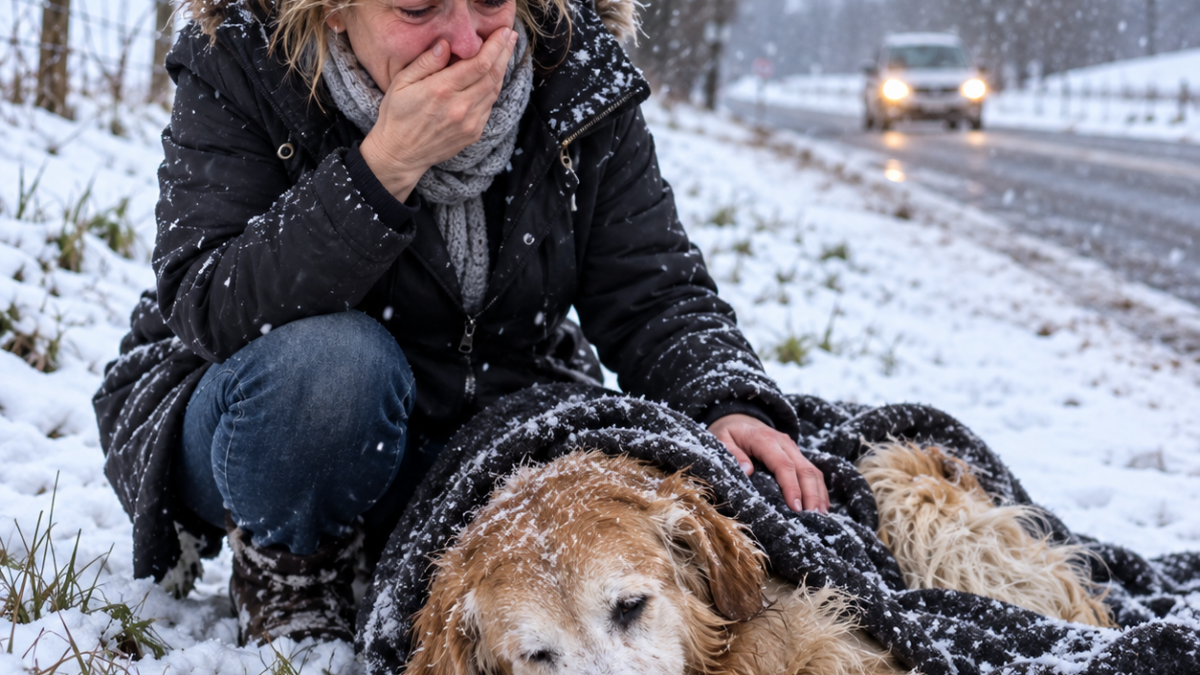
For three terrible seconds, I stood beside the snowy ditch believing the old dog at my feet was already dead.
I had actually turned back toward my car to call someone about the body when his tail scraped the snow once—so faintly that only a few flakes moved.
Then I knelt beside him, and before that morning was over, a veterinarian would discover something about that battered leather collar that changed everything I thought I knew about why he was there.
My name is Claire Moreau.
I was fifty-two, divorced for six years, and living alone in a small house outside Annecy when I found him.
There was no reason I should have been on that road.
I was returning a defective electric heater before the store’s refund deadline.
That was it.
An ordinary errand on an ordinary winter morning.
The cold was brutal.
The kind that silences fields and turns roadside ditches into strips of hard white ice.
At first, I thought the dark shape near the embankment was a garbage bag.
Then I saw fur.
I hit the brakes so hard my coffee spilled across the passenger floor.
I didn’t care.
I ran back.
The closer I got, the more certain I became that I was too late.
He was a large elderly dog, probably part Golden Retriever, with frost clinging to what remained of his blond coat.
His muzzle was almost completely white.
A worn leather collar circled his neck.
He was frighteningly thin.
Snow had accumulated along his spine, which meant he had been lying there long enough for the weather to begin covering him.
I crouched.
“Hey, sweetheart.”
Nothing.
I reached toward his neck, terrified I was about to touch a body that had already gone cold.
Then I saw it.
A weak puff of vapor escaped his nose.
Breath.
Barely.
But breath.
“Oh my God. You’re alive.”
One brown eye opened.
I will remember that look for the rest of my life.
It wasn’t aggression.
It wasn’t even fear.
It was exhaustion so complete that he seemed to have stopped expecting anything from people.
Then his tail moved again.
A tiny scrape against the snow.
My throat closed.
“You’re still trying, aren’t you?”
I took off my scarf and wrapped it around his neck.
Then I removed my coat and covered him.
He wasn’t even trembling properly anymore.
That frightened me.
His body seemed too depleted to produce enough energy for shaking.
I slid one arm beneath his chest.
No growl.
No resistance.
He simply let his head fall against my shoulder.
He was heavy.
But nowhere near as heavy as a dog his size should have been.
Getting him to the car felt endless.
My boots slipped twice.
My arms burned.
Each time I nearly fell, I tightened my grip.
I couldn’t drop him.
Not after he had spent what little strength remained in his body moving his tail for me.
I laid him across the passenger seat, wrapped him in my coat, and turned the heat up carefully.
Then I called the nearest emergency veterinary clinic.
“I found an older dog in the snow,” I said. “He’s breathing, but barely.”
“Bring him immediately.”
During the drive, I kept one hand against his side.
Every rise of his ribs mattered.
“Stay with me.”
I said it over and over.
“Stay with me, old man.”
At a red light, his eye opened.
Just once.
Then closed.
Twenty minutes later, veterinary technicians carried him through the clinic doors.
I followed, still wearing only a sweater despite the freezing weather.
A veterinarian examined him while I waited in the hallway.
Hypothermia.
Severe dehydration.
Malnutrition.
Arthritis.
A wound beneath his chest.
Possibly days without proper food.
Then someone called from the treatment room.
“Claire?”
I hurried in.
The veterinarian was holding the old leather collar.
She had found something hidden beneath its inner lining.
Not a name tag.
Not a phone number.
A tiny metal identification capsule.
She opened it carefully.
Inside was a folded strip of paper, old but still readable.
The veterinarian looked at the writing.
Then at the dog.
Then back at me.
“Claire,” she said quietly, “I think we know who he is.”
She handed me the paper.
And when I read the name printed across the top, I realized the old dog in that ditch had not simply been lost.
Someone had wanted him to disappear.
PART 2
The paper shook between my fingers.
At first, I thought it was because I was cold.
Then I realized my hands were trembling for an entirely different reason.
Across the top, written in neat block letters, were four words:
**BRUNO MOREL — MEDICAL ALERT**
Below that was an address in Talloires, a village on the eastern side of Lake Annecy.
There was also a telephone number.
And underneath, in smaller handwriting:
**If found alone, please contact Dr. Luc Fournier or Émile Morel immediately. Bruno should never be allowed to wander without supervision.**
I read it twice.
Then a third time.
“Bruno,” I whispered.
The old dog lay on the treatment table beneath heated blankets.
His eyes remained closed.
The veterinarian, Dr. Sophie Lambert, looked at me.
“That name mean anything to you?”
“No.”
“Morel?”
I shook my head.
Annecy and the surrounding villages weren’t huge, but they weren’t small enough for everyone to know everyone.
“What kind of medical alert?” I asked.
“We’ll find out.”
She handed the paper to a technician.
“Call both numbers.”
Then she looked at Bruno again.
“Right now, keeping his temperature up is still our priority.”
“Is he going to make it?”
Dr. Lambert did not answer immediately.
I was starting to hate that pause.
“It’s too early to know.”
“What exactly is wrong with him?”
“His temperature was dangerously low when you brought him in. He’s dehydrated. Severely underweight. His blood sugar is low. There are pressure sores on one side of his chest and hip, which suggests he may have been lying down for long periods before he ended up outside.”
“Before?”
“Yes.”
I stared at her.
“You think he was already weak before the snow?”
“Very likely.”
She gently lifted one of Bruno’s paws.
The nails were long but not neglected in the way I expected.
“They were clipped recently.”
I frowned.
“What does that mean?”
“It means somebody was caring for him not too long ago.”
That bothered me more than if he had simply looked abandoned for months.
Bruno had not slowly become a street dog.
Somebody had fed him.
Clipped his nails.
Kept a collar on him.
Then somehow he had ended up half-frozen beside a rural road.
A technician returned.
“The doctor’s number is active. Reception says Dr. Fournier is with a patient, but they’re getting him.”
“And Émile?”
“The number is disconnected.”
Dr. Lambert nodded.
“Keep trying.”
I moved closer to Bruno.
Under the clinic lights, he looked even older.
There were scars beneath his fur.
Not fresh injuries.
Old life.
A notch in one ear.
A small bald patch near his shoulder.
Gray hair around his eyes.
“Bruno,” I whispered.
His ear moved.
Barely.
I touched his head.
“Okay. At least you know your name.”
His tail did not move.
But he opened one eye.
Then the clinic phone rang.
The technician picked it up.
Her expression changed almost immediately.
She covered the mouthpiece.
“It’s Dr. Fournier.”
Dr. Lambert took the call.
“This is Sophie Lambert at Annecy Veterinary Emergency.”
She listened.
“Yes. Male, approximately eleven or twelve. Large Golden mix. Leather collar.”
Another pause.
Her eyebrows lifted.
“Yes.”
She looked at Bruno.
“No, he’s alive.”
The voice on the other end became loud enough that I heard something through the receiver.
Dr. Lambert held it away slightly.
“Yes, Doctor. Alive.”
She listened for nearly a minute.
Then her face hardened.
“Where was he supposed to be?”
Silence.
“Are you certain?”
Another long pause.
“All right. Come here.”
She hung up.
I waited.
“What?”
Dr. Lambert looked at me.
“Bruno belongs—or belonged—to a man named Émile Morel.”
“The person on the paper?”
“Yes.”
“And?”
“Émile died three months ago.”
I felt something cold move through me that had nothing to do with winter.
“So who had Bruno?”
“His nephew.”
The technician beside us stopped writing.
Dr. Lambert continued.
“According to Dr. Fournier, Bruno was never supposed to leave Émile’s property.”
“What happened?”
“He doesn’t know.”
“Did the nephew report him missing?”
“No.”
That answer filled the room.
I looked at Bruno.
His eye had closed again.
“Maybe he ran away.”
Dr. Lambert’s expression said she didn’t believe it.
Neither did I.
“He could barely stand when I found him.”
“I know.”
“How far is Talloires from where I found him?”
“Depending on the exact road, more than twenty kilometers.”
I stared at her.
“There is no way.”
“No.”
“Then somebody drove him.”
Dr. Lambert folded her arms.
“We need facts before we decide that.”
She was right.
But the thought had already settled in my chest.
Someone had put Bruno in a vehicle.
Driven him away from the only home he knew.
Left him in snow.
And gone back to a warm house.
I felt sick.
A voice came from the doorway.
“Where is he?”
An older man stood there.
Late sixties.
Gray hair.
Wool coat thrown over veterinary scrubs.
His face was pale.
Dr. Lambert stepped aside.
“Luc?”
He came directly to the table.
“Bruno.”
The dog’s ear moved.
The man stopped.
His face crumpled.
“Mon vieux.”
Old boy.
Bruno opened his eyes.
For the first time since I found him, something unmistakable happened.
His tail moved.
Not much.
But intentionally.
Once.
Twice.
Dr. Fournier put both hands over his mouth.
“Oh, Émile.”
Then he touched Bruno’s head.
“I’m sorry.”
I looked away.
Grief between a person and an animal feels private even when you’re standing three feet away.
After a moment, he turned to me.
“You found him?”
“Yes.”
“Where?”
I explained.
The road.
The ditch.
The snow.
The way Bruno had barely been breathing.
The more I spoke, the more Dr. Fournier’s face changed.
Confusion became disbelief.
Disbelief became anger.
“He couldn’t have reached that road.”
“That’s what we thought.”
“He can barely walk a kilometer on a good day.”
Dr. Lambert nodded.
“You treated him?”
“For almost nine years.”
Dr. Fournier pulled out a chair.
I sat opposite him.
“Can you tell me who Bruno is?”
He looked at the dog.
“Émile’s shadow.”
That was his first answer.
Then slowly, he gave me the rest.
Émile Morel had been seventy-eight when he died.
Widower.
Retired carpenter.
No children.
He lived in an old stone house overlooking part of Lake Annecy, surrounded by several acres of sloping land and orchard.
Bruno had come to him as a rescue nearly eleven years earlier.
Not a puppy.
A young adult dog found after flooding near Chambéry.
Nobody ever claimed him.
Émile did.
“They were inseparable,” Dr. Fournier said.
“Bruno slept beside his bed. Went with him to the bakery. Waited outside church. Rode in his van. When Émile had heart surgery five years ago, Bruno refused food for two days while he was hospitalized.”
I looked at Bruno.
“What medical problem does he have?”
“Arthritis, mostly. Early kidney disease. And he had a vestibular episode last year. That’s why the identification note says never to let him roam. He can become disoriented.”
“So after Émile died?”
Dr. Fournier’s jaw tightened.
“His nephew, Laurent, inherited the house.”
“Did Laurent want Bruno?”
“I asked that exact question.”
“And?”
“He said yes.”
The answer came too quickly.
Too flat.
“He promised Émile?”
“Yes.”
Dr. Fournier looked down.
“Émile was obsessed with what would happen to Bruno after he was gone.”
“Why?”
“Because he knew Laurent.”
That sentence told me more than the next five minutes.
Laurent Morel was Émile’s sister’s son.
Forty-one.
Worked in property development near Lyon.
He visited rarely before Émile became ill.
Then more frequently as Émile’s health declined.
According to Dr. Fournier, Émile had never trusted Laurent’s interest in the property.
“The house is valuable,” he said.
“How valuable?”
“Very.”
Lake Annecy had become increasingly expensive.
Land with views and development potential could make families behave in ways nobody liked admitting.
“Émile changed his will about two years ago,” Dr. Fournier continued.
“To leave it to Laurent?”
“Yes, but with conditions.”
“What conditions?”
He looked at me.
“One of them involved Bruno.”
My stomach tightened.
“What kind?”
“I don’t know the exact legal language. Émile told me that whoever inherited the house had to keep Bruno there and provide for him for the rest of his life.”
I stared.
“Seriously?”
“Yes.”
“Why put that in a will?”
“Because Émile knew Laurent wanted to sell.”
“And Bruno?”
“Émile wanted him to die at home.”
I looked toward the treatment table.
Bruno’s head rested against the blanket.
The entire story began rearranging itself inside me.
The old dog in the ditch.
The valuable property.
The dead owner.
The inheritance condition.
The nephew.
“Would removing Bruno affect the inheritance?”
Dr. Fournier rubbed his jaw.
“That depends on the will.”
“We need to know.”
Dr. Lambert stepped in.
“We also need to avoid making accusations without evidence.”
Again, she was right.
Again, my anger did not care.
Dr. Fournier stood.
“I know Émile’s notary.”
“Call him.”
He looked at me.
I had said it too sharply.
“You’re right,” I added. “Sorry.”
“No. You’re right.”
He stepped into the hallway.
Dr. Lambert came to check Bruno again.
“How is he?”
“Temperature is climbing slowly.”
“Good?”
“Good direction.”
“And the rest?”
“We need blood work.”
She hesitated.
“Claire, I need to ask you something.”
“What?”
“If there is no immediate legal owner willing to authorize care, somebody may need to assume financial responsibility tonight.”
I understood.
“How much?”
She gave me an estimate.
I almost laughed.
Not because it was funny.
Because I had spent the previous month complaining about electricity prices and a defective heater.
Now I was about to spend many times that amount on a dog I met in a ditch.
“Do it.”
“Claire—”
“Do everything reasonable.”
“Are you sure?”
No.
“Yes.”
I signed the forms.
That was the moment, though I didn’t know it yet, when Bruno stopped being a dog I had found and started becoming part of my life.
Dr. Fournier returned twenty minutes later.
His expression was serious.
“The notary is coming.”
“Tonight?”
“Yes.”
“That sounds urgent.”
“It is.”
The notary arrived after noon.
His name was Maître Bernard Vial.
Small man.
Perfectly tied scarf.
Leather briefcase.
The kind of person who looked as though he organized his receipts by emotional importance.
He asked who I was.
“Nobody,” I said.
Dr. Lambert corrected me.
“She found Bruno and authorized treatment.”
Bernard nodded.
“Then you’re not nobody.”
He opened his briefcase.
“I can’t disclose the entire estate without authority.”
“Then tell us what you can.”
Dr. Fournier leaned forward.
“Bernard, Bruno was found dying in a ditch twenty kilometers from Émile’s house.”
That did it.
Bernard’s composure cracked.
“What?”
He turned toward the dog.
“Alive?”
“Barely.”
Bernard sat.
He closed his eyes for a second.
Then opened the briefcase again.
“Émile expected trouble.”
My skin prickled.
“What does that mean?”
Bernard pulled out a copy of a document.
“I can confirm one clause because it is directly relevant to the animal’s care.”
He read:
“Bruno shall remain resident at the property known as Les Amandiers for the remainder of his natural life, except for veterinary treatment or temporary evacuation for his safety. The beneficiary inheriting said property shall provide food, shelter, veterinary care, and reasonable companionship. Deliberate abandonment, relinquishment for convenience, or neglect resulting in preventable harm shall constitute breach of the testamentary condition…”
Bernard stopped.
I waited.
“And if the condition is breached?”
He looked at us.
“The property does not remain with Laurent.”
Silence.
“Who gets it?”
“A charitable foundation named in the will.”
Dr. Fournier leaned back.
I whispered, “Oh my God.”
Bernard continued.
“Émile was very deliberate.”
“So if Laurent abandoned Bruno…”
“If proven, he could lose the property.”
There it was.
A motive.
Not a good one.
But a motive.
Bruno was not simply an elderly dog someone no longer wanted.
He was an obstacle worth hundreds of thousands—possibly millions—to the wrong person.
“What was Laurent supposed to do if Bruno died naturally?” I asked.
“Obtain veterinary certification.”
“And then he could sell?”
“Yes.”
“Could he euthanize Bruno?”
“Only upon veterinary certification of medical necessity.”
Dr. Fournier looked furious.
“He asked me about euthanasia.”
Every head turned.
“When?”
“Three weeks after Émile died.”
My stomach twisted.
“What did you say?”
“That Bruno had manageable arthritis and early kidney disease. He was old, not suffering beyond treatment.”
“Did Laurent argue?”
“Yes.”
“How?”
“He said Bruno had ‘no quality of life.’”
Dr. Fournier’s voice sharpened.
“I disagreed.”
“Then what?”
“He never brought Bruno back.”
Bernard stared at him.
“You didn’t tell me that.”
“I had no reason to think…”
His voice broke.
“I should have checked.”
“No,” I said.
We all looked at Bruno.
The blame in the room was expanding too quickly.
Laurent.
The legal system.
Dr. Fournier.
Everyone who had assumed someone else was caring.
I knew that pattern.
People are very good at believing responsibility exists somewhere else.
Bernard stood.
“I’m calling the gendarmerie.”
That turned a rescue into an investigation.
Two officers arrived.
They photographed Bruno’s collar.
Took the note.
Recorded where I found him.
Asked me to show the location later.
Requested veterinary documentation.
Then they drove to Les Amandiers.
I did not go.
That frustrated me.
It was not my case.
Not my property.
Not my family.
I sat beside Bruno instead.
For hours.
His temperature improved.
The fluids helped.
Blood tests showed dehydration, anemia, elevated kidney values, but nothing Dr. Lambert considered immediately irreversible.
The biggest concern was the cold.
And weakness.
And what appeared to be several days of inadequate nutrition.
Late afternoon became evening.
Bruno finally lifted his head.
I was half asleep in the chair.
His movement woke me.
“Hey.”
He looked around.
Confused.
“Clinic.”
His nose moved.
I offered my hand.
He sniffed.
Then rested his chin on my palm.
I smiled.
“That’s becoming a habit.”
Dr. Lambert came in carrying a small bowl.
“Think he’ll eat?”
“Let’s see.”
She set down a little bland food.
Bruno smelled it.
Nothing.
She moved it closer.
He licked once.
Then twice.
Then began eating.
Slowly.
I cried.
I hated how easily I had started crying since turning fifty.
Dr. Lambert smiled.
“That’s good.”
“He’s eating.”
“I can see.”
“He’s actually eating.”
“Claire.”
“Let me have this.”
She laughed softly.
“All right.”
That evening, one of the gendarmes returned.
His name was Capitaine Julien Marchand.
He asked to speak privately.
We went into the waiting room.
“What did you find?”
He did not answer immediately.
“Laurent Morel says Bruno escaped.”
I stared.
“From where?”
“The property.”
“When?”
“Two nights ago.”
“Did he report him missing?”
“No.”
“Why?”
“He claims he searched himself.”
I laughed.
Not politely.
“A dog who can barely walk traveled twenty kilometers in two days during a snowstorm?”
“He says Bruno may have entered someone’s vehicle.”
“That is absurd.”
“It may be.”
“May be?”
Marchand stayed calm.
“We need evidence.”
I clenched my jaw.
“What else?”
“The house has surveillance cameras.”
That got my attention.
“And?”
“Laurent says they were not functioning.”
“Convenient.”
“Yes.”
That single word told me the captain wasn’t stupid.
“Neighbors?”
“We’re speaking with them.”
He looked at Bruno through the glass.
“There’s another issue.”
“What?”
“Laurent wants the dog returned.”
I stood.
“No.”
“Claire.”
“No.”
“Legally—”
“He nearly froze to death.”
“I know.”
“You’re taking him back there?”
“Not tonight.”
That mattered.
Marchand continued.
“The veterinarian can retain him while medically necessary. After that, ownership becomes more complicated.”
“What does Bernard say?”
“That the testamentary clause may allow intervention if neglect is established.”
“If.”
“Yes.”
My anger had nowhere to go.
Marchand saw it.
“You did the right thing finding him.”
“That’s not enough.”
“No. It’s the part you can control.”
I hated sensible people.
That night, I went home without Bruno.
The house felt wrong.
I had known him for less than twelve hours.
Still wrong.
My coat was at the clinic.
My scarf too.
The passenger floor smelled like spilled coffee and wet dog.
I sat at the kitchen table in my sweater and stared at nothing.
Six years earlier, after my divorce, I had told everyone I enjoyed living alone.
Sometimes that was true.
Mostly, I had become efficient at loneliness.
There’s a difference.
My ex-husband, Marc, remarried quickly.
Our daughter lived in Paris.
My son worked in Brussels.
I had friends.
But friends had husbands.
Children.
Grandchildren.
Schedules.
Nobody noticed if I went three days without speaking out loud.
Bruno had been abandoned because he had become inconvenient.
I knew that feeling more than I liked.
Not because my family abandoned me.
Life had simply moved.
And I had learned to stop asking it to turn around.
At midnight, I texted Dr. Lambert.
HOW IS HE?
She replied ten minutes later.
SLEEPING. TEMP NORMALIZING. ATE AGAIN.
Then another message.
TAIL WAGGED AT TECHNICIAN.
I smiled.
“Traitor.”
The next morning, I returned before eight.
Bruno was awake.
When he saw me, his tail moved.
Three times.
I counted.
“Good morning.”
He tried to rise.
Failed.
“Don’t.”
He tried again.
Stubborn.
Dr. Lambert entered.
“He’s stronger.”
“Enough to go home?”
“Not yet.”
I felt relief.
Then guilt for feeling relief.
“Any word from the police?”
“Bernard called. They found something.”
“What?”
“He said he’ll explain when he gets here.”
An hour later, Bernard arrived with Capitaine Marchand.
Neither looked relaxed.
Marchand closed the consultation-room door.
“We spoke with a neighbor across from Les Amandiers.”
“And?”
“She has a doorbell camera.”
My heart started pounding.
“Did it catch something?”
“A vehicle leaving Laurent’s property around eleven forty the night before you found Bruno.”
“That proves nothing.”
“No.”
“What kind of vehicle?”
“Laurent’s.”
I leaned forward.
“Did he return?”
“Yes. Thirty-eight minutes later.”
“How long does it take to drive from the house to the road where I found Bruno?”
Marchand looked at me.
“Approximately seventeen minutes in those conditions.”
Silence.
Bernard put both hands on his briefcase.
“That’s thirty-four minutes round-trip.”
“Yes.”
“Four minutes to stop.”
“Yes.”
I felt sick.
“Did the camera show Bruno?”
“Not clearly. But we obtained another camera from a business near the junction.”
“And?”
“A vehicle matching Laurent’s SUV passes toward the location. Then returns.”
“Still circumstantial.”
“Yes.”
Marchand held my gaze.
“But we also searched the vehicle.”
My stomach tightened.
“What did you find?”
“Golden-colored dog hair in the rear cargo area.”
I exhaled.
“And traces of dried mud consistent with the roadside location.”
Bernard closed his eyes.
“Is that enough?”
“For prosecution? Investigation continues.”
“For the will?”
“That is your field.”
Bernard nodded.
“Laurent has already been notified that the estate may be placed under protective administration.”
That phrase pleased me more than it probably should have.
“What did he say?”
Bernard almost smiled.
“He became extremely interested in Bruno’s recovery.”
Of course he did.
If Bruno survived, he was evidence.
If Bruno died without clear proof of natural cause, the inheritance was still at risk.
If Bruno returned to the property, Laurent might try to create a different story.
“We are not returning him,” I said.
Marchand looked at me.
“You don’t decide that.”
“Then who does?”
“For now, the court can.”
“Can you ask?”
“We already did.”
I blinked.
“What?”
Bernard opened a document.
“A temporary protective order has been requested. Pending review, Bruno remains in veterinary care and may be placed in temporary foster custody with an approved person.”
I knew what was coming before he said it.
Bernard looked directly at me.
“Would you be willing?”
“Yes.”
He laughed.
“I haven’t explained responsibilities.”
“Yes.”
Dr. Lambert, standing in the corner, shook her head.
“Claire.”
“What?”
“You live alone.”
“So?”
“You have stairs.”
“I have a downstairs bedroom.”
“You work?”
“Three days a week.”
“What about the other four?”
“Bruno.”
That silenced everyone.
Maybe they thought I was impulsive.
They were right.
At fifty-two, after six years of living cautiously, I was suddenly impulse with a pulse.
The foster arrangement took another day.
Bruno came home on Saturday.
I borrowed a ramp.
Bought an orthopedic bed.
Special food.
Medication organizers.
Non-slip mats.
A harness for supporting his back end.
My dining room looked like a geriatric veterinary supply store.
Bruno stood at the threshold.
He hesitated.
I remembered how he had rested his head against me in the snow.
“You’re safe.”
He did not move.
I stepped inside.
Waited.
Finally, one paw crossed.
Then another.
His legs trembled.
He entered.
For the first hour, Bruno explored every room he could reach.
Slowly.
Painfully.
He smelled doors.
Furniture.
The kitchen.
My shoes.
Then he found the back window.
He stood there looking toward the garden.
“Not much of a lake view.”
Tail movement.
“My landscaping is terrible too.”
He looked at me.
“I’m doing my best.”
That night, I slept downstairs on the couch.
Bruno slept on the floor beside his expensive bed.
Of course.
At two in the morning, I woke to him whining.
I sat up.
“What?”
He was trying to stand.
I helped with the harness.
He walked to the back door.
Outside, snow had started falling again.
Not heavily.
Just soft flakes.
Bruno froze.
His body stiffened.
Then backed away.
I understood.
“No.”
I closed the door.
“You don’t have to.”
He looked at the snow through the glass.
Then at me.
I put a hand on his chest.
“You’re not going back there.”
He lowered his head.
I slept beside him the rest of the night.
Over the following week, Bruno began returning to himself.
Whatever that meant.
He ate.
A lot.
Gained a little weight.
Followed me from room to room.
Learned the sound of the refrigerator.
Learned where I kept cheese.
Learned that I would not share enough of it.
He also stood at the front door every afternoon around four.
Always four.
The first two days, I thought he needed to go outside.
Then Dr. Fournier visited.
At exactly four, Bruno moved toward the door.
Luc froze.
“Oh.”
“What?”
“Émile came home from the bakery at four.”
Every day?
“Almost.”
Bruno stood waiting.
My chest hurt.
He was waiting for a dead man.
I crouched.
“Bruno.”
His ears moved.
“He’s not coming.”
I immediately regretted saying it.
Dogs do not need our explanations of death.
They live in absence differently.
Luc sat beside him.
“Émile used to bring him a corner of baguette.”
“Every day?”
“Terrible veterinary practice.”
I smiled.
The next afternoon at four, I gave Bruno a small piece of bread.
He took it gently.
Then looked toward the door.
We did that for weeks.
Four o’clock.
Bread.
Wait.
Eventually, the waiting shortened.
Then stopped.
The bread did not.
Some traditions should survive people.
Meanwhile, Laurent’s problems were growing.
The police investigation found more.
A toll camera placed his SUV in the area.
His phone location data matched.
A witness at a late-night gas station remembered him buying coffee with mud on his boots.
None of that by itself proved he put Bruno in the ditch.
Then they found the blanket.
A red wool blanket in Laurent’s garage.
Golden fur.
Bruno’s.
Still not enough?
I asked Marchand.
He looked at me.
“Enough for a much stronger case.”
The worst evidence came from a text message.
Laurent had written to a real estate contact the day before Bruno disappeared:
**Once the dog problem is resolved, we can list immediately.**
I read that sentence in Bernard’s office.
My stomach turned.
“Dog problem.”
Bernard’s face was stone.
“The property was valued at 1.4 million euros.”
I stared.
“And Bruno was all that stood between him and selling?”
“Not exactly. Laurent inherited subject to the condition. He could live there. Maintain the property. He just couldn’t dispose of Bruno or sell in violation of the terms.”
“So Bruno was inconvenient.”
“Yes.”
I thought about the ditch.
The snow.
The weak tail.
One point four million euros.
That was the price Laurent placed on getting rid of an old dog.
“Will he lose the house?”
Bernard folded the document.
“Court decides.”
“And criminal charges?”
“Marchand says abandonment and cruelty charges are being pursued.”
“Is that enough?”
Bernard understood the real question.
“Nothing will feel enough.”
He was right.
I wanted Laurent to stand in the snow barefoot.
I wanted him to feel Bruno’s body going cold.
I wanted consequences that matched what could have happened.
Law is rarely poetic.
Then Laurent made his biggest mistake.
He came to my house.
It was a Tuesday afternoon.
I was in the kitchen.
Bruno was sleeping near the radiator.
A black SUV pulled into my driveway.
I knew immediately.
Laurent stepped out wearing a dark wool coat.
Expensive shoes.
Confident posture.
The kind of man who believed every room eventually became a negotiation.
I opened the door but did not let him enter.
“You’re Claire Moreau.”
“You’re on private property.”
“I want my dog.”
Behind me, Bruno lifted his head.
His body changed.
Not recognition like with Dr. Fournier.
Fear.
He tried to stand too quickly.
His legs slipped.
I stepped back.
“Bruno.”
Laurent looked past me.
“There he is.”
Bruno moved away.
That told me everything I needed emotionally, even if it proved nothing legally.
“You need to leave.”
Laurent smiled tightly.
“You don’t understand the situation.”
“I understand enough.”
“He belongs to the estate.”
“Then speak through Bernard.”
“You’re interfering.”
“Leave.”
His voice lowered.
“Do you know how much trouble you’ve caused?”
That almost made me laugh.
“I found a dying dog.”
“You stole him.”
“I saved him.”
“He wandered off.”
“You drove him.”
His face changed.
Tiny.
There.
I saw it.
“Careful.”
“No. You be careful.”
I had spent most of my adult life avoiding confrontation.
Marriage had trained me to smooth.
Divorce had trained me to withdraw.
At fifty-two, standing between an old dog and the man I believed left him in snow, I discovered there was a third option.
Stand.
“You put him in that ditch because you wanted the house clear.”
“You have no idea what you’re talking about.”
“Police seem interested.”
His jaw tightened.
“Bruno is an animal.”
I went still.
“Yes.”
“An animal. My uncle wrote an absurd condition into a will because he lost perspective at the end.”
I stared.
There are moments when people reveal themselves because they believe what they’re saying is reasonable.
Laurent continued.
“I spent three months trapped in a house I couldn’t sell because of a dog that can barely walk.”
“Then you should have cared for him.”
“I had a life.”
“So did Bruno.”
His expression hardened.
“You people are unbelievable.”
“What people?”
“Sentimental people.”
I stepped onto the porch.
Bruno was behind me.
“You’re right.”
Laurent blinked.
“I’m extremely sentimental about not leaving living animals to freeze.”
He took a step closer.
I lifted my phone.
“I’m recording.”
He stopped.
I wasn’t.
But suddenly I wished I had been.
Then a voice came from the road.
“Good afternoon, Monsieur Morel.”
Capitaine Marchand.
I had never been happier to see a police officer.
His car had pulled in behind Laurent’s.
Laurent turned.
“This is harassment.”
Marchand’s expression barely changed.
“You were instructed not to contact the temporary custodian.”
“I’m retrieving property.”
“The court order says otherwise.”
Laurent pointed at me.
“She’s poisoning everyone against me.”
“No,” Marchand said. “Evidence is doing that.”
I almost smiled.
Laurent left.
Fast.
Marchand waited until the SUV disappeared.
Then looked at me.
“You should have called.”
“I didn’t know he was coming.”
“When he arrived.”
“I was busy.”
“Doing what?”
“Winning.”
Marchand stared.
Then, despite himself, smiled.
“Please don’t make that your legal strategy.”
I laughed for the first time that day.
Bruno eventually stopped trembling.
I sat beside him.
“You’re okay.”
He pressed his head into my chest.
That evening, I finally cried.
Not because I was afraid.
Because Bruno had been.
Animals remember people in ways courts cannot measure.
His body had recognized danger before my mind finished identifying the man.
After that visit, the protective order tightened.
Laurent could not approach Bruno.
Could not approach me.
Could not enter certain areas of Les Amandiers without notice because the property had been placed under temporary estate supervision.
His lawyer challenged everything.
The case took months.
Bruno’s recovery took months too.
The two timelines ran beside each other.
One legal.
One living.
I preferred the living one.
By March, Bruno could walk fifteen minutes without collapsing.
By April, twenty.
His kidney values stabilized.
His fur filled in.
Weight returned slowly.
His eyes became brighter.
Snow melted.
The first day grass appeared in my garden, Bruno walked onto it and stood completely still.
Sunlight touched his back.
I waited.
He sniffed the air.
Then rolled.
Actually rolled.
An arthritic twelve-year-old dog rolled onto his back in wet grass like a puppy.
I laughed so loudly my neighbor came outside.
“What happened?”
“Nothing.”
Bruno kicked his legs.
Mud covered his coat.
“Absolutely nothing.”
That was happiness.
Nothing happening.
No emergency.
No ditch.
No court.
Just mud.
My daughter, Camille, came from Paris that weekend.
She had been skeptical when I told her I was fostering an old dog involved in an inheritance dispute.
“Mom, this sounds like a television movie.”
“I know.”
“Are you safe?”
“Yes.”
“Are you sure?”
“Mostly.”
She arrived carrying a bag of expensive dog treats.
Hypocrite.
Bruno adored her.
Of course.
Within ten minutes, she was sitting on my floor rubbing his belly.
“This is the dangerous witness?”
“Apparently.”
“He’s perfect.”
“He drools.”
“Perfectly.”
Later, Camille looked at me.
“You seem different.”
“Dirty?”
“No.”
“What?”
“Happier.”
I looked at Bruno.
He was asleep near the table.
“I have someone who expects breakfast.”
Camille smiled.
“You could get a cat.”
“Don’t ruin this.”
She laughed.
My son Julien visited next.
He brought tools.
Because men in my family express emotion through home improvement.
He built a better ramp for Bruno.
Fixed the gate.
Added a nonslip strip.
Bruno followed him around supervising.
At one point Julien stopped and said, “This dog thinks I work for him.”
“He’s correct.”
That weekend was the first time both of my children had stayed in my house together since the divorce.
We cooked.
Argued.
Laughed.
Bruno slept beneath the table.
I looked around and realized the dog I carried from a ditch had somehow pulled my family into rooms I had stopped expecting them to occupy.
He wasn’t replacing anyone.
He was creating reasons to return.
Then the court date arrived.
I hated it.
The hearing regarding the testamentary breach happened before the criminal case fully concluded.
Bernard prepared me.
“You may testify.”
“I found him.”
“That’s why.”
“Can I say Laurent came to my house?”
“Yes.”
“Can I say Bruno was afraid of him?”
“Carefully.”
“Can I say I think he’s a monster?”
“No.”
“Legal system is disappointing.”
Bernard almost smiled.
The courtroom was smaller than I imagined.
Laurent sat with his lawyer.
Expensive suit.
Calm face.
I sat behind Bernard.
Dr. Fournier was there.
Marchand too.
The charitable foundation had counsel present because if the clause was enforced, Les Amandiers would pass to them.
The foundation supported elderly people living alone.
I learned that from Émile’s will.
That mattered later.
Laurent’s lawyer argued the testamentary condition was unreasonable.
That Bruno’s disappearance could not conclusively be attributed to Laurent.
That surveillance evidence only proved driving.
That dog hair in an owner’s vehicle proved nothing.
That Laurent had no legal duty to file a missing-dog report immediately.
Technically clever.
Morally nauseating.
Then Bernard presented the text message.
Once the dog problem is resolved, we can list immediately.
Laurent’s lawyer said “resolved” could mean many things.
Veterinary placement.
Natural death.
Alternative caregiving.
Bernard asked why Laurent had contacted three real estate agencies before Bruno disappeared but none after the investigation began.
Then came the veterinary records.
Dr. Fournier testified.
Laurent had requested euthanasia.
No medical justification.
Refused.
Then Bruno disappeared.
Then my testimony.
I described finding him.
The snow.
The hypothermia.
How far he was from home.
How weak.
I tried not to cry.
Failed.
Laurent’s attorney asked whether I personally saw Laurent abandon Bruno.
“No.”
“So you cannot know how the dog arrived there.”
“I know he didn’t walk twenty kilometers.”
“Speculation.”
“Then call it arithmetic.”
Bernard touched my arm.
Calm.
The judge looked almost amused.
The strongest moment came unexpectedly.
A new witness.
Laurent’s former gardener.
His name was Pascal.
He had worked at Les Amandiers twice a week.
He testified that Bruno had been confined increasingly often in an unheated storage room after Émile died.
My hands clenched.
Pascal had complained.
Laurent told him the dog was “temporary.”
Then Pascal described the night before Bruno disappeared.
He had returned to the property to retrieve tools.
He saw Laurent carrying Bruno toward the SUV.
Wrapped in a red blanket.
My entire body went cold.
The red blanket.
“What did you think was happening?” Bernard asked.
“I thought veterinary emergency.”
“Did you ask?”
“Yes.”
“What did Monsieur Morel say?”
Pascal looked toward Laurent.
“He said, ‘I’m finally dealing with it.’”
The room went silent.
Laurent stared straight ahead.
That was the point everything changed.
Pascal had been afraid to come forward.
Why?
Because Laurent had threatened legal action over employment records.
The police found him only after reviewing property contractors.
Bernard had not told me because witness disclosure had been handled formally.
After Pascal, Laurent’s story collapsed.
Not instantly.
Law still moved through procedure.
But collapsed.
The judge issued the estate ruling two weeks later.
Deliberate breach.
Laurent forfeited Les Amandiers.
The property passed to the charitable foundation under Émile’s will.
I read the judgment at my kitchen table.
Bruno was sleeping beside my foot.
I laughed.
Then cried.
Then laughed again.
“You won your house.”
Bruno slept.
“Well. Technically you lost the house to a charity.”
Tail thump.
“Close enough.”
But the story wasn’t over.
Because the foundation now owned Les Amandiers.
And Bernard called me.
“They want to discuss Bruno.”
My heart tightened.
“What?”
“He has a right of residence under the will.”
“He lives here.”
“I know.”
“Are they taking him?”
“No.”
“Then why?”
“They have a proposal.”
The foundation director came to my house.
Her name was Hélène.
She was in her sixties.
Warm face.
Sharp eyes.
She explained Émile had supported their organization for years.
The foundation helped seniors remain in their homes rather than move prematurely into institutions.
Les Amandiers was too valuable and impractical to use as a normal facility.
Selling it would fund services.
But the will still provided Bruno’s lifetime right to remain there if appropriate.
“We could not sell while that right exists,” Hélène said.
I immediately stiffened.
“So you want him gone too.”
“No.”
She leaned forward.
“We want to ask where Bruno wants to live.”
I stared.
“He’s a dog.”
“Yes.”
“So how do we ask?”
“We observe.”
That answer surprised me.
She proposed taking Bruno back to Les Amandiers with me.
See his reaction.
No decisions.
No pressure.
Part of me wanted to refuse.
That house represented Émile.
But also Laurent.
Loss.
Maybe fear.
Dr. Fournier thought we should try.
“He may need closure.”
I raised an eyebrow.
“You’re anthropomorphizing.”
“I’m a veterinarian, not immune.”
So we went.
It was May.
The drive around the lake was beautiful.
Bruno sat in the back with Camille.
As we approached Talloires, his head lifted.
Then higher.
Ears forward.
He began whining.
Not afraid.
Something else.
Recognition.
At the gate of Les Amandiers, he stood.
His legs shook.
I opened the car.
He climbed out before I could attach the support harness properly.
“Bruno!”
He moved toward the house.
Faster than I had seen him move in months.
Past the stone wall.
Past lavender beds.
Toward a blue front door.
He stopped there.
Stared.
Then scratched once.
My heart broke.
Nobody answered.
Of course.
Bruno whined.
Dr. Fournier, who came with us, covered his mouth.
“He thinks Émile is inside.”
I crouched.
“Bruno.”
He looked at me.
Then back at the door.
Hélène unlocked it.
We entered.
The house smelled closed.
Wood.
Dust.
Old stone.
Bruno moved slowly from room to room.
Kitchen.
Hallway.
Living room.
Then bedroom.
He stopped beside an empty space where Émile’s bed had been.
Nothing remained except marks on the floor.
Bruno lay down.
Just lay down.
I sat beside him.
Nobody spoke.
For almost an hour, he did not move.
Then he stood.
Walked to the kitchen.
Looked at the counter.
Dr. Fournier laughed through tears.
“Four o’clock.”
I checked the time.
3:56.
I found bread.
Hélène had brought some.
I broke a small corner.
Bruno ate it.
Then looked at me.
Not the door.
Me.
That was the moment I knew.
His home was not the house anymore.
It was us.
We walked through the orchard.
Bruno smelled trees.
Rolled in grass.
Stopped near a wooden bench overlooking the lake.
There was a brass plaque.
ÉMILE MOREL
1938–2025
“LE BONHEUR EST UNE MAISON OÙ QUELQU’UN VOUS ATTEND.”
Happiness is a home where someone waits for you.
I cried before finishing it.
Bruno lay beneath the bench.
Hélène stood beside me.
“I think he should stay with you.”
I looked at her.
“So do I.”
“Then the foundation will petition to transfer custodial responsibility permanently.”
“What about the house?”
“We sell when legally permitted.”
She looked across the orchard.
“Émile’s property will fund home visits, food programs, and emergency support for elderly people living alone.”
I smiled.
“Laurent wanted to sell it too.”
“Yes.”
“But not for that.”
“No.”
That was revenge.
Not his loss alone.
The thing he tried to gain by abandoning Bruno would now support exactly the kind of vulnerable lives Émile cared about.
Old people.
People others forgot.
People who needed someone to show up.
The criminal case concluded later that summer.
Laurent accepted a plea rather than go through a full trial.
Animal abandonment.
Cruelty-related charges.
Financial penalties.
A suspended sentence with conditions.
Prohibition on owning animals for a period.
Community service.
Was it enough?
Emotionally?
No.
Legally?
It was real.
More importantly, his actions were recorded.
Not rumor.
Not family drama.
A judgment.
A consequence.
He also lost the property.
And his attempts to intimidate Pascal became part of the record.
I thought I would feel triumphant when Bernard called.
Instead, I was feeding Bruno dinner.
“So?”
Bernard said.
“So what?”
“Laurent accepted.”
I looked at Bruno.
He was eating slowly.
“So it’s over?”
“Mostly.”
I expected fireworks inside myself.
Nothing.
Just relief.
“I thought I’d be happier.”
Bernard said, “You already got what mattered.”
“What?”
“The dog.”
I looked down.
Bruno finished eating.
Walked toward me.
Rested his head against my knee.
Bernard was right.
Revenge had seemed important when I pictured the ditch.
But Bruno did not wake up every morning thinking about Laurent.
He woke up thinking about breakfast.
The garden.
Bread at four.
Me.
Dogs are wiser than our grudges.
They remember fear.
But given enough safety, they invest in the present.
I tried to copy him.
Summer became Bruno’s best season.
We walked slowly along the lake.
Never far.
He loved water.
The first time he stepped into the shallows, he went until water touched his chest.
Then stood.
I held the leash loosely.
“You swim?”
He looked back.
Then walked deeper.
His old body floated.
For maybe thirty seconds, his legs moved smoothly without weight.
No arthritis.
No limp.
Just motion.
I cried again.
Apparently that was my personality now.
Bruno came out dripping.
Shook himself directly beside me.
“Of course.”
He looked pleased.
His coat regained its gold.
Not the deep color of youth.
But enough that strangers stopped seeing only age.
People asked about the white muzzle.
I told shorter versions of the story.
Found in snow.
Recovered.
Lives with me.
I stopped mentioning Laurent unless necessary.
I didn’t want Bruno’s identity owned by the worst thing someone did to him.
He had eleven years before that night.
And then years after.
One ditch did not deserve the whole story.
My own life changed too.
I began walking every morning.
Lost weight I hadn’t meant to lose.
Met neighbors I had lived near for years without knowing.
Joined a local volunteer network after Hélène asked if I could help with check-in calls for seniors.
At first, I said no.
Then Bruno looked at me.
That’s a lie.
He was asleep.
I said yes because I knew what being alone felt like.
Once a week, I called three elderly people.
Simple conversations.
Do you have heat?
Food?
Medication?
Need transportation?
One woman named Madeleine lived alone after her husband died.
Eighty-four.
She complained constantly.
I loved her.
When Bruno was strong enough, I brought him.
She took one look.
“Too big.”
Bruno walked over.
Placed his head in her lap.
Madeleine scratched his ears for forty minutes.
When we left, she said, “Bring the horse again.”
We did.
Bruno became unofficially part of the foundation’s visiting program.
Not because anyone trained him.
He simply knew how to be quiet around lonely people.
Maybe grief had taught him.
He would enter an apartment.
Sniff.
Choose the person.
Lie down.
Wait.
No tricks.
No performance.
Presence.
I understood why Émile loved him.
One afternoon, we visited an old man named André.
He had early dementia.
He rarely spoke.
His daughter warned me.
“Don’t expect interaction.”
Fine.
Bruno walked in.
André stared.
Then whispered, “Max?”
His daughter froze.
“That was his childhood dog.”
Bruno approached.
André put both hands in his fur.
For twenty minutes, he spoke.
Not clearly.
Not always accurately.
But spoke.
His daughter cried in the hallway.
Afterward she hugged me.
I said, “It was Bruno.”
She said, “It was both of you.”
I disagreed.
But quietly.
The old dog who had once been left to disappear in snow became a reason other forgotten people opened their doors.
There was justice in that I could never have invented.
The following winter scared me.
First snow.
Bruno stood at the back door.
I remembered his first night with me.
The panic.
Backing away.
Now he watched flakes fall.
No trembling.
I opened the door.
He hesitated.
One paw out.
Then another.
He stepped onto snow.
Sniffed.
Walked three feet.
Stopped.
I held my breath.
Then Bruno lowered his shoulder and rolled.
I laughed.
Snow flew.
He sneezed.
Rolled again.
Fear had not vanished because the weather changed.
The meaning had changed.
Snow was no longer where he had been abandoned.
It was where he lived.
I took a picture.
Sent it to Dr. Fournier.
His reply:
ÉMILE WOULD LOVE THIS.
I looked at Bruno.
“I think so too.”
Christmas came.
Camille and Julien both came home.
We put a ridiculous red scarf on Bruno.
He tolerated it for seven minutes.
Then removed it with one paw.
My children gave me a framed photograph.
The first day at Les Amandiers.
Bruno beneath Émile’s bench.
Behind it, the lake.
On the frame they had engraved:
**HOME IS WHERE SOMEONE WAITS.**
I placed it by the front door.
The next spring, Les Amandiers sold.
Hélène called me.
“The sale is complete.”
I felt unexpectedly emotional.
“How much?”
She told me.
More than the valuation.
The proceeds created an endowment.
Émile Morel Home Support Fund.
The first program financed was emergency heating assistance for elderly people during winter.
I laughed so hard Hélène asked what was wrong.
“Nothing.”
“What?”
“I found Bruno because I was returning a heater.”
She went silent.
Then laughed too.
Sometimes life has no subtlety.
A defective heater put me on a road I would not otherwise have taken.
An abandoned dog led me to a foundation.
The foundation sold his former home.
The money bought heaters for people who might otherwise be cold.
I don’t believe everything happens for a reason.
That can be cruel to say about suffering.
But I do believe meaning can be built afterward.
That is different.
We built meaning out of what happened to Bruno.
Bruno turned thirteen.
Maybe fourteen.
Nobody knew exactly.
His arthritis worsened.
Kidney disease slowly progressed.
Dr. Fournier adjusted medication.
We shortened walks.
Added more rugs.
A second orthopedic bed.
Then a third because Camille thought he needed one in every room.
“He’s one dog.”
“He moves.”
“Barely.”
“Mom.”
Fine.
Three beds.
Bruno used the floor.
Ungrateful.
Age came quietly.
More sleep.
Longer time standing.
Less interest in long walks.
Still bread at four.
Never forgot bread.
Sometimes he forgot why he entered a room.
I understood.
We were aging together.
At fifty-four, I stopped dyeing my hair.
Camille noticed immediately.
“You’re gray.”
“So is Bruno.”
“That’s your argument?”
“Yes.”
She looked at us.
“Fine. You match.”
I liked that.
Bruno and I became local regulars.
People at the bakery knew him.
The pharmacist.
The woman at the produce stand.
Children asked to pet him.
He always tolerated them.
One boy said, “He looks tired.”
I said, “He’s old.”
“Is old bad?”
“No.”
He thought.
“Is it good?”
“Sometimes.”
Bruno leaned against my leg.
“Mostly it means you’ve been here a while.”
The boy accepted that.
So did I.
The lawsuit, the crime, Laurent—all of it faded.
One afternoon, years after the court case, I saw Laurent.
Annecy market.
Across the street.
He saw me.
Then Bruno.
For a second, nobody moved.
Bruno stood beside me.
Old.
Calm.
Laurent’s face changed.
I expected anger.
Maybe shame.
I don’t know.
He crossed halfway.
Then stopped.
“Claire.”
I did not answer.
His eyes went to Bruno.
“He’s still alive.”
The sentence made me furious.
Not because it was cruel.
Because it sounded surprised.
“Yes.”
Laurent swallowed.
“Can I…”
“No.”
I knew the question.
He looked at me.
“I wasn’t going to hurt him.”
I almost laughed.
“You left him in a snow-covered ditch.”
“I panicked.”
“Then you lied.”
“I thought…”
He stopped.
There was no useful ending.
“I was drowning in debt.”
I felt nothing.
Or almost nothing.
“Then you should have sold something that belonged to you.”
His face tightened.
“The house was supposed to be mine.”
“It came with Bruno.”
“That was irrational.”
“Maybe.”
I looked down at Bruno.
His tail moved because a woman nearby was carrying bread.
“But Émile’s irrationality saved a lot of people.”
Laurent looked confused.
I explained the heating fund.
Home support.
Visits.
Emergency aid.
The property he wanted had become a permanent source of help.
I expected that to hurt him.
Instead, he looked tired.
“I didn’t know.”
“No.”
He looked at Bruno again.
“Does he hate me?”
That question surprised me.
I looked at the old dog.
Bruno was now watching a pigeon.
“I don’t think he spends much time thinking about you.”
Laurent flinched.
I almost regretted saying it.
Almost.
“Goodbye, Laurent.”
I walked away.
That was the last time I saw him.
And strangely, it gave me more peace than the court judgment.
Not because I defeated him.
Because Bruno had outgrown him.
Our life was elsewhere.
Eventually, age took more.
Bruno’s back legs weakened.
I used the support harness more.
He stopped climbing even the small garden slope.
We stayed on flat paths.
Four o’clock bread became softer because chewing hurt.
Dental work helped.
Kidneys complicated anesthesia, so every decision became balancing risk.
Old dogs teach you that love is logistical.
Medication schedules.
Ramps.
Mats.
Blood tests.
Water intake.
Appetite.
Bowel movements.
Nobody writes poetry about bowel movements.
But if you’ve loved an elderly animal, you know they become important.
Bruno never complained.
That worried me sometimes.
Dogs hide pain.
I watched everything.
Was he interested in food?
Yes.
In me?
Yes.
Garden?
Yes.
Bread?
Always yes.
Good.
One winter morning, I woke before dawn.
Bruno was standing beside the bed.
That was unusual.
“What?”
He turned toward the hallway.
Walked slowly.
I followed.
He stopped at the front door.
Four o’clock?
No.
Six fifteen.
I opened the door.
Snow.
Fresh.
Quiet.
Bruno looked back at me.
Then stepped outside.
We walked to the edge of the garden.
He stood facing the pale horizon.
The mountains barely visible.
Snow around his paws.
I remembered the ditch.
For a second, the old image overlaid the new one.
Same white ground.
Same gray muzzle.
Everything else different.
Then Bruno sat.
I sat too.
Cold soaked through my pajamas.
I didn’t care.
We watched sunrise.
I put an arm around him.
“You scared me the first time.”
Tail movement.
“One stupid little wag.”
Again.
“You know what you did?”
Nothing.
“You ruined my quiet life.”
His head leaned against me.
“Thank you.”
That was one of my favorite mornings.
A few months later, Dr. Fournier told me Bruno’s kidney disease had progressed significantly.
I knew before he said it.
More water.
Less appetite.
Weight loss.
Fatigue.
“How long?”
He frowned.
“You know I hate that question.”
“I know.”
“Weeks. Months. Depends.”
“Pain?”
“Not much now.”
“Can we keep him comfortable?”
“Yes.”
“That’s what matters.”
I said it bravely.
Then cried in the parking lot for twenty minutes.
Bruno sat beside me in the car.
Watching.
I wiped my face.
“Don’t.”
Tail thump.
“You are not allowed to comfort me about you.”
He put his head in my lap.
Traitor.
We started supportive care.
Special diet.
Fluids.
Medication.
More frequent tests.
Bruno rallied.
For a while.
Camille came more.
Julien too.
Neither said why.
We all knew.
One Sunday, the entire family ate lunch at my house.
Bruno slept beneath the table.
Just like the first Christmas.
I looked around.
My daughter.
My son.
Their partners.
My granddaughter, who had arrived into our family by then, dropping food deliberately for Bruno.
“Élise.”
She smiled.
Bruno ate cheese.
“I saw that.”
She giggled.
My house was loud.
Beautifully loud.
I thought about the woman who once lived there alone for days without speaking.
Bruno had not magically fixed my life.
He created routines.
Routines created contact.
Contact created invitations.
Invitations became relationships again.
Sometimes change is that boring.
That powerful.
A dog needs a walk.
You meet a neighbor.
A dog needs a vet.
You meet Luc.
A dog has a past.
You meet Bernard.
A dog belonged to Émile.
You meet Hélène.
A dog loves people.
You start visiting lonely ones.
One life touches another.
Then another.
By late autumn, Bruno’s good days became quieter.
A good day meant he ate.
Wanted the garden.
Enjoyed being touched.
Breathed comfortably.
No nausea.
No trembling.
We measured carefully.
Luc helped me.
“I don’t want to wait too long.”
“I know.”
“I don’t want to do it too early.”
“I know.”
“How do people know?”
“They don’t always.”
That answer terrified me.
“You watch who he is.”
“What does that mean?”
“When most of what makes Bruno Bruno disappears, you’ll feel the change.”
I hated that too.
Then one morning, Bruno refused bread at four.
I froze.
He had refused breakfast before.
But never bread.
I placed it closer.
Nothing.
“Bruno.”
His eyes lifted.
No interest.
My heart knew before my mind allowed it.
I called Luc.
He came to the house.
Examined him.
Blood tests weren’t necessary.
We already knew.
His body was tired.
Very tired.
“Is this it?”
Luc sat beside me.
“I think we’re close.”
“Today?”
“Maybe not.”
“What would you do?”
He looked at Bruno.
“If he were mine?”
“Yes.”
“I would give him one more peaceful day if he wants it.”
Bruno wanted the garden.
So that’s where we went.
Camille drove down.
Julien came.
Hélène visited.
Madeleine, the eighty-four-year-old woman who called him a horse, sent a blanket because she was too frail to come.
Bernard stopped by with baguette.
“Illegal veterinary quantity,” Luc said.
Bruno ate a tiny piece.
We all celebrated like fools.
At sunset, everyone left except my children.
Bruno slept near the radiator.
I sat beside him.
At midnight, he woke.
Looked at me.
His breathing was different.
Not distressed.
Just tired.
I lay down beside him.
“Hey, old man.”
His tail moved.
Once.
One scrape against the blanket.
Exactly like the snow.
My throat closed.
“You did that the first day.”
Another weak movement.
“I saw you.”
I put my hand on his chest.
“Thank God I saw you.”
We stayed like that until morning.
Luc returned at nine.
Bruno did not want to stand.
That answered the question.
No more garden.
No bread.
No following me.
Just my hand.
I called Camille and Julien.
They were twenty minutes away.
Luc waited.
No rush.
When they arrived, Camille lay beside Bruno.
Julien sat behind me.
Nobody made speeches.
Eventually, I did.
Of course.
I always talked to Bruno.
“I need you to listen.”
His eye opened.
“You don’t have to stay because I’m scared.”
Tail movement.
Tiny.
“I’m going to be okay.”
I wasn’t sure.
But I would.
“I have people now.”
Camille sobbed.
Julien looked away.
“You gave me people.”
Bruno breathed slowly.
“And you’re tired.”
I kissed his white muzzle.
“The first day I found you, you spent all your strength telling me you were still here.”
Tears blurred him.
“You don’t have to do that anymore.”
Luc asked softly, “Claire?”
I nodded.
Bruno’s head was in my lap.
Exactly where it belonged.
The sedative relaxed him.
His breathing deepened.
I rubbed the place behind his ear he loved.
“Émile’s waiting, maybe.”
I don’t know what I believe about that.
It didn’t matter.
“If he is, tell him I kept the bread tradition.”
Camille laughed through tears.
Bruno exhaled.
Long.
Peaceful.
Then, after a while, there was no next breath.
The first time I touched Bruno, I was terrified I had found him after he was already gone.
The last time, I knew exactly when he left.
And he was warm.
That mattered more than I can explain.
Warm.
Home.
Held.
Not snow.
Not alone.
For days afterward, I hated four o’clock.
My body expected the ritual.
At 3:55, I would look toward the bread.
Then remember.
One afternoon, I cut a corner anyway.
Stood holding it.
Then laughed at myself.
I ate it.
“For you.”
The house became quiet again.
But not like before Bruno.
Before him, silence felt empty.
After him, silence felt full of evidence.
His bed.
Hair under furniture.
Scratches on the doorframe.
Bowls.
Harness.
A line of nonslip mats through the hallway.
I left everything for weeks.
Then slowly put things away.
Not because I was moving on.
Because grief also needs room to breathe.
The foundation held a small memorial at Les Amandiers’ old orchard after the new owners agreed.
Émile’s bench remained protected by an easement in the sale.
Hélène invited people Bruno had visited.
Madeleine came in a wheelchair.
André’s daughter came.
Luc.
Bernard.
Marchand.
Camille.
Julien.
People I would never have known without one old dog.
Hélène spoke.
“Bruno’s life began long before most of us knew him.”
I appreciated that.
“He belonged first to Émile, who loved him enough to worry about the world after his death.”
Then she looked at me.
“He belonged finally to Claire, who stopped beside a road.”
I cried.
Again.
“The fund created through Les Amandiers has provided winter heating assistance to eighty-three households this year.”
People applauded softly.
Eighty-three.
I remembered the heater.
Coffee spilling.
The ditch.
One tail movement.
Hélène continued.
“And because of Bruno, our volunteer animal visitation program now serves twenty-seven isolated seniors.”
I looked down.
That was his real revenge.
Laurent tried to erase one old dog for access to a valuable house.
Instead, the house became fuel, medicine, meals, home visits, and companionship for people who might otherwise have been forgotten.
And Bruno’s name was attached to none of it officially.
I liked that.
He didn’t need branding.
His life was enough.
After the memorial, Marchand approached me.
“You okay?”
“No.”
He nodded.
“You’re getting better at answering that.”
I smiled.
“I learned.”
He looked toward the bench.
“That case stayed with me.”
“Why?”
“Because everyone wanted it to be about property.”
“It wasn’t?”
“No.”
He put his hands in his coat pockets.
“It was about inconvenience.”
I understood immediately.
“Bruno became inconvenient.”
“Yes.”
He looked at me.
“People do terrible things when they start believing another life is an obstacle.”
That sentence stayed with me.
Years later, it still does.
I continued volunteering.
At first because I had promised Hélène.
Then because it became part of me.
I visited seniors.
Made phone calls during cold spells.
Delivered heaters.
Yes.
Heaters.
Every time I carried one into someone’s house, I thought about that morning.
One winter, I delivered a small electric heater to a widower named Paul.
He had no pets.
He complained his house was too quiet.
I knew that sentence.
A month later, he adopted a senior spaniel from a local rescue.
I did not suggest it.
I swear.
Maybe once.
Paul sent me pictures.
The spaniel slept on his couch.
He wrote:
**THE HOUSE ISN’T QUIET ANYMORE.**
I sat at my kitchen table and cried.
Camille says I cry too much.
Maybe.
My life is better for it.
Three years after Bruno died, I returned alone to the road where I found him.
It had snowed.
Not heavily.
Enough.
I parked safely.
Walked to the ditch.
There was nothing remarkable about it.
No plaque.
No flowers.
No sign saying a life changed here.
Cars passed.
Most never slowed.
I stood in the exact place as best I could remember.
Then crouched.
I could almost see him.
Golden fur under frost.
White muzzle.
Leather collar.
That one brown eye opening.
Tail.
Scrape.
I had spent years saying I saved Bruno.
People liked saying it too.
Claire saved an abandoned dog.
But standing there, I finally admitted the more complicated truth.
I did save him that morning.
From cold.
From death.
That was real.
But Bruno rescued parts of my life I had stopped admitting were in danger.
Not dramatically.
I was not dying.
I was functioning.
That can be a very lonely condition.
I had reduced my days to errands.
Bills.
Work.
Television.
Sleep.
Repeat.
Then Bruno needed food at seven.
Medication at eight.
Walking.
Veterinary appointments.
Four o’clock bread.
Garden doors opened.
People visited.
Children returned.
A foundation called.
Lonely strangers needed someone.
Life became inconvenient again.
Thank God.
Convenience is overrated.
I placed my hand in the snow.
Cold instantly seeped through my glove.
“I remember you.”
No tail moved.
No miracle.
Just wind.
That was enough.
I stood.
Walked back to my car.
On the passenger seat was an electric heater.
I was delivering it to a woman named Colette whose boiler had broken.
I laughed when I saw it.
“Fine.”
Some stories know how to repeat themselves without becoming the same story.
I drove away.
Today, years later, Émile’s old note is still in my desk.
Bernard returned it after the estate closed.
The paper is fragile now.
BRUNO MOREL — MEDICAL ALERT.
If found alone, contact Dr. Luc Fournier or Émile Morel immediately.
Sometimes I think about those words.
If found alone.
Bruno was found alone.
But he did not stay that way.
Neither did I.
That is the ending I choose.
Not Laurent losing the house.
Not the court judgment.
Not even the foundation’s work, important as it became.
The ending is simpler.
An old dog lay in snow believing, perhaps, that nobody was coming.
Then somebody did.
He moved his tail once.
That was all.
He didn’t need to run toward me.
He didn’t need to bark.
He didn’t need to prove he was worth saving.
He simply had to still be there when I noticed.
Years later, when his body was finished, he moved that same tail one last time against my blanket.
The first movement said:
I’m still here.
The last one felt like:
It’s okay. You can let me go.
Everything between those two movements became a life neither of us was supposed to have together.
Bread at four.
Mud in the garden.
Lake water.
My children laughing at the table.
Old people opening their doors.
Heaters delivered in winter.
A house turned into a fund.
Fear turned into safety.
Snow turned from a grave into weather.
And a woman who had become very good at being alone discovered that sometimes the smallest sign of life is enough to change the entire direction of your own.
I still drive that road occasionally.
Every time, I look toward the ditch.
I probably always will.
Because once in that exact place, beneath falling snow, an old dog everyone else had decided was an obstacle used the last strength in his body to move his tail.
And I was lucky enough to see it.