PART 2: I Followed a Bark Down an Abandoned Forest Trail—What I Found Chained to an Oak Changed My Life
PART 2
“Dispatch, this is Avery.”
Static answered first.
Then Linda’s voice came through.
“Go ahead, Tom.”
“I need animal control and medical assistance at the old North Ridge logging trail.”
There was a pause.
“That road’s closed.”
“I know.”
“What happened?”
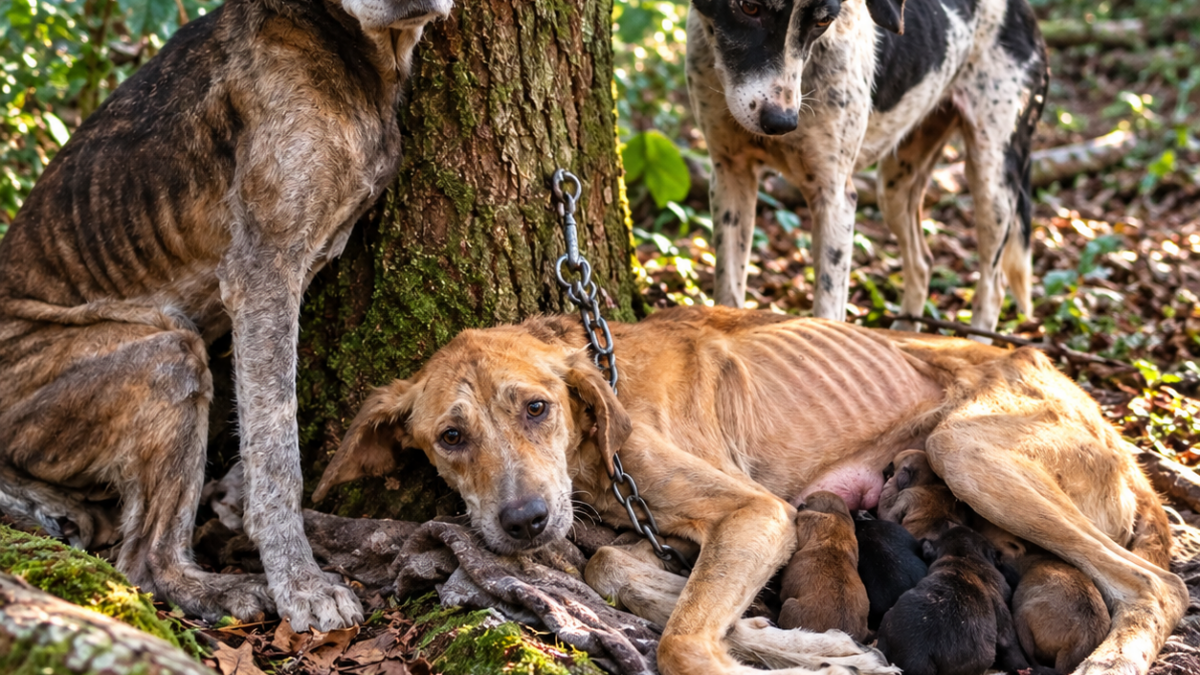
I looked at the mother.
She had finished most of the water and was now lying beside her puppies again.
“Six dogs.”
“Six?”
“Three adults. Three newborns.”
Another pause.
“And Linda?”
“Yeah?”
“Bring bolt cutters bigger than mine.”
She understood from my tone that I wasn’t joking.
“Copy that.”
The big shepherd mix watched the radio as though he suspected another person was hiding inside it.
I gave him a tired smile.
“You’re going to love civilization.”
He didn’t look convinced.
For the next forty minutes, I stayed on the ground.
I didn’t try to touch them again.
Trust with frightened animals is rarely built by doing more.
Most of the time, it’s built by proving you can stop.
So I waited.
I poured more water.
I opened an emergency food pouch from my pack and placed several small portions on flat pieces of bark.
The black-and-white dog was the first to eat.
The older dog waited.
Again, I noticed the same pattern.
He looked toward the mother before touching his portion.
“Who taught you that?” I whispered.
He ate quickly.
The mother took only a little.
That worried me.
Newborn puppies were depending on a body that had almost nothing left to give.
I studied the chain.
It wasn’t something that had accidentally caught around the tree.
Someone had secured it deliberately.
A thick metal loop had been wrapped around the oak and fastened with a lock.
The other end connected to the dog’s collar.
There was no bowl.
No shelter.
No sign anyone had planned to return.
My stomach tightened.
I had dealt with careless people before.
People who dumped garbage.
People who abandoned furniture.
People who left unwanted animals near trailheads because they convinced themselves somebody would find them.
But this wasn’t a trailhead.
This was almost four miles from the nearest open road.
Whoever had brought that dog here had chosen isolation.
I photographed everything.
The chain.
The lock.
The tree.
The ground.
The scraps.
The tire impressions near the edge of the clearing.
Thirty-eight years in public service teaches you something unfortunate.
Sometimes being angry is less useful than being thorough.
So I documented first.
I allowed myself to be furious later.
The old dog moved toward the mother and lay beside her.
She rested her head briefly against his shoulder.
That simple gesture almost undid me.
I had assumed at first that he might be the father of the puppies.
Maybe he was.
Maybe he wasn’t.
It didn’t matter.
He had stayed.
The black-and-white dog circled the clearing once and then sat facing the trail we had entered from.
Standing guard.
“You’ve been doing this awhile,” I said.
His ears turned toward me.
Twenty minutes later, I heard voices.
“Tom?”
“Here!”
The dogs immediately stood.
The old one moved in front of the mother again.
“Slow!” I called.
Dr. Elena Ruiz emerged first.
Elena worked with the county rescue team and had been treating wildlife and domestic animals for nearly twenty years.
Behind her came Mark Jensen from animal control and another officer carrying equipment.
Elena stopped the moment she saw the dogs.
“Oh.”
That was all she said.
Then she crouched.
“What do we know?”
“Mother is chained. Three newborns. Two free adults. Both males, I think. They’re protective but haven’t tried to attack.”
“How long?”
“No idea.”
She looked at the mother.
“More than a few days.”
“I think so.”
The old dog barked.
Elena sat down.
“Good afternoon to you too.”
Mark glanced at me.
“How are we getting them out?”
“One relationship at a time.”
He sighed.
“You always make everything sound philosophical.”
“I’ve been working alone too long.”
The first breakthrough came from the smaller dog.
Elena tossed a piece of chicken several feet in front of him.
He ate it.
Then another.
She repeated the process until he stood less than five feet away.
“Male,” she confirmed.
“Young adult.”
He looked to be maybe three or four.
The older dog was harder.
Every time Mark moved toward the chain, the shepherd mix blocked him.
After several attempts, I understood what he wanted.
“Everyone back up.”
Mark looked at me.
“Tom—”
“Back up.”
We did.
The old dog immediately returned to the mother.
I walked forward alone.
He stood again.
“I know.”
I stopped.
“You’ve been doing the job.”
His body remained stiff.
“But I’m taking over now.”
Of course he didn’t understand the words.
But dogs understand consistency.
I sat.
I placed my hand flat on the ground.
Then I waited.
Five minutes.
Ten.
The forest seemed to close around us.
Finally, the old dog took one step toward me.
He smelled my boot.
I didn’t move.
He smelled my knee.
Then my hand.
His nose was cold.
He backed away again.
I remained still.
The second time he approached, he stayed.
Very slowly, I touched the side of his neck.
His entire body tensed.
Then relaxed.
“That’s it.”
I scratched once behind his ear.
His eyes closed for half a second.
It was enough.
When I stood, he moved beside me instead of in front of me.
Mark whispered, “I’ll be damned.”
“Don’t celebrate yet.”
We still had the mother.
Elena approached with me.
I spoke continuously.
“Easy, girl.”
We eventually learned her name was Willow.
But then she was simply Mama.
Elena examined what she could without moving the puppies.
“She’s dehydrated.”
“I figured.”
“Underweight. Probably anemic. Mammary tissue looks okay from here. Chain has rubbed her neck, but I don’t see anything catastrophic.”
“Can she walk?”
“I don’t want her walking four miles.”
We had brought a collapsible rescue litter.
The challenge was freeing her without panicking the entire group.
Mark examined the lock.
“Bolt cutters should do it.”
The instant metal touched metal, Willow flinched.
The old dog moved closer.
I put my hand against his shoulder.
“Stay.”
He surprised me.
He did.
Mark cut the lock.
The sound was sharp.
Willow jerked.
The old dog gave one bark.
The puppies squeaked.
Then the chain fell away from the tree.
For the first time in however long she had been there, Willow was free.
She didn’t move.
That hurt more than I expected.
Freedom had arrived, and she no longer knew what to do with it.
Elena whispered, “Give her a second.”
Willow looked at the ground beyond the radius where the chain had allowed her to walk.
Then she extended one front paw.
Stopped.
Took another step.
Nothing pulled her back.
She looked behind herself.
At the chain.
At me.
Then she walked forward.
Only three feet.
But I swear every person in that clearing stopped breathing.
Elena wiped her eye with the back of her wrist.
“Dust,” she muttered.
“Sure.”
“Not a word, Tom.”
We lifted the puppies first into a padded carrier.
Willow became anxious until we placed the carrier where she could see and smell them.
Then we eased her onto the litter.
She was lighter than she should have been.
Far lighter.
We started toward the trailhead.
The old dog followed on the left.
The black-and-white dog followed on the right.
Neither needed a leash.
For four miles, they refused to leave her.
When we stopped to rest, they stopped.
When the litter moved, they moved.
Once, the smaller dog disappeared into the brush.
I worried we had lost him.
He returned less than two minutes later and walked directly to Willow.
Elena looked at me.
“You were right.”
“About what?”
“They’ve been keeping her alive.”
We reached the vehicles just before sunset.
Animal control had brought two vans.
Elena wanted Willow transported immediately to the emergency veterinary clinic.
The puppies would remain with her.
We opened another crate for the older dog.
He refused.
We tried food.
Nothing.
A leash.
He planted his feet.
Then Willow’s stretcher disappeared into the veterinary van.
The old dog panicked.
He pushed past Mark and reached the rear doors before we closed them.
He barked.
Once.
Twice.
Then scratched at the step.
Elena looked at me.
“Put him with her.”
“Safe?”
“As long as he doesn’t interfere.”
We opened the door.
The old dog climbed inside.
He immediately lay beside Willow’s stretcher.
The black-and-white dog jumped in after him.
Mark stared at the three of them.
“So much for separate transport.”
“No one’s separating them tonight.”
Elena nodded.
“Agreed.”
I drove behind the van.
It was nearly dark when we reached the clinic.
I should have gone home.
Instead, I stayed.
Willow’s examination lasted almost two hours.
The puppies were estimated to be four or five days old.
All three were small but alive.
Two males.
One female.
Willow was severely underweight, dehydrated, and exhausted, but her major organs looked better than Elena had feared.
The neck injury from the collar needed treatment.
Her paws had several cuts.
She also had evidence of having given birth before.
“She’s probably had previous litters,” Elena told me.
“Recently?”
“Not this recently. But more than one, I’d guess.”
“Breeding dog?”
“Maybe.”
The old shepherd mix had arthritis, several worn teeth, and a faded microchip that no longer traced cleanly to a current owner.
We started calling him Boone.
The black-and-white dog had no chip.
Mark called him Patch.
“Original,” I said.
“You want to name six dogs at midnight?”
“Point taken.”
I sat in the hallway while the staff worked.
Around one in the morning, Elena came out holding a paper cup of coffee.
“You look terrible.”
“I’m sixty-three.”
“That’s not what I meant.”
“I’ve been insulted more creatively.”
She sat beside me.
“You did good today.”
“I walked down a trail.”
“You found them.”
“Somebody put them there.”
Her expression changed.
“Yes.”
“I want to know who.”
“Tom.”
“What?”
“Don’t make this personal.”
I laughed once.
“Elena, somebody chained a nursing dog four miles into restricted forest.”
“I know.”
“Two other dogs nearly starved because they wouldn’t leave her.”
“I know.”
“Three puppies were born under a tree.”
Her voice softened.
“I know.”
I looked through the glass doors toward the treatment area.
Boone was lying beside Willow’s kennel.
Patch was asleep under a chair.
“It became personal before I got there.”
Elena didn’t argue.
The next morning, I returned to the clearing with Mark.
We treated it as an evidence site.
The tire tracks had been partially damaged by our rescue vehicles farther down the trail, but near the clearing they remained clear.
One set.
Large pickup.
Aggressive tread.
I photographed measurements and casting points.
We collected the cut lock and chain.
Under a bush, Mark found a torn corner from a commercial dog-food sack.
Most of the printing had been ruined by rain.
One thing remained visible.
A store logo.
Mercer Farm & Feed.
There were three Mercer stores in the county.
Not much.
But it was something.
Then I remembered why I had been investigating the trail in the first place.
The human tracks.
Two weeks earlier, after finding the first illegal tire marks, I had installed a wildlife camera overlooking a narrow section of the service road.
I had placed it high in a cedar and angled it away from the obvious approach.
I had almost forgotten about it.
“Mark.”
He looked up.
“What?”
“I may have a camera.”
He stared at me.
“May?”
“Depends whether somebody found it.”
We walked nearly a mile.
The camera was still there.
I removed the memory card.
Neither of us had a laptop in the field.
So for the next forty minutes, the little black card in my shirt pocket felt heavier than a brick.
Back at the ranger station, I inserted it into my computer.
Hundreds of images.
Deer.
Raccoons.
A black bear.
Three hikers who had apparently ignored the CLOSED AREA sign and would soon receive an educational phone call.
Then, eleven days earlier, a truck appeared.
Red.
Older model.
Extended cab.
The front license plate was obscured by mud.
The rear plate never faced the camera.
At 6:14 p.m., the truck drove north toward the abandoned trail.
Forty-three minutes later, it returned.
I enlarged the first photograph.
Something was visible in the truck bed.
A metal dog crate.
Mark leaned over my shoulder.
“Can you tell what’s inside?”
“No.”
We checked the next frame.
The angle changed.
Behind the crate bars was the outline of a dog.
Gray-brown.
My jaw tightened.
The next image showed something else.
Two dogs were running behind the truck.
One large.
One black and white.
Boone.
Patch.
Mark went silent.
We advanced the sequence.
The truck continued north.
The two dogs followed.
Forty-three minutes later, the truck returned alone.
I stared at the screen.
“Eleven days.”
Mark nodded.
“At least.”
That answered one question.
Boone and Patch hadn’t stumbled onto Willow.
They had come with her.
The person driving that truck had brought all three dogs into the forest.
But only Willow had been restrained.
Maybe Boone and Patch had been expected to wander away.
Maybe whoever did it assumed they would follow the truck back toward civilization.
They hadn’t.
They had chosen Willow.
“What kind of person does that?” Mark whispered.
I didn’t answer.
Because I had learned that asking why too early can distract you from proving who.
The truck gave us a starting point.
Red extended-cab pickup.
Older model.
Damaged right taillight.
Silver toolbox.
A white sticker in the rear window.
Mark contacted county investigators.
I contacted the feed store.
Mercer Farm & Feed kept electronic purchase records for customers with commercial accounts.
The torn bag had part of a product code.
It belonged to a high-calorie kennel feed mostly purchased by breeders, boarding facilities, and hunting kennels.
We couldn’t simply demand customer lists without proper authority.
So we passed the information to investigators.
Then we waited.
I hated waiting.
For the next week, I spent nearly every evening at the veterinary clinic.
Willow improved slowly.
She ate constantly.
Her milk supply strengthened.
The puppies gained weight.
Boone began treatment for arthritis.
Patch turned out to be younger than we guessed—probably two.
He also turned out to be a thief.
On my fourth visit, I found him walking down the clinic hallway carrying one of Elena’s shoes.
She followed him in one sock.
“Your friend has developed confidence.”
“He’s your patient.”
“He likes you.”
“He stole your shoe.”
“He stole it after you arrived.”
Patch dropped the shoe at my feet.
Elena crossed her arms.
“Explain that.”
I looked down at him.
“Traitor.”
His tail wagged.
Willow was different.
She tolerated the veterinary staff.
But when I entered, she watched me.
On the fifth day, I sat beside her enclosure.
She stood.
Walked toward the gate.
Then pushed her head against my hand.
I didn’t move for several seconds.
Elena saw it from across the room.
“She remembers.”
I rubbed Willow’s ear.
“Or she associates me with bolt cutters.”
“Very romantic.”
Boone stayed close to her.
Always.
If Willow moved, Boone lifted his head.
If a stranger entered quickly, Boone stood.
If one of the puppies cried, Boone sometimes approached the pen and stared down with an expression of deep concern.
Patch was more playful.
He began rolling toys toward the puppies’ enclosure even though they were too young to care.
One afternoon, Elena sat beside me.
“You know they’ll eventually need placement.”
“I know.”
“Separately, probably.”
I looked at Boone.
He was sleeping with one paw touching Willow’s blanket.
“No.”
“Tom.”
“No.”
“You’re not adopting six dogs.”
“I didn’t say I was.”
“You used your stubborn voice.”
“I have one voice.”
“You have twelve stubborn voices.”
I ignored her.
She sighed.
“The puppies will need homes. Patch probably will too. Boone and Willow are bonded, but—”
“No.”
“Again with the voice.”
“They stayed alive because they stayed together.”
“That doesn’t mean they all need one address forever.”
“I know.”
But emotionally, I didn’t.
Not yet.
On the eighth day after the rescue, Mark called.
“We have a name.”
I was at the station.
I shut my office door.
“Who?”
“Dean Colter.”
I knew the name.
Not personally.
Everyone in the county knew something about Dean.
He owned a twenty-acre property near Mill Creek.
He had bred hunting dogs and large mixed working dogs for years under the business name Colter Ridge Kennels.
There had been complaints.
Noise.
Loose dogs.
Improper fencing.
Nothing, as far as I knew, that had resulted in serious charges.
“How’d you get there?”
“Feed records and truck registration.”
My grip tightened around the phone.
“He owns the red pickup?”
“Yes.”
“Plate?”
“Matches make, model, year, damage pattern. Investigator drove past the property this morning. Same sticker in rear window.”
“Search warrant?”
“Working on it.”
“What about the dogs?”
“Feed store account shows he bought that exact food.”
“That’s not enough.”
“No.”
“What else?”
“Boone’s microchip.”
I straightened.
“You got a trace?”
“Old registration company found archived data.”
“To Colter?”
“Not directly. Boone was registered nine years ago to a woman named Rachel Colter.”
“Dean’s wife?”
“Former wife.”
“What about Willow?”
“No chip.”
“Patch?”
“Nothing.”
Mark paused.
“Rachel’s calling us this afternoon.”
“What does she know?”
“Apparently a lot.”
Rachel Colter lived two states away.
She and Dean had divorced four years earlier.
When investigators contacted her about Boone, she began crying.
Boone, she explained, had originally belonged to her father.
After her father died, Rachel took him.
During the divorce, she couldn’t immediately take all her animals to the apartment where she was living.
Dean had agreed to keep Boone temporarily.
Temporarily became years.
Rachel said Dean stopped answering messages about him.
Eventually he told her Boone had run away.
She believed him.
“What about Willow?” I asked when Mark later summarized the call.
“Rachel knew a dog matching her description. Name was Daisy.”
I looked through the glass of the clinic room at Willow.
“Daisy.”
“Dean used her for breeding.”
“How many litters?”
“Rachel doesn’t know. At least two before the divorce.”
“And Patch?”
“Could be from one.”
I turned toward him.
“You’re serious?”
“Possible.”
That changed the image in my head.
Boone.
Willow.
Patch.
Maybe they hadn’t simply formed a family in the forest.
Maybe some version of that family had existed before.
A search warrant was executed at Colter Ridge Kennels two days later.
I wasn’t there.
That wasn’t my jurisdiction.
But I heard enough afterward.
Seven dogs were found on the property.
All alive.
Several needed veterinary attention.
Records were incomplete.
Kennel conditions violated multiple county requirements.
There were old chains.
Breeding cages.
Medication without adequate documentation.
And behind a storage shed, officers found something important.
A stack of broken kennel panels and three collars.
One collar matched photographs Rachel had of Willow when she was younger.
Dean told investigators the dog had been sold.
Then he changed his story.
She had escaped.
Then he said someone else had taken her.
The problem with lying is not merely moral.
It is administrative.
You have to remember which version you used.
Dean apparently wasn’t very good at that.
The truck was photographed.
Its tires matched the general tread pattern found near the clearing.
The damage to the rear taillight matched the trail-camera image.
Still, investigators wanted more.
Then Dean made the mistake that turned a strong case into something much harder for him to explain.
He came to see me.
It was just after seven in the evening.
I was locking the ranger station when the red pickup entered the parking lot.
I recognized it before the engine stopped.
Dean stepped out.
Late forties.
Heavy shoulders.
Baseball cap.
Work boots.
He walked toward me quickly.
I didn’t like that.
I stayed beside my truck.
“Ranger Avery?”
“You know who I am.”
“You’re the one who found those dogs.”
I said nothing.
“They’re mine.”
“Then speak to county investigators.”
“I’m speaking to you.”
“Bad choice.”
His jaw tightened.
“The news is making me look like some monster.”
At that point, the rescue had been covered by a local television station.
No suspect had been named.
The county had released photographs of the dogs but said only that an investigation was underway.
“We haven’t named you publicly.”
“People know.”
“Then maybe you should ask how.”
He stepped closer.
“I didn’t abandon them.”
“Talk to investigators.”
“The female got loose.”
I stared at him.
“While chained to a tree?”
His expression changed.
Small change.
But enough.
I hadn’t told the public she was chained.
That detail had been withheld.
Dean realized his mistake at nearly the same moment I did.
He looked away.
I felt my pulse accelerate.
“You should leave.”
“You don’t know the whole story.”
“Then tell it to the investigator.”
“She was sick.”
“So you took her four miles into closed forest?”
“I said she got loose.”
“You also knew she was chained before I said it.”
Dean’s eyes hardened.
For one uncomfortable second, neither of us spoke.
Then he pointed a finger toward me.
“You stay out of my business.”
I almost laughed.
“You drove your business into my forest.”
He took another step.
I didn’t.
“Dean.”
My voice changed.
Thirty-eight years in uniform teaches you how to make one word sound like a closed door.
“You need to leave.”
He stared at me.
Then at the security camera mounted over the ranger-station entrance.
His face shifted again.
He stepped back.
“Those dogs belong to me.”
“No.”
“You don’t decide that.”
“Neither do you anymore.”
He returned to the truck.
Before getting inside, he said, “This isn’t over.”
I looked at the camera.
“No.”
I said it mostly to myself.
“It probably isn’t.”
The recording from the station security system went directly to investigators.
So did my written report.
Three days later, Dean’s attorney contacted the county.
Dean now claimed he had driven into the forest because he intended to transfer the dogs to someone who had agreed to take them.
According to his new story, Willow became difficult to handle, so he temporarily secured her to the tree while searching for Boone and Patch, who had run away.
Then, allegedly, his truck had developed mechanical problems and he had been forced to leave.
He intended to return.
Eleven days later.
Without once contacting a ranger.
Without contacting animal control.
Without reporting missing dogs.
Without leaving food.
Without leaving water.
Without returning to the site before I found them.
Mark read the statement aloud in my office.
I stared at him.
“He actually signed that?”
“Through counsel.”
“That might be the worst story I’ve heard since my grandson blamed a raccoon for breaking a lamp.”
Mark laughed.
Then his expression turned serious.
“We still need to prove intent.”
“Trail camera shows him going in with them and leaving without them.”
“Strong evidence.”
“Willow was locked to a tree.”
“Strong evidence.”
“He knew she was chained.”
“Also strong.”
“But?”
“But criminal cases aren’t campfire stories, Tom. Every element matters.”
I knew that.
I just didn’t like it.
Then Rachel Colter found photographs.
Dozens.
Old pictures from her marriage.
Boone as a younger dog.
Willow—then Daisy—lying in the grass.
And one photograph of a black-and-white puppy beside Willow.
Mark sent me the image.
I opened it on my phone while standing beside Patch at the rescue center.
Same white stripe.
Same black ear.
Same irregular black patch over the left shoulder.
Patch was one of Willow’s previous puppies.
Two years earlier.
Maybe three.
I sat down.
Patch immediately climbed halfway into my lap.
“You really are her kid.”
His tail slapped my leg.
Boone walked over.
He placed his chin on my knee.
The three dogs hadn’t simply stayed together randomly.
Patch had remained beside his mother.
Boone had once lived with both of them.
Whatever had happened at Dean’s property, they had recognized one another as family.
And when Willow was chained to the oak, they had chosen her over the road home.
That knowledge changed public interest in the case.
When the rescue organization shared the confirmed history—without naming Dean—the story spread quickly.
People were moved by one detail more than anything else:
Patch could have followed the truck.
Boone could have followed the truck.
They didn’t.
They stayed with Willow.
For eleven days.
Investigators believed the dogs traveled up to several miles searching for food.
We found tracks near an old camping area and around trash bins at a distant picnic access point.
Someone later reported seeing a black-and-white dog near dumpsters nine days before the rescue.
That was probably Patch.
Boone’s paws had worn raw in places.
He had likely made the same trip.
I began imagining those nights.
Willow unable to move beyond the chain.
Three newborn puppies pressed against her.
Boone and Patch disappearing into the darkness.
Then returning.
I wondered whether Willow watched the trail every time they left.
I wondered whether she feared they wouldn’t come back.
They always did.
The puppies grew.
We named them Ash, River, and June.
Ash was the largest male.
River had a white streak down his chest.
June was the smallest and loudest.
When their eyes opened, June immediately decided I belonged to her.
Every time I visited, she crawled toward my hand.
“You are five inches long,” I told her one afternoon.
She bit my finger with a mouth containing almost no teeth.
Elena laughed.
“Terrifying.”
“She has Boone’s security instincts.”
Boone was lying upside down on a blanket.
His tongue hung out.
“Clearly.”
Willow continued gaining strength.
Her coat changed.
That surprised me.
When I found her, it had looked dull and gray.
As nutrition improved, warm brown coloring appeared along her shoulders.
Her eyes softened too.
The first time she wagged her tail at me, I pretended not to notice because Elena was watching.
“I saw that.”
“Saw what?”
“You’re emotional.”
“I’m tired.”
“You smiled.”
“I do that.”
“Rarely.”
Willow walked across the room and leaned against my leg.
Elena folded her arms.
“You are absolutely adopting that dog.”
“I have not said that.”
“You don’t have to.”
“What about Boone and Patch?”
She sighed.
“There it is.”
“What?”
“The problem.”
“They stay together.”
“You have a cabin.”
“With land.”
“And a fenced yard?”
“Most of one.”
“Most?”
“Windstorm took the back section.”
“So repair it.”
“I work full time.”
“You’re eligible to retire.”
I looked at her.
“You’ve planned my entire life.”
“No. The dogs have.”
I laughed.
But the idea had already started growing.
I had lived alone for six years.
My wife, Carol, died after forty-one years of marriage.
We never had children.
That loss changed the shape of my home.
I kept working because the woods gave me somewhere to put my attention.
Every morning I wore the uniform.
Every evening I returned to a quiet cabin.
I had never thought of myself as lonely.
Loneliness is easier to deny when your job requires solitude.
But after finding Willow, Boone, and Patch, I began noticing the silence in my house differently.
I imagined Boone sleeping beside the woodstove.
Patch stealing my gloves.
Willow on the porch.
It frightened me.
Not because I didn’t want them.
Because I did.
Caring about something means accepting the possibility of losing it.
At sixty-three, I already knew enough about that bargain.
So I kept telling myself I was only helping.
The dogs ignored my argument.
Two weeks later, the case against Dean changed again.
Investigators recovered data from a second source.
A gas station.
The old logging road connected indirectly to a county route about six miles south.
A station camera had recorded Dean’s red pickup buying fuel on the evening the dogs were abandoned.
The timestamp placed him less than fifteen minutes from the forest entrance.
The truck bed contained the same metal crate.
On the return footage, the crate was empty.
Then came a receipt from Mercer Farm & Feed.
Earlier that afternoon, Dean had purchased a padlock.
Same brand.
Same size.
Same model as the lock cut from Willow’s chain.
Could someone else have bought the same lock?
Of course.
But evidence doesn’t always arrive as one dramatic revelation.
Sometimes it arrives as bricks.
Truck.
Camera.
Feed bag.
Tire tread.
Padlock.
Statements.
Knowledge of the chain.
Dog history.
One brick.
Then another.
Until denial has nowhere left to stand.
Dean’s attorney changed strategy.
Instead of claiming the dogs had escaped, they now argued Dean had intended to surrender them but had panicked after local shelters told him they were full.
That explanation created a new problem.
Every county shelter had phone records.
None showed calls from Dean.
Elena found that amusing.
“Does this man understand records exist?”
“Apparently not.”
The public still didn’t know his name.
That changed because Dean named himself.
He posted a long statement online.
He accused the county of targeting him.
He claimed Willow had been dangerous.
He claimed Boone was unmanageable.
He claimed Patch belonged to someone else.
Then he said the puppies had not been born when he last saw Willow.
That final statement destroyed what little credibility remained.
A veterinary specialist had estimated the puppies’ age.
Based on their development, Willow had almost certainly been close to giving birth when Dean drove her into the forest.
Rachel provided older breeding records showing that Dean had bred Willow multiple times.
People connected the pieces.
Reporters called.
My supervisor instructed me not to speak publicly beyond approved facts.
That was fine with me.
I had no interest in becoming a television ranger.
Then somebody posted my photograph.
It had been taken during the rescue.
I was kneeling beside Willow with Boone standing behind me.
The image spread.
Soon people began sending letters to the station.
Most were kind.
Some were angry.
A few were disturbing.
One envelope contained a handwritten note:
YOU SHOULD HAVE LEFT THEM WHERE THEY WERE.
No signature.
I read it twice.
Then I showed my supervisor.
“Probably nonsense,” he said.
“Probably.”
But we documented it.
Two nights later, someone drove past my cabin at 2:13 a.m.
My driveway camera recorded headlights slowing.
The vehicle never entered.
The image wasn’t clear enough to identify.
I told myself not to connect things without evidence.
That was the rule I preached to everyone else.
It was harder to practice when the dark felt personal.
I checked the locks twice.
Then I laughed at myself.
I had spent thirty-eight years walking alone in bear country.
Now one anonymous note had me checking windows.
Still, the next morning I installed another camera.
Not because I was afraid.
Because I was thorough.
Three days passed.
Nothing.
Then one evening, Patch did something strange.
He was still at the rescue facility, but I had taken all three adult dogs for a supervised walk on county property.
We were approaching the parking lot when Patch froze.
His body lowered.
Boone stopped too.
Willow moved behind me.
A red pickup had entered the lot.
My pulse jumped.
It wasn’t Dean’s.
Different truck.
An older couple got out.
Patch relaxed.
But the reaction told me something.
All three dogs remembered.
Whatever Dean had done, the red truck itself had become part of it.
That made me angrier than any legal document.
The hearing regarding temporary custody of the dogs came first.
Dean wanted them returned pending the criminal case.
The county opposed it.
The rescue organization opposed it.
Rachel sought legal ownership of Boone based on his original records.
I attended because I had found them and documented the scene.
Dean sat across the courtroom.
For the first time since the ranger station, our eyes met.
He looked away first.
The judge reviewed photographs.
Not the worst ones.
There really weren’t dramatic injuries.
That was almost what made the case more painful.
The evidence was quieter.
The worn circle around the oak where Willow had paced.
The empty ground.
The chain.
The three newborn puppies.
Boone’s damaged paws.
Patch’s weight.
The absence of food or water.
The judge asked Dean’s attorney a simple question.
“If your client intended to return, why did he not?”
The answer took nearly five minutes.
It never actually answered the question.
Temporary custody remained with the county.
Dean was prohibited from possessing the rescued dogs while the case proceeded.
Additional restrictions were placed on his access to the remaining animals from his property.
Outside the courthouse, reporters waited.
I tried to leave through a side entrance.
Dean found me first.
“You enjoying this?”
I stopped.
“Enjoying what?”
“My life getting destroyed.”
“No.”
“Could’ve fooled me.”
I looked at him.
There are moments when anger wants to become speech.
I had plenty I wanted to say.
Instead, I thought of Willow drinking from that folding bowl.
Boone refusing to leave the van.
Patch carrying Elena’s shoe.
I kept my voice level.
“Your life isn’t the part I’m interested in.”
“You made this happen.”
“No.”
I stepped closer—not threatening, just enough to make sure he heard me.
“You drove into that forest.”
His face tightened.
“You put that chain around the tree.”
“I didn’t—”
“You knew about it before I mentioned it.”
He stopped.
“And those dogs stayed alive in spite of what happened.”
A reporter rounded the corner.
Dean immediately backed away.
I walked past him.
That was the only confrontation we ever had.
It was enough.
Because the real consequences weren’t going to happen in a parking lot.
They were going to happen on paper.
Months passed.
The puppies grew so quickly that I sometimes felt cheated.
One week they fit beneath Willow’s stomach.
The next they were tumbling over Boone.
June developed a habit of climbing on him while he slept.
Boone tolerated everything.
Ash stole food.
River followed Patch everywhere.
Willow became playful.
That was the most beautiful change.
The first time she chased a ball, she didn’t understand what to do when she caught it.
She simply stood over it.
Patch ran past.
Willow ran after him.
Then Boone joined.
Three dogs that had once stood starving beneath an oak tree began racing around a fenced field like puppies.
I stood at the gate watching.
Elena came beside me.
“You’re crying.”
“Allergies.”
“In November?”
“Rare seasonal variety.”
She laughed.
“You retiring?”
I kept watching the dogs.
“I filed the paperwork.”
Her mouth fell open.
“You did?”
“January.”
“Tom.”
“What?”
“You actually listened to me.”
“Don’t tell anyone.”
“And the fence?”
“Fixed.”
“And the dogs?”
I looked at her.
“All three.”
She smiled so wide I regretted telling her in person.
“I knew it.”
“Conditions.”
“Oh?”
“Boone gets the downstairs bed because stairs are bad for his hips. Patch gets obedience training. Willow gets whatever she wants.”
“So no conditions.”
“Basically.”
“What about the puppies?”
That part hurt.
I could not responsibly keep six dogs.
The rescue organization screened adopters carefully.
I insisted—probably beyond my authority—that the puppies go to families willing to stay in contact.
Ash went to a firefighter and his husband who owned eight fenced acres.
River went to a veterinarian technician with two older dogs.
June went to a retired schoolteacher named Martha who lived fifteen minutes from my cabin.
Martha had met June once and immediately said, “This one.”
I asked why.
June had climbed into her purse.
“Confidence,” Martha said.
“Burglary,” I replied.
They were perfect for each other.
The day the puppies left, Willow searched for them.
That nearly broke me.
She walked from room to room at the rescue center.
Smelled their blankets.
Whined.
I sat beside her.
“I know.”
She pressed against my chest.
The puppies weren’t disappearing.
But she didn’t understand that.
So we arranged visits.
Within a month, Willow learned that strange modern arrangement where children leave home but occasionally return with no manners.
June especially returned as if she had been raised by wolves.
Boone pretended to hate the reunions.
Then slept in the middle of the puppy pile.
My retirement began on a snowy Friday.
Thirty-eight years.
My coworkers threw a party at the ranger station.
Someone gave me a plaque.
Someone else gave me a new pair of bolt cutters.
That got the biggest laugh.
My supervisor, James, handed them to me.
“In case retirement gets boring.”
“I’m never going into the woods again.”
Everyone laughed harder.
At home that evening, I opened the back door.
Three dogs were waiting.
Boone stood closest.
Patch circled me twice.
Willow leaned against my leg.
For the first time in almost forty years, I did not have to prepare for work the next morning.
That frightened me more than I expected.
Then Patch stole my glove and ran through the kitchen.
I spent ten minutes chasing him.
Retirement found a purpose.
The criminal case took nearly nine months.
During that time, Dean’s kennel business collapsed.
Not because anyone attacked him.
Not because I did anything.
Customers left.
Contracts disappeared.
His breeding license came under review.
The remaining dogs from his property were transferred under court supervision after veterinary reports documented multiple violations.
Then prosecutors filed the final charges.
Animal abandonment.
Cruelty-related counts.
Illegal dumping on protected land.
Trespass into a closed conservation area.
False statements connected to portions of the investigation.
There were also civil penalties for environmental and kennel violations.
Dean’s attorney negotiated.
The case did not end with some dramatic twenty-year sentence.
Real life is usually less theatrical.
But the outcome was substantial.
Dean entered pleas that resolved several charges.
He was prohibited from operating a breeding kennel for years.
He surrendered ownership of the remaining dogs.
He was ordered to pay restitution connected to veterinary and rescue costs.
Fines were assessed.
Probation conditions restricted his possession of animals.
He was required to complete community service and comply with inspections tied to the court’s order.
The county also pursued costs associated with the illegal entry and cleanup.
People asked whether I was disappointed he didn’t go to prison for years.
No.
I wasn’t.
I wanted one thing.
I wanted him never to put another dog in the position Willow had been in.
The order accomplished more toward that goal than any fantasy of revenge ever could.
Still, the case had one final surprise.
During the financial review of Dean’s kennel, investigators discovered records showing Willow had produced at least four litters.
Dean had sold most of the puppies.
Patch was from her third.
There was another dog from an earlier litter registered locally.
A female named Sadie.
Her family lived twenty miles away.
When they learned what had happened to Willow, they contacted the rescue.
We arranged a meeting.
I didn’t know whether dogs recognized relatives after years.
Experts can argue about that.
I can only tell you what happened.
Sadie entered the fenced yard.
Willow stopped.
Sadie stopped.
For several seconds, they stared.
Then Sadie approached.
Willow smelled her face.
Her neck.
Her shoulders.
Then both tails began moving.
Patch joined them.
The three dogs circled one another.
No dramatic music.
No perfect movie moment.
Just recognition of some kind.
Familiarity.
Comfort.
Something older than language.
Sadie’s owner began crying.
So did Martha, who had brought June for the gathering.
I pretended to have allergies again.
Nobody believed me anymore.
That spring, I went back to the oak tree.
Alone.
The trail had reopened for ranger use but remained closed to the public.
Grass had grown through the clearing.
The worn dirt circle around the tree was almost gone.
I carried something in my backpack.
Not a plaque.
I didn’t want to turn a protected forest into a memorial site.
Just a small native oak sapling approved by the forestry division.
The old tree had been damaged by storms and was declining.
We had decided to plant a replacement nearby.
I dug the hole.
Added soil.
Packed it firmly.
Then I sat beneath the old oak.
For months, I had thought about that clearing as the worst place in the story.
But sitting there again, I realized that wasn’t completely true.
Yes, somebody had done something cruel there.
But cruelty wasn’t the only thing that happened beneath that tree.
Boone stayed.
Patch stayed.
Willow gave birth.
Three puppies survived.
Two dogs walked miles for food and returned.
A family refused to abandon one another.
That mattered too.
Maybe more.
When I reached home, Willow met me at the gate.
Patch carried one of my gardening gloves.
Boone stayed on the porch because his hips were bothering him.
I sat beside him.
“You missed a trip.”
He rested his head against my leg.
“I went back.”
His ear moved.
“The tree’s still there.”
Boone closed his eyes.
I looked across the yard.
Patch and Willow were lying in the sun.
There are things animals carry that we will never fully understand.
Memory.
Fear.
Association.
Loss.
Maybe Boone remembered the oak.
Maybe he didn’t.
But his body had remembered enough to protect Willow when a stranger appeared.
And later, somehow, it learned that my hand was safe.
That was enough for me.
One year after the rescue, the local animal welfare organization held a fundraising event.
They wanted Willow, Boone, and Patch there.
I resisted.
Then Elena said something I couldn’t argue with.
“The story isn’t about what was done to them.”
“What is it about?”
“What they became afterward.”
So we went.
Hundreds of people attended.
Children sat on the grass.
Local rescue groups brought adoptable animals.
Martha arrived with June.
Ash and River came too.
For the first time since the puppies left, all six dogs were together.
Willow walked between them.
Boone lay in the shade.
Patch stole a sandwich from someone.
That part of his personality had not improved.
Near the end of the event, Elena walked onto a small stage.
I immediately became suspicious.
She had a microphone.
Nothing good happens when your veterinarian has a microphone.
She told the crowd the rescue had created a new emergency fund.
It would provide veterinary care and temporary housing for abandoned mother dogs and newborn litters.
The fund had a name.
The Oak Tree Fund.
I looked at her.
She smiled.
“No speech required.”
“Good.”
Then she handed me the microphone.
People applauded.
I considered leaving.
Instead, I looked down at Willow.
She was sitting beside me.
A year earlier, she had been unable to move beyond the length of a chain.
Now she stood in the middle of a field surrounded by hundreds of people who knew her name.
I lifted the microphone.
“I’ve spent most of my life working in forests.”
My voice sounded strange through the speakers.
“And one thing the woods teach you is that survival is rarely as simple as strength.”
The crowd became quiet.
“Sometimes survival is water.”
I looked at Boone.
“Sometimes it’s food.”
Patch stared at someone’s hot dog.
People laughed.
“And sometimes…”
I stopped.
My throat tightened.
“Sometimes survival is somebody refusing to leave.”
Boone lifted his head.
I looked at him.
“Those two dogs could have walked away.”
I pointed toward Boone and Patch.
“They could have followed the road. They could have saved themselves.”
Willow leaned against my leg.
“They stayed.”
I handed the microphone back to Elena before I embarrassed myself.
That night, I sat on my porch with all three dogs.
Boone was older.
Much older.
The vet estimated he was around eleven or twelve when I found him.
His arthritis had worsened.
Some mornings he needed help standing.
I knew what that meant.
I had spent enough time around animals to understand that rescue does not purchase immortality.
It only gives time.
And time is precious precisely because it ends.
Boone stayed with us another two years.
He became the unofficial grandfather of every foster dog that passed through my house.
Because that was what retirement turned into.
Elena had been right.
Once the fence was repaired, the rescue began asking whether I could temporarily foster dogs who struggled in kennels.
“Just one,” she promised.
That was a lie.
At various points, my cabin contained four dogs.
Five.
Once seven.
Patch considered this excellent.
Willow became gentle with frightened animals.
But Boone was remarkable.
He knew how to sit near fear without demanding anything from it.
I had seen him do it beneath that oak.
He simply transferred the skill indoors.
One winter, the rescue brought me a young hound that had spent weeks hiding beneath furniture.
For two days, the hound stayed behind my couch.
Boone lay ten feet away.
On the third day, five feet.
By the fifth day, they slept beside each other.
The hound went to a family a month later.
The night before he left, I sat beside Boone.
“You realize you’re better at this than I am.”
His tail moved once.
“Don’t get arrogant.”
Three months later, Boone stopped eating breakfast.
The veterinarian found cancer.
Advanced.
We could make him comfortable.
We could not make him young.
I hated that answer.
For several weeks, he still had good days.
We drove to the forest once.
Not the oak.
I didn’t want his final memory tied to that place.
We went to a lake near the ranger station.
Boone walked slowly to the water.
Patch raced ahead.
Willow stayed beside Boone.
They stood together at the shore.
I took a photograph.
It remains framed in my house.
Boone in the middle.
Gray face.
Willow on one side.
Patch on the other.
No chains.
No fences.
Just water and trees.
His last morning arrived quietly.
He could no longer stand without pain.
I sat on the floor beside him.
Willow lay against his back.
Patch remained near his paws.
The veterinarian came to the house.
Boone rested his head in my lap.
I scratched behind the same ear I had touched in the clearing years before.
“You did the job,” I whispered.
His eyes stayed on mine.
“You can stop guarding now.”
My voice broke.
“They’re safe.”
Willow pressed closer.
“Everybody’s safe.”
Boone exhaled.
And later, when he was gone, neither Willow nor Patch moved for a long time.
I didn’t either.
We buried Boone on my property beneath a maple tree.
Not because I thought he belonged to me alone.
He didn’t.
Boone belonged to every place he had stayed when leaving would have been easier.
I placed no long inscription.
Just his name.
And beneath it:
HE STAYED.
Patch slept beside the grave the first night.
The second too.
On the third morning, Willow walked there.
She lay beside him.
By noon, Patch joined her.
I sat on the grass several feet away.
We stayed until sunset.
Then Willow stood.
She walked toward the house.
Patch followed.
I followed them.
That was the lesson again.
Grief asks you to stay.
Love eventually asks you to move.
Years passed.
The Oak Tree Fund grew.
Not because of me.
Because people understood the story.
A restaurant held a fundraiser.
A school collected pet supplies.
A retired carpenter donated labor to repair rescue kennels.
Mercer Farm & Feed—the same store whose torn bag helped investigators—began donating food monthly.
One detail from the worst day became part of something good.
Dean eventually completed his court obligations.
I heard he sold the Mill Creek property.
Someone asked me if I wanted to know where he moved.
I said no.
That surprised the person.
“After everything he did?”
“Especially after everything he did.”
Justice had happened.
The dogs were safe.
I didn’t need Dean occupying another room in my life.
Revenge sounds satisfying when you’re angry.
But if you build your life around watching someone else suffer, they still own too much of your attention.
The better revenge was Willow asleep on my couch.
Patch stealing my socks.
Three puppies growing old in good homes.
Boone spending his final years warm.
The kennel shut down.
The court order.
The Oak Tree Fund.
The forest recovering.
That was enough.
More than enough.
Willow lived to be nearly thirteen.
By then, her face had turned almost completely white.
Patch remained beside her.
Of course he did.
He had been doing that since before I knew either of them.
In her final year, Willow slowed considerably.
She still walked to the porch every morning.
Still barked once when the mail carrier arrived.
Still demanded a piece of egg from my breakfast.
Every spring, I took her to visit the young oak we planted near the clearing.
Not all the way to the exact site as she aged.
Eventually we drove as close as permitted, and I carried a folding chair.
One April morning, we sat beneath the new tree.
It had grown taller than me.
Patch lay in the grass.
Willow rested beside my boots.
I looked at the old oak nearby.
Much of it had fallen during a storm the previous winter.
The forest was reclaiming it.
Moss covered the wood.
New plants grew through the cracks.
I thought about the first day.
The chain.
The puppies.
The barking.
The fear.
If someone had told me then that this place would eventually feel peaceful, I wouldn’t have believed them.
Willow lifted her head.
“You remember?”
She looked at me.
I smiled.
“Maybe that’s better if you don’t.”
Her tail moved once.
That summer, June turned seven.
Martha brought her for a visit.
Ash and River came too.
The puppies were no longer puppies.
Ash had a gray chin.
River had gained too much weight and was apparently on a diet he deeply resented.
June still stole things.
Mostly tissues now.
Willow lay in the middle of them while they moved around the yard.
I took a photograph.
Six had become five after Boone.
But the family was still there.
That night, after everyone left, Willow struggled to stand.
I helped her.
Patch waited.
We walked to the porch.
She lay down.
Patch curled beside her.
I sat in my chair.
For a long time, nobody moved.
Then I realized that the scene looked strangely familiar.
Two dogs side by side.
One protecting the other.
Only now there was no chain.
No hunger.
No fear.
Just home.
Willow died several months later.
At home.
Patch beside her.
My hand on her head.
Before she went, she looked directly at me.
I had wondered for years what she saw that first day in the forest when she watched me approach.
A threat?
Another person who might hurt her?
Maybe simply a stranger.
I will never know.
But in her final moments, I knew what I saw.
Trust.
Complete.
Quiet.
Earned over years.
Afterward, I buried her beside Boone.
Her marker said:
WILLOW
And beneath it:
SHE SURVIVED.
Patch stood between the two graves.
He was old by then too.
I rubbed his neck.
“You were the kid.”
He looked at me.
“You were supposed to be the irresponsible one.”
His tail moved.
He walked toward the house.
I followed.
Today, I am seventy years old.
I have been retired for seven years.
Patch is sleeping beside my chair as I tell this story.
He moves more slowly now.
His black markings have faded with gray.
He still steals my gloves occasionally.
I think he does it to maintain standards.
The Oak Tree Fund has helped more than two hundred animals.
Some were mothers with litters.
Some were seniors.
Some simply needed somewhere safe to stay until a permanent home appeared.
The sapling near the abandoned trail is now a young tree.
Rangers who came after me know the story.
New employees sometimes ask whether I really found six dogs out there.
I always correct them.
“I found three adults and three puppies.”
Then I usually add:
“But two of those adults had already found each other.”
Because that is the part I never want people to miss.
People often call me the man who saved Willow.
That isn’t accurate.
By the time I arrived, Boone and Patch had already been saving her for eleven days.
I merely brought equipment.
Water.
A radio.
A way out.
The courage happened before me.
It belonged to two hungry dogs that could have left but didn’t.
And if there is one thing thirty-eight years in the woods taught me, it is that character reveals itself most clearly when nobody is watching.
Dean Colter thought nobody was watching when he drove down that abandoned trail.
He was wrong.
A camera watched.
The forest kept tracks.
Receipts remained.
Records survived.
And three dogs remembered enough to lead us toward the truth.
He eventually had to answer for what he did.
But that was never the most important ending.
The important ending was this:
Willow never wore a chain again.
Boone never had to search for food again.
Patch never had to guard his mother alone again.
Ash, River, and June grew up knowing only homes.
And a place that had once represented abandonment eventually gave its name to a fund built around rescue.
Some people call that justice.
I do too.
But I think Boone would have called it something simpler.
Staying.
Staying when somebody is frightened.
Staying when they’re weak.
Staying when leaving would be easier.
Staying until help finally comes.
That old dog taught me more about loyalty in eleven days than some people learn in an entire lifetime.
And sometimes, late in the afternoon, when Patch and I sit on the porch and the forest beyond my property becomes quiet, I think back to that first bark on the abandoned trail.
I remember stopping.
Listening.
Turning away from the path I had planned to walk.
For years, I believed I had changed six lives that day.
I know better now.
They changed mine too.
Because the most important thing I found beneath that oak tree was not cruelty.
Cruelty had brought them there.
But it didn’t get the final word.
What I found was loyalty.
Family.
Endurance.
And proof that even after someone leaves you in the darkest part of the forest, your story does not have to end where they left you.
Sometimes someone stays.
Sometimes someone hears you.
And sometimes, after a very long night, help finally comes walking through the trees.








