PART 2: I FED MY NEIGHBOR’S CHAINED DOG THROUGH A HOLE IN THE FENCE—THEN HIS OWNER CAUGHT US
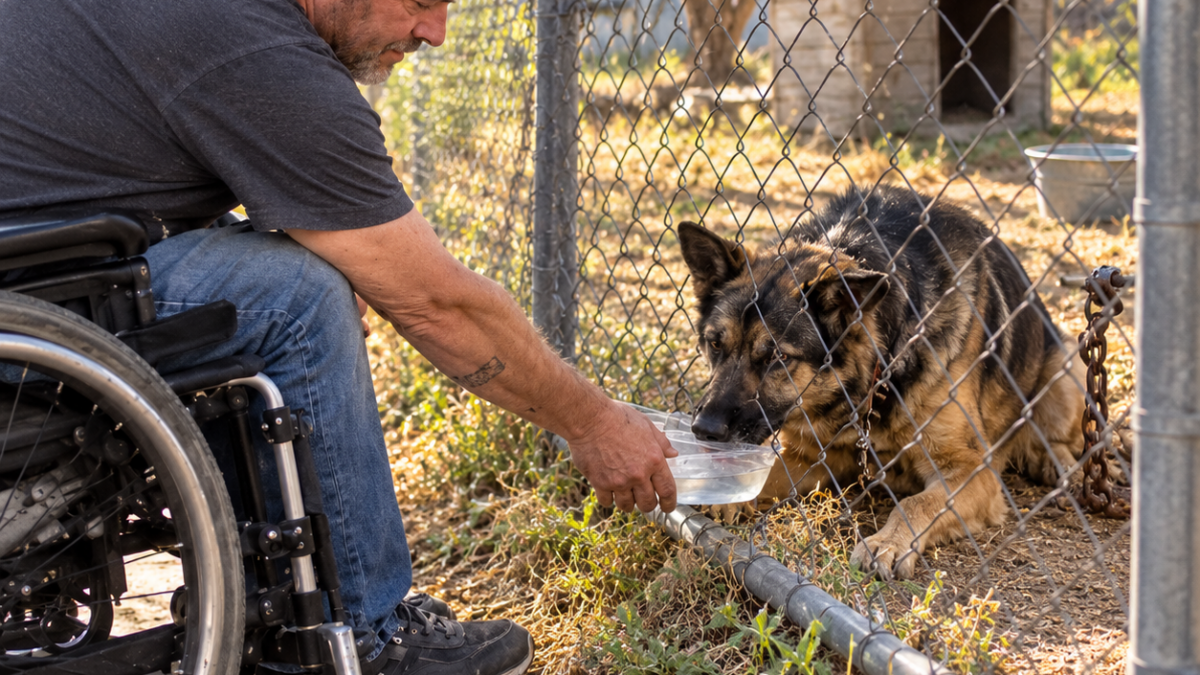
I could not cross the fence in my wheelchair, and the dog chained on the other side could no longer reach his water, so every morning we met exactly in the middle. I thought I was only bringing him a plastic container of water and a few scraps of food, but the way he reacted when his owner finally caught us told me the chain was hiding something much worse. Three weeks later, that same dog would drag himself toward me for a reason that changed both of our lives.
“Stay there, buddy. I’m not coming any closer.”
The shepherd mix backed away behind a broken lawn chair.
Even from several yards away, I could see his ribs beneath his black-and-tan coat. One ear stood straight while the other folded slightly at the tip. A heavy chain ran from his collar to a stake beside a collapsing doghouse.
It was too short.
He could reach the doghouse.
He could reach a circle of bare dirt.
He could not reach the shade of the porch.
And he could not reach the overturned water bucket lying only a few feet away.
My name is Julien Morel. I was forty-eight and living alone in a small wheelchair-accessible house outside Tours.
Six years earlier, I had been an electrician on construction sites. A temporary safety barrier failed beneath my weight, and the fall damaged my spinal cord.
My wheelchair gave me back much of my independence.
I was the one who had slowly stopped using that independence to build a life.
I worked remotely for a small electrical installation company. I drove an adapted van, bought my own groceries and made my appointments.
Then I came home.
Always home.
That changed when Damien rented the house next door.
He arrived with a few pieces of furniture, several black trash bags, an old car and the dog.
At first, I assumed the animal spent only a few hours outside.
Then hours became days.
Sometimes a food bowl appeared.
Often it was empty.
The water bucket was regularly tipped over and left beyond the chain’s reach.
Twice, I reported the situation.
Both times, Damien somehow knew when inspectors were coming.
The bowls were full.
The chain had been lengthened.
Damien smiled and said the dog slept inside and had only just been let out.
The moment the officials left, everything changed back.
And the dog kept getting thinner.
Then came the hottest day of the summer.
From my kitchen window, I watched him crawl toward the water bucket.
The chain tightened.
He strained against it.
Tried again.
Then collapsed in the dirt.
I filled a plastic container with cold water, put cooked chicken into a bag and headed outside.
The slope between our houses was nothing to someone walking.
For the small front wheels of my chair, it was dry soil, exposed roots and holes.
I pushed forward.
Got stuck.
Backed up.
Tried again.
By the time I reached the fence, sweat had soaked through my shirt.
An old rainstorm had washed a shallow gap beneath the wire.
Not large enough for the dog.
Large enough for the container.
I slid the water underneath.
He did not move.
“I’ll stay here.”
I rolled back.
Only then did he approach.
He drank so desperately that water spilled from both sides of his mouth.
When the container was empty, he licked the bottom.
Then he looked at me.
Really looked at me.
I slid a piece of chicken beneath the fence.
“You don’t owe me anything. Just eat.”
The next morning, he was waiting beside the gap.
So I came back.
And the next morning.
Soon I was calling him Neighbor because I still didn’t know his real name.
At first, I talked only to fill the silence. Then I began telling him things I had stopped telling people: how tired I was of inaccessible doors, pitying looks and pretending that living alone meant I preferred being alone. Neighbor never looked away.
By the third week, he no longer hid when I approached. Sometimes he rested his muzzle against the wire beside my wheel while I talked.
Then one morning, a door slammed behind him.
Neighbor’s entire body dropped flat before Damien said a single word.
And as Damien crossed the yard toward us, I finally understood that hunger was not the only thing this dog had learned to fear.
PART 2
“What the hell are you doing?”
Damien’s voice crossed the yard before he did.
Neighbor flattened himself so hard against the dirt that the chain went slack.
I had seen frightened dogs before.
This was different.
He didn’t look toward Damien.
He didn’t bark.
He didn’t try to hide.
He simply became small.
As if making himself invisible had once kept something worse from happening.
I felt the hair rise on my arms.
Damien stopped several feet from the fence.
He was wearing work pants and no shirt. A cigarette burned between two fingers.
His eyes dropped to the empty plastic water container on his side of the fence.
Then to me.
“You feeding my dog?”
“I gave him water.”
“I didn’t ask what you gave him.”
Neighbor’s eyes remained fixed on the ground.
I kept my voice even.
“His bucket was empty.”
“That’s none of your business.”
“He couldn’t reach it.”
“I said it’s none of your business.”
Damien stepped toward the dog.
Neighbor’s body jerked before Damien even touched the chain.
That was the moment everything changed for me.
Not because Damien hit him.
He didn’t.
Not then.
He simply reached down and grabbed the chain.
But Neighbor reacted as though he already knew what came next.
His belly hit the dirt.
His tail tucked so tightly I could barely see it.
His eyes closed.
Damien gave the chain a sharp pull.
“Get up.”
“Don’t.”
The word came out before I could stop it.
Damien turned.
“What?”
“You heard me.”
His face changed.
Until then, I had been the disabled neighbor.
The man in the chair.
The person he probably assumed would complain once or twice and then retreat behind his windows.
Now he looked at me differently.
“You want to tell me what to do with my dog?”
“I’m telling you he’s scared.”
“He’s stubborn.”
“He’s terrified.”
“You some kind of dog expert now?”
“No.”
“Then mind your own house.”
He pulled the chain again.
Neighbor stumbled upright.
I gripped the rims of my chair so hard my fingers hurt.
“Your dog is underweight, he has no shade, and half the time he can’t reach his water.”
Damien smiled.
Not a friendly smile.
“You’ve been watching me?”
“I can see your yard from my kitchen.”
“So you sit around staring through windows all day?”
Something in his tone landed exactly where he wanted it to.
Six years earlier, remarks like that could destroy my whole week.
People rarely insulted the chair directly.
They didn’t have to.
They used words like *sit around.*
*Must be nice not having to commute.*
*At least you get the good parking.*
I had learned to hear what people meant without forcing them to say it.
But that morning, with Neighbor trembling beside him, I felt something surprising.
I didn’t feel embarrassed.
I felt angry.
“Yes,” I said. “I noticed your dog because I can see him from my house.”
Damien took a drag from his cigarette.
“Stay off my property.”
“I haven’t been on your property.”
“Stop feeding him.”
“Then feed him yourself.”
His eyes hardened.
For several seconds, neither of us spoke.
Finally he bent down, grabbed the empty water bucket and filled it from an outside faucet.
Neighbor flinched at every movement.
Damien set the bucket inside the chain’s reach.
“There. Happy?”
“No.”
He laughed.
Then he pointed at the fence.
“Stay on your side.”
He walked toward the house.
Neighbor watched him disappear through the back door.
Only after the door shut did the dog breathe normally again.
I stayed where I was.
Neighbor looked at me.
His ears were still low.
“It’s okay.”
I wasn’t sure who I was saying it to.
Him or me.
I waited another minute.
Then rolled back toward my house.
Halfway up the slope, my front wheel sank into a patch of loose dirt.
The chair tilted.
I caught myself on one rim and swore.
From behind the fence came the faintest sound.
A whine.
I looked back.
Neighbor was standing at the edge of his chain.
Watching me.
“I’m fine.”
His head tilted.
“I said I’m fine.”
He took one step toward me.
The chain tightened.
There it was again.
That limit.
His was made of steel.
Mine wasn’t.
But for a long time, I had treated mine as if it were.
That afternoon, instead of logging into work immediately, I opened a spreadsheet.
Date.
Time.
Temperature.
Water available.
Food available.
Condition of chain.
Observed behavior.
I entered everything I could remember from the previous three weeks.
Then I began adding photographs.
Not dramatic ones.
Facts.
An empty bucket.
A tipped bowl.
The chain stretched tight while Neighbor tried to reach shade.
The dirt circle worn into the yard.
I photographed only what was visible from my own property.
At 2:15 p.m., the temperature outside reached ninety-four degrees.
Neighbor lay beside the doghouse.
The shade from the porch stopped several feet away.
I added that too.
At 3:40, Damien came outside.
He noticed me at the window.
He stared.
I did not move.
For once, I wanted him to know I was watching.
The following morning, the gap under the fence was blocked.
Damien had pushed a concrete paving stone over it.
I stopped my chair beside the fence.
Neighbor was waiting on the other side.
He looked at the stone.
Then at me.
“Well,” I said, “apparently diplomacy has failed.”
His water bucket contained a few inches.
His food bowl was empty.
I couldn’t pass anything through.
So I sat there.
That became our new routine.
For two mornings, I simply talked to him through the wire.
On the third, I brought a long wooden spoon.
I balanced a small piece of chicken on the end and guided it through one of the larger openings in the fence.
The first piece fell.
Neighbor ate it from the dirt.
The second stayed on.
He took it gently.
I laughed.
“There we go.”
Then I heard Damien’s window open.
I looked up.
He stood inside watching me.
I raised the spoon.
“Morning.”
The window slammed shut.
It was childish.
I knew that.
But for the first time in years, I felt awake.
Not happy exactly.
Alive.
There is a difference.
I began making phone calls.
Not just to the same municipal office.
I contacted an animal welfare organization.
I sent my log.
I sent photographs.
I explained that two previous inspections had occurred after the situation had somehow been temporarily corrected.
A woman named Claire called me that afternoon.
Her voice was calm and practical.
“How long has the dog been continuously tethered?”
“I can’t prove continuously.”
“Tell me what you can prove.”
That sentence immediately made me trust her.
“I work from home. Most days I can see the yard for several hours. I’ve never seen him inside the house.”
“Any overnight observations?”
“Yes.”
“How often?”
“Many nights.”
“Water?”
“Inconsistent.”
“Shelter?”
“A damaged doghouse.”
“Shade?”
“Limited to almost none during the afternoon.”
“Condition?”
“Too thin.”
“Any visible wounds?”
“Not that I can see from here.”
“Behavior around the owner?”
I paused.
“Extreme fear.”
“What does that mean specifically?”
I described what I had seen.
Flattening.
Tucking his tail.
Closing his eyes when Damien reached for the chain.
Claire was quiet.
“Have you seen physical abuse?”
“No.”
“Good.”
The word surprised me.
“I mean good that you’re separating what you know from what you suspect.”
“I understand.”
“We need that.”
I looked through my kitchen window.
Neighbor was lying in the dirt.
“What happens now?”
“I’ll file this with our partner service and request an unannounced welfare check.”
“He’ll fix everything before they arrive.”
“Then we document that too.”
“What if nothing happens?”
“Keep documenting.”
“That dog might not have time for paperwork.”
“I know.”
Her voice softened.
“But if he is in immediate danger, call emergency services. Don’t enter the property yourself.”
I looked at my chair.
“That wasn’t really an option.”
She understood immediately.
“I’m sorry.”
“Don’t be.”
I was tired of people apologizing for my wheelchair.
The chair wasn’t the problem.
The fence was.
The chain was.
Damien was.
Three days later, two people arrived without warning.
I watched from my kitchen.
Damien’s car was gone.
For once, no one had prepared the yard.
Neighbor’s water bucket was empty.
His chain was short.
The food bowl contained nothing but dirt and a few insects.
One inspector crouched near him.
Neighbor backed into the doghouse.
The second took photographs.
I felt relief so strong my hands shook.
Finally.
Someone else could see it.
Then Damien’s car came around the corner.
He pulled into the driveway hard enough to spray gravel.
He got out already shouting.
I could not hear every word through the closed window.
I didn’t need to.
His gestures were enough.
He pointed toward my house.
One inspector looked over.
Damien pointed again.
I raised my hand.
He did not appreciate that.
The visit lasted forty minutes.
When the inspectors left, they carried papers.
Damien stood in the yard reading something.
Then he crushed the sheet in one fist.
He looked toward my house.
That evening, he built a tarp barrier along the fence.
By dark, I could no longer see Neighbor from my kitchen.
The next morning, I rolled to our usual meeting place.
Blue plastic stretched between us.
“Neighbor?”
Nothing.
I waited.
“Hey, buddy.”
A chain moved.
Then I heard breathing on the other side.
“You there?”
A soft whine.
I touched the tarp.
A nose pushed against it from the other side.
For several seconds, neither of us moved.
His nose.
My hand.
A sheet of cheap plastic between us.
I laughed despite myself.
“You are stubborn.”
His nose pressed harder.
“Good.”
That became our contact.
I could no longer feed him.
Couldn’t see the bowl.
Couldn’t see whether he had water.
But every morning I went down to the fence.
And every morning, eventually, I heard him come.
Sometimes his nose pushed against the tarp.
Sometimes only his breathing told me he was there.
I kept reporting.
Damien started retaliating in smaller ways.
He parked his car partly across the edge of my driveway even though there was plenty of space at his house.
The first time, I squeezed my adapted van around him.
The second, I knocked on his door.
He opened it with an expression of exaggerated surprise.
“Problem?”
“Move your car.”
“There’s room.”
“Not enough for my ramp.”
He glanced at the van.
“Oh.”
The way he said it made clear that he knew.
I stared at him.
“Move it.”
“You could ask nicely.”
“I just did.”
“No. You gave me an order.”
“Damien.”
He leaned against the door frame.
“What?”
“If you block my access again, I’ll have it documented.”
A smile appeared.
“You document everything, don’t you?”
“So you know I’m doing it.”
His smile disappeared.
He moved the car.
The next day, he parked normally.
Small victory.
But that evening, the tarp barrier was doubled.
Summer deepened.
The temperatures climbed.
The welfare group made another visit.
This time Damien was home.
The tarp stayed.
I was told afterward that he had been formally instructed to provide constant access to water, adequate shelter and appropriate care.
For two days, Neighbor’s bucket stayed full.
I knew because I could hear him drinking.
On the third day, I heard the metal bucket tip.
No one came outside.
At noon, the temperature passed ninety-five.
At one, I went to the fence.
“Neighbor?”
Silence.
I waited.
“Come on, buddy.”
Nothing.
I told myself he was sleeping.
At two, I went back.
No movement.
At three, still nothing.
I called Claire.
“He isn’t coming to the fence.”
“Can you see him?”
“No. The tarp.”
“Any sounds?”
“No.”
“Is Damien home?”
“Car’s gone.”
“How long?”
“Since morning.”
She hesitated.
“Can you see through any gap?”
I moved along the fence.
At the far end, the tarp had torn around one zip tie.
The opening was only a few inches.
I angled my chair sideways and leaned.
I saw dirt.
The doghouse.
Part of the chain.
Then a black paw.
Motionless.
My stomach dropped.
“I can see him.”
“Is he moving?”
“No.”
“Julien, call emergency services.”
I already was.
The next fifteen minutes were some of the longest of my life.
I called his name until my throat hurt.
No response.
I tried pushing against the gate between the properties, but it was locked from Damien’s side.
I considered ramming it with my chair.
Stupid.
Useless.
Dangerous.
I backed away.
“Come on, Neighbor.”
Nothing.
Then I saw the paw twitch.
“He moved.”
The dispatcher told me help was coming.
I hated that sentence.
I had heard it six years earlier while lying beneath a construction platform, unable to feel my legs.
Help is coming.
When you are waiting, coming can feel infinitely far away.
A police vehicle arrived first.
Then a fire unit.
I showed them the fence.
The tarp.
The locked gate.
The photographs.
The previous welfare notices.
One officer tried calling Damien.
No answer.
They looked through the tear.
The firefighter beside me swore quietly.
Within minutes, they were on the property.
I heard the gate break open.
Then voices.
“Easy.”
“Get water.”
“Cut that.”
Metal snapped.
I gripped my chair.
The tarp blocked almost everything.
Then one firefighter pulled part of it down.
I saw Neighbor.
He was lying on his side.
The chain had twisted around one of the broken lawn chair legs, shortening his reach by another several feet.
The water bucket was overturned.
He could not have reached it anyway.
A firefighter poured water onto a cloth and pressed it gently around his paws and belly.
Another brought a stretcher.
I called his name.
Neighbor’s eyes moved.
“Hey.”
His head lifted less than an inch.
“That’s it.”
His tail moved.
Once.
Barely.
The firefighter nearest him looked toward me.
“You know him?”
“I’m the neighbor.”
At that moment, the dog tried to stand.
His front legs buckled.
He dragged himself one step.
Toward the fence.
Toward me.
Something inside my chest broke open.
“No, no. Stay down.”
He tried again.
One firefighter supported him.
Neighbor stretched his neck toward the fence.
I reached my hand through the wire.
His nose touched my fingers.
The same way it had touched the tarp.
“I’m here.”
His eyes closed.
“You did enough.”
They carried him toward the vehicle.
I followed as fast as my chair could manage.
Then Damien’s car appeared.
He braked in the road.
The door flew open.
“What are you doing?”
No one answered immediately.
He saw the broken gate.
Then the stretcher.
His face changed.
“That’s my dog!”
The police officer stepped between him and the animal.
“Sir, stay back.”
“You can’t take my dog.”
“He required emergency intervention.”
“He was fine this morning.”
I laughed.
I didn’t mean to.
The sound just came out.
Damien turned toward me.
“You.”
“Not today.”
His face went red.
“This is because of you.”
“No.”
I pointed toward Neighbor.
“This is because of you.”
He took a step toward me.
The officer stopped him with one arm.
“Sir.”
Damien jabbed a finger in my direction.
“He’s been harassing me for weeks. Feeding my dog. Watching my property. Calling people.”
I said nothing.
The officer looked at me.
I held up my phone.
“I have a dated log and photographs.”
Damien’s mouth closed.
The officer turned back toward him.
“We’ll speak separately.”
“I want my dog back.”
The firefighter carrying Neighbor continued toward the vehicle.
Damien raised his voice.
“I said that’s my dog!”
Neighbor heard him.
Even half-conscious, he reacted.
His body tightened.
His ears flattened.
He tried to pull his head away from Damien’s voice.
Everyone saw it.
The officer.
The firefighters.
The animal welfare representative who had just arrived.
Damien saw them see it.
That was the first time I watched him lose control of the story.
For weeks, every official visit had been met with explanations.
The dog sleeps inside.
The water had just spilled.
The chain is temporary.
The neighbor is exaggerating.
Now Neighbor was on a stretcher.
Underweight.
Overheated.
Unable to stand.
The explanations suddenly looked very small.
The veterinary clinic allowed me to follow.
Claire drove me because my hands were shaking too badly to transfer safely into my van.
At the clinic, they took Neighbor through double doors.
I waited.
The waiting room had polished floors and bright posters about vaccinations.
A little terrier barked from a woman’s lap.
A cat cried inside a carrier.
Normal animal problems.
I envied them.
Claire sat beside me.
“You did the right thing.”
“I should have done more sooner.”
“You reported it.”
“I watched him get thinner.”
“You reported it.”
“I kept going back to that fence instead of—”
“Instead of what?”
I looked at her.
“Saving him.”
“You couldn’t legally enter that property.”
“I’m not talking legally.”
“Neither am I.”
She leaned forward.
“You think being willing to hurt yourself would have made you care more?”
I didn’t answer.
“You got water to him when you could. You documented. You called. And today, when something changed, you acted.”
I looked at the doors.
“He tried to crawl toward me.”
“I saw.”
“I told him I was staying.”
“You did.”
The veterinarian came out almost an hour later.
“Are you Julien?”
I pushed forward.
“Yes.”
She crouched slightly, then seemed to reconsider and pulled over a chair instead.
I appreciated that more than she knew.
She sat.
“He’s severely dehydrated and significantly underweight. His body temperature was dangerously elevated when he arrived.”
“Is he going to die?”
“We’ve gotten his temperature down.”
“That wasn’t my question.”
She nodded.
“Right now, I think he has a good chance.”
I closed my eyes.
“What else?”
“There’s irritation around the neck consistent with prolonged tethering. Some of it is older. There are calluses and pressure areas. His nails are overgrown. We’re running blood work and checking for parasites.”
“Broken bones?”
“Nothing obvious so far.”
“Signs somebody hit him?”
She paused.
“There are things we can document. I don’t want to tell you more than the evidence supports.”
Claire gave me a look.
The same thing she had told me.
Facts.
Not rage.
Facts would matter later.
“Can I see him?”
“For a minute.”
They brought me into a treatment area.
Neighbor lay on blankets with an IV line taped to his leg.
Without the chain, his neck looked strangely bare.
I had never seen him without it.
He lifted his head when my wheels crossed the floor.
Then dropped it again.
“Hey, Neighbor.”
His tail moved against the blanket.
The veterinarian smiled.
“Neighbor?”
“I never learned his real name.”
“We scanned for a microchip.”
My heart jumped.
“And?”
“Nothing.”
Of course.
I rolled closer.
Neighbor watched me.
“You’re free of that stupid chain.”
His eyes closed.
I put my hand beside his paw.
I didn’t touch him.
Not yet.
“You don’t owe me anything.”
The same words I had used with the chicken.
“Just get better.”
His paw moved.
It landed against my fingers.
Accidentally, probably.
I didn’t care.
I sat there until they asked me to leave.
The investigation moved quickly after that.
Faster than I expected.
Emergency removal created paperwork Damien could not prepare for in advance.
The photographs from the yard.
The veterinary report.
The earlier warnings.
My log.
The testimonies of the firefighters.
The police officer who witnessed Neighbor’s reaction when Damien approached.
Taken separately, each thing was explainable.
Together, they told a different story.
Damien claimed the bucket had overturned after he left.
Possible.
He claimed the chain had tangled accidentally.
Possible.
He claimed the dog had always been thin.
Possible.
He claimed the dog panicked around everybody.
That one was harder.
Because by his second day at the clinic, Neighbor was accepting food from technicians.
By the third, he allowed one nurse to scratch his chest.
And when Damien requested access, the welfare authority refused while the case was being reviewed.
Damien came to my house instead.
It was almost nine at night when he pounded on my front door.
I saw him through the camera.
I did not open it.
“Julien!”
I stayed in my living room.
He knocked again.
“I know you’re in there.”
I pressed the intercom button.
“Leave.”
“You stole my dog.”
“No.”
“You think because you’re some poor cripple everyone’s going to believe you?”
There it was.
Clear.
Direct.
Not hidden behind *sit around* or *must be nice.*
For a second, I felt the old wound.
Then I looked around my house.
The lowered counters I had designed myself.
The widened doorways.
The ramp.
The workbench in my spare room.
Everything I had built after the accident.
I pressed the button again.
“You should go.”
“You ruined my life.”
“You did that without help.”
He kicked the bottom of my door.
Not hard enough to break it.
Hard enough for the camera to record.
I called the police.
When I told him, he left before they arrived.
But the footage remained.
That mattered.
Damien received a formal warning to stop contacting me.
His landlord also became involved.
I hadn’t known the landlord.
An older woman named Madame Rivière owned the neighboring house.
She called me after learning about the animal welfare investigation and the police visit.
“Mr. Morel, I owe you an apology.”
“You don’t.”
“I rented to him.”
“You didn’t chain the dog.”
“I should have inspected the property sooner.”
I understood the instinct to rewrite the past until we were responsible for everything we failed to predict.
I had been doing it for weeks.
“You know now,” I said.
“Yes.”
“What you do next is what matters.”
There was silence on the phone.
Then she said, “That sounds like something someone told you.”
“No.”
I looked toward the empty fence.
“It’s something I’m trying to tell myself.”
Neighbor remained at the clinic for five days.
On the sixth, he was transferred to a foster facility connected with the welfare organization.
Claire asked if I wanted to visit.
I told myself I would wait.
Give him space.
Let professionals handle it.
I lasted one day.
The facility was twenty minutes away.
Accessible entrance.
Wide hallways.
No one had to unlock a “special” back door for me.
That detail nearly made me emotional before I even saw the dog.
Claire led me into a quiet room.
“Don’t be surprised if he’s different here.”
“How?”
“Sometimes animals behave one way in the environment where trauma happened and another way once they leave.”
I nodded.
She opened an interior gate.
Neighbor stood on the other side.
No chain.
He looked larger somehow.
Still thin.
Still cautious.
But without the tether, his body had choices.
He could move backward.
Sideways.
Toward me.
Away from me.
Choice changes the way a creature stands.
I stopped several yards away.
“Hey, Neighbor.”
His good ear lifted.
The folded one followed halfway.
For several seconds, he stared.
Then he walked toward me.
Not crawled.
Not dragged.
Walked.
Slowly.
He stopped beside my chair.
I held out my hand low.
Neighbor sniffed my fingers.
Then he moved past them.
His muzzle touched my knee.
I froze.
He pressed harder.
Claire covered her mouth.
“What?”
I whispered it because I was afraid moving too much would end the moment.
“He’s choosing contact.”
Neighbor leaned the side of his face against my leg.
I put one hand on his shoulder.
He flinched.
I stopped instantly.
His eyes moved toward me.
“Sorry.”
I lowered my hand.
A second later, he pushed against my knee again.
Claire smiled.
“He told you the boundary.”
“And I listened.”
“That’s how trust starts.”
I stayed nearly an hour.
When I left, Neighbor followed me to the gate.
That hurt.
“Don’t.”
He stood there.
“I’m coming back.”
His ears moved.
“I know people say that and don’t.”
I swallowed.
“But I am.”
I came back the next afternoon.
And the day after.
My life, which had once consisted of work, groceries and returning home, now contained a dog twenty minutes away.
I rearranged meetings.
I drove more.
I spoke to people.
I learned the names of volunteers.
I began eating lunch at a café near the foster facility.
The first time, I almost left because the accessible table was occupied by people who could have sat anywhere.
Old Julien would have left.
I rolled up to the table.
“Excuse me. I need this spot because of the clearance underneath.”
They moved.
No argument.
No humiliation.
Nothing terrible happened.
I sat down and ate.
Later, I told Neighbor.
“You’re a bad influence.”
He rested beside my wheel.
“I used to avoid conflict.”
His ear twitched.
“Now I’m fighting people over tables.”
He sighed.
“Exactly.”
Two weeks after the rescue, Claire asked me a question.
“Would you consider fostering him?”
I laughed.
She didn’t.
“You’re serious.”
“Yes.”
“I’m in a wheelchair.”
“I noticed.”
“What if he pulls?”
“We’d work with equipment and training.”
“What if he needs help getting into a car?”
“You have an adapted van with a low entry.”
“What if—”
“Julien.”
I stopped.
Claire leaned against the wall.
“Are these real concerns or are you trying to disqualify yourself before anyone else can?”
That irritated me because it was accurate.
“I live alone.”
“So do many fosters.”
“I work.”
“From home.”
“He’s traumatized.”
“And he already trusts you.”
I looked through the glass.
Neighbor was asleep on a blanket.
“You don’t have to say yes.”
Seven days.
That was the trial period.
The first night Neighbor entered my house, he stopped just inside the doorway.
I had removed rugs.
Moved a side table.
Created a clear route through the rooms.
His water bowl was heavy enough not to slide.
His bed sat in a corner where he could see both the living room and hallway.
I had overprepared.
Neighbor took one step.
Then another.
His nails clicked on the floor.
The sound filled the house.
I had never realized how silent my home was until another living creature began moving through it.
He sniffed the wheelchair ramp.
The kitchen.
The table legs.
My work bag.
Then he found the sliding glass door facing the yard.
He stared outside.
The neighboring property was visible beyond the fence.
His body stiffened.
I immediately lowered the blind.
“No.”
He looked at me.
“You don’t live there anymore.”
That night, he would not sleep in the bed I had bought.
He slept beside my front door.
The next night too.
On the third night, I woke at two in the morning and heard him walking.
He stopped outside my bedroom.
I said nothing.
A minute later, his nose appeared through the doorway.
“You can come in.”
He disappeared.
“Fine.”
I went back to sleep.
When I woke, Neighbor was lying halfway through the doorway.
His front half inside.
His back half in the hall.
I laughed.
“Compromise.”
His tail tapped once.
That was the first time I saw him wag inside my house.
Progress came slowly.
He was terrified of raised objects.
A broom.
A rolled newspaper.
A jacket lifted too quickly.
Once, I reached for a box on a shelf above him.
Neighbor dropped flat.
I froze with my arm in the air.
The box suddenly felt like evidence.
I lowered it.
“Nothing’s happening.”
He trembled.
I backed my chair away.
It took fifteen minutes before he stood.
The next day, I moved the box to a lower shelf.
Not because I wanted to teach Neighbor that reaching overhead was safe.
Because he had already spent years adapting to humans.
It was my turn to adapt to him.
Food was another problem.
Neighbor ate as if every bowl might be his last.
He swallowed too fast.
Then searched the floor.
He checked corners.
Under the table.
Beside cabinets.
The first time I removed his empty bowl to wash it, he panicked.
He paced from the kitchen to the sink.
Back and forth.
I set the bowl down.
He immediately stood over it.
“It’s empty.”
He didn’t care.
The bowl itself meant food might return.
So I bought a second bowl.
One stayed on the floor.
One got washed.
It was a tiny solution.
It changed everything.
Within a week, Neighbor stopped following me to the sink.
I began understanding something.
Trauma was full of problems that looked irrational until you learned the rule the animal had been forced to live by.
Never trust water to remain.
Never trust food to return.
Never stand when a hand rises.
Never relax when a door slams.
Never believe a person is coming back.
Once you knew the rule, the behavior made sense.
Then you could build a new rule.
Water stays.
Food returns.
Hands can lower.
Doors can close without punishment.
People can leave and come back.
The first time I left Neighbor alone, I nearly canceled.
I had a rehabilitation appointment.
I could have rescheduled.
Claire refused to let me.
“You need your life.”
“He might panic.”
“So prepare him.”
“What if he thinks I abandoned him?”
“Then you come back and teach him you didn’t.”
I hated reasonable people.
I left a camera running in the living room.
For the first twenty minutes, Neighbor stood at the door.
Then he paced.
Then he lay down.
When I returned ninety minutes later, I opened the door carefully.
Neighbor stood.
His tail moved.
Once.
Twice.
Then faster.
He came toward me.
Stopped.
Came another step.
I bent forward.
“You thought I was gone?”
He sniffed my hands.
“I came back.”
His tail kept moving.
Something tightened in my throat.
“I said I would.”
For years, I had stopped making promises because promises created obligations.
Neighbor made me understand why obligations mattered.
Damien’s case moved forward in the background.
There were interviews.
Statements.
Veterinary records.
His attorney argued that the dog’s condition had been exaggerated.
Then the veterinary photographs were submitted.
The chain injuries.
The dehydration.
The weight.
The heat stress.
The previous warnings.
The emergency response.
Facts.
Damien tried a different argument.
Neighbor was difficult.
Aggressive.
Impossible to manage.
Claire almost smiled when she told me.
“Why is that funny?”
“Because he has not shown aggression here.”
“He flattened himself when people approached.”
“That is fear.”
“I know.”
“The court will know too.”
I was asked to provide a written statement.
I spent three nights rewriting it.
The first version was anger.
The second was accusation.
The third was fact.
I described the bucket.
The chain.
The temperatures.
Neighbor’s reactions.
The inspections.
The tarp.
The day he collapsed.
I did not write that Damien was evil.
I did not write that he enjoyed hurting the dog.
I didn’t know those things.
I wrote what I had seen.
It was enough.
Then Damien violated the warning.
He came back to my property.
This time, he waited near the end of my driveway while I returned from the foster center.
Neighbor was in the van.
The moment I saw Damien, I locked the doors.
He stepped toward my window.
I lowered it two inches.
“You need to leave.”
“I want to see him.”
“No.”
“He’s my dog.”
“That’s being decided elsewhere.”
“You think they’re going to give him to you?”
“I don’t know.”
Damien looked through the rear window.
Neighbor saw him.
The dog dropped to the floor of the van.
His whole body began shaking.
I felt something inside me go cold.
Damien pointed.
“See? Crazy.”
“No.”
“What?”
“He knows you.”
Damien’s jaw tightened.
“You don’t know anything about me.”
“I know enough.”
“You think you’re better than me because you throw chicken through a fence?”
“No.”
“Then what?”
I looked at him.
“I think he deserves better than you.”
Damien slapped the side of my van.
Neighbor scrambled behind the seat.
I pressed the window button.
“Move away.”
Damien grabbed the edge of the open glass before it closed.
For the first time, I felt real fear.
Not because I could not defend myself.
Because Neighbor was trapped inside with me.
I hit the horn.
Long.
Continuous.
A neighbor across the street opened her door.
Damien released the window.
“You’re pathetic.”
Maybe once that would have hurt.
Instead, I looked directly at him.
“You came to argue with a man in a wheelchair because a dog doesn’t want to go home with you.”
His face changed.
The neighbor across the street was filming now.
Damien saw her.
He stepped back.
“Enjoy him while you can.”
He walked away.
I called the police.
That incident changed the case again.
It was no longer only about Neighbor.
Damien had ignored a direct warning to stay away from me.
The video from across the street showed him hitting my van and grabbing the window.
The interaction was documented.
For once, documentation felt like power rather than paperwork.
That evening, Neighbor refused dinner.
He hid in my bedroom.
I sat several feet away.
“I’m sorry.”
He watched me.
“I should have driven away.”
His ears were flat.
“I thought I could handle him.”
Neighbor trembled.
“I forgot you shouldn’t have to.”
I switched off the light.
We sat in darkness.
After half an hour, Neighbor moved.
His nails clicked once.
Then again.
He stopped beside my chair.
His head touched my hand.
I turned my palm upward.
He rested his muzzle there.
No food.
No fence.
No chain.
Just trust.
“I’m going to make sure he never gets you back.”
I knew better than to promise legal outcomes I did not control.
So I corrected myself.
“I’m going to do everything I can.”
Neighbor sighed into my hand.
The temporary foster period ended.
Claire arrived with paperwork.
I assumed she was taking him back.
My stomach felt hollow all morning.
Neighbor sensed it.
He followed me from room to room.
Finally, when Claire arrived, I said it immediately.
“I want him.”
She smiled.
“I know.”
“No. I mean permanently.”
“I know.”
“How?”
“You have called me fourteen times this week.”
“That doesn’t prove anything.”
“You built him a ramp to the garden.”
“He needed access.”
“You bought an orthopedic bed.”
“His hips looked uncomfortable.”
“You ordered three different harnesses.”
“The first two were badly designed.”
Claire laughed.
I did not.
“I’m serious.”
“So am I.”
She set the folder on my table.
“We can begin the adoption process once the court formally clears ownership.”
“How long?”
“I don’t know.”
I hated that answer.
“But until then?”
“He remains in foster placement.”
“With me?”
“If you’ll keep him.”
Neighbor was lying beneath the table.
I looked down.
“No.”
Claire blinked.
“No?”
“I’m charging rent.”
She laughed so loudly Neighbor lifted his head.
I smiled.
“Yes. He stays.”
Weeks passed.
Neighbor gained weight.
Slowly at first.
Then enough that people who had only seen his rescue photographs stopped recognizing him.
His coat became glossy.
The hollow spaces above his eyes filled out.
His movements changed.
He began trotting instead of creeping.
He discovered that the garden contained birds.
This offended him deeply.
Every morning, he watched them from the patio as if monitoring an organized crime operation.
He still wore a leash outside because I did not trust his recall.
One day, a blackbird landed near the fence.
Neighbor lunged.
My chair rolled six inches.
“Absolutely not.”
He looked at me.
“We are not starting a wheelchair dog-sled team.”
His tail wagged.
That became another milestone.
Humor.
Not survival.
A problem that was funny because nobody was in danger.
I started taking him on longer walks.
Adapted routes at first.
Smooth sidewalks.
Wide paths.
Then we explored farther.
Before Neighbor, I evaluated every outing by effort.
Parking.
Ramps.
Surface.
Bathrooms.
Doorways.
If the calculation felt inconvenient, I stayed home.
Now I had a dog waiting beside my chair.
Sometimes inconvenience lost.
One Saturday, we drove to a riverside trail.
The accessible route was longer than the stairs everyone else used.
Old me would have resented that.
Neighbor did not care.
He sniffed every meter as if the detour had been created specifically for him.
At one point we stopped beside the river.
He sat next to my wheel.
People passed.
Cyclists.
Families.
An older couple walking a spaniel.
Nobody looked at me with pity.
They looked at Neighbor.
One child asked if she could pet him.
I almost said no automatically.
Then Neighbor looked at her.
His body stayed loose.
“Let him smell your hand first.”
She did.
Neighbor sniffed.
Then allowed one touch along his shoulder.
The girl smiled.
“He’s soft.”
“Don’t tell him. He thinks he’s dangerous.”
Her mother laughed.
After they left, I looked at Neighbor.
“That was very brave.”
He sneezed.
“Fine. Don’t let it go to your head.”
That afternoon, sitting beside the river, I realized I had traveled farther from my house for pleasure than I had in almost a year.
Because of a dog I once fed through a fence.
Damien’s hearing took place in early fall.
I attended.
I had promised myself I would stay calm.
That lasted until I saw him.
He sat with his attorney, clean shirt, trimmed hair.
Respectable.
That word bothered me.
Neglect rarely arrives in court looking like neglect.
Sometimes it wears a clean shirt.
The prosecutor summarized the evidence.
The earlier reports.
The warnings.
The emergency removal.
The veterinary findings.
The harassment afterward.
Damien’s attorney argued that he had been financially struggling.
That caring for the dog had become difficult.
That the heat event had been accidental.
That the chain had tangled unexpectedly.
That he had intended to return sooner.
Some of those things might even have been true.
Poverty can make animal care difficult.
So can housing problems.
So can illness.
But difficulty does not explain refusing help.
It does not explain blocking the fence after someone gives a dehydrated animal water.
It does not explain ignoring warnings.
It does not explain threatening the person who reported you.
When I gave my statement, Damien finally looked at me.
I spoke directly to the judge.
“I don’t know what Mr. Damien felt about his dog.”
My hands were shaking, so I rested them on my wheels.
“I can only tell you what I saw.”
Then I did.
No speech.
No revenge fantasy.
Facts.
When I described Neighbor trying to reach the overturned bucket, the room was silent.
When I described his body flattening before Damien touched the chain, Damien looked down.
When I described Neighbor trying to crawl toward me while firefighters treated him, I nearly lost my voice.
I stopped.
The judge gave me time.
Then I finished.
The final ruling did not feel dramatic.
Real consequences rarely do.
Damien lost legal custody of Neighbor.
He received penalties related to neglect and the later harassment, financial obligations connected with the animal’s care, and restrictions that prevented him from simply acquiring another animal immediately.
The details mattered.
But one sentence mattered more than all the others.
Neighbor would not be returned to him.
I closed my eyes.
Claire touched my shoulder.
“You okay?”
“No.”
She smiled.
“Good no or bad no?”
I laughed through tears.
“I don’t know.”
Outside the building, I expected to feel triumphant.
I had imagined this moment.
Damien losing.
Me winning.
Neighbor safe.
But revenge looks different when you finally reach it.
Damien walked out another door.
For the first time since he moved next door, I did not care where he went.
That surprised me.
I had spent months wanting him punished.
Now the only thing I wanted was to go home.
Neighbor was waiting.
The adoption paperwork was completed three days later.
Claire came to my house with a folder.
“Officially,” she said, “you need to choose a name.”
I looked at the dog.
He was asleep beside my chair.
“What’s wrong with Neighbor?”
“You named him that because you didn’t know his name.”
“And?”
“He lives inside your house now.”
“He is still my neighbor.”
Claire stared at me.
I stared back.
Neighbor opened one eye.
Finally she laughed.
“Fine.”
I signed.
Neighbor Morel.
It looked ridiculous.
Perfect.
That evening, I placed his old foster tag in a drawer.
Then I sat in the garden.
Neighbor lay beside me.
The neighboring house was empty.
Madame Rivière had ended Damien’s tenancy after the legal process allowed it. Contractors had removed the tarp and repaired the gate.
The doghouse was still there.
So was the metal stake.
I hated looking at them.
The next morning, I called Madame Rivière.
“Can I ask you something strange?”
“Of course.”
“The stake in your yard.”
A pause.
“Yes?”
“Can I remove it?”
Another pause.
Then she understood.
“I’ll have someone do it.”
“No.”
“You want to?”
“Yes.”
I could not cross the fence easily.
That mattered.
For months, the fence had separated me from Neighbor.
Now the gate between the properties was open while repairs were underway.
The ground remained rough.
Roots.
Dry holes.
The same slope that had challenged me the first day.
A contractor offered to help.
I refused.
Not because I had anything to prove.
Because I wanted to do this myself.
Neighbor walked beside me on a leash.
I pushed forward.
One wheel caught.
I backed up.
Adjusted the angle.
Tried again.
Exactly as I had months earlier.
But this time Neighbor was on my side of the fence.
When we reached the stake, I stopped.
The chain was gone.
Only the rusted metal remained.
I had brought tools.
Old electrician habits.
The contractor loosened the earth around the base where I could not get leverage safely.
Then he handed me the wrench.
I turned.
The first movement barely shifted it.
Again.
Metal scraped.
Neighbor watched.
Again.
The stake loosened.
I pulled.
It came free.
A dirty length of rusted steel lay across my lap.
For a moment, nobody spoke.
I expected satisfaction.
Instead, I felt grief.
For every morning Neighbor had waited there.
For every empty bowl.
For the heat.
For whatever happened before I noticed.
I looked at him.
He was sniffing grass.
He did not care about the stake.
That made me laugh.
Of course he didn’t.
Humans build ceremonies around pain.
Dogs look for what happens next.
I handed the metal to the contractor.
“Throw it away.”
Neighbor and I went home.
Winter came.
The first cold night, Neighbor refused to sleep in his bed.
Instead, he climbed onto the rug beside my bedroom.
By then, he had learned that the bed itself was not dangerous.
He simply preferred the doorway.
I began leaving my door open.
One morning I woke and found him fully inside.
A month later, he slept beside the bed.
Then came the night he put his head on the mattress.
“You are not getting up here.”
Neighbor stared.
“No.”
His tail moved.
“Absolutely not.”
Five minutes later, I was rearranging pillows.
He climbed onto the lower corner of the bed.
He curled into a tight ball.
I woke six hours later with one of his paws against my shoulder.
“That was a strategic error.”
He opened one eye.
My legs could not feel his weight.
My shoulder definitely could.
“You have your own bed.”
His eye closed.
That argument was over.
My life continued changing in ways I had not planned.
I started attending a local adaptive sports group again.
Not because Neighbor needed it.
Because I did.
The first session, I sat in the parking lot for ten minutes considering leaving.
Then I looked at the empty passenger space where Neighbor usually rode.
I heard my own voice from months earlier.
*My wheelchair didn’t shrink my world. I did.*
I went inside.
I met people.
Some had been injured recently.
Some had used chairs since childhood.
Nobody wanted my inspirational story.
Thank God.
We complained about bad pavement.
We compared equipment.
We laughed about inaccessible “accessible” bathrooms.
I began playing wheelchair tennis badly.
Very badly.
Neighbor attended outdoor practice once.
He watched me miss three balls.
Then turned his back.
“Traitor.”
Someone on the next court laughed.
I made friends.
Actual friends.
People started coming to my house.
Neighbor hated that at first.
New voices made him retreat.
So guests learned the rules.
Ignore him.
Don’t reach.
Let him choose.
My friend Marc became his favorite because Marc followed these instructions so completely that for the first hour he pretended Neighbor did not exist.
Neighbor spent the second hour trying to climb into his lap.
“I thought I wasn’t supposed to touch him,” Marc said.
“You weren’t.”
“What changed?”
“He decided you passed.”
Marc scratched Neighbor’s chest.
“I feel honored.”
“You shouldn’t. He eats insects.”
Spring arrived.
Neighbor’s body no longer resembled the dog behind the fence.
His ribs were covered.
His coat shone.
He had muscles in his shoulders.
The fold in one ear remained.
I loved it.
The pale mark around his neck never completely disappeared either.
Hair grew over some of it.
A thin line remained visible in certain light.
People sometimes asked what happened.
At first, I told the whole story.
Eventually, I stopped.
Neighbor did not need to be introduced by the worst thing someone had done to him.
“He had a rough start,” I would say.
Then I told them what mattered now.
“He loves chicken.”
“He hates vacuum cleaners.”
“He thinks birds are criminals.”
“He steals socks.”
“He snores.”
“He has terrible personal boundaries at night.”
That was Neighbor.
Not a victim.
A dog.
A year after I first saw him, another heat wave arrived.
The weather report predicted temperatures nearly identical to the day I had pushed water beneath the fence.
I woke early.
Neighbor was asleep on my bed.
One paw stretched across the blanket.
I watched him breathe.
Then I remembered that overturned bucket.
I went to the kitchen.
Filled his water bowl.
He followed a few minutes later.
Neighbor drank.
Stopped.
Walked away.
Just walked away.
I stared at the half-full bowl.
That was when it hit me.
He could leave water unfinished.
He trusted there would be more.
It sounds ridiculous until you have watched an animal drink like the world might never give him another drop.
I sat at the kitchen table and cried.
Neighbor came over.
He sniffed my knee.
“I’m fine.”
He stared.
“I am.”
He put his head on my lap.
“You’re manipulative.”
His tail moved.
That afternoon, I took him to the river.
We found shade beneath the trees.
I brought more water than we needed.
Old habits.
Neighbor lay beside me watching cyclists pass.
At one point, a man walked by with a dog on a loose leash.
The dog looked at Neighbor.
Neighbor looked back.
No fear.
No challenge.
Just curiosity.
When they passed, I realized I was smiling.
I used to think revenge meant Damien losing everything he had controlled.
His dog.
His house.
His ability to dismiss what he had done.
But that wasn’t the revenge I ended up caring about.
The real revenge was this.
Neighbor could leave water in his bowl.
He could sleep with doors open.
A raised hand no longer always meant danger.
A car leaving the driveway no longer meant abandonment.
He had choices.
And so did I.
Before him, I had mistaken isolation for independence.
I told myself I needed nobody because needing people created vulnerability.
My accident had taken movement from my legs.
Then I voluntarily surrendered half the rest of my life because I was tired of negotiating a world that often made access feel like a favor.
Neighbor had lived inside a real chain.
I had lived inside an invisible one.
His was easier to photograph.
Mine was easier to deny.
We both needed someone on the other side of the fence.
Two years after Damien left, Madame Rivière sold the neighboring house.
A young couple moved in with a little girl and a ridiculous white terrier named Biscuit.
The first time Biscuit saw Neighbor through the fence, he barked like a creature ten times his size.
Neighbor stared at him.
Biscuit kept barking.
Neighbor walked away.
“Good choice,” I said.
The little girl eventually discovered the old shallow gap beneath the fence.
The concrete block Damien had used was long gone.
One afternoon, she pushed something through.
A tennis ball.
Neighbor found it.
He picked it up.
The girl giggled.
“Throw it back!”
Neighbor looked at me.
“Don’t ask me. This is your relationship.”
He carried the ball to the fence.
Dropped it.
It rolled through the gap.
The girl cheered.
I stopped breathing.
Same fence.
Same gap.
Once, water and scraps of chicken had passed through because a chained dog could not reach what he needed.
Now a ball passed through because two neighbors were playing.
I looked away before the girl saw me cry.
That evening, I sat outside after sunset.
Neighbor lay beside my chair.
Biscuit barked somewhere next door.
The little girl laughed.
A dinner smell drifted over the fence.
Ordinary sounds.
That was what healing had become.
Ordinary.
I scratched Neighbor’s shoulder.
He leaned closer.
“You remember this fence?”
His ear twitched.
“I do.”
He sighed.
“Fine.”
I looked toward the place where the stake had been.
Grass had grown over the bare circle.
You could no longer tell where it stood.
That seemed right.
Some scars remain.
Some disappear.
Neither result tells you whether healing was real.
A few months later, Claire visited.
Neighbor greeted her at the door.
Not with panic.
Not with hesitation.
With a stolen sock.
She laughed.
“That’s mine.”
He ran.
“Good luck.”
“You trained him terribly.”
“I trained him to express himself.”
Neighbor circled the table.
Claire finally traded him a treat for the sock.
“He’s fat.”
“He is not fat.”
“He’s comfortable.”
“That is a better word.”
She sat at my table.
We drank coffee.
At one point, she looked around.
Tennis racket near the wall.
Dog toys everywhere.
Photographs.
A calendar full of appointments and social events.
“You’re different.”
“So is he.”
“I wasn’t talking about him.”
I looked down at my cup.
“I know.”
“Do you remember when I asked whether your reasons for not fostering him were real concerns or whether you were disqualifying yourself?”
“Yes.”
“You were furious.”
“I’m still furious.”
She laughed.
Neighbor came over and rested his muzzle on my thigh.
I put my hand on his neck.
The pale scar was beneath my fingers.
“People spent years asking what I couldn’t do.”
Claire listened.
“After a while, I started doing it for them.”
She nodded.
“Neighbor didn’t care.”
“No.”
“He cared whether you had chicken.”
“Exactly.”
I smiled.
“And apparently that was enough to restart my entire life.”
Three years passed.
Neighbor’s muzzle began showing a little gray.
Mine already had plenty.
We developed routines.
Morning walk.
Breakfast.
My work.
His nap.
Lunch.
Another walk.
In the evenings, I often rolled to the fence.
Not because he needed water.
Because he liked lying there.
Sometimes he pressed his nose near the old gap.
I would sit beside him.
Exactly where we used to meet.
One evening, a storm moved across Tours.
Thunder rolled in the distance.
Neighbor had always disliked storms.
I didn’t know whether they reminded him of anything specific.
Trauma does not always give explanations.
The first year, thunder sent him beneath my desk.
The second, he hid in the hallway.
By the third, he usually came to me.
That night, the thunder was close.
A flash lit the windows.
Neighbor stood from his bed.
I waited.
Another thunderclap.
He walked toward me.
Then rested his head on my lap.
I touched his shoulder.
“You good?”
He trembled once.
Then settled.
Rain struck the roof.
The lights flickered.
Neighbor stayed.
I thought about the first summer.
Heat.
Dust.
A chain.
An empty bucket.
I thought about the morning Damien caught us.
Neighbor dropping flat before a word was spoken.
I thought about the stretcher.
His paw against my fingers.
The courtroom.
The stake coming out of the ground.
Then I looked at the dog asleep against my chair.
Damien had once controlled the length of Neighbor’s world with a chain.
A few feet to the doghouse.
A few feet to dirt.
Not far enough to water.
Not far enough to shade.
Years later, Neighbor’s world included river paths.
My bedroom.
Marc’s terrible barbecue parties.
Claire’s office.
The café terrace where the owner kept a bowl for him.
The little girl next door.
Biscuit, whom he tolerated.
My adapted van.
The park.
The veterinary clinic where he now walked in voluntarily because everyone gave him treats.
The world had become larger than the chain ever allowed.
Mine had too.
That was justice.
Not Damien suffering forever.
Not me winning an argument.
A life expanding after someone tried to make it small.
On the fourth anniversary of the day I first pushed water under the fence, I woke before sunrise.
Neighbor was sleeping beside my bed.
I made coffee.
Then I filled a plastic container with water.
The same kind I had used years earlier.
I rolled outside.
Neighbor followed.
We went to the fence.
Dawn was just beginning.
The neighboring house was quiet.
I placed the container near the old gap.
Neighbor sniffed it.
Then looked at me.
“Go ahead.”
He drank twice.
Then wandered away to investigate a bush.
I laughed.
Years ago, he had emptied that container as if every drop mattered.
Now he could walk away.
I picked it up.
“Ungrateful.”
His tail wagged.
I rolled toward the patio.
Neighbor followed.
Halfway there, my front wheel hit a shallow hole.
The chair stopped abruptly.
“Seriously?”
I backed up.
Changed angle.
Pushed again.
Neighbor waited.
Three years earlier, that same kind of ground had felt like an enemy.
Now it was just terrain.
Something to negotiate.
Not a verdict.
I reached the patio.
Neighbor lay beside me.
Sunlight moved slowly across the garden.
I looked at him.
“You know what the strange part is?”
He closed his eyes.
“I thought I was saving you.”
One ear moved.
“But the first morning I came down to that fence, I was living in a smaller cage than I wanted to admit.”
Neighbor yawned.
“Thank you for your attention.”
He rolled onto his side.
I smiled.
Dogs do not care for speeches.
Probably another reason they are useful.
That afternoon, the little girl next door came to the fence.
She was older now.
“Can Neighbor play?”
“He has a busy schedule.”
Neighbor was asleep.
She laughed.
“I have chicken.”
Neighbor’s eyes opened immediately.
“Traitor.”
He stood and walked toward her.
She pushed a small piece through the old gap.
Neighbor took it gently.
I watched from the patio.
The fence remained.
That mattered to me.
I never asked for it to be removed.
A fence is not always a prison.
Sometimes it is simply a boundary.
The difference is whether you are free on your own side.
Neighbor ate the chicken.
The girl scratched his nose through the wire.
Then she ran back inside.
Neighbor returned to me.
He lay down.
His muzzle rested beside my wheel.
Exactly as it had during the third week, when he was still chained.
Except now there was no metal running from his neck.
No stake.
No empty bucket.
No Damien.
Only us.
Years earlier, I had told Neighbor something through that fence that I was still learning myself.
*You don’t owe me anything.*
I finally understood the rest.
Love that demands repayment is another kind of chain.
Neighbor never owed me gratitude for helping him.
He did not owe me perfect behavior.
He did not owe me healing on my schedule.
He did not owe me affection because I brought water.
And I did not owe the world an inspiring version of disability simply because I survived my fall.
I was allowed to be tired.
Angry.
Funny.
Difficult.
Independent sometimes.
Dependent sometimes.
Alive without making anyone comfortable about it.
Neighbor had helped teach me that simply by existing beside me.
One autumn afternoon, I received a letter connected to the old case.
Damien had completed the last of the obligations imposed on him.
For a moment, seeing his name brought everything back.
The yard.
The cigarette.
The chain.
His hand against my van window.
I read the letter twice.
Then folded it.
I expected anger.
Nothing came.
No satisfaction either.
Just distance.
I put the letter through the shredder.
Neighbor watched strips of paper fall into the bin.
“That,” I told him, “is about as much ceremony as he gets.”
Neighbor sneezed.
“Exactly.”
Damien had become irrelevant.
That might have been the most complete revenge of all.
Cruel people often occupy enormous amounts of space in the lives they damage.
Even after they leave.
Fear keeps them present.
Memory keeps them present.
Anger can keep them present too.
For a long time, I thought justice meant Damien remaining at the center of the story so everyone could see him punished.
He wasn’t the center.
Neighbor was.
And eventually, Neighbor did not think about Damien at all.
He thought about breakfast.
Walks.
Chicken.
The girl next door.
Whether Marc had brought cheese.
Where I was.
When we were going outside.
That was victory.
Damien became a name on old paperwork.
Neighbor became family.
One winter morning, snow fell heavily.
Tours rarely looked that quiet.
I opened the back door.
Neighbor stepped onto the patio.
He had seen snow before, but not much.
He sniffed.
One paw touched the white ground.
He pulled it back.
I laughed.
“You faced a chain for years and snow is where you draw the line?”
He tried again.
Then something changed.
He ran.
Full speed.
Across the yard.
He spun.
Jumped.
Buried his nose.
Came up with snow on his face.
I laughed so hard I nearly dropped my phone.
Neighbor raced toward the fence.
Turned.
Ran back to me.
His paws threw snow against my wheels.
“Hey!”
He ran around the chair.
I turned after him.
For several minutes, the yard became ridiculous.
A middle-aged man in a wheelchair trying to chase a shepherd mix through snow.
Neighbor was faster.
Obviously.
At one point he stopped several yards away.
His chest moved hard.
His tail was high.
His black-and-tan coat stood out against the white ground.
I took a photograph.
Later, when I looked at it, I barely recognized the dog from those first days.
No ribs.
No lowered head.
No chain.
Just strength.
I printed the photograph.
It still hangs beside my desk.
Not the rescue photo.
Not the doghouse.
Not the stake.
That photograph.
Neighbor running toward me through snow.
Because survival deserves documentation too.
One spring morning, years after our first meeting, Neighbor had trouble standing.
Not dramatically.
Just age.
I noticed before anyone else would have.
The veterinarian examined him.
“Arthritis.”
I hated the word.
“How bad?”
“Manageable.”
Medication helped.
We shortened walks.
I bought a support harness.
Neighbor hated it.
“Welcome to mobility equipment,” I told him.
He glared.
“Don’t judge until you’ve tried the premium model.”
We adapted.
Of course we did.
Ramps.
Slower routes.
More rest.
I understood those things.
There was no pity between us.
When he needed help, I helped.
When I needed someone to pick up something I had dropped, he was useless.
A balanced relationship.
One afternoon, I dropped my keys.
They landed beside his paw.
“Neighbor.”
He looked at them.
“Bring me the keys.”
He looked at me.
“Years of free housing.”
Nothing.
“Premium food.”
He yawned.
“Unbelievable.”
I transferred carefully and used a reacher.
Neighbor watched.
“Don’t strain yourself.”
His tail moved.
I loved him so much it hurt.
By then, the fence had weathered.
Some sections were being replaced.
The contractor asked if I wanted a solid privacy fence.
I looked at the old wire.
At the gap beneath it.
“No.”
“You sure?”
“Yes.”
“New wire?”
“New wire.”
When they rebuilt it, I asked them to leave a small space beneath one section.
Not enough for a dog to escape.
Just enough for a plastic container.
The contractor probably thought I was strange.
I didn’t explain.
Some things do not need plaques.
They only need room to remain possible.
The little girl next door continued pushing treats through that gap.
Neighbor continued accepting them.
One evening, I watched the two of them and remembered the sentence that began everything.
*I couldn’t cross the fence in my wheelchair.*
At the time, it felt like a limitation.
Now I understood that we had still found a way to meet.
Exactly in the middle.
That was what people do when something matters.
They stop waiting for perfect access.
Perfect courage.
Perfect timing.
They look for the opening that exists.
Sometimes it is a ramp.
Sometimes it is a phone call.
Sometimes it is a legal report.
Sometimes it is a plastic container pushed beneath a fence.
Sometimes it is simply showing up again tomorrow.
Neighbor taught me the power of tomorrow.
The first day, he would not approach.
I returned tomorrow.
The next, he drank.
Tomorrow.
Then he ate.
Tomorrow.
Then he waited for me.
Tomorrow.
Then he rested beside the fence.
Tomorrow.
Then he trusted my hand.
Tomorrow.
Then he entered my house.
Tomorrow.
Then my bedroom.
Tomorrow.
Then the bed I swore he would never share.
Healing almost never arrived as one enormous moment.
It arrived disguised as ordinary mornings.
Years later, on a warm evening, Neighbor and I sat near the fence while the sky turned orange.
He was old by then.
Gray around the muzzle.
Slow when he stood.
Still stubborn.
His head rested beside my wheel.
I ran my hand along his neck.
The old pale ring was barely visible beneath his coat.
“Do you remember when that chain was here?”
Neighbor breathed deeply.
“I do.”
He lifted his eyes.
“For a long time, I wished I could have crossed sooner.”
His ear twitched.
“Then I realized something.”
I looked at the fence.
“You crossed.”
Not physically.
Not that first day.
But trust had crossed.
Water had crossed.
Food had crossed.
Our voices had crossed.
And eventually the chain came off.
Maybe that was why the story stayed with me.
We are taught to think rescue means one person strong enough to break through every barrier.
It rarely works that way.
Sometimes nobody can cross immediately.
Sometimes all you can do is reach through.
Push something useful beneath.
Document.
Call again.
Return tomorrow.
Stay long enough that the creature on the other side begins to believe you will still be there.
The sun disappeared behind the houses.
Neighbor sighed.
I scratched beneath the good ear.
Then the folded one.
“You ready to go inside?”
He did not move.
“Come on, old man.”
Slowly, Neighbor stood.
His back legs needed a second.
So did my transfers some days.
I waited.
No rushing.
He waited for me plenty.
When he was steady, he looked toward the house.
Then toward me.
I pushed forward.
Neighbor walked beside my chair.
Not behind.
Not ahead.
Beside.
At the patio, he stopped and looked back toward the fence.
For one strange second, I saw every version of him at once.
The skeletal dog behind the broken chair.
The terrified animal flattening under Damien’s hand.
The body on the stretcher.
The foster dog afraid to enter my bedroom.
The young, healthy shepherd racing through snow.
The old dog standing beside me now.
Then he turned away from the fence.
We went inside.
His water bowl was full.
His dinner was waiting.
His bed sat in the living room.
My bedroom door was open.
And there was not a chain anywhere in sight.