PART 2: I Caught Karen Stealing Power From My Mountain Cabin—Then She Called 911 and Told Cops I Was the Thief
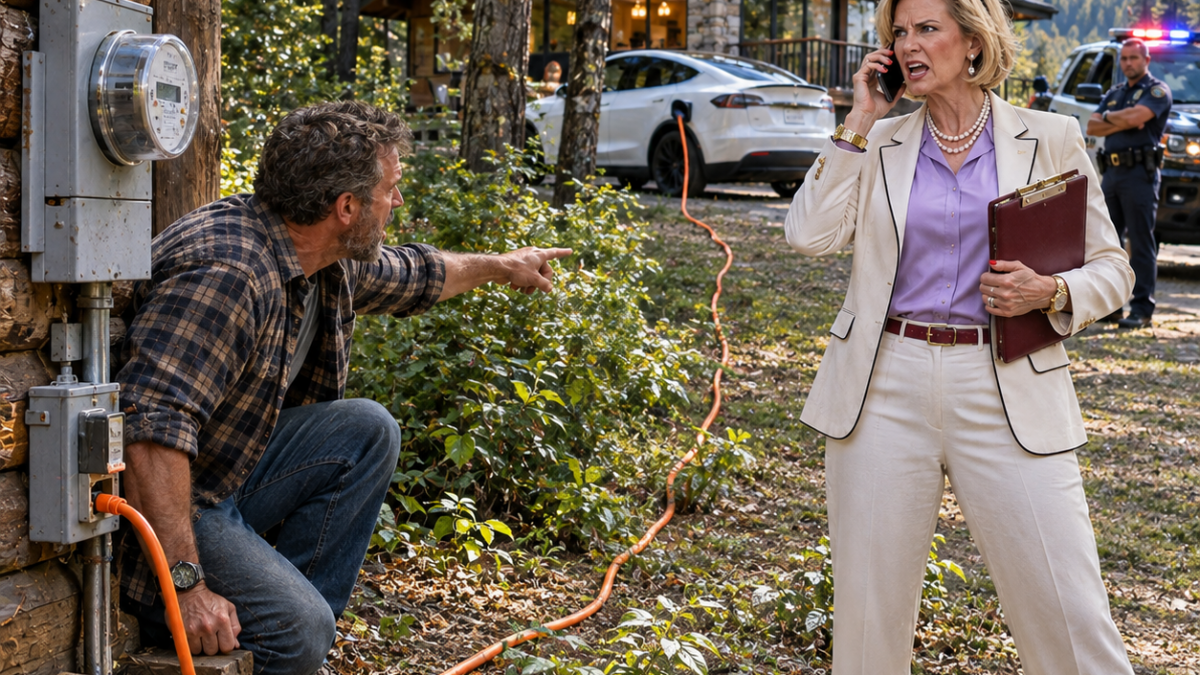
The second I stepped out of my truck and heard the electric meter on my mountain cabin spinning like it was feeding a factory, I knew something was wrong, because every breaker inside was off, the place had been empty all week, and yet enough power was being pulled through that little house to make the utility bill look like I had been running machinery around the clock.
Then I found the bright orange extension cord plugged into my exterior outlet, disappearing through the trees toward a neighbor I barely knew, and when I followed the trail and confronted the woman using my electricity, she didn’t apologize or even pretend it was a mistake—she told me I had more power than I needed, claimed mountain people were supposed to share, and announced that she had every right to keep taking it.
What made my hands go cold wasn’t the theft itself, but the way she suddenly raised her phone, called 911, and calmly told the dispatcher that I was threatening her on “community property,” because at that moment I realized she wasn’t afraid of being caught; she expected the authorities to believe her.
I had bought the cabin for silence.
That was the whole point.
After years of deadlines, traffic, ringing phones, and solving other people’s problems for a living, I wanted one place where nothing demanded anything from me. The cabin sat on five wooded acres in the Smokies, tucked between ridges where mornings smelled like wet pine and nights were quiet enough to hear the creek below.
It wasn’t fancy. The porch needed boards, the insulation was tired, and half the outlets looked ancient. I loved it anyway.
I’m an engineer by trade, so I had the electrical system inspected before I spent my first full weekend there. A licensed electrician replaced the meter and breaker panel and brought the cabin up to date. I wanted a safe retreat, not a fire waiting to happen.
For a while, everything was exactly what I’d hoped.
Then the bills started climbing.
At first, I blamed the heater, then the refrigerator, then myself. I was only there on weekends, but maybe I had left something running.
The next bill was nearly triple what I expected.
That bothered me enough that on my following trip, I shut down everything inside and walked back to the meter.
It kept racing.
I stood there listening to the faint mechanical hum, feeling irritation harden into suspicion.
Someone was drawing power from outside the cabin.
The ground near the porch outlet showed scratches and drag marks. A faint trail of flattened pine needles led into the trees.
I wanted proof.
The following weekend, I parked my truck a quarter mile down the road and hiked back through an old logging trail before sunrise. I settled behind spruce where I could see the driveway and waited with coffee, binoculars, and the suspicion I was wasting a Saturday.
At 7:18, a white SUV rolled onto my property.
A woman climbed out.
Mid-forties. Frizzy blonde hair. Oversized sunglasses. The kind of posture that somehow managed to look offended before anyone had spoken to her.
She opened her cargo area and pulled out a heavy orange extension cord.
My chest tightened.
She walked straight to my porch.
No hesitation after one quick scan.
She plugged into my outlet like she had done it a hundred times.
I came down the trail.
“What do you think you’re doing?”
She spun around.
For half a second, she looked startled, then annoyed.
“Excuse me?”
“This is my cabin.”
She stared at me as though I had interrupted her.
I pointed to the cord.
“You’re stealing my electricity.”
Her mouth tightened.
“I am not stealing anything. This is a mountain community.”
“No. This is five acres of private property.”
“We share resources up here.”
“We don’t share my electric account.”
She folded her arms.
“My service was shut off temporarily. I need power more than you do. You’re only here on weekends.”
She knew my schedule.
I took out my phone.
“Unplug it.”
Her eyes locked on the camera.
“Don’t you dare film me.”
“Then leave.”
Instead, she pulled out her own phone.
I thought she was going to record me.
She dialed three numbers.
9-1-1.
When the dispatcher answered, Karen’s entire voice changed.
“Yes, I need police at the Dalton cabin,” she said breathlessly. “There’s a man threatening me and blocking access to community electricity.”
I stared at her.
She looked straight back at me.
Then, while the dispatcher was still talking, Karen smiled.
Far down the mountain road, I heard the first faint crunch of tires coming uphill.
PART 2
The sound grew louder.
Gravel popping beneath tires.
Engine working against the grade.
Karen heard it too.
Her entire posture changed.
A moment earlier, she’d been standing on my porch with one hand on her hip, looking almost pleased with herself. Now she stepped away from the orange cord and moved toward the driveway as though preparing to welcome guests.
I kept recording.
“Put the phone away,” she snapped.
“No.”
“You don’t have permission to record me.”
“You called the police while standing on my property.”
“This isn’t your property.”
I almost laughed.
“You plugged into my cabin.”
“Community cabin.”
“There is no community cabin.”
“You really don’t understand how things work up here.”
“I understand a utility bill.”
The cruiser rounded the last bend.
Karen immediately started waving both arms.
“Here! Officers! Over here!”
I stood where I was.
Phone visible.
Hands away from my pockets.
The cruiser stopped near my truck.
Two deputies stepped out.
The driver was a tall man in his late forties with gray starting at his temples. His nameplate read DANIELS.
The younger deputy remained a few feet behind him.
Karen hurried toward them.
“Thank God. He has been threatening me.”
Daniels held up one hand.
“Slow down, ma’am.”
“He chased me out of the woods.”
I stared at her.
That was new.
“He’s trying to cut off electricity to residents.”
Also new.
“He thinks because he bought that cabin he owns half the mountain.”
The younger deputy looked toward me.
I raised my phone slightly.
“I have the interaction recorded.”
Karen spun around.
“He’s been filming me without consent!”
Daniels looked tired already.
“Everybody take a breath.”
Karen kept going.
“I want him arrested.”
“For what?” Daniels asked.
“Threatening me. Harassing me. Utility theft.”
That last one nearly broke my composure.
“Utility theft?”
She pointed at me.
“He’s interfering with shared electricity.”
Daniels looked past her.
His eyes followed the orange extension cord.
From my porch.
Into the woods.
He looked back at Karen.
“What exactly is shared about the electricity?”
She blinked.
“The community system.”
“What community system?”
“The mountain network.”
The younger deputy’s expression shifted.
Daniels remained completely neutral.
“Do you have an HOA?”
“No.”
“Utility cooperative?”
“Well, not formally.”
“Written agreement?”
Karen’s mouth tightened.
“Everyone up here understands how things work.”
I spoke for the first time.
“Officer, I own this cabin and five acres surrounding it. The electric account is in my name. I arrived this morning after several months of abnormal bills, shut every breaker off, and confirmed the meter was still drawing power.”
Karen interrupted.
“Because he’s tampering with it.”
Daniels raised a hand.
“Ma’am.”
I continued.
“I staked out my own property this morning. I recorded her driving onto my land, taking that cord out of her SUV, and plugging it into my exterior outlet.”
“That’s a lie.”
I looked at Daniels.
“Would you like the video?”
“Yes.”
Karen stepped between us.
“This is ridiculous.”
“Ma’am, move aside.”
“He edited it.”
“I recorded it about twenty minutes ago.”
“You’ve been planning this!”
Daniels gave her a long look.
“That would still not explain why you’re connected to his outlet.”
She opened her mouth.
Closed it.
I unlocked my phone.
The recording showed everything.
The SUV.
The cord.
Karen plugging it in.
My approach.
The argument.
Her statement:
**I’ve been using this electricity for weeks. I need it more than you do. My power got shut off.**
Then the 911 call.
Daniels watched without interrupting.
When it finished, he asked:
“Do you have proof of ownership?”
“Inside.”
“Get it.”
I brought out the folder I kept in the cabin.
Deed.
Property survey.
Utility statement.
Receipts from the electrical upgrade.
Daniels compared the address.
Then looked at Karen.
“Do you have any agreement allowing you to use this service?”
She crossed her arms.
“My paperwork is at home.”
“What paperwork?”
“The community arrangement.”
“What is it called?”
She hesitated.
“You wouldn’t understand.”
The younger deputy looked down.
I suspected he was hiding a reaction.
Daniels said:
“Try me.”
Karen’s voice sharpened.
“I’m not going to stand here while you interrogate me like a criminal.”
“You called us.”
“To arrest him.”
“Yes, ma’am. And now we’re investigating what happened.”
“That isn’t what I asked you to do.”
For the first time, Daniels looked openly irritated.
“That’s not how 911 works.”
Karen’s cheeks reddened.
“He threatened me.”
I held up my phone.
“It’s recorded.”
“He intimidated me.”
“By asking you to unplug your cord?”
“He came charging out of the woods.”
“Because I was watching my property.”
Daniels looked again at the orange line.
“Where does this go?”
Karen immediately said:
“Nowhere.”
I stared at her.
Daniels stared too.
The younger deputy walked toward the cord.
He crouched.
Picked it up.
Followed it with his eyes into the trees.
“Looks like it goes somewhere.”
Karen stepped forward.
“You can’t follow that.”
“Why?”
“Because it crosses private property.”
I almost laughed.
The irony was so perfect I didn’t trust myself to speak.
Daniels did.
“Whose?”
“Mine.”
He nodded slowly.
“So the cord begins at his cabin, crosses his property, then continues onto yours.”
Karen said nothing.
“Is that accurate?”
“This is harassment.”
The younger deputy looked at Daniels.
“Let’s see where it ends.”
Karen moved in front of the trail.
“No.”
“Ma’am.”
“You need a warrant.”
Daniels pointed toward the cord.
“We’re investigating a theft complaint occurring in our presence, and you’ve admitted the destination is your property.”
“I didn’t admit anything.”
“You just said it was your property.”
She looked furious with herself.
We followed the cord.
I stayed behind the deputies.
Karen followed behind all of us, talking almost nonstop.
She claimed the utility company had made a billing mistake.
Then she claimed I had offered electricity weeks ago.
Then she claimed previous cabin owners had allowed everyone to use the outlet.
That one caught my attention.
“There was no previous weekend owner,” I said.
She looked at me.
“What?”
“The seller lived here full-time for twelve years.”
Karen waved a hand.
“Whatever.”
Daniels glanced over his shoulder.
“You knew the previous owner?”
“No.”
“Then how would you know his electricity arrangement?”
She stopped talking for approximately ten seconds.
The orange cord descended the slope.
Branches were broken along the route.
Pine needles had been flattened.
Near the bottom, we passed a worn patch where a cable reel had apparently rested more than once.
Then her home appeared through the rhododendrons.
It was a small older structure with patched siding and a porch leaning slightly downhill.
The cord entered through a partially open window.
From outside I could see a cluster of appliances operating.
Space heater.
Small refrigerator.
Television.
Two lamps.
Microwave.
A portable air-conditioning unit that had no business being plugged into the arrangement I was looking at.
The younger deputy whistled softly.
Daniels turned.
“Ma’am.”
Karen crossed her arms.
“What?”
“How long have you been doing this?”
“I told you. Temporary.”
“How long?”
“A few days.”
I said:
“My bills have been elevated for months.”
“That’s your problem.”
Daniels looked at her.
“No, ma’am. If you’re taking his electricity, that’s precisely the issue.”
“My power was shut off unfairly.”
“Why?”
“The company is corrupt.”
“Why did they say they shut it off?”
She stared past him.
“That isn’t relevant.”
“Actually, it’s very relevant.”
She pointed at me.
“He’s never here. The power was being wasted.”
I stared.
“Electricity I wasn’t using was being wasted?”
“Exactly.”
“That might be the dumbest sentence I’ve heard in my life.”
“Shut up.”
Daniels stepped between us verbally before I could respond.
“Enough.”
He photographed the cord.
The window.
The appliance load.
Then he radioed dispatch.
The younger deputy asked Karen to stay near the driveway.
She refused.
Then she tried to pull the extension cord from the window.
He stopped her.
“Don’t touch it.”
“That’s my cord.”
“It’s evidence.”
“You can’t take my property.”
I looked toward the mountain and bit the inside of my cheek.
Daniels saw me.
“Don’t.”
“I didn’t say anything.”
“You were thinking loudly.”
That almost made me smile.
After more photographs, Daniels turned to me.
“Mr. Dalton, we’re going to need a formal statement.”
“Fine.”
“To be clear, you never gave her permission?”
“Never.”
“Did you know her before today?”
“I’d seen her vehicle around. Never had a conversation.”
He turned to Karen.
Her eyes widened.
“He’s lying.”
“How?”
“We’re neighbors.”
“Knowing where someone lives isn’t permission to use their utilities.”
Karen’s voice rose.
“He has plenty of money!”
Daniels paused.
“What does that have to do with anything?”
“He renovated that entire cabin.”
I felt something click into place.
“How do you know what I renovated?”
Silence.
I stepped forward.
“You’ve been watching the property.”
“No.”
“You knew I only came on weekends.”
“Everyone knows.”
“Who is everyone?”
“People.”
“What people?”
Daniels said:
“Mr. Dalton.”
I stopped.
He looked at Karen.
“Ma’am, at this point we have probable cause to document this as suspected theft of services and criminal trespass. We’re also going to review the statements made during your 911 call.”
Her face changed.
“You’re arresting him, right?”
“No.”
“You have to.”
“No, ma’am.”
She pointed at me.
“He frightened me.”
“That is not the same thing as threatening you.”
“He appeared out of nowhere.”
“On his own property.”
“He was aggressive.”
“We have video.”
Her voice cracked.
“So you’re taking his side because he owns some fancy cabin?”
Daniels rubbed his forehead.
“We’re taking the evidence’s side.”
That was when Karen finally lost control.
She screamed at me.
Not the theatrical frightened voice from the 911 call.
The real one.
“You selfish bastard! I didn’t have heat!”
The woods went still around us.
I looked at her.
For the first time, underneath the rage, I saw something else.
Desperation.
It didn’t excuse what she had done.
But it explained part of it.
“If you’d knocked on my door and asked for help, this conversation might be different.”
“You weren’t here!”
“You knew exactly when I was here.”
She looked away.
“You could have left me a note. Called the utility company. Asked Randall. Asked anyone.”
“I don’t beg.”
There it was.
Pride.
Not survival alone.
Pride.
She would rather steal than ask.
Daniels said quietly:
“You’re coming with us.”
Karen’s eyes snapped toward him.
“What?”
“For now, we’re detaining you while we complete the report and speak with the utility provider.”
“You cannot be serious.”
“Turn around.”
“No.”
“Ma’am.”
“You’re humiliating me.”
I almost said something.
Didn’t.
Daniels repeated:
“Turn around.”
The younger deputy placed cuffs on her.
She shouted the entire walk back uphill.
She threatened lawsuits.
She threatened my job.
She claimed she knew the county mayor.
Then the governor.
Then somebody at the power company.
By the time they reached the cruiser, she’d apparently acquired connections in every branch of government.
The door shut.
Silence returned.
I should have felt victorious.
Instead, I looked at the orange cord lying across the ground and felt tired.
Daniels stayed behind after the younger deputy drove Karen toward town.
He took another statement.
Then he warned me.
“People who get caught lying sometimes stop lying.”
“Sometimes?”
“Sometimes they get louder.”
“Which one is she?”
He gave me a look.
“You really need me to answer?”
I didn’t.
He told me to lock the exterior outlet and preserve all bills, video, and photographs.
I did.
I also changed the Wi-Fi password on every connected device, installed a locking outdoor cover, and spent the next hour checking the property.
The electric meter finally slowed.
That simple sight gave me more relief than watching Karen leave in cuffs.
I made coffee.
Sat on the porch.
Tried to listen to the creek.
An hour later, an older man came walking up the dirt road with a cane.
Gray beard.
Weathered jacket.
Sun-browned face.
“Morning.”
“Morning.”
He stopped at the bottom of my steps.
“Saw deputies come through.”
“Long story.”
He looked at the cut cord.
“I can guess parts of it.”
I raised an eyebrow.
“You know Karen?”
He laughed once.
“Everybody knows Karen.”
He introduced himself as Randall.
His cabin sat farther down the ridge.
He had lived there twenty-six years.
When I explained the electricity theft, he didn’t look surprised.
That bothered me.
“You expected this?”
“Not exactly.”
“Then why do you look like I just confirmed the weather forecast?”
Randall eased himself onto the porch step.
“Because folks have been getting strange power problems.”
“What kind?”
“Bills jumping. Breakers tripping. Lights flickering when cabins are empty.”
My coffee stopped halfway to my mouth.
“How many?”
“Don’t know.”
“Did anyone report it?”
“Some blamed old wiring.”
“Anyone see Karen?”
He scratched his beard.
“She pokes around.”
“What does that mean?”
“It means she acts like she owns the ridge.”
“She told police we have some kind of community electricity system.”
Randall laughed so hard he coughed.
“Community electricity?”
“Apparently.”
“Son, the closest thing this ridge has to community infrastructure is Earl’s snowplow, and even he charges twenty bucks.”
I smiled despite myself.
Then Randall became serious.
“She has a habit of creating rules nobody agreed to.”
“HOA?”
“No.”
“Committee?”
“She calls herself head of the Mountain Residents Committee.”
“Is that real?”
“If by real you mean she printed papers in her kitchen, sure.”
That fit.
“She told me my cabin was community property.”
“She once told me my woodpile violated scenic standards.”
“What happened?”
“I asked her which scenic standards.”
“What did she say?”
“She quit talking to me for six months.”
“Lucky.”
He smiled.
Then nodded toward the trees.
“You should check other trails.”
“Why?”
“If she ran that cord through your woods, she might’ve run others.”
That thought stayed with me after he left.
I walked my property again.
Not hunting for Karen.
Looking for evidence.
Halfway down the slope I found a broken three-prong adapter near the trail.
Farther below, where I could see Karen’s yard without stepping onto it, I spotted something blue running from another direction into her house.
Another extension cord.
Not mine.
It climbed uphill toward another property.
My irritation turned into something heavier.
This wasn’t one desperate decision.
It was a system.
I photographed it from my side of the boundary.
Then called Daniels.
He referred me to Detective Harris.
That afternoon, Harris asked me to come to the sheriff’s substation.
Before leaving, I wrote out everything.
Dates of utility bills.
Meter readings.
Times I was absent.
Video timestamps.
The adapter.
Photographs.
Engineers are trained to distrust memory when measurements exist.
For once, that habit felt useful outside work.
Detective Harris was broad-shouldered with gray in his beard and the calm voice of someone who preferred facts.
He read my notes.
Then looked at the adapter.
“This was on your property?”
“Yes.”
“Don’t handle it anymore.”
“I put it in a bag.”
“Good.”
He looked at my photographs.
“Where’s the blue cord?”
“Appeared to run from Karen’s place uphill toward another cabin.”
“You cross onto her land?”
“No.”
He nodded.
“Good.”
That single word made me glad I had resisted the temptation.
Harris sat back.
“We’ve had complaints.”
“What complaints?”
“Nothing that looked criminal by itself. Strange electrical issues. Property disputes. Karen calling about neighbors. Neighbors calling about Karen.”
“Why hasn’t anyone stopped her?”
“Stopped her from what?”
I understood his point.
Until there was evidence of a specific crime, being unbearable wasn’t illegal.
“She has a history of disputes,” he continued. “Mostly civil. Noise. Property lines. Parking. Accusations.”
“She called 911 and lied.”
“We’re reviewing the recording.”
“She told them I was attacking her.”
“And your video matters.”
He tapped my folder.
“This matters.”
I asked:
“What happens now?”
“We talk to the utility. We talk to other residents. We determine whether this was one theft or a pattern.”
“Randall thinks it’s a pattern.”
“Hearsay isn’t proof.”
“I know.”
Harris looked at me for a second.
“You really are an engineer.”
“Unfortunately.”
That got a faint smile.
Then he said:
“Brace yourself.”
“For what?”
“Karen made bail.”
I stared.
“Already?”
“These aren’t murder charges, Mr. Dalton.”
“I know.”
“She has release conditions.”
“Is staying off my property one of them?”
“It will be made very clear.”
I left the station with less relief than I’d arrived with.
At the grocery store, my phone showed a voicemail.
Unknown number.
I played it.
Karen.
“This isn’t over,” she screamed.
No fake calm.
No performance.
“You set me up. You got me arrested. I’ll sue you. I’ll take that cabin from you if I have to. You messed with the wrong woman.”
The message ended with a bang.
I immediately forwarded it to Harris.
His reply came ten minutes later.
**Received. Preserve original. Do not respond.**
I didn’t.
When I returned to the cabin that evening, dusk was settling.
The woods looked darker than usual.
Probably because now I knew somebody had been using them to watch my schedule.
I walked the perimeter.
Behind the generator shed I found a green extension cord coiled in the grass.
Newer.
Clean.
Not mine.
Then I saw fresh tire marks in the gravel.
My truck.
The deputies.
And a third tread pattern.
Someone had been there while I was in town.
My cabin door was untouched.
Windows intact.
But the discovery changed the atmosphere.
For the first time since buying the place, I locked the door and still didn’t feel secure.
My phone rang.
Randall.
“You back?”
“Yeah.”
“You should know Karen’s brother is at her place.”
“Who?”
“Joey.”
The way he said the name carried history.
“What should I know about Joey?”
“He’s strong.”
“That’s not normally a warning.”
“With Joey it is.”
“Violent?”
“Hotheaded. Gets into fights. Loses jobs. Thinks family loyalty means defending every stupid thing Karen does.”
“Great.”
“I saw him loading tools into his truck.”
I looked toward the dark window.
“What kind?”
“Couldn’t tell. Cords. Toolboxes. Maybe a generator.”
“Did he say anything?”
“He’s been telling people you set Karen up.”
“I caught her stealing.”
“I know.”
“He doesn’t?”
“He doesn’t care.”
That distinction bothered me.
Randall lowered his voice.
“Lock up tonight.”
“I will.”
“Keep those cameras on.”
“I only have one trail camera.”
“Then buy more tomorrow.”
That night I barely slept.
At 2:02 a.m., motion triggered the camera.
I didn’t see the footage until sunrise.
A man stood at the tree line.
Broad shoulders.
Hood pulled up.
He stayed there nearly three minutes.
Watching the cabin.
He never approached.
Never spoke.
Just watched.
Then disappeared down the same trail Karen had used.
I replayed it five times.
My hands didn’t shake.
That almost worried me more.
I called Harris.
Sent the clip.
Explained Randall’s warning.
He sighed.
“Documented.”
“I don’t want a cruiser stationed here.”
“We don’t have one to station there even if you did.”
“Fair.”
“But don’t engage if he comes back.”
“I won’t start anything.”
“That wasn’t what I said.”
I smiled despite the situation.
“I understand.”
I drove into town and bought two more trail cameras and motion lights.
The cashier asked if I was tracking bears.
“Something less reasonable.”
She laughed.
I didn’t.
Rain clouds rolled over the ridge during the drive back.
When I turned onto my road, I saw a silver pickup halfway up my driveway.
Dented fender.
Mismatched doors.
Mud on the tires.
I stopped twenty yards behind it.
No one inside.
I called Harris before getting out.
“This is Dalton.”
“What happened?”
“Unknown truck on my property.”
“Description?”
I gave it.
He was quiet.
“That plate comes back to Joseph Carter.”
“Joey?”
“Karen’s brother.”
My stomach tightened.
“Stay in your vehicle.”
Then I saw the side of my cabin.
The electrical service panel was partially open.
A small toolbox lay on the ground.
“I think he’s been at my breaker box.”
“Do not approach.”
The sensible thing would have been to wait.
I did for about thirty seconds.
Then movement appeared behind the cabin.
Joey came out of the trees.
He saw my truck.
Stopped.
Then walked straight toward me.
I stayed near my driver’s door.
Phone already recording.
Rain began to fall.
Joey stopped fifteen feet away.
“You.”
“Joseph?”
“Don’t call me that.”
“Joey, then.”
“You had my sister arrested.”
“She stole electricity.”
“She needed help.”
“She stole it.”
“You city people come up here with money, buy land, put up cameras, then act like you’ve always belonged.”
“I never said that.”
“You don’t help anybody.”
“She never asked.”
His jaw worked.
“She shouldn’t have had to.”
“That isn’t how permission works.”
He stepped closer.
“You’re going to fix this.”
“Fix what?”
“Drop the charges.”
“I don’t control charges.”
“Tell the cops you made a mistake.”
“I didn’t.”
His fists tightened.
“You think because you know electrical stuff you can make her look stupid?”
“She did that without me.”
Wrong thing to say.
He came another step.
I raised the phone.
“I’m recording.”
He froze.
“What?”
“You’re trespassing. You’re demanding I lie to investigators. And somebody opened my electrical panel while your truck was parked here.”
“That box was already open.”
I stared at him.
He realized what he’d just said.
“You went behind the cabin.”
“No.”
“How would you know the panel was open?”
His face hardened.
“Stop twisting my words.”
“Leave.”
“You don’t tell me what to do.”
“This is my land.”
“My family has been on this ridge longer than you.”
“Then you should know how property lines work.”
He stepped closer.
I didn’t move.
My heart was beating hard enough that I could feel it in my neck.
I wasn’t brave.
I was scared.
There is a difference between arguing with a woman holding an extension cord and standing alone in the rain while an angry man twice your width closes distance.
I made myself keep my voice steady.
“Leave, Joey.”
“You ruined her life.”
“No.”
“She has everybody calling her a thief.”
“She was stealing.”
“She had no electricity!”
“She could have asked.”
“She doesn’t ask people like you.”
“What does that mean?”
He didn’t answer.
A branch snapped behind him.
We both turned.
Randall emerged from the trees with his cane.
He took one look at Joey.
“Boy, you really are as dumb as your father said.”
Joey’s face reddened.
“Stay out of this.”
Randall kept walking.
“I’ve spent twenty-six years staying out of your family’s nonsense. Didn’t help.”
“This is family business.”
“Then conduct it on family property.”
Joey pointed at me.
“He got Karen arrested.”
Randall said:
“Karen got Karen arrested.”
Joey looked toward my phone.
Then back at Randall.
“You people don’t know the whole story.”
Randall shrugged.
“I know she ran a cord from his house to hers.”
“She needed heat.”
“So knock on a door.”
Joey spat into the mud.
“You don’t understand loyalty.”
Randall stepped beside me.
“No. You don’t understand it.”
Joey glared.
“If you want to protect Karen, go home.”
He said nothing.
“Every threat you make gives the sheriff another reason not to believe her.”
That landed.
Joey’s shoulders changed.
Not relaxing.
Thinking.
Randall continued.
“You’re being recorded. Your truck’s on his property. You already told him you knew about his electrical box.”
Joey glanced toward the pickup.
For the first time, I saw uncertainty.
Then he pointed at me.
“This isn’t over.”
“That’s what Karen said.”
He stormed toward the truck.
Slid behind the wheel.
Reversed too fast.
Gravel sprayed.
Then he disappeared down the mountain.
My knees felt weak after he left.
I hated that.
Randall noticed.
“Adrenaline.”
“I know.”
“Doesn’t mean you’re scared.”
“I was scared.”
“Good.”
I looked at him.
“Good?”
“Scared people who admit they’re scared make better decisions than angry people pretending they’re fearless.”
I saved the recording.
Sent it to Harris.
Then Randall and I inspected the cabin without touching the service panel.
The door had not been forced.
Nothing inside disturbed.
But Joey’s visit had pushed the situation somewhere darker.
I said:
“I bought this place to get away from people.”
Randall chuckled.
“Mountain mistake number one.”
“What?”
“Thinking living farther apart means you need neighbors less.”
I looked at him.
“You always talk like a fortune cookie?”
“Only in rain.”
He became serious.
“You’re not alone up here.”
That sentence mattered more than I wanted it to.
Because part of me had started thinking about selling.
I hadn’t admitted it to Sarah.
Hadn’t admitted it to myself.
But the thought existed.
Walk away.
Sell the cabin.
Let Karen have her miserable ridge.
Then I imagined her seeing a FOR SALE sign.
Thinking intimidation worked.
The thought made me sick.
That afternoon, a woman appeared on the trail.
Early forties.
Raincoat.
Nervous smile.
“Are you Mr. Dalton?”
“Depends.”
She looked startled.
I smiled.
“Sorry. Long week.”
“I’m Anna Pierce. My husband and I bought the cabin up the ridge.”
I remembered seeing their vehicle.
“What can I do for you?”
She twisted her fingers.
“Karen came to our house.”
Of course.
“With Joey.”
I sighed.
“What did she say?”
“That you’re dangerous.”
“Anything specific?”
“She said you built an electrical trap to shock her.”
I stared.
Anna continued quickly.
“I didn’t believe her. Not exactly. She wanted us to sign a complaint.”
“What complaint?”
“She said residents are organizing to have you removed from the mountain.”
“Removed by whom?”
“She didn’t say.”
“There is no HOA.”
“I know that now.”
I invited her onto the porch.
She sat.
I showed her only what I needed.
The original video.
Karen plugging into my outlet.
The police arrival.
The cord.
Joey’s visit.
Anna watched in silence.
When it finished, she whispered:
“My God.”
“She told you I tried to electrocute her?”
“Yes.”
“The outlet was standard. She plugged in herself.”
“She said you modified it.”
“I didn’t.”
Anna’s embarrassment turned to anger.
“She made us feel guilty for not signing.”
“That’s how she works.”
“She said mountain people stand together.”
“They should.”
I looked toward the ridge.
“But standing together doesn’t mean helping somebody lie.”
Anna nodded.
“We’ll tell the other new owners.”
“You don’t have to campaign for me.”
“I know.”
She stood.
“But people need to know before they sign anything.”
Before leaving, she stopped.
“There’s something else.”
“What?”
“My husband found an extension cord behind our shed last week.”
My stomach tightened.
“What color?”
“Blue.”
That evening I got a text from an unknown number.
A photograph.
Me.
Standing on my porch.
Taken from inside the woods.
Beneath it:
**YOU SHOULD HAVE MINDED YOUR BUSINESS.**
The anger that hit me was different from anything Karen had done before.
The cord was theft.
The 911 call was manipulation.
This was stalking.
Somebody had stood in my woods, photographed me, and wanted me to know they could.
I saved the original.
Screenshot it.
Forwarded everything to Harris.
Then called Randall.
He came up immediately.
He studied the angle.
“Old game trail.”
“You recognize it?”
“Yep.”
“Joey?”
“Could be.”
“Karen?”
“Could be.”
I hated uncertainty.
Randall sat across from me.
“Why are you fighting this hard?”
I looked at him.
“Seriously?”
“Yes.”
I thought about it.
“Because I spent years saving for this cabin.”
He listened.
“Because I wanted one quiet place in my life.”
I looked toward the dark windows.
“And because if I leave because they scare me, they’ll do it again to somebody else.”
Randall nodded.
“Good.”
His phone buzzed.
He checked it.
Then handed it to me.
Messages from neighbors.
**Karen came by asking for signatures.**
**Joey says Dalton attacked her.**
**We refused to sign.**
**She’s telling people his cabin is under investigation.**
Another:
**Found marks near my outdoor outlet. Call me.**
Another:
**My power bill jumped last winter. Think we need to compare notes.**
I sat back.
“How many people sent you this?”
“Enough.”
“They’re panicking.”
Randall nodded.
“They’re losing control of the story.”
“That’s when people get dangerous.”
“Sometimes.”
A sound came from outside.
Gravel.
Footsteps.
Heavy.
Then another set.
Randall raised one hand.
We went quiet.
Two silhouettes appeared beyond the porch light.
Joey.
Karen.
Karen screamed first.
“I know you’re in there!”
Joey called:
“Open the door. We’re talking.”
Randall whispered:
“Don’t.”
I picked up my phone.
Started recording.
Karen walked closer.
“You think you can destroy my life and hide?”
I stayed inside.
Joey banged on the porch railing.
“Come out.”
Randall said quietly:
“Let them talk.”
Karen shouted:
“You’ve turned everyone against me!”
I almost answered.
Didn’t.
“You stole my electricity,” I finally said through the closed door.
“You got me arrested!”
“No. You called the police.”
“You lied to them!”
“The video says otherwise.”
Joey hit the door once with his palm.
“Stop hiding.”
Randall looked at me.
“Call Harris.”
I reached for my phone.
Then headlights appeared through the trees.
Blue.
Red.
Karen stopped talking.
Joey turned.
The sheriff’s cruiser climbed the driveway.
Behind it came another.
Detective Harris stepped out of the first.
Officer Daniels from the original call exited the second.
Harris called:
“Karen Carter. Joseph Carter. Stay where you are.”
Karen’s face changed.
Not fear exactly.
Recognition.
For days she’d been creating her own version of reality.
Now reality had arrived with two cruisers.
Joey stepped off the porch.
“We weren’t doing anything.”
Harris pointed.
“Stay there.”
Karen immediately launched into her story.
“He’s been stalking us.”
Harris didn’t respond.
“He rigged his house.”
Nothing.
“He’s turned the whole mountain against me.”
Harris walked toward the porch.
“Mr. Dalton?”
I opened the door.
Randall stood behind me.
“You okay?”
“Yes.”
“Did you invite either of them onto the property?”
“No.”
Karen shouted:
“He doesn’t own the road!”
“I didn’t say the road. They’re on my porch.”
Harris looked toward the camera above the door.
“Recording?”
“Yes.”
“Good.”
Joey said:
“We just came to talk.”
I held up my phone.
“I have your earlier threat too.”
Joey’s jaw tightened.
Harris looked at him.
“What earlier threat?”
Joey didn’t answer.
Harris turned to Karen.
“Did you send Mr. Dalton a voicemail threatening to take his cabin?”
“It wasn’t a threat.”
“Did you send it?”
“I was emotional.”
“Did either of you send this?”
He held up his own phone.
The photograph from the woods.
Karen looked at Joey.
Joey looked at the ground.
That was enough for Harris to notice.
“Interesting.”
Karen recovered.
“Anybody could’ve sent that.”
Harris said:
“Correct.”
Then he looked at Joey.
“Mr. Carter, is that your truck in the video from yesterday?”
“What video?”
“The one where you’re demanding Mr. Dalton change his statement.”
Joey said nothing.
“You’re also recorded referencing the electrical panel before Mr. Dalton told you it had been disturbed.”
“That doesn’t prove anything.”
“No. But it’s useful.”
Karen stepped forward.
“You people are making a criminal case out of a neighbor disagreement.”
Daniels finally spoke.
“Ma’am, the first time we met, you called 911 and accused him of stealing electricity while your appliances were connected to his meter.”
“That was misunderstood.”
“You told me you needed the power because yours had been disconnected.”
“I was under stress.”
“You said he rented the cabin from you.”
Karen looked away.
Daniels continued.
“You said there was a community electrical arrangement.”
“It’s informal.”
“You said he attacked you.”
“He did emotionally.”
Randall made a noise that sounded suspiciously like a cough hiding laughter.
Harris looked at him.
“You Randall Hayes?”
“Yes, sir.”
“You witnessed tonight?”
“Everything since they walked up.”
“Earlier confrontation with Joey?”
“Most of it.”
Harris nodded.
Then he faced Karen and Joey.
“Both of you are being detained.”
Karen exploded.
“For what?”
“Criminal trespass to start.”
Joey swore.
Harris continued:
“Mr. Carter, we’re also investigating tampering with electrical equipment and intimidation of a witness.”
“I didn’t touch anything.”
“Great. You’ll have an opportunity to explain that.”
Karen pointed at me.
“He’s the witness?”
“Yes.”
“This is all because of him.”
Harris shook his head.
“No.”
He spoke calmly.
“This is because you keep coming back.”
That sentence shut her up.
For about three seconds.
Then she screamed:
“This mountain was peaceful before he came here!”
Randall stepped forward.
“No, Karen.”
She stared.
He rarely raised his voice.
Didn’t need to.
“It was quiet.”
The whole driveway went still.
“There’s a difference.”
Karen looked at him like he’d betrayed her.
Randall continued.
“People were tired of fighting you.”
She laughed bitterly.
“After everything I’ve done for this ridge?”
“What did you do?”
“I kept people connected.”
“You mean connected to other people’s outlets?”
Even Daniels looked away.
Karen’s face twisted.
“You’re all against me.”
Anna’s voice came from the road.
“Not against you.”
We all turned.
She had walked down with her husband.
Behind them stood another neighbor.
Then another.
I hadn’t called them.
Randall hadn’t either.
The police lights had drawn them out.
Anna stopped near the edge of my driveway.
“We’re against what you did.”
Karen looked around.
“This is a mob.”
“No,” Anna said. “These are neighbors.”
That was the moment Karen finally seemed small.
Not physically.
Her voice still worked.
Her anger still worked.
But the authority she had invented for herself was gone.
She had always depended on people backing away.
Now nobody did.
Harris and Daniels separated Karen and Joey.
Joey went into one cruiser.
Karen into another.
As Daniels closed her door, she leaned toward the window and stared at me.
I expected another threat.
Instead she looked exhausted.
For the first time, I wondered how long she had been living inside the story she told about herself.
The one where she was the organizer.
The protector.
The woman holding a broken mountain community together.
Maybe stealing electricity fit into that story somehow.
Maybe because she needed it, she decided taking it became sharing.
Maybe because people avoided arguing with her, she decided avoidance meant respect.
Maybe because nobody stopped her early, she concluded she had permission.
None of it mattered legally.
But it mattered to me because I needed to understand how a person could stand beside an orange cord running from someone else’s meter and still call herself the victim.
The cruisers left.
Neighbors remained.
Nobody celebrated.
We talked.
For almost two hours.
People brought bills.
Stories.
Photographs.
One man named Earl said his breaker had tripped repeatedly during weeks he wasn’t home.
Anna’s husband had the blue cord.
A woman farther downhill, Marie, said she’d found muddy prints beneath an outlet behind her garage.
Randall mentioned two other cabins with unexplained bill spikes.
I took notes.
Not because I was building revenge.
Because Harris had taught me what mattered.
Patterns needed proof.
The next morning, utility investigators came onto the ridge with the sheriff’s office.
They inspected my service.
Anna’s.
Earl’s.
Two others.
They documented evidence of unauthorized connections and tampering.
The utility representative explained that nobody should touch suspected illegal connections and that their technicians would handle everything safely.
I was happy to let them.
By afternoon, the scope became clearer.
Karen had not been powering her home from me alone.
She had rotated between several properties depending on who was absent and which outdoor connection was easiest to reach.
Some thefts were easier to prove than others.
Mine was undeniable because I had video.
Anna’s cord and account history supported another.
Earl had photographs from a previous month he hadn’t understood at the time.
The amount wasn’t millions.
It wasn’t some grand criminal empire.
That almost made it worse.
Karen had risked fires, damaged equipment, trespassed repeatedly, and turned neighbor against neighbor to avoid dealing honestly with a utility shutoff and unpaid bills.
Harris later told me the power company’s records showed her disconnection hadn’t been a mysterious mistake.
She had fallen behind.
Received notices.
Entered a payment arrangement.
Failed to keep it.
Then apparently decided everybody else’s meters were alternatives.
Her lawyer tried to frame it as desperation.
I believed there was some truth in that.
But desperation explained the first cord.
It didn’t explain months of sneaking.
It didn’t explain lying to 911.
It didn’t explain the fake community rules.
It didn’t explain Joey.
It didn’t explain the stalking photo.
That came from something deeper.
Entitlement.
The belief that hardship made boundaries optional.
The next few weeks were not satisfying.
They were exhausting.
I drove back and forth between the city and the mountain.
Gave statements.
Sent files.
Answered calls.
Paid an electrician to inspect the service after the tampering.
Missed work.
Lost sleep.
At one point, I stood in the cabin holding the FOR SALE page open on my laptop.
I could have listed it in ten minutes.
The market was good.
I’d probably make money.
No more Karen.
No more Joey.
No more wondering whether a noise outside was a branch or a person.
My finger hovered over the trackpad.
Then someone knocked.
I almost jumped.
“Who’s there?”
“Randall.”
I opened the door.
He saw the laptop.
Saw the real estate site.
Didn’t say anything for several seconds.
Then:
“You selling?”
“Thinking.”
He nodded.
“Can’t blame you.”
I expected an argument.
He didn’t give one.
That somehow made it harder.
He sat.
I closed the laptop.
“I don’t feel relaxed here anymore.”
“Understandable.”
“I bought this place because I could breathe.”
“Yep.”
“Now I check cameras before I check the weather.”
“Yep.”
I looked at him.
“You’re not helping.”
“You want me to lie?”
“No.”
“Then sell if you need to.”
That surprised me.
He continued.
“A house isn’t worth living scared.”
I thought of what I’d said to myself all week.
If I leave, Karen wins.
Randall seemed to read my face.
“Don’t make staying about beating her either.”
I frowned.
“She doesn’t get to decide whether you leave.”
“What does?”
“You.”
He pointed toward the window.
“You loved this place before you knew her name.”
I looked outside.
Pines.
Late-afternoon light.
The porch I’d rebuilt.
The ridge dropping toward the creek.
Randall stood.
“Figure out whether you still love it.”
He left.
I sat there until dark.
Then I closed the real estate listing.
Not because I had something to prove.
Because I realized I didn’t want to sell.
That distinction mattered.
Karen’s first court appearance drew almost no attention outside our little county.
Which suited me.
She faced charges connected to theft of services, trespass, false reporting, and harassment. Additional counts were considered as investigators reviewed other properties.
Joey faced his own case involving trespass, damage to my electrical equipment, and intimidation.
Both hired attorneys.
Both denied almost everything.
Karen insisted she had verbal permission from “the mountain community.”
Her lawyer asked prosecutors to treat the case as a neighbor dispute.
Then the 911 recording was played.
That recording became the simplest piece of evidence.
Karen:
**He’s stealing community electricity.**
Dispatcher:
**Who owns the property?**
Karen:
**The community does.**
Dispatcher:
**Is there an association?**
Karen:
**Yes.**
There wasn’t.
Then my video showed her claiming she had every right to use my outlet because I wasn’t there full-time.
Then Daniels’ body camera showed the cord entering her house.
Her own statements contradicted one another faster than anyone could cross-examine her.
The false narrative collapsed.
Joey’s case was worse than he expected because of my recording.
**You’re going to tell the sheriff you made a mistake.**
His voice.
Clear.
Then:
**That box was already loose.**
Before I had told him which equipment had been disturbed.
His lawyer argued he was angry and protecting his sister.
The prosecutor agreed he was angry.
They disagreed about whether anger excused trespass and intimidation.
It didn’t.
But the most emotionally difficult part wasn’t court.
It was hearing Karen’s side.
During one hearing, her attorney explained that she had lost steady employment several months earlier.
Medical bills had accumulated after an injury.
Her utility account fell behind.
She had tried unsuccessfully to borrow money.
Her brother had helped occasionally.
Then he couldn’t.
For one uncomfortable moment, I felt guilty.
If I’d known all of that and she’d asked me for twenty dollars of electricity during a cold night, would I have helped?
Probably.
If she’d asked to run an extension cord temporarily while she arranged emergency service?
Maybe.
If she’d knocked and said her food was spoiling and she was embarrassed?
I might have run the cord myself.
That thought sat heavily.
Then the prosecutor asked Karen:
“Did you ever ask Mr. Dalton for help?”
“No.”
“Why not?”
She stared forward.
“He wouldn’t have.”
“How do you know?”
“He’s one of those people.”
“What people?”
“People with money.”
I almost laughed.
My cabin was small.
My truck was nine years old.
But Karen had built an entire version of me without ever speaking to me.
A rich outsider.
An engineer.
City person.
Someone whose electricity mattered less because I could afford the bill.
Her lawyer tried to stop the questioning.
The prosecutor asked one last thing.
“Did you ever ask any of the residents whose power you used?”
Karen whispered:
“No.”
That was the whole case in one word.
Months passed.
Winter came.
The ridge turned gray.
The first snow covered the route where the orange cord had once run.
I expected that to feel symbolic.
Mostly it meant I had to shovel.
Randall arrived with an old snowblower that sounded like a helicopter dying.
“What is that thing?”
“Reliable.”
“It is leaking.”
“Character.”
“It has an oil puddle.”
“Lubrication.”
I laughed.
That was the first winter morning I felt normal at the cabin again.
Anna and her husband came by later carrying soup.
Earl brought firewood despite me telling him I had plenty.
Marie gave me a spare key to her shed in case anybody needed tools during a storm.
None of us formed an HOA.
Nobody printed rules.
Nobody elected a president.
We simply exchanged numbers.
Checked on one another.
Shared equipment when asked.
That last part became a running joke.
Randall once called me.
“Can I use your generator?”
“Did you just ask permission?”
“Don’t make this weird.”
I laughed.
“Come get it.”
That’s what community actually looked like.
Not ownership without permission.
Not invented authority.
Just asking.
Karen eventually accepted a plea rather than taking every count to trial.
I wasn’t consulted on every detail, nor should I have been.
The case belonged to the state.
Not me.
She admitted to theft of services from multiple properties, trespassing, and making false statements related to the original police call. The harassment evidence affected the conditions imposed afterward.
The judge ordered restitution for verified utility losses and damaged property.
She received a period of county confinement followed by supervised probation, mandatory no-contact provisions involving several residents, and restrictions tied to returning onto properties where she had trespassed.
Joey resolved his case separately.
He admitted entering my property and damaging electrical equipment.
He paid for the repairs.
He was placed under probationary conditions and ordered to stay away from me and the cabin.
Neither outcome looked like a movie.
No dramatic twenty-year sentence.
No judge giving a speech written for television.
Just consequences.
Specific.
Documented.
Real.
I preferred that.
At sentencing, the judge asked whether I wanted to speak.
I almost declined.
Then I stood.
Karen sat with her attorney.
Joey wasn’t there; his matter had been handled on another date.
I looked at the paper I’d prepared.
Then folded it.
“I bought the cabin because I wanted peace.”
My voice sounded strange in the courtroom.
“I don’t want revenge.”
Karen looked at me.
“I don’t want Ms. Carter homeless. I don’t want her hungry. I don’t want her freezing.”
Her expression changed slightly.
“But needing help does not give someone permission to turn another person’s home into a resource they can take without asking.”
I paused.
“If she had knocked on my door, this story might have lasted five minutes.”
The courtroom was silent.
“She didn’t.”
I looked at the judge.
“She watched my schedule. Entered my property while I was gone. Used my power. Lied when caught. Called police on me. Then her family tried to frighten me into changing my statement.”
I glanced toward Karen.
“The electricity was never the part that bothered me most.”
Her eyes met mine.
“It was the certainty that she had the right to take it.”
I sat down.
Karen said nothing.
The judge imposed sentence.
As deputies prepared to move her, she looked at me again.
For months I’d imagined this moment.
Maybe she’d curse me.
Maybe she’d whisper another threat.
Maybe she’d finally apologize.
She did none of those.
She looked tired.
Then said:
“I really was cold.”
It was so quiet I almost didn’t hear.
I answered before thinking.
“You should have asked.”
Her eyes dropped.
That was the last conversation I ever had with her.
Restitution didn’t arrive all at once.
Some came through court payments.
Some through insurance adjustments.
The utility company corrected certain charges after its investigation and gave us documentation for the remainder.
Money trickled back slowly.
I stopped tracking every dollar after a while.
It was never about getting rich.
I wanted the meter to measure my life again.
Nothing else.
Joey disappeared from the ridge for several months.
Randall heard he’d taken work two counties over.
Karen moved after probation conditions allowed her to relocate.
Her old house sat empty until the bank resolved whatever financial mess remained around it.
When a new couple eventually bought it, Anna made them dinner.
Randall brought firewood.
I stayed away for the first week because I didn’t want to become the local man who greeted strangers with stories about the previous owner.
They came to me instead.
The husband introduced himself as Mark.
“We’ve heard you’re the electrical guy.”
I laughed.
“I’m not your electrician.”
“Randall said you’d say that.”
“Then why are you here?”
Mark smiled.
“We’re replacing some outdoor outlets. I wanted to make sure we’re not accidentally crossing property.”
That question touched something unexpected.
“Come on.”
I walked the boundary with him.
Showed him the survey markers.
No drama.
No declarations about community resources.
He thanked me.
A week later, they invited everyone to dinner.
I went.
Sitting inside the house that had once been connected illegally to mine felt strange.
The window where the orange cord entered had been replaced.
The old portable heater was gone.
Fresh paint covered the walls.
A little girl had drawings taped near the kitchen.
The place was no longer Karen’s.
That should have felt like victory.
It didn’t.
It felt like life continuing.
Better.
Spring returned.
Snowmelt filled the creek.
I spent three weekends repairing the back trail.
Not to erase evidence.
The case was finished.
I wanted to erase the feeling.
I moved fallen branches.
Raked old cable marks.
Replanted a section near the porch where repeated traffic had worn the ground.
Randall watched from a chair.
“You know nature would’ve fixed that herself.”
“I know.”
“Then why are you doing it?”
“Because I enjoy work.”
“No, you don’t.”
“I enjoy this work.”
He nodded.
“Better.”
One afternoon, I found part of the orange extension cord in the shed.
Investigators had returned items no longer needed as evidence.
I had forgotten it was there.
I picked it up.
For a second, everything returned.
Karen beside the porch.
The 911 call.
Police lights.
Joey in the rain.
Photograph from the woods.
Court.
I could have kept it.
Mounted it on the wall.
Made a joke.
Instead, I drove it to an electronics recycling center with other scrap.
The employee lifted it.
“Long cord.”
“You have no idea.”
He tossed it into a bin.
That felt right.
I didn’t need a trophy.
That summer, Randall invited everyone to his property for a cookout.
“Not a community meeting,” he warned.
Anna laughed.
“Do we need minutes?”
“No.”
Earl called:
“What about bylaws?”
Randall pointed toward the road.
“Leave.”
Even I laughed.
There were maybe twenty of us.
People I had barely known the year before.
Children chased each other around the trees.
Someone played guitar badly.
Earl burned half the burgers and insisted it was intentional.
Near sunset, Randall sat beside me.
“Still thinking about selling?”
“No.”
“Good.”
“You would’ve been okay if I did.”
“Yep.”
“That annoyed me.”
“I know.”
I looked around.
“I thought I bought five acres and a cabin.”
“You did.”
“Turns out I bought twenty neighbors too.”
Randall nodded.
“Bad contract.”
“Terrible.”
We sat quietly.
Then he said:
“Funny thing about Karen.”
“What?”
“She kept talking about community.”
I knew where he was going.
“She wasn’t completely wrong.”
I looked at him.
He continued.
“You can’t live alone up here forever.”
“No.”
“She just got the definition backward.”
That was exactly it.
Karen believed community meant access.
If someone had more, she could take.
If a property was empty, she could use it.
If a neighbor disagreed, he was selfish.
If police questioned her, they were corrupt.
If residents refused to support her, they were traitors.
Real community turned out to be almost the opposite.
Ask.
Listen.
Respect no.
Show up when somebody needs help.
Leave when they need space.
Simple things.
Things that don’t require a committee.
A year after the first theft, I received my summer electric bill.
I opened it at the kitchen table.
Normal.
Almost boring.
I laughed.
I carried it onto the porch.
Randall happened to be walking past.
“What’s funny?”
“Electric bill.”
“That’s a strange hobby.”
“Sixty-eight dollars.”
He stared.
“You celebrating paying the utility?”
“Apparently.”
“City people.”
I threw the envelope at him.
He laughed.
That evening, I turned on the porch light.
Just one.
The meter outside moved slowly.
Exactly as it should.
I stood beside it for a moment.
A year earlier, the frantic movement of that little machine had told me someone was taking something from me.
Now its steady crawl meant nothing was wrong.
I went back to the porch.
The creek was loud from recent rain.
Wind moved through the pines.
A vehicle climbed the road below.
For a moment, my body tightened automatically.
Then I recognized Randall’s ancient truck.
I relaxed.
That reaction became less frequent over time.
The cameras stayed.
Not because I was afraid.
Because trail cameras are useful on mountain land.
Within months they mostly recorded deer.
A fox.
Three raccoons.
One black bear that proved my earlier confidence about bears had been embarrassingly misplaced.
I sent the clip to Officer Daniels.
He replied:
**Looks like the community finally sent an inspector.**
I laughed for five minutes.
Anna asked for a copy.
Randall claimed he had warned me.
He had not.
Eventually, the story stopped being the first thing people associated with my cabin.
That’s when I knew I had really gotten it back.
It became the place where I drank coffee at sunrise.
The place where I repaired an old canoe.
The place where Sarah joined me for quiet weekends when work allowed.
The place where Randall appeared without warning and somehow always found whatever food I had saved for dinner.
The place where Anna’s kids came to watch meteor showers because my ridge had the clearest northern view.
The place became mine again not because Karen was punished.
Because new memories grew over the old ones.
One October evening, I sat on the porch under a wool blanket.
The first cold front had moved in.
I could smell wood smoke from down the ridge.
The porch outlet was beside my chair.
Locked cover.
For months, I had checked it obsessively.
That night I realized I hadn’t thought about it in weeks.
I unlocked it.
Not because I needed to.
Just because I could.
I inspected the outlet.
Perfectly ordinary.
Then I closed the cover without locking it.
I stared at the little padlock in my palm.
For a year, that lock had represented safety.
Now it felt like something else.
A reminder that I’d once believed I needed metal between myself and every stranger.
I didn’t remove it permanently.
I’m not an idiot.
But I didn’t lock it that night.
At about eight, headlights climbed the driveway.
I stood.
A pickup stopped.
Randall got out.
He held up an extension cord.
I stared at him.
He grinned.
“My generator battery charger died.”
I looked at the cord.
Then at him.
“You planned this joke.”
“Maybe.”
“You walked all the way to your truck, got a cord, drove up here in the dark just to ask me for electricity?”
“Maybe.”
I started laughing.
He held out one hand.
“So?”
“So what?”
“Can I use your outlet?”
I looked at the cord.
A normal black extension cord.
Not orange.
“Why?”
“Need to charge a battery for an hour.”
“How much electricity?”
“Probably twelve cents.”
“That’s expensive.”
“I’ll pay.”
“Cash only.”
He dug in his pocket.
Pulled out a quarter.
I took it.
“Keep the change?”
“I don’t know. That’s how exploitation starts.”
He laughed.
I plugged his cord into the outlet.
That simple action hit me harder than I expected.
Same porch.
Same electricity.
Another neighbor.
Completely different feeling.
Because he asked.
Randall looked at me.
“You all right?”
“Yeah.”
“You’ve got that engineer face.”
“What face?”
“The one where you’re thinking something nobody else wants to hear.”
I smiled.
“Just realizing permission is pretty cheap.”
He nodded toward the quarter.
“Twenty-five cents, apparently.”
We sat on the porch while his battery charged.
No cameras pointed at him.
No police.
No shouting.
No lies.
Just two neighbors borrowing electricity.
An hour later, he unplugged the cord.
Coiled it.
Took his battery.
Before leaving, he tapped the quarter still sitting on the table.
“You keeping that?”
“Yes.”
“Trophy?”
“No.”
“What then?”
“Evidence.”
He shook his head.
“Once an engineer, always an engineer.”
After he left, I carried the quarter inside.
For a while, it sat beside the coffee maker.
Then one morning I used it at a vending machine.
That seemed right too.
I didn’t need another monument.
Years later, if somebody had looked at my cabin, they would never have guessed what happened there.
No sign.
No plaque.
No orange cord hanging on a wall.
Just a small log house between two ridges.
A porch.
A truck.
A slow-moving electric meter.
The scars were mostly invisible.
So was the lesson.
I had gone to the mountains believing peace meant distance.
Distance from traffic.
Work.
Noise.
People.
Karen taught me the ugly side of isolation.
Isolation made it easy for her to watch empty cabins.
Easy to tell different stories to different neighbors.
Easy for everyone to think their strange electric bill was only their problem.
What stopped her wasn’t me being tougher than she was.
It wasn’t some elaborate revenge.
It was evidence combined with people finally talking to one another.
My meter.
Anna’s cord.
Earl’s bills.
Randall’s testimony.
Daniels’ body camera.
Harris’ investigation.
Joey’s own recorded words.
Karen’s own 911 call.
She built the case against herself one lie at a time.
All I really did was refuse to carry those lies for her.
One late-summer night, Sarah and I sat outside watching lightning bugs move between the trees.
She had heard the entire story in pieces while it happened, but she rarely mentioned Karen anymore.
That night she asked:
“Do you still think about selling?”
“No.”
“Not even on bad days?”
“Only when Randall steals my food.”
She smiled.
Then looked toward the dark woods.
“You were scared for a while.”
It wasn’t a question.
“Yeah.”
“You didn’t tell me how scared.”
“I didn’t want you worrying.”
“I was already worrying.”
I looked down.
“That wasn’t very smart.”
“No.”
“Sorry.”
She leaned against me.
“I know why you stayed.”
“Do you?”
“You thought leaving would mean she beat you.”
I winced.
“At first.”
“And later?”
I looked at the cabin.
Warm light through the windows.
A stack of firewood.
The porch railing I’d repaired twice.
“I stayed because I still wanted to be here.”
She nodded.
“Better reason.”
Randall would have agreed.
We listened to the creek.
Somewhere down the slope, an owl called.
Then one of the motion lights flicked on.
I sat up.
Sarah laughed.
“Relax.”
A deer stepped into view.
It looked toward us.
Chewed something.
Walked directly beside the exterior outlet.
I stared.
Sarah said:
“Don’t accuse it of stealing electricity.”
I laughed.
The deer disappeared.
The light switched off.
Darkness returned.
But not the old darkness.
Not the kind filled with imagined figures and hidden threats.
Just mountain night.
The kind I had bought the cabin for in the first place.
The next morning, I woke before sunrise.
Made coffee.
Walked outside barefoot.
Mist filled the valley below.
The meter clicked softly beside the house.
Slow.
Steady.
Mine.
I touched the porch railing.
Then sat in my chair.
No orange cord crossed the boards.
No white SUV waited beyond the trees.
No one was watching from the shadows.
Far down the ridge, I heard Randall start his ridiculous snowblower for reasons known only to Randall despite the fact it was August.
I smiled.
A few minutes later my phone buzzed.
Message from him.
**Power’s out down here.**
Then another.
**May need extension cord.**
I typed:
**Quarter in advance.**
Three dots appeared.
Then:
**Extortion. Calling cops.**
I laughed so loudly a bird flew out of the nearest pine.
And that was the moment I realized the mountain had finally become what I wanted all along.
Not silent.
Not empty.
Safe.
There was a difference.
I took another sip of coffee and watched the first sunlight reach the ridge.
For once, the only electricity I was giving away was the kind I had chosen to share.
[END OF STORY]