“I DON’T CARE WHAT YOUR DEED SAYS—YOU DON’T BELONG HERE!” HOA Karen Called 911 as I Moved Into My Inherited Lake House, Never Imagining What My Uncle Had Hidden From Her for Six Years
“I DON’T CARE WHAT YOUR DEED SAYS—YOU DON’T BELONG HERE!” HOA Karen Called 911 as I Moved Into My Inherited Lake House, Never Imagining What My Uncle Had Hidden From Her for Six Years
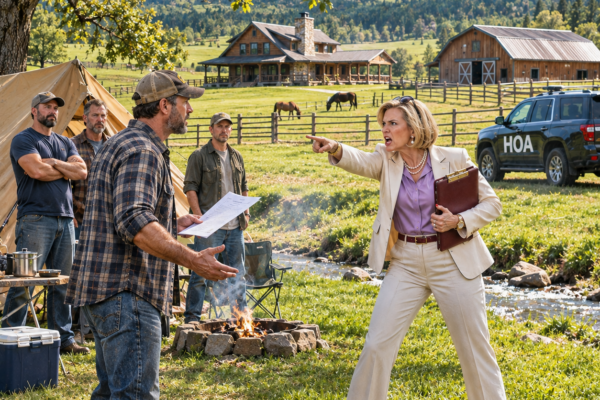
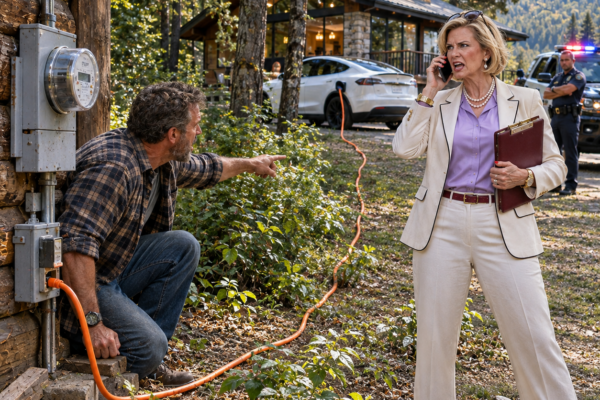
“Officers, these people are breaking into the Palmer property—get them out before they steal anything else!” HOA president Brenda Fitzgerald screamed as three police cruisers surrounded the rental truck parked outside the lake house I had legally inherited.
Even after I showed the officers my identification, keys, and property documents, Brenda stepped close enough for me to smell her expensive perfume and whispered, “I don’t care what papers you have, Theodore—you don’t belong here, and if you cross me, I’ll destroy you.”
Six weeks later, that same woman stood before television cameras demanding my removal from the neighborhood, completely unaware that the leather portfolio in my hands contained the evidence that would expose her secret payments, dismantle her empire, and send federal investigators straight to her door.
“Sir, step away from the truck.”
I lowered the antique wooden chest I had been carrying.
Behind me, Jake and Tommy, two college students I had hired to help with the move, stood frozen beside a stack of furniture.
Three police cruisers blocked the street.
Brenda Fitzgerald stood on her perfectly manicured lawn wearing white tennis clothes, sunglasses, and the satisfied expression of someone who believed she had just prevented a major crime.
“That one!” she shouted, pointing at me. “He’s the one who opened the house!”
I stared at her.
“Of course I opened it. It’s my house.”
She laughed.
“This property belongs to Theodore Palmer.”
“That’s my name.”
“Theodore Palmer is dead!”
“My uncle is dead. We have the same name.”
The nearest officer approached.
“Identification, please.”
I handed him my driver’s license, then retrieved the folder containing the documents associated with my inheritance.
He examined them.
I showed him the keys.
I explained that my uncle had died three months earlier and that the necessary property arrangements had been completed.
After several minutes, the officers established that we were legitimately moving my belongings into the house.
Brenda appeared disappointed.
“Well,” she said, folding her arms, “he should have notified the association.”
One officer returned my documents.
“Better safe than sorry, Mrs. Fitzgerald.”
I couldn’t believe what I was hearing.
She had called emergency services because she didn’t like the appearance of the people carrying furniture into a house.
And somehow, she was being congratulated.
After the cruisers departed, Brenda approached me.
“You should have called ahead.”
“Why?”
“We have protocols here. Standards.”
I looked toward the rental truck.
“Is there an approved way to carry my grandmother’s furniture through my own front door?”
Her expression hardened.
“Don’t get smart with me.”
Jake glanced toward Tommy.
Neither spoke.
Brenda lowered her voice.
“I don’t care what papers you have. You don’t belong here.”
I stared at her.
“Excuse me?”
“Cross me, and I’ll destroy you.”
Then she turned and walked back toward her mansion.
For several seconds, I remained beside the antique chest.
Tommy finally broke the silence.
“Is she always like that?”
“I guess we’re about to find out.”
One week later, I received a forty-seven-page package containing $2,847 in HOA fines.
My Honda Civic was supposedly a nonconforming vehicle.
My uncle’s fifteen-year-old garden shed was suddenly an unauthorized structure.
His native wildflower garden violated landscaping standards.
There were assessments, allegedly overdue dues, and even a $500 administrative charge for processing the complaints.
I called the management office.
“You have ten days to pay,” the employee told me. “Mrs. Fitzgerald handles enforcement personally.”
I looked at the photograph of my uncle sitting beside the lake.
Then I walked into his study.
The room contained several enormous filing cabinets, each drawer meticulously labeled.
My uncle had been a quiet man who rarely discussed his affairs.
At family gatherings, he talked about municipal bonds and usually disappeared before dessert.
I had never considered him particularly adventurous.
But as I opened the first drawer, I discovered photographs, financial statements, violation notices, correspondence, and years of records concerning Brenda Fitzgerald.
Every document was dated.
Every incident was cross-referenced.
There was evidence of families being harassed, elderly homeowners receiving extraordinary fines, and Brenda’s friends being permitted to violate the very rules she enforced against others.
Then I found a folder containing correspondence with an attorney named Sarah Kim.
My uncle had been preparing a lawsuit against Brenda for three years.
He had died approximately two weeks before he intended to proceed.
I turned another page.
A handwritten note appeared beneath the legal correspondence.
Don’t react before you understand what you’re dealing with.
I recognized his handwriting immediately.
I looked toward the window, where Brenda’s mansion stood across the quiet street.
She thought she had inherited another frightened homeowner to intimidate.
What neither of us yet understood was that my uncle had left me something considerably more dangerous than a lake house.
PART2
The first indication that Uncle Theo’s estate was more complicated than I had imagined came during a meeting with his attorney three months earlier.
I had arrived expecting a conversation about furniture, personal belongings, and perhaps the house where I remembered spending several childhood vacations.
Instead, the attorney placed a thick folder on the desk and said, “Congratulations, Mr. Palmer. You’ve inherited Willowbrook Lake Properties LLC.”
I looked at him.
“What exactly does that mean?”
He explained that my uncle had held significant business interests through several related entities. The estate contained property, contracts, financial arrangements, and records that would require careful review.
At the time, I was still processing the unexpected loss of the man who had left everything behind.
I signed what needed to be signed.
I listened to the explanations.
I asked questions about the house.
And I made the mistake of assuming that whatever else Uncle Theo had accumulated could wait until I was settled.
Brenda Fitzgerald made sure it couldn’t wait.
Willowbrook Lake was about two hours north of the city, far enough from the busiest roads that the nights were unusually quiet and the mornings belonged to the birds.
Twelve custom homes surrounded a beautiful stretch of water. There was a private beach, a boat launch, a small community center, and enough expensive landscaping to convince visitors that nobody living there had ever worried about money.
The houses typically sold for more than a million dollars.
Uncle Theo had purchased his place long before those prices became ordinary. He liked the lake, the privacy, and the opportunity to cultivate a garden that attracted native birds and butterflies.
I remembered visiting him as a child.
He wasn’t the kind of uncle who organized exciting outings or arrived at birthdays carrying extravagant gifts. He was reserved, intensely practical, and occasionally so quiet that people forgot he was sitting beside them.
But he paid attention.
When I mentioned wanting to attend Syracuse University, he remembered.
When my grandmother’s health began deteriorating, he quietly arranged for several things around her house to be repaired.
When somebody needed help, he rarely made an announcement about providing it.
He simply did what he could.
Only after his death did I begin understanding the extent to which that habit had shaped his relationship with Willowbrook Lake.
Brenda, by contrast, wanted everybody to notice everything she did.
She was fifty-eight, a former bank manager, and had occupied the position of HOA president for six consecutive years. Her husband had died, and she devoted an extraordinary amount of time to association matters.
She spoke about protecting property values as though she were defending a national treasure.
She inspected mailboxes.
She measured lawns.
She discussed residents’ landscaping choices with the seriousness of somebody negotiating an international agreement.
And she believed that living in an expensive community entitled her to determine what sort of people should be allowed to live beside her.
My appearance on moving day apparently failed her assessment.
I had arrived wearing faded jeans, an old Syracuse T-shirt, and a baseball cap. The rental truck was inexpensive, my Honda Civic was parked nearby, and Jake and Tommy were ordinary college students earning twenty dollars an hour.
Nothing about us suggested an extravagant lifestyle.
Apparently, Brenda had concluded that meant nothing about us suggested legitimate property ownership.
What angered me most about that morning wasn’t even her treatment of me.
It was Tommy’s reaction after the police left.
He stood near the truck, looking embarrassed.
“Did we do something wrong?”
I turned toward him.
“Absolutely not.”
He nodded, but his expression didn’t change.
“My mom’s going to freak out if I tell her.”
“Tell her you were helping somebody move and a neighbor made an unnecessary complaint.”
Jake looked toward Brenda’s house.
“She didn’t even ask what we were doing.”
“No.”
Tommy hesitated.
“Do you think she’ll call them again?”
I looked across the street.
“I won’t let her interfere with your work.”
I paid both young men for the additional time the interruption had cost them. When we finished unloading, I gave them dinner money and thanked them for remaining patient.
Before leaving, Tommy examined the lake.
“It’s beautiful here.”
I smiled.
“It is.”
He looked toward Brenda’s mansion.
“Except for her.”
I laughed.
At the time, I thought Brenda was simply an unpleasant neighbor.
I didn’t know that Tommy’s experience was a small example of something numerous residents had endured for years.
The forty-seven-page violation package arrived on a Tuesday.
I carried it onto the back deck and opened it beside my coffee.
The first notice concerned my car.
Improper parking of a nonconforming vehicle.
I read the description twice.
My Honda was registered, insured, mechanically sound, and parked in my own driveway.
What exactly made it nonconforming?
The notice provided no useful explanation beyond a reference to maintaining the community’s aesthetic character.
The second notice concerned Uncle Theo’s garden shed.
I walked outside to examine it.
It was an attractive, modest wooden structure tucked beside the garden. Uncle Theo had used it to store tools, seeds, gardening gloves, and the various things he needed to maintain the property.
It had stood there for fifteen years.
Now, one week after I arrived, it had apparently become an urgent concern.
There were also violations involving landscaping plans, several questionable maintenance requirements, and association payments allegedly overdue during the period following my uncle’s death.
Some of those financial issues needed to be reviewed through the estate records. I wasn’t going to assume they were invalid simply because I disliked receiving them.
But the accumulation of unrelated complaints made their purpose difficult to ignore.
At the end of the package was a $500 administrative fee.
I laughed.
They were charging me for the privilege of receiving an enormous collection of questionable charges.
The total was $2,847.
I contacted the management office and asked for the specific governing provisions supporting each item.
The employee who answered sounded young and uncomfortable.
“Mrs. Fitzgerald handles those matters.”
“Then I need to speak with her.”
“She isn’t available.”
“Can you send me the applicable documents?”
“You have ten days to pay.”
“That’s not what I asked.”
He hesitated.
“I’m just supposed to tell you that unpaid balances will be referred for further action.”
I thanked him and ended the call.
There was no point arguing with somebody who had clearly been instructed to repeat a particular message.
Instead, I returned to Uncle Theo’s study.
His filing system was more impressive than anything I had encountered in my professional life.
Every drawer contained categories.
Correspondence.
Property records.
Association notices.
Meeting minutes.
Vendor contracts.
Photographs.
I found a collection of violation letters issued to different residents over several years. Beside each letter were notes concerning how similar circumstances had been handled elsewhere in the neighborhood.
One of Brenda’s closest friends, Nancy, had parked a recreational vehicle in her driveway for approximately six months.
Uncle Theo had photographed it on numerous occasions.
There were no corresponding violation notices in the records he had obtained.
Another family had received a $200 penalty after leaving garbage containers visible for twelve hours beyond the designated collection period.
There were photographs showing comparable conduct at several other homes.
Those homes belonged to people Brenda liked.
They hadn’t received the same treatment.
I found records concerning Mrs. Patterson, an elderly widow whose sprinkler system had malfunctioned during a particularly dry period.
Several brown patches appeared on her lawn.
Brenda had responded with a series of enforcement notices and an extraordinary assessment associated with alleged damage to neighborhood property values.
Mrs. Patterson had explained that she was living on a fixed income and was arranging the repairs as quickly as possible.
The correspondence became increasingly threatening.
At one point, she wrote that the financial pressure was making her consider leaving her home.
Uncle Theo had placed a red line beneath that sentence.
Beside it, he had written:
Ask what she needs. Don’t let them force her out.
I sat staring at those words.
I could hear his voice in them.
He hadn’t been interested merely in proving Brenda wrong.
He had been worried about what she was doing to people.
And the deeper I went into his records, the clearer that distinction became.
The next victim of Brenda’s enthusiasm was my kayak.
I had taken it out of storage and placed it beside the house while preparing to use it on the lake.
By Wednesday afternoon, an envelope appeared.
A $300 fine.
An alleged violation of a watercraft registration policy.
Immediate removal demanded.
Possible additional daily penalties if I failed to comply.
I examined the association documents and searched for the policy.
Eventually, I located a recently circulated notice that appeared to establish new requirements for certain watercraft.
There was no clear evidence that the policy had been properly adopted or that the relevant enforcement procedures had been followed.
More interestingly, several longtime residents kept boats and kayaks in comparable locations without receiving similar complaints.
One of them happened to be Brenda’s friend Nancy.
I photographed my kayak, preserved the notice, and submitted a written challenge.
Then I requested the association’s financial records.
I wanted invoices, payment authorizations, vendor contracts, assessment records, and the documentation supporting the charges Brenda was attempting to collect.
When I delivered the request, she examined the envelope as though I had handed her something unpleasant.
“What is this?”
“A records request.”
“Regarding?”
“The association’s finances and the alleged violations against my property.”
She laughed.
“You’ve been here less than a month.”
“I’m aware.”
“And you’re already demanding access to our financial information?”
“I’m requesting the records I’m entitled to review.”
She straightened.
“People who come into Willowbrook Lake generally make an effort to establish good relationships with the existing residents.”
“I’ve been trying.”
She looked at me.
“Have you?”
“Yes. My first morning here, you called the police.”
Her expression became cold.
“That was a security matter.”
“No. It was moving day.”
She placed the envelope on a table beside her front door.
“I don’t appreciate your tone.”
“I don’t appreciate receiving nearly three thousand dollars in unexplained charges.”
“Then pay what you owe and stop creating problems.”
I smiled faintly.
“I’d prefer to determine what I actually owe.”
She closed the door.
Several days later, Brenda announced an emergency meeting concerning community standards.
I received the notice shortly after returning from work.
The language was vague, but it contained enough references to recent disturbances that I suspected I would become the principal subject.
I was right.
The community center contained several rows of folding chairs, a long board table, and windows overlooking the lake.
Brenda sat at the front wearing an immaculate navy jacket.
She began the meeting by discussing the importance of maintaining consistency among homeowners.
Then she started talking about recent challenges.
Unauthorized landscaping.
Improper storage.
Uncooperative residents.
People who apparently failed to understand established expectations.
She never mentioned my name.
She didn’t need to.
Several people turned toward me.
I raised my hand.
Brenda looked irritated.
“Mr. Palmer.”
“Could you identify the provisions supporting the fines you’ve issued against my property?”
She opened a folder.
“The association has established standards.”
“Which standards?”
“They’re available through the management office.”
“I asked the management office. They told me you handle enforcement personally.”
She sighed.
“This isn’t an appropriate setting to debate every violation you’ve accumulated.”
I held up the package.
“Forty-seven pages in one week seems worth discussing.”
Several people murmured.
Brenda reached for her gavel.
Before she could respond, a man sitting near the front stood.
His name was Bob Martinez.
I recognized him from my uncle’s photographs.
He had lived beside the lake for years.
“This harassment has got to stop,” Bob said.
Brenda stared at him.
“Excuse me?”
“You heard me.”
He turned toward the other residents.
“We’ve watched you bully good people out of this neighborhood for years.”
The room became quiet.
Brenda’s expression hardened.
“Mr. Martinez, you’re out of order.”
Bob shook his head.
“Then call me out of order. I’m still saying it.”
A woman named Linda Palmer, who lived nearby and wasn’t closely related to me despite sharing my surname, raised her hand.
“I’d also like to know why certain people receive violations for things other residents are allowed to do.”
Brenda glanced toward her.
“Every situation is different.”
Linda nodded.
“That’s precisely the problem. The rules seem to become different depending on whose house you’re standing in front of.”
An older man named Frank Sullivan leaned forward.
“I’ve paid assessments I never understood because I was afraid of what would happen if I didn’t.”
Brenda struck the table.
“We are not turning this meeting into a complaint session.”
Bob laughed bitterly.
“What exactly did you think homeowners were going to discuss at a homeowners association meeting?”
For the first time since meeting her, I saw Brenda struggle to control the room.
She had expected me to stand alone.
Instead, three longtime residents had publicly challenged her.
They weren’t loud or particularly confrontational people.
They were simply tired.
And once they realized somebody else was willing to speak, they found it considerably easier to do the same.
After the meeting, Bob approached me outside.
“Your uncle was a good man.”
I nodded.
“Thank you.”
“He used to ask questions, too.”
“What happened when he did?”
Bob looked toward the community center.
“She didn’t like it.”
Linda joined us.
“There’s something you should understand, Theodore.”
I turned toward her.
“This isn’t really about your kayak or your car.”
“I figured.”
She lowered her voice.
“Brenda decides who belongs here. Once she’s decided somebody doesn’t, she starts looking for reasons to make them leave.”
Frank nodded.
“Your uncle knew it.”
I looked toward the dark water.
I was beginning to understand why Uncle Theo’s filing cabinets contained so many documents.
He had witnessed the same behavior for years.
And apparently, he had been preparing to do something considerably more substantial than complain at an HOA meeting.
The following week, Brenda discovered an urgent problem with my mailbox.
The notice arrived on expensive association letterhead and demanded replacement with an approved model from a designated supplier.
I walked outside and examined my mailbox.
Black metal post.
Brass house numbers.
A little weathering around the base.
Then I walked far enough along the street to examine several others.
They were identical.
I took photographs and returned inside.
The approved supplier was Lakefront Mailbox Solutions.
The replacement price was approximately $400.
I searched the company’s publicly available business information.
Its owner was Robert Fitzgerald.
Brenda’s brother-in-law.
I stared at the screen.
Then I picked up my telephone.
“Lakefront Mailbox Solutions,” a cheerful voice answered.
“Hi. I’m looking for a standard residential mailbox.”
He asked a few questions about the model.
I described mine.
“That’ll be fifty dollars. Twenty for installation.”
“Seventy installed?”
“That’s right.”
“Interesting. What if the property is in Willowbrook Lake?”
His tone changed.
“Oh. Those are special.”
“Special how?”
“Association requirements. Four hundred installed.”
“Different material?”
“No.”
“Different manufacturer?”
“No.”
“Different post?”
“It’s the approved community package.”
I thanked him.
Then I wrote down what I had been quoted.
An ordinary mailbox priced at fifty dollars, with installation available for another twenty, somehow became a four-hundred-dollar purchase when the customer happened to live in a community where Brenda Fitzgerald selected the vendors.
I imagined twelve homeowners being told to replace mailboxes that were already perfectly functional.
Then I imagined similar arrangements involving every other service the association purchased.
Landscaping.
Pool maintenance.
Security.
Repairs.
Legal and administrative services.
The mailbox was no longer particularly interesting by itself.
It was interesting because it showed me what to look for in the financial records.
I contacted attorney Sarah Kim, whose correspondence I had found among Uncle Theo’s files.
She remembered him immediately.
“Your uncle was one of the most meticulous clients I’ve ever worked with,” she said.
I explained what had been happening.
She remained silent for several seconds.
Then she sighed.
“She started on you already?”
“You sound surprised.”
“I’m surprised she waited a week.”
I laughed.
Sarah asked me to send the notices and the records request I had already submitted.
After reviewing them, she prepared a formal follow-up seeking the relevant association documents.
This time, Brenda’s management office responded.
Several boxes of records became available.
Five years of financial information.
I spent the entire weekend reviewing them.
And what I discovered made the mailbox arrangement look almost insignificant.
Fitzgerald Family Services LLC had received $30,000 in consulting payments over three years.
The descriptions were vague.
Community administration.
Strategic planning.
Special project consultation.
I searched the available ownership records.
The company belonged to Brenda herself.
I found pool maintenance expenses substantially exceeding comparable market quotations Uncle Theo had collected.
The vendor was associated with one of Brenda’s former banking colleagues.
The landscaping contractor was married to a woman in her book club.
The security company belonged to her cousin.
Other purchases involved businesses connected with extended members of her family.
I arranged the documents across the dining room table.
The relationships were startling.
Willowbrook Lake consisted of twelve houses.
Yet the financial records looked as though an entire network of businesses had discovered a convenient source of money.
The individual invoices often appeared ordinary.
A maintenance visit.
A consultation.
A delivery of supplies.
An administrative task.
But the prices, recurring payments, relationships, and questionable approvals told a much more troubling story when examined together.
I found no convincing evidence that many of the contracts had been subjected to a meaningful independent selection process.
In several instances, Uncle Theo had already gathered competing quotations showing what comparable services ought to cost.
He had organized those quotations beside the actual invoices.
The work was remarkably thorough.
I called Sarah.
“I think I’ve found something.”
“Tell me.”
I described the consulting payments.
She asked me to preserve the records exactly as received.
Then I told her about the family relationships.
“We need to distinguish questionable transactions from transactions we can establish were improperly authorized or fraudulent,” she said. “Don’t jump straight from a familiar surname to a criminal accusation.”
I agreed.
“But this doesn’t look good.”
“No,” she replied. “It doesn’t.”
We arranged for an independent financial review.
I continued collecting information.
Then Brenda issued another notice.
This one banned me from the community pool.
According to the letter, I had created a hostile environment through aggressive conduct and inappropriate language.
Multiple residents had allegedly complained.
There was one significant problem.
I had never used the pool.
Not once since moving into the house.
I called Bob.
“Have you complained about me at the pool?”
He burst out laughing.
“What pool?”
“The community pool.”
“I haven’t seen you there.”
“Exactly.”
I contacted Linda and Frank.
Neither knew anything about the alleged incident.
Then I contacted the maintenance company responsible for the facility and asked whether there was any documented report concerning my conduct.
The manager sounded confused.
“We don’t have anything like that on file.”
“Nothing?”
“No.”
He hesitated.
“Actually, I’ve been trying to get somebody from the association to discuss another matter.”
“What matter?”
“There’s approximately twelve thousand dollars outstanding for repairs Mrs. Fitzgerald ordered last spring.”
I stopped writing.
“Twelve thousand?”
He confirmed the amount.
According to him, Brenda had requested work beyond the ordinary arrangements, and there had been continuing problems establishing payment authorization.
I asked him to provide whatever relevant documentation could appropriately be shared through the financial review.
Then I ended the call.
The pool ban had been intended to create another problem for me.
Instead, it had revealed another problem for Brenda.
I looked at the notice.
“Thank you very much.”
The emergency assessment letters arrived the next morning.
Eight hundred dollars per homeowner.
Payment demanded within ten days.
The stated purpose was urgent infrastructure work.
The description didn’t identify the precise repair.
There were no accompanying contractor estimates.
No useful engineering report.
No clear explanation of why the work was suddenly necessary.
The letter warned of collection measures and possible property liens.
Brenda understood what those words could do to people.
An ordinary homeowner receiving a letter threatening a lien against a valuable property might decide that eight hundred dollars was a small price to avoid potentially serious trouble.
That was especially true in a community where residents had become accustomed to Brenda’s aggressive collection practices.
I called Frank.
He sounded deeply upset.
“Eight hundred dollars,” he said. “Just like that.”
“Have you paid it?”
“Not yet.”
“Have you received any explanation of the work?”
“No.”
I heard papers moving.
“The letter says it’s urgent.”
“I know.”
He sighed.
“The thing is, Theodore, eight hundred dollars doesn’t sound like much to some people around here.”
I waited.
“But I’m on a fixed income. My expenses don’t change just because Brenda wakes up wanting another assessment.”
I understood.
I told him we were trying to obtain supporting records.
Then I contacted Bob and Linda.
By evening, several residents were asking the same questions.
What exactly needed repair?
Who had determined that it was urgent?
Where were the contractor estimates?
What approvals had been obtained?
And why had the association’s president waited until now to inform homeowners about a supposedly serious infrastructure problem?
Brenda responded by scheduling another emergency meeting.
But before that meeting arrived, she began visiting residents individually.
Her explanation was that I had created an atmosphere of distrust.
According to her, I was interfering with important maintenance work.
I was attempting to undermine the association.
I was considering buying properties and converting the neighborhood into a rental development.
The rumors became increasingly offensive.
One afternoon, Linda called.
“Theodore, you need to see what she’s circulating.”
She sent me a photograph of a petition.
Across the top were the words:
Protect Our Community Values.
The text discussed preserving Willowbrook Lake’s established character. It suggested that residents should share a common background and understand the traditions supposedly defining the neighborhood.
There was language implying that certain newcomers threatened those values.
Linda sounded angry.
“She’s telling people you’re working with developers to bring in housing nobody wants.”
I laughed in disbelief.
“I’ve been here a few weeks. I’m still unpacking boxes.”
“I know.”
“Does anybody believe her?”
“She’s got three signatures.”
“Three?”
Linda laughed.
“That’s all.”
I thought about the petition.
Brenda was attempting to mobilize prejudice and fear against me because ordinary property violations hadn’t persuaded me to leave.
She was also revealing a level of desperation that seemed excessive for somebody merely concerned about a mailbox.
I began wondering whether there was something more valuable at stake.
Something Brenda needed to protect.
Something she was afraid I might discover.
The black SUV appeared outside my house on Thursday morning.
Its engine was running.
A man wearing a security uniform sat inside.
I watched him for several minutes before walking toward the public street with my coffee.
“Morning.”
He looked up.
“Morning, sir.”
“Can I help you?”
“Just monitoring the situation.”
“What situation?”
He glanced toward my house.
“We’ve been assigned to observe activity in the area.”
“Specifically my property?”
He looked uncomfortable.
“Mrs. Fitzgerald asked us to keep an eye on things.”
I nodded.
“Does the association pay your company?”
“I believe so.”
“What’s the company name?”
He told me.
I recognized it immediately from the invoices.
The business belonged to Brenda’s cousin Rick.
I thanked the guard and returned home.
I wasn’t going to create trouble for an employee who might have been given incomplete information about the assignment.
But I documented the presence of the vehicle.
Over the following days, the security personnel repeatedly observed my property, took photographs of visitors, and recorded ordinary activities around the house.
The association was apparently financing surveillance of a homeowner who had asked to see its financial records.
I sent the information to Sarah.
She advised me to continue documenting the activity and avoid confrontations.
Brenda also had an exterior security light positioned in a way that illuminated my kitchen windows at night.
I approached her about adjusting it.
She was watering plants.
“The light stays exactly where it is,” she said.
“It’s shining directly into my house.”
“I need to monitor suspicious activity.”
“What suspicious activity?”
She gave me a look.
“You know perfectly well.”
“No, Brenda. I really don’t.”
She turned back toward her garden.
“Prove there’s a problem.”
I looked down.
Her sprinklers were running.
It was two in the afternoon on a Tuesday.
The local watering restrictions she had repeatedly encouraged homeowners to obey prohibited irrigation during that period.
I didn’t say anything.
I took a photograph from an appropriate location and returned home.
By then, Brenda’s hypocrisy had become almost predictable.
But later that afternoon, she crossed a line that made the preceding disputes seem trivial.
I found another notice attached to Uncle Theo’s front door.
Unapproved vegetation attracting undesirable wildlife.
Immediate removal required.
Two hundred dollars per day in proposed penalties until compliance.
I walked toward the garden.
There were native flowering plants, carefully established shrubs, and small areas Uncle Theo had arranged to support birds and pollinating insects.
He had spent approximately fifteen years developing that landscape.
It wasn’t neglected.
It was intentional.
There were labeled plants, carefully maintained paths, and features designed to complement the natural environment around the lake.
Several years earlier, he had worked with environmental specialists and the county extension office. His garden had even received favorable attention in a regional environmental publication.
Now Brenda wanted it destroyed.
I contacted Dr. Kim, the botanist who had worked with Uncle Theo on the project.
She was a different person from Sarah Kim, my attorney, although both had known my uncle professionally.
When I read the notice, she became furious.
“Those plants aren’t something you can simply purchase next week and put back.”
“I know.”
“Some of them took years to establish.”
I looked at the garden.
“She wants everything removed.”
“Then she needs to understand exactly what she’s asking you to destroy.”
Dr. Kim agreed to provide information about the garden’s environmental significance and its history.
I thanked her.
After ending the call, I walked along the narrow path beside the flowers.
I remembered Uncle Theo explaining the difference between a plant that belonged in the local environment and one introduced purely for appearance.
I remembered him stopping during a conversation to point out a butterfly.
I remembered him telling me that an attractive garden didn’t need to look like everybody else’s.
Standing there with Brenda’s notice in my hand, I finally became angry in a way none of her previous actions had managed to make me.
The mailbox could be replaced.
The fines could be challenged.
My car didn’t need defending against somebody who disliked its appearance.
But Uncle Theo was gone.
The garden was something he had left behind.
And I wasn’t going to stand quietly while a woman with a clipboard attempted to erase fifteen years of his work simply because she couldn’t frighten me into leaving.
That evening, Tom Bradley knocked on my door.
Tom was a retired teacher who lived several houses away. We had exchanged polite greetings since my arrival, but I didn’t know him particularly well.
He looked uncomfortable.
“Can we talk?”
“Of course.”
He handed me a letter Brenda had circulated.
“She came by my house earlier.”
I looked at the document.
“What did she want?”
“To know whether I’d support her at the next meeting.”
He swallowed.
“Then she started talking about your uncle.”
I waited.
“She said he was crazy. Said his family didn’t belong here.”
Tom looked toward the garden.
“She asked me whether I wanted people like you living beside my grandchildren.”
I felt my jaw tighten.
Tom continued.
“My father fought in the Second World War. He’d roll over in his grave if he knew I sat quietly while somebody talked about our neighbors like that.”
He shook his head.
“I should have challenged her sooner.”
I looked at him.
“You’re challenging her now.”
He nodded.
Then he asked what he could do.
I told him that accurate accounts of what had happened mattered more than angry confrontations.
If he was willing, he could prepare a written statement describing what Brenda had said.
He agreed immediately.
Before leaving, he looked at Uncle Theo’s garden.
“Your uncle helped me when my wife was sick.”
I turned toward him.
“I didn’t know that.”
“Most people didn’t.”
He smiled sadly.
“He was like that.”
After Tom left, I sat outside until darkness settled across the lake.
I had been discovering increasingly unpleasant things about Brenda.
But I was also discovering something extraordinary about Uncle Theo.
People kept telling me that he had helped them.
Sometimes financially.
Sometimes through practical assistance.
Sometimes simply by listening when Brenda was treating them as though their circumstances were an inconvenience.
He had rarely told anyone about those things.
Even I hadn’t known.
And that made me increasingly curious about the financial arrangements I had inherited.
There were boxes of documents I still hadn’t examined.
I decided it was time to find out what they contained.
Friday’s emergency assessment meeting began with a presentation designed to make everything sound like a catastrophe.
Brenda wore another expensive suit and displayed charts describing projected maintenance expenses.
“We are facing a crisis that threatens the future of Willowbrook Lake.”
Bob raised his hand.
“What infrastructure is failing?”
Brenda glanced toward him.
“We’ve received information concerning urgent county requirements.”
“From which department?”
She looked down at her papers.
“The relevant authorities.”
Bob leaned forward.
“Then let us see the notice.”
Linda raised her hand.
“Where are the contractor estimates?”
Frank spoke next.
“Why are we being given ten days to find eight hundred dollars?”
Several other homeowners began asking questions.
Brenda became visibly irritated.
“The resistance we’re experiencing is precisely why our community is becoming vulnerable.”
I watched her.
She abandoned the charts.
Then she pointed toward me.
“The real crisis is the hostile element disrupting our peaceful neighborhood.”
The room became quiet.
“Some people,” she continued, “simply don’t understand our values.”
I looked at the residents around me.
Tom stared at her.
Linda shook her head.
Even Nancy, one of Brenda’s usual supporters, appeared uncomfortable.
I raised my hand.
“Are you referring to me?”
Brenda looked directly at me.
“I’m referring to anybody who refuses to respect this community.”
I nodded.
“Then let me ask one question. Can you provide the homeowners with the documents establishing why the eight-hundred-dollar assessment is necessary?”
She struck the table with her gavel.
“This meeting is not about you interrogating me!”
I sat back.
“Apparently not.”
The meeting ended without a convincing explanation of the assessment.
Residents left discussing the missing documentation rather than the infrastructure crisis Brenda had attempted to describe.
I returned home and went downstairs.
Uncle Theo’s basement contained boxes labeled with years, company names, and property references.
I selected several covering the preceding decade.
Inside were acquisition agreements, property surveys, rental arrangements, and company ownership documents.
I started with the records concerning the house where I was living.
Then I discovered another property.
Then another.
I paused.
The addresses were familiar.
They belonged to houses around Willowbrook Lake.
I examined the corporate relationships between the entities identified in the documents.
Then I opened a master property schedule.
There were eight addresses.
Eight.
Out of twelve homes.
I carried the schedule upstairs and spread it across my uncle’s desk.
Through his related companies, Uncle Theo had quietly acquired eight of the twelve residential properties surrounding the lake.
And those business interests had passed to me.
I sat down.
“No way.”
I reviewed the records again.
They included the house Bob Martinez occupied.
The property where Linda lived.
Mrs. Patterson’s home.
Several others.
I found correspondence explaining the circumstances surrounding individual acquisitions.
When Bob’s wife became ill with cancer, the family needed financial flexibility. Brenda’s escalating enforcement campaign had made an already difficult situation worse.
Uncle Theo had arranged to acquire their property through one of his companies and allow the family to remain under favorable rental terms.
Mrs. Patterson’s financial pressures had led to a similar arrangement.
Other acquisitions followed circumstances in which residents had become vulnerable to selling under considerable pressure.
He hadn’t purchased the houses to remove the people occupying them.
He had purchased them so they could stay.
I thought about the way Bob had spoken about my uncle outside the community center.
Your uncle was a good man.
Suddenly, those words meant considerably more.
Brenda had apparently assumed that the residents paying rent were dealing with unrelated property companies or outside investors.
She hadn’t realized that several of those arrangements ultimately belonged to the quiet man whose garden she disliked.
Uncle Theo had been protecting the people she was trying to drive away.
And he had done it without turning their difficulties into a public display.
I closed my eyes.
For the first time since his death, I wished I could speak to him not as a nephew missing his uncle, but as a grown man discovering just how much he had failed to understand about someone he loved.
“Why didn’t you tell me?”
There was no answer.
Only the documents.
And there were still more of them.
The folder labeled Management Contracts contained the next revelation.
Willowbrook Management Services.
I recognized the name immediately.
It was the company responsible for much of the association’s administrative operation.
It handled records, collected payments, coordinated certain maintenance arrangements, and supported the processes through which the board conducted its business.
I examined its ownership documents.
Then I cross-referenced them with the estate information.
Uncle Theo had owned the company.
I stared at the page.
Then I laughed.
I couldn’t help it.
Brenda Fitzgerald had spent six years behaving as though she controlled every important decision around the lake.
Meanwhile, the management company with which she worked belonged to the man she had repeatedly attempted to marginalize.
That didn’t mean I could simply ignore the association’s governing arrangements or assume that owning a management company gave me unlimited authority over its board.
But it meant the company possessed a comprehensive record of the association’s operations.
It also meant that the estate I had inherited included contractual rights and financial interests I hadn’t yet appreciated.
Then I found the financial support records.
They were the most disturbing documents I had examined all evening.
For approximately three years, the association had experienced severe financial difficulties.
Its own resources had been insufficient to cover numerous obligations.
Uncle Theo’s related businesses had repeatedly provided funding or paid expenses connected with maintaining services.
Insurance.
Road repairs.
Pool obligations.
Common-area expenses.
Various costs associated with preserving access and facilities around the lake.
Without those arrangements, significant services might have been interrupted.
Brenda had continued congratulating herself on maintaining the neighborhood while my uncle quietly helped keep it functioning.
I found agreements concerning the boat launch, the private beach, and lake access rights.
Those, too, were connected with the holdings I had inherited.
I sat at the desk until nearly dawn.
Eight residential properties.
The management company.
Important access rights.
Financial records showing years of questionable expenditures.
A documented history of selective enforcement.
My uncle had been assembling a remarkably detailed case while quietly protecting the people affected by Brenda’s conduct.
Then I found his final note.
It was clipped to a collection of documents beside correspondence from Sarah.
Theodore, she’ll expose herself completely if you let her. The neighbors deserve to see who she really is before they see justice served. Then clean house properly.
Uncle T.
My eyes filled.
I read the note several times.
Then I called Sarah as soon as it was reasonable to do so.
“I need to come see you.”
She sounded concerned.
“What happened?”
“I opened the rest of his files.”
There was a pause.
Then she asked, “How much did you find?”
“Eight houses. The management company. The lake rights. The financial support arrangements.”
She exhaled.
“Yes.”
“You knew?”
“I knew what he’d been building. His estate attorney was responsible for the transfer arrangements, but I worked with him on the association dispute.”
I looked at his note.
“Why didn’t he end this sooner?”
“Because he wanted to establish the entire picture. He was worried that a narrow challenge would allow Brenda to escape accountability while leaving the underlying problems untouched.”
I understood.
“Then let’s finish it.”
Sarah’s conference table disappeared beneath the documents I brought to her office.
We spent hours reviewing the history of Uncle Theo’s investigation and the relationship between the different companies.
She explained that some of his theories required additional supporting evidence. Others were already well documented.
She also made it clear that we needed to proceed carefully.
“Ownership isn’t a magic wand,” she told me. “You own substantial interests, but the association has its own governing documents and obligations. Residents have rights. Existing contracts and financial arrangements need to be handled properly.”
“I don’t want to become Brenda.”
“Good.”
She examined several meeting records.
There were significant questions concerning the expiration of Brenda’s elected term and the absence of a properly documented reelection approximately eight months earlier.
Her authority to continue acting as president needed to be challenged through appropriate procedures.
The validity of particular enforcement actions also required review.
Sarah then showed me several letters she had prepared before Uncle Theo’s death.
There were potential civil claims involving selective enforcement, discrimination, improper financial transactions, and interference with property rights.
The financial evidence also warranted referral to investigators.
I looked at the documents.
“How much trouble is she in?”
Sarah shook her head.
“That depends on what investigators establish and what can be proved. We don’t decide criminal charges here.”
I appreciated the distinction.
“Then let’s give them everything.”
We arranged for records to be preserved, for the financial review to continue, and for the appropriate authorities to receive the evidence relevant to their responsibilities.
Sarah also advised me to contact the people occupying the properties my uncle had acquired.
I had inherited landlord responsibilities that needed to be understood separately from the dispute with Brenda.
Those conversations became some of the most emotional experiences of the entire affair.
Bob sat at his kitchen table looking at a copy of the ownership information.
“So Theo owned this house?”
“Yes.”
He looked toward the hallway.
“My wife spent her last Christmas here.”
I nodded.
“She didn’t want to leave.”
His eyes filled.
“We thought an investment company had agreed to help us.”
I looked down.
“It was him.”
Bob rubbed his forehead.
“He never said a word.”
Linda was equally stunned when she learned about the related ownership arrangements.
“You could have raised the rent?”
“I suppose the owners had options under the agreements. But Uncle Theo didn’t establish them to put pressure on you.”
She looked at me.
“Are you going to change anything?”
“No unnecessary changes. I want to honor what he intended.”
Frank became particularly quiet.
“Brenda’s spent years telling people the neighborhood would fall apart without her.”
I looked at him.
“The records suggest she had considerable help keeping it together.”
He laughed bitterly.
“From the man she hated.”
“Exactly.”
By the time we finished talking, Bob, Linda, Frank, Tom, and several other residents had agreed to support a proper review of the board’s conduct.
Nobody needed to threaten Brenda.
Nobody needed to fabricate evidence.
Nobody needed to create a dramatic confrontation merely to attract attention.
We already had enough real questions.
And Brenda was continuing to provide additional answers.
The security cameras went up around my property the following week.
Tom helped with the installation.
We made sure they were positioned to document activity on my land without unnecessarily recording private areas belonging to other residents.
The purpose was straightforward.
Brenda had been escalating her enforcement campaign, and I wanted a reliable record if somebody interfered with the property.
Tom examined the finished installation.
“Your uncle would’ve liked this.”
I smiled.
“He would’ve complained about the price.”
Tom laughed.
“Probably.”
The cameras proved useful sooner than either of us expected.
On Saturday morning, I noticed Brenda moving along the edge of my garden.
She carried a camera.
At first, I assumed she was photographing the vegetation from the street.
Then she stepped onto my property.
She approached the porch, where I had been reviewing several copies of Uncle Theo’s property surveys.
I had left them on a table when I went inside.
Brenda leaned forward and began photographing the documents.
I watched from the kitchen window.
Then she moved around the side of the porch, apparently looking for a better view.
There was a small memorial flag near the garden.
It had been presented to Uncle Theo by a local environmental organization in recognition of his conservation efforts.
Brenda caught the fabric while moving past it.
She became frustrated, pulled at it, and damaged it.
I stood staring.
Then I went outside.
“Brenda!”
She turned abruptly.
“What are you doing?”
She held up her camera.
“Documenting violations.”
“On my property?”
“This is association business.”
“You don’t have permission to be here.”
She glanced toward the papers.
“Those documents concern community property.”
“Then request whatever records you’re entitled to review. Don’t come onto my porch and photograph my belongings.”
She looked toward the memorial flag.
I followed her gaze.
The fabric had torn.
“You damaged that.”
She shrugged.
“It shouldn’t have been hanging there.”
For a second, I couldn’t speak.
It had been one of the few physical objects Uncle Theo had received in recognition of something he genuinely loved.
And she was standing beside it behaving as though destroying it represented another administrative task.
I took a breath.
“Leave my property.”
She straightened.
“You’ll regret speaking to me like that.”
“Leave.”
She walked away.
I picked up the flag.
Then I returned inside, preserved the recording, photographed the damage, and contacted Sarah.
We made the relevant reports.
The evidence would be reviewed by the appropriate authorities.
But something had changed for me personally.
Until then, I had occasionally considered whether Brenda might recognize how serious the situation had become and agree to step away.
Watching her dismiss the damage to Uncle Theo’s memorial convinced me that she wasn’t prepared to stop voluntarily.
She was still convinced that rules existed for everybody except herself.
The financial review uncovered additional relationships between association vendors and Brenda’s family.
A relative supplied pool chemicals at extraordinarily high prices.
Landscaping charges repeatedly exceeded comparable quotations.
Consulting arrangements were supported by descriptions so vague that the reviewer struggled to establish what services had actually been delivered.
Across five years, the broader collection of questionable or inflated transactions approached $150,000.
That didn’t mean every dollar represented proven theft.
Sarah and the accountant insisted on distinguishing between suspicious expenditure, inadequately documented expenditure, and amounts for which they had stronger evidence of improper diversion.
The more narrowly supported amount eventually identified for presentation was $88,000.
It was enough to make several homeowners furious.
But even those findings didn’t explain Brenda’s extraordinary determination to drive particular people away.
Why would an association president risk escalating a dispute over somebody’s car, garden, or ethnicity when her financial arrangements were already vulnerable to scrutiny?
Why was she willing to spend association resources monitoring my property?
Why was removing me so important?
The answer appeared in correspondence concerning Grandview Development Corporation.
The company had been exploring the possibility of assembling lakefront properties for a luxury resort development.
Its proposal involved acquiring the twelve homes and obtaining the access and facilities necessary to make the project commercially attractive.
I examined the documents.
Then I found references to community liaison services.
A proposed payment of $200,000 was associated with Brenda’s involvement in securing cooperation for the development.
There were also records concerning recurring consulting payments.
Five thousand dollars per month.
Over a period of approximately two years.
I stared at the figures.
One hundred and twenty thousand dollars in recurring payments over twenty-four months, quite apart from the proposed $200,000 arrangement.
The records required careful investigation.
But their implications were devastating.
If Brenda had been receiving substantial compensation from a developer seeking to acquire the neighborhood, her enforcement campaign against residents who didn’t want to sell suddenly had a financial explanation.
She hadn’t merely been attempting to preserve a particular vision of Willowbrook Lake.
She had been helping create the conditions under which that community might cease to exist.
Uncle Theo’s files contained photographs associated with meetings between Brenda and representatives of the developer.
There were copies of relevant correspondence and references to discussions about obtaining cooperation from reluctant residents.
I called Sarah immediately.
“This explains everything.”
She reviewed the material.
“It explains why investigators need to examine the development relationship very closely.”
I nodded.
I knew better by then than to treat an incomplete investigation as a finished verdict.
But I also knew what the homeowners needed to understand.
Brenda was telling them that I wanted to destroy Willowbrook Lake by bringing in outside development.
Meanwhile, documents indicated that she was the person being compensated by a company interested in acquiring their homes.
It was an extraordinary reversal.
And when I finally told the other residents, Linda began shaking with anger.
“She’s been selling us out.”
Bob examined the proposal.
“What happens to our houses?”
“The proposal would require acquiring them. Nobody can simply assume they own property because Brenda wants them to.”
He looked at me.
“And you’re not selling?”
“No.”
I thought about Uncle Theo’s note.
“Not for this.”
Frank sat quietly for a long time.
Then he said, “She fined me because she didn’t like the color of a flowerpot.”
Nobody laughed.
He continued.
“And all that time, she was talking to people who wanted to buy the whole neighborhood.”
I nodded.
The flowerpot suddenly seemed like something more than a petty disagreement.
It belonged to a pattern of pressure that needed to be examined in the context of Brenda’s financial interests.
That pattern was exactly what Uncle Theo had been documenting.
Brenda’s response to the growing resistance was to intensify it.
She distributed letters alleging that I had threatened residents and created serious financial problems for the community.
There were references to investigations and supposed misconduct for which she provided no credible supporting information.
She visited homeowners and warned them that refusing to support her could lead to additional expenses.
Linda called after one of those visits.
“She’s saying my dues will triple if I vote against her.”
“Did she put that in writing?”
“Some of it.”
“Save everything.”
“I will.”
Linda hesitated.
“She’s really frightened me, Theodore.”
I understood.
Threatening somebody’s housing costs was particularly effective when that person had already experienced financial difficulties.
“Don’t make any decisions tonight,” I told her. “Let Sarah review it.”
Brenda then delivered a notice demanding that I vacate my property within forty-eight hours.
It purported to derive authority from the association and a county housing body.
There was an alleged court case number.
There was language resembling an eviction order.
And there was a threatened penalty of $10,000 per day if I refused to leave.
I carried the document to Sarah.
She examined it carefully.
Then she verified the references through appropriate channels.
There was no corresponding judicial order authorizing my removal.
The supposed authority described in the letter was unsupported.
She looked at me.
“This is serious.”
I nodded.
“I figured.”
“Don’t treat it as a valid court order, but don’t destroy it either.”
We preserved the document and referred it for investigation.
I also made sure the other residents understood that they shouldn’t rely on dramatic threats appearing on association stationery without establishing whether those threats had an actual legal basis.
Brenda had spent years making paperwork look intimidating.
Now the paperwork itself was becoming evidence.
Around that time, I contacted Jessica Martinez, an investigative reporter with Channel 7.
I explained that there was a developing dispute involving association finances, selective enforcement, and possible conflicts of interest.
I sent her a selection of documents that could appropriately be shared.
She called back after reviewing them.
“There’s a lot here.”
“That’s what I thought.”
“Has an accountant examined the financial records?”
“Yes.”
“Are the authorities involved?”
“Relevant matters have been referred.”
She asked several additional questions.
Then she said, “We need to give Mrs. Fitzgerald an opportunity to respond.”
I agreed.
Interestingly, Brenda contacted Jessica herself before the reporter had completed that process.
She wanted to publicize what she described as a crisis involving an outsider destroying a peaceful community.
Jessica later told me that Brenda had spoken extensively about my supposed misconduct.
She accused me of intimidating elderly residents, attempting to bankrupt the association through legal proceedings, and undermining the character of Willowbrook Lake.
Jessica asked for documentation.
Brenda promised it would be presented at an emergency community meeting.
The meeting was intended to address my removal.
Every homeowner was instructed to attend.
The notice threatened a $500 penalty for nonparticipation.
I read it at my kitchen table.
Then I showed it to Sarah.
She shook her head.
“She really believes this will work?”
“Apparently.”
I wasn’t going to ask investigators to manufacture a public arrest or delay lawful action simply to create a spectacle. Decisions concerning charges and timing belonged to them.
But I informed them of the scheduled meeting and provided the relevant notices.
Jessica planned to attend.
County officials reviewing separate matters were also informed of the event.
The residents who had been examining the financial records agreed to be present.
And I prepared copies of the ownership documents showing the true extent of Uncle Theo’s holdings.
Brenda was going to demand that twelve homeowners remove me from a neighborhood where I had inherited interests in eight of the houses.
She was going to describe me as an outside agitator while defending expenditures made through a management company my family owned.
She was going to accuse me of threatening the community’s future while documents connected her to a development proposal that could eliminate the entire neighborhood.
I wondered how she would respond when those contradictions were placed directly in front of her.
The night before the meeting, I sat on the deck overlooking the lake.
The air had become cooler.
The water was quiet.
A light shone from Bob’s house.
Another from Linda’s.
I thought about what those houses meant to the people living inside them.
They weren’t simply assets on an ownership schedule.
They were places where families had experienced birthdays, illnesses, marriages, losses, and ordinary evenings together.
Uncle Theo had understood that.
It was why he had been willing to use his resources to help people remain there.
I opened the leather portfolio containing his documents.
His handwritten note was inside.
Then clean house properly.
I smiled sadly.
“I’m trying, Uncle Theo.”
Tomorrow, we would find out whether the neighborhood was finally prepared to listen.
On Monday evening, the community center was more crowded than I had ever seen it.
Residents occupied nearly every chair. Several stood near the windows, and Jessica Martinez’s camera crew had positioned its equipment where it could document the proceedings without obstructing the room.
Sarah sat beside me.
Bob, Linda, Frank, and Tom were scattered among the other residents.
There were also several officials whose presence Brenda appeared not to have anticipated.
She entered wearing a dark suit, carrying a laptop and a collection of documents.
For a moment, she looked around the room.
Then she smiled.
I suspected she interpreted the turnout as evidence of her importance.
She placed everything on the board table, adjusted the microphone, and struck the gavel.
“Ladies and gentlemen, tonight we address a crisis threatening the very survival of Willowbrook Lake.”
Sarah glanced at me.
I remained quiet.
Brenda began presenting charts concerning alleged financial losses, supposed changes in neighborhood property values, and the need to preserve community standards.
Then a photograph of my house appeared.
“Theodore Palmer has systematically harassed members of this association, interfered with necessary maintenance, and created a hostile environment for longtime residents.”
Bob raised his hand.
“Can you provide examples?”
Brenda ignored him.
She continued.
“We have attempted repeatedly to resolve these matters through our established enforcement process. Mr. Palmer has responded with frivolous challenges and threats.”
Linda spoke.
“What threats?”
Brenda struck the gavel.
“Questions will be addressed after the presentation.”
She displayed another document.
“Tonight, we will vote concerning the immediate removal of Theodore Palmer from Willowbrook Lake.”
I looked at Sarah.
She shook her head.
Brenda continued speaking.
She appeared to believe that saying something into a microphone in front of frightened people transformed it into legitimate authority.
When she finished, she turned toward the audience.
“Any homeowner who refuses to support necessary action should consider the financial consequences of allowing this situation to continue.”
Frank stood.
“Are you threatening us with another assessment?”
Brenda looked at him.
“I’m explaining reality.”
“Then explain the last assessment.”
She sighed.
“This is precisely the disruptive behavior we’ve been discussing.”
Frank remained standing.
“You asked me for eight hundred dollars. I’m asking what it was for.”
Several residents applauded.
Brenda raised her gavel again.
Before she could speak, a woman near the entrance stood.
Her name was Maria Santos, a county tax official who had been involved in reviewing matters concerning Brenda’s reported consulting income.
“Mrs. Fitzgerald, there is a separate financial matter requiring your attention.”
Brenda frowned.
“What financial matter?”
Maria approached with official correspondence.
She explained that Brenda faced approximately $34,000 in assessed back taxes and penalties connected with unreported consulting income, with additional amounts potentially accruing according to the applicable process.
Brenda stared at her.
“This isn’t the place.”
Maria indicated that the formal notices would be handled through the proper channels.
But the damage to Brenda’s public explanation of herself had already occurred.
Several homeowners began asking questions.
“Consulting income?”
“What consulting?”
“I thought you said you volunteered your time!”
Brenda attempted to regain control.
“This has nothing to do with the association.”
Sarah leaned toward me.
“Your turn.”
I stood.
“Actually, Mrs. Fitzgerald, there are several matters involving association finances that we need to clarify.”
Brenda looked at me.
“Sit down.”
I remained standing.
“You’re attempting to conduct a vote concerning the removal of a property owner. I think the people in this room should understand what property is actually involved.”
She laughed.
“You inherited one house. That doesn’t make you an authority here.”
I opened Uncle Theo’s portfolio.
“No, it doesn’t.”
I walked toward the front.
“But I didn’t inherit only one house.”
Her expression changed.
I unfolded the property schedules and displayed copies of the surveys.
“These documents establish the residential holdings controlled through the businesses I inherited from my uncle.”
I pointed toward the first address.
Then the next.
Then the next.
“Eight properties.”
The room became silent.
I looked at Brenda.
“Eight of the twelve houses surrounding Willowbrook Lake.”
She shook her head.
“That’s impossible.”
I turned toward the residents.
“Several families were experiencing financial difficulties while being subjected to the association’s enforcement campaign. My uncle arranged property acquisitions that allowed those families to remain in their homes under favorable rental arrangements.”
Bob stood.
“Mine was one of them.”
Linda nodded.
“Mine, too.”
Brenda looked between us.
“No!”
I continued.
“The holdings also include significant rights associated with lake access, the private beach, and the boat launch.”
She stared at the documents.
“You can’t own all that!”
I smiled faintly.
“Would you like to examine the records?”
She didn’t answer.
Then I opened another folder.
“There’s something else.”
Sarah moved closer to the board table.
“Willowbrook Management Services.”
Brenda looked confused.
“What about it?”
“My uncle owned it.”
The reaction from the room was immediate.
People began speaking over one another.
Brenda grabbed her gavel and struck the table repeatedly.
I waited.
Then I continued.
“The company responsible for much of this association’s administrative operation belonged to Theodore Palmer. Its records, contracts, and related ownership interests are now part of the businesses I’ve inherited.”
Brenda stood.
“I’ve been president here for six years!”
“Yes.”
She pointed toward me.
“You can’t just walk in and take over!”
“I’m not claiming unlimited power over the association. I’m asking its homeowners to examine your authority, your decisions, and the financial records.”
I paused.
“But for six years, while you’ve been trying to push my uncle out, you were working with a company he owned.”
Someone near the back began laughing.
Brenda turned toward the board members.
“This is some kind of trick!”
Sarah stepped forward.
“No, Mrs. Fitzgerald. These are verifiable documents.”
Then she placed the financial review materials on the table.
“And we have considerably more.”
Sarah began with the consulting payments.
Thirty thousand dollars over three years to Fitzgerald Family Services.
Brenda attempted to explain that the company had provided necessary administrative assistance.
Sarah asked for supporting agreements and descriptions of the work performed.
Brenda shuffled through her papers.
Then Sarah moved to the mailbox supplier.
Robert Fitzgerald.
The ordinary retail quotation.
The association’s substantially higher approved price.
The residents began discussing their own purchases.
A woman stood.
“I paid four hundred dollars last year!”
Another man raised his hand.
“So did I!”
Sarah continued.
There were pool expenses, landscaping arrangements, security payments, and additional transactions involving businesses associated with Brenda’s family and acquaintances.
She distinguished the wider collection of approximately $150,000 in questionable transactions from the more narrowly supported findings identifying $88,000 in improperly diverted or unsupported expenditure requiring recovery and investigation.
Brenda’s face became increasingly pale.
“These were legitimate contracts!”
Sarah looked at her.
“Then the documentation should establish that.”
She turned another page.
“Instead, the records indicate significant conflicts of interest, inadequate authorization, and discrepancies between what the association paid and the services it appears to have received.”
Bob stood.
“How long has this been going on?”
Sarah explained the time periods covered by the review.
Then I showed the records of Uncle Theo’s financial support.
The association had experienced severe shortfalls for approximately three years.
My uncle’s businesses had helped cover important obligations during that period.
Several homeowners looked genuinely stunned.
Frank slowly shook his head.
“All those newsletters,” he whispered.
I knew what he meant.
Brenda had circulated messages congratulating herself on the association’s financial management.
She had warned that challenging her would threaten essential services.
Yet behind those services stood arrangements she had rarely explained to the residents.
And behind many of those arrangements stood Uncle Theo.
I looked at Brenda.
“You told everyone that you were keeping this community afloat.”
She didn’t answer.
“My uncle was helping pay the bills while you were directing money toward businesses connected with your family.”
She grabbed her paperwork.
“This meeting is over.”
Linda stood.
“No, it isn’t.”
For the first time, Brenda looked genuinely frightened by the people sitting before her.
Jessica Martinez approached with her microphone.
“Mrs. Fitzgerald, we have documents concerning your relationship with Grandview Development Corporation.”
Brenda turned sharply.
“That’s confidential.”
Jessica continued.
“Can you explain the five-thousand-dollar monthly consulting payments?”
The room became silent.
Brenda stared at the reporter.
“What are you talking about?”
“Records indicate recurring payments over approximately two years. There is also a proposal describing a separate two-hundred-thousand-dollar arrangement associated with community liaison services for a luxury resort project.”
Tom stood.
“You were going to sell our homes?”
Brenda shook her head.
“That’s a complete misrepresentation!”
Jessica looked at her.
“Then what services were you providing?”
Brenda didn’t answer.
I placed a copy of the development proposal beside the property documents.
“The project involves acquiring these twelve properties and obtaining access to the lake facilities.”
I looked around the room.
“The homes my uncle acquired represent a significant obstacle to that proposal.”
Bob stared at Brenda.
“You knew my wife was dying when you were pressuring us.”
Brenda shook her head.
“That has nothing to do with—”
“Don’t tell me what it has to do with!”
His voice broke.
“You made my wife afraid we were going to lose our home.”
The room fell quiet.
Brenda looked away.
Mrs. Patterson began crying.
Linda moved beside her.
Frank remained seated, staring at the proposal.
I had imagined revealing the documents would feel entirely satisfying.
Instead, watching those people discover the possible financial motives behind the pressure they had experienced made me terribly sad.
The corruption wasn’t merely a collection of numbers.
Every number had affected somebody.
Every inflated invoice had been paid with money belonging to a community.
Every questionable fine had arrived in somebody’s mailbox.
Every threat had occupied somebody’s evening.
And some of those evenings had occurred during the most difficult periods of those people’s lives.
I looked toward Uncle Theo’s documents.
He had understood that.
It was why he had spent years collecting more than financial evidence.
He had collected the stories behind it.
Brenda stood abruptly.
“This is a conspiracy!”
Jessica stepped backward.
Brenda pointed at me.
“You arranged all of this!”
“I presented documents.”
“You’ve been trying to destroy me since you arrived!”
I looked at her.
“You called the police before I’d finished moving my furniture.”
Several residents nodded.
“You fined me over my car. My kayak. My uncle’s shed. His garden. You circulated allegations you couldn’t support. You threatened to remove me using documents that didn’t correspond to a valid court order.”
She shook her head.
“I was protecting this community!”
Bob pointed toward the development proposal.
“From what? People who wanted to keep their houses?”
Brenda began gathering her documents.
Then a man near the rear of the room approached.
He identified himself as Agent Rodriguez.
Two other officials accompanied him.
“Mrs. Fitzgerald?”
She stopped.
He spoke calmly.
“Brenda Fitzgerald, you are under arrest.”
Her eyes widened.
“What?”
He informed her that the arrest concerned charges arising from the investigation, including allegations of mail fraud, conspiracy, and civil rights violations.
Brenda looked toward Sarah.
Then toward me.
Then toward the cameras.
“No.”
The agent continued explaining what was happening.
She began protesting.
“You can’t do this! I’m the president of this association!”
Nobody answered.
For six years, that sentence had apparently been enough to make people step aside.
Now it meant nothing to the people responsible for executing the lawful arrest.
As the officers escorted her from the room, several residents remained completely silent.
Mrs. Patterson was crying.
Bob placed his arm around his wife’s old friend.
Linda stood beside Frank.
I watched Brenda pass the photographs and documents that had exposed the contradictions in her account.
Then she turned toward me.
For one brief moment, our eyes met.
I remembered the woman in tennis clothes standing beside my rental truck.
Cross me, and I’ll destroy you.
I remembered how certain she had sounded.
Now the person she had threatened was still standing inside the community center.
And she was the one leaving under arrest.
I didn’t shout anything after her.
There was no need.
Uncle Theo’s records had already said everything that mattered.
The months that followed were considerably less dramatic than the evening of Brenda’s arrest.
They were also considerably more important.
The investigators continued their work.
The association’s financial affairs required extensive review.
There were outstanding contracts, disputed expenses, invalid or questionable enforcement actions, and governance problems that needed to be addressed through appropriate procedures.
Brenda eventually accepted a plea agreement.
She received an eighteen-month sentence in a minimum-security facility, agreed to $127,000 in restitution, and was permanently excluded from further involvement in the association’s governance under the terms of the resolution.
She subsequently sold her mansion to address financial obligations and legal expenses.
I heard that she moved to Florida.
I didn’t follow her life afterward.
She had consumed enough of my attention.
Willowbrook Lake needed considerably more of it.
Sarah assisted with restructuring the association’s governance through the necessary legal and organizational processes.
The homeowners selected new leadership.
Bob Martinez became president.
Linda Palmer became treasurer.
Frank Sullivan became secretary.
The first meeting under the new arrangements was almost comically uneventful.
Bob presented maintenance information.
Linda explained the financial accounts.
Frank recorded the decisions.
Residents asked questions.
Nobody was threatened.
Nobody was told that asking to see an invoice represented an attack on community values.
At one point, Bob looked around.
“Anything else?”
Several people shook their heads.
“Then I guess we’re done.”
I laughed.
For six years, Brenda had treated association meetings like demonstrations of personal authority.
Bob had completed an ordinary meeting without making anybody feel inferior.
It was extraordinary how refreshing that felt.
Financial information became accessible to residents through improved reporting arrangements.
Meetings were recorded and made available in accordance with established procedures.
Contracting decisions became subject to meaningful review.
The questionable enforcement actions were examined individually, and approximately $23,000 in fines and related amounts was eventually returned to affected residents with interest.
Mrs. Patterson received $3,400.
I was present when Linda handed her the check.
The older woman stared at it.
Then she began crying.
“I thought I’d never see this again.”
Linda smiled.
“You shouldn’t have lost it in the first place.”
Mrs. Patterson looked toward me.
“Your uncle helped me stay here.”
I nodded.
“I know.”
She took my hand.
“And now you’ve helped me stay.”
I swallowed.
“He did most of the work.”
She smiled.
“Then tell him thank you for me.”
For several seconds, I couldn’t answer.
Finally, I nodded.
“I will.”
The garden became the part of Willowbrook Lake I cared about most.
Dr. Kim helped us preserve Uncle Theo’s original plants and develop the area into a small educational space.
Children occasionally visited with adults and learned about native vegetation, pollinators, and the importance of maintaining a healthy environment around the lake.
We established additional community environmental projects, including composting initiatives and improvements to the community center.
The garden Brenda had described as undesirable became one of the features residents were proudest of.
I repaired the damaged memorial display and placed it somewhere appropriate.
Whenever I walked along the path, I remembered the afternoon Brenda had demanded that everything be removed.
Then I looked at the butterflies moving among the flowers.
There was something deeply satisfying about knowing the garden had survived.
Not because keeping it represented one final argument I had won.
Because my uncle had spent years creating something beautiful, and other people could now enjoy it.
We also established the Theodore Palmer Memorial Community Fund.
The scholarship program supported two local students each year, with an emphasis on environmental science and community service.
Among the first recipients were Maria Santos’s daughter and Tommy Williams, one of the college students who had helped me move into the house.
When I telephoned Tommy about the scholarship, he thought I was joking.
“Wait. Seriously?”
“Seriously.”
There was a long silence.
Then he began laughing.
“Man, the last time I was there, somebody called the cops on us.”
“I remember.”
He laughed again.
“This is a considerably better phone call.”
“I thought so.”
During the award ceremony, I watched him stand beside the other recipient while the residents applauded.
I remembered him asking whether he had done something wrong on moving day.
Now he was being recognized for what he hoped to accomplish.
That moment meant more to me than watching Brenda lose her position.
It was evidence that the community had changed.
Eventually, Willowbrook Lake began organizing an annual festival.
Families gathered near the water.
Children participated in supervised activities.
Local musicians performed.
Food trucks arrived.
Neighbors who had previously avoided one another began sharing meals.
The place felt less like a collection of expensive houses and more like an actual neighborhood.
Property values improved, but for the first time since arriving, I rarely heard residents discussing them as though they were the only things worth protecting.
They talked about the people living in the houses.
They talked about the lake.
They talked about projects they wanted to complete together.
And they laughed.
That was perhaps the most noticeable difference.
People could laugh without looking toward Brenda’s house to see whether somebody was recording a violation.
One evening, Bob and I sat beside the community center watching the last families leave the festival.
He held a paper cup of coffee.
“Your uncle would’ve enjoyed this.”
I smiled.
“He would’ve complained about how much noise we were making.”
Bob laughed.
“Then he’d have stayed until everybody went home.”
I nodded.
“That sounds about right.”
We remained there for several minutes.
Then Bob became serious.
“You could’ve handled this differently.”
I looked at him.
“What do you mean?”
“You inherited enough property and financial interests to make life difficult for plenty of people.”
I considered his words.
He continued.
“You could’ve become another Brenda.”
I looked toward the water.
“That wasn’t what Uncle Theo wanted.”
Bob smiled.
“No.”
He finished his coffee.
“And I’m glad you understood that.”
I kept the lake house as my weekend retreat.
My old Honda Civic still occasionally sat in the driveway.
The mailbox remained exactly where Uncle Theo had installed it.
The garden shed continued holding the tools he had used for fifteen years.
And every autumn, I watched the changing colors settle over the trees surrounding the lake.
Sometimes I opened the filing cabinets in his study.
I no longer needed most of the documents for the original dispute, but I preserved them as part of the history of what had happened.
They reminded me of the man my uncle had been.
Quiet.
Patient.
Careful.
Far more compassionate than he had ever allowed himself to appear.
He hadn’t spent those years preparing a case because he enjoyed watching other people suffer.
He had done it because he had seen people suffering and wanted to establish a way to stop it.
I understood that only after living in the place he had left me.
On the anniversary of my arrival, I stood beside the driveway and remembered the antique chest, the frightened college students, and the three police cruisers.
I remembered Brenda looking at my faded jeans and deciding I didn’t belong.
Then I looked at the houses surrounding the water.
At Bob’s porch.
At Mrs. Patterson’s garden.
At the community center where financial records were now discussed openly.
At the memorial space where children learned about the native plants my uncle had loved.
And I realized that Brenda’s greatest mistake hadn’t simply been threatening somebody who owned eight houses.
It had been believing that ownership, wealth, appearance, and authority determined whose dignity deserved protection.
Uncle Theo had spent years demonstrating precisely the opposite.
I walked onto the deck, placed my coffee beside his favorite chair, and watched the sunrise turn the lake golden.
“It’s done, Uncle Theo.”
The water moved gently beneath the morning light.
For a moment, I could almost hear his familiar voice reminding me to be patient.
I smiled.
Brenda Fitzgerald thought she could destroy me because I arrived in an old Honda wearing a faded T-shirt—but the quiet man she had underestimated for six years left me something more powerful than eight million-dollar homes: the truth, the records, and a community that finally understood it never had to be afraid of her again.