PART 2: HOA Karen Called 911 Because I Changed My Own Wi-Fi Password — Then Police Found Her Secret Surveillance Room
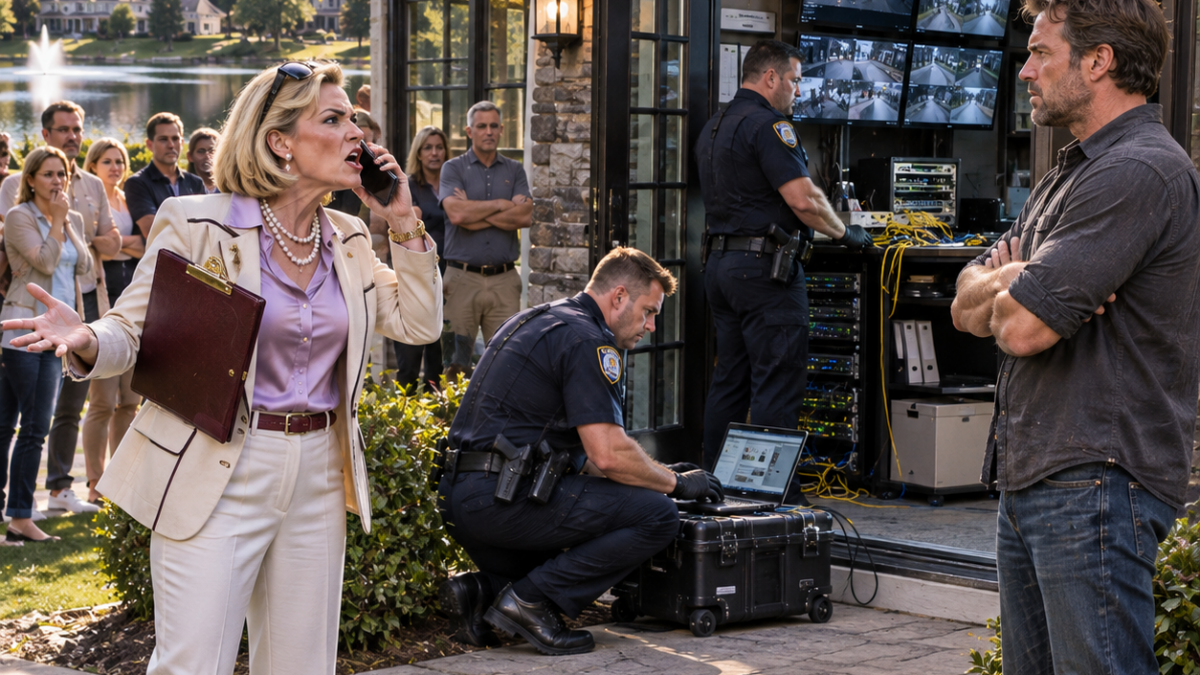
The morning I changed the password on the Wi-Fi router I had bought, installed, and paid for myself, the president of my HOA marched onto my porch with a binder under one arm, accused me of shutting down the neighborhood’s “security infrastructure,” and called 911 while half the street watched from behind curtains as if I had just hacked the Pentagon from my kitchen table.
I was still trying to explain that the only thing I had done was block an unfamiliar device that had been quietly draining hundreds of megabytes through my private connection every day when two police officers arrived, looked at my router logs, and suddenly stopped treating the situation like another ridiculous HOA complaint.
What happened after they followed that connection back to the Lakeside Grove clubhouse changed the way every family on our street looked at their cameras, their smart devices, their windows, and even one another—and for the first time since I moved there, Ella Thomas was no longer the person asking the questions.
My name is Paul King.
I’m a systems engineer, which means people tend to assume I spend my days doing something mysterious with code when the truth is usually less glamorous.
Most of my job involves making systems behave when they have decided not to.
Networks.
Servers.
Security policies.
Remote infrastructure.
The occasional printer possessed by Satan.
I work from home, so when I bought my house in Lakeside Grove, reliable internet mattered almost as much as the roof.
The neighborhood seemed perfect.
Small brick houses.
Trim lawns.
A man-made lake at the center.
Walking paths winding through maple trees.
On clear evenings, the sunset reflected across the water in orange and gold.
After years of apartment living, I wanted quiet.
I thought I’d found it.
Then I met Ella Thomas.
Ella lived two houses down and had been president of the Lakeside Grove Homeowners Association for almost six years.
She was in her mid-fifties, always perfectly dressed, always carrying some kind of folder, binder, or clipboard, and always watching.
At first, I assumed she was simply organized.
Then I received my first warning.
My mailbox flag wasn’t the HOA-approved shade of red.
I stared at the notice for a full minute.
Then I looked at the mailbox.
Red.
Apparently not red enough.
A month later, Ella objected to my rooftop solar panels.
She sent me three pages explaining that exterior alterations required approval.
I sent back the state statute protecting residential solar installations, along with the paperwork showing mine had been approved before closing.
She never apologized.
She simply stopped mentioning the panels.
That was Ella’s style.
She never admitted she was wrong.
She just moved to the next thing.
My recycling bins.
My porch lighting.
A garden hose left visible from the sidewalk.
The funny thing was, I wasn’t naturally confrontational.
I had no interest in winning a neighborhood war.
I wanted to work, make coffee, sit near the lake occasionally, and be ignored.
So I stayed polite.
Then my internet began dropping.
At first, it happened once or twice a day.
Then every hour.
My video calls froze.
Large file transfers stalled.
A client presentation died halfway through because my upload speed suddenly collapsed.
I blamed my provider.
Then I blamed my router.
Then I did what I should have done first.
I checked the logs.
There were more connected devices than I owned.
Laptop.
Phone.
Workstation.
Television.
Printer.
Those were mine.
Then I found another one.
**Lakeside HOA Network.**
I stared at the name.
At first, I thought somebody nearby had mislabeled a device.
Then I checked the traffic.
It wasn’t idle.
It had been moving data through my connection every day.
Not a little.
Hundreds of megabytes.
Sometimes gigabytes.
I blocked the device.
Then I changed the Wi-Fi password.
Simple.
Responsible.
Completely within my rights.
For amusement, I renamed the network:
**NO MORE FREE WI-FI.**
I made coffee.
Went back to work.
At 11:47 that morning, somebody pounded on my front door.
I opened it.
Ella Thomas stood on the porch.
Her face was red.
Her binder was open.
And before I could even say good morning, she shouted:
“What did you do to the community network?”
That was the moment I realized my internet problem wasn’t a technical glitch.
It was a human one.
And human problems are always harder to debug.
PART 2
I leaned against the doorframe.
“The community what?”
“The security network.”
Ella pointed toward my house as if the router itself had committed a felony.
“Our camera system went offline this morning.”
I took a sip of coffee.
“And?”
“And it happened immediately after you altered your network settings.”
“My network settings.”
“Yes.”
“My router.”
“Yes.”
“My internet service.”
Her jaw tightened.
“Paul, don’t play games.”
“I’m trying to understand what you’re accusing me of.”
“You disconnected community infrastructure.”
“No.”
“Yes, you did.”
“I changed the password to my Wi-Fi.”
“Exactly.”
There was a short silence.
I waited.
Ella apparently didn’t hear how absurd that sounded.
She flipped open her binder.
“Lakeside Grove operates on cooperative infrastructure.”
I sighed.
“I knew the irrigation system was cooperative.”
“And security.”
“I’ve never agreed to provide internet service to the HOA.”
“It’s covered in the bylaws.”
She began flipping pages.
I watched.
Page after page.
Landscape standards.
Parking.
Exterior paint.
Shared drainage.
Then she jabbed at a highlighted paragraph.
“Section fourteen-B.”
I read it.
**Homeowners shall reasonably cooperate in maintaining common infrastructure serving the community, including irrigation, drainage, lighting, and other shared utilities.**
I looked at her.
“That says nothing about private Wi-Fi.”
“Internet access is a utility.”
“My internet isn’t an HOA utility.”
“It supports the cameras.”
“Apparently without my knowledge.”
Her mouth tightened.
I could almost see the moment she realized she had said too much.
I lowered my mug.
“Ella.”
“What?”
“Why were HOA cameras connected to my router?”
“Because your house has the strongest signal on this side of the neighborhood.”
I stared at her.
She continued as though that explanation improved things.
“The system was designed to balance connectivity.”
“Designed by whom?”
“Our vendor.”
“With my permission?”
“Community security doesn’t require every homeowner to approve every technical decision.”
I laughed once.
Not because it was funny.
Because sometimes absurdity leaves you with limited options.
“You’ve been using my internet.”
“We’ve been utilizing community resources.”
“You’ve been using my internet.”
“For everyone’s protection.”
“Without asking me.”
“You never complained before.”
“I didn’t know.”
“That’s not our fault.”
I almost admired that.
“Ella, that is exactly your fault.”
Her eyes narrowed.
“If you have nothing to hide, why are you suddenly so concerned?”
That sentence changed the mood.
Not because it was clever.
Because people use it when they already believe your privacy belongs to them.
I put my mug on the porch railing.
“Go home.”
“Reconnect the system.”
“No.”
“I’m giving you an opportunity to resolve this cooperatively.”
“No.”
“Paul.”
“No.”
She straightened.
“Fine.”
“Fine.”
“I’ll call the police.”
I thought she was bluffing.
Then she pulled out her phone.
“You’re calling 911 because I changed my Wi-Fi password?”
“You intentionally interfered with a security network.”
“I blocked an unauthorized device.”
“You disabled cameras.”
“Your cameras were using my router.”
“You’re admitting it.”
For a moment, I genuinely wondered whether we were speaking the same language.
“Go ahead,” I said.
Her eyes brightened.
She thought she’d won something.
“Gladly.”
She dialed.
I could hear enough of the conversation to know she was making it sound far more dramatic than reality.
“Yes, I need immediate assistance.”
Pause.
“My neighbor has deliberately disabled our community surveillance network.”
Pause.
“No, I don’t know what else he’s accessing.”
Pause.
“Yes, electronic interference.”
Pause.
Then came the masterpiece.
“He may be tampering with protected communications.”
I closed my eyes.
Protected communications.
By the time she ended the call, three neighbors were standing outside.
Janet Webb, who treated every neighborhood disagreement like potential documentary footage.
Mark Davis, a retired history teacher who had once received a fine for growing tomatoes in a side planter.
And Mrs. Perez from the corner house, pretending to trim a shrub she had trimmed the day before.
Ella stood at the curb.
Arms crossed.
I stayed on my porch.
Eight minutes later, a patrol SUV turned onto the street.
No siren.
Thank God.
Two officers got out.
The older one had Sergeant Reeves on his nameplate.
The younger was Officer Lewis.
Reeves looked from Ella to me.
“We got a report involving a network issue.”
Ella stepped forward immediately.
“Yes. This man deliberately shut down the community security grid.”
Reeves looked at me.
“Sir?”
“I changed the password on my personal router.”
Lewis looked at Reeves.
Reeves looked back at him.
Then at Ella.
“That’s it?”
“No,” Ella said quickly. “He disconnected HOA equipment.”
I nodded.
“Equipment I didn’t know was connected to my network.”
That got Reeves’ attention.
“What equipment?”
“Apparently surveillance cameras.”
Ella interrupted.
“They’re community cameras.”
“Where are they?”
“Throughout the neighborhood.”
“Who operates them?”
“The HOA.”
“Who pays for the internet connection?”
Ella hesitated.
I raised my hand.
“I do.”
Lewis bit the inside of his cheek.
I could tell he was trying not to smile.
Reeves remained professional.
“Mrs. Thomas, do you have documentation showing Mr. King agreed to provide network access?”
“The bylaws cover shared infrastructure.”
“That isn’t what I asked.”
She opened the binder again.
Reeves held up a hand.
“Do you have written consent from him?”
Ella looked at me.
Then back at Reeves.
“It was unnecessary.”
Lewis’s eyebrows rose.
I said, “Would you like to see the logs?”
Reeves nodded.
“If you’re comfortable showing us.”
“I am.”
I invited them inside.
Ella immediately tried to follow.
Reeves turned.
“Ma’am, stay outside for a minute.”
“But I’m the complainant.”
“And we’ll speak with you.”
“This is HOA business.”
Reeves shut the door behind him.
I liked him already.
My home office sat at the back of the house.
Two monitors.
Workstation.
Router.
Backup equipment.
Nothing dramatic.
I opened the router dashboard.
Showed connected-device history.
The unfamiliar device.
The traffic.
The failed reconnect attempts after the password change.
Lewis leaned closer.
“What is that?”
A device was still trying to authenticate.
Repeatedly.
**Lakeside HOA Main Cam Server.**
Reeves stared.
“That appears to be coming from their system?”
“That’s my guess.”
“Can you tell where?”
“Not precisely from this interface.”
I opened a network log.
There were repeated attempts from the same local identifier.
Reeves looked toward the front of the house.
“Is the clubhouse nearby?”
“Two blocks.”
Lewis said, “So their equipment was using this man’s router.”
“That appears to be what happened.”
I nodded.
“Without permission.”
Reeves looked at me.
“Did you ever give anyone your password?”
“No.”
“Installer?”
“My provider set the original credentials when I moved in. I changed them once after installation.”
“Anybody from the HOA ever work inside your home?”
“Never.”
Lewis said, “How’d they get access?”
“That is an excellent question.”
The tone had changed completely.
This was no longer:
Homeowner changed Wi-Fi, HOA angry.
Now it was:
How did an outside system authenticate to a private router?
Reeves asked me to take screenshots of the logs.
I did.
He didn’t ask me to hand over devices.
He didn’t make dramatic accusations.
He simply documented.
Then we went outside.
Ella immediately approached.
“Well?”
Reeves said, “Mrs. Thomas, there’s evidence an HOA device has been connecting to Mr. King’s private network.”
She looked annoyed rather than surprised.
“Yes. I told you that.”
“You told us he interfered with your system.”
“He did.”
“He blocked your unauthorized access.”
“It wasn’t unauthorized.”
“Then show me the agreement.”
“The bylaws—”
“No.”
Reeves’ voice sharpened slightly.
“Not the bylaws. A consent form. Network authorization. Service agreement. Something showing he knowingly allowed this.”
Ella’s expression tightened.
“It wasn’t handled that way.”
“How was it handled?”
She looked toward the growing cluster of neighbors.
“This isn’t a conversation we should have in public.”
I said, “Convenient.”
Her head snapped toward me.
“Stay out of this.”
I almost laughed.
“You called 911 to my house.”
Reeves stepped between the conversation.
“Mrs. Thomas, where is the system controller?”
“The clubhouse.”
“We’d like to speak with whoever manages it.”
“I manage it.”
Reeves paused.
“You?”
“With our vendor.”
“What’s the vendor?”
“SafeCommunity Systems.”
“Contact information?”
“I’ll provide it through counsel.”
“Mrs. Thomas.”
Her posture changed.
“I don’t appreciate being interrogated.”
“You called us.”
That silenced even Janet.
Reeves continued.
“We need to determine whether equipment under your control is accessing a private network without permission.”
Ella looked toward the clubhouse.
Then back at him.
“There are sensitive security systems there.”
“Fine.”
“You can’t just enter.”
“I haven’t asked to enter yet.”
“You’ll need board approval.”
Lewis looked confused.
“Board approval?”
“The clubhouse is private community property.”
Reeves rubbed his forehead.
“We’ll handle access according to law.”
Ella crossed her arms.
“I will not allow residents’ security to be compromised.”
I looked at her.
“Apparently I’m one of the residents.”
She ignored me.
The officers returned to their vehicle.
I assumed they’d make calls and the situation would drag out for days.
Instead, Reeves came back about twenty minutes later.
“Mr. King.”
“Yes?”
“We’re going to document the clubhouse system. Because you’re the reporting party on the unauthorized connection issue, we may need a formal statement.”
“Fine.”
Then he looked at Ella.
“Mrs. Thomas, we’re requesting voluntary access to verify the network controller.”
“No.”
Immediate.
No hesitation.
Reeves nodded.
“Understood.”
She looked triumphant.
He continued.
“We’ll proceed from there.”
That ended the smile.
The police left.
The neighborhood didn’t.
People surrounded me with questions.
“Were they stealing your Wi-Fi?”
“Were they using ours?”
“What cameras?”
“Do they have our passwords?”
I raised both hands.
“I don’t know.”
Janet held her phone up.
“Can I interview you?”
“No.”
“Just thirty seconds.”
“No.”
“What do you think Ella’s hiding?”
“Janet.”
She lowered the phone.
“Fine.”
Mark came closer.
“You know, she installed that new camera near my driveway last year.”
“I’ve seen it.”
“She fined me three days later for storing gardening soil behind my garage.”
I looked at him.
“Could the camera see it?”
“Maybe.”
Mrs. Perez said, “She sent me pictures of my daughter’s car arriving after midnight.”
That caught everyone’s attention.
“What?”
“She said it violated guest parking rules.”
“Where was the camera?”
“I don’t know.”
Mark looked toward Ella’s house.
“She sees everything.”
I didn’t like the way he said it.
That night, I changed more than my Wi-Fi password.
Router administrator credentials.
Remote access settings.
Guest network.
Firmware.
I reviewed every device.
Nothing unfamiliar remained.
At 1:11 a.m., another authentication attempt appeared.
Blocked.
1:17.
Blocked.
1:42.
Blocked.
Someone was still trying.
I saved everything.
At eight the next morning, Sergeant Reeves called.
“Mr. King?”
“Yeah.”
“We’ve looped in our county cybercrime unit.”
I sat straighter.
“Okay.”
“We’d like to speak with you again.”
“About my router?”
“And several complaints that came in overnight.”
“What complaints?”
“Other residents are reporting devices and camera activity they don’t recognize.”
That was the first moment I felt actual fear.
Not for myself.
For the neighborhood.
By ten, Reeves was back with a cybercrime investigator named Daniel Rowe.
Rowe looked about forty-five, wore a dark county jacket, and had the exhausted expression of someone whose job involved explaining to people that their passwords were not supposed to be “password123.”
We sat at my dining table.
He reviewed the screenshots.
“When did you notice the device?”
“Monday night.”
“Why didn’t you disconnect it then?”
“I did.”
“Before that, how long was it active?”
“Logs show several months.”
“Any idea how the original credentials were obtained?”
“No.”
He nodded.
“Do you have smart cameras?”
“Doorbell. One backyard camera.”
“Cloud-based?”
“Yes.”
“Any HOA-installed equipment?”
“No.”
He looked through the traffic data.
“This is substantial.”
“How substantial?”
“Enough for video.”
That chilled me.
He turned the laptop toward Reeves.
“Consistent upstream traffic.”
Reeves said, “Meaning?”
“They weren’t just sending commands through his connection. They were likely transmitting footage.”
I felt my stomach tighten.
“From where?”
“That’s what we need to determine.”
Around noon, investigators obtained access to the clubhouse through a warrant based on the network evidence and additional resident complaints.
I’m not going to pretend it happened like television.
Nobody kicked the door down.
Nobody shouted dramatically.
An officer showed the paperwork.
Ella’s attorney arrived.
The board vice president, Tom Garcia, came down pale and confused.
The clubhouse door opened.
I was there only because Rowe asked me to identify the device name and confirm whether any equipment matched what I had seen in my logs.
The main room looked normal.
Folding tables.
Community-event posters.
Holiday decorations.
A coffee machine.
Ella stood near the front desk.
“This is completely unnecessary.”
Reeves ignored her.
Rowe followed ethernet lines into a utility closet.
Locked.
“Key?”
Tom looked at Ella.
Ella said nothing.
Tom whispered, “She has it.”
Every eye moved toward her.
“This room contains security equipment.”
Rowe said, “That’s why we’re here.”
Her attorney touched her arm.
“Ella.”
She removed a key from her purse.
The door opened.
Cold air rolled out.
Server cooling.
That was my first clue.
This wasn’t a simple home-security hub.
Three equipment racks lined one wall.
Switches.
Network storage.
Patch panels.
Two server units.
A workstation.
And monitors.
Lots of monitors.
Some showed exterior cameras.
Entrances.
The lake path.
Community parking.
Normal enough.
Then Rowe clicked through the system.
More feeds appeared.
Backyards.
Driveways.
Patios.
One camera pointed directly toward somebody’s kitchen window.
Another showed the rear of Mark’s property.
Another showed Janet’s hot tub area.
I felt sick.
Then my own address appeared.
My backyard.
The patio.
My office window.
Rowe froze the image.
“Mr. King?”
“Yes.”
“That’s your property?”
“Yes.”
The camera angle wasn’t from my house.
It came from a pole near the walking path behind the lots.
Zoomed.
Focused.
My laptop was visible through the glass.
Not readable.
But visible.
I looked at Ella.
“You were watching my house?”
She said nothing.
Reeves asked, “Mrs. Thomas, who controls this system?”
“The HOA.”
“Who specifically?”
“The board.”
Tom immediately said, “No.”
Everybody turned.
His face was white.
“We approve the budget. She manages the system.”
Ella glared.
“Tom.”
“No.”
His voice shook.
“You told us these were perimeter cameras.”
“They are.”
“That is Paul’s backyard.”
“For security.”
“That is Janet’s patio.”
“For security.”
Rowe opened a storage menu.
Folders.
Addresses.
Dates.
Camera identifiers.
Months of recordings.
Reeves’ face changed.
Not surprise anymore.
Anger.
“Mrs. Thomas, I’m advising you not to answer further questions without counsel.”
Her lawyer stepped forward.
“She will not.”
Rowe traced network routes.
Then he looked at me.
“Your connection is here.”
On the screen was my public IP associated with repeated outbound routes.
I stared.
“What does that mean?”
“Part of the traffic was being routed through your internet connection.”
“Why?”
“Possibly to obscure where remote uploads originated.”
Ella spoke before her lawyer could stop her.
“It improved redundancy.”
Rowe looked at her.
“By routing surveillance footage through a homeowner’s private network?”
“It was more secure.”
Her lawyer closed his eyes.
I said quietly, “You used my router as cover.”
Ella turned toward me.
“No.”
“You stole my bandwidth.”
“For community safety.”
“You routed private footage through my house.”
“You don’t understand the system.”
“I understand networks better than you do.”
Her face twisted.
“I protected this neighborhood for years.”
“From what?”
“Crime.”
“By watching people’s kitchens?”
She snapped.
“If residents followed the rules, there wouldn’t be anything to worry about.”
The room went silent.
Her lawyer said, “Ella. Stop.”
Too late.
That sentence told everyone exactly what this had become.
Not security.
Compliance.
Control.
Rowe began photographing equipment.
Digital evidence specialists arrived.
Hard drives were tagged.
Servers were isolated.
The system went offline.
For the first time since I’d lived in Lakeside Grove, every HOA camera went dark.
Outside, residents had gathered.
Word traveled fast.
Too fast.
Janet had apparently posted about the search.
Reporters arrived before investigators finished.
When Ella came outside with her attorney, people started shouting.
“Were you recording us?”
“Did you film my children?”
“Were you watching our windows?”
“My pool?”
“My backyard?”
Ella tried to speak.
Nobody listened.
Then she saw me.
Her face hardened.
“You did this.”
I stared at her.
“You called the police.”
She looked as if I’d slapped her.
“You changed the network.”
“Yes.”
“You deliberately broke the system.”
“No.”
I shook my head.
“I changed my password.”
A reporter pushed closer.
Ella’s attorney blocked him.
I continued quietly enough that only she heard.
“You built the rest.”
She was led away for questioning.
Not dragged.
Not handcuffed in some dramatic spectacle.
But the woman who had once walked through Lakeside Grove as if every driveway belonged to her now had two investigators beside her and no binder in her hands.
That was enough.
The following day, Rowe returned.
He stood by my mailbox with Reeves.
“Morning.”
“Should I be worried?”
“Yes.”
He said it so plainly that my stomach dropped.
“What did you find?”
“More than we expected.”
We went inside.
Rowe opened a folder.
“The storage system had remote backups.”
“Where?”
“Cloud account registered to the HOA.”
“That sounds normal.”
“It would be, except only one administrative user controlled it.”
“Ella.”
He nodded.
“The account recovery address was hers. Authentication device was hers. Activity logs show she personally accessed recorded footage hundreds of times.”
“Public cameras?”
“Not only.”
He slid over a printed summary.
“Some cameras had infrared capability.”
I stared.
“So?”
“Several were positioned close enough to windows to capture interior movement at night.”
My skin went cold.
Reeves added, “We also found connection attempts involving resident smart devices.”
“What kind?”
“Doorbells. Cameras. At least one baby monitor.”
I stood.
“Inside a house?”
“Potentially.”
I walked to the window.
For several seconds, I couldn’t speak.
I had joked about Wi-Fi.
About Ella.
About HOA nonsense.
This wasn’t funny anymore.
“How?”
Rowe answered carefully.
“We’re still investigating. Some homeowners used default credentials or reused passwords. Some devices were accidentally configured onto community infrastructure. We’re determining whether any access was intentional.”
“And my router?”
“Used as a relay point.”
“Without me knowing.”
“Yes.”
“Why mine?”
“Strong signal. Stable connection. And because your home office stays online.”
I laughed bitterly.
“Professional-grade internet.”
“Apparently.”
I looked at Reeves.
“What happens now?”
“Charges will depend on what prosecutors can prove.”
Rowe said, “Unauthorized access. Privacy violations. Data misuse. Possibly more.”
I sat down.
“How long has this been happening?”
“At least eight months.”
Eight months.
I thought about every night I’d sat in my kitchen.
Every morning I’d walked into my office.
Every time I’d stepped onto the patio.
Suddenly my own home felt different.
Not unsafe physically.
Observed.
That’s worse in a quieter way.
Two days later, Rowe asked me to come to the county cybercrime office.
The building looked nothing like television.
Gray carpet.
Cheap chairs.
Coffee that smelled burned enough to qualify as evidence.
He sat me in front of a monitor.
“I need to show you something.”
“I already don’t like that sentence.”
He almost smiled.
Then opened a directory.
Folders named by address.
Every house in Lakeside Grove.
My folder:
**KING – 214 LAKESHORE.**
Inside were dates.
Video clips.
Notes.
Screenshots.
One document labeled:
**COMPLIANCE OBSERVATIONS.**
My throat tightened.
Rowe said, “You don’t have to view everything.”
“I need to know.”
He opened a clip.
My patio.
Me working at the table.
Another.
My kitchen window.
Another.
Late evening.
I crossed the room inside.
Not detailed.
But visible.
Enough to know when I was home.
Enough to know when lights went out.
Enough to know routine.
Then another clip.
Bathroom window.
My silhouette.
Towel around my waist after a shower.
I turned away.
“Stop.”
Rowe closed the video immediately.
“I’m sorry.”
I stared at the wall.
For years, I had worked in cybersecurity-adjacent environments.
I lectured clients about least privilege.
Device isolation.
Consent.
Access control.
I understood privacy technically.
But sitting there, seeing myself reduced to a file in someone else’s system, I understood it emotionally.
“Why keep this?”
Rowe said, “Control.”
It was the first time an investigator used the word.
“Not security?”
“There are legitimate security systems.”
He pointed toward the monitor.
“This isn’t one.”
He opened the notes.
**King works late.**
**King leaves Mondays around 6:40.**
**Package deliveries frequent.**
**Possible unapproved work activity.**
**Solar compliance issue.**
Then:
**Spends excessive time on computer. Monitor for unusual behavior.**
I actually laughed.
“I’m a systems engineer.”
“I know.”
“My job is the computer.”
“I know.”
“She documented me working.”
“Looks that way.”
I rubbed both hands across my face.
“Every house?”
“Yes.”
“Children?”
“Some footage includes minors.”
“Pools?”
“Yes.”
“Bedrooms?”
“Some cameras captured interior rooms through windows.”
“Baby monitors?”
“We confirmed unauthorized access to at least two smart devices.”
My stomach turned.
Rowe closed the folder.
“All recovered footage is being preserved only as evidence. The court will determine destruction protocols.”
“Good.”
I stood.
“I want mine gone.”
“It will be.”
“When?”
“As soon as legally permitted.”
I hated that answer.
Not because he was wrong.
Because it meant Ella’s stolen copy of my life still existed somewhere I couldn’t control.
That night, I unplugged almost everything.
Smart speaker.
Doorbell camera.
Old television network adapter.
I covered my laptop webcam even though I knew it hadn’t been accessed.
I changed passwords again.
Then again.
I sat in bed staring at the ceiling.
At 2:30 a.m., I got up and checked the windows.
At three, I checked the router.
No unfamiliar connections.
At four, I was still awake.
Paranoia doesn’t care whether you’re technically competent.
Once someone proves they were watching, every dark screen becomes suspicious.
The next evening, Janet came to my door carrying cookies.
No phone.
That was how serious she was.
“Paul.”
“Hey.”
“Can I come in?”
I almost said no.
That reaction scared me.
I opened the door.
She sat at my kitchen table.
For a minute she stared at her hands.
“They had footage of our hot tub.”
“I heard.”
“My husband won’t go outside.”
“I’m sorry.”
“She recorded my daughter.”
I looked at her.
“When?”
“Last summer. Pool party.”
My jaw tightened.
“Did police tell you?”
“Yes.”
She wiped her eyes.
“I used to joke about Ella being controlling.”
“We all did.”
“I livestream everything.”
She laughed bitterly.
“And now I’m angry someone recorded me.”
“Consent matters.”
“I know.”
She looked around the kitchen.
“Do you feel weird in here now?”
That question hit harder than I expected.
“Yes.”
“Me too.”
We sat quietly.
Then she pushed the cookie box toward me.
“My mother always sends food when something terrible happens.”
“I respect the system.”
That got a small laugh.
Before leaving she said, “Thank you.”
“For what?”
“Changing your password.”
I smiled tiredly.
“Strong cybersecurity practice.”
“No.”
She shook her head.
“For not backing down.”
The HOA held an emergency meeting Friday.
Ella obviously wasn’t there.
Tom Garcia, the vice president, stood at the front.
He looked ten years older.
The room was packed.
People didn’t sit politely.
They demanded answers.
“What did the board know?”
“Who approved the cameras?”
“Why did she have access?”
“Why were we paying for servers?”
Tom raised both hands.
“We didn’t know the scope.”
Someone shouted, “You signed the checks!”
“I know.”
“Then you knew!”
“No. We approved a community safety program.”
“What did you think the servers were for?”
“License-plate cameras. Common areas. Package theft.”
Mark stood.
“She had a camera aimed behind my house.”
Tom swallowed.
“I didn’t know.”
Mrs. Perez shouted, “My daughter’s schedule was in her notes!”
“I didn’t know.”
The room erupted.
I stayed near the back.
Then Tom said something useful.
“Being unaware doesn’t mean the board isn’t responsible.”
The room quieted slightly.
He continued.
“We failed.”
That was the first honest sentence I’d heard from HOA leadership since moving in.
“We trusted one person with too much control. We didn’t understand the technology. We didn’t ask enough questions. And residents paid the price.”
A woman near the front said, “So resign.”
Tom nodded.
“We are.”
That shocked everyone.
“Effective tonight, the current board will dissolve its officer roles and schedule a special election under legal supervision.”
Then he looked toward me.
I knew what was coming.
I hated it already.
“Paul.”
“No.”
People laughed.
“I haven’t asked yet.”
“No.”
“We need someone to help us understand the systems.”
“No.”
“Temporary technical advisor.”
I rubbed my forehead.
Mark called from the audience.
“You broke it, Paul.”
“I fixed my Wi-Fi!”
More laughter.
Tom smiled for the first time.
“We need someone who knows how to build a transparent system.”
I looked around.
These people had been recorded.
Humiliated.
Their homes turned into data points.
I didn’t want an HOA role.
But I understood networks.
More importantly, I understood exactly how easily “security” becomes surveillance when nobody asks why.
“All right.”
Applause.
I held up a hand.
“Temporary.”
More applause.
“And first rule.”
The room quieted.
“No homeowner internet connections.”
That got the loudest applause of the night.
The rebuild started with destruction.
Not physical destruction.
Policy destruction.
Every Ella-era surveillance rule went onto a projector.
We read them.
All of them.
There was a clause granting the president “executive discretion regarding community safety technology.”
Gone.
A clause allowing emergency deployment of monitoring equipment without notice.
Gone.
A vague statement requiring residents to “cooperate with digital community infrastructure.”
Gone.
Shared administrator accounts.
Gone.
Default passwords.
Gone.
Permanent recording where live viewing would suffice.
Gone.
Resident data stored without retention limits.
Gone.
I wrote three words across the whiteboard.
**CONSENT. PURPOSE. LIMITS.**
Tom asked, “Explain.”
“Consent means people know what they’re participating in.”
I pointed to the second word.
“Purpose means every system has a specific reason to exist.”
Then the third.
“Limits mean technology can’t quietly grow beyond that reason.”
A homeowner asked, “So no cameras?”
“No.”
I shook my head.
“Security cameras aren’t automatically evil. Secret cameras are a problem. Cameras aimed into private spaces are a problem. Unlimited access is a problem. One person controlling everything is a problem.”
Mark said, “Especially if that person is Ella.”
“Especially anyone.”
That distinction mattered.
The new system would cover only genuine common areas.
Clubhouse entrances.
Community parking.
Pool gate.
Main vehicle entrance.
No backyard angles.
No windows.
No private driveways unless an owner specifically requested coverage and controlled it themselves.
Residents could see what cameras existed.
Where they pointed.
How long recordings remained.
Who could access them.
Every administrative login generated an audit trail.
No single person could export footage alone.
Tom stared at the proposal.
“Isn’t that excessive?”
I looked at him.
“Eight months ago, one woman had folders on every family here.”
He nodded.
“Fair.”
As we rebuilt the system, the criminal case moved forward.
The prosecution subpoenaed me.
State versus Ella Thomas.
I read the notice at my kitchen table.
Even knowing it would happen, seeing my name on formal court paperwork made everything real again.
I testified three weeks later.
Ella sat at the defense table.
Gray suit.
No pearls.
No binder.
She looked at me once.
Then never again.
The prosecutor began simply.
“Mr. King, what did you do on the morning of April fourteenth?”
“I changed my Wi-Fi password.”
A few people in the courtroom smiled.
“Why?”
“An unfamiliar device was using my network.”
“Did you know that device belonged to the HOA?”
“Not initially.”
“When did you learn?”
“When Mrs. Thomas came to my house demanding that I restore access.”
“Did you ever give the HOA permission to use your internet connection?”
“No.”
“Did you provide Mrs. Thomas your Wi-Fi password?”
“No.”
“Did you know surveillance footage was being routed through your connection?”
“No.”
Then came the harder questions.
“How did you feel when police showed you footage collected from your property?”
I looked toward the jury.
Then the judge.
“Robbed.”
The prosecutor paused.
“Robbed of what?”
“Privacy.”
My voice tightened.
“Money can be replaced.”
I looked at Ella.
“A password can be changed. A router can be reset.”
She finally looked at me.
“But once somebody shows you that moments you believed were private were actually being watched, you don’t get those moments back.”
The courtroom became very quiet.
“For weeks afterward, I checked windows. I unplugged devices I knew were safe. I stopped sitting near my kitchen window at night.”
I swallowed.
“My house stopped feeling like a place where I was alone.”
The prosecutor nodded.
“No further questions.”
Ella’s attorney stood.
“Mr. King, you are a systems engineer.”
“Yes.”
“So you possess advanced technical knowledge.”
“Depending on what you’re comparing me to.”
“Far more than the average homeowner.”
“Yes.”
“You understood that changing network credentials could disrupt connected devices.”
“Devices I knew about.”
“You acknowledge your action disabled HOA cameras.”
“I learned that afterward.”
“But technically, your password change caused the disruption.”
“My password change prevented unauthorized devices from using my router.”
He smiled.
“You’re being precise.”
“That’s my job.”
A few people laughed.
He walked closer.
“You later became technical advisor to the HOA.”
“Yes.”
“You gained authority as a result of this scandal.”
“No.”
“You were given control of the new security systems.”
“I was given responsibility under board oversight.”
“Power.”
“No.”
He frowned.
“What distinction are you making?”
“The exact distinction that caused this case.”
That got the judge’s attention.
I continued.
“Ella had power because nobody could see what she was doing.”
I nodded toward the public gallery.
“Our new system has oversight.”
Her attorney changed direction.
“You’ve given interviews.”
“A few.”
“You’ve described Mrs. Thomas as controlling.”
“Yes.”
“A dictator?”
“I repeated language from neighborhood discussions.”
“HOA tyranny?”
“I may have used that phrase.”
“So you benefited socially from humiliating her.”
I looked at him.
“I lost sleep for months because your client recorded my home.”
He stopped.
I continued.
“If you’re asking whether strangers recognizing me at the grocery store compensates for that, no.”
He sat down.
Ella testified later.
Her lawyer tried to frame the system as overzealous community protection.
Ella said crime reports had increased.
Package theft.
Vehicle break-ins.
Trespassing near the lake.
She said she had acted because residents wanted more security.
Then prosecutors introduced emails.
One line appeared on the courtroom monitor.
From Ella to a friend:
**These fools don’t even know they’re on camera. Makes enforcement much easier.**
The room reacted immediately.
Ella stared at the screen.
Her attorney objected.
The judge allowed it.
Another email:
**King thinks those solar panels put him above the rules. We’ll see how cooperative he is when I know his schedule.**
My stomach turned.
I had never seen that before.
The prosecutor asked:
“Mrs. Thomas, what did you mean by knowing his schedule?”
Ella’s voice was barely audible.
“I don’t remember.”
“You maintained logs stating when Mr. King left his home.”
“For security.”
“You recorded residents’ routines.”
“For security.”
“You stored private footage.”
“For security.”
“You routed traffic through Mr. King’s network.”
“For redundancy.”
“You accessed a baby monitor.”
Ella looked toward her attorney.
He couldn’t save her.
“I don’t recall accessing it personally.”
The prosecutor displayed the admin log.
Her username.
Timestamp.
Session.
She stopped talking.
The verdict came after deliberation.
Guilty on several counts.
Not every allegation.
Enough.
The sentence included probation, community service, restrictions related to electronic systems, restitution obligations, and permanent disqualification from HOA leadership under the court order.
Some residents wanted prison.
Some wanted more.
I didn’t know what I wanted.
Then the judge said something that stayed with me.
“Protection without consent can become control. Control without oversight can become abuse.”
That was enough.
Outside the courthouse, reporters surrounded me.
One shouted:
“Mr. King, do you feel like you won?”
I almost kept walking.
Then I stopped.
“No.”
“Do you think justice was served?”
“I think accountability happened.”
“What did you win?”
I looked at the cameras.
“Privacy did.”
That became the headline.
I hated it at first.
Then I realized it wasn’t terrible.
Lakeside Grove held a dinner near the lake that weekend.
Not an HOA event.
Nobody submitted a permit.
Nobody voted on table placement.
People simply brought food.
Someone hung a handwritten sign near the clubhouse.
**LAKESIDE GROVE — NOW 100% SPY-FREE**
I laughed.
Mark had grown tomatoes specifically for the salad.
Janet left her phone in her purse almost the entire night.
Kids ran along the water.
People talked.
Actual conversation.
No one scanning for Ella.
No one wondering who was listening.
I stood near the lake as the sun went down.
Tom came beside me.
“You okay?”
“I think so.”
“You don’t sound convinced.”
“I keep expecting the router logs to show something.”
“Do they?”
“No.”
“Then maybe stop checking.”
“That’s offensive.”
“Paul.”
“I check twice a day now.”
“How many before?”
“Twenty.”
He laughed.
“Progress.”
A month later, the county cybercrime office completed its evidence review.
Rowe called me.
“The copies related to your residence are being handled under the court order.”
“Meaning?”
“Original investigative evidence remains sealed as required. Non-evidentiary duplicates have been destroyed.”
I let out a breath I hadn’t known I was holding.
“And Ella’s cloud storage?”
“Secured and disabled.”
“Any other copies?”
“None we’ve identified.”
That answer wasn’t perfect.
In security, almost nothing is.
But it was enough to begin sleeping better.
Then came the civil lawsuits.
Several residents sued.
Privacy claims.
Emotional distress.
Unauthorized data use.
The HOA’s insurance carrier got involved.
Lawyers appeared.
Letters multiplied.
I stayed out of most of it.
I gave testimony when required.
Provided logs.
Provided copies of my internet bills showing bandwidth consumption.
But I refused to let the case become my entire life.
I had work.
Clients.
A house.
A lake.
Eventually, the neighborhood needed normalcy more than it needed another headline.
That should have been the end.
It wasn’t.
Three months after sentencing, an official envelope arrived.
Ella was appealing portions of the judgment.
I stared at it.
“No.”
The empty kitchen did not answer.
I opened the notice.
Her new attorney argued the restrictions were excessive and that public commentary by residents had damaged her reputation.
My name appeared repeatedly.
I called Tom.
“She’s appealing.”
“I know.”
“She’s blaming me.”
“I know.”
“How do you know everything before me?”
“I’m HOA president.”
I went silent.
He laughed.
“Relax. Transparent HOA president.”
“That title should never be spoken proudly.”
“Fair.”
The appeal hearing brought me back to court.
Ella looked different.
Thinner.
More composed.
Her attorney, Gregory Hunt, was polished and aggressive.
He argued she had acted from legitimate safety concerns.
That the HOA had failed to provide technological guidance.
That residents had benefited from security cameras before turning on her.
Then he turned to me.
“Mr. King, you changed your password knowing HOA security services depended on your connection.”
“No.”
“You knew after Mrs. Thomas informed you.”
“Yes.”
“And still refused to restore access.”
“Yes.”
“Even though cameras were offline.”
“Yes.”
“Why?”
“Because they had no right to use my private internet connection.”
“You could have temporarily restored access while discussing the issue.”
“I could have.”
“But you chose not to.”
“Yes.”
He smiled.
“Because you wanted conflict.”
“No.”
“Because you disliked Mrs. Thomas.”
“I disliked unauthorized access.”
“You publicly mocked her.”
“After police discovered she was recording my house.”
“You called her behavior tyrannical.”
“I stand by that.”
Hunt paced.
“You’re enjoying this.”
I stared at him.
“No.”
“You became a local celebrity.”
“Against my will.”
“You joined the HOA.”
“Temporarily.”
“You now manage the technology system.”
“Under written policies and oversight.”
“You’re everything Mrs. Thomas was accused of being.”
That angered me.
I leaned forward.
“No.”
He stopped.
I continued.
“Ella controlled a secret system.”
I pointed toward Tom and several residents.
“Ours is published.”
“Ella could watch any resident.”
“Our admins require authorization.”
“Ella stored private footage.”
“Our retention is limited.”
“Ella made herself the system.”
I looked directly at Hunt.
“We designed ours so no one person can become the system.”
Silence.
The judge made a note.
Then prosecutors introduced additional recovered files Ella had kept.
Not video this time.
Notes.
Detailed resident routines.
**Mark Davis: leaves Thursdays 8:10.**
**Janet Webb: frequent guests.**
**Perez daughter returns late weekends.**
Then mine.
**Paul King: computer activity irregular. Solar issue unresolved. Leaves Monday evenings. Resistant personality.**
I stared.
Resistant personality.
For some reason, that phrase made me angrier than the video.
She had reduced every neighbor to something to manage.
The judge asked Ella directly:
“Why did you maintain these notes?”
“Safety.”
“Why record whether Mr. King was resistant?”
Ella had no answer.
The appeal was denied.
Additional no-contact restrictions were imposed regarding residents involved in the case.
Ella broke down.
Not theatrically.
Quietly.
Then suddenly she said:
“I gave everything to that neighborhood.”
Nobody answered.
I don’t know why I spoke.
Maybe because months earlier I would have wanted to hurt her.
Now I only felt tired.
“You didn’t give, Ella.”
She looked at me.
“You took.”
Her face crumpled.
The bailiff led her away.
I never saw her in court again.
Outside, Tom caught up with me.
He was holding a folder.
“What now?”
“Please don’t say Wi-Fi.”
He laughed.
“New charter was approved.”
“What charter?”
“Technology and privacy amendments.”
I stopped walking.
“You mean the consent rules?”
“All official.”
I took the folder.
The new provisions were simple.
No shared private networks.
No secret monitoring.
No interior surveillance.
No camera installation without a public map and majority approval.
No administrative access without logging.
No use of resident data for ordinary HOA enforcement unless provided voluntarily or legally obtained.
Mandatory deletion schedules.
Independent annual audit.
And one clause I had insisted on:
**No homeowner shall be required to surrender personal network access, passwords, device credentials, or private digital services as a condition of HOA membership or compliance.**
I smiled.
Tom said, “Worth all the trouble?”
“No.”
He looked surprised.
“Really?”
“Nothing makes what happened worth it.”
I closed the folder.
“But this makes sure it wasn’t wasted.”
That evening I changed my network name again.
Not because I needed to.
Because it amused me.
**HOA SPY-FREE ZONE.**
Tom saw it.
Texted immediately.
**Subtle.**
I replied:
**Accurate.**
The new community network was built slowly.
No shortcuts.
Independent internet service at the clubhouse.
Separate VLANs.
Locked-down administration.
Public documentation.
Residents got access only to what they needed.
Nobody could view footage from their couch just because they were president.
Every administrative action logged.
Every export required two authorized people.
Camera placements were physically inspected.
Janet volunteered for that committee.
She stood beside one camera near the pool entrance.
“Move it three degrees left.”
I looked.
“Why?”
“It can see into the Hendersons’ second-floor window.”
I adjusted it.
She smiled.
“Look at me. Privacy expert.”
“Terrifying.”
The Hendersons weren’t home.
We left them a note explaining the adjustment anyway.
That’s what transparency looks like.
Boring.
Documented.
Considerate.
Over the next few months, Lakeside Grove changed.
Not visibly at first.
The same houses.
Same lake.
Same mailboxes.
But people behaved differently.
They asked questions at meetings.
Not angry questions.
Specific ones.
“Who can access this?”
“How long do you keep that?”
“Why do we need this camera?”
“Can homeowners opt out?”
The first time somebody asked whether a new pool camera was necessary, Tom looked at me.
I smiled.
He answered without help.
“We justify it or we don’t install it.”
I almost felt proud.
Ella’s house went up for sale.
A month later, a black sedan pulled up outside the clubhouse.
She stepped out.
I was cleaning old cables from a storage closet.
For a second, I froze.
She looked older.
No pearl necklace.
No binder.
She carried a cardboard box.
She set it on the clubhouse steps.
Saw me.
Stopped.
I didn’t move.
She gave a small nod.
Then left.
Inside the box were old HOA keys.
Her identification badge.
Paper files.
And a note.
**To the new board,**
**Consider this my final act of compliance.**
**I believed control was the same thing as protection. I understand now that I was protecting my own authority more than I was protecting anyone else.**
**Ella Thomas**
Tom read it.
“Think she means it?”
“I don’t know.”
“Forgive her?”
“I don’t know.”
“Useful conversation.”
“You asked bad questions.”
He laughed.
Ella sold the house.
Moved away.
Rumor said she went to Arizona.
Rumor also said her new neighborhood had no HOA.
If true, the universe had a sense of humor.
For a while, life became ordinary.
Beautifully ordinary.
Work.
Coffee.
Walks by the lake.
Saturday cleanup days.
Noise complaints that ended with neighbors talking instead of formal citations.
Paint disputes that nobody turned into constitutional crises.
I started woodworking in my garage.
One project became a sign for the community center.
**LAKESIDE GROVE**
Under it:
**PRIVACY • PEACE • COMMUNITY**
Tom thought it was sentimental.
Janet loved it.
Mark wanted:
**NO SPYING, GOOD TOMATOES.**
He lost the vote.
One evening, Rowe texted.
**Case formally closed. Remaining devices destroyed under order.**
I read the message three times.
Then sat on the porch.
That should have made me happy.
Instead, I cried.
Not much.
Just enough to surprise myself.
I hadn’t cried during the police search.
Not during court.
Not when I saw the footage.
The finality did it.
For months, part of my brain had stayed on alert.
Somewhere, maybe a server existed.
Somewhere, maybe another copy.
Somewhere, maybe Ella was still watching.
Now, as far as the investigation could determine, it was over.
I deleted Rowe’s message.
Then checked my router.
Old habits.
Only my devices.
I smiled.
The following spring, Lakeside Grove hosted a community cleanup day.
Tom was hanging a banner when I arrived.
“You’re early.”
“I always wake early.”
“You used to wake early to check router logs.”
“I still check them.”
“How often?”
“None of your business.”
He laughed.
We spent the morning cleaning around the lake.
Kids collected trash.
Adults repaired benches.
Mark planted tomatoes in two community planters.
No one fined him.
At lunch, Tom sat beside me.
“You should run for the board.”
“No.”
“We need you.”
“You have me as tech advisor.”
“Permanent tech advisor.”
“Temporary permanent.”
“That isn’t a thing.”
“It is now.”
He shook his head.
“You know people trust you.”
That word landed differently than he intended.
Trust.
For months, that had been the entire problem.
Not technology.
Trust.
People trusted Ella too much.
Then they trusted nobody.
Rebuilding technology was easy.
Rebuilding trust was harder.
“I don’t want power,” I said.
Tom nodded.
“That’s why people want you to have some.”
I looked at him.
“That sentence should scare you.”
“It does.”
“Good.”
We laughed.
Later that afternoon, I returned to my garage.
My wooden Lakeside Grove sign sat on the bench.
I sanded the final edge.
My phone buzzed.
Unknown sender.
An email.
Subject:
**One last thing.**
I almost deleted it.
Then saw the attachment.
A video file.
The message was short.
**Paul,**
**I know I shouldn’t contact you. This was recorded before the court restrictions and was left with my attorney to forward only after the case closed. You don’t owe me anything.**
**Ella**
I stared at the screen.
Every part of me said don’t open it.
Then curiosity won.
I disconnected from the network.
Scanned the file.
Old habits.
Then opened it.
Ella appeared on screen.
She sat in the old clubhouse office.
Walls bare.
No monitors.
No binder.
She looked exhausted.
“If you’re watching this, Paul, then I’m gone from Lakeside Grove.”
She paused.
“I spent months thinking you ruined my life.”
I watched silently.
“I told myself that if you hadn’t changed the password, none of this would have happened.”
A sad smile.
“That might even be technically true.”
I almost laughed.
“But the cameras would still be there.”
Her expression changed.
“And that’s the part I couldn’t admit.”
She looked down.
“I started small.”
“Package theft.”
“Cars.”
“Pool vandalism.”
“Then somebody broke a rule and denied it.”
“So I checked a camera.”
“I proved they lied.”
“It felt useful.”
“Then another person.”
“Another camera.”
“Another rule.”
“At some point, safety stopped being the goal.”
She looked into the lens.
“Knowing became the goal.”
That line chilled me.
“I liked knowing where everyone was.”
“What they were doing.”
“Who was breaking rules.”
“Who was criticizing me.”
“It made me feel prepared.”
“Then powerful.”
She stopped.
“I became the thing I claimed I was protecting people from.”
For several seconds, she said nothing.
“I’m not asking you to forgive me.”
“I don’t deserve that request.”
“I only wanted you to know one thing.”
She leaned closer.
“You were right.”
“Control isn’t protection.”
“It’s fear dressed as order.”
The video ended.
I sat in the dark garage.
No anger.
No triumph.
Just sadness.
People imagine villains understand themselves.
Most don’t.
Most build a story where every next step feels justified.
Ella didn’t wake one morning and decide to become a neighborhood spy.
She convinced herself that one small violation was acceptable.
Then another.
Then another.
Power didn’t corrupt her overnight.
It taught her to stop asking permission.
I copied the video to an encrypted drive.
Then, after thinking about it, I deleted the local copy.
I didn’t need a trophy.
The next HOA meeting was almost boring enough to make me proud.
Pool maintenance.
Reserve funding.
Tree trimming.
Community movie night.
Then Tom said:
“Paul has one technology update.”
Everyone groaned theatrically.
I stood.
“Good evening to you too.”
Laughter.
“We’ve completed annual access review.”
I clicked to one slide.
“Four cameras.”
“Four documented purposes.”
“Two administrators.”
“Thirty-day retention.”
“No unresolved access anomalies.”
Mark raised his hand.
“English?”
“Everything works.”
Applause.
“And I renamed the guest network.”
More groans.
Janet shouted, “Oh God.”
I smiled.
“**TRUST BUT VERIFY.**”
The room laughed.
Tom raised his coffee cup.
“To Paul King.”
“No.”
“Yes.”
“No speeches.”
“Too late.”
He stood.
“To the man who accidentally exposed the largest scandal in Lakeside Grove history by changing his Wi-Fi password.”
I raised my cup.
“To everybody who finally learned to read the technology budget.”
That got more applause.
After the meeting, people drifted outside.
The lake reflected the sunset exactly the way it had when I first moved there.
Orange.
Gold.
Calm.
Tom walked beside me.
“You ever regret staying?”
I thought about it.
“Sometimes.”
“Why didn’t you leave?”
“Because leaving would have made my house feel like something Ella took from me.”
He nodded.
“Do you regret exposing her?”
“No.”
“That answer came fast.”
“Because if I hadn’t changed the password, she’d still be watching.”
We stopped near the water.
A family walked past.
Kids on bicycles.
Parents talking.
Nobody glancing at cameras.
Tom said, “Funny.”
“What?”
“All this because of one password.”
I smiled.
“Small changes reveal big dependencies.”
“Engineer answer.”
“That’s why you keep me around.”
A few months later, the neighborhood held an outdoor movie night.
Families sat on blankets near the lake.
Janet ran a small projector.
Mark sold tomato sandwiches for a charity drive.
I sat near the back.
Not working.
Not checking logs.
Just watching a terrible comedy with fifty neighbors.
Halfway through, my phone vibrated.
Security notification.
My body reacted instantly.
Shoulders tight.
Heart faster.
I opened it.
**Firmware update available.**
I stared.
Then laughed.
Tom looked over.
“What?”
“Nothing.”
I put the phone away.
Didn’t update it.
That was progress.
Near the end of the movie, a little girl from across the street came over.
“Mr. King?”
“Yeah?”
“My dad says you’re the Wi-Fi man.”
I sighed.
“Your dad and I need to talk.”
She smiled.
“Did you really make the police come because you changed your password?”
“No.”
“Mrs. Thomas called them.”
“Why?”
“Because she was angry.”
“About Wi-Fi?”
“Basically.”
The girl considered this.
“That’s weird.”
“Correct.”
“Did you beat her?”
I looked toward the lake.
“No.”
She frowned.
“But my dad said you won.”
“I didn’t.”
“Who won?”
I thought about that.
“Everybody who gets to close their curtains now.”
She stared at me.
Children have limited patience for metaphors.
“So privacy?”
I smiled.
“Exactly.”
She ran back to her parents.
The movie ended.
People packed blankets.
I stayed behind.
The clubhouse lights reflected on the water.
No hidden cameras.
No secret server room.
The equipment closet still existed.
I had helped rebuild it.
But now the door had a transparent access policy posted beside it.
Anyone could read exactly what was inside.
That mattered more than locks.
The next morning, I woke before sunrise.
Made coffee.
Opened my laptop.
Checked work email.
Then hovered over the router dashboard.
Habit.
I almost opened it.
Then stopped.
I carried my coffee outside instead.
The lake was quiet.
Mist hung over the water.
A duck moved through the reeds.
For the first time in a long time, I wasn’t thinking about who might be watching.
That was the real victory.
Not Ella’s guilty verdict.
Not the headlines.
Not the appeal denial.
Not even the new bylaws.
The victory was ordinary privacy becoming ordinary again.
The right to sit in my kitchen without wondering whether somebody had filed a note about it.
The right to work at my computer without becoming “suspicious.”
The right to walk into my backyard without seeing myself later on somebody else’s screen.
The right to change my own password without asking permission.
People talk about privacy like it’s secrecy.
It isn’t.
Privacy isn’t hiding wrongdoing.
It’s having space where you don’t owe anyone an explanation.
Ella never understood that.
She believed knowing more made her a better leader.
In reality, it made her incapable of trusting anyone.
And once she stopped trusting people, she built a system that required everyone else to live without privacy so she could feel secure.
That’s not community.
That’s control.
Lakeside Grove eventually became less perfect.
I liked it better.
Some lawns grew a little too long.
Some trash cans stayed out overnight.
Mark’s tomatoes spread beyond the approved planter.
A teenager painted his mailbox dark blue.
Nobody held an emergency meeting.
People talked.
Compromised.
Argued.
Apologized.
Normal human disorder.
Turns out a healthy community is messy.
Ella had spent years trying to remove every unpredictable thing.
But unpredictability is where trust lives.
If you already know what everybody is doing, you don’t need trust.
You need surveillance.
One Saturday, Tom called.
“Emergency.”
“What happened?”
“Clubhouse.”
I grabbed my keys.
“What broke?”
“Nothing.”
“Cyber incident?”
“No.”
“Then why are you saying emergency?”
“Come here.”
I arrived five minutes later.
He stood beside the community router.
Janet.
Mark.
Three other residents.
A cake on the table.
I stopped.
“No.”
Tom grinned.
“One-year anniversary.”
“Of what?”
“Spy-free Lakeside Grove.”
“You baked a cake for a privacy scandal?”
“Janet did.”
She pointed at the frosting.
It read:
**HAPPY PASSWORD DAY**
I stared.
“You people need hobbies.”
Mark handed me a plastic knife.
“You’re the guest of honor.”
“I hate all of you.”
They laughed.
We ate cake.
It was ridiculous.
It was also kind of perfect.
Later, Tom showed me a plaque the board wanted to hang.
It read:
**NO TECHNOLOGY WITHOUT CONSENT.
NO AUTHORITY WITHOUT OVERSIGHT.
NO COMMUNITY WITHOUT TRUST.**
I read it twice.
“Too dramatic?”
He asked.
“Little bit.”
“Should we hang it?”
“Yes.”
We did.
A year earlier, the clubhouse wall had displayed Ella’s “Project Harmony” poster.
Now it displayed something closer to the truth.
Harmony doesn’t come from making everyone obey.
It comes from creating rules people understand and can challenge.
That evening, I returned home.
My network name appeared on my phone.
**NO MORE FREE WI-FI**
I had forgotten I never changed the original private name.
I smiled.
Then renamed it one last time.
**PAUL’S WIFI — ASK FIRST**
Simple.
No joke.
No slogan.
Just the rule Ella should have followed from the beginning.
Ask first.
Before using somebody’s connection.
Before entering their data.
Before pointing a camera toward their life.
Before deciding their privacy matters less than your idea of safety.
Ask.
I saved the settings.
For several seconds, devices disconnected.
Then reconnected.
Laptop.
Phone.
TV.
Printer.
Only mine.
Exactly the way it should be.
I closed the dashboard.
Outside, the neighborhood was quiet.
Not the old quiet.
The old quiet had been fear.
Curtains moving.
Neighbors watching what they said.
People paying fines because arguing felt dangerous.
This quiet was different.
Comfortable.
Earned.
Someone laughed near the lake.
A dog barked.
A lawn sprinkler clicked.
A car door closed.
Ordinary sounds.
I sat on the porch.
Sometimes people still stopped me in town.
“Are you the Wi-Fi guy?”
Unfortunately, yes.
They’d ask what lesson I took from everything.
Most expected something clever.
Change your passwords.
Secure your devices.
Read your HOA bylaws.
All good advice.
But that wasn’t the real lesson.
The real lesson was much older than technology.
Power grows in whatever space people stop questioning.
Sometimes it looks like a government office.
Sometimes a corporation.
Sometimes a tiny clubhouse beside an artificial lake with a woman holding a binder.
Technology didn’t create Ella’s problem.
It magnified it.
Cameras gave her eyes.
Networks gave her reach.
Cloud storage gave her memory.
Weak oversight gave her permission.
But the original problem was simpler.
She stopped believing other people’s boundaries mattered.
Mine happened to be a Wi-Fi password.
When I changed it, the entire system suddenly hit a boundary it couldn’t quietly cross anymore.
And everything behind it became visible.
That’s what boundaries do.
They don’t create conflict.
They reveal who was benefiting from the absence of one.
I looked toward Ella’s old house.
A new family lived there now.
Young couple.
Two children.
No HOA binder.
The father had asked me once whether the neighborhood Wi-Fi was shared.
I said:
“Absolutely not.”
He laughed.
I wasn’t joking.
Their kids played in the driveway until sunset.
Nobody logged their schedule.
Nobody photographed them for compliance.
Nobody cared whether they were outside ten minutes after some imaginary curfew.
I watched for a moment.
Then went inside.
Before bed, I checked the router.
I know.
I said I was improving.
Only my devices.
I turned off the screen.
No hidden feeds.
No unexplained traffic.
No unfamiliar names.
Just a quiet line at the bottom:
**SECURE.**
I thought about the first morning.
My frozen video call.
The strange device.
The new password.
Ella pounding on my door.
The police arriving.
The hidden room.
The monitors.
The footage.
Court.
The appeal.
All because I noticed something that didn’t belong and refused to ignore it.
People love dramatic revenge stories.
The bully loses.
The tyrant falls.
The victim wins.
But revenge wasn’t the best part.
The best part was simpler.
Ella could no longer watch us.
Nobody replaced her.
Nobody inherited the secret system.
Nobody turned her tools against her.
We shut it down.
Then we built something that required trust instead of fear.
That’s a better ending than revenge.
Because destroying a bad leader is temporary.
Building rules that make the next bad leader less dangerous lasts longer.
A few weeks later, I walked around the lake at sunset.
Tom joined me.
He carried two coffees.
“Peace offering.”
“For what?”
“I’m about to ask you something.”
“No.”
“You don’t know the question.”
“You’re HOA president.”
“Fair.”
He handed me the cup.
“Will you stay technology advisor another year?”
I groaned.
“Paul.”
“One year.”
“We said temporary.”
“Everything is temporary if you’re philosophical enough.”
I stared at him.
“That’s terrible.”
“Did it work?”
I looked across the lake.
At the clubhouse.
At families walking.
At children on bicycles.
At camera poles that everyone knew were there.
“Fine.”
He grinned.
“One year.”
“One.”
“No lifetime appointment.”
“Absolutely not.”
“No secret admin privileges.”
“You wrote the rule.”
“Good.”
We kept walking.
After a while Tom said:
“You know what I think is funny?”
“What?”
“Ella called 911 because she thought the police would force you to reconnect the cameras.”
I laughed.
“Worst technical support ticket ever.”
“And instead she invited them into the entire mess.”
“Technically, she escalated her own incident.”
“Engineer answer again.”
“Get used to it.”
The sun disappeared behind the houses.
Lights came on along the path.
I looked at one of the public cameras.
Tiny green status light.
For months after the scandal, even seeing a camera made me uneasy.
Not anymore.
I knew where that one pointed.
I knew what it recorded.
I knew who could access it.
And most importantly, I knew what it couldn’t see.
My home.
My windows.
My life.
That difference was everything.
I finished the coffee.
Tom threw his cup away.
We stopped at the path leading to my house.
“See you tomorrow.”
“Hopefully not.”
“You’re coming to the meeting.”
“I know.”
“Budget review.”
“Thrilling.”
“No surveillance scandal.”
“Even better.”
He walked away.
I went home.
My porch light came on automatically.
For a brief second, I thought about all the data systems surrounding ordinary life.
Phones.
Cameras.
Routers.
Doorbells.
Cars.
Thermostats.
So many devices watching something.
Recording something.
Remembering something.
Technology makes privacy easier to lose because loss can happen quietly.
No broken lock.
No open drawer.
No missing object.
Sometimes the only sign is a device name you don’t recognize.
That’s what saved us.
A line in a router log.
Small.
Easy to ignore.
I didn’t ignore it.
The next morning, I woke early.
Opened my laptop.
Connected to the network.
For once, I didn’t check the logs.
I worked.
At noon, I walked outside.
Janet was across the street.
She waved.
“Hey, Wi-Fi man!”
I regretted everything.
Mark shouted from his garden:
“Password still secure?”
I yelled back:
“Tomatoes still illegal?”
He raised both hands.
“Freedom!”
I laughed.
That was Lakeside Grove now.
Annoying.
Imperfect.
Free.
And I wouldn’t trade it for the perfectly controlled neighborhood Ella had tried to create.
Because control can make everything look peaceful from the outside.
Trim lawns.
Matching mailboxes.
Quiet streets.
But peace built on fear isn’t peace.
It’s silence.
Real peace came later.
After the police tape.
After the courtroom.
After the embarrassment.
After we admitted what had happened.
After people learned to question authority without treating every question as rebellion.
After I could sit beside my own window again without wondering who was watching.
One password had started it.
But the password wasn’t the story.
The boundary was.
Ella crossed it.
I restored it.
And once the rest of the neighborhood understood that their boundaries mattered too, she could never control Lakeside Grove the same way again.
That was the part nobody expected when she called 911.
Not the secret room.
Not the servers.
Not even the cameras.
The thing Ella never expected police to discover was that the system she claimed protected everybody had only survived because everybody else had been kept in the dark.
The moment the lights came on, it collapsed.
And every night now, before I close my laptop, I see the same network status.
Connected.
Secure.
Private.
Three ordinary words.
After everything that happened, they mean more to me than they probably should.
But that’s fine.
Some people frame court verdicts.
Some people keep newspaper clippings.
I kept my router.
Same little black box.
Same blinking lights.
Same desk.
The only difference is that now, when I change the password, nobody calls the police.
And if someone ever does—
at least they’ll have to use their own Wi-Fi.