PART 2: HOA Bulldozed the Fence My Dad Built — Days Later, Their Perfect Blue Pool Became a Swamp
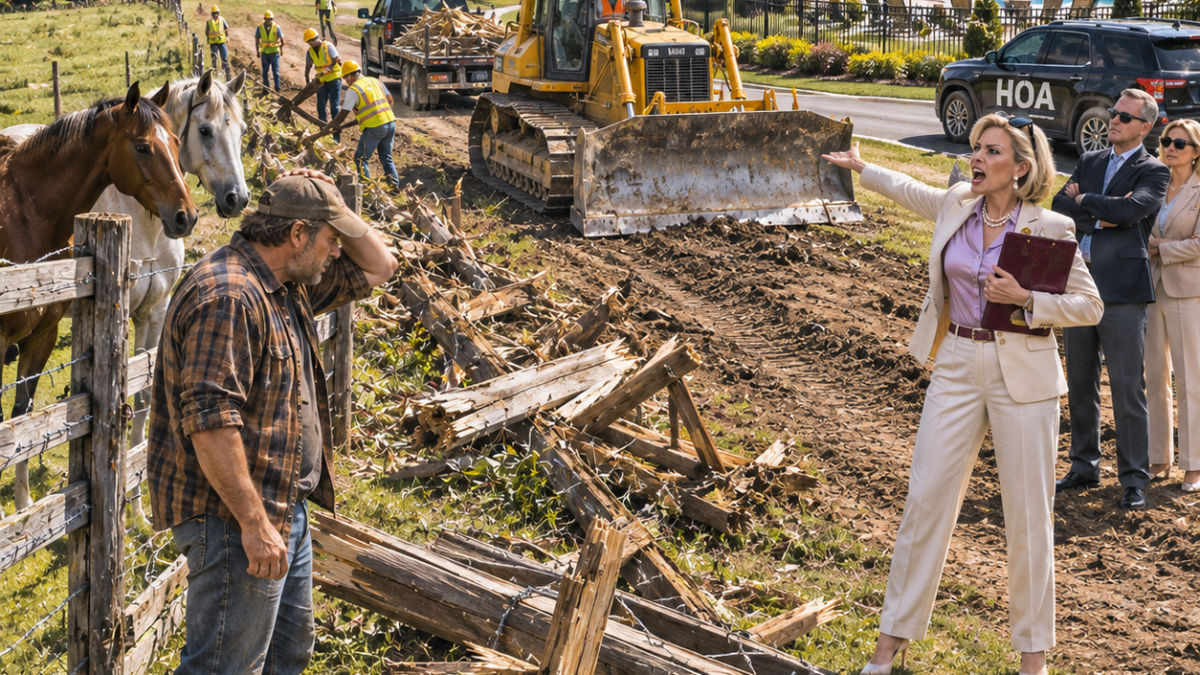
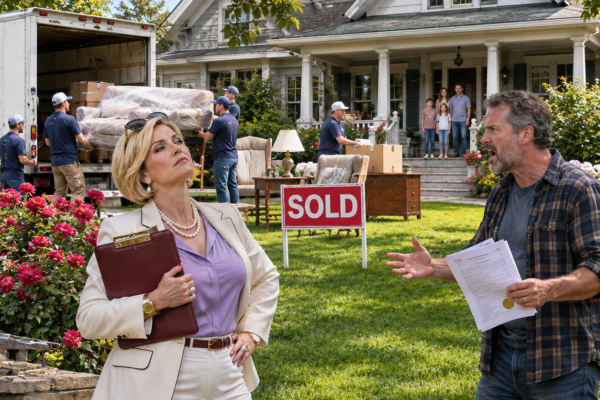
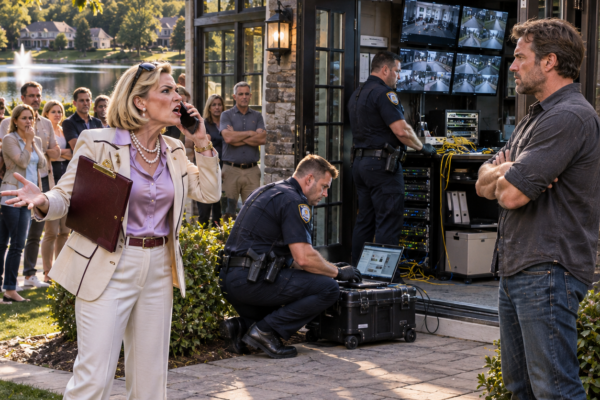
The afternoon I came home and found every cedar post my father and I had set by hand ripped out of the ground, stacked like garbage beside my pasture, and replaced with a laminated HOA violation notice from a neighborhood I did not even belong to, I stood beside my restless horses and realized somebody had mistaken my silence for permission to erase a piece of my family’s history.
Caroline Havs, the president of Willow Creek Estates, believed her bulldozer had solved an “aesthetic problem,” but while she was congratulating herself on cleaning up the view from her walking trail, she had no idea that the perfect blue pool at the center of her community depended on something buried beneath the very land she had just invaded.
I could have screamed, called a lawyer, or spent months arguing with people who thought a clipboard gave them ownership of anything they could see, but as I stared at the empty line where my fence had stood since I was a boy, another possibility occurred to me—and suddenly I wasn’t angry enough to shout anymore.
My name is Daniel Mercer, and I own eighty acres of pasture, cedar breaks, and low rolling ground that my family has worked for more than forty years.
Before Willow Creek Estates arrived, the nearest house was almost a quarter mile away.
My mornings had a rhythm I trusted.
Coffee on the porch.
Boots on gravel.
Horses breathing steam into the cool air.
Ranger, my oldest gelding, leaning over the fence whenever he thought I might have an apple hidden in my jacket.
And that fence.
It was never beautiful in the way a real-estate brochure defines beautiful.
The cedar had gone silver with age. A few rails bowed. Some posts leaned just enough to tell you they had survived storms, droughts, and horses that occasionally forgot they weighed twelve hundred pounds.
But my father built most of it.
I helped.
I was barely tall enough to swing a post maul when he first handed me one.
“Straight matters,” he told me.
I looked down the line of crooked country fence.
“Apparently not that much.”
He laughed so hard he had to sit on the tailgate.
Dad died eleven years ago.
The fence stayed.
Then developers bought the land beside us.
Within two years, pasture became Willow Creek Estates—matching shutters, ornamental stone entrances, chemically green lawns, a clubhouse, a walking trail, and a large swimming pool that seemed to matter more to residents than some members of their own families.
At first, I didn’t care.
They had their world.
I had mine.
Then I met Caroline Havs.
Caroline wore pastel blazers, expensive sunglasses, and the expression of someone constantly disappointed that the rest of civilization had not asked her permission before existing.
Her first letter informed me that my fence created an “unappealing visual contrast” with the community.
I threw it away.
The second claimed it might be a safety concern for residents walking beside my property.
I called the HOA office.
“I’m not a member.”
Caroline answered herself.
“We understand that.”
“Then stop sending me violation notices.”
“It isn’t technically a violation notice.”
“It says NOTICE OF VIOLATION across the top.”
A pause.
“It concerns community impact.”
“My land isn’t your community.”
“The fence is visible from our trail.”
“So is the sky. Are you regulating that next?”
She hung up.
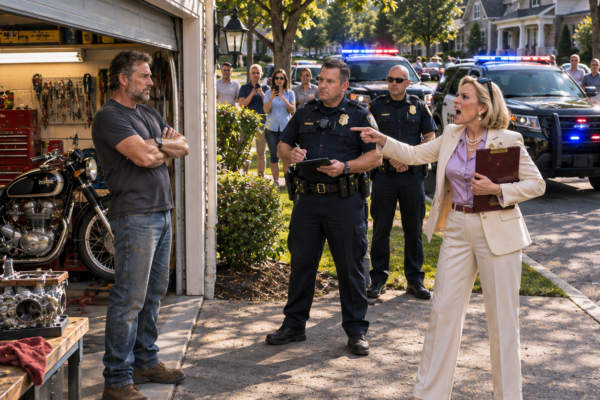
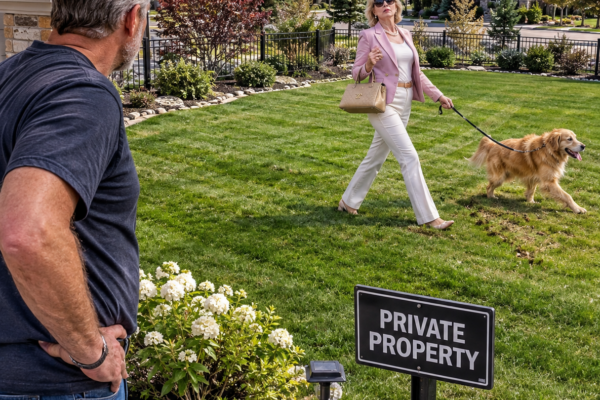
A week later, she appeared at the property line carrying a clipboard.
“You could replace this with white vinyl,” she said.
“I could also replace my truck with a helicopter.”
Her smile tightened.
“We’re trying to maintain harmony.”
“My fence hasn’t complained.”
She tapped the clipboard.
“Mr. Mercer, cooperation would be easier for everyone.”
I looked at the cedar rails my father had installed.
“Then cooperate with my property line.”
She walked away without another word.
After that, things became quiet.
Too quiet.
A week before the fence disappeared, I found heavy tire tracks near the boundary.
I told myself a landscaping crew had taken a wrong turn.
Then one Tuesday afternoon I came home from work, turned into my driveway, and saw open pasture where the fence should have been.
Ranger paced inside the corral.
Broken cedar was stacked beside the trail.
Machine tracks cut deep into my soil.
And one laminated sheet had been stapled to the only post they left standing.
FENCE DOES NOT MEET COMMUNITY AESTHETIC GUIDELINES.
I read it twice.
Then I looked across the pasture toward Willow Creek Estates.
For the first time in my life, that perfect blue pool looked very different to me.
PART 2
I didn’t drive to Caroline’s house.
That surprised me.
Five years earlier, maybe I would have.
Twenty years earlier, definitely.
But anger changes as you get older.
When you’re young, anger wants movement.
It wants shouting.
Doors slammed.
Fists clenched.
Somebody to know exactly how furious you are.
Older anger is different.
Older anger sits down.
Takes pictures.
Finds the deed.
I photographed everything.
The tire tracks.
The broken rails.
The post holes.
The machinery scars.
The laminated notice.
Even the hoofprints from Ranger pacing near the corral.
My horses hadn’t escaped because the inner corral fencing was intact, but the outer boundary had protected the pasture for decades.
Now the walking trail beside Willow Creek Estates opened directly toward my land.
Anybody could wander in.
Dogs.
Children.
Joggers.
That mattered.
I picked up one of the cedar rails.
The wood had split almost perfectly down the middle.
A rusted nail remained bent in one end.
I recognized it.
That sounds ridiculous.
A nail.
But Dad had always hammered nails crooked.
Every carpenter has a signature.
His was the inability to drive a fence nail without making it look slightly offended.
I sat down on the broken rail.
For a minute, I wasn’t fifty-eight years old anymore.
I was thirteen.
Dad stood beside me in a sweat-darkened work shirt, holding a post level against a cedar upright.
“Push.”
“I am pushing.”
“No, you’re leaning.”
“What’s the difference?”
“About fifty dollars in repairs later.”
I had rolled my eyes.
Now I would have given almost anything to hear him say it again.
Ranger came over.
He pushed his nose against my shoulder.
I rubbed the white stripe between his eyes.
“They tore it down, buddy.”
He breathed against my neck.
“I know.”
I looked across at Willow Creek.
“They’re going to put it back.”
That was the first promise I made.
The pool came later.
First, I wanted to know exactly who had done this.
The tracks told me heavy equipment had entered from the HOA walking trail.
I followed them toward the main road.
They were obvious.
Deep tread.
Fresh soil compressed beneath them.
A bulldozer or skid steer had come through, crossed my boundary, removed nearly three hundred feet of fence, then exited the same way.
No attempt to hide it.
That told me something important.
Whoever did this believed they had permission.
People committing deliberate trespass usually try not to leave a road map.
These people practically signed the dirt.
About a mile away sat a contractor yard I had seen for years.
Maddox Landscape & Site Services.
Skid steers.
Excavators.
Dump trailers.
Yellow machinery lined behind a chain-link fence.
I pulled in.
A large man with a sunburned neck stood beside a pickup filling out paperwork.
I got out.
“Morning.”
He looked up.
“Help you?”
“Maybe.”
I pointed back toward the highway.
“You guys work at Willow Creek Estates yesterday?”
He hesitated.
“Depends.”
“I’m Daniel Mercer. Eighty acres east side of the walking trail.”
Recognition moved across his face.
Small.
But there.
“The fence property?”
“My fence property.”
He set down his clipboard.
“Look, man, we were hired by the HOA.”
“To do what?”
“Remove a noncompliant fence.”
I stared at him.
“Noncompliant with what?”
He shrugged.
“The community.”
“I’m not in the community.”
He shifted.
“That’s between you and them.”
“No.”
I shook my head.
“You drove machinery onto my land and destroyed my property. That’s between you and me too.”
He glanced toward his workers.
Nobody was looking at us.
Which meant every one of them was listening.
“We were given a work order.”
“By whom?”
“HOA president.”
“Caroline Havs?”
“Yes.”
“You checked the property line?”
His eyes moved away.
“We were given a map.”
“Can I see it?”
“No.”
“Why?”
“Client paperwork.”
“Did the map identify my land as HOA property?”
He paused too long.
“That wasn’t my job.”
I nodded slowly.
“What was your job?”
“Remove the fence.”
“Even if it belonged to somebody else?”
“Look, if there’s been a mistake—”
“A mistake is knocking down one post.”
I stepped closer.
“Three hundred feet is a project.”
His mouth tightened.
“We trusted the client.”
“That’s going to become an expensive philosophy.”
He frowned.
“You threatening me?”
“No.”
I pulled out my phone.
“I’m documenting the name of the company whose equipment crossed my property.”
He looked at the phone.
Then at me.
“Talk to Caroline.”
“I will.”
I started back toward my truck.
“Mr. Mercer.”
I turned.
His posture had changed.
Less defensive.
More nervous.
“For what it’s worth, she told us you had already been notified.”
“I was notified that she didn’t like my fence.”
“She said authorization was handled.”
“It wasn’t.”
He looked at the ground.
“Damn.”
“Yeah.”
I drove home.
Still didn’t confront Caroline.
Instead I called my attorney.
Her name was Rachel Monroe.
Rachel had handled the probate work after Dad died and helped me update the agricultural-use paperwork on the ranch.
She knew the property almost as well as I did.
“You sound angry,” she said.
“Somebody bulldozed Dad’s fence.”
Silence.
“Who?”
“The HOA.”
“Your HOA?”
“I don’t have an HOA.”
Another silence.
Then:
“Start over.”
I explained everything.
When I finished, Rachel said, “Do not touch their property.”
“I know.”
“Do not threaten anybody.”
“I know.”
“Do not turn off any utility people rely on for drinking water.”
That sentence caught me.
“Interesting you mention that.”
“Daniel.”
“Their pool and clubhouse line comes off our well.”
Silence again.
Rachel had a talent for turning silence into accusation.
“Explain.”
So I did.
Years before Willow Creek Estates had become Willow Creek Estates, the developer needed water for construction operations and later for the clubhouse and pool.
The municipal line available then wasn’t enough for their recreational system.
Dad had a deep well on the southern section of our property.
The developer asked to connect temporarily.
Dad agreed.
In exchange, they let him use a paved service road that cut several miles off the drive to the county highway.
No lease.
No easement.
No formal purchase agreement.
Just a handshake.
Dad trusted people.
For years, so did I.
The development grew.
Municipal water eventually reached the homes.
But the clubhouse and pool continued using our well connection because it was cheaper.
Much cheaper.
I had maintained the pump.
Paid electricity.
Replaced pressure components.
Never invoiced the HOA.
Dad had treated it like being neighborly.
So had I.
Rachel said, “You have the original property documents?”
“All of them.”
“Find anything involving the well.”
I did.
Old survey.
Pump records.
Dad’s handwritten maintenance notes.
A short letter from the original developer thanking him for “temporary water accommodation.”
Temporary.
That word mattered.
Rachel reviewed everything that afternoon.
At six thirty, she called.
“I don’t see a recorded easement.”
“Meaning?”
“Meaning based on what I’ve reviewed, there is no permanent property right granting Willow Creek access to the well.”
I walked onto my porch.
Across the pasture, sunlight glowed against the clubhouse windows.
“And the road?”
“Different issue. The access-road arrangement also doesn’t appear recorded, but you’ve used it openly for decades. Don’t complicate things.”
“I won’t.”
“More importantly, confirm exactly what your well supplies.”
“Pool and clubhouse.”
“Nothing residential?”
“No houses.”
“Drinking fountains?”
“Clubhouse interior line, probably sinks and restrooms.”
“Then don’t shut anything off tonight.”
I sighed.
“Rachel.”
“Daniel.”
“They destroyed my fence.”
“And I intend to make them pay for it.”
“How long?”
“Not long.”
She paused.
“Send written notice that the informal water accommodation is suspended because the HOA has materially interfered with your property and because there is no written service agreement.”
I almost smiled.
“That’s very romantic.”
“Law isn’t supposed to be romantic.”
“Dad would’ve hated that letter.”
“Your father also would’ve had a written contract if he’d hired me.”
That made me laugh.
“Fair.”
We drafted it.
Formal.
Dry.
Clear.
The HOA had no recorded right to water from my private well.
Continued supply had been a revocable accommodation.
Because the association had entered my property without permission, destroyed fencing, created livestock-safety issues, and demonstrated disregard for the boundaries underlying the neighborly arrangement, I was suspending nonessential water service pending resolution.
Rachel also demanded preservation of all board communications and contractor records relating to my property.
That part mattered.
At 8:03 the next morning, the letter was emailed to the HOA and delivered by certified courier.
At 8:17, Caroline called.
I watched the phone ring.
Didn’t answer.
8:19.
Again.
8:26.
Again.
At 8:41, an email arrived.
**YOU HAVE NO AUTHORITY TO INTERRUPT COMMUNITY INFRASTRUCTURE.**
I forwarded it to Rachel.
Her reply came thirty seconds later.
**Excellent. Keep letting her write.**
I liked Rachel.
At nine, I drove to the pump house.
The building sat beneath two old cottonwoods.
Corrugated metal.
Rust along the bottom edge.
Nothing impressive.
Dad built most of it from salvaged material.
Inside, the pump system hummed steadily.
I knew every pipe.
Every valve.
Every sound.
Dad taught me maintenance before he trusted me to drive alone.
“Water doesn’t care what you meant to do,” he once told me.
“It goes where the system tells it.”
I put my hand on the supply line running toward Willow Creek.
For almost twenty years, water had gone where we told it.
Free.
Quietly.
No argument.
No invoice.
That was the arrangement between neighbors.
But neighbors don’t bulldoze each other’s fences.
I checked the branch lines one last time.
My house.
Barn.
Livestock system.
Irrigation.
All separate.
Then the Willow Creek recreational branch.
I closed it.
Slowly.
The valve resisted near the end.
Then seated with a heavy metallic thunk.
The pipe changed pitch.
That was it.
No explosion.
No dramatic sound.
Just a line that had carried free water for years becoming still.
I locked the pump house.
Walked outside.
Ranger stood fifty yards away.
“Done.”
He lowered his head and kept grazing.
Horses don’t appreciate dramatic timing.
For the first few hours, nothing changed.
The pool had stored water.
The filtration system had reserve capacity.
The clubhouse had a pressure tank.
I repaired a barn hinge.
Fed the horses.
Replaced a broken strand on the inner corral.
At noon, I saw maintenance vehicles around the clubhouse.
At one, another truck arrived.
By three, two men stood outside the pool equipment room.
At five thirty, Caroline called again.
I answered.
“Daniel.”
“Caroline.”
“What did you do?”
“To what?”
“The clubhouse water.”
“I suspended the private well accommodation.”
“You can’t.”
“I already did.”
“This is sabotage.”
“No.”
“You deliberately shut off community infrastructure.”
“I shut a valve on my land supplying my water.”
“That line serves our pool.”
“I know.”
“Our clubhouse.”
“I know.”
“You’ve endangered residents.”
“Your residential water is municipal.”
She hesitated.
That told me she knew.
“This is retaliation.”
“This is the end of a free arrangement.”
“Because of the fence.”
“Yes.”
“You cannot weaponize water because you’re angry about an ugly fence.”
For a second, I couldn’t speak.
Then I said quietly:
“Say that again.”
“What?”
“Call my father’s fence ugly again.”
Silence.
She changed direction.
“The board will take legal action.”
“Please do.”
“You’ll regret this.”
“My attorney sent your attorney the property records.”
Another silence.
“You hired a lawyer?”
“You hired a bulldozer.”
She hung up.
By sunset, the pool’s circulation problem was obvious.
I could see maintenance staff moving around.
The pool itself still looked blue.
For now.
The next morning, it wasn’t as bright.
At seven forty, a man I recognized as the clubhouse manager drove up my driveway.
Khaki pants.
Golf shirt.
Red binder.
He got out before I stood.
“Mr. Mercer?”
“Morning.”
“I’m Stephen Cole, clubhouse operations.”
“I know.”
“We appear to have a water-supply failure.”
“So I’ve heard.”
“Do you know anything about it?”
“Yes.”
His eyes widened.
“You do?”
“The private supply from my well has been suspended.”
He stared.
“You shut us off?”
“I ended a free service arrangement.”
“The filtration system needs makeup water.”
“That sounds like an operations issue.”
“The pool is scheduled for three parties this weekend.”
I took a sip of coffee.
“I have four horses scheduled to remain inside my property this weekend.”
He frowned.
“What does that mean?”
“It means your organization removed the fence keeping my livestock separated from your walking trail.”
Stephen looked uncomfortable.
“I wasn’t involved in that.”
“I believe you.”
“Then why punish the clubhouse?”
“I’m not punishing you.”
I gestured toward Willow Creek.
“Your HOA president decided property boundaries were optional. The water arrangement existed because my father believed we were neighbors.”
I pointed toward the missing fence line.
“That arrangement required respect.”
Stephen rubbed his forehead.
“So what do you want?”
“Fence rebuilt.”
“Okay.”
“Land restored.”
He nodded.
“Contractor damages covered.”
“Yes.”
“Written acknowledgment that the HOA has no jurisdiction over my property.”
He hesitated.
“That may require counsel.”
“Good.”
“And if you want future well access, you pay for it.”
His eyebrows lifted.
“We’ve never paid.”
“I noticed.”
He stared toward the pool.
“Do you know how much that could cost us?”
“No.”
I smiled slightly.
“But for the first time, you’re asking the right question.”
He left.
By the second day, the water was cloudy.
Not a swamp yet.
But headed in a bad direction.
The pool staff couldn’t maintain levels properly.
They brought in temporary water.
Something in the filtration system failed.
Events were canceled.
Caroline posted a neighborhood message blaming an “unexpected external service interruption.”
That lasted approximately forty minutes.
Then somebody asked:
**Is this related to the ranch fence?**
Another replied:
**What ranch fence?**
Then a third:
**The one HOA management had removed even though it isn’t HOA property.**
By noon, Willow Creek’s community page had turned against itself.
I knew because Mark Ellis, one of the few Willow Creek residents I’d actually spoken to before, sent me screenshots.
**Why was the HOA bulldozing private property?**
**Did we pay for that contractor?**
**Caroline said the fence belonged to the community boundary.**
**County parcel map says otherwise.**
**Why are we using a private well?**
That last question was my favorite.
Apparently most residents hadn’t known either.
By late afternoon, Caroline drove up.
White SUV.
Coral blazer.
Sunglasses.
She stopped at the end of my driveway but didn’t cross.
A small improvement.
I walked out.
“What do you think you’re doing?” she demanded.
“Right now?”
“Yes.”
“Walking.”
“You know what I mean.”
“No, Caroline. Say it.”
“The pool is failing.”
“Call a pool company.”
“We have.”
“Good.”
“They said the water source needs to be restored.”
“Then negotiate a water agreement.”
Her face reddened.
“You are acting like a child.”
I looked toward the destroyed fence.
“Interesting choice of words.”
“That fence was deteriorated.”
“It was mine.”
“It harmed the character of the trail.”
“Still mine.”
“It was a safety concern.”
“Still mine.”
“You refuse to understand that residents have rights too.”
I almost laughed.
“To my land?”
“To an environment they pay substantial dues to enjoy.”
I nodded slowly.
“So anything they can see becomes HOA property.”
“That’s not what I said.”
“You said almost exactly that last week.”
She pulled off her sunglasses.
“Turn the water back on.”
“No.”
“Now.”
“No.”
“I am formally directing you as HOA president—”
I laughed.
I couldn’t help it.
She stopped.
“You’re what?”
“You heard me.”
“Caroline, you have exactly as much presidential authority over this ranch as Ranger does.”
Behind me, the horse lifted his head.
I pointed.
“Actually, he contributes more fertilizer.”
Her face went crimson.
“You think this is funny?”
“No.”
The humor left me.
“You entered land you don’t own.”
“You hired people to destroy property you don’t own.”
“You left my pasture open to your trail.”
“You frightened my animals.”
“You damaged something my father built.”
I stepped closer to the line.
“And after doing all that, you came here demanding I continue giving your organization free water.”
For the first time, she had no answer.
I continued.
“Do you know what my father asked from the original developer?”
She stared.
“No.”
“Nothing.”
“That isn’t true.”
“Almost nothing.”
I pointed toward the paved service road.
“He asked permission to use that road.”
“Exactly. A trade.”
“A neighborly arrangement.”
“So you admit there was consideration.”
I smiled.
“You’ve talked to a lawyer.”
Her jaw tightened.
“Our counsel says longstanding usage may establish rights.”
“Then your counsel can talk to mine.”
She stepped forward.
“This isn’t over.”
“I know.”
I looked toward the pool.
“Neither is the algae.”
She spun around and walked away.
I shouldn’t have enjoyed that line.
I did.
By day three, the pool looked bad.
By day four, it looked biblical.
Green film formed along the sides.
The circulation problems had triggered additional equipment trouble.
Water trucks arrived.
Thousands of gallons were hauled in.
The new water diluted the mess temporarily.
Then the underlying problem returned.
Their filters weren’t designed to keep operating under the improvised setup.
A county health inspector arrived after residents complained.
He walked around the pool.
Tested the water.
Talked to the clubhouse manager.
By that afternoon, orange signs appeared.
**POOL CLOSED UNTIL FURTHER NOTICE.**
The resident group exploded.
Birthday parties canceled.
Swim lessons canceled.
An anniversary reception moved.
The HOA board scheduled an emergency meeting.
Then another.
The smell began drifting toward the walking trail.
Not catastrophic.
Just unpleasant enough to make perfection impossible.
Nature had a way of mocking cosmetic control.
Then came the turtle.
I was repairing a gate when I heard children laughing from the trail.
“Mom! There’s a turtle in the pool!”
I looked over.
Couldn’t see much from that distance.
Later Mark sent me a photo.
Sure enough, a small turtle had somehow found its way into the murky water.
Somebody captioned it:
**NEW HOA PRESIDENT.**
I laughed until Ranger looked concerned.
The following morning, someone made a cardboard turtle sign and taped it near the trail.
**HE PAYS NO DUES.**
Caroline had it removed within an hour.
Another appeared that afternoon.
That was when I realized she had lost control of her own neighborhood.
Not because of me.
Because once people stop being afraid of authority, ridicule arrives quickly.
But underneath the jokes, real money was burning.
The clubhouse had canceled events.
Pool repairs were climbing.
Water-hauling costs were ridiculous.
Residents were demanding to know why their dues were paying for a crisis created by destroying a nonmember’s fence.
Then Rachel called.
“We received the board records.”
“Anything interesting?”
“You’re going to want coffee.”
“I have coffee.”
“Get better coffee.”
The HOA had turned over emails under threat of litigation.
Most were boring.
Then Rachel read one.
Caroline to the property committee:
**The Mercer fence remains a major aesthetic issue along the premium trail corridor. Since owner refuses voluntary replacement, removal may be necessary under community hazard authority.**
I laughed.
“Community hazard authority?”
“Apparently she invented government.”
“Anything authorizing entry?”
“No.”
“Survey?”
“No.”
“Legal opinion?”
“No.”
“Board vote?”
Rachel paused.
“There was a vote.”
My expression changed.
“What?”
“Three to two approving ‘remediation of unsafe boundary feature.’”
“They voted to destroy my fence?”
“Yes.”
“Did they know it wasn’t HOA property?”
“That is where things get fun.”
She read another email.
Board member Bill Harmon:
**Caroline, parcel map appears to show the fence entirely outside Willow Creek ownership. We should obtain written consent from Mercer before any work.**
Then Caroline’s reply:
**Visual-impact authority does not depend exclusively on title location. Proceeding before he creates additional obstacles is preferable.**
I stopped moving.
“She knew.”
“She appears to have known there was at least a serious property issue.”
“Who is Bill?”
“Board member. Voted no.”
That mattered.
“What about the contractor?”
“They were given a diagram prepared by the HOA.”
“Showing what?”
“The fence marked as COMMUNITY HAZARD REMOVAL AREA.”
I rubbed my forehead.
“So everybody just assumed.”
“Pretty much.”
“Can we sue?”
“Yes.”
“How badly?”
Rachel laughed.
“That’s not a legal measurement.”
“Can we sue enough to get their attention?”
“Absolutely.”
I looked toward the pool.
“I think I already have their attention.”
Rachel sighed.
“Daniel.”
“What?”
“Enjoying the pool situation too much will make you annoying in deposition.”
“I’ll practice looking solemn.”
“You’re terrible at solemn.”
That afternoon, I prepared an invoice.
Not a fake number.
Not revenge math.
Actual costs.
Licensed fence reconstruction estimate.
Ground restoration.
Livestock-security measures.
Survey expense.
Legal fees permitted as part of settlement negotiations.
Contractor trespass damages.
Then Rachel helped calculate something bigger.
Historical well usage.
Not ten years of punitive fantasy.
A reasonable estimate based on actual volume records, electricity, maintenance, pump depreciation, and comparable bulk-water rates.
The total surprised even me.
Then we added a proposed future lease.
Twenty years.
Metered usage.
Annual minimum.
Maintenance allocation.
Access restrictions.
Insurance.
Termination rights.
No more handshakes.
Rachel looked at the draft.
“Your father would hate this.”
“He’d call it unfriendly.”
“He’d also still have his fence if people understood unfriendly paperwork.”
I looked at Dad’s old photo hanging in my office.
“He believed neighbors would do the right thing.”
Rachel softened.
“Then make the contract require them to.”
That line stayed with me.
The next evening, five vehicles came up my driveway.
They stopped before the damaged boundary.
Nobody drove onto the pasture.
Another improvement.
Caroline.
Stephen, the clubhouse manager.
Two board members I recognized.
And Bill Harmon.
Bill was in his late sixties.
Gray hair.
Work boots.
Plain shirt.
He looked more like a man who belonged on my side of the property line than theirs.
He walked forward first.
“Mr. Mercer.”
“Daniel.”
“Bill.”
We shook hands.
Caroline didn’t.
One board member held a leather folder.
Caroline said, “We’re here to restore service.”
“No.”
Her face tightened.
Bill glanced at her.
“Caroline.”
She exhaled.
“We’re here to discuss restoring service.”
“Better.”
The younger board member opened the folder.
“We understand you have demands.”
I smiled.
“That’s one way to describe an invoice.”
He handed me a document.
“We’re prepared to reimburse fence replacement.”
“How much?”
He named a number.
Half the estimate.
“No.”
Caroline snapped, “It’s an old fence.”
“It was a functional fence.”
“It was depreciated.”
“So is your clubhouse.”
Bill coughed.
The younger man tried again.
“We’re trying to find a reasonable compromise.”
I handed him my packet.
“Then start with reasonable numbers.”
They opened it.
The expressions changed one at a time.
Fence.
Land restoration.
Survey.
Damage.
Legal costs.
Historical water-service accounting.
Then the proposed lease.
Caroline looked up.
“This is extortion.”
Rachel had prepared me for that word.
“No.”
I kept my voice calm.
“Extortion would be threatening something I have no legal right to do unless you pay me.”
I pointed toward the packet.
“You destroyed my property. Those are documented damages.”
Then toward the pump house.
“You want a private resource from my land. That’s a proposed contract.”
“You’ve supplied it free for years.”
“Correct.”
“That establishes—”
“Your lawyer can call Rachel.”
Caroline slapped the papers against her palm.
“You’re exploiting a community emergency.”
I looked straight at her.
“You created the emergency.”
Her mouth opened.
Bill stepped forward.
“She’s right about one thing.”
I turned.
“The residents didn’t bulldoze your fence.”
I nodded.
“No.”
“They’re getting the consequences.”
“Yes.”
He looked toward the pool.
“And some of them are kids.”
That landed.
I hadn’t hurt anyone physically.
The pool was closed before it became unsafe.
Homes had municipal water.
Nobody was being deprived of drinking water.
Still.
Bill was right about something.
The people paying for Caroline’s arrogance weren’t all Caroline.
I looked at him.
“What are you proposing?”
“Short-term water restoration while we negotiate.”
“No.”
Caroline scoffed.
Bill ignored her.
“Why not?”
“Because once water resumes, your urgency disappears.”
He considered that.
“Fair.”
“Rebuild the fence first.”
“That takes time.”
“Then start tomorrow.”
“Caroline?”
Bill turned toward her.
She stared at him.
He continued.
“You authorized the removal.”
“The board authorized—”
“You pushed it.”
“It was an eyesore.”
Bill’s face changed.
“Stop saying that.”
Everybody went quiet.
Caroline stared.
Bill pointed toward my pasture.
“His father built that fence.”
“So?”
Bill looked almost disgusted.
“So it wasn’t ours.”
That was the first time anyone from Willow Creek said it plainly in front of her.
Caroline’s face hardened.
“The community’s needs—”
“Do not override somebody else’s deed.”
Bill turned toward me.
“I voted against the removal.”
“I know.”
He looked surprised.
“My attorney has the emails.”
Caroline went pale.
That was satisfying.
Bill nodded slowly.
“Then you know I warned them.”
“I do.”
“I’d like to fix it.”
I studied him.
“Bring me a real proposal.”
“I will.”
They left.
Caroline was last to her SUV.
Before getting in, she looked back.
“You’re enjoying this.”
I thought about lying.
Then didn’t.
“Parts of it.”
Her face twisted.
“At least you’re honest.”
“So was my property line.”
She drove away.
The next morning, trucks arrived at Willow Creek.
Not fence trucks.
Pool trucks.
Caroline was still trying to solve the problem without me.
Water tankers.
Portable pumps.
Chemical treatment.
Technicians.
By afternoon, the pool changed from green to a color somewhere between brown and gray.
Mark texted:
**Congratulations. They have invented soup.**
I laughed.
Rachel would have hated that.
The board announced plans to drain the entire pool.
Six hours later, the water was gone.
What remained looked awful.
Stained tile.
Dark residue.
Sediment.
The kind of mess that makes a luxury amenity look abandoned.
A worker standing in the empty pool covered his nose with his shirt.
Someone photographed him.
By evening, the picture was everywhere.
Then came the buzzards.
Not landing.
Just circling the nearby fields and clubhouse area.
That was enough for the residents.
Somebody posted:
**EVEN THE BIRDS THINK THE HOA IS DEAD.**
The turtle became a mascot.
Someone made stickers.
**FREE THE WILLOW CREEK TURTLE.**
I ordered three.
I’m not proud.
Actually, yes.
I am.
But the humor covered something heavier.
Every time I looked at the open boundary, I still felt the loss.
Dad’s fence was gone.
No joke changed that.
One evening, I carried one surviving rail into the barn.
The board was faded gray.
Two old nail holes.
One section where Dad had carved an M with his pocketknife while waiting for me to bring more staples.
I ran my fingers across it.
Suddenly I remembered the last summer he was healthy.
We had repaired that exact stretch.
His hands shook by then.
He refused help.
“I’m old, not decorative.”
“You’re both.”
He glared at me.
Then laughed.
I leaned the rail against the barn wall.
“You’d tell me to turn the water back on, wouldn’t you?”
Silence.
I imagined him answering.
Probably.
Then I imagined the other thing he’d say.
But first they’d fix what they broke.
That sounded more like him.
The next morning, Bill returned alone.
Pickup truck.
Manila folder.
No blazer.
No entourage.
I met him near the barn.
“Coffee?”
He looked surprised.
“Sure.”
We sat on the porch.
He watched Ranger graze.
“Nice horse.”
“He thinks so.”
Bill smiled.
Then opened the folder.
“We had an emergency board meeting.”
“How many of those can one HOA survive?”
“Apparently at least six.”
I looked through the papers.
A new proposal.
Full fence replacement at HOA expense.
Land restoration.
Contractor damages.
Legal reimbursement.
Written acknowledgment that my property was outside HOA jurisdiction.
Formal prohibition on board action involving nonmember property without verified legal authority.
And a twenty-year well lease.
Paid substantially upfront.
Usage metered thereafter.
Maintenance shared.
My control of the source preserved.
No easement beyond the specific pipe.
No implied rights to the surrounding land.
I looked at Bill.
“This is serious.”
“We’re serious.”
“Caroline approve it?”
His mouth moved slightly.
“Not voluntarily.”
“What happened?”
“She lost two board votes.”
I leaned back.
“Meaning?”
“There’s a removal petition.”
I said nothing.
Bill continued.
“Residents found out about the emails.”
“How?”
“Board records were requested.”
“Good.”
“They’re furious.”
“They should be.”
“Some people are furious at you too.”
“Also fair.”
He looked toward Willow Creek.
“They think you should’ve turned the water back on for the residents.”
“Do you?”
Bill thought.
“I think I would’ve done it sooner.”
I nodded.
“Probably why you’re a better man.”
He shook his head.
“No.”
Then looked at the destroyed fence line.
“I also think if someone bulldozed something my father built, I’d be sitting where you’re sitting.”
We were quiet.
Finally I said, “The fence first.”
“We can start within forty-eight hours.”
“Same location.”
“Yes.”
“Cedar.”
“Yes.”
“Four rails.”
“Yes.”
“Not white vinyl.”
Bill laughed.
“Especially not white vinyl.”
“Ground restored.”
“Included.”
“Contractor can’t enter without coordinating with me.”
“Written.”
“And no HOA notices.”
He smiled.
“Ever.”
I looked at the lease.
“Twenty years?”
“Community needs stability.”
“So do I.”
“That’s why it’s twenty.”
I tapped the payment section.
“This is a lot of money.”
“Less than rebuilding the pool every year.”
Fair point.
I didn’t sign immediately.
Rachel reviewed it.
Made changes.
Their attorney objected.
Rachel objected to their objections.
Lawyers did what lawyers do.
Three days later, we had language everyone could live with.
But before the lease activated, the fence had to be underway.
That was my condition.
At seven thirty Monday morning, a contractor truck pulled up.
Different company.
**Bennett Rural Fencing.**
Their foreman, Luis Alvarez, got out.
He held a survey copy.
Not an HOA map.
An actual county survey.
I already liked him.
“Mr. Mercer?”
“Daniel.”
“We’re rebuilding three hundred eighteen feet, four-rail cedar, plus gate and ground restoration.”
“Yes.”
He pointed.
“Property corners are here and here?”
“Yes.”
“We’ll verify before digging.”
I almost hugged him.
“Thank you.”
He looked confused.
“That’s usually how fences work.”
“You’d be surprised.”
The crew removed damaged soil.
Reset the boundary.
Installed posts.
The first post went in with a mechanical driver.
**THUNK.**
I felt it in my chest.
Another.
**THUNK.**
Another.
The line slowly returned.
Not Dad’s fence.
That was impossible.
But the boundary.
The shape.
The protection.
Ranger watched from the corral.
By noon, several Willow Creek residents had gathered on their walking trail.
Nobody crossed.
A woman with a golden retriever called:
“Looks good!”
I waved.
She hesitated.
Then said:
“I’m sorry about what happened.”
That surprised me.
“You didn’t do it.”
“We elected the people who did.”
I didn’t know what to say.
She continued walking.
Later, a boy stopped beside his mother.
“Is that the fence the HOA broke?”
His mother looked mortified.
“Ethan.”
“What?”
I smiled.
“Yes.”
“Why?”
His mother tried to pull him away.
I said, “Because adults sometimes make dumb decisions.”
He nodded.
“My dad does that.”
His mother closed her eyes.
I laughed.
On the third day, the rails went up.
Cedar.
Fresh.
Golden-brown.
The smell took me back decades.
Dad’s truck.
Sawdust.
Leather gloves.
Hot afternoons.
I picked up a small offcut.
For a second, my eyes burned.
Luis noticed.
“You okay?”
“Yeah.”
I looked at the fence.
“My dad built the original.”
He nodded.
“Then we’ll make this one last.”
That nearly got me.
By Friday, the fence was complete.
Straight posts.
Four rails.
New gate.
Repaired soil.
They even replaced damaged grass where machinery had churned through.
Luis walked the line with me.
“Anything?”
I shook one post.
Solid.
“Better than before.”
He smiled.
“That’s the goal.”
After the crew left, I stood there alone.
I touched the new cedar.
It wasn’t weathered.
No crooked nails.
No carving from Dad’s pocketknife.
But it stood on the same line.
That mattered.
I went into the barn.
Picked up the surviving original rail.
Carried it outside.
Then attached a small section beside the inside of the gate.
Not structural.
A memory.
The old gray wood against the new cedar.
I carved a small plaque.
**MERCER PROPERTY
FENCE FIRST SET BY THOMAS MERCER & SON**
No date.
Didn’t need one.
That evening, Bill returned.
“Looks good.”
“Yeah.”
He noticed the old rail.
“Your dad’s?”
I nodded.
“Nice.”
He handed me another envelope.
“Initial payment cleared.”
That meant the lease could activate once Rachel confirmed.
I checked my phone.
Email from her.
**FUNDS CLEARED. DOCUMENTS RECORDED. YOU MAY RESTORE SERVICE.**
I stared at it.
For weeks, turning the valve off had felt like power.
Walking toward the pump house to turn it back on felt different.
It felt like peace.
Bill came with me but stopped outside.
“You want to see?”
He shook his head.
“Your land.”
Another small thing.
Another lesson learned.
I entered alone.
The pump hummed.
I opened the panel.
The Willow Creek valve waited exactly where I had left it.
Dad’s voice came back.
Water doesn’t care what you meant to do.
It goes where the system tells it.
I gripped the valve.
Turned.
Slowly.
Metal creaked.
Then water rushed into the line.
The pipe shuddered.
Pressure climbed.
For the first time, the HOA wasn’t receiving charity.
It wasn’t stealing anything.
It wasn’t assuming.
It was buying a service under a contract both sides understood.
Strangely, that made me happier than shutting it off had.
I stepped outside.
Bill heard the line humming.
“We good?”
“We’re good.”
He offered his hand.
I shook it.
“Thank you.”
“For paying me?”
“For not making us suffer longer than necessary.”
I looked toward the new fence.
“Don’t thank me yet. Caroline still lives there.”
His expression changed.
“About that.”
“What?”
“She resigned this morning.”
I stared.
“Voluntarily?”
“Depends how generous your definition is.”
The residents had collected enough signatures to force a recall vote.
Caroline stepped down before it happened.
The board appointed Bill acting president until a special election.
I laughed.
“You?”
“I tried to say no.”
“Smart.”
“They ignored me.”
“Smarter.”
He sighed.
“We’re rewriting the rules.”
“Start with ‘don’t bulldoze neighboring ranches.’”
“Page one.”
He wasn’t kidding.
Over the next month, Willow Creek changed.
Not magically.
People were still people.
Some blamed Caroline.
Some blamed the whole board.
Some blamed me for shutting off the water.
One man yelled from the trail that I had cost residents thousands.
I yelled back:
“Send the invoice to the bulldozer.”
He didn’t appreciate that.
But many residents did.
Board meetings became crowded.
Financial records were published.
The contractor agreement for destroying my fence became public.
So did Caroline’s emails.
Residents learned their dues had paid for the bulldozer.
That made them furious.
Not just because it was wrong.
Because they had unknowingly financed the mistake.
Caroline stopped walking the trail.
Then her house went on the market.
Before she left, she came to see me.
I almost didn’t recognize her.
No coral blazer.
No sunglasses.
Jeans.
Simple shirt.
She stopped on her side of the fence.
The new fence.
She didn’t cross.
“Daniel?”
I walked over.
“Caroline.”
She looked at the cedar.
“They did a nice job.”
“Yes.”
Silence.
She touched the top rail from her side.
Then pulled her hand back.
“I owe you an apology.”
I waited.
She took a breath.
“I was wrong.”
Those three words looked physically painful.
“About the fence?”
“About all of it.”
I said nothing.
“I convinced myself that because your property affected the appearance of Willow Creek, I had some responsibility to act.”
“Responsibility isn’t ownership.”
“I know.”
“Now.”
“Yes.”
She looked toward the old rail mounted by the gate.
“Your father really built it?”
“Yes.”
“I didn’t understand.”
“I told you.”
She closed her eyes briefly.
“I know.”
There was no defense for that.
She continued.
“I was so focused on proving I had authority that I stopped asking whether I had any.”
That was probably the most honest thing I’d ever heard her say.
“I cost the HOA a fortune.”
“Yes.”
“I embarrassed myself.”
“Yes.”
“You really enjoy saying yes.”
“A little.”
A faint smile.
Then gone.
“I’m moving.”
“I heard.”
“My daughter lives in Denver.”
“That sounds good.”
She looked at the pool.
Workers were still rebuilding parts of it.
Fresh tile.
New filtration equipment.
“What you did was cruel.”
There it was.
I stared at her.
“Maybe.”
She looked surprised.
“You admit that?”
“I enjoyed watching you panic more than I should have.”
She didn’t expect that either.
“But I didn’t contaminate your pool. I didn’t enter your land. I didn’t damage your equipment. I stopped providing a free resource from mine.”
“You knew what would happen.”
“Yes.”
She looked down.
“So did I when I authorized the fence removal.”
That silenced us both.
Finally she said:
“I think that’s why I’m here.”
“What?”
“To admit that.”
Her eyes lifted.
“I knew it would hurt you.”
I felt the words in my chest.
“Why?”
“Because you kept saying no.”
There it was.
Not aesthetics.
Not safety.
Not harmony.
Control.
She continued.
“And I couldn’t stand that my title didn’t matter to you.”
I looked at her.
“It shouldn’t have.”
“I know.”
For the first time, I believed she did.
“I’m sorry, Daniel.”
I nodded.
“I accept the apology.”
Her eyes widened.
“That easy?”
“No.”
I looked at the old rail.
“Accepting it doesn’t make the fence come back.”
“No.”
“It doesn’t undo trespass.”
“I know.”
“It doesn’t make us friends.”
She nodded.
“But carrying this forever doesn’t rebuild anything either.”
Her eyes filled.
“Thank you.”
I almost told her not to thank me.
Then didn’t.
She walked away along the trail.
No clipboard.
No residents following.
No authority.
Just a woman leaving a neighborhood she once tried to control.
A week later, the pool reconstruction finished.
They couldn’t simply refill it and pretend nothing happened.
Several components had been damaged.
Some surfaces required deep cleaning and resurfacing.
The board decided to renovate while everything was already torn apart.
New pumps.
New filtration.
Fresh plaster.
Blue tile.
When it reopened, Bill invited me.
I laughed.
“Absolutely not.”
“Why?”
“You want me standing beside that pool on opening day?”
“Symbolic reconciliation.”
“Symbolic homicide.”
He laughed.
“Fine.”
I watched from my porch instead.
Kids ran toward the water.
Parents sat under umbrellas.
The new pool shone blue again.
Not swamp green.
No turtle.
Though someone had placed a small ceramic turtle near the entrance.
I learned later the residents voted to keep it.
A plaque beneath it read:
**BOUNDARIES MATTER.**
Bill denied approving the wording.
I didn’t believe him.
The well lease changed my finances more than I expected.
Not millionaire money.
But meaningful.
Twenty years of guaranteed income.
Maintenance covered.
Pump upgrades funded.
Legal protections recorded.
For the first time, the water Dad had given away out of kindness had a structure protecting both sides.
I used part of the first payment to improve the well.
Part to repair the barn.
Part to establish a savings account for property maintenance.
And part for something else.
I ordered a custom cedar bench.
When it arrived, I placed it beside the old section of fence rail near the gate.
A small brass plaque:
**FOR TOM MERCER
WHO TAUGHT ME THAT A GOOD FENCE DOESN’T KEEP NEIGHBORS APART.
IT REMINDS THEM WHERE RESPECT BEGINS.**
I sat there the first evening after installing it.
Ranger grazed nearby.
The sunset colored the Willow Creek roofs orange.
Dad had never hated the development.
He died before most of the houses were completed.
He was actually excited when the first families moved in.
“Maybe there’ll be kids around again,” he said.
I remember teasing him.
“You hate people.”
“I hate adults. Kids are still deciding.”
That was Dad.
He would have been angry about the fence.
Furious.
But he wouldn’t have wanted Willow Creek destroyed.
That realization stayed with me.
My revenge felt good because it forced attention.
But the thing that lasted wasn’t the pool becoming a swamp.
It was the contract.
The new fence.
The rules.
The apology.
The boundary restored.
That was the part Dad would have understood.
Months passed.
The ranch returned to its old rhythm.
Coffee.
Gravel.
Horses.
Wind.
The new fence weathered slowly.
Its bright cedar darkened.
Rain softened the color.
Dust settled into the grain.
One afternoon, a little girl walking with her mother stopped near the property line.
She was maybe seven.
She pointed.
“Is that the new fence?”
Her mother looked embarrassed.
“Yes, honey.”
The girl called to me.
“Mr. Mercer?”
I looked up from fixing a gate latch.
“Yeah?”
“I like your fence.”
“Thank you.”
“It looks pretty.”
Her mother laughed.
“Come on.”
The girl waved.
I waved back.
Pretty.
Not compliant.
Not harmonious.
Not approved.
Just pretty.
That felt better.
The neighborhood became calmer after Caroline left.
Bill eventually won the special election.
He didn’t campaign.
That probably helped.
His first board meeting passed new rules.
No board action affecting property outside the association without written legal verification.
No contractor entering nonmember land.
No unilateral spending above a defined threshold.
No property modification without documented ownership.
And a conflict-resolution process requiring actual conversation before violation letters.
Imagine that.
Talking.
Revolutionary.
One afternoon Bill stopped by.
“We’re considering a community garden.”
“On whose property?”
He laughed.
“Ours.”
“Good start.”
“Residents want something less manicured.”
“What’s wrong with you people?”
“We’re recovering.”
He looked toward my pasture.
“Would you advise us?”
“About gardening?”
“About irrigation.”
“You’re paying consultant rates now.”
He grinned.
“We learned.”
We walked toward the pump house.
I showed him how the new meter worked.
Usage.
Pressure.
Maintenance schedule.
Bill took notes.
At the door, he stopped.
“You know what embarrasses me most?”
“What?”
“How long we used this without knowing anything about it.”
“That wasn’t the residents’ fault.”
“Maybe.”
He looked toward Willow Creek.
“But we all enjoyed benefits without asking where they came from.”
I nodded.
“Most infrastructure works that way.”
“Until it doesn’t.”
“Exactly.”
The pool incident became neighborhood folklore.
Stories grew.
According to one version, the water became black overnight.
It didn’t.
Another claimed alligators appeared.
We lived nowhere near wild alligator territory.
Another said I filled the pool with manure.
Absolutely not.
Mark once told a new resident I had diverted an entire creek through the clubhouse.
I told him if he kept talking, I’d charge royalties.
The truth was simpler.
I closed one valve.
That’s all.
But sometimes one valve exposes a whole structure of assumptions.
Willow Creek had assumed the water belonged to them because it always arrived.
Caroline assumed my compliance belonged to her because I had stayed polite.
The contractor assumed permission existed because somebody in a blazer said it did.
I assumed being a good neighbor meant never asking for paperwork.
We were all wrong about something.
Some mistakes were more expensive than others.
A year after the fence came down, I found an old photograph in Dad’s desk.
He and I stood beside the original fence.
I was maybe fourteen.
Skinny.
Bad haircut.
Holding a hammer.
Dad had one hand on my shoulder.
Behind us, the cedar posts looked almost new.
I took the photo outside.
Held it beside the rebuilt fence.
Same line.
Same pasture.
Different wood.
For a moment, grief hit me so hard I had to sit on the bench.
Eleven years without him.
You’d think grief would get bored.
It doesn’t.
It just learns where to hide.
I sat there until the sun lowered.
Ranger came over.
He was old now.
Gray around the muzzle.
I gave him the apple I’d brought for myself.
“Dad would’ve liked this fence.”
Ranger chewed.
“Probably would’ve said the posts were too straight.”
The horse kept chewing.
“You’re no help.”
That evening, I decided what to do with the old rail.
I’d kept it attached near the gate.
But weather would eventually finish what the bulldozer started.
So I removed it carefully.
Carried it into my workshop.
Cut away the damaged sections.
And built a small shelf.
Nothing fancy.
Three feet long.
Dad’s nail holes still visible.
The carved M still there.
I mounted it inside the house beneath his photograph.
On it, I placed one thing.
The original laminated HOA notice.
**FENCE DOES NOT MEET COMMUNITY AESTHETIC GUIDELINES.**
Rachel saw it during a visit.
“You kept that?”
“Absolutely.”
“Why?”
I looked at the shelf.
“Perspective.”
She laughed.
“You’re petty.”
“Documented pettiness.”
“Worse.”
The legal case against the original contractor ended quietly.
Their insurance paid a portion of the damages.
They apologized in writing.
The foreman who had told me “not our job” called personally.
“I should’ve checked.”
“Yes.”
“I’ve changed our policy.”
“What policy?”
“No demolition without parcel verification and owner authorization.”
I smiled.
“That’s a good policy.”
“Learned it the expensive way.”
“Those lessons stick.”
He hesitated.
“Your fence looks good.”
“Thanks.”
That was enough.
The last loose end was the road.
Dad’s handshake arrangement had allowed us to use Willow Creek’s paved service road.
Once attorneys started reviewing everything, the HOA could theoretically have tried ending that too.
Instead, Bill proposed a formal reciprocal access agreement.
My family retained use of the service road.
Willow Creek retained its metered well line.
Each side had defined rights.
Defined duties.
Insurance.
Maintenance.
Notice requirements.
Boring paperwork.
Beautiful paperwork.
I signed it.
Then looked at Rachel.
“Dad is haunting us.”
“Good.”
“He hates every page.”
“He should’ve hired counsel.”
“He’d say handshakes are enough.”
Rachel pointed toward Willow Creek.
“Ask the pool.”
I couldn’t argue.
Two years passed.
Ranger slowed down.
The new fence turned silver.
Willow Creek’s pool remained blue.
Caroline disappeared from neighborhood conversation.
Rumor said she had moved near her daughter.
I hoped she was doing well.
That surprised me.
I didn’t want her back.
I didn’t excuse what she did.
But eventually justice becomes less about watching someone suffer and more about no longer needing them to.
One autumn afternoon, an envelope arrived.
No HOA seal.
Denver postmark.
Inside was a handwritten note.
Daniel,
I don’t know whether this will matter to you, but I recently drove past an old farm fence outside my daughter’s neighborhood.
It leaned.
Several rails were mismatched.
Nothing about it was uniform.
And for the first time I understood why someone might find it beautiful.
I thought about your father.
I thought about what I destroyed.
I am sorry again.
I used to believe standards created respect.
I understand now that respect has to come first.
Caroline.
I read it twice.
Then placed it on Dad’s shelf.
Beside the violation notice.
Two pieces of paper.
Same woman.
Different person.
Maybe.
People can change.
Sometimes they don’t.
Sometimes consequences simply teach them better vocabulary.
Either way, I appreciated the note.
That evening, Bill called.
“Pool pump’s making noise.”
“You have a maintenance contractor.”
“I know.”
“So why are you calling me?”
“Because I enjoy your warmth.”
“Goodbye, Bill.”
“Wait.”
“What?”
“Community barbecue Saturday.”
“No.”
“We’re honoring original landowners.”
“Absolutely no.”
“Kids voted to invite Ranger.”
I paused.
“Ranger?”
“Yes.”
“He’s a horse.”
“Very popular demographic.”
I went.
Mostly for Ranger.
They set up picnic tables near the walking trail.
The ceramic turtle sat beside the pool.
Someone had put a tiny cowboy hat on it.
I pretended not to approve.
Residents who once avoided eye contact came over.
Some apologized.
Some told me what Caroline had done to them.
Fines.
Letters.
Threats.
Nothing as extreme as my fence.
But enough to make them afraid of challenging her.
An older man named Howard shook my hand.
“You did what none of us would.”
“What?”
“Said no.”
I thought about that.
“I said no plenty of times.”
“Exactly.”
He nodded toward the pool.
“She just finally heard you.”
That was probably the best summary anyone ever gave.
Later, a teenager asked:
“Did you really turn the pool into mud on purpose?”
“No.”
He looked disappointed.
“I shut off my well.”
“So kind of.”
“The mud was their achievement.”
He laughed.
“Still legendary.”
I pointed at him.
“Don’t learn the wrong lesson.”
“What’s the right lesson?”
I looked toward the fence.
“Don’t bulldoze things you don’t own.”
He nodded solemnly.
“Fair.”
The sun set.
People stayed.
Kids played.
Someone brought a guitar.
Ranger stood in a temporary paddock eating grass and receiving far too many carrots.
I sat on the cedar bench.
Bill joined me.
“Not bad.”
“What?”
“Community.”
“I’ll admit nothing.”
He smiled.
“You know, when this started, half the residents thought you were the villain.”
“Only half?”
“Okay, seventy percent.”
“Better.”
“They thought you were some angry rancher trying to ruin their summer.”
“Technically accurate.”
He laughed.
“Then they saw the emails.”
“Ah.”
“Now you’re the folk hero who killed the pool.”
“I hate that.”
“No, you don’t.”
I thought about it.
“Little bit.”
We watched the children near the water.
The pool was clear.
Healthy.
Blue.
Nothing like the swamp it became.
Bill said, “Would you do it again?”
That question stayed between us.
I looked at the fence.
Dad’s fence.
My fence.
New fence.
Same line.
“I’d stop the water.”
“Immediately?”
“No.”
That surprised him.
“I’d call Rachel first.”
He laughed.
“Character development.”
“I’d document more before getting angry.”
“You documented plenty.”
“I’d remember earlier that not every resident was Caroline.”
Bill nodded.
Then asked, “Would you forgive her?”
“I already did.”
He looked at me.
“Really?”
“Forgiveness isn’t saying she was right.”
“No.”
“It isn’t giving back the damages.”
“No.”
“It isn’t pretending the fence didn’t matter.”
He waited.
“It’s deciding she doesn’t get to live in my head for free anymore.”
Bill smiled.
“That’s annoyingly healthy.”
“I hate it too.”
We laughed.
A few months later, Ranger died.
Old age.
Quietly.
He lay down in the pasture one cold morning and never stood again.
The vet came.
There wasn’t anything to do.
I stayed with him.
My hand on his neck.
The same horse who had stood beside me when the fence disappeared.
The same horse I’d promised everything would be okay.
When he was gone, the ranch felt too quiet.
I buried his ashes near the cedar break.
Not by the fence.
Dad used to say boundaries were for the living.
I planted an oak nearby.
Willow Creek residents sent flowers.
Bill brought a small horseshoe plaque.
Mark—the guy who sent me pool screenshots—sent a card.
Even Caroline sent one after Bill apparently told her.
That nearly broke me.
Grief does strange things to old grudges.
For several weeks I barely noticed the pool.
Barely cared about the HOA.
One morning, a little girl from Willow Creek—the same one who had once said my new fence looked pretty—stood on the trail with her mother.
She called:
“Mr. Mercer?”
I walked over.
She held a small bunch of wildflowers.
“These are for Ranger.”
I couldn’t speak for a second.
She passed them through the rails.
“Mom said he was really old.”
“He was.”
“Was he your best horse?”
“Yes.”
She thought.
“Then he probably knew you loved him.”
Children say things adults spend thousands of dollars on therapy trying to understand.
“Thank you.”
I put the flowers beside the oak.
That was when I finally realized Willow Creek wasn’t the enemy.
Caroline had been wrong.
The board had been careless.
The contractor had been reckless.
But a neighborhood isn’t a board.
It isn’t a rulebook.
It’s people.
Some arrogant.
Some afraid.
Some decent.
Some learning.
I had spent months seeing matching rooftops and thinking they were all the same.
That wasn’t fair either.
Dad would’ve pointed that out.
Probably while pretending he wasn’t giving advice.
Three years after the fence incident, the twenty-year lease was running smoothly.
Meter reports arrived automatically.
Payments arrived on schedule.
The HOA created a reserve for water infrastructure.
The pool had no major failures.
The clubhouse added a plaque explaining that its supplemental water came through a private agricultural well under agreement with Mercer Ranch.
Bill insisted on the plaque.
I thought it was excessive.
Then I read the final line:
**WITH GRATITUDE TO THE MERCER FAMILY FOR DECADES OF NEIGHBORLY WATER ACCESS.**
I didn’t tell him how much that meant.
I just said:
“Font’s too big.”
He called me something impolite.
The fence needed its first minor repair that spring.
One rail warped.
I replaced it myself.
As I drove the nail, I missed slightly.
It bent.
I pulled it.
Tried again.
Bent another.
Then I stopped.
Dad.
I laughed.
“Fine.”
I left it slightly crooked.
The next time Bill visited, he pointed.
“That nail is crooked.”
“Historical accuracy.”
He stared.
I refused to explain.
Eventually the new fence stopped looking new.
Sun.
Rain.
Dust.
Horses.
Time.
Exactly what I wanted.
It belonged to the land now.
One evening, I walked the entire line.
Slowly.
The same way I’d walked the destruction years earlier.
Back then, I had cataloged every scar.
Now I noticed different things.
Grass growing thick where the bulldozer tracks had been.
Cedar silvering.
A bird nest in one post.
Wildflowers along the edge.
Children laughing from Willow Creek’s trail.
Pool water glinting beyond them.
No anger.
Just distance.
I reached the spot where the laminated notice had been stapled to the final remaining post.
That post was gone now.
Luis’s crew replaced it because the machinery had loosened the base.
For years, I thought losing that last original post bothered me.
It didn’t anymore.
Memory doesn’t live in lumber.
The old rail on Dad’s shelf reminded me of that.
So did the crooked nail.
So did the way I still heard his voice whenever I repaired something.
“Straight matters.”
“Apparently not that much.”
I smiled.
The pool lights came on.
Blue water.
No mud.
No algae.
No turtle.
Though the ceramic one was still there.
I walked back toward the house.
At the gate, I stopped.
A new sign hung beside it.
Not an HOA sign.
Mine.
Small.
Plain.
**MERCER RANCH
PRIVATE PROPERTY
PLEASE RESPECT THE FENCE**
Nothing threatening.
Nothing angry.
I didn’t need anger anymore.
People respected it.
That’s what mattered.
Looking back, everybody remembers the swamp.
Of course they do.
It’s funnier.
The perfect HOA pool turning green after the board bulldozed the wrong man’s fence makes a better story than lawyers drafting a water lease.
But the pool wasn’t my favorite part.
My favorite part was the first cedar post going back into the ground.
**THUNK.**
Because revenge can give you a moment.
Restoration gives you something to keep.
Caroline lost her position.
The HOA lost money.
The contractor paid damages.
The pool became a foul green mess.
All of that satisfied the angry part of me.
But none of it healed what I felt when I first drove home and saw open land where Dad’s fence had stood.
The healing came later.
One post.
Then another.
One rail.
Then another.
A written acknowledgment.
A contract.
An apology.
A little girl’s wildflowers.
A crooked nail.
That’s the part people miss about boundaries.
A boundary isn’t only a way to keep someone out.
It’s a way of saying:
This is where responsibility changes hands.
This side is mine to care for.
That side is yours.
Respect the line and we can be neighbors.
Ignore it and eventually somebody has to remind you it exists.
Caroline thought a clipboard erased that line.
The bulldozer made her feel powerful for one afternoon.
Then one little valve reminded her that ownership works both ways.
I never poured dirt into their pool.
Never damaged their equipment.
Never crossed onto their property.
I simply stopped giving away something that belonged to me.
The mud came later.
That was the irony.
Their pool didn’t become a disaster because I invaded Willow Creek.
It became a disaster because they invaded me and discovered how dependent they had become on a neighbor they refused to respect.
That’s a lesson bigger than any HOA.
People are often careless with things they receive freely.
Time.
Help.
Kindness.
Access.
Trust.
They start treating generosity like obligation.
Dad gave them water because he believed neighbors helped neighbors.
For years, that belief worked.
The mistake wasn’t generosity.
The mistake was assuming generosity could survive without respect.
Now the water still flows.
But the agreement has boundaries.
Maybe that’s less romantic.
It’s also more durable.
On the anniversary of Ranger’s death, I sat beside the oak I’d planted for him.
The tree was taller than me now.
Willow Creek’s rooftops showed through its branches.
I could hear children at the pool.
Dad would’ve liked that.
Ranger would’ve ignored it.
I had coffee in one hand.
No clipboard.
No violation notices.
No angry phone calls.
Just land.
My land.
Behind me stood the fence.
Ahead of me stood a neighborhood that had finally learned where it ended.
And somewhere underground, water moved through pipes under a contract everybody understood.
Balance.
Not victory.
Balance.
That’s what I wanted all along.
I just didn’t know it when I first saw the bulldozer tracks.
Back then, I wanted Caroline humiliated.
I wanted the board begging.
I wanted that pool ugly enough that every resident would have to look at it and remember what their HOA had done.
For a while, I got exactly that.
The pool turned green.
Then brown.
It smelled.
A turtle moved in.
Buzzards circled.
Residents revolted.
Caroline’s authority collapsed.
It was dramatic.
It was satisfying.
It was also temporary.
The pool was eventually repaired.
The smell disappeared.
Caroline moved.
People forgot the details.
But the fence remained.
The contract remained.
The new board rules remained.
Respect remained.
That’s how I measure who really won.
Not by who suffered the most.
By what survived after the anger was gone.
One afternoon, Bill stopped his truck beside the gate.
He was older.
So was I.
“Daniel.”
“Bill.”
“Pool needs resurfacing next year.”
“My condolences.”
“We’re budgeting properly.”
“Miracles happen.”
He leaned on the gate.
“You know the new residents don’t believe the turtle story.”
“Good.”
“I showed them pictures.”
“You’re a terrible leader.”
“Transparency.”
I laughed.
He looked at the fence.
“Still standing.”
“So is the pool.”
“Most days.”
We shook hands.
He drove away.
I watched his truck disappear along the service road Dad had first used under a handshake deal decades before.
Now there was paperwork for everything.
Dad would’ve teased me.
“Lawyer got you scared?”
“No, Dad.”
Experience did.
But maybe that’s what growing older is.
Turning painful experience into rules that protect the next peaceful day.
That night, a storm came through.
Hard rain.
Wind.
Thunder.
I stood at the window watching trees bend.
Years earlier, whenever storms hit, Dad and I would inspect the fence the following morning.
I woke before sunrise.
Put on boots.
Walked out.
One small branch lay across the top rail.
No damage.
I pulled it away.
Checked the posts.
Solid.
At the last section, I noticed the crooked nail I’d left.
Still there.
I put my hand on the cedar.
And for some reason, I felt Dad beside me.
Not literally.
Nothing supernatural.
Just memory doing what memory does.
Keeping people close in ordinary moments.
“Straight matters,” I whispered.
Wind moved through the grass.
I smiled.
“Yeah. I know.”
Then I walked back toward the house.
Behind me, Willow Creek Estates woke slowly.
Sprinklers clicked.
Garage doors opened.
Somebody jogged along the trail.
A woman waved.
I waved back.
No one complained about the fence.
No one measured it.
No one photographed it.
No one called it ugly.
It simply stood there.
Exactly where it belonged.
And the pool beyond it was blue.
Exactly where it belonged.
For years, people told the story as if I had destroyed the HOA’s pool because they destroyed my fence.
I always corrected them.
“I didn’t destroy their pool.”
They’d laugh.
“Come on, Daniel.”
“No.”
I’d tell them the truth.
“They destroyed my fence.”
“I stopped giving them my water.”
“What happened next was between them and their maintenance schedule.”
That distinction always mattered to me.
Because the day I become the kind of man who believes somebody else’s property is mine to destroy because I’m angry, I become Caroline.
I wasn’t going to do that.
She crossed my boundary.
I enforced mine.
And once everyone understood where the line actually was, peace became possible again.
That’s why the old violation notice still sits under Dad’s photograph.
Not because I’m angry.
Because it reminds me how ridiculous arrogance looks after time has passed.
**FENCE DOES NOT MEET COMMUNITY AESTHETIC GUIDELINES.**
Maybe it didn’t.
But it met mine.
It kept horses safe.
It held memories.
It marked land.
It taught an HOA where its authority ended.
And after everything, that was enough.
The pool eventually returned to perfect blue.
The clubhouse reopened.
The turtle found somewhere else to live.
Willow Creek Estates survived.
So did I.
And so did the lesson Caroline learned the hardest possible way:
You can dislike your neighbor’s fence.
You can complain about it.
You can wish it were prettier.
You can even build something nicer on your own side.
But the moment you decide that seeing something gives you the right to own it, change it, or destroy it, you’ve stopped being a neighbor.
You’ve become a trespasser.
And trespassers shouldn’t be surprised when the person on the other side finally closes the valve.
Years later, when I look across the pasture, I don’t see the swamp anymore.
I see sunlight on cedar rails.
I see Ranger’s oak.
I see my father’s bench.
I see a little piece of old fence preserved inside my house.
And beyond all of it, I see children splashing in a pool whose water is now paid for, documented, and respected.
That’s the ending Dad would’ve wanted.
Not a ruined neighborhood.
A better one.
Not revenge forever.
Consequences long enough to create respect.
Not destruction.
Restoration.
Because the day Caroline sent a bulldozer across my boundary, she thought she was removing an eyesore.
What she actually removed was the one thing keeping our relationship based on trust.
It took a ruined pool, a new board, thousands of dollars, a formal lease, and three hundred eighteen feet of new cedar to rebuild that trust into something stronger.
This time it wasn’t a handshake.
It was a boundary everyone could see.
And every morning when I walk past it with my coffee, I run my hand across the top rail and remember the simplest lesson my father ever taught me.
A good fence isn’t about keeping people away.
It’s about making sure everyone knows where respect begins.