PART 2: HOA Karen Called 911 Because I Closed My Own Garage — Then the Officers Realized Who She Had Accused
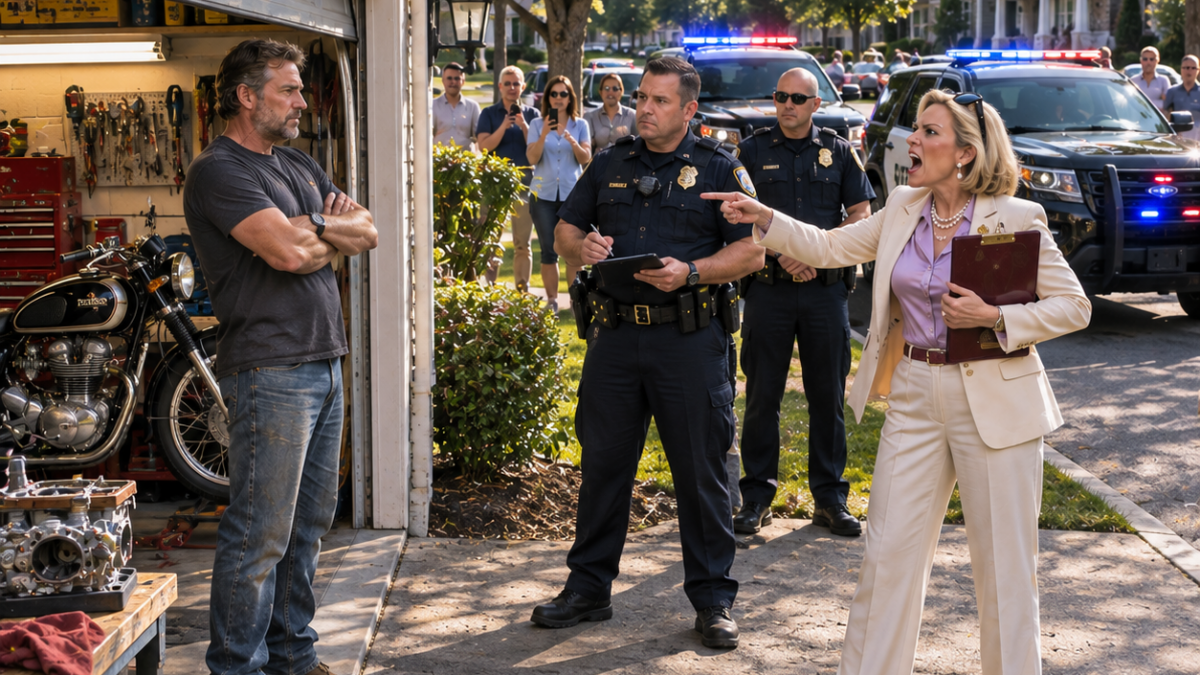
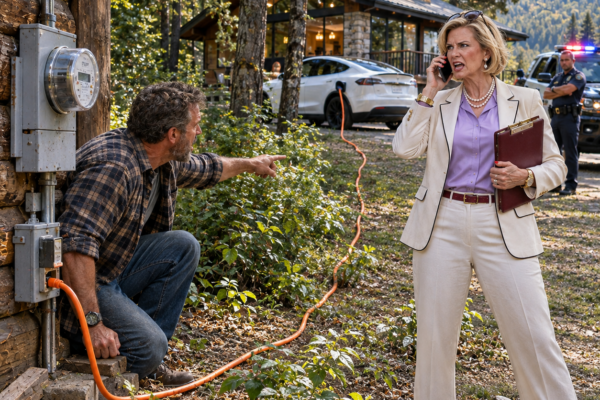
The morning Karen Hullbrook called 911 because I pressed the button to close my own garage door, she stood in the middle of my driveway shouting that I was “barricading myself with possible weapons,” while my only weapons were a socket wrench, a half-disassembled motorcycle carburetor, and a coffee mug I had been trying to finish before it went cold.
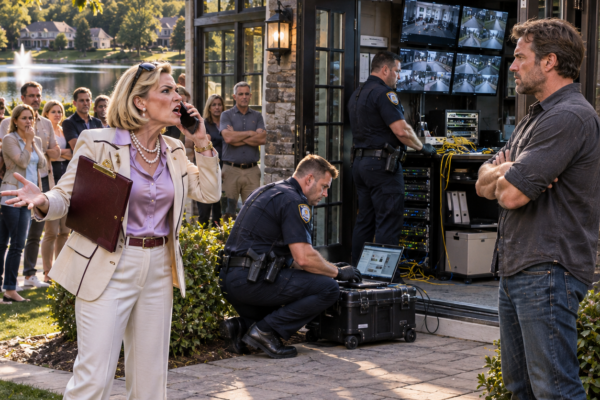
By the time two police SUVs rolled into Silver Ridge Estates with lights flashing, half the neighborhood was watching from porches, Karen was telling the dispatcher I was dangerous, and I was beginning to understand that this had stopped being a disagreement about HOA rules and turned into something far uglier.
What none of them knew—not Karen, not the neighbors filming through their windows, and certainly not the woman demanding that officers search my garage—was that I had spent most of my adult life learning exactly what happens when frightened people invent crimes around someone who refuses to surrender his rights.
My name is Daniel Cole.
I’m fifty-two years old, and when I bought the corner house on Maple Court, I wasn’t looking for excitement.
I was trying to get away from it.
Silver Ridge Estates advertised itself as quiet suburban perfection.
Tree-lined sidewalks.
Gray and beige houses.
A community pool.
A clubhouse.
Children on bicycles.
Golden retrievers that looked like they had signed contracts requiring them to appear in every real-estate brochure.
I bought the house because of the garage.
Two-car.
Deep.
Good natural light.
A side door opening beneath an old maple tree.
After decades of working in rooms where every conversation mattered, I wanted a place where the only thing demanding my attention was a stubborn bolt.
My favorite project was a 1974 Norton Commando.
British.
Beautiful.
Temperamental.
The kind of motorcycle that rewarded patience and punished arrogance.
I respected it immediately.
Most mornings I woke before sunrise, made coffee, opened the garage, and worked for an hour before the neighborhood came alive.
That was my peace.
Then I met Karen Hullbrook.
Karen was president of the Silver Ridge Estates HOA.
Mid-fifties.
Perfectly sprayed hair.
Pastel cardigans.
A slim binder held against her chest as though someone might try to steal civilization from her if she loosened her grip.
She introduced herself two days after I moved in.
“Welcome to Silver Ridge,” she said brightly. “We value residents who value standards.”
“Sounds reasonable.”
Her smile widened.
She opened the binder.
That should have warned me.
She immediately pointed out a rule stating garage doors should remain open no longer than fifteen minutes unless a resident was actively loading or unloading.
I read it twice.
“Who measures that?”
Her expression barely changed.
“We encourage voluntary compliance.”
That was not an answer.
For the first few weeks, Karen’s attention seemed harmless.
A yellow note appeared because my garden hose was visible.
Then one because my trash can lid wasn’t completely shut.
Then another because I watered my lawn too late in the morning.
I taped them above my workbench.
It became a collection.
My neighbor Priya saw them one Saturday.
“You’re keeping these?”
“Historical documents.”
“She hates that garage.”
“She doesn’t know the garage.”
“She hates what she can’t see.”
That turned out to be closer to the truth.
Karen began asking what I did inside.
I told her I repaired my motorcycle.
She asked whether customers came over.
“No.”
Whether money changed hands.
“No.”
Whether I was licensed.
“To own wrenches?”
She didn’t laugh.
Soon the HOA newsletter contained a warning about “unapproved garage-based commercial activity.”
No name.
But everybody knew.
Then came an official violation notice.
**UNAPPROVED ACTIVITY.**
**NOISE CONCERN.**
**POSSIBLE COMMERCIAL USE.**
Attached was a photograph of me working on the Norton with the garage door halfway down.
Karen had handwritten:
**VISIBLE WORK SUGGESTS COMMERCE.**
I confronted her at the mailbox.
“My garage is not a business.”
“Residents have concerns.”
“Which residents?”
“Confidential.”
“About what?”
“Late-night activity.”
“I don’t work late.”
“Mechanical sounds have been reported.”
“It’s a garage.”
She lifted her phone and photographed me.
I stared.
“Did you just take my picture?”
“Documentation.”
“Of what?”
“Your demeanor.”
I should have walked away.
Instead I said:
“Karen, you can’t turn privacy into evidence of guilt.”
Her smile disappeared.
“If you have nothing to hide, why do you keep closing the door?”
That sentence told me more about her than every violation notice combined.
The following Saturday, I was adjusting the Norton when I saw Karen coming up the driveway.
I pressed the remote.
The garage door began lowering.
She stopped.
Her phone came up.
Her face reddened.
Then she shouted the words that started everything.
“Stop right there! I’m calling 911!”
PART 2
For a moment, I genuinely thought she was joking.
Karen had threatened legal action before.
She had threatened fines.
Hearings.
Architectural review.
“Community sanctions,” whatever that meant.
But 911?
I let go of the remote.
The garage door stopped about three feet above the concrete.
“Karen.”
She was already holding the phone.
“You cannot close that door.”
I looked at the door.
Then at her.
“I’m fairly sure I can.”
“You’re concealing evidence.”
“Of what?”
“I’ve seen equipment.”
I glanced behind me.
The Norton sat on its stand.
Socket set.
Bench vise.
Small soldering iron.
Battery charger.
Ordinary garage tools.
“Yes.”
“What kind of equipment?”
“Equipment for fixing a motorcycle.”
“You have machinery.”
“Karen, my blender has a motor. Should I register breakfast with the board?”
Her face tightened.
“Don’t get sarcastic with me.”
“Don’t call emergency services because I own a garage door.”
She tapped the screen.
I heard the connection.
Then her voice transformed.
I’d seen that transformation before in people who knew exactly how they wanted a story to sound.
Urgent.
Fragile.
Controlled panic.
“Yes, hello. This is Karen Hullbrook. I’m the president of the Silver Ridge Estates Homeowners Association.”
Pause.
“Yes. I need officers immediately.”
I folded my arms.
She continued.
“We have a male resident barricading himself inside a garage after being confronted about suspicious activity.”
I looked at the three-foot opening.
“Barricading?”
She turned away from me.
“There may be weapons.”
That changed everything.
Not because I was afraid of Karen.
Because false references to weapons can get people hurt.
I kept both hands visible.
“Karen.”
She ignored me.
“Yes, metallic objects. Machinery. He’s behaving aggressively.”
I lowered my voice.
“Tell them I’m standing here holding a coffee mug.”
She stepped backward.
“He’s talking to me now. I feel threatened.”
I hadn’t moved.
My pulse remained steady.
Training does that.
Not bravery.
Training.
When you’ve spent decades listening to real emergencies, you learn that the loudest person in the room is often not the most dangerous.
Karen was loud.
The situation was dangerous anyway.
Because the officers responding had only her description.
I placed the remote on the workbench.
Set down my wrench.
Then the coffee.
I stepped into the open driveway and waited.
Karen mistook that for surrender.
“Stay where you are.”
“You are not law enforcement.”
“I’m preserving the scene.”
“There is no scene.”
She raised her phone and filmed me.
I almost laughed.
Instead, I heard sirens.
Closer.
The first patrol SUV entered the cul-de-sac.
Then another.
Neighbors appeared almost instantly.
Curtains moved.
Doors opened.
Priya stepped onto her porch.
Ken from two houses down came outside holding a garden hose that wasn’t running.
Everyone suddenly had a reason to be near a window.
Karen waved both arms.
“Here! Over here!”
I stayed still.
Two officers approached.
The younger one kept a hand near his belt.
The older officer looked at me, the garage, then Karen.
“Sir, can you step away from the garage?”
“Absolutely.”
I moved several feet forward.
“Hands where we can see them.”
I raised them slightly.
Karen said, “Be careful. He’s extremely calm.”
The older officer looked at her.
“Ma’am?”
“He’s trained.”
That almost made me smile.
The officer turned back.
“Any weapons on you, sir?”
“No.”
“In the garage?”
“There are legally owned firearms secured inside my house, not in the garage. Nothing involved here.”
He nodded.
“What’s going on?”
“I was working on my motorcycle. Mrs. Hullbrook came up the driveway. I started closing my garage door. She called 911.”
Karen jumped in.
“That’s not all.”
The officer looked at her.
“What else?”
“He operates suspicious equipment.”
“What equipment?”
“Mechanical devices.”
The younger officer looked into the garage.
“A motorcycle?”
“Yes.”
“And tools?”
“Yes.”
“And he keeps closing the door.”
The officer waited.
Karen waited.
I waited.
Finally he said:
“That’s normally what garage doors do.”
Priya coughed to hide a laugh.
Karen’s face reddened.
“You don’t understand. There have been repeated violations.”
“HOA violations?”
“Yes.”
“Not criminal violations?”
“Safety violations.”
“Such as?”
“He works with the door closed.”
The younger officer looked at me.
I could see him fighting something between disbelief and amusement.
The older officer remained calm.
“Did he threaten you?”
Karen hesitated.
“Not directly.”
“Did he display a weapon?”
“No.”
“Did he tell you he had a weapon?”
“No.”
“Did you see a firearm?”
“No, but—”
“Did he prevent you from leaving?”
“No.”
“Approach you aggressively?”
“He stared at me.”
I said, “I was squinting into the sun.”
The younger officer looked down.
Priya definitely laughed this time.
Karen pointed at me.
“See? He thinks this is funny.”
The older officer sighed.
“Ma’am, sarcasm isn’t probable cause.”
“I demand you search that garage.”
“No.”
“You haven’t even looked.”
“I can see most of it from here.”
“He could have illegal equipment inside.”
“Based on what evidence?”
“I’m the HOA president.”
The officer blinked.
Then said slowly:
“That isn’t evidence.”
Karen looked personally insulted by the Constitution.
The older officer turned toward me.
“Sir, I’ll need your ID for the call report.”
“Of course.”
I reached slowly into my wallet.
Handed him my license.
Daniel Edward Cole.
He studied it.
His eyes lifted.
Then returned to the card.
Something changed.
Small.
Recognition, maybe.
He handed it to his partner.
The younger officer read it.
Looked at me.
Looked again.
I gave the slightest shake of my head.
Not here.
Not necessary.
He understood.
The older officer returned the license.
“Thank you for cooperating, Mr. Cole.”
Karen noticed the change in tone.
“What?”
Nobody answered.
She stepped closer.
“What is it?”
“Nothing, ma’am.”
“You recognized him.”
The younger officer said, “We’re finished here.”
“No, you’re not.”
“Yes, we are.”
“I want him cited.”
“For closing his garage?”
“For suspicious activity.”
“There is no criminal activity in evidence.”
Karen’s voice rose.
“So you’re taking his side.”
“We aren’t taking sides.”
“You didn’t even investigate.”
“We responded to your report.”
“And?”
“And we found a man working on a motorcycle.”
Karen stared at them.
The older officer added:
“You also told dispatch there might be weapons and that he was barricaded.”
“He was closing the door!”
“That isn’t a barricade.”
“He was being hostile.”
“He’s been cooperative since we arrived.”
“Because he’s pretending.”
The officer’s patience thinned.
“Mrs. Hullbrook, emergency services cannot be used to escalate HOA disputes.”
“I had legitimate concerns.”
“If you have new evidence of a crime, call the non-emergency number. But another 911 call based only on a garage door may result in consequences.”
That struck harder than any argument I could have made.
Karen looked at me.
“You think you’ve won.”
“I was fixing a carburetor.”
She pointed.
“I’ll find out who you really are.”
There was something in the way she said it.
Not curiosity.
Threat.
Then she turned and walked away.
The police remained.
The older officer waited until she was out of earshot.
Then looked at me.
“Director Cole?”
There it was.
Quiet.
I nodded.
Technically, I was still Director of the Federal Bureau of Investigation, but I was on an extended leave that everyone—including me—understood was likely the beginning of the end of my tenure.
After decades in federal service, I had reached the point where ordinary mornings mattered more than briefing rooms.
Only a handful of neighbors knew I had ever worked for the government.
None knew my title.
That’s exactly how I wanted it.
The younger officer looked slightly horrified.
“She called 911 on the FBI Director because he closed his garage.”
I said:
“Please don’t phrase it that way in the report.”
He smiled.
“Why?”
“Because I’m trying very hard not to become a local story.”
The older officer glanced toward Karen’s house.
“I don’t think she’s going to make that easy.”
He was right.
Before they left, I said:
“One request.”
“Yes?”
“Document her exact statements from dispatch.”
“We will.”
“Especially the weapons allegation.”
He nodded.
“Already flagged.”
I thanked them.
Then they drove away.
Neighbors slowly disappeared.
Priya crossed the street.
She stared at me.
“Director?”
I closed my eyes.
“Please don’t.”
“FBI?”
“Priya.”
“You are the FBI Director?”
“I work for the Bureau.”
“That wasn’t my question.”
I looked at her.
“Yes.”
Her mouth fell open.
For once in her life, the attorney had no words.
Then she started laughing.
Not a polite laugh.
A full, bent-over, hand-on-knee laugh.
“This is not funny.”
“Oh, Daniel.”
She wiped her eyes.
“She called 911 on the FBI Director for owning a socket wrench.”
“I am begging you not to repeat that sentence.”
“No promises.”
I groaned.
Within twenty-four hours, half Silver Ridge knew.
Not from me.
Probably from one of the officers.
Or Priya.
She still denies it.
Karen reacted exactly the way Karen reacted to everything she could not control.
She escalated.
Monday morning, a violation notice appeared.
**HOSTILE CONDUCT TOWARD HOA OFFICER.**
Tuesday:
**ONGOING GARAGE ACTIVITY UNDER REVIEW.**
Wednesday:
**RESIDENT SAFETY CONCERN.**
Then the newsletter.
**Community Reminder: No individual, regardless of profession or status, is above Silver Ridge rules.**
That one almost impressed me.
She didn’t name me.
She didn’t need to.
But something else happened.
People started talking.
Not to Karen.
To me.
Leonard Hayes, a retired accountant who served on the HOA finance committee, caught me near the mailbox.
“Mr. Cole?”
“Daniel.”
He looked around before speaking.
“Can I ask you something?”
“Sure.”
“Do you really work for the FBI?”
“Yes.”
He lowered his voice.
“I think something’s wrong with our HOA finances.”
That changed the temperature of the conversation.
“What kind of wrong?”
“I don’t know.”
“Then tell me what you know.”
He hesitated.
“For three years, Karen has handled nearly every major vendor relationship.”
“That’s unusual?”
“We’re supposed to have committee review.”
“Do you?”
“On paper.”
That phrase mattered.
“Keep going.”
“There are landscaping invoices I’ve never seen work for. Community improvement grants. Security upgrades.”
“Did you approve them?”
“We’re given summaries.”
“Original invoices?”
“Karen says they’re stored securely.”
“Have you asked to see them?”
“Once.”
“And?”
“She told me I was creating internal distrust.”
I nearly smiled.
“That’s not an answer.”
“No.”
“What do you want from me?”
He looked uncomfortable.
“I don’t know.”
“Good.”
He blinked.
“Good?”
“If you came over asking me to use my job against her, I’d tell you no.”
“I wasn’t—”
“I know.”
I softened my voice.
“But if you believe HOA money is being mishandled, use your rights as a board member.”
“What rights?”
“Get the bylaws.”
He nodded.
“Request the records in writing.”
“She’ll refuse.”
“Then let her refuse in writing.”
That was all.
No FBI database.
No secret surveillance.
No special access.
A neighborhood association was not a federal target because its president annoyed me.
My position came with enormous authority.
That authority wasn’t mine to use because someone called me suspicious.
The line mattered.
Maybe more to me than anyone.
Two days later, Leonard came back.
He held an envelope.
“She refused.”
I read her response.
**Financial records are maintained under executive supervision and cannot be distributed where disclosure may compromise vendor confidentiality.**
“Is that allowed?”
Leonard asked.
“I’m not your lawyer.”
“Priya is.”
“Then ask Priya.”
He did.
That evening, Priya knocked on my door.
“You started something.”
“I told him to read the bylaws.”
“You know exactly what you did.”
“Reading is dangerous.”
She held up a copy.
Section 12.4.
Any member could inspect association expenditure records after seventy-two hours’ written notice.
Karen had violated her own rules.
Priya smiled.
“So we’re requesting them.”
“We?”
“Several residents.”
“Good.”
“You coming?”
“To what?”
“Records inspection.”
“No.”
“Why?”
“I have a conflict.”
“Because of your job?”
“Because Karen and I have an active dispute.”
Priya understood.
That frustrated her.
“You could probably spot fraud in five minutes.”
“Then I’m exactly the wrong person to lead this.”
She studied me.
“That’s annoyingly ethical.”
“Occupational hazard.”
The residents inspected the records without me.
What they found wasn’t proof.
But it was enough to raise questions.
Five vendors had almost no public footprint.
Invoices looked repetitive.
Several projects existed only on paper.
A $14,600 “perimeter lighting upgrade” had no corresponding lights.
A $9,800 “playground drainage remediation” had never occurred.
A landscaping contract listed an Arizona mailing address.
Priya brought copies to my house.
I didn’t touch them immediately.
“You obtained these lawfully?”
“Yes.”
“HOA records request.”
“Yes.”
“Copies permitted under the bylaws?”
“Yes.”
I took the folder.
The vendor name caught my attention.
Sunline Community Initiative.
Not a landscaping company.
A nonprofit.
At least according to the invoice header.
“Why is a nonprofit billing you for tree maintenance?”
“Exactly.”
I looked at her.
“Take this to local law enforcement.”
“Daniel.”
“Take it to the county financial crimes unit.”
“They’re going to laugh at an HOA complaint.”
“Then ask them not to.”
She stared.
“You could make one phone call.”
“Yes.”
“Will you?”
“No.”
“Why?”
“Because Karen already claims I’m targeting her.”
I tapped the folder.
“If there’s a crime here, the evidence needs to survive without my title attached.”
Priya sat back.
“That must be difficult.”
“What?”
“Having power and refusing to use it.”
I thought about that.
“That’s the entire point of having it.”
The county did not laugh.
Not after Priya and Leonard submitted the records.
A detective named Samuel Grant called them back for interviews.
Two weeks later, the county requested additional financial documents from the HOA.
Karen found out.
And went nuclear.
She called an emergency board meeting.
I didn’t plan to attend.
Priya convinced me.
“You’re the reason she thinks we’re doing this.”
“That’s another reason not to go.”
“Residents need to see you aren’t hiding.”
That word again.
Hiding.
I went.
The clubhouse was packed.
Karen sat at the head table beneath a framed sign reading:
**ORDER IS KINDNESS.**
That told you everything.
She opened the meeting.
“We are here because certain residents have made defamatory accusations regarding the integrity of this association.”
Priya raised her hand.
“Financial questions aren’t defamation.”
Karen smiled.
“Mrs. Shah, you will be recognized.”
“I just recognized myself.”
Several people laughed.
Karen’s eyes moved toward me.
“Some residents may believe professional influence gives them special privileges.”
I folded my hands.
She continued.
“We will not be intimidated.”
I said nothing.
That bothered her more.
After ten minutes of speeches, Leonard stood.
“Can we discuss the five vendors?”
Karen’s expression hardened.
“They’re legitimate.”
“Then why do three use the same post-office box?”
“Shared administrative services.”
“Where?”
“Arizona.”
“Why is an Arizona entity trimming trees in Virginia?”
Murmurs.
Karen looked toward me.
Not Leonard.
Me.
“Because some people intentionally misinterpret ordinary transactions.”
I finally spoke.
“Karen, he asked you a question.”
“This isn’t your investigation.”
“You’re right.”
That surprised her.
I continued.
“It’s his money.”
The room shifted.
One resident said:
“It’s our money.”
Another:
“Show us the contracts.”
Karen banged the table.
“Order.”
I looked at the sign behind her.
The irony almost hurt.
That night, Karen sent me an email.
**You may fool these people, but you don’t fool me. I know people like you. You manufacture threats to justify your authority. Stay out of my business.**
I read it twice.
Then forwarded it to the attorney handling ethics matters for my office.
Not because the email was a crime.
Because I wanted the record clear.
I had not initiated a federal investigation.
I had not accessed restricted databases.
I had not directed agents.
I had not used my office to retaliate.
The county investigation belonged to the county.
If federal jurisdiction emerged, someone else would decide that.
That mattered.
Three days later, Detective Grant called me.
“Director Cole?”
“Yes.”
“I understand you’re a resident of Silver Ridge.”
“Yes.”
“And involved in a dispute with Mrs. Hullbrook.”
“Yes.”
“We found something.”
I stayed silent.
“One vendor is tied to interstate transfers.”
I closed my eyes.
There it was.
“That may create federal jurisdiction.”
“It may.”
“We’d like to make a referral.”
“Then make it through normal channels.”
A pause.
“You don’t want to know what we found?”
“I very much want to know.”
“Then why—”
“Because I live across the street from the target.”
He understood.
“Conflict.”
“Exactly.”
“Who should we contact?”
I gave him the number for the appropriate field-office intake.
Then I called my deputy.
Told him everything.
His response was immediate.
“You are recused.”
“Agreed.”
“You do not touch evidence.”
“Agreed.”
“You do not direct agents.”
“Agreed.”
“You do not access case systems.”
“Agreed.”
“And you stop sounding pleased.”
“I’m not pleased.”
“You’re drinking coffee in a garage, aren’t you?”
I looked at my cup.
“Maybe.”
He sighed.
“Daniel.”
“What?”
“Let us do our jobs.”
That was harder than it sounded.
Because once the investigation became federal, I knew enough to understand what every delay might mean.
But I did nothing.
I repaired the Norton.
I walked the neighborhood.
I attended HOA meetings only as a homeowner.
I documented Karen’s conduct toward me through normal channels.
And the Bureau worked the case without me.
That drove Karen crazy.
She expected me to attack.
When I didn’t, she attacked shadows.
She sent violation notices.
She accused Priya of conspiring with me.
She threatened Leonard with removal from the board.
She claimed people were hacking association accounts.
Then one Friday evening, she appeared at my driveway.
The garage door was open.
I was sanding a small maple panel.
She held a stack of papers.
“You.”
“Good evening.”
“You think you’re clever.”
“Occasionally.”
“You brought federal agents into Silver Ridge.”
“No.”
“Don’t lie to me.”
“I haven’t.”
“You expect me to believe the FBI just happens to be looking at HOA records?”
“I expect you to talk to your lawyer.”
“You’re behind this.”
“Karen.”
I set down the sandpaper.
“You called police on me.”
“You humiliated me.”
“The officers found no crime.”
“You turned the neighborhood against me.”
“Your financial records did that.”
Her face changed.
Just slightly.
Fear.
“Those records were confidential.”
“They were HOA records.”
“Somebody stole files.”
I looked at her.
“What files?”
Her mouth stopped.
I hadn’t asked about files.
Neither had Priya.
Detective Grant had never publicly mentioned seized digital records.
Karen realized it too.
Her eyes narrowed.
“You’re twisting my words.”
“No.”
I took one step backward.
“I’m going inside.”
“You always do that.”
“Do what?”
“Close doors.”
I almost smiled.
“Yes.”
I pressed the garage remote.
The door began lowering.
Her face transformed.
Not again.
She pulled out her phone.
“You’re hiding evidence!”
“Karen.”
“Stop the door!”
“No.”
“I’m calling 911.”
I stared at her.
“You cannot possibly be serious.”
She dialed.
Again.
This time, the dispatcher apparently recognized the address.
I heard only Karen’s side.
“Yes, him again.”
Pause.
“He’s concealing evidence related to a federal investigation.”
Pause.
“He admitted he has files.”
I had admitted nothing.
She continued.
“He may be destroying them.”
I took out my own phone.
Started recording.
“Karen, for the record, you are standing on my driveway falsely accusing me of destroying evidence.”
“You are!”
“Which evidence?”
“The Sunline records.”
There it was.
I said nothing.
She did.
“The grant files. The contractor transfers. All of it.”
Then she realized.
Those details had never been publicly released.
I looked at her.
“Interesting.”
Her face went pale.
“What?”
“Nothing.”
The police arrived.
Officer Lane was one of them.
He stepped out.
Looked at Karen.
Looked at me.
Then looked up toward heaven as if asking for patience.
“Mrs. Hullbrook.”
“He’s destroying evidence.”
Lane looked at me.
“Director?”
“Garage contains one motorcycle, woodworking tools, and my personal records. Nothing connected to any official investigation.”
Karen snapped:
“He has copies!”
Lane said:
“How would you know?”
She stopped.
Another officer approached.
“Ma’am, what evidence are you referring to?”
“The Sunline files.”
“What Sunline files?”
“The files they took.”
“Who took?”
“The—”
She stopped.
Lane’s expression changed.
He said quietly:
“Mrs. Hullbrook, I strongly recommend you stop talking.”
She stared.
“Why?”
“Because you appear to be describing materials that aren’t part of any public disclosure.”
Her face emptied.
She turned toward me.
“You set me up.”
“No.”
My voice stayed calm.
“You called 911.”
Again.
The officers took statements.
No dramatic arrest.
Not that night.
But Karen’s words went into the report.
And that report went to the task force.
The next morning, unmarked vehicles entered Silver Ridge before sunrise.
I knew what they were before anyone else did.
I stayed inside.
That was important.
This was not my raid.
Not my warrant.
Not my operation.
I watched through the kitchen window as agents approached Karen’s house.
Across the street, Priya’s porch light came on.
Then Leonard’s.
Then half the cul-de-sac.
Karen opened the door wearing a robe.
An agent showed her the warrant.
Even from my house, I saw the change in her posture.
Authority meeting authority.
Real authority.
Documented.
Judicially approved.
Not a binder.
Not an HOA title.
They searched her house.
The HOA office.
A storage unit.
By nine thirty, Karen was sitting in the back of an unmarked vehicle.
Not because she complained about my garage.
Because investigators had found enough evidence to arrest her on financial charges.
She saw me.
I was standing by my mailbox.
For several seconds, we looked at each other.
No smile.
No victory salute.
I didn’t want one.
Then the vehicle left.
Silver Ridge remained silent.
An hour later, Priya came over.
“Is she arrested?”
“Yes.”
“How do you know?”
“I know what arrested looks like.”
She stared.
“Was this you?”
“No.”
“Daniel.”
“I’m recused.”
“Completely?”
“Yes.”
She studied my face.
“You’re telling the truth.”
“I usually try.”
“What did they find?”
“I don’t know.”
That answer frustrated both of us.
By noon, the HOA announced an emergency meeting.
Karen had been removed temporarily from all leadership authority.
Her access to association accounts was suspended.
Leonard and Ruth were appointed to preserve records.
The clubhouse filled that evening.
Nobody knew what to believe.
Some residents were furious.
Some frightened.
A few still defended Karen.
Harold Bishop, the vice president, stood at the front.
“As you know, President Hullbrook has been detained in connection with an investigation.”
A woman shouted:
“Detained?”
“Arrested!”
Another:
“Is our money gone?”
Another:
“How much?”
Harold raised both hands.
“We don’t know.”
I sat in the back.
Exactly where I wanted to be.
Then Leonard stood.
He held a folder.
“I know some.”
The room quieted.
He projected a spreadsheet.
Payments.
Vendor names.
Dates.
Three years.
Approximately one hundred twenty thousand dollars in suspicious association expenditures.
Gasps.
A man near the front said:
“That can’t be right.”
Leonard’s voice shook.
“I approved some of these summaries.”
He swallowed.
“I trusted the documentation.”
Priya said:
“Did the projects happen?”
“No.”
The room erupted.
Landscaping.
Lighting.
Playground work.
Drainage repairs.
Security consulting.
Many had either never occurred or cost a fraction of the invoiced amount.
Then Harold looked toward me.
“Mr. Cole.”
I knew what he wanted.
I didn’t move.
He continued.
“Would you explain what happens now?”
I stood slowly.
“I’m not involved in the investigation.”
People murmured.
Someone said:
“But you’re FBI.”
That was the first time the words were spoken publicly in that room.
Everyone turned.
I sighed.
“Yes.”
A woman dropped her pen.
Literally.
It struck the floor.
Karen had spent months turning me into the suspicious man with the garage.
Now thirty residents stared as if the garage door had opened and revealed another life.
Harold said:
“You’re the FBI Director?”
“I’m currently serving as Director, on extended leave.”
Silence.
Priya looked delighted that she no longer had to keep the secret.
I continued.
“And because I live here and have a personal conflict with Karen Hullbrook, I am not directing the investigation.”
Leonard asked:
“Then who is?”
“Agents who don’t live across the street from her.”
That got a nervous laugh.
I pointed toward the spreadsheet.
“What you are seeing tonight comes from your own association records.”
I looked around the room.
“That’s important.”
Nobody spoke.
“You don’t need an FBI Director to tell you when your organization stops showing you where your money goes.”
I nodded toward Leonard.
“You need residents willing to ask.”
A woman near the aisle raised her hand.
“She fined my disabled son because his wheelchair ramp wasn’t approved.”
I remembered her.
Karen had once listed accessibility modifications as “temporary exterior alterations.”
The woman started crying.
“She made us feel like criminals.”
Another resident stood.
“She threatened me over my daughter’s car.”
Another:
“She made me replace Christmas lights because they were ‘too blue.’”
Laughter.
Bitter.
Then another:
“She threatened a lien over six hundred dollars in fines.”
The room changed.
This wasn’t only about money.
Money was the evidence.
Fear was the system.
I waited until people settled.
Then said:
“Karen’s criminal case belongs to the courts.”
I paused.
“But Silver Ridge belongs to you.”
That line mattered.
Not because it was brilliant.
Because people had forgotten.
For years, Karen acted as if the HOA belonged to its president.
It didn’t.
The meeting lasted three hours.
They voted to suspend the entire current board pending independent audit.
Priya was chosen to organize a temporary homeowner committee.
She immediately said:
“All financial records open.”
Applause.
“No unilateral fines.”
More applause.
“No hidden vendor contracts.”
More.
“No one photographing residents for ‘demeanor documentation.’”
Everyone turned toward me.
I smiled.
“Strongly support.”
For the first time since I moved into Silver Ridge, a meeting ended with people laughing.
The federal case became larger.
Much larger.
I learned details only when they became public or when prosecutors cleared information for me as a witness.
Sunline Community Initiative had been used as a pass-through entity.
HOA funds flowed into Sunline.
Sunline paid shell contractors.
Some money returned to accounts connected to Karen.
Other funds moved through an Arizona business tied to her brother.
Investigators found similar payments involving several small associations.
Not hundreds.
Not some national conspiracy stretching into darkness forever.
But enough.
Enough to make federal prosecutors interested.
Enough to turn Karen’s small kingdom into evidence.
Her legal name had changed years earlier.
That fact alone wasn’t criminal.
People change names.
Records get sealed for legitimate reasons.
What mattered was what she had done after.
Fraud.
False vendor invoices.
Concealment.
Obstruction.
Investigators found deleted records.
Falsified meeting minutes.
Vendor approvals dated after payments were issued.
A private ledger tracking how much she believed each board member could be pressured before they resisted.
That part disturbed me most.
Leonard:
**Worries about daughter. Easy compliance.**
Ruth:
**Conflict avoidant. Use public embarrassment.**
Harold:
**Needs status. Give title.**
Priya:
**Problem. Watch closely.**
And me:
**Unknown background. Control issue. Garage leverage.**
Garage leverage.
I stared at those words when prosecutors showed them to me before trial.
My garage had never been the problem.
It was leverage.
Karen had seen privacy and immediately looked for a way to turn it into suspicion.
The false 911 call hadn’t been random.
It was an escalation pattern she used whenever someone stopped responding to ordinary pressure.
I thought about how easily it could have gone wrong.
An officer arriving frightened.
A misunderstanding.
A sudden movement.
One false word about weapons.
I felt anger then.
Real anger.
Not about fines.
Not about my reputation.
About recklessness.
At her preliminary hearing, I was called as a witness.
The courthouse smelled the way courthouses always smell.
Paper.
Old wood.
Coffee.
Stress.
Karen sat at the defense table in a gray suit.
No pastel.
No binder.
She looked smaller.
But her eyes were the same.
The prosecutor began:
“Mr. Cole, how did your conflict with the defendant begin?”
“With my garage door.”
A few people smiled.
“What happened?”
“She repeatedly accused me of operating an unauthorized business because I restored a motorcycle in my garage.”
“Did you?”
“No.”
“What did she do?”
“She issued HOA notices.”
“Then?”
“She called 911 when I closed the garage.”
“Why?”
“She claimed I was barricading myself and might possess weapons.”
“Was that true?”
“No.”
“Were weapons involved?”
“No.”
“Did police find evidence of criminal activity?”
“No.”
“Were you arrested?”
“No.”
The prosecutor paused.
“What was your occupation at the time?”
I looked toward Karen.
She stared at the table.
“Director of the Federal Bureau of Investigation.”
The courtroom stirred.
Even though it had been reported, hearing it in testimony made the irony unavoidable.
The prosecutor continued.
“Did you use that position to begin an investigation into Mrs. Hullbrook?”
“No.”
“Why not?”
“Because I had a personal dispute with her.”
“Did you access FBI databases to investigate her background for personal reasons?”
“No.”
“Did you direct Bureau agents to investigate her?”
“No.”
“What did you do?”
“I documented my own HOA interactions. Other residents exercised their rights to inspect HOA financial records. They took suspicious transactions to local law enforcement.”
“And when federal jurisdiction became apparent?”
“I disclosed the conflict and recused myself.”
Karen’s attorney stood for cross-examination.
He was good.
Very good.
“Director Cole, you expect this court to believe your position had no influence whatsoever?”
“No.”
That surprised him.
“You admit it did?”
“My identity influenced how people perceived events. I can’t control that.”
“So officers treated you differently.”
“I don’t know what was in their minds.”
“You were recognized.”
“Yes.”
“You received courtesy.”
“Possibly.”
“And then Mrs. Hullbrook was suddenly investigated.”
“Not suddenly.”
“You had access to immense federal resources.”
“Yes.”
“And you expect us to accept that you didn’t use them?”
“I expect you to examine the case logs.”
He stopped.
The prosecutor smiled slightly.
I continued.
“My recusal is documented.”
The attorney shifted.
“You disliked Mrs. Hullbrook.”
“Yes.”
“Strongly?”
“Eventually.”
“So you had motive.”
“To do what?”
“Destroy her.”
I looked at Karen.
Then back at him.
“No.”
“You wanted revenge.”
“For false police reports? I wanted them documented.”
“For harassment?”
“I wanted it stopped.”
“For humiliating you?”
“I have been criticized by senators on live television. Karen Hullbrook was not my first difficult morning.”
A few people laughed.
The judge tapped her pen.
The attorney frowned.
“You’re enjoying this.”
“No.”
I leaned slightly forward.
“I enjoyed repairing motorcycles before your client turned my garage into evidence of imaginary crimes.”
That ended that line.
The financial evidence was harder for Karen to fight.
Bank transfers.
Invoices.
Email records.
Deleted documents recovered from backups.
The prosecution showed an email:
**Use resident compliance issues aggressively enough and they’ll stop asking financial questions.**
Another:
**Leonard is nervous. Fine him if necessary.**
Then one about me:
**Cole requires a public incident. Once neighbors believe he is dangerous, his credibility becomes irrelevant.**
I read that sentence from the witness bench.
It changed something in me.
She had not called 911 because she was afraid.
She called because she wanted everyone else to be.
Karen finally looked at me.
I don’t know what she expected.
Anger?
Triumph?
I felt neither.
Only disappointment.
What a waste.
All that energy.
All that intelligence.
All that organization.
Used to frighten people who wanted to live in peace.
The trial lasted weeks.
I wasn’t there every day.
I didn’t need to be.
My part was small.
The case was bigger.
Karen was eventually convicted on multiple financial and obstruction-related charges.
The sentence was eight years.
Substantial restitution.
Additional supervised release after prison.
Her attorneys appealed.
That was their right.
The neighborhood moved on before the appeals finished.
Silver Ridge’s new leadership held elections.
Priya ran reluctantly.
Won overwhelmingly.
Her first meeting was outdoors beneath the clubhouse gazebo.
No elevated table.
No president sitting like a judge.
Just folding chairs in a circle.
She held up the old bylaws.
“We’re going to keep what works.”
Then another stack.
“And burn what doesn’t.”
I raised an eyebrow.
She smiled.
“Metaphorically. Daniel is here.”
“Thank you.”
They rewrote enforcement rules.
Warnings before fines.
Mediation before escalation.
Financial statements published monthly.
Vendor bids disclosed.
Board members prohibited from approving contracts involving relatives.
Independent audits.
Term limits.
No photography of residents except for documenting objective property conditions necessary to an actual violation.
And garage rules?
Gone.
Not weakened.
Gone.
Priya announced it with unnecessary drama.
“Residents may close their own garage doors.”
Applause.
I stood.
“This is the greatest civil-rights achievement of our time.”
Everyone laughed.
The garage changed too.
For months, people had avoided it.
Karen turned it into the neighborhood’s suspicious place.
After she was gone, Leonard brought over a broken lawnmower.
“Can you look at this?”
“No.”
He stared.
“Why?”
“I fix motorcycles.”
“Engines are engines.”
“That is offensive.”
He left it anyway.
I repaired it.
Then Ken brought a toaster.
“Absolutely not.”
I repaired that too.
Then Priya’s teenage nephew arrived with a bicycle whose chain kept slipping.
Within two months, Friday evenings became unofficial repair nights.
People brought broken lamps.
Fans.
Bikes.
Coffee makers.
One ancient stereo.
I couldn’t repair everything.
That wasn’t the point.
The garage door stayed open.
Not because the HOA required it.
Because I chose to open it.
Kids sat on the driveway watching me explain why forcing a stripped bolt only makes things worse.
Adults drank coffee.
Neighbors talked.
The place Karen had treated as a threat became the closest thing Silver Ridge had to a town square.
Priya named it Fix-It Friday.
I hated the name.
It survived.
One evening, a boy named Marcus stared at the Norton.
“Does it run?”
“Eventually.”
“You’ve been saying that for months.”
“Excellent investigative instincts.”
He grinned.
“Why’s it take so long?”
“Because old machines punish impatience.”
“Like Mrs. Hullbrook?”
The adults went silent.
I looked at him.
Then laughed.
“Something like that.”
Six months after Karen’s arrest, the Norton was ready.
Polished tank.
Rebuilt carburetors.
Fresh lines.
Electrical system finally behaving like electricity had agreed to modern civilization.
I rolled it onto the driveway.
Half the neighbors appeared.
Apparently Marcus had told everyone.
“Do we need permits?” Leonard asked.
“Leave.”
I turned the key.
Nothing.
Priya laughed.
I tried again.
The engine coughed.
Then caught.
That deep British twin-cylinder sound filled the cul-de-sac.
Beautiful.
Imperfect.
Alive.
Everyone cheered.
I sat there with both hands on the bars and felt something shift inside me.
For years, I had measured my life in investigations.
Briefings.
Threat assessments.
Arrests.
Congressional hearings.
Decisions where somebody always hated the outcome.
The Norton was different.
You couldn’t command it.
You listened.
Adjusted.
Tried again.
Maybe that’s why I loved it.
My phone rang.
Harper.
My deputy.
I killed the engine.
“What?”
“I heard you finally got that antique running.”
“How?”
“Federal intelligence capabilities.”
“Priya texted you.”
“Also federal intelligence capabilities.”
I laughed.
Then his voice changed.
“We closed another part of the Sunline case.”
“What happened?”
“Two more HOA-linked contractors pleaded.”
“Good.”
“Karen cooperated?”
“Eventually.”
I leaned against the bike.
“Why?”
“Sentence exposure. She gave us accounts we hadn’t found.”
I wasn’t surprised.
Harper continued.
“She says she wasn’t the architect.”
“Everyone says that.”
“She may be telling the truth.”
“That doesn’t make her innocent.”
“No.”
We were silent.
Then Harper asked:
“You coming back?”
I looked around the driveway.
Marcus was showing another kid the motorcycle.
Priya was arguing with Leonard about whether he had destroyed my socket organizer.
Sunlight moved through the maple leaves.
“No.”
“Not even for a year?”
“No.”
“You’re still Director.”
“For a little longer.”
“You sure?”
I thought about the first morning.
Coffee.
Garage.
Karen.
Sirens.
Then everything that followed.
“Yes.”
I submitted my retirement paperwork two weeks later.
No grand announcement.
No press conference in Silver Ridge.
The Bureau issued the appropriate statement.
A career measured in decades summarized in a few paragraphs.
Colleagues called.
Some congratulated me.
Some tried to change my mind.
Harper accused me of abandoning civilization.
I told him civilization had too many meetings.
My last official day felt strange.
I walked out of a building I had entered thousands of times.
No dramatic music.
Just doors.
Security checkpoints.
People working.
The institution continued.
That’s how good institutions are supposed to work.
One person leaves.
The rules remain.
That was something Karen never understood.
She built the HOA around herself.
When she fell, everything had to be rebuilt.
Power that depends on one personality isn’t leadership.
It’s dependency.
My first morning fully retired, I woke at five eleven.
Body didn’t care about retirement.
I made coffee.
Walked into the garage.
Then stopped.
For years, part of me always carried the Bureau with me.
Even at home.
Phone.
Briefing.
Secure messages.
Some crisis somewhere.
That morning, nothing waited.
Just the Norton.
A tool chest.
A radio.
The maple tree casting shadow across the driveway.
I stood there longer than necessary.
Then pressed the remote.
The garage door lowered.
Halfway down, I froze.
Memory hit.
Karen’s voice.
**Stop right there! I’m calling 911!**
I almost laughed.
Then I lowered it completely.
The motor hummed.
The door touched concrete.
Silence.
No sirens.
No shouting.
No woman demanding to know what I was hiding.
Just privacy.
I sat on the stool.
And for reasons I didn’t expect, tears came.
Not many.
Enough.
Retirement had been an abstract word.
That closed door made it real.
I had spent my adult life entering other people’s emergencies.
Now I could sit behind a garage door and be nobody important.
That felt like freedom.
A week later, a letter arrived.
Federal correctional institution.
Karen.
I nearly threw it away.
Then opened it.
Daniel,
You won.
I hope that satisfies you.
You took my position, my reputation, my home, and my freedom.
People I protected turned against me the moment things became difficult.
They act as though I created every problem in Silver Ridge when all I ever wanted was order.
You probably tell yourself this was justice.
Maybe it was.
But you should know that you made me into something larger than I was.
You needed a villain.
Now you have one.
K.H.
I read it twice.
Then placed it on the workbench.
The old version of me would have analyzed every sentence.
Manipulation.
Projection.
Victim framing.
Control language.
The retired version made coffee.
Priya came over later.
Saw the letter.
“From her?”
“Yes.”
“What did she say?”
“She won the victim Olympics.”
“Anything threatening?”
“No.”
“You responding?”
“No.”
“Good.”
She started toward the door.
Then stopped.
“Daniel.”
“Yeah?”
“You didn’t take her home.”
I looked at her.
“She sold because of legal expenses.”
“You didn’t take her reputation.”
“No.”
“She did.”
“I know.”
“You didn’t take her freedom.”
“The court did.”
She pointed at the letter.
“Then don’t let her give you ownership of her consequences.”
That was annoyingly good.
“You practice that speech?”
“No. I’m naturally profound.”
“Leave.”
She laughed.
I kept the letter.
Not as a trophy.
As a reminder.
People who build their identities around control often experience consequences as persecution.
If every disagreement is disobedience, then accountability feels like attack.
Months passed.
Silver Ridge changed slowly.
Children played basketball past nine.
Nobody measured.
A resident painted her front door dark green.
The old standards required muted blue, black, or burgundy.
Priya approved it.
Then changed the rule.
Someone left holiday lights up until February.
Civilization survived.
Leonard’s granddaughter drew a giant chalk dragon across the sidewalk.
Under Karen, that would have generated three pages of violation language.
Priya photographed it.
Put it in the newsletter.
**COMMUNITY ART.**
Karen would have combusted.
The biggest change was conversation.
People stopped filing complaints anonymously.
If Ken’s dog barked too much, Ruth walked over and talked to him.
If Leonard’s hedge blocked the sidewalk, somebody told Leonard.
He trimmed it.
No hearing.
No fine.
No binder.
It almost seemed revolutionary.
Then trouble returned.
Not Karen.
Not exactly.
Federal investigators discovered the Sunline scheme had connections beyond Silver Ridge.
Several small associations had paid similar fake vendors.
Some board officers knowingly participated.
Others had no idea.
A former accountant tied to one of the shell companies disappeared before charges could be filed.
Harper called.
“I know you’re retired.”
“That’s how retirement works.”
“We want your institutional knowledge.”
“No.”
“Advisory only.”
“No.”
“Three calls.”
“No.”
“Two.”
“Harper.”
“One secure briefing and you never hear from me again.”
“That last part is a lie.”
“Yes.”
I agreed to one briefing.
Not because I missed the work.
Because if Karen’s records could help recover stolen money from other communities, I wanted the chain finished properly.
I reviewed public and cleared material.
Offered context.
Then left.
No badge resurrection.
No return to command.
That mattered.
The wider investigation eventually led to multiple indictments.
Not a secret nationwide empire.
Not some cinematic conspiracy.
Just a network of greedy people exploiting small organizations because they assumed no one would examine transactions closely.
That was almost worse.
Crime doesn’t always need genius.
Sometimes it only needs boredom and trust.
Silver Ridge became a case study in governance reform.
Priya hated when reporters used that phrase.
“Governance reform sounds like we invaded a country.”
“You did overthrow Karen.”
“She was voted in.”
“Details.”
One local reporter asked to interview me.
I refused.
Then Priya volunteered my garage for the interview location.
I threatened litigation.
She reminded me she was a lawyer.
I lost.
The reporter stood beside the Norton.
“So this is where it started?”
“Yes.”
“With a garage door?”
“Yes.”
“And an HOA president called police because you closed it?”
“Yes.”
“Did she know you were FBI Director?”
“No.”
“What did you think when the officers arrived?”
“That I hoped everybody stayed calm.”
“Not that she had made a terrible mistake?”
“No.”
The reporter looked surprised.
“Why?”
“Because a false emergency call isn’t funny when police believe someone may be armed.”
That sobered her.
I continued.
“The title makes the story entertaining.”
**HOA President Calls 911 on FBI Director.**
“People laugh.”
“But I could have been anybody.”
I looked at the camera.
“A teacher. A mechanic. A retiree. A Black teenager. A veteran with PTSD. Someone who panics under police pressure.”
The reporter didn’t interrupt.
“If you exaggerate danger because you’re angry at a neighbor, you don’t control what happens after emergency services arrive.”
That became the part of the interview people shared most.
Not the FBI reveal.
Not Karen.
The warning.
I’m glad.
Because revenge makes a good story.
Responsibility makes a better lesson.
A year after the arrest, Priya organized a neighborhood dinner.
She claimed it was to celebrate the new charter.
I suspected she just wanted an excuse to make me grill burgers.
The clubhouse lawn filled with tables.
Children ran between them.
Leonard played terrible music.
Ken’s wife threatened to unplug the speaker.
Mark from the next street brought homemade beer nobody trusted.
At sunset, Priya tapped a glass.
“No speeches.”
Everyone cheered.
She glared.
“I said no speeches from Daniel.”
More cheering.
I stood anyway.
“Thirty seconds.”
Groans.
“Karen used to say order was kindness.”
People quieted.
I looked around.
“She was half right.”
Priya raised an eyebrow.
“Order can be kind.”
I pointed toward the tables.
“When it’s built together.”
Then toward the clubhouse.
“When rules are visible.”
Then toward the residents.
“When people can challenge them.”
I paused.
“But order without consent isn’t kindness.”
No one moved.
“It’s control.”
I raised my cup.
“So here’s to a neighborhood that finally learned the difference.”
People applauded.
I sat.
Priya whispered:
“That was forty-seven seconds.”
“Arrest me.”
She smiled.
“Don’t tempt the HOA president.”
For one terrible second, we both stared at each other.
Then burst out laughing.
Later, Leonard asked:
“You ever forgive her?”
We were sitting beneath the maple tree near my driveway.
“I don’t know.”
“Still angry?”
“No.”
“Then maybe you did.”
I thought about that.
“Forgiveness and forgetting aren’t the same.”
“No.”
“She could’ve gotten somebody hurt.”
“Yes.”
“She stole money.”
“Yes.”
“She frightened people.”
“Yes.”
“But I don’t wake up thinking about her anymore.”
Leonard nodded.
“That’s probably close enough.”
Another year passed.
The Norton became my regular Sunday ride.
Not far.
Country roads.
Diners.
Occasionally the Blue Ridge when weather cooperated.
One Sunday, Marcus—the kid who once mocked how long repairs were taking—showed up at the garage.
He was seventeen now.
Tall.
Nervous.
“Mr. Cole?”
“Daniel.”
“My mom would kill me.”
“Then Mr. Cole.”
He smiled.
“I bought something.”
That sentence is dangerous when spoken by a teenager.
“What?”
He pushed an old Honda motorcycle from behind his father’s truck.
It looked like it had been recovered from a river.
“No.”
“What?”
“No.”
“You haven’t even looked.”
“I have eyes.”
“It was six hundred dollars.”
“You overpaid.”
“Can you help me fix it?”
I looked at the Norton.
Then at the Honda.
Then at Marcus.
“First lesson.”
He leaned closer.
“Never buy a motorcycle without bringing someone who understands motorcycles.”
His face fell.
“Second lesson?”
“Push it inside.”
For the next six months, we rebuilt it.
Not every day.
Saturday mornings.
Some evenings.
I made Marcus do most of the work.
He complained.
I sounded exactly like every older man who ever taught me anything.
“Again.”
“But it’s tight.”
“Wrong tight.”
“How can tight be wrong?”
“You’ll learn.”
One afternoon, he stripped a bolt.
He stared at it.
“Oh no.”
“What did you learn?”
“Old machines punish impatience.”
I smiled.
“Good.”
“That line sounded cooler when you said it.”
“It always does.”
His motorcycle finally ran.
His mother cried.
His father filmed.
Marcus screamed when the engine caught.
I stood behind him and thought about the strange road from Karen’s first violation notice to this moment.
The garage had once made people suspicious.
Now it taught kids patience.
Maybe places remember what we choose to do inside them.
Karen wrote again.
Three years into her sentence.
Different tone.
Daniel,
I won’t ask whether you forgive me.
My counselor says apologies should not contain requests.
I used to think people respected me.
I understand now that many were simply afraid of consequences.
There is a difference.
I have replayed the morning I called 911 more times than I can count.
At the time I truly believed I was protecting the community.
That is the frightening part.
I believed myself.
You once told me privacy was not proof of guilt.
I understand that now.
I am sorry for what I did to you and to Silver Ridge.
No excuse.
K.
I sat at the workbench for a long time.
Marcus wasn’t there.
Radio low.
Late afternoon light.
I read the phrase again.
**I believed myself.**
That was the most important thing Karen ever wrote.
People imagine harmful people wake up knowing they are harmful.
Often they don’t.
They construct reasons.
Every violation becomes protection.
Every intrusion becomes responsibility.
Every lie becomes strategy.
Every frightened neighbor becomes proof that control is necessary.
By the time reality breaks through, the story inside their head has become a fortress.
I wrote back.
One paragraph.
Karen,
I received your letter.
Accountability matters more to me than apology, but an honest apology still matters.
I hope you use the rest of your life to become someone who no longer needs fear to feel respected.
Daniel.
I mailed it.
Never told anyone.
Not even Priya.
Some things don’t need an audience.
Five years after the garage incident, Silver Ridge held its annual neighborhood festival.
Annual.
That still made me laugh.
Karen once required a permit for sidewalk chalk.
Now the streets were covered in it.
Children painted temporary murals.
Food tables blocked half the clubhouse walkway.
Someone played music slightly above the old noise limit.
Nobody died.
The new HOA president wasn’t Priya anymore.
Term limits.
Her idea.
A young father named Miguel had the job.
He stopped by my garage.
“Daniel.”
“No.”
“I didn’t ask anything.”
“You’re HOA president.”
“You’ve trained us to fear you.”
“Healthy.”
He handed me a plaque.
I stared.
“What is this?”
Silver Ridge Community Workshop.
Below:
**FIX WHAT’S BROKEN. DON’T HIDE IT.**
I looked at him.
“Absolutely not.”
“Already voted.”
“Unanimously.”
“Dictatorship.”
“Democracy.”
“Worse.”
They mounted it near my garage side door.
I complained for months.
Secretly, I liked it.
Marcus went to engineering school.
Priya became a judge.
Leonard eventually moved closer to his grandchildren.
Ken finally learned not to bring me appliances without asking.
Silver Ridge kept changing.
As communities do.
People moved.
New families arrived.
Most knew nothing about Karen.
Occasionally somebody heard the story.
They’d come to Fix-It Friday and ask:
“Is it true an HOA president called 911 because you closed this door?”
“Yes.”
“And you were FBI Director?”
“Yes.”
“Did she really not know?”
“No.”
Then the inevitable:
“What did her face look like when she found out?”
I always disappointed them.
“There wasn’t one big moment.”
Because that’s true.
Life rarely delivers perfect cinematic revenge.
Karen’s downfall wasn’t one shocked expression.
It was a series of smaller moments.
The officer telling her an HOA title wasn’t probable cause.
Residents demanding records.
Leonard finding invoices.
Priya reading bylaws.
Investigators following money.
A judge signing warrants.
A jury listening to evidence.
A neighborhood electing new leadership.
The law working slowly.
Boringly.
Properly.
That was better than a dramatic reveal.
One evening, I sat in the garage after everyone left.
The Norton stood beside Marcus’s old workbench.
He had carved his initials underneath before leaving for college.
I pretended not to notice.
The radio played Fleetwood Mac.
The same station I’d listened to the morning Karen called police.
Outside, the maple had grown wider.
Its branches threw shadows over the driveway.
I pressed the garage remote.
The door started lowering.
For half a second, memory returned.
Pink cardigan.
Raised phone.
“Stop right there!”
Then it passed.
The door closed.
I sat in the quiet.
For years, I thought peace meant escaping conflict.
Retirement.
Garage.
Motorcycle.
No briefings.
No threats.
No crises.
Karen taught me something different.
Peace isn’t the absence of people who challenge your boundaries.
Those people always exist.
Peace is knowing your boundaries are real even when someone dislikes them.
Knowing you don’t have to shout to defend them.
Knowing authority can be questioned.
Knowing privacy doesn’t require explanation.
Knowing the door can close because it is your door.
That’s why I never removed the remote from my workbench.
Small gray device.
Scratched button.
Nothing special.
But every time I press it, I remember the day a woman decided a closed garage meant guilt.
She called 911.
She expected police to force the door open.
Instead, her own choices opened everything she had spent years trying to keep closed.
The false reports.
The financial records.
The intimidation.
The hidden transactions.
Not because I destroyed her.
Because she finally encountered boundaries she couldn’t rewrite.
A police officer who wouldn’t search without cause.
Residents who demanded records.
Investigators who followed evidence.
A court that didn’t care about her binder.
And neighbors who realized the HOA president worked for them.
Not the other way around.
Years later, I still get asked whether it felt good to watch Karen fall.
The answer is complicated.
At first?
Yes.
There were moments.
I’d be lying if I denied it.
Hearing that residents had voted to remove her authority felt satisfying.
Seeing fraudulent fines canceled felt satisfying.
Watching people walk into meetings without fear felt satisfying.
But seeing Karen in court wasn’t satisfying.
Watching someone lose freedom isn’t entertainment when you’ve spent your life around the justice system.
Punishment is sometimes necessary.
That doesn’t make it joyful.
The thing that satisfied me most was something much smaller.
One Friday afternoon, long after the trial, I was working with Marcus when a little girl rolled past the driveway on her bicycle.
She stopped.
“Mr. Cole?”
“Yeah?”
“Can I watch?”
“Watch what?”
“You fix stuff.”
“Sure.”
She parked her bike.
Sat on the edge of the driveway.
No adult told her my garage was dangerous.
No newsletter warned that “garage-based activity” threatened property values.
No president photographed her.
She just sat there while I showed Marcus how to set valve clearances.
After ten minutes she asked:
“Why do you fix old things?”
Marcus answered before I could.
“Because throwing stuff away is easier.”
I looked at him.
“That’s annoyingly good.”
He smiled.
The girl frowned.
“But why not buy a new motorcycle?”
I looked at the Norton.
“Because some things are worth repairing.”
She nodded.
Children accept truths adults overcomplicate.
Silver Ridge was one of those things.
It would’ve been easier to move.
Sell the house.
Escape Karen.
Let somebody else deal with her.
I considered it once.
Only once.
Then I realized leaving because she made my home uncomfortable would give her exactly what she wanted.
Instead, the neighborhood repaired itself.
Not perfectly.
Nothing worthwhile repairs perfectly.
There are scars.
People still remember.
Some residents never recovered all the money they lost through inflated dues and fraudulent contracts.
Some moved.
Some relationships stayed damaged.
But the system changed.
Transparency.
Term limits.
Mediation.
Open records.
Real elections.
And one rule nobody wrote down:
Don’t confuse authority with ownership.
A president can enforce legitimate rules.
She doesn’t own residents.
A director can lead a federal agency.
He doesn’t own the law.
A police officer can enforce statutes.
He still needs cause.
A homeowner owns his garage.
He doesn’t owe the neighborhood an explanation every time he closes the door.
Different roles.
Different boundaries.
That was the lesson underneath everything.
On my sixty-second birthday, Silver Ridge threw me a surprise party.
I hate surprise parties.
Priya knew this.
Which is why she organized it.
She came back from the courthouse wearing jeans and a sweatshirt.
“Happy birthday.”
“This is abuse of judicial power.”
“File an appeal.”
The garage was full.
Marcus flew home.
Leonard drove three hours.
Ken brought a blender he claimed was broken.
It wasn’t.
People laughed.
Someone hung an old photograph near the plaque.
The morning of the first police call.
Taken from Priya’s porch.
I’m standing in the driveway with a coffee mug.
Karen is pointing.
Two police SUVs behind us.
Underneath, someone wrote:
**THE DAY DANIEL LEARNED TO KEEP HIS GARAGE OPEN.**
I stared.
Then took a marker.
Crossed out **OPEN**.
Wrote:
**HIS BUSINESS PRIVATE.**
Everyone laughed.
Later, after people left, Priya stayed behind.
She looked at the photograph.
“Feels like another life.”
“Yeah.”
“You ever think what would’ve happened if she hadn’t called?”
“Probably nothing.”
“No investigation?”
“Eventually maybe.”
“No neighborhood reform?”
“Probably not then.”
She nodded.
“All because of a garage door.”
I looked at her.
“No.”
She waited.
“All because people were afraid to tell her no.”
Priya smiled.
“That sounds like a speech.”
“I’m retired.”
“Finally.”
We stepped outside.
Maple leaves moved in the breeze.
The street was quiet.
A garage across the cul-de-sac was closed.
Another open.
One neighbor had music playing.
A teenager left a basketball in the road.
Silver Ridge looked less perfect than when I moved in.
Much better.
Priya started walking home.
“Daniel?”
“Yeah?”
“You closing the garage?”
I picked up the remote.
“Thinking about calling 911?”
She laughed.
“Good night.”
“Night.”
I stood alone.
Then pressed the button.
The door descended.
Slowly.
Steady hum.
Light narrowed beneath it.
For a moment, the entire story existed in that shrinking strip.
Karen’s shoes on concrete.
The phone.
The sirens.
Officers.
Violation notices.
Invoices.
Courtrooms.
Neighbors finding courage.
Marcus rebuilding a motorcycle.
The garage becoming a workshop.
Then the door touched the floor.
Click.
Darkness.
Peace.
No one knocked.
No one shouted.
No one demanded it reopen.
And that’s the ending people usually miss.
Karen called 911 believing a closed garage was proof that I had something to hide.
In the end, she was the one hiding things.
Money.
Records.
Fear.
Her own mistakes.
I never needed to expose her with some brilliant act of revenge.
I only had to refuse to let her define the truth.
The evidence did the rest.
That’s why, when people ask whether I got revenge, I usually say no.
Revenge would’ve meant using my title to crush her.
I could not do that.
Justice meant something harder.
Staying within the rules while someone else abused them.
Documenting instead of retaliating.
Recusing myself when the case became federal.
Letting investigators investigate.
Letting residents reclaim their own association.
Letting a jury decide.
Letting consequences belong to the person who created them.
Karen thought calm meant weakness.
She thought privacy meant guilt.
She thought rules existed to make other people obey.
She was wrong about all three.
Calm gave me time.
Privacy gave me peace.
And rules, when written and applied properly, eventually protected the very people she had used them against.
The Norton still sits in my garage.
It runs beautifully now.
Mostly.
British motorcycles enjoy reminding you that perfection is suspicious.
Some Sunday mornings I ride before sunrise.
When I return, I park beneath the maple.
Let the engine tick as it cools.
Carry my helmet inside.
Then press the remote.
The garage door closes.
Every single time.
No stopwatch.
No violation notice.
No woman with a binder.
Just a door doing exactly what a door is supposed to do.
Separating public space from private.
A simple boundary.
Apparently, that was all Karen ever needed to understand.
She learned it too late.
Silver Ridge didn’t.
And neither did I.
Because after decades spent enforcing federal law, the strangest lesson of my career came from my own driveway:
The people most determined to invade your boundaries will often accuse you of hiding something the moment you close the door.
You don’t have to open it for them.
You only have to make sure that when the truth finally comes out, you’re still standing on the right side of it.