PART 2: HOA Karen Kept Cutting Across My Lawn—So I Set a Trap That Turned Her Own Rules Against Her
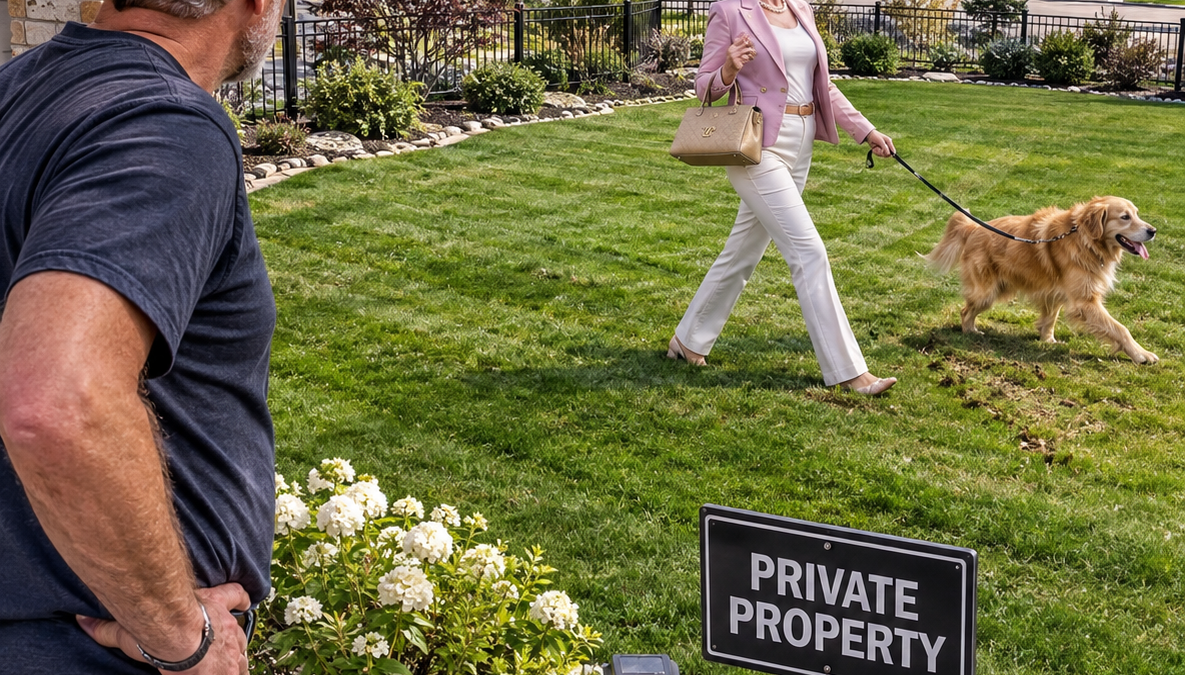
The first time Karen Whitmore deliberately stepped over my PRIVATE PROPERTY sign, looked straight into the security camera, and smiled while her dog tore another muddy track across the lawn I had spent months restoring, I understood that this was no longer about a shortcut—it was about whether she could force me to accept that anything she wanted automatically became “community property.”
I had already asked politely, shown her the recorded plat proving there was no pedestrian easement through my yard, complained to an HOA board that treated her like royalty, and replaced one warning sign after another, yet Karen kept crossing my property every morning with the slow confidence of someone who believed rules only existed for other people.
What finally convinced me to stop arguing wasn’t another footprint or another smug remark—it was what my camera recorded after dark, when Karen thought nobody was watching and walked onto my lawn carrying something that made me realize she wasn’t simply ignoring my boundary anymore.
My name is John Miller, and after twenty years working as a structural engineer, I retired earlier than most people expected.
I wasn’t rich enough to disappear onto an island, and I didn’t want to.
I wanted a quiet house in a quiet neighborhood, enough space for a workshop, a porch where I could drink coffee in the morning, and one good lawn I could maintain without thinking about load calculations, inspections, deadlines, or contractors calling me at six in the morning.
The lawn became ridiculous to me in the best possible way.
I leveled the low spots myself, repaired the irrigation, reseeded the thin sections, edged the beds, and spent evenings sitting on the porch watching green grass move under the breeze instead of staring at spreadsheets.
It was my small piece of order after a career built around solving other people’s problems.
Then Karen discovered that walking diagonally across it saved her perhaps twenty seconds.
The first footprint didn’t bother me.
The second didn’t either.
By the end of the first week, there was a visible trail from the direction of Karen’s driveway toward the main sidewalk.
One morning, I caught her halfway across.
She wore white walking shoes, an ironed blouse, sunglasses, and the expression of a woman who believed being questioned was itself a violation.
Her golden retriever trotted behind her.
“Morning, Karen.”
She stopped.
“John.”
“Would you mind using the sidewalk?”
She looked down at the grass.
“For what?”
“This is my lawn.”
Her eyebrows lifted.
“Oh, John. Don’t start.”
“I’m not starting anything. I’m asking you not to cut across my property.”
She gave me a patient little smile.
“This section is part of a community access easement.”
“No, it isn’t.”
Her smile stopped.
“I’ve seen the map.”
“So have I.”
“I checked the recorded plat when I bought the house. The easement ends at the sidewalk.”
Karen adjusted her sunglasses.
“You may not have the updated version.”
“Recorded where?”
That question irritated her.
She tightened her grip on the leash.
“I help write the HOA rules.”
“That wasn’t my question.”
She stepped closer.
“I am chairwoman of property aesthetics, John. I think I understand how our community functions.”
“And I understand where my property line is.”
For several seconds, neither of us moved.
Then Karen smiled again.
“Lovely grass, by the way.”
She walked straight across it.
The dog followed.
Two days later, I brought photographs to the HOA meeting.
Muddy tracks.
Dog waste near my flower bed.
A worn diagonal line through the grass.
Mark Ellison, the HOA president, barely studied them.
“These could have come from anyone.”
Karen sat three chairs away.
She folded her arms.
“Maybe if John’s yard wasn’t positioned so conveniently, people wouldn’t naturally cross it.”
A few board members laughed.
I looked at Mark.
“So the HOA’s position is that private property becomes public when it’s convenient?”
“That’s not what I’m saying.”
“Then tell her to stop.”
Mark glanced at Karen.
That tiny movement told me everything.
“I think both parties should exercise neighborly judgment.”
Karen smiled.
Meeting over.
The next morning, I installed a red-and-white PRIVATE PROPERTY sign.
Twenty-four hours later, it disappeared.
In its place stood a small wooden marker:
COMMUNITY PATHWAY — HOA AUTHORIZED
I stood staring at it until the anger in my chest turned strangely calm.
That afternoon, I installed cameras.
Three days later, I opened the overnight footage expecting to see Karen’s usual morning shortcut.
Instead, the timestamp read 9:14 p.m.
Karen entered the frame carrying a flashlight in one hand and my missing PRIVATE PROPERTY sign in the other.
Then a second person stepped out of the darkness behind her.
And when I recognized who it was, I stopped the video and played it again from the beginning.
PART 2
The second person was Mark Ellison.
The HOA president.
For a few seconds, I honestly wondered whether I was looking at the wrong date.
Mark had spent the meeting pretending he didn’t know who was crossing my lawn. He had shrugged at my photographs. He had told me the tracks could belong to anyone.
Now here he was at nine-fourteen on a Thursday night, standing in the middle of my property beside the woman responsible for most of them.
I turned up the audio.
The porch camera had caught more than I realized.
Karen’s voice came first.
“Put it farther toward the sidewalk.”
Mark sounded nervous.
“I don’t think we should be doing this ourselves.”
“Doing what? Clarifying access?”
“Karen.”
“Oh, please. He wants a fight.”
“I think he wants people off his lawn.”
She laughed.
“Then he shouldn’t have moved into an HOA.”
I leaned closer to the screen.
Karen planted the little COMMUNITY PATHWAY stake beside the route she’d already worn through my grass.
Mark looked toward my house.
“What about his cameras?”
“They’re unauthorized.”
“You don’t know that.”
“I’ll make them unauthorized.”
That sentence was so clear I replayed it twice.
Mark rubbed the back of his neck.
“I don’t want another complaint.”
“You’re president. Start acting like it.”
“I am acting like it.”
“No. You’re hiding behind procedure.”
She pointed toward my house.
“He’s challenging the board in public. If you let one resident decide the rules don’t apply, everybody starts doing it.”
There it was.
Not concern about access.
Not confusion over a plat.
Control.
Karen bent down, pulled my PRIVATE PROPERTY sign from behind a shrub, and carried it toward Mark’s SUV.
I paused the video.
For almost a minute, I sat in my dark kitchen listening to the refrigerator hum.
Then I saved the clip in three places.
Engineer habit.
Never trust a single point of failure.
By seven-thirty the next morning, Karen was back.
Same dog.
Same diagonal route.
Same smug wave toward the camera.
This time I didn’t confront her.
That seemed to bother her.
She slowed near my porch.
“Morning, John.”
I lifted my coffee.
“Morning.”
“Nothing to say?”
“Beautiful day.”
Her smile twitched.
She had expected anger.
I gave her none.
The moment she reached the sidewalk, I called the county planning office.
A woman named Rachel answered.
I gave her my parcel number and asked for every recorded easement affecting the property.
She emailed the plat within twenty minutes.
Exactly as I remembered.
Utility easement along the rear boundary.
Drainage strip on the east edge.
Nothing crossing the front lawn.
No community pathway.
No pedestrian right-of-way.
No HOA access.
I printed three copies.
Then I called Tom Alvarez next door.
Tom was sixty-four, retired from the county sheriff’s department, and possessed the dangerous combination of too much free time and a sense of humor that had survived thirty years in law enforcement.
He came over wearing slippers.
“You look serious.”
“I’ve got a question.”
“If it’s about hiding a body, I’ve been retired too long.”
I turned the laptop toward him.
He watched the footage.
When Karen’s voice said, I’ll make them unauthorized, Tom’s grin disappeared.
Then Mark appeared.
Tom whistled.
“Well.”
“That’s about where I landed.”
“You saving this?”
“Everywhere.”
“Good.”
“Can an HOA invent an easement?”
“No.”
“Can they fine me for security cameras?”
“They can try to regulate visible exterior modifications if the governing documents allow it.”
“They don’t.”
“Then they can still try.”
“That sounds helpful.”
Tom shrugged.
“I’m explaining reality, not fairness.”
He watched Karen remove the sign.
“That part, though? Taking your property is different.”
“I want this over.”
“Then don’t turn it into a neighborhood screaming match.”
“I wasn’t planning to.”
He looked suspiciously at me.
“What are you planning?”
“I haven’t decided.”
“That answer has gotten engineers and cops in trouble for generations.”
I laughed.
After Tom left, I checked my irrigation controller.
Twelve ordinary sprinkler heads.
Smart scheduling.
Motion integration I had originally installed to discourage deer from the flower beds.
A thought occurred to me.
A harmless one.
Mostly.
I spent the afternoon adjusting the system so that during my normal morning watering window, movement through the middle of the lawn would trigger a short cycle.
No trip wires.
No holes.
No chemicals.
Nothing that could injure anyone.
Just water.
A lot of it.
I tested the pattern from the sidewalk.
The center section came alive in overlapping arcs.
I stood there watching.
Then smiled.
Karen wanted community access.
I was about to make sure the community lawn stayed extremely well hydrated.
The next morning, I woke at six-forty.
Coffee.
Laptop.
Camera feed.
At seven twenty-six, nothing.
Seven twenty-eight.
Motion alert.
Karen appeared at the far edge of the frame.
White heels.
Cream pants.
Light blue blouse.
Golden retriever.
She reached my curb and paused.
For the first time in weeks, she looked toward the house.
Maybe my silence had made her suspicious.
Then she saw the COMMUNITY PATHWAY stake she had planted herself.
Her shoulders relaxed.
She stepped onto the grass.
One step.
Two.
Three.
The sprinklers activated.
Karen disappeared behind a wall of water.
She screamed.
The dog jumped sideways.
One of her shoes sank into the soft soil near the edge of the bed, and she grabbed the leash with both hands while trying to retreat.
Another sprinkler rotated.
Water hit her from the opposite direction.
“JOHN!”
I nearly inhaled my coffee.
She stumbled onto the sidewalk, soaked from shoulders to ankles.
Her sunglasses hung crooked.
Her hair was plastered to one side of her face.
The dog shook himself enthusiastically.
Which somehow made things worse.
Karen looked toward my porch.
I stepped outside.
“Morning.”
“You did this!”
I looked at the sprinkler heads.
“I watered my lawn.”
“You targeted me!”
“You walked through an active irrigation zone.”
“You programmed it!”
“I programmed sprinklers to water my property.”
Her face darkened.
“You think this is funny?”
A drop of water fell from her nose.
I tried very hard to remain serious.
“I think sidewalks are dry.”
“Turn them off!”
“You’re already off the lawn.”
She pointed at me.
“You’ll regret this.”
Then she marched home with one shoe squishing audibly every few steps.
I knew that wasn’t the end.
I had underestimated exactly how much Karen hated being embarrassed.
The pounding on my front door came the following morning.
I opened it.
Karen stood there with a thick HOA folder.
No dog.
No smile.
“John, you’ve crossed a line.”
I leaned against the doorframe.
“Which line?”
“You intentionally assaulted an HOA official.”
“With water?”
“With a targeted irrigation system.”
“On my lawn.”
“You knew I would be walking there.”
“I knew people had been trespassing.”
Her eyes narrowed.
“That route is authorized.”
“Show me the recorded easement.”
“You’ve already been told.”
“Show me.”
“It’s an HOA matter.”
“Then show me the HOA document.”
She opened her folder.
For half a second, I thought she actually had one.
Instead she pulled out a violation notice.
“Unauthorized surveillance equipment visible from a public roadway. Five hundred dollars.”
I read it.
Then looked at her.
“This rule doesn’t exist.”
“It’s under architectural harmony.”
“No, it isn’t.”
“You don’t get to interpret the bylaws.”
“Neither do you.”
“I chair property aesthetics.”
“That doesn’t make you a legislature.”
Her voice dropped.
“You’re becoming a problem.”
That was more revealing than she intended.
I handed the paper back.
She refused to take it.
“Keep it.”
“I won’t pay it.”
“You’ll accumulate late fees.”
“I’ll appeal.”
“I oversee appeals involving property aesthetics.”
I smiled.
“So you’re accusing me, writing the charge, and reviewing the appeal?”
“That’s how committees work.”
“No, Karen.”
I folded the notice.
“That’s how bad committees work.”
She stared at me.
Then glanced toward the nearest camera.
“You’re recording this.”
“Yes.”
“You don’t have my permission.”
“You’re on my porch.”
Her jaw flexed.
“I will have those removed.”
“Get a court order.”
She stepped backward.
“This isn’t over.”
“I know.”
She left.
The next HOA meeting was five days later.
I arrived ten minutes early carrying a laptop, printed plats, a folder of notices, and a USB drive.
Tom was already there.
He saw the equipment.
“Oh, good. Visual aids.”
“Behave.”
“I’ve been waiting fifteen years for someone to say that after retirement.”
The clubhouse filled more than usual.
Karen sat near the middle of the board table.
Mark at the center.
Diane Porter, the treasurer, beside him.
When I entered, Karen gave me a small satisfied smile.
“Mr. Miller.”
“Karen.”
Mark tapped his microphone.
“We’ve received several complaints involving an escalating dispute between residents.”
“Several?” I asked.
“We’ll get to comments later.”
Karen folded her hands.
“Some residents have installed devices designed to intimidate and harass HOA representatives performing official duties.”
Tom whispered:
“Some residents sound terrible.”
I kept my eyes forward.
Mark continued.
“Mr. Miller, you’ve appealed a five-hundred-dollar surveillance violation.”
“Yes.”
“Would you like to explain?”
“Sure.”
I stood.
Connected my laptop to the projector.
First slide:
County plat.
I pointed to the front boundary.
“This is my parcel.”
Karen sighed theatrically.
“We know.”
“This is the recorded sidewalk easement.”
I highlighted it.
“This is the drainage easement.”
Another highlight.
“This is the utility easement.”
I looked at Karen.
“Would anyone like to point out the pedestrian easement through my lawn?”
Silence.
Mark shifted.
“HOA rules may recognize common access independent of county—”
“No.”
I clicked to the governing declaration.
“Section eight requires any common-access easement to be identified on a recorded plat or separate recorded instrument.”
Tom leaned back.
A woman behind him murmured:
“He came prepared.”
Karen said:
“Historical use establishes—”
“Not an HOA easement.”
I clicked again.
Video.
Karen crossing.
Day one.
Day three.
Day seven.
Dog.
Footprints.
Her sarcastic wave.
The room became quiet.
Then the night footage began.
Karen appeared carrying my sign.
Mark appeared behind her.
His face changed instantly.
“John,” he said.
I let the video play.
Put it farther toward the sidewalk.
I don’t think we should be doing this ourselves.
I’ll make them unauthorized.
Then Karen removed my sign.
The clip ended.
Nobody spoke.
Mark stared at the table.
Diane stared at Karen.
Karen’s mouth tightened.
“That was taken out of context.”
Tom laughed once.
Loudly.
“What context makes stealing a private-property sign better?”
Karen stood.
“I did not steal anything. I removed an unapproved visual obstruction.”
“From my property.”
“It violated community aesthetics.”
“Then where is it?”
She didn’t answer.
I looked at Mark.
He avoided my eyes.
“You told me my photographs could have been anyone.”
Mark swallowed.
“I was trying to de-escalate.”
“You were on my lawn at night helping her replace my sign.”
“I did not help her remove anything.”
The distinction was pathetic.
Karen cut in.
“This meeting is becoming a personal attack.”
A woman in the back raised her hand.
“Maybe because you’ve been personally attacking people for years.”
Heads turned.
Patricia Greene.
Widowed.
Soft-spoken.
I’d barely heard her speak at meetings.
Karen looked offended.
“Excuse me?”
Patricia stood.
“You fined me two hundred dollars because my Christmas wreath went up November twenty-fifth.”
“That was an established seasonal-display period.”
“You threatened a lien.”
“That is standard enforcement.”
Another man stood.
“You fined me for my mailbox flag.”
Someone else:
“You cited my kids’ basketball hoop.”
Another:
“You told me my porch chairs were the wrong shade of gray.”
The room erupted.
Not screaming.
Stories.
Dozens of them.
Karen looked around as though strangers had invaded.
Mark banged the gavel.
“Order!”
Tom leaned toward me.
“Interesting structural failure.”
I almost smiled.
Karen grabbed her folder.
“This is exactly what happens when rules stop being respected.”
She stormed out.
The door slammed.
For the first time, I realized my lawn wasn’t really the issue anymore.
It had merely been the place where one resident finally stopped moving aside.
After the meeting, Patricia caught me near the exit.
“Thank you.”
“I haven’t done anything yet.”
“You did enough.”
“What does that mean?”
She glanced toward the parking lot.
“People are afraid of her.”
“Why?”
“Because if you challenge one fine, you get three more.”
A man beside her nodded.
“She controls inspections.”
Another woman added:
“And Mark lets her.”
I looked back toward the board table.
Mark was packing papers alone.
Something about his face bothered me.
Not arrogance.
Fear.
I walked over.
“Mark.”
He froze.
“John.”
“What is she holding over you?”
His eyes snapped toward mine.
“That is an inappropriate question.”
“Probably.”
I lowered my voice.
“You don’t act like someone who agrees with her. You act like someone who’s afraid to disagree.”
His chair scraped.
“I think you should leave.”
“Okay.”
I turned.
Then he said quietly:
“Be careful.”
I looked back.
He was already walking away.
That night, another motion alert hit at nine-oh-seven.
Karen again.
Flashlight.
She stepped onto the lawn near the pathway stake.
The sprinklers activated.
She jumped backward before getting fully soaked.
This time there was no comedy.
She stared directly at the camera.
Then raised her phone and photographed each sprinkler head.
The next morning, I received:
FINAL NOTICE — AGGRESSIVE PROPERTY MODIFICATION
It accused me of creating “targeted environmental hazards.”
I appealed.
Two days later came another letter.
MANDATORY PROPERTY INSPECTION.
Karen would lead it.
Saturday at nine.
I called Rachel Barnes, a property attorney Tom recommended.
I sent her the plat, videos, bylaws, fines, and inspection notice.
She called that afternoon.
“I’ve seen HOAs overreach.”
“How bad?”
“Your cameras are probably defensible under the documents you’ve sent. The easement claim is weak. The retaliatory pattern is more interesting.”
“What should I do Saturday?”
“Do not obstruct a lawful inspection if your governing documents authorize reasonable exterior inspections.”
“They do.”
“Film it.”
“I planned to.”
“Don’t antagonize her.”
“I wasn’t planning to.”
Rachel paused.
“John.”
“Yes?”
“Tom described you as ‘an engineer who gets quiet when he’s plotting.’”
I closed my eyes.
“I need better friends.”
Saturday morning, Karen arrived with Mark and Diane.
I opened the front door.
Karen held her clipboard against her chest.
“We’ll begin at the driveway.”
“Have fun.”
“We need you present.”
“I’ll be right here.”
She measured the mailbox.
Photographed my fence.
Crouched beside the flower border.
Checked the distance from a shrub to the sidewalk.
Then she stood in the center of my lawn.
“Uneven turf.”
I looked down.
The worn diagonal path was still visible.
“Wonder how that happened.”
“You may be required to resod.”
“Because you damaged it?”
She wrote something.
Mark looked miserable.
Diane said nothing.
Karen moved toward one of the cameras.
“This unit is clearly visible from common space.”
“Yes.”
“Violation.”
“Show me the rule.”
“You’ve received the citation.”
“That isn’t the rule.”
She smiled.
“You’re very argumentative.”
“And you’re very bad at answering simple questions.”
Mark stepped between us verbally.
“Let’s keep the inspection professional.”
I looked at him.
“Professional would have been not planting a fake pathway marker on my property after dark.”
His face reddened.
Karen snapped:
“We are finished here.”
She turned and walked away.
But at the sidewalk she looked back.
“Your lawn isn’t going to remain private much longer.”
That sentence stayed with me.
Monday morning explained why.
Every doorstep in the neighborhood received a yellow flyer.
COMMUNITY POLICY UPDATE
Lawns immediately adjacent to common sidewalks may be designated community access zones when necessary for pedestrian circulation and safety.
Signed:
Karen L. Whitmore
Chair, Property Aesthetics
I read it twice.
Then called Rachel.
“She did what?”
I read it aloud.
Rachel was silent.
Then:
“When was this voted on?”
“I don’t know.”
“Board minutes?”
“Nothing posted.”
“Notice period?”
“None.”
“Get me the last six months of minutes.”
I did.
No proposed amendment.
No vote.
No homeowner notice.
No recorded change.
Karen had simply written a flyer and declared new law.
Tom came over holding his copy.
“She really can’t help herself.”
“She just made it easier.”
“How?”
“Before, she claimed the rule existed.”
I held up the flyer.
“Now she’s creating a rule after the dispute started and applying it to my property.”
“Retaliation.”
“Exactly.”
Tom grinned.
“You’ve got that engineer face.”
“What face?”
“The one that says somebody put a load-bearing wall in the wrong place.”
I didn’t need another physical prank.
The sprinklers had made the point.
Anything more elaborate could create exactly the story Karen wanted—that I was dangerous, vindictive, unstable.
So I decided the next trap would be administrative.
Karen worshiped paperwork.
I would give her enough paperwork to bury herself.
Rachel drafted a formal demand asking the board to identify:
The date of the vote.
The quorum.
The authority.
The exact parcels designated.
The engineering or safety study justifying pedestrian access.
Any insurance review.
Any recorded easement.
Any legal opinion.
Any conflict disclosures involving the rule.
We sent it certified.
Then I placed a fresh sign on my lawn:
PRIVATE PROPERTY — NO PEDESTRIAN EASEMENT RECORDED
Below it:
ALL ACCESS CLAIMS MUST BE PROVIDED IN WRITING
Karen saw it the next morning.
She stopped.
Read every word.
Then looked toward my camera.
She smiled.
And walked across anyway.
But she didn’t know the camera wasn’t the trap anymore.
The letter was.
Three days later, the HOA responded.
Not with documents.
With another fine.
Seven hundred fifty dollars.
OBSTRUCTION OF COMMUNITY ACCESS.
Rachel called.
“Good.”
“That’s good?”
“Very.”
“I owe seven hundred fifty dollars.”
“No. You received evidence that they enforced the new rule without answering whether the rule legally exists.”
I laughed.
“Lawyers have strange hobbies.”
“Engineers aren’t allowed to judge.”
Then something unexpected happened.
Diane Porter came to my house.
Alone.
She looked over both shoulders before stepping onto the porch.
“Can we talk?”
“Sure.”
“Inside?”
That worried me.
I let her into the living room.
She refused coffee.
Her hands trembled slightly around her purse.
“I shouldn’t be here.”
“Then why are you?”
“Because Karen is getting worse.”
I waited.
Diane looked toward the window.
“Mark never approved that policy.”
“I figured.”
“Neither did I.”
“So Karen fabricated a board rule.”
“She says as aesthetics chair she has emergency authority.”
“Does she?”
“No.”
“Then why are you letting her?”
Diane’s eyes filled with frustration.
“Because every time somebody challenges her, she finds something.”
“Something what?”
“A violation. An old receipt. A technical mistake.”
She swallowed.
“And because Mark owes the association money.”
I sat forward.
“What?”
“He approved reimbursements without documentation two years ago. Nothing enormous. But Karen found it during an audit and threatened to accuse him of stealing if he opposed her.”
That explained his fear.
“What about you?”
Diane looked down.
“I signed checks.”
“For what?”
“I don’t know anymore.”
My stomach tightened.
“Diane.”
“There are expenses Karen called consulting.”
“How much?”
“I’d need to check.”
“Who was paid?”
She stared at her hands.
“Whitmore Property Solutions.”
Karen’s last name.
I felt the room go still.
“Does that company exist?”
“I couldn’t find it.”
“Why are you telling me?”
“Because you’re forcing everyone to look.”
Her voice cracked.
“And I think we’re going to find something worse than fake lawn rules.”
The following week changed the entire neighborhood.
Diane turned over copies of financial records to Rachel and the rest of the board.
Four years of payments.
Most legitimate.
Landscaping.
Pool service.
Insurance.
Roof repairs.
Then dozens labeled:
Community Improvement Consulting
Compliance Review Support
Property Standards Coordination
The vendor varied.
Whitmore Property Solutions.
WPS Consulting.
Community Standards Group.
Addresses led to mailboxes.
A residential address tied to Karen’s sister.
One was a UPS store.
The total wasn’t forty-two hundred.
It was more than forty-two thousand dollars.
Tom sat at my dining table when Rachel gave us the number.
“Forty-two grand?”
“Approximately.”
“For what?”
Rachel shook her head.
“We don’t know yet.”
Tom leaned back.
“She financed her dictatorship.”
Rachel looked at me.
“You need to stay out of the financial investigation.”
“Gladly.”
“Let the board’s attorney and auditor handle it.”
“I only wanted her off my lawn.”
Tom laughed.
“That’s how revolutions start.”
An emergency HOA meeting was scheduled.
Karen arrived.
That surprised everyone.
She walked in wearing a navy suit.
Hair perfect.
Folder under her arm.
No hesitation.
She took her usual chair.
Mark sat at the center.
Diane beside him.
Both looked pale.
I sat with Tom in the second row.
Mark cleared his throat.
“We need to discuss allegations regarding association funds.”
Karen spoke immediately.
“I object to the word allegations.”
Mark looked at her.
“What word would you prefer?”
“Accounting irregularities.”
Diane slid a folder toward him.
“These are not irregularities.”
Karen turned.
“Diane.”
Something in her voice sounded like a warning.
Diane’s hands shook.
But she kept speaking.
“I found payments to companies I can’t verify.”
“They were consultants.”
“For what?”
“Compliance services.”
“Who performed them?”
Karen’s expression hardened.
“Independent contractors.”
“Names.”
“That information may be confidential.”
A homeowner shouted:
“With our money?”
Mark banged the gavel.
Karen leaned closer to Diane.
“You approved those checks.”
Diane went white.
“I signed based on invoices you provided.”
“So you’re equally responsible.”
There it was.
The trap Karen always used.
Shared blame.
Fear.
Silence.
Diane took a breath.
Then pushed another document across the table.
“No.”
Karen stared.
Diane continued.
“I brought the records to the board attorney this morning.”
The room erupted.
Karen stood.
“You had no authority.”
“I’m treasurer.”
“You violated confidentiality.”
“It’s association money.”
Karen’s face changed.
For the first time since I’d met her, she looked afraid.
Not embarrassed.
Afraid.
Mark said:
“Karen, effective immediately, your committee authority is suspended pending an independent audit.”
She laughed.
“You can’t suspend me.”
“Yes, we can.”
“You wouldn’t be president without me.”
Mark’s face tightened.
“Maybe that’s part of the problem.”
She turned toward me.
“This is him.”
I raised an eyebrow.
“This man orchestrated this.”
I didn’t stand.
“I didn’t write the checks.”
“You poisoned everyone.”
“I asked you to stop walking across my lawn.”
People laughed.
That made her angrier.
“You humiliated me.”
“You ignored a sign.”
“You created traps.”
“I watered grass.”
The room burst into louder laughter.
Karen slammed her folder onto the table.
“You think this is funny?”
Nobody answered.
She looked around at neighbors who had spent years lowering their eyes.
Now they looked back.
Patricia stood.
“No.”
Her voice was quiet.
“We think we’re done being afraid of you.”
That silence was different.
Karen had no procedure for it.
No violation number.
No committee authority.
No fine.
She grabbed her purse and walked out.
The audit took three weeks.
During that time, the neighborhood felt suspended between relief and dread.
Nobody knew whether Karen had truly taken money or whether she had created sloppy shell vendors to pay legitimate contractors.
I hoped, strangely, that it was the second.
I wanted her removed from power.
I didn’t want her life destroyed.
Then the auditor reported.
Forty-two thousand eight hundred dollars in unsupported payments.
Several charges to association credit cards for furniture that could not be located in common areas.
Wine purchases tied to community events that never happened.
Reimbursements for “inspection travel” inside a neighborhood that could be crossed on foot in ten minutes.
Payments to a consulting company registered to a mailbox Karen controlled.
The board referred the matter to authorities.
Every fine Karen had issued to me after our first dispute was suspended.
Then came the most satisfying document of all.
Not an arrest warrant.
Not a lawsuit.
A refund.
Twelve hundred dollars.
Wrongful fines.
I sat on the porch holding the check.
Tom walked over with two beers.
“What are we celebrating?”
I handed it to him.
He whistled.
“Twelve hundred.”
“They charged me to be trespassed against.”
“Efficient.”
He gave it back.
“You cashing it?”
“Absolutely.”
“Buying new sprinklers?”
“No.”
“Missed opportunity.”
The next morning, I found a handwritten envelope.
No stamp.
No return address.
Inside:
You think you won. You have no idea what I’m capable of. —K
I photographed it.
Bagged it.
Called Rachel.
She told me to keep it.
I did.
I also increased the camera retention.
Karen’s house went quiet.
Then, one evening, a moving truck appeared.
I stood at my window and watched.
No blazer.
No clipboard.
Karen wore jeans and a hoodie.
Her hair was tied back.
She carried boxes from the garage.
For a moment, I felt satisfaction.
Then something else.
Sadness, maybe.
Not for what she lost.
For how unnecessary all of it had been.
She could have used the sidewalk.
That was literally where this started.
Twenty extra seconds.
Instead, she had treated a boundary like an insult and built an entire conflict around refusing to respect it.
She looked toward my house.
Our eyes met through the fading light.
Neither of us waved.
Neither spoke.
Then she got into her car.
The moving truck followed.
She disappeared around the corner.
The next morning, a FOR SALE sign stood in her yard.
A week later, the HOA voted to remove her remaining authority permanently.
The bylaws were rewritten.
No committee chair could independently issue fines.
Appeals had to be heard by people who had not issued the original violation.
New policies required recorded votes.
Financial records became available to homeowners.
Major vendor contracts required competitive bids.
And no new access designation could be created without legal review and recorded property documentation.
Tom leaned over during the final vote.
“Look at that.”
“What?”
“You created democracy with a lawn sprinkler.”
“Don’t put that in the minutes.”
He wrote something on his copy.
I sighed.
Afterward, Mark found me outside.
“John.”
I stopped.
He looked exhausted.
“I owe you an apology.”
“You owe the whole neighborhood one.”
“I know.”
He nodded.
“I should’ve stopped her.”
“Why didn’t you?”
His jaw tightened.
“Fear.”
At least he admitted it.
“She had those reimbursement records.”
“Were you stealing?”
“No.”
“What happened?”
“My wife had surgery. I paid a contractor out of pocket for an emergency common-area repair while everything at home was falling apart. I submitted receipts late. Karen found discrepancies and made it sound criminal.”
“So you let her control the board.”
“Yes.”
I appreciated the honesty more than an excuse.
“You still made choices.”
“I know.”
“What now?”
“I won’t run again.”
“That may be best.”
He smiled sadly.
“Probably.”
Then he held out his hand.
I shook it.
Not forgiveness exactly.
But an ending.
I thought that was the end of Karen’s story.
It wasn’t.
Two months later, a plain white envelope appeared in my mailbox.
Inside was a cashier’s check.
Five thousand dollars.
I thought it had been mailed to the wrong person.
Then I found the note.
Thank you for standing up to her.
She fined some of us until we learned silence was cheaper.
We can’t undo those years, but we can help repair what started the change.
Use this for the neighborhood.
No names.
Only:
From the ones she fined into silence.
I sat on the porch for a long time.
Five thousand dollars.
I didn’t want it.
Tom arrived that afternoon.
He read the note.
“You’ve got anonymous donors.”
“I don’t want their money.”
“Then don’t keep it.”
“Return it to who?”
“Exactly.”
He looked toward the end of the cul-de-sac.
There was an unused common green.
Mostly weeds.
A dying bench.
“Build something.”
I followed his gaze.
“With five thousand dollars?”
“You’re the engineer.”
“Retired engineer.”
“Apparently not retired enough to weaponize irrigation.”
I laughed.
But the idea stayed.
At the next HOA meeting—my first as an elected volunteer member, against my better judgment—I proposed a community garden.
No decorative perfection standards.
No plant-color rules.
No fines because a tomato vine grew two inches too far.
Raised beds.
Herbs.
Vegetables.
Flowers.
Benches.
Solar lights.
Anyone could participate.
Patricia raised her hand.
“I’ll bring seeds.”
Tom said:
“I’ll build the boxes.”
A young couple volunteered irrigation supplies.
Someone else offered compost.
A teenager said his landscaping class needed service hours.
The vote was unanimous.
Two months later, the empty green was alive.
Tomatoes.
Lavender.
Basil.
Mint.
Sunflowers taller than some of the children watering them.
People who had sat silently beside one another in HOA meetings now traded zucchini.
Patricia hung a wreath on the garden shed in October.
Nobody fined her.
I made sure of it.
One evening, Tom handed me a beer.
“You know what’s irritating?”
“What?”
“This is actually nice.”
“Terrible.”
“We should file a complaint.”
“Anonymous, obviously.”
We sat on the bench under the new solar lights.
Kids ran between the garden beds.
Somebody’s radio played softly.
The air smelled like tomatoes and damp soil.
For months, I had thought victory would feel like watching Karen lose.
It didn’t.
This did.
Then Karen’s old house sold.
The new owner arrived on a Saturday afternoon.
Moving truck.
Boxes.
A woman in her mid-forties wearing jeans and a T-shirt that read:
MAKING SIMPLE THINGS COMPLICATED SINCE FOREVER
I laughed the first time I saw it.
I walked over.
“Welcome.”
She set down a box.
“Thanks.”
“I’m John.”
Her expression shifted.
“John Miller?”
“That sounds ominous.”
She smiled.
“I’m Laura.”
We shook hands.
Then she glanced toward the house.
“My sister used to live here.”
I felt my stomach tighten.
“Your sister?”
“Karen Whitmore.”
For half a second, I wondered whether I had accidentally walked into part two.
Laura saw my face.
“Oh, don’t worry.”
She laughed.
“We haven’t spoken much in over a year.”
I relaxed slightly.
“She told me stories about this neighborhood.”
“I’m sure.”
“Her version was… creative.”
“That sounds accurate.”
Laura looked toward my lawn.
“Were you the sprinkler guy?”
I closed my eyes.
“Apparently that’s my legacy.”
She laughed.
“That video reached Arizona.”
“Great.”
“Karen hated it.”
“I assumed.”
Laura became quieter.
“She was always difficult.”
I didn’t respond.
“When we were kids, she couldn’t stand being told no. If our parents said no, she’d convince herself the rule was unfair. If I had something she wanted, she’d explain why sharing meant giving it to her.”
That sounded painfully familiar.
“What happened to her?”
“She moved to Arizona.”
“HOA?”
Laura grinned.
“No HOA.”
I laughed.
“You’re kidding.”
“Nope. She specifically searched for a place without one.”
“That is poetic.”
“She grows vegetables.”
I stared.
“What?”
“Tomatoes. Peppers. Apparently she’s obsessed.”
I looked toward the community garden.
Somewhere in the universe, irony had a sense of humor.
“Is she okay?”
Laura studied me as if she hadn’t expected the question.
“I think she’s trying.”
“That wasn’t what I asked.”
“No.”
She sighed.
“I don’t think she’s okay yet.”
I nodded.
Laura picked up her box.
“I’m not asking you to forgive her.”
“Good.”
“She did awful things.”
“Yes.”
“But losing everything forced her to look at herself.”
“That can happen.”
Laura smiled sadly.
“Maybe someday she’ll become someone different.”
“Maybe.”
I genuinely hoped so.
Not because she deserved freedom from consequences.
Because everyone around her deserved freedom from a repeat.
Laura turned out to be a good neighbor.
She used the sidewalk.
That became a running joke between us.
The first morning she passed my house, she pointed dramatically down at the concrete.
“Look, John!”
I looked.
“What?”
“Sidewalk.”
“Revolutionary.”
“No sprinklers!”
“Usually.”
She laughed and kept walking.
The months passed.
My lawn recovered.
I removed the fake COMMUNITY PATHWAY stake but kept it in my garage.
Tom wanted to mount it on a plaque.
I refused.
He threatened to do it while I was away.
I told him my cameras had improved.
The association changed too.
Meetings shortened.
Fines dropped.
Warnings replaced punishment for minor issues.
Neighbors appealed without fearing retaliation.
The financial audit became public.
Mark stepped down.
Diane stayed long enough to help rebuild the accounting system, then resigned voluntarily.
Patricia joined the board.
She lasted six months before announcing she hated meetings too much.
That was probably the healthiest qualification anyone had ever brought to HOA leadership.
I stayed involved only because the garden needed a liaison.
I refused every nomination for president.
Tom nominated me anyway each year for entertainment.
“John Miller.”
“No.”
“Nominations haven’t opened.”
“My answer is still no.”
“You’d be excellent.”
“Exactly why I don’t want it.”
The sprinklers returned to normal scheduling.
No special motion routine.
No Karen hours.
I kept the cameras.
Not because I expected trouble.
Because retirement had not cured me of redundant systems.
One Sunday morning, almost a year after the original fight, I stepped outside with coffee.
The lawn was wet with dew.
No footprints.
No fake signs.
No dog waste.
Just grass.
That should not have felt extraordinary.
It did.
I walked toward the mailbox.
There was another envelope.
For one second, old tension tightened my shoulders.
I opened it.
A photograph.
Karen.
Standing beside a small vegetable garden in Arizona.
No makeup.
Baseball cap.
Gloves.
She looked older.
More ordinary.
On the back, Laura had written:
She said I could show you this. She wouldn’t let me send a message from her. Maybe this is as close as she can get right now.
I stared at the picture.
Karen held a tomato.
Behind her stood a small sign.
PLEASE STAY ON THE PATH
I laughed so suddenly coffee came out my nose.
Tom heard me from his driveway.
“What?”
I held up the photograph.
He came over.
Read the sign.
Then bent over laughing.
“You have to frame this.”
“No.”
“John.”
“No.”
“This belongs in the clubhouse.”
“Absolutely not.”
“She finally believes in paths.”
“Go home, Tom.”
He wiped his eyes.
“You know she’s going to hate that you’re laughing.”
“I think she’s aware.”
I took the photograph inside.
I didn’t frame it.
But I kept it.
Not as a trophy.
As proof people can sometimes learn, even after learning becomes expensive.
That summer, the community garden expanded.
The anonymous five thousand dollars had covered the original beds and lighting. Donations handled the rest.
We added a small reading bench beneath a maple.
A tool shed.
A rain barrel.
Children painted wooden stones with vegetables and flowers.
No committee reviewed the colors.
One afternoon, Patricia stopped beside me while I was fixing an irrigation connector.
“You know what Karen would say about this?”
“What?”
“She’d say the painted rocks violate visual consistency.”
I looked at one shaped like a purple strawberry.
“She’d be right.”
Patricia gasped.
I smiled.
“They’re terrible.”
A little girl nearby shouted:
“I MADE THAT!”
I raised both hands.
“It is magnificent.”
Patricia laughed.
That night, I sat alone on my porch.
The sky faded from orange to blue.
The garden lights came on at the end of the street.
My lawn moved gently in the breeze.
I remembered the beginning.
One footprint.
Then two.
A diagonal trail.
How small it seemed.
How foolish.
But boundaries often work that way.
Nobody announces that they’re about to test how much of you they can take.
They take one step.
Then another.
They watch whether you object.
They listen to how firmly you say no.
Karen heard no as a challenge.
I had eventually answered with evidence.
The sprinklers were funny.
I won’t pretend they weren’t.
Seeing a woman who had mocked me for months get drenched on the exact grass she refused to stop crossing gave me a moment of satisfaction.
But the sprinklers didn’t defeat Karen.
Her own choices did.
The fake easement.
The stolen sign.
The invented policy.
The retaliatory fines.
The shell-company payments.
The threats.
I didn’t need to create evidence against her.
I needed to stop allowing her to hide the evidence she created herself.
That was the real trap.
She thought she was walking across a lawn.
She was walking through cameras, documents, witnesses, board minutes, financial records, and finally a neighborhood that had stopped pretending not to see.
Months later, I replaced one last damaged strip of grass near the sidewalk.
Tom wandered over.
“You know synthetic turf would be easier.”
“Get off my property.”
He laughed.
“Still touchy.”
“Very.”
“You keeping the sprinklers?”
“Obviously.”
“Motion sensors?”
“For deer.”
He nodded.
“Sure.”
I pushed the final piece of sod into place.
Then stepped back.
The old diagonal shortcut was gone.
Not covered.
Gone.
There was no worn trail anymore because nobody used it.
People took the sidewalk.
Even kids.
Even delivery drivers.
Laura’s dog occasionally stared longingly across the grass before she tugged him back.
“Don’t even think about it,” she’d tell him.
Sometimes she’d look toward my porch when she said it.
I pretended not to notice.
On the second anniversary of the incident, the garden committee held a small summer dinner.
Nobody called it an anniversary.
Tom did bring a cake decorated like a sprinkler.
I considered throwing him out.
Patricia stopped me.
The neighborhood gathered under string lights.
People ate tomatoes and herbs grown thirty yards from where Karen once ruled meetings with a clipboard.
Mark came.
That surprised me.
He had moved across town but received an invitation from Diane.
He approached awkwardly.
“John.”
“Mark.”
“The garden looks good.”
“It is.”
He stared at the children running between the beds.
“I’ve wanted to say something.”
“You already apologized.”
“Not for all of it.”
I waited.
He looked toward the ground.
“I knew some of Karen’s fines were ridiculous before your dispute.”
“I assumed.”
“I told myself keeping her happy kept the association stable.”
“That worked well.”
He smiled painfully.
“No.”
He took a breath.
“I confused quiet with peace.”
That sentence stayed with me.
Because I had done something similar.
When I first moved in, I thought peace meant avoiding conflict.
Smile.
Be polite.
Don’t make scenes.
Let small things go.
Most of the time, that’s good advice.
But quiet isn’t always peace.
Sometimes quiet is what fear sounds like when everyone has learned complaining costs too much.
I held out my hand.
Mark shook it.
“Good to see you.”
“You too.”
He left before dark.
Later, Tom and I sat near the garden.
He handed me a beer.
“Think Karen would’ve liked this?”
“The garden?”
“Yeah.”
I thought about the photograph from Arizona.
“Probably.”
“Think she’d have tried to regulate it?”
“Definitely.”
He laughed.
Then the laughter faded.
“You ever regret the sprinklers?”
I looked toward my lawn.
“No.”
“The humiliation?”
I considered that longer.
“A little.”
Tom raised an eyebrow.
“Really?”
“I wanted her to stop.”
“Fair.”
“I didn’t want her life to collapse.”
“That wasn’t because of water.”
“I know.”
“But?”
I stared at the lights.
“It feels different when you’re watching someone lose everything, even when they built the machine themselves.”
Tom nodded.
“That’s what separates consequences from revenge.”
“Since when did you become philosophical?”
“Third beer.”
“Fair.”
A breeze moved through the mint.
Children laughed near the far end of the garden.
I thought of Karen holding the tomato.
Maybe she had finally found something she could control without controlling another person.
Soil.
Water.
Seeds.
Sun.
Even those don’t obey perfectly.
Maybe that was good for her.
A month later, Laura knocked on my door.
She held an envelope.
I groaned.
“If this is another HOA notice—”
“It isn’t.”
“Anonymous donation?”
“No.”
“Lawsuit?”
“John.”
“Sorry.”
She handed it to me.
From Arizona.
Karen’s handwriting.
I stood on the porch without opening it.
Laura looked nervous.
“She said you don’t have to read it.”
“Then why send it?”
“I asked the same thing.”
“What did she say?”
“That she needed to write it even if you burned it.”
I opened the envelope.
One page.
No excuses at first.
That surprised me.
John,
I have rewritten this letter six times because every version sounded like I was explaining myself instead of apologizing. Laura told me that’s what I always do.
I stopped.
Laura smiled slightly.
“She does listen occasionally.”
I continued.
I was wrong about your property. I knew the easement wasn’t what I said it was. I believed that because I had spent years enforcing rules, I had earned the right to decide when rules needed to bend. Then I became angry because you wouldn’t let me decide for you.
My throat tightened unexpectedly.
The sprinklers were humiliating. At the time I thought humiliation was the worst thing you had done to me. It took losing my position, my home, several friendships, and a lot of money to understand that the humiliation came from being seen clearly.
I read that sentence again.
I’m paying back what the association says I owe. I don’t expect forgiveness. I don’t expect a reply. I only wanted to say something I should have said the first week.
It was your lawn.
I should have used the sidewalk.
Karen
I lowered the letter.
Laura waited.
“Well?”
“I don’t know.”
“That sounds fair.”
I read the final two lines again.
It was your lawn.
I should have used the sidewalk.
I laughed softly.
Not at her.
At how absurdly simple the entire beginning had been.
Twenty seconds.
That’s what all of it started over.
Maybe less.
A twenty-second shortcut.
Laura leaned against the railing.
“Are you going to answer?”
“I don’t know.”
“Also fair.”
She started toward the steps.
“Laura.”
She turned.
“Tell her I got the letter.”
“Anything else?”
I looked toward the lawn.
“Tell her the grass recovered.”
Laura smiled.
“I think she’ll understand.”
That was the only reply I ever sent.
Years passed.
Not dramatically.
That’s the important part.
The neighborhood stopped producing stories.
No viral meetings.
No threatening notes.
No financial scandal.
No committee warfare.
The garden grew.
Children who once painted rocks badly became teenagers who complained about pulling weeds.
Tom became more annoying with retirement.
Patricia adopted a small terrier that hated everybody equally.
Laura repainted Karen’s old front door dark blue.
Under the old regime, it probably would have required three forms.
Nobody cared.
I finally converted part of my garage into the woodworking shop I’d planned when I moved in.
That mattered to me.
For a long time, every project around the house had felt connected to the dispute.
Cameras.
Signs.
Irrigation.
Evidence folders.
Now I built chairs.
Bookshelves.
A cedar bench for the garden.
Things that existed because I wanted them, not because I needed to defend something.
One fall morning, I walked outside and noticed footprints in the lawn.
Small.
Muddy.
Diagonal.
I froze.
Then heard laughter.
A little boy from across the street was chasing a soccer ball.
He reached it, saw me, and stopped.
“Sorry, Mr. Miller.”
I looked at the grass.
One set of footprints.
He looked terrified.
Not because of me.
Because every neighborhood eventually develops legends.
Apparently I had become the sprinkler man.
I smiled.
“Ball get away from you?”
He nodded.
“You okay?”
“Yes.”
“Then go play.”
He hesitated.
“I’m not in trouble?”
“No.”
He picked up the ball.
Then carefully returned to the sidewalk.
I watched him run away.
The footprints remained.
Years earlier, they might have ruined my morning.
I went inside.
Finished my coffee.
An hour later, the sun dried them.
That was when I understood I had finally gotten my peace back.
Not when Karen moved.
Not when the board changed.
Not when the refund arrived.
Not when she apologized.
That morning.
Because I could look at footprints in my grass and see footprints.
Not disrespect.
Not a challenge.
Not the beginning of another war.
Just a kid retrieving a ball.
That afternoon, I went to the community garden.
Tom sat on the bench I built.
He looked suspiciously comfortable.
“You’re sitting on my work.”
“I thought this was community property.”
I stared at him.
He immediately stood.
“Too soon?”
“It’s been years.”
“So yes?”
“Sit down, Tom.”
He grinned.
I sat beside him.
The garden was nearly finished for the season.
Tomato vines browning.
Sunflowers bent.
Mint still refusing to die.
The solar lights would come on soon.
A few houses away, my lawn stretched green between the porch and sidewalk.
No signs.
I had removed the PRIVATE PROPERTY notice a year earlier.
Not because the property stopped being private.
Because everyone finally knew where the line was.
And respected it.
You shouldn’t need a sign when respect is doing its job.
Tom nodded toward the grass.
“Remember when Karen used to walk through there every morning?”
“Unfortunately.”
“Best entertainment this neighborhood ever had.”
“The bar is low.”
“Remember the first sprinkler hit?”
“I was there.”
“I wish I’d filmed your face.”
“I was drinking coffee.”
“You looked like a Bond villain.”
“Go home.”
He laughed.
Then grew quiet.
“Funny thing.”
“What?”
“She thought power was getting to walk wherever she wanted.”
I looked at him.
“And?”
“Turns out power was everybody finally telling her she couldn’t.”
I considered correcting him.
Then didn’t.
The lights came on one by one around the garden.
Soft yellow points along the path.
The original anonymous donation had paid for those lights.
Every time they came on, I remembered the note.
From the ones she fined into silence.
They weren’t silent anymore.
Neither was I.
But none of us had to shout.
That was the part Karen had never understood when she held power.
Boundaries don’t destroy community.
They make community possible.
My lawn could be mine.
Her house could be hers.
The sidewalk could belong to everyone.
We could share a garden because we chose to.
Respect wasn’t everybody getting access to everything.
Respect was asking.
Listening.
Accepting no.
And knowing that another person’s boundary wasn’t an insult.
The sprinklers had eventually become ordinary again.
Tuesday, Thursday, Saturday.
Five-thirty in the morning.
No sensors aimed at Karen hours.
No cameras waiting for a spectacle.
Just water crossing grass in slow silver arcs before sunrise.
Sometimes I woke early enough to watch.
The pattern was still precise.
Engineer habits.
One morning, years after the whole mess, I stepped onto the porch with coffee and saw the sprinklers running.
The rising sun caught the mist.
For a second, the lawn looked almost gold.
I could hear Tom’s dog barking.
A delivery truck farther down the street.
Someone opening a garage door.
Normal noise.
Then Laura came walking along the sidewalk.
She stopped when she saw me.
Raised both hands theatrically.
“Look!”
I looked.
“Still on the sidewalk!”
I laughed.
“Excellent work.”
“Five consecutive years.”
“I’m proud of you.”
“Think I earn access privileges?”
“No.”
She grinned.
“Worth a shot.”
She kept walking.
I watched her disappear around the corner.
Then I looked across the lawn.
The old diagonal path existed only in my memory.
Grass had filled it completely.
No scar.
No worn dirt.
Nothing marking where the conflict had once run from one side of my life to the other.
I took a sip of coffee.
One sprinkler rotated toward the sidewalk.
Stopped exactly where it should.
Turned back.
Water stayed inside the property line.
I smiled.
After everything, that tiny detail felt perfect.
Not because Karen had lost.
Because the line no longer needed a fight.
It was simply there.
And everyone knew it.
[END OF STORY]