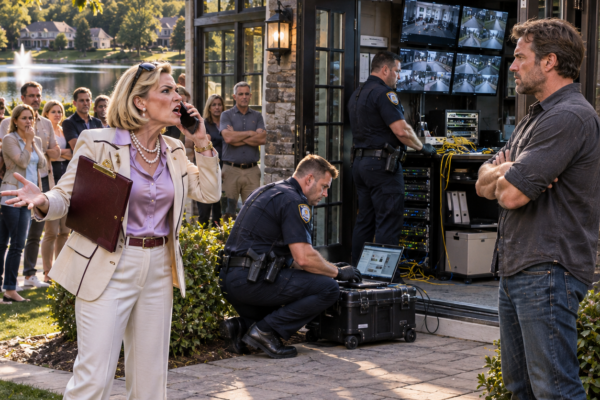
“PAY $1,120 A DAY, YOU FILTHY SLOB!” HOA Karen Dumped 56 Bags of Her Own Yard Waste on My Property—She Never Expected Every Single Bag to Come Back With a Receipt
“PAY $1,120 A DAY, YOU FILTHY SLOB!” HOA Karen Dumped 56 Bags of Her Own Yard Waste on My Property—She Never Expected Every Single Bag to Come Back With a Receipt
“Seventy-two hours, Mr. Mabry—then it’s twenty dollars per bag, per day, and I suggest you start counting!” HOA president Patrice Holloway sneered as she stood beside the enormous pile of landscaping debris somebody had illegally dumped behind my house.
When my security camera revealed that Patrice herself had directed a hauling truck onto my property, using money collected from our neighborhood’s HOA dues, I discovered that the woman threatening to fine me had been secretly making the entire community pay for her private swimming pool renovation.
But instead of immediately calling the sheriff, I bought fifty-six transparent contractor bags, printed fifty-six delivery labels, and returned every piece of her garbage to the one address she had foolishly registered as the official headquarters of our homeowners association.
My name is Curtis Mabry.
I’m a delivery driver in Polk County, Florida, and until that particular Thursday afternoon, I had spent years trying to avoid trouble with the Pelican Ridge Homeowners Association.
I paid my dues.
I maintained my property.
And whenever Patrice Holloway issued one of her ridiculous little violation notices, I usually paid the fine rather than wasting an entire evening arguing with her.
That was my mistake.
Patrice had confused my patience with permission.
I discovered the mountain of yard waste when I returned home from work.
There were palm fronds, hedge clippings, broken branches, purple flowers, chunks of bark, and enormous piles of leaves scattered across the grass beside my back fence.
“What the hell?”
Before I could investigate, a familiar white SUV pulled up.
Patrice stepped out carrying her clipboard.
She wore spotless white pants, a pale blue blouse, and the smug expression she usually reserved for homeowners who had given her something to complain about.
“Mr. Mabry.”
I pointed toward the debris.
“Did you see who dumped this?”
She examined the pile.
“Seventy-two hours.”
“What?”
“That’s how long you’re permitted to leave yard debris visible from the street.”
“Patrice, this isn’t mine.”
She smiled.
“It’s on your lot.”
“It wasn’t here when I left at five this morning.”
“You’re a corner lot, Mr. Mabry. Visible from two streets.”
I stared at her.
“You think I did this?”
“I count fifty bags in that pile, easy.”
She wrote something on her clipboard.
“Twenty dollars per bag, per day, once the seventy-two hours expire.”
“Somebody dumped their garbage on my property, and you’re threatening to fine me?”
She shrugged.
“I don’t make exceptions.”
Then she noticed something beside the fence.
She took out a small measuring tool and bent toward my lawn.
“Three and three-quarters inches.”
I looked at her.
“You’re measuring my grass right now?”
“Standard is three and a half.”
She straightened.
“That one can wait. You’ve already paid three lawn violations this year. You know how it works.”
I looked toward the branches crushing the grass I had maintained so carefully.
“Do you seriously expect me to clean up somebody else’s mess?”
Patrice smiled.
“Neat street, sweet street.”
It was her favorite little slogan.
She had printed it on newsletters, repeated it at meetings, and used it whenever she wanted to remind homeowners who was in charge.
Then she climbed into her SUV and drove away.
I stood beside the enormous pile for several seconds.
I could already imagine the hours it would take to clean everything up.
Then I remembered something.
A wildlife camera.
I had purchased it several weeks earlier because an armadillo had been digging around my fence.
The camera was attached to a post, facing the very section of my property where somebody had deposited the debris.
I walked toward it.
“Bought you for the armadillo,” I muttered. “Let’s see what you caught.”
I retrieved the recording.
At 10:12 that morning, a commercial landscaping truck appeared beside my fence.
A woman in white pants stepped into view.
She pointed toward my yard.
The truck positioned itself where she indicated.
Then the debris began falling onto my grass.
The woman stepped backward, watched the entire load come down, and gave the driver a thumbs-up.
I froze the recording.
There was no mistaking her face.
“Patrice.”
I watched the footage again.
Then I opened the HOA’s governing documents and found the provision she had quoted.
Section 11.2.
I read it slowly.
Then I read it again.
Patrice had conveniently omitted the final portion.
The fine was assessed against the lot on which the debris was located.
Not against the person who originally owned it.
Not against the person who had hired the hauler.
Against the lot where it sat.
I leaned back in my chair.
“Well, Mrs. Holloway.”
I looked toward the mountain of garbage outside.
“Every return needs an address.”
And I knew hers better than almost anybody in Pelican Ridge.
PART2
Fourteen Heron Court.
I delivered packages there at least twice a week.
Patrice Holloway’s house was one of the most recognizable properties in the neighborhood, partly because she had spent years making certain everyone knew how proud she was of it.
White exterior walls.
Perfectly trimmed hedges.
Decorative planters.
A spotless driveway.
And, hanging beside her front gate, a little sign announcing that her property had been selected as Pelican Ridge’s Yard of the Month.
More importantly, her home also served as the homeowners association’s registered office.
Patrice had insisted on that arrangement when she became president.
She liked having official correspondence delivered directly to her house. It allowed her to control what arrived, when it was opened, and who got to see it.
As far as she was concerned, the arrangement demonstrated her authority.
As far as I was concerned, it meant I had a very specific destination for fifty-six packages she wasn’t expecting.
But before I touched a single branch, I needed to make absolutely certain I understood what she had done.
Because if I was going to challenge Patrice Holloway in front of the entire neighborhood, I wasn’t going to do it with accusations.
I was going to do it with receipts.
I had moved into Pelican Ridge eleven years earlier, back when the neighborhood was considerably smaller and the homeowners association was mostly concerned with keeping the retention pond maintained and making sure the entrance lights worked.
My house sat on a corner lot near a road that contractors sometimes used to reach properties undergoing renovations. It wasn’t the largest house in the community, and it certainly wasn’t the most expensive, but it was mine.
I had worked hard for it.
Being a delivery driver meant waking before most of the neighborhood and returning after a long day of lifting boxes, climbing steps, dealing with traffic, and occasionally discovering that somebody had ordered a piece of furniture considerably heavier than the packaging suggested.
I didn’t earn a fortune.
But I earned enough to pay my mortgage, maintain my property, and live a reasonably comfortable life.
My lawn was one of the few things I genuinely enjoyed working on after spending most of the week driving.
Florida’s weather could be unforgiving. Keeping St. Augustine grass healthy required attention, especially during the hotter months. I knew which areas needed additional care, which sections stayed damp longer than others, and how easily a heavy vehicle or a large pile of wet landscaping debris could damage a healthy lawn.
There was something satisfying about looking across the property on a Saturday morning and seeing the results of work I had done myself.
I didn’t need a Yard of the Month sign.
I didn’t need neighbors complimenting me.
I simply liked taking care of something that belonged to me.
For the first several years, that was enough.
Then Patrice Holloway became president of the HOA.
At first, she sounded perfectly reasonable.
She spoke about improving communication, maintaining property values, and ensuring that the association’s money was being spent responsibly.
She presented herself as someone willing to do the work other people didn’t have time to do.
And, to be fair, running an HOA board did require time.
Most residents had jobs, families, and other responsibilities. They appreciated having somebody willing to coordinate contractors, answer questions, and deal with the inevitable disagreements associated with a neighborhood governed by shared rules.
Unfortunately, Patrice gradually began treating the position as something more than a responsibility.
She treated it as ownership.
Not ownership of the common areas.
Ownership of the neighborhood.
And, eventually, ownership of the people living in it.
She introduced new inspection routines. She began driving through Pelican Ridge several times a week, photographing anything she considered inconsistent with the association’s standards.
A garbage container visible beside a garage.
A child’s bicycle left near a driveway.
A mailbox in need of repainting.
A lawn that had grown slightly beyond the prescribed height.
Everything became an opportunity for a notice.
Patrice enjoyed explaining that rules existed for a reason.
The problem was that she seemed considerably more interested in enforcing them than understanding those reasons.
One of my first disagreements with her concerned my work vehicle.
I had arrived home later than usual after a particularly difficult delivery route. I parked, carried several things inside, and returned to the driveway a little later to finish organizing the vehicle.
Patrice appeared while I was working.
“Mr. Mabry, we’ve received concerns.”
I looked up.
“About what?”
“Commercial activity.”
I stared at her.
“I’m unloading my own belongings.”
She examined the vehicle.
“Nevertheless, appearances matter.”
I pointed toward the empty street.
“Whose appearance am I offending?”
She didn’t appreciate the question.
“Please don’t make this more difficult than necessary.”
I apologized for whatever misunderstanding had occurred and finished what I was doing.
A few days later, a notice arrived.
I dealt with it.
I didn’t want to become known as the resident who argued over every little thing.
That was the reputation Patrice gave people whenever they questioned her decisions.
Difficult.
Uncooperative.
Not community-minded.
She didn’t need to announce those descriptions formally. She used them in conversations, hinted at them during meetings, and occasionally included references to troublesome homeowners in association communications without identifying them directly.
Everybody usually knew who she meant.
Nobody wanted to become the next example.
Eventually, Patrice introduced what she called the Community Standards display.
It occupied a wall inside the clubhouse.
Officially, its purpose was to remind residents of recurring maintenance issues and encourage compliance with the association’s rules.
In practice, it became a public collection of photographs showing properties she believed had failed to meet her expectations.
Residents began calling it the Wall of Shame.
The first time I saw it, I felt uncomfortable.
There was a photograph of a house with an untidy garden.
Another showed a driveway with several objects temporarily stored near the garage.
A third showed a lawn that had developed brown patches.
Underneath each photograph was an address.
Patrice stood beside the display during an association meeting, explaining that transparency was essential to maintaining standards.
A woman whose house appeared on the wall quietly approached her afterward.
“My husband’s recovering from surgery,” she said. “We’ve arranged for somebody to take care of the yard this weekend.”
Patrice smiled.
“I’m sorry to hear about your husband.”
The woman nodded.
“Would you mind taking our picture down?”
“Once the violation has been resolved.”
The woman’s face changed.
“I’m asking because my children have friends in this neighborhood.”
Patrice folded her arms.
“Then perhaps they’ll learn an important lesson about maintaining property.”
I remember watching that exchange and feeling a familiar kind of anger.
I should have said something.
Instead, I stood there holding a paper cup of coffee, convincing myself that somebody else would challenge her.
Nobody did.
The photograph remained on the wall.
A few weeks later, the woman’s lawn looked considerably better.
Patrice eventually removed the picture.
And the neighborhood continued functioning as though what had happened was perfectly normal.
That was how Patrice acquired so much power.
Not all at once.
Not through one enormous decision that everybody recognized as unacceptable.
Through dozens of little decisions people found uncomfortable but didn’t consider worth the trouble of challenging.
I understood those people because I was one of them.
When Patrice fined me over my lawn, I paid.
When she complained about minor issues near my property, I corrected them.
When she spoke to me in that particular condescending tone, I reminded myself that arguing would probably cost me more time than simply doing what she wanted.
I had a demanding job.
I needed to get up early.
I didn’t want to spend my evenings researching HOA documents.
So I paid for convenience.
And Patrice learned that if she selected Curtis Mabry, she was unlikely to encounter much resistance.
That assumption would eventually cost her $4,690, her position as president, her favorite little sign, and the public humiliation she had spent years distributing to other people.
But on that Thursday evening, she still believed I was going to do exactly what I had always done.
She believed I would clean up her mess.
She believed I would pay whatever she demanded.
And she believed nobody would ever know why the debris had appeared on my property.
After reviewing the security footage, I went outside to examine the pile more carefully.
The debris wasn’t the sort of material produced by ordinary weekly lawn maintenance.
There were thick branches, substantial hedge clippings, and sections of plants that appeared to have been removed rather than simply trimmed.
Some of the material was still fresh.
Leaves hadn’t begun drying significantly, and several purple blossoms remained attached to the branches.
I picked up one of the flowers.
I recognized it.
Jacaranda.
There weren’t many mature jacaranda trees in Pelican Ridge.
In fact, I could only remember one.
Before I could investigate further, my neighbor arrived.
She had operated a nursery for years and knew more about the plants growing around our community than practically anybody else.
She stopped near the fence and stared at the enormous pile.
“Curtis Mabry, what in the world is in your yard?”
I looked at her.
“I was hoping you’d tell me.”
She walked closer.
“That’s a substantial load.”
“Courtesy of somebody who apparently thought my yard was a landfill.”
She examined several of the branches.
Then she picked up a cluster of purple flowers.
“Jacaranda.”
I nodded.
“That’s what I thought.”
She looked toward me.
“There’s only one mature tree like this in Pelican Ridge.”
“Whose?”
She stared at the blossoms.
“Patrice’s.”
I felt my mouth tighten.
“Fourteen Heron Court?”
“That’s right. I sold her that tree eight years ago.”
She turned the branch over in her hand.
“I remember because she wanted something that would look impressive when it flowered.”
I laughed bitterly.
“Apparently, it’s making an impression in my backyard now.”
My neighbor looked at the rest of the debris.
“Hedges. Palms. Half that jacaranda.”
She shook her head.
“She’s tearing out her backyard for a pool deck. I’ve seen the contractors going in and out.”
I took out my telephone.
“Want to see something?”
I showed her the camera footage.
She watched Patrice wave the truck toward my property.
Then she watched the debris come down.
When the recording reached the moment Patrice gave the driver a thumbs-up, my neighbor stopped breathing for a second.
“Good grief.”
I replayed it.
“That’s her, right?”
“Unless she’s got an identical twin who dresses exactly like her.”
She looked toward the pile.
“And she’s the one who came over here threatening to fine you?”
I nodded.
“Twenty dollars a bag, every day.”
My neighbor stared at me.
“Call the sheriff.”
I understood the suggestion.
The recording appeared to provide evidence of illegal dumping, and contacting the appropriate authorities was a reasonable option.
But something else was beginning to bother me.
“Do you know who she’s using for the hauling?”
My neighbor hesitated.
“Duane. I think.”
“The contractor who does work for the association?”
She nodded slowly.
“Same truck, anyway.”
I looked at the frozen image on my phone.
The truck’s markings were visible.
So was its license plate.
I had seen that vehicle before.
It had been present near the clubhouse, along several common areas, and beside the retention pond during previous maintenance work.
Suddenly, the entire situation looked considerably more serious.
If Patrice had hired somebody privately to remove landscaping debris from her backyard, she was responsible for that arrangement.
But if she had used the association’s contractor and charged the work to the HOA, the money paying for the load might have come from everybody in Pelican Ridge.
Including me.
Including my neighbor.
Including the woman whose husband’s surgery hadn’t been considered a sufficient reason to remove her house from Patrice’s Wall of Shame.
I returned inside and opened the financial summaries circulated to homeowners.
The documents were not particularly detailed, but they contained enough information to establish that there had been several recent expenditures categorized as common-area debris removal.
I found thirteen loads listed over approximately six weeks.
Each was priced at ninety-five dollars.
I turned the screen toward my neighbor.
“Look at this.”
She adjusted her glasses.
“Common-area debris removal?”
“Thirteen loads.”
She looked puzzled.
“From where?”
“Doesn’t say.”
She examined the dates.
Then she looked at me.
“There hasn’t been a significant storm here since last fall.”
“I know.”
“I asked about this at the last meeting. Patrice told me to sit down.”
I stared at the figures.
Ninety-five dollars per load wasn’t an enormous expenditure individually.
But thirteen loads represented considerably more money.
And if the truck that dumped debris on my property was part of the same arrangement, there could be another invoice coming.
I needed the original records.
Not summaries.
Not descriptions Patrice had approved.
The actual invoices.
The pickup addresses.
The authorizations.
The documentation showing what the association had purchased and why.
My neighbor looked toward the window.
“Curtis, you have to do something.”
I nodded.
“I intend to.”
She pointed toward my phone.
“Send the sheriff that recording.”
“I will report what happened.”
“Good.”
“But a dumping citation isn’t going to tell the homeowners where their money went.”
She looked at me.
I continued.
“Patrice pays a ticket, tells everybody the contractor made a mistake, and keeps running the board.”
My neighbor considered that.
Then she looked toward the clubhouse, although it couldn’t be seen from where we were standing.
“You know what Patrice is afraid of?”
“What?”
“That wall.”
I smiled slowly.
“The Community Standards wall?”
She nodded.
“She loves putting other people’s houses up there. Nine houses this year, Curtis.”
I remembered several of them.
“She’s never been on it,” my neighbor continued.
“No.”
“Never.”
I looked at the flowers scattered across my lawn.
For years, Patrice had been photographing other people’s property and using those photographs to establish her authority.
Now I had footage of her directing a truck to unload her own waste onto somebody else’s land.
I had evidence that the debris came from her backyard.
And I had discovered a rule stating that fines followed the location of the debris.
I wondered what would happen if, for once, Patrice found herself facing the standards she had been so eager to enforce against everybody else.
My neighbor watched my expression.
“What are you thinking?”
I smiled.
“I’m going to clean it up.”
She looked horrified.
“Curtis!”
“What?”
“You’re going to let her win?”
I shook my head.
“I’m going to send it back.”
She stared at me for several seconds.
Then a grin slowly spread across her face.
“Wait here.”
She went home.
A few minutes later, she returned carrying a large roll of transparent contractor bags.
“Don’t use black ones,” she said.
I took the roll.
She pointed toward the purple blossoms.
“Let everybody see whose flowers those are.”
For the first time since discovering the debris, I laughed.
Not because the situation was funny.
Because I was finally beginning to understand that Patrice had given me something more useful than another violation notice.
She had given me evidence.
Friday morning, I woke up at my usual time and prepared for work.
Before leaving, I walked outside and photographed the debris from several angles.
I documented the condition of the lawn beneath the material as well as I could without disturbing it. I saved copies of the security recording somewhere separate from the camera.
Then I sent a written request to the association asking for records concerning the recent hauling expenses.
I wanted the original invoices and any documents supporting the description of those expenses as common-area maintenance.
I kept the request professional.
I didn’t accuse Patrice of theft.
I didn’t announce that I had caught her using the association’s contractor for personal work.
I simply asked to see what the homeowners had paid for.
Shortly before leaving, I stood beside the fence and looked at the pile again.
Patrice was expecting me to panic.
She knew what my working days looked like.
She knew I left early and often returned late.
She probably expected the threat of accumulating fines to be enough to persuade me to spend my entire weekend cleaning up the evidence of her renovation.
And she wasn’t entirely wrong.
I did intend to spend part of my weekend cleaning up.
I just wasn’t planning to dispose of everything the way she expected.
I started Saturday morning.
The Florida sun was already warming the yard when I pulled on my gloves and began separating the debris.
Some of the branches needed to be handled carefully because of their size. The palm fronds were awkward, the hedge clippings tangled together, and the leaves had become damp beneath the heavier material.
It was miserable work.
I kept thinking about Patrice sitting comfortably inside her house while I cleaned up a project that had nothing to do with me.
Then I reminded myself that becoming angry wasn’t going to make the pile smaller.
So I continued.
My neighbor came over periodically, identifying plants and helping me distinguish some of the landscaping material.
She laughed when we uncovered another cluster of purple blossoms.
“There’s her expensive tree.”
I placed the branches into a clear bag.
“Special delivery.”
She pointed toward another section.
“And there’s part of her hedge.”
“Another special delivery.”
We worked until the first section of lawn became visible.
The grass underneath looked terrible.
It had been compressed beneath the weight of the material. Several areas were discolored, and some sections appeared to have suffered more significant damage.
I crouched beside the worst patch.
“Look at this.”
My neighbor shook her head.
“That’s going to need work.”
I photographed it.
The damage irritated me more than the inconvenience of the cleanup.
I knew how much time I had spent maintaining that grass.
Patrice knew, too.
She had inspected it often enough.
And now the woman who had repeatedly fined me over fractions of an inch had deliberately directed a hauling truck onto the very property she claimed needed to be maintained to such exacting standards.
As we continued filling bags, several neighbors slowed while passing the house.
Some asked whether I had been doing landscaping.
Others were surprised by the amount of material.
One man walking his dog stopped near the sidewalk.
“Doing some spring cleaning, Curtis?”
“Something like that.”
He looked at the clear bags.
“That’s a lot of purple flowers.”
I smiled.
“Isn’t it?”
He continued walking.
A few minutes later, Patrice’s white SUV appeared.
She slowed when she saw us.
Then she pulled over.
“Mr. Mabry.”
I looked up.
“Mrs. Holloway.”
She examined the bags arranged near the fence.
“I’m glad to see you’re taking care of the violation.”
My neighbor stood beside me, holding another empty bag.
Patrice looked at her.
“How nice. Neighbors helping neighbors.”
My neighbor smiled.
“Isn’t it?”
Patrice nodded approvingly.
“That’s what a community is supposed to be about.”
I continued placing leaves into the bag.
“Couldn’t agree more.”
Patrice appeared pleased with herself.
“Neat street, sweet street.”
I tied the bag.
“Exactly.”
She looked at the remaining debris.
“Make sure all of it is removed within the allowed period.”
“It’s all going right where it belongs.”
“Good.”
She drove away.
My neighbor waited until the SUV disappeared around the corner.
Then she bent forward laughing.
“Oh, Curtis.”
I shook my head.
“Don’t say anything.”
“I didn’t!”
“You were about to.”
She laughed harder.
“I cannot believe she just stood there congratulating us for cleaning up her yard.”
I looked at the next pile of branches.
“Let’s finish.”
By early afternoon, the number of bags had grown considerably.
Thirty-one.
Thirty-eight.
Forty-four.
Forty-nine.
I kept the count carefully.
Patrice had estimated fifty.
She had sounded so confident when she announced that number.
But when the last smaller branches and leaves were collected, we had fifty-six bags.
Fifty-six.
At twenty dollars each, that was $1,120 for a single day of penalties under the language she had quoted.
I stood looking at the bags.
My neighbor rested her hands on her hips.
“Going somewhere, Curtis?”
“Something is.”
She laughed.
“You really think she’s going to accept this?”
I considered the question.
“I’m going to give her notice first.”
That was important to me.
I wasn’t interested in sneaking onto somebody’s property in the middle of the night or damaging her belongings.
Whatever happened next, I wanted there to be a record.
I wanted Patrice to know that I had identified the waste, that I was returning it, and that the association’s registered address was the destination associated with the delivery.
I also understood that disputes concerning property access and waste disposal could become complicated. Being angry with Patrice didn’t automatically give me unlimited permission to do whatever I wanted.
I intended to keep the situation as orderly and documented as possible, rather than creating another confrontation that would make the original misconduct harder to establish.
I prepared a written notice identifying the material, the number of containers, and the address.
I included the reason I was returning it.
The debris had been removed from my property after being deposited there by a hauling contractor working under Patrice’s direction.
It was being returned to the association’s registered office pending resolution of responsibility.
I delivered the notice separately.
Patrice received it.
She signed the acknowledgment.
Whether she bothered reading the entire document was another matter.
From the expression she wore when accepting it, I suspected she thought it was another complaint she could dismiss whenever she found the time.
I didn’t attempt to persuade her otherwise.
As a delivery driver, I had spent years learning the difference between handing something to a person and ensuring that the person had actually paid attention to what they received.
Patrice had accepted the notice.
She had acknowledged receiving it.
I retained the record.
And before returning home, I checked the public registration information confirming the association’s office address.
Fourteen Heron Court.
It was exactly as I remembered.
That evening, I prepared the labels.
Each bag received its own identification.
Each was part of the same documented return.
I prepared an itemized record of all fifty-six.
My neighbor watched me working.
“You look like you’re doing your regular job.”
I smiled.
“Every package needs to go somewhere.”
She examined the label attached to the first bag.
“Return to sender?”
“That’s right.”
She shook her head.
“I think I’m going to take an early walk tomorrow.”
“Walk past Heron Court around six.”
She looked at me.
“Six in the morning?”
I nodded.
“Should be an interesting neighborhood.”
Sunday morning arrived before sunrise.
By six o’clock, the fifty-six clear bags had been returned to the designated address.
I kept them together and documented their condition and location.
I didn’t conceal their contents.
Anybody looking at the bags could see the palm fronds, leaves, hedge clippings, and unmistakable purple flowers.
I also made certain that I retained a record of the entire delivery.
Fifty-six containers received at the same destination.
The photograph showed the location.
The time was recorded.
The earlier acknowledgment showed that Patrice had received notice.
And the footage from my fence showed why the material had been on my property in the first place.
I looked at the enormous collection.
Then I looked toward the neatly maintained flower beds surrounding Patrice’s entrance.
It was an extraordinary contrast.
For years, she had presented her property as an example of how every resident should maintain a home.
Now the evidence of her private landscaping project sat directly outside the house.
Behind it, the Yard of the Month sign hung beside her gate.
I took one final photograph.
“Fifty-six of fifty-six.”
Proof of delivery.
I returned home, prepared coffee, and waited.
I didn’t have to wait long.
My telephone rang.
The name on the screen was Patrice Holloway.
I answered.
“Good morning.”
“WHAT ON EARTH IS ALL THIS?”
I took a sip of coffee.
“What are you referring to?”
“DON’T PLAY STUPID WITH ME!”
I looked toward my kitchen window.
“The fifty-six bags?”
“Yes!”
“Your yard waste, Mrs. Holloway. Returned to the association’s registered office.”
There was a moment of silence.
Then she said, “My yard waste?”
“Yes.”
“That is not my—”
She stopped.
I imagined her looking at the transparent bags.
The flowers were difficult to explain.
“Patrice?”
She didn’t answer immediately.
“Get over here.”
I took another sip.
“Is there a problem with the delivery?”
“GET THESE OFF MY PORCH!”
I looked at the clock.
“I’m off the clock until Monday, ma’am.”
She hung up.
I laughed.
Then I finished my coffee.
A little later, I walked toward Heron Court.
Several people had already noticed the unusual display.
A couple walking their dog stopped across the street.
Another neighbor stood near the sidewalk, looking confused.
My nursery-owning neighbor was there as well.
She gave me a smile.
Patrice stood beside her driveway wearing a white jacket over her morning clothes.
Her face was red.
“Mr. Mabry!”
I approached from the public sidewalk.
“Morning.”
She pointed toward the bags.
“Remove them.”
I looked at the clear plastic.
“That’s your jacaranda, isn’t it?”
My neighbor stepped forward.
“It certainly looks like the tree I sold you, Patrice.”
Patrice turned sharply.
“Stay out of this.”
My neighbor examined the flowers.
“Eight years ago. Beautiful tree.”
Patrice looked toward the people gathering nearby.
“This is harassment.”
I shook my head.
“It’s a documented return of the material that was deposited on my property.”
She raised her voice.
“He dumped garbage at the association’s office!”
One neighbor looked at the bags.
“Isn’t that landscaping debris?”
Patrice ignored him.
Then she spotted Joyce, the association’s treasurer, approaching from farther down the street.
“Joyce! Get over here!”
Joyce looked startled.
“What happened?”
“Look what he’s done!”
Joyce stared at the bags.
Then her eyes settled on the purple flowers.
Something changed in her expression.
She didn’t say anything.
Patrice continued.
“I’m calling the sheriff.”
I nodded.
“That’s your decision.”
She pulled out her telephone.
“You’ve made a very serious mistake, Mr. Mabry.”
I smiled faintly.
“Let’s find out.”
The deputy who responded to the dispute arrived a little later.
He stepped out of his vehicle, looked toward the collection of transparent bags, and then examined the group standing nearby.
“Morning, everybody. Somebody called about bags?”
Patrice hurried toward him.
“Yes, Officer. That man dumped garbage on my porch.”
She pointed at me.
“That’s trespassing, illegal dumping, harassment, and whatever else applies.”
The deputy looked at me.
“What’s going on, sir?”
I took out my telephone.
“I’d like to show you what happened Thursday morning.”
Patrice interrupted.
“That has nothing to do with this.”
The deputy glanced toward her.
“Ma’am, let him finish.”
I opened the recording.
“Thursday, 10:12 a.m. That’s my back fence.”
The deputy watched the vehicle appear.
He watched Patrice direct the driver.
He watched the debris being unloaded.
Then he looked up.
“That’s you, ma’am?”
Patrice stiffened.
“That truck was conducting association business.”
He returned his attention to the recording.
“It’s unloading yard debris onto his lot.”
She folded her arms.
“There were arrangements for staging the material.”
I looked at her.
“Arrangements with whom?”
She ignored me.
The deputy replayed part of the footage.
Then he said, “From what you’re showing me, we need to look into what happened at his property. Did you authorize that material to be left there, sir?”
“No.”
“Did anybody contact you?”
“No.”
He looked toward Patrice.
“Then that’s the dumping allegation I need to document first.”
Patrice’s mouth opened.
“But look at my porch!”
“I see it.”
“He admitted putting it there!”
The deputy turned toward me.
I showed him the documentation associated with the return, including the notice Patrice had acknowledged and the registration information for the association’s office.
He examined the material.
Then he asked several questions about the circumstances.
I answered them.
Patrice interrupted whenever she thought I was describing something in a way that made her look responsible.
Eventually, the deputy raised his hand.
“Ma’am, we’re going to handle one issue at a time.”
She became silent.
He documented my allegation concerning the original dumping, gave me the report information, and explained that the circumstances would need to be investigated.
Then he addressed Patrice’s complaint.
“I’m not making a determination about every possible civil property issue here,” he told her. “But based on what I have in front of me this morning, I’m not arresting Mr. Mabry.”
Patrice stared at him.
“You can’t be serious.”
He looked toward the bags.
“There’s a documented dispute over where this material belongs. The association’s registered address is here. There’s written notice. If you believe you have a further claim concerning the return, you can pursue the appropriate process.”
She pointed toward me again.
“He needs to take them away!”
“I’m not ordering him to perform landscaping work on your behalf.”
I nearly laughed.
Somebody behind us did.
Patrice looked toward the neighbors.
Her face became even redder.
“Fine.”
She turned back toward the deputy.
“I won’t touch those bags.”
He looked puzzled.
“That’s your choice, ma’am.”
She raised her chin.
“The minute I touch one, he’ll claim I’m admitting it’s mine.”
I remained silent.
Patrice continued.
“The board will order him to remove every single one. Publicly.”
The deputy glanced toward me.
“Anything else you want to add to your report?”
I shook my head.
“Not right now. I’ll provide the association records if I obtain anything relevant.”
He nodded.
Then he left.
Patrice stood beside her driveway for several seconds.
She appeared unable to understand why the arrival of a law enforcement officer hadn’t immediately restored her control over the situation.
Finally, she turned toward me.
“Enjoy yourself while you can, Mr. Mabry.”
I looked at the bags.
“You have seventy-two hours, Mrs. Holloway.”
She stopped.
“What?”
“Section 11.2.”
Her eyes narrowed.
“You think you’re clever?”
I smiled.
“The photograph is timestamped. Six this morning.”
She shook her head.
“That truck was association business. Storm cleanup. It’s on the books, signed by my treasurer.”
I looked toward Joyce.
She appeared uncomfortable.
Patrice continued.
“Staging material on a corner lot near the construction road is a board matter. Not something you get to turn into a neighborhood spectacle.”
“Then perhaps the board should explain it.”
“It will.”
She pointed toward me.
“Friday. We’re voting Friday.”
I nodded.
“Seven?”
“You’ll receive the notice.”
She smiled coldly.
“Bring your checkbook, Mr. Mabry.”
I looked at the transparent bags sitting beneath her Yard of the Month sign.
“Of course.”
Then I turned and walked home.
Behind me, Patrice was telling the neighbors that everything had been authorized properly.
She mentioned the treasurer again.
Signed by my treasurer.
I couldn’t stop thinking about those words.
Because Joyce wasn’t merely somebody Patrice had mentioned during an argument.
Joyce was the person who signed the checks.
And if Patrice wanted to make the association’s financial records part of her defense, I was going to make sure the homeowners saw exactly what those records contained.
On Monday morning, I discovered another violation notice attached to my front door.
It concerned the condition of my lawn.
Specifically, the damaged section where Patrice’s landscaping waste had been deposited.
I read the notice twice.
Dead turf.
One hundred and fifty dollars.
For several seconds, I couldn’t decide whether to laugh or become angry.
Patrice had directed a commercial truck onto my property.
She had ordered it to unload a substantial amount of landscaping debris onto healthy grass.
Then, after I removed the material, she had photographed the damage and issued a penalty.
I carried the notice inside and placed it beside the photographs I had taken before and after the cleanup.
“She killed my grass,” I muttered, “and fined me for the funeral.”
I added the document to my records.
At that point, I wasn’t merely dealing with an unreasonable neighbor.
I was dealing with somebody who appeared willing to use the association’s enforcement machinery to punish me for damage she had caused.
That made the financial questions even more important.
I followed up on my records request.
Then I left for work.
All day, while delivering packages, I kept thinking about the pickup addresses that would appear on the contractor’s invoices.
If the records showed that the work had been performed at the retention pond or other common areas, I would have to reconsider part of my suspicion.
Perhaps some of the previous hauling expenses were legitimate.
Perhaps Patrice had used the same contractor privately and had simply directed him to an improper disposal location.
But if the invoices repeatedly identified her home as the pickup address while describing the service as common-area debris removal, there would be a much more serious problem.
By the time I returned home, I had received a message from Joyce.
She wanted to speak with me.
Privately.
Joyce arrived shortly after dinner carrying a folder and a small recording device.
She stood at my front door looking toward the street.
“Curtis, can I come in?”
“Of course.”
She glanced over her shoulder.
“I’d rather not do this on the step.”
I stepped aside.
She entered the living room and sat near the kitchen table.
For several seconds, she appeared unsure how to begin.
Then she placed the folder in front of me.
“You asked for the invoices.”
I nodded.
“All fourteen.”
I opened it.
“Fourteen?”
She nodded.
“The last one came in Thursday. I cut the check Friday morning.”
I turned to the first invoice.
The service description read:
Common-area debris removal.
Ninety-five dollars.
Then I looked farther down.
Pickup address: 14 Heron Court.
I turned the page.
Another ninety-five dollars.
Another pickup address.
Fourteen Heron Court.
I examined the third.
The fourth.
The fifth.
All the same.
I looked up.
“Joyce.”
She stared at her hands.
“I know.”
“Every one?”
“Every one.”
I continued through the folder until I reached the final invoice.
The date corresponded with the morning my camera recorded Patrice directing Duane’s truck toward my fence.
The pickup address was identical to the others.
Fourteen Heron Court.
Fourteen loads.
Ninety-five dollars each.
Thirteen hundred and thirty dollars.
Taken from association funds to pay for hauling material collected from Patrice Holloway’s private property.
I looked at Joyce.
“You signed these?”
She nodded.
“All of them.”
“Why?”
“She told me it was storm debris from the retention pond.”
I stared at the address.
“You never checked?”
Her eyes filled.
“No.”
She swallowed.
“I checked the amounts. I checked the vendor. I made sure the expenses were recorded under the maintenance category she gave me.”
I pointed toward the pickup information.
“But not this.”
She shook her head.
“No.”
For a while, neither of us spoke.
I had known Joyce for years.
She wasn’t a particularly confrontational person. She performed her duties, attended meetings, and usually supported Patrice when decisions were presented as already settled.
I suspected she had become accustomed to trusting the descriptions Patrice provided.
That trust didn’t eliminate her responsibility.
But sitting across from her, I could see that she understood what she had done.
She looked exhausted.
“Sunday morning, when I saw those purple flowers outside her house, I couldn’t stop thinking about them.”
I remembered her expression when she had approached the bags.
She continued.
“I went home and pulled the invoices.”
Her voice cracked.
“I kept turning the pages, Curtis. Every single one said her address.”
I looked at the total again.
“Thirteen hundred thirty dollars.”
She nodded.
“I’ve signed every check.”
“Does she know you’ve brought me these?”
“No.”
“Why are you doing it?”
Joyce looked directly at me.
“Because when this comes out, I am not going down for her pool deck.”
I leaned back.
“That doesn’t mean you’re off the hook for signing them.”
“I know.”
She nodded quickly.
“I should have checked. I’ll say that in front of everybody.”
I watched her.
“You’re prepared to do that?”
“Yes.”
“Even if Patrice says you authorized everything?”
Joyce’s expression hardened.
“I authorized what she told me was common-area maintenance. I didn’t authorize paying to clear her backyard.”
She pointed toward the folder.
“And there’s something else.”
I looked at the little recording device.
“What?”
Joyce explained that she routinely recorded board work sessions so she could prepare accurate notes and assist with the minutes. The board members knew about the practice, and the recording device was ordinarily placed somewhere visible during those sessions.
Many of the work sessions took place in Patrice’s dining room.
The previous Wednesday evening, the night before the dumping, there had been another session.
During a break, Patrice received a telephone call.
She placed the call on speaker.
The recording device was still running.
Joyce tapped the folder.
“I typed up my notes Sunday afternoon.”
I looked at her.
“And?”
She pressed her lips together.
“I listened to minute fourteen.”
She slid the device toward me.
“Then I listened to it again.”
I stared at the recorder.
“What did she say?”
Joyce shook her head.
“Listen.”
She located the relevant portion.
Several ordinary sounds came through the speaker.
Chairs moving.
Papers shifting.
Somebody talking in the background.
Then I recognized Patrice’s voice.
“Tomorrow’s the last load.”
A man’s voice answered.
I recognized Duane’s name from the conversation.
Patrice continued.
“They pour my pool deck at noon. I need that yard empty.”
I looked at Joyce.
She nodded.
Then Patrice said something that made my stomach tighten.
“So don’t drive to the landfill, Duane. It’s an hour each way.”
There was a pause.
“The delivery man’s fence is right there.”
I stopped breathing.
Patrice continued.
“He’s gone till dark. He’ll bag it and pay the fine like he always does.”
The man’s voice answered.
“You got it.”
Joyce stopped the recording.
The room became silent.
For several seconds, I could hear nothing except the refrigerator running in the kitchen.
I looked at her.
“Play it again.”
She did.
The delivery man’s fence is right there.
He’s gone till dark.
He’ll bag it and pay the fine like he always does.
There it was.
The entire explanation.
Not a contractor’s misunderstanding.
Not an accidental wrong address.
Not a truck driver who had misunderstood where he was supposed to unload.
Patrice had selected my property deliberately.
She had known I was at work.
She had known I had a history of paying HOA penalties without creating much trouble.
And she had turned that knowledge into a plan.
I thought about every previous violation notice.
Every check I had written.
Every time I had told myself that cooperating was easier than fighting.
Patrice hadn’t appreciated my cooperation.
She had studied it.
She had recognized that I was the kind of homeowner who would probably absorb an inconvenience quietly.
And she had decided to exploit that.
Joyce watched me.
“Curtis?”
I remained silent.
She swallowed.
“Are you all right?”
I looked toward the window.
“No.”
Then I looked at the recorder.
“But I’m going to be.”
I asked Joyce to preserve the original recording and the documents.
I didn’t want to rely on edited excerpts or isolated photographs if the association needed to establish what had happened.
The complete records mattered.
So did the context.
We discussed how the material would be presented and how the original documents could be made available for appropriate review.
Then I looked at her.
“Friday. Seven.”
She nodded.
“I’ll be at the board table.”
“Patrice is going to try to blame you.”
“I know.”
“You need to be prepared for that.”
Joyce closed the folder.
“I am.”
When she left, I remained at the table for a long time.
I wasn’t thinking about the money I might save.
I wasn’t even thinking about the fifty-six bags still sitting outside Patrice’s house.
I was thinking about how casually she had spoken about me.
He’ll pay the fine like he always does.
She hadn’t sounded angry.
She hadn’t sounded uncertain.
She had sounded comfortable.
That was what bothered me most.
Making somebody else’s life more difficult had become such an ordinary thing for her that she could discuss it during a break in an HOA work session.
I opened a fresh folder.
Then I arranged the evidence in three sections.
The original dumping.
The association payments.
The recorded instructions.
Three receipts.
One story.
And on Friday evening, Patrice was going to hear all of it.
Wednesday morning, the seventy-two-hour period expired.
The bags were still at Fourteen Heron Court.
Patrice had refused to touch them.
Her refusal had initially been an attempt to avoid appearing responsible for the debris. But as the days passed, it became increasingly difficult for her to maintain the argument that she was simply the innocent victim of somebody else’s dumping.
People had seen the flowers.
People knew about the pool construction.
People had heard that the sheriff had been called.
And because Patrice was accustomed to controlling neighborhood gossip, she began attempting to establish her own version of events.
According to her, an angry homeowner had turned the association’s office into a dumping ground.
According to her, a contractor had been performing authorized maintenance.
According to her, the situation demonstrated precisely why Pelican Ridge needed stronger enforcement.
She spoke confidently.
But she never addressed the most obvious question.
Why were the branches from her own jacaranda tree inside those bags?
On Wednesday, I documented that the debris remained at the address.
Thursday, I did the same.
Friday morning, the bags were still there.
Fifty-six bags.
Twenty dollars each.
Three chargeable days under the provision Patrice had repeatedly quoted.
Wednesday.
Thursday.
Friday.
Three thousand three hundred and sixty dollars.
I wrote the calculation on a sheet of paper.
Then I placed it in the folder.
I knew the association would need to follow its own enforcement process. I couldn’t personally impose a fine simply because I had performed the arithmetic, and any final resolution would require the appropriate board and committee procedures or an agreed settlement.
But I also knew that if Patrice wanted to treat her preferred interpretation of Section 11.2 as binding when the debris sat on my property, she would have difficulty explaining why it suddenly meant something different when the debris sat on hers.
That evening, I changed out of my work clothes and prepared to attend the meeting.
I collected the folder.
I checked that the relevant recordings and documents were available.
Then I looked at my checkbook.
Patrice had told me to bring it.
So I did.
Not because I planned to write her another check.
Because I wanted her to remember exactly what she had said.
The Pelican Ridge clubhouse was already crowded when I arrived at seven.
Usually, HOA meetings attracted a small collection of regular attendees. Several people came because they were interested in maintenance issues. Others attended because they had received violation notices and wanted to challenge them.
Most residents preferred spending Friday evenings doing practically anything else.
That evening was different.
People filled nearly every available chair.
Several stood near the back.
My neighbor had saved me a seat.
She smiled when she saw my folder.
“Ready?”
I nodded.
“I think so.”
At the front of the room, Patrice sat behind the board table with a stack of papers and a glass of water.
Joyce sat several chairs away.
The association’s secretary was reviewing the agenda.
Behind them stood the Community Standards wall.
Nine properties had appeared on that wall over the course of the year.
Several residents whose homes had been displayed were present in the room.
Patrice looked delighted by the turnout.
I suspected she believed the large audience would make my public humiliation particularly effective.
She tapped the microphone.
“Thank you all for coming on short notice.”
The room became quiet.
“As many of you are aware, our community has experienced an unacceptable incident involving the association’s registered office.”
She held up a photograph.
It showed fifty-six bags outside her house.
“This material has been sitting there for five days.”
Several people exchanged glances.
Patrice continued.
“Fifty-six bags of garbage deliberately deposited at our association’s office.”
She looked directly at me.
“And the resident responsible has refused to remove them.”
I remained seated.
She lifted another photograph.
It showed the damaged grass beside my fence.
“And this is how he maintains his own lawn.”
I heard my neighbor inhale sharply.
Patrice placed the photographs beside her paperwork.
“We cannot allow personal disagreements to undermine community standards. Therefore, I move that the property responsible for turning our association’s office into a dumping ground be included on our Community Standards display.”
She looked toward the wall.
“Mr. Mabry’s property.”
The room remained silent.
Then she smiled.
“Neat street, sweet street.”
I raised my hand.
Patrice looked irritated.
“Mr. Mabry?”
I stood.
“Mrs. Holloway, I brought three receipts.”
Several people turned toward me.
Patrice sighed.
“This isn’t a delivery route. Make it quick.”
I walked toward the front of the room.
“I intend to.”
I placed the first section of my folder on the table.
“Receipt number one.”
I displayed the photograph captured by my wildlife camera.
“Thursday morning. Ten-twelve. My back fence.”
Patrice immediately straightened.
I continued.
“This is the contractor’s truck. That’s my property. And that’s Mrs. Holloway.”
A man near the front leaned forward.
“What’s she doing?”
I played the recording.
Nobody spoke as Patrice appeared on the screen.
They watched her point toward my yard.
They watched the truck position itself.
They watched the landscaping debris being unloaded.
Then they watched her raise her hand and give the driver a thumbs-up.
The recording ended.
A woman near the back gasped.
Somebody whispered, “You’ve got to be kidding.”
I placed a copy of the sheriff’s report information beside the photograph.
“The original dumping has been reported to the Polk County Sheriff’s Office. The case remains open.”
Patrice reached for her microphone.
“That truck was hauling common-area debris!”
I looked at her.
“Then it took a wrong turn into my backyard.”
Several people laughed.
She glared at them.
“This is a board-authorized maintenance matter.”
“Which brings us to receipt number two.”
I opened the second section.
“Fourteen hauling invoices over six weeks.”
I showed the first document.
“Ninety-five dollars each.”
Then the next.
“Every one categorized as common-area debris removal.”
I turned another page.
“Total expenditure: thirteen hundred and thirty dollars.”
People began murmuring.
I continued.
“That’s thirteen hundred and thirty dollars of your HOA dues.”
Patrice shook her head.
“Those expenditures are legitimate association business.”
“Then let’s look at the pickup address.”
I displayed the relevant information.
“Fourteen Heron Court.”
Several residents recognized the address immediately.
I showed another invoice.
“Fourteen Heron Court.”
And another.
“Fourteen Heron Court.”
A man stood.
“Isn’t that your house, Patrice?”
She stared at him.
“Please remain seated.”
He didn’t.
“Is it your house?”
Patrice looked toward Joyce.
“Joyce, explain these expenditures.”
Joyce took a breath.
Then she stood.
“I signed the checks.”
Patrice nodded triumphantly.
“There you are.”
Joyce continued.
“Mrs. Holloway represented the work as storm-debris removal from the retention pond.”
Patrice’s smile disappeared.
Joyce looked toward the residents.
“I didn’t check the pickup addresses. I should have.”
She held up a copy of the invoices.
“Every load originated at her house.”
The room erupted.
“WHAT?”
“OUR MONEY?”
“HER BACKYARD?”
Patrice struck the table with her hand.
“ORDER!”
Joyce remained standing.
“I signed every check, Patrice. I won’t sign a story.”
That silenced several people immediately.
My neighbor raised her voice from the audience.
“There hasn’t been a storm that produced that sort of debris since last fall. I asked about the hauling expenses before, and you told me to sit down.”
Patrice looked toward her.
“You were disrupting the meeting.”
“I was asking where our money went!”
Another resident spoke.
“Was this for your pool?”
Patrice became visibly uncomfortable.
“The landscaping contractor was working on several matters.”
I looked at her.
“Then perhaps you can identify which portion of your private backyard was the retention pond.”
Laughter broke out again.
Patrice’s expression hardened.
“This is ridiculous.”
I reached for the third section of my folder.
“There’s one more receipt.”
She glanced at the recording device Joyce had placed on the table.
“What is that?”
“The board work session from last Wednesday evening.”
Patrice froze.
“The night before the truck came,” I continued.
Joyce looked toward her.
“Minute fourteen.”
Patrice’s face changed.
“What recording?”
“The recorder used for the work session.”
Joyce placed it where the board members could see it.
“You’ve known about it for years.”
Patrice reached toward her paperwork.
“I don’t authorize—”
Joyce interrupted.
“The recorder was sitting on your dining room table.”
I looked toward the residents.
“Listen to what was said.”
The room became completely quiet.
Then Patrice’s recorded voice filled the clubhouse.
“Tomorrow’s the last load. They pour my pool deck at noon. I need that yard empty.”
A woman sitting in the front row covered her mouth.
The recording continued.
“So don’t drive to the landfill, Duane. It’s an hour each way.”
Patrice stood abruptly.
“TURN THAT OFF!”
Nobody moved.
Her recorded voice continued.
“The delivery man’s fence is right there. He’s gone till dark.”
I looked at the people seated behind me.
“He’ll bag it and pay the fine like he always does.”
Duane’s voice followed.
“You got it.”
Joyce stopped the recording.
For a moment, the clubhouse was silent.
Not the uncomfortable silence that usually followed one of Patrice’s angry little speeches.
A different kind of silence.
The silence of fifty people realizing that somebody they had trusted with their association’s money had deliberately selected a working neighbor’s property as a disposal site because she expected him to accept the abuse without fighting back.
Patrice looked around.
“That was a private phone call.”
Joyce shook her head.
“It occurred during a break in a board work session. You were sitting in front of the recorder everyone knew we were using.”
The secretary spoke quietly.
“We’ll preserve the recording and obtain whatever review is necessary.”
Patrice pointed toward Joyce.
“You had no right to bring that here!”
Joyce looked at her.
“You had no right to spend their money clearing your backyard.”
Applause erupted.
Patrice stared at the residents.
For years, she had been the person deciding whose conduct deserved condemnation.
Now everybody was looking at her.
And she couldn’t make them look away.
I allowed the room to settle.
Then I opened a copy of the association’s rules.
“Mrs. Holloway, let’s talk about Section 11.2.”
She sat down.
“I don’t need you to read the rules to me.”
I smiled.
“I know. You wrote half of them.”
Several people laughed.
I continued.
“Yard debris visible from any street for more than seventy-two hours is subject to a penalty of twenty dollars per bag, per day or part of a day.”
Patrice folded her arms.
“You’re responsible for putting those bags there.”
I looked down at the document.
“Here’s the portion you didn’t read to me Thursday afternoon.”
I raised the page.
“Assessed against the lot on which the debris is located.”
She opened her mouth.
Nothing came out.
I continued.
“You photographed the fifty-six bags yourself, Mrs. Holloway. They’re outside Fourteen Heron Court.”
I displayed my delivery record.
“Six a.m. Sunday.”
Then I showed the subsequent photographs.
“Still there Wednesday.”
“Still there Thursday.”
“Still there today.”
A resident near the back called out, “How much?”
I held up the calculation.
“Fifty-six bags at twenty dollars each.”
I looked toward Patrice.
“One thousand one hundred and twenty dollars per day.”
She shook her head.
“No.”
“Wednesday, Thursday, and Friday.”
I placed the paper on the table.
“Three thousand three hundred and sixty dollars.”
The audience erupted again.
Patrice stood.
“You cannot fine me!”
I nodded.
“Correct. I’m not the fining committee. I’m asking the association to apply the same provision, through the same process, that you’ve been threatening to apply against me.”
She looked toward the other board members.
“This is outrageous!”
I reached into my pocket.
Then I placed my checkbook beside the paperwork.
“You told me to bring my checkbook, Mrs. Holloway.”
I smiled.
“Bring yours.”
The laughter was so loud that several board members struggled to maintain order.
The secretary eventually raised her hand.
“We have an alleged violation at Fourteen Heron Court. We’ll send the appropriate notice and arrange a hearing under our established procedures.”
She examined the calculation.
“The claimed amount is three thousand three hundred and sixty dollars. Mrs. Holloway will have the same opportunity to contest it as any other homeowner.”
Somebody called out, “Does she get proof of delivery, too?”
The room erupted again.
Patrice looked toward the door.
Then a homeowner near the front stood.
“I move that we recall Patrice Holloway.”
Another resident immediately said, “Second!”
Several people began applauding.
The secretary reminded everyone that removing a board member required the appropriate notice and voting arrangements under the association’s applicable procedures.
The residents couldn’t simply skip that process because they were angry.
A recall meeting was arranged for the following Friday at seven.
Seven days’ notice.
The motion was recorded.
Patrice gathered her paperwork.
She appeared unable to understand how an evening she had planned around my punishment had turned into the beginning of her removal.
Before leaving, she looked at me.
“This isn’t over, Mr. Mabry.”
I closed my folder.
“No, ma’am.”
Then I looked toward the photographs on the Community Standards wall.
“Not quite.”
That night, Patrice moved every one of the fifty-six bags into her garage.
Several neighbors witnessed it.
One told me she had started shortly after returning from the meeting and continued working until her driveway was clear.
The woman who had refused to touch a single bag because doing so might make people believe the debris belonged to her was suddenly carrying all fifty-six containers herself.
Unfortunately for Patrice, removing them didn’t erase the photographs.
It didn’t erase the invoices.
And it certainly didn’t erase the recording.
During the following week, the association arranged for the financial records to be reviewed and consulted its attorney concerning recovery of the hauling expenses.
Joyce cooperated.
She acknowledged her own failure to examine the invoices properly and provided the documentation necessary to establish what had happened.
Patrice was given the opportunity to respond.
By then, her defense had become considerably less confident.
The recording made it difficult to maintain that Duane had independently selected my property.
The invoices made it difficult to maintain that the hauling had been exclusively associated with common-area maintenance.
And the visible contents of the bags made it difficult to argue that the material had nothing to do with her private landscaping project.
Meanwhile, residents who had previously avoided association meetings began discussing what they wanted from the board.
They wanted clearer financial reporting.
They wanted meaningful oversight of contractor payments.
They wanted enforcement decisions based on the circumstances and evidence rather than the president’s personal preferences.
Most importantly, they wanted an association that behaved like an organization belonging to the homeowners.
Not an organization belonging to Patrice.
The following Friday, fifty-five eligible votes were cast on the recall.
I sat beside my neighbor while the results were counted.
Patrice remained at the front of the room.
She wore an expression I had never seen on her before.
Uncertainty.
The secretary stood.
“Fifty-two in favor of recall.”
She paused.
“Three against.”
The clubhouse erupted in applause.
“Patrice Holloway is removed from the board.”
I looked toward the woman who had spent years driving through Pelican Ridge with a clipboard, issuing threats and photographing lawns.
She sat completely still.
Her position was gone.
Not because I had become more powerful than she was.
Because the homeowners had finally exercised the authority she had encouraged them to forget they possessed.
The acting head of the board addressed the remaining matters.
“First, the fining committee has dismissed the one-hundred-and-fifty-dollar dead-turf penalty against Mr. Mabry.”
My neighbor squeezed my arm.
The acting president continued.
“The association will also resolve the documented damage to his lawn.”
Then he looked toward Patrice.
“Mrs. Holloway has waived her scheduled hearing concerning the debris violation and signed a settlement.”
The room became quiet.
“Under that settlement, she will reimburse the association for the thirteen hundred and thirty dollars in hauling expenses and pay the three thousand three hundred and sixty dollars in full.”
He turned toward her.
“Is that correct, Mrs. Holloway?”
Patrice stared at the table.
“Yes.”
“Please speak into the microphone.”
She leaned forward.
“That’s correct.”
The total was $4,690.
Every dollar of the disputed hauling expense was being returned.
The debris penalty she had been so eager to impose on me was being resolved against her own property through the settlement she had signed.
And my damaged lawn would be repaired.
The acting president explained that without the repayment agreement, the association had been prepared to pursue recovery of the hauling expenses through its attorney.
Then he glanced toward the clubhouse wall.
“One piece of unfinished business.”
Several residents smiled.
“At our previous meeting, Mrs. Holloway moved that the property responsible for turning the association’s office into a dumping ground be displayed on the Community Standards wall.”
He held up a photograph.
Fourteen Heron Court.
Fifty-six transparent bags.
Purple jacaranda flowers.
And, visible beside the gate, the Yard of the Month sign.
“I think that motion has finally found the correct address.”
The photograph was placed on the wall.
The residents applauded.
Then the acting president raised his hand.
“It stays for thirty days. After that, this display comes down permanently.”
I smiled.
That second decision meant considerably more to me than the first.
Patrice had experienced the embarrassment she had imposed upon other homeowners.
But I didn’t want the association to continue humiliating people simply because we had replaced the person deciding whose turn it was.
The wall needed to disappear.
And thirty days later, it would.
Duane lost the association’s hauling contract.
The sheriff’s investigation also reached its conclusion after the relevant information was gathered. Duane acknowledged that Patrice had selected the disposal location, and both received citations connected with the original dumping.
The deputy contacted me with the update.
I thanked him.
Then I filed the final information alongside my other records.
By that time, Patrice had taken down her Yard of the Month sign.
Neighbors had seen her making trips to the landfill in her white vehicle, transporting the material that Duane had originally been paid to remove.
There was something almost poetic about that.
She had wanted to avoid the inconvenience of properly disposing of her own landscaping debris.
Instead, she eventually experienced the inconvenience herself.
Her shortcuts hadn’t saved her any money.
They had cost her considerably more.
One Saturday morning, a landscaping crew arrived at my house to replace the damaged sections of St. Augustine grass.
I watched them remove the unhealthy turf and install the replacement sod.
By afternoon, the lawn looked considerably better.
There was a small unfinished strip near the fence that still needed attention.
I was examining it when I heard footsteps behind me.
“Mr. Mabry?”
I turned.
Patrice Holloway stood near the sidewalk.
She was wearing ordinary gardening clothes.
No clipboard.
No measuring tool.
No association paperwork.
Just a woman carrying a pair of work gloves.
I looked at her.
“Mrs. Holloway.”
She glanced toward the unfinished section.
“The crew left a strip.”
“I noticed.”
She hesitated.
“I’d like to finish it.”
I studied her expression.
For a moment, I wondered whether she had come because she believed repairing the lawn personally would help restore her reputation.
Then she looked toward the fence.
“I stood in front of that wall for ten minutes last night.”
I said nothing.
She continued.
“Nine houses I put up there this year.”
Her voice became quieter.
“I remembered every one of them.”
I watched her.
She looked down at the gloves.
“I picked your fence because I figured you’d just pay.”
She swallowed.
“Like always.”
For the first time since the entire situation began, Patrice wasn’t attempting to explain what she had done through association authority, maintenance arrangements, or alleged misunderstandings.
She was admitting it.
“I made my mess your problem.”
She looked at me.
“I’m sorry, Curtis.”
I remained silent for several seconds.
There were plenty of things I could have said.
I could have reminded her of the recording.
I could have repeated the threat she had made beside my fence.
I could have told her what I thought about every violation notice I had paid simply because challenging her seemed too exhausting.
But she had already repaid the money.
She had lost her position.
She had faced the consequences of her decisions.
And, most importantly, she had finally acknowledged why those decisions had been wrong.
I nodded.
“Apology received, Patrice.”
She looked relieved.
Then she glanced toward the sod.
“St. Augustine?”
“That’s right.”
She pulled on her gloves.
“It’ll take.”
I handed her the necessary tools, and together we finished the remaining section.
We didn’t become close friends that afternoon.
An apology didn’t instantly erase years of unpleasant behavior.
But for the first time, Patrice was standing on my property without trying to find something wrong with it.
She was there to help repair something she had damaged.
That was enough for one day.
Thirty days after the photograph of Fourteen Heron Court appeared on the clubhouse wall, the new board removed the entire display.
No more photographs of neglected gardens.
No more addresses displayed to embarrass homeowners.
No more public collection of somebody else’s difficult circumstances.
The association still maintained rules and procedures.
But the enforcement process was supposed to serve the community rather than provide entertainment for the people administering it.
Several residents who had previously avoided association meetings began attending more regularly.
I became one of them.
I still worked long days.
I still didn’t particularly enjoy sitting inside the clubhouse on Friday evenings.
But I had learned what could happen when responsible people surrendered every decision to somebody who enjoyed exercising power without being questioned.
I wasn’t interested in allowing that to happen again.
A few weeks later, I was mowing my lawn when Patrice walked past.
She stopped near the sidewalk and examined the newly established grass.
I switched off the mower.
“Morning, Patrice.”
“Morning, Curtis.”
She looked toward the fence.
“The sod’s doing well.”
I nodded.
“Three and a half.”
She looked confused.
“What?”
I pointed toward the grass.
“Three and a half inches. Exactly.”
For a second, she appeared uncertain how to respond.
Then she shook her head.
I smiled.
“Neat street, sweet street, Patrice.”
She looked at me.
“Don’t push it, Mr. Mabry.”
I laughed.
And, surprisingly, so did she.
After she continued down the street, I stood beside the fence for a moment.
The grass was green again.
The association’s money had been returned.
The contractor responsible for the dumping no longer worked for the neighborhood.
And the wall that had once made residents afraid of attending meetings was gone.
Somewhere inside my house, I still had the delivery records for fifty-six very unusual packages.
I kept them not because I wanted to embarrass Patrice again, but because they reminded me of something important.
Being a good neighbor doesn’t require accepting somebody else’s misconduct.
Being cooperative doesn’t mean surrendering your rights.
And being patient doesn’t mean remaining silent forever.
Patrice had expected the delivery man to clean up her garbage, absorb the damage, and write another check.
Instead, she discovered that the man who delivered packages for a living understood something she had overlooked while creating her endless collection of neighborhood rules.
Every package has a destination, every delivery leaves a record, and when you deliberately make your own mess somebody else’s problem, you’d better be prepared for the day it comes back marked RETURN TO SENDER.