PART 2: HOA Karen Sold My Inherited House Before I Could Move In—But We Were Never Part of Her HOA
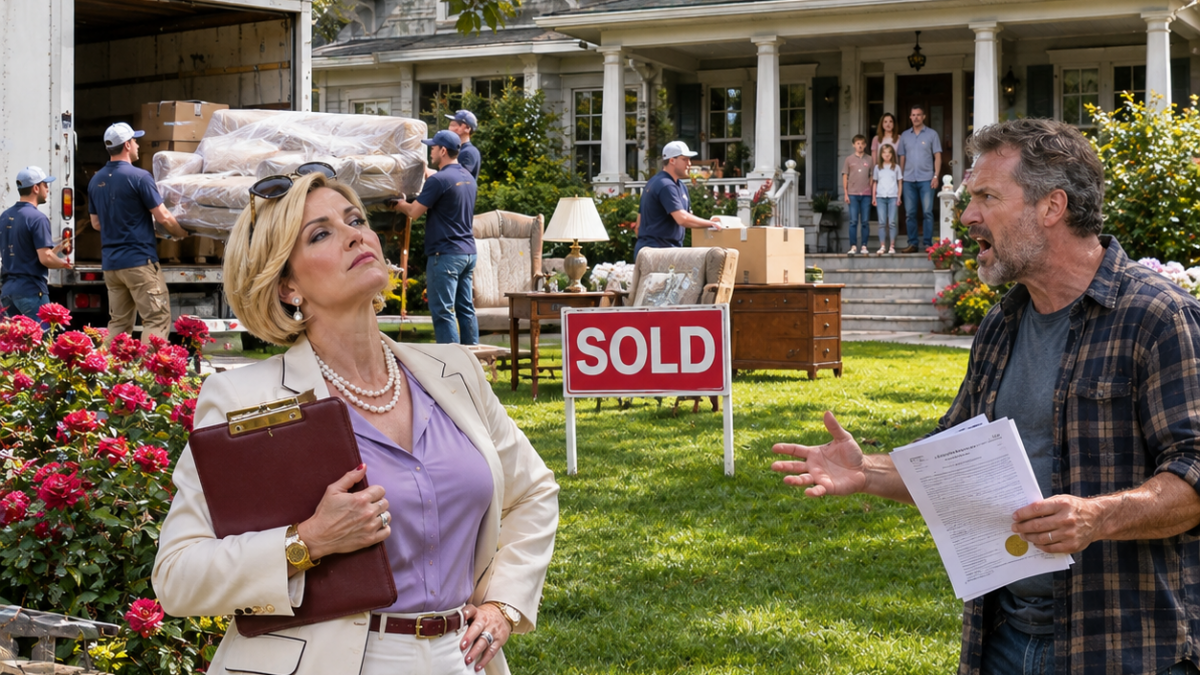
The morning I arrived to move my family into the house my uncle had left me, I found a moving truck in the driveway, strangers carrying furniture through the front door, children running across the lawn, and a red SOLD sign planted beside the rose bushes Uncle Ray had tended for thirty years.
The man unloading boxes calmly told me he and his wife had closed on the property three weeks earlier, even though I had never listed the house, never signed a sales contract, and had spent four months completing probate so the county could transfer the deed into my name.
The worst moment came when he handed me a copy of the closing papers and I saw my own signature at the bottom—close enough to fool a stranger, wrong enough that I knew somebody had studied my handwriting before deciding to steal more than a house from me.
My name is William Brown, though everyone who knew Uncle Ray called me Will.
I was forty-seven, a high-school history teacher, a husband, and the father of two kids who had spent the previous month arguing over bedrooms in a house they believed would finally give us more room than our cramped city apartment.
That house mattered for reasons no appraisal could capture.
Raymond Brown had taken me in when my parents died in a car accident when I was twelve. He raised me there, taught me how to sand wood on the back porch, balance a checkbook at the kitchen table, and measure twice before cutting anything that couldn’t be put back.
When he died at eighty-two, he left the house to me.
The probate was clean. The mortgage had been paid off for years. The county deed listed me as sole owner. Most important, the property had been built in 1965 on three acres outside the Maple Ridge subdivision, decades before its homeowners association existed.
Uncle Ray had warned me about that association before he died.
“There’s a woman down the road who keeps trying to rope this place into her HOA,” he told me during one of our last porch conversations. “Don’t let her smile fool you.”
Her name was Addison Young.
I met her a few weeks before moving day.
She pulled up in a silver SUV while I was changing the porch light, stepped out in a pastel blazer and pearls, and introduced herself as president of the Maple Ridge HOA.
“You must be the new owner,” she said.
“I am. But just so we’re clear, this property isn’t part of your HOA.”
Her smile barely moved.
“That’s what your uncle used to say.”
I remember the uneasiness that sentence gave me.
I told her the original deed and a 1988 addendum specifically rejected HOA annexation.
She made a note on her clipboard.
“Of course. Just let us know your move-in date. We like to keep our records current.”
At the time, I thought she was nosy.
On moving morning, I learned what she had wanted that date for.
The strangers in my house were John and Rebecca Morrison. They weren’t squatters. They were terrified buyers holding a recorded deed, a purchase contract, title documents, and proof that they had wired nearly everything they had into what they believed was a legitimate closing.
Rebecca looked at me with tears in her eyes.
“We sold our old place for this.”
I couldn’t answer.
My wife, Sarah, stood beside me gripping my arm. Ethan and Lily had gone completely quiet behind us.
Then John handed me the contract.
My name appeared on the signature line.
William Brown.
The forged handwriting copied little habits almost nobody noticed—the long downstroke in the B, the slightly late dot over the i.
Beside it sat a fresh notary stamp.
I was still staring at it when a silver SUV rolled to the curb.
Addison stepped out carrying her clipboard.
She surveyed the moving truck, the strangers inside my uncle’s house, and my family standing frozen in the yard.
Then she smiled.
“Good morning,” she said. “I see the Morrisons are getting settled.”
I held up the forged contract.
“You sold my house.”
Her expression didn’t change.
“Your uncle’s property had outstanding HOA obligations.”
“My uncle was never in your HOA.”
Addison opened her folder and removed a plastic-sleeved document.
“Actually,” she said, “you may want to read this before making accusations.”
She handed it to me.
Across the top were the words VOLUNTARY HOA MEMBERSHIP AGREEMENT.
At the bottom was Uncle Ray’s name.
And next to his signature was a date that made my hands go cold.
2010.
PART 2
I stared at that date until the numbers blurred.
2010.
I knew where Uncle Ray had been in 2010.
Right here.
In this house.
Complaining about Maple Ridge.
Complaining about the HOA.
Complaining specifically about Addison’s attempts to pull his property into it.
There was no universe in which Raymond Brown had voluntarily signed that form.
I turned the page over.
Nothing.
I looked back at the signature.
It was decent.
Better than the forged version of mine on the sale contract.
But it wasn’t Ray’s.
His R always leaned sharply forward because arthritis made the return stroke difficult. Whoever copied his signature had made it smooth.
Too smooth.
“Where did you get this?”
Addison’s smile sharpened.
“Association records.”
“Original?”
“This is an official copy.”
“Where’s the original?”
“You’ll need to submit a records request.”
I laughed once.
It came out ugly.
“You sold a house based on a document you won’t even show me?”
Her chin lifted.
“The property accumulated years of delinquent assessments after your uncle refused to comply with his obligations.”
“He didn’t have obligations.”
“The board determined otherwise.”
“What board?”
“The Maple Ridge board.”
“Names.”
Her eyes narrowed.
“Excuse me?”
“Give me the names of the board members who voted to foreclose.”
“You’re becoming hostile.”
“No, Addison. I’m becoming specific.”
Sarah touched my arm.
“Will.”
I heard the warning in her voice.
Ethan and Lily were still behind us.
My children were watching their father lose his temper on what should have been one of the happiest days our family had shared in years.
I stepped back.
Took a breath.
Then I looked at John Morrison.
“Call the police.”
He blinked.
“You want me to?”
“I already am.”
I dialed.
Addison sighed loudly.
“This is completely unnecessary.”
I stared at her.
“You sold my dead uncle’s house using two forged signatures.”
“Be careful with accusations.”
“Or what?”
“The association has counsel.”
“So will I.”
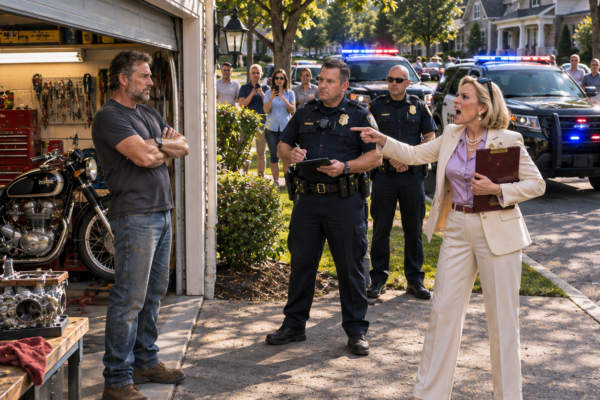
Two patrol cars arrived about fifteen minutes later.
By then the movers had stopped.
Boxes sat halfway between the truck and porch.
Nobody knew whether to carry them inside or back out.
The older officer introduced himself as Sergeant Morris.
He listened first to me.
Then John.
Then Addison.
I handed him my deed, probate order, tax records, Uncle Ray’s original 1965 title documents, and the 1988 recorded rejection of annexation.
John handed over his purchase agreement and recorded deed.
Addison produced the supposed 2010 membership agreement and a stack of HOA assessment notices.
Sergeant Morris stared at everything for a long moment.
“This is beyond what I can resolve standing in a driveway.”
“Somebody forged my signature.”
“That part we can document.”
“And they’re inside my house.”
John immediately said, “We didn’t know.”
“I know.”
He looked relieved and miserable at the same time.
The younger officer asked Addison:
“You conducted the foreclosure?”
“The association did.”
“Through a court?”
“We exercised remedies available under our governing documents.”
“Was there a judicial foreclosure?”
Addison’s face tightened.
“Our counsel handled the procedure.”
“What counsel?”
“I don’t have to answer that here.”
The officer looked at Sergeant Morris.
That look mattered.
But it didn’t get me my house back.
Sergeant Morris pulled me aside.
“Mr. Brown, I understand why you’re angry.”
“Then remove them.”
“I can’t.”
“They have a forged deed.”
“They have a recorded deed.”
“Based on fraud.”
“Maybe. But determining which title controls is going to require a judge.”
I stared at him.
“So somebody can forge my name, sell my home, and the police tell me to get a lawyer?”
“I didn’t say no crime occurred.”
“It sure sounds like it.”
“We’ll take a fraud report. The detective unit can investigate the signatures and notarizations. But I’m not going to physically evict a family holding facially valid title documents while another person is standing here with competing title documents. That becomes dangerous fast.”
I hated his answer.
I also knew he wasn’t wrong.
John and Rebecca had children standing inside.
My children were standing outside.
Every adult there had been placed in a nightmare by somebody else.
Everybody except Addison.
She stood near her SUV checking her phone.
Calm.
Almost bored.
As if she had seen this scene before.
That thought lodged in my head.
Before the officers left, I asked Sergeant Morris one more question.
“Can you give me the report number?”
“Absolutely.”
“And document that I specifically reported suspected deed fraud, forged signatures, forged notarization, and fraudulent foreclosure?”
He looked at me more carefully.
“You’ve done this before?”
“I’m a history teacher.”
He almost smiled.
“Not quite the answer I expected.”
“I teach teenagers to cite sources.”
That got the smallest laugh.
He wrote down the report number.
“Get an attorney today.”
I intended to.
Addison waited until both cruisers were pulling away.
Then she walked over.
“There. Now that the theatrics are finished—”
I turned on her.
“My uncle warned me about you.”
Something flickered across her face.
It was gone immediately.
“Raymond was difficult.”
“He was careful.”
“He refused to participate in the community.”
“He wasn’t part of your community.”
“Everything within Maple Ridge affects Maple Ridge.”
“That’s not how property law works.”
She smiled.
“We’ll see.”
I stepped closer, keeping my voice low.
“You picked the wrong house.”
“People always say that when they don’t understand procedure.”
“No.”
I looked at the forged signature in my hand.
“You picked the wrong family.”
Her expression became almost sympathetic.
“William, your uncle was an old man who let this property become a burden. We resolved it.”
For one second, rage erased every sensible thought in my head.
Sarah’s hand closed around my wrist.
Hard.
I looked at her.
Not Addison.
Sarah.
She shook her head.
Barely.
That saved me.
I turned away.
“Come on.”
“Will—”
“We’re leaving.”
Ethan stared at the house.
“But that’s Grandpa Ray’s place.”
“I know.”
“Where are we going?”
I swallowed.
“A hotel.”
Lily’s eyes filled.
“We packed everything.”
“I know, sweetheart.”
That was the first moment I truly hated Addison Young.
Not when I saw the SOLD sign.
Not when I saw the forged signature.
When I heard my daughter ask why we were driving to a motel instead of moving into the home her great-uncle had left us.
We found two adjoining rooms off the highway.
Sarah took the kids for food.
I stayed behind.
I spread documents across the little round table beneath the window.
Uncle Ray’s deed.
The probate order.
Tax statements.
The 1988 annexation rejection.
The forged 2010 membership agreement.
The fake version of my signature.
I stared at all of them until the anger stopped feeling hot.
It became focused.
Then I called Jennifer Miles.
Jennifer had handled a property-line dispute for a colleague years earlier and had a reputation for making arrogant people regret putting things in writing.
She answered on the fourth ring.
“Jennifer Miles.”
“Jennifer, it’s William Brown.”
“Will. What’s wrong?”
“My house was sold.”
Pause.
“What?”
“Somebody sold a house I inherited while I was preparing to move into it.”
“Start over.”
So I did.
She didn’t interrupt.
When I finished, she asked:
“Do you have copies of everything?”
“Yes.”
“Recorded deed?”
“Yes.”
“Probate order?”
“Yes.”
“Buyer documents?”
“Photographs.”
“Claimed HOA agreement?”
“Yes.”
“Police report number?”
“Yes.”
Another pause.
Then:
“Be at my office at eight.”
“Tomorrow?”
“Tonight if you want, but the courthouse won’t open faster because we’re angry.”
That sounded like something Uncle Ray would have respected.
“Eight.”
“And Will?”
“Yeah?”
“Don’t contact Addison Young again.”
“I wasn’t planning to.”
“Good. From this point forward, give her nothing but paperwork.”
I hung up.
Sarah returned twenty minutes later with burgers.
She found me sitting in front of the forged contract.
“You okay?”
“No.”
She sat across from me.
For a while neither of us spoke.
Then she reached across the table.
“Do you remember what Ray told you every time you worked in his shop?”
I looked at her.
“Measure twice.”
“Cut once.”
I nodded.
Sarah squeezed my hand.
“So measure.”
That night I barely slept.
At eight the next morning, Jennifer was waiting.
She wore black slacks, a dark jacket, and an expression that suggested smiling was something she reserved for verdicts.
She laid the forged contract beside my actual deed.
Then she compared Uncle Ray’s alleged 2010 signature to one on a notarized 2009 estate document.
“These aren’t the same.”
“I know.”
“How certain?”
“Completely.”
“That isn’t what I asked.”
I understood.
“How do we prove it?”
Now she smiled.
“Better question.”
For the next four hours, we built the case.
Jennifer filed for an emergency injunction to freeze further transfers or encumbrances on the property.
She requested the full county title history.
We sent preservation notices to the brokerage, title company, notary, supposed HOA, and bank involved in the closing.
Then the county records came back.
Jennifer stared at her screen.
“Oh.”
I was sitting across from her.
“What?”
“Your house has HOA liens on it.”
I felt sick.
“How many?”
“Three recorded last year.”
“For what?”
She opened the first.
“Unpaid assessments dating to 2010.”
“That’s impossible.”
“I know.”
“Who notarized them?”
She scrolled.
Then stopped.
“Mark A. Young.”
I recognized the name.
“Addison’s brother-in-law.”
Jennifer leaned back.
“You’re sure?”
“She introduced him once at a neighborhood event. He has a mobile notary business.”
“Convenient.”
She opened the next document.
Same stamp.
Same name.
Third.
Same.
Then she pulled up the 2010 membership agreement.
There he was again.
**Mark A. Young, Notary Public.**
Jennifer tapped the screen.
“The alleged HOA membership, the liens, and at least part of the foreclosure chain all run through the same notary.”
“Family.”
“Family isn’t automatically fraud.”
“No.”
“But it makes the pattern worth investigating.”
My phone rang.
Sarah.
I answered.
“You need to see this,” she said.
“What?”
“I’m sending a link.”
A neighborhood Facebook group opened.
**MAPLE RIDGE NEIGHBORS ASSOCIATION**
Profile photo:
Addison smiling beside a flower bed.
Latest post:
**Another neglected property restored to Maple Ridge pride. Thanks to decisive association leadership, a long-standing delinquency has been resolved and a new family welcomed into our community.**
Below it was a photograph of my uncle’s house.
The Morrisons’ moving truck was in the driveway.
My hands tightened around the phone.
One comment said:
**Wasn’t this Raymond Brown’s home? I thought he wasn’t in the HOA.**
The comment disappeared while I was reading.
Jennifer watched my face.
“What?”
I handed her the phone.
She read.
Then took a screenshot.
“Good.”
“Good?”
“She’s talking publicly.”
“She called my uncle’s house neglected.”
“And every unsupported claim she makes becomes something we can test.”
I hated how lawyers could make infuriating things sound useful.
By three that afternoon, Jennifer received notice from the court.
The judge had granted temporary relief.
The title was frozen.
Nobody could sell, refinance, pledge, or further encumber the property until the dispute was resolved.
It wasn’t possession.
But it was the first thing Addison couldn’t simply talk around.
Jennifer called her attorney.
Then looked at me.
“Interesting.”
“What?”
“There doesn’t seem to be one.”
“The HOA doesn’t have counsel?”
“The email she gave the police as ‘Maple Ridge Legal Department’ routes to a generic account.”
“Meaning?”
“Meaning I want to know what this organization actually is.”
That question opened the door.
The next morning, I received an email.
**MAPLE RIDGE LEGAL DEPARTMENT**
**FINAL DEMAND**
It claimed I owed $39,450 in unpaid assessments, penalties, legal fees, maintenance charges, and “community restoration expenses.”
Jennifer read it.
Then actually laughed.
“What?”
“These citations don’t exist.”
“What citations?”
She pointed.
“HOA Code 7.3B. There is no state HOA code 7.3B governing this property. She invented a citation.”
“So now what?”
“Now I stop assuming we’re dealing with an overreaching real HOA.”
She opened the state corporate registry.
Searched.
Once.
Twice.
Then used variations.
No registered nonprofit corporation matching Addison’s entity.
No valid state filing.
No active association corporation corresponding to the documents she had given us.
Jennifer stared at me.
“Will.”
“What?”
“I don’t think Addison is running the actual Maple Ridge HOA.”
I felt the floor shift beneath the story.
“What do you mean?”
“There is a legitimate Maple Ridge homeowners association.”
“I know.”
“South of the creek.”
“Yes.”
“Your uncle’s property isn’t in it.”
“Right.”
“But the organization issuing these notices appears to be something else using almost the same name.”
I sat very still.
“She copied them?”
“Looks that way.”
“Why would nobody notice?”
“People see an HOA letterhead, a familiar neighborhood name, somebody carrying a clipboard, and they assume the authority exists.”
I thought about Addison’s confidence.
The pastel suits.
The SUV.
The way she talked about “the board.”
“She made herself president.”
Jennifer’s eyes stayed on the screen.
“She may have made herself the entire association.”
We needed witnesses.
The first was Marilyn Cooper.
Seventy-one.
Twenty years in Maple Ridge.
She met us at a diner and brought an accordion folder so thick the elastic band barely closed.
“Addison started showing up about six years ago,” Marilyn said.
“What did she tell residents?”
“That the old board had become inactive and she was reorganizing things.”
“Did you vote?”
Marilyn laughed bitterly.
“Apparently there was an election.”
“Were you notified?”
“No.”
“Did you pay dues?”
“Yes.”
“Why?”
“Because she sent me a notice threatening late fees and a lien.”
Jennifer slid a receipt toward herself.
“Who received payment?”
Marilyn pointed.
“Maple Ridge Community Administration.”
Jennifer and I exchanged a look.
Different name.
Same mailing address Addison used.
Marilyn lowered her voice.
“She fined us once because my husband called her a dictator.”
I thought I misheard.
“For what?”
“Hostile communications toward a community official.”
“You paid?”
“My husband wanted to fight.”
Her mouth trembled.
“I was scared she’d put another lien on the house.”
That silenced me.
A petty tyrant is irritating.
A person who can frighten an elderly couple into paying money because they fear losing their home is something else.
Outside the diner, Marilyn grabbed my sleeve.
“If you’re going after her, don’t stop halfway.”
“I won’t.”
“She ruins people.”
Our second witness was Gary Turner.
No relation to Addison.
He had received annexation letters despite living outside the actual subdivision boundary.
“She told me everybody within half a mile was being integrated.”
“Did you sign?”
“No.”
“What happened?”
“Fees appeared anyway.”
He showed us notices.
Same fake legal language.
Same escalating penalties.
Then he said:
“You should talk to Linda Chen.”
That name became the first clue this was far worse than my case.
Linda lived in a one-bedroom apartment across town.
She was seventy-four.
Her husband had died three years earlier.
They had owned a paid-off home on Birch Lane.
“What happened to it?” Jennifer asked.
Linda stared into her tea.
“Addison said my husband had signed an HOA integration agreement.”
My spine tightened.
“Did he?”
“Not that I ever knew.”
“What happened when you refused to pay?”
“Lien.”
Her voice became quieter.
“Then foreclosure notices.”
“From whom?”
“AY Property Consulting.”
Jennifer stopped writing.
“AY?”
Linda nodded.
“I didn’t understand. I thought it was the HOA’s lawyer.”
“What happened to your house?”
“Sold.”
The word barely came out.
“My husband built that house.”
She looked at me.
“They told me I had thirty days to leave.”
For a second I saw Uncle Ray’s porch.
My children outside.
The Morrison children inside.
I understood the scale differently.
This wasn’t Addison’s first attempt.
It wasn’t even her first success.
Jennifer subpoenaed documents tied to my sale.
The responses came in over the next week.
My property had sold for just under four hundred thousand dollars.
A substantial transfer—fifty thousand dollars—went almost immediately to AY Property Consulting LLC.
The rest moved through the brokerage and settlement structure.
The real estate agent involved in the transaction?
Robert Young.
Addison’s husband.
I was sitting in Jennifer’s office when she turned her monitor toward me.
“Robert listed it.”
“He knew?”
“Don’t jump yet.”
“He’s her husband.”
“I said don’t jump.”
“He sold a property his wife claimed through a fake HOA.”
“I know what it looks like.”
I stood and paced.
“This is a family operation.”
“Probably.”
“Jennifer.”
“Probably is not a courtroom word.”
I stopped.
That became one of the hardest things about the next year.
Knowing what I believed.
Waiting until evidence could prove it.
Jennifer arranged a meeting with Carolyn Hail, president of the legitimate Maple Ridge HOA.
Carolyn brought two board members and an attorney.
The instant she saw Addison’s documents, her expression hardened.
“We did not issue these.”
Jennifer pushed over a notice.
“Is this your logo?”
“A modified version.”
“Did you authorize Addison Young to represent Maple Ridge?”
“No.”
“Was she ever president?”
“Not of our association.”
Carolyn looked at me.
“We’ve sent her cease-and-desist letters before.”
My mouth fell open.
“Before?”
“She calls her group the Maple Ridge Neighbors Association in some places, Maple Ridge HOA in others. Residents confuse the two.”
“Why didn’t you stop her?”
“Our counsel threatened action over the name. She changed letterheads, changed email addresses, claimed she represented an adjacent voluntary community organization.”
Jennifer asked:
“Did you know she was filing liens?”
Carolyn’s face changed.
“No.”
“Foreclosures?”
“No.”
“Selling properties?”
“No.”
The attorney beside her leaned forward.
“We need copies of everything.”
That meeting was the moment the story stopped being a property dispute.
Addison Young wasn’t an HOA president who had gone too far.
She was impersonating authority.
And she had used that illusion to take people’s homes.
Jennifer said it after everyone left.
“She built a machine out of assumptions.”
“What assumptions?”
“That county clerks would trust notarized documents.”
“That homeowners would trust an HOA letterhead.”
“That buyers would trust recorded deeds.”
“That police would see title disputes and send people to civil court.”
“That frightened residents wouldn’t have enough money to fight.”
She closed the folder.
“And most important, she assumed the victims would be isolated.”
I looked at the list of names we’d begun compiling.
“She was right.”
Jennifer shook her head.
“Past tense.”
The Morrison family became another difficult part of the case.
I visited them one evening after speaking with Jennifer.
John answered the door.
He looked exhausted.
“Mr. Brown.”
“Will.”
He stepped aside.
Rebecca was at the kitchen table.
My kitchen table.
Except it wasn’t Uncle Ray’s anymore.
Their furniture occupied the room.
Children’s drawings were taped to the refrigerator.
I felt a flash of resentment.
Then shame.
They had done nothing wrong.
Rebecca stood.
“We got a letter from the title company.”
“I figured.”
“They say the title is contested.”
“It is.”
She swallowed.
“Are we going to be homeless?”
I didn’t know.
So I refused to lie.
“I don’t know what happens yet.”
John rubbed both hands over his face.
“We put almost everything into this.”
“I know.”
“We sold our old house.”
“I know.”
“Rebecca quit her job because we moved farther out.”
“I know.”
He looked at me.
“Then what are we supposed to do?”
That question hurt because I had been asking the same thing.
“I don’t blame you.”
Rebecca’s eyes filled.
“You don’t?”
“No.”
“I would.”
“I did for about ten minutes.”
John almost smiled.
Then I said:
“Addison did this to both families.”
Rebecca looked around the room.
“We thought this was our fresh start.”
“So did we.”
Nobody knew what to say after that.
Before leaving, I stood in the hallway.
There was a notch in the doorframe.
My height at thirteen.
Then fourteen.
Then fifteen.
Uncle Ray had marked it with pencil.
The Morrisons hadn’t painted over it.
Rebecca saw me looking.
“We didn’t know what that was.”
“My uncle measured me there.”
She put a hand over her mouth.
“I’m sorry.”
I touched the old pencil marks.
“Don’t erase them.”
“We won’t.”
That was the moment the Morrisons stopped being strangers in my stolen house.
They became people trapped in the same crime.
A week later, the investigation found another victim.
Sergeant Daniel Lewis.
United States Marine.
He had been deployed overseas when his home was targeted.
We met outside the courthouse.
He wore his service uniform because he had another official appointment afterward.
“She declared my house abandoned.”
His voice was flat.
“My sister had power of attorney.”
“What happened?”
“Addison told her the POA didn’t override HOA foreclosure authority.”
Jennifer asked:
“Was the house in Addison’s association?”
Daniel laughed without humor.
“There was no association.”
His jaw tightened.
“I came home from Afghanistan and a family was living in my house.”
I stared at him.
Exactly my story.
Only worse.
“I fought two wars overseas,” he said. “Never thought I’d come home and have to prove I owned my bedroom.”
Jennifer collected his documents.
The pattern matched.
Fake assessments.
Fake membership.
Fake lien.
Notarization.
AY Property Consulting.
Property sale.
The names differed.
The method didn’t.
Then Mark Young asked to talk.
Addison’s brother-in-law.
The notary.
His attorney contacted Jennifer late at night.
“He’s scared,” she told me.
“Good.”
“Don’t do that.”
“Do what?”
“Enjoy it.”
I looked at her.
“He notarized my dead uncle’s signature.”
“And if he gives us the evidence that proves who directed it, you want him talking.”
She was right.
I hated that.
We met Mark in a district attorney’s conference room.
He looked like he hadn’t slept.
His hands moved constantly.
Folding.
Unfolding.
Gripping a paper cup.
Jennifer sat across from him.
His lawyer sat beside him.
An investigator recorded the interview.
Mark started before anyone asked.
“I didn’t know it would become this.”
Jennifer’s voice was cold.
“You notarized documents without witnessing signatures.”
“Yes.”
“You notarized signatures for people who were not present.”
“Yes.”
“You notarized Raymond Brown’s signature after being told he had agreed to HOA membership.”
“Yes.”
“My uncle was dead when some later documents were filed,” I said.
Mark stared at the table.
“I know.”
I leaned forward.
“Did you know then?”
His lawyer touched his sleeve.
Mark looked up anyway.
“Yes.”
The room seemed to shrink.
“You stamped a dead man’s name.”
Tears formed in his eyes.
“Addison said it didn’t matter.”
“What exactly did she say?”
Mark closed his eyes.
Then whispered:
“She said, ‘The dead can’t argue.’”
I stopped breathing for a second.
Uncle Ray had taken me in at twelve.
He had sat awake beside my bed when nightmares about the accident woke me.
He had attended every parent-teacher conference.
He had taught me to drive in an old Ford pickup with a transmission that fought every gear change.
He had saved birthday cards because he hated throwing away handwriting.
And Addison had reduced him to:
**The dead can’t argue.**
I stood.
Jennifer said quietly:
“Will.”
“I need a minute.”
I walked into the hallway.
Pressed both palms against the wall.
My chest hurt.
Not metaphorically.
Actually hurt.
A door opened behind me.
Jennifer stepped out.
“You okay?”
“No.”
“Take five.”
“I want her destroyed.”
“I know.”
“I mean it.”
“I know.”
I turned.
She looked at me calmly.
“That is exactly why you don’t get to decide what happens to her.”
I hated hearing it.
She continued.
“The evidence decides.”
I looked through the little window into the conference room.
Mark sat with his face in his hands.
“So what do I do?”
“Stay useful.”
Uncle Ray’s voice came back.
Measure twice.
Cut once.
I returned to the room.
Mark testified that Addison had initially described the scheme as “paper cleanup.”
Old HOA records.
Informal annexations.
Correcting missing acknowledgments.
Then came fabricated membership forms.
Fake meeting minutes.
Liens.
He claimed he resisted.
Then participated.
Addison threatened to blame him for all of it if he stopped.
“You understand that doesn’t make you innocent,” Jennifer said.
“Yes.”
“Why cooperate now?”
He looked at me.
“Because she sold his house.”
I stared back.
Mark shook his head.
“I knew she was doing bad things. I told myself they were just money things. Fees. Forms. People arguing. Then she told me the old man was dead, the nephew hadn’t moved in yet, and nobody would catch it.”
His voice cracked.
“I realized there would always be another house.”
That testimony pushed the case forward.
Then Robert Young disappeared from public view.
Addison’s husband.
Real estate agent.
The man who had handled sales tied to her scheme.
Jennifer’s investigator found him staying at a rental property in another county.
Robert hired counsel almost immediately.
Then he began cooperating.
His version was exactly what everyone expected.
He hadn’t known at first.
Then he knew a little.
Then enough.
Then too much.
He kept going because the money was good and because Addison controlled everything.
I didn’t believe the first part.
Federal investigators didn’t seem to either.
Bank subpoenas did what excuses couldn’t.
Transfers.
Shell companies.
Cash purchases.
Jewelry.
Vacations.
Vehicles.
The fraudulent proceeds initially tied to Addison’s operation exceeded $340,000.
Then investigators expanded the timeframe.
More accounts.
More victims.
More companies.
The number kept climbing.
Before long, federal agents joined the case.
Special Agent Rebecca Nolan met us in Jennifer’s office.
She had the calmest voice of anyone involved.
That made her terrifying.
She opened a binder.
“Addison Young has been on our radar in connection with suspicious real estate transactions.”
“How long?”
“About eighteen months.”
I stared.
“You knew?”
“We had fragments.”
“While she was taking houses?”
“We had reports that didn’t initially establish a common scheme.”
Jennifer interrupted before I could say something useless.
“What changed?”
Agent Nolan looked at me.
“His file.”
My evidence.
Uncle Ray’s records.
The forged deed.
Mark’s notarizations.
The other victims.
AY Property Consulting.
Robert’s transactions.
Nolan turned a page.
“Your case gave us a structure.”
I didn’t feel proud.
I felt angry that structure had cost so many people their homes.
Then Nolan showed us another name.
Stanley Ree.
County records employee.
Mid-level.
Twenty-three years in the office.
“What about him?”
“We believe he processed questionable filings without required verification.”
Jennifer asked:
“For money?”
Nolan didn’t answer directly.
“We’re investigating.”
Two weeks later, Stanley Ree confessed.
Cash payments.
Gifts.
Transfers routed through one of Robert’s companies.
He had helped questionable documents move through the system with fewer questions.
That explained the part none of us could understand.
Why so many obviously suspicious documents had been accepted.
Addison hadn’t merely exploited the bureaucracy.
She had purchased a weak point inside it.
The charges expanded.
Forgery.
Wire fraud.
Real estate fraud.
Conspiracy.
Financial crimes.
Additional state charges followed.
Addison responded by holding an emergency “HOA meeting.”
Jennifer and I went.
So did county investigators.
The clubhouse overflowed.
Residents stood along the walls.
Addison marched to the front in a powder-blue suit.
She still looked polished.
Still carried the clipboard.
Still behaved like the room belonged to her.
“These allegations,” she began, “are being spread by disgruntled individuals who do not understand association law.”
Someone shouted:
“You’re not even our association!”
Addison ignored it.
“Every action taken during my leadership was authorized.”
I stood.
“By whom?”
Her eyes found me.
“Sit down, Mr. Brown.”
“No.”
Murmurs spread.
She tapped the microphone.
“This isn’t your meeting.”
“Show us the vote.”
“What?”
“The vote authorizing the foreclosure on my uncle’s house.”
“That information is in the minutes.”
Jennifer stood beside me.
“We have those.”
Addison’s face changed.
Only slightly.
Jennifer held up a folder.
“Several signatures belong to people who had moved away years before the dates shown.”
A man near the back shouted:
“My wife is listed on one of those votes! She was dead!”
The room erupted.
Addison hit the microphone.
“Order!”
Nobody listened.
She raised her voice.
“Order!”
Still nothing.
For years, that word had worked because people believed she had authority behind it.
Now the word sounded empty.
Two investigators moved toward the front.
One spoke.
“Addison Young?”
She stared.
“Yes?”
“We need you to come with us.”
“This is an official association meeting.”
“Ma’am.”
“You cannot interrupt—”
“Addison Young, you’re under arrest.”
For the first time, her voice cracked.
“You can’t arrest me for enforcing HOA rules.”
The investigator placed a hand near her elbow.
“We’re not arresting you for HOA rules.”
Addison looked at me.
Her eyes burned.
“This is you.”
I didn’t move.
She pointed.
“He did this because he lost a property dispute.”
I said:
“You sold a house you didn’t own.”
“I protected this community!”
“No.”
My voice came out quieter than hers.
“You stole from it.”
She looked around.
Waiting, I think, for someone to defend her.
Nobody did.
Diane Stevens looked down.
Marilyn Cooper stared straight ahead.
Gary shook his head.
Carolyn Hail from the real HOA stood near the back with folded arms.
The investigators led Addison toward the door.
She suddenly twisted around.
“I am the HOA!”
The room went silent.
I don’t know whether she realized how absurd that sounded.
Maybe she meant it.
The door closed behind her.
No applause.
No cheering.
Just breathing.
For the first time since moving day, I felt something inside me loosen.
Then Jennifer leaned toward me.
“Don’t celebrate.”
“I wasn’t.”
“Good.”
“Why?”
“Because getting your house back is still the hard part.”
She was right.
The criminal case didn’t magically untangle the title.
The Morrisons were still living there.
Their deed had been recorded.
Their money was gone.
The title company was investigating.
My own family had been in a motel for weeks before moving into a short-term rental.
My kids had started asking whether we should give up.
One night Ethan found me at the kitchen table surrounded by files.
“Dad?”
“Yeah?”
“Can I ask something?”
“Always.”
“Is the house worth all this?”
The question caught me off guard.
“What do you mean?”
He sat across from me.
“Mom’s stressed. Lily hates the rental. You’re always with lawyers.”
I looked at my son.
He was fifteen.
Old enough to see more than adults sometimes wanted children to see.
“Do you want me to stop?”
“I don’t know.”
I closed the folder.
“The house is worth something to me because Uncle Ray raised me there.”
“I know.”
“But you and your mom and Lily are worth more.”
He nodded.
“So if fighting for that house destroys us, then no. It isn’t worth it.”
He looked relieved.
“Then why keep going?”
“Because this isn’t only about the house anymore.”
I hated how cliché that sounded.
But it was true.
“Mrs. Chen lost hers.”
“Sergeant Lewis too.”
“Yes.”
“And there are others.”
He thought about that.
“So you’re doing this for them?”
“Partly.”
“And Grandpa?”
“Definitely.”
He smiled.
“Okay.”
Then he stood.
“Still think my room should be the upstairs one.”
I laughed.
“We haven’t even won.”
“Planning ahead.”
After he left, I sat alone.
That conversation kept me honest.
I didn’t want to become obsessed with beating Addison.
I wanted to restore what she damaged.
Those were not the same thing.
Addison was released on bail after the first arrest.
Almost immediately she filed lawsuits.
Against me.
Against Jennifer.
Against former associates.
Defamation.
Interference.
Emotional distress.
Political retaliation.
Jennifer’s assistant, Renee, dropped the stack on her desk.
“She is suing everyone who knows her name.”
Jennifer barely looked up.
“That’s fine.”
Renee stared.
“Fine?”
“She wants us distracted.”
“Is it working?”
“No.”
Jennifer pushed the pile aside.
“Discovery works both ways.”
That sentence made Addison’s lawyers regret several decisions.
Her civil claims opened additional financial questions.
Requests for records.
Communications.
Board authorizations.
Evidence supporting her statements.
She withdrew some claims.
Others were dismissed.
Meanwhile, federal agents executed warrants.
Black SUVs appeared outside Addison’s house.
Boxes came out.
Computers.
Ledgers.
Phones.
AY Property Consulting records.
Fake vendor files.
Neighboring residents stood on sidewalks watching the polished image of suburban authority being carried away one banker’s box at a time.
Then Addison vanished.
Her attorney claimed she was ill and resting.
Investigators went to her house.
Suitcases were missing.
Closets partly emptied.
Her dog had been left with a neighbor.
Agent Nolan called me.
“She may be attempting to flee.”
My stomach tightened.
“Can she?”
“Not far.”
Two days later, news alerts started appearing.
Addison had been intercepted at Denver International Airport while attempting to board an international flight using documents under her maiden name.
Federal agents found multiple passports in her luggage and a substantial amount of cash.
The video of her arrest spread everywhere.
She shouted:
“This is harassment!”
The irony would have been funny if the damage behind it hadn’t been so real.
Her bail was revoked.
She remained in federal custody.
Robert filed for divorce.
Then he offered full cooperation.
The legitimate Maple Ridge HOA discovered another wound.
Addison had used identifying information connected to the real association to open accounts and redirect funds.
The genuine HOA’s finances were devastated.
It entered restructuring and eventually dissolved before being rebuilt under a new organization.
The deeper accountants went, the worse the numbers became.
$340,000 became $600,000.
Then nearly $900,000.
When all known proceeds, diverted association money, fraudulent sales, and related accounts were calculated, prosecutors alleged losses exceeding $1.2 million.
Jennifer sat across from me when that number arrived.
“One point two million.”
I didn’t respond.
“Will?”
“How many people?”
“More than we first knew.”
“That’s what matters.”
She nodded.
The victims list expanded.
Elderly homeowners.
People in probate.
Absentee owners.
Families with language barriers.
Residents temporarily living out of state.
Addison chose people whose paperwork was complicated enough that her version could survive for a while.
My uncle had been different.
Ray’s paperwork was perfect.
That was the flaw in her plan.
He had kept everything.
Every rejection letter.
Every certified receipt.
Every survey.
Every tax statement.
Even envelopes.
One afternoon, Jennifer spread his 1988 correspondence across the table.
“Your uncle saved the certified-mail receipt.”
“Of course he did.”
“He saved the returned green card.”
“Yep.”
“He saved the HOA’s acknowledgment.”
“He didn’t trust them.”
Jennifer looked at me.
“He didn’t trust anyone.”
I smiled.
“No. He trusted paper.”
She held up one letter.
“This may be one of the strongest documents in the case.”
It stated clearly that Raymond Brown declined annexation and that his parcel remained outside the HOA boundary.
The organization had acknowledged receipt.
Addison’s alleged 2010 “voluntary membership” directly contradicted it.
The signature expert later confirmed what I already knew.
The signature wasn’t Ray’s.
Mine wasn’t mine.
Others weren’t theirs.
The whole empire was handwriting and confidence.
Then Mark gave prosecutors something worse.
Emails.
One read:
**The Brown parcel is clean. No mortgage. No local occupant. Nephew is delayed moving in. We can close quickly if paperwork is processed before he establishes possession.**
I read that sentence three times.
She knew.
She knew I inherited it.
She knew I intended to move in.
She knew I wasn’t absent.
She sold it before I arrived because she understood the window was closing.
Another email to Robert said:
**Once buyer records, Brown will spend months fighting title. Most people settle rather than burn money on litigation.**
Jennifer watched me read.
“She counted on exhaustion.”
“Uncle Ray warned me.”
“About what?”
“That she smiles while sharpening the knife.”
Jennifer didn’t smile.
“Your uncle understood her.”
The case attracted media attention.
More than I wanted.
One headline called it the “HOA Empire Fraud Case.”
Another called Addison the “Fake HOA Queen.”
I disliked both.
Turning her into a cartoon made it too easy to forget the victims.
Linda Chen wasn’t a meme.
Daniel Lewis wasn’t a meme.
The Morrisons definitely weren’t.
Sarah asked me one night whether I planned to speak publicly.
“No.”
“Why?”
“Because I don’t want this becoming entertainment.”
She nodded.
Then asked:
“What do you want?”
I thought about it.
“My house.”
“Only that?”
“No.”
I looked at Uncle Ray’s folder.
“I want people to know what happened before the next Addison finds another Linda.”
The criminal trial was scheduled almost a year after the morning we arrived with our moving truck.
By then I was tired in ways sleep didn’t fix.
Depositions.
Meetings.
Hearings.
Title proceedings.
Work.
Teaching.
Parenting.
My students knew something was happening because local news had my face on television.
One day a senior stayed after class.
“Mr. Brown?”
“Yes?”
“My mom says you’re fighting an HOA.”
I sighed.
“Your mother watches too much news.”
“Did they really sell your house?”
“Yes.”
He shook his head.
“That’s insane.”
“It is.”
He hesitated.
“You still grading essays?”
“Unfortunately.”
He laughed.
That ordinary moment helped.
I needed reminders that my entire identity wasn’t a property dispute.
Trial morning, victims filled the courthouse.
Jennifer sat with me in the gallery.
The federal case was led by Assistant U.S. Attorney Paul Jensen.
Addison entered in custody.
No pastel blazer.
No pearls.
Her hair showed gray at the roots.
She looked tired.
But when she saw me, the old smile returned.
Small.
Condescending.
As if she still knew something I didn’t.
Paul’s opening statement avoided theatrics.
He didn’t need them.
He described the mechanism.
Fabricated HOA authority.
Forged membership.
False liens.
Manipulated county filings.
Fraudulent sales.
Shell companies.
Wire transfers.
He called it “an organized scheme built to turn other people’s homes into private revenue.”
Then witnesses began.
Linda Chen went first.
She looked tiny in the witness chair.
Paul asked:
“Mrs. Chen, did you voluntarily join an HOA managed by Addison Young?”
“No.”
“Did you owe the assessments claimed against your property?”
“No.”
“What happened when you refused payment?”
“They sold my house.”
Her voice cracked.
The courtroom became still.
“My husband built it.”
Paul paused.
Linda wiped her eyes.
“He used to joke that every crooked wall was his signature. After he died, I thought at least I still had the house.”
She looked toward Addison.
“She took that too.”
Addison didn’t react.
Daniel Lewis testified next.
He wore his uniform.
Paul asked where he was when foreclosure proceedings began.
“Deployed.”
“Did you abandon the property?”
“No.”
“Did you have a representative in the United States?”
“My sister had power of attorney.”
“What happened when she contacted Ms. Young?”
“She was told the HOA authority superseded it.”
“Was that true?”
“No.”
“What did you find when you returned?”
Daniel’s jaw flexed.
“Strangers living in my house.”
He paused.
“I’ve had people shoot at me overseas. I knew what the danger was there.”
He looked at the jury.
“I didn’t know I needed to defend my home from paperwork while serving my country.”
Even Addison’s attorney stopped taking notes for a second.
Then Mark Young testified.
The prosecutor walked him through document after document.
“Did Raymond Brown sign this in your presence?”
“No.”
“Did William Brown sign this in your presence?”
“No.”
“Did Linda Chen sign this?”
“No.”
“Why did you notarize them?”
Mark looked toward Addison.
“She told me to.”
Addison suddenly said:
“Liar.”
The judge looked up.
Her attorney whispered urgently.
Paul waited.
Then:
“What happened when you told Ms. Young you wanted to stop?”
“She threatened me.”
“How?”
“She said if the operation collapsed, she’d make it look like I created the forged documents myself.”
“Did she ever discuss Raymond Brown specifically?”
Mark swallowed.
“Yes.”
“What did she say?”
He stared at his hands.
“She told me he was dead.”
Paul waited.
“And?”
Mark whispered:
“She said the dead can’t argue.”
I closed my eyes.
Just for a second.
Sarah’s hand found mine.
Then Robert Young took the stand.
Addison finally stopped smiling.
Robert looked older.
Divorce papers had already been filed.
His voice was flat.
“She used me.”
Addison’s lawyer objected.
The judge overruled after Paul reframed.
“What was your role?”
“I handled real estate transactions.”
“Did you know some HOA claims were fraudulent?”
“Eventually.”
“When?”
Robert hesitated.
“Before the Brown sale.”
That mattered.
Paul asked:
“Why continue?”
“Money.”
The word hung there.
“And my wife.”
“What about her?”
“She believed she was smarter than everybody.”
He looked at Addison.
“She called homeowners sheep.”
Addison’s face changed.
Robert continued.
“She said people see official paperwork and do whatever it tells them.”
“Did she consider the Brown property legitimate HOA property?”
“No.”
The courtroom stirred.
Paul asked:
“How do you know?”
“Because she complained about Raymond for years.”
“What did she say?”
“That he was the one house she couldn’t control.”
My skin prickled.
Uncle Ray.
Still resisting after death.
Then Stanley Ree testified under cooperation agreement.
Cash.
Processing shortcuts.
Documents accepted despite inconsistencies.
He admitted Addison’s operation would have faced greater scrutiny without his help.
That testimony connected the private fraud to the public records system.
Finally, I was called.
I walked to the stand carrying the same folder I had carried into Uncle Ray’s driveway that first morning.
The prosecutor asked:
“Mr. Brown, how did you acquire 342 Maple Ridge Drive?”
“My uncle left it to me.”
“Who was Raymond Brown?”
That question almost broke me.
I had spent a year answering legal questions about Ray.
Owner.
Decedent.
Grantor.
Estate.
Parcel holder.
Nobody had asked who he was.
“My father.”
The prosecutor paused.
“Your uncle?”
“Legally, yes.”
I looked toward the jury.
“My parents died when I was twelve. Uncle Ray took me in. So he was my uncle on paper and my father everywhere else.”
Sarah wiped her cheek.
I continued.
“He raised me in that house.”
Paul asked me to explain moving day.
I did.
The moving truck.
The SOLD sign.
The Morrisons.
The forged signature.
Addison.
The police.
The motel.
Then he handed me Uncle Ray’s 1988 letter.
I knew it immediately.
“Do you recognize this?”
“Yes.”
“What is it?”
“Ray’s response rejecting an attempt to annex his property into Maple Ridge.”
“Was it retained with his records?”
“Yes.”
“Why?”
I almost smiled.
“He kept everything.”
Paul displayed the letter.
Then the green certified-mail card.
Then the association acknowledgment.
Then Addison’s supposed 2010 membership agreement.
“Mr. Brown, did your uncle ever tell you he joined?”
“No.”
“Did he ever behave as though he had?”
“No.”
“Did he warn you about anyone?”
I looked toward Addison.
“Yes.”
“Who?”
“Her.”
Paul didn’t ask for drama.
He just let the answer sit.
The defense attorney tried to paint the whole matter as bureaucratic confusion.
“Mr. Brown, isn’t it possible your elderly uncle changed his mind without telling you?”
“No.”
“You cannot know every document he signed.”
“No.”
“So you can’t know.”
“I know the signature expert says he didn’t sign it.”
The attorney’s mouth tightened.
“And you personally benefited from this prosecution, correct?”
“How?”
“You expect restitution.”
“I expect my house back.”
“Financially.”
“I spent money because your client sold something she didn’t own.”
The judge warned both of us to stay within the question.
The attorney tried again.
“You have publicly described Mrs. Young as a fraudster.”
“No.”
“You’ve never called her that?”
“Not publicly.”
“Privately?”
“Probably.”
A few people laughed.
The judge looked over his glasses.
I continued:
“I didn’t need to label her. The documents did that.”
No more questions.
The defense called witnesses.
Former supporters.
A bookkeeper.
An expert who argued some HOA procedures could be misunderstood.
Their central theory was that Addison believed she had legitimate authority and made administrative mistakes.
Then prosecutors showed her emails.
**The Brown parcel is clean.**
**Nephew delayed moving in.**
**Close quickly.**
**Most people settle rather than burn money on litigation.**
Honest mistake died on the screen.
Then came a message involving another elderly homeowner:
**If she can’t afford counsel, she’ll fold.**
The room went silent.
Addison’s own words did more damage than any witness.
The jury deliberated for about ninety minutes.
When they returned, I couldn’t look at Addison.
I looked at Linda.
Daniel.
The Morrisons.
Sarah.
My kids.
The foreperson stood.
“Guilty.”
Count after count.
Twenty-seven in total.
The details blurred.
Fraud.
Forgery-related offenses.
Wire fraud.
Conspiracy.
Financial crimes.
The room exhaled.
Linda cried.
Daniel bowed his head.
I sat perfectly still.
Sentencing came later.
Judge Ramirez spoke for several minutes.
He talked about homes as more than assets.
About public records depending on trust.
About how Addison weaponized the appearance of lawful authority against people least equipped to challenge it.
Then he imposed eighteen years in federal prison along with restitution and forfeiture orders totaling approximately $1.2 million across the proven scheme.
Addison stood rigid.
When marshals moved toward her, she turned.
Our eyes met.
“You think you’ve won, Brown?”
Nobody had addressed me directly.
The courtroom froze.
I looked at her.
“No.”
My voice was steady.
“The truth finally caught up.”
She tried to answer.
The marshal guided her away.
I watched the door close.
Then I felt… tired.
That was all.
Not triumphant.
Not victorious.
Tired.
Outside, reporters crowded the steps.
Jennifer guided us through.
Someone shouted:
“Mr. Brown, do you feel vindicated?”
I kept walking.
Another:
“Will you move into the house now?”
That question stopped me.
Because even after the verdict, the Morrisons were still there.
The criminal case proved fraud.
It didn’t magically refund their savings.
Title insurance litigation continued.
Restitution funds would take time.
Jennifer and I spent another month negotiating a clean resolution.
She explained it one afternoon.
“Legally, the fraudulent deed can be voided.”
“Good.”
“But that leaves the Morrisons with damages claims, title insurance claims, possession issues, moving expenses, and lost equity.”
“I know.”
“You could push for immediate possession.”
I looked at her.
“And put their kids in a motel.”
“Yes.”
“No.”
Jennifer leaned back.
“I expected that.”
“What would Ray do?”
“I never met Ray.”
“I know what he’d do.”
We structured an agreement with the title insurer and restitution process.
Functionally, I bought the property back at full legitimate value while the fraudulent chain was unwound, ensuring the Morrisons recovered the money they had put into the transaction rather than being crushed between my valid title and Addison’s fraud.
It cost nearly four hundred thousand dollars on paper.
The restitution and insurance recovery covered substantial portions over time.
But when I sat across from John and Rebecca in the notary office, none of those numbers mattered.
Rebecca cried when the documents were finished.
“You didn’t have to protect us.”
“I know.”
“Then why?”
I looked at John.
Then her.
“Because I don’t want to win my home by doing to your family what Addison did to mine.”
John stared at the table.
“I don’t know how to thank you.”
“Don’t.”
I smiled slightly.
“Just don’t become HOA presidents.”
He laughed through tears.
That helped.
They found another house a few miles away.
John later opened a small hardware store.
The first time I visited, he handed me a box of nails.
“On the house.”
“Absolutely not.”
“Will.”
“After everything we’ve been through, we’re documenting this transaction.”
He laughed.
Rebecca started volunteering with a local food bank.
Our families stayed in touch.
I never expected that.
Shared disaster makes strange friendships.
Linda Chen received restitution.
She bought a smaller place near her daughter.
Months later she sent me a letter.
**I have a garden again.**
That was the first sentence.
I didn’t need to read anything else to cry.
Daniel Lewis recovered his property after separate proceedings and assistance tied to the fraud case.
He called me after repainting.
“Porch is red.”
“HOA approved?”
“Will.”
“Just checking.”
“My wife hates it.”
“Then why red?”
“Because I can.”
I laughed.
“Best reason I’ve heard.”
Robert received consequences under his cooperation agreement.
Mark lost his notary commission and faced his own legal penalties, though cooperation reduced the severity.
Stanley Ree was prosecuted for his role.
Addison’s assets were sold.
Vehicles.
Jewelry.
Accounts.
Business interests.
Whatever could be recovered went toward victims and restitution.
The legitimate Maple Ridge HOA had to rebuild from damage done in its name.
Residents voted to dissolve the old structure and form a new association with stricter transparency rules.
They asked me to join the board.
I said no.
Then they asked me to speak.
I almost said no to that too.
Jennifer convinced me.
“You don’t have to become part of the HOA.”
“Thank God.”
“You can explain how easy fake authority becomes real when nobody checks.”
So I stood in the community center before about fifty residents.
Some had once believed Addison.
A few had defended her online.
One woman couldn’t meet my eyes.
I didn’t embarrass anyone.
I started with Uncle Ray.
“He saved paper.”
A few people smiled.
“He saved envelopes. Certified receipts. Old deeds. Rejection letters. Surveys. Tax statements. Things most of us throw into drawers and forget.”
I held up his 1988 annexation letter.
“This document helped expose a multimillion-dollar fraud decades after he filed it.”
The room grew quiet.
“Addison’s real power wasn’t forged signatures.”
I looked around.
“It was assumption.”
“She assumed nobody would verify.”
“She assumed official-looking paper would scare people.”
“She assumed old people would give up.”
“She assumed deployed service members couldn’t fight from overseas.”
“She assumed buyers would trust recorded title.”
“She assumed police would see a civil dispute.”
“She assumed neighbors would stay quiet.”
I paused.
“And for a long time, she was right.”
Nobody moved.
“That’s what has to change.”
When I finished, people stood.
The applause embarrassed me.
I hadn’t gone there for applause.
But then Marilyn hugged me.
Linda wasn’t there, but Daniel was.
Carolyn shook my hand.
And for the first time, that room felt like a community instead of an audience.
The scandal prompted statewide attention.
Lawmakers began reviewing HOA filing and foreclosure safeguards.
Months later, legislation passed requiring stronger registration, disclosure, audit, and judicial review protections before associations could pursue serious collection actions against homeowners.
Local reporters nicknamed parts of the reform “Raymond’s Law.”
Jennifer texted me a photograph from the signing ceremony.
**Your uncle beat bureaucracy with bureaucracy.**
I stared at the message for a long time.
Then I laughed.
That was exactly the joke Ray would have made.
Six months after Addison’s sentencing, we finally moved into the house.
Again.
This time there was no strange truck.
No SOLD sign.
No police.
No Addison.
Just our U-Haul.
Sarah.
Ethan.
Lily.
Me.
The front door stuck slightly when I turned the key.
Uncle Ray always meant to fix that.
I pushed my shoulder against it.
The old hinges groaned.
Then the smell hit me.
Pine.
Old wood.
Dust.
Something faint from the fireplace.
Home.
Sarah stood behind me.
“You sure?”
My throat tightened.
“Yeah.”
“You don’t have to be.”
“I know.”
I stepped inside.
The floor creaked exactly where it used to near the entry.
I laughed.
“What?”
Sarah asked.
“Nothing.”
I put my hand against the doorframe.
The pencil marks were still there.
Age thirteen.
Fourteen.
Fifteen.
The Morrisons had kept their promise.
Ethan came up behind me.
“Those yours?”
“Yeah.”
“Grandpa Ray did that?”
“Every birthday.”
Ethan stood against the frame.
“Measure me.”
“You’re fifteen.”
“So were you.”
I found a pencil.
Sarah took a picture.
Ethan complained.
Lily demanded her own mark.
By the time we finished, the old doorframe held three generations of memory.
That mattered more than any court order.
We restored the house slowly.
Not because it was destroyed.
Because living through the case made every small repair feel important.
I refinished the porch railing in Ray’s dark oak stain.
Ethan helped repair the garage.
Lily replanted irises where Addison’s SOLD sign had stood.
Purple.
Ray’s favorite.
Sarah filled the hallway with family photographs.
We hung one of Uncle Ray in the study.
Same half-smile.
Plaid shirt.
Coffee mug.
Looking like he knew something we didn’t.
One afternoon, while clearing the attic, I found a small metal box behind a beam.
It was dusty.
Inside were receipts.
Postcards.
Old photographs.
Then an envelope.
My name was written across the front.
**WILL**
The date was 2017.
I sat down on the attic floor.
My hands trembled before I even opened it.
Ray’s handwriting.
**Will,**
**If you’re reading this, I suppose the house is yours now.**
I stopped.
Swallowed.
Continued.
**You’ve probably already met that woman down the road. Addison something. She’s been trying to drag this property into her little kingdom for years. She’s clever, but clever people get careless when nobody challenges them.**
I laughed softly through tears.
Then:
**Keep records. Keep copies. Never let anyone tell you what belongs to you just because they sound more confident saying it.**
I wiped my eyes.
The next line ended me.
**If she ever comes after this land, don’t fight angry. Fight smart.**
I read it again.
Fight smart.
Jennifer’s voice.
Sarah’s voice.
Evidence.
Documents.
Patience.
Measure twice.
Cut once.
Ray had left me the strategy years before I needed it.
The final paragraph was simpler.
**This house isn’t important because I built it. Houses are wood, nails, pipes, taxes, and repairs. It’s important because people we love lived here. If keeping it ever costs you the people you love, choose the people.**
I lowered the letter.
For almost a year, I had told myself I was fighting for Ray.
But there had been nights when I barely saw Sarah.
Weekends when the kids waited while I talked to attorneys.
Dinner conversations consumed by Addison.
Uncle Ray would have hated that.
He had known me better than I knew myself.
I carried the letter downstairs.
Sarah read it.
She cried before reaching the end.
Then she looked at me.
“He really did know you.”
“Apparently.”
“Especially the stubborn part.”
“That’s hereditary.”
“He wasn’t related to you genetically on that side.”
“Emotionally hereditary.”
She laughed.
We placed the letter beside Ray’s photograph.
Not in a safe.
Not hidden.
Where I could see it.
Addison faded from our lives.
Jennifer occasionally received updates.
Transfer.
Appeal.
Restitution.
Therapy programs.
Prison work assignment.
I stopped asking.
There had been a time when every bad thing happening to Addison would have felt like justice.
Eventually, I understood that continuing to watch her punishment would let her occupy space in my life she no longer deserved.
So I stopped.
Her sentence belonged to her.
The house belonged to us.
One Christmas, Sarah and I stood on the porch under warm lights.
Snow covered the railing.
Smoke rose from the chimney.
Across the street, the new association president walked past carrying a casserole dish.
She waved.
“Evening, Will!”
“Evening.”
“No violations tonight?”
I called.
She laughed.
“We’re overlooking your dangerously festive porch lights.”
“Corruption already.”
Sarah nudged me.
“Behave.”
The door opened behind us.
Lily shouted:
“Dad, Ethan stole the good blanket!”
“I had it first!”
Normal family crisis.
I smiled.
Sarah looked at me.
“What?”
“Nothing.”
“You have the Ray face.”
“The what?”
“That little half-smile.”
I looked out at the yard.
The irises were dormant beneath the snow.
The spot where Addison’s SOLD sign once stood was empty.
No plaque.
No monument.
I didn’t want one.
I didn’t need to commemorate the worst morning of our lives.
The house itself was enough.
Restored porch.
Warm windows.
Kids arguing inside.
Sarah beside me.
Ray’s letter in the study.
That was the answer.
Months later, I began helping Jennifer with homeowner education workshops.
Nothing formal at first.
Just a Saturday session at the library.
How to read a deed.
How to verify whether an HOA is properly registered.
How to confirm liens.
How to request governing documents.
How to preserve notices.
How to recognize when official-looking paperwork is only official-looking.
The first workshop drew twelve people.
The next drew thirty.
Then other towns called.
Daniel spoke at one.
Linda came to another.
John Morrison once brought hardware-store coffee and joked that it was “legally purchased.”
People laughed.
But some stories were painful.
A widower who almost paid fake assessments.
A young couple threatened by a management company.
A woman who hadn’t understood a lien notice until days before a hearing.
I realized the case had given me something I didn’t expect.
Not fame.
Usefulness.
I’m a teacher.
That’s what I know how to do.
Take something complicated.
Break it down.
Show people what to look for.
The fraud had turned my own life into a lesson I never wanted.
At least now the lesson could protect somebody.
Years after the trial, a student asked me why I kept an old certified-mail receipt framed in my classroom.
I had put a photocopy beside the filing cabinet.
Green card.
1988.
Raymond Brown’s signature.
I smiled.
“Because boring paperwork can be surprisingly heroic.”
The student looked unconvinced.
“That’s the most teacher answer ever.”
“Probably.”
He walked away.
I looked at the copy.
Then at the date.
1988.
Before my marriage.
Before my children.
Before Addison’s fake association.
Before anyone knew what the document would become.
Ray had simply kept proof.
He didn’t know it would save his home decades later.
That’s the thing about truth.
It often looks boring before you need it.
One summer evening, I sat on the porch alone.
Ethan was preparing for college.
Lily was inside arguing with Sarah about borrowing the car.
The oak tree cast a long shadow across the lawn.
I could hear a lawn mower far down the road.
No patrol cars.
No reporters.
No lawyers.
I had spent months imagining what victory would sound like.
A gavel.
Handcuffs.
A guilty verdict.
Addison finally speechless.
I was wrong.
Victory sounded like my daughter yelling:
“Mom, Dad said I could!”
I shouted through the screen:
“I absolutely did not!”
Sarah laughed.
Lily groaned.
A door slammed upstairs.
I smiled.
That was victory.
Ordinary life returning.
I leaned back in Uncle Ray’s old chair.
The wood creaked.
Across the yard, Lily’s irises moved in the breeze.
I thought about the morning we arrived.
The moving truck.
John Morrison holding a clipboard.
Rebecca carrying a pantry box.
My children frozen beside our own U-Haul.
Addison stepping from her silver SUV like she had already won.
She had believed the house was vulnerable because Ray was dead and I hadn’t moved in yet.
She saw absence.
I saw inheritance.
She saw a parcel.
I saw the kitchen where Ray taught me fractions using measuring cups.
The hallway where he stayed awake waiting the first time I missed curfew.
The workshop where I ruined three pieces of oak before learning not to rush a cut.
She couldn’t understand the difference.
That was why she thought a forged signature could replace ownership.
Paper can transfer a property.
It can’t manufacture history.
It can’t recreate trust.
It can’t erase the person who built the porch or the child he raised there.
In the end, Addison lost because she believed every system worked the same way she did.
She believed everybody had a price.
Every official could be pressured.
Every neighbor could be frightened.
Every record could be altered.
Every victim would eventually get tired.
Most dangerous of all, she believed confidence was the same thing as authority.
Uncle Ray understood something simpler.
Measure twice.
Cut once.
Keep records.
Don’t fight angry.
Fight smart.
I looked toward the study window where his framed photograph sat beside the letter.
“Still teaching me, old man,” I said.
The front door opened.
Sarah came outside carrying two glasses of iced tea.
“Talking to Ray again?”
“Maybe.”
She handed me one.
“What did he say?”
“That the porch needs staining.”
She looked at the railing.
“You stained it last summer.”
“He had high standards.”
“Convenient.”
She sat beside me.
For a while we watched the light disappear behind the trees.
Then Sarah said:
“Remember the motel?”
“I try not to.”
“I do.”
I looked at her.
“Why?”
“Because I remember you sitting at that little table with all those papers.”
She smiled softly.
“You looked terrified.”
“I was.”
“I know.”
“You didn’t say that then.”
“You needed me to think you could handle it.”
“Could I?”
She leaned her head against my shoulder.
“Eventually.”
I laughed.
Then she said:
“I think this is the first time I’ve seen you sit on this porch without looking like you’re waiting for someone to take it.”
That hit harder than I expected.
I looked down the road.
No silver SUV.
No clipboard.
Nothing.
She was right.
For years, even after we moved in, some part of me had remained defensive.
As though ownership could disappear if I relaxed.
I took Sarah’s hand.
“I’m not waiting anymore.”
“Good.”
Inside, Ethan started yelling about pizza.
Lily yelled something back.
Sarah stood.
“You coming?”
“In a minute.”
She kissed my forehead and went inside.
I stayed long enough to watch the porch light come on.
Warm yellow across dark oak.
The same light I’d been replacing when Addison first introduced herself.
I remembered her words.
**We like to keep our records current.**
Now I understood the irony.
Records were what destroyed her.
Uncle Ray’s records.
County records.
Bank records.
Emails.
Wire transfers.
Notary logs.
Meeting minutes.
Her whole operation depended on people treating paper as power without checking what the paper actually said.
In the end, the paper told the truth.
I stood.
At the edge of the yard, where the red SOLD sign had once been planted, the irises were blooming again.
Purple.
Tall.
Unbothered.
I walked over and touched one of the petals.
Then I went inside.
The floorboard near the entry creaked.
Ethan shouted:
“Dad, tell Lily pineapple belongs on pizza.”
“No.”
“Traitor!”
Sarah laughed from the kitchen.
I closed the door behind me.
Not locked because I was afraid.
Just closed.
Home.
Finally.
Completely.
Ours.
[END OF STORY]