PART 2: I BROKE THE LOCK ON AN ABANDONED CAGE—BUT THE DOG WOULDN’T LEAVE
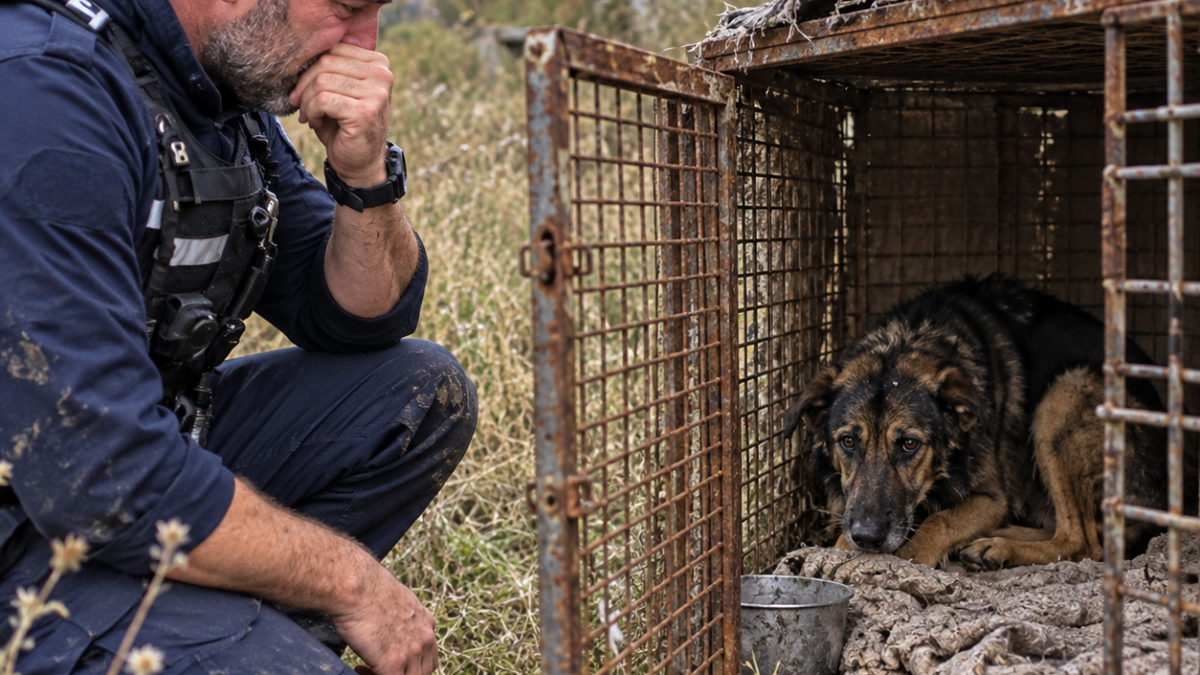
I broke the padlock on an abandoned cage expecting the starving dog inside to bolt for freedom, but when the door swung open, he never moved. He stared at the opening as if freedom were something he had stopped believing applied to him. Months later, I would realize that the dog I carried out of that cage was about to teach me how trapped I had become too.
My name is Julien Morel. I was forty-two then, a warrant officer with the gendarmerie in rural Corrèze, where narrow roads ran between farms, wooded hills and villages small enough that everyone recognized everyone else’s car.
I had patrolled the area for eight years.
Out there, trouble rarely announced itself dramatically.
It hid behind ordinary things.
An open gate.
Fresh tire tracks across an empty field.
A light burning at three in the morning inside a house everyone believed vacant.
A dog barking for hours behind a barn.
But this dog wasn’t barking.
He wasn’t making any sound at all.
I had been sent to check a report about vehicles entering an abandoned agricultural cooperative several miles outside Uzerche. The main building had been empty for years. Broken windows stared over weeds. Rusted sheet metal hung from the roof. An old loading dock sagged toward a wall of blackberry vines.
It was the kind of place people drove past without turning their heads.
I was walking behind the property when I saw something square through the tall grass.
At first I assumed it was discarded machinery.
Then I smelled it.
Rotting food.
Wet metal.
Waste.
The unmistakable smell of an animal that had been confined too long.
The cage was improvised from metal panels and wire mesh. A torn tarp covered one side.
Inside was an overturned water container, almost dry.
A bowl held a swollen lump of rain-soaked kibble.
And in the darkest corner lay a black-and-tan shepherd mix.
His eyes were open.
That was what stayed with me.
He wasn’t sleeping.
He was waiting.
His body looked too large for the cage, yet painfully thin. His hips pushed beneath his dull coat. His hind legs were folded strangely under him.
I crouched several feet away.
“Hey, buddy.”
One ear moved.
Nothing else.
No growl.
No whine.
No frantic movement toward me.
I radioed for animal services and asked for a veterinarian to be alerted, then returned to my vehicle for tools.
When I came back, I kept talking.
“I’m opening this, okay?”
His eyes followed me.
“I’m not going to hurt you.”
Maybe I was explaining it more for myself than for him.
The padlock finally snapped with a sharp metallic crack.
The sound echoed between the empty buildings.
The dog flinched.
I pulled the wire door fully open and backed away.
Most trapped dogs do something when an exit appears.
They crawl.
Sniff.
Hesitate.
Try.
This one only stared at the opening.
“You can come out now.”
His front paws shifted.
His chest lifted.
His entire body began trembling with effort.
Then his hind legs collapsed.
He fell back into the corner without making a sound.
That was when I understood.
He wasn’t refusing to leave.
He couldn’t walk.
I took off my jacket and eased it beneath him.
When I lifted him, what shocked me most was his weight.
Or the lack of it.
He rested his head against my arm, but his eyes widened as soon as I held him tighter.
Being carried clearly did not mean safety to him yet.
“I know,” I whispered.
But I didn’t.
Not then.
Dr. Claire Delaunay examined him at a small veterinary clinic outside town. Hours later, she called me into the room.
The dog lay on a thick blanket beneath a warming pad.
Claire folded her arms.
“Severe muscle wasting. Long-term malnutrition. Pressure sores. No obvious fractures in the hind legs, but almost no usable strength.”
“How long would it take for a dog to get this bad?”
Claire looked at him before answering.
The pause chilled me more than the words that followed.
“Julien, he wasn’t trapped there for a few days.”
I stared at her.
“How long?”
She exhaled slowly.
“Long enough that somebody had to keep coming back.”
And suddenly, the abandoned cage stopped looking like neglect.
It started looking like evidence.
PART 2
“What do you mean, somebody had to keep coming back?”
Claire didn’t answer immediately.
She pulled a stool closer to the examination table and sat down.
The dog’s eyes followed her movement, but his body remained still beneath the blanket.
“The food,” she said. “The condition of it. The amount of waste. The dehydration. His muscle loss.”
I looked at the dog.
“If someone kept coming back, why is he starving?”
“That’s the question.”
Claire lowered her voice.
“He wasn’t simply forgotten yesterday, Julien. This took time.”
“How much time?”
“I can’t give you an exact number from an exam.”
“Days?”
“No.”
“Weeks?”
“Possibly longer.”
I felt my jaw tighten.
Claire continued.
“His back legs are weak because he’s barely been using them. Some of that may be malnutrition. Some may be prolonged confinement. We’ll need imaging and blood work before I say more.”
I looked at the thick hair around his neck.
There was no collar.
No tag.
No name.
“Could he recover?”
Claire glanced toward him.
“Yes.”
The answer came quickly enough to make me breathe again.
Then she added, “But we don’t know how much.”
That sentence stayed with me.
Not because it was hopeless.
Because it wasn’t.
There was a difference between damage and an ending.
I reached one hand toward the dog, stopping several inches before his face.
He watched me.
“Can I?”
Claire smiled slightly.
“You’re asking him?”
“Yes.”
“That’s not a bad habit.”
I lowered my hand to the blanket.
He did not move toward it.
I didn’t touch him.
“All right.”
His breathing slowed.
“We’ll do this your way.”
Claire looked at me.
“You plan to visit him?”
“He’s evidence.”
“That wasn’t what I asked.”
I glanced at her.
“Do you always interrogate gendarmes?”
“Only the stubborn ones.”
I almost smiled.
Almost.
“I found him.”
“That still isn’t an answer.”
“I’ll come back.”
The dog’s ear moved.
Claire noticed.
“So will he.”
I left the clinic after dark.
Rain had started.
As I drove toward the brigade, I should have been thinking about the illegal entry reports at the cooperative.
The vehicles.
The property owner.
Possible trespassing.
Instead I kept seeing the cage door swing open.
And the dog remain still.
I had worked cases involving animals before.
Loose livestock.
Dog bites.
Neglect complaints.
Hunting disputes.
Nothing about this should have felt personal.
It did.
At the brigade, my captain, Arnaud Bellier, was waiting beside my desk.
“You found something.”
“A dog.”
“I heard.”
“Someone left him in a locked cage.”
Arnaud leaned against the filing cabinet.
“Animal services handling it?”
“They are now.”
“Then write your report and go home.”
I opened a file.
“That property complaint is connected.”
“To the dog?”
“I don’t know yet.”
“Then don’t decide before you know.”
I looked at him.
Arnaud had been my supervisor for almost five years.
He was irritating because he was often right.
“You’re staring at me,” he said.
“I’m thinking.”
“That worries me.”
I began typing.
The cooperative belonged to a dissolved agricultural supply company whose assets had been tied up in a property dispute. The land technically belonged to a holding company in Limoges.
No employees.
No active business.
No reason for anyone to be entering regularly.
Yet several residents had reported a white utility van visiting at odd hours.
I pulled the original complaint.
One witness had noted partial license digits.
Another had seen two men unloading something behind the building.
Something.
Not someone.
Not a dog.
A third complaint mentioned barking several months earlier.
I froze.
I read it again.
Intermittent dog barking from abandoned cooperative, mostly evenings.
Date: eleven weeks earlier.
I sat back.
Eleven weeks.
The dog at the clinic could have been there then.
I opened the follow-up report.
An officer had driven past.
Heard nothing.
Saw no vehicle.
No entry made because the property was fenced and there was no visible emergency.
No fault.
Reasonable decision.
Still, I stared at that one line.
Dog barking.
Eleven weeks.
I called Claire.
She answered on the fifth ring.
“Is he alive?”
“That’s your greeting?”
“Claire.”
“He’s stable.”
I closed my eyes.
“Good.”
“What did you find?”
“How do you know I found anything?”
“Because you sound worse than when you left.”
“There was a barking complaint at the same location eleven weeks ago.”
Silence.
Then, “That fits.”
“You think he could’ve been in that cage eleven weeks?”
“I think his condition could support prolonged confinement. I’m not giving you a forensic estimate over the phone.”
“I know.”
“Julien.”
“What?”
“Don’t make yourself responsible for something you didn’t know.”
I looked at the report.
“I work that sector.”
“You’re one man.”
“It was there.”
“And now he isn’t.”
“That’s not enough.”
“For tonight, it has to be.”
I hated that answer.
But she was right too.
Everyone around me had apparently agreed to be right that evening.
I drove home after midnight.
My house was dark.
It had been dark most evenings for years.
I lived in a small stone house outside town, far enough from neighbors that nobody noticed when I came home and went straight to bed.
People at work assumed I liked solitude.
I encouraged that assumption.
It was easier than explaining that my wife, Elise, had died four years earlier.
Cancer.
Fast enough to be cruel.
Slow enough to let us understand exactly what we were losing.
Afterward, friends kept inviting me places.
Dinner.
Birthdays.
Hikes.
Sunday lunches.
I declined.
At first because I couldn’t bear being the extra person at every table.
Later because declining became easier.
Eventually people stopped asking.
That had been a relief.
Or I told myself it was.
I microwaved soup.
Ate standing at the kitchen counter.
Then opened the photos from the cooperative.
Cage.
Lock.
Food bowl.
Water container.
Tracks in the mud.
Tire impressions.
I enlarged one photograph.
Behind the cage, near the wall, there were shallow rectangular marks.
As if another cage had once stood beside it.
I stopped eating.
The next morning, I returned with a crime-scene technician.
We found more than I wanted to find.
Old cable ties.
Plastic bowls.
Two lengths of chain.
Dog hair caught in the wire.
A small pile of veterinary medication packaging burned in a metal drum.
The cooperative had not held only one dog.
Maybe not even recently.
“What do you think?” the technician asked.
“I think somebody used this place repeatedly.”
“For what?”
“I don’t know.”
But the answer was beginning to take shape.
Not dogfighting.
There were no obvious signs of that.
No blood patterns.
No training equipment.
No multiple active pens.
What we did find suggested temporary storage.
Cages.
Transport.
Animals moved in.
Animals moved out.
And one dog had been left behind.
By noon, we had a list of vehicle registrations matching the partial plate description.
One belonged to a plumbing company.
Another to a delivery firm.
The third belonged to a man named Étienne Carrel.
I knew the name.
Everyone in the area did.
Carrel ran a small animal transport and boarding business outside Brive.
Mostly working dogs.
Guard dogs.
Hunting breeds.
People paid him to transport animals, board them temporarily or find buyers.
He also had a reputation for being unpleasant but careful enough never to cross an obvious legal line.
I pulled previous complaints.
Noise.
Loose dogs.
A dispute over payment.
One allegation that an animal returned from boarding underweight.
Unsubstantiated.
Nothing serious.
I stared at his photograph.
Arnaud came up behind me.
“You’re doing it again.”
“What?”
“Deciding.”
“I’m reading.”
“You’re glaring.”
“He owns a van matching the witness description.”
“Then verify.”
We did.
Traffic cameras placed Carrel’s van on a road leading toward the cooperative at least six times over the previous three months.
That afternoon, we requested records and prepared the next steps.
I should have been satisfied.
Instead, after work, I drove to Claire’s clinic.
The dog was awake.
He had been washed carefully.
Without the dirt, his condition looked worse.
His ribs were sharper than I remembered.
His hips were narrow.
The fur around his legs had thinned where he had lain too long on hard surfaces.
But his eyes were different.
More alert.
Claire handed me a paper cup.
“Chicken.”
“For me?”
“For him.”
“That seems insulting.”
“You look adequately nourished.”
I sat on the floor several feet away.
The dog watched.
I tossed a tiny piece of chicken halfway between us.
Nothing.
Another.
Still nothing.
I turned my face away.
A minute later, I heard licking.
The chicken was gone.
I smiled.
“I saw that.”
He froze.
I looked away again.
Another piece.
This time he moved one front paw.
Then the other.
He dragged himself forward.
His hindquarters barely followed.
My throat tightened.
“You don’t have to prove anything.”
He reached the chicken.
Ate it.
Then looked at me.
“Good.”
His front paws shifted again.
He crawled another few inches.
Toward me.
I didn’t breathe.
He stopped a foot from my boot.
Claire appeared in the doorway.
“Interesting.”
“Don’t ruin it.”
“I wasn’t speaking to you.”
The dog’s nose stretched toward my shoe.
He sniffed.
Then withdrew.
“That’s enough.”
I stood slowly.
His body tensed.
So I lowered myself again.
“All right.”
Claire leaned against the door.
“He reacts badly when people stand over him.”
“I noticed.”
“So stand sideways. Give him space.”
“How are the legs?”
“We did imaging.”
“And?”
“No spinal fracture. No major joint damage.”
“So why can’t he walk?”
“Muscle wasting, weakness, pain, and probably learned immobility.”
“Learned?”
“When movement repeatedly leads nowhere, animals stop trying.”
I looked at him.
The cage door flashed into my mind.
Open.
Meaningless.
Claire continued.
“We start physiotherapy tomorrow.”
“Will he walk?”
“I think he has a real chance.”
That night, for the first time in years, I did not go straight home after work.
I stayed with a dog.
I told myself it was because of the investigation.
It wasn’t.
Over the next week, the case widened.
Carrel denied using the cooperative.
Then we showed him traffic records.
He said he had stored equipment there with permission from “someone connected to the owner.”
No name.
No contract.
When asked about dogs, he denied ever keeping animals there.
Then forensic swabs from the cages came back.
Multiple canine DNA profiles.
We obtained a search authorization for his business property.
The kennels were legal enough.
Clean enough.
Water present.
Records posted.
Exactly what an experienced operator knew officials needed to see.
But in a locked office, we found transport logs that did not match his invoices.
Dogs listed by numbers instead of names.
Payments in cash.
Pickups from private owners.
Transfers to unidentified recipients.
Several animals had no destination recorded.
One number caught my attention.
M17 – male shepherd cross – unsuitable – hold.
Date: thirteen weeks earlier.
No final destination.
I photographed the line.
When I showed Claire later, she stared at it.
“You think that’s him?”
“I don’t know.”
“Does the timing fit?”
“Yes.”
“What does unsuitable mean?”
“That’s what I intend to ask.”
Carrel had an answer.
Aggressive.
The dog, he claimed, had been surrendered by an owner who wanted him rehomed as a guard dog.
Carrel said the animal showed fear aggression and could not be sold.
So he temporarily placed him at the cooperative while arranging “another option.”
“What option?” I asked.
Carrel shrugged.
“A farm.”
“Which farm?”
“I don’t remember.”
“You keep transport records but don’t remember where you planned to send a dog?”
“I manage dozens.”
“How long was M17 at the cooperative?”
“A day. Maybe two.”
“Eleven weeks ago someone reported barking there.”
“Could’ve been anyone’s dog.”
“Your van was there.”
“So?”
“And the dog we recovered has been underfed for considerably longer than two days.”
Carrel leaned back.
“You a veterinarian now?”
“No.”
“Then stick to your job.”
I almost smiled.
“I am.”
The evidence contradicted him.
The dog’s blood work showed chronic malnutrition.
His pressure sores reflected prolonged inactivity.
The waste accumulation inside the cage was inconsistent with a one- or two-day stay.
And Carrel’s van had continued visiting the cooperative after the dog was already there.
Someone had seen him.
Someone had known.
And someone had chosen not to let him out.
Still, proving intent was harder than recognizing cruelty.
Carrel claimed a worker was supposed to feed him.
Then named a seasonal employee, Lucas Perrin.
Lucas was twenty-six and terrified when we interviewed him.
He denied everything first.
Then we showed him the logs.
The camera records.
Photos of the cage.
Finally he cried.
Not dramatically.
Quietly.
His hands shook.
“I fed him.”
“How often?” I asked.
“When Étienne told me.”
“How often?”
“Every few days.”
I stared at him.
“The dog had no clean water.”
“I filled it.”
“The container was overturned.”
“He knocked it over.”
“So you left?”
“I had work.”
“How long had he been there?”
Lucas looked at the table.
“Two months. Maybe more.”
The room seemed to narrow.
“Why?”
“Étienne said the dog was dangerous.”
“Did he attack you?”
“No.”
“Growl?”
“No.”
“Try to bite?”
Lucas shook his head.
“Then what made him dangerous?”
“He wouldn’t move.”
I leaned back.
That answer was so absurd I thought I had misheard it.
“He wouldn’t move?”
“Étienne wanted him for a security client. The dog froze during training. Wouldn’t bark at strangers. Wouldn’t attack.”
“So he put him in a cage?”
“He said he needed to decide what to do.”
“And for two months nobody decided?”
Lucas covered his face.
“I should’ve done something.”
“Yes.”
I let the word stand.
No comfort.
No anger.
Just yes.
“You kept feeding him enough to keep him alive.”
Lucas cried harder.
“I thought somebody would take him.”
“Who?”
“I don’t know.”
“You saw his legs stop working?”
He nodded.
“When?”
“A few weeks ago.”
“And you left him there.”
Another nod.
That interview changed the case.
It also changed me.
For days afterward, I dreamed about the open cage door.
Except in the dream, I was the one inside.
I would wake in darkness and hear Elise’s voice in the silence.
Not words.
Just memory.
The sound of her moving around our old apartment.
Her keys.
Her laugh from another room.
The last year of her illness had reduced our lives to appointments.
Hospitals.
Medication.
Waiting rooms.
When she died, I told everyone I needed time.
Then time became habit.
Four years later, I was still waiting for something to reopen.
I just didn’t know what.
The dog got a name before I was ready to admit he needed one.
Claire called him Atlas.
“Why Atlas?”
“Because he’s carrying too much.”
“That’s very poetic for someone who spends half her day draining abscesses.”
She ignored me.
“Do you have a better suggestion?”
“M17.”
She stared.
“Atlas it is.”
By the second week, Atlas could stand with a support sling.
For three seconds.
Then five.
Then eight.
His back legs shook violently.
But they held.
The first time he stood long enough to take one step, Claire called me while I was working.
“You need to come.”
“I’m on duty.”
“After.”
“What happened?”
“He walked.”
I was silent.
“Julien?”
“How far?”
“One step.”
“That’s not walking.”
“Tell him that.”
I arrived forty minutes later than I intended.
Atlas was resting.
“You made me miss it.”
Claire handed me the sling.
“Then help with the next one.”
“No.”
“You break locks but a support harness frightens you?”
“I’m not trained.”
“I’ll show you.”
So she did.
I stood beside Atlas.
One hand under the sling.
One at his chest.
“Easy.”
He looked at me.
“Apparently we’re both learning.”
Claire held a piece of chicken several feet away.
Atlas shifted.
One front paw.
Then the other.
His left hind paw dragged.
The right planted.
His body shook.
“Come on.”
Another step.
Then another.
He collapsed against my legs.
I dropped to my knees.
“Hey.”
Atlas panted.
His tail moved.
Once.
I laughed.
“You smug little bastard.”
Claire was crying.
I pointed.
“Unprofessional.”
“Shut up.”
Atlas licked my hand.
That was the first time.
I stopped speaking.
His tongue touched my knuckles once.
Then again.
A ridiculous amount of emotion hit me all at once.
I turned my face away.
Claire said nothing.
For once.
The investigation continued.
Carrel was eventually charged with multiple animal welfare violations, falsification of transport records and illegal commercial practices related to animal transfers.
Lucas cooperated fully.
His responsibility did not disappear because he helped, but his testimony exposed the system.
Dogs deemed useful were moved quickly.
Dogs deemed difficult were kept off official books.
Some were passed through informal networks.
Others vanished from the records.
We identified four dogs still alive with questionable transfer histories.
All were located.
Two were healthy.
One was underweight.
One had been rehomed legitimately but without proper documentation.
Atlas had been the worst case.
The one Carrel had apparently decided wasn’t worth the cost of transporting elsewhere.
A failed product.
That phrase was never written in any report.
But that was what it felt like.
When I told Claire, she looked at Atlas across the rehabilitation room.
“He failed at being what Carrel wanted.”
“Yes.”
“Good.”
I looked at her.
“That’s one way to see it.”
“It’s the right way.”
Atlas was lying with his front paws crossed.
Peaceful.
“Somebody wanted him to intimidate people,” Claire said. “He refused.”
“He froze.”
“Exactly.”
“That’s fear, Claire.”
“I know.”
She looked at me.
“But maybe survival doesn’t always look brave while it’s happening.”
I thought about that for a long time.
Atlas was moved to a foster home after three weeks.
I told myself I was relieved.
The foster couple, Marc and Sophie, lived outside town and had experience with shepherds.
Large fenced yard.
Quiet house.
No children.
Perfect.
I lasted two days before calling.
Sophie answered.
“Is he eating?”
“Yes.”
“Walking?”
“With assistance.”
“Sleeping?”
“Yes.”
“Any panic?”
“Less than we expected.”
“Good.”
A pause.
“Julien?”
“Yes?”
“You can visit.”
“I was just checking the case.”
“Of course.”
I went the next afternoon.
Atlas heard my voice from the yard.
He stood.
Without a sling.
His legs shook.
He took two uneven steps.
Then four.
Then he came toward me.
Not gracefully.
Not quickly.
But toward me.
I crouched.
He pressed his forehead against my chest.
Marc smiled.
“I think the investigator has been identified.”
“Apparently.”
Atlas leaned harder.
I put both hands around his shoulders.
For the first time, he did not stiffen.
Something inside me shifted.
I stayed for dinner.
That surprised everyone.
Including me.
Sophie asked about my work.
Marc asked about the cooperative.
I kept details vague.
Then conversation moved elsewhere.
Gardening.
Football.
A road project.
Normal things.
I realized halfway through dessert that I had not eaten dinner at someone else’s house since the Christmas after Elise died.
My chest tightened.
Sophie noticed.
“You okay?”
“Fine.”
I stood.
Too quickly.
Atlas lifted his head.
“I should go.”
Marc looked at the clock.
“It’s barely eight.”
“Early shift.”
It was a lie.
On the drive home, I felt angry.
At them.
At myself.
At Elise for dying.
At Atlas for somehow pulling me into a dinner I had not wanted.
Grief is irrational that way.
It punishes whoever opens the door because closed doors feel safer.
I did not visit Atlas for five days.
Claire called on the sixth.
“You avoiding him?”
“No.”
“You avoiding everyone?”
“I’m working.”
“You’re always working.”
I said nothing.
She sighed.
“Atlas walked twelve meters today.”
That got me.
“Twelve?”
“Without the sling.”
I looked toward my empty kitchen.
“I’ll come tomorrow.”
“Good.”
“I’m not adopting him.”
“I didn’t ask.”
“You were thinking it.”
“So were you.”
I hung up.
Atlas kept improving.
Weeks became months.
His body filled out.
His coat changed completely.
What had been dull and coarse became glossy black and tan.
His ears stood differently.
One upright.
One slightly angled outward.
He began carrying toys.
At first, he did not play with them.
He simply moved them from one room to another.
Then one afternoon, Marc sent me a video.
Atlas was chasing a rubber ball.
Badly.
His hind legs still moved with a slight hitch.
But he ran.
I watched the video twelve times.
At work, Arnaud caught me watching again.
“You’ve become embarrassing.”
“I’m reviewing evidence.”
“That ball looks dangerous.”
“Very.”
Arnaud sat on the edge of my desk.
“You should take some leave.”
“No.”
“You have nineteen days unused.”
“I’m aware.”
“You’ve worked every holiday you could volunteer for.”
“I like working.”
“You hide at work.”
I looked up.
“Careful.”
He shrugged.
“I knew Elise too.”
That shut me up.
Arnaud continued.
“She’d be furious.”
“Don’t.”
“She would.”
“You don’t get to use her against me.”
“I’m not.”
“Then stop.”
He stood.
At the door, he turned.
“Take three days.”
“No.”
“That was not a suggestion.”
I hated him.
I took three days.
The first morning, I woke at 5:40 out of habit.
No uniform.
No shift.
No plan.
I sat at the kitchen table for almost an hour.
Then drove to see Atlas.
Marc opened the door.
“He’s in the garden.”
Atlas was standing near the fence.
Standing.
No sling.
No support.
When he saw me, his tail started moving.
He trotted.
Actually trotted.
Toward me.
He nearly lost balance on the turn.
Recovered.
Then bumped into my knees.
“You’re showing off.”
He pushed his head under my hand.
Marc came outside carrying coffee.
“He needs longer walks now.”
“That’s good.”
“Very good.”
“He’ll be adoptable soon.”
The words hit harder than they should have.
I nodded.
“Good.”
Marc studied me.
“You want coffee?”
“No.”
“You look like you need one.”
I took the coffee.
We sat outside.
Atlas lay beside my chair.
Marc scratched his beard.
“Sophie and I can keep fostering him until someone fits.”
“Okay.”
“He needs someone patient.”
“Yes.”
“Quiet household.”
“Yes.”
“Probably no small animals.”
“Agreed.”
“Someone who can walk him a lot.”
“He’ll need that.”
“Someone he trusts.”
I looked at Marc.
He stared into his coffee.
Coward.
“I work long hours.”
“You also live ten minutes from the brigade.”
“He’s never been alone in my house.”
“He was alone in a cage.”
“That’s different.”
“Exactly.”
I stood.
“I’m going home.”
Atlas stood too.
Marc laughed.
“Very convincing.”
I drove home without Atlas.
The house felt wrong.
That annoyed me.
Nothing had changed.
Same table.
Same chairs.
Same silence.
Yet for the first time, silence did not feel peaceful.
It felt empty.
I spent my second day of forced leave cleaning the garage.
My third, I drove to a hardware store.
I bought a dog bed.
Then I stood in the parking lot staring at it.
“This is absurd.”
The cashier collecting carts heard me.
“Probably.”
I drove to Marc and Sophie’s.
Sophie saw the bed in my trunk.
She smiled.
“Don’t.”
“I didn’t say anything.”
“Don’t think anything either.”
“I can’t promise that.”
Atlas came outside.
I crouched.
“You’re on probation.”
His tail wagged.
“Temporary.”
More wagging.
“Very temporary.”
Sophie handed me a bag containing his food, medication and favorite ball.
“You had this ready?”
“We have intuition.”
“You’re terrible people.”
Marc hugged me.
I stiffened.
Then hugged him back.
Another door.
Another thing I had forgotten how to do.
Atlas entered my house cautiously.
He walked through the living room.
Kitchen.
Hallway.
Then stopped outside my bedroom.
He looked in.
“Absolutely not.”
His tail moved.
“You have your own bed.”
He entered anyway.
“Great.”
The first night, Atlas slept in the hallway.
The second, outside my bedroom.
The third, just inside.
By the end of the week, his dog bed had migrated beside mine.
I claimed this was because he moved it.
Nobody believed me.
Especially because Atlas could barely drag it.
Our routines formed.
Morning walk before sunrise.
Breakfast.
I worked.
A neighbor, Monsieur Laurent, came midday if my shift ran long.
Evening walk.
Dinner.
Physical therapy exercises.
Atlas hated the exercises.
I bribed him with chicken.
He hated rain too.
That surprised me, considering how long he had lived beneath a torn tarp.
Or maybe it explained everything.
The first wet morning, he stopped at the doorway.
“You’re a shepherd.”
Nothing.
“You have fur.”
Nothing.
“I have a uniform.”
Atlas sat down.
I stared.
He stared.
Five minutes later, I was holding an umbrella over a dog while he urinated.
“This stays between us.”
He sneezed.
At work, things changed.
Not dramatically.
I took lunch breaks.
I stopped volunteering for every overnight shift.
I went home when my shift ended.
People noticed.
Arnaud was unbearable.
“You have a curfew?”
“Yes.”
“Girlfriend?”
“Dog.”
“Worse.”
Atlas forced me outside.
That was the joke.
At first.
Then it became something else.
He needed walks on days when I wanted to stay home.
He needed parks.
Fields.
Roads.
The forest trail near the river.
He did not care that I was tired.
He did not care that couples reminded me of Elise.
He did not care if a café terrace had people I might know.
He cared about smells.
Trees.
Mud.
Other dogs.
And chicken.
So I went.
The first time I sat at an outdoor café alone with Atlas, I nearly left.
Everyone else seemed paired.
Friends.
Couples.
Families.
Atlas lay under the table.
The waitress brought water for him.
“Beautiful dog.”
“He’s a criminal.”
She laughed.
Atlas ignored us.
I stayed twenty minutes.
Then forty.
No catastrophe.
No one asked about Elise.
No one pitied me.
I drank coffee.
Went home.
Two days later, I did it again.
Months earlier, I had broken a lock for Atlas.
Now, without understanding it, he kept breaking mine.
The case against Carrel moved slowly.
Real cases always do.
Witnesses.
Records.
Defense challenges.
Expert reports.
Lucas’s testimony.
The prosecution focused on documented neglect, illegal confinement and falsified commercial records.
Carrel claimed Atlas’s poor condition resulted from illness.
Claire’s records dismantled that.
No underlying disease explained the muscle wasting pattern.
No injury explained the prolonged pressure sores.
No medical condition explained an empty water container inside a locked cage.
Then the defense argued Carrel had delegated care to Lucas.
Lucas testified that Carrel repeatedly ordered him to “keep the useless one alive until I decide.”
That phrase silenced the room.
The useless one.
I looked at Atlas’s photograph in the evidence file.
Healthy now.
Standing in sunlight.
Useful to no one.
Loved anyway.
Carrel’s attorney tried to reduce everything to management failure.
Poor supervision.
Bad employee.
Administrative confusion.
The prosecutor asked one question.
“If this was confusion, why was the animal kept at an abandoned property rather than your licensed kennel?”
Carrel had no good answer.
The court eventually convicted him on multiple charges.
His business license was suspended.
He received financial penalties, restrictions involving animal-related commercial activity, and a custodial sentence partly suspended under conditions.
Some people thought it was too little.
Some thought it was severe.
I had spent months imagining how I would feel when someone finally said guilty.
I felt almost nothing.
That disturbed me.
Outside the courthouse, Claire found me near the steps.
“You okay?”
“I thought I’d be happier.”
“Why?”
“He suffered.”
“And?”
“Carrel should matter more.”
Claire looked at me carefully.
“No.”
I frowned.
“No?”
“No. Atlas matters. Carrel is paperwork now.”
I laughed despite myself.
“That sounds cold.”
“It’s not.”
She glanced toward the street.
“Cruel people take enough space while they’re hurting someone. They don’t deserve the rest of the story too.”
I remembered that sentence for years.
The adoption became official a month later.
Atlas Morel.
Claire laughed when she saw the paperwork.
“That’s ridiculous.”
“He has better manners than half my relatives.”
“That’s not saying much.”
Atlas stood between us.
Healthy weight.
Strong chest.
Slight weakness still visible in the back legs.
The veterinarian predicted it might never fully disappear.
I didn’t care.
He could walk.
He could run.
He could choose where to lie down.
Choice.
That became the word I associated with him.
For most of the time we knew each other, every new milestone was a choice.
First time he entered my bedroom.
First time he approached a stranger voluntarily.
First time he walked toward another dog without fear.
First time he refused food because he was full.
That one almost made me cry.
I put down his breakfast.
Atlas ate half.
Then walked away.
I stared at the bowl.
“Atlas.”
He looked back.
“You forgot something.”
Nothing.
“There’s food.”
He went to his bed.
I called Claire.
“He left breakfast.”
“Is he vomiting?”
“No.”
“Diarrhea?”
“No.”
“Energy?”
“Normal.”
“Then he’s probably full.”
I was silent.
Claire understood.
“Oh.”
“He’s full.”
“Yes.”
I sat down.
A dog who had once been starved in a cage now trusted that food could remain unfinished.
That there would be another meal.
Safety had reached his stomach.
It took longer to reach mine.
Not literally.
Emotionally.
A year after finding Atlas, I still spent the anniversary alone at home.
I declined Marc and Sophie’s invitation to dinner.
I told myself I was tired.
Atlas watched me from the rug.
It was the date Elise had died.
I had not said her name all day.
Around seven, Atlas stood and went to the door.
“You already walked.”
He waited.
“No.”
Tail wag.
“I said no.”
He sat.
“You’re manipulative.”
He remained there.
Finally, I grabbed my jacket.
We walked without a route.
Atlas chose left at the bottom of the road.
Then toward the old footpath beside the river.
We walked until the light began fading.
At a bend, there was a bench Elise and I had once used during a summer picnic.
I hadn’t been there since before she got sick.
My body stopped.
Atlas continued until the leash tightened.
Then he turned.
I nearly went home.
Instead, I sat.
Atlas sat beside me.
For several minutes, I could not breathe normally.
Memories came too fast.
Elise stealing my sunglasses.
Her shoes in the grass.
Her hair before chemotherapy.
Her hair after.
The way she apologized for being tired.
The way I told her never to apologize.
The way I later apologized to an empty room for every moment I had been impatient.
Atlas rested his head on my thigh.
“I miss her.”
My voice broke.
He didn’t move.
“I miss her every damn day.”
That was the first time I said it aloud in months.
Maybe years.
I cried beside the river with a dog who had no idea who Elise was.
People passed behind us.
I did not care.
The world did not collapse.
Grief did not kill me.
It hurt.
Then it passed through.
Not away.
Through.
When we finally stood, it was dark.
Atlas walked beside me.
I realized he had gotten me out of the house on the one night I always tried hardest to disappear.
Months earlier, I had forced open his cage.
Now he was doing the same thing to mine.
That became our pattern.
When I withdrew, Atlas demanded a walk.
When I worked too late, I remembered he was waiting.
When I refused invitations automatically, sometimes I asked whether dogs were allowed.
If the answer was yes, I occasionally went.
The first holiday meal I attended after years away was at Marc and Sophie’s.
Atlas came too.
He stole a piece of roast from the table.
Everyone blamed me.
“You rehabilitated him badly,” Marc said.
“I rehabilitated him into confidence.”
“He committed theft.”
“Growth isn’t linear.”
Sophie laughed so hard she nearly spilled wine.
I did too.
And for once, laughing did not feel disloyal to Elise.
That had been another invisible cage.
The belief that feeling joy meant leaving her behind.
It didn’t.
I understood that slowly.
Atlas never forgot the cooperative completely.
At least I don’t think he did.
Two years after the rescue, I accidentally drove past it with him in the back of the vehicle.
The property had been fenced for demolition.
Atlas was asleep.
Then suddenly he stood.
His breathing changed.
I checked the mirror.
“Atlas?”
His ears flattened.
He looked through the window.
At the building.
At the weeds.
At the place where the cage had been.
I almost accelerated.
Instead, I pulled over well down the road.
Atlas paced in the rear compartment.
I opened the side door but kept him clipped to the leash.
He did not jump out.
“It’s okay.”
His body trembled.
I crouched beside him.
“We don’t have to go there.”
That mattered to me.
We don’t have to.
For months, his life had been defined by having to.
Stay.
Wait.
Endure.
Now we could simply leave.
I closed the door.
Drove away.
Twenty minutes later we reached a lake.
Atlas ran directly into the water.
He hated rain but loved lakes.
I never understood that.
He came out soaked and shook water over my uniform.
“Perfect.”
His tail wagged.
The cooperative disappeared behind us.
A year later, demolition crews tore it down.
I drove by once after the work finished.
Nothing remained except a cleared slab and piles of gravel.
I expected satisfaction.
Instead, I felt something closer to peace.
The cage was gone.
Carrel’s business was gone.
The place had lost its power.
Atlas didn’t need to know.
He was busy elsewhere.
Living.
He became a familiar sight around Uzerche.
The gendarme with the shepherd.
People assumed he was a police dog.
He was not.
Atlas was afraid of vacuum cleaners, hated umbrellas opening unexpectedly and once hid behind me because a goat sneezed.
Not exactly elite operational material.
But children loved him.
Older people loved him.
Even Arnaud loved him, though he denied it.
One afternoon, Arnaud came to my house with paperwork.
Atlas greeted him carrying a rope toy.
Arnaud took it.
“You’ve made him soft.”
“He was starved in a cage.”
“Still. No discipline.”
Atlas pulled.
Arnaud pulled back.
Five minutes later my captain was sitting on the floor playing tug.
I took a picture.
“If this appears anywhere, I’ll have you transferred.”
“Evidence should be preserved.”
“Delete it.”
I never did.
Atlas’s rear legs remained slightly weaker than normal.
As he aged, we adapted.
Shorter walks.
More swimming.
Medication during cold months.
A ramp into the car.
He hated the ramp at first.
I stood at the bottom with chicken.
“You once couldn’t walk. Don’t become arrogant now.”
Atlas stared.
“Ramp.”
Nothing.
“Chicken.”
He came down immediately.
“Corrupt.”
He licked my hand.
By then, I had changed too.
I stopped volunteering for every holiday shift.
I accepted dinner invitations.
Not all of them.
I still liked quiet.
But quiet became a choice again instead of a hiding place.
I started hiking with a small group on weekends.
Atlas came.
The first trip was only three miles.
I nearly canceled that morning.
Then Atlas stood by the door wearing his harness.
I went.
We climbed through chestnut woods above the Vézère.
Nothing dramatic happened.
That was why it mattered.
People talked.
Atlas sniffed everything.
We ate sandwiches near a ridge.
I laughed at a terrible joke.
Came home tired.
Slept well.
A normal day.
For years, I had believed returning to life required one huge decision.
It didn’t.
It required small doors opening repeatedly.
A coffee.
A dinner.
A walk.
A dog waiting by the door.
Atlas taught me that freedom is useless until you trust yourself enough to step through.
That was what I had misunderstood the day I opened his cage.
I thought the lock was the problem.
The lock was only metal.
The real prison was what happened after enough locked days.
The body stops trying.
Then the mind follows.
Atlas had learned that doors changed nothing.
I had learned that invitations changed nothing.
Different cages.
Same lesson.
It took time to unlearn.
Three years after I found him, Claire asked me to speak at a local animal welfare event.
“No.”
“I haven’t finished.”
“No.”
“It’s twenty people.”
“Still no.”
“Atlas can come.”
I paused.
She smiled.
“Manipulative.”
“I learned from him.”
I agreed.
The room held closer to forty people.
I hated Claire.
Atlas lay beside my chair.
I had prepared notes.
I barely used them.
I talked about evidence.
About prolonged confinement.
About why animals may not immediately flee when released.
About muscle wasting.
Fear.
Learned helplessness.
The importance of documenting conditions instead of only describing anger.
Then someone asked, “When did you know he was going to be okay?”
I looked down at Atlas.
He was asleep.
“I didn’t.”
The audience waited.
“I still don’t think life gives you that certainty.”
I scratched behind his ear.
“But one day he stopped finishing every meal.”
A few people looked confused.
“He had been starved. For a long time, he ate as if every bowl was the last bowl he would ever see.”
My throat tightened.
“Then one morning, he left food behind.”
Claire smiled from the wall.
“That was when I realized he trusted tomorrow.”
The room became very quiet.
I looked at Atlas.
“He taught me to do the same.”
Afterward, an older man approached.
His wife had died two years earlier.
He didn’t say much.
Just, “I understood what you meant.”
I nodded.
So did I.
We didn’t need more.
Years passed.
Atlas’s muzzle turned gray.
So did mine.
He slowed.
I changed jobs within the gendarmerie, moving into a training and investigative coordination role that gave me fewer nights on patrol.
Partly age.
Partly choice.
For the first time in my career, I stopped treating exhaustion as proof of usefulness.
Atlas had something to do with that too.
He had never cared about rank.
Or hours.
Or reports.
He cared whether I came home.
That can rearrange a man’s priorities.
On the fifth anniversary of his rescue, Claire sent me the original intake photograph.
I stared at it for a long time.
Atlas in the clinic.
Emaciated.
Unable to stand.
Eyes enormous.
Then I looked across my living room.
The real Atlas was sleeping upside down on the couch.
One back leg sticking awkwardly into the air.
I laughed.
“You were very dramatic.”
He opened one eye.
I held up the phone.
“Look.”
He closed the eye.
“You have no respect for history.”
His tail thumped once.
I saved the photograph.
Not because I wanted to remember his suffering.
Because distance deserves proof too.
Later that year, Atlas developed arthritis.
Claire examined him personally.
“He’s getting older.”
“I noticed.”
“You sound offended.”
“I object.”
“Denied.”
Medication helped.
Swimming helped more.
We went to the lake often.
Atlas moved slowly entering the water, then floated almost weightlessly.
I walked beside the shore.
One afternoon, he swam farther than usual.
I called him.
“Atlas.”
He turned.
For a second, I saw the younger dog.
Strong.
Free.
Then he paddled back.
I knelt in the shallows.
He placed both front paws against my legs.
“You know you’re heavy now.”
His tail moved through the water.
“Remember when you weighed nothing?”
He licked my chin.
“Disgusting.”
I laughed.
People nearby turned.
I didn’t care.
That too was progress.
The final lesson Atlas taught me came much later.
He was old.
Nearly eleven, according to Claire’s best estimate.
His rear legs had become weak again.
Not from starvation this time.
Age.
The irony hurt.
We used a support harness.
The same kind Claire had shown me years earlier.
One evening, Atlas stood at the back door.
Rain was falling.
He hated rain until the end.
“You have to go.”
He looked at me.
“Yes.”
Nothing.
I held up chicken.
Atlas sighed.
I could swear he sighed.
Then stepped outside.
Slowly.
We walked ten yards.
He stopped.
The rain hit his gray face.
I held an umbrella over him.
Years earlier, I would have felt ridiculous.
Now I felt grateful.
He finished.
We turned home.
Halfway back, his legs gave out.
I caught the harness.
“Easy.”
Atlas looked up.
No panic.
That was what broke me.
When I first carried him from the cage, being lifted terrified him.
Now his body sagged into the harness because he knew my hands.
He trusted them.
Completely.
“I’ve got you.”
His eyes stayed on mine.
“I’ve got you.”
I carried most of his weight back inside.
Claire came the next morning.
We adjusted medication.
She examined him.
When she finished, she sat on my kitchen floor beside Atlas.
“He’s comfortable.”
“For how long?”
“I don’t know.”
I hated that answer as much as I had years earlier.
“How much time?”
“Julien.”
“How much?”
“Could be months.”
“And if it’s not?”
“Then we make sure you don’t keep him here for yourself.”
The words hurt.
I nodded.
“I know.”
Atlas gave me another summer.
A good one.
Short walks.
Lake swims.
Long naps in the garden.
Visits from Marc and Sophie.
Chicken from Claire.
Arnaud pretending not to bring treats.
One evening, we sat outside while swallows crossed the sky.
Atlas rested with his head on my shoe.
“You know,” I said, “I think you were supposed to be temporary.”
One ear moved.
“I never signed up for this.”
His tail tapped.
“Terrible administrative error.”
He closed his eyes.
I watched him breathe.
The dog I found had spent so long trapped that an open door meant nothing.
Now every door in my house was open.
He chose where to lie.
Where to sleep.
When to go outside.
When to come back.
That was the life I wanted for him.
Not endless repayment for suffering.
Choice.
In October, his appetite dropped.
Blood work showed kidney disease.
Claire didn’t lie to me.
Treatment might buy time.
Not cure.
We tried.
Atlas still enjoyed food occasionally.
Still wanted the garden.
Still raised his head when I came home.
So we kept going.
Then came a morning when he did not stand.
I sat beside him.
“Come on.”
His eyes opened.
Tail moved once.
My chest broke.
Claire arrived at the house.
She examined him quietly.
Then looked at me.
I knew.
“No.”
She said nothing.
“Not today.”
Atlas breathed slowly.
Claire touched my shoulder.
“You opened the cage when he couldn’t leave.”
I stared at her.
“Don’t.”
“Julien.”
“Don’t turn this into some metaphor.”
“I’m not.”
Her eyes filled.
“I’m reminding you that loving him has always meant giving him a way out when he couldn’t create one himself.”
I hated her.
Because she was right.
Again.
Atlas was lying beside the open back door.
Sunlight reached his paws.
I sat on the floor.
Placed his head across my legs.
For almost an hour, I told him everything.
About the cooperative.
About the first piece of chicken.
About how bad he had been at walking.
How he stole roast.
How he hated rain.
How he had made me go outside when I wanted to disappear.
How Elise would have loved him.
That was the first time I said her name to him.
“Elise would’ve loved you.”
Atlas breathed out.
I smiled through tears.
“She would’ve spoiled you worse than I did.”
Claire gave him the first medication.
Atlas relaxed.
His eyes stayed on me.
No fear.
I placed my hand on his chest.
“You don’t have to stay because I’m scared to let you go.”
His tail moved against the blanket.
One small movement.
Like an answer.
I leaned down.
“You can go.”
For the second time in our lives, I opened a door for Atlas.
This time, he did not have to walk through it.
He died with his head in my lap.
The house became silent.
Not the silence I used to crave.
A terrible silence.
Bowls remained.
Bed.
Leash.
Hair on the couch.
I left everything untouched for two weeks.
Then Marc came.
He did not ask permission.
He made coffee.
Sat down.
Sophie arrived later.
Claire came after work.
Arnaud brought bread.
Nobody told me to move on.
Nobody told me Atlas had lived a good life.
They simply stayed.
That was his final revenge against the cage I had built around myself.
Years earlier, after Elise died, I had disappeared into solitude.
When Atlas died, I couldn’t.
He had populated my life.
He left me with people.
Friends.
Routines.
Places.
Memories outside the walls of my house.
He had made sure I no longer knew how to vanish.
Three months later, Claire called.
“I have a problem.”
“No.”
“You don’t know what it is.”
“Animal.”
Silence.
“Maybe.”
“No.”
“A dog.”
“No.”
“Temporary.”
I laughed for the first time in days.
“You’re shameless.”
“I learned from you.”
I did not adopt that dog.
Not then.
I volunteered.
One Saturday.
Then another.
I sat with frightened dogs in quiet rooms.
I did not reach too quickly.
I did not stand over them.
I did not assume an open door meant they knew how to walk through.
Sometimes I talked.
Sometimes I sat in silence.
And whenever a volunteer asked why a dog refused to leave a kennel even when the door was open, I told them:
“Because freedom is something the body may need before the mind believes in it.”
I never forgot Atlas.
I didn’t try.
Forgetting is not healing.
He remained in the old leash hanging by my door.
In mud on hiking boots.
In the café terrace where the waitress still once asked, “No dog today?”
In the lake.
In the scarred floor where his claws slipped during rehabilitation exercises.
In the photograph above my desk.
Not the one from the cage.
The one by the river.
Atlas standing in sunlight.
Strong legs.
Gray beginning around his muzzle.
Looking ahead.
That is the photograph I kept.
The cage picture belonged to evidence.
The river picture belonged to him.
Years after the case ended, someone asked me whether putting Carrel out of business felt like revenge.
I thought about it.
Carrel lost his license.
His reputation.
His ability to quietly treat animals as disposable inventory.
The law did what it could.
But revenge?
No.
Revenge was Atlas learning to leave food in his bowl because he knew another meal would come.
Revenge was him sleeping on a couch after being locked on metal.
Revenge was him running beside a river after his legs had forgotten how to stand.
Revenge was an animal labeled useless becoming the reason a lonely man learned how to live again.
Carrel had tried to reduce Atlas to something with no value.
Atlas answered by becoming priceless to me.
That was enough.
More than enough.
On the tenth anniversary of the day I found him, I drove back toward the old cooperative site.
The building was long gone.
A small commercial workshop stood nearby now.
Nothing about the place looked familiar.
I parked.
Got out.
Walked to the edge of the field.
Somewhere beneath the gravel and weeds had been the cage.
I couldn’t locate the exact spot.
At first that bothered me.
Then I smiled.
Good.
It deserved to disappear.
I stood there for several minutes.
No speech.
No ceremony.
Then I got back in the car.
Instead of driving home, I went to the river.
Marc and Sophie were waiting.
Claire arrived later.
Arnaud came last, complaining about traffic.
We ate at a café.
I stayed until dark.
When I finally returned home, I opened the front door.
For half a second, some part of me still expected claws on the floor.
They weren’t there.
That hurt.
But the pain no longer sent me backward.
I stepped inside.
Left the door open behind me while I carried in my bag.
Then I looked at the old leash.
I remembered a padlock breaking.
A cage opening.
A dog lying still.
And how completely I had misunderstood what freedom was.
I thought I rescued Atlas when I opened that metal door.
I didn’t.
I merely gave him the first opportunity.
He spent the rest of his life teaching both of us what to do with it.
And because of him, when my own door finally opened, I learned to walk through too.
By the time Atlas reached eleven, the dog I had once carried out of a locked cage had become an old man.
Gray had spread across his muzzle and around his eyes. The powerful shoulders he had built during his recovery had softened. On cold mornings, his rear legs took a few seconds longer to cooperate.
But every morning, he still found me.
Sometimes beside the coffee machine.
Sometimes at the front door.
Sometimes standing over my bed with that one slightly crooked ear raised as if I had personally failed him by sleeping six minutes past our normal walk.
For years, I had measured Atlas’s life by the things he learned to do.
Stand.
Walk.
Run.
Play.
Trust.
Eat without panic.
Sleep with a door open.
Now I began measuring it differently.
How long he could walk comfortably.
Whether he finished breakfast.
How easily he stood after sleeping.
Whether his breathing settled after climbing the two small steps from the garden.
I hated noticing those things.
Claire noticed me noticing.
During one examination, she ran both hands gently along Atlas’s spine while he stood beside the table.
“He’s getting older, Julien.”
“I know.”
“You say that like it’s an accusation.”
“I object to the entire process.”
Claire smiled.
“So does everyone who loves a dog.”
Atlas turned his head and licked her wrist.
“Traitor,” I muttered.
His arthritis could be managed.
For a while, medication helped.
Swimming helped even more.
So during warm months, I took him to the lake outside town.
The first time we had gone there years earlier, Atlas had been strong enough to charge into the water like an idiot and then act shocked that the lake was wet.
Now he entered slowly.
Front paws first.
Then chest.
Then the weakened rear legs.
Once he floated, everything changed.
The stiffness disappeared.
He moved like the younger dog I remembered.
I walked along the edge while he paddled beside me.
One evening, the sun was low and the entire lake looked copper-colored.
Atlas swam farther than usual.
“Atlas.”
He turned.
For a second, with only his head above the water, I saw the same dark eyes that had stared at me from the back of that cage.
But there was no emptiness in them now.
He turned toward shore and paddled back.
When he reached me, he placed both front paws against my legs and shook water over everything.
“Perfect.”
His tail moved through the lake.
“You know this uniform has to be dry tomorrow?”
He licked my chin.
“You’re impossible.”
I laughed.
There had been a time when I could not remember laughing without feeling guilty.
Atlas had changed that.
Then autumn came.
He stopped finishing breakfast.
Not every day.
Just occasionally.
At first, I tried to convince myself it meant nothing.
Atlas had spent years learning he did not have to empty every bowl.
I had once celebrated that.
Now I stood over the same half-full bowl feeling afraid.
“Not hungry?”
Atlas walked away.
I followed him with my eyes.
He drank.
Lay down.
Nothing dramatic.
Still, I called Claire.
She did blood work.
The results showed kidney disease.
Not catastrophic yet.
Not immediately terminal.
But real.
“How much time?” I asked.
Claire leaned against the counter.
“We don’t know.”
“I hate that answer.”
“I know.”
“A year?”
“Maybe.”
“Months?”
“Maybe.”
“Weeks?”
She looked at me.
“Julien.”
I turned away.
Atlas was lying on the clinic floor.
His eyes were closed.
“When I found him,” I said, “you told me you didn’t know how much he would recover.”
“Yes.”
“And now you don’t know how long he has.”
“No.”
I laughed once, without humor.
“You’re remarkably consistent.”
Claire stepped closer.
“You had years you weren’t supposed to be guaranteed.”
I looked at her.
“That’s not comforting.”
“It’s not supposed to be.”
She glanced at Atlas.
“It’s supposed to be true.”
So we treated what could be treated.
Changed his food.
Adjusted medication.
More blood work.
More monitoring.
Atlas gave me another summer.
A good one.
That mattered.
We still went to the lake.
Shorter swims.
Longer naps.
Marc and Sophie visited almost every weekend.
Arnaud, who continued insisting he did not particularly like dogs, began appearing with expensive treats hidden in his jacket.
One evening I caught him breaking a biscuit into tiny pieces for Atlas.
“You’re ruining his diet.”
Arnaud looked offended.
“This is medical support.”
“You’re a gendarme, not a veterinarian.”
“Neither are you.”
Atlas took another biscuit.
Both of them ignored me.
Claire visited often enough that my neighbors assumed we were together.
We weren’t.
Our relationship was stranger than that.
She had saved my dog.
Then spent years refusing to let me lie to myself.
That creates a particular kind of friendship.
One evening, all of us sat in my garden.
Atlas slept under the table.
Conversation moved around him.
Work.
Politics.
Marc’s broken lawn mower.
Sophie’s plan to repaint their kitchen.
Nothing important.
Everything important.
I looked around and realized something.
After Elise died, I had spent years protecting myself from the possibility of losing anyone else.
Then Atlas arrived.
And somehow he had filled my life with people.
If I lost him now, I would not be alone.
That realization was comforting.
And heartbreaking.
Because it meant his work was almost done.
In October, Atlas had a bad morning.
He tried to stand and couldn’t.
His back legs slid sideways.
I reached for the support harness.
“Easy.”
He looked up.
There was no panic.
That destroyed me more than fear would have.
The first time I carried him, years earlier, being lifted had terrified him.
He had gone rigid in my arms.
Now he let his weight settle into the harness because he knew the person holding it would not hurt him.
Trust had become physical.
“I’ve got you.”
Atlas breathed slowly.
“I’ve got you.”
I helped him outside.
He stood long enough to urinate.
Then looked toward the garden.
“Want to stay?”
He took two slow steps.
Then another.
We remained outside nearly an hour.
No walk.
No destination.
Just morning sunlight and grass beneath his paws.
Claire came later.
She examined him on the living-room rug.
“Pain?”
“Managed.”
“Appetite?”
“Poor.”
“Water?”
“Yes.”
“Any vomiting?”
“Once.”
She listened to his heart.
Checked his gums.
Felt his abdomen.
Then she sat back.
“He’s still comfortable.”
“For how long?”
“Julien.”
“How long?”
“I don’t know.”
I hated her for saying it.
I hated myself for asking.
Atlas put his head on my shoe.
Claire looked at him.
“When comfort becomes more bad hours than good ones, we talk again.”
I knew what she meant.
“No.”
“Not today.”
“Good.”
“But eventually.”
I stared at her.
“Don’t.”
“I have to.”
“No, you don’t.”
“Yes.”
Her voice stayed gentle.
“Because when the time comes, you’ll try to bargain.”
I looked away.
“You’ll say one more day.”
I said nothing.
“Then one more night.”
My eyes burned.
“And then you’ll tell yourself he ate half a biscuit, so maybe he’s improving.”
“Stop.”
Claire’s eyes filled too.
“I’m telling you now because later you may not be able to hear it.”
Atlas sighed between us.
Claire looked down.
“You opened a cage once because he couldn’t open it himself.”
I closed my eyes.
“Don’t turn this into a metaphor.”
“I’m not.”
She reached for my hand.
“I’m telling you loving him has always meant refusing to make him stay somewhere painful just because you’re afraid of what happens after he leaves.”
That sentence followed me for weeks.
Atlas stabilized again.
We got more time.
Not much.
But enough for another Christmas.
Marc and Sophie brought dinner.
Arnaud brought wine.
Claire brought something expensive Atlas was absolutely not supposed to eat.
I caught her feeding it to him under the table.
“You are literally his veterinarian.”
“I’m off duty.”
Atlas swallowed.
“Both of you are corrupt.”
For several hours, my house was loud.
Atlas slept through most of it.
At midnight, after everyone left, I sat beside him.
The tree lights reflected faintly in his eyes.
“You remember when this house was quiet?”
His ear moved.
“Terrible, wasn’t it?”
Atlas breathed deeply.
“I thought I liked it.”
I ran my hand across his shoulder.
“You knew better.”
In January, he stopped climbing onto my bed.
In February, he stopped trying.
I put another bed beside mine.
He slept there.
Some nights, I lowered my hand from the mattress until my fingers touched his fur.
That became enough.
Then came a March morning when Atlas did not get up for breakfast.
I carried the bowl to him.
He smelled it.
Turned his head away.
I tried chicken.
Nothing.
Cheese.
Nothing.
The treats Arnaud brought.
Atlas looked at them.
Then at me.
His tail moved once.
But he didn’t eat.
I called Claire.
She heard my voice and did not ask questions.
“I’m coming.”
While we waited, I opened the back door.
The morning was cold but bright.
Atlas was lying where sunlight reached the edge of the rug.
I sat beside him.
“You know, you still owe me for that jacket.”
His eyes moved toward me.
“The one I ruined carrying you out.”
A small breath.
“Good jacket.”
I swallowed.
“You weighed nothing.”
My voice cracked.
“You scared the hell out of me.”
His tail moved faintly.
I put one hand against his chest.
“You’re not supposed to make jokes now?”
Atlas closed his eyes.
Claire arrived twenty minutes later.
She examined him quietly.
Longer than usual.
Then she looked at me.
I knew.
Every part of me knew.
But knowing and accepting live in different rooms.
“No.”
Claire said nothing.
“Not today.”
Atlas breathed.
Claire sat beside us.
“Julien.”
“No.”
I looked at Atlas.
“He’s still looking at me.”
“I know.”
“He wagged his tail.”
“I saw.”
“He went outside yesterday.”
“I know.”
“He drank.”
“I know.”
“Then no.”
Claire let me finish.
Then she said softly, “What are you waiting for him to prove?”
That stopped me.
I looked at her.
She nodded toward Atlas.
“He already proved everything.”
My throat closed.
“He survived.”
She continued.
“He learned to walk.”
Atlas’s breathing was slow.
“He trusted you.”
I wiped my face.
“He had years of good days.”
Claire’s voice broke.
“He doesn’t have to prove he can survive one more bad one.”
I lowered my forehead to Atlas’s.
His fur smelled like home.
For almost an hour, I talked.
I told him things dogs cannot understand and somehow need to hear anyway.
I told him about the cooperative.
The cage.
The first piece of chicken.
The day he stood for three seconds.
The first step.
The first time he ran.
The roast he stole from Marc’s table.
The goat that frightened him.
The umbrella incident.
The rain.
The lake.
The café.
The night he forced me out of the house on the anniversary of Elise’s death.
Then I said her name.
“Elise.”
Atlas opened his eyes slightly.
“She would have loved you.”
I smiled through tears.
“She would have spoiled you worse than I did.”
Claire prepared the medication.
I saw it.
My body reacted before my mind did.
“No.”
Claire stopped.
“I can wait.”
I held Atlas tighter.
Five minutes passed.
Maybe ten.
Then I remembered the cage.
The door opening.
Atlas staring at freedom but unable to use it.
I had carried him out because his body couldn’t do the rest.
He had trusted me once with that decision.
Now he needed me to do it again.
I nodded.
Claire gave the first medication.
Atlas relaxed slowly.
The tension left his legs.
His breathing became easier.
I placed his head across my lap.
His eyes stayed on mine.
For the first time since I had found him, there was absolutely no fear in them.
I bent close.
“You don’t have to stay because I’m afraid.”
His tail moved once against the blanket.
Tiny.
Almost nothing.
Enough.
“You can go.”
Claire gave the final medication.
I kept my hand on his chest.
His breathing slowed.
Paused.
Returned once.
Then stopped.
I waited.
As if it might begin again.
It didn’t.
Atlas died with his head on my lap and the back door open to the morning sun.
The house became unbearable afterward.
Not immediately.
Immediately, there were things to do.
Papers.
Claire.
The blanket.
Decisions.
Practical things are merciful because they give grief somewhere to stand.
The real silence came that evening.
I opened the front door after taking out the trash.
No nails clicked across the floor.
I automatically looked toward the hallway.
Nothing.
His water bowl was still there.
Half full.
I sat on the kitchen floor.
For a long time, I stared at it.
Then I started crying.
Not carefully.
Not quietly.
Everything I had spent years learning how to control disappeared.
Elise.
Atlas.
The cage.
The lake.
The bed beside mine.
All of it.
I don’t know how long I stayed there.
Eventually someone knocked.
Marc.
He had a key but still knocked.
He came inside carrying food.
He did not say, “He had a good life.”
I was grateful.
Instead he sat on the floor opposite me.
After a while, Sophie arrived.
Then Claire.
Later, Arnaud.
Nobody tried to fix it.
Nobody told me to be grateful.
Nobody told me time heals.
They simply stayed.
That was when I finally understood Atlas’s last gift.
After Elise died, I had responded by disappearing.
I had protected grief by becoming unreachable.
Atlas had made that impossible.
He had dragged people into my life.
Marc.
Sophie.
Claire.
Neighbors.
Colleagues.
The hikers.
The café owner.
People I would never have known if I had continued living between work and an empty house.
Atlas died.
But he left me surrounded.
Three months later, Claire called.
“I have a problem.”
“No.”
“You don’t know what I’m calling about.”
“Dog.”
Silence.
“Maybe.”
“No.”
“Temporary.”
I laughed.
Actually laughed.
“You are shameless.”
“I learned from you.”
“I’m not adopting another dog.”
“I didn’t ask you to.”
“You were thinking it.”
“Yes.”
I didn’t adopt that dog.
Not then.
But the next Saturday, I went to the shelter.
There was a frightened shepherd mix in a kennel near the back.
Not like Atlas.
No dog would ever be Atlas.
This one barked when people passed but retreated whenever someone approached the door.
A volunteer said, “He won’t come out.”
I sat on the floor outside the kennel.
“Then don’t make him.”
The volunteer looked at me.
“The door’s open.”
“I know.”
“He could come out.”
“I know.”
“Why doesn’t he?”
I looked at the dog.
Years disappeared.
A rusted cage.
A broken padlock.
An animal staring at freedom as if freedom belonged to somebody else.
“Because an open door isn’t the same thing as believing you’re allowed to leave.”
I sat there nearly an hour.
The dog never came out.
That was okay.
I returned the following Saturday.
And the next.
Not to replace Atlas.
You cannot replace a life.
You can only let what it taught you keep moving.
Years after Carrel’s conviction, someone asked whether watching him lose his business had felt like revenge.
I had to think.
At the time, I wanted punishment.
I wanted him to lose sleep.
Money.
Reputation.
Everything Atlas had lost because of him.
He did lose much of that.
His license disappeared.
His business collapsed.
His name became attached to court records instead of respectable invoices.
But by then, none of it felt like the ending.
Carrel had called Atlas useless.
A dog that wouldn’t intimidate strangers.
Wouldn’t attack.
Wouldn’t become what he wanted to sell.
And that “useless” dog became the reason I stopped hiding from my own life.
That was revenge enough.
Carrel had locked Atlas inside a cage.
Atlas spent the rest of his life opening doors.
Mine.
Marc’s.
Sophie’s.
Claire’s.
Even Arnaud’s, though he would deny it.
Cruelty wanted Atlas reduced to a number on a transport log.
Atlas became a name people still spoke years later.
That was justice.
On the tenth anniversary of the day I found him, I drove back to the old cooperative site.
The building was gone.
So was the cage.
A workshop stood nearby.
Fresh gravel covered most of the land.
I walked toward the place where I thought the cage might have been.
I could not find the exact spot.
At first, I felt disappointed.
Then relieved.
Good.
The cage did not deserve a monument.
The dog did.
And Atlas’s monument was everywhere else.
The lake where he learned to swim.
The café where he slept under my chair.
The trail where he made me start hiking again.
The house that stopped being silent.
The shelter where I now volunteered.
The people around my dinner table.
So I left the old cooperative behind.
I drove to the river.
Marc and Sophie met me there.
Claire came after work.
Arnaud arrived late and blamed traffic.
We ate outside.
Told stories.
Some about Atlas.
Most not.
That mattered.
He had become part of our lives rather than the only reason they existed.
When I drove home after dark, I opened my front door.
For a fraction of a second, some ancient part of me expected Atlas to appear.
He didn’t.
That still hurt.
I looked at his leash hanging on the wall.
Then at the open doorway.
Years earlier, I had broken a padlock because I believed freedom was created by removing whatever physically held you.
Atlas taught me otherwise.
A lock can break in one second.
A cage can open immediately.
But freedom begins only when someone believes there is still a world worth walking into.
I thought I had rescued Atlas when I carried him out of that cage.
Maybe I had.
But years later, when I finally stopped hiding inside my own life, I understood that rescue had gone both directions.
I broke his lock.
He broke mine.
And after he was gone, the door stayed open.