PART 2: I BOUGHT AN ABANDONED RAILWAY DEPOT—THEN THE HOA BOARD FROZE WHEN THEY SAW THE PROPERTY LINES
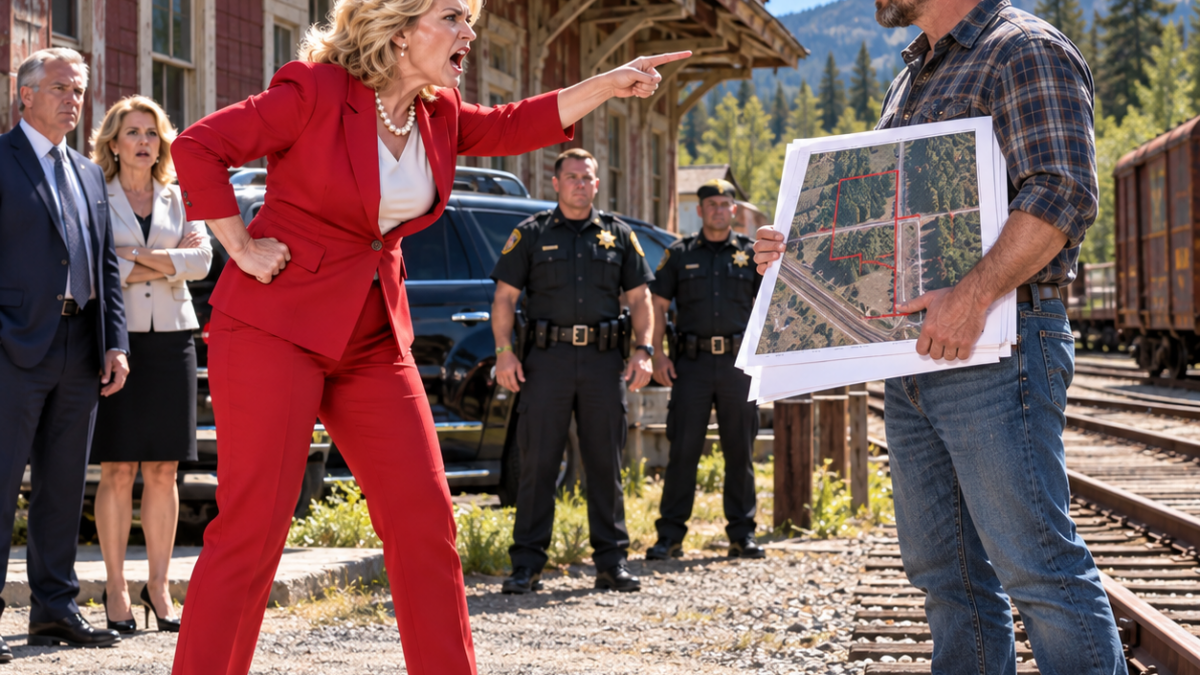
PART 2
The surveyor’s name was Delia Hatch.
She was in her fifties, wore the same sun-faded field hat every day, and possessed the useful professional quality of not caring whether the answer she gave you was the answer you wanted.
Before she unloaded a single instrument from her truck, she looked directly at me.
“I need you to understand something, Mr. Cobb.”
“Aron.”
“Aron, then. I can tell you where lines are. I cannot tell you what a judge will do about them.”
“Understood.”
“People hire surveyors because they think we’re going to hand them ammunition.”
She set a tripod on the gravel.
“I hand you measurements. What you turn them into is your business.”
“That’s all I’m asking for.”
“It never is.”
She worked three days.
The railroad spike became the center of everything.
Delia brushed away mulch and exposed the base.
“That’s not fence hardware.”
“I didn’t think so.”
“It’s vertical.”
“Yes.”
“And the head was intentionally flattened.”
She looked down the line of buried ballast.
“Railroad crews used whatever permanent markers were available. Spikes were cheap. They had boxes of them.”
“Does it prove the boundary?”
“By itself? Absolutely not.”
She stood.
“But if it corresponds with recorded railroad geometry, historic corridor descriptions, monument references, and modern control points, then it stops being an interesting spike.”
“What does it become?”
“Confirmation.”
She packed her brush away.
“Give me two days.”
On the third afternoon, I was resetting granite on the depot platform when I heard the dull rhythm of a sledgehammer.
I came around the building.
Delia was walking uphill carrying orange stakes.
She passed the old wall.
Passed the association landscaping.
Passed the gate.
Then she stopped about twenty feet inside Laurel Hollow’s entrance.
She drove the first stake.
Thunk.
A guard stepped out of his booth.
“Ma’am?”
Delia ignored him.
Thunk.
The second stake went behind the guardhouse.
The guard opened his mouth.
Delia gave him a look.
He reconsidered.
Then she crossed the fountain turnaround where the grass looked so perfect it could have been installed with tweezers.
Thunk.
The third stake went in.
“Delia?”
“Don’t talk to me while I’m working.”
I shut up.
She sighted another line.
Measured.
Checked her receiver.
Then she pulled off her hat.
“All right.”
“What?”
She pointed downhill.
“Your parcel includes the old railroad corridor.”
I waited.
“How much?”
“Right-of-way plus clearance on both sides.”
I looked toward the entrance wall.
“That wall?”
“On your parcel.”
“The guardhouse?”
“On your parcel.”
My eyes moved to the asphalt.
“Hollow Lane?”
“Two hundred ten feet of it, beginning at the county road and continuing to a point just beyond that light pole.”
I stared at her.
“Two hundred ten feet.”
“That’s what I said.”
“Their only entrance.”
“I didn’t say that.”
“It is.”
“Then that’s a planning problem.”
She pulled another stake from the bundle.
“I’ll certify the survey.”
I should have felt triumphant.
I didn’t.
Because thirty-four houses sat behind that gate.
Thirty-four families had bought homes believing that road belonged to their association or, at minimum, that their access across it was permanent.
Delia must have read something on my face.
“There’s more.”
“What?”
“Chain of title.”
“What about it?”
“I’m not ready to say.”
“Delia.”
“I need certified copies.”
“How long?”
“A week.”
“That’s a long week.”
“So was the last hundred years.”
Then Renata appeared.
She didn’t yell.
That was worse.
She walked downhill slowly, photographing every stake.
A woman pushing a stroller stopped.
A man walking a Labrador slowed down.
Renata knew she had an audience.
“Mr. Cobb is measuring your homes.”
I looked at her.
“No, I’m not.”
She raised her voice.
“He’s putting stakes where your children play and trying to determine how much Laurel Hollow property he thinks belongs to him.”
Delia turned.
“I’m a licensed surveyor. The stakes mark a recorded railroad corridor.”
Renata didn’t respond to her.
She didn’t need to.
She had already created the picture she wanted.
An outsider.
Orange stakes.
Private property.
Threatened families.
She walked uphill holding her phone.
I knew photographs would be circulating before I made it back to the depot.
I was right.
That evening, Hollis Beam waved me over from his porch.
Hollis was seventy-something, retired after forty-one years dispatching freight and passenger trains.
He had first appeared at the depot carrying two thermoses.
One supposedly for me.
One supposedly for himself.
I somehow ended up with both.
“You’re the fool who bought the station,” he’d said.
“Apparently.”
“Hollis Beam. Forty-one years railroad.”
He became my unofficial historian after that.
That evening, however, there was no joke in his voice.
“If those stakes are right…”
“They are.”
“What happens to everybody up here?”
I looked across Laurel Hollow.
Thirty-four roofs caught the orange evening light.
“I don’t know.”
Hollis nodded.
“That’s honest.”
He drank his coffee.
“Not comforting.”
“No.”
He studied me.
“Renata told people you’re going after their houses.”
“I’m not.”
“I know.”
“Do they?”
“Some.”
“Some isn’t thirty-four.”
“No.”
I stood there a little longer.
Then Hollis said something that stayed with me.
“Paper is funny, Aron. Nobody thinks about it until two pieces of paper disagree.”
A week later, Renata stopped coming after my boundary.
She came after the depot.
The County Heritage Commission met on the third Tuesday of every month in a room designed by somebody who hated both architecture and human eyesight.
Bad fluorescent lights.
Plastic chairs.
Brown carpet.
I sat in the third row.
Renata was listed under CITIZEN CONCERN.
She had photographs of my roof mounted on foam board.
She had hired an engineer who had never entered the depot but had written a letter containing the phrase “potential uncontrolled collapse” twice.
She spoke for nine minutes.
And she was excellent.
I’ll give her that.
She thanked the commissioners for protecting local history.
She talked about children walking nearby.
She talked about preservation.
She even said her grandfather had once worked near a train depot similar to mine.
Then she stopped performing.
And said the most important thing she said during the entire dispute.
“Thirty-four families financed their homes based on a plat this county accepted. They sat at closing tables. They signed mortgages. They bought title insurance. They believed the map.”
Nobody moved.
Renata looked around the room.
“If one man with one surveyor can erase that, what exactly does ownership mean for anyone else?”
The room went quiet.
Because beneath all her manipulation was one uncomfortable truth.
Those homeowners hadn’t created the mistake.
They had trusted paperwork.
So had I.
The commission voted to pause my restoration permit for ninety days pending structural review.
Ninety days.
September to December.
To somebody unfamiliar with historic masonry, that sounds inconvenient.
To me it was devastating.
Lime mortar needs workable temperatures.
It needs time.
Cold weather destroys your season.
They hadn’t merely stopped construction.
They had taken my entire fall.
I sat in my truck afterward without starting it.
For ten minutes.
Maybe twenty.
The sunlight through the windshield had that low yellow color you get when summer is already gone and winter hasn’t announced itself yet.
Then I called Delia.
“Stop measuring.”
“What?”
“Start reading.”
“I’m already reading.”
“Everything.”
“Aron—”
“Chain of title. All of it. As far back as you can go.”
“That becomes research work.”
“I know.”
“It gets expensive.”
“I know.”
“You might not like the answer.”
“I don’t like the answer now.”
Silence.
Then she said, “All right.”
That night I went back to the depot.
The nine granite stones at the east end of the platform were the only part of the building I always covered before bad weather.
Cade had set them.
My son was nineteen when he helped me on a restoration project years earlier.
He’d never laid stone before.
He watched me set the first few.
Then he said, “How hard can it be?”
I told him that sentence had caused more structural damage than earthquakes.
He laughed.
Then he set nine stones almost perfectly level in one afternoon.
When he finished, he stood with his hands on his hips like he’d invented masonry.
Those nine stones eventually came with me, in memory more than ownership, into every restoration I touched afterward.
When I bought the depot, I found a section of platform where they could be reset using original material.
So I did.
Nine stones.
Perfect line.
Cade was gone by then.
I don’t talk much about that part.
Some grief becomes worse when you explain it too carefully.
I just know that when I ran my hand across those nine stones, I could remember his hands there too.
Three days after the Heritage Commission hearing, I left town to inspect a quarry near Boone.
I was trying to match original granite.
I came home Saturday afternoon.
The first thing I saw was fresh dirt.
Brush had been cleared twelve feet on both sides of Hollow Lane.
A laminated sign hung from the gatepost.
FIRE LANE CLEARANCE — AUTHORIZED WORK.
Skid-steer tracks ran downhill.
Across the disputed boundary.
Across my parcel.
Onto the depot loading platform.
My stomach tightened.
I walked faster.
Two of Cade’s stones were gone.
One had been pushed off its bed.
The other lay in the weeds.
Broken into three pieces.
I stopped breathing for a second.
Granite doesn’t break politely.
The fracture exposed bright crystal that hadn’t seen daylight since the stone was quarried more than a hundred years earlier.
I knelt.
Touched one piece.
There are moments when anger arrives hot.
This wasn’t one.
This was cold.
The quarry that produced those stones closed in the 1920s.
The original ledge was now beneath a reservoir.
I could buy similar granite.
Maybe even excellent granite.
But I couldn’t buy that stone.
And I couldn’t buy another afternoon with a nineteen-year-old boy grinning because he’d set something straight.
I called the sheriff.
A deputy arrived at 5:20.
He photographed the tire tracks.
The stones.
The sign.
The contractor information.
Then he closed his notebook.
“Mr. Cobb, this boundary is disputed.”
“I have a certified survey.”
“The association has an agreement with you.”
“They drove machinery onto my platform.”
“I understand.”
“They broke historic stone.”
“I understand that too.”
“So what happens?”
He hesitated.
“The work order says fire-safety clearing. Your access agreement is active. The boundary dispute is civil.”
“They crossed onto my structure.”
“A judge may agree completely.”
“You don’t?”
“I’m not a judge.”
He looked down at the broken pieces.
Then his expression softened.
“I’m sorry about the stone.”
“Yeah.”
“It’s a shame.”
He left.
Laurel Hollow held its board meeting at seven.
Hollis called me at 9:15.
He was breathing heavily through his nose.
“They clapped.”
I knew exactly what he meant.
“Hollis.”
“She called it proactive fire-lane remediation.”
I sat on the platform.
“They clapped?”
“Thirty, maybe thirty-five people.”
He stopped.
“They clapped.”
I looked at the broken granite.
Then Hollis said quietly, “I didn’t.”
I closed my eyes.
“I know.”
“I want you to know that.”
“I know.”
After the call, I went inside.
On a shelf behind the ticket office was a wooden box.
Inside was Cade’s old masonry trowel.
Cheap steel.
Tape around the handle.
I had once offered to buy him a better one.
He told me the ugly one worked fine.
I carried it outside.
Set it beside the three broken pieces.
For a moment, I wanted to throw it through something.
Instead I wiped dirt from the handle.
Put it back in the box.
And shut the lid.
The next person who changed everything was Nell Ashby.
She came down from Laurel Hollow on a Thursday morning.
Seventy-one.
Small.
Carefully dressed.
Holding her purse with both hands.
She waited until I climbed down from the scaffold.
“I’m not here to yell at you.”
“All right.”
“I want you to know that.”
“I understand.”
“My house went under contract in August.”
“Congratulations.”
“It isn’t congratulations anymore.”
She looked toward the creek.
“The title company won’t insure it.”
I stopped.
“Why?”
“They say there is a defect in the recorded access easement.”
My stomach dropped.
“And because the subdivision has one entrance, they will not write a policy until the access issue is resolved.”
“Nell—”
“My son lives four miles from Greensboro.”
She continued before I could say anything.
“I put nine thousand dollars down on an assisted-living apartment near him.”
She swallowed.
“Nonrefundable.”
I said nothing.
“My husband and I bought our house in 1994.”
She looked directly at me.
“He was alive then.”
Her voice stayed perfectly level.
“There was a stack of documents maybe an inch thick. A woman told us where to initial. We initialed.”
I nodded.
“That’s the entire extent of my involvement in whatever happened thirty years ago.”
“I know.”
“Then somebody tell me why I’m the one paying for it.”
That question hurt worse than Renata’s threats.
I told Nell the truth.
I had not contacted a title company.
I had not asserted ownership over anyone’s house.
I had filed no claim against any resident.
The certified survey had entered public records.
The title companies found it themselves.
She listened.
Then nodded once.
“That’s probably true.”
She turned toward her car.
“It doesn’t help me.”
She sat behind the wheel for a few seconds before starting the engine.
That image followed me for weeks.
The newsletter arrived that weekend.
PROTECTING YOUR EQUITY.
Renata never used my name in the headline.
She was too careful for that.
The article described an “unnamed neighboring landowner” creating title uncertainty as a negotiating tactic.
The word deliberate appeared four times.
Two mornings later, somebody painted an orange stripe down the side of my truck.
Driver’s door to tailgate.
I never learned who did it.
I won’t say Renata did.
I won’t say an HOA resident did.
What I know is that the paint appeared during that week.
That is all.
Then Gideon Marsh called.
He was Laurel Hollow’s treasurer.
He asked me to meet behind the Methodist church on Route 9.
When I arrived, he was already standing beside his car with reading glasses pushed onto his head.
“I’m not doing this because I like you.”
“Good morning to you too.”
“I don’t dislike you either.”
“That’s reassuring.”
“I have no opinion about you.”
“Now I’m touched.”
He didn’t smile.
He handed me a copy of board minutes.
One page was tabbed.
“Fire-lane work never received board authorization.”
I looked at him.
“What?”
“No vote.”
He tapped the page.
“President’s discretionary spending limit is two thousand dollars.”
“How much was the contractor?”
“Eleven thousand four hundred.”
“Who approved it?”
“Renata.”
“The board?”
“No.”
“You?”
“I signed the check.”
“Why?”
“She told me it had been approved.”
He removed his glasses.
“I was in a hurry.”
I looked at him.
“Why tell me?”
“Because that’s mine to carry.”
He handed me another page.
A section from Laurel Hollow’s management agreement.
One line highlighted.
Renata’s brokerage received two and a half percent from every resale in Laurel Hollow.
In addition to listing commissions.
“Every house?”
“Every one sold through the program.”
“Since when?”
“2016.”
I did the arithmetic.
Thirty-four homes.
Three or four sales most years.
A depot considered an eyesore at the subdivision entrance didn’t merely offend Renata aesthetically.
It affected her business.
Hollis had hinted at it.
Now Gideon had the contract.
“She told residents the depot was hurting values.”
“Four to six percent.”
“Based on what?”
“A slide.”
I almost laughed.
“Of course.”
Gideon opened his car door.
“She’s going to move against you formally.”
“Jurisdiction?”
“Yes.”
“They don’t have any.”
“That has never stopped her from saying they do.”
He got inside.
Then lowered the window.
“I won’t sign another check I haven’t verified.”
I nodded.
“Good.”
“Don’t thank me.”
“I wasn’t going to.”
He drove away.
That weekend, Hollis came down to the depot.
He stood looking at the missing stones.
“Maybe give it a couple weeks.”
“What?”
“Let everybody cool off.”
Something snapped.
“Cool off?”
Hollis didn’t move.
“They broke my son’s stones.”
“I know.”
“They came onto my property.”
“I know.”
“They applauded.”
“Hear me—”
“No. You hear me.”
My voice rose.
“Thirty-five people sat in that room and clapped.”
He waited.
“Not one stood up.”
“Aron.”
“And now I’m supposed to protect everybody’s feelings?”
He looked at me for a moment.
Not angry.
That made it worse.
“Maybe.”
I stared at him.
He nodded toward the broken granite.
“Because you’re still the man you were before they clapped.”
Then he walked away.
I immediately regretted everything I had said.
Ten minutes later, I texted him.
Deleted it.
Wrote another.
Deleted that.
Finally sent four ugly sentences that amounted to an apology.
He replied within the hour.
FORTY-ONE YEARS ON THE RAILROAD. I’VE BEEN YELLED AT BY BETTER MEN AND WORSE MEN.
Then:
4 A.M. TOMORROW. I’LL BRING COFFEE.
He did.
Delia arrived at my kitchen table the following Wednesday with two certified documents.
She laid them down carefully.
“I’m going to show you these in order.”
“All right.”
“Then I’m going to say one sentence.”
“Sounds ominous.”
“I’ve been sitting on this for nine days, Aron. I would like to stop.”
The first document was dated 1994.
Piedmont Traction Holdings—the successor to the old railway company—conveyed the entire abandoned rail corridor to Black Ridge County.
Every foot.
Recorded.
Certified.
The second document was dated 1998.
It was the access easement referenced by every Laurel Hollow property deed.
The developer had been granted a perpetual right to cross the corridor.
I looked between the two.
Then looked again.
“Wait.”
Delia said nothing.
I pointed at the grantor.
“Piedmont Traction Holdings.”
“Yes.”
“Same company.”
“Yes.”
“They gave the county the corridor in 1994.”
“Correct.”
“Then four years later they granted Laurel Hollow an easement over it.”
“Correct.”
“They didn’t own it in 1998.”
“No.”
I leaned back.
“They sold a key to a door they had already sold.”
“That’s one way to put it.”
“How did nobody catch this?”
“Because title chains aren’t magic.”
She folded her arms.
“Somebody records a deed. Somebody records another document four years later. A developer references the later one repeatedly. Attorneys copy the description. Title companies insure based on established documents. Houses change hands. Thirty years passes.”
“And now?”
“The county later transferred the segment below the ridge into private ownership.”
“When?”
“2001.”
“And it passed down—”
“Through several owners.”
“Until the tax sale.”
“Until you raised your paddle in March.”
I stared at the kitchen table.
“So there is no valid easement.”
“Not the one they rely on.”
“Thirty-four homes have defective access.”
“Yes.”
“Not defective homes.”
“Correct.”
“The houses are fine.”
“Yes.”
“The road isn’t.”
“That’s the problem.”
“How long have you known?”
“I suspected it when I found the 1994 deed.”
“Nine days ago.”
“Suspected.”
“You didn’t tell me.”
“I needed certified recording dates.”
She stood.
“And because once I told you, I knew you’d want to do something.”
“Fair.”
She put on her coat.
Then she stopped.
“Here is my sentence.”
“I’m listening.”
“You have one hundred nine days remaining on that temporary access agreement.”
I knew where this was going.
“Delia.”
“On day one hundred eighty-one, you could legally close the two hundred ten feet of Hollow Lane crossing your property, subject to whatever emergency and equitable arguments they might raise.”
I said nothing.
“There is no other vehicle entrance.”
“I know.”
“They would settle.”
“I know.”
“Probably within a week.”
I thought about Nell.
The nine-thousand-dollar deposit.
Hollis.
The woman with the stroller.
Thirty-four roofs.
Thirty-four closing tables.
Thirty-four families who hadn’t forged anything.
“No.”
Delia stared at me.
“No?”
“I’m not locking them in.”
“Renata drove equipment across your platform.”
“Renata did.”
“Her board cheered.”
“Some residents did.”
“She stopped your permit.”
“I know.”
“She has forty thousand dollars in fines pointed at you.”
“I know.”
“Then what exactly do you plan to use for leverage?”
I opened the kitchen drawer.
Inside was the one-page temporary access accommodation Renata had handed me at the stone yard.
Clause Six.
Four sentences.
I touched the page.
“I don’t know yet.”
Delia looked at the paper.
Then at me.
“What is that?”
“Something she wrote.”
“Does it matter?”
“It might.”
“When?”
“When she does exactly what she keeps promising to do.”
The formal notice arrived the first Friday in November.
SPECIAL MEETING OF THE BOARD OF DIRECTORS.
Resolution 14.
Assertion of HOA jurisdiction over my depot parcel.
Accumulated fines: $41,250.
Authorization for association counsel to file for declaratory and injunctive relief.
At the bottom:
Mr. Aron Cobb invited to attend as respondent.
I read it twice.
Then I smiled for the first time in weeks.
Not because I had beaten anyone.
Because Renata had finally stepped exactly where she had promised she would.
The meeting room was full.
Forty residents, maybe more.
Nell sat three rows ahead.
Hollis stood near the door.
Delia arrived wearing field clothes and carrying a survey tube.
Gideon sat at the board table.
Renata opened the meeting precisely at seven.
She thanked everyone.
Read announcements.
Recognized a landscaping committee.
Then moved to Resolution 14.
Her voice was polished.
“Whereas the owner of the Kestrel Run parcel has failed to comply with association standards…”
Kestrel Run was apparently what she had decided to call my depot property.
“…and whereas said conduct presents continuing aesthetic, access, and safety concerns…”
I watched Gideon.
He stared at the tabletop.
“…the board therefore resolves to authorize enforcement proceedings…”
When she finished, she looked at me.
“Mr. Cobb, you have two minutes.”
“I’ll wait.”
That threw her.
“Excuse me?”
“Take your vote.”
She paused.
“You’re waiving comment?”
“Before the vote.”
A flicker crossed her face.
She hid it quickly.
“Very well.”
She looked around the table.
“All in favor?”
Six hands went up.
Gideon’s remained flat.
“Opposed?”
His hand rose.
“Motion carries six to one.”
Renata made a note.
I stood.
Walked forward.
And placed Delia’s certified survey overlay on the table.
County plat beneath.
Rail corridor outlined in red.
The line ran through Laurel Hollow’s entrance wall.
Through the guardhouse.
Across landscaping.
And directly beneath two hundred ten feet of Hollow Lane.
Nobody spoke.
One director leaned closer.
Another put on his glasses.
A woman behind me whispered, “That’s our road.”
I placed the 1994 deed beside the 1998 easement.
Delia spoke from the wall.
“Piedmont Traction Holdings conveyed the corridor to the county in 1994.”
People turned.
She continued.
“The purported subdivision access easement was recorded in 1998 by the same grantor.”
A man asked, “So?”
Delia answered.
“They did not own the corridor in 1998.”
The room changed.
“What does that mean?”
“It means the easement referenced in your deeds was granted by an entity that had already conveyed the underlying property.”
Someone behind me said, “Oh, God.”
I raised a hand.
“Let me finish.”
Then I placed Renata’s agreement on the table.
One page.
Two signatures.
Mine.
Hers.
Clause Six exposed.
I slid it toward her.
“You didn’t lose the lane tonight.”
Renata stared at me.
“You lost the protection when you raised your hands.”
Nobody else understood yet.
She did.
I watched her eyes move down the paragraph.
Clause Six stated that any enforcement action, claim, or proceeding by either party against the other’s parcel would terminate the temporary access accommodation immediately and automatically.
No notice.
No cure period.
No second chance.
Resolution 14 was an enforcement action.
Adopted ninety seconds earlier.
Six to one.
Recorded in the minutes.
In front of forty witnesses.
The only temporary agreement preserving Laurel Hollow’s unquestioned use of Hollow Lane had just been terminated by the same board that depended on it.
Renata read the clause again.
Her finger stopped on one sentence.
I remembered the supply yard.
Her smile.
“It cuts whichever way I need it to.”
Now it had.
Nobody spoke for several seconds.
Then Gideon removed his voting card.
Placed it in the center of the table.
Pushed his chair backward.
The director beside him looked at him.
Then at Renata.
She placed her card down too.
A resident stood.
“Can he close the road?”
I looked at him.
“I have not said that.”
“Can you?”
Delia answered carefully.
“The existing recorded easement has a serious title defect. The temporary agreement has now terminated under its own language.”
Renata finally spoke.
“I move to reconsider Resolution 14.”
Gideon shook his head.
“You can’t erase the record by pretending the vote didn’t occur.”
“I move to table.”
“It passed.”
“Then I move—”
“Renata.”
The voice came from the third row.
Nell Ashby.
She stood slowly.
“My house sale is already dying because of this.”
Renata turned.
“Nell, we’re working—”
“No.”
Her voice trembled now.
“You’ve been telling us Mr. Cobb was attacking us.”
“I’ve been protecting—”
“He didn’t file anything against my house.”
Renata stopped.
Nell continued.
“My title company found the problem after the survey.”
“Which he commissioned.”
“Because you put a gate across his road.”
The room stirred.
Renata’s jaw tightened.
Nell pointed at the one-page agreement.
“Did you write that?”
“Our counsel prepared—”
“Did you approve it?”
“Yes.”
“And tonight you terminated it?”
“I was acting to protect—”
“Answer me.”
Silence.
“Yes.”
Nell sat down.
Nobody applauded.
Nobody needed to.
I rolled up the survey.
Picked up my folder.
Then walked toward the door.
As I passed Nell, she caught my sleeve.
Just for half a second.
I stopped.
She didn’t say anything.
Neither did I.
Outside, Hollis followed me.
“Well.”
“Yeah.”
“You closing it?”
“No.”
He studied me.
“Tonight?”
“Ever.”
His eyebrows lifted.
“Ever?”
“I won’t punish thirty-four families because one person couldn’t stop swinging.”
He smiled faintly.
“Cade would approve.”
I looked away.
“Don’t do that.”
“All right.”
We stood there quietly.
Then he handed me a thermos.
“Coffee?”
“At seven-thirty at night?”
“Railroad rules.”
The board collapsed within two weeks.
A recall petition circulated.
Not because I started it.
I didn’t sign it.
I couldn’t.
I didn’t live there.
Residents did it themselves.
Gideon provided financial records.
The unauthorized $11,400 contractor payment became public.
So did the brokerage agreement that paid Renata’s company a percentage tied to property resales.
So did the emails discussing the depot’s supposed impact on property values.
So did the fact that she had repeatedly described the road as an HOA-owned “community asset corridor” even though no recorded document used that term.
Forty-one residents voted to recall her.
Three supported her.
Her brokerage later lost the association management account it had held since 2016.
The new board asked to meet.
There were five directors across a folding table.
Their new president was a retired school administrator named Carver Hayes.
Gideon had resigned from the board but attended voluntarily.
Carver opened the meeting.
“Mr. Cobb, before we begin, I want to say something.”
“Go ahead.”
“We should have verified the facts before allowing this to become personal.”
I nodded.
“Yes.”
“That’s all.”
“Good.”
He looked slightly surprised.
“You don’t want an apology?”
“Thirty-four families didn’t drive a skid steer across my platform.”
“No.”
“Thirty-four families didn’t write fake violations.”
“No.”
“Thirty-four families didn’t break my stone.”
His expression changed.
“No.”
“Then let’s fix the road.”
I placed my proposal on the table.
A properly negotiated, properly recorded easement.
Forty years.
No claim of ownership by the HOA.
A right of passage only.
One-time contribution: $400 per household.
Not $4,000.
Not $40,000.
Four hundred.
Annual maintenance contributions for gravel, grading, drainage, culverts, and snow access.
Indexed modestly over time.
Clear language stating that my parcel remained private property.
No architectural jurisdiction.
No HOA enforcement authority.
No fines.
No fictional community asset corridor.
Carver read the number.
“Four hundred per household?”
“Yes.”
“You understand you could ask for considerably more.”
“Yes.”
“Why aren’t you?”
I thought about Nell.
“Because I want a legal road.”
I pointed toward Laurel Hollow.
“Not hostages.”
Nobody spoke.
Gideon finally said, “I’ll write my check tonight.”
Carver looked at him.
“You’re not on the board anymore.”
“I still live there.”
That got the first real laugh I had heard from Laurel Hollow in months.
The new agreement was recorded January ninth.
Within weeks, title companies resumed writing policies.
Nell Ashby closed on her house February third.
A few days before the movers arrived, she came down to the depot.
The roof had new rafters on the east end.
She walked onto the platform.
This time she didn’t stop at the property line.
“My son is four miles away.”
“Good.”
“I move next Thursday.”
“Good.”
“I’ll see him Sundays.”
She looked at the depot.
Then at me.
“I wanted to thank you.”
“You don’t have to.”
“I know.”
She smiled.
“That’s why I’m doing it.”
She handed me an envelope.
Inside was a photograph.
Black and white.
The depot in 1947.
A freight crew standing beside the loading platform.
I stared at it.
“Where did you get this?”
“My husband collected local photographs.”
She pointed.
“Look.”
At the far edge of the picture, barely visible, were the same granite platform stones.
The same grain.
The same joints.
I swallowed.
“Nell.”
“I thought you should have it.”
She touched my arm.
Then walked back to her car.
There was one thing the new agreement couldn’t repair.
Cade’s stones.
I searched three quarries.
Two architectural salvage yards.
A demolition yard outside Danville.
Nothing matched.
Granite can be close.
Very close.
But historic stone has a color that comes from a particular mountain, a particular depth, a particular century.
Every replacement looked wrong.
So I stopped trying.
Instead, I asked the new board for one additional term.
Not money.
A memorial.
The east end of the depot platform would remain publicly accessible during scheduled hours once restoration was complete.
The three broken pieces would be displayed behind protective glass exactly as they were.
Unrepaired.
A small bronze plaque beneath them.
The board asked what I wanted written on it.
I said:
CADE COBB
“Nothing else?”
“Nothing else.”
Carver looked at me.
“No dates?”
“No.”
“No explanation?”
“No.”
“Why?”
“People who need to know will know.”
The board approved it unanimously.
Spring came.
Lime season returned.
I opened the old wooden box.
Took out Cade’s trowel.
The tape was fraying.
I could have replaced it.
I didn’t.
Hollis arrived at four in the morning with coffee.
“You know normal people sleep.”
“Normal people don’t buy train stations.”
“Fair.”
We worked until sunrise.
Around seven, the same gate guard who had once told me I wasn’t allowed on my own shoulder walked down.
He had survived the board turnover.
Good kid.
Wrong employer instructions.
He stopped beside us.
“Morning, Mr. Cobb.”
“Morning.”
He hesitated.
Then smiled.
“You’re welcome to use the lane.”
I looked at Hollis.
Hollis looked at me.
The guard added, “You’re our guest.”
I couldn’t help it.
I laughed so hard I nearly dropped the trowel.
The kid looked confused.
“Did I say something?”
“No.”
I wiped my eyes.
“No, son. It’s perfect.”
By summer, the depot had a roof.
By fall, the ticket office windows were restored.
A local historical group donated original railway benches.
Hollis found an old dispatcher clock in storage.
Delia refused every invitation to opening day until I threatened to put her survey on the wall without her permission.
“That’s blackmail.”
“It’s historic preservation.”
She came.
Nell came back from Greensboro with her son.
Gideon came.
Carver came.
Even the young guard came with his wife.
The platform was full.
Nobody from the county gave a grand speech.
I didn’t want one.
We opened the east-end display.
Three pieces of broken granite.
Cade’s name.
Nothing else.
Hollis stood beside me.
“Looks right.”
“No.”
He waited.
“It looks honest.”
“Better.”
I looked uphill toward Laurel Hollow.
Cars moved freely along Hollow Lane.
The same two hundred ten feet of road that had nearly torn thirty-four families apart now had an easement nobody needed to lie about.
That mattered to me.
More than winning would have.
Renata never came to the depot again.
I saw her once months after the recall.
She was standing beside a moving van outside her house.
Her brokerage sign was gone from the clubhouse entrance.
She noticed my truck.
For a second, we looked at each other.
I could have stopped.
Could have reminded her about Clause Six.
Could have asked whether the road still belonged to the community.
Could have told her what the recall vote had been.
I kept driving.
There are people who think revenge requires humiliation.
Sometimes the best revenge is simply allowing the record to become complete.
She had wanted the depot condemned.
It survived.
She had wanted control of the lane.
Her board signed an agreement acknowledging it did not own the corridor.
She had called the building an eyesore hurting home values.
It became a restored historic landmark.
Her brokerage had profited from Laurel Hollow property sales.
The association replaced it.
She had used Clause Six to frighten me.
Clause Six ended her leverage.
And she had told me, standing beside her car with that pink folder against her chest:
“It cuts whichever way I need it to.”
She was right about one thing.
It cut.
Just not where she expected.
People still ask me why I didn’t close Hollow Lane after Resolution 14.
Legally, the situation had given me enormous leverage.
Emotionally, part of me wanted to.
Especially after Cade’s stones were broken.
Especially after people applauded the work that broke them.
For four days, I came dangerously close.
Then I kept remembering Nell.
“I signed where they told me to initial.”
That sentence did it.
Because she was right.
Most people don’t spend their lives reading deeds from 1898.
They don’t inspect railroad conveyances.
They don’t cross-reference grantors.
They don’t question whether the road beneath their tires was legally transferred four years before somebody created an easement over it.
They trust professionals.
They sign.
They go home.
They raise families.
Then thirty years later, somebody discovers that two pieces of paper don’t agree.
I didn’t want thirty-four families paying for a mistake they didn’t create.
Renata wanted a war between me and Laurel Hollow.
What she got instead was something much worse for her.
Laurel Hollow eventually realized I wasn’t its enemy.
That was the moment she lost.
A year after the new easement was recorded, Carver invited me to an HOA meeting.
I almost refused.
Then Hollis said he’d already told everybody I was coming.
“You what?”
“Railroad privilege.”
“That’s not a thing.”
“It was.”
So I went.
The room looked different without Renata.
Same folding tables.
Same bad coffee.
Different atmosphere.
Carver stood.
“We have one item before regular business.”
He held up a framed copy of the new easement.
Someone had printed the corridor map beside it.
“Some of you know why we’re putting this here.”
People looked toward me.
I immediately regretted coming.
Carver continued.
“This is not a trophy.”
Good.
“It’s a reminder.”
Better.
“A road is not yours because you’ve driven over it for thirty years.”
A few people smiled.
“And a neighbor is not your enemy because someone tells you he is.”
Nobody smiled at that.
Carver hung the frame.
Then said, “Mr. Cobb?”
“No speech.”
Laughter.
“Anything?”
I looked around the room.
Nell’s old chair was empty because she lived near her son now.
Gideon sat in the back.
Hollis had two thermoses.
Of course.
I stood.
“Read before you vote.”
That was it.
I sat down.
Gideon laughed first.
Then everyone did.
Even me.
Years later, the thing I remember most isn’t the board freezing over Delia’s survey.
It isn’t Renata reading Clause Six.
It isn’t even the recall.
It’s a spring morning at the depot.
Sun coming through restored windows.
Dust in the light.
Cade’s old trowel in my hand.
Hollis talking too much.
Cars moving quietly up Hollow Lane.
And three broken pieces of granite behind glass.
For a long time, I thought restoring the depot meant putting everything back the way it had been.
Perfect joints.
Original materials.
Correct mortar.
Correct slate.
Correct windows.
Then the fight with Laurel Hollow taught me something old buildings already knew.
Restoration isn’t pretending nothing was ever damaged.
Sometimes you preserve the fracture.
You make it stable.
You tell the truth about how it happened.
Then you keep building around it.
That’s what happened to the depot.
That’s what happened to Laurel Hollow.
That’s what happened to me.
Renata told me I had fourteen days.
She threatened $250 daily fines.
She blocked my delivery.
She pushed the county until I lost a construction season.
Her contractor drove machinery across my platform and shattered stone I could never replace.
She convinced neighbors I was trying to steal their homes.
And finally, after eleven months of insisting the HOA had authority over me, she called a meeting and ordered six board members to raise their hands.
They did.
That vote was supposed to crush me.
Instead, it activated the exact clause she had written herself.
Ninety seconds later, I laid a survey across the table showing that the wall she thought protected Laurel Hollow stood on my property.
The guardhouse stood on my property.
And two hundred ten feet of the only road into the subdivision had been paved across my land.
Then I placed the deeds beside it.
1994.
1998.
A corridor sold once, then supposedly granted again by a company that no longer owned it.
Finally, I placed her own agreement in front of her.
She didn’t need a lawyer to explain what she had done.
I saw it happen in her face.
Her eyes moved from Clause Six to the red corridor line.
Then from the red line to the board members whose hands had just gone up.
For the first time since I’d met her, Renata Pruitt had nothing to say.
And that was the moment the HOA board finally understood something I had learned while rebuilding a ruined railway station:
Property lines do not care who has the louder meeting.
Deeds do not care how many newsletters you print.
And paper doesn’t become true because thirty-four families were told to believe it.
But none of that meant those families deserved to lose their road.
So I gave them the one thing Renata had never offered me.
A fair deal.
Today Hollow Lane is still open.
Laurel Hollow has a legal recorded easement.
The depot is restored.
The platform is public during visiting hours.
And at the far end, behind glass, are three pieces of broken granite beneath a small bronze plate.
CADE COBB.
I still use his trowel.
The handle is worn smooth beneath the tape now.
Every spring, when the weather finally warms enough for lime mortar, I take it out of the box.
I lay one course.
Check it.
Level it.
Then lay another.
Because some things you never get back.
You just keep the rest level.








