They Left the Nurse Alone With an Aggressive Military K9—Then He Found Something in Her Pocket That No One Could Explain
They Left the Nurse Alone With an Aggressive Military K9—Then He Found Something in Her Pocket That No One Could Explain.
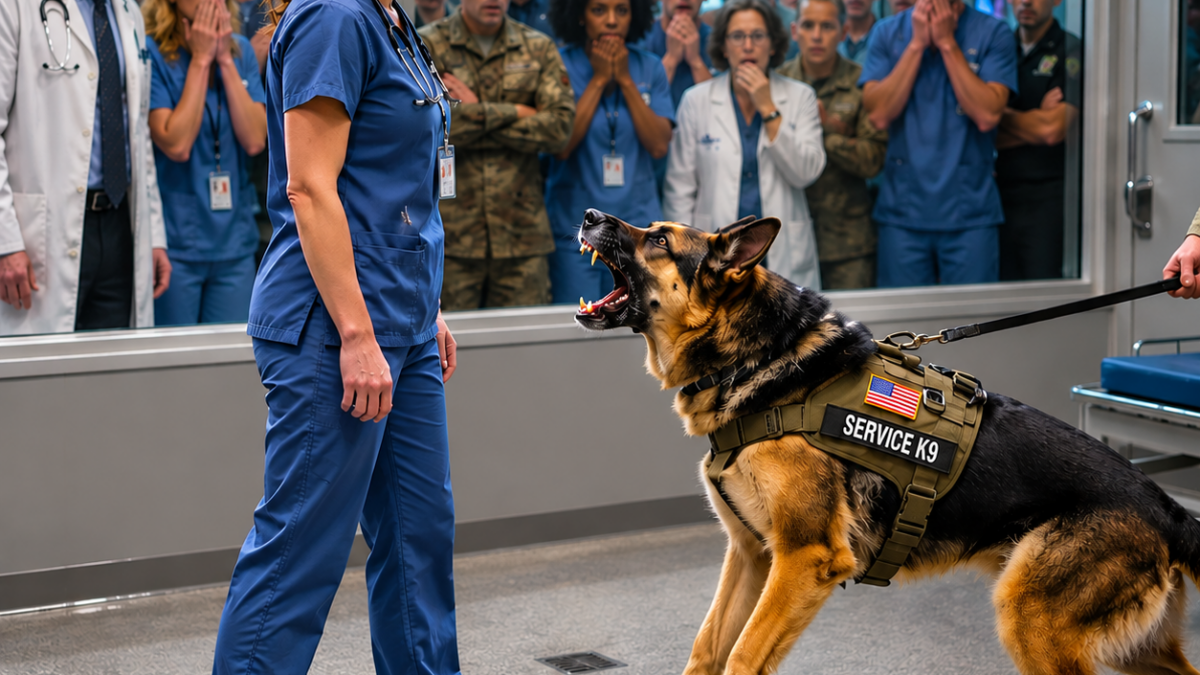
Three experienced handlers had failed to control the retired military German Shepherd, the veterinarian had abandoned the examination, and the dog had spent nearly an hour trembling, refusing food, and ignoring every command he had obeyed for years.
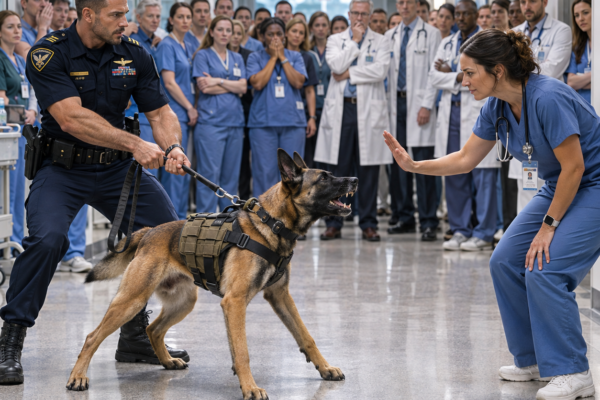
Then trauma nurse Claire Bennett walked into the room alone, sat several feet away without touching the leash, and watched as the supposedly aggressive K9 crossed the floor, pressed his nose to her wrist, and began frantically searching her pockets.
When Claire pulled out a faded blue ball and whispered, “You still remember,” the dog dropped calmly at her feet—and the commander who had trusted Atlas for six years realized there was an entire part of his partner’s life nobody had ever told him about.
At 11:43 on Thursday morning, Commander Nathan Cole realized he had a problem he did not understand.
That was worse than a problem he could identify.
Nathan had spent enough years around military working dogs to know what fear looked like.
Excitement looked different.
Pain looked different.
Aggression looked different.
Defiance looked different.
Atlas was showing none of those things cleanly.
The nine-year-old German Shepherd stood near the examination-room door with his body rigid, ears pulled back, and eyes fixed on the corridor beyond it.
His black-and-tan coat had begun graying around the muzzle.
A pale scar crossed the fur over his right shoulder.
The old olive tactical harness he wore for appointments had faded from years of use, but the brass identification plate was still polished.
Nathan maintained it that way out of habit.
Atlas had been retired from operational duty, but Nathan could not make himself treat the dog as though the working years no longer mattered.
The harness mattered.
The plate mattered.
The old commands mattered.
Routines mattered.
That morning, almost none of them were working.
“Atlas.”
The dog glanced at him.
Only for a second.
Then his attention returned to the double doors leading into the veterinary corridor.
Nathan crouched.
“Look at me.”
Atlas’s eyes came back.
Good.
“Sit.”
Nothing.
Nathan waited.
“Atlas. Sit.”
The dog’s breathing quickened.
Then an electronic monitor somewhere beyond the doors sounded twice.
High.
Clean.
Mechanical.
Atlas flinched so violently that his front claws scraped across the non-slip floor.
Nathan caught the leash before the dog could retreat completely behind him.
“Easy.”
Atlas trembled.
PART2:
That was when Nathan stopped treating the situation as ordinary appointment anxiety.
He lowered the leash tension immediately.
“Okay.”
His voice changed.
No command now.
No pressure.
“I’m here.”
Atlas pressed against his leg.
Dr. Miriam Lawson stood near the opposite wall.
She had been waiting without moving toward the dog.
That was one reason Nathan liked her.
Too many people saw a frightened animal and instinctively tried to touch it.
Reassure it.
Restrict it.
Fix it.
Dr. Lawson understood that closeness could become pressure.
“Has he ever reacted like this in a hospital?” she asked.
“Never.”
“Any new medication?”
“No.”
“Recent injury?”
“Nothing except the shoulder stiffness we discussed.”
“Change in appetite?”
“No.”
“At home?”
“Normal.”
Nathan ran one hand along Atlas’s back.
The dog was warm.
Not feverish.
Muscles hard beneath his coat.
“He walked in fine.”
Dr. Lawson nodded.
“I saw that.”
“The second we reached this hallway, he changed.”
Another distant beep.
Atlas’s ears flattened.
Nathan felt it through the leash before the dog even moved.
Dr. Lawson saw it too.
“That sound matters.”
Nathan looked toward the doors.
“You think that’s it?”
“I think it may be part of it.”
“Why now?”
“I don’t know.”
She looked at Atlas.
“But he’s telling us something.”
For twenty minutes, they did almost nothing.
That was deliberate.
Water sat nearby.
Treats available.
Door open.
No forced examination.
Atlas stayed positioned so his back was near the wall and his eyes remained on the corridor.
One veterinary technician sat on the floor several feet away.
She avoided eye contact.
After a while, she rolled a treat gently toward him.
Atlas sniffed it.
Turned his head away.
Nathan stared.
Atlas refusing food unsettled him more than the ignored sit command.
“You’re really scared.”
The Shepherd’s eyes flicked toward him.
Nathan had handled Atlas nearly six years.
He knew the dog’s preferences with ridiculous precision.
Atlas hated bananas.
Loved scrambled eggs.
Preferred sleeping near doors.
Would carry an empty water bottle around the house if Nathan forgot to throw it away.
He could distinguish Nathan’s truck from other engines before it turned onto their street.
If Nathan left in the morning without saying goodbye, Atlas sometimes ignored breakfast until he returned.
They had worked together, retired together, and slowly built a life where the line between handler and family had stopped mattering.
Nathan believed he knew the dog.
That belief began cracking before noon.
Dr. Lawson tried the exam again after Atlas’s breathing slowed.
No restraints.
No table.
She approached from the side.
Atlas tolerated her until another monitor sounded.
Then his whole body tightened.
He backed away.
Dr. Lawson stopped immediately.
“No.”
Nathan looked at her.
“No what?”
“We’re done pushing.”
“We still need the evaluation.”
“Not like this.”
Nathan nodded.
He did not argue.
The annual retirement evaluation mattered.
Atlas’s old shoulder injury needed monitoring.
His joints had become stiffer.
There was also a new program the medical center wanted to test.
Selected retired military dogs would make supervised visits to recovering veterans.
Not formal therapeutic service.
Not another job disguised as retirement.
Only structured visits for dogs whose temperaments and health made it appropriate.
Nathan had volunteered Atlas because the dog had always been steady around people he trusted.
He liked veterans.
He liked quiet rooms.
He seemed bored at home sometimes, as though retirement had given him comfort but removed the rhythm that had defined most of his adult life.
Nathan thought occasional hospital visits might give him something useful without asking too much.
Now Atlas would not let a veterinarian approach him.
Hospital director Richard Hale arrived a little after noon.
He was tall, gray-haired, and carried the permanently tired expression of someone whose job involved solving problems other people escalated before calling him.
He looked through the observation glass.
“Has he threatened anyone?”
“No,” Dr. Lawson said.
“Growled?”
“No.”
“Snapped?”
“No.”
“Then why is everybody calling him aggressive?”
Nathan looked toward the corridor.
That word had already spread.
Aggressive military dog.
Out of control K9.
Dangerous retired Shepherd.
Richard frowned.
“He’s frightened.”
Dr. Lawson nodded.
“That is my assessment.”
Nathan appreciated hearing it.
Fear and aggression were not interchangeable.
A frightened dog could become dangerous if cornered.
But Atlas was not trying to attack anyone.
He was trying to avoid whatever he believed threatened him.
“Then nobody forces him,” Richard said.
Nathan nodded.
“That works for me.”
Unfortunately, sensible decisions attract fewer spectators than dramatic rumors.
Staff members had begun passing the observation window more often than necessary.
Some genuinely cared.
Some were curious.
One seemed entertained.
Martin Voss, senior hospital administrator, stood in the corridor with his arms folded.
Martin was good at budgets.
Good at scheduling.
Good at asking why procedures took thirteen minutes instead of ten.
He was less gifted at hiding impatience.
When trauma nurse Claire Bennett passed carrying a tray of supplies, Martin nodded toward the examination room.
“Perhaps our famous trauma nurse can fix him.”
Claire stopped.
“What?”
“Military dog refuses everybody.”
A nurse beside Martin frowned.
“She’s not a dog handler.”
Martin smiled faintly.
“I know. But we’ve all heard Claire is good at getting frightened people to trust her.”
The remark landed awkwardly.
Claire looked at him.
Then through the observation window.
She did not respond to the sarcasm.
Her eyes settled on Atlas.
The dog stood with his back partly toward the wall.
Head low.
Every few seconds, he glanced toward the corridor.
Then the monitor sounded again.
Atlas tightened.
Claire’s expression changed.
Not with fear.
Recognition of fear.
She set down the tray.
“Who is his handler?”
Nathan stepped out.
“I am.”
“Commander?”
“Nathan Cole.”
“Claire Bennett.”
“I know. Trauma unit.”
She nodded toward Atlas.
“Would you mind if I tried sitting with him?”
Nathan studied her.
“Have you handled military working dogs?”
“Not professionally.”
“Dogs like him?”
She hesitated.
“Not for a long time.”
That answer was different.
Nathan noticed.
“Then I need you to understand something.”
“I know he’s frightened.”
“He may react unpredictably.”
“I won’t corner him.”
“I don’t want anyone proving something.”
“Neither do I.”
Immediate.
Calm.
No defensiveness.
Nathan glanced at Dr. Lawson.
The veterinarian considered.
“We could let her sit quietly. No contact unless Atlas initiates.”
Nathan looked back at Claire.
“If he tells you no, you leave.”
“Of course.”
“Don’t call him toward you.”
“I won’t.”
“Don’t reach over his head.”
“I know.”
Again that phrase.
Nathan frowned slightly.
She knew more than she was admitting.
Still, Atlas had been reacting to almost everyone.
Another calm human sitting in the room was unlikely to make things worse if managed properly.
He handed her nothing.
No leash.
No treats.
No toy.
Claire entered alone.
The door closed.
She walked only far enough to place a chair against the wall.
Several feet from Atlas.
Then sat sideways.
Not facing him directly.
Hands resting loosely in her lap.
Atlas watched.
Claire lowered her gaze.
For almost a minute, nothing happened.
Martin stood behind the glass.
“Let’s see how long that lasts.”
Nathan ignored him.
Atlas shifted one paw.
Then another.
Claire did not move.
Softly she said:
“It’s all right.”
Atlas lifted his head.
“Nobody’s going to make you do anything.”
Nathan’s eyes narrowed.
The dog took one step.
Claire looked toward the floor.
“You can stay right there.”
Second step.
Atlas’s nose began moving.
Scenting.
His ears lifted slightly.
Nathan had seen him catch a familiar odor before.
His posture changed exactly that way.
But that made no sense.
Claire had supposedly never met him.
Atlas approached.
Stopped directly in front of her.
Sniffed the lower sleeve of her scrubs.
Then her wrist.
Claire froze.
Not from fear.
Recognition.
Atlas pressed his nose against the inside of her wrist.
Whined.
Nathan’s stomach tightened.
The dog sniffed again.
More urgently.
Claire’s right pocket.
Then left.
Back to her hand.
Nose moving quickly.
Searching.
Claire’s face lost color.
“Atlas.”
She barely whispered it.
The dog sat immediately.
Nathan stared.
Dr. Lawson turned toward him.
“Was that a command?”
“No.”
Nathan did not take his eyes off them.
“Not one I’ve ever heard.”
Claire raised one hand slowly.
Touched Atlas’s cheek.
His eyes softened.
“You remember me.”
Atlas leaned into her palm.
His breathing slowed.
Not a little.
Completely.
Within less than thirty seconds, the dog who had trembled for nearly an hour lowered himself beside Claire’s chair.
Rested his head across her shoes.
The observation area went silent.
Nathan opened the door.
Entered slowly.
“Claire?”
She looked up.
Her eyes were wet.
“I’m sorry.”
“For what?”
“I didn’t expect this.”
Nathan crouched beside Atlas.
The dog looked at him.
Then placed his head back over Claire’s shoe.
Nathan had seen Atlas bond with people.
Handlers.
Medics.
Teammates.
Children of service members.
Veterans.
He knew affection.
This was different.
Atlas was not discovering Claire.
He was returning to her.
“Who is he to you?”
Claire looked down.
“Someone I thought I’d never see again.”
Dr. Lawson entered.
Before anyone asked another question, Atlas stood.
He began gently pawing at Claire’s jacket pocket.
Again.
Again.
Not scratching.
Insistent.
Dr. Lawson noticed.
“Is there something in there?”
Claire hesitated.
Her fingers moved toward the pocket.
Then stopped.
Nathan felt something tighten inside his chest.
“What?”
Claire reached in.
Pulled out a small blue fabric ball.
Faded almost gray in places.
Soft from age.
A rough line of hand stitching ran across one side.
Atlas saw it.
His whole face changed.
Nathan stood.
“Where did you get that?”
Claire held the ball carefully.
“It belonged to him.”
Nathan stared.
“No.”
Claire looked up.
“What?”
“Atlas had a blue ball as a puppy. His first handler told me it was lost before training was completed.”
Claire shook her head.
“It wasn’t lost.”
Nathan looked at the old toy.
Then the dog.
Atlas pressed his nose against the fabric.
Closed his eyes.
Claire whispered:
“My father fixed that seam.”
Nobody spoke.
“He tore it when he was about seven months old.”
Nathan’s throat went dry.
“How long did you have him?”
“Eleven months.”
Before military training.
Before Atlas belonged to the system Nathan knew.
Before operational assignments.
Before Nathan.
Dr. Lawson looked toward the records on her tablet.
“You fostered him?”
Claire nodded.
“My family did.”
Nathan stared at her.
“You raised Atlas.”
“Part of the way.”
The dog lay beside her.
Nose still touching the blue ball.
Claire’s hand moved over his head.
“He wouldn’t sleep without this.”
Nathan almost laughed from disbelief.
“Atlas?”
“Yes.”
“This dog?”
“He used to carry it everywhere.”
Nathan looked at the retired German Shepherd who had ignored new toys for years unless food was hidden inside.
“You’re serious.”
Claire smiled through tears.
“He was unbearable.”
Atlas opened one eye.
Nathan looked down.
“You’ve been lying to me about your entire personality.”
Atlas seemed unconcerned.
Dr. Lawson’s attention moved back to the corridor.
“What about the alarm?”
Claire’s smile faded.
“When he was young, certain electronic tones frightened him.”
Nathan turned.
“What kind?”
“High-pitched repetitive ones.”
“Like that monitor?”
“Similar.”
“How bad?”
“He would hide.”
“Where?”
“Under our kitchen table.”
Nathan stared.
“When?”
“Usually when something beeped unexpectedly. A smoke detector once. A medical alert device my father used briefly after surgery. A neighbor’s security alarm.”
“Did anyone in the program know?”
“Yes.”
“Who?”
“The placement coordinator. Elias Ward.”
Nathan knew the name only faintly.
Old paperwork.
Before his time with Atlas.
Claire continued.
“Elias asked about it the day Atlas left our house.”
“Why?”
“I thought routine behavior documentation.”
Nathan looked through the glass toward the corridor.
Another monitor sounded.
Atlas heard it.
His ears moved.
But he remained against Claire.
Not relaxed completely.
Just safe enough.
Dr. Lawson nodded.
“Several things may be happening.”
Nathan looked at her.
“Sound triggers the fear.”
“Possibly.”
“And then he smells Claire.”
“Familiar person associated with safety.”
Claire looked at Atlas.
Nathan asked:
“Did you leave anything else with him?”
Claire thought.
“A photograph.”
Nathan froze.
“What?”
“A picture of Atlas and me.”
“Where?”
“I gave it to Elias.”
Nathan’s hand moved slowly toward Atlas’s harness.
Inside the faded tactical material was a small leather sleeve.
Nathan had seen it for six years.
He had never opened it.
He had been told when Atlas transferred to him:
Do not remove the identification sleeve.
He assumed it contained old program tags.
Vaccination information.
Historical unit documentation.
He had never questioned it.
Nathan unfastened the flap.
“There’s something inside.”
Claire’s breathing changed.
He reached in.
Pulled out a photograph.
Edges curled.
Color faded.
A young woman sat beneath a large oak tree.
Brown hair loose.
Laughing.
A German Shepherd puppy leaned across her shoulder.
Too-large ears.
Huge paws.
Blue ball in the grass.
Nathan looked at Atlas.
Then Claire.
Claire covered her mouth.
“My father took that.”
Nathan turned the photograph over.
Handwriting.
Not Claire’s.
A short message.
He read silently.
Then again.
Claire noticed.
“What?”
Nathan held it toward the light.
Claire leaned closer.
Her face changed.
“That isn’t my handwriting.”
“Whose?”
She read aloud.
“If he ever finds his way back to you, it means he remembered what we couldn’t afford to lose.”
Beneath it:
Elias Ward.
Claire went very still.
Nathan looked at her.
“You know that name.”
“He coordinated Atlas’s foster placement.”
“Why would he write this?”
“I don’t know.”
For a moment, the reunion stopped feeling simple.
Atlas remembered Claire.
That much was obvious.
The ball connected them.
The photograph confirmed the foster placement.
But the message suggested Elias Ward had deliberately preserved something.
A memory.
A relationship.
Maybe a warning.
Maybe nothing sinister at all.
Nathan had learned long ago that unexplained information tempts people to invent the most dramatic explanation available.
He did not want that.
Neither did Dr. Lawson.
“We verify,” she said.
Nathan nodded.
“Everything.”
Claire looked at the photograph.
“There should be records.”
Richard Hale stepped closer.
“I can authorize an archive request.”
Nathan looked at him.
“Do it.”
Richard nodded.
“We’ll also document today’s reaction and identify the exact alarm tone in the corridor.”
Martin Voss entered more slowly than everyone else.
His sarcasm was gone.
He looked toward Claire.
“Nurse Bennett.”
She turned.
“I owe you an apology.”
Claire waited.
“For making your offer into a joke.”
Martin glanced at Atlas.
“I thought you were going to walk in, pet him, and make everybody’s job harder.”
Nathan’s expression tightened.
Martin noticed.
“I was wrong.”
Claire looked at him.
“I didn’t know what would happen.”
“No.”
Martin nodded.
“But you knew he was scared.”
“Yes.”
“I treated him like a spectacle.”
Claire considered.
Then:
“You don’t need someone’s entire history before taking their distress seriously.”
Martin absorbed that.
“No.”
He looked at Atlas.
“You don’t.”
The next several hours returned to ordinary hospital work.
At least externally.
Claire went back to the trauma unit.
Nathan took Atlas home.
The dog carried the faded blue ball in his mouth the entire drive.
Nathan looked over twice.
“You’ve ignored every toy I’ve bought you for five years.”
Atlas held the ball.
Nathan shook his head.
“Apparently I’ve been purchasing inferior merchandise.”
At home, Atlas did something Nathan had never seen.
He walked directly into the bedroom.
Placed the ball beside his bed.
Lay down.
Rested one paw over it.
Nathan stood in the doorway.
For six years, he had believed he knew nearly everything that mattered about Atlas.
Now one faded toy and a photograph had opened an earlier life.
That realization unsettled him.
Not because he was jealous.
Because working dogs are often discussed through service.
Training.
Certification.
Missions.
Handlers.
Performance.
Nathan had unconsciously treated Atlas’s life before official training as preparation.
A waiting room before the “important” part.
Claire changed that in fifteen minutes.
Eleven months.
A kitchen table.
A family.
A blue ball.
An oak tree.
Fear of electronic alarms.
Those things mattered too.
Possibly more than anyone realized.
That evening, Claire called her mother.
Her mother answered on the fourth ring.
“Hi, honey.”
“Do you remember Elias Ward?”
Silence.
Then:
“The man from the dog program?”
“Yes.”
“Of course.”
Claire sat on the edge of her bed.
“And Atlas?”
Another pause.
Longer.
Her mother’s voice softened.
“Oh, Claire.”
Claire closed her eyes.
“I saw him.”
“What?”
“Today.”
“Atlas?”
“Yes.”
“Where?”
“The medical center.”
Her mother gasped.
“Is he all right?”
“He’s retired.”
Claire smiled slightly.
“Gray around his muzzle.”
“Oh.”
Her mother made the sound people make when a decade collapses in one sentence.
“He recognized me.”
“Of course he did.”
Claire laughed through tears.
“Mom.”
“He loved you.”
“He was a puppy.”
“He slept outside your bedroom for six months.”
Claire looked toward her nightstand.
She had not thought about that in years.
“Do you remember the blue ball?”
“The one your father repaired?”
“Yes.”
“I remember stepping on it every morning.”
Claire laughed.
“He still has it.”
“What?”
“Somehow.”
That silence carried more emotion than words.
Then Claire asked:
“Did Elias contact Dad after Atlas left?”
Her mother took longer.
“Yes.”
Claire sat straighter.
“When?”
“Several months later.”
“What did he say?”
“I don’t remember exactly.”
“Did Dad keep the letter?”
“Probably.”
Of course he did.
Claire’s father kept receipts from appliances purchased in 1987.
Every tax record.
Every Christmas card.
Every instruction manual.
“He had a file?”
“In the study cabinet.”
Claire closed her eyes.
Her father had died three years earlier from heart disease.
Sometimes grief hid inside absurd details.
A filing cabinet could become sacred because somebody else once knew which drawer mattered.
“Can you look?”
“Tonight?”
“Please.”
Her mother’s tone changed.
“What happened today?”
Claire told her.
The alarm.
Atlas’s panic.
Recognition.
The ball.
The photograph.
Elias’s message.
Her mother was quiet.
“I always wondered whether that dog remembered us.”
“So did I.”
“You used to cry after he left.”
“I know.”
“No, you don’t. You pretended you were fine.”
Claire smiled sadly.
Apparently that habit started young.
Her mother promised to look.
The next morning, she called at 7:12.
“I found it.”
Claire stood so quickly coffee spilled.
“The letter?”
“Yes.”
“What does it say?”
Her mother read.
Elias thanked the family for their help.
Said Atlas had transitioned successfully into the next phase.
Said information they provided about his temperament had been valuable.
Normal.
Then:
“There is another page.”
Claire gripped the counter.
“What?”
“Looks like a copy of an internal note.”
Her mother read slowly.
Atlas had shown sensitivity to a specific electronic training tone.
The response was consistent with an earlier documented behavior.
The foster family had not received full background information because the placement was considered temporary.
An internal review had been recommended before operational assignment.
Claire’s stomach tightened.
“What does ‘full background’ mean?”
“I don’t know.”
“Does it say?”
“No.”
“Anything about injury?”
“No.”
“Abuse?”
“No.”
“Training problem?”
“It just says response to tone.”
Claire closed her eyes.
She forced herself not to leap to conclusions.
A few vague lines could mean anything.
An ordinary puppy sensitivity.
A controlled training exercise.
A procedural note.
A problem resolved years ago.
Her father had apparently asked Elias questions.
According to her mother, Elias told him the training team would handle it.
Her father trusted the program.
Claire thanked her mother.
Then called Nathan.
He answered immediately.
“Everything okay?”
“I found something.”
There was a pause.
“About Atlas?”
“Yes.”
Nathan listened.
When she finished, he did not dramatize it.
Did not say someone had hidden abuse.
Did not accuse the program.
He said:
“We need the actual record.”
Relief moved through Claire.
“Yes.”
“I’ll call Lawson.”
“Thank you.”
“And Claire?”
“Yes?”
“Don’t scare yourself with the gaps.”
She closed her eyes.
“I’m trying not to.”
“Gaps are where people put the worst answer.”
That sounded like experience.
She asked:
“You’ve done that?”
“Professionally.”
He gave a dry laugh.
“And personally.”
Claire returned to Redwood Point that afternoon.
Atlas saw her before Nathan finished saying hello.
Tail wag.
Head forward.
Entire dog softening.
Claire crouched.
“Hi.”
Atlas pressed against her shoulder.
Nathan watched.
“You know, I might actually be offended.”
Claire laughed.
“He liked you first today.”
“That isn’t helping.”
They met Dr. Lawson.
Archive authorization had begun.
An old training summary was already available.
It referred to a temporary pause after Atlas became distressed by a repeated electronic tone.
The matter had been reviewed before assignment.
But the full report was missing from the active file.
Claire looked at Dr. Lawson.
“Who submitted the observation?”
She checked.
“Elias Ward.”
Nathan and Claire looked at each other.
So Elias’s note on the photograph was not random.
He had been involved.
Still, nothing proved anything sinister.
The preliminary document said Atlas ultimately completed training.
Nathan knew the dog had served successfully for years.
That mattered.
They waited.
Four days.
Claire worked.
Nathan returned home with Atlas.
The blue ball began traveling everywhere.
Atlas carried it room to room.
One night Nathan woke at two and found it beside his bed.
“You’re regressing.”
Atlas sighed.
“Fair. Retirement is supposed to be relaxing.”
On the fourth morning, Nathan received the call.
The original review had arrived.
He called Claire.
“They found it.”
She stepped away from the nurses’ station.
“What does it say?”
“I haven’t read the whole thing.”
His voice told her that wasn’t completely true.
“Is Atlas okay?”
“He’s fine.”
Pause.
“Chewing the replacement ball you brought him.”
Claire smiled.
“I told you not to let him swallow the fabric.”
“I told him.”
“Did he listen?”
“No.”
“Good. He’s definitely the same dog.”
That afternoon, they gathered around a consultation-room table.
Richard Hale.
Dr. Lawson.
Nathan.
Claire.
Martin Voss.
Atlas lay beside Nathan’s chair.
The old blue ball between his paws.
Richard began carefully.
“We’re going to stay within what these records establish.”
Claire nodded.
That was exactly what she wanted.
No invented tragedy.
No convenient villain.
Dr. Lawson opened the report.
Nine years earlier.
Atlas still in early training.
Controlled exercise.
Repeated electronic alert.
Behavioral distress.
Training paused.
Additional assessment.
Claire read the paragraph twice.
“So he wasn’t injured.”
“No.”
“Not punished.”
“Nothing here says that.”
“Not removed from training?”
“No.”
Nathan leaned forward.
“What exactly happened?”
Dr. Lawson read.
Atlas had shown a heightened fear response to that specific tone.
He attempted to retreat toward an enclosed area.
Refused food briefly.
Had difficulty responding to commands.
Claire looked at Nathan.
Exactly like Thursday.
Dr. Lawson continued.
Once the tone stopped and pressure decreased, Atlas recovered.
Further evaluation found no medical disorder.
No generalized aggression.
No evidence he was unsuitable for continued preparation.
The recommendations were practical.
Avoid unnecessary exposure to the specific high-frequency alert.
Allow time to settle in unfamiliar environments.
Use familiar handlers.
Monitor future responses.
Nathan leaned back.
“So no hidden catastrophe.”
Richard shook his head.
“Not according to the records.”
Claire felt an unexpected wave of relief.
Part of her had feared something terrible.
A secret training incident.
Cruelty.
Trauma hidden from the family.
Instead, the answer was far more ordinary.
Atlas had been frightened.
People documented it.
Some information moved forward.
Some didn’t.
“Why weren’t we told?” Claire asked.
Richard turned to the correspondence.
“The program considered the formal assessment internal operational information. Foster families received care instructions relevant to the placement period.”
Claire’s jaw tightened.
“We told them about the alarms.”
“Yes.”
“They documented it.”
“Yes.”
“But when they confirmed it mattered, nobody came back and said, ‘You were right.’”
Richard did not defend the decision.
“No.”
“Why?”
“The record doesn’t tell us motive.”
Martin shifted.
Richard continued.
“It may have been standard policy. It may have been an assumption that the training team would manage it going forward. What we can establish is that the communication was incomplete.”
Nathan looked down at Atlas.
“Did I ever get this?”
“Not the full report.”
“My records mentioned sensitivity to certain alerts.”
“Yes.”
“But not where it came from.”
“No.”
Nathan rubbed Atlas’s shoulder.
“I wish I’d known.”
Dr. Lawson nodded.
“It may have helped last week.”
“Would it have changed his service?”
“Possibly not.”
The veterinarian looked at Claire.
“He worked successfully for years.”
Nathan nodded.
“He did.”
“Then whatever adjustments were made apparently worked.”
Claire let out a slow breath.
“So the old fear wasn’t proof he should never have been a military dog.”
“No.”
Nathan answered before the veterinarian could.
“Atlas wasn’t broken.”
Claire looked at him.
“Neither was the puppy hiding under our kitchen table.”
Nathan smiled faintly.
“Exactly.”
The report contained one other detail.
During testing, Atlas responded unusually well to familiar caregivers.
Not only handlers.
Familiar scent and calm physical presence helped him regulate.
Claire looked down at him.
“You already knew.”
Atlas slept.
The old message remained.
If he ever finds his way back to you, it means he remembered what we couldn’t afford to lose.
Claire touched the photograph in her pocket.
“Why write that?”
Nobody knew.
Elias Ward was no longer employed by the program.
Contact details outdated.
Years had passed.
Maybe someday they would locate him.
Maybe not.
Nathan offered one possibility.
“He knew the relationship mattered.”
Claire looked at him.
“Then why wasn’t my family told more?”
“Both things can be true.”
She waited.
“A system can fail to communicate clearly without one person inside that system being malicious.”
Claire understood.
Elias may have been following instructions.
May have believed the issue was resolved.
May have felt uneasy anyway.
Maybe that was why he put the photograph into Atlas’s harness.
A private act of preservation.
Something familiar carried forward.
The meeting ended without arrests.
Without shouting.
Without exposing a grand conspiracy.
Nobody was dragged from the hospital.
Nobody discovered secret experiments.
The truth was smaller.
And somehow more believable.
A dog’s fear had been documented.
The information had not transferred perfectly across years and organizations.
A foster family had noticed something important.
Later professionals noticed it too.
But the connection between those observations was incomplete.
Everybody involved thought someone else had enough information.
Then nine years later, the retired dog walked into a hallway containing the wrong sound and the right person.
Martin approached Claire after the meeting.
“I owe you another apology.”
She looked at him.
“You already apologized.”
“Not enough.”
“For what?”
“I treated emotion like evidence of weakness.”
Claire said nothing.
He continued.
“When Atlas panicked, I assumed the problem was inconvenience.”
“You weren’t the only one.”
“I made a joke.”
“Yes.”
“I should have asked what he needed.”
Claire nodded.
Martin looked through the glass.
Atlas was asleep.
“You said something the other day.”
“What?”
“You don’t need someone’s whole history to take distress seriously.”
“Yes.”
He thought.
“I’ve been thinking about that.”
Claire smiled slightly.
“Good.”
The hospital began reviewing how historical behavioral records were transferred.
Not only for Atlas.
Other retired dogs.
Partner organizations.
Handlers.
Veterinary teams.
The changes were boring.
Which meant they mattered.
Clearer notes.
Behavioral triggers included with medical summaries.
Earlier notification when a dog had a known environmental sensitivity.
Options for quieter appointments.
More consistent contact between previous and current handlers when records supported it.
No sweeping revolution.
No heroic speech.
Forms.
Emails.
Updated protocols.
Nathan appreciated that.
Real improvements usually look administrative after the dramatic moment passes.
Claire helped.
Not as a dog expert.
She refused that title.
She worked with frightened human patients.
Trauma victims.
People after accidents.
Veterans.
Families receiving terrible news.
Her contribution was simple.
“Observe before assuming.”
Someone wrote it on a whiteboard during the first meeting.
“Reduce unnecessary pressure.”
Another note.
“Give them time to respond.”
Claire looked at the words.
“They apply to people too.”
Dr. Lawson nodded.
“Most good principles do.”
The medical center also began exploring supervised reunions between retired working dogs and former foster families where reliable records existed and welfare supported it.
Claire insisted on one rule.
“No forced reunions.”
Richard agreed.
“Of course.”
“People will want emotional videos.”
“Yes.”
“If a dog doesn’t care, that’s fine.”
“Yes.”
“If he walks away, that’s the answer.”
“Yes.”
Claire smiled.
“Good.”
Some reunions were beautiful.
An old Labrador saw a woman who had fostered him as a puppy and nearly pulled his retired handler over.
One Malinois sniffed his former family politely, accepted a treat, and returned to his handler without visible excitement.
Everyone respected that.
Another elderly Shepherd ignored the people completely and spent ten minutes investigating their picnic basket.
Claire loved that one.
Memory did not owe humans performance.
Atlas’s reunion remained his.
Weeks passed.
Claire and Nathan began walking him in the hospital garden after appointments.
Nothing romantic at first.
No dramatic connection.
Just two people with a dog between them.
Nathan learned about Claire’s father.
Robert Bennett.
Mechanic.
Heart disease.
Died three years earlier.
Claire had been working when her mother called.
By the time she reached the hospital, he was gone.
She carried guilt about it.
Of course.
People who care professionally often believe caring should grant control.
“If I’d noticed something earlier…”
Nathan looked toward her.
“You weren’t living with him.”
“I called.”
“But not every day.”
“No one calls every day.”
“I should have.”
“That isn’t evidence.”
Claire laughed softly.
“Listen to you.”
“What?”
“Using my own logic against me.”
“Seems efficient.”
She looked down at Atlas.
“My father loved him.”
“I can tell.”
“He didn’t want to foster at first.”
“Really?”
“He said he wasn’t interested in becoming attached to a dog we would have to give away.”
Nathan smiled.
“Smart man.”
“He lasted four hours.”
“What happened?”
“Atlas fell asleep on his boot.”
Nathan laughed.
“That sounds right.”
Claire smiled.
“My dad built him a sleeping platform. Then a ramp. Then a ridiculous wooden box for his toys.”
“The blue ball?”
“Always on top.”
Nathan looked at Atlas.
The dog walked between them.
“I spent six years thinking I was his whole world.”
Claire glanced at him.
Nathan corrected himself.
“Not arrogantly.”
“You can be a little arrogant.”
“Thank you.”
“You’re welcome.”
He looked down.
“I mean I knew he had training before me. Other handlers. But intellectually.”
Claire understood.
“Then you saw a photograph.”
“Yes.”
“And realized he had a childhood.”
Nathan laughed.
“Exactly.”
Atlas was not born in a harness.
He had been a clumsy puppy under a kitchen table.
Chewed shoes.
Carried a blue ball.
Slept on Robert Bennett’s boots.
Loved a twenty-six-year-old Claire.
Then left.
His life did not begin when Nathan became his handler.
That realization changed Nathan’s idea of retirement.
He had been trying to protect Atlas by reducing everything.
Short walks.
Predictable house.
Minimal stimulation.
No work.
No demands.
That was good in some ways.
But Claire pointed out something.
“You don’t have to recreate his working life.”
“I know.”
“Then stop measuring his retirement against work.”
Nathan looked at her.
“What do I measure?”
“Whether he’s comfortable.”
“That’s too simple.”
“Good.”
She nodded toward Atlas sniffing a hedge.
“Does he like this?”
“Yes.”
“Then this matters.”
“Doesn’t he need purpose?”
“Maybe.”
“See?”
“But purpose does not have to mean a job.”
Nathan stayed quiet.
Claire continued.
“Your job was part of your life too.”
“Was?”
“You’re still working.”
“Exactly.”
“But someday you won’t.”
Nathan made a face.
“Don’t say that.”
“Why?”
“I’m not old.”
“Of course.”
Her smile made it obvious she enjoyed this.
“You’re forty.”
“That is not old.”
“Atlas is judging you.”
“He always does.”
Claire looked toward the dog.
“Maybe his purpose now is walking with you. Sleeping by the door. Seeing people he remembers. Carrying one ugly ball around your house.”
“It is objectively ugly.”
“My father repaired that ball.”
“He did poor work.”
Claire stopped walking.
Nathan looked at her.
Then the expression on her face.
He raised a hand.
“I apologize to your father’s sewing.”
“Good.”
Atlas’s next annual evaluation was scheduled differently.
Quiet morning.
Room away from the electronic monitor.
No crowded corridor.
Nathan arrived early.
When Atlas slowed near the double doors, Nathan noticed.
Old Nathan might have given the command.
Come.
Now he stopped.
“Easy.”
Atlas looked toward the hall.
Nathan loosened the leash.
“We’ve got time.”
The dog stood.
Listened.
Then looked back at Nathan.
Several seconds.
Walked forward.
Dr. Lawson waited in a quieter room.
No rush.
The examination went smoothly.
Joints stiff.
Shoulder stable.
Heart good.
Weight healthy.
Nothing alarming.
When it ended, Claire met them in the garden.
She held the blue ball.
Atlas saw it.
Tail wag.
He approached.
Claire crouched.
“Look what I found.”
Nathan stared.
“That’s the original?”
“No.”
“Good.”
She smiled.
“The original stays home now.”
She had found a similar fabric ball.
Same color.
Close enough.
Atlas took it.
Carried it proudly.
Nathan watched him trot across the grass.
“You know what?”
“What?”
“I used to think his important years were the service years.”
Claire looked at him.
“And now?”
Nathan watched Atlas.
“The puppy years mattered.”
“Yes.”
“The training years.”
“Yes.”
“Service.”
“Yes.”
“Retirement.”
“Yes.”
“Even the eleven months with your family.”
Claire smiled.
“Especially when he destroyed your shoe?”
“He never destroyed my shoe.”
She raised an eyebrow.
Nathan stopped.
“He destroyed your shoe?”
“My father’s.”
“Good.”
“Why is that good?”
“Professional integrity.”
Claire laughed.
Atlas dropped the ball at Nathan’s feet.
Nathan threw it.
The dog ran.
Not fast like before.
But with joy.
Nine years old.
Gray muzzle.
Old scar.
Retired.
Alive.
Claire watched.
For years, she had believed saying goodbye meant surrendering her place in Atlas’s story.
She had helped raise him.
Then the program collected him.
Training continued.
Life continued.
No updates.
No reunions.
Eventually she stopped asking.
That did not mean the eleven months disappeared.
Atlas carried part of them literally.
A photograph.
The ball.
Maybe scent memory.
Maybe emotional association.
Whatever word scientists would use, Claire no longer needed to make it mystical.
Recognition was enough.
The fact was extraordinary without embellishment.
Atlas had encountered a frightening sound.
He had searched for safety.
Then found someone who had once represented exactly that.
Nathan understood something similar.
A relationship did not become less meaningful because another relationship came later.
Claire did not replace Nathan.
Nathan did not erase Claire.
Robert Bennett mattered.
Elias Ward mattered, even if some questions around his choices remained unanswered.
Handlers after foster care mattered.
Veterinarians.
Trainers.
People Atlas had worked beside.
All were chapters.
A dog’s life was larger than one label.
Military K9.
Retired K9.
Foster puppy.
Service partner.
Household companion.
All true.
None complete.
Months later, Nathan brought Atlas to the hospital for one of the retired-dog visits they had originally intended to assess.
Carefully supervised.
Quiet wing.
One recovering veteran at a time.
Atlas entered a room where a young Marine recovering from multiple orthopedic surgeries sat staring at a television he was not really watching.
Nathan asked:
“Want company?”
The Marine shrugged.
“Sure.”
Atlas approached.
No commands.
No performance.
Sat beside the wheelchair.
The Marine looked down.
“He looks old.”
Nathan smiled.
“Don’t tell him.”
The Marine touched Atlas’s head.
The dog leaned slightly.
They sat quietly.
Ten minutes.
Maybe twelve.
The Marine eventually said:
“I had a dog growing up.”
Nathan listened.
German Shepherd mix.
Name Duke.
Used to sleep outside his door.
Died while he was deployed.
The story came slowly.
Atlas remained.
Afterward, Nathan found Claire in the corridor.
“How’d he do?”
“Better than I did.”
“That isn’t an answer.”
“He sat.”
Claire smiled.
“Sounds like him.”
Nathan leaned against the wall.
“The kid talked.”
“Good.”
“About his dog.”
“Good.”
“That was all.”
“That can be enough.”
Nathan looked toward Atlas.
Maybe Claire was right.
Purpose did not always need to look like work.
Sometimes purpose was presence.
Atlas did not fix the veteran.
Did not cure trauma.
Did not understand the details.
He sat.
And sometimes someone sitting beside you while your world hurt was enough to make the next ten minutes tolerable.
Claire knew that.
Her patients taught her constantly.
Her father had taught her too.
So had Atlas.
One afternoon, Claire’s mother visited Redwood Point.
Nathan was there.
Atlas saw her.
Stopped.
His nose moved.
Claire’s mother covered her mouth.
“Oh my God.”
Atlas approached slowly.
Not dramatically.
No pulling.
He sniffed her hands.
Then her coat.
Tail moved.
She knelt with difficulty.
“Hello, sweetheart.”
Atlas pressed his head against her chest.
Claire turned away because she knew she would cry if she watched directly.
Her mother held his face.
“You got so gray.”
Nathan looked at Claire.
She wiped her eyes.
“Don’t.”
“I didn’t say anything.”
“Your face did.”
Atlas’s reunion with Claire’s mother was quieter.
Maybe less recognition.
Maybe only familiar scent layered beneath age.
Nobody cared.
Claire’s mother sat in the garden with the dog resting near her feet and told Nathan stories.
Atlas stealing socks.
Atlas frightened by the blender.
Atlas falling asleep inside an empty laundry basket despite already being too large.
Robert building that ridiculous toy box.
“He loved that dog,” she said.
Nathan looked at Atlas.
“I wish I’d met him.”
“So do I.”
Claire sat nearby.
Her mother touched the old dog’s head.
“Robert always wondered if Atlas became what they wanted him to become.”
Nathan answered:
“He became excellent.”
Claire’s mother smiled.
“Good.”
Then:
“But he was already pretty good.”
Nathan laughed.
“I’m learning that.”
They never found a complete explanation for Elias Ward’s message.
Eventually they located an old contact.
Elias was alive.
Retired.
Living quietly two states away.
Richard handled the outreach professionally.
No ambush.
No accusation.
Elias agreed to speak.
He remembered Atlas.
Not every detail.
Enough.
He explained that foster families were sometimes intentionally given limited operational background.
At the time, programs separated home-placement information from training assessments more rigidly than they would later.
He had personally disagreed with how little continuity there was between stages.
The message on the photograph?
Elias paused.
Then said:
“Atlas responded strongly to that family.”
Claire asked:
“Why put the photo in his harness?”
“Because dogs don’t care about our administrative divisions.”
She almost smiled.
Elias continued.
“He was leaving a home, not simply finishing a placement.”
That sentence hit her.
He had seen it too.
“I thought something familiar might help.”
“The ball?”
“Your father insisted.”
Claire laughed through tears.
“That sounds like Dad.”
Elias said he never intended the handwritten message to become mysterious.
He meant something simple.
If Atlas ever returned to the people who raised him, it would mean the early bond survived everything that came after.
“What couldn’t you afford to lose?” Claire asked.
Long pause.
Elias answered:
“The idea that training a working dog doesn’t require erasing the dog he was before.”
Claire wrote that down.
Years later, she would still keep the sentence.
Not as doctrine.
As reminder.
Systems need categories.
Puppy.
Foster.
Trainee.
Operational.
Retired.
Categories organize care.
But categories can become dangerous when they convince people each new stage replaces the last.
Atlas proved otherwise.
He remained all of them.
The puppy beneath the kitchen table.
The working dog at Nathan’s side.
The frightened retiree hearing an old sound.
The elderly Shepherd finding Claire by scent.
The companion beside recovering veterans.
Same dog.
Different seasons.
Claire kept the original photograph.
Nathan kept a copy inside the harness.
The blue ball remained at his house.
Atlas slept with it nearby more often as he aged.
Nathan stopped teasing him.
Mostly.
On hard days, Atlas still sought enclosed spaces.
Not often.
Sometimes thunderstorms.
Occasionally unfamiliar alarm tones.
Nathan no longer tried to command him out immediately.
He gave space.
Lowered pressure.
Stayed close.
The dog emerged when ready.
That change seemed small.
It wasn’t.
Understanding does not always eliminate fear.
Sometimes it changes how someone responds to fear.
That was enough.
Years of military service had taught Nathan to act quickly.
Identify.
Respond.
Control.
Claire taught him there were moments when the best action was reducing action.
Wait.
Observe.
Offer choice.
That lesson followed him into other parts of life.
He became slower to interpret silence as refusal.
Slower to push conversations before people were ready.
Slower to think leadership meant having an immediate answer.
Claire noticed.
“You’re becoming annoyingly thoughtful.”
Nathan looked offended.
“I’ve always been thoughtful.”
“You bark orders at coffee machines.”
“They malfunction deliberately.”
“Obviously.”
Atlas slept between them.
Neither noticed exactly when friendship became something deeper.
There was no dramatic confession.
No hospital kiss after a crisis.
No cinematic shortcut.
Maybe one evening after a garden walk.
Maybe after Claire’s mother invited Nathan to dinner.
Maybe the first time Nathan called Claire because Atlas had a difficult night and realized she was the person he wanted to hear.
Maybe earlier.
Maybe later.
It did not matter.
Like Atlas’s entire story, the bond mattered more than the label.
When people eventually asked how they met, Nathan sometimes gave the short version.
“My dog found her.”
They laughed.
He didn’t.
Because technically, that was true.
He had spent nearly six years believing Atlas trusted him more than anyone.
Then one Thursday morning the dog dragged half a room toward a nurse Nathan barely knew.
Pressed his nose against her wrist.
Searched her pockets.
Found an old life.
Nathan had walked into the hospital for a retirement evaluation.
He left understanding that retirement did not mean closing chapters.
Sometimes old chapters reopened because they had never truly ended.
Claire had walked into a veterinary room because someone made a careless joke.
She left with proof that kindness given nine years earlier had survived beyond memory.
Martin Voss changed too.
Not dramatically.
He remained impatient.
Still obsessed with schedules.
Still capable of making staff roll their eyes three times before lunch.
But he stopped calling distressed behavior “drama.”
When staff members raised concerns, he listened longer.
Once, Claire heard him tell a new administrator:
“You don’t need someone’s entire history before you treat their distress as real.”
She smiled.
He saw.
“You started it.”
“No.”
“Atlas?”
“Yes.”
“Fair.”
Richard Hale’s documentation reforms expanded beyond working dogs.
Trauma staff requested better continuity notes during transfers.
Veterans moving between programs benefited.
Small gaps closed.
Not all.
Enough.
One frightening dog appointment had exposed something larger.
Information matters.
But so does what we do when information is incomplete.
We cannot always know the reason immediately.
That does not give us permission to dismiss the response.
Atlas had been communicating from the beginning.
Body rigid.
Refused food.
Ignored commands.
Wanted the door.
People called him aggressive.
He wasn’t.
He was afraid.
Claire never needed the archive to know that.
Neither should anybody else have.
The archive explained.
Compassion came first.
As Atlas grew older, his hospital visits became less frequent.
His joints stiffened.
Runs became walks.
Walks became shorter.
Nathan added rugs at home because smooth floors made rising harder.
Claire bought orthopedic bedding.
Atlas ignored it for three weeks.
Then used it every night.
The original blue ball became too fragile for regular chewing.
They placed it in a small wooden box.
Robert Bennett’s old stitching still visible.
Atlas had replacements.
He knew the difference.
Whenever the original came out, his nose went directly to the repaired seam.
Claire believed scent remained.
Nathan wasn’t sure.
Neither needed certainty.
One rainy evening, Atlas stood in Nathan’s living room while an electronic alert sounded from a television commercial.
He froze.
Nathan muted it.
No command.
Claire, sitting nearby, turned sideways.
Atlas looked at her.
Then Nathan.
Walked between them.
Lay down.
The moment lasted perhaps fifteen seconds.
Nobody spoke.
Nathan rested one hand on the dog’s shoulder.
Claire touched his head.
Atlas sighed.
That was all.
Fear had not vanished.
But it no longer owned the room.
Years earlier, the puppy had hidden beneath a kitchen table.
Now he had two people who understood why.
Claire thought about Elias’s message.
What we couldn’t afford to lose.
Maybe it meant memory.
Maybe kindness.
Maybe continuity.
Maybe simply the idea that the frightened puppy mattered as much as the decorated working dog.
Atlas had never needed to choose between the people who loved him.
He had simply accumulated them.
Robert.
Claire.
Claire’s mother.
Elias.
Trainers.
Handlers.
Nathan.
Veterinarians.
Veterans whose rooms he visited.
Each had known a different Atlas.
None owned the whole dog.
That became Nathan’s favorite truth.
The years of service did not make Atlas worthy.
Retirement did not reduce him.
Fear did not erase training.
Age did not erase courage.
Remembering Claire did not make his bond with Nathan smaller.
Love was not subtraction.
Claire had once believed the military had taken Atlas from her life.
Nathan had once believed everything before him belonged only to history.
Both were wrong.
Nothing meaningful needed to replace anything else.
It could continue.
Change form.
Go quiet.
Return.
One afternoon, near the end of another routine hospital visit, Atlas spotted Claire at the far side of the garden.
He was moving slowly now.
Gray covering most of his muzzle.
Nathan loosened the leash.
Atlas walked toward her.
No pulling.
No frantic searching.
He knew exactly where she was.
Claire saw him.
Crouched.
Atlas reached her.
Placed his head against her chest.
She wrapped both arms around him.
Nathan stood a few feet away.
Nine years earlier, Claire had said goodbye to a puppy beneath an oak tree.
She believed she had completed her role.
Six years earlier, Nathan met a trained military dog and believed he understood his beginning.
Both lives moved forward.
Then one Thursday morning an old alarm sounded.
Atlas became frightened.
And fear did something nobody expected.
It led him backward just far enough to find the person who had once made him safe.
That reunion did not expose a conspiracy.
It did not uncover some terrible hidden crime.
The truth was more ordinary.
More useful.
A frightened behavior had been noticed.
Documented.
Managed.
Then partly lost in years of records and transfers.
A relationship had been treated as temporary.
The dog remembered it anyway.
And because Atlas remembered, people changed something.
A hospital improved its records.
A commander learned more about the dog beside him.
A nurse stopped thinking goodbye had erased eleven months of love.
A cynical administrator learned fear deserves respect before explanation.
Retired dogs were given opportunities to reconnect without being forced.
And one old German Shepherd got his blue ball back.
Sometimes that is enough for a story.
Atlas never understood why people stared through the glass that first day.
He never knew anyone had called him aggressive.
He never read the archived report.
Never knew Elias Ward’s sentence became important.
Never knew policies changed.
He knew simpler things.
The alarm frightened him.
Nathan stayed.
Claire smelled familiar.
The blue ball returned.
The room became safe.
For a dog, perhaps that was the whole truth.
And maybe humans were the ones who needed everything else explained.
Years later, when Claire told the story, she never began with the old records.
She began with Atlas walking toward her.
The trembling.
The searching nose.
That faded blue ball.
People always asked the same thing.
“Did he really remember you after nine years?”
Claire would look at Nathan.
Nathan would look at Atlas.
Then she would say:
“I can’t tell you exactly what he remembered.”
Because honesty mattered.
“But I know what he did.”
He crossed the room.
He found her.
He settled.
He stayed.
Sometimes proof is not perfect.
Sometimes it does not need to be.
There are connections we can explain through scent.
Associative memory.
Body language.
Conditioning.
Familiar sounds.
All real.
None make the connection smaller.
If anything, they make it more extraordinary.
A puppy once learned that a particular woman meant safety.
Nine years passed.
Training.
Service.
Handlers.
Deployments.
Retirement.
Age.
Then, inside an unfamiliar hospital during a moment of fear, something in him recognized her.
And he went back.
Not because the past had swallowed his future.
Because one safe memory had survived inside it.
That was what shocked everyone in the room.
Not that an aggressive military K9 suddenly became obedient.
Atlas had never really been aggressive.
They had misunderstood the question.
The remarkable thing was that the frightened old dog still knew where safety lived.
And once he found it, he sat down at Claire Bennett’s feet as if nine years had only been a long hallway between one home and another.