99 Doctors Couldn’t Control the Military K9’s Aggression—Only an Overlooked Nurse Understood Why
99 Doctors Couldn’t Control the Military K9’s Aggression—Only an Overlooked Nurse Understood Why
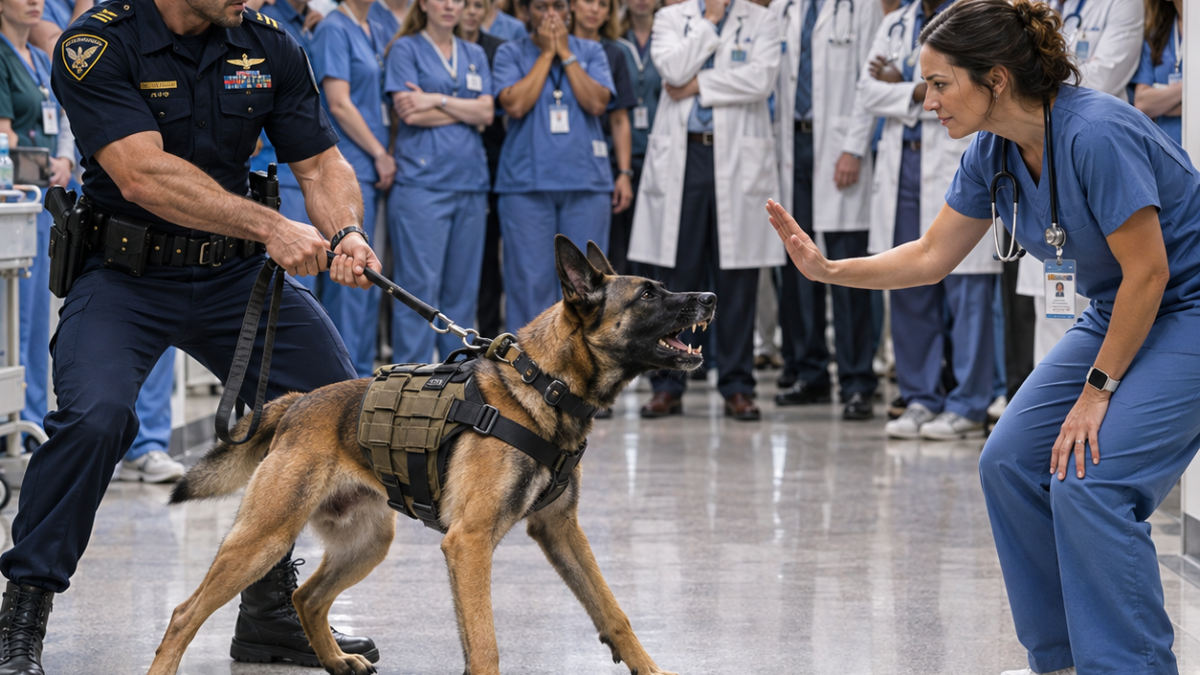
For nearly two hours, doctors, military handlers, veterinary staff, security officers, and behavioral specialists tried to control the Belgian Malinois growling in the middle of St. Catherine’s Hospital—and every attempt only made him more defensive.
Then an overlooked nurse named Evelyn Hart stopped beside the linen cart, watched Ranger for less than a minute, and quietly said, “He isn’t trying to attack anyone. He’s trying to make you notice something.”
What Ranger led them to next—a faded strip of blue fabric, a forgotten military box, and the name of a man dead for seventeen years—would force everyone in that hallway to reconsider everything they thought they knew about aggression.
At 10:26 on a rainy Monday morning, the security corridor at St. Catherine’s Regional Hospital became almost completely silent.
Hospitals are rarely silent.
Phones ring.
Wheels squeak.
People call for nurses.
Elevators open.
Monitors beep.
Families whisper outside rooms where they are terrified to speak loudly.
That morning, however, nearly everyone in one section of St. Catherine’s had stopped whatever they were doing to watch a dog.
His name was Ranger.
Seven-year-old Belgian Malinois.
Lean.
Powerful.
Dark mask.
Muscles held so tightly beneath his coat that even someone who knew nothing about dogs could see the tension running through him.
His ears were forward.
His mouth was closed.
His tail hung low.
His eyes stayed locked on a set of double doors leading toward the rehabilitation wing.
Every thirty or forty seconds, a deep growl rolled out of his chest.
Chief Petty Officer Adrian Cross stood beside him with one hand wrapped around the leash.
“Easy.”
Ranger did not move.
“Ranger.”
Nothing.
Adrian shortened the leash slightly.
The dog’s shoulders tightened.
Adrian stopped immediately.
“That’s not him.”
The military veterinarian standing nearby looked at Ranger.
“I know.”
Dr. Samuel Bennett had spent almost fifteen years around working dogs.
He had treated torn ligaments, heat injuries, broken teeth, infected paws, shrapnel wounds, and every ordinary problem that came with placing highly trained animals into extraordinary environments.
Ranger confused him.
The dog was not lunging.
PART2
He was not attempting to bite.
He was not snapping at random people.
He had not lost awareness.
He was not disoriented.
He knew exactly where Adrian stood.
He reacted to familiar commands.
He simply refused them.
And whenever somebody moved toward the rehabilitation doors, Ranger issued the same warning.
Stay away.
A physician watched from twenty feet away.
“Could he be in pain?”
Samuel shook his head.
“No obvious signs.”
“Neurological?”
“Possible, but unlikely from what I’m seeing.”
“Environmental stress?”
“Maybe.”
Another specialist had already suggested fatigue.
Another suggested overstimulation.
Another wondered whether the rain, unusual smells, polished flooring, hospital machinery, or unfamiliar crowd had pushed him past threshold.
Nothing fit.
The most frustrating part was that Ranger had entered the hospital calmly.
Adrian had walked him through the main lobby.
Children.
Wheelchairs.
People carrying coffee.
Two police officers.
A woman crying near registration.
Ranger ignored all of it.
Exactly as expected from a trained military dog.
He entered an elevator.
Calm.
Exited.
Calm.
Walked down the rehabilitation hallway.
Calm.
Then halfway down the corridor he stopped.
No warning.
No obvious trigger.
Just stopped.
Adrian had given the heel command.
Ranger refused.
Then the nearby service elevator started.
Low mechanical vibration.
Ranger’s head snapped toward it.
His body went rigid.
The first growl came seconds later.
By 8:45, Adrian had assumed Ranger was reacting to some unfamiliar hospital sound.
By 9:00, that theory looked too simple.
The elevator stopped.
Ranger remained tense.
A janitor approached.
Growl.
Nurse passed.
Growl.
Security officer moved toward the doors.
Deeper growl.
Adrian attempted to redirect.
Ranger resisted.
Not violently.
Completely.
By 9:30, hospital security cleared unnecessary traffic from the corridor.
By 9:45, military veterinary support had arrived.
By 10:00, a behavioral consultant was observing from a distance.
People later exaggerated the number.
Some said twenty.
Others said fifty.
A few hospital employees started joking that ninety-nine doctors had tried and failed.
That number became part of the story.
It was not literally ninety-nine physicians surrounding one dog.
What mattered was the feeling.
A building full of experts.
Military professionals.
Medical professionals.
Behavior specialists.
Security staff.
Everyone trying to answer one question.
How do we make Ranger stop?
At the far end of the corridor, Nurse Evelyn Hart pushed a linen cart.
Thirty-seven years old.
Eight years at St. Catherine’s.
Light blue scrubs.
Black stethoscope.
White badge.
Hair pulled back because she hated having it fall into her face during twelve-hour shifts.
Evelyn was not the nurse people remembered from dramatic moments.
She was not loud.
Did not dominate rooms.
Rarely interrupted physicians.
Did not tell stories about herself.
She was the person who noticed a patient had stopped eating before lab results changed.
The person who remembered that an elderly man became confused after sunset.
The nurse who would move a chair six inches because she had noticed a frightened child kept glancing toward the door.
Most people called that attention to detail.
Evelyn thought of it as listening without requiring words.
She turned the corner.
Saw the crowd.
Stopped.
Then saw Ranger.
The dog growled.
Adrian immediately raised one hand.
“Don’t come any farther.”
Evelyn nodded.
“I wasn’t planning to.”
That answer made Adrian look at her.
Most people who entered the situation did one of two things.
They tried to help.
Or retreated quickly.
Evelyn did neither.
She remained where she was.
Watching.
Samuel glanced toward her.
“We’re trying to determine his trigger.”
Evelyn did not take her eyes off Ranger.
“He already told you.”
The veterinarian frowned.
“What?”
She pointed.
“Watch his eyes.”
Everyone looked at Ranger.
Nothing obvious happened.
He stared toward the rehabilitation corridor.
Samuel said:
“He’s watching the doors.”
“No.”
Evelyn shook her head.
“The elevator.”
Adrian looked at the small service elevator beside the double doors.
“We checked it.”
“I know.”
“No one is inside.”
“I didn’t say someone was.”
She kept watching.
“He isn’t watching it.”
Samuel crossed his arms.
“Then what is he doing?”
“Listening.”
As if the building wanted to prove her point, the elevator motor engaged.
Soft.
Mechanical.
Barely noticeable beneath hospital noise.
Ranger’s ears snapped forward.
His breathing changed.
A growl began.
Then the motor stopped.
Ranger looked down.
Not at the doors.
At the narrow gap near the bottom.
Evelyn saw it.
“There.”
Adrian followed the dog’s gaze.
“What?”
“He checks the gap every time the sound stops.”
Samuel looked at Ranger.
“That could still be a learned stress association.”
“Maybe.”
Evelyn nodded.
“But look at his direction.”
Ranger pulled once on the leash.
Toward the elevator.
Not away.
Evelyn said:
“He isn’t trying to escape it.”
That made Adrian pause.
She continued.
“If something frightened him and he wanted distance, I’d expect him to increase distance when he had the chance.”
Samuel nodded slowly.
“Reasonable.”
“But he keeps trying to get closer.”
Adrian looked at the dog.
Ranger leaned forward again.
Nose aimed toward the base of the door.
Evelyn said:
“So stop asking why he’s afraid of the elevator.”
“What should we ask?”
“Why does he want you to open it?”
Nobody answered.
Evelyn moved toward the wall.
Not toward Ranger.
She crouched near the baseboard.
There was a faint brown smear.
Almost invisible.
A technician said:
“Probably from a cart.”
“Probably.”
Evelyn wiped it with a tissue.
Smelled it carefully.
Nothing obvious.
Old dust.
Detergent.
Maybe fabric residue.
Ranger’s nose lifted.
His focus sharpened.
Evelyn looked at him.
“I don’t know what that is.”
Then toward the elevator.
“But I think he does.”
Facilities shut the elevator down temporarily.
No one opened anything in front of Ranger.
No forced exposure.
No attempt to drag him closer.
Evelyn asked the facilities supervisor:
“What moved through this elevator this morning?”
He opened a tablet.
“Laundry.”
“When?”
“Eight forty.”
“That’s around when Ranger started reacting.”
Adrian nodded.
“Eight forty-two, maybe.”
“Anything unusual?”
“Not reported.”
“Who delivered it?”
The supervisor scrolled.
“Daniel Ruiz.”
“Where’s Daniel?”
“Rehabilitation.”
Evelyn watched Ranger.
The dog had stopped growling.
He sat facing the elevator.
Still alert.
Still waiting.
Adrian lowered his voice.
“You’ve done this before?”
“With military dogs?”
“Yes.”
“No.”
He looked surprised.
“Then why are you so sure?”
“I’m not.”
That answer seemed to bother him.
“You keep talking like you know what he wants.”
“No.”
She looked at Ranger.
“I know what everyone else keeps doing.”
“What?”
“Trying to make him stop.”
Samuel raised an eyebrow.
“And?”
Evelyn looked at the dog.
“I’m more interested in what he refuses to ignore.”
For the first time that morning, the problem changed.
Not:
How do we control Ranger?
But:
What is Ranger trying to show us?
Evelyn asked to see the laundry route.
Adrian came.
Samuel too.
Ranger remained with a second handler near the elevator.
They reached a service area.
Several rolling laundry carts stood along the wall.
White towels.
Blue hospital blankets.
Sheets.
Uniform bags.
Nothing dramatic.
Then Ranger, still visible down the hall, suddenly pulled toward them.
Adrian brought him closer.
“Easy.”
The dog approached one cart.
Sniffed the side.
Backed away.
Sniffed again.
Evelyn walked around it.
That was when she noticed something trapped beneath one wheel.
A strip of faded blue fabric.
Less than three inches long.
Frayed.
Dirty.
She pulled it free.
Ranger froze.
Not tensed.
Froze.
His eyes locked on the cloth.
Evelyn held it low.
Not directly under his nose.
Ranger stepped forward.
Sniffed once.
Everything changed.
Shoulders lowered.
Mouth opened slightly.
The growl vanished.
His ears softened.
Then Ranger looked at Adrian.
A sound escaped him.
Short.
Quiet.
Closer to a whine.
Adrian stared.
“Ranger?”
The dog sniffed again.
Same sound.
Samuel stepped closer.
“That’s not fear.”
Evelyn looked at the fabric.
“No.”
“What is it?”
“I don’t know.”
She looked at Ranger.
“But it’s recognition.”
The veterinarian took the cloth.
“It’s ordinary hospital linen.”
“Maybe.”
Evelyn pointed.
“Take it away.”
He moved the fabric toward another room.
Ranger immediately stood.
Eyes followed.
The moment the cloth disappeared behind the doorway:
Whine.
Adrian’s expression changed.
“He hasn’t done that all morning.”
Evelyn nodded.
“That matters.”
Samuel asked:
“What do you think he wants?”
“I think we’re still asking the wrong question.”
“What question?”
She looked at Ranger.
“Who does he think is here?”
The hospital reviewed the laundry route.
8:40 delivery.
Service elevator.
Rehabilitation corridor.
Several rooms.
Daniel Ruiz confirmed nothing unusual had happened.
Then Ranger began pulling toward the rehabilitation floor.
Not aggressively.
Purposefully.
Adrian looked at Evelyn.
“You think we should follow him?”
“I think we should stop assuming we know where he’s supposed to go.”
They moved slowly.
Ranger beside Adrian.
Evelyn a few steps behind.
Samuel watching.
The farther they went, the more focused Ranger became.
At room 426, he stopped.
Ears forward.
Nose lifting.
Then sat.
Samuel whispered:
“That’s the strongest reaction yet.”
Adrian looked toward Evelyn.
“Fear?”
She shook her head.
“No.”
“How do you know?”
“He wants the door open.”
Facilities checked with the patient.
Permission granted.
The door opened.
Inside was an elderly veteran.
Thin white hair.
Blanket over his legs.
Empty wheelchair beside the window.
Another faded blue blanket hung over a chair.
The veteran looked up.
“Well.”
Then smiled weakly.
“What’s the dog doing here?”
Adrian answered:
“Trying to tell us something, apparently.”
Ranger entered.
He ignored the veteran at first.
Went directly toward the blanket.
Sniffed.
Stopped.
His entire body became rigid again.
But there was no growl.
No teeth.
He lowered his head.
The veteran frowned.
“Is he all right?”
Evelyn watched Ranger.
Then looked at the man.
“Sir, have you seen this dog before?”
The veteran laughed.
“No.”
Ranger looked up.
The man’s smile faded slightly.
“Well…”
Everyone waited.
“I’ve seen dogs like him.”
“Where?”
“Afghanistan.”
Adrian’s expression sharpened.
“Military working dogs?”
“Yes.”
“Do you remember any names?”
“Not really.”
The veteran rubbed one hand over the blanket.
“Long time ago.”
Then his eyes moved toward Ranger again.
“There was a handler.”
“Name?”
The veteran closed his eyes.
“Can’t remember.”
Evelyn noticed a small framed photograph beside the bed.
She picked it up.
Several service members stood beside a military vehicle.
Dusty.
Young.
Tired.
At the far edge was a dog.
Adrian stared.
“That’s Milo.”
The veteran nodded.
“Yes.”
“Milo.”
Evelyn looked at Ranger.
“That’s not him.”
“No.”
Adrian’s voice had changed.
“Milo was Ranger’s predecessor.”
The veteran looked confused.
“Predecessor?”
“Same K9 program.”
“Some of the same training lineage.”
Then Adrian added:
“Ranger was later trained by Milo’s former handler.”
Ranger whined.
Not at the photograph.
The blanket.
Evelyn looked at the blue strip still inside the evidence bag.
Same color.
Same worn texture.
She touched the corner of the blanket.
A faded embroidered symbol.
Navy anchor.
“Where did you get this?”
The veteran looked down.
“Hospital.”
“This hospital?”
“I think.”
“When?”
He shrugged.
“Rehab gave it to me.”
“Was it new?”
“Don’t know.”
Evelyn looked at the room.
Something still did not fit.
Ranger had never met this patient.
The photograph explained a connection.
Not the reaction.
Then Adrian’s phone rang.
He answered.
Listened.
His face changed.
“What?”
He looked at Evelyn.
“Security found something in the service elevator.”
They returned immediately.
A maintenance panel had been opened behind an old storage compartment.
Inside sat a small metal box.
Scratched.
Military green under years of dust.
Faded latch.
No modern hospital inventory sticker.
Ranger saw it.
Stopped.
Then came the quietest sound anyone had heard from him all morning.
Not growl.
Not bark.
A low mournful whine.
Adrian knelt.
Opened the box.
Old photographs.
Military patch.
A dog tag.
Folded document.
And one letter.
He picked it up.
Paper yellowed.
Handwriting faded.
Adrian unfolded it.
The first line made him stop.
Evelyn noticed.
“What?”
He read it again.
Then aloud.
“If Ranger ever becomes frightened by a hospital corridor, don’t force him forward.”
Samuel stared.
“What?”
Adrian kept reading.
The letter explained that Ranger had been trained within a K9 program carrying forward certain scent-recognition and environmental-conditioning exercises connected to earlier dogs.
One name appeared repeatedly.
Milo.
Then another.
Captain Elias Mercer.
Adrian went quiet.
Evelyn asked:
“Who was Elias Mercer?”
“My commanding officer.”
Samuel said:
“You knew him?”
“Yes.”
Adrian swallowed.
“He died during a medical evacuation.”
Silence.
Ranger looked toward the corridor.
Adrian continued reading.
The final line was shorter.
“He does not fear hospitals. He remembers the man who never returned from one.”
Evelyn felt something tighten in her chest.
Everything they had watched for two hours rearranged itself.
The elevator.
Laundry fabric.
Mechanical vibration.
Blue blanket.
The corridor.
The waiting.
The growling.
The refusal to move.
Ranger had not been trying to attack the hospital.
He had been trying to complete something.
A pattern.
A memory.
A search.
Samuel looked skeptical.
“Ranger wasn’t alive seventeen years ago.”
Adrian nodded.
“He was a puppy much later.”
“Then he cannot literally remember Mercer’s evacuation.”
“No.”
Evelyn agreed.
“But memory doesn’t have to mean a conscious event.”
The veterinarian looked at her.
She continued.
“He may have learned a chain of associations through training.”
“Sound.”
“Scent.”
“Behavior.”
“Specific materials.”
“Handler cues.”
Adrian looked at the letter.
“Milo was there.”
“Yes.”
“And later Milo’s handler trained Ranger.”
“Possibly using the same objects.”
The military program had been small.
Equipment reused.
Blankets.
Training boxes.
Scent items.
Environmental drills.
Patterns passed from dog to dog through handlers who repeated the same exercises.
Ranger did not remember a man he had personally lost.
He remembered the shape of an unfinished search he had been taught to perform.
To Ranger, the distinction did not matter.
The signals were real.
The building was giving him the same instruction repeatedly.
Find him.
And nobody knew who “him” was anymore.
Evelyn looked at Ranger.
“He isn’t aggressive.”
Samuel nodded slowly.
“He’s frustrated.”
“And confused.”
“Maybe.”
Adrian crouched beside the dog.
“What are you trying to show me, buddy?”
Ranger turned.
Walked several steps down the rehabilitation corridor.
Stopped.
Looked back.
Once.
Twice.
Evelyn smiled faintly.
“I think he wants us to follow.”
For the first time that morning, nobody tried to stop him.
Adrian loosened the leash.
“Lead.”
Ranger moved.
Past room 431.
Nurse’s station.
Empty wheelchair.
Service hallway.
At the far end stood old double doors leading into a rarely used section of rehabilitation.
Ranger stopped.
Nose at the seam.
Whine.
Adrian looked at Evelyn.
“This?”
She nodded.
“Open it.”
The doors revealed a dim room used mostly for storage.
Old cabinets.
Desk.
Retired medical equipment.
Stacked chairs.
One photograph on the wall.
Ranger walked straight toward it.
Stopped.
Everyone looked up.
A young military officer stood beside an older working dog.
Another service member on the other side.
Adrian whispered:
“Elias.”
Captain Elias Mercer.
Young.
Alive.
Smiling.
Milo beside him.
Evelyn looked at Ranger.
“He’s never seen this room?”
“Not that I know.”
Samuel opened one cabinet.
Blue blankets.
Old.
Faded.
Hospital insignia.
Another label.
TRANSFERRED FROM MILITARY REHABILITATION UNIT.
Adrian checked the date.
His hand stopped.
“Seventeen years.”
The same year Elias died.
Nobody said anything.
Ranger approached the lowest shelf.
Sniffed.
Sat.
Not barking.
Not pulling.
Not threatening.
Sitting.
Adrian knelt.
“Is this what you wanted?”
Ranger looked at him.
Calm.
Then the ventilation system came on.
Low mechanical hum.
Ranger’s right ear moved.
His body tightened slightly.
Evelyn noticed.
“Wait.”
She looked upward.
“The sound.”
Adrian followed.
“What?”
“The elevator wasn’t the only trigger.”
Samuel listened.
The ventilation motor had a low cyclical rumble.
Very similar to the service elevator.
Evelyn said:
“What did medical evacuation vehicles sound like?”
Adrian stared.
Then looked at Ranger.
“Low engine vibration.”
“Hydraulic equipment.”
“Ventilation.”
Samuel nodded.
“Combine that with the linen scent.”
Evelyn finished:
“And the hospital corridor.”
Adrian finally understood.
“He thought the sequence was happening again.”
Not consciously.
Not like a human remembering a movie.
But the dog’s body had learned a pattern.
Mechanical vibration.
Blue medical fabric.
Hospital environment.
Search.
Find the missing person.
The problem was:
The missing person had been dead for seventeen years.
Ranger could never complete the task.
So every time someone tried to drag him away, the urgency increased.
He wasn’t refusing because he wanted dominance.
He was refusing because he believed the job was unfinished.
Evelyn looked at the dog.
“That’s why every command made him worse.”
Adrian nodded.
“We were telling him to abandon the search.”
Samuel said:
“And he was trained not to.”
There it was.
The irony.
What everyone had interpreted as failed obedience was partly the result of obedience embedded too deeply.
Ranger had learned:
Do not leave until the person is found.
Adrian sat on the floor beside him.
“Mercer isn’t here, buddy.”
Ranger watched him.
Adrian touched the old photograph.
“He’s not here.”
The dog’s head lowered.
No one pretended Ranger understood the sentence.
But he understood Adrian.
Tone.
Body.
The absence of urgency.
Evelyn asked facilities to turn off the ventilation motor temporarily.
The low hum stopped.
The room became quiet.
No mechanical cue.
No movement.
No forced commands.
Ranger looked around.
Then stood.
Walked away from the cabinet.
Toward Adrian.
Stopped.
Then unexpectedly crossed the room toward Evelyn.
She remained still.
He reached her.
Sniffed her hand.
Then lowered his head beside her knee.
Adrian looked stunned.
“He doesn’t do that.”
Evelyn smiled.
“I didn’t do anything.”
“You listened.”
“Maybe.”
She looked at Ranger.
“Or maybe everyone finally stopped shouting over him.”
Later that afternoon, Adrian sat in the hospital courtyard.
The rain had stopped.
Pavement still wet.
Ranger lay beside his boots.
No rigid muscles.
No growling.
No constant scanning.
Samuel sat on another bench.
Evelyn had coffee.
Bad coffee.
Hospital coffee.
Adrian looked down at Ranger.
“I’ve worked with K9s twenty years.”
Evelyn smiled.
“And?”
“And apparently I can still be an idiot.”
Samuel laughed.
“Professional humility. Historic moment.”
Adrian ignored him.
He looked at Evelyn.
“He taught me something.”
“What?”
“I kept thinking obedience meant understanding.”
She nodded.
“Different things.”
“A dog can obey every command you give him and still be experiencing something you haven’t noticed.”
“People too.”
Adrian looked at her.
She shrugged.
“Occupational hazard.”
A patient refuses a room.
Everyone calls him difficult.
Maybe his wife died there.
A woman becomes angry during discharge.
Everyone says she is unreasonable.
Maybe home is the place where her husband abused her.
A veteran avoids elevators.
Everybody tells him they are safe.
Maybe his body learned something his conscious mind would rather forget.
Behavior says something.
Not always what we think.
Ranger had spent two hours saying:
Something happened here.
Nobody understood because everyone focused on the volume of the message.
The growl.
The refusal.
The tension.
Evelyn had looked at direction.
Where was he looking?
When did he react?
Was he moving toward the trigger or away?
What changed?
Small questions.
They changed everything.
Hospital administration later contacted military records.
The broad history in the old box checked out.
Captain Elias Mercer had undergone emergency medical evacuation seventeen years earlier.
He later died from complications.
Milo had been involved in the original working-dog unit.
Some equipment from the military rehabilitation program had eventually been transferred to St. Catherine’s when an old joint treatment unit closed.
Blue blankets.
Training material.
Storage containers.
Records.
Nobody had intentionally created Ranger’s reaction.
That mattered.
No hidden experiment.
No saboteur.
No cruel handler.
No dramatic villain.
Just old material.
Old sounds.
Old training.
A coincidence powerful enough to awaken a learned response nobody realized the dog still carried.
That frightened Adrian more than a villain would have.
Because villains are easy.
You remove them.
Memory is different.
You cannot handcuff memory.
You have to understand what activates it.
The K9 team changed Ranger’s handling plan.
No forced exposure.
Controlled reintroduction.
Reward calm behavior.
Allow observation.
Break the old cue chain.
Hospital corridor without the blue blanket.
Mechanical sound in a neutral environment.
Blue fabric without the sound.
Service elevator at distance.
Choice.
Time.
New associations.
The first controlled session lasted less than five minutes.
Ranger approached the corridor.
Paused.
Adrian waited.
No heel command.
No pressure.
Ranger looked at him.
Adrian said:
“Good.”
The dog moved forward.
That was enough.
The next session:
Slightly farther.
Then another.
Weeks.
Small progress.
One day Ranger walked past the service elevator while it operated.
His ear moved.
Head turned.
Then he looked at Adrian.
Adrian smiled.
“Not today.”
Ranger continued walking.
That moment affected Adrian more than the dramatic morning had.
Because now the dog had a different option.
Signal appears.
But the old job does not begin.
Nothing terrible follows.
The world can change.
So can learned responses.
St. Catherine’s revised its procedure for working animals entering rehabilitation.
The new guideline was simple.
WATCH FIRST. INTERPRET SECOND.
It appeared near the service entrance.
Not:
Never approach a growling dog.
Obviously staff still respected safety.
Not:
Every reactive animal has a tragic story.
Sometimes aggression is aggression.
Pain matters.
Illness matters.
Training matters.
Management matters.
The point was not romanticizing dangerous behavior.
The point was observation before assumption.
What happened immediately before the behavior?
What direction is the animal oriented?
What changes when the environment changes?
Is the animal trying to escape?
Approach?
Protect?
Search?
Avoid?
Those questions became routine.
Evelyn hated that people credited her.
Adrian once introduced her to another handler as:
“The nurse who solved Ranger.”
She corrected him immediately.
“I didn’t solve him.”
The handler laughed.
“What would you call it?”
“I noticed where he was looking.”
Adrian said:
“That’s annoyingly modest.”
Evelyn shrugged.
“The dog did most of the work.”
Months later, Ranger returned to St. Catherine’s for an unrelated follow-up.
Adrian was nervous.
He didn’t admit it.
Nobody believed him.
They entered the rehabilitation corridor.
Same walls.
Same elevator.
Same doors.
Ranger walked beside him.
The elevator engaged.
Low mechanical hum.
His ear moved.
Nothing else.
He passed.
No growl.
No hesitation.
Continued toward the courtyard.
Evelyn happened to be there.
She was sitting on a bench during break, drinking coffee and looking at her phone.
Ranger saw her first.
Ears lifted.
His pace changed.
Adrian laughed.
“Traitor.”
Ranger walked toward Evelyn.
She looked up.
“Well, hello.”
He sat.
Then placed his head against her thigh.
Evelyn scratched behind one ear.
Adrian shook his head.
“You’ve got a fan.”
“I think he likes people who don’t make him do things.”
“That is definitely why he ignores me.”
Ranger closed his eyes.
The dog who had once frightened an entire hospital now looked completely ordinary.
Old military dog.
Wet pavement.
Quiet afternoon.
Nurse’s hand behind his ear.
But everyone who knew the story understood that his calm was not defeat.
Not exhaustion.
Not obedience forced hard enough that resistance disappeared.
It was peace.
The environment no longer demanded the old response.
That became the part Evelyn remembered most.
Not the growling.
Not the crowd.
Not people whispering that Ranger had “gone aggressive.”
The moment his body stopped bracing against something no one else could see.
People often mistake calm for obedience.
They are not identical.
A frightened animal can freeze.
A terrified person can comply.
A patient can become silent because they have given up explaining.
That is why Evelyn watched before she assumed.
The lesson followed her outside canine cases.
A twelve-year-old boy who refused a scan because the machine sounded like the one used during his father’s final hospitalization.
An elderly woman who became combative every evening because dementia made sunset feel like being abandoned.
A veteran who kept demanding that nurses leave the door open.
Everyone initially described behavior.
Evelyn asked:
“What happened to you?”
Sometimes nobody knew.
Sometimes the answer changed care.
Ranger had taught the hospital that the same principle applied beyond dogs.
Behavior is communication.
Not always clear communication.
Not always safe communication.
Still communication.
Years passed.
The story became hospital folklore.
Like most folklore, details grew.
Seven handlers became twenty.
Twenty became fifty.
Eventually someone claimed ninety-nine doctors had surrounded Ranger while Evelyn walked through them like some magical dog whisperer.
Evelyn hated that version.
“No.”
She would say.
“It wasn’t ninety-nine doctors.”
People laughed.
“And I didn’t magically calm him.”
“What happened, then?”
“He kept showing us the same thing.”
“And?”
“We finally paid attention.”
The real story was better because nobody needed magic.
Adrian was not incompetent.
Samuel was not foolish.
Security did the right thing by creating distance.
The specialists were reasonable to consider pain, stress, unfamiliar environment, and medical causes.
They simply began with the assumption that Ranger’s reaction was the problem to be removed.
Evelyn began with curiosity.
That was the difference.
One question:
What is he trying to tell us?
A year after the incident, Ranger was starting to slow.
Still working.
But not forever.
Gray along the muzzle.
Longer recovery after exercise.
Adrian noticed first.
Handlers always do.
Retirement discussions began.
There was never a question where Ranger would go.
Home with Adrian.
Someone asked whether Ranger would struggle without work.
Adrian said:
“Probably.”
Evelyn replied:
“So give him a new job.”
“What job?”
“Make sure you get off the couch occasionally.”
Adrian laughed.
Ranger retired the following year.
Small ceremony.
Nothing dramatic.
He hated the applause.
Loved the food.
Evelyn attended.
Ranger saw her.
Ignored three senior officers.
Walked directly toward her.
Adrian said:
“You see what you created?”
“I created nothing.”
“You permanently damaged military discipline.”
Ranger leaned against her leg.
Evelyn smiled.
“He looks devastated.”
The old dog lived with Adrian after that.
Morning walks.
Backyard.
Favorite rug.
Ridiculous orthopedic bed he often ignored.
He liked sleeping beside Adrian’s boots.
Some habits never left.
The service-elevator reaction never returned.
Not because the memory had been erased.
Because it had been given a different ending.
That distinction mattered to Evelyn.
People often think healing means forgetting.
It rarely does.
Healing can mean the old signal appears and your body learns:
This time is different.
The sound happens.
No disaster.
The hallway appears.
No one disappears.
The scent exists.
The search does not begin.
Again.
Again.
Again.
Until the nervous system stops preparing for the past every time the present rhymes with it.
Ranger did not forget.
He learned.
One autumn afternoon, Adrian brought him back to St. Catherine’s.
No appointment.
They were nearby.
Ranger was older now.
Movement slower.
Evelyn met them in the courtyard.
She crouched.
“Look at you.”
Ranger placed his head against her hand.
Adrian sat beside them.
For a while, nobody spoke.
Then he said:
“I found Mercer’s full report.”
Evelyn looked over.
“What did it say?”
“Not much more than we knew.”
He rubbed Ranger’s neck.
“But there was one detail.”
“What?”
“Milo stayed beside the medical vehicle almost six hours.”
Evelyn looked at Ranger.
“Waiting?”
“Yeah.”
Adrian swallowed.
“When they finally took Mercer away, Milo refused to leave the loading area.”
Evelyn understood.
The behavior had not begun with Ranger.
It had been shaped around an earlier dog’s attachment.
Humans had converted pieces of that behavior into training.
Follow scent.
Search the medical environment.
Hold location.
Do not abandon target.
Years later, Ranger encountered the same cues.
His training did exactly what it had taught him to do.
Adrian said:
“Maybe we created that morning without realizing it.”
Evelyn shook her head.
“You created a working dog.”
“That feels like an excuse.”
“No.”
She looked at Ranger.
“It means responsibility.”
“What’s the difference?”
“An excuse says, ‘Not our fault.’”
She scratched behind Ranger’s ear.
“Responsibility says, ‘Now that we know, we do better.’”
Adrian smiled.
“That sounds like something nurses put on mugs.”
“Don’t insult me.”
Ranger closed his eyes.
The courtyard was quiet.
No alarms.
No growls.
No crowd.
That was how Evelyn preferred the ending.
Not the dramatic corridor.
Not the ninety-nine-doctors version.
An old dog beside his handler.
Calm.
Understood.
Months later, one of the nurses placed a photograph near the rehabilitation service entrance.
Ranger sitting between Adrian and Evelyn.
His gray muzzle obvious.
Evelyn smiling reluctantly.
Adrian looking proud.
Underneath were four words.
WATCH FIRST. INTERPRET SECOND.
Somebody later added a smaller card.
He wasn’t asking to be controlled.
He was asking to be understood.
Evelyn thought it was too sentimental.
She never removed it.
Patients walked past.
Staff walked past.
Most never knew why it was there.
But occasionally a new nurse would ask.
Someone would tell the story.
They might exaggerate.
“Ninety-nine doctors couldn’t control him.”
Evelyn would overhear.
Roll her eyes.
But the important part survived the exaggeration.
A military K9 stopped in a hospital corridor.
Growled.
Refused every command.
Everyone saw aggression.
One overlooked nurse noticed he kept reacting to the same elevator.
The same sound.
The same scent.
The same direction.
She followed the details.
And behind those details was not a vicious dog.
Not a broken dog.
Not an uncontrollable dog.
There was a working animal trapped inside a task that no longer had a possible ending.
Searching for a man who had been gone for seventeen years.
Responding to a memory he had never understood as memory.
Trying to finish something humans had unknowingly taught him never to abandon.
Ranger had spent hours shouting with his body.
Growl.
Refusal.
Rigid posture.
Fixed stare.
Nobody understood the message because everybody kept focusing on the shouting.
Evelyn listened for what was underneath.
That was why Ranger eventually approached her.
Not because she dominated him.
Not because she knew a secret command.
Not because she was stronger than the handlers, veterinarians, security officers, or doctors around her.
She simply never asked him to stop feeling what he was feeling before she understood why he felt it.
And sometimes that is the difference between control and care.
Years later, Adrian would still tell people about that morning.
He always ended the story the same way.
“Everyone in that hallway was trying to make Ranger do something.”
Then he would smile.
“Evelyn was the first person who asked why he couldn’t.”
That question changed everything.
Because Ranger had never needed ninety-nine experts.
He needed one person quiet enough to notice where he kept looking.
One person patient enough to follow him instead of forcing him forward.
One person willing to believe that what looked like aggression might be fear, memory, grief, or unfinished duty.
And once Ranger realized someone was finally listening, he no longer needed to growl loud enough for the whole hospital to hear him.