PART 2: HOA Karen’s Spoiled Son Ordered Me Out of My Own Pool—Then I Showed His Mother the Sheriff’s Badge She Never Saw Coming
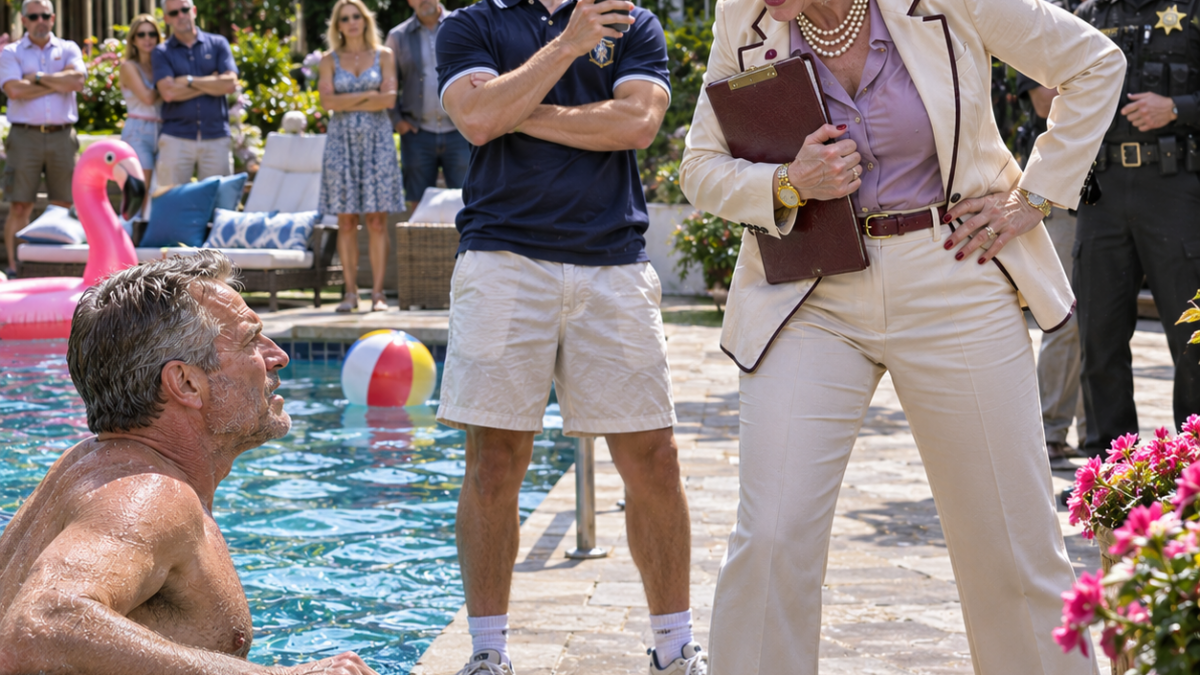
A seventeen-year-old kid walked into my backyard, stood beside my private swimming pool, and ordered me to get out because his mother “ran the neighborhood.”
Five minutes later, that mother was standing on my patio threatening me with thousands of dollars in HOA fines, legal action, and even removal from the community—all while her son recorded the confrontation like he was about to become famous.
They both thought that Saturday afternoon would end with me humiliated in front of my neighbors, but they had no idea what I had been quietly collecting for six months.
My name is Michael Reeves.
I was fifty-two years old when I moved into Willowbrook Estates.
On paper, it looked like exactly what I needed.
Quiet streets.
Mature trees.
Decent homes.
A small community center.
Families walking dogs in the evening.
The kind of neighborhood where people waved when you drove past and children left bicycles in driveways without anyone worrying too much.
After years of living around unpredictable schedules and difficult situations, I wanted boring.
Boring sounded wonderful.
There was one thing I deliberately didn’t tell anybody when I moved in.
My exact profession.
Whenever neighbors asked what I did, I said I worked in public service for the county.
That was true.
Technically.
But I had learned years earlier that people behave differently when they know exactly what kind of authority you’re carrying.
Some get nervous.
Some become overly polite.
Some suddenly remember every traffic ticket they ever got.
I didn’t want any of that.
I wanted to meet people as Michael Reeves.
Not as a title.
That decision gave me a front-row seat to the real Willowbrook Estates.
I met Karen Mitchell on my third day.
She arrived carrying a basket of muffins in one hand and a forty-seven-page HOA welcome packet in the other.
Blonde highlights.
Expensive workout clothes.
Perfect smile.
Clipboard tucked beneath her arm.
“Welcome to Willowbrook,” she said.
“Thanks.”
“I’m Karen Mitchell, HOA president.”
There was something about the way she said *president* that made it sound less like a volunteer position and more like a hereditary title.
She handed me the muffins.
Then immediately said:
“I noticed your moving truck blocked the Henderson driveway yesterday.”
“For about fifteen minutes.”
“Twenty-three.”
I stared at her.
She smiled.
“We have very strict parking regulations. I’d hate for you to receive your first citation before you’ve even finished unpacking.”
There it was.
Not welcome.
Warning.
I thanked her anyway.
Karen left.
The muffins weren’t bad.
The personality needed work.
I met her son Brandon the following week.
Seventeen years old.
Brand-new BMW.
Two-hundred-dollar sneakers.
The confidence of somebody who had never experienced a consequence he couldn’t talk his way out of.
At two in the morning on a Tuesday, music from his house was shaking my bedroom windows.
I walked over.
Knocked.
Brandon opened the door.
“Hey.”
“Michael from down the street.”
“I know.”
“The music’s carrying.”
He looked past me.
“So?”
“It’s two in the morning.”
“It’s not that late.”
“It is literally two in the morning.”
He laughed.
“My mom’s the HOA president.”
I waited.
He added:
“We can basically do whatever we want.”
That sentence explained the next six months.
Karen fined a seventy-two-year-old widow named Mrs. Patterson because garden gnomes she’d owned for fifteen years suddenly violated “aesthetic harmony.”
A young couple named Tom and Sarah Johnson received a five-hundred-dollar fine because their ten-year-old Honda sat three inches outside a designated parking line.
Marcus Webb was ordered to repaint his fence after vandals spray-painted it.
Brandon regularly parked across two spaces.
Nothing happened.
He held parties until dawn.
Nothing happened.
He borrowed Mr. Chen’s lawn mower without permission, broke it, denied it, then somehow the Chens were the ones cited for having an “improperly maintained lawn.”
I began noticing something else.
People changed when Karen appeared.
Conversations stopped.
Neighbors looked away.
Nobody argued.
They weren’t respecting her.
They were afraid of becoming her next project.
Karen tried me too.
Grass warnings.
Truck complaints.
“Surprise inspections.”
Letters claiming my work vehicle looked “commercial.”
I followed legitimate rules.
I ignored invented ones.
And I documented everything.
For six months.
Photos.
Dates.
Emails.
Security footage.
Statements from neighbors who would speak privately but were too afraid to challenge Karen publicly.
I didn’t know exactly what I was going to do with it yet.
Then came that Saturday.
I was floating in my own swimming pool after one of the hardest weeks I’d had since moving to Willowbrook.
Cold drink beside me.
Sun overhead.
Ranger-blue sky.
No phone calls.
No meetings.
No Karen.
Perfect.
Then I heard expensive sneakers scrape against concrete.
“Hey, old man.”
I opened one eye.
Brandon Mitchell stood beside my pool with his arms crossed.
“This is HOA property,” he announced.
I sat up slightly.
“Excuse me?”
“My mom runs this neighborhood.”
He pointed toward the water.
“So get out.”
I stared at him.
Then at my house.
Then at my pool.
Then back at him.
And for the first time in six months, I realized staying quiet had finally become more dangerous than speaking.
PART 2
I floated there for another few seconds because my brain needed time to decide whether Brandon was joking.
His expression told me he wasn’t.
I paddled toward the pool edge.
“This is your opening position?”
“What?”
“You walk into a man’s backyard and order him out of his own swimming pool?”
He rolled his eyes.
“It’s not your pool.”
I laughed.
Not a polite laugh.
A real one.
Brandon’s face changed.
People who grow up around fear are rarely prepared for laughter.
“What’s funny?”
“You.”
His cheeks reddened.
“I’m serious.”
“That’s what makes it funny.”
He pulled out his phone.
“You think this is a joke?”
“I think you’re trespassing.”
“No, I’m not.”
“You entered through my side gate.”
“This whole section is HOA recreational property.”
“No.”
“My mom showed me the map.”
“Your mom is wrong.”
He smirked.
“My mom is never wrong about HOA stuff.”
That told me more about his childhood than any confession could have.
I climbed out of the pool.
Brandon raised his phone and started recording.
I wrapped a towel around my shoulders.
“I’m going to ask you once.”
He held the camera closer.
“Leave my property.”
“You can’t order me around.”
“I just did.”
“You know who my family is?”
“Yes.”
He looked surprised.
“Then you know my mom can make your life hell.”
“That supposed to frighten me?”
The smirk disappeared.
That was when I saw something I had noticed with Brandon before.
His confidence wasn’t really confidence.
It was borrowed authority.
He had spent seventeen years watching everyone retreat whenever his mother arrived.
He believed that reaction belonged to him too.
It didn’t.
He stabbed at his phone.
“You’re done.”
“What does that mean?”
“My mom’s coming.”
“I’ll alert the media.”
He didn’t appreciate that.
Karen arrived less than five minutes later.
She didn’t use the front door.
She marched straight through my side gate.
That alone told me how far the Mitchell family had drifted from reality.
Karen wore oversized sunglasses and athletic clothes that probably cost more than the patio furniture.
“What is going on?”
She directed the question at me.
Not Brandon.
“Your son entered my property and ordered me out of my pool.”
Brandon immediately said:
“I was checking community property.”
Karen turned toward him.
“Did he threaten you?”
“No.”
Then he reconsidered.
“Well, kind of.”
I stared.
Karen faced me.
“My son says you became aggressive.”
“I asked him to leave.”
“You raised your voice.”
“I didn’t.”
Brandon was still recording.
Good.
Karen pulled out her phone.
“According to HOA property records, your rear recreational area sits within designated common-use boundaries.”
I actually stepped closer because I wanted to see what nonsense she was relying on.
She displayed a digital map.
The boundary lines were completely wrong.
Lot numbers didn’t align.
The pool area had been colored green and labeled:
**COMMUNITY RECREATION EASEMENT.**
I stared.
“This isn’t a county map.”
“It’s the HOA map.”
“Exactly.”
Her face tightened.
“It is an official association record.”
“Karen, I have a deed.”
“So does everybody.”
“A survey.”
“The HOA has updated records.”
“From where?”
She lowered the phone.
“You don’t get to interrogate me.”
“I’m asking who created the map you’re using to claim ownership over my property.”
She pointed at the pool.
“The HOA has managed this section for years.”
“No.”
“You only moved in six months ago.”
“And the deed existed before I did.”
Brandon said:
“Dude, just get out.”
I looked at him.
“Of my own yard?”
“Yes.”
That almost made me laugh again.
Karen’s voice became sharper.
“Michael, you have demonstrated a pattern of hostility since moving here.”
“Such as?”
“Refusing inspections.”
“Unannounced entry requests.”
“Arguing about your truck.”
“Which is legally parked.”
“Rejecting community standards.”
“Which ones?”
She ignored the question.
“Now you’ve threatened a minor.”
“Your son trespassed.”
“He was carrying out an HOA function.”
“Your seventeen-year-old son is not an HOA enforcement officer.”
“He is a resident.”
“So am I.”
“He has rights.”
“So do I.”
That sentence seemed to offend her.
Neighbors had begun watching.
Mrs. Patterson stood on her porch.
Tom Johnson was visible near his garage.
Curtains moved.
Nobody approached.
That bothered me.
Not because I needed help.
Because it showed how completely Karen had trained them.
Karen noticed the audience too.
Her posture changed.
Shoulders back.
Voice louder.
Performance mode.
“Your behavior will have serious consequences.”
“Such as?”
“Fines.”
“For using my pool?”
“Unauthorized use of community property.”
I stared at her.
She continued.
“Harassment of an HOA family member.”
“He came into my yard.”
“Failure to comply with HOA directives.”
“What directive?”
“I am giving you one now.”
She pointed toward my house.
“You will cease using this pool until the board reviews its common-property status.”
I smiled.
Karen stopped.
“What?”
“Nothing.”
“Why are you smiling?”
“Because you just said that on camera.”
Brandon lowered his phone slightly.
Karen frowned.
“So?”
I gestured toward him.
“Keep recording.”
Brandon looked at his mother.
She said:
“Absolutely. We need documentation.”
“Perfect.”
I walked to my patio table.
My phone sat inside a waterproof case.
Recording.
It had been recording since Brandon entered the yard.
Karen didn’t know that.
Neither did Brandon.
I wasn’t hiding it.
They simply hadn’t looked.
I picked up the phone.
“Karen, I’m going to give both of you one final opportunity.”
She crossed her arms.
“Take your son and leave.”
She laughed.
“Or what?”
“I’ll handle it properly.”
“Call the police.”
The words came out with pure contempt.
“Please do.”
She stepped closer.
“I would love to explain how you’re illegally occupying HOA land and threatening leadership.”
I looked at her.
For a moment, I almost told her.
Almost.
But then I thought about Mrs. Patterson watching from across the street.
Tom Johnson.
The Chens.
Marcus.
All the people who had been frightened into silence.
Not yet.
“Monday night,” Karen said.
“What?”
“I’m calling an emergency board meeting.”
She lifted her chin.
“Your conduct will be addressed formally.”
“Okay.”
“That isn’t something you should be casual about.”
“I’ll be there.”
She seemed irritated that I wasn’t frightened.
“I’ll also be recommending substantial fines.”
“How substantial?”
“Thousands.”
“Anything else?”
“If you continue refusing to comply, legal proceedings to remove you from Willowbrook may become necessary.”
“For swimming?”
“For your pattern of misconduct.”
I nodded.
“Put that in writing.”
“I will.”
“Excellent.”
Brandon laughed.
“You’re seriously stupid.”
I looked at him.
“Maybe.”
Karen turned to leave.
At the gate she stopped.
“Oh, and Michael?”
“Yes?”
“That truck you keep in the driveway.”
“My county truck?”
She didn’t notice the word *county*.
Or she did and misunderstood it.
“Commercial vehicles are prohibited. I’m having it towed tomorrow.”
“Are you?”
“Yes.”
“You might want to reconsider.”
“I don’t take legal advice from residents.”
“Good thing I’m not giving you any.”
She left.
Brandon followed.
As he walked through the gate, he looked back.
“This is going viral.”
I smiled.
“I hope so.”
They disappeared.
My neighbors did too.
Doors closed.
Curtains settled.
The street became quiet again.
I stood alone on the patio.
Then looked at my phone.
Still recording.
“Consequences,” I whispered.
Karen loved that word.
She was about to learn it belonged to everybody.
—
That evening, someone knocked on my door.
Mrs. Patterson stood outside.
She held a casserole dish.
“I hope I’m not bothering you.”
“You’re rescuing me from cooking.”
She smiled weakly.
Then looked toward Karen’s house.
“May I come in?”
I stepped aside.
Her name was Evelyn Patterson.
Seventy-two years old.
Widowed five years.
She and her husband had purchased their Willowbrook home three decades earlier.
She sat at my kitchen table.
For the first ten minutes, we talked about nothing important.
Weather.
Pool maintenance.
The casserole.
I could tell she was trying to decide whether she trusted me.
Finally she said:
“I saw what happened.”
“I figured.”
“Karen won’t forget it.”
“I’m counting on that.”
Evelyn looked alarmed.
“You don’t understand.”
“I think I do.”
“No.”
Her voice lowered.
“She doesn’t just fine people.”
I waited.
“She punishes them.”
“What happened to you?”
Her eyes filled almost immediately.
That answered the question.
She told me about the garden gnomes.
I knew that part.
I did not know about the rest.
Her mailbox had allegedly been the wrong shade of black.
Fine.
Her doormat was two inches wider than new guidelines allowed.
Fine.
Her porch light supposedly exceeded “acceptable brightness.”
Fine.
She left a trash bin visible after returning late from a doctor’s appointment.
Fine.
Then Evelyn challenged one citation.
Karen increased it.
When Evelyn requested a hearing, inspection notices began arriving.
Weekly.
Sometimes twice weekly.
Her fines eventually exceeded three thousand dollars.
“I’m on Social Security,” she whispered.
“Did you pay them?”
“Most.”
“How?”
She looked down.
“I delayed some prescriptions.”
I stopped breathing for a second.
“What?”
“They’re expensive.”
“Evelyn.”
“I know.”
“No.”
I leaned forward.
“You skipped medication to pay HOA fines?”
“I didn’t want them to lien the house.”
The cold anger returned.
Not explosive.
Focused.
My career had taught me something important.
Anger that moves too fast makes mistakes.
Anger forced to sit still becomes strategy.
“What medications?”
She told me.
Nothing minor.
“Do your children know?”
“No.”
“Why?”
“They’d make me move.”
She began crying.
“My husband and I raised them here.”
She wiped her face.
“I shouldn’t have to leave because Karen Mitchell doesn’t like garden gnomes.”
“No.”
I pushed a box of tissues toward her.
“You shouldn’t.”
“What can I do?”
For the first time, I almost told her who I was.
Instead, I asked:
“Would you be willing to document everything?”
Fear returned immediately.
“If Karen found out—”
“She won’t.”
“She always finds out.”
“Evelyn.”
I looked directly at her.
“I won’t let her hurt you.”
She gave me a sad smile.
“How can you guarantee that?”
“Because I’m going to make sure everything is done correctly.”
That wasn’t enough for her.
Not yet.
But she left me copies.
Notices.
Fine schedules.
Emails.
Bank records showing payments.
That night, I read every page.
The pattern was worse than I expected.
Some charges didn’t match the written bylaws.
Late fees changed without explanation.
Several payments had been made by check but didn’t appear on the HOA annual statements Evelyn had received.
I marked those.
Then my doorbell rang again the next morning.
Tom Johnson.
He kept looking toward the street.
“I heard Karen’s going after you.”
“She can try.”
Tom didn’t laugh.
“You need to be careful.”
“I am.”
“No, man.”
He lowered his voice.
“Seriously.”
He told me about their Honda.
Three inches outside a parking line.
Five hundred dollars.
Then something worse.
When he challenged the fine, their car was keyed.
Three separate times.
“No cameras?”
“Not then.”
“Police report?”
Tom looked embarrassed.
“Sarah wanted to.”
“But?”
“Karen said if we created ‘negative police activity’ tied to the neighborhood she’d inspect our property and report every violation.”
“You believed her?”
“You weren’t here yet.”
That sentence hurt.
He continued.
“She knows we have a baby.”
“Meaning?”
“She knows we can’t afford lawyers.”
There it was.
Karen didn’t dominate because she was powerful.
She selected people for whom fighting back was expensive.
Time.
Money.
Stress.
Fear.
She weaponized exhaustion.
“Anything else?”
Tom hesitated.
“I think Brandon keyed the car.”
“Evidence?”
“None.”
“Then we don’t say he did.”
Tom stared.
“You don’t think so?”
“I think evidence matters more than guesses.”
He nodded slowly.
“Why are you taking this so seriously?”
I almost smiled.
“Habit.”
—
Over the next several days, people came to me.
Quietly.
Individually.
Never in groups.
Mr. and Mrs. Chen showed me receipts for a lawn mower Brandon had borrowed and returned broken.
When they confronted him, Karen cited their lawn.
Marcus Webb showed me photographs of his fence covered in spray paint.
Karen fined him within twenty-four hours.
The Rodriguezes told me their teenage daughter had rejected Brandon at school.
Three nights later, their house was egged.
Their security camera captured a BMW matching Brandon’s.
Not enough by itself.
But another piece.
Another pattern.
I made copies of everything.
I told everyone the same thing:
“Facts only.”
No rumors.
No exaggeration.
No “everybody knows.”
Dates.
Photographs.
Original documents.
Witnesses.
That was how cases survived.
Meanwhile, Brandon became bolder.
Monday evening, I found him with three friends behind my fence.
“What are you doing?”
“Checking community property.”
“Leave.”
“Relax.”
“Now.”
They laughed.
But they left.
Tuesday, Brandon drove past my house over and over.
Engine revving.
Horn blasting.
Security cameras counted eleven passes in less than ninety minutes.
I called him once.
2:47 p.m.
“Brandon.”
“What?”
“Stop using your car horn outside my house.”
“Or what?”
“I’m asking politely.”
He laughed.
“Whatever, old man.”
He hung up.
Forty-three seconds.
Saved.
Wednesday morning, trash covered my lawn.
Fast-food bags.
Cups.
Cigarette packaging.
Camera footage showed Brandon’s BMW stopping at 3:06 a.m.
Thursday, two truck tires were slashed.
The camera angle didn’t clearly show who touched them.
But Brandon’s BMW appeared on the street less than a minute before the damage.
I documented.
Didn’t accuse.
Friday was the breaking point.
I worked late.
There had been a major situation at the county level, and I didn’t return home until almost midnight.
When my headlights reached the driveway, I saw one patio chair lying in the grass.
My first thought was wind.
Then I opened the gate.
My backyard looked like the aftermath of a college fraternity party.
Beer bottles floated in the swimming pool.
Pizza boxes covered the deck.
Cigarette butts had been crushed into flowerpots.
A patio table was overturned.
Someone had vomited beside the hydrangeas.
The grill—
my twelve-hundred-dollar grill—
was at the bottom of the pool.
I stood there.
My hands slowly tightened.
Then I noticed the security-camera indicator.
Recording.
I went inside.
Pulled the footage.
6:14 p.m.
Brandon’s BMW.
Then another car.
Another.
Teenagers climbing over the fence.
Brandon unlocking my gate from inside.
Twenty-plus kids.
Beer coolers.
Music.
Swimming.
Breaking bottles.
Using my furniture.
At 9:42, two boys pushed the grill.
Brandon stood nearby laughing.
The grill toppled into the pool.
At 10:13, somebody yelled:
“His truck next!”
Brandon said something I couldn’t hear clearly.
They left before eleven.
My phone rang.
Evelyn.
“Michael?”
“Yeah?”
“I’m sorry.”
“For what?”
“I saw them.”
I walked outside.
She was standing on her porch.
I crossed the street.
“They came around six.”
“I have the video.”
Her face filled with relief.
“I wanted to call someone.”
“Why didn’t you?”
She looked down.
“Karen came outside.”
“What?”
“She was home.”
“You saw her?”
“Yes.”
“She saw the party?”
“Yes.”
My anger sharpened.
“Did she stop it?”
“No.”
“What did she do?”
Evelyn hesitated.
“I called her.”
“You called Karen?”
“I told her Brandon and those children were breaking into your yard.”
“And?”
“She said…”
Evelyn’s face crumpled.
“What?”
“She laughed.”
I felt something cold move through me.
“She said boys will be boys.”
I closed my eyes.
“There’s more.”
“Tell me.”
“She told me not to call police.”
“Exact words?”
Evelyn thought.
“She said, ‘Anyone who brings police into this neighborhood over Brandon having fun should expect their property compliance to be reviewed very carefully.’”
I opened my eyes.
“You’re certain?”
“Yes.”
“Would you state that formally?”
Fear appeared.
“I don’t know.”
“Evelyn.”
“She’ll destroy me.”
“No.”
“You don’t know that.”
This time I had had enough of hiding.
I looked toward Karen’s house.
Then back to Evelyn.
“What if I could promise you she can’t?”
“How?”
“Monday.”
“What about Monday?”
“The emergency HOA meeting.”
She nodded.
Karen had announced it that morning.
“Come.”
“I can’t.”
“Come.”
Evelyn’s hands shook.
“Why?”
“Because Monday night, Karen Mitchell is finally going to learn who she’s been threatening.”
She stared.
I didn’t explain.
Not yet.
—
Saturday morning, I stopped being only a homeowner collecting evidence.
I made formal reports.
Trespass.
Property damage.
Vandalism.
Underage alcohol activity.
Harassment.
I preserved the recordings.
Had copies secured.
Because I was personally involved as a victim, I did not want anybody later claiming I had secretly used my office to manufacture a case against neighbors I disliked.
So I contacted my chief deputy.
County counsel.
The prosecutor’s office.
State investigators handling financial matters.
Everything went through proper channels.
My position gave me access to people.
It did not give me permission to skip rules.
That distinction mattered to me.
The financial angle had already raised concerns.
HOA statements didn’t match several residents’ payment records.
Special assessments seemed unusually high.
Some vendor names led nowhere.
I forwarded the information.
Investigators took it from there.
By Sunday, what I suspected was becoming much bigger than pool trespass.
State regulators had questions.
Financial investigators had questions.
The board’s records were being preserved.
I spent Sunday afternoon repairing my patio.
Marcus helped pull the grill out of the pool.
Tom Johnson showed up with tools.
Mr. Chen brought lunch.
None of them knew exactly what I planned.
Only that Monday mattered.
At sunset, Marcus sat beside the pool.
“You’re really going to that meeting?”
“Yes.”
“Karen says she’s demanding fifteen grand.”
“So I heard.”
“She says she can force you out.”
“She can’t.”
“You sound very sure.”
“I am.”
Marcus stared.
“Who are you?”
I smiled.
“You’ll find out tomorrow.”
—
Monday evening, the Willowbrook Estates Community Center parking lot was overflowing before seven.
Karen had made sure of it.
Flyers.
Emails.
Neighborhood posts.
According to her announcement, residents would be addressing:
**A SERIOUS THREAT TO COMMUNITY SAFETY AND VALUES.**
That threat was me.
I arrived in jeans and a blue button-down shirt.
No uniform.
No marked vehicle.
I carried a leather folder.
Inside:
My deed.
County survey.
Zoning confirmation.
Security records.
Phone logs.
Copies of HOA notices.
Witness statements.
And several documents state investigators had authorized me to reference publicly.
The rest would stay confidential until appropriate proceedings.
The room went quiet when I entered.
Karen sat at the front.
Gray power suit.
Perfect hair.
Brandon in the first row.
Phone already recording.
Board members sat beside Karen.
Several looked uncomfortable.
Gerald Hutchins, one of Karen’s most reliable supporters, wouldn’t meet my eyes.
Karen smiled.
“Good. You decided to attend.”
“I wouldn’t miss it.”
She didn’t hear the warning.
At seven, she struck a small wooden gavel against the table.
Of course she owned a gavel.
“Thank you all for coming.”
She stood.
“We have a serious matter before us.”
The projector turned on.
My house appeared.
Then my truck.
Then a photograph of my swimming pool.
Karen pointed toward the screen.
“This man moved into Willowbrook six months ago.”
Not Michael.
Not Mr. Reeves.
This man.
“He has repeatedly demonstrated contempt for our standards.”
A new slide.
Photograph of my truck.
“He parks a prohibited commercial vehicle.”
Another.
My backyard.
“He has illegally occupied common recreational property.”
A murmur passed through the audience.
Another photograph.
Me standing beside the pool.
“He has harassed members of this community.”
She looked toward Brandon.
“And most seriously, he verbally threatened a minor.”
Brandon lowered his eyes as if reliving trauma.
Impressive.
Karen continued.
“Last Saturday, my son approached him peacefully to inform him that he was using HOA common property without authorization.”
I almost smiled.
“Michael became aggressive.”
Another slide appeared.
Still frames from Brandon’s recording.
Carefully selected.
Me climbing out of the water.
Me pointing toward the gate.
My expression serious.
No context.
“My son genuinely feared for his safety.”
Karen placed a hand on Brandon’s shoulder.
Brandon looked down.
The performance would have been funny if I hadn’t watched similar lies destroy residents for three years.
“Brandon,” Karen said gently, “would you like to tell everyone what happened?”
He stood.
“Yeah.”
He looked around.
“I was just walking through the neighborhood.”
Lie number one.
“I saw him using the community pool area.”
Lie number two.
“I politely told him he might not know that it belongs to the HOA.”
Lie number three.
“He immediately started yelling.”
Lie four.
“He used language I won’t repeat.”
Lie five.
“I honestly thought he might hit me.”
He paused.
Karen looked proudly wounded.
“So I called my mom.”
Brandon continued.
“When she came, he got even more aggressive.”
I saw Tom Johnson clench his jaw.
Evelyn sat in the back gripping her purse.
Marcus stood near the wall.
Brandon looked at me.
“He’s been targeting us ever since.”
Karen nodded.
“Thank you, honey.”
Honey.
I nearly laughed.
She returned to center stage.
“Following that event, this individual has continued harassing my family.”
A slide appeared showing one phone call.
The forty-three-second call.
Karen said:
“Repeated unwanted communications.”
Repeated.
One.
Interesting mathematics.
“He has been surveilling my minor son.”
Security-camera stills from my property appeared.
“He has recorded members of my family without consent.”
I wondered where she’d obtained those images.
Something else to document.
Karen’s voice rose.
“The board has met regarding these violations.”
Gerald looked down.
“Based on repeated noncompliance, harassment, misuse of common property, improper vehicle storage, and hostile behavior toward HOA representatives, I am recommending fines totaling fifteen thousand dollars.”
Gasps.
Evelyn covered her mouth.
Karen waited.
She enjoyed the silence.
“Additionally, the commercial vehicle must be removed immediately.”
She looked directly at me.
“And if Mr. Reeves fails to comply within thirty days, I will recommend legal action seeking enforcement against the property, including any remedies available to compel sale or removal from Willowbrook Estates.”
There it was.
Her dream.
The ultimate threat.
Obey or lose your home.
Karen spread her hands.
“This isn’t personal.”
Someone behind me whispered:
“Sure.”
Karen continued.
“If one person can ignore our authority, where does it end?”
I thought:
Tonight.
She turned toward me.
“Mr. Reeves, the board will permit you a brief response.”
Permit.
How generous.
I stood.
Picked up my folder.
Walked forward.
Karen gave me the microphone reluctantly.
“Make it quick.”
“I’ll try.”
Several people shifted.
I put my folder on the table.
“Let’s begin with the pool.”
Karen crossed her arms.
I removed my deed.
“Karen has repeatedly claimed the swimming pool behind 742 Oak Street is HOA common property.”
I held up the document.
“This is my recorded deed.”
The county seal was visible.
“Here is the certified survey.”
Second document.
“Here is the official parcel map.”
Third.
“And here is written confirmation from the county zoning and property office stating that my house, backyard, pool, patio, and surrounding lot are privately owned and have never been designated as HOA common property.”
People began murmuring.
Karen laughed.
“Those documents could be fabricated.”
I nodded.
“Good point.”
She seemed surprised.
“So I brought certified copies.”
I placed them on the table.
“And anyone here can verify them directly with the county tomorrow morning.”
Gerald leaned forward.
“Karen, where did your map come from?”
She glared.
“HOA records.”
“Which record?”
“The property-management system.”
“Who entered it?”
“That’s irrelevant.”
“No.”
Gerald picked up my survey.
“It seems pretty relevant.”
Karen snapped:
“We’ll address that later.”
I continued.
“Now let’s discuss harassment.”
I displayed my phone log.
“One call to Brandon Mitchell in six months.”
I pointed.
“Last Tuesday. 2:47 p.m. Forty-three seconds.”
Karen said:
“You illegally recorded a minor.”
“The recording was lawful under applicable state rules, but more importantly, it’s evidence of what was actually said.”
I connected my phone to the projector.
My voice:
“Brandon, please stop repeatedly honking outside my house.”
His:
“Whatever, old man.”
Click.
Silence.
I turned toward Karen.
“That is the entire threatening phone call.”
A few residents laughed.
Karen’s face tightened.
“Your behavior goes beyond phone calls.”
“Excellent.”
I smiled.
“Let’s discuss recordings.”
Brandon shifted.
For the first time all night, he looked worried.
I pressed play.
My backyard appeared on screen.
Timestamp:
Friday, 6:14 p.m.
Brandon’s BMW pulled up.
The room went silent.
Brandon climbed out.
Then teenagers.
One after another.
They crossed my property.
Climbed the fence.
Opened the gate.
Coolers.
Beer.
Music.
Karen stopped breathing.
I let it play.
Teenagers jumped into my pool.
Furniture moved.
Bottles broke.
At 9:42, two boys shoved my grill.
It toppled into the water.
The room gasped.
Brandon was clearly visible.
Laughing.
“Four hours,” I said.
“Trespassing.”
“Property destruction.”
“Underage drinking.”
“Vandalism.”
Brandon stood.
“That video is—”
“Sit down,” Karen hissed.
He did.
I looked at her.
“Would you like the remaining footage?”
“This is completely unrelated to the meeting.”
“No.”
I shook my head.
“You accused me of harassing your son.”
I pointed at the screen.
“He entered my property with more than twenty people and caused thousands of dollars in damage.”
“Teenagers make mistakes.”
There it was.
Evelyn stood.
“Karen.”
Everybody turned.
Her hands shook.
But she remained standing.
“I called you that night.”
Karen’s face changed.
“Evelyn, sit down.”
“No.”
A sound moved through the room.
Evelyn Patterson had just said no to Karen Mitchell.
Maybe for the first time in three years.
“I called you because they were destroying Michael’s property.”
Karen said:
“I don’t remember that.”
“I do.”
Evelyn’s voice became stronger.
“You told me boys will be boys.”
Karen shook her head.
“No.”
“You told me anyone who called the police on Brandon would have their property compliance reviewed.”
Several people gasped.
Karen pointed.
“That is a lie.”
“No.”
I opened another folder.
“Mrs. Patterson gave a formal statement on Saturday.”
Karen whipped toward me.
“You’ve been interviewing residents?”
“Listening.”
“Without HOA authorization?”
That line triggered something.
Marcus Webb laughed.
Then Tom Johnson.
Then half the room.
Karen stared at them.
“What is funny?”
I answered:
“You genuinely think people need your permission to talk.”
The laughter stopped.
I turned toward Evelyn.
“Would you like to tell them about your fines?”
She nodded.
And did.
Garden gnomes.
Doormat.
Porch light.
Trash bin.
Three thousand dollars.
Then the medications.
When she admitted she had delayed prescriptions to pay HOA penalties, somebody near the back said:
“Oh my God.”
Karen looked horrified.
Not because Evelyn suffered.
Because people had heard it.
“It was her responsibility to comply.”
Evelyn stared.
Then slowly said:
“I hate you.”
The room froze.
Evelyn’s eyes filled with tears.
“I have hated myself for three years because you made me feel weak.”
Karen opened her mouth.
Evelyn continued.
“My husband and I bought my home before you ever moved here.”
Her voice broke.
“You made me afraid to sit on my own porch.”
Karen looked away.
That was the first crack.
Then Tom Johnson stood.
“Our Honda.”
Karen muttered:
“Oh, please.”
“Five hundred dollars.”
“You violated parking standards.”
“By three inches.”
“Rules are rules.”
“Our car was keyed three times after we appealed.”
Karen pointed.
“You have no proof my family did that.”
Tom nodded.
“You’re right.”
That surprised her.
“I don’t.”
He looked around.
“But I do have proof that you threatened extra inspections if we challenged you again.”
He held up printed emails.
Another crack.
Marcus stood.
“My fence got vandalized.”
Karen snapped:
“And I gave you time to repair it.”
“You fined me before the paint was dry.”
“You had an eyesore.”
“My security footage showed Brandon’s BMW on the street that night.”
Brandon shouted:
“That doesn’t prove anything!”
Marcus looked at him.
“I didn’t say it did.”
The kid stopped.
“But you know what it proves?”
Marcus continued.
“That every time something happened involving your family, your mother used the HOA against whoever complained.”
The Rodriguezes stood.
Then the Chens.
Stories began coming from everywhere.
Wrong-color mailbox.
Unapproved basketball hoop.
Decorations removed one day late.
A barbecue visible from the street.
A child’s bicycle.
A fence.
A flower bed.
A garden bench.
People had been fined for being human.
Karen tried banging the gavel.
“ORDER!”
Nobody listened.
“ORDER!”
The room grew louder.
Then I picked up the microphone.
“Everybody.”
The room slowly quieted.
I looked at Karen.
She was shaking.
Not frightened yet.
Furious.
“This is coordinated defamation.”
“No.”
I said it calmly.
“This is what happens when people compare notes.”
Her eyes narrowed.
“You’ve organized this.”
“No.”
“Then why are they all talking now?”
“Because somebody finally gave them a room where you couldn’t punish them one at a time.”
Silence.
Karen looked toward the board.
“End this meeting.”
Gerald didn’t move.
“Gerald.”
He stared at the documents.
“Not yet.”
Her face changed.
I continued.
“There’s one more thing.”
Brandon muttered:
“Oh, what now?”
I looked at him.
“Now we discuss who I am.”
Karen laughed.
“We know who you are.”
“No.”
I shook my head.
“You know what I let you believe.”
She stared.
I reached into my pocket.
Removed the badge case.
Opened it.
Set it on the table.
The gold shield caught the overhead light.
For two full seconds, nobody made a sound.
Then gasps.
Someone said:
“No way.”
Karen’s face emptied of color.
Brandon stopped breathing.
I picked up the microphone.
“My name is Michael Reeves.”
I paused.
“I am the elected sheriff of this county.”
Chaos.
Not shouting.
At first.
Just shock.
Chairs shifted.
People whispered.
Karen stared at the badge.
Then me.
“No.”
“Yes.”
“You said county public service.”
“That was true.”
“You lied.”
“No.”
“I didn’t give you my title because I wanted to live here as a neighbor.”
I looked around.
“I wanted people to treat me like Michael.”
Then back to Karen.
“You certainly did.”
Somebody laughed.
Karen pointed at the badge.
“You’ve been spying on me.”
“No.”
“You abused your office.”
“No.”
“You deliberately tricked us.”
“I did not make your son enter my backyard.”
Brandon looked down.
“I did not make you issue fraudulent notices.”
Karen’s breathing quickened.
“I did not make you threaten elderly residents.”
I closed the badge case.
“And I didn’t make anyone here tell the truth tonight.”
Karen tried to recover.
“This is entrapment.”
“No.”
“Absolutely it is.”
“Entrapment would require law enforcement to induce criminal conduct.”
I looked at Brandon.
“I didn’t invite your son into my backyard.”
Then at her.
“I didn’t invite you onto my property.”
Silence.
“I didn’t tell Brandon to bring twenty teenagers into my pool.”
Brandon shifted.
“I didn’t tell somebody to slash my tires.”
I was careful there.
The evidence was not conclusive enough to say who did it.
“And I certainly did not tell you how to run this HOA.”
I opened the thicker folder.
“Over the last six months, residents voluntarily gave me evidence regarding possible systematic harassment.”
Karen’s eyes widened.
“Because I became personally involved as a victim, the criminal and financial aspects were referred through proper independent channels.”
That mattered.
“I am not secretly prosecuting my neighbor from my kitchen table.”
I looked at the board.
“State investigators and county prosecutors are reviewing the appropriate evidence.”
Karen gripped the table.
“Reviewing what?”
“Financial irregularities.”
Board members turned toward her.
Gerald said:
“What irregularities?”
Karen snapped:
“Nothing.”
I pulled out several publicly releasable summaries.
“Multiple special assessments do not appear to match recorded HOA expenditures.”
Tara wasn’t part of this story; Karen’s husband was not here. Gerald frowned.
“Which assessments?”
“The landscaping emergency assessment last spring.”
Another board member looked up.
“We spent that.”
“On what?”
Karen interrupted.
“This is confidential HOA business.”
Gerald stared at her.
“I’m on the board.”
She said nothing.
I continued.
“Investigators are also reviewing several vendor payments involving entities that don’t appear to have performed the billed work.”
Another board member, Susan Blake, whispered:
“Oh my God.”
Karen looked at me.
“You accessed my bank account.”
“No.”
“Don’t lie.”
“Investigators obtained the appropriate legal process after evidence established probable cause.”
Her face turned white.
“You have a warrant?”
“I don’t.”
I smiled slightly.
“Other investigators do.”
That distinction hit harder.
Karen realized this wasn’t just me.
She could accuse one sheriff of revenge.
Harder to explain independent financial investigators.
The board began talking over each other.
Gerald:
“Why weren’t we told?”
Susan:
“Karen, what vendors?”
Another member:
“Were financial reports altered?”
Karen slammed the table.
“STOP!”
Everyone froze.
She pointed at me.
“This man is destroying our community.”
I stared.
“No.”
“He came here six months ago and has been collecting information on all of us.”
“On misconduct.”
“Who gave you the right?”
“The people who brought it to me.”
“I am the president of this association!”
There it was.
The sentence she believed meant everything.
Gerald slowly stood.
“Not for much longer.”
Karen turned.
“What did you say?”
He looked terrified.
Then he looked at his wife in the audience.
Then at Evelyn.
Then me.
Then back to Karen.
“You threatened my family.”
Karen’s mouth opened.
“When?”
“Last month.”
He swallowed.
“You told me if I didn’t vote for your assessment increase, you’d report my wife’s patio renovation to insurance and the county.”
“You misunderstood.”
“No.”
His voice strengthened.
“I didn’t.”
Susan stood.
“She threatened me too.”
Karen stared.
“You liar.”
Susan shook her head.
“I questioned discrepancies in the landscaping account.”
She looked toward the crowd.
“Karen told me she’d make sure my clients heard that I had ‘compliance problems’ at home.”
Another board member rose.
Then another.
The dam broke.
Karen had never had loyal supporters.
She had hostages.
The moment one spoke, the others realized the locks were imaginary.
Karen looked around wildly.
“You would all be nothing without me.”
Gerald stared at her.
“That is exactly the problem.”
Then Brandon stood.
“This is stupid.”
I looked at him.
“Sit down.”
“No.”
“Brandon.”
He stepped toward me.
“My mom runs this place.”
“Not anymore, apparently.”
“You think you’re tough because you have a badge?”
I didn’t move.
“Sit down.”
“Or what?”
Karen grabbed his arm.
“Brandon.”
He pulled away.
“You ruined everything!”
He stepped closer.
“Your decisions did that.”
“You’ve been waiting to embarrass us.”
“No.”
“Liar!”
Another step.
He was seventeen.
Angry.
Humiliated.
Terrified.
I wanted him to stop.
“Brandon.”
My voice became the one I used when people needed to understand there would not be another warning.
“Do not touch me.”
He shoved me.
One hand.
Center of my chest.
Not enough to knock me over.
Enough.
The room froze.
Brandon looked at his hand.
Then my face.
He knew immediately.
“Oh.”
I said:
“Yeah.”
Karen screamed:
“He barely touched you!”
I raised one hand.
“Everybody stay where you are.”
I didn’t lunge at him.
Didn’t throw him down.
Didn’t turn a neighborhood meeting into theater.
I keyed my radio.
“Dispatch, Sheriff Reeves.”
The room seemed to inhale.
“I need the units staged nearby to enter the Willowbrook Community Center.”
Brandon backed away.
“You had cops waiting?”
“Deputies.”
“For me?”
“For safety.”
The doors opened.
Deputy Martinez and Deputy Chen entered.
Professional.
Calm.
No drama.
I looked at Martinez.
“Brandon Mitchell is being detained in connection with the reported trespass and vandalism investigation, and he has just made physical contact with me after being warned not to.”
Brandon’s face collapsed.
“It was a shove.”
Martinez said:
“Turn around, please.”
“No.”
“Brandon.”
Karen moved between them.
“You are not touching my son.”
“Mrs. Mitchell,” Chen said, “step aside.”
“No.”
“Ma’am.”
“This is an abuse of power!”
I stepped forward.
“Karen.”
“You planned this.”
“I planned for safety because you turned a neighborhood dispute into a public tribunal.”
“You’re arresting a child because he embarrassed you!”
“No.”
I gestured toward the evidence still frozen on the projector screen.
“He is being taken into custody based on an investigation supported by documented conduct.”
Brandon suddenly ran.
Not far.
Maybe six feet.
Martinez intercepted him before the side door.
No tackle.
No dramatic fight.
Just a trained deputy stepping into his path and controlling his arms.
“Stop resisting.”
“I DIDN’T DO ANYTHING!”
His voice cracked.
He was no longer the kid with the BMW.
He was seventeen.
Scared.
“Mom!”
Karen surged forward.
Chen blocked her.
“Ma’am, step back.”
“LET HIM GO!”
“Step back.”
“I’LL HAVE YOUR JOB!”
“I need you to step back.”
“Do you know who I am?”
Chen answered calmly:
“Right now, ma’am, you’re a person being instructed not to interfere.”
That landed.
Karen stopped.
Brandon began crying.
Not fake crying.
Real.
“It was just a party.”
Martinez read him his rights.
“I was kidding.”
The cuffs clicked.
“I’ll pay for the grill.”
No one laughed.
Good.
This wasn’t funny anymore.
Karen looked at me.
“You destroyed my son.”
“No.”
I lowered my voice.
“Stop doing that.”
“What?”
“Making every consequence somebody else’s fault.”
Her eyes filled with hatred.
“You think you’ve won?”
“This isn’t a game.”
“It is to you.”
“No.”
I pointed toward Evelyn.
“Ask her if this was a game.”
Evelyn looked Karen directly in the eyes.
Karen looked away first.
Deputies escorted Brandon outside.
Karen started after him.
Gerald said:
“Karen.”
She turned.
“What?”
“We need a board vote.”
She stared.
“Tonight?”
“Yes.”
“You cannot conduct business while I’m under attack.”
Gerald looked around.
Every resident watched him.
“I move that Karen Mitchell be immediately removed as HOA president pending a full financial audit and state review.”
Susan raised her hand.
“Second.”
Karen laughed.
“You can’t be serious.”
“All in favor?”
Every board member raised a hand.
Then something unexpected happened.
Residents did too.
They didn’t have formal votes on that motion.
Didn’t matter.
Hands rose everywhere.
Evelyn.
Tom.
Sarah Johnson.
Marcus.
Mr. Chen.
Mrs. Rodriguez.
Dozens.
A visual declaration.
No more.
Gerald looked at Karen.
“Motion passes.”
Karen stared.
Three years of power disappeared in one sentence.
“You spineless cowards.”
Gerald flinched.
Then said:
“You made us cowards.”
Silence.
“But we’re done.”
Karen grabbed her purse.
“This isn’t over.”
I almost answered.
Then decided not to.
She deserved silence more than another argument.
She stormed out.
The doors closed.
Nobody moved.
Then Evelyn began clapping.
Slowly.
Tom joined.
Then Marcus.
Within seconds the room filled with applause.
Not for me.
At least, I hoped not.
It felt bigger than that.
People were applauding the sound of a door finally closing.
Evelyn came toward me.
Tears covered her face.
“Thank you.”
I shook my head.
“You stood up.”
“Because you were here.”
“No.”
I took her hand.
“You stood up because you were ready.”
Gerald approached.
“Sheriff, I owe you an apology.”
“For?”
“The board.”
He looked ashamed.
“We knew things weren’t right.”
“Knowing isn’t stopping.”
“I know.”
“What now?”
“Audit.”
“Good.”
“New election.”
“Good.”
“Review every fine.”
“Better.”
He exhaled.
“We need to rebuild the entire HOA.”
I looked around.
“No.”
He frowned.
“You need to rebuild trust.”
—
The meeting did not magically fix everything.
Justice rarely works that fast.
The next morning came paperwork.
Statements.
Interviews.
Evidence transfers.
Lawyers.
Prosecutors.
Juvenile procedures for Brandon.
State regulators reviewing the HOA.
Independent auditors.
Insurance notifications.
I also had my own problem.
Conflict of interest.
I was sheriff.
But I was also the homeowner victimized by Brandon.
So I formally removed myself from decisions regarding charging strategy in matters where I was personally involved.
The prosecutor’s office and an outside investigative team handled those pieces.
I wanted the case clean.
Karen would already claim conspiracy.
I wasn’t giving her legitimate ammunition.
The security footage was devastating.
Not because I narrated it.
Because cameras don’t care who your mother is.
Brandon entering.
Alcohol.
Damage.
The grill.
The discarded bottles.
Multiple juveniles gave statements.
Several admitted Brandon told them the pool belonged to the HOA.
One said Brandon bragged:
“The old guy can’t do anything because my mom owns this neighborhood.”
That line reached me through the case file.
I wasn’t angry anymore.
Mostly sad.
Brandon had been taught a worldview.
Authority equals ownership.
Rules apply downward.
Consequences are for other families.
Karen had built that in him.
But at seventeen, he was old enough to start taking responsibility for keeping it.
The court treated him as a juvenile where appropriate.
The final disposition included probation.
Extensive community service.
Restitution.
Counseling.
Anger-management requirements.
Restrictions involving alcohol.
The approximately twelve thousand dollars in verified property damage had to be repaid.
At sentencing, the judge looked at him.
“Mr. Mitchell, the word ‘prank’ does not erase a victim.”
Brandon looked down.
“You entered property after being told not to.”
Silence.
“You damaged property that did not belong to you.”
Silence.
“You repeatedly participated in behavior meant to intimidate another resident.”
His shoulders slumped.
“The issue here is not one swimming pool.”
The judge leaned forward.
“The issue is a pattern suggesting that you believed other people’s boundaries were optional.”
Brandon whispered:
“Yes, Your Honor.”
“Do you still believe that?”
“No.”
“Why?”
He took a long time.
“Because everything got out of control.”
The judge shook her head.
“That’s not quite enough.”
Brandon looked confused.
She continued.
“Things did not ‘get out of control’ by themselves.”
She pointed toward him.
“You made choices.”
His eyes filled.
“Yes.”
“That is where change begins.”
Karen sat behind him.
Stone-faced.
She had brought an attorney.
Not the famous powerful family attorney she had threatened everybody with.
Her brother-in-law did exist.
He was a tax lawyer in Denver.
Apparently, once he saw the evidence, his principal advice to Karen was:
Stop talking publicly.
For once, she listened.
—
The HOA audit became worse.
Far worse.
Investigators found more than forty thousand dollars in questionable transfers and expenditures over approximately three years.
Some special assessments had not been authorized properly.
Some resident payments did not appear where they should.
Several invoices came from vendors with suspicious ownership connections.
One “landscape consulting firm” had received thousands.
Its listed address led to a mailbox service.
Another vendor account ultimately linked back to Karen-controlled financial interests.
Fraud investigators took over.
I stayed out of that case as much as possible.
I had provided information.
Professionals followed it.
Karen had always accused everybody else of paperwork violations.
Paperwork was now dismantling her life.
There was a strange symmetry in that.
The new board hired an outside accountant.
The first full financial report was forty-eight pages.
Residents packed the community center again.
This time no one sat at a raised table.
Gerald stood among everyone.
“We owe you transparency.”
He went line by line.
People discovered fines they had paid were never properly approved.
Late charges differed between residents.
Assessment rules had changed without recorded votes.
Vendor spending had escaped oversight.
At one point Gerald stopped.
He looked sick.
“I signed some of these statements.”
Evelyn asked:
“Did you know?”
“No.”
“Did you read them?”
Gerald lowered his eyes.
“Not carefully enough.”
That mattered.
People wanted to make Karen a monster who had secretly fooled innocent board members.
Reality was more uncomfortable.
She had abused authority.
But others had enabled her.
Some were afraid.
Some lazy.
Some liked being close to power.
Some simply stopped asking questions.
Gerald said:
“I don’t deserve to stay president.”
A resident called:
“Then don’t.”
He nodded.
“I won’t run in the permanent election.”
No excuses.
That earned him more respect than clinging to the position would have.
A temporary reform committee formed.
David Rodriguez volunteered.
That surprised me.
I had known David only as the quiet guy who lived two streets over.
Turns out he was an attorney.
Civil rights.
Property disputes.
HOA litigation.
He had moved to Willowbrook partly to escape his work.
Poor man.
Over coffee, he told me:
“I’ve been documenting Karen for almost two years.”
I stared.
“You too?”
He smiled.
“You weren’t the only person waiting.”
“Why not sue earlier?”
“Same reason you built the criminal evidence carefully.”
“Pattern.”
“Exactly.”
He opened a binder.
Emails.
Fine records.
Board minutes.
Threat letters.
“I knew if I filed on one incident, Karen would claim misunderstanding.”
He tapped the binder.
“Twenty incidents become policy.”
We understood each other.
Seventeen households eventually joined civil actions against Karen and, where appropriate, former board leadership.
Evelyn sought reimbursement for improper fines and related damages.
The Johnsons.
The Chens.
Marcus.
The Rodriguezes.
Others.
David represented several without charging them up front.
For the first time, Karen faced opponents who could afford to say no.
Not because everybody suddenly became rich.
Because they stood together.
That was the part that mattered.
—
Six weeks after the HOA meeting, the Mitchell house went on the market.
No dramatic sign.
No open-house balloons.
Just a quiet online listing.
I saw Karen loading boxes one morning.
For months I had imagined what I might say if she finally left.
I had prepared several excellent lines.
None felt right anymore.
She looked across the street.
Our eyes met.
She didn’t glare.
Didn’t threaten.
Didn’t apologize.
She looked tired.
Human.
Then she looked away.
I did too.
Revenge stories usually want a grand final confrontation.
Real life rarely gives you one.
Sometimes a person who terrorized an entire neighborhood simply carries a cardboard box into a moving truck.
The consequences speak for themselves.
Brandon didn’t leave immediately.
Part of his court-ordered service took place locally.
One Saturday, I saw him wearing an orange safety vest and picking trash from a drainage area near the community center.
The irony was obvious.
I didn’t comment.
He approached during lunch.
“Sheriff Reeves?”
I turned.
“Brandon.”
He looked thin.
Less polished.
No designer shoes.
Work boots.
“I wanted to…”
He stopped.
I waited.
“Say sorry.”
“For?”
His expression tightened.
“Everything.”
“That’s a large category.”
“The pool.”
I waited.
“The party.”
Still waiting.
“Your tires.”
That got my attention.
“You slashed them?”
He looked down.
“Yes.”
There it was.
A fact I had suspected but never proved.
“Anything else?”
“The trash.”
“Horn?”
“Yes.”
“Marcus’s fence?”
“No.”
I watched him closely.
“No?”
“No.”
He swallowed.
“My friend Tyler did that.”
“Why?”
“Marcus yelled at us earlier that week.”
I closed my eyes.
Children pretending revenge was entertainment.
“What about the Rodriguezes?”
“The eggs.”
“Yes.”
Brandon nodded.
“Me and two friends.”
“Because their daughter rejected you?”
He flushed.
“Yes.”
I stared at him for several seconds.
“Why are you telling me?”
“Counselor says taking responsibility matters.”
“Your counselor told you to confess to additional conduct?”
“No.”
He almost smiled.
“That part is probably stupid.”
“Possibly.”
“I just…”
His eyes filled.
“I don’t want to be like this anymore.”
That was different.
I folded my arms.
“What does ‘this’ mean?”
“Like my mom.”
His voice immediately softened.
“I don’t mean she’s evil.”
“I didn’t say she was.”
“She always told me people were trying to take advantage of us.”
I listened.
“She said if you don’t make people respect you, they’ll walk over you.”
“And what did respect mean?”
“Doing what we said.”
There it was.
The disease in one sentence.
“That’s obedience.”
Brandon nodded.
“I know that now.”
“Do you?”
“I think.”
He looked toward his trash bag.
“This sucks.”
“Community service?”
“Everything.”
He kicked at the dirt.
“People at school know.”
“Yeah.”
“My friends disappeared.”
“That happens.”
“BMW’s gone.”
I almost smiled.
“Tragic.”
He actually laughed.
Small.
Then serious.
“Dad sold it to pay restitution.”
“Good.”
He nodded.
“I used to think having consequences meant somebody hated you.”
I considered that.
“Sometimes consequences are the first sign that somebody believes you can do better.”
He looked at me.
“You believe that?”
“You’re seventeen.”
“So?”
“You have decades to decide whether this becomes the worst thing you did as a kid or the blueprint for your entire life.”
His eyes dropped.
“What do I do?”
“Start with what’s in front of you.”
I pointed toward the litter.
“Pick it up.”
He looked at the bag.
“That’s it?”
“No.”
“Then what?”
“Tomorrow, pick up whatever tomorrow puts in front of you.”
He smiled faintly.
“That sounds like old-man advice.”
“You did call me old man.”
“I’m sorry about that too.”
“That one hurt most.”
He laughed.
For the first time, Brandon sounded seventeen instead of entitled.
I watched him return to work.
I didn’t trust him.
Not yet.
Forgiveness and trust are not the same thing.
But I hoped for him.
That surprised me.
—
Willowbrook changed quickly after Karen left.
Not because every rule disappeared.
That would have been another kind of stupidity.
We still needed parking standards.
Maintenance budgets.
Pool rules for the actual community facilities.
Landscaping.
Road agreements.
An HOA isn’t automatically evil.
It becomes dangerous when procedure turns into personality.
The new board rewrote enforcement policies.
No surprise inspections.
Clear notice.
Transparent appeals.
Published fines.
No daily penalty escalation without review.
No board member could decide violations alone.
Financial statements went online quarterly.
Contracts above a certain amount required multiple bids.
Conflict-of-interest disclosure became mandatory.
Residents applauded the reforms.
Then came the most controversial proposal.
Garden gnomes.
Evelyn brought hers back immediately.
All seven.
She arranged them along her flower bed like a victorious infantry unit.
One wore a red hat.
One held a tiny shovel.
The largest one sat beside her porch.
I stopped while walking past.
“That seems aggressive.”
She smiled.
“Think I’ll be fined?”
“I might personally issue a warning.”
She narrowed her eyes.
“For what?”
“Excessive gnome confidence.”
She laughed so hard she had to hold the porch railing.
That laugh meant more to me than Karen’s conviction ever could.
The Johnsons kept the Honda.
Marcus repainted his fence whatever color he wanted within reasonable neighborhood standards.
The Chens bought a new mower.
Brandon anonymously paid part of the replacement cost through restitution.
Mrs. Rodriguez told me her daughter left for college and was doing well.
Life resumed.
Messy.
Normal.
Human.
Then Gerald came to my house.
“We have an idea.”
“That usually concerns me.”
“Community event.”
“Still concerned.”
“At your pool.”
“No.”
He laughed.
“Let me finish.”
“No.”
“Michael.”
“What?”
“A voluntary neighborhood pool day.”
I stared.
“My backyard?”
“Symbolic.”
“That’s exactly why I don’t like it.”
He smiled.
“We thought it would be a way to reset.”
I considered.
Kids laughing in the same water Brandon had claimed belonged to the HOA.
Neighbors entering because I invited them.
Not because Karen said they owned it.
Choice.
That was the difference.
“Fine.”
Gerald grinned.
“One condition.”
“What?”
“No HOA clipboard.”
“Deal.”
The pool day happened in August.
Evelyn brought potato salad.
Marcus ran the grill.
The repaired grill.
Tom and Sarah brought their toddler, who spent twenty minutes refusing to enter the pool and then another hour refusing to leave.
The Chens brought enough food for twice the neighborhood.
Someone played music.
Reasonable volume.
Nobody measured anything.
At one point I stood by the back door watching people.
My property.
My pool.
Full of neighbors.
I didn’t feel invaded.
I felt lucky.
Because permission changes everything.
Tom Johnson approached holding two beers.
He handed me one.
“Can I ask something?”
“Sure.”
“Why didn’t you tell us?”
“What?”
“That you were sheriff.”
I knew that question would come eventually.
“I’ve thought about it.”
“And?”
“I wanted a normal neighborhood.”
He laughed.
“That worked out.”
“Poorly.”
“Seriously.”
I looked across the yard.
“If I moved in wearing the badge, Karen would’ve treated me differently.”
“Definitely.”
“Brandon too.”
“Probably.”
“I might have stopped some of it sooner.”
Tom nodded.
“But?”
“But then we’d have one confrontation.”
I gestured toward Evelyn.
“Not three years of evidence.”
Tom considered.
“I still wish you’d told us.”
“Fair.”
“Maybe we would have felt safer sooner.”
That landed.
There was no perfect answer.
“You may be right.”
He looked surprised.
“Sheriffs admit that?”
“Rarely. Don’t tell anyone.”
He laughed.
“I guess there was one advantage.”
“What?”
“Karen showed you exactly who she was.”
I looked toward the pool.
“Yes.”
“That she did.”
—
The criminal financial case against Karen took longer.
White-collar cases often do.
Bank records.
Invoices.
Authorization.
Intent.
Who knew what.
Who signed what.
The final outcome was less dramatic than neighborhood gossip predicted.
No cinematic twenty-year sentence.
No federal agents kicking down doors.
But there were criminal consequences related to misappropriated funds and false financial activity.
Restitution.
Probationary restrictions.
Civil judgments.
Legal fees.
Loss of reputation.
Loss of office.
Loss of the control she had valued above everything.
The civil settlements reimbursed multiple residents.
Evelyn got her improper fines back.
When the check arrived, she came to my house.
“Look.”
She held it up.
I smiled.
“What are you doing with it?”
“Medication.”
“Good.”
“And something irresponsible.”
“How irresponsible?”
She pointed toward her house.
Two days later, a new garden gnome appeared.
Nearly three feet tall.
I stood staring at it.
Evelyn stepped beside me.
“His name is Justice.”
“You paid money for that?”
“A lot.”
“He’s terrifying.”
“I know.”
Justice remained in her garden for years.
Every time I drove past, he made me smile.
—
Six months after the pool confrontation, Willowbrook felt like a different place.
Property values had not collapsed.
Despite everything Karen had warned.
In fact, homes began selling well.
Families liked the transparency.
Meetings were quieter.
Budgets made sense.
Nobody received three-thousand-dollar surprise penalties.
People waved again.
More importantly, they disagreed.
Openly.
That sounds strange as a sign of health.
But it is.
A healthy community isn’t one where everyone agrees.
It’s one where disagreement doesn’t get punished.
At one board meeting, residents argued for forty-five minutes about installing speed bumps.
Nobody threatened anybody.
Nobody issued retaliatory inspections.
Nobody called lawyers.
They voted.
Proposal failed.
Everyone went home.
I considered it beautiful.
One evening, Evelyn sat with me beside the pool.
She pointed at the water.
“Funny.”
“What?”
“This whole thing started here.”
“Brandon would argue it was HOA common property.”
She laughed.
Then grew quiet.
“Do you regret waiting?”
There was that question again.
“Sometimes.”
“You saved us.”
“No.”
“Michael.”
I shook my head.
“I helped.”
“You gave us courage.”
“No.”
“You’re terrible at accepting compliments.”
“Professional training.”
She looked across the yard.
“I should have fought Karen earlier.”
“You were afraid.”
“I feel stupid.”
“Don’t.”
“I skipped medication.”
“That wasn’t stupid.”
“It feels stupid.”
I turned toward her.
“Fear changes calculations.”
She looked at me.
“If somebody says, ‘Fight me and maybe lose your house,’ paying a fine may feel rational.”
“But it let her continue.”
“Yes.”
I didn’t lie.
“That’s why systems matter.”
“What do you mean?”
“A community shouldn’t depend on every resident being fearless.”
I pointed toward the houses.
“There should be rules that make one person’s abuse difficult even when everybody else is tired.”
Evelyn smiled.
“You sound like the sheriff now.”
“I hate when that happens.”
She touched my arm.
“You know what I think?”
“What?”
“I think Karen thought power meant nobody could tell her no.”
“Probably.”
“And Brandon thought the same thing.”
“Yes.”
She looked at the pool.
“But real authority was you knowing you could stop them and waiting until you had enough evidence to do it right.”
I considered that.
“Maybe.”
“See?”
“What?”
“You took the compliment.”
“Don’t get used to it.”
—
A year later, I received a letter.
Handwritten.
No return address I recognized.
Inside:
Sheriff Reeves,
It’s Brandon.
I’m at community college now.
I know you’re probably surprised I can write without using “dude” every other sentence.
My counselor made that joke first.
I wanted to tell you I still think about the pool.
Not because I got arrested.
Because I really believed I could order you out.
That sounds insane now.
At the time it didn’t.
Mom always said the HOA was ours because she was president.
I thought rules belonged to whoever enforced them.
I know better now.
I’m studying automotive technology.
I bought an old truck with money from my job.
Not a BMW.
It barely starts.
Probably good for me.
I paid the last part of my restitution this month.
I hope your grill still works.
I’m sorry.
Brandon.
I read it twice.
Then walked outside.
The grill still worked.
I took a picture.
Printed it.
On the back I wrote:
**Still works. So can people. Keep going. — M.R.**
Then mailed it.
I never heard from him again.
That was fine.
Sometimes closure doesn’t need a friendship.
Sometimes it just needs proof that a person learned something.
—
Karen never wrote.
For a long time, I thought that bothered me.
Then I realized what I wanted wasn’t an apology.
I wanted acknowledgment.
I wanted her to say:
You were right.
I hurt people.
I abused power.
But needing that would still give Karen control over how the story ended.
So I stopped waiting.
One winter afternoon, I ran into her by accident at the county courthouse.
She was leaving an attorney’s office.
I was coming from a budget hearing.
We nearly passed without recognizing each other.
Her hair was shorter.
No clipboard.
No designer workout clothes.
Simple coat.
She stopped.
“Michael.”
“Karen.”
We stood there.
People moved around us.
She looked at my uniform.
I happened to be wearing it that day.
“I still can’t believe you lived across the street for six months and never told me.”
“I told you county public service.”
She almost smiled.
“That was cruel.”
“No.”
I shook my head.
“Cruel would’ve been using the badge the first time you annoyed me.”
She looked down.
“I suppose.”
Silence.
Then:
“Brandon’s doing better.”
“I know.”
That surprised her.
“He wrote me.”
“He did?”
“Yes.”
Her eyes changed.
“I didn’t know.”
“He sounds like he’s growing up.”
Karen nodded.
“He blames me.”
I didn’t answer.
“Do you?”
She looked directly at me.
“Blame me?”
“For him.”
That was complicated.
“I think parents teach children what power looks like.”
She flinched.
“But he’s responsible for what he does with the lesson.”
She considered that.
“That’s kinder than I expected.”
“I’m not trying to be kind.”
“What are you trying to be?”
“Accurate.”
For once, Karen laughed.
Quietly.
Then her eyes filled.
“I really did think I was protecting the neighborhood.”
“I believe you.”
She seemed surprised.
“You do?”
“I think you started there.”
I paused.
“Then being obeyed started feeling better than helping.”
Karen looked away.
“You always talk like this?”
“Mostly when people stop me in courthouses.”
She smiled faintly.
“I’m sorry about Mrs. Patterson.”
“That isn’t mine to accept.”
“I know.”
“The Johnsons?”
“I know.”
“Marcus?”
“I know.”
“You should tell them.”
Her eyes lowered.
“I’m ashamed.”
“That’s usually when apologies matter most.”
She nodded.
Then started walking away.
“Karen.”
She stopped.
“One thing.”
“What?”
“My pool was never HOA property.”
A real smile appeared.
Small.
“I know that now.”
Then she left.
A month later, Evelyn received a letter.
So did the Johnsons.
Marcus.
The Chens.
The Rodriguezes.
Karen apologized.
Not perfectly.
But directly enough.
Evelyn showed me hers.
“What should I do?”
“Whatever you want.”
“Forgive her?”
“That’s yours.”
“Would you?”
I thought.
“I already stopped carrying her.”
Evelyn folded the letter.
“That isn’t an answer.”
“It’s the only one I have.”
—
Two years after the day Brandon ordered me out of my pool, Willowbrook held another community pool day.
By then it had become an unofficial tradition.
Still my pool.
Still invitation only.
Every year I put up a ridiculous sign:
**PRIVATE PROPERTY — NEIGHBORS WELCOME BY INVITATION — NO HOA COUPS ALLOWED**
Gerald hated the wording.
Evelyn loved it.
Justice the giant garden gnome occasionally attended.
That year, Tom Johnson’s little boy jumped into the water by himself for the first time.
Everyone cheered.
Marcus had remarried and brought his new wife.
The Chens handled food.
David Rodriguez complained that nobody should trust lawyers near a grill.
I stood in the shallow end holding a floating basketball hoop.
For a moment, I remembered Brandon at seventeen.
Designer sneakers.
Smirk.
“Get out.”
It almost felt like another lifetime.
Evelyn lowered herself carefully into a chair beside the pool.
“You’re staring.”
“Thinking.”
“Dangerous.”
“I know.”
She watched the children.
“Worth it?”
“What?”
“All of it.”
I looked around.
Neighbors laughing.
No fear.
No clipboards.
No one scanning the street for Karen.
“Yes.”
Then I corrected myself.
“The outcome was.”
She nodded.
“But?”
“I wish they hadn’t had to suffer first.”
Evelyn rested both hands on her cane.
“People were suffering before you got here.”
“I know.”
“You didn’t create it.”
“I know.”
“You helped stop it.”
I looked at her.
“Are you going to keep saying nice things until I agree?”
“Yes.”
“Manipulative.”
“Learned from the HOA.”
I laughed.
She smiled.
Then pointed toward the pool.
“You should get in.”
“I am in.”
“Deeper.”
“Why?”
Before I understood, Tom Johnson shoved me from behind.
I went completely underwater.
When I surfaced, the entire yard was laughing.
“That’s assault on the sheriff.”
Tom raised both hands.
“Worth it.”
I splashed him.
Kids joined.
Within thirty seconds, everybody was wet.
Evelyn remained safely outside the splash zone, laughing harder than anyone.
I remember standing there with water running from my face and thinking:
This.
This was what authority was supposed to protect.
Not property values.
Not uniform mailboxes.
Not Karen’s sense of control.
This.
People feeling safe enough to laugh.
—
I retired from the sheriff’s office several years later.
By then, the Willowbrook story had become local folklore.
Like all local folklore, it became less accurate every year.
In some versions, Brandon pushed me into the pool and I arrested him underwater.
Didn’t happen.
Another claimed Karen tried to handcuff me with HOA-issued cuffs.
Definitely didn’t happen.
One version said I bought the entire HOA.
I would’ve moved first.
The truth was simpler.
A teenager believed his mother’s position gave him the right to enter another man’s property.
His mother believed an HOA presidency gave her authority beyond law, decency, and common sense.
A neighborhood believed it was powerless because everyone was afraid alone.
Then people compared notes.
That was what ended it.
Not my badge.
The badge helped.
It gave me access to tools.
It gave the moment drama.
But Karen’s power began dying before I ever opened the badge case.
It died when Evelyn stood and said no.
It died when Gerald admitted fear.
When Marcus told the truth.
When the Chens stopped whispering.
When Tom Johnson produced emails.
When residents realized Karen could retaliate against one family.
Not all of them.
That is what bullies fear most.
Not stronger bullies.
Witnesses.
Community.
Records.
People who stop being isolated.
The badge wasn’t the lesson.
Solidarity was.
I understood that more clearly after retirement.
One afternoon, I sat beside the same pool.
Older.
More gray.
Cold drink beside me.
Almost exactly like the day this started.
There was a knock at the side gate.
I looked up.
A teenage boy stood outside.
Not Brandon.
A new family had moved into Willowbrook.
“Yes?”
“Mr. Reeves?”
“That’s me.”
“My mom said you sometimes let people swim.”
“Sometimes.”
He looked embarrassed.
“Can my sister and I?”
“Your mom home?”
“Yes.”
“Have her call me.”
He nodded.
“Okay.”
Then he looked at the pool.
“This HOA property?”
I stared at him.
He looked confused.
Then I started laughing.
“What?”
“Nothing.”
I wiped my eyes.
“No, son.”
I pointed toward the house.
“Very definitely not HOA property.”
“Okay.”
“Very.”
He backed away.
“Got it.”
I watched him leave.
Then looked toward Evelyn’s old house.
She had moved to live closer to her daughter the previous year.
Justice the garden gnome went with her.
She sent me photographs occasionally.
Justice at Christmas.
Justice wearing sunglasses.
Justice beside a hospital appointment.
The woman who once skipped medication because of HOA fines now spent her retirement tormenting me with garden-gnome photographs.
I considered that a successful ending.
Willowbrook kept going.
Boards changed.
Rules evolved.
People moved.
Children grew.
The quarterly financial reports remained public.
Somebody complained every year about how boring meetings had become.
Good.
Boring government is underrated.
No one person controlled everything.
No family owned the neighborhood.
No teenager could say:
“We can do whatever we want.”
Not anymore.
And every summer, when the pool water warmed, I remembered the afternoon Brandon Mitchell stood beside it and ordered me out.
At the time, he thought he was demonstrating power.
He was really demonstrating something else.
How fragile fake authority becomes when it finally meets a boundary that refuses to move.
Karen had spent years teaching Willowbrook to fear consequences.
Fines.
Inspections.
Threats.
Lawyers.
Embarrassment.
She never understood that consequences work in both directions.
Eventually, the records get reviewed.
Eventually, somebody asks where the money went.
Eventually, the video gets played from the beginning instead of the edited clip.
Eventually, the people who were too afraid to speak alone discover they can speak together.
Eventually, somebody says no.
That was the day everything changed.
Not when I revealed I was sheriff.
Not when Brandon was detained.
Not when Karen lost her presidency.
The real turning point came several minutes earlier.
An elderly widow stood up in a crowded room, looked directly at the woman who had terrified her for three years, and refused to sit down.
Everything after that was paperwork.
The courage came first.
Years later, I visited Evelyn.
She had a small house near her daughter.
Flowers everywhere.
Justice stood beside the walkway.
Still ugly.
Still enormous.
She made coffee.
We sat on the porch.
“You know what I regret?” she asked.
“What?”
“Not telling Karen no sooner.”
“I told you not to blame yourself.”
“I know.”
She looked toward her flowers.
“But maybe I needed to learn it.”
“Learn what?”
“That being afraid doesn’t mean you have to surrender.”
I nodded.
She smiled.
“You taught me that.”
“No.”
I looked toward Justice the gnome.
“You taught yourself.”
She frowned.
“You still can’t accept credit.”
“Nope.”
“You’re impossible.”
“Retired.”
“Same thing.”
We sat quietly.
After a while she asked:
“Do you miss being sheriff?”
“Parts.”
“The power?”
“No.”
She looked surprised.
“What then?”
“The chance to make something safer than I found it.”
Evelyn nodded.
“You did that here.”
I looked at her little garden.
Maybe.
But Willowbrook had taught me something too.
A badge gives you legal authority.
It does not give you moral courage.
I’ve met deputies with badges who stayed silent.
I’ve met ordinary neighbors with no title who stood up when it mattered.
Karen had a title and mistook it for virtue.
Brandon had privilege and mistook it for strength.
Evelyn had neither.
Yet when she finally stood, she became the strongest person in that room.
That was why I never told the story as:
The sheriff defeated the HOA Karen.
That wasn’t really what happened.
A neighborhood defeated fear.
I just happened to be there wearing the right badge when the truth finally came out.
Before I left Evelyn’s porch, I noticed a new gnome beside the flowers.
Smaller.
Blue uniform.
Tiny gold star on its chest.
I stared.
“No.”
Evelyn started laughing.
“Absolutely not.”
“His name is Michael.”
“I’m confiscating him.”
“You’ll need a warrant.”
I pointed.
“That isn’t funny.”
She laughed harder.
I picked up the tiny sheriff gnome.
“Seriously?”
“Look at the mustache.”
“I don’t have a mustache.”
“He does.”
I shook my head.
Then placed him beside Justice.
Two ridiculous statues.
One holding scales.
One wearing a sheriff star.
Evelyn leaned back.
“Perfect.”
I had to admit it.
Maybe it was.
On the drive home, I passed the Willowbrook entrance.
Same stone sign.
Same trees.
Different feeling.
A group of kids were playing basketball near the community center.
A Honda sat slightly crooked in a parking space.
Nobody measured it.
One house had Christmas lights still hanging in February.
Civilization had somehow survived.
I smiled.
Then turned onto Oak Street.
My house was still there.
So was the pool.
My pool.
No ambiguity.
No HOA map.
No teenager telling me to leave.
Just sunlight on blue water.
I sat beside it as evening settled.
And I thought about everything Karen had once promised.
She would fine me.
Destroy me.
Tow my truck.
Force me out.
Make me regret challenging her.
She failed.
But the most satisfying part wasn’t watching her fall.
It was watching the people she had pushed down stand back up.
Evelyn buying medication without fear.
The Johnsons laughing about their crooked parking.
Marcus grilling beside a repaired fence.
The Chens lending tools to neighbors again.
Brandon learning that restitution was not humiliation but responsibility.
A neighborhood rediscovering the courage to disagree.
That’s the ending I wanted.
Not revenge for revenge’s sake.
Something better.
A bully losing the thing she valued most:
Not money.
Not office.
Control.
And everyone else getting back the thing she had stolen from them:
The feeling that their homes belonged to them.
I looked across the water as the last sunlight faded.
Then I raised my glass toward the empty patio where Brandon had once stood.
“You were right about one thing, kid.”
No one answered.
“This pool did belong to somebody.”
I smiled.
“Me.”
And after everything Willowbrook had been through, no one needed a badge to understand that boundary anymore.