PART 2: HOA Fined Me for Building a Cabin —Turns Out My Property Deed’s Older Than Their Entire Neighborhood
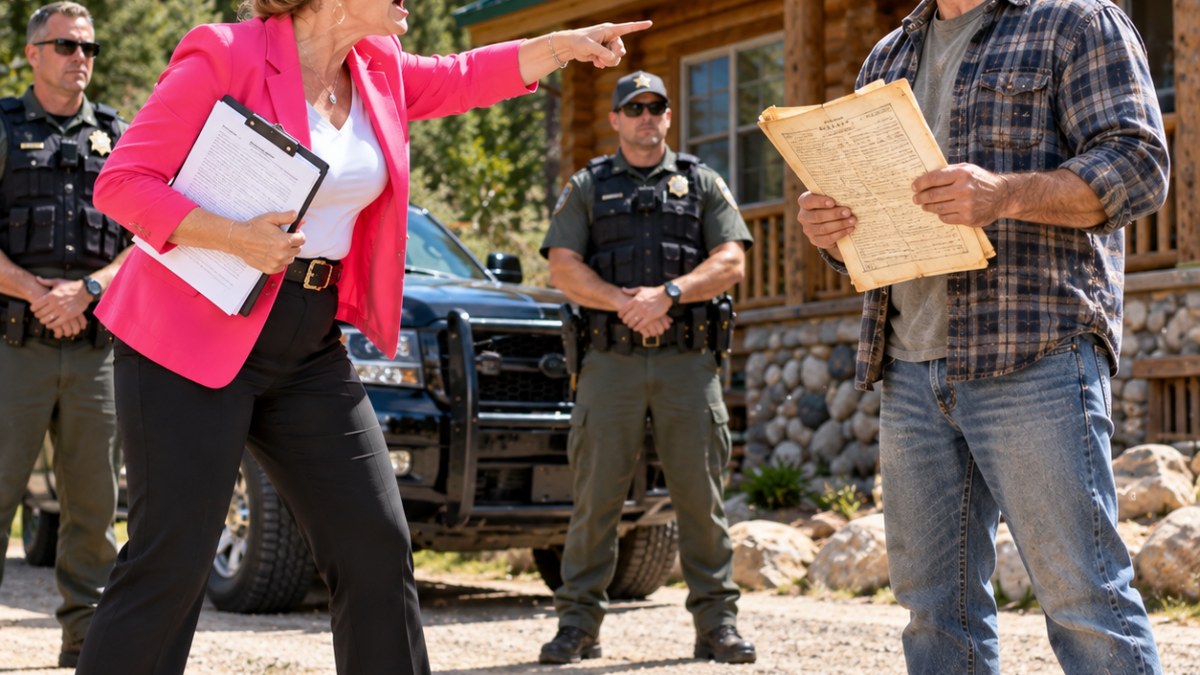
The HOA president handed me a $500 fine for rebuilding a cabin on land my family had owned for four generations, then smiled like she had just taught me an expensive lesson. She told me I had no right to continue construction until her board approved it, even though the foundation beneath my boots had been there long before her subdivision existed. What she didn’t know was that before sunset, I would open my grandfather’s old metal lockbox and find the first piece of a history someone had spent decades pretending didn’t exist.
My name is Jonathan King.
I’m a carpenter, and the three acres I live on in North Carolina have been in my family since 1943.
My great-grandfather Samuel bought the land when most of what surrounds me now was still farmland, pine trees, and dirt roads.
Decades later, developers built Sycamore Glenn around us.
Literally around us.
Rows of nearly identical homes eventually wrapped around our property on three sides, but our three acres stayed exactly what they had always been.
King land.
The cabin stood near the back of the property.
Four hundred square feet.
Nothing fancy.
My great-grandfather built the first version with his own hands, and every generation after him repaired something.
My grandfather replaced the porch.
My father rebuilt part of the roof.
I learned my first real carpentry joints inside that cabin before I was old enough to drive.
Last winter, age finally won.
Rot had worked through enough of the original framing that saving the entire structure was impossible.
So I did what my father would have done.
I rebuilt it on the same footprint.
Same location.
Same proportions.
Same purpose.
That Saturday afternoon, I was securing one of the final roof beams when I heard tires crunching over gravel.
A black SUV stopped near my property boundary.
A woman stepped out wearing a navy blazer despite the Carolina heat.
A man followed her with a camera.
Before he even reached the fence line, he started taking pictures.
The woman stayed carefully on the other side of the boundary.
“Sir,” she called, “are you aware that you are constructing an unauthorized structure?”
I set my hammer down.
Climbed off the scaffolding.
Walked toward them.
“I’m Jonathan King. This is my property.”
Her smile never reached her eyes.
“Diane Prescott. President of the Sycamore Glenn Homeowners Association.”
She gestured toward the man.
“Gerald Finch, compliance officer.”
Gerald took another photograph.
Diane continued.
“All construction within our community requires architectural approval.”
“My land isn’t part of your community.”
Her expression changed the way a teacher’s does when a child gives the wrong answer confidently.
“Mr. King, your property falls within the geographic boundaries of Sycamore Glenn.”
“No, it doesn’t.”
“All properties inside our community footprint are subject to HOA governance.”
“That’s not how deeds work.”
Her smile tightened.
Then she extended a sheet clipped to her board.
“This is a notice of violation. Unauthorized construction. Five hundred dollars.”
I didn’t take it.
She placed it on my sawhorse.
“You’ll need to stop work immediately and submit your plans.”
“And if I don’t?”
Gerald finally spoke.
“Additional penalties. Possible lien action. Legal enforcement.”
I looked from him to Diane.
“You’re threatening a lien against land you don’t own and don’t govern?”
Diane adjusted the clipboard under her arm.
“I suggest you review our covenants before making assumptions.”
Then she gave me the kind of smile that told me she believed the conversation was finished.
“Our monthly meeting is the first Tuesday. You’re welcome to raise your concerns through the proper channels.”
They returned to the SUV.
Gerald took three more pictures before getting inside.
I stood there until the vehicle disappeared between the houses of Sycamore Glenn.
Then I picked up the citation.
Official logo.
Bold lettering.
VIOLATION.
NON-COMPLIANCE.
ENFORCEMENT.
$500.
My father would probably have paid it.
That thought hurt.
He had been a quiet man.
Not weak.
Just tired of unnecessary battles.
He used to say sometimes fifty dollars was cheaper than fifty hours of anger.
But I couldn’t look at that cabin frame and think about surrendering.
My father died two years earlier.
My grandfather before him.
Every beam I was replacing carried something they had taught me.
I had promised myself the cabin wouldn’t disappear just because time had finally beaten the old lumber.
That evening, after the tools were put away and the property went quiet, I carried my grandfather’s metal lockbox to the kitchen table.
The hinges squealed when I opened it.
Inside were tax receipts, surveys, handwritten notes, old photographs, and documents wrapped in yellowing envelopes.
Then I found the deed.
March 15, 1943.
Samuel King.
Three acres.
Recorded legally with the county.
No restrictive covenants.
No HOA.
No future-development clause.
Nothing giving anyone named Prescott—or any association that didn’t even exist yet—the right to tell a King what he could build there.
And beneath the deed was something else.
A handwritten note from my great-grandfather.
Only a few lines.
But after I read them, I stopped thinking about Diane’s $500 fine.
Because I realized this fight had actually started decades before either of us ever met.
PART 2
The handwriting was faded pencil.
My great-grandfather had never been a man who wasted words.
Samuel King wrote the way he built things—straight, functional, nothing decorative.
Sycamore Development offered $50,000.
Told them no.
This ground isn’t for sale.
Not now.
Not ever.
Whoever reads this next, remember that.
The note was dated 1985.
I sat at the kitchen table holding it between both hands.
Fifty thousand dollars in 1985 wasn’t pocket change.
For a working man like Samuel, that kind of money could have changed retirement.
Paid debts.
Bought another property.
Made life easier.
Instead, he had turned it down.
Two years later, Sycamore Glenn began construction.
I looked out the window.
The cabin skeleton stood dark against the tree line.
Beyond it, porch lights from the subdivision glowed through the trees.
Hundreds of homes now surrounded the land Samuel refused to sell.
Diane thought that geography gave her jurisdiction.
Samuel had apparently spent decades proving geography did not mean surrender.
I opened my laptop.
Wake County Register of Deeds.
Then county planning records.
Then property attorneys.
By eleven that night, I had a list of questions and one name circled on a notepad.
Ralph Hughes.
Property law.
Boundary disputes.
Covenant litigation.
Downtown Raleigh.
I called his office first thing the next morning.
But before I met Ralph, I wanted copies of everything.
The county recorder’s office opened at eight-thirty.
I arrived fifteen minutes early.
The clerk who helped me was named Margaret Ellis.
Sixty-something.
Wire-framed glasses.
The patient expression of someone who had spent thirty years watching people discover that land disputes usually started long before the people fighting them were born.
“What are we looking for?” she asked.
“My deed first.”
I gave her the parcel information.
“And the formation documents for Sycamore Glenn.”
She looked at me.
“HOA problem?”
“That obvious?”
She smiled.
“You’d be surprised how many people suddenly care about deeds after getting HOA mail.”
She pulled the digital record.
There it was.
March 15, 1943.
William Tate to Samuel King.
Three acres.
Twelve hundred dollars.
Margaret zoomed in.
“No recorded covenants attached.”
“Can there be something separate?”
“Possibly. We’ll check the chain.”
She disappeared into the archive room.
Half an hour later, we had nearly eighty years of King family ownership spread across a table.
Transfer after Samuel died.
Then my grandfather.
Then my father.
Then me.
No HOA declaration.
No annexation.
No covenant agreement.
No recorded restrictions tying the parcel to Sycamore Glenn.
Margaret tapped one page.
“If this is all accurate, your land has stayed independent.”
“I want to see their original map.”
She retrieved Sycamore Glenn’s incorporation file.
1987.
Forty-four years after Samuel bought our property.
The boundary map looked like someone had drawn a horseshoe.
Sycamore land wrapped around our three acres.
But the HOA boundary stopped precisely at our property lines.
I traced it with my finger.
“They knew.”
Margaret nodded.
“Developers usually know exactly what they own.”
“So Diane’s wrong.”
Margaret gave me the professional answer.
“I’m not your attorney.”
Fair.
I requested certified copies.
Deed.
Chain of title.
Boundary map.
Formation documents.
By noon I was sitting in my truck with a folder on the passenger seat worth more to me than anything Diane could put on HOA letterhead.
The association was younger than my land by forty-four years.
More importantly, it had been designed around my property.
I drove home feeling lighter.
That feeling lasted approximately forty minutes.
I opened the old lockbox again.
This time I went deeper.
Tax receipts.
Insurance documents.
Old utility bills.
Then bank records from my father.
I almost missed them.
Small canceled checks.
Sycamore Glenn HOA.
$25.
$50.
$75.
One memo line:
Exterior modification fine.
Another:
Vegetation non-compliance.
Another:
Fence color.
I stared at the checks.
My father had paid them.
Not hundreds every month.
Just nuisance fines.
Small enough that fighting them probably seemed ridiculous.
I could hear his voice.
Jonathan, sometimes the cheapest thing you can buy is peace.
The problem was that every check now looked like something Diane’s lawyer could hold up.
See?
The Kings recognized HOA authority.
I called Ralph Hughes.
He answered personally.
“Hughes.”
“My name is Jonathan King. I have a property issue involving an HOA.”
“That narrows it down to half my week.”
I explained.
Land purchased in 1943.
HOA formed in 1987.
Original boundary excludes me.
No covenant.
No annexation.
Current president just fined me for rebuilding a historic cabin.
Ralph listened.
Then he asked:
“Has anyone in your family ever paid HOA dues or fines?”
There it was.
“I found checks from my father.”
“How many?”
“Several over the years.”
“Regular dues?”
“No.”
“Assessments?”
“No.”
“Just fines?”
“Yes.”
He was silent for a moment.
“That complicates things.”
My stomach tightened.
“How badly?”
“Not fatally.”
I leaned against the kitchen counter.
“Explain.”
“They’ll argue implied consent. They’ll say your family accepted association jurisdiction through a long course of conduct.”
“Does paying a fine make them legally entitled to my property?”
“No.”
His answer was immediate.
“Not without a covenant or binding agreement. But litigation isn’t only about the winning argument. It’s also about what the other side can make expensive.”
“When can you see me?”
“Tomorrow.”
Ralph’s office occupied the third floor of an old brick building downtown.
He was younger than his phone voice suggested.
Mid-forties.
Gray at the temples.
No theatrical lawyer energy.
Just calm.
I liked him immediately.
I laid everything on his desk.
He started with the deed.
Then the HOA documents.
Then the certified boundary map.
Then my father’s checks.
Then Samuel’s handwritten note.
He spent almost thirty minutes reading before saying anything.
Finally, he leaned back.
“Legally, your position is strong.”
“How strong?”
“Your deed predates the HOA by forty-four years. Your parcel isn’t inside the association’s original legal boundary. There are no covenants attached to title. No annexation agreement.”
“So they can’t fine me.”
“They have no contractual basis I can see.”
“What about my father?”
He lifted the canceled checks.
“They’ll make noise about this.”
“But?”
“But paying money demanded from you does not magically amend your deed.”
I breathed out.
Ralph continued.
“The question is how you want to proceed.”
“What choices do I have?”
“Two basic strategies.”
He lifted one finger.
“We send a cease-and-desist letter now. We attach the deed, map, and formation documents. We demand immediate withdrawal of the cabin citation and every pending enforcement action.”
“Option two?”
“We say nothing.”
That surprised me.
“Nothing?”
“You finish the cabin. Ignore them. If they file a lien or sue, we respond with the records.”
“Why would I choose that?”
“Because sometimes the cleanest evidence of abuse is letting someone take a step they have no right to take.”
I looked at him.
“You’re suggesting I let them file a lien.”
“I’m saying it’s an option.”
He leaned back.
“If they merely threaten you, you have a dispute. If they knowingly record an invalid lien against property outside their jurisdiction after being shown the deed, you may have stronger claims.”
“That sounds like living with a gun pointed at my title.”
“It is.”
I looked through the office window toward downtown Raleigh.
My father would have chosen silence.
Not because he was cowardly.
Because he believed energy mattered.
Samuel would have done the opposite.
I picked up the handwritten note.
Not now.
Not ever.
“Send the letter.”
Ralph nodded.
“I thought you might.”
He drafted it that afternoon.
Certified mail.
Return receipt.
The language was professional.
Almost boring.
My property was not subject to Sycamore Glenn HOA covenants.
The citation was invalid.
Any attempt to file a lien, cloud title, interfere with construction, or enter the property would be challenged.
Attached:
1943 deed.
1987 formation documents.
Original boundary map.
Chain of title.
Ralph looked at me before I left.
“Diane is probably used to homeowners complaining emotionally.”
“I’m guessing.”
“This letter is different.”
“How?”
“It tells her you have counsel and records.”
He capped his pen.
“People who rely on intimidation often escalate when intimidation stops working.”
“What should I do?”
“Document everything.”
Three days later, Diane signed for the certified letter herself.
Then nothing happened.
For one week.
I kept working.
That became therapy.
Cut.
Measure.
Fit.
Fasten.
The cabin didn’t care about HOA politics.
A beam was square or it wasn’t.
A joint held or it didn’t.
Wood never pretended authority it didn’t have.
Then the lawyer letter arrived.
Six pages.
Thick paper.
Expensive envelope.
Sycamore Glenn’s attorney “respectfully disagreed” with Ralph’s legal interpretation.
They claimed my land existed inside a “geographic service area.”
Ralph later laughed at that phrase.
Then they argued “decades of community integration” established association authority.
Translation:
My father had paid fines.
The original $500 citation was now $2,000.
Continued construction constituted willful non-compliance.
Payment due in thirty days.
Failure to comply could result in a lien.
I called Ralph.
“They doubled it.”
“Expected.”
“They’re actually threatening my title.”
“Expected.”
“You keep saying that.”
“I’d rather be boring than surprised.”
“What now?”
“Keep building.”
I did.
Three days later, Diane changed tactics.
A woman in a silver sedan stopped near my property.
She rolled down the window.
“You Jonathan King?”
“Yes.”
“I’m Patricia Nelson. I live on Cedar Circle.”
“Can I help you?”
She hesitated.
“I thought you should see something.”
She showed me her phone.
HOA email.
Subject:
PROTECTING OUR COMMUNITY STANDARDS.
Diane described an “outside property owner” refusing to follow Sycamore Glenn construction requirements.
She warned that unchecked development near HOA homes could affect aesthetics and property values.
She asked residents to report concerns.
No name.
No address.
None needed.
There was only one half-built cabin surrounded by Sycamore Glenn.
Mine.
Patricia lowered the phone.
“People are talking.”
“I assumed.”
“Some think you’re building a rental compound.”
I laughed.
“It’s four hundred square feet.”
“I know.”
“Anything else?”
She looked uncomfortable.
“Diane told people you’ve refused to cooperate with every board attempt to resolve this.”
“Her attempt was a $500 fine.”
Patricia nodded.
“I figured there was another side.”
“Thank you for showing me.”
After she left, I stood beside the cabin and looked at the houses around me.
The legal threat hadn’t worked.
Now Diane wanted social pressure.
Make me the outsider.
Make the neighborhood afraid.
Turn a property-line dispute into a question of community loyalty.
That evening, somebody knocked on my door.
An older man stood outside.
White hair.
Sun-weathered face.
Workman’s hands.
“Jonathan King?”
“Yes.”
“Walter Jennings.”
The name sounded familiar.
“I live over on Maple. Since ’89.”
I opened the door.
“What can I do for you?”
“Maybe I can do something for you.”
That got my attention.
Walter sat in my living room.
He looked at Samuel’s note on the coffee table.
“You find that in the old King papers?”
“You knew my great-grandfather?”
“Knew of him more than knew him.”
Walter smiled.
“Whole neighborhood knew him.”
“How?”
“Because Sycamore Glenn got built around him.”
I sat forward.
“People knew that?”
“In the beginning? Absolutely.”
Walter laughed.
“Developers wanted that three acres. Your great-grandfather wouldn’t sell.”
“How much did they offer?”
“I heard fifty grand.”
That matched the note.
Walter continued.
“First few years, everyone understood your land wasn’t part of the HOA.”
“What changed?”
He shrugged.
“People moved. Boards changed. Paperwork gets forgotten when forgetting it gives somebody more power.”
Then my phone buzzed.
Voicemail.
Diane.
“Mr. King, I believe we may have gotten off on the wrong foot. I’d like to propose a meeting to discuss a peaceful resolution. I’m certain neighbors acting in good faith can find common ground.”
Walter actually snorted.
“Peaceful resolution.”
“You don’t believe her?”
“I’ve watched Diane run this board eight years.”
He stood.
“That woman only wants peace after she’s figured out what surrender looks like.”
Before leaving, he stopped at the door.
“If you need somebody to testify about what this neighborhood knew in 1989, call me.”
That night, Ralph had the same reaction.
“They’re nervous.”
“Diane doesn’t sound nervous.”
“She won’t.”
“What about the lien?”
“If they file it after our notice, we act.”
“How?”
“Potential quiet-title action. Declaratory judgment. Slander of title depending on facts.”
Then he paused.
“But I want records first.”
“HOA records?”
“Yes.”
“Why?”
“Because if they’re asserting jurisdiction they don’t have over you, I want to know whether they’ve done it before.”
That decision uncovered everything.
Ralph’s paralegal, Jessica Monroe, became obsessed with Sycamore Glenn’s old development records.
Two weeks later, she called while I was driving.
“Mr. King, pull over.”
“That sounds dramatic.”
“Pull over.”
I did.
“What did you find?”
“The developer correspondence.”
My hands tightened around the steering wheel.
“What correspondence?”
“1985. Sycamore Development trying to buy Samuel King’s property.”
“How many offers?”
“Three.”
She listed them.
Ten thousand.
Twenty-five thousand.
Fifty thousand.
Samuel rejected all three.
Then the developer’s attorney wrote back acknowledging the refusal.
Development will proceed on adjacent parcels only.
I closed my eyes.
“They knew.”
“Oh, it gets better.”
“Better?”
“I’m emailing you the 1986 county site plan.”
My phone chimed.
I opened it.
Zoomed into my property.
There, printed directly across the three acres:
PRIVATE PROPERTY — NOT PART OF DEVELOPMENT.
For a long time, I said nothing.
Jessica finally asked:
“You still there?”
“Yes.”
“Pretty useful, right?”
“Useful?”
I laughed.
“They put it in bold letters.”
“Yes.”
“They filed it with the county.”
“Yes.”
“And Diane’s lawyer says we’re inside a geographic service area.”
Jessica laughed.
“I’m just the paralegal. You’ll want Ralph’s opinion.”
Ralph’s opinion was considerably less amused.
“This destroys any good-faith boundary argument.”
We sat in his office two days later.
Jessica had a stack of documents covering the conference table.
Original purchase offers.
County site plan.
Planning commission approval.
Development maps.
Everything showed the same thing.
King land was never part of Sycamore Glenn.
Then Ralph pointed at a second stack.
“These came from the HOA.”
“You got the records?”
“They delayed.”
“Of course.”
“We filed.”
He smiled slightly.
“Then they became more cooperative.”
Inside were years of meeting minutes.
Financial statements.
Internal communications.
Most were dull.
Pool pumps.
Insurance.
Road landscaping.
Parking.
Then Jessica slid one document toward me.
2003.
CONFIDENTIAL — INTERNAL BOARD USE ONLY.
Subject:
KING PROPERTY JURISDICTION STATUS.
I started reading.
Halfway through, I stopped.
Then started again.
The memo acknowledged that the King parcel was “technically outside association jurisdiction” because it had never been included in the original development boundaries and no covenants had been attached.
It noted that prior King family members had nonetheless paid several compliance charges.
Then came the sentence that made my hands go cold.
Continue existing enforcement approach unless formally challenged.
Why?
Because formal annexation would require King family consent.
And acknowledging the lack of authority could “create unnecessary questions regarding prior enforcement decisions.”
I looked at Ralph.
“They knew.”
“Yes.”
“This was twenty years ago.”
“Yes.”
“Who signed it?”
Jessica turned the page.
Richard Hoffman.
HOA president in 2003.
Countersigned:
Diane Prescott.
I stared at her signature.
Same name.
Same neat cursive I had seen on the $500 cabin violation.
Diane hadn’t misunderstood anything.
She had known for more than twenty years.
She knew when my father wrote those checks.
She knew when she became president.
She knew when she stood on my property line and told me geography gave her authority.
She knew when she threatened a lien.
This wasn’t incompetence.
This was policy.
Keep demanding money until somebody knows enough to stop paying.
I thought about my father.
Every small check.
Every time he chose peace.
He wasn’t conceding jurisdiction.
He was being exploited by people who knew he hated conflict.
Something inside me changed.
Until that moment, I had wanted Diane to leave me alone.
Now I wanted every homeowner in Sycamore Glenn to know exactly what had been done in their name.
Ralph watched me.
“You’re angry.”
“Yes.”
“Good time not to make decisions.”
“I already made one.”
“What?”
“I want a meeting.”
He was quiet.
“Public?”
“Every resident.”
Jessica smiled slightly.
Ralph didn’t.
“She will attack you.”
“I know.”
“She’ll say documents are outdated.”
“I know.”
“She’ll say your father accepted jurisdiction.”
“I know.”
“She’ll say this threatens community stability.”
“Probably.”
He looked at me for several seconds.
“You sure?”
I pushed the memo toward him.
“My father paid them because he trusted that if an organization sent him an official fine, it probably had the right.”
I pointed at Diane’s signature.
“She knew it didn’t.”
Ralph nodded.
“We’ll request the meeting.”
The night before it happened, I opened the lockbox again.
By then I had gone through every document repeatedly.
Still, I found one envelope I had overlooked.
SYCAMORE.
Inside was the developer’s final 1985 offer.
Fifty thousand dollars.
At the bottom, Samuel had written directly on the paper in pencil.
Benefits?
You want my grandfather’s land so you can put cheap houses around it?
No deal.
Not now.
Not ever.
Then beneath that:
This ground isn’t for sale.
Whoever reads this next, remember that.
I sat alone at the kitchen table for almost an hour.
Sometimes family history gets reduced to photographs and birthdays.
This was different.
Samuel’s decision had physically shaped the neighborhood.
Every street around me bent because one man refused to sell.
Tomorrow, I would walk into a room full of people living inside the shape of his no.
Walter came over in the morning.
He brought coffee.
And a photograph.
1989.
Bulldozers.
Half-built houses.
Bare streets.
And in the center:
Samuel’s cabin.
Alone.
Untouched.
Walter tapped the photograph.
“Show them this.”
“I planned to use maps.”
“Maps prove boundaries.”
He pushed the photograph toward me.
“This proves memory.”
The meeting started at seven.
Almost eighty people packed the Sycamore Glenn community center.
More than any ordinary HOA meeting drew.
Diane sat at the front wearing a cream blazer.
Three board members beside her.
Gerald Finch near the projector.
Ralph sat beside me.
Walter behind us.
Patricia Nelson was across the aisle.
I recognized several faces only because they had slowed down while driving past my cabin over the previous weeks.
Diane started with routine business.
Minutes.
Treasurer.
Pool fence.
She was reminding everyone who normally controlled that room.
Finally:
“We have received a formal complaint from an adjacent property owner.”
Adjacent.
Interesting word.
Not member.
Not homeowner under association jurisdiction.
Adjacent.
Maybe Ralph’s letter had taught her something already.
“Mr. King will be given fifteen minutes.”
I stood.
Plugged in the flash drive.
Turned toward the room.
“My name is Jonathan King.”
People quieted.
“My family has owned three acres bordering this neighborhood since 1943.”
First slide.
Deed.
March 15, 1943.
“Forty-four years before Sycamore Glenn existed.”
Next.
1987 HOA formation.
Next.
Original development boundary.
“Our property is outside it.”
A man near the back raised his hand.
Diane said sharply:
“Questions afterward.”
I continued.
Next slide.
1985 purchase offer.
Ten thousand.
Next offer.
Twenty-five thousand.
Next.
Fifty thousand.
“Sycamore Development tried to buy the property.”
Then the attorney letter.
“Samuel King declined.”
Next.
1986 site plan.
PRIVATE PROPERTY — NOT PART OF DEVELOPMENT.
The room murmured.
I looked toward Diane.
She stayed still.
Then Walter’s photograph.
1989.
The original cabin surrounded by developing houses.
Several older residents reacted immediately.
“I remember that.”
“So do I.”
“That cabin was there.”
Exactly.
I continued.
“For years, everyone knew.”
Then I displayed my father’s canceled checks.
“The King family eventually began receiving fines.”
I didn’t hide them.
That mattered.
“Some were paid.”
Diane leaned toward her microphone.
“There.”
Ralph whispered:
“Keep going.”
I did.
“My father believed paying small fines was easier than fighting.”
Next slide.
2003 memo.
The room went silent.
“This document was produced from HOA records after legal demand.”
I enlarged the important section.
KING PROPERTY TECHNICALLY OUTSIDE ASSOCIATION JURISDICTION.
Then:
CONTINUE EXISTING ENFORCEMENT APPROACH UNLESS FORMALLY CHALLENGED.
Nobody moved.
I let them read.
Then I advanced to the signature page.
Richard Hoffman.
Diane Prescott.
The room changed.
Not loudly.
First there was silence.
Then a man in the middle stood.
“Diane.”
She looked at him.
“Did you sign that?”
She took a breath.
“The document is being presented without legal context.”
“Yes or no?”
“The board at the time was reviewing several complicated jurisdictional matters.”
“Did you know his land wasn’t part of the HOA?”
Diane’s composure cracked.
Only slightly.
But eighty people saw it.
“That conclusion is overly simplistic.”
A woman shouted:
“Yes or no?”
Diane looked toward Ralph.
“This meeting is turning into litigation theater.”
I finally spoke directly to her.
“Then answer one question.”
She stared at me.
“When you placed a $500 fine on my property, did you know my land had never been annexed into Sycamore Glenn?”
Her eyes flicked toward the memo.
That hesitation was enough.
The room erupted.
Questions from everywhere.
“How many other parcels?”
“What about Cedar Lane?”
“I want my deed checked.”
“What have we been paying?”
“You threatened him with a lien?”
“Did our attorney see this memo?”
Diane lifted the gavel.
“Order.”
Nobody listened.
“ORDER.”
Patricia Nelson stood.
“My property was purchased from the Harper farm in 1972.”
The room quieted slightly.
“I’ve asked three times whether the HOA can explain why older easements on my deed aren’t recognized.”
A retired man stood near the wall.
“Our Oak Street easement predates this development too.”
Another voice.
“I paid $1,800 in fines last year.”
Another.
“I want every enforcement record audited.”
The dam had broken.
Diane kept calling for order.
But authority based on unquestioned trust disappears very quickly once questions become contagious.
Walter rose slowly.
“I’ve lived here since 1989.”
People quieted because old neighborhoods listen to people who remember.
“We all knew King land was separate.”
He pointed toward the photograph.
“The developers built around it.”
Diane stared at him.
Walter continued.
“What I didn’t know was that this board later started pretending otherwise.”
A board member beside Diane leaned toward the microphone.
“I want an independent audit.”
Diane turned sharply.
“Harold—”
“I’m making a motion.”
Someone seconded.
Audit of twenty years of jurisdictional enforcement and financial collections.
Hands rose.
Almost every hand.
Then somebody called for a vote of no confidence in Diane.
Her face went pale.
She knew the count before anyone counted.
For years, she had survived because everybody saw disputes individually.
One homeowner’s landscaping fine.
One person’s fence issue.
One family’s cabin.
Now the room saw a system.
Diane stood.
Her hands were no longer steady.
She gathered her papers.
Then leaned toward the microphone.
“I am resigning as president of the Sycamore Glenn Homeowners Association, effective immediately.”
No apology.
No explanation.
She looked toward me once.
Then left.
The door closed.
Nobody followed her.
I stayed in my chair.
I thought I would feel triumphant.
Instead, I thought about my father.
How many checks had he mailed just to avoid exactly this kind of room?
How many nights had he decided peace was worth fifty dollars?
He had never known they knew.
That hurt more than anything Diane had done to me personally.
Outside afterward, Walter leaned against his truck.
“Well.”
I smiled.
“Well.”
“Haven’t seen that many people angry since they raised pool dues in ’97.”
I laughed.
“Thank you.”
“For what?”
“The photo.”
“I just held onto a picture.”
“No.”
I looked back toward the community center.
“You remembered.”
Walter nodded.
“Sometimes that’s enough.”
Before driving away, he said:
“Samuel would’ve enjoyed tonight.”
“Think so?”
“He hated bullies.”
The audit took three months.
It confirmed the 2003 memo had not been an isolated note.
The King property had repeatedly been discussed as legally separate.
Yet enforcement continued.
My family had paid $4,200 over approximately two decades.
Every dollar was refunded.
The new board voted unanimously.
The $2,000 cabin fine disappeared.
The $500 original citation disappeared.
The threatened lien never happened.
Ralph sent me the final acknowledgement.
Sycamore Glenn formally recognized that the King parcel was not and had never been subject to association covenants.
I framed that letter.
Then changed my mind.
I put it in Samuel’s lockbox instead.
That felt better.
Diane put her house on the market six weeks after resigning.
I heard she moved toward Charlotte.
I never confirmed it.
Didn’t care.
Gerald Finch resigned from the compliance role.
Two other board members chose not to run again.
The new board commissioned proper boundary maps for every parcel.
Old easements were reviewed.
Enforcement procedures were rewritten.
Financial records became open electronically.
Homeowners could challenge jurisdiction before fines accumulated.
Simple reforms.
The kind that seem obvious after somebody gets hurt.
Patricia eventually learned that parts of her Cedar Lane property were subject to different recorded restrictions than the HOA had been telling her for years.
The Oak Street couple got their easement recognized.
Other residents recovered improperly assessed penalties.
The scandal grew larger than my cabin.
But my cabin was where I spent most of my time.
I finished the roof in September.
Windows in early October.
Porch by the middle of the month.
Late October, the cabin stood complete.
Four hundred square feet.
Fresh oak.
Simple metal roof.
Small porch.
Same footprint.
Same orientation.
The original foundation had been reinforced but preserved where possible.
I saved a piece of old oak from the original structure.
Weathered gray outside.
Still strong at the heart.
I turned it into a plaque.
KING CABIN
EST. 1945
REBUILT 2024
Then beneath it:
THIS GROUND ISN’T FOR SALE.
I mounted it beside the front door.
Walter arrived the following Sunday carrying something wrapped in brown paper.
“What’s this?”
“Garage archaeology.”
I opened it.
Black-and-white photograph.
A man standing beside the original cabin.
One hand on the door frame.
Sun in his eyes.
Samuel King.
Summer 1960.
I had never seen him that young.
Most family photographs showed an old man.
Here he looked maybe forty.
Broad shoulders.
Work shirt.
Same stubborn jaw I saw in my father.
And sometimes in the mirror.
“Where did you find this?”
“The people who owned my house before me left boxes in the attic.”
“You kept it all these years?”
“Recognized the cabin.”
Walter shrugged.
“Figured somebody would want it eventually.”
I looked at him.
“Thank you.”
He nodded toward the new cabin.
“Put it inside.”
I hung Samuel’s photograph on the wall facing the entrance.
First thing anybody saw when they walked in.
Not the HOA letter.
Not Diane’s fine.
Samuel.
Because the story wasn’t really about Diane.
That took me a while to understand.
She was only one chapter.
The land was older.
The cabin was older.
The promise was older.
Diane believed the most important fact was that Sycamore Glenn surrounded my property.
Samuel had understood the opposite.
Being surrounded didn’t mean belonging to what surrounded you.
It didn’t mean surrender.
It didn’t mean somebody else got to rewrite your deed because their houses happened to be newer and more numerous.
Neighbors began visiting.
At first, people came to apologize.
One man stood awkwardly at the porch.
“I believed Diane.”
“About what?”
“That you were some guy ignoring construction codes.”
“I am some guy.”
He laughed nervously.
“You know what I mean.”
“Yes.”
“I’m sorry.”
“Thank you.”
Patricia brought pie.
The Oak Street couple brought an old map.
Kids from the neighborhood asked about Samuel.
People wanted to see the 1989 photograph.
The cabin slowly became something strange.
Not a monument.
I never wanted that.
More like a reference point.
Proof that Sycamore Glenn had history before homeowners associations, landscaping committees, and matching mailbox posts.
Walter once told me:
“You know what’s funny?”
“What?”
“Diane spent years saying this place hurt property values.”
He looked toward three neighbors taking pictures of the cabin.
“Now everybody loves it.”
“People love stories.”
“No.”
Walter smiled.
“They love surviving one.”
Winter arrived.
The first hard frost turned the field silver.
I sat on the new porch one evening wearing my father’s old work jacket.
Inside, Samuel’s photograph hung beside the door.
The lockbox sat beneath the bed.
Deed.
Letters.
Refund receipt.
HOA acknowledgement.
Everything together.
I thought about my father more than Samuel that night.
That surprised me.
Samuel had become the hero everyone liked talking about.
The stubborn great-grandfather who refused fifty thousand dollars.
The man who forced developers to build around him.
But my father was different.
He didn’t fight.
He paid the fines.
For a while, I had been angry about that.
Why hadn’t he checked?
Why hadn’t he challenged them?
Why had he let Diane’s board build confidence by paying money they weren’t owed?
Then I remembered who he was.
He worked ten-hour days.
Cared for my mother during her illness.
Fixed neighbors’ cars.
Spent weekends keeping the cabin standing.
He wasn’t surrendering the land.
He was choosing which battles he had energy to fight.
The failure wasn’t his.
The failure belonged to people who saw his decency and treated it as consent.
That distinction mattered.
I stopped resenting the checks.
Instead, I placed one of them in a small frame beside Samuel’s photograph.
Fifty-dollar HOA fine.
My father’s signature.
A reminder that systems can exploit quiet people just as easily as they can punish loud ones.
One afternoon, a teenager from Sycamore Glenn stopped at the cabin.
His name was Noah.
He was sixteen.
“Mr. King?”
“Jonathan.”
“My dad says this place caused the HOA president to quit.”
I laughed.
“This cabin didn’t do anything.”
“He said your deed did.”
“That’s closer.”
Noah looked around.
“Is it true they built the neighborhood around your family?”
“Yeah.”
“Why didn’t your great-grandfather sell?”
I thought about the easy answer.
Stubbornness.
History.
Family.
Instead I said:
“Because he didn’t want to.”
Noah looked confused.
“That’s it?”
“That should be enough.”
I pointed toward the houses.
“If something belongs to you, nobody should need a better reason for you to keep it than you want to keep it.”
He nodded slowly.
Then read the plaque.
THIS GROUND ISN’T FOR SALE.
“Pretty serious.”
“He was a serious man.”
Years ago, Samuel’s refusal had probably irritated an entire development company.
Now teenagers thought it was cool.
History has a sense of humor.
The following spring, Sycamore Glenn held its annual meeting.
I wasn’t required to attend.
Technically, I wasn’t a member.
That felt good every time I said it.
Walter convinced me to go as a guest.
The new president, Karen Mills, opened the meeting by displaying updated association maps.
My property was clearly labeled:
KING PROPERTY — NON-HOA PARCEL.
I nearly laughed.
Twenty years of fines.
Thousands in legal fees.
Months of fighting.
And the final administrative fix was one label on one map.
Karen pointed toward it.
“For avoidance of future confusion, this parcel is not subject to Sycamore Glenn covenants.”
Somebody chuckled.
Walter leaned toward me.
“You want to stand up and object?”
“Very funny.”
Then Karen announced a new policy.
Any jurisdictional dispute had to be verified against county title records before enforcement began.
No assumption based on location.
No “geographic service area.”
No fines until legal authority was confirmed.
Common sense written into policy because common sense had once been ignored.
After the meeting, Karen approached me.
“Jonathan?”
“Yes?”
“I wanted to ask you something.”
“Sure.”
“The board is creating a neighborhood history page.”
I waited.
“We’d like permission to include the story of the King property.”
I stared at her.
“The HOA wants to celebrate the property it tried to fine into submission?”
Karen winced.
“When you say it like that…”
“That is how it happened.”
“We could leave out the embarrassing parts.”
“No.”
She looked surprised.
“If you tell it, tell all of it.”
“The memo too?”
“Especially the memo.”
She nodded.
“Fair.”
I agreed.
Not because I wanted attention.
Because forgetting was how the problem began.
New residents would someday move into Sycamore Glenn.
They would see our land surrounded by HOA houses.
Some future board president might assume what Diane assumed she could get away with.
Records mattered.
Memory mattered.
Walter mattered.
Samuel’s photograph mattered.
And yes, even that ugly 2003 memo mattered.
A year after the cabin was finished, I sat inside during a summer thunderstorm.
Rain hammered the metal roof.
The whole place smelled like oak and wet earth.
I had Samuel’s note framed now.
Not now.
Not ever.
Whoever reads this next, remember that.
I finally understood the last line.
Samuel wasn’t only telling future Kings not to sell.
He was telling us not to forget the boundary.
Not the survey line.
The principle.
People will ask.
People will offer.
Some will threaten.
Some will hide behind paperwork.
Some will tell you resistance is selfish because everyone around you has already agreed.
That doesn’t change ownership.
That doesn’t change truth.
That doesn’t change where the line is.
Later that evening, I walked outside after the storm.
Water dripped from the roof.
Sycamore Glenn lights glowed through the trees.
Walter’s house.
Patricia’s.
Oak Street.
Cedar Lane.
Families living ordinary lives.
I didn’t hate the neighborhood.
That surprised some people.
Sycamore Glenn hadn’t wronged me.
Individuals had.
Structures without oversight had.
Habit had.
Silence had.
Most residents were simply people who assumed their board knew what it was doing.
That was the real danger.
Bad authority rarely survives because everyone is bad.
It survives because most people are busy.
Because checking records takes time.
Because a $50 fine is easier to pay than challenge.
Because meetings are boring.
Because official stationery looks legitimate.
Because somebody else will probably handle it.
Until nobody does.
I sat on the cabin steps.
When Samuel rejected the developer, he protected three acres.
When I challenged Diane, I thought I was doing the same.
But the outcome touched people I barely knew.
Patricia got her questions answered.
The Oak Street easement was restored.
Residents demanded transparency.
A new board changed enforcement rules.
Walter finally told a story he had carried thirty years.
My father’s money came back.
And the cabin survived.
That was enough.
One autumn afternoon, my nephew Ethan came to visit.
He was twenty-two.
My sister’s son.
Good with tools but impatient.
Exactly like me at his age.
We worked on a small cabinet inside the cabin.
He kept rushing one joint.
I made him redo it.
“Uncle Jonathan.”
“What?”
“It’s fine.”
“No.”
“Nobody will see it.”
“I’ll know.”
He rolled his eyes.
Then redid it.
Eventually he looked at Samuel’s photograph.
“Mom says this land will probably come to me someday.”
“Part of it might.”
“What am I supposed to do with it?”
“Whatever you want.”
He pointed at the plaque.
“Except sell?”
I laughed.
“Samuel doesn’t get to control you from the grave.”
“Sounds like he tries.”
I looked at the old photograph.
“His message wasn’t that you can never sell.”
“What was it?”
“That you shouldn’t let somebody convince you something isn’t yours just because they want it.”
Ethan thought about that.
Then nodded.
“That makes more sense.”
Good.
Family traditions should survive because they still mean something.
Not because dead people become another kind of HOA.
Years may pass.
Boards will change again.
Walter won’t always be around.
Neither will I.
Maybe one day Sycamore Glenn will barely remember Diane Prescott.
That’s probably healthy.
But I hope they remember what happened.
Not because she was uniquely evil.
She wasn’t.
That would make the lesson too easy.
Diane was a person who spent too long being obeyed.
A board member who learned that official language could make people surrender.
A real estate professional who understood enough about property to know exactly where the limits were—and eventually decided those limits only mattered if someone enforced them against her.
She saw my father pay.
So she kept billing.
She saw nobody challenge the 2003 memo.
So she kept pretending.
She saw a cabin being rebuilt and assumed I would follow the same pattern.
Letter.
Fine.
Threat.
Payment.
Silence.
She was wrong.
Not because I was tougher than my father.
Not because I was smarter.
I just had the lockbox.
I had Ralph.
I had Jessica.
I had Walter.
I had records.
And I had reached the point where peace purchased by surrender no longer felt peaceful.
One evening near the second anniversary of Diane’s first visit, I found the original $500 citation in a folder.
I had forgotten about it.
SYCOMORE GLENN HOA.
UNAUTHORIZED STRUCTURE.
$500.
Signed:
Diane Prescott.
For a moment, I considered throwing it away.
Instead, I carried it to the cabin.
I placed it in the lockbox with everything else.
Not as a trophy.
As evidence.
Future King family members might someday ask why our property was labeled separately on county and HOA maps.
They might wonder why Samuel refused to sell.
They might ask why the cabin plaque says:
THIS GROUND ISN’T FOR SALE.
The papers would answer.
Samuel’s note.
The 1986 site plan.
The 2003 memo.
My father’s checks.
Diane’s fine.
The refund.
The formal HOA acknowledgement.
All of it.
Stories get cleaner over time.
Too clean.
Heroes become braver.
Villains become worse.
People forget the uncertainty.
I didn’t want that.
The truth was messier.
I had been scared.
When the HOA lawyer threatened a lien, I lost sleep.
When neighbors started looking at me differently, I wondered whether fighting was worth it.
When I saw my father’s checks, I worried our case had collapsed.
When Ralph said litigation could take months, I thought about paying the $500.
More than once.
There was no moment when I felt invincible.
There were only decisions.
One after another.
Check the deed.
Call the lawyer.
Send the letter.
Keep building.
Request records.
Attend the meeting.
Tell the truth.
That was all.
One afternoon, I was repairing a porch rail when a black SUV slowed near the boundary.
For half a second, my body reacted.
Memory.
Then the window lowered.
Karen Mills.
New HOA president.
“Jonathan.”
“Karen.”
“We’re having the fall picnic Saturday.”
“I’m aware.”
“You coming?”
“I’m not a member.”
She rolled her eyes.
“It’s a picnic, not an annexation agreement.”
“Can I get that in writing?”
She laughed.
“You’re impossible.”
“I’ve been told.”
“Bring the cabin photos.”
“Maybe.”
She drove off.
I stood there smiling.
That was what healing looked like.
Not erasing the boundary.
Respecting it enough that people could joke about it.
Saturday, I attended.
Walter grilled burgers.
Patricia brought potato salad.
Kids played near the community center.
Nobody asked me to sign anything.
At one point, Karen introduced me to a new resident.
“This is Jonathan King.”
The man shook my hand.
“Oh. The cabin guy.”
I sighed.
“Apparently.”
“Heard your land is older than the neighborhood.”
“Land’s considerably older than both of us.”
Karen laughed.
The man said:
“Good story.”
I looked across the road toward the trees hiding my property.
“It became one.”
That distinction mattered.
Living through it had not felt like a good story.
It felt exhausting.
Stories make conflict look inevitable.
Real life is usually just people choosing whether to send one more letter.
Years later, I still work as a carpenter.
The cabin still stands.
Fresh oak has darkened.
The roof has weathered.
Samuel’s photograph hangs in the same place.
Walter visits less often now.
Age.
Patricia still waves when she passes.
Sycamore Glenn continues arguing about ordinary things.
Pool budgets.
Parking.
Landscaping.
Once, residents spent forty minutes debating whether holiday lights could remain up until January fifteenth.
I heard about it from Walter.
“Civilization restored,” he said.
I agreed.
Boring government is underrated.
On clear nights, I sit on the cabin porch and look at the neighborhood lights through the trees.
I think about Samuel standing on this same land before any of those houses existed.
Maybe he heard developers’ machinery in the distance.
Maybe he worried about being surrounded.
Maybe he wondered whether refusing fifty thousand dollars was foolish.
I’ll never know.
Family stories turn uncertainty into certainty.
But his handwriting remains.
No deal.
Not now.
Not ever.
This ground isn’t for sale.
Whoever reads this next, remember that.
I remember.
I remember my father too.
His fifty-dollar checks.
His quiet way.
His belief that peace had value.
He wasn’t wrong.
Peace does have value.
But peace and submission are not the same thing.
I had to learn that myself.
Diane thought she was fining me for a cabin.
What she actually did was force me to open a lockbox.
That lockbox forced me to open county records.
Those records opened forty years of buried history.
And that history forced an entire neighborhood to look at where its authority actually came from.
All because of five hundred dollars.
Sometimes the smallest abuse is useful.
It makes you ask the question nobody expected you to ask.
Who gave you the right?
Diane never had a good answer.
Samuel did.
The deed did.
The county map did.
The 2003 memo did.
And now everybody in Sycamore Glenn knows.
One late October evening, almost exactly two years after I finished rebuilding the cabin, I sat on the porch while leaves moved through the yard.
Ethan had helped me stack firewood.
Inside, the little woodstove glowed.
He stood beside the plaque.
“Uncle Jonathan?”
“Yeah?”
“You ever think Great-Great-Grandpa Samuel knew all this would happen?”
“What? The HOA?”
“People trying to control the land.”
I smiled.
“No.”
“Then why write the note?”
I looked at Samuel’s words.
“Because he knew people.”
Ethan laughed.
“Fair.”
He sat beside me.
For a while, we said nothing.
Then he asked:
“If somebody offers me a million dollars someday, can I sell?”
I looked at him.
“One million?”
“Hypothetically.”
“Absolutely not.”
He laughed.
I did too.
Then I became serious.
“It’ll be your decision.”
He looked surprised.
“Really?”
“If it’s yours, it has to be.”
I pointed toward Sycamore Glenn.
“That was the entire fight.”
He understood.
Ownership without choice isn’t ownership.
Diane forgot that.
Samuel never did.
The sun disappeared behind the trees.
Porch lights began appearing through the neighborhood.
The same houses that once felt like a wall around my family land now looked ordinary.
Neighbors.
Nothing more.
Nothing less.
I went inside before the cold settled.
At the doorway, I looked at Samuel’s photograph.
One hand on the cabin.
Squinting into the Carolina sun.
A man who could not possibly have known my name.
Could not have known Diane’s.
Could not have known what an HOA was going to become.
But he had left something anyway.
Not just land.
Not just lumber.
A boundary.
And a reminder that boundaries mean nothing unless somebody is willing to stand behind them.
I touched the old oak plaque.
Then turned off the porch light.
The cabin settled quietly in the darkness.
Sycamore Glenn surrounded us on three sides.
Just like it always had.
But surrounding something had never meant owning it.
And now, finally, everyone understood the difference.








