PART 2: HOA Cops Broke: Burned My Winter Stockpile — I Brought a Shotgun and Chaos Hit
PART 2
By sunrise, I was standing in the ruins with my phone recording.
“November fourteenth, six forty-seven a.m. Austin Gonzalez documenting the remains of the storage structure behind 847 Ridgewood Lane.”
My voice sounded strangely calm.
That was training.
You can be terrified, furious, or grieving, but once you start documenting a scene, emotion becomes secondary to detail.
I moved slowly across the blackened ground.
Collapsed roof.
Twisted hinges.
Melted water barrels.
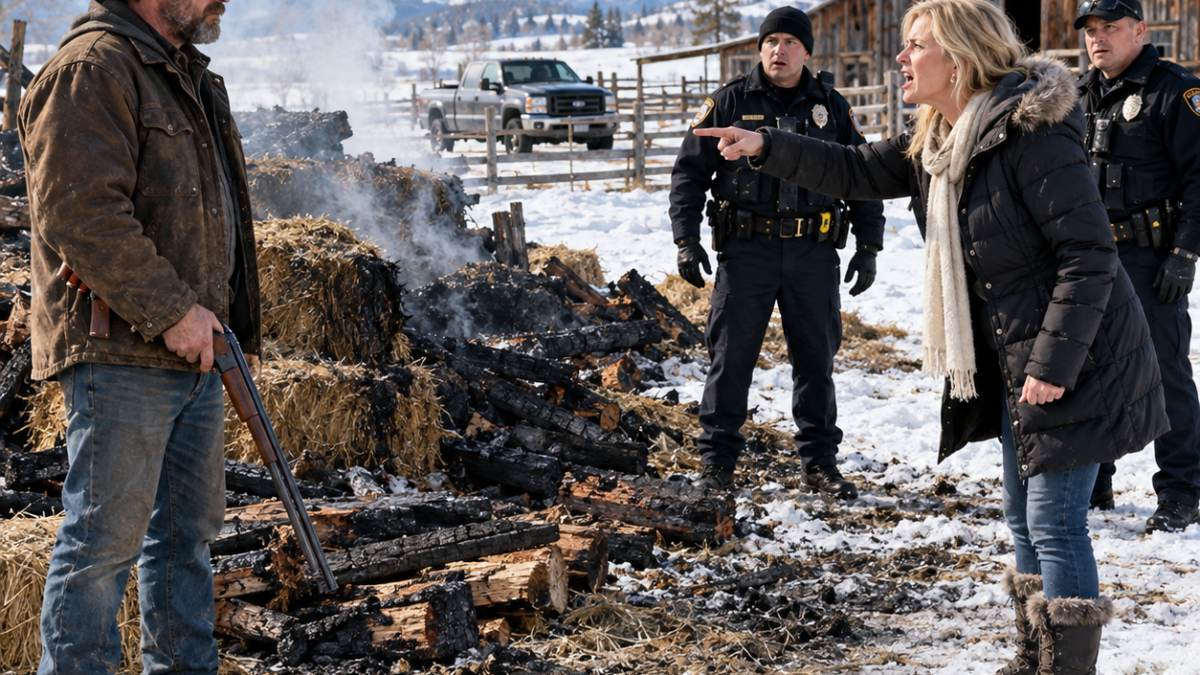
A smoking mound where four hundred pounds of carefully wrapped meat had been stored.
Near the foundation, several dark burn patterns cut through the frost.
Accelerant.
Even before the fire investigator said the word, I knew.
Natural fires don’t usually create neat lines where somebody has poured fuel.
I stopped recording and looked toward the corner of the cabin.
The security camera was still there.
Smoke had blackened the housing.
But the cloud backup was untouched.
Inside, I opened my laptop.
3:14:07 a.m.
Two figures emerged from the tree line.
Baseball caps low.
Pinewood Security jackets.
One man carried the fuel can.
The other looked repeatedly toward my bedroom windows.
They didn’t rush.
That bothered me most.
Men committing their first serious crime usually move fast.
Nervous movements.
Jerking heads.
Hands fumbling.
These two walked like employees completing maintenance.
The taller man poured accelerant along the back wall.
The second poured near the door.
A lighter flashed.
They watched until the flames caught.
Then they walked away.
At 3:18, the white Pinewood Security SUV pulled away from the end of the road.
Four minutes.
Four months of my work destroyed in four minutes.
I copied the video onto an external drive.
Uploaded another copy.
Emailed a third copy to myself.
Then I wrote down every timestamp.
The 911 call disturbed me almost as much as the fire.
When I had called from the yard, the dispatcher said someone had already reported a permitted debris burn at my address.
A permit existed in the system.
I hadn’t requested one.
Someone had created enough paperwork to delay the emergency response.
Forty-seven minutes.
That was how long it took for the first truck to reach me.
Forty-seven minutes was plenty of time.
I didn’t drive to the local police station.
Chief Barnes played golf with Gerald Hoffman.
Maybe that meant nothing.
Maybe it meant everything.
Either way, I wasn’t going to hand my only evidence to a system I didn’t trust before creating redundancies.
Instead, I drove thirty-two miles to the county sheriff’s office.
Deputy Diane Reyes met me in a small interview room.
She was probably in her early forties, dark hair pulled back, eyes that moved between my face and documents rather than staring at one or the other.
I liked her immediately because she didn’t pretend to believe me.
Good investigators don’t.
They verify.
I told her the entire story.
The shed.
The fines.
Gerald.
The security patrols.
The fire.
The fake controlled-burn notice.
When I finished, Diane folded her hands.
“What do you think happened?”
“Pinewood Security burned my shed on behalf of Gerald Hoffman.”
“Can you prove the second part?”
“No.”
“Good.”
I frowned.
She continued.
“The fact that you said no instead of filling the gap tells me you’re still thinking clearly.”
I opened my laptop.
“I can prove the first part.”
The footage played.
Diane watched without speaking.
When the taller man’s face briefly caught moonlight, she raised one finger.
“Stop.”
I paused.
“Back three seconds.”
I did.
She stared at the frame.
Then turned to her computer.
After half a minute, she rotated her monitor.
A booking photograph appeared.
Same jaw.
Same nose.
Same heavy brows.
“Travis Whitmore,” she said. “Assault. Criminal mischief. Charges reduced twice. Pinewood Security employee.”
I looked at the screen.
“You know him?”
“I know the name.”
“So arrest him.”
“I can investigate him.”
“Diane.”
“Mr. Gonzalez, your video is strong. But if I arrest Whitmore this afternoon, what happens?”
“He gets charged.”
“And his attorney says some unknown person paid him privately. Hoffman denies everything. Pinewood Security fires him. Everybody above him walks.”
My anger rose.
“So we do nothing?”
“I didn’t say that.”
She leaned forward.
“People who run systems like this survive because victims focus on the most visible act.”
She pointed toward my laptop.
“That’s visible.”
“What isn’t?”
“Who ordered it.”
I thought about Gerald’s office.
His confidence.
I’m the one who enforces that law.
Diane continued.
“You want Hoffman?”
“Yes.”
“Then don’t give him warning that we’re coming.”
That sentence changed my approach.
I left the sheriff’s office with a case number and instructions to send everything I had.
For three days, I lived inside records.
Pinewood Ridge was organized as a homeowners association under Montana nonprofit law.
That meant some financial records could be requested.
I filed everything in writing.
No phone calls.
No verbal agreements.
Certified mail.
Email confirmation.
Copies.
Gerald had taught me something without realizing it.
Systems that abuse paperwork can often be defeated by better paperwork.
The partial records arrived suspiciously fast.
Annual budgets.
Vendor lists.
Meeting summaries.
No independent audit.
The reserve fund contained almost half a million dollars.
One vendor caught my attention.
Hoffman Property Maintenance.
More than $300,000 paid across four years.
Owner?
Derek Hoffman.
Gerald’s brother-in-law.
I called Eleanor.
She refused to discuss it over the phone.
That night, she came to my porch.
She stood outside.
“Come in.”
“No.”
“It’s twenty degrees.”
“If they see me inside, they’ll know.”
“Who?”
She looked toward the road.
Pinewood Security had parked near the entrance.
“Gerald.”
I lowered my voice.
“What do you know about Derek?”
Her eyes filled.
“Sunrise Realty.”
“What’s that?”
“His company.”
I invited her in again.
This time she stepped inside.
I turned off the porch light.
Eleanor sat at my kitchen table with both hands wrapped around coffee.
“After Henry died, I fell behind.”
“On dues?”
“Everything.”
She stared into the cup.
“Your husband?”
“Forty-nine years.”
“I’m sorry.”
She nodded.
“Three months after his funeral, the violation notices started.”
Three months.
Gerald hadn’t even let the dirt settle over Henry Marsh before deciding Eleanor was vulnerable.
“First my roses.”
“What was wrong with them?”
“Too close to the sidewalk.”
“And?”
“They removed them.”
Her voice tightened.
“Henry planted those bushes our first spring here.”
I said nothing.
“Then my fence stain. My trash cans. A bird feeder. They said it attracted wildlife.”
“In Montana?”
She almost smiled.
Then the smile died.
“The fines reached nine thousand dollars.”
“Nine?”
“I couldn’t pay.”
“What happened?”
“Sunrise Realty offered to buy.”
My skin went cold.
“How much?”
“Fifty-five percent of market.”
I sat back.
“You refused.”
“Yes.”
“So they kept fining you.”
“Yes.”
“How many others?”
She reached into her coat and pulled out folded pages.
“I started looking.”
Property records.
Twelve homes sold to Sunrise Realty in five years.
Each owner had faced escalating HOA enforcement shortly before the sale.
Each property had sold far below comparable market value.
I looked up.
“Derek owns Sunrise?”
“Registered agent.”
I turned pages.
“What happened to the two people who complained?”
Eleanor’s hands trembled.
“The county said the complaints weren’t in the system.”
“Lost?”
“That’s what they told them.”
“Who was county clerk?”
“Not the elected clerk. Deputy administrator handled HOA filings.”
She whispered the name.
A man who had played cards with Gerald for years.
I closed the folder.
“This isn’t an HOA.”
“No.”
“What is it?”
“A machine.”
She started crying.
Not loudly.
The kind of crying people do after years of being afraid of making noise.
“They were going to take my house, Austin.”
I reached across the table.
“They’re not.”
“You don’t know that.”
“No.”
I looked toward the ruins outside.
“But now they burned something of mine.”
Eleanor stared at me.
“They picked the wrong neighbor.”
The next monthly HOA meeting occurred two nights later.
I went.
Not armed.
Not angry.
Just carrying my notebook.
Gerald sat above the residents on a slightly raised platform.
I had never noticed that before.
Maybe the platform had always been ridiculous.
Maybe I was only now understanding what it represented.
When public comments opened, I raised my hand.
Gerald saw me.
“Mr. Gonzalez.”
“I’d like to ask about financial disclosures.”
“You’re not registered.”
“Registered?”
“Speakers must register thirty days ahead.”
“The notice for this meeting was sent twelve days ago.”
A few people laughed nervously.
Gerald’s eyes hardened.
“Rules are rules.”
“Can you show me the bylaw?”
“I’m not going to debate procedure.”
“I’m asking for the section.”
He leaned toward the microphone.
“This is precisely the behavior we’ve been discussing.”
“What behavior?”
“Disruptive conduct.”
I looked around.
Fifty residents.
“Is asking where three hundred thousand dollars went disruptive?”
The room changed.
One board member leaned toward Gerald.
He ignored her.
“Sit down.”
“I am sitting.”
More nervous laughter.
“Mr. Gonzalez.”
His voice became colder.
“You are already facing enforcement proceedings. I strongly advise you not to create additional problems.”
There.
Not a direct threat.
Better.
A public one.
Fifty witnesses heard it.
I closed my notebook.
“Thank you.”
Gerald seemed confused.
“You finally said something useful.”
I left.
That night, I wrote a new plan.
Request financial records.
Map Sunrise purchases.
Compare violations.
Identify vendor ownership.
Preserve arson footage.
Document retaliation.
No confrontation.
No mistakes.
The white security SUV parked across from my house again.
I watched from behind the curtain.
Then I looked at my grandfather’s shotgun above the fireplace.
Granddad had been a rancher.
Not military.
He believed in simple rules.
Protect family.
Don’t start fights.
Finish necessary work.
And never hand a bully the version of you he needs to justify his behavior.
I didn’t always agree with him.
That night, I did.
Four days later, sitting on my floor surrounded by property records, I proved Eleanor’s theory.
Twelve properties.
All twelve had received substantial HOA penalties.
All twelve had sold to Sunrise Realty.
All twelve had sold at depressed prices.
A spreadsheet began forming.
Owner.
Address.
Violations.
Fine amount.
Lien.
Sale date.
Purchase price.
Estimated market value.
The pattern was so clean it made my stomach turn.
Number thirteen was Eleanor.
Still unsold.
Number fourteen was me.
I stared at my own address.
847 Ridgewood Lane.
Suddenly, the shed made sense.
It was never about the shed.
They were manufacturing pressure.
First violation.
Then fines.
Then social isolation.
Then surveillance.
Then property damage.
Break the homeowner emotionally and financially.
When he can’t keep fighting, send Derek.
Cash offer.
Problem solved.
Asset acquired.
My phone chimed.
An email from a random address.
Drop this or lose more than firewood.
I read it three times.
Then saved it.
Printed it.
Backed it up.
I wasn’t fearless.
Anybody who tells you threats like that don’t affect them is lying.
I checked windows twice that night.
I inspected the underside of my truck before driving.
I slept badly.
But fear and surrender are not the same thing.
The following morning, I called Diane Reyes.
I explained the pattern.
She went quiet.
“Send everything.”
“I already did.”
“Everything?”
“Spreadsheet, property records, vendor disclosures.”
“You’re thorough.”
“Occupational damage.”
“What occupation?”
“Army.”
“That explains the timelines.”
I smiled for the first time in days.
Then her voice turned serious.
“Austin, listen carefully. Financial fraud changes this case.”
“How?”
“Arson is one event. This suggests enterprise.”
“Can you move?”
“I need independent verification.”
“How long?”
“Days if we’re lucky.”
“I might not have days.”
“I know.”
The lawsuit arrived Monday.
Gerald Hoffman personally sued me.
Defamation.
Harassment.
Intentional infliction of emotional distress.
$500,000.
I stood in the doorway holding the complaint while snow blew across my boots.
For almost a minute, I couldn’t decide whether to laugh or throw up.
The man whose security employees had burned my winter stockpile was claiming I had caused him emotional pain.
I called five attorneys.
Four refused.
The fifth told me to settle.
Then the internet did something neither Gerald nor I expected.
The security footage had been posted publicly through an account I created solely to preserve evidence if something happened to me.
I never expected many people to see it.
Within three days, more than two hundred thousand had.
Then my phone rang.
“Mr. Gonzalez?”
“Yes.”
“My name is Rebecca Thornton. I’m an attorney working on civil rights and housing matters in Montana.”
I sat up.
“I’ve seen your footage.”
“Everybody has, apparently.”
“I’ve also been researching Pinewood Ridge.”
That got my attention.
“What did you find?”
“Enough to want a conversation.”
We met thirty miles outside the neighborhood.
Rebecca arrived carrying a leather case filled with documents.
She was direct.
No inspirational speeches.
No promises that justice always wins.
I liked her.
She spread several cases across the table.
Other HOAs.
Other Montana communities.
Aggressive fines.
Lien threats.
Low-value property sales.
Questionable vendor arrangements.
“Gerald Hoffman isn’t unique,” she said.
“That’s comforting.”
“It shouldn’t be.”
“I was being sarcastic.”
“So was I.”
She pushed my lawsuit complaint back toward me.
“He thinks this scares you.”
“It does.”
“Good.”
I frowned.
“Fear keeps clients from doing stupid things.”
She tapped the complaint.
“He made an error.”
“What?”
“He sued.”
“I’m aware.”
“No.”
She smiled slightly.
“He sued you.”
I still didn’t understand.
“Discovery.”
The word changed everything.
Because Gerald had accused me of lying about financial misconduct, his finances and relevant HOA operations could become discoverable.
His own attempt to silence me opened doors.
Rebecca agreed to represent me without requiring me to finance the litigation personally.
We countersued.
Malicious prosecution.
Retaliatory enforcement.
Property damage claims.
Related civil violations.
Then discovery began.
Gerald’s lawyers demanded everything from me.
Medical history.
Military records.
Tax returns.
Social media.
Phone logs.
Bank statements.
They clearly wanted to prove the unstable-veteran narrative.
Rebecca gave them lawful material.
Then sent ours.
Seven years of HOA financial statements.
Vendor contracts.
Board communications.
Emails regarding enforcement.
Lien records.
Property sale documentation.
Pinewood Security communications.
Every reference to something called Phase Three.
The HOA objected.
The judge rejected most objections.
“If the organization believes its actions were proper,” she said, “documents demonstrating those actions should not be difficult to produce.”
Fourteen boxes arrived.
Gerald’s mistake had become physical.
Cardboard.
Rebecca rented a conference room.
For four days, we read.
Invoices first.
Hoffman Property Maintenance billed emergency roof repairs for buildings without roofs.
Plumbing services at structures using independent wells.
Landscape maintenance at properties whose owners performed all yard work themselves.
Then companies I hadn’t seen.
Mountain View Holdings.
Ridge Administrative Consulting.
Pinewood Property Services.
Shell after shell.
Money circulated.
Payments ended up connected to Gerald or Derek.
Rebecca sat back.
“This is uglier than your first theory.”
“Meaning?”
“Your theory was targeted real-estate acquisition.”
“And?”
“That appears to be one revenue stream.”
“One?”
She held up invoices.
“They were also siphoning association funds.”
I stared at Gerald’s signature.
For years, residents had paid dues believing they funded snow removal, maintenance, insurance, and community services.
Some of that money had been diverted through companies that barely existed.
Then we found the emails.
Problem residents.
That was the term.
Not homeowners.
Not neighbors.
Targets were discussed like inventory.
The Martinez property remains non-compliant. Recommend escalation to Phase Three.
Another document defined Phase Three.
Coordinated enforcement designed to maximize financial pressure and encourage voluntary disposition.
I read it twice.
“Voluntary disposition.”
Rebecca looked disgusted.
“Sell before foreclosure.”
Then we found the spreadsheet.
Fourteen names.
Twelve crossed out.
Sale dates beside them.
Eleanor Marsh was thirteen.
Austin Gonzalez was fourteen.
I sat there staring at my name.
Not because I was surprised anymore.
Because there is something different about knowing you were targeted and seeing the fact typed inside another man’s internal document.
They had selected me.
Studied me.
Military veteran living alone.
Minimal family nearby.
Winter stockpile.
Detached property.
Useful house.
Probably concluded I was socially isolated enough to pressure.
I thought back to Gerald saying regulations evolve.
He already knew.
Before I ever entered his office, he knew.
Then Rebecca stopped turning pages.
“Austin.”
“What?”
She held one email.
From Gerald’s personal account.
To Travis Whitmore.
Three days before the fire.
Handle the Gonzalez situation.
Make sure he gets the message.
I want him gone before the next board meeting.
My hands went numb.
“That’s it.”
“Maybe.”
“Maybe?”
“It’s powerful.”
“He ordered it.”
“He ordered something. We still have to connect ‘handle’ to arson.”
I hated lawyers.
Then I understood why I needed one.
Truth and proof are not identical.
“We give it to Diane.”
“Immediately.”
Deputy Reyes read the email.
Then called someone from the hallway.
When she returned, she closed the door.
“The attorney general’s office has opened a preliminary nonprofit fraud review.”
I exhaled.
“So arrest Gerald.”
“Not yet.”
I almost laughed.
“You’re all trying to kill me with patience.”
“We arrest too early, we lose bigger charges.”
“Everybody says that.”
“Because it’s true.”
“What if he tries something else?”
“Then call me before you handle it.”
Her eyes moved toward the wall where my grandfather’s shotgun hung.
“Especially before you handle it.”
The weapon had been down from the wall several times since the fire.
I cleaned it.
Checked it.
Kept it nearby at night.
I never pointed it at anyone.
Never took it to Gerald’s house.
Never wanted to fire it.
But I understood what Gerald was doing.
Every rumor online called me unstable.
Dangerous.
Armed.
A survivalist.
The truth was almost funny.
The most dangerous things I owned were a security camera and a spreadsheet.
Then the emergency HOA meeting notice arrived.
The board would vote on my removal.
Not eviction exactly.
But suspension of membership rights, accelerated enforcement, lien action, and foreclosure options.
The language was built to sound administrative.
The effect was obvious.
They wanted my home.
Rebecca obtained the proposed resolution.
It cited my “threatening conduct.”
The same conduct Gerald had spent months inventing.
That night, Eleanor’s living room filled with people.
Seven homeowners at first.
Then nine.
Then twelve.
Margaret Chen.
Retired nurse.
$12,000 in fence fines.
Robert and Linda Whitfield.
Nearly $30,000 after an RV remained in their driveway over a weekend.
James Okonkwo.
Seventy-one.
Retired postal worker.
Forced to sell to Sunrise Realty at roughly forty percent below market after lien threats.
James cried when he described the last morning at his former house.
“My wife planted that garden.”
His wife had been dead four years.
“I dug up what I could.”
Nobody spoke.
“I put the roses in plastic buckets.”
His hands shook.
“Most died.”
Eleanor reached over and took his hand.
That meeting changed the fight.
Until then, Gerald had made every victim believe they were alone.
Isolation had been part of the machinery.
Once people compared stories, the machinery became visible.
Rebecca looked around the room.
“This is why abusive systems work so hard to keep complaints separate.”
James wiped his face.
“So what happens now?”
“The emergency meeting.”
Everyone looked at me.
I hated that.
I wasn’t their commander.
Wasn’t their lawyer.
Wasn’t their hero.
“I’m going to speak.”
Margaret nodded.
“So am I.”
Eleanor lifted her chin.
“Me too.”
One by one, they agreed.
Later that night, I stood alone in my cabin.
The shotgun lay across the kitchen table.
Gerald knew I owned it.
Maybe everybody did.
The question was whether I should carry it to the meeting.
Montana law did not automatically make open carry illegal in that setting, and Rebecca had checked the specific restrictions involved.
Legality wasn’t my only concern.
Gerald needed an image.
Austin Gonzalez enters HOA meeting armed.
Nothing after that sentence would matter.
The evidence would become secondary.
He wanted spectacle.
He needed fear.
I thought about leaving it home.
Then I thought about Pinewood Security.
Travis Whitmore.
The men who had burned my shed.
The threats.
The patrols outside my house.
I cleaned the gun.
Removed the ammunition.
Checked the chamber twice.
Locked every shell in my truck’s glove compartment.
The shotgun would enter unloaded.
It would never leave my control.
Not a threat.
Not a plan.
A choice I still wasn’t sure was wise.
Before the meeting, I called Diane.
“You’re really taking it?”
“Unloaded.”
“Still a terrible idea.”
“Probably.”
“Then why?”
I looked toward the burned shed.
“Because I’m tired of Gerald deciding which lawful things become evidence that I’m dangerous.”
Diane was silent.
“That sentence worries me.”
“I’m not going there to threaten anyone.”
“I know.”
“Can you be present?”
“I was already planning to.”
That surprised me.
“Why?”
“Because Travis Whitmore will likely be there.”
“And?”
“And because we’re closer than you think.”
The meeting was scheduled for eight.
I arrived at six-thirty.
Cold Montana morning.
Clear sky.
Frozen ground.
My grandfather’s Remington rested across my arms, muzzle down.
Several residents saw me.
One gasped.
Another recorded.
I kept walking.
Inside, I chose the front row.
Then I opened the action.
I removed the shotgun from its soft case.
Opened the action visibly.
Confirmed empty chamber.
Placed it across my lap.
Eleanor arrived.
She looked at it.
Then at me.
“Your grandfather would call this dramatic.”
“He was dramatic.”
“He wore cowboy boots to church.”
“Exactly.”
She sat beside me.
Then Margaret.
The Whitfields.
James.
Others.
At 7:15, investigative reporter Cynthia Chavez entered with a camera crew.
Rebecca had connected us.
Cynthia had spent two years investigating HOA abuse.
She positioned the camera at the back.
“Live?”
I asked.
“Once the meeting begins.”
“How many viewers?”
“Depends.”
“Good.”
She raised an eyebrow.
“You nervous?”
“Extremely.”
“You don’t look it.”
“Army teaches lying with posture.”
She almost laughed.
At eight, Gerald entered.
Dark suit.
Personal attorney.
Board members behind him.
He saw me.
Then the shotgun.
For the first time, Gerald Hoffman looked uncertain.
Just for a second.
Then the mask returned.
He called the meeting to order.
“Before we begin, there is an urgent safety matter.”
He looked directly at me.
“Mr. Gonzalez has brought a firearm into this meeting.”
The room stirred.
“I am directing Pinewood Security to remove it.”
Two guards approached.
One was Travis Whitmore.
The man from my video.
My hands remained visible.
I did not touch the trigger.
Did not raise the gun.
Then a woman spoke from behind us.
“Stop.”
Diane Reyes stepped into the aisle.
Real badge.
Real authority.
She looked at Travis.
“I’ve already inspected Mr. Gonzalez’s firearm.”
Gerald stared.
“It’s unloaded.”
Diane continued.
“And under the applicable law and circumstances, he is not currently committing an offense merely by possessing it.”
Gerald pointed.
“This is private association property.”
“Then your remedy is a lawful property policy, not having unlicensed security employees pretend they possess police powers.”
Whispers spread.
Travis stopped moving.
Diane’s eyes locked onto him.
He looked away.
Gerald adjusted his papers.
“Very well.”
He wanted control back.
“We’re here because Mr. Gonzalez has engaged in a months-long campaign of harassment—”
For twelve minutes, Gerald described a fictional version of my life.
Unstable veteran.
Hostile resident.
Online agitator.
Threat to community harmony.
Defamer.
Dangerous loner.
The shotgun made the story easier for some people to believe.
I could see it.
That was the price of bringing it.
Then Gerald announced the proposed resolution.
Expulsion from HOA privileges.
Immediate enforcement acceleration.
Lien authorization.
Foreclosure review.
Rebecca stood.
“Before the vote, Mr. Gonzalez has a right to respond.”
Gerald didn’t look at her.
“He failed to register.”
“Section eight, paragraph three of your bylaws.”
His attorney leaned over.
Whispered.
Gerald’s face tightened.
“Five minutes.”
Rebecca smiled.
“The disciplinary section provides reasonable opportunity, not five minutes.”
Another whisper.
Gerald looked at me.
“Ten.”
I stood.
The Remington remained on the chair.
I deliberately stepped away from it.
The room noticed.
So did the camera.
I carried only my notebook.
“My name is Austin Gonzalez.”
The microphone squealed.
“I served two tours in Afghanistan.”
Gerald rolled his eyes slightly.
“I didn’t move here to fight anyone.”
I looked toward Eleanor.
“I moved here because I was tired of fighting.”
Then I told them about the first winter.
Nine-day blackout.
Frostbite.
The reason for the stockpile.
I described the shed.
The sudden violation.
The $500 daily fine.
Gerald’s threat.
The security patrol.
Then Cynthia’s cameraman connected to the projector.
My surveillance footage filled the screen.
3:14 a.m.
Two men.
Gasoline.
Pinewood Security jackets.
Fire.
Someone shouted.
Another person stood.
Travis went pale.
Gerald leaned toward his lawyer.
The room watched the flames consume my shed.
No dramatic music.
No editing.
Just timestamped video.
Then I showed the 911 record.
The false controlled-burn notice.
The delayed response.
Next came vendor records.
$300,000.
Derek Hoffman.
Gerald interrupted.
“These are confidential association documents.”
Rebecca stood.
“They were produced in litigation initiated by your lawsuit.”
Laughter erupted.
Gerald banged the gavel.
“Order!”
I continued.
Sunrise Realty.
Twelve properties.
Violation histories.
Lien pressure.
Below-market sales.
Derek Hoffman.
Now people weren’t laughing.
They were angry.
I projected the Phase Three email.
Maximize financial pressure.
Encourage voluntary disposition.
Then the target spreadsheet.
Fourteen names.
Twelve crossed out.
Eleanor Marsh.
Austin Gonzalez.
I turned toward the residents.
“These weren’t random violations.”
I pointed at the names.
“They selected homeowners.”
James stood.
“My name used to be on one of those lists.”
All heads turned.
Gerald shouted.
“Sit down!”
James didn’t.
“You took my house.”
“I did nothing of the sort.”
“Your brother-in-law bought it.”
“You sold voluntarily.”
James began trembling.
“You put thirty-two thousand dollars in liens against me.”
“Because you violated community rules.”
“For what?”
Gerald didn’t answer.
James raised his voice.
“My wife’s garden?”
Eleanor stood.
Then Margaret.
Then the Whitfields.
One after another.
Residents began naming fines.
Threats.
Lien notices.
Pressure.
Gerald lost control of the room.
He stood.
“This is a coordinated attack.”
I lifted one final page.
“Then explain this.”
Gerald froze.
Email.
Personal account.
To Travis Whitmore.
Handle the Gonzalez situation.
Make sure he gets the message.
I want him gone before the next board meeting.
The room exploded.
Gerald pointed at me.
“Fabricated!”
Rebecca walked forward.
“It was produced by your attorneys.”
“Taken out of context.”
“Server metadata confirms origin.”
“My account was accessed—”
“Your own legal team authenticated the archive.”
Gerald’s lawyer closed his eyes.
That told me everything.
Gerald looked at Travis.
Travis looked toward the exit.
Deputy Reyes noticed.
So did I.
“Don’t.”
Her voice cut across the hall.
Travis stopped.
Gerald slammed both hands against the table.
“You people have no idea what I’ve done for this community!”
The room quieted.
“I built Pinewood Ridge!”
Nobody responded.
“I kept values high!”
His face was red.
“I kept trash out!”
James whispered something.
Gerald heard him.
“What did you say?”
James stood straighter.
“I said you treated people like trash.”
Gerald pointed at us.
“You’re all ungrateful.”
Diane began moving closer.
Gerald continued.
“You need someone in charge!”
Rebecca watched silently.
Cynthia’s camera kept streaming.
“I maintained order for fifteen years!”
He turned toward me.
“And then you came here.”
“No.”
My voice stayed calm.
“I lived here three years before you decided you wanted my house.”
“You think this place belongs to people like you?”
The words left his mouth before he could stop them.
The room changed again.
I looked at him.
“People like me?”
Gerald hesitated.
Then anger won.
“People who don’t understand community.”
“What does that mean?”
“People who think rights matter more than standards.”
I almost smiled.
“That’s the whole problem, Gerald.”
He slammed the table.
“I am responsible for the law here!”
Silence.
Gerald realized what he had said.
Too late.
Diane walked toward the platform.
“No.”
Gerald looked at her.
“What?”
“You aren’t.”
She removed handcuffs.
“Gerald Hoffman, you’re under arrest on probable cause related to conspiracy, property offenses, fraud, and the arson investigation.”
His face emptied.
“You can’t arrest me.”
Diane almost looked amused.
“I can.”
“My attorney is right here.”
“Excellent.”
Two deputies entered from side doors.
Gerald backed away.
His attorney did not help him.
“Do not touch me.”
“Turn around.”
“This is politically motivated!”
“Turn around.”
“You think this veteran did this?”
Diane grabbed his wrist.
“Mr. Gonzalez gave us evidence.”
She secured one cuff.
“Your financial records gave us more.”
Second cuff.
“And Travis Whitmore spent the last forty-eight hours reconsidering how much loyalty a Pinewood Security paycheck buys.”
Gerald stopped fighting.
He looked at Travis.
Travis stared at the floor.
There it was.
The missing connection.
Travis had begun cooperating.
Gerald’s face collapsed.
One board member stood.
“I had nothing to do with any of this.”
Another immediately said the same thing.
The crowd erupted.
Some shouted.
Some applauded.
Some cursed.
I stood by my chair.
The shotgun still rested exactly where I had left it.
Untouched.
Cynthia moved her camera toward me.
I shook my head.
Not yet.
Diane escorted Gerald down from the platform.
When he passed me, he stopped.
“You think you won?”
I looked at him.
“No.”
“You destroyed this community.”
“No.”
“You brought a gun into a meeting!”
I glanced down.
Then back at him.
“And never touched it.”
Gerald’s mouth tightened.
He had needed the gun to become the story.
It hadn’t.
The evidence had.
“You wanted me angry,” I said.
He stared.
“You wanted me reckless.”
Diane tugged his arm.
“Keep moving.”
I gave Gerald one final answer.
“You burned four months of my work trying to make me become the man you told everyone I was.”
He said nothing.
“It didn’t work.”
Gerald was taken outside.
Then chaos really began.
Not violence.
Truth.
Residents surrounded Rebecca.
Others approached Diane.
Names.
Addresses.
Old notices.
Former neighbors.
People suddenly remembered strange things.
Board members making cash offers.
Security guards arriving after disputes.
Complaints that disappeared.
Snow removal charges for roads never plowed.
Emergency repair fees for damage nobody remembered.
The meeting that Gerald intended to use to remove me became a public intake session for fifteen years of allegations.
Eleanor stood beside me.
She touched the shotgun.
“Put that ridiculous thing away.”
I laughed.
“Yes, ma’am.”
I carried it outside.
Opened the truck.
Locked it in the case.
It had never been loaded inside the building.
Never pointed.
Never raised.
Never fired.
It went back to being what it should have remained all along.
An old family gun.
Nothing more.
The next arrests came quickly.
Derek Hoffman lasted two weeks.
Investigators alleged he attempted to transfer Sunrise Realty funds into an offshore account after Gerald’s arrest.
They caught the transaction.
Pinewood Security began collapsing almost immediately.
Travis Whitmore cooperated.
According to investigators, Gerald had used deliberately vague instructions for years.
“Handle it.”
“Apply pressure.”
“Make sure they understand.”
“Move them toward resolution.”
Everybody knew what the phrases meant.
Nobody wrote the ugly parts down.
Whitmore explained the system.
Security vehicles parked outside targeted homes.
Employees photographed family members.
Packages disappeared.
Property was damaged.
Complaints were encouraged.
In some cases, according to his testimony, intimidation escalated to vandalism.
My shed wasn’t the first fire connected to people around the operation.
That revelation brought Eleanor to my door one afternoon.
She was crying before I opened it.
“Mrs. Henderson.”
“What?”
“The barn.”
Years earlier, another elderly resident had questioned Gerald’s finances.
Her barn burned.
The fire was never solved.
Investigators reopened the case.
Then others.
A pattern that had once looked like bad luck became much harder to dismiss once witnesses started talking.
Chief Barnes resigned during the investigation.
Officially, he denied participating in any criminal scheme.
The state reviewed complaint-handling failures under his leadership.
For residents, the distinction almost didn’t matter.
They finally understood why so many complaints had gone nowhere.
The financial investigation became even larger.
Gerald and Derek had treated Pinewood Ridge like a private extraction system.
HOA dues flowed into vendors they controlled.
Fines created financial pressure.
Sunrise Realty purchased distressed homes.
Renovation companies connected to Derek billed for work.
Some homes were resold at large gains.
The same families profited at every stage.
Create the problem.
Charge to enforce it.
Buy the distressed asset.
Charge to repair it.
Sell it.
Repeat.
Twelve homes.
Twelve families.
Some had moved out of Montana.
Rebecca helped locate them.
James Okonkwo’s former house had already been resold twice.
He couldn’t get his garden back.
No court could return the final morning he spent digging his wife’s roses out of frozen ground.
But his testimony mattered.
At a preliminary hearing, Gerald’s lawyer attempted to characterize the property sales as voluntary market transactions.
James sat upright.
“Voluntary?”
The attorney looked at him.
“Yes.”
James’s hands tightened on the rail.
“You put a man underwater, then sell him air.”
The courtroom went silent.
“You don’t get to call the purchase voluntary because he chose breathing.”
Even the judge paused before continuing.
Eleanor testified too.
She described Henry’s death.
The first violation three months later.
The rose garden.
Gerald’s office.
The lowball offer.
At one point, the prosecutor asked why she hadn’t reported the pressure earlier.
She looked directly toward Gerald.
“Because fear is very convincing when you’ve just buried the person who used to stand beside you.”
Gerald looked away.
My own testimony came months later.
The prosecutor asked about the shotgun.
Of course he did.
Everyone did.
“Why did you bring it to the HOA meeting?”
I answered carefully.
“At the time, I believed lawful possession was a way of refusing to let Gerald define me through rumor.”
“Do you still believe bringing it was a good idea?”
“No.”
The courtroom shifted.
The prosecutor raised an eyebrow.
“Why not?”
“Because evidence won the case.”
I looked toward the jury.
“The firearm gave Gerald something he could point at. The documents gave us something we could prove.”
That answer was true.
I don’t regret many things in life.
But maturity requires admitting when courage and theater become confused.
Walking into that room armed was legal under the circumstances described to me, but legality wasn’t what defeated Gerald.
Restraint did.
Preparation did.
Witnesses did.
Video did.
Financial records did.
The weapon never helped the evidence.
At best, it became irrelevant because I refused to use it.
At worst, it nearly became the picture Gerald wanted people to see.
That lesson stayed with me.
Gerald’s trial lasted almost three weeks.
Fourteen counts resulted in convictions.
Fraud.
Theft.
Conspiracy.
Arson-related charges tied to the larger scheme.
Financial misconduct.
The final sentence was eight years.
Restitution orders exceeded one million dollars.
Derek received five years after his own conviction.
Pinewood Security was dissolved.
Several employees lost licenses or eligibility for security work.
Board members who participated faced civil consequences and bans from future HOA leadership roles under settlements and court orders.
The recovery money was complicated.
Insurance.
Seized assets.
Restitution.
Civil settlements.
Nobody got everything back.
That’s another lie people tell about justice stories.
They imagine a judge hits a gavel and the universe returns to its previous position.
It doesn’t.
James never recovered his old home.
Eleanor never recovered the years she spent afraid.
Former residents didn’t get their neighborhoods back.
I didn’t get four months of work returned from ash.
Justice can stop ongoing harm.
It can expose wrongdoing.
It can punish.
It can compensate.
It cannot reverse time.
Six months after the fire, I rebuilt my shed.
Bigger?
No.
Same basic dimensions.
But now fully documented.
Permits.
Photos.
Survey.
Receipts.
Everything.
Eleanor came over carrying homemade bread while contractors installed the final roof panel.
“You know,” she said, “Gerald would hate that shed.”
“That’s almost reason enough to love it.”
She handed me the loaf.
James arrived later.
He had moved closer to his daughter in Billings.
He brought a wooden crate filled with seedlings.
“Roses?”
I asked.
He nodded.
“My daughter’s nursery.”
Eleanor went quiet.
James crouched near the edge of my yard.
“Thought maybe we could plant some.”
I looked at her.
She was crying.
“No,” she said.
James froze.
Then Eleanor wiped her face.
“Not here.”
She looked toward her own house.
“My yard.”
That afternoon, we planted twelve rose bushes along the path where Gerald’s people had once torn Henry’s garden apart.
Neighbors joined.
No ceremony.
No speeches.
Just gloves.
Shovels.
Cold dirt.
Eleanor touched the first branch after we finished.
“Henry hated roses.”
James blinked.
“What?”
She laughed through tears.
“He planted them because I loved them.”
That was the first time I heard Eleanor laugh.
The new HOA board was elected three months later.
I refused nomination.
So did Eleanor.
James wasn’t a resident anymore.
The board ended up being five people who had never held HOA office.
A nurse.
An electrician.
A stay-at-home father.
A retired accountant.
A young woman who worked remotely in software.
Their first acts were boring.
Perfectly boring.
Independent audit.
Competitive bidding.
Conflict disclosures.
Limits on fines.
Mandatory notice and hearing periods.
Outside review for liens.
No private security enforcement of civil HOA rules.
Records available to homeowners.
Boring governance is underrated.
When rules work properly, they don’t feel dramatic.
They feel invisible.
My first winter after the fire was brutal.
Seven days below zero.
Heavy snow.
Power failed on the fourth night.
The new shed held enough wood.
Enough food.
Enough water.
I sat beside the stove listening to wind hammer the cabin.
For a moment, I remembered the fire.
The orange sky.
The melted barrels.
Gerald’s belief that destroying my preparations would destroy me.
Then someone knocked.
I grabbed a flashlight.
Not the shotgun.
At the door stood Margaret Chen.
Her husband beside her.
“Generator died,” she said.
“Come in.”
“We don’t want to impose.”
“Margaret.”
She smiled.
“Okay.”
Then the Whitfields arrived.
Their furnace igniter had failed.
Eleanor came because her pipes were starting to freeze.
By nine, six neighbors were sitting inside my cabin.
We heated soup.
Burned wood from my rebuilt stockpile.
Shared blankets.
The emergency supplies Gerald had called a visual obstruction kept elderly neighbors warm through the night.
Around midnight, Eleanor looked around.
“Imagine Gerald seeing this.”
Margaret groaned.
“Don’t ruin dinner.”
Everybody laughed.
That night meant more to me than the verdict.
The original stockpile had been for survival.
Mine.
The rebuilt one became something else.
Community.
Real community.
Not identical mailboxes.
Not paint colors.
Not landscaping compliance.
People showing up when the temperature can kill.
The next morning, snow covered Pinewood Ridge.
I stepped outside with coffee.
The world was silent.
White mountains.
Smoke from chimneys.
Then I noticed Eleanor walking toward my yard.
She carried a small wooden sign.
“What now?”
“Close your eyes.”
“Absolutely not.”
“Austin.”
“No.”
She shoved past me.
At the shed, she drilled the sign into the wall.
Her teacher handwriting was painted across it.
THIS PROPERTY PROTECTED BY DUE PROCESS.
I stared.
“You made that?”
“James suggested something involving lawyers and prison.”
“This is better.”
“I know.”
She smiled.
Above my fireplace, Granddad’s Remington had returned to its original hooks.
Clean.
Oiled.
Unfired.
Sometimes visitors asked about it.
Sometimes they knew the story.
“Is that the shotgun?”
“Yes.”
“The one you took to the meeting?”
“Yes.”
“Did you really walk in carrying it?”
“Yes.”
“Did it scare Gerald?”
“Probably.”
Then they usually expected the heroic line.
Something about armed men refusing tyranny.
But that’s not the lesson I give them.
I tell them Gerald wanted a gunfight without bullets.
He wanted me reckless.
He wanted an angry veteran carrying a firearm so every accusation he had made could suddenly look reasonable.
If I had raised that shotgun, threatened someone, or allowed anger to decide what happened next, Gerald would have won even if every financial record was fraudulent.
Because the story would no longer have been about what he did.
It would have become about what I did.
That’s how people like Gerald survive.
Provocation.
Reaction.
Justification.
They hurt you until you become useful to their defense.
The strongest decision I made wasn’t taking the Remington off the wall.
It was leaving it on the chair when I walked to the microphone.
Years in the Army taught me that having force available and choosing not to use it are completely different things from being powerless.
Gerald never understood restraint.
To him, power existed to be exercised.
A title meant control.
Rules meant leverage.
Fear meant compliance.
That philosophy worked for fifteen years.
Until records met witnesses.
Until isolated homeowners started talking.
Until an old teacher opened her door.
Until James told people what happened to his wife’s garden.
Until Rebecca turned Gerald’s lawsuit into discovery.
Until Diane refused to let a county friendship decide what became criminal evidence.
Until a reporter put a camera in the back of a meeting room.
Until two hundred residents heard Gerald finally say aloud what his entire system had always believed.
I am the law here.
No, he wasn’t.
That was the point.
Six months became a year.
The rose bushes along Eleanor’s walkway bloomed.
Pink and red.
She cut twelve roses one morning and drove somewhere without telling me.
Later, I learned she left them at Henry’s grave.
One for each family Gerald’s system had pushed out.
James came back that summer.
We stood beside the roses.
“They look good.”
“She talks to them.”
“I heard.”
“Threatens them too.”
“That’s gardening.”
He laughed.
Then his expression changed.
“I dream about the old house.”
“I figured.”
“My wife’s kitchen.”
He looked toward the mountains.
“I know getting money doesn’t fix that.”
“No.”
“You ever think about what you lost in the fire?”
“Sometimes.”
“Angry?”
“Sometimes.”
“At Gerald?”
I considered it.
“Less than before.”
“Why?”
“Because he already took enough.”
James nodded.
That was something victims eventually learn.
Anger can protect you temporarily.
It tells you something matters.
But if you keep feeding it after the threat is gone, you start paying rent to the person who hurt you.
Gerald was already living behind concrete and steel.
I wasn’t giving him space inside my cabin too.
The lawsuit he filed against me was dismissed.
Our counterclaims contributed to settlements.
The surveillance footage remained online as part of public reporting.
Occasionally, somebody recognized me at a gas station.
“You’re the HOA shotgun guy.”
I hated that name.
“I’m the shed guy.”
They’d laugh.
I usually didn’t.
One man once asked:
“Would you do it again?”
I knew what he meant.
Bring the shotgun.
“No.”
He looked disappointed.
“No?”
“I’d bring two bankers’ boxes.”
“What?”
“Documents.”
He laughed as though I were joking.
I wasn’t.
Gerald feared the firearm for several minutes.
He feared the records for the rest of his case.
Another winter came.
The stockpile grew again.
Two tons of wood.
Not because the HOA required it.
Not because I expected collapse.
Because preparation had saved me once, and sharing it had saved other people later.
I smoked elk again.
Stored water.
Checked medical kits.
The new board asked residents to create household emergency plans.
No fines.
No forced inspections.
Just workshops.
Eleanor taught one.
Seventy-nine years old.
Standing before thirty neighbors explaining how to keep important documents in waterproof bags.
At the end, she looked at me.
“Anything to add?”
“Security cameras.”
Everybody laughed.
She pointed.
“Working ones.”
More laughter.
It felt good.
The camera that recorded the fire remained under my roofline.
I never replaced it.
Its casing still carried smoke discoloration from that night.
A black streak along one side.
I could clean it.
I don’t.
People need reminders.
So do institutions.
So do I.
One November morning, almost exactly a year after the fire, I walked behind the cabin before sunrise.
Frost covered the grass.
The rebuilt shed stood solid.
Wood stacked inside.
Water barrels intact.
Meat stored safely.
Nothing dramatic.
I opened the door.
The smell of cedar and smoke drifted out.
For a second, I could see the old fire.
Then it disappeared.
The sun came up over the mountains.
Eleanor’s sign hung beside the door.
THIS PROPERTY PROTECTED BY DUE PROCESS.
I smiled.
Granddad probably would have preferred a warning about trespassers.
He came from a different generation.
But I think eventually he would have understood.
Protecting what’s yours doesn’t always mean standing in a doorway with a gun.
Sometimes it means walking into a courthouse with receipts.
Sometimes it means saving a video.
Sometimes it means helping a frightened neighbor speak.
Sometimes it means allowing someone who wronged you to expose himself through his own arrogance.
And sometimes the hardest kind of strength is standing three feet from the weapon everyone expects you to use and choosing the notebook instead.
Gerald burned my winter stockpile believing destruction would create desperation.
He almost succeeded.
For a few hours after that fire, I wanted confrontation more than justice.
I wanted him afraid.
I wanted him to feel the kind of helplessness I felt watching flames consume the supplies that were supposed to keep me alive.
But revenge is impatient.
Justice is methodical.
Revenge asks what will hurt the person who hurt you tonight.
Justice asks what will stop him from hurting the next person tomorrow.
That distinction saved me.
Maybe it saved Pinewood Ridge too.
Gerald’s name eventually disappeared from the entrance monument.
No ceremony.
Workers simply removed the brass plaque listing him as founding president.
I happened to drive past.
For a moment, I considered stopping.
Didn’t.
Some endings don’t need witnesses.
The empty space where his name had been was enough.
That afternoon, I found Eleanor on her porch.
“His plaque is gone.”
“I know.”
“You went to watch?”
“Of course.”
I laughed.
“You claim to hate drama.”
“I taught middle school for thirty-six years. I thrive on drama.”
She handed me coffee.
We sat.
“What should they put there?”
I asked.
“Nothing.”
“Nothing?”
She looked toward the neighborhood.
“Maybe that’s the lesson.”
I thought about it.
No names.
No permanent rulers.
No person bigger than the institution.
“You’re smarter than you look.”
She slapped my arm.
“I look extremely smart.”
“Terrifying.”
“Good.”
The mountains turned gold.
Cars passed.
Neighbors waved.
No security SUV slowed in front of my house.
No camera followed residents.
No president tracked lawns looking for pressure points.
Pinewood Ridge hadn’t become perfect.
People still argued.
Someone complained about holiday lights.
Two neighbors nearly started a war over snow being pushed across a property line.
The new board meetings occasionally lasted three hours because everybody suddenly loved transparency a little too much.
But boring disagreement was healthy.
Nobody feared losing their house because they questioned a president.
Nobody’s dead husband’s roses became leverage.
Nobody’s emergency food became evidence of instability.
That was enough.
Late that evening, I walked inside.
The fireplace was burning.
Granddad’s Remington hung above it.
I stopped and looked at it.
For years, I thought the shotgun represented his lesson to me.
Stand your ground.
Protect what is yours.
Never back down.
Now I understood I’d remembered only half of it.
My grandfather also taught me something else.
He used to say:
“A man who needs everyone to know he’s dangerous usually isn’t strong. A strong man knows exactly what he could do and chooses what he should do.”
I had forgotten that until Pinewood Ridge.
Gerald gave me every opportunity to become dangerous.
He burned my supplies.
Threatened my home.
Watched me.
Smeared me.
Sued me.
Tried to isolate me.
Tried to take my property.
And when I finally walked into his meeting carrying that old Remington, he thought he had won before I said a single word.
There he is.
The unstable veteran.
The dangerous loner.
The man who finally snapped.
Then I put the gun down.
Opened my notebook.
And showed everyone what he had been doing for fifteen years.
That was when Gerald Hoffman actually lost.
Not when Diane cuffed him.
Not when the judge sentenced him.
Not when Derek’s accounts were seized.
Not when Pinewood Security closed.
He lost the moment he realized I wasn’t going to become his excuse.
Outside, wind moved through the pines.
The rebuilt shed stood against the dark mountain line.
Firewood stacked high.
Food stored.
Water ready.
Eleanor’s ridiculous sign facing the road.
My home.
Still mine.
And for the first time since the flames rose into that November sky, I understood something clearly.
Gerald thought courage meant being willing to fight him.
He was wrong.
Courage was refusing to fight on his terms.
That was how we got Pinewood Ridge back.
Not with the shotgun.
With everything I chose instead.








